This post documents the oral comments I submitted at the Draft State Energy Plan Public Hearing on September 4, 2025 in Rochester, NY. The New York State Energy Research & Development Authority (NYSERDA) only allocated two minutes per person, so this article documents the statements that I made.
I am convinced that implementation of the New York Climate Leadership & Community Protection Act (Climate Act) net-zero mandates will do more harm than good if the future electric system relies only on wind, solar, and energy storage because of reliability and affordability risks. I have followed the Climate Act since it was first proposed, submitted comments on the Climate Act implementation plan, and have written over 550 articles about New York’s net-zero transition. The opinions expressed in this article do not reflect the position of any of my previous employers or any other organization I have been associated with, these comments are mine alone.
Net-Zero Aspirations
The Climate Act established a New York “Net Zero” target (85% reduction in GHG emissions and 15% offset of emissions) by 2050 and has two electric sector targets: 70% of the electricity must come from renewable energy by 2030 and all electricity must be generated by “zero-emissions” resources by 2040.
According to the New York State Energy Plan website: “The State Energy Plan is a comprehensive roadmap to build a clean, resilient, and affordable energy system for all New Yorkers.” The New York State Energy Planning Board is a “multi-agency entity established under Article 6 of the Energy Law, playing a core role in the State Energy Plan process”. Among its responsibilities is adopting the State Energy Plan: The Board has the authority to adopt the comprehensive statewide energy plan, and the stakeholder process should be an important component of that responsibility.
The driving factor for the updated Energy Plan is net-zero ambitions of the Climate Act. This is the first update of the Energy Plan since the Climate Act was passed in 2019. I have provided more background information and a list of previous articles on my Energy Plan page. Because of the importance of this process on the future energy system of New York I am following it closely and will be submitting oral and written comments.
Comments
This section documents the comments I made on August 4, 2025. I used bullets to differentiate my comments from the explanations.
- My name is Roger Caiazza. Documentation for my comments will be posted on my Pragmatic Environmentalist of NY blog
As noted in the introduction I am convinced that implementation of the New York Climate Act will do more harm than good.
- The Overview for the Draft State Energy Plan states that it is “Advancing abundant, reliable, affordable, and clean energy for all New Yorkers.”
The Overview for the Draft State Energy Plan explains that “the State Energy Plan provides broad policy direction that guides energy-related decision making within New York State”, and includes “an outlook through 2040 with recommendations for meeting future energy demands that prioritize an energy system that is reliable, clean, and affordable while supporting economic development, equity, and a healthy environment.” The Overview also describes broad planning goals including:
Delivering abundant, reliable, resilient, and clean energy through a diverse mix of energy sources and supply infrastructure, while supporting energy efficiency and load flexibility. As clean energy resources ramp up over time, the State will maintain adequate supplies of all major energy sources.
Clearly this is a public relations statement checking all the politically sensitive topics. There is an interesting statement in the preceding paragraph: “the state will maintain adequate supplies of all major energy sources.” This hints at the possibility that fossil fueled resources will still be used in 2040. Another broad planning goal is described:
Providing affordable energy to households and broad clean energy benefits to support continued prosperity, community and economic development, and an equitable energy transition. Policy and market solutions that help New Yorkers make energy-efficient choices and cut energy costs, matching programs to community needs, and inclusive engagement can help ensure that all communities benefit from the energy transition, including disadvantaged communities.
As before, this is just a public relations slogan.
- Affordability, reliability, and clean energy need to be defined.
All the slogans in the Overview are meaningless unless these terms are defined. I have long argued that Public Service Law (PSL) Section 66-P, “Establishment of a renewable energy program”, includes bounds on implementation that have not been considered to date. I have shown that one of the provisions of that regulation and other circumstances warrant the PSC commencing a hearing process to “consider modification and extension” of New York Renewable Energy Program timelines. Clearly this has an impact on the Draft Energy Plan and must be considered.
- The first prerequisite to considering affordability is a clear and transparent accounting of all the projected costs to meet the Climate Act mandates, not just the Climate Act mandated programs.
New Yorkers are starting to see their utility bills increase because of the Climate Act. The Hochul Administration talks about energy cost concerns but as described in my August 19 comments the Draft Energy Plan continues to hide the costs by cherry picking their Pathways Analysis scenarios. This should be corrected.
- The PSC has an affordability metric appropriate for utility costs but that is inadequate for the energy plan that considers other energy costs such as personal transport and heating in homes that do not use electricity or natural gas. A new metric is needed.
I have been arguing for this in many venues. I described my search for an affordability metric and I submitted a comment in the Niagara Mohawk/National Grid rate case that also summarizes my concerns. In short, despite the obvious need, nothing exists.
- Two aspects of reliability must be addressed. An electric system that relies on wind and solar is dependent upon weather variability. The Integration Analysis, Pathways Analysis, PSC, NYISO, and independent work by Cornell’s Lindsay Anderson all agree new dispatchable, emissions free resources (DEFR) will be required to backup wind and solar during dark doldrums. The relevant reliability question is how much is needed? The second reliability aspect is safety. What happens to an all-electric energy system when there is an ice storm?
On August 12, 2025 Richard Ellenbogen, Constatine Kontogiannis, Francis Menton, and I submitted a filing to the Public Service Commission that argued safety valves need to be defined that address reliability challenges of a the proposed wind, solar, and energy storage electric system described in the Draft Energy Plan. The filing included an exhibit that described the resources needed and the challenge associated with determining how much is needed. A recent post summarized the concerns that should be addressed in the Draft Energy Plan.
- Clean energy needs to be defined too. The Scoping Plan failed to compare the environmental and life cycle impacts of wind and solar relative to existing alternatives. In addition, the last update of the cumulative environmental impact statement was completed in 2020 before future energy projections called for many more solar panels and wind turbines.
The Scoping Plan considered every possible environmental impact associated with fossil fuels but ignored all the environmental impact associated with the manufacture of wind turbines, solar panels, and energy storage batteries. That means that there hasn’t been a direct comparison of impacts. In addition no environmental impact accounting addressed the shorter expected lifetimes of those technologies. There also is a serious deficiency regarding cumulative environmental impacts. Consistent with 6 New York Codes, Rules and Regulations (NYCRR) §617.9(a)(7), a Generic Environmental Impact Statement was released on September 17, 2020 . This Final Supplemental Generic Environmental Impact Statement (SGEIS) for the Climate Leadership and Community Protection Act was released that claimed to evaluate the environmental impacts associated with the incremental resources expected to be needed to comply with the Climate Act. It built upon and incorporated by reference relevant material from four prior State Environmental Quality Review Act (SEQRA) analyses.
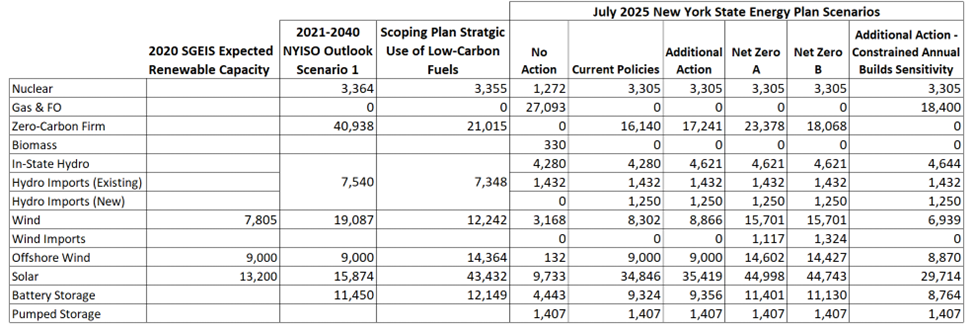
As I documented in the August 12, 2025 PSC filing, the problem is that the original expectations of renewable capacity for the Climate Act falls far short of the renewable capacity requirements in more recent assessments. The following table compares the capacity (MW) in the 2021-2040 NYISO Outlook Scenario 1, the Scoping Plan Strategic Use of Low-Carbon Fuels Scenario and six scenarios in the July 2025 Draft State Energy Plan. There are inconsistencies in the categories but the massive increase in renewable resources is obvious. Onshore wind is projected capacity is 145% higher than analyzed, offshore wind expected capacity is 62% higher than analyzed, and solar is 241% higher than the maximum scenario expectation. In addition, no previous analysis considered the environmental impacts of massive energy storage facilities or the “zero-carbon firm resource” that the integrated analysis presumes will be provided by hydrogen resources. The Draft Energy Plan needs to address this failing.
CLCPA Implementation 2040 Fuel Mix Capacity (MW) Compared to 2020 SGEIS Exhibit 2-5 Expected Renewable Capacity
- If these terms are not defined, then they are just meaningless slogans.
New Yorkers deserve a complete affordability, reliability, and environmental impact accounting.
Discussion
There is no sign to date that NYSERDA is changing anything in its stakeholder process from the unresponsive approach used in the Scoping Plan. There is another aspect concerning that process and the current outreach. The public gets slick promotional information and carefully crafted slogans promising abundant, reliable, affordable, and clean energy for all New Yorkers. These terms are vague enough that the Hochul Administration can continue to avoid responsibility for the impacts of the Climate Act. The Draft Energy Plan is too important to rely on emotion and political pandering to specific constituencies to not do this process right.
Conclusion
It is troubling that New York energy policy has been dominated by political mandates that ignore physical reality. I am convinced that nothing from the energy experts responsible for the electric system can say will change the disastrous path of the Draft Energy Plan. It is going to take a political policy shift to avert disaster. If you are concerned, demand accountability from the NYSERDA energy plans and please speak out to your elected officials.

 Pragmatic Environmentalist of New York