UPDATE 10/18/2025 – In response to a comment the Fort Edward Solar Site Map compared to Washington County Grasslands Wildlife Management Area has been added
In my opinion, the deployment of solar resources exemplifies the poor planning inherent in the Climate Leadership & Community Protection Act (Climate Act) net-zero transition plan. One of my concerns is that the state process is not emphasizing responsible solar siting because facilities have been built on prime farmland. I recently found out about a project that is going to be built adjacent to Department of Environmental Conservation (DEC) protected grasslands. This is another “you have to be kidding me” solar siting travesty and indicates a bigger underlying issue.
I acknowledge the use of Perplexity AI to generate summaries and references included in this document. Ethics-wise I also acknowledge that I am pushing the bounds of plagiarism simply because I don’t have time to re-write everything to dispel all claims of plagiarism. I will, however, provide links to the Perplexity source material. Note that my Perplexity queries are made through my account. The AI program apparently keeps track of my queries and background so they include disconcerting, to me anyway, references to myself.
I am convinced that implementation of the Climate Act net-zero mandates will do more harm than good because of reliability and affordability risks. I have followed the Climate Act since it was first proposed, submitted comments on the Climate Act implementation plan, and have written nearly 600 articles about New York’s net-zero transition. The opinions expressed in this article do not reflect the position of any of my previous employers or any other organization I have been associated with, these comments are mine alone.
Overview
The Climate Act established a New York “Net Zero” target (85% reduction in GHG emissions and 15% offset of emissions) by 2050. The Climate Action Council (CAC) was responsible for preparing the Scoping Plan that outlined how to “achieve the State’s bold clean energy and climate agenda.” After a year-long review, the Scoping Plan was finalized at the end of 2022. Since then, the State has been trying to implement the Scoping Plan recommendations through regulations, proceedings, and legislation. However, this does not mean that there is a plan that includes milestones, acceptability criteria for targets or boundary conditions that must be met to continue. As far as I am concerned, Climate Act implementation consists of building as many renewable energy resources as possible, as fast as possible without regard to the wishes of those people affected by those resources and hoping that it will all work out.
Renewable Permitting
Early in the process Climate Act proponents found that the New York State permitting process was slow. I am familiar with those processes because I was involved with many projects over my career and I admit that they are slow and can be burdensome because there are extensive public participation requirements. To make progress against those who just don’t want anything in their backyards, responsible State agencies developed extensive siting requirements. If the proposed facility met all those requirements, then the public participation process incorporated them and worked with the public, so everyone understood what was necessary and made sure the proposal was consistent.
However, that takes time, and the Climate Act has an ambitious schedule. Climate Act proponents successfully convinced the Legislature that a new siting process was necessary, and the Office of Renewable Energy Siting (ORES) was established. My Perplexity research explains:
ORES, established under Executive Law Section 94-c through the 2020 Accelerated Renewable Energy Growth and Community Benefit Act, has authority to override local zoning and land use laws for major renewable energy facilities—those 25 megawatts or larger (with projects 20-25 MW able to opt in). This creates a two-tiered system where large solar farms fall under state jurisdiction while smaller projects remain subject to local control.
The enabling statute explicitly grants ORES power to “elect not to apply, in whole or in part, any local law or ordinance” if it finds such laws “unreasonably burdensome in view of the CLCPA targets and the environmental benefits of the proposed facility”. This waiver authority operates on a case-by-case basis rather than creating blanket preemption.
I have been tracking solar permitting and its impact on prime farmland. It is extremely disappointing that ORES has ignored guidance from other state agencies. My latest article provides background on solar mandates I also have a solar siting issues page that documents my concerns.
Farmland Protection
The New York Department of Agriculture and Markets has guidelines for solar siting. New York Department of Agriculture and Markets testimony notes that “The Department’s goal is for projects to limit the conversion of agricultural areas within the Project Areas, to no more than 10% of soils classified by the Department’s NYS Agricultural Land Classification mineral soil groups 1-4, generally Prime Farmland soils, which represent the State’s most productive farmland.” That seems reasonable to me because they are the Agency responsible for supporting New York agriculture.
I keep track of the status of projects with this guideline with a Prime Farmland Scorecard. In May 2025 only 12 of the 25 facilities with data available at the Office of Renewable Energy Permit Applications site meet those guidelines. Two facilities had no impacts on prime farmland. If they can do it, why can’t others.
In my last article on the status of prime farmland, I noted that it is extremely frustrating to me that the Department of Ag and Markets recommendation was not adopted as a matter of course for solar development permitting. Instead, the New York State Energy Research & Development Authority (NYSERDA) is studying the issue.
Last May I noted that I did not see any sign of urgency to finalize and implement farmland protections using the NYSERDA scorecard. The Smart Siting Scorecard Specialist Committee had three meetings early in this year but according to the website there hasn’t been any meetings since then. Worse it does not appear that a solar development can get a failing grade for not doing smart siting. In my opinion, this is lip service to the issue.
DEC Protected Land
I recently came across another example of ORES ignoring other state agency land use priorities. In this case the Washington County Grasslands Wildlife Management Area (WMA) is threatened by the development of the Boralex Fort Edward Solar project. My first Perplexity query produced this description of the WMA:
The Washington County Grasslands Wildlife Management Area (WMA) encompasses 478 acres of protected former agricultural lands in the town of Fort Edward, Washington County. The primary purposes are for wildlife management, wildlife habitat management, and wildlife-dependent recreation. The New York State Department of Environmental Conservation acquired these lands through multiple purchases:
When I asked Perplexity AI how close the WMA was to the Boralex Fort Edward Solar Farm I got this response: “The Boralex Fort Edward Solar project is not merely “close to” the DEC-protected grasslands—the project is located directly on top of and within these protected areas, creating an unprecedented conflict between renewable energy development and established conservation designations.”
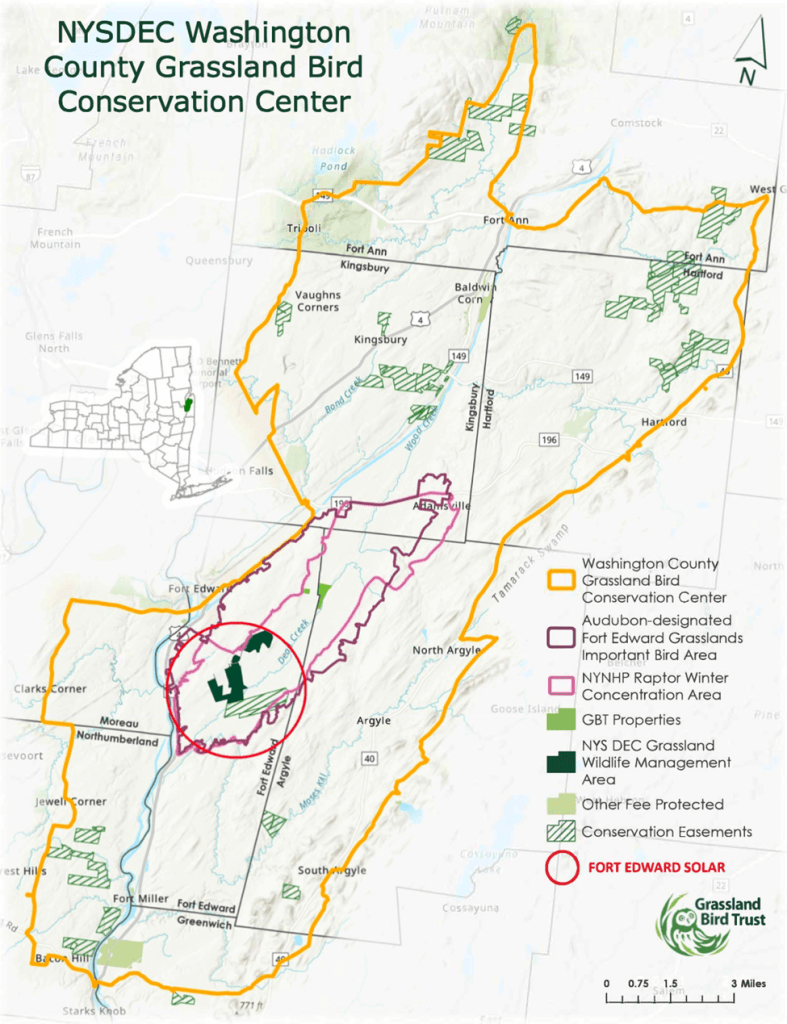
Source: https://houseofgreen.substack.com/p/no-your-eyes-arent-deceiving-you
Alexandra Fasulo writing at the House of Green Substack has described this situation She posed the obvious question:
So how could it be that a New York State DEC Grassland Wildlife Management Area could play host to a solar corporation that plans to clear the vegetation and anchor solar panels deep into the earth’s soil?
I called the DEC to ask them this very question. Their answer was discouraging. The DEC told me that since ORES (Office of Renewable Energy Siting) was created in 2020 to “streamline the environmental review process” and circumvent local town laws/pushback that are deemed “burdensome,” the DEC has been largely shut out of all environmental conversations related to solar and wind “farms.”
The individual at the DEC shared in my exasperation and then told me he had not heard of this Fort Edward Solar project. I said to him, “This is a massive solar project that’s going in on top of DEC-protected and fragile habitat! How could this be?”
Again, he shared in my frustration and told me that the future of this land rests with ORES.
Discussion
I have allied myself with the Stop Energy Sprawl coalition because of our shared concerns. In fact, this post was prompted by Fasulo’s presentation at a recent meeting. We all share the same vision of a clean environmental legacy but are convinced that New York State’s implementation of the Climate Act is causing significant and irreparable harm to rural communities. Everyone in the coalition shares the same frustration with ORES. My Perplexity research condenses our local community concern:
In practice, ORES’s authority creates what amounts to state preemption of home rule for large-scale solar development, though with important procedural protection. The statutory framework acknowledges this by requiring ORES to apply local laws unless they’re found unreasonably burdensome—establishing a presumption in favor of local requirements that must be overcome through specific findings.
However, the “unreasonably burdensome” standard is evaluated explicitly in relation to statewide CLCPA mandates. This inherently weights the analysis toward state energy policy goals over local land use preferences.
It is not only the home rule implications. I am positive that staff in the state agencies responsible for prime farmland protection and wildlife management areas share the frustration that their guidance is being ignored as illustrated by the responses to Fasulo. I believe that all this is the consequence of the failure to plan the transition to Net-zero. The blame for that can be placed squarely on the Climate Action Council who approved the Scoping Plan without including provisions for the development of a feasible transition consistent with existing environmental guidance and recommendations.
The failure to plan has had negative consequences. The decision to not require developers to meet the Department of Ag & Markets prime farmland protection guideline has led to the destruction of 6,650 acres of prime farmland. Renewable developers have blown off Agency comments by saying that their guidance is only a recommendation. If Boralex is allowed to destroy rare grassland habitat, then this will be a sad day for the environment of New York.
This was all preventable. The claim that these programs had to be implemented as fast as possible because of the existential threat of climate change is no excuse. If New York were able to eliminate all its GHG emissions, the effect of global emission increases elsewhere would supplant our efforts in one year. New York GHG emissions are less than one half of one percent of global emissions and global emissions have been increasing on average by more than one half of one percent per year since 1990. It is long past time to pause this process until safeguards consistent with State Agency guidance are incorporated into the ORES permitting decisions. I also think that the public should be aware of the destruction of home rule actions by ORES.
Conclusion
This finding is a great example why I believe the Climate Act implementation can only do more harm than good. It is time to hold the politicians who were responsible for this debacle accountable for their actions. Revisions to the laws are necessary to prevent further harm.
Update 10/18/2025 in response to comment
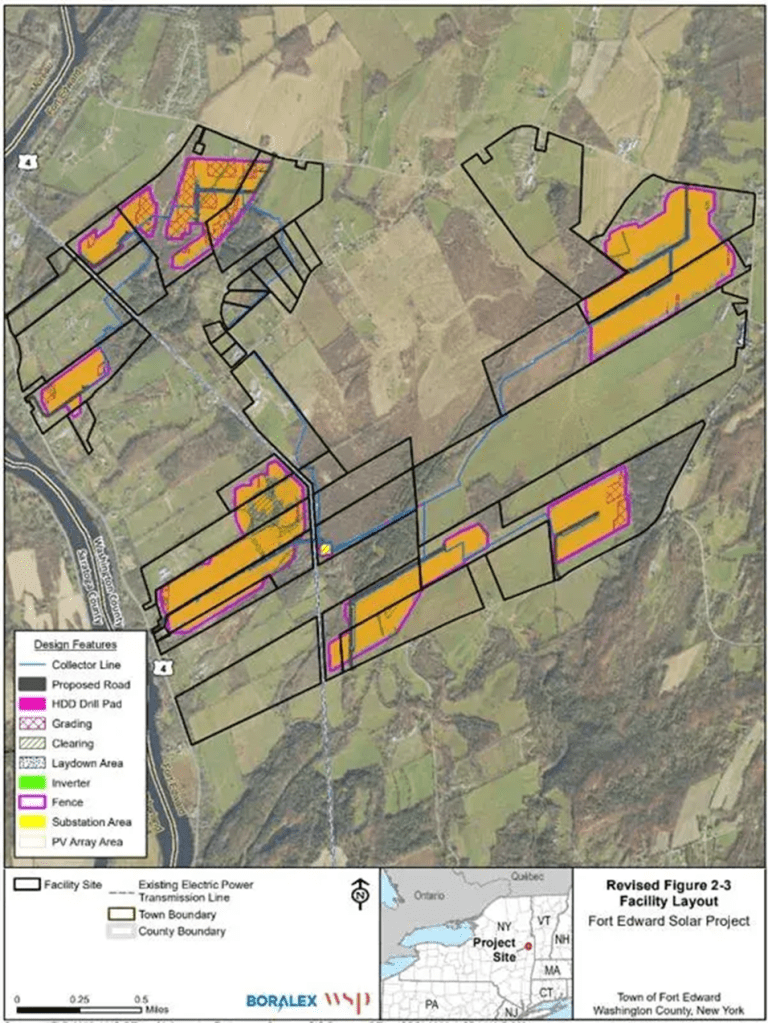
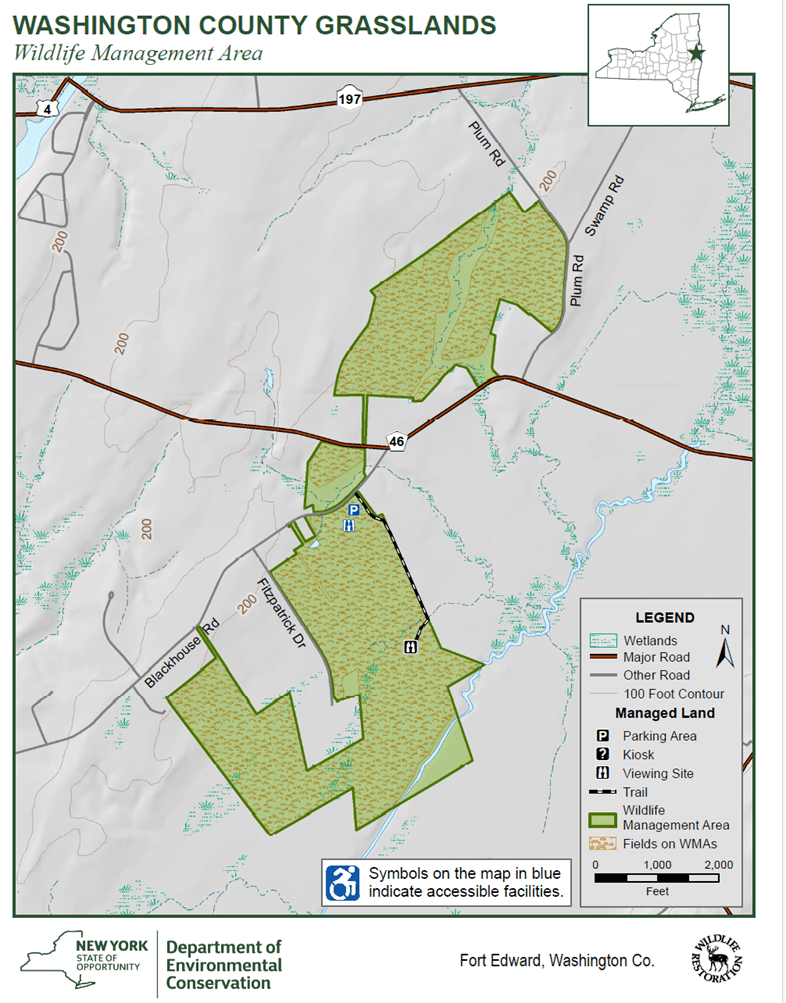
Washington County Grasslands Wildlife Management Area
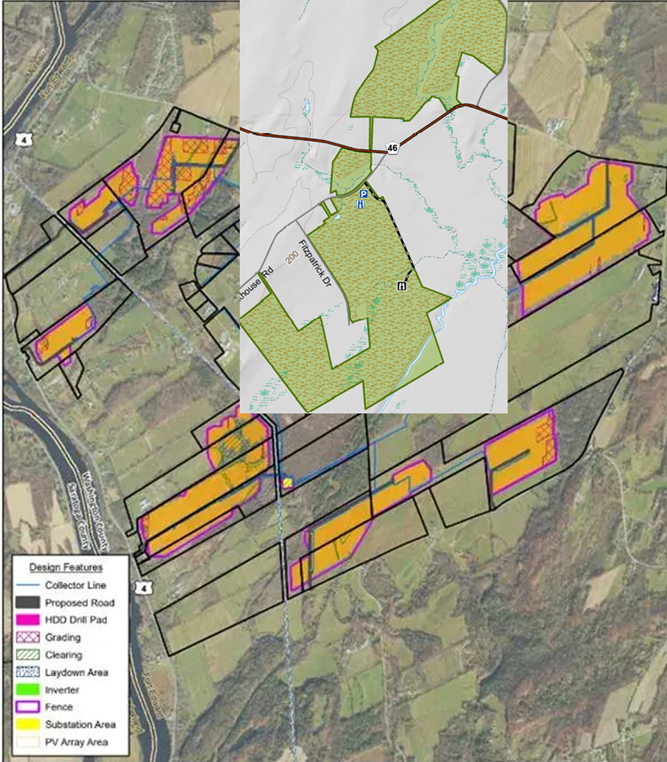
Overlay Two Maps – Approximate Fit- However, the point is that the Boralex Fort Edward Solar panels will be close to the WMA and will impact similar land use types that the DEC is trying to protect. Given all the possible locations for solar projects, why does ORES allow development on this kind of land?

 Pragmatic Environmentalist of New York
Hi there. It’s clear you are relying on Alexandra Fasulo false information for a lot of your writing about the Fort Edward Solar project. She provides a lot of misinformation on this project and, frankly, propaganda about solar. Your other source is AI research, which you should know needs to be verified.
The Fort Edward Solar project is NOT located on the DEC Grassland Wildlife Management Area, despite Alexandra’s claims. This has been pointed out in comments on her many social media posts, but ignored by her. See Revised Figure 3-8 of the Application (https://documents.dps.ny.gov/public/Common/ViewDoc.aspx?DocRefId={703FDD95-0000-CA1D-9BED-D8A20BC093A4}). This is also acknowledge by the Grassland Bird Trust in their “Avian Impact and Mitigation Assessment” (see page 2) (https://documents.dps.ny.gov/public/Common/ViewDoc.aspx?DocRefId={6050BA99-0000-C343-86C9-D2955BB80BC2}).
LikeLike
Thank you for getting back to me. I will look into this further.
LikeLike
Hi there. It’s clear you are relying on Alexandra Fasulo false information for a lot of your writing about the Fort Edward Solar project. She provides a lot of misinformation on this project and, frankly, propaganda about solar. Your other source is AI research, which you should know needs to be verified.
The Fort Edward Solar project is NOT located on the DEC Grassland Wildlife Management Area, despite Alexandra’s claims. This has been pointed out in comments on her many social media posts, but ignored by her. See Revised Figure 3-8 for a map of the project and DEC lands (https://documents.dps.ny.gov/public/Common/ViewDoc.aspx?DocRefId={603FDD95-0000-C133-A51E-381AA422BDC9}). The Grassland Bird Trust also acknowledges in their “Avian Impact and Mitigation Assessment” (https://documents.dps.ny.gov/public/Common/ViewDoc.aspx?DocRefId={6050BA99-0000-C343-86C9-D2955BB80BC2}) that the project is not on the WMA.
LikeLike
The Fort Edward Solar – Avian Impact and Mitigation Assessmenr (https://documents.dps.ny.gov/public/Common/ViewDoc.aspx?DocRefId={6050BA99-0000-C343-86C9-D2955BB80BC2}) states:
“The proposed Fort Edward Solar Project’s Net Conservation Benefit Plan submitted by Fort Edward Solar LLC (fails to adequately mitigate the significant, irreversible damage that would result from the Project’s implementation. The Plan disregards the exceptional ecological importance of the 1,828 acre Project facility site, which lies within the New York State Department of Environmental Conservation Washington County Grassland Bird Conservation Center.”
I looked at maps of the proposed facility and the Washington County Grassland Bird Conservation Center. The Center will be surrounded on three sides by Fort Edward Solar.
The Avian Impact Assessment states:
“Grassland bird species need large, open landscapes to support their foraging, breeding and nesting behaviors.
These birds do not rely on specific parcels. They require unbroken, open landscapes to survive.”
“The NYSDEC established the GBCCs to strategically protect and manage the last remaining strongholds of grassland bird habitat in New York State. The GBCCs serve as a refuge or ecological “lifeboat” for both wintering and breeding populations of grassland bird species. Within the Washington County GBCC, the Washington County Grassland Wildlife Management Area (“WMA”) serves as the anchor field within that refuge.”
Based on this information I stand by my conclusion that building this solar facility at this location is a travesty. It does not represent responsible solar siting and should not be built.
LikeLike
Also – I unapproved your secomd comment. I refuse to publish personal attacks on anyone especially from anonymous commenters.
LikeLike