

As electric energy prices increase substantially the blame game starts. On October 23, 2025 the New York State Assembly Standing Committee on Energy had a public hearing “Protecting Residential Ratepayers from Certain Increased Energy Costs”. This article explains why I think this heating misses the point of the affordability crisis affecting New Yorkers.
I am convinced that implementation of the New York Climate Leadership & Community Protection Act (Climate Act) net-zero mandates will do more harm than good if the future electric system relies only on wind, solar, and energy storage because of reliability and affordability risks. I have followed the Climate Act since it was first proposed, submitted comments on the Climate Act implementation plan, and have written nearly 600 articles about New York’s net-zero transition. The opinions expressed in this article do not reflect the position of any of my previous employers or any other organization I have been associated with, these comments are mine alone.
Hearing Announcement
The hearing announcement states:
The United States Energy Information Administration’s April 2025 “Annual Energy Outlook” estimates that electricity consumption in the United States will increase to record highs in 2026, from 4,097 billion Kilowatt Hours (kWh) in 2024, to 4,283 billion kWh by 2026, driven primarily by large energy users such as computing services. The New York Independent System Operator’s (NYISO) “2025 Power Trends Report” confirms that this trend will likely also occur in New York, estimating that an additional 1,600 megawatts of power could be needed by 2030, driven primarily by these large energy users.
This increased energy demand, along with the accompanying need for infrastructure and generation, is expected to lead to higher utility bills for consumers in the coming years. This phenomenon has been seen in other states, such as in Illinois where data has shown that Commonwealth Edison’s existing customers paid over 91% of the costs associated with new large energy users. However, some states, such as Georgia and Oregon, have taken action to protect residential customers from such rate increases. The purpose of this hearing is to examine measures that may be effective in protecting residential ratepayers against increased energy costs associated with the integration of new large energy users.
I think this hearing is part of an effort by supporters of the fossil fuel transition to net-zero is deflect concerns about costs away from the Climate Act. They argue that infrastructure costs associated with increased load driven primarily by large energy users such as computing services is driving the utility rate increases.
The hearing announcement references the New York Independent System Operator’s (NYISO) “2025 Power Trends Report” estimates that an additional 1,600 megawatts of power could be needed by 2030, “driven primarily by these large energy users”. Climate Act proponents are deflecting net-zero transition costs by blaming load growth due to energy centers and semiconductor manufacturing plants. There is no question that this load growth impacts electric bills in New York, but context is important. While those costs are substantial, they are dwarfed by the infrastructure support needed for electric grid transition to wind, solar, and energy storage displacement of fossil fuels.
Impact of New Large Loads on Electric Bills
I acknowledge the use of Perplexity AI to generate this summary of potential impacts on electric bills. The proposed Clay, NY Micron chip fabrication plant could use 16,000 gigawatt-hours annually which is more than the energy used by Vermont and New Hampshire and works out to be about 11% of New York’s total usage. Loudoun County, Virginia—specifically the “Data Center Alley” area around Ashburn and Sterling—hosts the world’s highest concentration of data centers, with approximately 199 operational facilities as of 2025 and 40GW of contracted capacity. The higher demand from these sources leads to increased wholesale electricity prices. In addition utilities must also invest in infrastructure upgrades for these large loads, resulting in higher delivery charges that are typically socialized across all ratepayers.
New York Assemblyman Jonathan Jackobson has proposed legislation that aims to prevent the transfer of infrastructure costs from large users to everyday consumers, targeting costs specifically to data centers and chip fabs. Meanwhile, discussions are ongoing about special contracts that would require major users to cover their infrastructure costs and reduce load during peak times, but these measures are not yet widespread.
On the other hand, increased electricity sales could help spread fixed costs, potentially lowering per-kWh delivery rates. Sadly, this effect is usually less than the impact of new loads. There is the potential for demand response agreements with large users that could enhance system reliability and mitigate severe price spikes.
New York Future Loads
I looked at load projections for New York. The NYISO 2025 Load & Capacity Data Report (Gold Book) includes two spreadsheets: 2025 Gold Book Higher Demand Scenario Tables and the 2025 Lower Demand Scenario Tables that report future energy usage (GWh). I used these tables to extract the expected sources of future load growth. Unfortunately, the Gold Book does not break out the energy capacity (MW) for the same categories as the NYISO Power Trends report which makes comparison to the hearing announcement projection difficult. Because ratepayers pay for energy and not capacity, I think the better metric is energy.
In the following table I combined Gold Book projected annual energy load forecast (GWh) tables I-15a: and I-16a. I extracted the NYISO projected future load for five different load categories: storage net energy consumption, electric vehicles, building electrification, large load projects and electrolysis. Table 1 compares the large load projects energy relative to GHG reduction programs. The GHG reduction programs are the sum of the other four categories that, were it not for efforts to reduce GHG emissions by the Climate Act, legacy New York programs and Federal policies, would not exist. According to the NYISO Gold Book projections, in 2025 1.2% expected energy use is due to the GHG reduction programs and 2.4% is due to large load projects for the lower demand forecast and 1.4% due to the GHG reduction programs and 2.4% for large load projects for the higher demand forecast.
Table 1: Gold Book Projected Annual Energy Load Lower and Higher Demand Forecasts – GWh
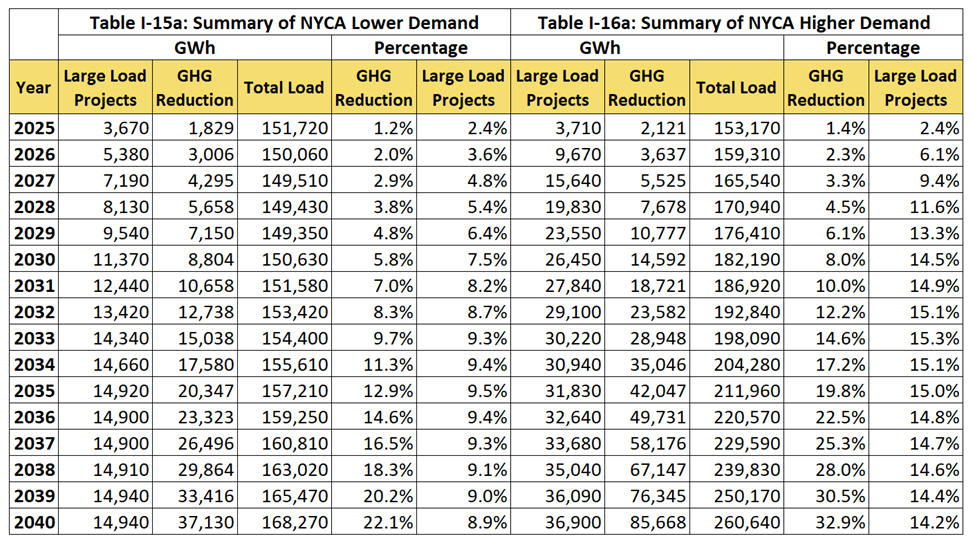
Assembly Bill A9064 presumes that prohibiting utilities from passing along the “costs of capital expenditures or maintenance of infrastructure resulting from the building or operation of a data center or semiconductor fabrication plant” will substantively reduce ratepayer costs. While true it ignores the fact that GHG emission reduction load increase will be more than double the energy load increase expected for the large load projects.
Discussion
The ideologues who insist that the net-zero transition must proceed on the arbitrary schedule of the Climate Act do not generally support development of data centers and semiconductor fabrication plants. I think continuing operations of crypto mining are also on their hit list. In all three instances, they argue that they require a lot of energy and water and are responsible for electricity price increases.
In my opinion, the analyses supporting their arguments were contrived to support the concept that they increase electricity prices. Another characteristic of the analyses is that they ignore any potential positive impacts. Vilifying chip fab plans ignores the tremendous economic benefits of hundreds of jobs, for example. Ideologues tend to ignore any tradeoffs and that does not make for rational policy.
Conclusion
There is an energy affordability crisis. The scramble to find excuses for higher electric prices to cover the costs of decarbonizing the energy system is on. It is long past time for Climate Act supporters to define acceptable affordability, track where we stand relative to their metric, and commit to stop the insanity when costs inevitably exceed their limit. Blaming data centers and chip fabrication plants is misdirection.

 Pragmatic Environmentalist of New York
Allowing investments and expenses driven by discrete large loads such as data centers and chip plants is regulatory malpractice.
https://substack.com/home/post/p-174826380
LikeLiked by 1 person