

I recently described the Oct. 24, 2025, New York Albany Supreme Court decision pitting environmental organizations against the New York State Department of Environmental Conservation (DEC). The judge ordered DEC to issue final regulations establishing economy-wide greenhouse gas emission (GHG) limits on or before Feb. 6, 2026 or go to the Legislature and get the Climate Leadership & Community Protection Act (Climate Act) 2030 GHG reduction mandate changed. I have argued for months that there are so many issues coming up with the schedule and ambition of the Climate Act that it is obvious that we need to pause implementation and consider modifications to the Climate Act. This post summarizes the findings by the State of New York that support that position.
I am convinced that implementation of the Climate Act net-zero mandates will do more harm than good because of reliability and affordability risks. I have followed the Climate Act since it was first proposed, submitted comments on the Climate Act implementation plan, and have written nearly 600 articles about New York’s net-zero transition. The opinions expressed in this article do not reflect the position of any of my previous employers or any other organization I have been associated with, these comments are mine alone.
For this overview of New York State findings, I acknowledge the use of Perplexity AI to generate summaries and references included in this document.
Court Decision
The most important reason that the Legislature should consider revisions to the Climate Act is the recent court case. Environmental organizations initiated this lawsuit because the New York State Department of Environmental Conservation (DEC) did not promulgate regulations as mandated by the Climate Act. The State agued that regulations were inappropriate but Judge Schreibman’s decision stated that:
DEC does not have the discretion to say no or to decide that it has the authority to choose not to follow the express legislative directive at issue. Under our system of separation of powers, upon concluding, based on its subject-matter expertise, that achieving the goals of the Climate Act might be “infeasible” for the reasons stated, DEC had two options. One, it could issue compliant regulations anyway, and let the chips fall where they may for the State’s political actors. Or, two, it could raise its concerns to the Legislature so that the State’s elected representatives could make a determination about what costs their constituents can or cannot bear in the pursuit of reining in climate change.
This decision should prompt the Legislature to address the concerns raised by DEC. Furthermore, there are other State analyses that indicate that changes are in order as described below.
State Supplemental Letter
As part of the legal wrangling associated with the trial Assistant Attorney General Meredith G. Lee-Clark submitted further correspondence related to the litigation. The State’s submittal addressed “two categories of new developments: (1) the publication of the 2025 Draft New York State Energy Plan by the New York State Energy Planning Board on July 23, 2025 and (2) additional actions by the federal government that impede New York’s efforts to achieve the Climate Leadership and Community Protection Act’s (the Climate Act) goals in a timely manner.”
The State of New York argued that it was inappropriate to implement regulations that would ensure compliance with the 2030 40% reduction in GHG emissions Climate Act mandate because meeting the target is “currently infeasible”. The following paragraph concedes that there are significant upfront cost issues that out-weigh other benefits.
Ordering achievement of the 2030 target would equate to even higher costs than the net zero scenarios and would affect consumers even sooner. Undoubtedly, greenhouse-gas reducing policies can lead to longer-term benefits such as health improvements. This does not, however, offset the insurmountable upfront costs that New Yorkers would face if DEC were forced to try to achieve the Legislature’s aspirational emissions reductions by the 2030 deadline rather than proceeding at an ambitious but sustainable pace.
The letter concluded that the Climate Act is unaffordable:
Petitioners have not shown a plausible scenario where the 2030 greenhouse gas reduction goal can be achieved without inflicting unanticipated and undue harm on New York consumers, and the concrete analysis in the 2025 Draft Energy Plan dispels any uncertainty on the topic: New Yorkers will face alarming financial consequences if speed is given preference over sustainability.
Comptroller Audit
The New York State Comptroller Office audit of the NYSERDA and PSC implementation efforts for the Climate Act was an early acknowledgement that the implementation plan needs to be revised. The report titled Climate Act Goals – Planning, Procurements, and Progress Tracking (“Comptroller Report”) found issues that question the current plan. The Perplexity AI summary concludes that “the audit reveals critical deficiencies in planning, cost assessment, risk management, and progress tracking” and notes that “With outdated data, calculation errors, project cancellations, technology limitations, transmission constraints, and escalating costs all threatening goal achievement, the audit calls for immediate action to improve planning and transparency.”
Clean Energy Standard Biennial Review
The Public Service Commission (PSC) released the draft Clean Energy Standard Biennial Review Report (“Biennial Report”) in July 2024. It compares the renewable energy deployment progress relative to the Climate Act goal to obtain 70% of New York’s electricity from renewable sources by 2030 (the 70% goal). The final document found that 2030 goal will likely not be achieved until 2033. The Perplexity AI summary describes seven key factors impeding progress.
- Global economic pressures,
- Transmission system inadequacies,
- Interconnection delays,
- Capacity accreditation changes,
- Federal policy uncertainty,
- Siting and permitting complexity, and
- Increasing electric load.
All these factors are part of the lessons learned since the implementation of the Climate Act that began five years ago. I think this shows that the Legislature needs to address the schedule and ambition of the law.
Second Informational Report
The Climate Act requires the Department of Public Service (DPS) to prepare an annual report as described in the following slide from the presentation that summarizes the report.
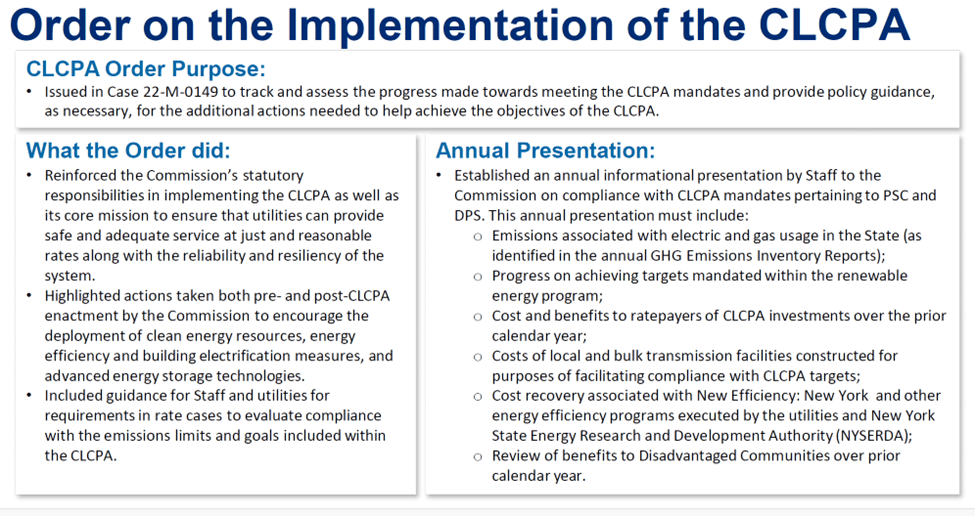
The Second Informational Report (Report) prepared by Department of Public Service (DPS) staff “focuses on Commission actions from January 2023 through August 2025, and includes the estimated costs and outcomes from 2023 through 2029 to provide the most up to date information.” According to the Perplexity AI summary there are four feasibility concerns: the 2030 renewable energy target is “likely unattainable”, offshore wind faces major obstacles, transmission remains a “critical bottleneck”, and grid reliability challenges are mounting. There also are cost trajectory concerns. Despite the report’s careful messaging—”emphasizing that CLCPA costs are not the primary bill driver and that multiple factors beyond climate policy contribute to rate increases” – it cannot hide the magnitude of the challenges to meet the Climate Act requirements schedule.
Draft State Energy Plan
The Energy Plan process is currently underway. The New York State Energy Research & Development Authority (NYSERDA) is processing stakeholder comments on the draft document for the Energy Planning Board to consider when it decides whether to approve the draft. I recently highlighted New York Independent System Operator (NYISO) comments on the Draft Energy Plan recommendations. There are six extensive quotations from the Draft Energy Plan that NYISO supports that represent previously unacknowledged concerns about the Climate Act ambition and schedule:
- The State will need to be strategic about the pace of combustion unit retirements and/or replacement
- Combustion generating units will remain essential parts of electric grid reliability and affordability. Retirement of these units will not be able to occur until resources that provide the same grid reliability attributes are put in place.
- A primary challenge for New York’s energy system is its advancing age, which creates unique risks for reliability.
- The State will need to be strategic in identifying and integrating clean firm technologies that have the attributes necessary to support the achievement of a zero emissions electric grid by 2040.
- For the electricity system, continue to incorporate the impacts of climate change into future reliability planning scenarios.
- Consider whether the current reliability-related metrics should be supplemented given the evolving nature of the grid and increased risks of high-impact reliability events
The Perplexity AI summary concludes that:
The 2025 Draft State Energy Plan represents New York’s effort to reconcile the CLCPA’s statutory mandates with economic, technical, and political realities that have emerged since 2019. By acknowledging that key deadlines will be missed while maintaining long-term decarbonization objectives, the plan shifts from aspirational targets to pragmatic pathways.
Discussion
Judge Schreibman’s decision is very straightforward. The law says that regulations must be promulgated to meet the Climate Act mandates so DEC must either do that or get the Legislature to modify the law. If the Hochul Administration cynically appeals the decision, it is simply a politically-motivated delaying tactic to kick the resolution off until after the gubernatorial primary and state-wide election in late 2026. Because there is so much evidence that the schedule and ambition of the law are infeasible, the Legislature should address the law, however unpopular lessons learned reality will be to the environmentalist community.
Bill Gates recently argued that climate change is not going to wipe out humanity and that we need to “put human welfare at the center of our climate strategies.”. That is another argument for modifying the Climate Act. Even if the premise of the Climate Act that human emissions of greenhouse gases is a primary driver of observed warming is true, New York cannot solve climate change by itself. New York GHG emissions are less than one half of one percent of global emissions and global emissions have been increasing on average by more than one half of one percent per year since 1990.
In my opinion, the best way to proceed is to modify the law. Revisions should couple a revised Climate Act schedule with clearly defined standards for affordability, reliability, and environmental impacts. A trackable metric for each should be developed and a tracking system put in place. The key point is that the law should be modified so that there are requirements to modify the mandates when those metrics are exceeded. In short, the safety valve provisions of Public Service Law (PSL) Section 66-P should be modified and incorporated into the Climate Act.
The process to establish these metrics should incorporate extensive public participation. New Yorkers need to understand the range of costs, impacts on personal choice, and changes to lifestyles that are buried in the Scoping Plan and Energy Plan. If the safety valve metrics have reasonable limits, I expect that affordability, reliability, and environmental impact targets will be exceeded as soon as tracking begins. That is the point. Eliminating fossil fuels sounds has been portrayed as simple and cheap but the reality is very different. Accepting that and developing a new way forward is necessary.
Conclusion
There is overwhelming evidence that something must give in the energy transition. The Climate Act has always been about politics and money. The authors of the Climate Act mistakenly believed that the energy transition would be simple and cheap. Experience shows otherwise. It is long past time for the politicians to revisit the Climate Act and make the proposed energy transition accountable. Unfortunately, there is a politically connected constituency that is dependent upon the status quo for their business plans.

 Pragmatic Environmentalist of New York
2 thoughts on “Climate Act Fork in the Road”