

Yesterday I published a post that described my thoughts about today’s State Energy Planning Board meeting that discussed public comments on the Draft State Energy Plan document. This post describes my initial thoughts about the meeting and compares my predictions for the outcome.
I am convinced that implementation of the New York Climate Leadership & Community Protection Act (Climate Act or CLCPA) net-zero mandates will do more harm than good if the future electric system relies only on wind, solar, and energy storage because of reliability and affordability risks. I have followed the Climate Act since it was first proposed, submitted comments on the Climate Act implementation plan, and have written nearly 600 articles about New York’s net-zero transition. The opinions expressed in this article do not reflect the position of any of my previous employers or any other organization I have been associated with, these comments are mine alone.
Energy Plan Overview
According to the New York State Energy Plan website (Accessed 3/16/25):
The State Energy Plan is a comprehensive roadmap to build a clean, resilient, and affordable energy system for all New Yorkers. The Plan provides broad program and policy development direction to guide energy-related decision-making in the public and private sectors within New York State.
I have provided background information and a list of previous articles on my Energy Plan page.
Meeting Overview
There were three items on the agenda: approval of last meeting minutes, discuss public comments on the Draft Energy Plan, and consider any new business. As has been the case for previous meetings Chair Doreen Harris added an Update on the status of the net-zero transition.
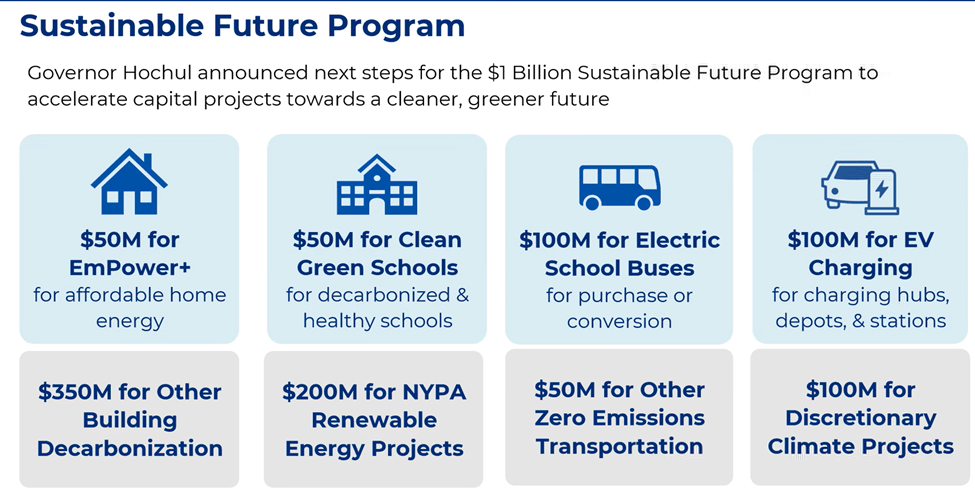
The highlight of the update discussion was not what was mentioned but what was not mentioned. I did not make a copy of the first slide that included impacts of Federal rollbacks on New York’s clean energy industry where it was mentioned that “reporting has estimated that more than 6,200 jobs and $2.5B in investments have been lost or delayed in 2025 due to the Trump administration’s energy policies.” Harris put in a plug for Governor Hochul’s $1 billion Sustainable Future Program. The following slide shows where the money is allocated.
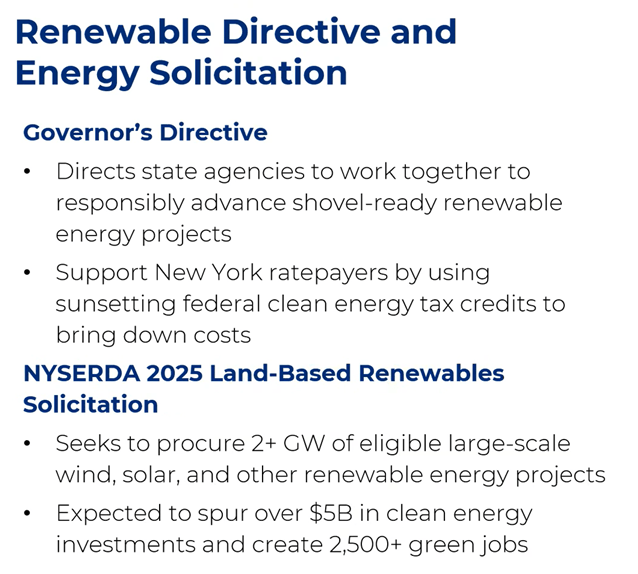
Harris described the renewable directive and energy solicitation.
Harris also mentioned that the New York State Department of Environmental Conservation (DEC) approved required permits for the proposed Northeast Supply Enhancement (NESE) pipeline project, that the Constitution pipeline application was withdrawn, and that the air permit for the Greenidge crypto mining facility had been approved. There also were a couple of slides for statewide updates.
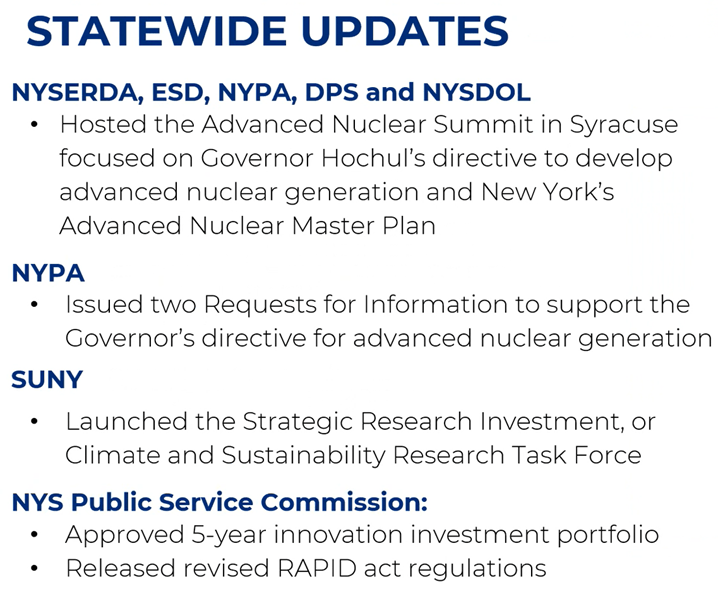
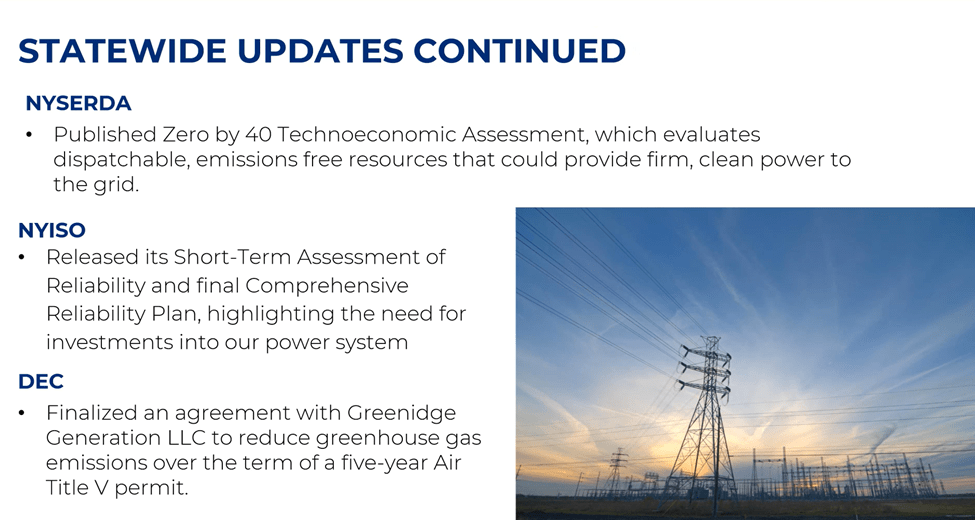
That covers what was mentioned in the Update. Conspicuous by its absence, there was no mention of the Supreme Court decision described in yesterday’s post. On Oct. 24, 2025, New York Albany Supreme Court issued a decision in a case brought by environmental organizations that sued the New York State Department of Environmental Conservation (DEC). The judge ordered DEC to issue final regulations establishing economy-wide greenhouse gas emission (GHG) limits on or before Feb. 6, 2026 or go to the Legislature and get the Climate Act 2030 GHG reduction mandate changed. Importantly, the Attorney General Office supplemental letter submitted during the trial stated that the Climate Act target would cause “undue harm”:
Petitioners have not shown a plausible scenario where the 2030 greenhouse gas reduction goal can be achieved without inflicting unanticipated and undue harm on New York consumers, and the concrete analysis in the 2025 Draft Energy Plan dispels any uncertainty on the topic: New Yorkers will face alarming financial consequences if speed is given preference over sustainability.
In my opinion, the fact that the Attorney General said this is unaffordable and the Judge said they need to consider changing the law is important information relative to the Energy Plan so it was inappropriate to exclude this as part of the update.
Public Comment Discussions
My previous article highlighted four issues that I thought should be addressed in the discussion of the public comments. Unfortunately, the presentations gave no indication whatsoever that individual comments would be addressed. I will follow up with another post that describes the presentation specifics. For this post I will only describe my initial impression relative to issues raised yesterday.
In my first oral comments I stated that unless the process includes stakeholder meetings that give the public to ask clarifying questions and there is a commitment to document the response to all comments submitted, the stakeholder process will have no credibility. The fact that people asked for more meetings was mentioned during the meeting but no reason that they did not hold them was given. My suggestions for changes to make the comment process credible were ignored.
The New York Independent System Operator (NYISO) comments included recommendations that are sure to infuriate proponents of the Climate Act. They say that we are not ready to retire existing fossil-fired generating plants, the necessary resources to replace them will not be ready any time soon so we need to build new fossil-fired units, and maintaining existing nuclear facilities is necessary. I was very disappointed that the discussion of comments was just an overview and that the impression given was that the greater number of comments supporting a particular position the greater the value of the comment. NYISO had some unique opinions and there was no acknowledgement of their positions relative to others on things like the need to keep fossil fired infrastructure in place.
I submitted comments that described significant problems with the Health Benefits Analysis chapter including over-simplification of the air quality analysis used to predict health impacts, failure to correctly verify the new model used, claiming health benefits when there is no observed relationship between annual average PM2.5 and emergency room visits related to asthma, and suggesting significant benefits when the effects are much less than the observed inter-annual variation. Another characteristic of the NYSERDA description of comments was that there was no indication that any of the numbers in the Draft Plan or Pathways Analysis were incorrect anywhere. The Energy Planning Board can only assume that the NYSERDA work is infallible and above reproach.
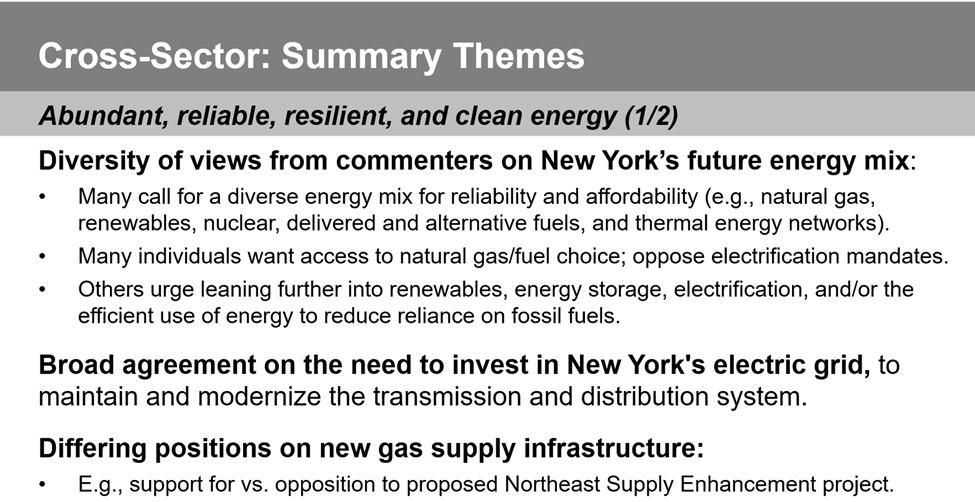
I also submitted comments that described why New York is not ready to eliminate the use of natural gas. I addressed natural gas use for transportation, unacknowledged advantages for natural gas used for electric generation, arbitrary permitting decisions that have blocked necessary infrastructure projects, and the use at peaking power plants that provide critical reliability support. As I will show in a subsequent post, this topic was popular. The following slide exemplifies the briefing approach as it only shows themes of the comments. There is nothing explicit in this to suggest a link to my concerns. I want to make the point that I never heard the word feasibility in any of the presentations. NYISO says you need natural gas but “others urge leaning further into renewables, energy storage, electrification, and/or the efficient use of energy to reduce reliance on fossil fuels. How will this contradiction get resolved?
Discussion
When the meeting materials are released, I will follow up with more observations on the comments. However, it is probably a waste of time because this process is not credible. While there are some indications that reality is dawning on the Hochul Administration, these presentations show that NYSERDA, undoubtedly at the behest of the Administration, is using the Energy Plan process to fulfill an obligation and further their energy agenda. Unfortunately for the Governor there is a loud faction of her party that demand doubling down on renewable energy resources at the same time reality is showing that simply will not work. This tradeoff colors everything related to energy policy. It appears that the Administration is going to try to placate both sides by not taking public positions on controversial issues.
All signs are that NYSERDA did not use the Energy Plan as an opportunity to consider the implications of the observed transition and improve the transition going forward. There is no indication that there will be any attempt to meaningfully engage with stakeholders and address feasibility.
Conclusion
The Energy Plan should be based on energy and physical reality. Unfortunately, there are clean energy ideologues who cannot accept that their presumptions are indefensible relative to those standards. Sooner or later this conflict must be resolved, and it will cause political fallout for the Governor. Holding the safety of the citizens of New York hostage for political gain will not end well.

 Pragmatic Environmentalist of New York