

The New York State Energy Research & Development Authority (NYSERDA ) recently announced the completion of its Zero by 40 Technoeconomic Assessment. This report directly addresses what I think is the biggest reliability risk of the Climate Leadership & Community Protection Act (Climate Act) net-zero electric system transition so I believe understanding the implications of the report findings is important. This article provides a summary overview of the report. I will follow up with another post describing the implications.
I am convinced that implementation of the New York Climate Act net-zero mandates will do more harm than good if the future electric system relies only on wind, solar, and energy storage because of reliability and affordability risks. I have followed the Climate Act since it was first proposed, submitted comments on the Climate Act implementation plan, and have written over 600 articles about New York’s net-zero transition. The opinions expressed in this article do not reflect the position of any of my previous employers or any other organization I have been associated with, these comments are mine alone.
Overview
The Climate Act established a New York “Net Zero” target by 2050. It includes an interim reduction target of a 40% GHG reduction by 2030. Two targets address the electric sector: 70% of the electricity must come from renewable energy by 2030 and all electricity must be generated by “zero-emissions” resources by 2040. The Climate Action Council (CAC) was responsible for preparing the Scoping Plan that outlined how to “achieve the State’s bold clean energy and climate agenda.” The Integration Analysis prepared by NYSERDA and its consultants quantified the impact of the electrification strategies. That material was used to develop the Draft Scoping Plan outline of strategies. After a year-long review, the Scoping Plan was finalized at the end of 2022. Since then, the State has been trying to implement the Scoping Plan recommendations through regulations, proceedings, and legislation.
One fundamental flaw in the Climate Act is the mistaken belief by the authors of the law that existing wind, solar, and energy storage would be sufficient and that no new technology would be required. In May 2023 the Public Service Commission (PSC) initiated a process “to examine the need for resources to ensure the reliability of the 2040 zero-emissions electric grid mandated by the Climate Act” that directly contradicted that presumption. The Order notes that the Climate Act directs the PSC to establish a program to ensure that the electric sector targets are achieved. It goes on:
However, several studies indicate that renewable energy resources may not be capable of meeting the full range of electric system reliability needs that will arise as fossil generation is replaced. These studies suggest that there is a gap between the capabilities of existing renewable energy technology and expected future system reliability requirements.
The Order concludes: “This Order responds to the Petition and initiates a process to identify technologies that can close the gap between the capabilities of existing renewable energy technologies and future system reliability needs, and more broadly identify the actions needed to pursue attainment of the Zero Emission by 2040 Target.” This report responds to that order.
Zero by 40 Technoeconomic Assessment
The announcement for the study stated:
NYSERDA is pleased to share that following yearslong thorough, deliberative analysis in partnership with State agency staff, it has completed its Zero by 40 Technoeconomic Assessment, which is intended to help inform the State’s assessment of the readiness and timing for the introduction of new technologies. The Assessment has been filed with the New York State Public Service Commission to inform stakeholders engaged in the Commission’s proceeding investigating different technologies that could contribute to a zero-emission electricity system.
This article will summarize the report. I acknowledge the use of Perplexity AI to generate a summary of the report and provide references included in this document.
The study was prepared by the Electric Power Research Institute (EPRI) under contract to NYSERDA.
The NYSERDA Zero by 40 Technoeconomic Assessment evaluates technologies needed for New York’s goal of a zero-emissions electric grid by 2040. NYSERDA and Department of Public Service staff “provided guidance, review, and strategic prioritization for this project.”
The Summary of the report gives a good overview. I have annotated the following quotes from the Summary below.
The Summary explains the reason for the report:
In May 2023, the New York State (NYS) Public Service Commission (PSC) issued an order initiating a process “to identify technologies that can close the gap between the capabilities of existing renewable energy technologies and future system reliability needs, and more broadly identify the actions needed to pursue attainment of [New York State’s] Zero Emission by 2040 target.” New York State has engaged in this process by conducting a study to evaluate candidate technologies that could close the gap.
The authors of the Climate Act relied on analyses that used a simplistic model of the electric system to conclude that no new technologies would be needed. The Summary describes the nuances not considered by the Climate Act authors:
A 2040 zero-emission grid will require resources with a mix of attributes to maintain reliability requirements. These include resources that can provide energy and capacity for long durations, that are dispatchable and flexible with quick-start and fast ramping capabilities over multiple starts in a day, and that can provide inertial response, frequency control, dynamic reactive control, and high short circuit current contribution to the grid. Every resource does not need to provide every attribute, but the grid needs enough of each to maintain reliability.
Meeting these needs will require a diverse set of resources. This includes intermittent zero-emission energy resources such as solar and land-based and offshore wind, short-duration energy storage, legacy resources like hydropower and existing nuclear, dispatchable emissions free resources (DEFRs), transmission infrastructure, and other technologies that can provide grid services, like grid-forming (GFM) inverters. This report focuses on DEFRs.
The Summary describes the technologies evaluated in the report:
This report evaluates seven candidate DEFR technology categories that could provide clean, firm power to the NYS grid to achieve a zero-emissions power sector. The candidate resources include hydrogen, biofuels (such as renewable natural gas [RNG] and renewable diesel [RD]), advanced nuclear, carbon capture and storage on thermal power plants, next-generation geothermal, long-duration energy storage (LDES), and virtual power plants (VPPs).
The next paragraph in the Summary describes the problem. In my opinion, the statements also reveal the bias of the EPRI authors and the guidance from NYSERDA and DPS. There is no consideration of the potential finding that nothing might be affordable and technically feasible within the constraints of the Climate Act. The report is skewed towards optimism that technologies can solve this challenge within the constraints of a net-zero grid.
Given that these technologies are not currently deployed at scale, each is expected to require a varying degree of innovation and deployment support. However, all of these technologies can still contribute usefully to the grid, and any present challenges faced by an individual technology should not exclude it from consideration. Even as certain technologies may see structural deployment obstacles in some regions—for example, near urban settings—smaller and more targeted deployments remain possible.
I had difficulty interpreting the following paragraph. I think it ranks the options. Things like hydrogen that require pipelines and fuel storage facilities are less preferable than the other options.
To continue reliably serving New York State’s energy needs, the State will need to deploy resources with more limited infrastructure barriers in the near term. Technologies that require significant infrastructure build, such as new pipelines, fuel storage facilities, and additional transmission, add costs and complexity. Therefore, resources with fewer infrastructure needs will play a crucial role in reliably and cost-effectively providing zero-emission electricity.
The next paragraph supports my belief that they are ranking the options.
Each resource has characteristics that make it better suited for some use cases over others. Figures S-1 and S-2 show how these candidate resources were classified for comparison in this report. This classification is based on resource performance, as well as technology-specific supply, cost, and emission constraints that could affect availability. This resource classification approach is a simplification—in some configurations, technologies could fit into multiple classes.
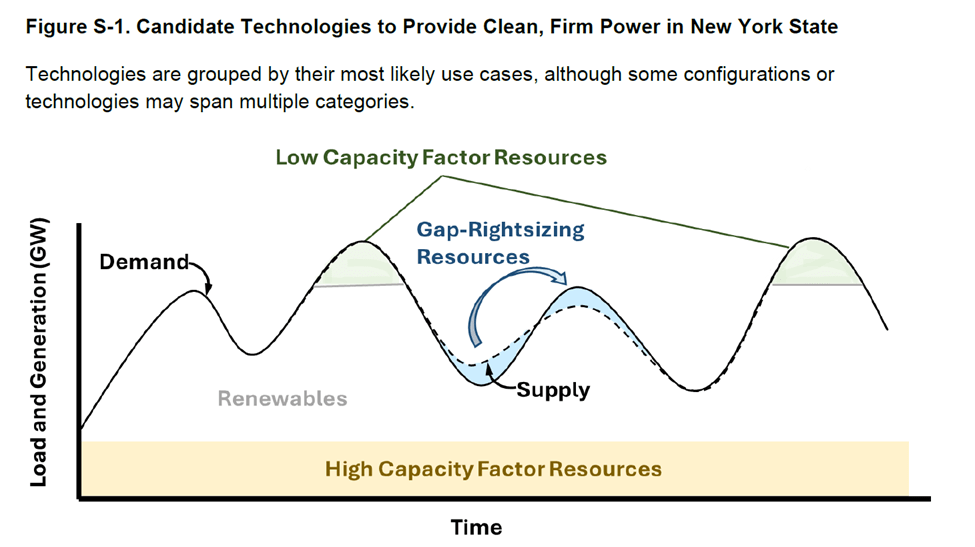
Source: New York State Energy and Research Development Authority (NYSERDA). 2025. “Zero by 40 Technoeconomic Assessment, Final Report.” Prepared by Electric Power Research Institute, Palo Alto, CA. Zero by 40 Technoeconomic Assessment
I think Figure S-2 has important ramifications. However, if I started to address these categories it would make this document too long. I will hold off further discussion for a subsequent post.
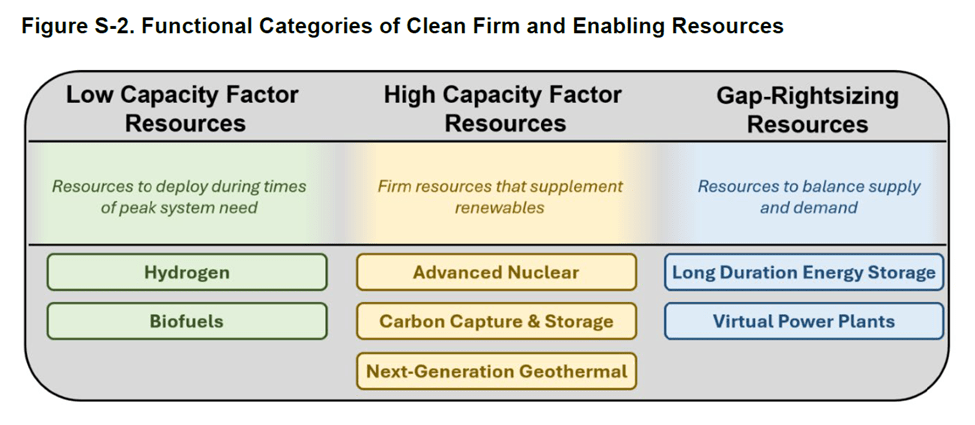
Source: New York State Energy and Research Development Authority (NYSERDA). 2025. “Zero by 40 Technoeconomic Assessment, Final Report.” Prepared by Electric Power Research Institute, Palo Alto, CA. Zero by 40 Technoeconomic Assessment
Technologies Evaluated
The report assesses seven candidate DEFR technologies based on performance, readiness, emissions, costs, and other factors:
- Hydrogen: Explored for use in combustion turbines and fuel cells. This was the place holder DEFR technology in the Scoping Plan.
- Biofuels: Recognized for near-term availability but limited by supply constraints.
- Advanced Nuclear: Including small modular reactors (SMRs), noted for high-capacity factors and flexibility in meeting energy demands.
- Carbon Capture and Storage (CCS): Evaluated for its potential to reduce emissions while utilizing existing fossil-fuel infrastructure.
- Next-Generation Geothermal: Assessed for its capability to provide clean, firm power generation.
- Long-Duration Energy Storage (LDES): Essential for addressing extended periods of low renewable output, beyond typical battery durations.
- Virtual Power Plants (VPPs): Aggregated distributed energy resources that enhance grid flexibility and capacity.
Zero by 2050 Report Conclusions
In this summary article I will just list the conclusion highlights.
- A 2040 zero-emission grid will require a mix of attributes to maintain reliability requirements, and meeting these needs will require diverse resources.
- A mix of DEFR technologies within and across resource categories will best meet statewide needs, maximize benefits, and minimize the risk associated with overreliance on any one resource. The following three categories were identified:
- Low capacity factor DEFR with fast ramping capabilities will play a vital role on days with the most extreme system needs and will be needed throughout New York State. Potential resources such as hydrogen and biofuels are expected to be needed throughout the State to support the grid during peaking events, but each type of fuel faces distinct geographic limitations and cost challenges.
- High capacity factor DEFR can help meet growing loads, reduce the need for buildout of some intermittent renewables and mostly idle peaking plants, diversify the energy mix, and provide inertia and other critical grid services to support a grid increasingly dependent on variable renewables. Potential resources such as nuclear, Natural Gas combustion paired with carbon capture, and geothermal can increase energy diversity while meeting load growth, but projects face geographic limitations, high and uncertain capital costs per project, and timeline challenges.
- Gap-rightsizing DEFR can balance supply and demand, reduce the need for upgrades to transmission and distribution infrastructure, and provide benefits to consumers even today. Regional variability may require different solutions in different locations. Potential resources such as VPPs and LDES can provide valuable support in balancing supply and demand and reducing infrastructure buildout needs, but they have inherent duration limitations.
The report described actions that can facilitate the readiness of these resources to achieve the scale needed for 2040.
- Pursue a diverse set of resources to minimize the risk of overreliance on individual technologies.
- Start early to increase the likelihood of readiness by 2040.
- Invest in grid-enhancing technologies early to minimize the need for backstop resources.
- Invest in innovation to enhance resource viability.
- Develop strategies across industries for unlocking key resources with infrastructure hurdles.
- Engage early with technology developers, end users, and other stakeholders.
- Conduct grid modeling to understand tradeoffs of relying on different resources.
- Conduct a regular assessment of options and remain flexible as new technology options come online.
Discussion
I think this report is a good first step towards addressing “the need for resources to ensure the reliability of the 2040 zero-emissions electric grid mandated by the Climate Act.” The question now is where do we go from here? Just like the Scoping Plan and the Draft Energy Plan, this document lists different technologies and their characteristics but does not include a feasibility analysis suitable for putting together an actual implementation plan. The Public Service Commission must propose a plan that can guide implementation, project the potential costs, and propose a realistic timeline. The Legislature should then revise the Climate Act to comply with those requirements.
I think there is a major issue with this report. The document is full of statements that when viewed objectively indicate that the schedule of the Climate Act is not realistic. That calls out for a re-assessment of the Climate Act itself. What is missing is that the authors did not address the presumption that an electric system reliant upon weather-dependent wind and solar resources can safely and affordably prevent a blackout during the worst-case renewable resource drought. I will address my arguments that this is not possible in my next post. In the meantime, I described the challenges just defining the worst case in a filing earlier this year.
Conclusion
In a rational world, New York politicians would announce that they wanted to develop regulations to achieve a zero emissions electric grid and then go to the organizations in New York responsible for the electric system and ask them for a plan. This report should be a component of a future plan to achieve zero emissions. There still is no feasibility analysis, comprehensive estimate of the costs, or realistic timeline to achieve the 2040 zero emissions goal. Instead, we have a Climate Act mandate to achieve a zero-emission electric grid by 2040 because the New York Legislature naively believed it was only a matter of political will. It is long past time that the Public Service Commission should break away from the ideology and admit that the Climate Act schedule and aspiration needs to be revisited.

 Pragmatic Environmentalist of New York