David Wojick recently published an article describing why New York’s Climate Leadership & Community Protection Act (Climate Act or CLCPA) 2030 GHG emission mandate to reduce New York State 1990 GHG emissions 40% by 2030. This article supplements his article with numbers and additional context.
I am convinced that implementation of the New York Climate Act net-zero mandates will do more harm than good if the future electric system relies only on wind, solar, and energy storage because of reliability and affordability risks. I have followed the Climate Act since it was first proposed, submitted comments on the Climate Act implementation plan, and have written over 600 articles about New York’s net-zero transition. The opinions expressed in this article do not reflect the position of any of my previous employers or any other organization I have been associated with, these comments are mine alone.
David Wojick is an independent policy analyst and senior advisor to Committee for a Constructive Tomorrow (CFACT). As a civil engineer with a Ph.D. in logic and analytic philosophy of science, he brings a unique perspective to complex policy issues. His specializes in science and technology intensive issues. I correspond regularly with him on New York issues.
Supplemental Number for the Article
Wojick’s article is an overview of the challenge and impossibility of the Climate Act 2030 interim GHG emission reduction goal. He explains:
New York Governor Hochul has told the Court her administration cannot write the regulations required to enforce the Climate Act’s 2030 emission reduction targets because they would be infeasible and ruinously expensive to New Yorkers. For all practical purposes, they are actually impossible, so the law must be changed. The legal situation is explained in my article “New York’s climate law hits the wall” here:
He provides a brief qualitative analysis of the impossibility.
The law calls for a 40% reduction in CO2 and other greenhouse gas emissions from the 1990 levels by 2030. According to state data, the emissions have already been reduced by 10% leaving a whopping 30% to go in just four years.
The Department of Environmental Conservation’s 2024 Statewide GHG Emissions Report, covering data through 2022, revealed that New York emissions as of 2022 were 371.08 million metric tons of carbon dioxide equivalent (MMTCO2e) from Table ES.2 in the report. According to the Final Department of Environmental Conservation Part 496 regulation, 1990 emissions were 409.78 MMTCO2e. Using these numbers NYS has achieved only a 9.3% reduction in gross GHG emissions from 1990 levels.
Table ES-2: 2022 New York State GHG Emissions (mmtCO2e GWP20), by IPCC Sector
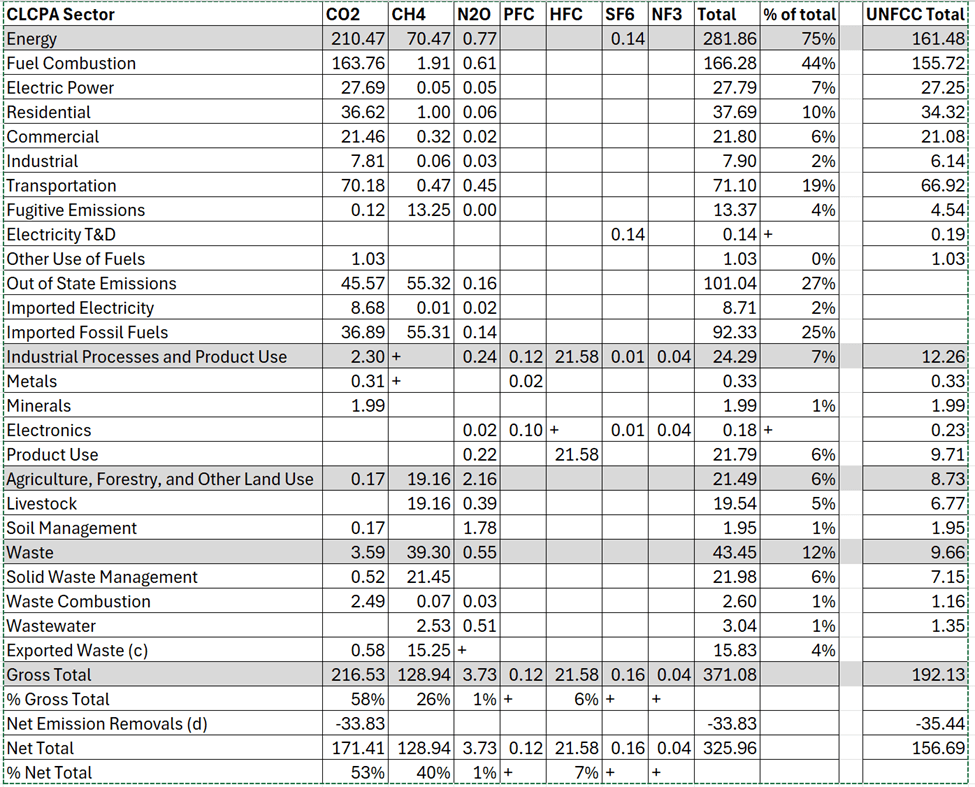
Table ES-2 lists data in four CLCPA sector categories. I acknowledge the use of Perplexity AI to describe and summarize these sectors. The Energy sector is the dominant source (75%) of GHG emissions in New York State, accounting for about 282 MMTCO₂e in 2022. The Industrial Processes and Product Use (IPPU) sector covers emissions from manufacturing processes and the use of manufactured products, accounting for approximately 6% of total gross emissions (24.29 mmt CO₂e in 2022). The
Agriculture, Forestry, and Other Land Use (AFOLU) Sector encompasses emissions from agricultural activities, livestock management, and soil practices, as well as carbon sequestration from forests, wetlands, and harvested wood products. In 2022, agricultural emissions totaled 21.49 mmt CO₂e (6% of gross emissions). The Waste sector covers emissions from managing and treating waste materials, accounting for approximately 12% of total gross emissions (43.45 mmt CO₂e in 2022). This sector is unique in New York’s inventory because it includes emissions from waste exported to out-of-state facilities, addressing potential emission leakage.
Wojick describes the reasons for the observed reductions.
Most of the reductions occurred in just two ways that are similar to America as a whole. Foremost, is a switch from coal to natural gas in electric power generation. Second, is the loss of manufacturing, helping to make China the industrial center of the world. Neither of these reduction measures is available or feasible to help hit the remaining 30%.
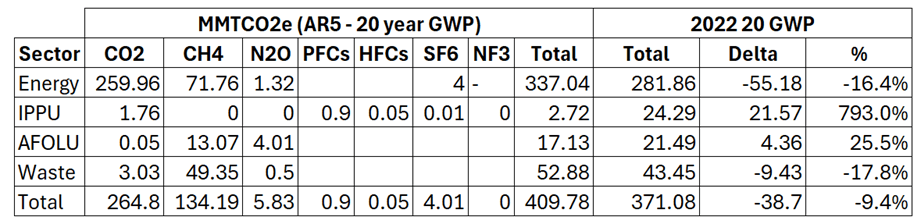
Table 1 from the Part 496 Revised Regulatory Impact Statement lists 1990 emissions for the CLCPA sectors used in ES-2. The following table has been supplemented with the 2022 observed emissions. Note that there have been reductions in the energy and waste sectors but increases in the IPPU and AFPLU sectors. This supports Wojick’s assertions that observed reductions have come from the energy sector.
Table 1. Total Statewide Greenhouse Gas Emissions in 1990 by IPCC Sector and Gas, in GWP20.
Wojick breaks down the potential for additional emission reductions.
According to EIA, roughly 50% of New York’s energy consumption is from petroleum. About 80% of this is transportation fuel, especially gasoline, diesel, and jet fuel. It is clearly impossible to reduce transportation by 30%. In some cases, electrification is technologically feasible, but it cannot possible be done at the needed scale in just four years.
This is especially true given much of the transportation is from out of state vehicles. New York stands between New England and the rest of America, so it gets a huge amount of through traffic.
In addition, an estimated 20% of New York households heat with fuel oil. Winters are very cold, so we are not about to cut that by 30%.
The next biggest source is natural gas, which accounts for about 30% of energy consumption, not counting electricity generation. Roughly 60% of households are heated with natural gas as are most larger buildings, such as apartments, co-ops, offices and stores. Here again, while electrification is theoretically possible, it cannot possibly be done in just four years.
Table ES-3 from the most recent emission inventory lists emissions by economic sector. The type of fuels used are not included but this table supports Wojick’s arguments.
Table ES-3: 2022 New York State GHG Emissions (mmtCO2e GWP20), by Economic Sector
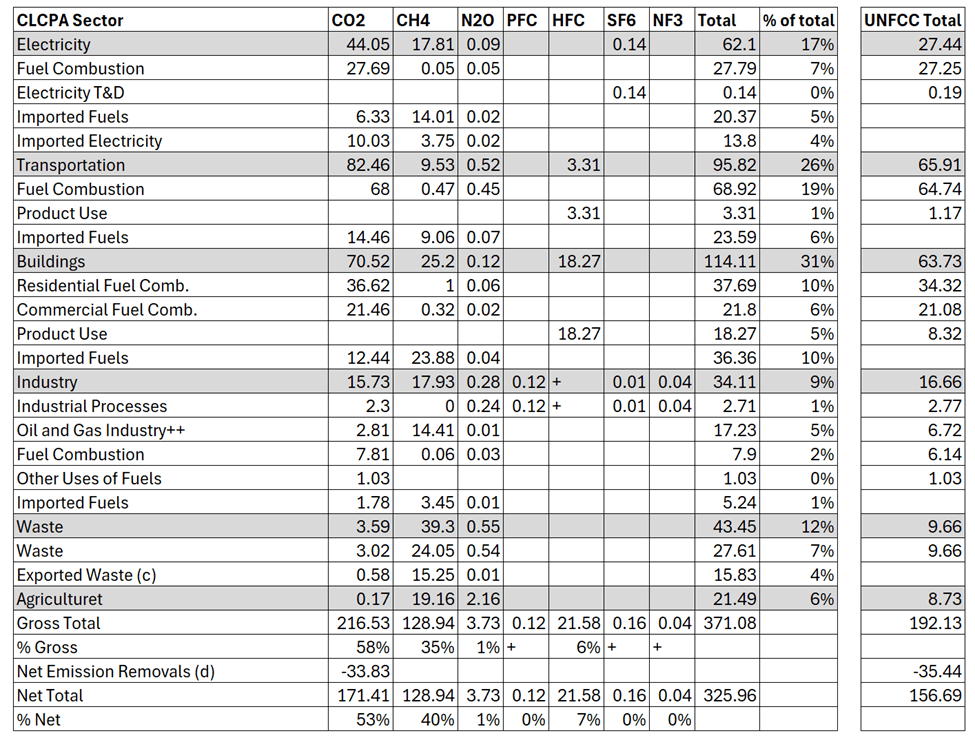
Wojick points out that the Climate Act accounting includes unique provisions to account for imported fuels and imported electricity.
A big extra complication is that the emissions to be reduced by 30% include those out of state emissions created by producing imported electricity and fossil fuels. This might include emissions from things like Texas refineries and Pennsylvania coal fired power plants. New York obviously has no control over these sources.
Here is the Climate Law’s incredible definition of the emissions that need to be reduced: “”Statewide greenhouse gas emissions” means the total annual emissions of greenhouse gases produced within the state from anthropogenic sources and greenhouse gases produced outside of the state that are associated with the generation of electricity imported into the state and the extraction and transmission of fossil fuels imported into the state.”
New York imports almost all of the huge amounts of petroleum and natural gas that it uses. These out of state emissions are likely to be a significant fraction of those that are required to be reduced 30% in just four years.
Plus of course, there are the emissions from electric power generation. Roughly 40% of the natural gas consumed in New York is used to generate electricity. About 54% of the generated electricity is powered by natural gas versus just 15% from renewables, mostly hydro. These numbers can be little changed in just four years.
The sum of the imported fuels and imported electricity category GHG emissions in Table ES-3 is 63 MMT CO2e or 17% of the total emissions. Those emissions are beyond the control of New York to reduce.
Climate Act Global Warming Potential
There is one aspect of the impossible target not addressed by Wojick. The Climate Act uses a unique GHG accounting methodology. This is a particular problem for me. I used Perplexity AI to provide a summary of the reasons I have described on this blog why I think the use of 20-year global warming potential emissions accounting is inappropriate. The reason that these values are used is because the authors of the Climate Act had an irrational obsession with methane because they thought that the global warming potential of methane is much greater than carbon dioxide. However, as the summary shows, the use of a 20-year global warming potential is scientifically flawed and politically motivated. In brief, the parameter measures the ability of a molecule of a greenhouse gas to reduce long wave radiation (the greenhouse effect) in the laboratory. In the atmosphere where proponents worry about greenhouse effects on global warming, saturation effects, relative impacts on black body radiation and actual concentrations make the global warming potential relative of methane to CO2 insignificant.
Tables ES-2 and ES-3 from the 2024 GHG report list the United Nations Framework Convention on Climate Change (UNFCC) GHG emissions. This is the International Treaty aimed at addressing climate change. It includes established specific guidelines to report and compare emissions data using a global warming potential measured over 100 years instead of the 20 year parameter used in the Climate Act. New York proponents for climate change claim to follow the science but in this instance, they chose to ignore the established science. As a result, it is impossible to track New York’s progress relative to the rest of the world.
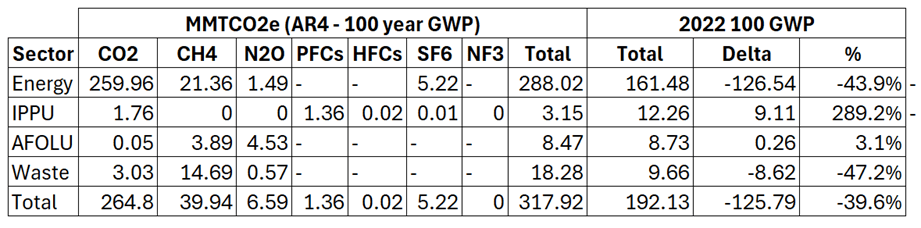
As a practical matter the Climate Act accounting increases emissions. In 2022, total GHG emissions using the GWP-20 units were 371.08 MMT CO2e but are only 192.13 MMT CO2e using the UNFCC GWP-100 units. Table 2 from the Part 496 Revised Regulatory Impact Statement lists 1990 emissions for the CLCPA sectors used in ES-2. Note that 1990 emissions were 317.92 MMT CO2e compared to 409.78 MMT CO2e using GWP-20. Furthermore, when compared to the 2022 emissions total emissions are down 39.6% – very near to the 40% 2030 mandate!
Table 2. Total Statewide Greenhouse Gas Emissions in 1990 by IPCC Sector and Gas, in GWP100
Discussion
Wojick concludes:
New York State cannot cut emissions by the required 30% in just four years, so the 2030 target of the Climate Act is impossible. The legislature must change the law, and the Court has given them until February 6 to do so. After that, the Court says it will impose the Climate Law, which would be incredibly harmful.
When the reported numbers are considered the conclusion that New York State cannot make the 2030 40% GHG emission reduction target is confirmed. However, if the GWP-100 GHG emission accounting methodology is used a 40% reduction from 1990 by 2030 only needs a further 1% reduction from current emissions. There is a caveat to this observation. While this suggests that the 2030 reduction target is possible, the fuel switching and loss of manufacturing emission reductions that were the cause of the observed reductions will not provide significant future reductions. Future reductions will require replacement with zero emissions resources no matter what the accounting methodology. Those strategies are much more difficult and costly.
Although changing the accounting methodology would be a potential political approach to achieve compliance for the Hochul Administration, this is unlikely. In the spring of 2023, her Administration floated the idea of changing the metric undoubtedly because of these numbers. Climate Act activists melted down when that was proposed and the idea was shelved.
In my opinion, Wojick correctly points out that the law must be changed in response to the recent legal decision he referenced. These data are just one of a long list of other reasons that I think that Climate Act implementation should be paused and the lessons learned since 2019 incorporated in a new implementation schedule. I believe that evidence is overwhelming that the aspirational targets should also be modified to include affordability, reliability risk, and environmental impact boundary conditions constraints.
Conclusion
David Wojick and I agree that the Climate Act 40% reduction by 2030 target cannot be met using the existing GHG accounting methodology. My numbers confirm everything he said in his article.

 Pragmatic Environmentalist of New York
A.8332/S.8012, sponsored by Assemblymember Micah Lasher, should be on your radar screen. The bill would remove the last vestige of local control over large-scale renewables, the power to level local property taxes.
Assemblyman Lasher’s district is on the upscale upper west side of Manhattan. He and his constituents have no need to worry about a massive wind or sprawling solar project defacing their community. But he obviously finds it perfectly OK to impose these things on the rural communities of upstate New York.
Now he is pushing that imposition to a new level with a bill that that would take away any remaining authority of local government officials to tax the owners of wind and solar projects. This, in spite of the fact that there is ample evidence that a large wind or solar project harms the overall prosperity of upstate towns.
The owners of fossil fuel and nuclear power plants in New York pay fully assessed property taxes as determined by the local elected representatives of the people in those towns, and are given no special consideration.
The wind and solar industry is already entirely dependent on taxpayer support. Each project gets millions in renewable energy credits, paid for by a charge on ratepayers’ bills. Both New York and the federal government provide tax credits far beyond what other types of energy get–and they complain they still can’t compete without more!
Governor Hochul should let this bill die on her desk.
LikeLiked by 1 person