
Note: Updated on 12/10/2025 to add a slide 32 from the presentation
On November 13 I published an article describing my initial thoughts about the State Energy Planning Board meeting that day that discussed public comments on the Draft State Energy Plan document. I had intended to follow up with another post providing more detail, but other projects got in the way. This post describes the latest meeting held on December 1.
I am convinced that implementation of the New York Climate Leadership & Community Protection Act (Climate Act or CLCPA) net-zero mandates will do more harm than good if the future electric system relies only on wind, solar, and energy storage because of reliability and affordability risks. I have followed the Climate Act since it was first proposed, submitted comments on the Climate Act implementation plan, and have written over 600 articles about New York’s net-zero transition. The opinions expressed in this article do not reflect the position of any of my previous employers or any other organization I have been associated with, these comments are mine alone.
I acknowledge the use of Perplexity AI to generate summaries and references included in this document. The focus of this article is how the results of the Pathways Analysis relate to Climate Act goals. Note that I went so far as to request that the response be written up.
Energy Plan Overview
According to the New York State Energy Plan website (Accessed 3/16/25):
The State Energy Plan is a comprehensive roadmap to build a clean, resilient, and affordable energy system for all New Yorkers. The Plan provides broad program and policy development direction to guide energy-related decision-making in the public and private sectors within New York State.
I have provided background information and a list of previous articles on my Energy Plan page.
Meeting Overview
There were three items on the agenda: approval of last meeting minutes, discuss analyses conducted for the Energy Plan, and consider any new business. The recording of the meeting available here included a transcript. I created an edited transcript that has headings and includes the slides.
The New York State Energy Research & Development Authority (NYSERDA) prepared a Draft Energy Plan last summer. Stakeholder comments were accepted until early October. At the last Energy Planning Board meeting there was a perfunctory description of the comments received. In this meeting NYSERDA described the updated Pathways Analysis—the modeling exercise that underpins New York’s triennial State Energy Plan.
Implementation Timing
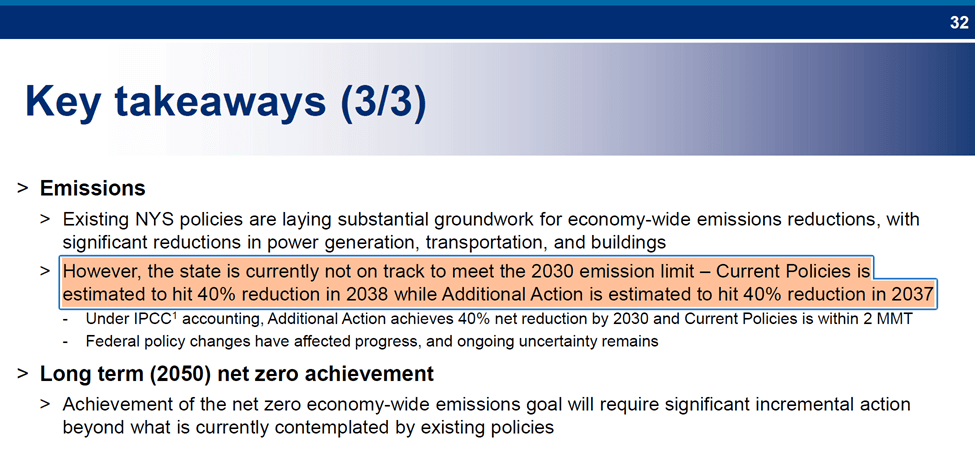
Under New York’s own Climate Act accounting framework—the methodology that matters for compliance—no scenario modeled by NYSERDA hits the 40% economy-wide GHG reduction target by 2030. Not the “current policies” case. Not the “additional action” case. None of them. Instead, the core planning cases achieve the 40% GHG emission reduction by 2030 mandate in roughly 2037–2038, a full 7–8 years later than the statute requires. The 70% renewable electricity target by 2030 is also behind schedule. Offshore wind permitting delays push that into the 2036–2040 window.
This is not a surprise to anyone closely tracking federal policy and state implementation. However, this is the first time that it is not necessary to read between the lines of the NYSERDA presentations. NYSERDA laid it out in black-and-white. The State is no longer pretending the Climate Act is on schedule.
Federal Rollbacks and Deployment Headwinds
The updated modeling incorporates two major factors that were not included in the draft plan.
The draft plan was counting on extensive Federal support but there have been policy changes. The modeling breaks this down by sector:
- Across the electric sector: $25 billion in lost investment tax credit (ITC) and production tax credit (PTC) for renewables and related credits.
- Buildings: ~$1.5 billion in lost heat pump and efficiency incentives by 2040.
- Transportation: ~$4.5 billion in lost EV incentives, plus higher long-term fuel costs if the Advanced Clean Car and Advanced Clean Truck programs are also repealed.
- Offshore wind deployment delays. Federal permitting obstruction and supply-chain headwinds are slowing the pace of offshore wind additions.
- Offshore wind deployment delays. Federal permitting obstruction and supply-chain headwinds are slowing the pace of offshore wind additions. The 2035 offshore wind capacity in the modeling is below the 9 GW target, which cascades into delays across the entire renewable timeline.
The second factor is that issues with siting constraints are slowing the physical deployment of wind and solar deployment relative to the unrealistic presumptions in the Draft plan. Offshore wind deployment delays because of changes in Federal permitting and supply-chain issues are slowing the pace of offshore wind additions. The 2035 offshore wind capacity in the modeling is below the 9 GW target, which cascades into delays across the entire renewable timeline.
Policy Implications
The Perplexity AI summary listed six takeaways.
- NYSERDA plainly states that the 2030 targets cannot be met using the Climate Act’s accounting as shown on the Key Takeaways (3/3) Slide 32 shown below.. However, the presentation just described this analysis result and not the implication that this means that the Climate Act must be amended to shift the schedule.
- The building sector urgently need more aggressive policy actions to achieve Climate Act goals. The gap between current-policy building decarbonization and a net-zero-consistent path is large, and it’s growing. Stronger codes, more financing, larger direct-install programs, and targeted support for renters and low-income owners are all needed.
- The transition of the gas system requires active management and investment. This isn’t a “let the market sort it out” situation. Utilities, the PSC, and the state need coordinated strategies for how gas infrastructure evolves over time—including decisions about when and where to invest in network modernization versus when to accelerate targeted electrification.
- The presentation noted the importance of Dispatchable Emissions Free Resources (DEFR). I disagree with the optionality adjective, however. There is nothing optional about the need for these new and unproven resources. The description of green hydrogen illustrates why it won’t solve the problem. The presentation argues the state should be actively exploring, piloting, and supporting a portfolio of zero-carbon dispatchable technologies. RNG, long-duration storage, ammonia, and others all deserve serious development support.
- Federal policy is now a binding constraint. New York can optimize its own policies, but it cannot outrun federal rollbacks. The state’s energy strategy increasingly needs to figure out how to replace Federal funding, procure projects to lock in tax credits before phase-outs, and re-structure policy design that works even if federal support evaporates.
- Nuclear is back in the conversation, and that’s not a bad thing. The modeling shows that nuclear power, where available and deployable, reduces system costs and relieves pressure on renewables and DEFR. The presentation argues that the state should pursue the NYPA project, explore other Small Modular Reactor and advanced reactor opportunities, and think carefully about lifecycle extension of existing assets.
Stakeholder Comments
I am extremely disappointed with the stakeholder process. In my comments at the first virtual public hearing and a subsequent written comment I explained that the lack of documentation on the disposition of stakeholder comments undermined the credibility of the process and the opportunity to improve the Energy Plan. The only acknowledgment of the comments received is a promise that “all comments will be posted on the State Energy Plan website as soon as practicable”. It has been two months since that promise was posted and the comments still are not posted.
This matters because the presentation at this meeting claimed the Pathways Analysis finds that the additional-action case generates net societal benefits of about $18 billion by 2040, with roughly $19 billion in aggregate net-present-value benefits through 2040, when carbon and health benefits are factored in. However, in my unacknowledged comments I pointed out that the cost accounting in the Pathways Analysis “No Action” scenario only includes costs associated with the Climate Act law, not the cost to meet the Climate Act targets. The misleading “No Action” scenario is not a baseline that excludes all programs necessary to achieve the Climate Act targets because it includes legacy programs in place prior to the Climate Act. Furthermore, in other comments I identified issues that reduced the alleged benefits. If costs and benefits were properly addressed, then I suspect that there would not be net societal benefits.
Discussion
I recently described the Oct. 24, 2025 New York Supreme Court decision and order in a case pitting environmental organizations against the New York State Department of Environmental Conservation (DEC). The judge ordered DEC to issue final regulations establishing economy-wide greenhouse gas emission (GHG) limits on or before Feb. 6, 2026 or go to the Legislature and get the Climate Act 2030 GHG reduction mandate changed. Importantly, during the trial , the Attorney General Office submitted a supplemental letter that argued that promulgating regulations for the Climate Act target would cause “undue harm” because the Climate Act mandates are infeasible due to excessive costs that are “unaffordable for consumers” to bear. Subsequently, DEC appealed the decision which postpones resolution of the problem.
The rationale for the Judge’s decision coupled with the acknowledgement that the costs are unaffordable and the updated Pathways Analysis finding that the 2030 targets cannot be met using the Climate Act’s accounting methodology should mean that the Climate Act itself needs to be amended. This important finding was not mentioned in the presentation. Furthermore, there has been no sign that the Hochul Administration or the majority leadership in the Legislature are amenable to considering amendments to the Climate Act.
There is another aspect to this. The Climate Act is not the only law that includes the mandates for the net-zero transition. New York Public Service Law § 66 “Establishment of a renewable energy program” describes energy systems that are prohibit some of the findings in the updated Pathways Analysis. It appears to me that this legislation also needs to be amended.
I will follow up with another post on this meeting because there are more issues that I did not address.
Conclusion
Reality bats last. The findings of the updated Pathways Analysis reflect that fact. The aspirational schedule of the Climate Act was never realistic, and these results are simply acknowledgement of that fact. It remains to be seen how the identified problems and the implicit feasibility concerns described will be addressed. Given that it will require accountability by the politicians who got New York into this mess I am not optimistic.

 Pragmatic Environmentalist of New York
One thought on “Initial Thoughts on Energy Planning Board Meeting on 1 December 2025”