Governor Hochul plans to pursue “the most ambitious development of nuclear power in America, setting a new goal to build five gigawatts of new nuclear capacity”. I believe that nuclear power is the best option to reduce electric system GHG emissions but there are issues. This post includes Richard Ellenbogen’s description of practical deployment issues and my observations relative to the Climate Leadership & Community Protection Act (Climate Act).
Richard Ellenbogen has been speaking to NY State policy makers and regulators since 2019 regarding the deficiencies inherent in NY State Energy policy. He has a proven record implementing carbon reduction programs at his own manufacturing business in Westchester County where it has reduced its electric utility load by 80% while reducing its carbon footprint by 30% – 40% below that of the downstate system. I have previously published other articles by Ellenbogen including a summary description of his issues with the Climate Act.
I am convinced that implementation of the Climate Act net-zero mandates will do more harm than good because the energy density of wind and solar energy is too low and the resource intermittency too variable to ever support a reliable electric system relying on those resources. I have followed the Climate Act since it was first proposed, submitted comments on the Climate Act implementation plan, and have written over 600 articles about New York’s net-zero transition. The opinions expressed in this article do not reflect the position of any of my previous employers or any other organization I have been associated with, these comments are mine alone.
Hochul Proposal
Hochul’s State of the State Book describes the nuclear proposal in the following two sections:
Establishing a Nuclear Reliability Backbone for a Zero-Emission Grid
As New York transitions to a zero-emission electric grid, the State must ensure reliable and cost effective baseload power to keep homes, businesses, and critical infrastructure running at all hours. Governor Hochul will ensure that New York State leads in the race to harness safe and reliable advanced nuclear energy to power homes and businesses with zero-emission electricity for generations to come.
To catalyze progress towards those goals, the Governor will advance a new initiative, the Nuclear Reliability Backbone, directing state agencies to establish a clear pathway for additional advanced nuclear generation to support grid reliability. The Nuclear Reliability Backbone will be developed by a new Department of Public Service (DPS) process to consider, review, and facilitate a cost-effective pathway to four gigawatts of new nuclear energy that will combine with existing nuclear generation and the New York Power Authority’s (NYPA) previously announced one gigawatt project, to create an 8.4 gigawatt “backbone” of reliable energy for New Yorkers.
This effort will provide firm, clean power that complements renewable energy resources and reduces reliance on fossil fuel generation. By creating a stable foundation of always-on energy, the Backbone will allow renewable resources to operate more efficiently and flexibly. Together, these actions will support a resilient, flexible, and zero-emission grid that meets New York’s growing energy needs.
Ensuring New York’s Nuclear Power Future is Built By and For New Yorkers
As New York expands advanced nuclear energy, the State must ensure that New Yorkers benefit from these jobs and investments, including making sure New Yorkers are prepared to build, operate, and sustain this emerging industry. Governor Hochul will launch NextGen Nuclear New York to develop a skilled, in-state nuclear workforce through coordinated education and training pathways.
The initiative will expand partnerships across K–12 schools, higher education institutions, labor organizations, and training programs to align curricula, credentials, and career pathways with industry needs. It will also support workforce transitions for existing energy workers and increase public awareness of nuclear career opportunities. By investing in people and skills, New York will ensure its nuclear future is powered by New Yorkers, for New Yorkers.
Practical Deployment Issues – Ellenbogen
Ellenbogen recently sent an email that described his concerns about the proposal to add 5 Gigawatts (GW) of nuclear to NY State’s generation fleet that forms the basis for this article. Because we are closely aligned on our thoughts I am not going to try to differentiate between his material and my supplemental information. However, I take responsibility for the contents of this article and accept that I may have misquoted or misrepresented Ellenbogen’s beliefs.
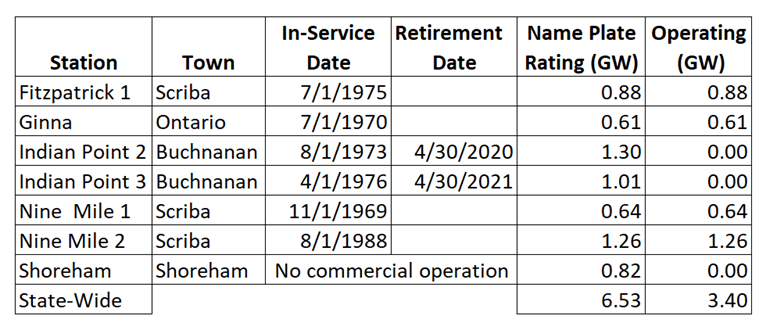
For background consider New York’s nuclear power plants (Table 1). Five gigawatts of nuclear is basically equivalent to building five new traditional reactors like Nine Mile 2, the last completed plant in New York. Note that Shoreham was completed, tested, and then shut down before it operated in the mid 1980’s.
Table 1: New York Nuclear Generating Plants
We agree on one thing completely: It’s a step in the right direction but it is too little, too late. Building this amount of capacity will take a long time. Nine Mile 2 construction took 13 years, and the most recent reactors built in the US at Vogtle, Georgia took 15 years from the start of initial site work.
According to a Perplexity AI query, The new Vogtle units are Westinghouse AP1000 designs with passive safety systems; The capacity of each unit is on the order of 1.1 GW. Construction went over schedule and budget “as the first new U.S. nuclear build in decades, became a protracted megaproject with schedule slips and cost growth to roughly the mid‑$30‑billion range, widely characterized as one of the most expensive infrastructure projects in U.S. history”. These issues were caused by a “combination of incomplete design and planning, contractor and supply‑chain problems, first‑of‑a‑kind AP1000 implementation issues, weak project management and oversight, and the 2017 Westinghouse bankruptcy, which disrupted construction and financing”.
Most of these underlying factors will be problems for New York State. If new technology is used the design and planning will have to evolve as the plants are built. There are contractor and supply-chain problems with existing infrastructure construction so this will be more of a problem for the new technology. If the deployment goes so far as to mandate that the facilities are “built by and for New Yorkers”, then there will be delays because there are insufficient skilled trade workers available today.
Climate Act Schedule and Reliability Issues – Ellenbogen
The Climate Act has a requirement for zero emissions electric generation by 2040. There is no possibility that all the nuclear capacity proposed by Hochul could be built by 2040 and there is a low probability that any new nuclear could be built by then. Last June Hochul ordered the New York Power Authority (NYPA) to develop at least on gigawatt of nuclear capacity. NYPA has not even announced where they might consider siting new nuclear capacity. In my experience with power plant permitting, it takes at least three years to secure permits for existing design equipment. There have been indications that New York would favor new designs which would slow down permitting substantially. Finally, “Nuclear” has been a four-letter word in New York State for about 45 years so we expect opponents to try to delay permitting in every way possible.
Last November the New York Independent System Operator (NYISO) released its 2025-2034 Comprehensive Reliability Plan (CRP). The report found that “the electric grid is at an inflection point driven by the convergence of three major trends: the rapid growth of large loads, (e.g.: microchip manufacturing and AI-related data centers); the aging generation fleet; and a lack of new dispatchable generation resources being added to the system.” The description of the CRP went on to say:
The CRP highlights that the future reliability of the grid depends on the development of flexible generation capable of performing during extended periods of high consumer demand and extreme weather. The report examines lessons-learned from the June 2025 heatwave and the need for a planning framework that better reflects present challenges of operating the grid while anticipating plausible future risks.
“The system requires additional dispatchable generation to serve forecasted increases in consumer demand,” said Zach Smith, Senior Vice President, System and Resource Planning. “We also need to refine and evolve our planning processes to better reflect this period of great change on the grid and a broader range of plausible future outcomes.”
The CRP demonstrates that due to emerging reliability challenges, traditional planning methods built around a single forecast are no longer sufficient. To maintain system reliability and protect public safety, the economy and quality of life, the CRP recommends actions that will strengthen planning processes across a broad spectrum of system conditions and advance needed investment before reliability margins disappear.
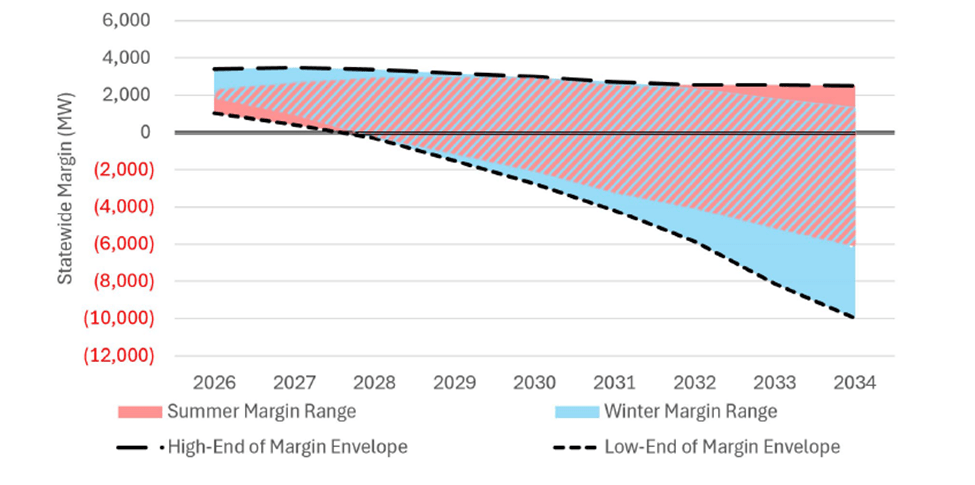
Our biggest concern is the reliability margin crisis described in the CRP. The NYISO plausible range of reliability margins illustrates the problem (Figure 1). The CRP doesn’t explain what is going to keep the lights on after 2033, and possibly as early as 2027 if replacement capacity does not keep up with retirements. My Perplexity AI search found that there are no new fossil-fired capacity proposed. While adding new nuclear capacity is appropriate, replacement of existing capacity must also be considered. The youngest of the 3.4 GW of existing nuclear in NY State will be reaching 60 years of age by 2040.
Figure 1: Plausible Range of Statewide System Margins NYISO 2025-2034 Comprehensive Reliability Plan
Reason to Pause – Caiazza
Over the last year I have written many articles describing various reasons to pause implementation and reconsider the schedule and scope of the Climate Act. The State Energy Plan and the CRP both include multiple future energy projections that include estimates of capacity and grid infrastructure additions. The CRP “recommends actions that will strengthen planning processes across a broad spectrum of system conditions and advance needed investment”. The State Energy Plan advocates massive deployment of as much wind, solar, and energy storage capacity as possible as fast as possible hoping that it will work out.
Wind and solar energy resources are diffuse, intermittent, and correlated. Because they are diffuse, utilizing wind and solar means that transmission and distribution systems must be upgraded. Because they are intermittent, that means that energy storage is needed on daily to seasonal scales. Because wind and solar are correlated, new dispatchable emissions-free resources (DEFR) are needed to make the electric energy system viable during extended periods of low wind and solar resource availability. I believe the only likely viable DEFR backup technology is nuclear generation because it is the only candidate resource that is technologically ready, can be expanded as needed, and does not suffer from limitations of the Second Law of Thermodynamics.
Every day that the resolving the DEFR requirement is delayed the costs associated with what may be a false solution increase. If the only viable DEFR solution is nuclear, then the wind, solar, and energy storage approach cannot be implemented without nuclear power. Nuclear power works best as a baseload resource so using it solely as DEFR backup is inappropriate. Developing baseload nuclear eliminates the need for a huge DEFR backup resource and means that the “build as much as we can as fast as we can” wind and solar buildout currently in progress is unnecessary. Climate Act implementation should be paused until the most appropriate path forward is determined.
Discussion
Both Ellenbogen and I have been harping about reliability for years. Unfortunately, no one at the state level seems to be ready to confront the problem. It is absolutely necessary to come to grips with it. The state government keeps trying to defy physical law by pushing technologies that can’t keep the lights on. They need to get out of their bubble because the time frame required to fix what has become a massive problem is getting increasingly small. The rapidly decreasing margins and negative capacity margins appear likely before new generation of any type can be built.
One of the biggest takeaways from this latest political energy proposal is the danger of political interference in energy policy. New York politicians now claim that we need 5 GW of nuclear generating capacity. New York politicians shut down 3.1 GW of nuclear capacity since 1984. Hochul’s announcement is encouraging but until it must be accompanied by a pause in Climate Act implementation to be credible. If timely decarbonization using nuclear power is appropriate, then a restart at Indian Point should be considered because it is the cheapest and quickest option. However, that would be politically toxic so I cannot imagine that ever being proposed by the Hochul Administration.
Conclusion
In my opinion, nuclear power should be part of New York’s electric system future. However, Hochul’s proposal is too little, too late as part of the Climate Act implementation without revising the schedule. It is necessary first to pause implementation and reassess the schedule and ambition of the Act so that it can play a meaningful role.

 Pragmatic Environmentalist of New York
2 thoughts on “New York Nuclear Renaissance”