

I was recently asked to give a briefing about Climate Leadership & Community Protection Act (Climate Act) issues. The New York’s Legislature works on a two‑year term with annual sessions from January to (roughly) mid‑June, and the centerpiece of each year is enacting the state’s April 1 budget through an executive‑budget model. This is relevant because the Climate Act was enacted during this process and there are aspects of the law that should be considered this session.
I am convinced that implementation of the New York Climate Act net-zero mandates will do more harm than good if the future electric system relies only on wind, solar, and energy storage because of reliability and affordability risks. I have followed the Climate Act since it was first proposed, submitted comments on the Climate Act implementation plan, and have written over 600 articles about New York’s net-zero transition. The opinions expressed in this article do not reflect the position of any of my previous employers or any other organization I have been associated with, these comments are mine alone.
Overview
The Climate Act established a New York “Net Zero” target (85% reduction in GHG emissions and 15% offset of emissions) by 2050. Among its interim 2030 targets is a reduction target of 40% less GHG emissions and a 70% renewable energy electricity mandate. The Climate Action Council (CAC) was responsible for preparing the Scoping Plan that outlined how to “achieve the State’s bold clean energy and climate agenda.” Since the Scoping Plan was finalized in 2022, the State has been trying to implement the Scoping Plan recommendations through regulations, proceedings, and legislation. As part of the implementation, the State updated its Energy Plan in 2024.
Climate Act Issues
My Climate Act issues briefing described the following key issues that need to be addressed:
- The schedule and affordability impacts of the Climate Act can no longer be ignored
- DEC needs to respond to the New York Cap-and-Invest (NYCI) economy wide emission reduction initiative requirements
- PSC must address safety valve provisions
- Recent news stories suggest that Hochul may propose revising GHG accounting again
Climate Act Implementation Schedule
It is no longer debatable that New York has fallen behind on its Climate Act transition plan 2030 mandates. There is no question that the 70% renewable electricity by 2030 target will not be met because the percentage of renewable energy (28% of total generation) has stayed the same since 2019. The New York Independent System Operator (NYISO) annual load and capacity data report universally known as the “Gold Book” data over the last six years is shown in Table 1. Note that the renewable percentage shown in the table is an overestimate because the NYISO references to renewable resources do not necessarily align with the New York State Clean Energy Standard definition.
Table 1: NYISO Gold Book Annual Total and Renewable Summer Capability and Generation
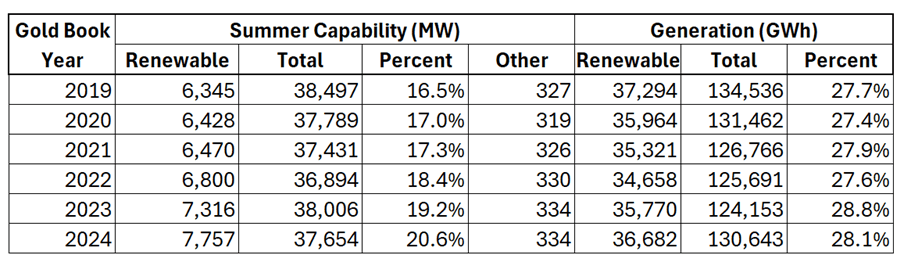
There is supposed to be a 40% reduction in economy‑wide GHG emissions by 2030. I reviewed the 2025 NYS GHG Emission Inventory Report in my article Implications of New York State 2025 GHG Emissions Inventory. I found that GHG emissions through 2023 are 14% less than the 1990 baseline and emissions have been basically unchanged since 2022. That makes meeting 2030 GHG emission reduction target of a 40% reduction impossible.
Affordability and Rate Impacts
New York currently has an energy affordability crisis because as of December 2024, over 1.3 million households are behind on their energy bills by sixty-days-or-more, collectively owing more than $1.8 billion. My recent status summary of Climate Act affordability referenced an article about the observed rate impacts to date. Kris Martin published a similar post that included a table ratepayer impacts. Table 2 summarizes recent electric rate cases (Con Edison, National Grid, Central Hudson, O&R, NYSEG, and RG&E with an estimate of the Climate Act proportion.
Table 2: Typical 2024 Residential Electric Costs from What it costs
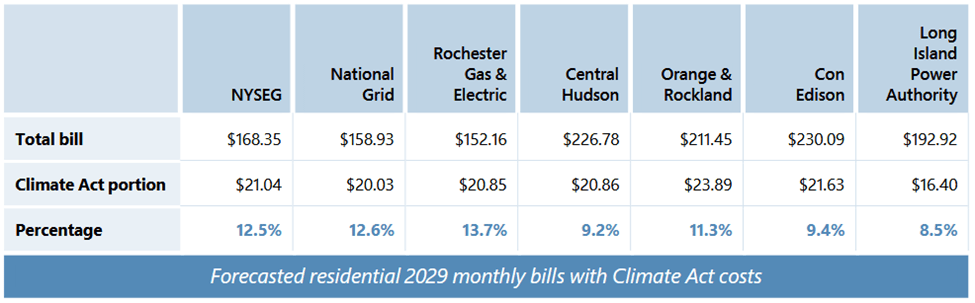
Department of Public Service (DPS) staff provides estimates of the impact of the Climate Act on electric rates. The Second Informational Report “includes the estimated costs and outcomes from 2023 through 2029 to provide the most up to date information.” According to the Summary of Ratepayer Impact for Electric Utilities table, residential impacts of the Climate Act range from 4.6% to 10.3% of 2023 total monthly electric bills.
In my opinion, those estimates are conservative because there is immense pressure on agency staff to minimize the costs of the Climate Act. In addition, the costs necessary to implement the Climate Act were ramping up in 2023. I expect that these costs will continue to climb. Kris Martin also noted that the DPS estimates for future costs don’t include all the Renewable Energy Credits (REC) and OREC (offshore wind REC) costs that would be required to reach Climate Act targets—or even what they might realistically expect to complete.
Also note that the State Attorney General Office is on the record that the current implementation schedule has an affordability liability. Assistant Attorney General Meredith G. Lee-Clark submitted correspondence related to the litigation associated with Climate Act implementation that addressed affordability. The State’s submittal argued that it was inappropriate to implement regulations that would ensure compliance with the 2030 40% reduction in GHG emissions Climate Act mandate because meeting the target is “currently infeasible”. The letter concluded that the Climate Act is unaffordable: “Petitioners have not shown a plausible scenario where the 2030 greenhouse gas reduction goal can be achieved without inflicting unanticipated and undue harm on New York consumers, and the concrete analysis in the 2025 Draft Energy Plan dispels any uncertainty on the topic: New Yorkers will face alarming financial consequences if speed is given preference over sustainability.”
All these analyses have focused on utility rate case costs. The New York State Energy Research & Development Authority (NYSEDA) has not been forthcoming about total household costs but did offer a glimpse of those costs in the State Energy Plan as described in my post Energy Affordability Fact Sheet.
The Fact Sheet summarizes selected results in the Energy Plan Energy Affordability Impacts Analysis. NYERDA claimed that the use of “new, efficient equipment and electrification can cut energy spending by $100 to $300 every month for many New York households” in the Fact Sheet. However, these projections do not cover the costs of the equipment to make the reductions. Table 3 is derived from the NYSERDA supporting documentation and shows the monthly energy costs when equipment costs are included.
Table 3: Total Monthly Energy Costs Including Levelized Equipment Costs for an Upstate New York moderate income household that uses natural gas for heat projected monthly costs and hardware costs
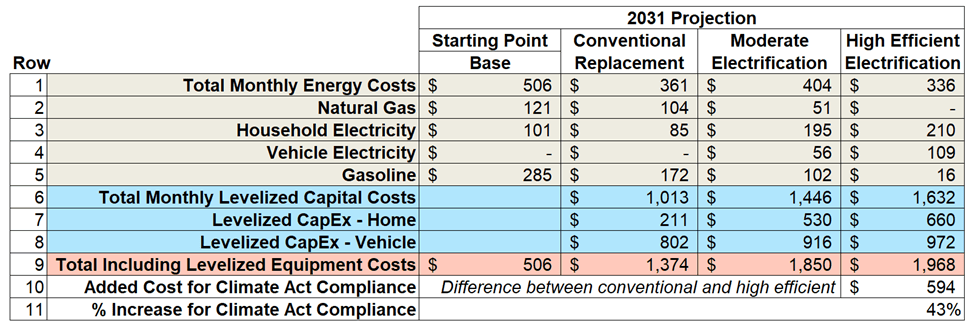
NYSERDA modeled four household profiles ranging from doing nothing from the starting point to a 2031 “high efficient electrification” scenario that upgrades the building shell and electrifies conventional appliances, furnace and automobiles in an Upstate home that uses natural gas in 2025. The improvements in efficiency decreases monthly energy costs for all three journeys but when capital expenditures (CapEx) is considered that changes. The cost of Climate Act compliance is the difference between replacement of conventional equipment and the highly efficient electrification equipment. Row 10 shows this difference. It lists the $594 increase in costs necessary for Climate Act compliance and row 11 lists the percentage increase as 43%. The shortcomings of this analysis are described in my review of the Fact Sheet. It is even worse than shown here.
NYSERDA’s messaging for these results is that costs are going to go up anyway and that the increase in costs due to the Climate Act are small in comparison. I think that additional costs will add more households to the already unacceptable number living in energy poverty.
Cap‑and‑Invest and GHG Regulatory Architecture
There are two aspects of the Climate Act mandate to implement an economy-wide cap-and-invest program by January 1, 2024 that must be addressed by the Legislature and Governor Hochul. I have described the New York Department of Environmental Conservation (DEC) New York Cap-and-Invest (NYCI) regulations in many articles. Currently DEC has only finalized the Mandatory GHG Emissions Reporting Rule. There have been no suggestions when the two other regulations will be proposed. The Cap-and-Invest Rule defines affected sources, binding caps, and allowance allocations. DEC also needs an auction rule that implements the auction that will be used to distribute allowances.
This is problematic. On 3/31/25 a group of environmental advocates filed a petition pursuant to CPLR Article 78 alleging that DEC had failed to comply with the timeframe for NYCI because DEC missed the January 1, 2024 date. I explained that on 10/24/25 Supreme Court Judge Julian Schreibman’s decision stated that by 2/6/26 shall “promulgate rules and regulations to ensure compliance with the statewide missed statutory deadlines and ordered DEC to issue final regulations establishing economy-wide greenhouse gas emission (GHG) limits on or before Feb. 6, 2026 or go to the Legislature and get the Climate Act 2030 GHG reduction mandate schedule changed. On 11/24/25 DEC appealed the decision. On 1/8/26 the Albany County judge rejected the request for “reargument or reconsideration” but that does end the process. The State has appealed to the Appellate Division. This means that the deadline of Feb 6 is suspended until the Appellate Division rules. Therefore, the State has no risk of being held in contempt and can safely ignore the deadline — which appears to be what is happening. However, kicking the can down the road ignores the responsibility to reconsider what is obviously a failed prescription for energy policy.
The other NYCI issue is the DEC regulations. The Mandatory GHG Emissions Reporting Rule was finalized December 1, 2025, but is so poorly written that I would be surprised if it gets litigated. The auction rule regulation should not be an issue. However, the Cap-and-Invest Rule will be controversial because there are non-trivial problems that have political consequences. The rule will set the price trajectory for the costs of an allowance, but what price will be chosen. There will be an increase in prices due to this rule that will have competitiveness impacts on industry. The provision that 35 to 40% of revenues are supposed to benefit disadvantaged communities needs to address implementation logistics. Will the funds be dispersed by direct rebates or targeted program spending? The biggest DEC NYCI issue is the timing. When will DEC propose these rules?
PSL 66-P Safety Valve
There is another important issue that must be resolved. Climate Act proponents constantly state that the mandates are required by law no matter what but ignore the other associated law that includes safety valve provisions. New York Public Service Law § 66-p “renewable energy systems” mandates define which generating sources are “renewable”. Section 66-p (4) “Establishment of a renewable energy program” states: “The commission may temporarily suspend or modify the obligations under such program provided that the commission, after conducting a hearing as provided in section twenty of this chapter, makes a finding that the program impedes the provision of safe and adequate electric service; the program is likely to impair existing obligations and agreements; and/or that there is a significant increase in arrears or service disconnections that the commission determines is related to the program”.
Unfortunately, the PSC has not yet considered conducting a hearing. Two petitions have been filed calling for such a hearing. The Coalition for Safe and Reliable Energy filing on 1/6/26 made a persuasive argument that there are sufficient observed threats to reliability that a hearing is necessary to ensure safe and adequate service. On 8/12/25 the Independent Intervenors filing argued that there were affordability and reliability issues and that there was an explicit requirement for the hearing because the customers in arrears threshold has been exceeded
On 1/28/26 the Public Service Commission issued a notice soliciting comments regarding the Coalition for Safe and Reliable Energy petition.
Comments on the Coalition petition are due on 3/30/26. Stay tuned to this space for more information on how readers can force the State to be accountable for the issues described.
GHG Emission Accounting
There is another issue in the news. In early February the Governor said that she is specifically interested in reconsidering the methodology by which the state tallies its emissions, explaining that New York’s unique 20-year metric puts the state at a disadvantage over other states that use a 100-year methodology to count their emissions. At the time the Climate Act was written it incorporated unique emissions accounting requirements that inflate the emission totals by increasing the effect of methane pollution. In my opinion, this irrational obsession with methane is misguided because, the higher impacts of methane are a laboratory artifact. In the atmosphere, methane has less of an effect than CO2 on global warming.
In the 2023 Budget Season changing the accounting methodology was proposed because it would reduce the total GHG emissions and when NYCI kicks in that will translate to lower costs to New Yorkers. In addition, using a unique methodology eliminates the possibility that the New York cap and invest program can be integrated into other jurisdictions’ programs. In theory that would increase market efficiency and reduce costs.
I applaud this pragmatic modification but shudder to think how climate advocates who got us into this mess will react. Moreover, this is a peripheral issue compared to the others described.
Discussion
I have previously noted that decisions about the future of the Climate Act must be addressed. The ideologues who fervently supported the promulgation of the Climate Act also zealously reject the possibility that changes are needed. However, reality can no longer be ignored. David Wojick recently described his report “Severe Climate Act impacts threaten New York State”. His analysis addresses these issues and provides additional support explaining why action is needed.
Conclusion
There are significant Climate Act issues that can no longer be ignored. Most targets are behind schedule, and the increased costs of the Climate Act will exacerbate the existing energy affordability crisis. DEC needs to respond to the New York Cap-and-Invest (NYCI) economy wide emission reduction initiative requirements and will have to eventually respond to the litigation. PSC must address safety valve provisions of PSL 66-P.
Unfortunately, to be resolved all these Climate Act issues require political accountability. The Climate Act has always been about political pandering to specific constituencies under the guise of saving the planet. Therefore, I expect that all the inconvenient issues described will be ignored until after the election in hopes that the electorate will not catch on that the reliability of the state’s energy system is at risk and the energy system crisis will be aggravated by the Climate Act for political gain. New York GHG emissions are less than one half of one percent of global emissions and global emissions have been increasing on average by more than one half of one percent per year since 1990. Implementing the Climate Act will have no effect on global warming and the purported co-benefits are illusory.
I doubt that the Legislature or Governor will act on these issues this year as they try to placate those who deny reality by demanding no changes to the Climate Act and the rest of us. It is time for the rest of us to demand that the PSC conduct a hearing to consider suspending or modifying the obligations of the Climate Act by submitting comments on the Coalition petition.

 Pragmatic Environmentalist of New York
One thought on “February 2026 Climate Act Issues”