

A recent article in New York Focus, How a More Flexible Grid Could Save New York Billions, received widespread New York media coverage. Unfortunately, the claims that VPP can provide reliable power falls apart under close examination. I believe it was misinformation because it presents false information that was not created or shared with intention of causing harm. I wrote this article because this kind of false information is leading New York’s Climate Leadership & Community Protection Act (Climate Act) transition to net-zero efforts towards a false solution.
I am convinced that implementation of the New York Climate Act net-zero mandates will do more harm than good if the future electric system relies only on wind, solar, and energy storage because of reliability and affordability risks. I have followed the Climate Act since it was first proposed, submitted comments on the Climate Act implementation plan, and have written over 600 articles about New York’s net-zero transition. The opinions expressed in this article do not reflect the position of any of my previous employers or any other organization I have been associated with, these comments are mine alone.
Overview
The Climate Leadership & Community Protection Act (Climate Act) established a New York “Net Zero” target (85% reduction in GHG emissions and 15% offset of emissions) by 2050. Implementation plans have called for a cleaner, more distributed system that minimizes load variations consistent with the virtual power plant (VPP) approach.
VPP terminology was used in the predecessor Reforming the Energy Vision program. In the Climate Act Scoping Plan and last year’s State Energy Plan the concept has been repackaged as Distributed Energy Resources”. In draft Energy Plan comments, the New York Solar Energy Industries Association stated: “By doubling down on distributed energy resources, New York can lower costs, strengthen the grid, and sustain one of its most successful clean energy industries.”
This article describes errors that I think support my belief that this clean-energy industry promise is another miracle technology that will not support the system when needed most. All the promised savings and good intentions will vanish when people freeze or suffer in the dark.
How a ‘Flexible’ Grid Works
The New York Focus article was written by Jack Carroll and Colin Kinniburgh. Kinniburgh has a knack for explaining technical concepts well for the general public. The article describes VPP:
In a traditional electric grid, power flows essentially in one direction: from central power plants to homes and businesses. In a “flexible” grid, powered in part by virtual power plants, those homes and businesses take on a new role. Not only can they supply power back to the grid with rooftop solar and batteries, but their devices — smart thermostats and electric vehicles, for example — can communicate with each other and with grid operators to respond to the system’s demands.
Under the traditional model, utilities have to keep an army of power plants, substations, and wires on standby at all times, in preparation for peak times like hot summer days. The costs of maintaining that system show up on every energy bill, even when customers are using less energy.
“It’s built for the hottest couple of days or hours of the year, but customers are paying for it all year long,” said Richard Kauffman, who served as the state’s energy czar from 2013 to 2019 and chaired the board of the energy authority NYSERDA until last year.
The more you use technology to spread out demand and adapt to the grid’s needs, the less utilities rely on costly infrastructure to meet the peak — and the less utility spending shows up on customers’ bills.
I think this is a good description of the concept, but it contains a fundamental flaw. The electric system must be built around reliability during peak demand because that is when it is needed the most. That is why utilities must “keep an army of power plants, substations, and wires on standby at all times, in preparation for peak times”. While the “costs of maintaining that system show up on every energy bill” that is also why ratepayers are assured power is always available. This is the first mistake.
Many VPP advocates have the naïve belief that if there are enough distributed energy resources that peaks will be eliminated and there will be no need for peaking resources. Others know better but continue to argue otherwise. There is no better example of those who should know better than the politically connected former New York energy czar Richard Kaufmann. He parrots the talking point that building the system for peaks costs money and insinuates that there is a better way. In my opinion he cannot be trusted because he has a massive personal financial interest in this false information. I used Perplexity AI to research his connection to the Biden administration’s Inflation Reduction Act “gold bars” controversy. The Perplexity AI report describing his connection includes the following quotes:
Richard Kauffman did join one of the organizations that received IRA “gold bars” funding. He became CEO of the Coalition for Green Capital (CGC) in January 2025 — a nonprofit that had been awarded $5 billion from the EPA’s Greenhouse Gas Reduction Fund under the Inflation Reduction Act.
Kauffman’s career trajectory — from Obama DOE advisor, to New York energy czar under Cuomo, to NYSERDA board chair, to CGC board member, and finally to CEO of a $5 billion GGRF recipient — illustrates the tight interconnection between government clean energy policymakers and the nonprofit organizations that subsequently received billions in IRA-funded grants.
In April 2024, the EPA selected CGC as a recipient of $5 billion under the National Clean Investment Fund. Coalition for Green Capital (CGC) had originally requested $10 billion in its application. Career EPA reviewers flagged several concerns during the application process:
- CGC had “only expended $1.42 million in 2023 before receiving a $5 billion award”
- “Of the 71 expected hires, more than 20% would be making salaries more than approximately $450,000”
- CGC’s “assumption of deploying $10 billion in the first fiscal year of performance seems unattainable”
- “FY2022 and 2021 financials show a net loss with declining fees for service income”
In my opinion, the value of a reference from a crony capitalist with a salary of more than $450,000 is worthless because of his vested interest in a particular response. This quote is the second mistake in this article.
Pilot Study
Orange and Rockland (O&R) initiated the Innovative Storage Business Models (ISBM) pilot with Sunrun as a REV Demonstration Project approved by the Public Service Commission (PSC) that was referenced in the Carroll and Kinniburgh article. The goal of the pilot is to test an innovative residential solar-plus-storage VPP business model to “optimize and deliver clean energy, provide dispatchable grid services and reduce costs for customers.”
I used Perplexity AI to also document the technical specifications. It found that the program deploys residential solar-plus-storage systems across O&R’s service territory in Orange and Rockland counties, aggregating them into a dispatchable virtual power plant that provides grid services during peak demand periods. The ISBM Project’s design specifications, as established in O&R’s June 2020 Initial Filing Letter to the PSC, include:
- Customer installations: Approximately 300 residential solar-plus-storage (Brightbox) systems
- Solar capacity: Approximately 2.9 MW of distributed rooftop solar
- Energy storage capacity: Approximately 2.1 MW / 4.7 MWh of distributed battery storage
- Aggregate VPP size (after 3-year deployment): 2 MW / 4 MWh
- Program duration: 10-year demonstration period with 25-year customer lease agreements
- Target deployment locations: 15 distribution circuits identified by O&R as having distribution value
The solar array panel at each home was designed to provide 110 percent of the annual average and the battery was designed to provide between 8 and 12 hours of essential load for the homeowner. The battery energy more than the homeowner’s needs contributes to the 2.1 MW VPP that can provide 4.7 MWh. The VPP pilot could provide 2.1 MW for a little over two hours.
According to the Perplexity summary, the VPP achieved the following milestones in Summer 2024:
- Enrolled systems: 325 O&R customers contributing approximately 2 MW of aggregated capacity
- Dispatch events (summer 2024): Called on 18 times to provide electricity to the grid during peak demand events
- Dispatch events (2025 heat wave): In June 2025, Sunrun completed its fourth dispatch event in a single week in New York, helping relieve stress on congested circuits
- The VPP was described as having supported dozens of peak electricity demand events during the summer of 2024, with home batteries supplying stored solar energy to help stabilize the electric grid.
Carroll and Kinniburgh state that: “The 350 households participating can deliver close to 50 megawatts of power to the grid at peak times — about enough to supply Calderon’s entire small town of Warwick for a couple of hours.” This is the third mistake. The actual capacity is about 2 megawatts so the quotation is off by 25 times.
Virtual Power Plants Reliability Support
The third mistake is minor but the claims that VPP are a viable solution to reliability problems is serious. The following quote from the article claims that some experts have demonstrated that the VPP network can replace an average sized gas plant.
The New York Independent System Operator, the nonprofit that manages the state’s grid, has warned that New York may not have enough energy to meet demand over the next decade, as large energy users like data centers come online and the state electrifies homes and transportation. New York City, it said, could face a gap as soon as next summer. Even last summer, NYISO had to activate emergency protocols during a worse-than-expected heat wave.
In response (and to some controversy), NYISO recommended the state delay the retirement of multiple fossil fuel plants, including high-polluting peaker plants in New York City, and strongly consider the construction of new ones.
Some experts argue that virtual power plants offer a cheaper, cleaner way to close the gap. A 2023 Brattle analysis found that the networks can backstop the grid as reliably as an average-sized gas peaker plant, for about half the price.
Renewable advocates focus on energy production, but power systems are built around reliability during peak demand. If you look at the grid through the lens of accredited capacity, that is, capacity that can be relied upon during peak demand – instead of average energy, the resource allocations for different technologies look radically different.
Because I don’t have time to read and evaluate every article referenced, I again used Perplexity to review the Brattle Group’s 2023 analysis. The Executive Summary of the response states:
The Brattle Group’s May 2023 “Real Reliability: The Value of Virtual Power” report—prepared for Google—compared the cost and reliability of virtual power plants (VPPs), natural gas peakers, and utility-scale batteries in providing 400 MW of resource adequacy for an illustrative mid-sized utility. Rather than explicitly modeling extreme multi-day renewable droughts (sometimes called “Dunkelflaute” events), the analysis addressed low renewable availability indirectly through its net load methodology and deliberate selection of operationally challenging system conditions. This approach has significant implications for interpreting the study’s reliability conclusions
The fatal flaw in the Brattle analysis is that the approach used did not address the extreme events that affect peak demand adequately. The analysis focused on individual peak hours/days, not sustained multi-day low-output periods that are associated with peak demand. The inevitable problem can be illustrated using observations from the January 2026 winter storm.
January 2026 Winter Storm
I recently described the effects of this storm on the New York grid over the last ten days of January. Wind and solar resources during the January 24 to January 27, 2026 winter storm were impacted during the storm. The NYISO January Operations Performance Metrics Monthly Report includes a graph of net statewide wind and solar performance total daily production and capacity factors (Figure 1). The data clearly show that the snowstorm caused both the utility-scale and rooftop solar resources to go to essentially zero on January 25th at the height of the storm. Utility-scale generation came back slowly but had not returned to before storm levels by the end of the month. Rooftop solar never exceeded more than 5% energy availability over the ten days and was only 2% the last four days of the month. The period of prolonged sub-freezing weather prevented snow covered rooftop solar panels from clearing and caused a peak in the electric load.
Figure 1: Net Wind and Solar Performance Total Daily Production and Capacity Factors
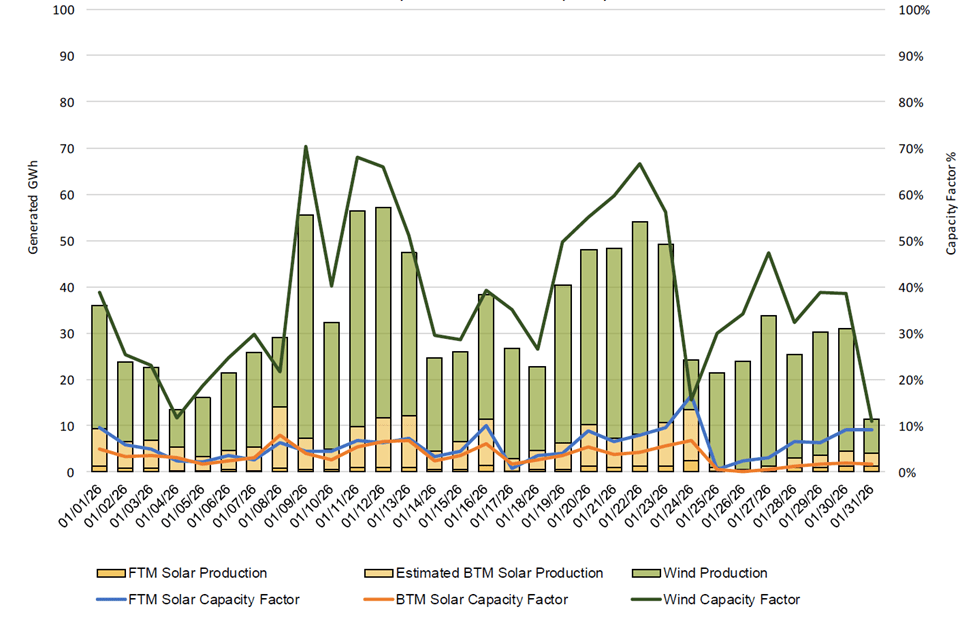
Source: NYISO JanuaryOperations Performance Metrics Monthly Report
VPP during the January 2026 Winter Storm
There is insufficient data available to quantitatively assess what would happen if New York were to rely on VPP technology. However, we can look at the energy production at the end of January 2026 and see serious problems both for the homeowners participating in the program and the grid.
Recall that the solar array panel at each home was designed to provide 110 percent of the annual average energy and the battery was designed to provide between 8 and 12 hours of essential load for the homeowner. The promise to homeowners is that these systems will provide essential support during outages. If there is an outage at the same time rooftop solar panels are covered with snow, then there will be no essential support for an outage greater than 12 hours. That is an admittedly a rate event but when it occurs the homeowner would be desperate for electric power.
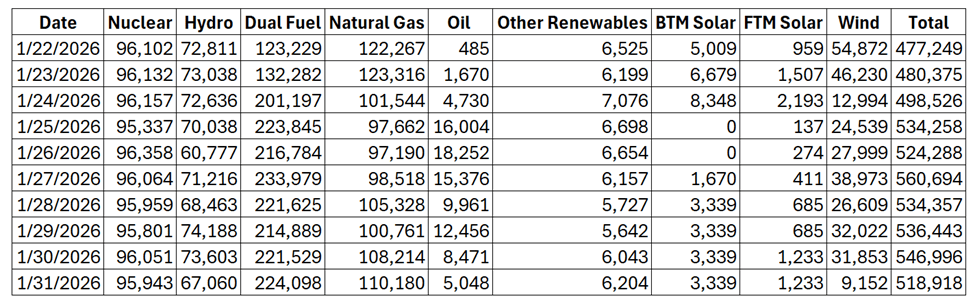
There are also problems on the grid level. Table 1 lists the daily energy production by fuel-type documented in my first article about this event. VPP technology is supposed to smooth peak loads and eliminate the need for peaker power plants. Oil fired units are used almost exclusively as peaker unit in New York so we can assume that their load during this event is “peak” energy. The Brattle analysis only looks at individual peak days. The peak daily oil energy production was 18,252 MWh on 1/26. If New York expanded the O&R VPP pilot producing 2.1 MW VPP that can provide 4.7 MWh to a 9,000 MW system that would produce over 20,000 MWh. That would be sufficient for the maximum daily peak. However, looking at the entire episode, it is obvious that a VPP that relies on distributed rooftop solar would run out of energy on the day after the snowstorm. The sum of the solar resources is not greater than the oil generation for the remainder of the episode. The VPP would have no value to the system after the second day.
Table 1: Daily NYISO Energy Production (MWh) January 22 to January 31, 2026
Discussion
The January 2026 storm proves that VPP solar plus storage technology has no value during extended periods of light winds, low solar availability, and snow-covered solar panels. It simply cannot provide necessary power to replace an existing peaking power plant during these periods.
The VPP proposal introduces yet another threat to grid reliability. New York’s own agencies agree that Dispatchable Emissions-Free Resources (DEFRs) must be developed to backstop wind and solar when those resources falter for days at a time. The January 2026 winter storm made that reality unmistakable. Every delay in pursuing DEFRs compounds the risk and economic burden of clinging to an unproven wind–solar–storage–VPP strategy.
I view nuclear generation as the only realistically viable DEFR backup option, despite its costs, because it is uniquely technologically mature, can be scaled as needed, and is not constrained by the thermodynamic limits that burden storage‑based approaches. However, nuclear plants are best suited to operate as baseload resources, so using them solely for DEFR backup duty would be an inappropriate application of the technology.
If the only viable DEFR technology is nuclear power that implies that large expenditures on wind, solar, battery storage, and VPPs that cannot reliably supply electricity during periods of greatest system stress are unnecessary. When the full lifecycle and system costs of the Scoping Plan’s wind‑, solar‑, and storage‑centric strategy are weighed against a nuclear‑based electric system, I believe that nuclear will be the lower‑cost option, particularly once asset lifetimes are taken into account.
Conclusion
Advocates for VPP claim one of the benefits is that it can replace an army of power plants. However, you can’t shut down the old power plants until you’re sure the new system actually works under all conditions. If it doesn’t, the lights go out, costs rise, and people get hurt. The NY Focus article on VPP misses the fundamental VPP flaw.

 Pragmatic Environmentalist of New York
Superb! Superb! Superb!
The pursuit of weather dependent wind and solar junk energies is energy insanity. They will NEVER be able to reliably power modern societies. Wind and solar are not fit for purpose.
Mr. Caiazza, you state:
“Renewable advocates focus on energy production, but power systems are built around reliability during peak demand. If you look at the grid through the lens of accredited capacity, that is, capacity that can be relied upon during peak demand – instead of average energy, the resource allocations for different technologies look radically different.”
The wind and solar advocates focus on “average energy” really needs to be mocked, discredited, disparaged, denigrated, and hammered endlessly for its myopic view of grid dynamics, grid function, and societal needs. Modern grids MUST be balanced moment to moment, instant to instant, to maintain the stipulated frequency and voltage. Power consumed MUST equal power produced moment to moment, instant to instant. Even a frequency disruption lasting less than a second can trip grid breakers. Dispatchable thermal generation, which is also providing grid inertia, is the only power source available which can react fast enough, and provide the inertia, to balance the hopelessly chaotic wind and solar electricity generation. “Average energy” production, whether of 5 minute increments, hourly increments, monthly increments, or annual increments, are simply too granular to capture just how hopelessly chaotic and destabilizing are wind and solar energy inputs to modern grids. “Average energy” production also hides just how useless wind and solar electricity generation can be in the moment.
There is no switch on earth which can compel the sun to shine, nor the wind to blow. Since weather dependent wind and solar energies are inherently, completely, totally, and inalterably blind to demand, the ONLY way wind and solar junk energies can achieve access to the grid is by deliberate actions of grid operators to impair, curtail, and reduce thermal generation output. Weather dependent wind and solar junk energies are capacity impairment vehicles to thermal dispatchable generation. They force thermal dispatchable generation to reverse mirror the hopelessly non-dispatchable natures, and low average capacity outputs, of wind and solar electricity generation.
Literally trillions of dollars are being spent because of the insanity of CO2 hatred. The pursuit of CO2 reduction is doomed to create a fragile grid, expensive electricity, and endless delusional claims from Ruinable advocates of “what studies show”.
LikeLike