

On March 20, 2026 Governor Hochul claimed in an exclusive opinion piece in New York Empire Report that the climate action and affordability “can and must” go hand in hand. She did not provide substantive evidence to support that claim and her claims do not address many other Climate Leadership & Community Protection Act (Climate Act) affordability issues.
I am convinced that implementation of the Climate Act net-zero mandates will do more harm than good if the future electric system relies only on wind, solar, and energy storage because of reliability and affordability risks. I have followed the Climate Act since it was first proposed, submitted comments on the Climate Act implementation plan, and have written over 600 articles about New York’s net-zero transition. The opinions expressed in this article do not reflect the position of any of my previous employers or any other organization I have been associated with, these comments are mine alone.
Overview
The Climate Act established a New York “Net Zero” target (85% reduction in GHG emissions and 15% offset of emissions) by 2050. It includes an interim reduction target of a 40% GHG reduction by 2030. Two targets address the electric sector: 70% of the electricity must come from renewable energy by 2030 and all electricity must be generated by “zero-emissions” resources by 2040. The Climate Action Council (CAC) was responsible for approving the Scoping Plan prepared by New York State Energy Research & Development Authority (NYSERDA) that outlined how to “achieve the State’s bold clean energy and climate agenda.” NYSERDA also prepared the recent State Energy Plan that was approved by Energy Planning Board (EPB). Both the CAC and the EPB were composed of Governor Cuomo and Hochul appointees who believed that implementation of the Climate Act was only a matter of political will.
Status
Progress on the Climate Act is at an inflection point. I recently described two affordability aspects of the implementation process that are causing confusion for almost everyone. Hochul’s administration has recognized two aspects but has covered up a third component.
I think the primary reason for Hochul’s announcement is related to the first issue: New York Cap-and-Invest (NYCI) regulations. In February the Hochul Administration “leaked” a New York Energy Research & Development Authority (NYSERDA) memo that said that “full compliance with New York’s 2019 Climate Leadership and Community Protection Act could cost upstate households more than $4,000 a year – on top of what they are already paying today”. Note that these costs are only for this component of the Climate Act. Last fall a decision regarding an environmentalist petition pursuant to CPLR Article 78 alleged that DEC had failed to comply with the timeframe for NYCI because DEC missed the January 1, 2024 implementation date was rendered. The decision stated that DEC shall “promulgate rules and regulations to ensure compliance with the statewide missed statutory deadlines” and ordered DEC to issue final regulations establishing economy-wide greenhouse gas emission (GHG) limits or request the Legislature amend the law. As we will see, Hochul is advocating changes to the law so that NYCI can be revised and the projected costs do not become an election issue.
The second issue is a PSC request for comments related to New York Public Service Law (PSL) § 66-p “renewable energy systems” that includes an indirect affordability mandate and the potential for suspension or modification of obligations if certain conditions are met and a hearing is held to determine if changes are needed. Even though New York has seen a significant increase in arrears since the Climate Act was enacted the PSC has not address this provision. The Commission has finally acknowledged the possible need for a hearing and asked for comments. Rory Christian, Chair and CEO of the Public Service Commission (PSC) recently posted a brief status update regarding the PSC’s ability to make changes to the Climate Act even if there is a hearing. Clearly, they can address aspects of the PSL 66-P renewable energy systems targets in 2030 and 2040 but little else.
Hochul’s Administration is trying to deflect attention away from the third affordability aspect of Climate Act – all the other costs not included in NYCI and utility rates. NYCI is simply an economy-wide carbon tax and will affect the cost of energy that anyone uses in New York. The Climate Act mandates also will require reductions in the building, transportation, industrial sectors, agricultural, forestry, and waste sectors that include aspects beside fuel. Those costs have received very little attention.
Late last year the Hochul Administration completed the New York State Energy Plan. Plan reports included an Affordability Analysis Overview Fact Sheet that describes affordability impacts of household costs related to energy used and the need for electric vehicles to meet the Climate Act mandates for those sectors. I summarized the contents of the fact sheet, the Energy Affordability Data Annex spreadsheet (Annex Spreadsheet) and the Energy Affordability Impacts Analysis (Impact Analysis last December. The results show that the Hochul Administration is not providing transparent and comprehensive costs for expected residential costs. When the appliances, electric vehicles, and building shell upgrades necessary are included then costs increase as shown in the Figure 1.
Figure 1: NYS Energy Planning Board Meeting Presentation Slide 43
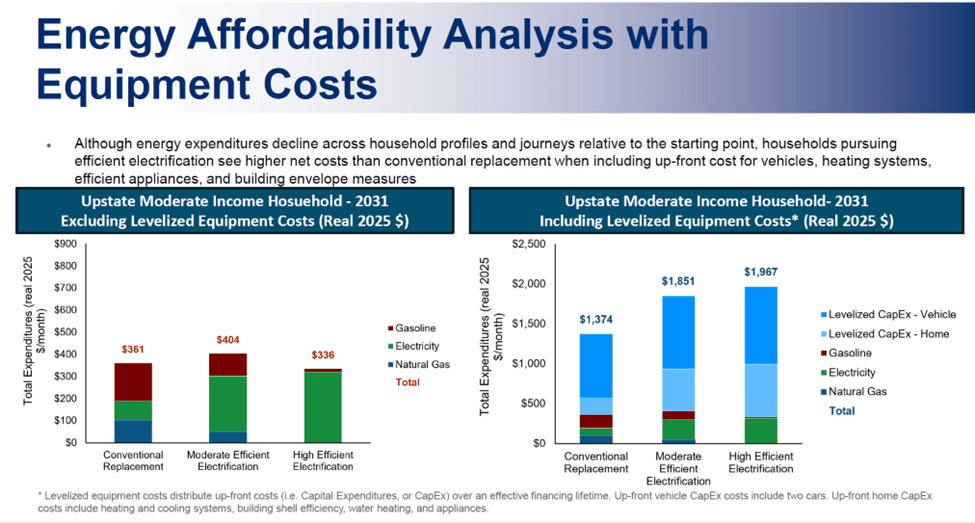
The Hochul Administration has covered up the costs buried in this figure. The equipment cost of Climate Act compliance is the difference between replacement of conventional equipment and the highly efficient electrification equipment. The difference for an upstate moderate‑income gas‑heated household is roughly a 43% increase in levelized monthly energy‑related costs—about $7,000 per year.
Hochul’s Proposal
Governor Hochul’s Empire Report op‑ed presents New York as a national leader on climate, highlighting offshore wind contracts, large-scale renewables, Champlain Hudson Power Express, and continued participation in RGGI as evidence that the State is on track and that affordability concerns are primarily the product of federal “headwinds” and local opposition. She argues that the Climate Act is “not the driver of the high energy prices we are experiencing,” and that limited, “common‑sense” adjustments to timelines and accounting will preserve ambition while avoiding “crushing costs” for households and businesses.
The op‑ed also shifts blame outward: to the Trump administration for hostility to renewables and tax incentives, to global events like the war in Iran for high fuel prices, and to local NIMBYism and siting barriers for delays in renewable deployment. What it does not do is confront the extent to which the design of the Climate Act itself, and the implementation choices made since 2019, hardwire higher costs and reliability risks into New York’s energy system.
Hochul’s opinion piece outlined revisions to NYCI but ignored the ramifications of PSL 66-P and the State Energy Plan. The following is a copy of the recommendations in her opinion piece. She introduces her revisions with some general recommendations:
It’s why I am pushing a Ratepayer Protection Plan that will hold utilities accountable, reform the process by which regulators consider rate hike requests, and make it easier for working families to learn about and access the state’s Energy Affordability Programs.
And to make sure we keep the lights and heat on and costs down for New Yorkers, I have adopted an all-of-the-above approach to energy that includes more renewables, emission-free, reliable round-the-clock nuclear, and other needed power sources.
The remainder of her recommendations are sure to infuriate the zealots who advocated for the law and demand that there be no changes. The only question is whether the Democratic lawmakers who have supported the Climate Act so far will acknowledge reality or double down on the current law.
It’s also why, despite supporting the intentions of the Climate Act, I am pushing changes to the law as part of our budget discussions with the Legislature. This is solely out of necessity – to protect New Yorkers’ pocketbooks and economy. Despite all the headwinds and obstacles that could not have been foreseen when the law was enacted in 2019, advocates still took the extreme step of suing the state to force it to issue regulations to meet the Climate Act’s 2030 emission reductions targets.
A judge agreed and ruled that the state must swiftly issue regulations to achieve what now would be costly and unattainable targets, unless the law is changed.
This refers to the NYCI economy-wide lawsuit and lays out the challenge to the Legislature who should change the law. Next ,she lays out the cost of NYCI compliance while ignoring the State Energy Plan costs for equipment needed to comply with the Climate Act.
I have repeatedly said that utility rates in our state are too high. And while the Climate Act is not the driver of the high energy prices we are experiencing, the undeniable fact is we cannot meet the Climate Act’s 2030 targets without imposing new and additional crushing costs on New York businesses and residents.
Absent changes to the law, the New York State Energy Research and Development Authority found the impact of meeting the Climate Act’s 2030 targets would be staggering—more than $4,000 a year for upstate oil and natural gas households, and $2,300 more for New York City natural gas households. And gas prices at the pump would jump an additional $2.23 per gallon above where it would otherwise be.
In the next paragraphs she piously claims that costs are too high.
As Governor, I can’t let that happen. While I am still committed to working toward our targets, with all the stress our residents are under, New Yorkers expect their elected officials to prioritize affordability. They are suffering from high costs every single day and I for one will not ignore their cries for relief.
This is utter hypocrisy given that she knows about the levelized costs to purchase equipment. In addition, it long past time that NYSERDA admit their analyses compare mitigation scenarios to a Reference Case that already embeds zero‑emission vehicle mandates and other policies, excluding large chunks of Climate Act cost from the “action” side while still counting their benefits. This biases cost low. We simply do not know how much this will cost. Hochul goes on to discuss schedule problems.
The fact is, we will be dealing with a White House outright hostile toward renewable energy for at least another three years, making it impossible for us to meet our targets without imposing higher costs on homeowners, renters, and businesses.
We need more time, and so I am proposing we amend the law to require regulations to reduce statewide greenhouse gas emissions to be issued at the end of 2030. We are seeking to change what emission limits the regulations are tied to – including a new 2040 target as well as the existing 2050 statewide emission limits. Nothing else in the CLCPA is changing regarding the existing statewide emission limit targets and these new regulations would still require the state to make timely progress, ensuring long-term policy stability.
The schedule targets mentioned must be changed because they cannot be achieved. The politicians who arbitrarily set deadlines must recognize that the energy system is more complicated than they thought in 2019. However, the bigger question is whether extending the deadlines will enable cost-effective implementation at any time.
Conclusion
The Climate Act has always been about politics. New York has a woeful history of legislative mandates on the energy system, but this has never stopped Albany lawmakers from trying again. Hochul’s pragmatic proposal is sure to infuriate the political constituency that advocated for the law and do not want changes. The changes proposed are unquestionably needed but they only address portions of the Climate Act.

 Pragmatic Environmentalist of New York