NY State Senate Energy and Telecommunications Committee Meeting 18 March 2025

On March 18, 2025 Senator Mattera invited Richard Ellenbogen to Albany to address the NY State Senate Energy & Telecommunications Committee regarding NY State’s energy situation.  This article describes the presentation and documents meeting materials and follow up information.

Ellenbogen is the President [BIO] of Allied Converters and frequently copies me on emails that address various issues associated with the New York Climate Leadership and Community Protection Act (Climate Act). I have published other articles by Ellenbogen including a description of his keynote address to the Business Council of New York 2023 Renewable Energy Conference Energy titled: “Energy on Demand as the Life Blood of Business and Entrepreneurship in the State -video here:  Why NY State Must Rethink Its Energy Plan and Ten Suggestions to Help Fix the Problems”. He is an engineer who truly cares about the environment and is an early adopter of renewable technologies at both his home and business.

Overview

The Climate Act established a New York “Net Zero” target (85% reduction in GHG emissions and 15% offset of emissions) by 2050.  It includes an interim reduction target of a 40% GHG reduction by 2030. The Climate Action Council (CAC) was responsible for preparing the Scoping Plan that outlined how to “achieve the State’s bold clean energy and climate agenda.”  After a year-long review, the Scoping Plan was finalized at the end of 2022.  Since then, the State has been trying to implement the Scoping Plan recommendations through regulations, proceedings, and legislation. 

Senate Energy and Telecommunications Committee Meeting

On March 18, 2025 Senator Mattera invited Richard Ellenbogen to Albany to address the NY State Senate Energy & Telecommunications Committee regarding NY State’s energy situation.  Senator Parker, the committee chair, was extremely gracious and essentially gave him an unlimited amount of time to describe his thoughts on utility decarbonization using existing technologies.  There is a video of the hearing available.   Ellenbogen’s presentation starts at 12:40.

Senator Parker has shown signs of pragmatism regarding the implementation of the Climate Act.  During the 2023 budget process he co-sponsored a bill to modify the Climate Act to use the 100-year global warming potential (GWP) that the Environmental Protection Agency and the Intergovernmental Panel on Climate Change use instead of the 20-year GWP mandated by the Climate Act.  The only reason to use the 20-year GWP is the irrational belief that methane is a significant threat to global climate.  New York’s environmental community went ballistic calling the proposed revision an attempt to gut the Climate Act.  The proposal was quietly withdrawn in response to the pressure.  Frankly, I thought that experience would mean that Ellenbogen’s presentation on the heretical idea that using natural-gas fired combined cycle combustion turbines with carbon capture (that can get a 90% CO2 reduction but not reach zero emissions) would be given short shrift but it wasn’t.

Ellenbogen Presentation

Ellenbogen referred to a handout during his presentation and the full version of the document is available.  He also referenced recent comments on  utility system decarbonization 15-e-0302 that provide more background information.  The remainder of this section describes highlights of the hearing with links to the video for each highlight.

Ellenbogen’s presentation started with a description of his background.  As noted in the introduction he has a proven record of reducing GHG emissions, waste reductions, and energy efficiency deployment at both his home and manufacturing facility.  He emphasized that his strategies reduced emissions significantly but did not eliminate them entirely so his efforts would not be enough to meet Climate Act mandates.

Ellenbogen made the point that the Climate Act authors placed too much reliance on Academic “Science”.  He gave an example describing how the emphasis on methane is misplaced.  I agree that the methane obsession in the Climate Act is irrational.

Ellenbogen offered to discuss his concerns about the results of Ignoring science during his summary of the problem.  His personal decarbonization experience made him aware of logistical issues so the labor and supply chain that are delaying the Climate Act strategies were no surprise to him.  He argues that physics makes the reliance on wind and solar an impossible proposition.  He has explained to me that the energy density of wind and solar energy is too low and the resource intermittency too variable to ever support a reliable electric system relying on those resources

Ellenbogen says that one of the huge issues is New York’s existing fossil load.  He described the following chart explaining that the first column is the load in 2019.  If we were to electrify everything you would get the second column because many of the electric technologies are more efficient.  The problem is that without energy storage the system breaks down.  The third column shows the energy storage in the NYSERDA report New York’s 6 GW Energy Storage Roadmap: Policy Options for Continued Growth in Energy Storage.  Column D lists the state plan for renewables in 2035.   The point of the graph is that the projected renewables do not come anywhere near what is needed.

Ellenbogen’s presentation argued that there is a better way that “adheres to reality”.  He believes that repowering existing power plants with combined cycle gas turbines gives a carbon reduction of “30 to 40%.”  Replacing the old units reduces emissions, decreases reliability risks because the old units are so old that they are more likely to fail, and because the combined cycle plants are more efficient, they would burn less fuel to produce the same amount of electricity.

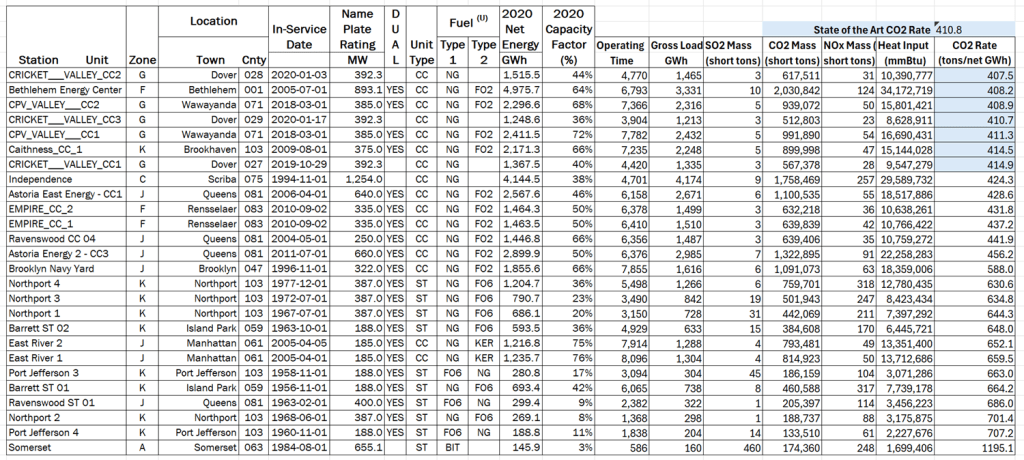
Note: I will eventually publish a post describing my supplemental emissions analysis of this proposal. For this article note that when I evaluated 2020 emissions and I found that if 45 existing New York fossil-fired units were replaced by state-of-the-art combined cycle natural gas fired combustion turbines, annual emissions would be reduced 16%. My results are lower than the Ellenbogen presentation because I did not account for the improved efficiency and resulting lower fuel use that would reduce emissions more.  Ellenbogen’s email description of the analysis provides background information until I do a detailed post on emissions.

Questions

I am not going to address all the questions and issues that were raised during the presentation.  The following are some highlights.

Senator Parker had questions about methane.  Ellenbogen responded that the emphasis on methane reductions is misleading because recent analysis shows that anthropogenic activities are not the primary source of methane in the atmosphere.   Consequently, reducing natural gas in New York is not going to significantly affect potential global warming.

 There was a cost discussion. Ellenbogen did not respond to the issues raised during the presentation because he needed to review recent information.  He did respond to the questions in a follow-up letter that referenced a Central Hudson response to a rate case question about the costs of the Climate Act.  It has been my experience that every issue I have looked at is more complicated than it appears at first glance.  Such is the case with the Central Hudson $4.269 trillion cost estimate based on the Scoping Plan.  Suffice to say here that there is a lot of uncertainty associated with that figure.  I have addressed some of the affordability problems recently but will explain the issues associated with the Scoping Plan cost estimates some other time.

I want to discuss is the comment by Parker that the state will not be repealing the Climate Act.  He asked Ellenbogen what we can do to make it successful.  Ellenbogen responded that we need to broaden the terms to overcome physics reality.  He explained that the energy density of wind and solar is insufficient for what is needed.  Intermittency is another issue because it needs over-building and storage.  Ellenbogen’s recommendation is for a non-zero alternative because it is energy-dense and dispatchable.  There still are significant reductions but reliability risks are eliminated.

Parker said he would need to see the difference between the various options described.  We know  existing emissions levels but he also wants to see the improvements due to more efficient combined cycle units and the improvements if carbon capture is added to that.  The analysis of mine described earlier was prepared to directly respond to these questions.

When Ellenbogen was asked for recommendations going forward, he said “We have to be realistic” because the reality is that physics and math limit what can be done for the transition.  That leads to his recommendation to pursue combined cycle combustion turbines with carbon capture until other proven zero-emissions technologies like nuclear can be deployed.

Parker re-iterated his request for emission numbers and noted that the timeline may have to shift to accommodate numbers and physics.  He admitted that we are not on track for a variety of reasons.  More importantly he also said that  at the end of the day NY is not going to solve the climate crisis but we can still provide leadership.

Discussion

Ellenbogen’s recommendation is a pragmatic solution that I support.  Unfortunately, there was no one at this hearing who was aware of the recent history of re-powering proposals for combined cycle natural gas plants and relevant nuances of the Climate Act that make this approach a tough sell.

For example, at one point Senator Parker stated that if there are companies out there that want to submit proposals for combined cycle plants, they should submit proposals.  The problem is that three repowering project applications have all been rejected or withdrawn since the Climate Act passed.  The Danskhammer Energy Center proposed a replacement gas-fired combined-cycle combustion turbine but DEC denied the permit  stating that “The proposed project would be inconsistent with or would interfere with the statewide greenhouse gas emissions limits established in the Climate Act.”  Although not a combined cycle proposal, NRG Energy proposed replacing their old units with modern units but the DEC decision letter claimed that “the Project would be inconsistent with or would interfere with the attainment of the Statewide greenhouse gas (GHG) emission limits established in Article 75 of the Environmental Conservation Law (ECL)”.  A subsidiary of Eastern Generation LLC proposed to repower their old turbines at Gowanus and Narrows with modern simple cycle turbines.  As far as I could tell everyone at this hearing understood the benefits of replacing old with new and trying to avoid stranding the investments.  This development was for barge mounted turbines.  Once it was clear that they could be replaced with something consistent with the Climate Act they could have been moved elsewhere but the company withdrew their application because of DEC’s position on consistency with the Climate Act.

There also is a problem with the recommendation to capture the carbon.  My reading of the Climate Law is that it prohibits the use of carbon capture and sequestration for an electric generating unit.  The references to sequestration in the law are associated with the definition of “Greenhouse gas emission offset projects” that includes the following project: carbon capture and sequestration.  Section 75-0109 “Promulgation of regulations to achieve statewide greenhouse gas emissions reductions (4. a.)” states that “The department may establish an alternative compliance mechanism to be used by sources subject to greenhouse gas emissions limits to achieve net zero emissions.”  However, carbon capture and sequestration at electric units is expressly prohibited in § 75-0109, (4,f) “Sources in the electric generation sector shall not be eligible to participate in such mechanism.”

Conclusion

I was very encouraged by the meeting.  Senator Parker’s admission that there are implementation issues and course corrections are necessary is refreshing because most of his colleagues have not shown any departure from the orthodoxy.  At one point during the meeting Senator Mattera and Senator Parker agreed on the need to be more flexible which Richard Ellenbogen notes is the equivalent of seeing a Unicorn.  All this suggests that there might be support for a course correction of the Climate Act.

Nonetheless, I want to point out that at the end of the meeting Ellenbogen left a gift for Albany – a wand in a glass case with a note saying  in case of a blackout break glass.  A magical solution still may be the last hope.

Are New Yorkers Willing to Pay for the Climate Act?

Last December the Empire Center did a poll that asked questions about the Climate Leadership & Community Protection Act (Climate Act).  I missed it at the time, but the results are striking. This post describes the results and takes a deeper look at the willingness to pay question. 

I am convinced that implementation of the Climate Act net-zero mandates will do more harm than good because the proposed green energy programs are crimes against physics.  The energy density of wind and solar energy is too low and the resource intermittency too variable to ever support a reliable electric system relying on those resources. If this reality is not acknowledged soon and these policies paused, then the enormous costs of this futile gesture to control the climate will bankrupt the state. 

I have followed the Climate Act since it was first proposed, submitted comments on the Climate Act implementation plan, and have written over 500 articles about New York’s net-zero transition.  The opinions expressed in this article do not reflect the position of any of my previous employers or any other organization I have been associated with, these comments are mine alone.

Overview

The Climate Act established a New York “Net Zero” target (85% reduction in GHG emissions and 15% offset of emissions) by 2050.  It includes an interim reduction target of a 40% GHG reduction by 2030. The Climate Action Council (CAC) was responsible for preparing the Scoping Plan that outlined how to “achieve the State’s bold clean energy and climate agenda.”  After a year-long review, the Scoping Plan was finalized at the end of 2022.  Since then, the State has been trying to implement the Scoping Plan recommendations through regulations, proceedings, and legislation. 

Poll Overview

The Empire Center, based in Albany, is an independent, not-for-profit, non-partisan think tank dedicated to promoting policies that can make New York a better place to live, work and raise a family.  In the interests of full disclosure, I am an adjunct fellow of the Empire Center. 

They sponsored a survey late last year. The Empire Center announcement of the survey says it canvassed 1,021 New York registered voters (margin of error: 3 percent) and was conducted by Morning Consult in mid-December 2024. The toplines and crosstabs can be viewed here.  For survey neophytes like me the topline lists the questions and the overall results.  Crosstabs breakdown the responses by the characteristics of the people polled.  There were 38 questions in the survey and 16 questions about the demographics of the respondents.  The crosstabs provides the breakdown of questions by the demographic categories.

Questions about the Climate Act were in the minority.  Most of the questions were related to the value of taxes paid – “New Yorkers by a margin of more than two-to-one said they aren’t getting their money’s worth from taxes they pay in the state”.  Other questions addressed the education system

There were six questions about the Climate Act.  I will address the first two questions in this article but will only list the others below.

Climate Act Awareness

Knowing what I understand about this law it is frustrating that there is so little pushback associated with it.  The only reason I could think of is that the majority of New Yorkers are unaware of it.  The question “How familiar are you, if at all, with the provisions of the Climate Leadership and Community Protection Act (also known as CLCPA or the Climate Act) that was signed into law in New York in 2019?” confirms my suspicion.

The survey found that 45% of the people polled had never heard of it and another 24% had heard of it, but didn’t know what it is.  In my opinion, if they only have a general sense what it is (another 19%) then they are probably unaware of how much it will cost.  That means 88% of the people polled do not know what is coming in enough detail to understand its impacts on affordability, personal choice, reliability, and environmental impacts.

I believe that the biggest trigger for demands to pause this will be the costs so let’s talk about those results.

Willingness to Pay

I have never seen any poll regarding a willingness to pay that did not find most people are unwilling to pay very much.  This is proof of Roger Pielke’s Iron Law of Climate “While people are often willing to pay some price for achieving climate objectives, that willingness has its limits.”

This poll is no different.  One third of the respondents are not willing to anything on their monthly energy bill for cleaner energy.  Another 28% are only willing to pay up to $20 a month for cleaner energy while another 20% would pay up to $40 a month.  Nineteen percent are willing to pay up to $200 a month but only 3% are willing to pay more than $200 per month. Another 7% did not know or had no opinion.

I recently submitted comments about affordability in Proceeding 22-M-0149 “Assessing Implementation of and Compliance with the Requirements and Targets of the Climate Leadership and Community Protection Act”.  On March 26, 2025, Jessica Waldorf, Chief of Staff and Director of Policy Implementation for the Department of Public Service (DPS) posted a letter responding to a letter from Michael B. Mager Counsel to Multiple Intervenors that had been submitted earlier in March to Chair of the Public Service Commission Rory Christian regarding the affordability standard.  The Mager letter from the Multiple Intervenors pointed out that the DPS and New York State Energy Research & Development Authority (NYSEDA) were supposed to provide an annual report describing Climate Act implementation costs.  No report was produced in 2024 and the letter asked when the next report would be provided.  Waldorf’s response made no commitment.  Given the politicization of all New York agencies and the willingness to pay results I don’t think that it is surprising that the Hochul Administration is stonewalling those estimates because I am sure that they will probably exceed $200 a month.

National Grid Long-Term Gas Plan

In a recent post I described the comments I submitted on Case 24-G-0248 Review of the Long-Term Gas System Plan for National Grid.  That plan describes how the three National Grid operating companies intend to transition away from natural gas out to 2050. 

I was frankly surprised with the costs for just this component of Climate At transition plan.  The scenarios include a reference case, CEV or “clean energy vision”, and AE or “accelerated electrification”.  The difference between the reference case and the CEV scenario represents the minimum cost of the Climate Act.  The following tables are from the Long-Term Gas System Plan document.

The 2030 average monthly increase for National Grid customers in the former Niagara Mohawk service territory ranges from a 50% increase to a 96% increase.  The Climate Act cost by 2030 is $57 additional per month.

Table 12-11: Niagara Mohawk Bill Impacts by Scenario

The 2030 average monthly increase for National Grid customers in the former Brooklyn Union Gas service territory ranges from a 65% increase to a 148% increase.  The Climate Act cost by 2030 is $43 additional per month.

Table 12-12: Brooklyn Union Gas Company Bill Impacts by Scenario

The 2030 average monthly increase for National Grid customers in the former Key Span service territory on Long Island ranges from a 41% increase to a 90% increase.  The Climate Act cost by 2030 is $44 additional per month.

Table 12-13: KeySpan Gas (LILCO) Bill Impacts by Scenario

Willingness to Pay for National Grid Long-Term Gas Plan

In the National Grid Long-Term Gas Plan, the expected increase in price to implement the “clean energy vision” exceeds $40 per month for all three service companies.  Table 1 lists the willingness to pay $40 per month for selected demographics of the survey participants.  Note that 71% of respondents when polled said that they were unwilling to pay more than $40 per month.  I am not going to discuss the demographic breakdowns but present them for your edification.

Table 1: Empire Center Willingness to Pay for Increased Energy Costs Relative to National Grid Expected Gas System Transition Costs of at least $40 per Month Additional by 2030

Discussion

The electric and gas utilities must invest in programs that will implement the Climate Act mandates and those costs are starting to show up in their rate case proceedings.  The National Grid long-term plan to transition the gas system out of existence which is necessary to comply with the Climate Act is but one example.  The expected cost increase by 2030 to fulfill the clean energy vision is more than $40 per month.  Only 22% of the people polled were willing to pay that much.

That is only one cost component for New Yorkers.  Electric bills will need to increase by at least the same amount to pay for the infrastructure necessary to electrifying everything.  The New York Cap-and-Invest program is nothing more than a tax on carbon that will necessarily increase the cost of gasoline and heating fuels.  To electrify homes and transportation individual investments will be necessary.  I believe that when people finally figure out that there is law in place that will markedly increase their energy costs that there will be a reckoning.  I also believe that the Hochul Administration is fully aware of the ramifications of Climate Act costs on the next election.  Consequently, they are slow walking the mandates to provide cost information.

In the meantime, the politicians will be more than willing to let the utilities take the heat for the inevitable major cost increases.  No doubt they will simultaneously forbid the utilities to explicitly break out the Climate Act costs in their bills and demand that they lower their rate case proposals.

Conclusion

Any way you look at the willingness to pay question response, the Empire Center survey confirms Roger Pielke Jr’s Iron Law of Climate.  People polled are not willing to pay much for the net-zero aspirations of the Climate Act if 50% are unwilling to pay more than $10 per month for cleaner energy.  It is troubling that 88% of the New Yorkers polled had no more than a general sense of the Climate Act and many had never heard of it.  This is setting up a reckoning for all the politicians that foisted the Climate Act on New Yorkers.  It is inevitable that the politicians will reconsider and give up on it or be voted out for utter stupidity.  The only question is whether political reality will occur before the electric and gas system is destroyed and costs bankrupts the state.

More Reasons to Pause Climate Act Implementation April 16 2025 Edition

I am very frustrated with the New York Climate Leadership & Community Protection Act (Climate Act) net zero transition because the reality is that there are so many issues coming up with the schedule and ambition of the Climate Act that it is obvious that we need to pause implementation and figure out how best to proceed.  This article describes additional reasons to pause implementation.

I am convinced that implementation of the Climate Act net-zero mandates will do more harm than good because the proposed green energy programs are crimes against physics.  The energy density of wind and solar energy is too low and the resource intermittency too variable to ever support a reliable electric system relying on those resources. If this reality is not acknowledged soon and these policies paused, then the enormous costs of this futile gesture to control the climate will bankrupt the state. 

I have followed the Climate Act since it was first proposed, submitted comments on the Climate Act implementation plan, and have written over 500 articles about New York’s net-zero transition.  The opinions expressed in this article do not reflect the position of any of my previous employers or any other organization I have been associated with, these comments are mine alone.

Overview

The Climate Act established a New York “Net Zero” target (85% reduction in GHG emissions and 15% offset of emissions) by 2050.  It includes an interim reduction target of a 40% GHG reduction by 2030. The Climate Action Council (CAC) was responsible for preparing the Scoping Plan that outlined how to “achieve the State’s bold clean energy and climate agenda.”  After a year-long review, the Scoping Plan was finalized at the end of 2022.  Since then, the State has been trying to implement the Scoping Plan recommendations through regulations, proceedings, and legislation. 

Protecting American Energy from State Overreach

On April 8 President Trump issued an Executive Order protecting American energy from state overreach.   The purpose of the order: “My Administration is committed to unleashing American energy, especially through the removal of all illegitimate impediments to the identification, development, siting, production, investment in, or use of domestic energy resources — particularly oil, natural gas, coal, hydropower, geothermal, biofuel, critical mineral, and nuclear energy resources.”

New York earned a specific callout:

Many States have enacted, or are in the process of enacting, burdensome and ideologically motivated “climate change” or energy policies that threaten American energy dominance and our economic and national security.  New York, for example, enacted a “climate change” extortion law that seeks to retroactively impose billions in fines (erroneously labelled “compensatory payments”) on traditional energy producers for their purported past contributions to greenhouse gas emissions not only in New York but also anywhere in the United States and the world.  

But wait there’s more.  Trump implicitly addresses New York’s carbon taxation cap and invest plan:

Other States have taken different approaches in an effort to dictate national energy policy.  California, for example, punishes carbon use by adopting impossible caps on the amount of carbon businesses may use, all but forcing businesses to pay large sums to “trade” carbon credits to meet California’s radical requirements.  Some States delay review of permit applications to produce energy, creating de facto barriers to entry in the energy market.

The first section ends with this: “These State laws and policies are fundamentally irreconcilable with my Administration’s objective to unleash American energy.  They should not stand.”

Section 2 starts with this:

State Laws and Causes of Action.  

  • The Attorney General, in consultation with the heads of appropriate executive departments and agencies, shall identify all State and local laws, regulations, causes of action, policies, and practices (collectively, State laws) burdening the identification, development, siting, production, or use of domestic energy resources that are or may be unconstitutional, preempted by Federal law, or otherwise unenforceable.  The Attorney General shall prioritize the identification of any such State laws purporting to address “climate change” or involving “environmental, social, and governance” initiatives, “environmental justice,” carbon or “greenhouse gas” emissions, and funds to collect carbon penalties or carbon taxes.
  • The Attorney General shall expeditiously take all appropriate action to stop the enforcement of State laws and continuation of civil actions identified in subsection (a) of this section that the Attorney General determines to be illegal. 

That section also notes that the report from the Attorney General is due in 60 days.  I imagine that the report will prominently feature New York’ Climate Act as impeding American energy.  I think even the fanatics in the Hochul Administration are realizing that Climate Act implementation is going to be ruinously expensive even if it works and there are signs that it won’t.  However, admitting this will open the Administration to attacks that they are not trying hard enough.  What better excuse to pause than to blame this Trump Executive Order?

Electric Vehicle Mandates are Failing

Paul Homewood at Not a Lot of People Know That published three recent articles describing the progress of electric vehicle mandates in Great Britain.  There are no encouraging signs that it is working.

In the first article he documents that the electric vehicle (EV) sales figures are lower than the mandates. 

The second article notes that the EV costs are not coming down as projected which no doubt contributes to the poor sales.  He concludes with a note describing the government’s long awaited announcement of the new plans to rollout EVs.  He notes: “But strip away the waffle, greenwash and gaslighting, and we are left with rearranging to deckchairs on the Titanic to a higher deck, so that they don’t sink below the waves quite as soon!”

There is no way that the EV projections and rollout will be any different in New York.

Green Energy Jobs

Proponents of the Climate Act claim that the investments in green energy are creating new economic activity in New York.  The 2024 Clean Energy Industry Report claims in a factsheet that “New York’s clean energy industry gained 7,700 jobs between 2022 and 2023”.  I recently ran across a well-documented post by JoNova that suggests that this claim is a biased assessment:

It’s not rocket science. If energy costs more, that means we have to make do with less of it, or make do with less of something else. Thus if the government forces everyone to pay more for electricity, companies have less spare cash to employ people. Their margins are tighter, they can’t make and sell as many products. So when we are told the clean energy revolution is creating jobs, is it virtually self-evident that’s a mythical fairy claim.

Her article quotes analyses that show that each green job in Britain costs £100,000 (and 3.7 other jobs); in Spain for every green job created 2.2 jobs were lost; in Italy, each green job cost 5 jobs from the rest of the economy; in Germany, the subsidies far exceed the wages of the jobs created; and in Denmark wind power reduces the GDP.  If there is a full accounting of the costs of the Climate Act provided we will be able to calculate the cost per job created.  I doubt that New York will perform any better than the European countries when a final job accounting is completed.  

Pausing to assess whether the job benefits are real is not the only jobs-related issue.  The bigger problem is that the work needed relies on skilled tradespeople and there simply are not enough available to do what needs to be done.

Necessity for Nuclear Challenge

I have frequently written about the dispatchable emissions free resource (DEFR) necessary to keep the lights on during extended periods of low wind and solar resource availability in the Scoping Plan proposed electric system.   One major problem is that there are no commercially available DEFR resources.  I think the most promising DEFR backup technology is nuclear generation because it is the only candidate resource that is technologically ready, can be expanded as needed and does not suffer from limitations of the Second Law of Thermodynamics. However, it is not really ready to fulfill New York’s needs.

Ted Nordhaus describes the issues that the nuclear industry has to overcome before we can deploy it in New York effectively: “Rebooting the US nuclear sector for the 21st century is a hard problem in the face of an ossified industry, an overbearing and underprepared regulator, liberalized electricity markets that are ill-suited to investing in large public works projects, and competition from both cheap gas and a mature, subsidized renewables industry.”

Clearly it would be prudent to pause renewable development until DEFR feasibility is proven because nuclear generation may be the only viable path to zero emissions and that will not be ready to deploy as needed to meet the aspirational Climate Act schedule..

Implication of Assessment of Extreme Renewable Resource Lulls

Note: A version of this article was posted at Watts Up With That

I am convinced that implementation of the New York Climate Leadership & Community Protection Act (Climate Act) could have devastating impacts on New York residents as long if proponents ignore lessons that could be learned elsewhere and continue down the current path.  This post describes work done in Great Britain that has direct bearing on New York’s implementation plans and shows we need to re-think the tradeoffs of Climate Act implementation.

I believe that implementation of the Climate Act net-zero mandates will do more harm than good if the future electric system relies only on wind, solar, and energy storage because of reliability and affordability risks.  I have followed the Climate Act since it was first proposed, submitted comments on the Climate Act implementation plan, and have written over 500 articles about New York’s net-zero transition.  The opinions expressed in this article do not reflect the position of any of my previous employers or any other organization I have been associated with, these comments are mine alone.

Overview

The Climate Act established a New York “Net Zero” target (85% reduction in GHG emissions and 15% offset of emissions) by 2050.  It includes an interim reduction target of a 40% GHG reduction by 2030. The Climate Action Council (CAC) was responsible for preparing the Scoping Plan that outlined how to “achieve the State’s bold clean energy and climate agenda.”  After a year-long review, the Scoping Plan was finalized at the end of 2022.  Since then, the State has been trying to implement the Scoping Plan recommendations through regulations, proceedings, and legislation.  Recently, the State initiated the State Energy Plan process to update it to be consistent with the Climate Act.  It is not clear whether this proceeding will consider stakeholder comments that were ignored during the Scoping Plan process.

Renewable Resource Lulls

The Scoping Plan, Integration Analysis, New York Independent System Operator (NYISO), New York Department of Public Service, the New York State Reliability Council, and others all have noted that a new category of generating resources called Dispatchable Emissions-Free Resources (DEFR) is necessary to keep the lights on during periods of extended low wind and solar resource availability.  The frequency, duration, and intensity of wind and solar availability gaps must be known to properly plan to provide the generation, storage, and DEFR resources necessary to maintain reliable service.  Analyses done by the New York State Reliability Council Extreme Weather Working Group have shown that extended periods of low wind and solar resource availability will be challenging for the future New York electric system. 

On December 24, 2024 I submitted testimony for the December 18, 2024, Assembly Standing Committee on Energy Public Hearing regarding NYSERDA Spending and Program Review. I noted that the biggest feasibility challenge is the identified “gap” when wind and solar resources are low for long periods.  As one example of appropriate feasibility funding, I recommend analyzing the variability in low wind and solar resource availability.  The characteristics of the resource gaps must be quantified not only for New York but also for adjoining regional systems presuming that they also transition to an electric system with a similar reliance on wind and solar.

The Independent System Operator of New England (ISO-NE) Operational Impact of Extreme Weather Events  completed an analysis that addresses this need for New England.  The study evaluated 1-, 5-, and 21-day extreme cold and hot events using a database covering 1950 to 2021. The results found that the system risk or “the aggregated unavailable supply plus the exceptional demand” during an event increased as the lookback period increased.  If the resource adequacy planning for New England only looked at the last ten years, then the system risk would be 8,714 MW, but over the whole period of record, the worst system risk was 9,160 MW which represents a resource increase of 5.1%.  This means that the low renewable resource analysis should cover as long a period as possible to determine the longest period of exceptional demand and low renewable resources.

Great Britain Renewable Assessment

David Turver blogs about energy issues in Great Britain. In an October 2023 post  he describes a report from the Climate Change Committee (CCC),  their equivalent to New York’s Climate Action Council. He explains that the Royal Society (RS) Large Scale Electricity Storage report authored by Professor Chris Llewellyn-Smith claims that Great Britain can meet its demand for electricity with wind and solar, supported by large-scale hydrogen storage.  Large-scale hydrogen storage is the placeholder DEFR technology in the Scoping Plan, so this analysis is directly applicable to New York’s DEFR resource issue.

Turver argues that the report is deeply flawed. Among his concerns are the following:

They begin by assuming that electricity demand will be 570TWh in 2050 which represents roughly halving the energy demand across residential, transport and industrial and commercial categories. The evidence from Our World in Data shows that rich economies require high energy consumption to thrive. There are no rich countries with low energy consumption and those countries that have reduced energy consumption have grown more slowly, or even shrunk. The first extraordinary claim of low energy consumption fails because the evidence shows that if we allow that to happen, we will be much poorer.

The report then goes on to assume that the profile of electricity demand will be the same as today. However, as we move from gas to electricity to heat our homes and offices, the winter surge in electricity demand will be further exaggerated. Moreover, demand will change from year to year such as during the cold winter in 2010 that also coincided with a calm period when we would have generated much less renewable electricity. These variations in demand profile will lead to more generation capacity and an even bigger energy store than RS assumes, pushing up costs.

He goes on to argue that there are other flaws.  the report assumes unrealistic load factors for both onshore and offshore wind. It underestimates the amount of offshore wind needed and goes on to assume efficiencies and costs for hydrogen electrolysers, storage, and generation that do not stand up to scrutiny.  He also points out that the economic assumptions are flawed. 

He describes the “main positive aspect of the report”:

The thing that stands out most is the painstaking analysis that has been conducted to understand the very significant changes in the weather that occur on yearly and decadal timescales. They analysed wind and solar records over 37 years to estimate the level of variation we might expect from wind power.

In a recent article Turver includes a graphic that shows this issue using the 37 year database.

The analysis of 37 years is longer than anything done to date for New York.  He also points out an aspect of DEFR that relies on hydrogen storage that I had not considered previously.  It is not just the annual worst-case episode but there can be multi-year issues:

They found that we can sometimes have several consecutive years where the wind speed is lower than average. This means that if we are to have a grid powered solely by wind, solar and storage, then we need to build up massive stores of energy in the windy years to be used in the calmer years. They conclude that to consistently deliver their 570TWh of electricity each year, we would need 123TWh of hydrogen storage. Some of that hydrogen may have to be stored for a decade or more before it is used.

He also points out that the requirement for decadal storage is another flaw for any DEFR backup resource:

This has important implications for the economics of storage and effectively rules out batteries as the storage medium. Who would want to spend millions on building a battery or hydrogen storage cavern, even more to fill it and maintain it, yet not see any revenue from it for years after it was completed?

DEFR Backup Reliability Risk

Turver’s article raises the ultimate reliability risk for a weather-dependent electric system.  Today’s electric system resource planners for a conventional system base the amount of capacity that they think will be needed based on decades of observations of the fallibility of power plants.  The result is that they know the probability there will be a shortage of available capacity to meet load when the installed reserve system capacity margin is a fixed percentage of the expected load very well.  In New York State the installed reserve margin to meet the accepted probability of a loss of load expectation of an outage no more than once in ten years reliability metric is around 20%.

A fundamental observation is that there is no expectation that the failure of conventional power plants will be correlated.  We do not expect that many will fail at the same time.  That in turn means that even if we decided to set the reliability metric based on a one in thirty-year probability that there would not be much of an increase in the installed reserve margin.

That all changes when the electric system transitions to one dependent upon wind and solar weather-dependent resources.  We know that solar energy is zero and night and much lower in the winter.  Similarly, we know that wind energy is much lower in a high-pressure system, and that those systems are huge and cover all Great Britain and much of western Europe or eastern North America at the same time.  Exacerbating the problem is the fact that those conditions are associated with the hottest and coldest episodes with the greatest expected electric loads.

Turver’s post shows that looking at one year is absurd.  Not looking at the worst year on record is nearly as bad: “They used 1987 as a 1-in-20 year stress test, when they admit that 2010 was a 1-in-50 year event”.  The insurmountable problem is that we know that if an even longer period of record was used there would very likely be an even worse event.  Instead of the confidence in the current planning process that increasing the lookback period will not markedly change the resources needed for the worst case, relying on weather-dependent resources means that inevitably there will be a period of extreme weather that exceeds the planning criteria chosen and the expected resources based on those criteria.  The costs to provide DEFR backup support will be extraordinary and building excess capacity for a very rare event will significantly add to those costs.  This trade-off means that eventually there will be a catastrophic blackout when the load exceeds the storage capacity.

Conclusion

Turver’s articles are further evidence of the DEFR “gap” problems for any electric system that relies upon weather-dependent renewable resources.  The first problem is that you have to determine how much DEFR capacity is needed using as long record as possible.  The second problem is that there is no commercially available DEFR technology that is available to deploy for the aspirational Climate Act targets.  Thirdly, until a DEFR strategy is proposed we have no idea how much this will all cost so any claims that the Climate Act will be “affordable” are incomplete.  Finally, there is the insurmountable weather-related probability that eventually there will be a unusual set of weather conditions and load requirements that exceed the DEFR resources deployed. 

To sum up: we know that a new resource will be needed, we don’t know how much, what it will be, how much it will cost, and that whatever we do eventually it won’t be enough so people will die in a catastrophic blackout.  This is insanity.

Energy Plan Board Meeting Misleading Information – Climate Change Impacts are Here

I recently wrote an article about the claim that renewable energy can reduce costs in the presentation by Jeff Freedman from the Atmospheric Sciences Research Center, University at Albany at the Energy Planning Board on March 3, 2025.  I concluded that the claim is based on hope not evidence.  Dr. Freedman’s presentation also included slides that support the Hochul Administration narrative that Greenhouse Gases (GHG) are the cause of the observed increases in global temperature and that the impacts of that warming are evident today.  This article explains why I disagree with those claims in Freedman’s presentation.

I am convinced that implementation of the New York Climate Leadership & Community Protection Act (Climate Act) net-zero mandates will do more harm than good if the future electric system relies only on wind, solar, and energy storage because of reliability and affordability risks.  I have followed the Climate Act since it was first proposed, submitted comments on the Climate Act implementation plan, and have written over 500 articles about New York’s net-zero transition.  The opinions expressed in this article do not reflect the position of any of my previous employers or any other organization I have been associated with, these comments are mine alone.

Energy Plan Overview

According to the New York State Energy Plan website (Accessed 3/16/25):

The State Energy Plan is a comprehensive roadmap to build a clean, resilient, and affordable energy system for all New Yorkers. The Plan provides broad program and policy development direction to guide energy-related decision-making in the public and private sectors within New York State.

The current Plan was initially published in 2015, and updated in 2020, when it was amended to align with the objectives of the 2019 Climate Leadership and Community Protection Act (Climate Act). Since the last update, the Climate Action Council produced its Scoping Plan, examining many of the energy issues that contribute to climate change and offering recommendations that are currently being implemented by the State.

On September 9, 2024, the Hochul Administration initiated the State Energy Plan process to update the Plan consistent with the Climate Act.  The goal of the planning process is to “map the state’s energy future by showing how the state can ensure adequate supplies of power, reduce demand through new technologies and energy efficiency, preserve the environment, reduce dependence on imported gas and oil, stimulate economic growth, and preserve the individual welfare of New York citizens and energy users.” The major question that must be addressed is whether the Hochul Administration will use the energy planning process as an opportunity to consider the advice of stakeholders in its stakeholder process or just an obligation with no attempt to meaningfully engage with any comments inconsistent with the narrative.

If the March 3 meeting is any indication, then the Energy Plan will be another political show extolling the virtues of the Climate Act and ignoring anything inconsistent with the political narrative.  In other words, it looks just like the Scoping Plan process.  Many of the appointees to the Climate Action Council chosen to approve the Scoping Plan were chosen because of their position within the Hochul Administration or political connections and not their technical expertise.  One feature of the Scoping Plan process was the New York State Energy Research & Development Authority (NYSERDA) strict adherence to the political narrative rather than full disclosure of inconsistent issues.  This article addresses several arguments made in the NYSERDA presentation by Freedman that misled the Energy Planning Board members.

Narrative Support

Climate Leadership & Community Protection Act Section 1. Legislative findings and declaration, subsection 3 defines the narrative:

Action undertaken by New York to reduce greenhouse emissions will have an impact on global greenhouse gas emissions and the rate of climate change. In addition, such action will encourage other jurisdictions to implement complementary greenhouse gas reduction strategies and provide an example of how such strategies can be implemented. It will also advance the development of green technologies and sustainable practices within the private sector, which can have far-reaching impacts such as a reduction in the cost of renewable energy components, and the creation of jobs and tax revenues in New York.

The  presentation slides for the March 3 meeting included Freedman’s Key Findings slide that support this narrative.   The first finding says that “Climate change is already constraining some sources of energy supply and stressing transmission and distribution infrastructure through extreme heat, changes in precipitation, and increasing storm intensity”.  The implication is that reducing GHG emissions in New York will affect the rate of climate change which they claim has already become evident.  The second finding that “Patterns of energy demand are shifting due to climate change and are expected to continue evolving over the coming decades” explicitly states that impacts are observable.

These findings were presented to the Energy Planning Boad as unequivocal statements of fact.  In reality, there is significant uncertainty that should be considered in the draft Energy Plan.

Comparison of CO2 and Global Temperature

The common basis of the threat of climate change caused by human emissions of GHG is the graph comparing the concentration of CO2 and global temperatures that was included in Freedman’s presentation.  There is no question that increasing the concentration of GHG in the atmosphere will reduce the out-going long wave radiation which will warm the atmosphere, and the graph shows a correlation.  However, the conclusion that reducing New York’s GHG will affect global temperatures and the alleged weather impacts given the small contribution to the global concentration is unwarranted.

Esteemed climate scientist Richard Lindzen describes the energy budget in context:

The energy budget of this system involves the absorption and re-emission of about 200 watts per square meter. Doubling CO2 involves a 2% perturbation to this budget. So do minor changes in clouds and other features, and such changes are common. In this complex multifactor system, what is the likelihood of the climate (which, itself, consists in many variables and not just globally averaged temperature anomaly) is controlled by this 2% perturbation in a single variable?

Lindzen points out that believing this is “pretty close to believing in magic”.  Nonetheless, Freedman presents the graph of CO2 concentration and global temperature without any mention of the shortcomings and complexities of the climate system.

My point is that this is not as obvious a relationship as claimed.  Sabine Hossenfelder produces You Tube videos on science and technology.  Her climate change-related videos generally adhere to the narrative, but she has shown signs of waking up to reality. Peter Ridd commented on her awakening noting that she does not quite get there.  I call your attention to Ridd’s commentary where he talks about uncertainties about how the earth’s weather system works. Especially relevant to Freedman’s graphic is Ridd’s explanation of temperature and CO2 concentrations going further back in time than Freedman’s graph.  Ridd points out in the following graph that temperatures were higher many times in the last 10,000 years at the same time that CO2 concentrations were lower.  That directly contradicts the notion that global temperature is primarily driven by anthropogenic CO2 concentrations.

Climate vs. Weather

Freedman perpetuates the Climate Act myth that climate change is increasing extreme heat, changes in precipitation, and increasing storm intensity with a graph that shows increasing storm events in New York from 2001 to 2024.  In general, climate is what you expect, and weather is what you get.  To determine what you expect from climate, meteorologists use a 30-year climatological average.  Therefore, to have a climate trend you need to look at the difference between two 30-year averages at a minimum.  Freedman’s graph is a weather average trend unsuitable for making any climate trends claims.

After I drafted this article Anthony Watts summed up my problems with claims that climate change is an existential threat in a post entitled “Is Climate Change Real? Short Answer: Yes — But It’s Complicated.”  I published an article that quoted the article with my annotated comments relating the points he made to the Climate Act.  I highly recommend reading that aartilce.

Basis for Narrative Claims

Expert presentations designed to promote the Climate Act narrative to an audience such as the Energy Planning Board often cite the results of modeling.  In this instance there is a slide that describes the “effects of climate change on renewable energy distribution in New York State” based on “results from high-resolution dynamic downscaling”.  Sounds very scientific and above reproach.

The grid size for CMIP5 (Coupled Model Intercomparison Project Phase 5) climate models typically ranges between 125 km to 300 km.  This is too coarse for predicting the impacts of climate change on New York so higher-resolution regional models have been used in projects sponsored by NYSERDA to project impacts.  This process is called dynamical downscaling.  Unmentioned are the errors and inherited biases in the process from the Global Climate Models (GCM) for the following:

  • Temperature trends: Persistent warm/cold biases in coastal and inland regions, exacerbated by future GCM projections exceeding historical maxima.
  • Precipitation patterns: Systematic underestimation of seasonal rainfall in regions like the Caribbean and Southern Africa.
  • Extreme events: Misrepresentation of high-frequency, low-intensity rainfall (“drizzle problem”) due to GCM limitations.

I think that those issues underestimate the problems because the fact is the GCM projections do not include the physics of clouds.  The problem is that coarse grid size cannot incorporate precipitation or extreme events.  This is not to say that the models don’t predict storms, just keep in mind that they are little more than guesses strongly influenced by the biases of the modelers. 

There are structural RCM limitations that introduce their own errors despite higher grid size resolution:

  • Simplified physics: Inadequate representation of convective processes and local interactions (e.g., lake effects).
  • Scale mismatches: Difficulty resolving sub-grid features even at 10–50 km resolutions.
  • Computational constraints: Limited ability to run multiple GCM-RCM combinations, reducing uncertainty sampling.

Those limitations are relevant to the purported New York results.  For five months of the year much of Upstate weather is strongly influenced by the Great Lakes.  Convective processes and local interactions like lake effect are erroneous in the RCM because the scale of the lake effects is smaller than the resolution of the models.  I have been working with weather models and Upstate mesoscale weather regimes for decades and I am positive that the model projections are poor at best.   Combined with the fact that the projections use a totally unrealistic estimate of future emissions (the RCP 8.5 scenario), I do not believe the results presented have any value. 

Discussion

NYSERDA scripted the presentation to the Energy Board so that it was completely consistent with the narrative that climate change impacts are occurring today.  I recently showed that the uncertainty of the historical temperature measurements is similar to the alleged temperature increase due to GHG emissions.  This post explains that the claimed trend in storm events is not a climatic trend because the time range is too short, and that the model projections of weather have limited value. As a result, the Energy Planning Board came away from the meeting erroneously believing that the effects of climate change are occurring now and that reducing New York GHG emissions will reduce those impacts.

This is not in the best interests of New York.  The New York energy plan is supposed to be a roadmap for a “clean, resilient, and affordable energy system for all New Yorkers.”   There are conflicting priorities and challenges for those three goals.  The State Energy Planning Board should be given all the information so that they can “focus on strategies to meet future energy needs and advance economy-wide decarbonization, while balancing reliability, affordability, environmental and public health impacts and economic growth.”  The presentation did not give any of the qualifying information about uncertainties, so it gave the Board a false basis for evaluating the Climate Act approach and schedule.

The basic strategy for decarbonizing the economy is electrification of all sectors.  Authors of the Climate Act believed that no new technology was needed for the transition of the electric sector to “zero emissions” using wind, solar, and hydro.  All the organizations responsible for electric system reliability agree that a new dispatchable, emissions-free resource is necessary for extended periods of low wind and solar resource availability so that presumption is wrong.  That means that the schedule must be adjusted to account for the necessity to develop, test, and deploy this new technology. 

 A primary driver for the Climate Act schedule was the perceived necessity to do something immediately because the effects of climate change are evident now.  As shown here, that argument is not supported when temperature trend uncertainty is considered, long-term trends of weather events are evaluated, and the weaknesses of global climate models are acknowledged.  Those results do not necessarily mean that it is inappropriate to do something, but the results do mean that the claims we must act immediately are unwarranted.  We have time to do this right.  I think that is a primary concept that should be incorporated into the Energy Plan.

Conclusion

I am disappointed that NYSERDA has become so politicized.  The NYSERDA presentation by Dr. Freedman gave the Energy Planning Board misleading information about the threat of climate change and the need to act immediately.  It is becoming increasingly evident that there are so many unanticipated issues associated with the Climate Act implementation that a pause to re-evaluate the schedule and goals is in order.  If NYSERDA documentation had not been politicized the Scoping Plan could have included caveats and achievement milestones to provide an off-ramp to a Plan B that is clearly necessary.  As it stands now, admitting delays and unavailable technologies will be a political embarrassment.  However, it is necessary to ensure that reliability, affordability, environmental and public health impacts, and economic growth goals can be achieved.

Grifters Follow the Money

A recent letter to the editor of the Syracuse Post Standard Focus on economic benefits of NY’s renewable energy projects is the subject of this post.  I am very frustrated with the New York Climate Leadership & Community Protection Act (Climate Act) net zero transition because claims made by the supporters are so misleading that it beggars my mind that editors publish the letters.  The reality is that there are so many issues coming up with the schedule and ambition of the Climate Act that it is obvious that we need to pause implementation and figure out how best to proceed.

I am convinced that implementation of the Climate Act net-zero mandates will do more harm than good if the future electric system relies only on wind, solar, and energy storage because of reliability and affordability risks.  I have followed the Climate Act since it was first proposed, submitted comments on the Climate Act implementation plan, and have written over 500 articles about New York’s net-zero transition.  The opinions expressed in this article do not reflect the position of any of my previous employers or any other organization I have been associated with, these comments are mine alone.

Overview

The Climate Act established a New York “Net Zero” target (85% reduction in GHG emissions and 15% offset of emissions) by 2050.  It includes an interim reduction target of a 40% GHG reduction by 2030. The Climate Action Council (CAC) was responsible for preparing the Scoping Plan that outlined how to “achieve the State’s bold clean energy and climate agenda.”  After a year-long review, the Scoping Plan was finalized at the end of 2022.  Since then, the State has been trying to implement the Scoping Plan recommendations through regulations, proceedings, and legislation. 

Letter to the Editor

The following letter was written by Marguerite Wells from Ithaca, NY. 

Keeping an open mind is one of the hardest things to do. With a constant stream of social media, information and communication, we can develop opinions and stances that are very hard to change.

When I first entered New York’s renewable energy conversation as a farmer in Central New York, my focus was on protecting air and water quality and not relying on foreign sources for our energy. While these goals are admirable, it was harder to answer the more personal questions, “How does this help me, my farm, and my family?” I wasn’t the only one asking that question.

When you hear of a solar or wind farm being proposed near you, it’s fair to ask, “How will this help me?”

While these projects will contribute to our statewide energy transition, those who most stand to benefit are the towns and landowners who host these projects.

It isn’t just about climate goals. It is about the deli down the street getting more customers during and after construction. It is about towns receiving funds to fix the roads, or build a new park. It is about our children’s public school receiving millions from tax agreements from these private companies. Projects such as Morris Ridge Solar, New York’s largest solar farm, will pay $1.6 million in direct community payments each year, according to public data. This is an example of how these types of investments bring real, tangible benefits to local communities.

As a farmer, I was also drawn to the fact that these projects help preserve agricultural land. Rather than being permanently lost to real estate development, developing wind and solar can offer a lifeline to our family farms, providing them with new revenue, and helping keep farmland in the family for future generations.

Skepticism is good. Questions are good. Preconceived notions that don’t allow you to hear the facts are not.

Whether you’re a farmer, a town official, an everyday citizen or a skeptic, I invite you to continue this conversation. Join us at the 21st Annual Symposium on Energy on April 4 at the SUNY College of Environmental Science and Forestry in Syracuse. Learn more at energy21symposium.org.

Marguerite Wells

Ithaca

Comments

Faced with incessant media messaging that the green energy transition is necessary and will save the planet keeping an open mind is indeed difficult.  Here is one aspect of the issue not pursued by the mass media. Robert Bryce describes the IRA lobbying frenzy currently underway in Washington:

The late economist Milton Friedman famously declared that “nothing is so permanent as a temporary government program.”

Friedman’s line comes to mind because a lobbying frenzy is underway in Washington, DC. Some of the city’s most powerful special interests are working to prevent a repeal or reduction of the lavish energy-related tax credits in the Inflation Reduction Act. No lobby group is working harder than the American Clean Power Association.

Why is the ACPA pushing so hard? The answer is simple: Its members have collected tens of billions of dollars in federal subsidies, loans, and loan guarantees over the past few years to install solar energy, wind energy, batteries, and other forms of alt-energy, and they don’t want that geyser of federal money to stop.

In the face of mounting evidence that the Climate Act net-zero transition is not going according to plan and should be paused for a re-assessment, New York’s green energy special interests are also pushing hard.  This letter is an example.

When I read the letter, my impression was that the author was a farmer who was only interested in the renewable energy conversation.  Her name was somewhat familiar, but it was not until I read an announcement for the New Yorkers for Clean Power April Renewables Supporters Speaker Series agenda for “Insights on Onshore Wind” that I made the connection.  The announcement said that Marguerite Wellswas an expert in onshore wind energy development and policy and she is the Executive Director at the Alliance for Clean Energy New York (ACE NY).  ACE NY mission is “to promote the use of clean, renewable electricity technologies and energy efficiency in New York state, in order to increase energy diversity and security, boost economic development, improve public health, and reduce air pollution.” My first observation is that readers deserve to know that Wells is not just a farmer but has more than a passing personal interest in the renewable energy transition.

Her association with ACE NY biases the letter contents.  Advocates like Wells invariably repeat the talking point that green energy will protect air and water quality while decreasing reliance on foreign sources for our energy. Russ Schussler compiled a document that addresses many green energy talking points.  He explains that claiming that green energy is environmentally neutral ignores the adverse impacts of renewable energy development. New York has not updated the environmental assessment of the cumulative impacts for the projected onshore wind, offshore wind, solar, and energy storage resources projected by the State in the Scoping Plan completed at the end of 2022.  The Final Supplemental Generic Environmental Impact Statement (SGEIS) on the proposed Climate Leadership and Community Protection Act was accepted in September 2020.  Since then, the projections for renewable resources have increased.  The Scoping Plan projects 830 additional 3 MW onshore wind turbines, 439 additional 18 MW offshore wind turbines, and over 100 million 350-watt solar panels compared to the SGEIS. There also were no projections for energy storage or Dispatchable Emissions-Free Resources that the Scoping Plan has determined are necessary for a zero-emissions electric generating system.  The Scoping Plan considered life-cycle impacts of fossil fuels but ignored the adverse impacts related to their operation and disposal of wind and solar components.  Recycling is challenging to impossible for the large structural components and also the scarce resources needed for energy conversion.

Another point that this letter ignores is the magnitude of the resources necessary and the resulting sprawl across New York.  The New York State Office of Renewable Energy Siting and Electric Transmission (ORES) and the Department of Public Service (DPS) have a new interactive map of solar and wind project siting status.  Here are the total capacity and the land covered by existing renewable energy sprawl.

The Scoping Plan’s Integration Analysis (IA) included three scenarios that projected future resources necessary (Strategic Use of Low-Carbon Fuels, Accelerated Transition from Combustion, and Beyond 85% Reduction) and the New York Independent System Operator made two projections too.  The number of acres required for those resources shown below is staggering.

According to Wells the development of wind and solar resources “bring real, tangible benefits to local communities” and help preserve agricultural land.  Wells mentions that the Morris Ridge Solar will pay $1.6 million in direct community payments each year and notes that rental payments “can offer a lifeline to our family farms, providing them with new revenue”.  One of the unintended consequences of extensive solar development is that it affects the viability of farmers that must rent land for their operations.  An agronomist and environmental planner in western New York explained that the problem is that farmers are now competing with solar developers who are paid direct and indirect subsidies that enable them to offer land owners up to ten times the current agricultural annual lease rates.   This raises the concern that farmers will not have enough available farmland to support the investment they have made in facilities, livestock, or equipment.  Furthermore, claims that these projects will support the agricultural economy overall is simply wrong.  It will reduce farm jobs when farmers rent their land rather than farm so economic activity may be improved during construction but once the facility is operational there are very few economic benefits to essential local businesses.

Wells claims that wind and solar development will “help preserve agricultural land”.  She does not mention that the New York state utility-scale solar siting program does not ensure responsible solar siting that protects agricultural land.  I have documented some of the issues with solar siting.  For example, the Department of Agriculture and Markets (“Department”) has a solar project siting goal “to limit the conversion of agricultural areas within the Project Areas, to no more than 10% of soils classified by the Department’s NYS Agricultural Land Classification soil groups 1-4, generally Prime Farmland soils, which represent the State’s most productive farmland.”  Undoubtedly due to lobbying pressure, the Department has submitted comments raising the issue when solar projects apply for permits but no application has been modified when the limit is exceeded.  The Morris Ridge Solar project is the biggest project in the state, and they did not convert any prime farmland so it can be done.  The Prime Farmland Scorecard at my solar issues page lists 35 solar projects and only 12 meet the Department goal and the average over all projects is 18%.  The total prime farmland converted to solar factories is 10,952 acres.

In her closing arguments she says that skepticism and questions are good, but “preconceived notions that don’t allow you to hear the facts are not.”  This leads up to an invitation to “continue this conversation at the 21st Annual Symposium on Energy in the 21st Century on April 4 at the SUNY College of Environmental Science and Forestry in Syracuse. This annual gathering of the grifters of the green energy scam is an example of the many ways that green energy can pay out.  I am familiar with examples of symposiums on issues of the day that provided the organizer with enough money to forgo full-time work.  I have little doubts that this symposium is any different.

Worse these purveyors of doom and gloom who claim it can be solved with their green energy solutions are a real danger to society.  Bryce provides two relevant reasons related to the Federal programs that are also applicable to New York:

First and foremost, the ITC and PTC are, to use the title of Meredith Angwin’s excellent 2020 book, shorting the grid. The massive subsidies for weather-dependent forms of generation are distorting electricity markets and contributing to the premature closure of the thermal plants needed to assure the affordability, reliability, and resilience of our electric grid.

Second, these subsidies are fueling the landscape-wrecking, bird-and-bat killing, property-value-destroying energy sprawl that comes with the expansion of Big Solar and Big Wind. They are also fueling the insane expansion of offshore wind energy into the known habitat of the critically endangered North Atlantic Right Whale and other marine mammals.

Conclusion

The Scoping Plan and all the proposed green energy programs are crimes against physics.  The energy density of wind and solar energy is too low and the resource intermittency too variable so that no electric system relying on those resources for most of its energy can ever hope to provide reliable electricity.  If this reality is not acknowledged soon and these policies paused, then the enormous costs of this futile gesture to control the climate will bankrupt the state. 

Despite all the evidence that this can never work, the Hochul Administration continues to push the Climate Act, supporters like Wells continue to get misleading opinions published, and people flock to meetings to congratulate each other on their virtuous plans.  I believe that ultimately the reason for the continuing support is the money.  For every advocate motivated to save the planet for selfless reasons, there is someone whose primary motivation is cashing in on the scam.

Commentary on Recent Articles April 8, 2025

This is an update of articles that I have read that I want to mention but only have time to summarize briefly.  I have also included links to some other items of interest.  Previous commentaries are available here

My primary focus lately has been New York’s Climate Leadership & Community Protection Act (Climate Act).  I have been following the it since it was first proposed and most of the articles described below are related to the net-zero transition. My opinions expressed in this article do not reflect the position of any of my previous employers or any other company I have been associated with, these comments are mine alone.

Interactive Renewables Map

The New York State Office of Renewable Energy Siting and Electric Transmission (ORES) and the Department of Public Service (DPS) have a new interactive map  of solar and wind project siting status.  Here are the total capacity and the land covered by renewable energy sprawl.

It gets worse.  The following table lists the expected sprawl (acres covered)  in 2040 when all the wind and solar resources are built for projections made by the New York Independent System Operator (NYISO) and the Integration Analysis (IA).

Solar Net-Metering

An interview in the Express Tribune describes hidden costs of solar energy

The current net metering system allows solar users to sell excess electricity back to the grid at rates that do not account for the full costs of electricity generation, distribution, and infrastructure maintenance. Unlike large-scale renewable energy projects that are directly integrated into the grid, individual net-metered solar users contribute less to grid upkeep, shifting the financial burden onto traditional grid customers and utilities.

The More You Add the Worse It Gets

Bjorn Lomborg explains that Adding more solar and wind to the energy supply pushes up the price of electricity for consumers and businesses.  He goes on to explain:

In Germany, electricity costs 43 cents per kWh—much more than twice the Canadian cost, and more than three-times the Chinese price. Germany has installed so much solar and wind that on sunny and windy days, renewable energy satisfies close to 70 per cent of Germany’s needs—a fact the press eagerly reports. But the press hardly mentions dark and still days, when these renewables deliver almost nothing. Twice in the past couple of months, when it was cloudy and nearly windless, solar and wind delivered less than 4 per cent of the daily power Germany needed.

Current battery technology is insufficient. Germany’s entire battery storage runs out in about 20 minutes. That leaves more than 23 hours of energy powered mostly by fossil fuels. Last month, with cloudy skies and nearly no wind, Germany faced the costliest power prices since the energy crisis caused by Russia’s invasion of Ukraine in 2022, with wholesale prices reaching a staggering $1.40 per kWh.

Lessons from California

Like many New Yorkers I worry that too many New York politicians aspire to follow California’s lead on issues.  Joel Klotkin describes the cost of California climate politics.  Tom Shepstone summarized the article.  I found this quote especially pertinent:

In embracing the catastrophism that defines climate change as an existential threat to life on the planet, Newsom has left behind the old progressive notion of focusing on materially improving people’s lives by embracing inherently uncertain computer models predicting danger.

In California, experts from what Bjorn Lomborg, a leading skeptic of climate catastrophism, calls “the climate industrial complex” provide the justification for staggeringly expensive, socially regressive mandates based on the conjured models; the state mandates GHG reductions but leaves implementation in the hands of state agencies closely aligned with the green lobby.

As far as I can see this situation is playing out in New York as well.  The whole article is worth a read.

A Mystery Solved

Michael Mann is the mainstream media’s go to person when they want to further the existential threat of climate change narrative because he is the author of the infamous hockey stick graph.  In a recent article I explained that his lawsuit aimed at critics of his work had come back to bite him. Stephen McIntyre is a retired mining engineer who got interested in the numbers associated with the hockey stick and discovered that Mann concealed adverse verification statistics that proved that his conclusions were wrong.  Watts Up With That published an article combining McIntyre’s “Substack, Russiagate and Other Analysis” that primarily addressed his analysis of the portion of the Mann trial that addressed Mann’s supposed loss of grants due to the people criticizing his work.

In 2009 Mann received grants totaling $2.5 million under the 2009 Obama “stimulus” bill – the so-called American Recovery and Reinvestment Act (ARRA).  The article explains:

The American Recovery and Reinvestment Act (ARRA) was passed on February 17, 2009, in the first month of the Obama presidency, and had a total budget of $831 billion – about the same, allowing for inflation, as the $893 billion budget of Biden’s so-called Inflation Reduction Act in 2022. Approximately $3.1 billion of ARRA funding was allocated to the National Science Foundation (NSF).

In an interesting recent Jon Stewart podcast (link at 44 minutes), Ezra Klein noted the total failure of the ARRA program to deliver anything on its signature promises: high-speed rail, “smart” grid or interoperable electronic health care records.

That certainly does not portend well for the Inflation Reduction Act.

The article then explained one mystery that has bothered me for years.  Have you noticed the ADA compliant crosswalks that do not connect to anything when new traffic signals are installed?  It turns out that ARRA (link) did succeed in building thousands of “ADA corner crosswalk things that didn’t actually connect to anything”. 

There is No Existential Threat from Climate Change

Anthony Watts has summed up my problems with claims that climate change is an existential threat in a post entitled “Is Climate Change Real? Short Answer: Yes — But It’s Complicated.”  This post reproduces the article with my annotated comments.

I am convinced that implementation of the New York Climate Leadership & Community Protection Act (Climate Act) net-zero mandates will do more harm than good if the future electric system relies only on wind, solar, and energy storage because of reliability and affordability risks.  I have followed the Climate Act since it was first proposed, submitted comments on the Climate Act implementation plan, and have written over 500 articles about New York’s net-zero transition.  I also am an air pollution meteorologist with bachelor and master of science degrees in meteorology and was a Certified Consulting Meteorologist before I retired with nearly 50 years of experience. The opinions expressed in this article do not reflect the position of any of my previous employers or any other organization I have been associated with, these comments are mine alone.

Overview

The Climate Act established a New York “Net Zero” target (85% reduction in GHG emissions and 15% offset of emissions) by 2050.  The Climate Leadership & Community Protection Act Section 1. Legislative findings and declaration, subsection 3 defines the alleged threat and goal: “Action undertaken by New York to reduce greenhouse emissions will have an impact on global greenhouse gas emissions and the rate of climate change.”  I have tried to argue against this point many times, but I think Watts has provided a concise well-documented case that the basic premise that New York can have an effect on the rate of climate change is misplaced.

Is Climate Change Real?

Anthony Watts prepared the post addressing this question because he gets asked this a lot.  His response to the question shows that New York does not need to rush to comply with the aspirational Climate Act schedule and targets set by politicians during the always rushed and hectic New York budget process.  Watts provides a simple primer that makes five key points.  Note that all the bold passages in the following quotes were highlighted by Watts.

1. The Basics: Climate Does Change

His first point cuts to the nub of the problem.  Climate change is real and is always occurring.  That makes it easy for everyone to have an impression that the climate isn’t what it used to be.

First, let’s be clear — climate change is real in the literal sense. The Earth’s climate has been changing for billions of years. We have geological records showing periods that were much warmer (like the Eocene, with crocodiles in the Arctic), and much colder (like the Ice Ages that covered North America in glaciers).

Even more recently, we have the Holocene Climate Optimum, significantly warmer than present day:

Watts explains that there is a nuance to the fact that the climate is changing.  Those nuances are being ignored as he notes:

So, yes — the climate changes, and it always has. The debate isn’t about whether it changes, but whyhow fast, and how much humans are influencing it today. The debate is also about how accurately we are able to detect temperature change, plus the overreliance on climate models to predict the future rather than actual data.

2. What the “Consensus” Says — and Where It Falls Short

Folks like me who publicly decry the claim of an existential threat must confront the consensus argument he describes. 

The mainstream position (IPCC, NOAA, NASA, etc.) holds that recent warming — roughly 1.1°C since the late 1800s — is largely due to increased CO₂ from human activity, mainly fossil fuels.

But here’s the rub: this view is heavily dependent on climate models, which are notoriously uncertain.

The fact that the extreme risks claimed are based on models is frustrating because I know the limitations of model projections and they never get mentioned in the mainstream coverage of climate change. The only thing I would add to his remarks is that he could have included many more issues.

As someone with a meteorology background, I can tell you models struggle with cloud feedbacksocean cyclessolar variability, and regional forecasts — all of which are crucial to understanding climate.

When models are run backward, they often fail to replicate past climate variability accurately — like the Medieval Warm Period or the Little Ice Age — unless they’re tuned heavily. That calls into question their reliability for long-term projections.

3. Natural Variability: The Elephant in the Room

As Watts explains, natural variability is not understood well.  I think the thing to keep in mind is that this variability is driven in large part by the patterns of the upper air steering currents like the jet stream.  The massive flooding due to Helene in western North Carolina was caused by a rare weather pattern that stalled the storm in one place.  A similar pattern occurred in 1916 so today’s level of CO2 and warming were not the cause.  Unfortunately, we don’t know what caused that pattern or if it was just normal variability.  Watts describes the variability of observed warming:

A lot of warming in the 20th century happened before CO₂ rose sharply post-WWII. For example:

  • The warming from 1910 to 1940 occurred with much lower CO₂ levels.
  • Then there was a cooling trend from the 1940s to 1970s, despite rising CO₂ emissions during that time period.

Clearly, natural factors — like solar cycles, ocean oscillations (PDO, AMO), volcanic activity, and cloud dynamics — are still in play and possibly underestimated in mainstream assessments.

Keep in mind that the consensus says that the recent warming was caused by GHG emissions, but I don’t see any big difference between that warming and the previous one that was “natural”.  We know there are natural factors in play but we don’t understand them well enough to be able to discern what the impact of the greenhouse effect is relative to them.

4. The CO₂ Connection: Overstated?

The second complicating factor is that the greenhouse effect is real and increased CO2 in the atmosphere should also increase warming.  However, as Watts explains even that fact is conditional on at least one factor rarely mentioned.

CO₂ is a greenhouse gas, no question. But its effect on temperature is logarithmic — meaning, the more CO₂ you add, the less warming you get per unit. The first 100 ppm has the biggest impact, and we’re well past that as seen in the figure below.

Moreover, satellite data from UAH and RSS shows a slower warming trend than surface datasets like HadCRUT or GISS. That discrepancy raises questions about data adjustments, urban heat island effects, and instrument biases.

I addressed a couple of warming trend issues in two recent articles about measuring temperature trends here and here.  This primer just touches the surfaces of isues.

5. Are We in a Crisis?

Ultimately the only reason we are being forced to endure the insane transition policies that defy physics, math, and economics is the existential threat.  Watts points out problems with that claim. 

Even if we accept that humans are influencing climate, the notion that we’re in an “existential crisis” is unproven. Extreme weather trends (hurricanes, tornadoes, droughts) don’t show clear worsening patterns once you account for improved detection and population growth in vulnerable areas such as coastal developments.

The Intergovernmental Panel on Climate Change (IPCC) agrees, suggesting a “low confidence” in many current and future weather events being affected by climate change. The “existential crisis” view is heavily dependent on climate model projections, which are notoriously uncertain and refuted by data.

Sea level is rising — but at a slow, linear pace of about 3 mm/year. That’s about 12 inches per century, similar to what’s been observed since before industrial CO₂ emissions.

Away from the bluster and hype in the real-world evidence is clear that even if there is a potential for massive impacts due to climate change, the pace observed is slow and not accelerating.  That means that we have time to consider and modify the politically motivated schedule of the New York Climate Act.

Bottom Line

I cannot conclude this post any better than Anthony Watts did in his bottom line.

Yes, the climate is changing. It always has. The idea that global climate must be unchanging is simply wrongheaded. The real issue is how much of today’s change is due to human activity, how reliable our predictions are, and whether proposed policy responses are justified — or likely to do more harm than good.

At Watts Up With That, we’ve been pointing out for years that this issue is riddled with confirmation bias, model overconfidence, and selective reporting. There is no justification for shutting down economies or reshaping civilization based on the incomplete science of climate change.

So yes, climate change is real, but no, it’s not a crisis.