The Problem with Climate Innumeracy

I am a numbers guy and I am terrified by what appears to be the general perception that numbers don’t matter when it comes to an emotional issue or pre-conceived idea.  This post explains what I mean by numeracy and offers examples of the problems I worry about related to climate.

The opinions expressed in this post do not reflect the position of any of my previous employers or any other company I have been associated with, these comments are mine alone.

Meteorology

One of my responsibilities over my career was reporting data from meteorological monitoring stations to regulatory agencies primarily concerned with air pollution transport.  The first problem is that the monitors had to be located where they measured the wind speed and direction that represented the flow in the area.  Ideally the site had to be located in an open field with no nearby obstructions that could affect the wind direction.  Once the wind vane was up and running it was not enough to just report all the data collected.  There is a vital quality control check to make sure the data are realistic.  To do that I developed a program to review the data for oddities.  For example, if the wind direction did not vary at all for several hours that period would be flagged for further review.  If the temperature was below freezing and there was precipitation at the monitor then I would check the local weather station for freezing rain.  If that was observed then it was clearly appropriate to flag the data as missing and note in the data submitted to the regulatory agency that there was freezing rain.  The regulatory agency could easily check that decision and in the end, everyone was confident that the data submitted accurately represented the air pollution transport conditions in the area.

Emissions

Another responsibility of mine was to report data from continuous emissions monitoring systems (CEMS) from power plants.  Coming from my background it seemed logical that the data should be reviewed in a similar fashion as the meteorological data.  The problem is that there are physical relationships between weather parameters that make it much easier to flag problems.  Eventually I developed a system to review the data in a reproducible manner basically by looking for outliers and trends in the data.  My process flagged data that needed to be checked.  It was possible to compare the raw data against operating information and other information to see if the outlying data were just odd or incorrect.  The analysis did not say that the data were wrong only that they needed to be reviewed and validated. 

In some cases, the numbers were measured correctly but were not representative. For example, during startup and shutdown fuel combustion processes are inefficient and some pollutant levels are high.  However, if your concern is the long-term average you don’t want to weigh those short-term values too much because they bias the result.  The Environmental Protection Agency uncritically used the CEMS data[1] in a couple of instances and proposed inappropriate limits as a result.

Global Warming

I am irritated by those who make claims that climate change effects are being observed now whenever there is an extreme weather event or a new weather record and have documented instances where the message is incorrect.  In the first place, the message is never that there might be good news associated with warming and more CO2 but always it is a sign of imminent, inevitable Armageddon.  I could write many posts on examples of this but just want to make a point about temperature trends.  Recall that when setting up a meteorological sensor you have to consider whether it will make representative measurements.  When measuring temperature trends, a big concern is whether conditions around the sensor are changing and over long periods of time that is difficult.  In addition, changes to the observing methods or instruments themselves all affect the trend and have to be considered when evaluating the results.  Ultimately measuring temperature trends is not easy and picking and choosing trends has over-hyped the observed global warming.  Not considering the data correctly for the task at hand undermines the concept that CO2 is the control knob for climate change.

There is another major problem.  The National Oceanic and Atmospheric Administration publishes the “official” temperature trends and it has been shown that there is a very strong correlation between the average temperature adjustments (final vs. raw) and the atmospheric CO2 concentrations.  This is clear evidence that the adjustments to the temperature record are being made to match the CO2 is the control knob of climate theory.

https://realclimatescience.com/2020/10/alterations-to-the-us-temperature-record/

Conclusion

Data numeracy recognizes that irregularities need to be reviewed.  Inconsistent data patterns do not prove that there is a problem only that further review is necessary.  If the data are audited in an open and transparent manner then everyone can be confident in the result.  Sadly, too many people will not accept numerical results that run counter to their pre-conceived notions and biases. 

My personal experiences with data reporting were in regulatory contexts that in the big scheme of things don’t matter much.  But I think the data I submitted was unambiguous and believe that my results could withstand scrutiny.  On the other hand, the implications of global warming are a big deal because they are being used as the rationale to completely over-haul the entire energy system of New York and the world.  Unfortunately, much of the numerical evidence purportedly proving that global warming is occurring is ambiguous and the results do not standup to close scrutiny.  My concern is that when I have gone through the process to evaluate data to check a climate change impact and shown that the claim is not supported by the evidence it has not been uncommon that people reject the results.


[1] For example, an arithmetic average of mostly startup data was used to say that facilities were not using their air pollution equipment correctly.

Climate Leadership and Community Protection Act Adaptation and Resilience Recommendations

On July 18, 2019 New York Governor Andrew Cuomo signed the Climate Leadership and Community Protection Act (CLCPA), which establishes targets for decreasing greenhouse gas emissions, increasing renewable electricity production, and improving energy efficiency.  According to a New York State Department of Environmental Conservation (DEC) bulletin dated May 10, 2021, the Advisory Panels to the Climate Action Council have all submitted recommendations for consideration in the Scoping Plan to achieve greenhouse gas (GHG) emissions reductions economy-wide.   My posts describing and commenting on the strategies are all available here. This post addresses the Land Use and Local Government Advisory Panel Adaptation and Resilience Recommendations presented at the June 8, 2021 Climate Action Council meeting.

I have written extensively on implementation of the CLCPA because I believe the solutions proposed will adversely affect reliability and affordability, will have worse impacts on the environment than the purported effects of climate change, and cannot measurably affect global warming when implemented.   I briefly summarized the schedule and implementation: CLCPA Summary Implementation Requirements.  I have described the law in general, evaluated its feasibility, estimated costs, described supporting regulationssummarized some of the meetings and complained that its advocates constantly confuse weather and climate in other articles.  The opinions expressed in this post do not reflect the position of any of my previous employers or any other company I have been associated with, these comments are mine alone.

Background

Buried in the CLCPA are two amendments to § 9. Chapter 355 of the laws of 2014, constituting the community risk         and resiliency act that add two new sections 17-a and 17-b.  The amendments read as follows:

  • 17-a. The department of environmental conservation shall take actions to promote adaptation and resilience, including:

(a) actions to help state agencies and other entities assess the reasonably foreseeable risks of climate change on any proposed projects, taking into account issues such as: sea level rise, tropical and extra-tropical cyclones, storm surges, flooding, wind, changes in average and peak temperatures, changes in average and peak precipitation, public health impacts, and impacts on species and other natural resources.

b) identifying the most significant climate-related risks, taking into account the probability of occurrence, the magnitude of the potential harm, and the uncertainty of the risk.

(c) measures that could mitigate significant climate-related risks, as well as a cost-benefit analysis and implementation of such measures.

  • 17-b. Major permits for the regulatory programs of subdivision three of section 70-0107 of the environmental conservation law shall require applicants to demonstrate that future physical climate risk has been considered. In reviewing such information, the department may require the applicant to mitigate significant risks to public infrastructure and/or services, private property not owned by the applicant, adverse impacts on disadvantaged communities, and/or natural resources in the vicinity of the project.

One of the tenets of pragmatic meteorologists is that extreme weather is going to happen with or without climate change.  Therefore, adaptation and resilience measures for known extreme weather risks is an obvious “no-regrets” approach to mitigate weather-related impacts.  This post will discuss the approach proposed and the solutions suggested for adaptation and resilience. 

Adaptation and Resilience Recommendations

The Land Use and Local Government Advisory Panel outlined the perceived problem, described 12 adaptation and resilience recommendations in three categories, and claimed a number of benefits and impacts in the presentation to the Climate Action Council (recording here).  

One of the ironies of the presentation was that there were repeated appeals to the “science” even as the discussion ignored the scientific process.  Central to the scientific method is the idea of empirical falsification whereby theories are scrutinized and tested using data and facts.  Importantly, this means evaluation of all the data.  Albert Einstein once said, “No amount of experimentation can ever prove me right; a single experiment can prove me wrong.”  The CLCPA process routinely picks and chooses its supporting science arguments but ignores any conflicting evidence.

In order to justify the adaptation and resilience recommendations there was a slide listing “New York’s climate vulnerabilities”.  The CLCPA rationale for the transition away from fossil fuels is that climate change is a reality and our future is at stake.   I recently summarized recent articles debunking the “climate emergency” meme.  I have also set up a page that provides links to posts on the claims that the effects are being seen now and there is a climate emergency that dictates action now.  I also have a page with posts highlighting the  difference between weather and climate which is constantly mistaken by Climate Leadership and Community Protection Act (CLCPA) advocates.  Based on that work, I believe the slide is mostly cherry-picked baloney.

The justification for action veers even further from the science in the slide “Significant risk in continuing GHG emissions”.  The claim that there could be 100s of billions of dollars of damages per year is only possible “under a high emissions scenario”.  That scenario has been described as “increasingly implausible with every passing year”.  Roger Pielke, Jr. explains “Evidence indicates the scenarios of the future to 2100 that are at the focus of much of climate research have already diverged from the real world and thus offer a poor basis for projecting policy-relevant variables like economic growth and carbon dioxide emissions.”  Nonetheless, the CLCPA advisory panels and state agencies trot out this propaganda at every opportunity.  The fact is that they pick and choose the quotes that support their claims for inevitable climate catastrophe and ignore all contradictory findings.  That is not “science”.

The panel proposed 12 enabling strategies in three categories.  Under “Building Capacity” they proposed four enabling strategies: AR1: Commit to creating, implementing and updating a comprehensive and equitable state climate change adaptation and resilience plan; AR2: Incorporate equitable adaptation and risk-reduction considerations into relevant state funding and regulatory programs, projects and policies; AR3: Strengthen meaningful community engagement and public education, and build adaptive capacity across all sectors; and AR4: Identify and evaluate options for supporting equitable adaptation and resilience practices and projects, and to enhance insurance protection.  The “Communities and Infrastructure” theme had five strategies: AR5: Provide state agency planning and technical support for equitable regional and local adaptation and resilience plans and projects; AR6: Evaluate opportunities to ensure equitable consideration of future climate conditions in land-use planning and environmental reviews; AR7: Develop policies, programs, and decision support tools to reduce risks associated with coastal and inland flooding; AR8: Develop policies and programs to reduce human risks associated with new patterns of thermal extremes; and AR9: Ensure the reliability, resilience and safety of a decarbonized energy system.  The last category, “Living Systems” had three enabling strategies: AR10: Develop policies and programs to reduce risks threatening ecosystems and biodiversity; AR11: Enhance climate resilience and adaptive capacity of agricultural community, while preparing to take advantage of emerging opportunities; and AR12: Develop policies and programs to preserve and protect the ability of forest ecosystems to sequester carbon.  I am not going to address each of these strategies but will highlight some issues with some of them.

“Building capacity” refers to yet another plan with its associated bureaucracy, including adaptation and risk-reduction considerations into relevant state funding and regulatory programs, projects and policies; identification and evaluation of options for supporting equitable adaptation and resilience practices and projects. Finally, there is the indoctrination recommendation to “strengthen meaningful community engagement and public education” no doubt continuing the theme of carefully selected “science” as the rationale for all this planning.

I agree with the concept of a state adaptation and resilience plan but I believe that it would be more appropriate to emphasize observed extreme weather rather than alleged climate impacts.  Most of the people involved in the CLCPA implementation don’t understand, don’t want to understand, or understand but have vested interests to ignore the fact that we don’t understand the climate system well enough to project how much of an effect, if any, reductions in GHG emissions will have on observed weather.  The fact is that society does not have a resilient plan for extreme weather so even though the rationale is wrong, the concept of a plan to address extreme weather is a good one. 

The proposal includes an update the New York State Energy Research & Development Authority’s (NYSERDA) ClimAID report.  The last edition squandered a lot of money for climate scientists to run models and claim that they could distinguish the climate signal in New York.  Naturally all the results were consistent with New York’s climate agenda.  I expect nothing different this time.  Unfortunately, the enabling strategies continually refer to using the projections from this analysis in their planning processes.  If the analyses use the inappropriate emissions projections described above, the result will over-estimate potential effects and unnecessary resources will be expended for unlikely projections.

The theme of “communities and infrastructure” is to develop a planning process that incorporates consideration of future climate conditions. Specific strategies for coastal and inland flooding as well as “new patterns of thermal extremes” are proposed.  The benefit of implementation is: ”reduction of climate risks results in direct health and safety benefits”.  This includes the biggest oversight in the presentation.

The final enabling strategy for communities and infrastructure is “Ensure the reliability, resilience and safety of a decarbonized energy system.”  The Climate and Community Investment Act’s Legislative findings and declaration stated that Superstorm Sandy “caused at least 53 deaths and $32 billion in damage in New York state”.  In February 2021, severe winter weather in Texas caused at least 151 deaths, property damage of $18 billion, economic damages of $86 billion to $129 billion, and $50 billion for electricity over normal prices during the storm.   For years prior to the storm about $66 billion was spent on wind and solar in Texas.   In addition, the wind and solar sectors collected about $21.7 billion in local, state, and federal subsidies and incentives.  The problem in Texas is that when electricity is needed most, weather conditions are least conducive to wind and solar production.  New York is embarking on the same approach, has the same renewable resource availability problem, and should expect the same sort of impacts if a winter storm knocks out the electric system when heating and transportation are electrified.  This enabling strategy is critical but not because of climate impacts.  It is much more likely that the transition to renewable energy to meet the CLCPA targets will be the problem that affects reliability, resilience and safety.

The theme “living systems” had three enabling strategies: policies and programs to reduce risks threatening ecosystems and biodiversity, “enhance climate resilience and adaptive capacity of agricultural community” and policies and programs to preserve and protect the ability of forest ecosystems to sequester carbon.  These enabling strategies suffer from the same oversight as the previously discussed reliability, resilience and safety strategy.  The greatest threat to New York’s living system is the land needed to build all the wind and solar facilities needed to produce enough renewable energy to replace fossil fuels.  An analysis done for NYSERDA on wind power and biodiversity found that: “5,430 square kilometers (1.3 million acres) of land in New York that are both suitable for wind power development and avoid areas that are likely to have high biodiversity value. Using an estimate of 3.0 MW/square kilometers, this translates to a megawatt capacity estimate of 16,300 MW (± 9,000 MW) for New York’s terrestrial landscape.”  The latest projections suggests that twice as much wind power development will be required which obviously means that development will occur in areas of high biodiversity value.  Surely the space needed for wind and solar development will also adversely affect agriculture lands and forests.  Also unrecognized is the fact that in rural areas where electric outages are common residents commonly use wood stoves for backup.  When the requirement for all electric homes kicks in, I think the demand for wood for heating will soar which will adversely affect the ability of forest ecosystems to sequester carbon.

Benefits and impacts

The presentation to the Climate Action Council had three slides describing benefits and impacts.  The first argued that because disadvantaged communities are most vulnerable to climate change it presents an opportunity for the CLCPA implementation to address those vulnerabilities.  While I have no issue with the concept that disadvantaged communities should be targeted, I worry that the potential for all the programs to increase energy costs will mean that many of those least able to afford higher energy prices will not get the support they need to prevent energy poverty.  The disconnect between inevitable higher energy prices with very little direct benefits to those least able to afford those increases and the support for programs that cause higher energy prices by environmental justice organizations befuddles me.  Ultimately poorer people will have a more difficult time adapting and becoming more resilient to extreme weather and the alleged effects of climate change.  I will address this issue when I post on the recommendations from the Climate Justice Working Group

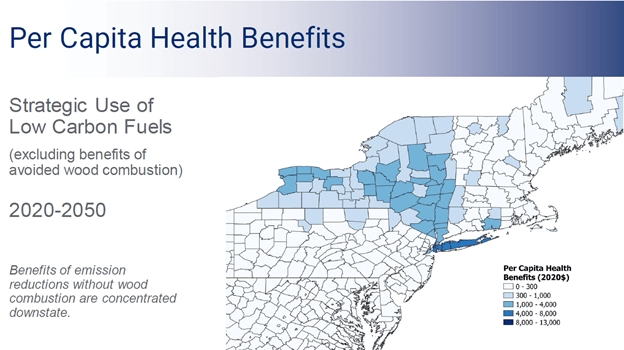
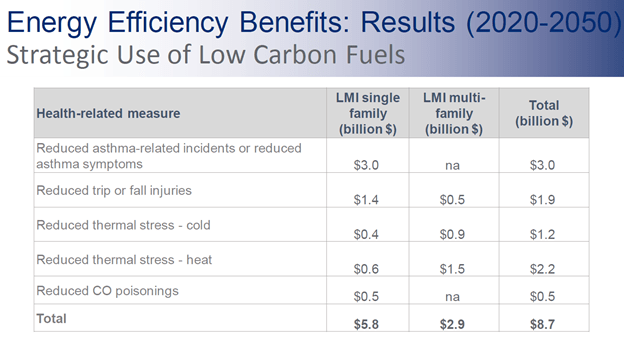
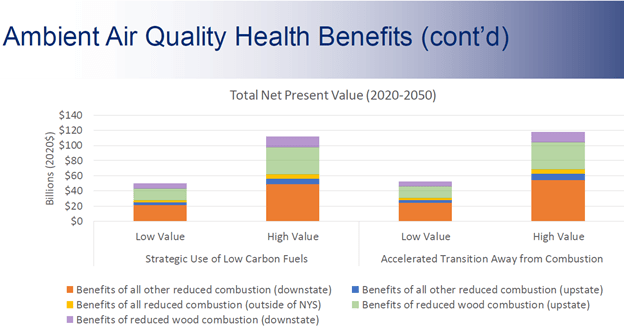
Health benefits are commonly ascribed to actions that consider climate change.  The presentation’s slide lists direct health benefits.  Someone, somewhere following the climate change funding bandwagon has undoubtedly made claims for those benefits.  I leave it the reader to consider how likely these alleged benefits could be linked to climate change as opposed to other factors

Another common theme for CLCPA proponents is that implementing these programs will create jobs.  During this process no one has raised the possibility that higher energy prices might force businesses to re-locate or go out of business so job losses are a real potential.    There is one other aspect of this slide that needs to be highlighted.  There is a graphic image that includes a quotation that states that UCLA professor Christa Tirado said in 2011 “in 2020, the UN has projected that we will have 50 million climate refugees”.  It is 2021, and rather than relying on a ten-year old projection I believe it would be more appropriate to document where the climate refugees are.  Absent that verification I can only label this as another example of cherry-picked propaganda.

Conclusion

In my 45-year air pollution meteorology career there has been more than one instance where I got the right answer but for the wrong reason.  For example, while evaluating air quality models that predict the impacts of power plants, I found that the models were protective of human health and welfare because they conservatively predicted downwind concentrations compared to observations.  However, there were instances when the models predicted the highest concentrations for one set of meteorological conditions and the observed highest concentrations occurred during a different set of conditions.  Right answer for the wrong reason.

In my opinion this sums up the CLCPA adaptation and resilience recommendations.  I agree that this is something that should be done because our current infrastructure is not resilient to observed extreme weather.  However, the rationale for these recommendations is that they need to be done because of climate change impacts.  Proponents of the CLCPA believe that any unusual weather is due to climate change caused by human emissions of greenhouse gases.  That opinion flies in the face of the “science” that the naïve believe supports their position and common sense.  Given that climate has always been changing and that historical CO2 levels have varied more than current observations, common sense says that whatever effect anthropogenic greenhouse gas emissions have on weather is a tweak and not the primary driver of observed weather variations. 

Finally, I showed that the greatest threat to the reliability, resilience, and safety of the electric system is not climate change but the proposed plan to rely on intermittent and diffuse wind and solar resources to provide most of the electric energy in the state.  Furthermore, the greatest threat to ecosystem biodiversity is the land use that will have to be converted to utility-scale wind and solar facilities.  There simply is not enough land suitable for wind development that does not have high biodiversity value to prevent development where it will have significant impacts.

NY Office of Renewable Energy Siting Heritage Wind Decision

On June 4, 2021 the New York Office of Renewable Energy Siting determined that some provisions of local laws were “unreasonably burdensome” in light of the State’s Climate Leadership and Community Protection Act (CLCPA) goals and the environmental benefits of the proposed 185 megawatt Heritage Wind Project. This post discusses the specifics of this ruling.

I have written extensively on implementation of the CLCPA closely because I believe the solutions proposed will adversely affect reliability and affordability, will have worse impacts on the environment than the purported effects of climate change, and cannot measurably affect global warming when implemented.   The opinions expressed in this post do not reflect the position of any of my previous employers or any other company I have been associated with, these comments are mine alone.

Background

In early April 2020, NYS passed the Accelerated Renewable Energy Growth and Community Benefit Act (AREGCBA) as part of the 2020-21 state budget.  This legislation was intended to ensure that renewable generation is sited in a timely and cost-effective manner.   The law established the Office of Renewable Energy Siting (ORES), housed within the Department of State, that is supposed to “consolidate the environmental review of major renewable energy facilities and provide a single forum to ensure that siting decisions are predictable, responsible, and delivered in a timely manner along with opportunities for input from local communities”.  All large-scale, renewable energy projects 25 megawatts or larger will be required to obtain a siting permit from the Office of Renewable Energy Siting for new construction or expansion. ORES has the authority to issue a single permit for the construction of major renewable energy facilities from both a state and local law perspective, but applicants will still be required to obtain any approvals necessary under federal law, including federally-delegated permits. 

Decision

Heritage Wind originally filed an Article Ten application but transferred it to ORES.  The plan is for construction of a 184.8 megawatt (MW) Wind Electric Generating Facility located in the Town of Barre, Orleans County.  The Town of Barre code for wind turbines included some provisions that the Developer asked ORES to overrule.  I will address these below.

According to the ORES determination, the office “conducted a thorough review of the Transfer Application, including all exhibits, reports and supporting information”, to determine the Facility’s compliance with the ORES regulation and the “potential need for additional site specific terms and conditions to avoid potential significant adverse environmental impacts from construction and operation of the Facility to the maximum extent practicable”  The Office evaluated each of Permittee’s requests against the local laws and ordinances in effect both at the time of the Siting Board’s December 8, 2020 determination of compliance, and at the time of Permittee’s filing of the Transfer Application with the Office on January 13, 2021. The Office “thoroughly reviewed the Transfer Application and considered all applicable New York State law concerning CLCPA targets and the environmental benefits of major renewable energy facilities, and the detailed information in the Transfer Application concerning CLCPA targets and the environmental benefits of the proposed Facility”.

The Permittee requested relief from the Barre wind turbine noise limit which requires that wind turbine noise be limited to 45 dBA measured at a distance 1,000 feet from the base of the wind turbine.  The permittee claimed that “this standard would be technologically infeasible as no available commercial turbine model meets this standard” and argued that recent Siting Board cases used a noise limit of forty-five (45) dBA Leq (8-hour) at the outside of any non- participating residence and a fifty-five (55) dBA Leq (8-hour) at the outside of any participating residence.  ORES found the code to be “unreasonably burdensome in view of CLCPA targets and the environmental benefits of the Facility, and determined that the Office’s uniform standards for wind facility noise at 19 NYCRR

§§ 900-2.8(b) and 900-6.5(a) were applicable”.  These are the Siting Board noise limits listed above.

The Town also has a night time noise standard and has argued that Heritage Wind has not demonstrated compliance with that standard.  Heritage Wind claimed that there was “no scientific basis to support the more stringent 40 dBA night standard.  ORES sided with the developer and no changes to address the night-time standard were accepted.

Clear Skies Above Barre (CSAB) requested party status and submitted a petition with six issues.  One of the issues raised was support of the Town of Barre’s arguments that the proposed facility would not meet the Town Code.  ORES stated that they granted the minimum relief necessary to the alleged burdensome local regulations.  ORES “respectfully submits that CSAB has failed to raise any substantive or significant issues for adjudication or claims for party status with respect to the Office’s determinations and findings and determinations on unreasonably burdensome local laws and ordinances”.

The Barre Town Code included restrictions on the use of guy wires.  Apparently that provision was modified and ORES did not have to over-rule the provisions.

The Barre Town Code included a provision that “the Facility  be designed such that shadow flicker from an individual wind turbine will not fall on any specific are of a roadway or any portion of a residential structure in excess of 25 hours per year.  In support of its argument, “Permittee noted the lack of basis for the Town standard and that the Siting Board has reviewed the available science and other considerations on shadow flicker and adopted a 30 hour per year shadow flicker limit in recent Siting Board cases”.   ORES sided with Heritage Wind and the shadow flicker requirement is 30 hours per year.

The Barre Town Code includes a restriction that limits the height of wind turbines to 500 feet.  The Permittee claimed that “changing manufacturing standards and available turbine heights, technological needs, CLCPA targets and the environmental and ratepayer needs for affordable renewable energy in New York State”.  ORES sided with Heritage Wind.  ORES “determined not to apply this provision of the Barre Town Code, on the condition that overall turbine tip height shall not exceed 675 feet as limited and requested by the Permittee”.  However, the Town Code was modified to put a limit of 700 feet on turbines making all this moot.

The Barre Town Code includes a requirement for 40% reforestation but Heritage Wind argued that was not feasible or reasonable because open spaces are needed to operate the facility.  ORES “elected not to apply this provision of the Barre Town Code and determined that the Permittee’s proposed landscaping and restoration mitigation measures shall comply with 19 NYCRR §900-10.2(e)(4), which requires Permittee to provide a pre-construction compliance filing consisting of a comprehensive Vegetative Management Plan that will be subject to prior review and approval of the Office before a Notice to Proceed with Construction is granted”. 

The Barre Town Code limited construction to 9:00 a.m. – 8:00 p.m. daily with exceptions for emergencies.  ORES “elected not to apply this provision of the Barre Town Code in the limited circumstances requested by Permittee”.   The discussion suggests that Heritage Wind and the Town worked out a compromise that made this finding moot.

The Barre Town Code required that “the foundation top of each wind turbine shall be buried to a depth of four feet below ground, or to the specifications of the New York State Department of Agriculture and Markets guidelines, whichever is greater”.  Heritage Wind argued that burying the foundation top below grade would cause corrosion.  This is another provision of the Town Code that was subsequently revised making the arguments moot.

The Barre Town Code specified decommissioning timelines and related requirements that Heritage Wind argued did not cover all the reasons why a facility might shutdown other than retirement.  ORES danced around the rationale when decommissioning requirements should kick in.  ORES claims there are no substantive or significant issues requiring adjudication of the Office’s finding but I think applicability is still ill-defined.

A number of other minor issues were mentioned.  None were substantive enough to discuss.

Discussion

For the most part this determination over-ruled the Town of Barre Code when it was more stringent than recent Siting Board decisions.  For example, the Siting Board set a limit of 30 hours of shadow flicker and the Barre Town Code had a limit of 25 hours, so ORES set the limit at 30 hours.  I agree with the concept that there should be consistent requirements across New York.

There is one issue however.  The basis for recent Siting Board decisions and the ORES requirements supposedly represents the “science”.  I described the comments I submitted on the ORES implementing regulations and raised one technical issue on setback distances that is relevant to the rulings described above.  ORES established the setback requirement for non-participating residences in 19 NYCRR §900—2.6(b): (1) 1.5 times turbine tip height from non-participating property lines, public roads, aboveground transmission lines and substations; and (2) 2.0 times turbine tip height from non-participating residences and non-participating  commercial buildings.  In my comments I showed that the ORES wind turbine tower setback is less than the predicted throw distance of material, such as ice shards, from several examples.  I argued that while the American Wind Energy Association claims that no member of the public has ever been injured by a turbine, I believe that is in no small part due to the relatively small number of turbines currently in use.  If New York has to install thousands of turbines, then I believe that the likelihood that a turbine will be close enough to cause damage or injure the public is so high that the ORES setback distances are unacceptable. I recommended a more nuanced approach that considered site-specific considerations and the number of turbines proposed.  Setback distances were not mentioned in the ORES response to comments submitted.  According to the response “ORES reviewed all remaining comments and concluded that no changes were warranted.”

My other comments addressed three shortcomings in the proposed regulation.  Unless a cumulative impact analysis is done by the Office of Renewable Energy Siting the public welfare and environment will be threatened. I believe that is particularly necessary to address concerns related to avian species especially bald eagles.  It may be a misunderstanding on my part but I did not see any provision to require applicants to provide capability information in the applications.  I don’t think it is appropriate to short-change local participation and environmental issues for renewable facilities that will not provide renewable energy credit to New York so I recommended that if a facility cannot prove that the renewable energy credits generated by the facility will be used to meet New York’s goals that they be required to go through the existing Article Ten process.   ORES did not respond to any of these comments.

The greatest deficiency of the Climate Leadership and Community Protection Act (CLCPA) and the Accelerated Renewable Energy Growth and Community Benefit Act (AREGCBA) is the failure to consider the cumulative environmental impact of the wind and solar resources necessary to replace the fossil-fired electric generating capacity of New York. It can be argued that on an individual or even facility basis that most environmental impacts are acceptable. It is clear that applicants should not be required to address cumulative impacts.  Nonetheless, cumulative environmental impacts are a concern and should be considered with respect to these regulations so ORES should provide that analysis. 

In order to assess the potential impacts on power system reliability in 2040 when meeting the CLCPA target for 100% zero-emissions electric generation, the New York Independent System Operator (NYISO) contracted with ITRON and the Analysis Group to develop estimates of the necessary resources.  On October 8, 2020 Kevin DePugh, Senior Manager for NYISO Reliability Planning, made a presentation to the Executive Committee of the New York State Reliability Council that summarized their work and provides an estimate of the Generation Capacity resource mix (Table A).  The resource mix for the climate change phase II, CLCPA case is extraordinary.  At the end of 2019 the total New York State wind nameplate capacity was 1,985 MW but this case projects that 35,200 MW will be needed which is the National Renewable Energy Lab (NREL) projected total technical potential land-based capacity.  Governor Cuomo has announced offshore wind targets totaling 9,000 MW by 2035 but this case projects a need for 21,063 MW by 2040 which is another technical potential estimate limit.  There is a goal for 6,000 MW of solar by 2025 in the CLCPA targets but this projection estimates that 10,878 MW of behind-the-meter solar and 29,262 MW of grid connected solar will be needed. 

Table A: Generation Capacity – Climate Change Phase II Analysis, CLCPA Case

Most concerning to me is that an analysis done for NYSERDA on wind power and biodiversity found that: “5,430 square kilometers (1.3 million acres) of land in New York that are both suitable for wind power development and avoid areas that are likely to have high biodiversity value. Using an estimate of 3.0 MW/square kilometers, this translates to a megawatt capacity estimate of 16,300 MW (± 9,000 MW) for New York’s terrestrial landscape.”  The difference between this number and the NYISO projections suggests that wind turbines will have to be sited within the areas of high biodiversity value.

Conclusion

Based on this first ORES determination it appears that the emphasis is on consistency with previous Siting Board decisions and the ORES standards and requirements.  I agree that is appropriate.

However, the ORES standards themselves were pushed through on an expedited schedule.  Comments inconsistent with the State’s agenda were ignored.  In other words, I don’t accept all their standards and requirements.  As a result, I predict that there will be seriously impacted neighbors when all the solar and wind facilities necessary to meet the CLCPA targets are built.

I also maintain that there will be serious cumulative environmental impacts because the State has not evaluated the cumulative impacts for the enormous number of facilities projected in the last year.  The described disparity between the areas suitable for wind power development not located in areas of high biodiversity value and the total area needed for the projected wind power developments seems to be a prescription for unacceptable cumulative environmental impacts.

Climate Leadership & Community Protection Act GHG Emissions and the Value of Carbon

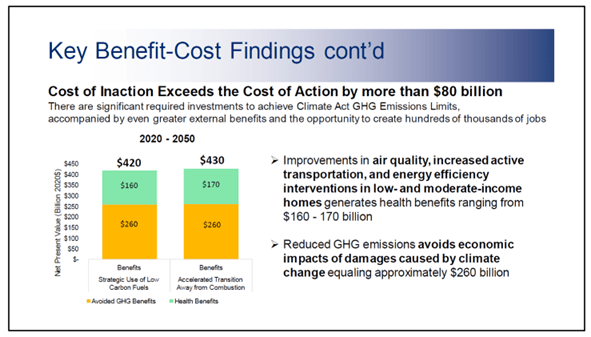
On July 18, 2019 New York Governor Andrew Cuomo signed the Climate Leadership and Community Protection Act (CLCPA), which establishes targets for decreasing greenhouse gas emissions, increasing renewable electricity production, and improving energy efficiency. This post documents issues with the benefits calculations methodology that I expect will be used to show that the “benefits” outweigh the costs.

I have written extensively on implementation of the CLCPA because I believe the solutions proposed will adversely affect reliability and affordability, will have worse impacts on the environment than the purported effects of climate change, and cannot measurably affect global warming when implemented.   I briefly summarized the schedule and implementation: CLCPA Summary Implementation Requirements.  I have described the law in general, evaluated its feasibility, estimated costs, described supporting regulationssummarized some of the meetings and complained that its advocates constantly confuse weather and climate in other articles.  The opinions expressed in this post do not reflect the position of any of my previous employers or any other company I have been associated with, these comments are mine alone.

Background

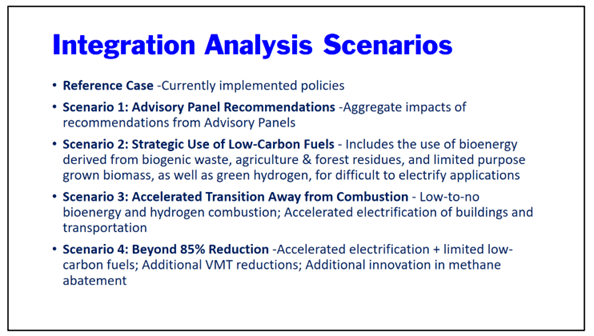
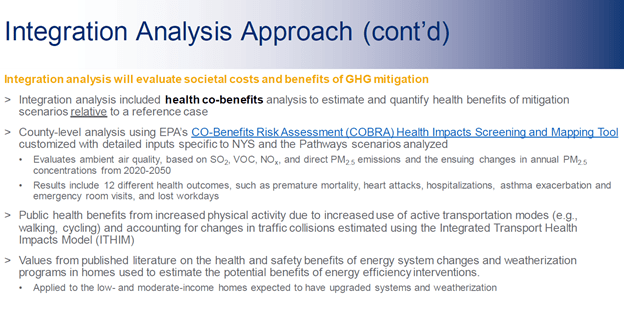
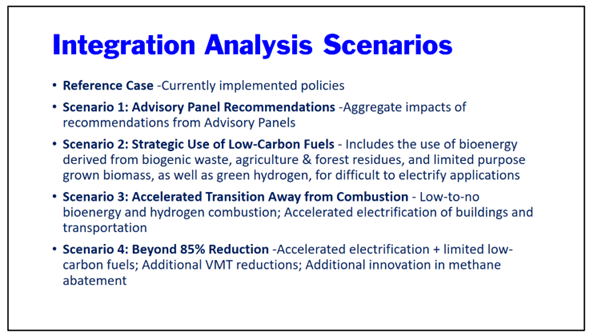
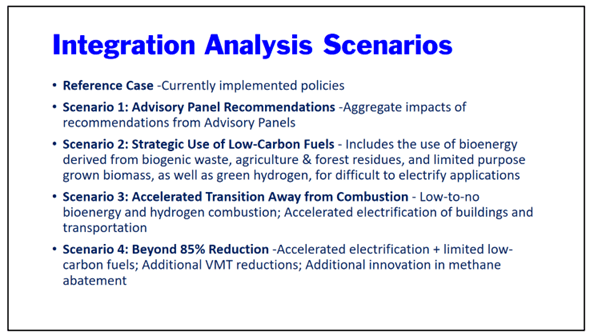
According to a New York State Department of Environmental Conservation (DEC) bulletin dated May 10, 2021, the Advisory Panels to the Climate Action Council have all submitted recommendations for consideration in the Scoping Plan to achieve greenhouse gas (GHG) emissions reductions economy-wide. All these recommendations will be incorporated into the integration analysis which is a modeling effort by the State.  They will develop the scoping plan that outlines what is needed to meet the law’s requirements.  Once the scoping plan is accepted State agencies will implement codes and regulations.     My posts describing and commenting on the strategies are all available here.

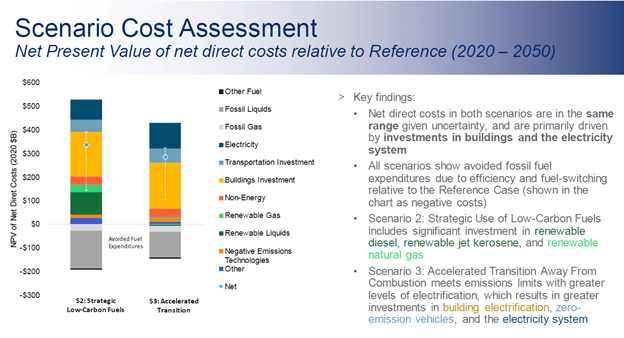
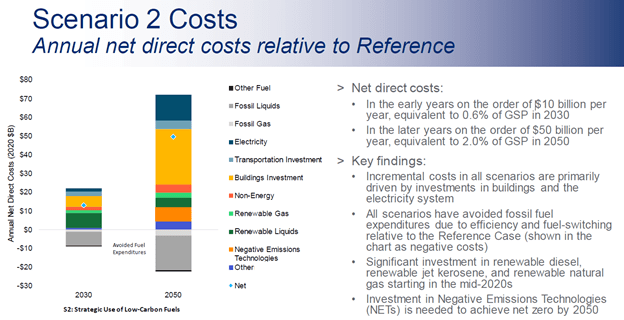
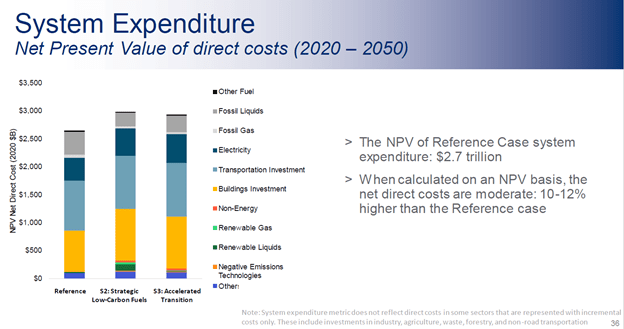
Although no costs have been provided there have been discussions at Climate Action Council meetings that indicate that the Council is positioning itself to prove that their investments are “cost-effective”.

I will outline how the benefits analysis should be calculated and how the state is doing it.

Emissions

The first step is to define the emissions. The 1990 emissions were defined in the Department of Environmental Conservation’s Part 496 regulations.  GHG emission inventories have been developed for many years.  Prior to the CLCPA New York State followed the Inter-governmental Panel on Climate Change guidelines.  It makes a lot of sense to use those guidelines for consistency and inter-comparability.  However, the authors of the CLCPA chose to do things differently

According to the Revised Regulatory Impact Statement (RIS):

Under the CLCPA, statewide greenhouse gas emissions include both greenhouse gas emissions from all sources located within the state and certain sources that are located outside of the state that are associated with in-state energy consumption. In particular, the statute requires that statewide greenhouse emissions include both: (1) “the total annual emissions of greenhouse gases produced within the state from anthropogenic sources,” and (2) “greenhouse gases produced outside of the state that are associated with [a] the generation of electricity imported into the state and [b] the extraction and transmission of fossil fuels imported into the state.” ECL § 75-0101(13). Moreover, the CLCPA defines “carbon dioxide equivalent” as a measurement of global warming potential based on a twenty-year timeframe. ECL § 75-0101(2).

The RIS goes on to explain:

The Energy sector includes five (5) main categories: (a) Fuel Combustion, (b) Fugitive Emissions, (c) Electricity Transmission, (d) Imported Fuels, and (e) Imported Electricity. The latter two categories are not included in IPCC protocol or other governmental greenhouse gas inventories, but as described above are two key distinct requirements of the CLCPA for this rulemaking. These two categories represent an estimate of what may be referred to as the lifecycle, fuel cycle, or out-of-state upstream emissions associated with in-state energy demand and consumption.

The RIS explains the inclusion of a category for imported fuels:

The most significant difference between the 1990 baseline, as set forth in the CLCPA and developed for the proposed rule, and other governmental greenhouse gas inventories is the inclusion of emissions associated with “the extraction and transmission” of imported fossil fuels. Because of the novel nature of this CLCPA requirement, as compared to other standard governmental inventories following the IPCC protocol, the Department undertook an analysis of these emissions in collaboration with NYSERDA. This analysis considered emissions from extraction and processing (production) through transmission or transportation to the New York border, but did not include emissions from infrastructure construction and maintenance outside of the state or from the manufacture of equipment or facilities outside of the state. The fuels included are the same as those addressed in the in-state analysis, or coal, natural gas, distillate, diesel, residual fuel, jet fuel, kerosene, LPG, motor gasoline, and other petroleum fuels (lubricants, petroleum coke, and unspecified napthas).

The inclusion of these two categories adds to the baseline and any reduction benefits are increased.  Importantly, note that the lifecycle, fuel cycle, or out-of-state upstream emissions associated with wind and solar energy development are not included in any state analysis.

Value of Carbon

In section §75-0113, Value of Carbon the CLCPA states that the “social cost of carbon shall serve as a monetary estimate of the value of not emitting a ton of greenhouse gas emissions” and that “As determined by the department, the social cost of carbon may be based on marginal greenhouse gas abatement costs or on the global economic, environmental, and social impacts of emitting a marginal ton of greenhouse gas emissions into the atmosphere, utilizing a range of appropriate discount rates, including a rate of zero.”

The total monetary estimate of not emitting NY’s 1990 emissions is shown here for different years.  We don’t know when the emissions occurred or will occur so we need to consider a range.   If every ton is reduced in 2021, the value of carbon benefits at a 2% discount rate is $681,266 million.  If every ton is reduced in 2050, the value of carbon benefits at a 2% discount rate is $1,115,104 million.

Games New York Plays

In late February, 2021 I wrote to DEC and Climate Action Council about a problem with the New York State guidance document Establishing a Value of Carbon, Guidelines for Use by State Agencies (the “Guidance”). In particular the Guidance includes a recommendation how to estimate emission reduction benefits for a plan or goal.  I believe that the guidance approach is wrong because it applies the social cost multiple times for an emission reduction.  I recommended that the Guidance be revised.

In the Guidance section entitled “Estimating the emission reduction benefits of a plan or goal” an example is included:

The net present value of the plan is equal to the cumulative benefit of the emission reductions that happened each year (adjusted for the discount rate). In other words, the value of carbon is applied to each year, based on the reduction from the no action case, 100,000 tons in this case. The Appendix provides the value of carbon for each year. For example, the social cost of carbon dioxide in 2021 at a 2% discount rate is $127 per metric ton. The value of the reductions in 2021 are equal to $127 times 5,000 metric tons, or $635,000; in 2022 $129 times 10,000 tons, etc. This calculation would be carried out for each year and for each discount rate of interest.

The Integrated Working Group (IWG) damages approach value is the net present benefit of reducing carbon dioxide emissions by one ton.  The calculation methodology determines that value from the year of the reduction out to 2300.  It is inappropriate to claim the benefits of the annual reduction over any lifetime.  Consider that in this example, if the reductions were all made in the first year the value would be 50,000 times $127 or $6,350,000, but the guidance approach estimates a value of $37,715,000 using this methodology. 

I also argued that if 1990 emissions were reduced in 2021 the benefits of completely eliminating those emissions equals $681 billion.  If we assume that the emissions are reduced to zero in 2050 by reducing emissions each year by the same amount, the annual reduction times that year’s social cost sums to $886 billion. However, if the social costs are multiplied by the cumulative reductions the costs sum to $15,373 billion, nearly twice as much as summing the annual reduction values.  Furthermore, the cumulative reduction approach is over 23 times higher than if the reductions were all achieved in one year.  My final argument that it is inappropriate is: if the social costs were calculated out to 2300, then when do you stop calculating cumulative reductions for the social cost benefits for permanently retiring a source of greenhouse gas emissions?

New York’s record using this approach goes back to 2020.  The 2010 Climate Action Plan interim report calculated the cost per avoided emissions using cumulative emission reductions.  The Regional Greenhouse Gas Initiative (RGGI) and the New York State Energy Research & Development Authority (NYSERDA) reports on the investment proceeds from the RGGI tax both improperly use cumulative emission reductions.  The NYSERDA Clean Energy Dashboard also highlights values using cumulative emission reductions.  By the way I have submitted comments regarding this issue to RGGI and NYSERDA and no changes have been made to the reports. 

Conclusion

The use of cumulative emission reductions to claim more benefits is a common New York practice.  New York should include annual reductions in all its GHG emission reduction reports but does not. All emission reduction targets are set based on emissions at a certain time and never include cumulative values.  Social cost of carbon or other carbon reduction valuation schemes also consider reductions at a certain time and exclude cumulative values.  I have raised this issue with New York State agencies and aside from a “thank you we will look into it” from DEC there has been no response.

When the inevitable high costs of CLCPA implementation are released to the public, they will no doubt be couched in some sort of value of carbon benefit comparison.  Obviously, the fundamental problem is that the costs will be real and the benefits will be made up.  This post shows that even the contrived value of carbon arguments are insufficient, that the CLCPA mandates emission categories contrived to increase emissions, and that the state has systematically over-estimated GHG emission reduction benefits in this context for years.

Summary of Enabling Strategies Submitted to the Climate Action Council

On July 18, 2019 New York Governor Andrew Cuomo signed the Climate Leadership and Community Protection Act (CLCPA), which establishes targets for decreasing greenhouse gas emissions, increasing renewable electricity production, and improving energy efficiency.  This post highlights some of the aspects of the enabling strategies needed to meet the targets that I believe the general public does not know is headed their way.

I have written extensively on implementation of the CLCPA closely because I believe the solutions proposed will adversely affect reliability and affordability, will have worse impacts on the environment than the purported effects of climate change, and cannot measurably affect global warming when implemented.   The opinions expressed in this post do not reflect the position of any of my previous employers or any other company I have been associated with, these comments are mine alone.

According to a New York State Department of Environmental Conservation (DEC) bulletin dated May 10, 2021, the Advisory Panels to the Climate Action Council have all submitted recommendations for consideration for the Scoping Plan that will be used to achieve the necessary greenhouse gas (GHG) emissions reductions economy-wide.  Advisory panels were created to develop recommendations for the Scoping Plan and made presentations at the April 12, 2021 Meeting and the May 10, 2021 Meeting and recordings of the presentations are available.  I provide links to all those recommendations and my posts describing them here.  The following summarizes what has been suggested.

In the past month or so the same politicians who managed to foist the CLCPA upon the citizens of New York advocated for the Climate and Community Investment Act (CCIA) which was intended to provide funding to support the CLCPA implementation efforts.  I wrote several posts on the legislation and talked to my local assemblyman’s office about my concerns.  In that conversation a WHAM report that the carbon tax alone would bring in $2.3 billion a year and could increase gasoline costs 55 cents a gallon was mentioned as the main reason the assemblyman was not supporting the legislation.

The costs for the enabling strategies are not known but it will be expensive so this is going to prove very unpopular based on the response to the CCIA.  The Transportation Advisory Panel proposed a strategy to transition to 100% zero-emission light duty vehicle sales which I believe mandate that all light-duty vehicles sold starting in 2035 have to be electric.   The panel claims that by 2028 electric vehicles (EVs) will be comparable in cost to an internal combustion engine.  Of course, all the infrastructure to support EVs in public ($1 billion to the utilities so far) will have to be covered, homeowners who purchase the vehicles will have to purchase at home charging support, and when every home has an EV the local electrical distribution systems will have to be upgraded as I discussed in my comments on the transportation panel strategies.

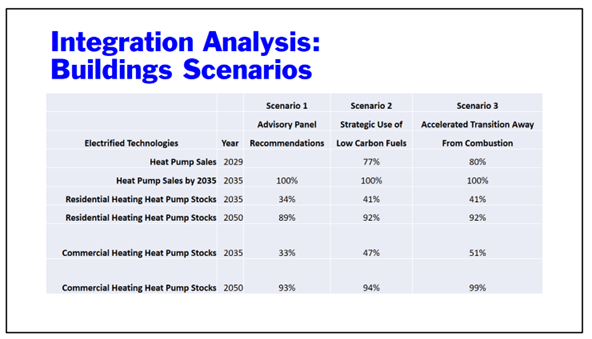
The energy efficiency and housing advisory panel sector emissions were the highest of any sector.  As a result, the primary mitigation strategy is to phase out fossil fuel use in buildings.  A primary enabling strategy is to change codes and standards as shown in the following slide.  The plan is to amend the state codes for new construction, including additions and alterations, to require a plethora of specific requirements including solar PV on “feasible” areas, grid-interactive electrical appliances, energy storage readiness, electric readiness for all appliance and electric vehicle readiness.  They propose to adopt these all-electric state codes for single family residences by 2025.  Note that a homeowner that chooses to an addition or alteration could be covered by the same requirements.    In 2030, gas/oil replacements will be prohibited when heating and hot water systems have to be replaced in homes and in 2035 electric stoves and driers are mandated replacements.  I expect that there is a requirement that when a house is sold after 2030 that it will have to be all-electric.  If you prefer to use natural gas for home heating, hot water, and cooking you will not have that choice.

The presentation notes that “Resilience is of critical importance”. There is a major disconnect between the advisory panel and the public in this regard.  For the public, a slogan does not keep the house warm.  In the event of extreme weather such as an ice storm many people had experience surviving because of fossil fuel options.  I doubt the public will willingly give up the resilient capabilities of natural gas and fuel oil for heating.  I described these issues in more detail in this post.

The Land Use & Local Government Advisory Panel proposed a theme facilitating “responsible siting and adoption of clean energy sources” apparently oblivious to the fact that clean energy siting requires much more land than available at any of the priority development areas simply because wind and solar energy are diffuse and require large areas to collect it.  The Agriculture and Forestry Advisory Panel proposed enabling strategies to avoid forest conversion and avoid agricultural land conversion because of the role of forests and farmlands in sequestering carbon. There is no recognition or plan to address the extraordinary buildout of wind generation projected by the Analysis Group – 35,200 MW compared to 5,905 MW in the last state impact statement that evaluated wind energy cumulative impacts.  Note that there are less than 2,000 MW of wind turbines today.  Responsible siting, minimizing conversion of sequestration land, and reducing cumulative impacts of thousands of turbines while developing the thousands of wind turbines is a significant challenge.

The waste advisory panel recommendations illustrate one overarching problem with these panels.  In light of the critical need for firm, zero-emissions resources and the fact that the methane emissions from municipal solid waste landfills, digesters at water resource recovery facilities, livestock farms, food production facilities and organic waste management operations are a major percentage of the total emissions, it only seems logical to address both problems by collecting and using that gas.  However, as I showed in my analysis of the waste strategies, there are passionate ideologues involved that don’t agree.  The meeting minutes note “concern regarding renewable natural gas, suggesting that there is a limited opportunity for it to contribute to Climate Act goals and believes that efforts in this area benefit the source without contributing additional environmental benefits”. Another member “expressed his concerns about how to move ahead with biogas if it is combusted as this would clearly increase net co-pollutants locally, and suggested the Council consider applications for biogas that would not be combusted (such as fuel cell technology at wastewater treatment plants)”.  

The Energy-Intensive and Trade-Exposed Industries Advisory Panel illustrates a less-than flattering aspect of the CLCPA.  The strategies for the small and declining industrial, mining, and manufacturing sector were described as “heterogeneous”.  This means that there are many different sources so economy of scale is not going to reduce costs.  Clearly New York’s unilateral transition off fossil fuels will increase relative energy costs relative to other jurisdictions and industries will have to leave to survive.  They conclude that this sector needs currently unavailable solutions to produce emission reductions and remain viable within the state.  It seems pretty obvious that this advisory panel was included as a political ploy to placate the industrial sector.  Unfortunately, there is not much that can be done to reduce emissions significantly or prevent the remaining industries from fleeing the state out of necessity.

The Power Generation advisory panel is arguably the most important because in order to meet the targets all the other sectors will have to be electrified. The recommendations are available in a slide presentation.  I did a review of final recommendations, and, because this panel is most closely related to my background and interest, I posted earlier on the draft recommendations.  At the start of the process, I also posted on the membership of this panel.  The Albany politicians who nominated the members of the panel chose people whose ideological agendas are aligned with the CLCPA presumption that the transition away from fossil fuels is simply a matter of political will.  As a result, they included enabling strategies for the process of, for example, developing off-shore wind, but the related strategy did not include costs for actually developing offshore wind facilities or offer enabling strategies for it.

The ultimate problem replacing fossil fuels with renewable wind and solar energy is providing power during periods when both renewable resources are near zero.  In their presentation to the Power Generation Advisory Panel on September 16, 2020, E3 included the following slide that notes that illustrates the winter doldrum issue.  Incredibly, the panel recommendations did not specifically address this issue. 

Conclusion

This post highlights some of the aspects of the enabling strategies needed to meet the CLCPA emission reduction targets that I believe the general public does not know are headed their way.  Given the constant harping from politicians and the media about the existential threat of climate change many might believe implementing this law is appropriate.  However, the question is just how much is the public willing to pay and how many limitations on personal choice will they accept?

All these recommendations will be incorporated into the integration analysis modeling effort by the State.  Technical staff at the agencies will develop the scoping plan that outlines what is needed to meet the law’s requirements and maintain reliability.  The scoping plan goes to the Climate Action Council for review and comment and the public even gets a chance to respond.  Once the scoping plan is accepted State agencies will implement codes and regulations.  The proponents of the CLCPA are convinced that they have broad public support for these changes in personal choice and the inevitable higher prices.

This year’s CCIA legislation was intended to cover CLCPA implementation costs and the thought that the carbon tax alone would bring in $2.3 billion a year and could increase gasoline costs 55 cents a gallon apparently was too much to bear.  Those costs are a fraction of the CLCPA costs.  The proposed enabling strategy for residential home heating mandates that all new homes built after 2025 be all-electric and that when fossil appliances have to be replaced after 2030 that they be replaced by electric alternatives that the public will have to cover.  All new light-duty vehicles sold in 2035 will be electric.  In order to transition the electric grid Kevin Kilty points out “It took money spent over a century to learn the systems engineering currently built into the grid. It will take a lot of money to duplicate all this for a completely re-imagined grid in a decade.”  New Yorkers need to wake up and ask for the costs of this legislation sooner rather than later.

Power Generation Advisory Panel Enabling Strategies Submitted to Climate Action Council

On July 18, 2019 New York Governor Andrew Cuomo signed the Climate Leadership and Community Protection Act (CLCPA), which establishes targets for decreasing greenhouse gas emissions, increasing renewable electricity production, and improving energy efficiency.  According to a New York State Department of Environmental Conservation (DEC) bulletin dated May 10, 2021, the Advisory Panels to the Climate Action Council have all submitted recommendations for consideration in the Scoping Plan to achieve greenhouse gas (GHG) emissions reductions economy-wide.   My posts describing and commenting on the strategies are all available here. This post addresses the Power Generation Advisory Panel enabling strategy recommendations, including my impressions of the panel presentation itself.

I have written extensively on implementation of the CLCPA because I believe the solutions proposed will adversely affect reliability and affordability, will have worse impacts on the environment than the purported effects of climate change, and cannot measurably affect global warming when implemented.   I briefly summarized the schedule and implementation: CLCPA Summary Implementation Requirements.  I have described the law in general, evaluated its feasibility, estimated costs, described supporting regulationssummarized some of the meetings and complained that its advocates constantly confuse weather and climate in other articles.  The opinions expressed in this post do not reflect the position of any of my previous employers or any other company I have been associated with, these comments are mine alone.

Power Generation Emissions

Although the presentations all follow the same format the details differ.  One of the more important components of the presentations is the emissions estimates and they all include a graphic showing historical emissions in 1990, “preliminary draft” emissions for 2018, and their projections for 2030 and 2050.  A constant theme with this panel compared to others is a lack of critical information for stakeholders trying to understand their recommendations.  The ultimate reason for the recommendations is for emission reductions and this presentation does not provide all the numbers whereas most of the presentations included the values for each year.

The 1990 emissions were defined in the Department of Environmental Conservation’s Part 496 regulations but the sectors used in that regulation are not comparable to this advisory panel’s sector.  In the following graph I estimate that the 1990 emissions are 100 million metric tons (MMt) of carbon dioxide equivalent[1] (CO2e) and 2018 preliminary draft emissions are 60 MMt. 


[1] The amount of carbon dioxide by mass that would produce the same global warming impact as the given mass of another greenhouse gas over a specific time frame, as determined by the IPCC, and as provided in Section 496.5 of this Part.

There are two emission reduction targets in the CLCPA: 40% reduction in GHG emissions by 2030 and 85% reduction in GHG emissions by 2050.   The slide provides the percentage reductions so that the emissions can be estimated.  The projected total reductions emission reduction goals for this advisory panel are a 71% reduction from 1990 by 2030 and a reduction of 95% by 2050.  However, the power generation sector has its own goals: 70% renewable energy by 2030 and 100% carbon-free electricity by 2040.  No documentation is provided to substantiate the claim that 70% renewable energy is equivalent a 50% reduction from the 2018 levels.

The power generation sector was the third largest source of greenhouse gas (GHG) emissions in 2018.  Direct combustion emissions accounted for 57% of the total, imported fossil fuel 28%, oil and gas methane leakage 15%.  The inclusion of emissions by imported fossil fuels and leakage is mandated by law, ECL § 75-0101(13). These two categories represent an estimate of what may be referred to as the lifecycle, fuel cycle, or out-of-state upstream emissions associated with in-state energy demand and consumption.  However, these sectors are not included in internationally accepted emission inventory procedures.  I am working on a post that addresses this issue specifically.

 Power Generation Strategies

According to the meeting presentation, the advisory panel proposed fourteen enabling strategies:

1             Growth of Large-Scale Renewable Energy Generation

2             Clean Energy Siting & Community Acceptance

3             Distributed Generation / Distributed Energy Resources

4             Existing Storage Technology

5             Demand Side

6             Reliability for the future grid

7             Access and Affordability for All

8             Workforce Development

9             Market Solutions

10           Technology Solutions

11           Long Duration Storage Technology

12           Energy Delivery & Hosting Capacity

13           Gas Infrastructure, Transmission & Methane Leakage

14           Retirement of Fossil Fuel-Fired Facilities

The recommendations are available in a slide presentation.  I am not going to critique each of these strategies individually because it would take far too long.  Instead, I will comment on a few things with an emphasis on inconsistencies and implementation issues.  Because this panel is most closely related to my background and interest, I posted earlier on the draft recommendations.  I will also compare the proposed strategies to the draft strategies.

In September 2020 I also posted on the membership of this panel.  That post describes how this process was supposed to work.  I also described the background of the panel members.  I noted the members were mostly aligned with the ideological agenda of the Cuomo Administration rather than maintaining an affordable and reliable power generation system.  Sadly, the events of the last six months or so exceeded my expectations.  In order to make power generation recommendations it is necessary to understand how the power system works and how planning affects reliability and affordability.  Many of the members did not want to understand and did not try to understand the technological challenges.  Unfortunately, they were the loudest voices and their naïve insistence on speculative technologies has resulted in some risky enabling initiatives.

Discussion

One of the good things that this presentation did include were the category definitions.  Each mitigation strategy describes the potential effect of the strategy on GHG reductions by 2030, cost and funding expectations, and ease of implementation in three categories: low, medium and high.  The following tables define what they mean by low, medium and high.  This panel and the Energy Efficiency & Housing panel were the only ones to include these definitions and I note that there are subtle differences between them.  For example, the Power Generation panel defines the low mitigation strategy cost as <$250M total resource cost and most resources required for successful implementation are already on hand.  The other panel uses the same definitions but expresses the value as “equivalent annualized cost”.

I appreciate the inclusion of these definitions.  However, I don’t think some of the category definitions for the enabling initiatives are correct.  In particular, Initiative #1, Growth of Large-Scale Renewable Energy Generation states that the cost and funding considerations are $, <$250 million total resource cost for NYSERDA’s existing Tier 1, Tier 4, and offshore wind programs.  The only way those estimates can be correct is if they are referring only to the process for growing large-scale renewable generation.

The New York State Energy Research & Development Authority (NYSERDA) offshore wind website notes that the State’s five currently planned offshore wind projects total 4,300 MW.   The US Energy Information Administration (EIA) regularly assesses the levelized costs of all power sources, and only a year ago calculated that the cost of offshore wind was $115.04/MWh.  EIA claims a capacity factor of 45% which means that the 4,300 MW will generate 16,950,600 MWh.  Using the EIA levelized cost of electricity, see below, with that amount of generation yields $1.9 billion for the 4,300 MW of offshore wind.  Something else to keep in mind is that this projection does not include costs on the wholesale market, capacity market, or impacts on balancing and ancillary service markets which all add to the cost.  The biggest concern is providing power when the wind is not blowing.  It is hard to imagine how the authors of this slide managed to estimate that these costs would be less than $250 million unless they were only talking the process.  Then the question becomes where the heck do these costs show up in the recommendations.

Reliability

In general, the greatest threat to grid reliability is the transition away from fossil-fired power plants that provide dispatchable electricity whenever needed to intermittent and diffuse generation from wind and solar.  Donn Dears book “The Looming Energy Crisis” provides a detailed description of potential problems associated with this transition.  In this post I am only going to address two CLCPA aspects.

The final recommendations to the Climate Action Council at least emphasized the need to maintain reliability.  Incredibly, the first presentation from the Climate Action Council on the advisory panels did not mention reliability.  There are extensive electric system reliability requirements in place and despite numerous requests, no presentation on New York’s requirements was provided to this panel. 

Moreover, enabling initiative #6, reliability for the future grid, misses the point.  As shown in the following description the cost and ease of implementation refer to the process for maintaining reliability, not the difficulty of making the changes needed to make the system reliable.  For example, in August 2019 there was a blackout in England.  Initially triggered by a lightning strike followed by “Two almost simultaneous unexpected power losses” from an offshore wind farm and a gas-fired power plant resulted in a “cumulative level of power loss greater than the level required to be secured by the Security Standards” and the blackout ensued.  My point is that as the system transitions to renewables I expect this kind of trial and error de-bugging of the system reliant on intermittent renewable energy.  For example, the North Park Solar proposal calls for a facility with up to 450 MW of solar panels covering 2500 acres.  What happens on a partly cloudy day when the incident solar radiation varies wildly?  Could that trigger an unexpected power loss? 

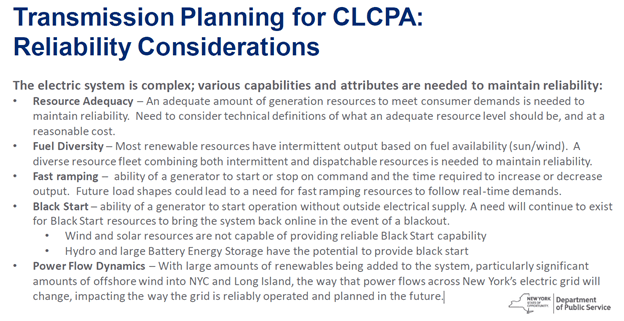
A reliable electric power system is very complex and must operate within narrow parameters while balancing loads and resources and supporting synchronism. New York’s conventional rotating machinery such as oil, nuclear, and gas plants as well as hydro generation provide a lot of synchronous support to the system. This includes reactive power (vars), inertia, regulation of the system frequency and the capability to ramping up and down as the load varies. Wind and solar resources are asynchronous and cannot provide these necessary grid ancillary support services.  Earlier this year I wrote that no one seemed to want to take the responsibility to figure out was is needed to provide that support. 

Enabling initiative #9, Market solutions, is the only place in the recommendations where ancillary services is mentioned.  Similar to the problem for the reliability initiative, this recommendation discusses the market mechanisms rather than the problem itself.  The responsibility for the initiative is on the New York Independent System Operator (NYISO).  The barriers to success note that this “Will require several forward-looking market designs and the implementation of each design must be structured in a way that sends the correct price signal at the appropriate time”.  This panel unloads all the responsibilities onto the NYISO. Not only do they have to anticipate all the potential issues in an unprecedented system reliant on asynchronous generation but also have to create a market mechanism to get market participants to invest in that technology.  This is another trial-and-error exercise where the rate-payers of the state are lab rats.

Feasibility

I have always maintained that the fundamental flaw of the CLCPA is that it assumed it was only a matter of political will to completely transform the existing electrical system to one dependent upon renewable energy.  Clearly, it would be appropriate to define affordability and reliability metrics then do a comprehensive analysis to determine if the transition would threaten those metrics.  The following tables list the ease of implementation descriptions for all 14 enabling strategies.

There are three easy to implement strategies: Reliability for the future grid, Workforce Development, and Gas Infrastructure, Transmission & Methane Leakage. These strategies are supposed to have been implemented many times and/or can build off an existing NYS program, rely on Proven and widely available technology, and the key stakeholders are strong supporters, there were no strong opponents.  However, recall that the reliability strategy was more about the mechanics of assessing reliability than actually addressing the problem.  It is ludicrous for this panel to claim reliability for a wind and solar dependent electric generation system will be “easy”.

Most of the strategies had a medium ease of implementation defined as: strategy is new to New York State but has been successfully implemented in other comparable states/countries, proven technology with known GHG impact, but still small-scale, and key stakeholders are neutral, or balanced mix of supporters and opponents.  I think the biases of the panel members and their lack of technical backgrounds impact these ease of implementation estimates.  Consider the medium label for existing storage technology.  Despite all the fawning reports over Tesla’s utility-scale batteries, the press and this panel has not picked up on how they are being used.  The Australian Hornsdale Power Reserve battery system is making money for the operators and saving consumers money by providing frequency control ancillary support services.  It is not being used to provide meaningful energy storage for the system.  As a result I argue that claiming that utility-scale energy storage has been successfully implemented is dubious at best.

There are three initiatives that even this panel had to conclude would be hard to implement: long duration storage technology, energy delivery & hosting capacity, and retirement of fossil fuel-fired facilities.  I believe that both existing and long duration energy storage technologies should be difficult.  A recent article by Kevin Kilty “Why is Energy so Difficult to Store? Why is Stored Energy so Difficult to Use?” described the generic problems with energy storage systems. He concluded that “It took money spent over a century to learn the systems engineering currently built into the grid. It will take a lot of money to duplicate all this for a completely re-imagined grid in a decade.”  Long-duration storage is necessary so depending upon a technology that does not even exist in a pilot project is an incredible risk.

Energy delivery & hosting capacity refers to “planning and implementation processes to facilitate necessary energy delivery options for the renewable energy buildout”.  Like all the other strategies by this panel it is presumed that there are no technical challenges to accomplish this.  In fact, this reads like a wish list for the renewable energy developers on the panel. 

Retirement of fossil fuel-fired facilities engendered a non-consensus recommendation with majority support: “temporary moratorium on new or repowered fossil fuel-fired facilities until the full recommendation is adopted”.  The strategy description is to develop a plan and implement regulations to phase out fossil fuel-fired baseload and peaking generation resources as quickly as practicable while retaining system reliability by prioritizing efforts to lower emissions of co-pollutants in disadvantaged and environmental justice communities.   The current cause célèbre amongst environmental justice activists are power plants in disadvantaged communities because they just have to be causing health problems due to ozone and inhalable particulates.  The problem is that those are both secondary pollutants and form long after the precursor pollutants are emitted so any health effects are not due to neighborhood power plants.  The mitigating solution to this non-problem: “The recommendations from the Power Generation Advisory Panel focus on enabling strategies to assist in the transition away from fossil fuels. These include strategies to more rapidly deploy renewable technologies, including flexible resources, addressing barriers to renewables deployment, transmission and distribution upgrades, developing and deploying technology innovations, encouraging effective market structures, and ensuring a just and equitable transition.”  As near as I can interpret this, there is absolutely no inkling that there might be technological and physical barriers that could preclude any of these enabling strategies.

Affordability

The panel covers affordability with its own enabling initiative.  I find it rich that the panel presumes that Federal Relief Funds should be used first.  The problem is that similar efforts elsewhere have markedly increased costs.  According to Germany’s Enegiewende program, the share of renewables in electricity generation should reach 45 percent by 2030 and 100% by half century.  The costs have sky rocketed and now German electricity prices are three times higher than France.  The Global Warming Policy Foundation has analyzed the cost of Great Britain’s net-zero programs concluding that astronomical cost burden risks are becoming a “toxic issue” for the government. If CLCPA proponents could point to a single jurisdiction with high renewable energy use that did not experience a marked increase in costs, then I would not believe this is an insurmountable problem.

Conclusion

Two things about this advisory panel.  It is arguably the most import panel because achieving CLCPA will only be possible if zero-emission electric power is available.  It was inarguably the worst run panel by far.  John Rhodes “leadership“ was abysmal and by the time he retired the damage had been done.  A leader would have steered discussions to achievable solutions that could maintain current levels of reliability and affordability.  What happened is that the loudest voices in the room drove the recommendations and discussions. As David Zaruk, who writes at the Risk Monger blog, explains those voices are: “millennial militants preaching purpose from the policy pulpit, listening to a closed group of activists and virtue signaling sustainability ideologues in narrowly restricted consultation channels”.  Rather than trying to understand the technological challenges these idealogues made recommendations for processes that would enable what they believe only requires political will.  “It is hard to imagine a more stupid or more dangerous way of making decisions than by putting those decisions in the hands of people who pay no price for being wrong.”– Thomas Sowell

Energy Efficiency & Housing Advisory Panel Enabling Strategies Submitted to Climate Action Council

On July 18, 2019 New York Governor Andrew Cuomo signed the Climate Leadership and Community Protection Act (CLCPA), which establishes targets for decreasing greenhouse gas emissions, increasing renewable electricity production, and improving energy efficiency.  According to a New York State Department of Environmental Conservation (DEC) bulletin dated May 10, 2021, the Advisory Panels to the Climate Action Council have all submitted recommendations for consideration in the Scoping Plan to achieve greenhouse gas (GHG) emissions reductions economy-wide.   My posts describing and commenting on the strategies are all available here. This post addresses the Energy Efficiency & Housing Advisory Panel enabling strategy recommendations.

I have written extensively on implementation of the CLCPA closely because I believe the solutions proposed will adversely affect reliability and affordability, will have worse impacts on the environment than the purported effects of climate change, and cannot measurably affect global warming when implemented.   I briefly summarized the schedule and implementation CLCPA Summary Implementation Requirements.  I have described the law in general, evaluated its feasibility, estimated costs, described supporting regulationssummarized some of the meetings and complained that its advocates constantly confuse weather and climate in other articles.  The opinions expressed in this post do not reflect the position of any of my previous employers or any other company I have been associated with, these comments are mine alone.

Energy Efficiency & Housing Emissions

Although the presentations all follow the same format the details differ.  One of the more important components of the presentations is the emissions estimates and they all include a graphic showing historical emissions in 1990, “preliminary draft” emissions for 2018, and their projections for 2030 and 2050.  The 1990 emissions were defined in the Department of Environmental Conservation’s Part 496 regulations but the sectors used in that regulation are not comparable to this advisory panel’s sector.  In the following graph 1990 emissions are 103 million metric tons (MMt) of carbon dioxide equivalent[1] (CO2e) and 2018 preliminary draft emissions are 115 MMt. 


[1] The amount of carbon dioxide by mass that would produce the same global warming impact as the given mass of another greenhouse gas over a specific time frame, as determined by the IPCC, and as provided in Section 496.5 of this Part.

There are two emission reduction targets in the CLCPA: 40% reduction in GHG emissions by 2030 and 85% reduction in GHG Emissions by 2050.   The projected total reductions emission reduction goals for this advisory panel don’t meet either target only projecting a 27% reduction from 1990 by 2030 and a reduction of 83% by 2050. 

This sector was the largest source of greenhouse gas (GHG) emissions in 2018 but there are two caveats.  The New York emission inventory includes upstream GHG emissions and the emission rates for methane are high so over half the emissions relative to combustion come from imported fossil fuels.  In a rational world that observation would suggest an analysis to see why such an illogical outcome is observed but in the CLCPA it is a feature not a possible flaw.  The other factor is that refrigerants are a large component of the total because the global warming potential for HFC is high. 

Energy Efficiency & Housing Strategies

According to the meeting presentation, the advisory panel proposed the following four mitigating strategies and six enabling strategies:

  • Mitigation strategy 1: Phase out fossil fuel use in buildings
  • Mitigation strategy 2: Require benchmarking
  • Mitigation strategy 3: Shift reliance on fossil gas to clean energy system
  • Mitigation strategy 4: Shift reliance on HFC use as refrigerant and in all products used in construction
  • Enabling strategy 1: Public financial incentives
  • Enabling strategy 2: Public and private low-cost financing
  • Enabling strategy 3: Workforce
  • Enabling strategy 4: Consumer education
  • Enabling strategy 5: Innovation
  • Enabling strategy 6: Embodied carbon

The recommendations themselves are available in a slide presentation.  I am not going to critique all these strategies because it would take far too long.  Instead, I will comment on some of the strategies with an emphasis on inconsistencies and implementation issues. 

There is no question that meeting the CLCPA goals for this sector will be a challenge.  The presentation explains that there are 6.2 million buildings in New York State: 4.9m single family homes, 250k multifamily buildings, and 370k commercial/institutional buildings.  The first mitigation strategy is to phase out fossil fuel use in buildings.  Obviously “Eliminating GHG emissions from New York’s building stock by 2050 will require broad, systemic changes”.

The Energy Efficiency and Housing presentation to the Climate Action Council presentation summarizes the first initiative to modify building codes and standards in this strategy in the following slide.  The plan is to amend the state codes for new construction, including additions and alterations, to require solar PV on “feasible” areas, grid-interactive electrical appliances, energy storage readiness, electric readiness for all appliance and electric vehicle readiness.  They propose to adopt these all-electric state codes for single family residences by 2025 and for multifamily and commercial buildings by 2030. The presentation notes that by 2030, more than 200,000 homes per year will be upgraded to all-electric and energy efficient standards.

I suspect most people are like me and don’t understand what some of these terms mean and how it will affect my personal choices if I want to buy a new house or remodel my existing house in 2025. Solar panels will be required where “feasible” but feasibility is not defined.  Electric readiness means “The installation of electrical service and panel capacity, conduit, fixtures, and outlets for a future installation of electric equipment for space heating and cooling, hot-water, cooking, and laundry”.  This initiative proposes to prohibit (“at end of useful life”) gas or oil replacements of “heating, cooling and domestic hot water equipment” in single family homes by 2030 so it makes sense to install the electric infrastructure sooner.  Electric vehicle readiness is defined as the “installation of electrical service and panel capacity, conduit, fixtures, and outlets for a future installation of EV chargers”.  The transportation advisory panel has proposed that all new vehicles sold by 2030 will be electric vehicles so this is another consistent requirement. 

I was surprised that there was a requirement for energy storage readiness: “The installation of electrical service and panel capacity, conduit, fixtures, and outlets for a future installation of electric batteries”.  The biggest problem with solar energy is its intermittency and the advisory panel is proposing that homeowners help provide a solution by providing space for the batteries and footing the bill for the electrical service.  I suspect there will eventually be a requirement to install the batteries themselves but not to worry because the panel suggests that this will pay for itself by providing revenues.   The most intrusive aspect of this proposal is the requirement for grid-interactive electrical appliances “as feasible (e.g., batteries, hot water heaters)”.  For batteries the ability of the grid operator to call up your stored energy when needed makes sense but I am not comfortable having someone else decide when I can have hot water.  Moreover, heating and cooling appliances surely will eventually be grid-interactive too.  Proponents point out that capability would have helped reduce the impacts of the Texas February 2021 blackouts but cynics like me argue that the existing system does not need that capability because fossil fuels work better.

The presentation to the Climate Action Council notes that “Electrification of heating and hot water systems in nearly all buildings is a key strategy for building decarbonization and depends upon energy efficiency improvements in all buildings and 100% zero-emissions electricity by 2040 under the Climate Act”.  The second mitigation strategy sets benchmarking standards for building energy use.  New York State has a long history of support for energy efficiency.  I have long argued that the fatal flaw of the CLCPA is that it presumes that the targets are achievable despite the lack of a feasibility study to determine whether achieving the targets would adversely affect affordability and reliability.  In that context the question is where does the state stand vis-à-vis the energy efficiency needed for all-electric heating systems.  While converting to heat pumps is an overall energy use improvement, direct combustion on-site is more efficient actually warming homes because it provides hotter air.  The only way to be comfortable using heat pumps is to have an extremely well insulated building.

Also included in this initiative is another buried cost.  In particular, there are energy use disclosure requirements:

  • Starting in 2025-Require owners of all residential and commercial buildings to obtain and publicly disclose, as part of sale or lease listing of a building, housing unit, or commercial space, the prior-year energy consumption of the building, unit, or space (e.g., at least 12 consecutive months of energy bill data).
  • Starting in 2027–Require owners of single-family buildings to obtain and disclose an energy performance rating (e.g., a Home Energy Rating System (HERS) index) as part of sale listing.

The cost of these requirements will be borne by the owners.

The third mitigation strategy initiative is entitled “Gas System Transition”.  I believe it is included because the advisory panel knows that weaning the public off natural gas will be a challenge because of its advantages.  This difficulty is illustrated in the following slide listing the components required for delivery.  The first component states “Stop utilities advertising fossil gas as “clean,” “natural,” “climate friendly,” or in similar terms”.  The problem with not calling it natural gas of course is that it is called natural gas because it is a naturally occurring gas.  Wherever a geologic formation that contains natural gas is exposed to the air, natural gas can be released to the atmosphere.  For example, western New York’s Eternal Flame Falls has a vent that seeps natural gas, and someone, sometime lit it off.  Does this panel propose to change the signage there too?

The panel recommends six enabling strategies as shown in the enabling strategy summary slide below.  All but one are financial actions and two address only financial incentives and low-cost financing.  While the panel apparently realizes that cost is a major issue for this conversion, it is not clear whether they understand that general support for environmental issues evaporates when the personal impacts to costs and individual choices are explained.  This is illustrated by recent events in Great Britain where the implementation process for a similar net-zero target is further advanced than in New York.  When the government threatened to ban gas boilers in existing homes by 2035 and to fine homeowners if they met that deadline, the blowback was immediate.  Within hours the government backtracked and said there wouldn’t be any fines.  It will be interesting to see what happens now that the curtain has been pulled aside and the public starts to see all the costs to meet net-zero targets. 

Conclusion

The presentation slides suggest the difficulties facing this sector’s reduction targets:

  • Eliminating GHG emissions from New York buildings by 2050 requires broad, systemic changes.
  • Behavior and practice change lead to decarbonization
  • Equitable transformation at this scale requires new resources.
  • Private capital investment focused on highly efficient buildings
  • Public incentives for early adoption
  • Public investments in building efficiency and electrification in low and middle income homes, affordable and public housing, and disadvantaged communities
  • Transformation at this scale and advancement of equity will require mobilizing private capital and a significant increase in public resources.
  • The CAC should conduct an economy-wide analysis to identify resources and funding mechanisms to address the Scoping Plan, holistically.
  • Advocate for Federal resources and policy support in the scoping plan.
  • Continue PSC attention to rate design and retail rates for electricity and gas.
  • Resilience is of critical importance. Amend State codes to enhance building-level resilience and grid reliability/resilience.
  • Support recommendations of the Adaptation and Resilience group.
  • Broad adoption of insulation/weatherization and energy efficiency in homes; increased funding for weatherization and energy efficiency in LMI homes; energy disclosures can inform future policy.

These are all aspirational gambits that on one hand are necessary but on the other hand are no means assured.  The comment stating resilience is of critical importance is a hollow gesture.  Fossil fuels provide more resilience in general and in the event of extreme weather such as an ice storm reliance on electric heat and renewable energy will have fatal consequences.  Importantly, the public gets that and I doubt will not willingly give up the capabilities of natural gas and fuel oil for heating.

One notable aspect of these recommendations is the inclusion of specific components that favor the interests of individual members of the advisory panel.  This is a common problem for all the advisory panels caused by the membership selection process.  For example, the gas system transition includes the following component: “Level the playing field for adoption of clean heating solutions by eliminating the “100-foot rule” which can bias customer decision-making around heating choices. (The 100-foot rule covers most or all of the cost of new gas connections for residential customers and significant costs for new non-residential firm gas customers).”  Given that all the clean heating solutions are directly subsidized and that when everything is electrified the distribution systems will likely have to be upgraded which represents an indirect subsidy, the “level the playing field” argument can only come from a vested interest blinded to the contradictions.

These panel recommendations and the facts that this sector has the highest emissions and the does not meet the projected targets is a problem for the CLCPA.  When I describe the limits on personal choices for energy use and added costs most people don’t accept that this could be possible.  I believe that public backlash will be similar to what has been observed in Great Britain when the implications and costs become readily known.  If the public response forces reconsideration of the enabling initiatives, then it will weaken the potential emission reduction strategies making achievement of the CLCPA targets that much more difficult.

Re-building Interstate I-81 in Syracuse, NY

The US edition of the Guardian has picked up on the issue of the re-building of Interstate 81 through the city of Syracuse in an article entitled The NY Highway That Racism Built.  According to the article it was built through a historically black neighborhood because of racism.  I only want to post this article because the reality is that the location of the highway was dictated by geography.

Background

Briefly, New York State wants to replace the highway through Syracuse because it is needs to be replaced.  According to the Department of Transportation website:

Interstate 81 (I-81) is important to the Syracuse area. The highway serves as a major commuter route, providing access to jobs, businesses and services in downtown Syracuse and the hospitals and institutions on University Hill. It also serves as a national and international north-south trade route from Tennessee to the Canadian border. This connectivity is essential and influences the livability, economic vitality, and sustainability of the Syracuse metropolitan region.

Portions of I-81, which was built in the 1950s and 1960s, are deteriorating and nearing the end of their useful life. Also, sections of I-81 do not meet current standards and are experiencing high accident rates. This is especially true of the 1.4-mile elevated section, or “viaduct,” near downtown Syracuse. Now is the time to address I-81’s safety concerns and the structural integrity of the viaduct. In order to do this, the New York State Department of Transportation (NYSDOT) and the Federal Highway Administration (FHWA) are following an environmental review process. The purpose of the I-81Viaduct Project is to address the structural deficiencies and non-standard highway features in the I-81 corridor while creating an improved corridor through the City of Syracuse that meets transportation needs and provides the transportation infrastructure to support long-range planning efforts (such as SMTC LRTP, Syracuse Comprehensive Plan, and others).

Discussion

According to the article:

In the 1960s, I-81 plowed through a historically Black neighborhood in Syracuse, displacing hundreds. Organizers’ dream of seeing it torn down may get new life under Biden.

Just south of downtown Syracuse in upstate New York, a stretch of highway has long divided surrounding neighborhoods.

On the east side are large buildings where university students live, well-maintained green spaces, and a wall that blocks the highway from view. On the west side is a predominantly low-income and disinvested Black neighborhood where the pollution from the highway exacerbates many residents’ existing health conditions

I believe that once the decision was made to bring the highway through the city that the location was destined to go through the neighborhood in question simply because of geographical constraints.  There is an overview map of the Syracuse region in the introduction to the draft environmental impact statement.  Not shown on the map are railroads that parallel most of the route of the interstate through Syracuse.

The Central Study Area map from the draft environmental impact statement shows the north-south route of I-81 through the city.  The viaduct that is the cause of so much concern runs between Downtown and Near Eastside south of I-690 which runs east to west.  Note that further south the viaduct separates Southside and University Hill.

There is a picture in the article credited to the Onondaga Historical Society that shows the highway being constructed that shows the hills to the south of the city that are a major reason for the location of the highway. 

This picture provides the rationale for my argument that the location of the highway was due to geography.  The picture looks south with University Hill, the location of Syracuse University, to the east and downtown Syracuse on the valley floor to the west.  Check the overview map and you can see that to the north there is a lake that precludes building the highway to the west of downtown Syracuse.  The most direct transportation corridor from the north into the downtown originally followed a canal which was followed by a railroad.  The highway route replaced them both.  Not shown in the picture is a railroad that cuts under the interstate at the end of the viaduct headed south along the hill on the left.  The most direct route to the city from the south followed this transportation corridor into the city. In order to connect the two transportation corridors, the most direct route was through the predominately black neighborhood. 

Conclusion

I don’t believe that the argument that the highway location was chosen specifically to target a black neighborhood stands up to the geography rationale.  This does not detract in any way the very real environmental and health impacts of the residents near the highway.  I have not doubt that in today’s political climate that the viaduct through this section of the city will be torn down and replaced by a community grid.  The arguments for and against replacement of the viaduct versus the politically correct community grid option boil down to value judgements. 

Ultimately the only thing I am sure that will not happen is that the community grid will ignite a renaissance of the city’s fortunes and revitalization of all the neighborhoods near the highway.   There are too many other factors at play to believe that the simply changing the highway will solve the problems that advocates for the community grid option claim are due to the highway.

Updated Comments on Pennsylvania Participation in RGGI

Because I have a long-standing interest in the Regional Greenhouse Gas Initiative (RGGI), I checked out a Pennsylvania Department of Environmental Protection (DEP) webinar held on August 6, 2020.  I prepared a post describing my impression of the presentation against the reality of my experience with RGGI that caught the attention of Daryl Metcalfe, the Chair of the Pennsylvania House of Representatives Environmental Resources & Energy Committee who asked me to provide testimony at the August 25, 2020 committee meeting regarding RGGI as described here.  Sadly, the plan to join RGGI is still alive.  This post looks at a couple of the most recent claims made by DEP for projected emission reductions. Thanks to a friend for alerting me to the inconsistencies.

I have been involved in the RGGI program process since it was first proposed prior to 2008.  I blog about the details of the RGGI program because very few seem to want to provide any criticisms of the program. I have extensive experience with air pollution control theory and implementation having worked on every cap and trade program affecting electric generating facilities in New York including the Acid Rain Program, Regional Greenhouse Gas Initiative (RGGI) and several Nitrogen Oxide programs.  Note that my experience is exclusively on the industry side and the difference in perspective between affected sources trying to comply with the rules and economists opining about what they should be doing have important ramifications. The opinions expressed in this post do not reflect the position of any of my previous employers or any other company I have been associated with, these comments are mine alone.

Discussion

The DEP website  describing RGGI states: “By participating in RGGI Pennsylvania will reduce climate pollution from carbon emissions by a massive 188 million tons by 2030.”  At the same webpage, DEP further states “Air pollution Reductions: Carbon pollutions – 188,000,000 tons, Nitrogen Oxide pollution – 112,000 tons and Sulfur Dioxide pollution – 67,000”.  This post will compare the CO2 projections to other estimates.

The Pennsylvania Citizens Advisory Council reviews all environmental regulations and makes recommendations.  At the May 19, 2021 the Council addressed the proposed regulation implementing RGGI.  Slide 10 (shown below) of the presentation reports the proposed cap levels for Pennsylvania’s participation in RGGI. The RGGI annual reductions summed from 2022 to 2030 total 19,914,960 tons.  The “massive” 188 million ton reduction is over a different time period including at least 2021 but clearly the RGGI rule is not the primary driver of expected emission reductions. Another way to look at the RGGI reductions is to compare total CO2 emissions baseline for the period 2022-2030 if emissions stayed at the 2020 emissions rate throughout the period (779 million tons) to the total RGGI budget over that period (690 million tons).  In that scenario RGGI will reduce emission by 88 million tons which is just 47% of the reduction claimed by DEP on their website.

The meeting materials for the Citizens Advisory Council also included modeling results which should be the basis for the DEP claims.  They used ICF’s Integrated Planning Model® (IPM) to simulate the power generation system.  The modeling used the “most recent laws, policy changes, inputs & assumptions”.  Note that this model only projects impacts for the power sector and wholesale electric costs, it does not include costs for the economy as a whole.  The model is run for two cases: a reference case (without the RGGI regulation) and a policy case (with the RGGI regulation) from 2021 going out to 2030.  (I believe that 2021 is the starting point for the summary totals listed in the spreadsheets.)

The IPM results can be used to determine the effect of RGGI on emissions.  The Pennsylvania CO2 emissions baseline for the period 2021-2030 using the the IPM Reference Case is 679 million tons.  The most recent ICF Policy Case modelling results report Pennsylvania CO2 emissions for the period 2021-2030 to be 582 million tons which yields a planned reduction due to RGGI participation of 97 million tons or an overall reduction of 14.3% which is just over half of the 188 million ton reduction claimed by DEP.  Even considering the total RGGI reductions within all the RGGI states, the results of the two ICF Models are only estimated to reduce CO2 emissions by 75 million tons (4.6%) in the 12 RGGI States.  In fact, IPM projects that CO2 emissions will increase in the other states by 22 million tons when Pennsylvania joins RGGI.  The ICF Case results do not report estimated emissions for either Nitrogen Oxides or Sulfur Dioxide so I could not check those claims.

The slide presentation presents six 2021 modeling results key takeaways that are listed below with my comments in italics:

1: Confirmed Starting Allowance Budget: Original allowance budget confirmed at 78 million tons of CO2.  The final RGGI agreement for participation established the budget shown in slide 10 above.

2: Significant Avoided Emissions through RGGI participation: All modeling shows that PA would experience significant CO2 reductions as a RGGI participating state.  The total RGGI budget from 2021 to 2030 is reduction is 690 million tons (assume 2020 emissions for 2021 budget) and the IPM reference case for that period totals 679 million tons which means that the RGGI rule itself will only reduce CO2 emissions 11 million tons when 2021 emissions are included.

3: Sharp Decline in Coal Generation by 2025: Overall PA coal generation decreases significantly with or without RGGI participation.  In other words, RGGI has little to do with all the CO2 emission reductions associated with changes in coal generation.  The IPM modeling results for fuel consumption shows that by 2030 RGGI has no projected effect on coal generation.  The results shown also suggest that the projections should be used cautiously because it shows an idiosyncrasy of IPM.  Note that in 2020 the projected emissions are different in Pennsylvania even though the regulation does not take effect until 2022.  I am pretty sure that is because IPM has perfect foresight and presumes that the affected power plants will act in their best interests knowing exactly what will happen in the future.  That modeling assumption is wrong on so many levels that I could do a post just addressing the implications of that.

4: Limited Impact on Natural Gas Generation: Minor overall impact on natural gas generation with RGGI participation.  The IPM modeling results for fuel consumption predicts that natural gas usage is projected to be smaller from 2022 to 2030 when Pennsylvania adopts RGGI.  That runs counter to what I would expect.  The only thing I can think of is that IPM thinks the added RGGI carbon tax will make Pennsylvania natural gas generation more expensive than power generated outside the state so imports will increase but that is a wild guess.  The modeling does project lower regional energy use so that probably is the main reason.

5: PA Remains a Leading Energy Exporter: Updated modeling showing a smaller impact on exports due to RGGI participation.  No comment.

6: Similar Minimal Impact on Electricity Prices Compared to Past Modeling: PA’s wholesale power prices are projected to be slightly higher in the policy case, as seen with the 2020 modeling. This does not account for future program investments, which can reduce prices.  RGGI is a tax.  The auction for allocations will generate money that can be used for “program investments” which proponents claim will reduce prices.  If the past results from RGGI states is any guide, the benefits claims will be biased to ensure that there are cost savings.  RGGI is supposed to be a GHG emission reduction program to save society from all the purported effects of the existential threat of climate change.  In order to “prove” cost effectiveness, advocates use the social cost of carbon metric.  Note however, that New York’s record of investments relative to the metric has been dismal.  I have shown that the New York State Energy Research & Development Authority RGGI Status Report does not include a single program using auction proceeds that reduces carbon dioxide more cost efficiently than today’s social cost of carbon.  In other words their programs are not cost-effective.

Conclusion

US Alternative Energy

The DEP website claims for RGGI emission reductions, health benefits, or economic benefits are not supported by the reported ICF model results.  For one thing IPM modeling does not estimate health benefits and economic benefits and even though the model can estimate SO2 or NOx emissions no data was provided. While many questions cannot be answered by the very limited modeling results released by DEP, it is clear that their claims for CO2 emission reduction benefits are not supported by the results that are available to the public.

In addition, the modeling results indicate that most of the projected CO2 reductions will occur even if RGGI is not implemented.  It is not clear if it is in the best interests of the state to impose a new tax and bureaucratic program with such poorly defined benefits.

Land Use & Local Government Advisory Panel Enabling Strategies Submitted to Climate Action Council

On July 18, 2019 New York Governor Andrew Cuomo signed the Climate Leadership and Community Protection Act (CLCPA), which establishes targets for decreasing greenhouse gas emissions, increasing renewable electricity production, and improving energy efficiency.  According to a New York State Department of Environmental Conservation (DEC) bulletin dated May 10, 2021, the Advisory Panels to the Climate Action Council have all submitted recommendations for consideration in the Scoping Plan to achieve greenhouse gas (GHG) emissions reductions economy-wide.   My posts describing and commenting on the strategies are all available here. This post addresses the Land Use & Local Government Advisory Panel enabling strategy recommendations.

I have written extensively on implementation of the CLCPA closely because I believe the solutions proposed will adversely affect reliability and affordability, will have worse impacts on the environment than the purported effects of climate change, and cannot measurably affect global warming when implemented.   I briefly summarized the schedule and implementation CLCPA Summary Implementation Requirements.  I have described the law in general, evaluated its feasibility, estimated costs, described supporting regulationssummarized some of the meetings and complained that its advocates constantly confuse weather and climate in other articles.  The opinions expressed in this post do not reflect the position of any of my previous employers or any other company I have been associated with, these comments are mine alone.

Land Use & Local Government Emissions

This panel did not propose any strategies to reduce emissions. 

Land Use & Local Government Strategies

According to the meeting slide presentation, this panel’s recommendations encompassed the following themes:

  • Promote efficient land use and smart growth that reduces vehicles mile traveled
  • Maximize natural carbon sequestration potential
  • Facilitating responsible siting and adoption of clean energy sources
  • Provide local governments the tools and resources to lead on climate
  • Commit to environmental justice, disadvantaged communities, and a just transition

After discussing each theme, the advisory panel presentation listed the following key strategies:

  • Expand availability of hands-on support and training for municipalities across a range of climate actions with a focus on increased support to small, resource-constrained, and underserved communities.
  • Develop a centralized portal that offers resources and information to assist communities in navigating, accessing and integrating state programs relative to sustainable community development and clean energy development.
  • Explore options to simplify local government enforcement of evolving building codes such as a statewide permitting system, a tool kit with templates and guidance to assist local building departments, support for implementation of shared services agreements, and third party inspections for the energy code.
  • Establish statewide policies that require consistent advancement on building decarbonization by adopting a highly efficient State Energy Code aligned with CLCPA goals as soon as possible, establishing energy benchmarking and performance standards for buildings, and creating innovative public benefit financing mechanisms.

More detail is available in the recommendations and you can listen to the presentation.   Note, however, that the recommendations are not the same as the key strategies and themes.  I will concentrate my comments on the presentation.

The efforts to reduce vehicle miles traveled overlap with the planning strategies from the Transportation Advisory Panel.  Guiding “future growth, redevelopment, and conservation at the multi-municipal scale through regional planning” sounds innocuous but when the planners recommend that all development occur where they want rather than where the public wants it to go, I suspect there will be friction.  I discussed transit-oriented development in my comments on the transportation panel concluding that while it might work outside of New York City elsewhere the development patterns preclude it from working.  In order to make these projects work they want to “empower local governments” by providing support and “align state funding priorities to prioritize smart growth”.  The smart growth illustrated was a “once-contaminated industrial site now being re-purposed to revitalize the Oswego waterfront with housing, retail and commercial space” (Climate Action Council Meeting Presentation May 10,2021).

This is supposed to illustrate a strategy to reduce vehicle miles traveled, but like so many of the enabling strategies it does not work out all the time.  Oswego is a beautiful location for much of the year and the picture shows one of those days.  Unfortunately, that is not true all year round and the following picture from one of my more memorable commutes to Oswego shows they can get clobbered by snow.   During those periods the idea that people would walk or bike to get groceries or go to work is absurd.  Bottom line you still need to have a car but in the best case you just use it less. 

Another theme was to maximize natural carbon sequestration potential.  They only discussed wetland sequestration and “blue carbon” which is carbon captured by ocean and coastal ecosystems.  The agriculture and forestry advisory panel had strategies for carbon sequestration in agricultural soils and forests.  This panel appears to me to cop out.  Wetlands and ocean and coastal ecosystems are already regulated so it is not clear how much additional planning is needed.  On the other hand, there is a looming issue vis-à-vis the space needed for all the solar panels and wind turbines.  Why land use and local government did not address this trade-off is not immediately obvious.

The next theme is facilitating responsible siting and adoption of clean energy sources.  Excuse my cynicism, but this theme appears to be the reason that the aforementioned tradeoff is not addressed in any meaningful way.  My impression of this theme is that it is not especially concerned with local concerns about renewable developments but more getting all the facilities built.  The strategy for guiding future growth states:

Develop criteria and incentives for regional entities and counties to identify priority development areas (including areas appropriate for clean energy siting) and priority conservation areas in consultation with local jurisdictions and communities. Priority Development Areas may include Brownfield Opportunity Areas, downtowns, central businesses districts, municipal centers, hamlets, former industrial districts, infill projects in developed areas, obsolete fossil fuel-based power plants, re-development/adaptive re-use of existing buildings, TOD/Equitable TOD, disadvantaged communities (as defined by the Climate Justice Working Group), dead/dying malls and vacant property clusters designated by land banks, among others. Priority Conservation Areas may include wetlands, riparian areas, forests, agricultural lands and other natural areas and working lands that preserve and restore vital habitats, landscape connectivity, biodiversity, natural water movement, local food security and passive recreation, among others.

This description seems oblivious to the fact that clean energy siting requires much more land than available at any of the priority development areas simply because wind and solar energy are diffuse and require large areas to collect it.  Throw in the incompatibility of wind turbines in developed areas and the result is there will be a conflict between the renewable energy development and the priority conservation areas.  This theme and the Guide Future Growth enabling strategy appear to willfully ignore this issue.

The two last themes are throwaways.  Not surprisingly they think local governments need the tools and resources to lead on climate.  One of the recommendations is for a dashboard “of community greenhouse gas emissions inventories to promote local climate action planning, monitor equity considerations, measure progress, and ensure data consistency at the county/municipality level”.  Years of trying to make numbers simple enough for a dashboard has made me complete distrust the value of such a system – it’s pretty but what is it for?  Finally, they propose to “Commit to environmental justice, disadvantaged communities, and a just transition”.

Conclusion

This panel is a specific requirement of the CLCPA but why?  Land use and local government policies don’t directly affect emissions.  On the other hand, those policies do affect implementation of the enabling strategies envisioned by the authors of the CLCPA.  I suspect that it was included to address the difficulties of permitting power generation facilities and all the other land use strategies necessary to meet the CLCPA targets of a 40% reduction in greenhouse gas emissions from 1990 levels by 2030 and an 85% reduction by 2050.

There is a major inconsistency in the enabling strategies vis-à-vis the agriculture and forestry enabling strategy to minizine the loss of farmlands and forests with their carbon sequestration potential versus the land needed to collect diffuse solar and wind energy necessary to meet the CLCPA targets.  Clearly, the land use and local government advisory panel should have addressed this as a priority.  It is a major flaw that it is mentioned only in passing. 

The other shortcoming and one that is consistent across all the enabling strategies is the recommendation for initiatives that work most of the time.  If you stop and think about it many personal choices incorporate some rare need such as people who buy pickups for the occasional big load.  For this panel the mixed-use development approach to reducing vehicle miles traveled was recommended.  However, there are very few locations where such a development is going to preclude the need for a car.  Residents may be using their cars less but the necessity of having a car minimizes the value of this strategy.