Grifters Follow the Money

A recent letter to the editor of the Syracuse Post Standard Focus on economic benefits of NY’s renewable energy projects is the subject of this post.  I am very frustrated with the New York Climate Leadership & Community Protection Act (Climate Act) net zero transition because claims made by the supporters are so misleading that it beggars my mind that editors publish the letters.  The reality is that there are so many issues coming up with the schedule and ambition of the Climate Act that it is obvious that we need to pause implementation and figure out how best to proceed.

I am convinced that implementation of the Climate Act net-zero mandates will do more harm than good if the future electric system relies only on wind, solar, and energy storage because of reliability and affordability risks.  I have followed the Climate Act since it was first proposed, submitted comments on the Climate Act implementation plan, and have written over 500 articles about New York’s net-zero transition.  The opinions expressed in this article do not reflect the position of any of my previous employers or any other organization I have been associated with, these comments are mine alone.

Overview

The Climate Act established a New York “Net Zero” target (85% reduction in GHG emissions and 15% offset of emissions) by 2050.  It includes an interim reduction target of a 40% GHG reduction by 2030. The Climate Action Council (CAC) was responsible for preparing the Scoping Plan that outlined how to “achieve the State’s bold clean energy and climate agenda.”  After a year-long review, the Scoping Plan was finalized at the end of 2022.  Since then, the State has been trying to implement the Scoping Plan recommendations through regulations, proceedings, and legislation. 

Letter to the Editor

The following letter was written by Marguerite Wells from Ithaca, NY. 

Keeping an open mind is one of the hardest things to do. With a constant stream of social media, information and communication, we can develop opinions and stances that are very hard to change.

When I first entered New York’s renewable energy conversation as a farmer in Central New York, my focus was on protecting air and water quality and not relying on foreign sources for our energy. While these goals are admirable, it was harder to answer the more personal questions, “How does this help me, my farm, and my family?” I wasn’t the only one asking that question.

When you hear of a solar or wind farm being proposed near you, it’s fair to ask, “How will this help me?”

While these projects will contribute to our statewide energy transition, those who most stand to benefit are the towns and landowners who host these projects.

It isn’t just about climate goals. It is about the deli down the street getting more customers during and after construction. It is about towns receiving funds to fix the roads, or build a new park. It is about our children’s public school receiving millions from tax agreements from these private companies. Projects such as Morris Ridge Solar, New York’s largest solar farm, will pay $1.6 million in direct community payments each year, according to public data. This is an example of how these types of investments bring real, tangible benefits to local communities.

As a farmer, I was also drawn to the fact that these projects help preserve agricultural land. Rather than being permanently lost to real estate development, developing wind and solar can offer a lifeline to our family farms, providing them with new revenue, and helping keep farmland in the family for future generations.

Skepticism is good. Questions are good. Preconceived notions that don’t allow you to hear the facts are not.

Whether you’re a farmer, a town official, an everyday citizen or a skeptic, I invite you to continue this conversation. Join us at the 21st Annual Symposium on Energy on April 4 at the SUNY College of Environmental Science and Forestry in Syracuse. Learn more at energy21symposium.org.

Marguerite Wells

Ithaca

Comments

Faced with incessant media messaging that the green energy transition is necessary and will save the planet keeping an open mind is indeed difficult.  Here is one aspect of the issue not pursued by the mass media. Robert Bryce describes the IRA lobbying frenzy currently underway in Washington:

The late economist Milton Friedman famously declared that “nothing is so permanent as a temporary government program.”

Friedman’s line comes to mind because a lobbying frenzy is underway in Washington, DC. Some of the city’s most powerful special interests are working to prevent a repeal or reduction of the lavish energy-related tax credits in the Inflation Reduction Act. No lobby group is working harder than the American Clean Power Association.

Why is the ACPA pushing so hard? The answer is simple: Its members have collected tens of billions of dollars in federal subsidies, loans, and loan guarantees over the past few years to install solar energy, wind energy, batteries, and other forms of alt-energy, and they don’t want that geyser of federal money to stop.

In the face of mounting evidence that the Climate Act net-zero transition is not going according to plan and should be paused for a re-assessment, New York’s green energy special interests are also pushing hard.  This letter is an example.

When I read the letter, my impression was that the author was a farmer who was only interested in the renewable energy conversation.  Her name was somewhat familiar, but it was not until I read an announcement for the New Yorkers for Clean Power April Renewables Supporters Speaker Series agenda for “Insights on Onshore Wind” that I made the connection.  The announcement said that Marguerite Wellswas an expert in onshore wind energy development and policy and she is the Executive Director at the Alliance for Clean Energy New York (ACE NY).  ACE NY mission is “to promote the use of clean, renewable electricity technologies and energy efficiency in New York state, in order to increase energy diversity and security, boost economic development, improve public health, and reduce air pollution.” My first observation is that readers deserve to know that Wells is not just a farmer but has more than a passing personal interest in the renewable energy transition.

Her association with ACE NY biases the letter contents.  Advocates like Wells invariably repeat the talking point that green energy will protect air and water quality while decreasing reliance on foreign sources for our energy. Russ Schussler compiled a document that addresses many green energy talking points.  He explains that claiming that green energy is environmentally neutral ignores the adverse impacts of renewable energy development. New York has not updated the environmental assessment of the cumulative impacts for the projected onshore wind, offshore wind, solar, and energy storage resources projected by the State in the Scoping Plan completed at the end of 2022.  The Final Supplemental Generic Environmental Impact Statement (SGEIS) on the proposed Climate Leadership and Community Protection Act was accepted in September 2020.  Since then, the projections for renewable resources have increased.  The Scoping Plan projects 830 additional 3 MW onshore wind turbines, 439 additional 18 MW offshore wind turbines, and over 100 million 350-watt solar panels compared to the SGEIS. There also were no projections for energy storage or Dispatchable Emissions-Free Resources that the Scoping Plan has determined are necessary for a zero-emissions electric generating system.  The Scoping Plan considered life-cycle impacts of fossil fuels but ignored the adverse impacts related to their operation and disposal of wind and solar components.  Recycling is challenging to impossible for the large structural components and also the scarce resources needed for energy conversion.

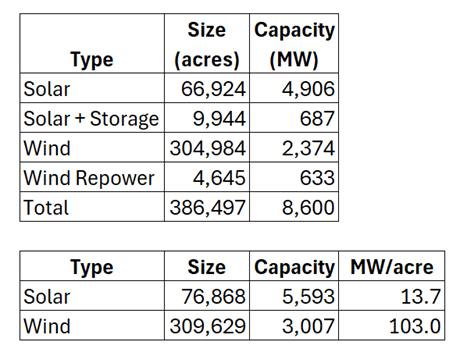
Another point that this letter ignores is the magnitude of the resources necessary and the resulting sprawl across New York.  The New York State Office of Renewable Energy Siting and Electric Transmission (ORES) and the Department of Public Service (DPS) have a new interactive map of solar and wind project siting status.  Here are the total capacity and the land covered by existing renewable energy sprawl.

The Scoping Plan’s Integration Analysis (IA) included three scenarios that projected future resources necessary (Strategic Use of Low-Carbon Fuels, Accelerated Transition from Combustion, and Beyond 85% Reduction) and the New York Independent System Operator made two projections too.  The number of acres required for those resources shown below is staggering.

According to Wells the development of wind and solar resources “bring real, tangible benefits to local communities” and help preserve agricultural land.  Wells mentions that the Morris Ridge Solar will pay $1.6 million in direct community payments each year and notes that rental payments “can offer a lifeline to our family farms, providing them with new revenue”.  One of the unintended consequences of extensive solar development is that it affects the viability of farmers that must rent land for their operations.  An agronomist and environmental planner in western New York explained that the problem is that farmers are now competing with solar developers who are paid direct and indirect subsidies that enable them to offer land owners up to ten times the current agricultural annual lease rates.   This raises the concern that farmers will not have enough available farmland to support the investment they have made in facilities, livestock, or equipment.  Furthermore, claims that these projects will support the agricultural economy overall is simply wrong.  It will reduce farm jobs when farmers rent their land rather than farm so economic activity may be improved during construction but once the facility is operational there are very few economic benefits to essential local businesses.

Wells claims that wind and solar development will “help preserve agricultural land”.  She does not mention that the New York state utility-scale solar siting program does not ensure responsible solar siting that protects agricultural land.  I have documented some of the issues with solar siting.  For example, the Department of Agriculture and Markets (“Department”) has a solar project siting goal “to limit the conversion of agricultural areas within the Project Areas, to no more than 10% of soils classified by the Department’s NYS Agricultural Land Classification soil groups 1-4, generally Prime Farmland soils, which represent the State’s most productive farmland.”  Undoubtedly due to lobbying pressure, the Department has submitted comments raising the issue when solar projects apply for permits but no application has been modified when the limit is exceeded.  The Morris Ridge Solar project is the biggest project in the state, and they did not convert any prime farmland so it can be done.  The Prime Farmland Scorecard at my solar issues page lists 35 solar projects and only 12 meet the Department goal and the average over all projects is 18%.  The total prime farmland converted to solar factories is 10,952 acres.

In her closing arguments she says that skepticism and questions are good, but “preconceived notions that don’t allow you to hear the facts are not.”  This leads up to an invitation to “continue this conversation at the 21st Annual Symposium on Energy in the 21st Century on April 4 at the SUNY College of Environmental Science and Forestry in Syracuse. This annual gathering of the grifters of the green energy scam is an example of the many ways that green energy can pay out.  I am familiar with examples of symposiums on issues of the day that provided the organizer with enough money to forgo full-time work.  I have little doubts that this symposium is any different.

Worse these purveyors of doom and gloom who claim it can be solved with their green energy solutions are a real danger to society.  Bryce provides two relevant reasons related to the Federal programs that are also applicable to New York:

First and foremost, the ITC and PTC are, to use the title of Meredith Angwin’s excellent 2020 book, shorting the grid. The massive subsidies for weather-dependent forms of generation are distorting electricity markets and contributing to the premature closure of the thermal plants needed to assure the affordability, reliability, and resilience of our electric grid.

Second, these subsidies are fueling the landscape-wrecking, bird-and-bat killing, property-value-destroying energy sprawl that comes with the expansion of Big Solar and Big Wind. They are also fueling the insane expansion of offshore wind energy into the known habitat of the critically endangered North Atlantic Right Whale and other marine mammals.

Conclusion

The Scoping Plan and all the proposed green energy programs are crimes against physics.  The energy density of wind and solar energy is too low and the resource intermittency too variable so that no electric system relying on those resources for most of its energy can ever hope to provide reliable electricity.  If this reality is not acknowledged soon and these policies paused, then the enormous costs of this futile gesture to control the climate will bankrupt the state. 

Despite all the evidence that this can never work, the Hochul Administration continues to push the Climate Act, supporters like Wells continue to get misleading opinions published, and people flock to meetings to congratulate each other on their virtuous plans.  I believe that ultimately the reason for the continuing support is the money.  For every advocate motivated to save the planet for selfless reasons, there is someone whose primary motivation is cashing in on the scam.

New York Budget Articles

I have never closely followed New York State’s budgeting process before because I never felt connected to Albany politics, and it seemed so complicated.  My obsession with the unfolding disaster of the Climate Leadership and Community Protection Act (Climate Act) net-zero transition has prompted me to take an interest in the process.  The latest New York Focus Newsletter describes budget articles that include an overview of the process and discussion of funding proposals with one article focused on funding for the ambitious climate goals.  I recommend all the stories to New York readers.

I am convinced that implementation of the New York Climate Act net-zero mandates will do more harm than good if the future electric system relies only on wind, solar, and energy storage because of reliability and affordability risks.  I have followed the Climate Act since it was first proposed, submitted comments on the Climate Act implementation plan, and have written over 500 articles about New York’s net-zero transition.  The opinions expressed in this article do not reflect the position of any of my previous employers or any other organization I have been associated with, these comments are mine alone.

Budget Overview

Sam Mellins answers questions about the state’s notoriously opaque budget process.  His article addresses the following questions:

  • What is the state budget?  It is likely to allocate over $250 billion with “biggest shares going to healthcare and education.  He makes the critical point that the budgeting legislation is also used to “enact laws that don’t involve spending money.”  Guess how the Climate Act was passed.
  • Where does the money come from?  Most of the money allocated in the budget comes from the taxes that New Yorkers pay to the state government. But a sizable portion is cash that the federal government gives New York to provide services “ranging from highways and transit to health insurance for low-income residents.”
  • What are the major steps in the budget process?  This description summarizes the process that is used to pass the budget.
  • Who are the key players?  I was aware that the budget negotiations boiled down to a few individuals. Mellins explains that “Three key parties dominate the process: the governor, the Senate majority leader, and the Assembly speaker.”
  • How does our process compare to other states?  This is a must-read section: “In a 2015 analysis by the Center for Public Integrity, New York ranked dead last among all states for accountability and transparency in its budget process.”  Not surprisingly the politicians ignore State Constitution requirements and push things through at the last minute.
  • Is the entire budget up for negotiation?   Mellins explains that most of the budget is more or less on autopilot so only “optional” items cause debate.
  • How does the public get involved?  Mellins notes that the budget process is always accompanied by a flurry of lobbying, activism, and advocacy and that “Any New Yorker can submit written testimony during budget hearings.” 

Funding the Green Transition

Colin Kinniburgh describes how the Senate, Assembly and Governor stand on funding Climate Act implementation.  As this is my primary focus, I will quote his article in its entirety with my annotated comments.  He introduces the article with this: ” If Albany is planning to rally against the Trump administration’s attack on its climate plans, it’s not showing in the budget.”

The New York Cap and Invest program is of special interest to me.  Establishing any cost on carbon like this program is no more than a hidden and regressive tax.  The slow pace of implementation may be the result of dawning realization that the costs involved may be politically inimical to its political supporters.  Kinniburgh describes the status:

In New York, the governor sets the budget agenda. That’s particularly clear on climate this year. Breaking two years of promises, Governor Kathy Hochul in January dropped the climate funding program known as “cap and invest” from her 2025 agenda. Her agencies have been writing the rules to structure the carbon pricing program, but the legislature would likely have needed to approve spending the resulting revenue — about $3 billion a year and growing — setting up what could have been a major budget fight.

Hochul effectively brushed that plan off the table, and the legislature isn’t making any big moves to bring it back.

The reality is that this is a major undertaking but despite the challenge the Department of Environmental Conservation managed to get draft rules put together.  The reason that they have not been released is solely due to politics and the inevitable need to show the costs.  No amount of gilding the pig with slogans will be able to hide the costs.  But funds are still needed if the Climate Act transition is to proceed.

In the place of the permanent program, Hochul offered a one-time, $1 billion budget line to fund a variety of climate initiatives over the next five years. The Senate and Assembly have both accepted that amount, though they want more guardrails on how it’s spent. Hochul’s proposal lists a few broad areas she wants to fund, like renewables and building retrofits, but gives little further detail.

The Senate wants to give legislative leaders a chance to review the governor’s spending plan. The Assembly has gone further, divvying the $1 billion between seven programs advancing building decarbonization and electric vehicles, particularly school buses and charging infrastructure.

“The governor and Senate have a slush fund, the Assembly makes clear allocations,” said Liz Moran, Northeast policy advocate at Earthjustice, in a text message.

In this political process the missing piece by the Governor and the legislators is the reality that they don’t have the expertise to set energy policy funding priorities.  Selective listening to supposed authoritative sources all the while ignoring the experts who have the responsibility to keep the lights on, choosing winners and losers based on lobbyist effectiveness, and setting priorities based on the whims of favored constituencies is sure to result in poor policy.

The Senate also includes a nod to cap and invest in its budget resolution, urging the governor to “immediately issue all draft regulations necessary” to implement the program. (Hochul has said her agencies need more time to complete the rules, but internal emails reported by Politico show that they were ready to go before she abruptly hit the brakes in January.) There’s little chance that the message will revive cap and invest in this year’s budget, but it adds to a growing chorus. (Green groups’ call to release the regulations may soon be backed up by a lawsuit, according to Michael Gerrard, director of the Sabin Center for Climate Change Law at Columbia University.)

This paragraph scares me.  The only thing that could foul up the proposed cap-and-invest program more than the provisions inserted in the draft regulations to comport with the Climate Act would be for politicians to get involved with implementation details.  Well maybe it would be worse if some judge decides how to do the implementation.  Kinniburgh goes on to describe other “big-ticket climate items.”

The NY HEAT Act, a top priority for green groups, once again faces an uphill battle. For the third year running, the Senate has included the bill — which would allow the state to gradually transition homes off fossil fuels — in its budget proposal. But the chamber is alone in doing so. Last year, Hochul included a version of the bill in her budget, but the Assembly blocked it in final negotiations.

There’s no sign in its budget proposal that the Assembly is warming to the HEAT Act this year. Two assembly members told New York Focus that its omission reflected the chamber’s longstanding — and inconsistently held — position that policy does not belong in the budget, but they expected it to be on the table in final talks.

I could not agree more with the admonition that policy does not belong in the budget.  What is absolutely necessary for the climate budgeting strategy is a clear, transparent, and well documented description of the costs, emission reductions, realistic implementation schedules, and expected revenue streams for the strategies proposed to meet the Climate Act mandates.  The time for only providing the slogan that the cost of inaction is more than the cost of action has long since passed.  New Yorkers deserve the details.  The total costs to implement the NY Heat Act is a prime example of this need.

There is one new climate item that the legislature has aligned on: solar tax credits. The current $5,000 credit for homeowners who install solar power took effect in 2006 and has not been updated since. The Assembly and Senate want to increase the maximum credit to $10,000 and make it easier for co-op and low-income residents to receive it.

The tweak would give a further boost to small-scale solar, the only area where New York has outpaced its climate targets. The state closed out last year with 6.6 gigawatts of rooftop and community solar, beating its 2025 goal. But research has found that the subsidies fueling that growth go disproportionately to high-income homeowners. This year’s budget legislation, with newfound support from the Assembly, aims to shift the balance.

This is a perfect example of political ambition outrunning reality.  It is accepted by all credible sources that to support a reliable New York State electric grid that depends primarily upon wind, solar, and short-term storage resources that a new dispatchable and emissions-free resource (DEFR) must be deployed.  In my opinion, the most promising DEFR technology is nuclear generation because it is the only candidate resource that is technologically ready, can be expanded as needed, and does not suffer from limitations of the Second Law of Thermodynamics. If the only viable DEFR solution is nuclear, then renewables cannot be implemented without it.  But nuclear power runs best as baseload generation so it can replace renewables, eliminating the need for a massive DEFR backup resource.  Therefore, it would be prudent to pause all actions that encourage further renewable development until DEFR feasibility is proven because nuclear generation may be the only viable path to zero emissions.

Kinniburgh concludes:

Solar boost aside, the Senate and Assembly’s proposals leave climate issues largely where Hochul did: in the margins of budget talks. Almost six years after New York passed a climate law promising to shift its economy away from fossil fuels, the state has committed no consistent funding to do so, and it looks like this year’s budget will not change that.

I would only add that six years after the law passed the Hochul Administration has still not opened the books on the expected costs.  In these budget debates those costs are absolutely necessary.

Other Articles

The newsletter included links to other articles about the budget.  There is one about budget showdown hot topics including millionaire tax hikes and inflation rebate checks. Another article dives into the proposal for a “middle-class” tax cut.  The legislature has proposed more money for child care than proposed by the Governor.  Another item raised by the legislature are changes to the school funding formula.  The legislature has proposed a boost to nonprofits and safety net programs serving New York’s neediest.  After the recent prison strikes actions on prisons and public safety policies will be debated.

Conclusion

As a New Yorker I am not sure what is the biggest embarrassment.  Is it a plan to completely transform the economy to eliminate fossil fuels without doing a feasibility analysis before implementing it?  Or is it the annual budget process back-room shenanigans described in these New York Focus articles.  The only thing I am sure of is that the impacts of both are not in the best interests of New York.

Renewables are Cheaper Because of Fuel Volatility

I have run into a couple of instances where New York Climate Leadership & Community Protection Act (Climate Act) proponents have claimed that renewable energy development can reduce costs.  This article responds to the argument that reduced fuel price volatility will make renewables cheaper.

I am convinced that implementation of the New York Climate Act net-zero mandates will do more harm than good if the future electric system relies only on wind, solar, and energy storage because of reliability and affordability risks.  I have followed the Climate Act since it was first proposed, submitted comments on the Climate Act implementation plan, and have written over 500 articles about New York’s net-zero transition.  The opinions expressed in this article do not reflect the position of any of my previous employers or any other organization I have been associated with, these comments are mine alone.

Renewable Energy Can Reduce Costs

I am disappointed that the renewable energy can reduce costs claim has made it into the New York State Energy Plan process.  The Energy Plan is “a comprehensive roadmap to build a clean, resilient, and affordable energy system for all New Yorkers”.  When the Energy Planning Board met on March 3, 2025 to adopt the scope for the state energy plan the claim was mentioned.  One item on the agenda was a discussion of the “planned approach for techno-economic pathways analysis”.  This is the analysis work whereby the state agencies and their consultants will “prove” the pre-conceived notion that the Climate Act net-zero transition concocted by politicians will work. 

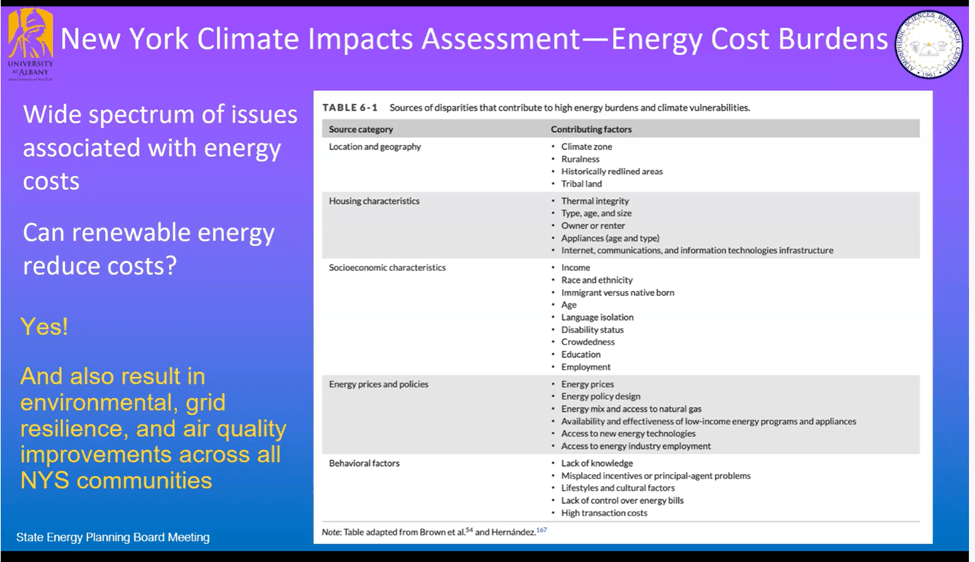
The presentation by Jeff Freedman from the Atmospheric Sciences Research Center, University at Albany, Albany, New York included the following slide that makes the claim that renewable energy can reduce costs. One characteristic of the New York State Energy Research & Development Authority (NYSERDA) documentation for the implementation plan is inadequate documentation, so it is not surprising that the justification for the claim is not readily available.

Table 6-1 was in New York State Climate Impacts Assessment Chapter 06: Energy.  That chapter does not address renewable energy costs specifically.  I searched for references for costs in the chapter and found only one relevant reference on page 370:

Energy costs: Fossil fuel prices are increasingly volatile, largely because they are traded on global markets. In contrast, a power sector composed of large volumes of renewable resources that have no fuel costs could lead to less volatile energy bills due to the elimination of this driver of variability in energy costs. The presence of distributed resources amplifies this effect. Whether the costs of a clean power sector are lower than, comparable to, or higher than the status quo, they will be more predictable and less likely to create indirect costs that arise from unexpected price changes.

I am aware of one other instance where this rationale was mentioned.  The December 18, 2024 New York Assembly Committee on Energy public hearing enabled legislators to question NYSERDA and the New York State Department of Public Service (DPS) staff about Climate Act progress. When Jessica Waldorf, Chief of Staff & Director of Policy Implementation, DPS was asked what impact Climate Act GHG emission reductions would have given that New York emissions are smaller than the observed annual increases in global GHG emissions. Waldorf said that there are other reasons “to build renewable energy resources in New York that are not just related to emissions.”  She gave two reasons: energy security and price volatility. 

The other thing I would say about energy security is price volatility.  Customers are beholden to the whims of the fossil fuel industry and the up and down markets that we see from fossil fuels.  Localizing our energy production and renewables allows us for price stability.  That is definitely a benefit of building resources here. 

The presumption in this article is that the basis of these claims that renewable energy will be cheaper and less volatile is that a renewable energy dependent electric system will have less unstable fuel costs resulting in cheaper and more secure energy.  This in turn is based on two presumptions: fuel prices are volatile because of global markets and renewables would eliminate this cost driver.

Fuel Volatility

The US Energy Information Administration (EIA) noted in June 2024 that fossil fuel price volatility has shown significant changes over time, with recent years experiencing particularly high levels of volatility: “In 2022, natural gas price volatility reached extreme levels, with historical volatility peaking at 171% in February 2022, the highest since at least 1994.”  Note that EIA is only discussing natural gas volatility which has become a much larger electric generating fuel source in recent years.  In my opinion, the increasing reliance on a single fuel could be the fundamental reason for the observed increase in volatility.

In any case, the New York agency global market argument picks just one driver for fuel price volatility.  The EIA  gave other reasons for natural gas variability in August 2022:

Increased uncertainty about market conditions that affect natural gas supply and demand can result in high price volatility. Events that have contributed to changing market conditions include:

  • Production freeze-offs
  • Storms
  • Unplanned pipeline maintenance and outages
  • Significant departures from normal weather
  • Changes in inventory levels
  • Availability of substitute fuels
  • Changes in imports or exports
  • Other sudden changes in demand

U.S. natural gas prices are typically more volatile during the first quarter of a year because of the fluctuating demand for natural gas for space heating as weather changes. Factors that contributed to heightened volatility in the first three months of this year include:

Of the eight events that contribute to changing market conditions and fuel volatility is the only one is related to global market conditions.

Jurisdictional Proof

When I get around to submitting a comment on the weakness of this argument, I intend to demand that the proponents of the Climate Act offer an example of a jurisdiction where the electric system has become reliant on wind and solar renewable generation and consumer costs have gone down because the fuel volatility has decreased.  To my knowledge, all jurisdictions have seen consumer cost increases. 

I used Perplexity AI to research electric energy prices as a function of wind and solar deployment.  My experience showed the weaknesses of AI research.  The response to the question whether consumers in any jurisdiction have seen decreased costs when transitioning their electric system to rely on wind and solar claimed that it was true.  The response said: “This trend is driven by the rapidly declining costs of renewable energy technologies and their increasing cost-competitiveness compared to conventional fossil fuel sources.”  The reference cited was from Ember-Energy “a global energy think tank that accelerates the clean energy transition with data and policy” that can hardly be considered an unbiased source.  The response also does not address consumer rate costs.  It makes the mistaken claim that the cost of developing renewable technologies has little relation to the delivered cost of electricity to consumers. In the real world, the cost of storage to address intermittency, the cost of additional transmission support to address diffuse wind and solar, and the cost to provide the ancillary transmission support services not available from wind and solar, make renewables much more expensive than fossil fuels.   I was unable to frame a question that provided an answer that acknowledged that the costs necessary to provide consumers with reliable power made delivered renewable energy more expensive.

German Experience

However, if the claim is true then proponents should be able to point to jurisdictions where wind, solar, and energy storage have make electric prices cheaper.  The best example of the claim that renewable energy is cheaper because it reduces fuel volatility should be Germany.  Oil, coal and gas prices spiked in the immediate aftermath of Russia’s invasion of Ukraine and have been volatile ever since. Germany’s Energiewende is the country’s planned transition to a low-carbon, nuclear-free economy and is often cited as an example of what New York should do. Enerdata reports that “According to the German Federal Network Agency, the installed renewable power capacity in Germany increased by nearly 20 GW (+12%) to nearly 190 GW in 2024.” If the proponent’s claim is true then prices should be trending down.  However, since 2000, electricity prices for German households have risen by 116%, from 13.94 to 30.43 cents per kilowatt-hour in 2019 .  As of April 1, 2024, households with basic supplier contracts were paying around 46 cents per kilowatt-hour, making it “the most expensive option compared to other providers or special contracts” .

Another way to look at the claim is to compare electricity prices within the European Union.  I highly recommend  the Nemeth Report for its coverage of European energy issues. The post EU Action Plan for Affordable Energy  includes just such a comparison.  It quotes Ursula von der Leyen, President of the European Commission, as saying: “We’re driving energy prices down and competitiveness up. We have already significantly reduced energy prices in Europe by doubling down on renewables. “

However, the data in the following figure do not support her claim. 

The analysis states that:

Note that the household price average shows a large difference between EU countries that use coal, nuclear, and gas vs those that have focused on wind and solar. For example, as shown in the chart above, according to Statista, using 2023 data, Hungary’s electricity price was 9.68 Eurocents/kwh (50% of their electricity is from nuclear, 38% coal & gas) and Bulgaria which relies mostly on coal and nuclear was around 11 Eurocents/kwh, whereas Germany, which has “doubled down on renewables” (and closed down its nuclear), was the highest at 44.97 Eurocents/kwh and Denmark which has a small population and a whole lot of windmills was at 39.44 Eurocents/kwh! 

Data sources and the year of the data matters. Eurostat uses numbers from the first quarter of 2024 which reorder some of the countries but the overall argument, that countries that “doubled down on renewables” and made other poor choices of shutting down nuclear power plants and/or coal experienced higher prices, remains supported. 

Discussion

Roger Pielke, Jr recently posted an article about the politicization of expertise that is relevant here.  He argues that society needs to depend on the expertise of specialists in many fields – “Nobody knows enough to run the government”.  As a result, society needs all of us.  He explains that “We do not have to agree on everything, but we do have to work together”.  Then he points out that “In recent years, credential expertise—like many things—has become pathologically politicized.”         

Such is the case shown by the politicization of the Climate Act implementation led by NYSERDA.   Consider, for example, the presentation by Jeff Freedman to the Planning Board.  It is concerning on a couple of levels.  In the first place, the Planning Board is composed of agency heads and political appointees who for the most part do not have background and experience in the energy sector.  Freedman was presented as an expert from the energy sector whose claim that “renewable energy can reduce costs” was probably taken as the gospel.  However, his main research focus is on “renewable energy and atmospheric boundary layer (ABL) processes” so his bias is towards renewable energy virtues and he has no energy sector experience that qualifies him to make such a statement.  He was a spokesman because of his adherence to the narrative.

In the second place, the presentations at the meeting suggest that NYSERDA will follow the Scoping Plan approach in the stakeholder process for the Energy Plan.  The primary purpose of the meeting was to approve the final scope of the Energy Plan.  As was the case with the Climate Act Scoping Plan the NYSERDA response to stakeholder comments is to document the number of comments received by category and provide general descriptions of key themes and “responsive Scope revisions”.  My problem with this is that if anyone provides specific comments or raises specific issues with claims, there is no documentation that the submittal was addressed, and nothing included to respond to the issue raised.  For example, the claim that renewable energy can reduce costs was undocumented in Freedman’s presentation.  I have no doubts that NYSERDA will continue the charade that renewable energy can reduce costs and that costs of inaction are worse than the costs of action.  They have never responded to related issues raised and will continue to do so as long as they can get away with it.  In my opinion this is another instance of pathologically politicized expertise by NYSERDA because they are so arrogant that they don’t see any need to respond to stakeholder comments.

Conclusion

The biggest threat to Climate Act progress is the inevitable extraordinary cost of implementation.  The Hochul Administration has ducked the issue since the Climate Act was passed.  They can only hide reality for so long.  The question is whether the issues associated with the net-zero transition will be addressed before New York’s economy is severely compromised.

In the meantime, if you ever hear anyone say renewable energy can reduce costs, please ask them why German electric prices are so high or to cite an example of any jurisdiction that is transitioning their electric system that has reduced ratepayer bill costs when using the Climate Act strategy to rely wind, solar, and energy storage resources.

Peer Review and Costs of Building Electrification for Commercial Users 

This is an article primarily by Richard Ellenbogen that estimates projected annual operating costs and emission reductions for New York commercial facilities when the new building codes are implemented.  It is also an example of how peer review should be done.

I am convinced that implementation of the New York Climate Act net-zero mandates will do more harm than good if the future electric system relies only on wind, solar, and energy storage because of reliability and affordability risks.  I have followed the Climate Act since it was first proposed, submitted comments on the Climate Act implementation plan, and have written over 500 articles about New York’s net-zero transition.  The opinions expressed in this article do not reflect the position of any of my previous employers or any other organization I have been associated with, these comments are mine alone.

Ellenbogen is the President [BIO] of Allied Converters and frequently copies me on emails that address various issues associated with the New York Climate Leadership and Community Protection Act (Climate Act). I have published other articles by Ellenbogen including a description of his keynote address to the Business Council of New York 2023 Renewable Energy Conference Energy titled: “Energy on Demand as the Life Blood of Business and Entrepreneurship in the State -video here:  Why NY State Must Rethink Its Energy Plan and Ten Suggestions to Help Fix the Problems”. He comes to the table as an engineer who truly cares about the environment and as an early adopter of renewable technologies at both his home and business two decades ago.

Heat Pump Hype

I am a long-time critic of the New York State Energy Research & Development Authority’s (NYDSERDA) biased promotion of all green energy technologies.  Their description of cold climate heat pumps is a good example: “Today’s cold-climate heat pumps are a smarter, more efficient option to keep your home comfortable all year long. These all-in-one heating and air conditioning systems are environmentally friendly, extremely efficient, and affordable to operate.”  In another example, they breathlessly exclaim that heat pumps outsell gas furnaces for the second straight year.  This claim uses national figures and could be solely the result of new building sales that are much stronger in southern states where heat pumps are a cost-effective choice.  Ellenbogen addresses the affordability claims below.

Ellenbogen Heat Pump Experience

Ellenbogen installed geothermal heat pumps when his house was completed in 2004.  He has 21 years of experience with them and has maintained a database of the performance and costs.  His monitoring system includes temperature sensors on the inputs and the outputs of the wells and water flow.  Because he uses a geothermal system, he can rely on it even during the coldest periods when air source heat pumps cannot extract enough energy from the air to keep the house warm.  Furthermore, his system uses deeper wells than are currently allowed by law that were legal when the system was developed.  They are also open loop which greatly increases their efficiency but that is also no longer allowed. In his configuration, his heat pumps can pull 7 tons of heat transfer per well where current geothermal wells are limited to about 2.5 tons per well.  As a result, his system can achieve a Coefficient of Performance (COP) of about 5.5 whereas current Geo-thermal systems can achieve a COP of about 3.5 with the restrictions on well depth and having to be closed loop.  During long periods of cold temperatures that force the heat pumps to run for extended periods, the well temperatures can drop and the efficiency of the system decreases so it will use more energy.

One of the things I admire as a techno-weenie is Ellenbogen’s quantitative nature.  He built his house “as a science project to satisfy his intellectual curiosity” and it has yielded an enormous amount of data. When the Indian Point nuclear station was operating, he ran a calculation and found his geo-thermal system was about 7% more carbon free than his 95% efficient modulating gas boilers that were originally installed as a backup in case of a power failure.  After New York politicians shut down Indian Point the carbon emissions of local electricity increased and the GHG emissions advantage vanished.  Given his concerns about GHG emissions he decided to figure out a cost and energy comparison.  He turned the heat pumps off this winter and used the duplicate gas system to compare with multiple years of data with the heat pumps operating.

The results are notable.  His gas bill went up less than the electric bill went down and this is for an electric system with an efficiency 57% higher than what can be built now during a colder winter.  The electric bill was about $8600 lower than it would have been with the heat pumps operating.  The gas bill only went up by $6057 for a net savings of $2543 using the natural gas heating and the current winter has been 120 degree days colder than last year.  That figure has been adjusted for the higher electricity prices this year.   Note that the heating system is well designed with 14,500 square feet of high mass radiant floors that use 100-degree water in the system and 18 separate zones which makes it even more efficient.  The large scale of the system removes measurement aberrations that might occur with a smaller system.

To compare the costs of heating with electricity and natural gas it is appropriate to compare the cost to generate the same amount of heat.  Table 1 lists the cost for the delivery of one therm (heat energy equal to 100,000 British thermal units) between a 95% efficient boiler and electric heat at relationship different Coefficient of Performance efficiency values.  A COP of 1 is inefficient.  A highly efficient ground source heat pump has a COP of 3.5.  Even an efficient ground source heat pump is 16% more expensive ($2.85 for one therm compared to $2.45 for a 95% efficient gas system in the Downstate New York area which covers 60% of the state’s population.  Also note that air source heat pumps on a very cold day can reach COP’s of 1 – 1.5 and easily go below 2.  As a result, they can be two to three times as expensive to operate.

Commercial Facility Projection

New York State legislators passed a prohibition on the installation of fossil fuel equipment and building systems starting in 2026 for small buildings and 2029 for larger ones. The prohibition starts in 2026 for new buildings up to 7 stories tall, except for commercial and industrial buildings larger than 100,000 square feet. There are exemptions for certain types of buildings including emergency backup power systems, manufacturing facilities, commercial food establishments, laboratories, hospitals and medical facilities, critical infrastructure (e.g., water treatment plants), agricultural buildings, crematoriums.

Ellenbogen applied the numbers derived from his house experiment to his business and extrapolated them to the 55,000 square foot factory which would fall under the less than 100,000 square foot rule for new construction after 2026.  Admittedly, there is no law currently in place that would require a developer who wanted to replicate Ellenbogen’s manufacturing facility because of the exemptions.  Eventually, however, the net-zero mandates will require all electric construction of all new facilities and for the replacement of existing equipment before the end of useful life.  Therefore, it is a relevant example of Climate Leadership and Community Protection Act (Climate Act). costs.

Ellenbogen’s home has a backup gas boiler heating system and his manufacturing plant has a combined heat and power system.  In 2002 he installed the first microturbine-based Combined Heat and Power (CHP) system in the Con Ed service area.  This approach generates electricity by burning natural gas.  Waste heat is recovered “to heat the building in the winter, or to be sent to absorption chillers to cool the building in the summer.”  This approach allows him to recover 70 to 75 percent of the energy content of the fuel and augments a solar array on the roof.

By doing a thermal analysis of his home’s gas usage he was able to determine what would be needed to heat the factory.  The end result is that removing gas from his manufacturing facility would raise energy bills to about $147,000, more than doubling them,  and raise his carbon footprint by about 15%.  The key takeaway is that even using the most efficient electric heating/cooling system available, it still means that this gas ban policy will cost businesses in NY state enormously while raising carbon emissions.  When and if the Downstate New York electric system reaches zero GHG emissions the carbon emissions will be reduced.

Environmental Impacts

Ellenbogen calculated that because the Downstate electric system is CO2 rate is 950 pounds per MWh according to 2022 EPA data, that the CO2 emissions from using the CHP system are actually less than if heat pumps were used.  He also pointed out he has replaced three compressors in his home’s ground source system over the past 21 years and each time the failure resulted in a full loss of refrigerant.  He said that it is not preventable and that you only find out when the unit gives a fault code with no early warning.

Discussion

This post is based on three emails from Ellenbogen.  I did not include all the calculation details he provided in the originals but will provide them if requested.  The reason for the three versions is that the details provided enabled a reader to point out an issue that he corrected.  Ellenbogen noted that:

Those damned Laws of Thermodynamics are getting in the way again, but this may be a teaching moment to show what a real peer review looks like and that we have to acknowledge errors to make sure that the best information is in the public space.  It also is a clear example of how we can’t escape those Laws in our calculations.  Miscalculations introduce errors and a failure to account for the Laws of Thermodynamics entirely when setting energy policy introduces huge errors.

This raises an issue with the implementation of the Climate Act.  The agencies responsible for the implementation plans have not provided adequate documentation to enable detailed review of the plan.  Even if it is possible to make a detailed comment on an obvious issue, there hasn’t been any acknowledgement of any problem, much less evidence of a revision to the plans.  The appropriate peer review process exemplified by Ellenbogen’s analysis is not a feature of the Climate Act stakeholder process.  As a result, Ellenbogen notes “errors are apparent across the entire spectrum of NY State’s Energy plan.”

Ellenbogen summarized his peer review concerns in this regard.

While I hate to beat on academia, it has a great deal of responsibility for NY State’s energy mess.  A certain University Professor that sat on the Climate Action Council still refuses to acknowledge that all of the technologies for this transition do not exist despite a Public Service Commission conference determining that fact in 2023.   Unfortunately, people in the legislature and certain environmental groups have adopted those ideas despite there being known large deficiencies in those theories as it applies to putting them into practice.  Untested theories that can’t be put into practice in the “Real World” are dangerous for society.  State residents shouldn’t be turned into a science project and that is what is happening. 

I received the following response to my email from a retired professor that now works in industry.  I have redacted portions to keep them anonymous.  While on average, the refrigerant replacement is every 20 years as there are three heat pumps, their observations are profound and are critical to understanding a huge issue now facing the NY State.  It follows in italics.

This is the most sobering analysis of a heating system I have ever read. I constantly hear about the miracles of heat pumps, but the carbon footprint is never honestly presented. Plus the replacement of freon every 7 years is never included. Thanks for providing a clear analysis of a day in the life of a NY business and resident.

I’m still enjoying life in XXXXXXXX, and in no longer being a professor. Academia lives in a bubble, and you can’t see that until you leave. Professors need to do a real sabbatical leave in industry and be forced to solve real problems, not problems they dream up. It’s tough out here! I thought I knew something about XXXXXX  after XX  years as an academic doing research, but XX years at XXXXXXX  has shown me I have much to learn. It is stimulating, I’m glad to be here. They need to have a similar experience.

Regarding the statement above, one of the reasons that the carbon footprints of heat pumps is never honestly mentioned is that the loudest voices in the space are the people selling them and other people don’t have enough experience to question the results.  I’ve been using them for 21 years.  My house was built as a science project to satisfy my intellectual curiosity.  It has yielded an enormous amount of data, some of which has been used by the state.

One of the major issues that I have with NY State policy is that many of the people that are hired to do the energy analyses for the government actually work for the manufacturers or other interested parties.  The reports read more like advertisements paid for by the NY State taxpayers than a sound scientific document.  I dealt with that in a 2020 paper on the Lansing Gas moratorium.  The company hired to do the Tompkins County energy analysis sold heat pumps and the resulting report reflected that and had a huge error in its results.  The paper is very relevant to the building electrification discussion.

Regarding the professor’s comments, when someone is forced to deal with the consequences of their decisions as occurs in industry, it greatly changes their perspective.  There are no negative consequences for someone theorizing about policy on a University Campus and that is okay because it can move society forward.  However, if they don’t really test those ideas before pushing them into society as a gospel, there will be huge problems and that is what we are now seeing in NY State.

Conclusion

The ramifications of New York’s Climate Act on business development are becoming evident.  In 2026, certain new buildings in New York will no longer be able to install fossil fuel equipment and building systems.  Richard Ellenbogen has performed a “science project” that proves that New York’s net-zero transition electrification plans for heating will be more expensive than using natural gas.  It is also notable that the experiment was best on a geothermal heat pump system that is more efficient than legally possible today.  Adding to the already large energy costs in New York is not a good way to attract and maintain manufacturing in the state. 

This exercise also shows the importance of robust peer review.  Ellenbogen’s first draft contained an error that was identified because he showed his work.  He acknowledged the problem and corrected his analysis.  New York’s Climate Act stakeholder process does not document analyses well enough for considered review and the Hochul Administration does not acknowledge any comments that do not comport with their narrative.  As a result, the broken stakeholder process in New York will likely ignore Ellenbogen’s real-world results. 

Governor Hochul and Climate Act Affordability Part 2

I have argued that Climate Leadership & Community Protection Act (Climate Act) affordability would become a political issue.  I also argued that when Governor Hochul assigns Climate Act responsibilities to the New York Power Authority (NYPA)and then says “Too many New Yorkers are already falling behind on their energy bills and I will do everything in my power to reign in these astronomical costs” when NYPA proposed raising rates to cover those costs it is hypocritical.  This post looks at utility rate impacts.  Those costs are already increasing dramatically.

I am convinced that implementation of the New York Climate Act net-zero mandates will do more harm than good if the future electric system relies only on wind, solar, and energy storage because of reliability and affordability risks.  I have followed the Climate Act since it was first proposed, submitted comments on the Climate Act implementation plan, and have written over 500 articles about New York’s net-zero transition.  The opinions expressed in this article do not reflect the position of any of my previous employers or any other organization I have been associated with, these comments are mine alone.

Overview

The Climate Act established a New York “Net Zero” target (85% reduction in GHG emissions and 15% offset of emissions) by 2050.  It includes two 2030 targets: an interim emissions reduction target of a 40% GHG reduction by 2030 and a mandate that 70% of the electricity must come from renewable energy by 2030. The Climate Action Council (CAC) was responsible for preparing the Scoping Plan that outlined how to “achieve the State’s bold clean energy and climate agenda.”  After a year-long review, the Scoping Plan was finalized at the end of 2022.  Since then, the State has been trying to implement the Scoping Plan recommendations through regulations, proceedings, and legislation. 

Personal Experience

This post was prompted by an email from a friend who sent along screen shots of his most recent and last year’s electric supply bills from New York State Electric & Gas (NYSE&G).

NYSE&G current bill screen shot:

NYSE&G electric bill from a year ago:

I looked up my electric bills.  Here are screenshots of current Niagara Mohawk Power Corporation, dba– National Grid electric rates

Here is a screenshot of the same information from a year ago:

I compared the cost increases in Table 1.  NYSE&G electric supply rates have increased sharply.  National Grid went up but not nearly as much. 

Table 1: New York Electric Supply Rate Increases Examples

New York State Electric Utility Rate Cases

The differences between the two utility rates in Table 1 is striking.  Particularly because the service territories overlap so much (Figure 1).

Figure 1: NYS Electric Utility Service Territories

I suspected that the differences at this time are due to the status of New York State electric utility rate cases.  NYSE&G has recently settled their rate case whereas National Grid is in a pending case.  National Grid rates will go up as soon as a new rate case is settled and the only question is how much.  I checked the Public Service Commission (PSC) Pending and Recent Electric Rate Cases web pages and found the following information.

Niagara Mohawk Power Corporation dba National Grid:

NMPC is requesting an increase in annual electric revenues of approximately $525 million (20 percent increase in delivery revenues or 11 percent in total revenues) for the rate year ending March 31, 2026. NMPC estimates that the requested increase in delivery revenues will result in a monthly bill increase of $18.92 (23.4 percent increase in delivery bill or 15.3 percent increase in total bill) for a typical residential customer using 625 kilowatt-hours (kWh).

For the record here is information on other rate cases listed at the PSC website.

Central Hudson:

Central Hudson Gas and Electric Corporation is requesting an increase in annual electric delivery revenues of approximately $47.2 million (8.8 percent increase in base delivery revenues, or 4.6 percent increase in total system revenues), compared to the revenues approved by the Commission for the Company’s current Rate Year. The requested increase in electric delivery revenues results in a monthly bill increase of $9.19 (8.6 percent increase on the delivery bill, or 5.3 percent increase on the total bill) for an average residential customer using 630 kilowatt-hour per month.

Consolidated Edison:

Con Edison is requesting an increase in annual electric delivery revenues of approximately $1,612 million (an 18.0 percent increase in base delivery revenues, or an 11.4 percent increase in total revenues). The requested increase in delivery revenues results in an average residential monthly delivery bill increase of $26.60 (a 19.1 percent increase on the delivery bill, or a 13.4 percent increase on the total bill) for a 600 kilowatt-hour/month customer. 

The primary drivers of the requested electric increase are local property taxes (which account for an overall electric bill increase of 3.1 percent), new infrastructure investment (2.6 percent) and operating expenses (2.6 percent). Con Edison purports that its filing will help accommodate demand growth, especially with clean energy options and substation investments, while maintaining reliability with investments in feeder replacements. The Company is also enhancing its system resiliency for more frequent and severe storms, as well as warmer temperatures.

In addition, the Company’s filing purportedly includes a focus on improving customer outreach and accessibility, enhancing customer support and the customer experience, and promoting energy efficient programs. The Company plans to expand outreach efforts to enroll eligible customers in the Energy Affordability Program.

I also did a Perplexity AI search asking the question: What is the status of New York State electric utility rate cases.  The results noted that “as of February 17, 2025, there are no pending or recent electric rate cases for New York State Electric & Gas (NYSEG). However, there are some notable developments in the New York electric utility landscape”.  The response stated:

Con Edison’s proposed rate hike: Governor Hochul has directed the state agency to reject Con Edison’s proposed rate increase, which would have raised electricity rates by 11.4% in 2026.

Orange & Rockland Utilities: There is a pending case (Case 24-E-0060) for Orange and Rockland Utilities, Inc. The company is requesting a 7.3% increase in electric delivery revenues for the rate year ending December 31, 2025.

National Grid: The company filed a request in May 2024 for new electric and gas rates in upstate New York, proposing to reset prices beginning in Spring 2025.

Previous rate increases: Con Edison has already implemented rate increases of 9% in 2023, 4% in 2024, and 1.4% in January 2025.

Discussion

The Perplexity AI response also noted that “It’s worth noting that Governor Hochul has also directed the Department of Public Service to conduct a statewide audit of utility company salaries and compensation, which may impact future rate cases.”   The referenced article notes that Governor Hochul “pushed back against proposed rate hikes from Con Edison, directing the state’s Department of Public Service to reject the company’s request for approval.”  I believe that there should be a line on bills that documents the Climate Act costs.  That transparency could be politically damaging so that will never happen.

I am also concerned about the Public Service Commission.  Given that all the Commissioners are partisan political appointees when she directs them to reject the rate case, that is what will happen.  Furthermore, most of the board has ties to green energy.  This will certainly lead to biased outcomes that I think will not be in the best interests of New York.

I asked Perplexity AI another question – Are the commissioners of the New York Public Service Commission partisan appointees of the governor. It responded that was true.  The response was based primarily upon New York Public Service Law Section 4 and stated that:

The governor appoints the commissioners with the advice and consent of the New York State Senate.

However, there are restrictions on partisan composition:

  • The commission consists of up to seven members.
  • No more than three commissioners may be members of the same political party if there are five commissioners.
  • If the number of commissioners is increased to seven, no more than four may be from the same political party.

These rules ensure some level of bipartisan representation on the commission, despite the commissioners being appointed by the governor. The commissioners serve six-year terms on a full-time basis.

However, the current composition is anything but bipartisan.  Technically there are only three Democrats and one Republican but four members have direct experience with green energy non-governmental organizations.  The Public Service Commission website for the Commissioners lists the backgrounds of the seven members. 

  • Rory M. Christian, Chair of the Commission – Chairs of New York agencies are chosen for political allegiance to the party of the Governor so I count him as a Democrat.  He also was the Director of New York Clean Energy at Environmental Defense Fund.
  • James S. Alesi – Held an office as a Republican.
  • David J. Valesky – Held an office as a Democrat.
  • John B. Maggiore – Worked in Democrat administrations.             
  • Uchenna S. Bright – Has not held political office but worked with environmental non-governmental organizations include the Natural Resources Defense Council (NRDC).
  • Denise M. Sheehan has not held political office but has “30 years of experience in government and non-profit sectors” and currently serves as Senior Advisor to the New York Battery and Energy Storage Technology Consortium (NY-BEST).
  • Radina R. Valova has not held political office.  Served as Vice President of the Regulatory Program at the Interstate Renewable Energy Council (IREC), a national non-profit organization that builds the foundation for clean energy and energy efficiency.  Prior to joining IREC, Ms. Valova served as Senior Staff Attorney and Regulatory Affairs Manager for the Pace Energy and Climate Center in White Plains.

I make that one Republican, three Democrats, and three that could conceivably be called non-partisan but certainly could also be called environmentalists.  As a result, I think the makeup of these Commissioners will acquiesce to anything the Governor wants.  At the top of that list is the Climate Act green energy narrative that transitioning away from fossil fuels to “free” solar and wind will lower prices.  If that does not happen it must be because of the greedy utility companies.

There is only one problem with that approach – reality.  In the real world, providing reliable wind and solar energy is expensive.  The utility companies will be on the hook to provide the distribution and transmission system upgrades necessary to get the diffuse solar and wind power from where it is generated to where it is needed.  The utility companies have also been told to develop infrastructure for electric vehicle charging. If Hochul’s grandstanding disapproval of rate cases continues, then how are those necessary components of the net-zero transition going to get built?

Conclusion

Hochul was quoted as saying “Too many New Yorkers are already falling behind on their energy bills and I will do everything in my power to reign in these astronomical costs.”  I can’t believe that the Hochul Administration does not understand that the transition will cost enormous amounts of money and is a major reason for those “astronomical” costs.    In my opinion, the political solution is to stop the transition and blame someone else.  I expect that the Trump Administration’s slow down of offshore wind, cancellation of electric vehicle mandates, and the cut back on components of the Inflation Reduction Act will provide the political cover for Hochul to say we tried but evil Trump makes it impossible.   Stay tuned to the political theater as this unfolds.

Governor Hochul and Climate Act Affordability

I have argued that Climate Leadership & Community Protection Act (Climate Act) affordability would become a political issue soon.  My previous article concluded that there is no way to simultaneously achieve the Climate Act emission reduction goals and maintain affordability such that it will not be a campaign issue for Governor Hochul 2026 re-election campaign.  This article follows that up with the ramifications of this news “The New York Power Authority (NYPA) backed down from a significant rate increase proposed for hydropower after facing bipartisan backlash, but it was an order from Gov. Kathy Hochul herself that ultimately doomed the plan.”

I am convinced that implementation of the New York Climate Act net-zero mandates will do more harm than good if the future electric system relies only on wind, solar, and energy storage because of reliability and affordability risks.  I have followed the Climate Act since it was first proposed, submitted comments on the Climate Act implementation plan, and have written over 500 articles about New York’s net-zero transition.  The opinions expressed in this article do not reflect the position of any of my previous employers or any other organization I have been associated with, these comments are mine alone.

Overview

The Climate Act established a New York “Net Zero” target (85% reduction in GHG emissions and 15% offset of emissions) by 2050.  It includes two 2030 targets: an interim emissions reduction target of a 40% GHG reduction by 2030 and a mandate that 70% of the electricity must come from renewable energy by 2030. The Climate Action Council (CAC) was responsible for preparing the Scoping Plan that outlined how to “achieve the State’s bold clean energy and climate agenda.”  After a year-long review, the Scoping Plan was finalized at the end of 2022.  Since then, the State has been trying to implement the Scoping Plan recommendations through regulations, proceedings, and legislation. 

NYPA Rate Hike 

According to the Governor’s press release:

Governor Kathy Hochul today announced that she is demanding the New York Power Authority suspend its proposed electric rate hike, protecting consumers from sky-high utility costs that are making New York State less affordable.

“Today, I’m calling for an end to the Power Authority’s unacceptable proposal to raise electric rates on its customers statewide,” Governor Hochul said. “Too many New Yorkers are already falling behind on their energy bills and I will do everything in my power to reign in these astronomical costs. While I recognize the Power Authority’s critical importance in providing invaluable, clean, baseload power from its large hydroelectric power plants Upstate, I expect NYPA to go back to the drawing board, shelve this existing proposal, and figure out a better way forward.”

Spectrum News provided background on the news:

The New York Power Authority backed down from a significant rate increase proposed for hydropower after facing bipartisan backlash, but it was an order from Gov. Kathy Hochul herself that ultimately doomed the plan.

The increase, which was in the midst of a lengthy implementation process, would have sent hydropower rates from $12.88/MWh to $33.05 over the next four years before settling back to a rate of $24.26 by 2029.

Republican lawmakers in Western New York pushed back on the proposal.

Sen. George Borrello told Spectrum News 1 he is thankful that NYPA called the rate hike off.

“As a business owner in New York state, this is one of he few things that is actually a positive when doing business in New York, the ability to get low cost power,” Borrello said.

Spectrum News noted that:

“At Governor Hochul’s request, NYPA will move to withdraw the 2025 proposed rate increase. We understand that New Yorkers are struggling right now, and we intend to make every effort to collaborate with our customers and stakeholders to find a way forward,” NYPA told Spectrum News 1 in a statement

NYPA had said the increases were necessary to keep pace with maintenance and operational costs.

I question the claim that the costs were primarily related to maintenance and operational costs.  I am not alone.  Spectrum News said that:

Borrello and others have blamed both instances on the state’s drive toward clean energy to meet its climate goals.

“It’s all directly related to the [Climate Leadership and Community Protection Act] then you add to it the reliability, the fact that we’ve shut down reliable forms of energy like Indian Point which supplies 20% of New York City’s power,” Borrello said.

Not surprisingly Hochul has pushed back on that premise.  When discussing the large proposed Con Ed hike, she said: “It is a factor, but to increase rates to this percentage is not supported by that.”

New NYPA Climate Act Responsibilities

In the magical world of political cost accounting, adding responsibilities to state agencies is free. In the last year Governor Hochul has placed significant mandates on NYPA related to the Climate Act.   According to the NYPA Strategic Renewables Plan dated January 28, 2025:

The 2023-24 State Budget authorized the most significant expansion of NYPA’s authority under the Power Authority Act in a generation. This expanded authority builds on the day-to-day work of NYPA staff to supply the state with reliable electricity, expand New York’s transmission system, and provide clean, affordable power and innovative energy services to our customers.

The enactment included four new areas of responsibility for NYPA, one of which expanded our authority to develop, own, and operate renewable energy generation projects to help meet the state’s clean energy goals. The expanded authority directed NYPA– beginning in 2025 and biennially thereafter– to develop and publish a renewable energy generation strategic plan that identifies our renewable energy generating priorities for the next two years. In addition, NYPA is directed to update the plan annually and may update the plan more often than annually if needed.

Beyond directing NYPA to build renewables, the budget enactment contained several other mandates:

  • NYPA will work with the New York State Public Service Commission (PSC) to establish the REACH program to provide renewable energy bill credits to low- or moderate-income New Yorkers in disadvantaged communities;
  • NYPA will invest up to $25 million annually in workforce training in collaboration with the New York State Department of Labor (DOL);
  • NYPA will cease fossil fuel generation at its small natural gas power plants by the end of 2030, so long as electric system reliability and environmental conditions allow.

In addition, NYPA will lead the Decarbonization Leadership Program, which calls for the development of energy and emissions profiles for state government’s largest carbon-emitting facilities and decarbonization action plans that will guide state agencies on facility improvements that will reduce carbon emissions.

If I was a betting man, I would wager that the costs of these efforts are a significant chunk of the revenues raised by increasing hydropower rates from $12.88/MWh to $33.05 over the next four years before settling back to a rate of $24.26 by 2029. 

Time for a Cost Reckoning

It is time for the Hochul Administration to acknowledge the total costs of all the programs associated with Climate Act implementation.  The Climate Act requires that the Public Service Commission (PSC) issue a biennial review for notice and comment that considers “(a) progress in meeting the overall targets for deployment of renewable energy systems and zero emission sources, including factors that will or are likely to frustrate progress toward the targets; (b) distribution of systems by size and load zone; and (c) annual funding commitments and expenditures.”  The draft Clean Energy Standard Biennial Review Report released on July 1, 2024 will fulfill this requirement.  The final report was due at the end of 2024 but was delayed on December 17, 2024.

On December 18, 2024, the New York Assembly Committee on Energy held a public hearing where the status of the Biennial Report was discussed.  At 28:01 of the video, Jessica Waldorf, Chief of Staff & Director of Policy Implementation, New York State Department of Public Service (DPS) explained the decision to delay:

The decision to pull the report yesterday was really based on the fact that we did a major review of the main program that would have otherwise been included in that report – the Clean Energy Standard that governs all the renewable energy programs.  That report is currently under consideration by the Commission.  Rather than do things piece meal we’re going to release the next version of the CLCPA annual report once the commission has acted on that CES biennial review.  We will include one comprehensive review report that will look back two years and also respond to other stakeholder feedback that we’ve received in response to the issuance of the first report.

My interpretation of this statement is that there is no commitment when the costs report is coming out.  If they could get away with delaying the report, they would wait until after the 2026 election.  More troubling was her comment about NYSERDA spending increases:

It also can’t be attributed to just the Climate Act.  Many of the initiatives go back several years all the way to 1996 when we started authorizing funds for things like energy efficiency investments and so a lot of programs and initiatives preceded the Climate Act. 

My concern is that this suggests that the DPS is going to hide the total costs of all the programs needed to achieve Climate Act mandates when the biennial report cost estimates are released.  The emphasis on the Clean Energy Standard when describing the review suggests that they will try to list only the costs of that component of New York’s energy plan net-zero transition. If the costs of programs and initiatives like the Clean Energy Standard, that preceded the Climate Act are not included, then Hochul can claim lower costs but New Yorkers are still on the hook for all the costs.   I recently described this as mal-information because while the costs listed are based on reality it is misleading and harms New Yorkers because it improperly excludes necessary costs to achieve all the goals of the energy transition.  New Yorkers deserve to know all the costs associated with Climate Act implementation.

Discussion

The costs of green energy policies has become an issue elsewhere as well.  Gordon Tomb of the Commonwealth Foundation recently explained that

Last October, electric grid operator PJM Interconnection received a joint letter from five Democrat governors—Pennsylvania’s Josh Shapiro, Illinois’ JB Pritzker, New Jersey’s Phil Murphy, Maryland’s Wes Moore, and Delaware’s John Carney. According to them, PJM, which supplies electricity to 13 states and the District of Columbia, has gouged customers with its annual capacity auctions

Just like Hochul rather than take accountability for destructive policies that produced the higher costs these Democrat governors are playing the blame game.  Tomb concludes:

It is time for policymakers to face the economic and physical realities of energy production. Their misguided efforts to reduce carbon emissions—from cap-and-trade schemes to government mandates favoring solar and wind—have proved costly to consumers and damaging to the reliability of power systems.

This perfectly exemplifies Progressive New York Democrats led by the Governor Hochul.  Their Climate Act fantasies are going to cost enormous amounts of money and risks to reliability have been largely ignored by them.  So far, the Hochul Administration has not fulfilled the mandate to document the “annual funding commitments and expenditures” and I suspect that they when they finally provide numbers they will continue the mal-information coverup used to minimize Scoping Plan costs y excluding costs not associated with the Climate Act itself.

There is another missing piece in the cost assessments.  The cost projections in the Scoping Plan are approaching several years old now.  It is time that those numbers were updated.  To do it right, clear documentation for all the energy use and emission reduction strategies proposed that includes assumptions, expected costs, and projected emission reductions is necessary.

Conclusion

Hochul was quoted as saying “Too many New Yorkers are already falling behind on their energy bills and I will do everything in my power to reign in these astronomical costs.”  It is inconceivable that her Administration does not understand that these new NYPA responsibilities will cost a lot of money.  That makes her actions hypocritical.  She was indignant that the companies and NYPA would hike rates when people are struggling but conveniently overlooks all the costs for renewables and other Climate Act mandates that are buried in the rate cases. It is time for transparency.  There should be a line on consumer bills that documents Climate Act costs.

Climate Leadership & Community Protection Act Mal-Information

I recently evaluated the New York Affordable Energy Future proposal for revenues generated by the New York Cap-and-Invest (NYCI) program.    Their report includes a perfect example of New York State Energy Research & Development Authority (NYSERDA) mal-information created by NYSERDA’s intentional misrepresentation of their cost estimates for the Climate Leadership & Community Protection Act (Climate Act) implementation plan. 

I am convinced that implementation of the New York Climate Act net-zero mandates will do more harm than good if the future electric system relies only on wind, solar, and energy storage because of reliability and affordability risks.  I have followed the Climate Act since it was first proposed, submitted comments on the Climate Act implementation plan, and have written over 490 articles about New York’s net-zero transition.  The opinions expressed in this article do not reflect the position of any of my previous employers or any other organization I have been associated with, these comments are mine alone.

Overview

The Climate Act established a New York “Net Zero” target (85% reduction in GHG emissions and 15% offset of emissions) by 2050.  It includes an interim 2030 reduction target of a 40% GHG reduction by 2030.  The Climate Action Council (CAC) was responsible for preparing the Scoping Plan that outlined how to “achieve the State’s bold clean energy and climate agenda.” The Integration Analysis prepared by the New York State Energy Research and Development Authority (NYSERDA) and its consultants quantified the impact of the electrification strategies.  After a year-long review, the Scoping Plan was finalized at the end of 2022. 

NYSERDA claims that there was “robust public input” during the draft Scoping Plan process that “included 11 public hearings across the State and more than 35,000 written comments” that supposedly were read, summarized, and presented to the CAC.  However, the summary was a slide presentation.   The public comment period for the Draft Scoping Plan closed on July 1, 2022.  The CAC reviewed the feedback received from stakeholders over a series of five meetings from August 23, 2022 to October 25, 2022.  The presentations for all CAC meetings are posted and all public comments received by the CAC are available. However, NYSERDA did not summarize the comments or provide a response to them.

False Information

There is a bigger problem with the Scoping Plan implementation process than the lack of documentation.  The Hochul Administration and NYSERDA are guilty of peddling false information.  Media Defence defines three false information terms:

  • Disinformation: Disinformation is information that is false, and the person who is disseminating it knows it is false. “It is a deliberate, intentional lie, and points to people being actively disinformed by malicious actors”.
  • Misinformation: Misinformation is information that is false, but the person who is disseminating it believes that it is true.
  • Mal-information: Mal-information is information that is based on reality, but it is used to inflict harm on a person, organization or country.

I am not going to assign motives to the agencies and staff responsible for the Scoping Plan component of Climate Act implementation, so I am not going to accuse anyone of disinformation.  However, there are examples of misinformation and mal-information on the record in the Scoping Plan process.

Misinformation

At the May 26, 2022 Climate Action Council meeting the topic of misinformation came up as I documented here.  CAC Co-Chair Basil Seggos discussed his thoughts starting at 19:50 of the recording and brought up the subject of public engagement.  He admitted that when they got out into public that they gained a better appreciation of the scale of the challenge.  He said it was tough to communicate the challenges but when on to say there is lots of “misinformation and misunderstanding but also lots of excitement and support”. 

One topic for misinformation according to CAC member comments was concerns about the reliability of an electric system that relies on wind and solar.  Paul Shepson (starting at 23:39 of the recording said:

Mis-representation I see as on-going.  One of you mentioned the word reliability.  I think the word reliability is very intentionally presented as a way of expressing the improper idea that renewable energy will not be reliable.  I don’t accept that will be the case.  In fact, it cannot be the case for the CLCPA that installation of renewable energy, the conversion to renewable energy, will be unreliable.  It cannot be.

Robert Howarth, starting at 32:52 of the recording) picked up on the same issue.  He said that fear and confusion is based on misinformation, but we have information to counter that and help ease the fears.  He stated that he thought reliability is one of those issues: “Clearly one can run a 100% renewable grid with reliability”, although he did admit it had to be done carefully. 

Since then, the claims that the conversion to renewable energy had no reliability challenges that could not be overcome with existing technology have been shown to be false.  The CAC members who dismissed anyone who disagreed as purveyors of misinformation were clearly wrong.  I have documented that experts, including those that are responsible for electric system reliability, agree that a new category of generating resources called Dispatchable Emissions-Free Resources (DEFR) is necessary during extended periods of low wind and solar resource availability.  The fact that this requirement was included in the Integration Analysis and Co-Chair Seggos did not call out the CAC members who claimed that no new technologies would be needed and allowed them to enter those statements in the record is clear misinformation.

Mal-Information

The authors of the New York Affordable Energy Future proposal were tricked by mal-information in the Scoping Plan.  The report notes that “NYSERDA has estimated that decarbonizing the state will cost $11 billion in 2030, counting both private and public spending.  That statement was document with the following reference: “According to p. 131 of the NY Climate Action Scoping Plan (NYS Climate Action Council 2022).”  The Scoping Plan states “In 2030, annual net direct costs relative to the Reference Case are around $11 billion per year, approximately 0.5% of GSP; in 2050, costs increase to $41 billion per year, or 1.3% of GSP. 

Lest you think this is an isolated reference, Governor Hochul’s executive budget described in the FY2026 NYS Executive Budget Book included the following paragraph:

From the beginning of her administration, Governor Hochul has made it clear that responding to climate change remains a top priority for New York State. Acknowledging that the cost of inaction greatly outweighs the cost of any actions we can take together, New York will continue to pursue an aggressive agenda in transitioning to a sustainable green energy economy, in a way that is both environmentally effective and economically affordable for all New Yorkers.

Unfortunately, the statement is deliberately misleading.  The Hochul Administration wanted to be able to say that implementing the Climate Act would be beneficial.  NYSERDA provided support for the sound bite “The costs of inaction are more than the costs of action” that has been the mantra of the Administration.  However, that statement is misleading and inaccurate as I documented in my verbal comments and in my written comments on the Draft Scoping Plan.  I described the machinations based on reality used to mislead and harm New York as a shell game in a summary post.

The reason that this claim is a shell game is that the cost estimate everyone wants to know is how much it is going to cost to achieve the New York “Net Zero” target (85% reduction in GHG emissions and 15% offset of emissions) by 2050 and all the other targets in the Climate Act. The “New York Affordable Energy Future” authors said “NYSERDA has estimated that decarbonizing the state will cost $11 billion in 2030, counting both private and public spending” I believe that they presumed that number included all the costs of all the decarbonization programs needed to achieve the Climate Act targets.

The NYSERDA gimmick used to support the narrative picks and chooses what control strategies are included in the costs of de-carbonization.  To evaluate the effects of different policy options, this kind of modeling projects future conditions for a baseline case.  The evaluation analysis makes projections for different policy options, and then the results are compared relative to the baseline.  The standard operating procedure is to use a business-as-usual or status quo case for the baseline. 

NYSERDA did not do that.  In my review of the Draft Integration Analysis supplement, I showed that NYSERDA conjured up a Reference Case to fulfill their imperative to “prove” Climate Act benefits.  Instead of a typical baseline case, the Reference Case used in the scenario excluded programs that are needed to meet the Climate Act targets but were implemented before the Climate Act was passed.  I think it is troubling that this approach was hidden.  I identified the problem only after I searched the Scoping Plan documents for the phrase “reference case” to try to determine what “already implemented” decarbonization programs were included in the Reference Case.  The following figure reproduces the page with the documentation on page 12 in Appendix G Integration Analysis Technical Supplement Section I. The documentation is buried in the footnote for the circled reference for the blank caption to Figure 4. 

Given its importance to the cost/benefit claim, my Draft Scoping Plan comment noted that this reference case caveat should have been clearly described in the text rather than in a footnote.  The Final Scoping Plan document included explanatory text in section 5.3 of the document.  However, that text was not even included in the draft document!  

The appropriate descriptive text is in the final Appendix G section 5.3: Scenario Assumptions chapter and lists the “already implemented” programs.  It states:

The integration analysis evaluated a business-as-usual future (Reference Case) a representation of recommendations from CAC Advisory Panels (Scenario 1), and three scenarios designed to meet or exceed GHG limits and carbon neutrality (Scenarios 2 through 4). Scenarios 2, 3, and 4 all carry forward foundational themes based on findings from Advisory Panels and supporting analysis but represent distinct worldviews. A detailed compilation of scenario assumptions can be found in Annex 2.

For the record Annex 2 refers to a massive spreadsheet that is certainly detailed but most certainly does not provide an easily accessible compilation of scenario assumptions.  In particular, the documentation does not provide explicit information to determine what costs are specifically included in the Reference Case relative to the other scenarios.

The Reference Case described as “Business as usual plus implemented policies” includes the following:

  • Growth in housing units, population, commercial square footage, and GDP
  • Federal appliance standards
  • Economic fuel switching
  • New York State bioheat mandate
  • Estimate of New Efficiency, New York Energy Efficiency achieved by funded programs: HCR+NYPA, DPS (IOUs), LIPA, NYSERDA CEF (assumes market transformation maintains level of efficiency and electrification post-2025)
  • Funded building electrification (4% HP stock share by 2030)
  • Corporate Average Fuel Economy (CAFE) standards
  • Zero-emission vehicle mandate (8% LDV ZEV stock share by 2030)
  • Clean Energy Standard (70×30), including technology carveouts: (6 GW of behind-the-meter solar by 2025, 3 GW of battery storage by 2030, 9 GW of offshore wind by 2035, 1.25 GW of Tier 4 renewables by 2030)

Mal-information is information that is based on reality, but it is used to make misleading statements that improperly convey a false narrative.  In this case, the uncommon definition of the base case used for the implementation cost modeling led most New Yorkers to believe that annual net direct costs to achieve the Climate Act targets were around $11 billion per year.  The Scoping Plan mentions that those costs are “relative to the Reference Case” but the draft Scoping Plan did not document what programs were included in the Reference Case.  This is why I believe that the “costs of inaction and more than the costs of action” narrative is mal-information. 

Discussion

This post was prompted by my realization that the authors of the New York Affordable Energy Future report were misled by NYSERDA mal-information related to the expected annual net direct costs needed to achieve the Climate Act mandated targets.  When I did some background research I found Media Defence definitons of three false information terms and realized that NYSERRDA was guilty of two out of three.

NYSERDA is guilty of misinformation because the Scoping Plan was approved because information fundamental to the implementation schedule was known to be false.  The only way to justify the Climate Act schedule is to believe that no new technology is needed so the only constraint is deployment.  CAC member Dr. Robert Howarth is the primary source of that presumption, and I am sure he believes that no new technology is needed.  However, the Integration Analysis recognized that during extended periods of low wind and solar resource availability that a new DEFR technology is needed.  The leadership of the CAC should have addressed this fundamental issue.  That they didn’t was likely because acknowledging the problem is tantamount to admitting that the Climate Act law was deeply flawed. 

NYSERDA and Governor Hochul are guilty of peddling mal-information.  Their oft-repeated sound bite that the “costs of inaction are more than the costs of inaction” is based on reality but mis-leads and harms New Yorkers because it does not include all the costs necessary to meet the Climate Act mandates.  No one cares which regulation, or law mandates a specific portion of the total costs necessary to meet the goals.  The total costs are all we care about.

NYSERDA claims that there was “robust public input” during the draft Scoping Plan process that “included 11 public hearings across the State and more than 35,000 written comments” that supposedly were read, summarized, and presented to the CAC.  The problem is that NYSERDA and DEC staff screened the comments and only presented generalities and not specific comments that questioned any of the narrative that the Administration wanted pushed. I specifically addressed this issue in my verbal and written comments but have never seen any evidence that anyone on the

I recently found an example of how a stakeholder process should work.  The Santa Clara County Rapid Transit Development Project includes a master plan for transportation for Silicon Valley.  An interview with the founding manager notes: “Part of the plan is a four-year public stakeholder review process.  In the reviews, if the public came up with good ideas, the ideas went into the plan.  If an idea wasn’t good, we had the responsibility of explaining why.”[1] 

That commitment to responding to comments is sorely needed in New York.  In my opinion, the CAC should have been informed about this issue.  A summary describing what I claimed, their response to my concern, and a recommendation for the CAC is necessary to assure public confidence in Climate Act implementation.  If NYSERDA is to have any credibility regarding their stakeholder process, then they must provide better documentation showing that all the comments were considered and addressed.

Conclusion

The Hochul Administration has been the first to pitch a fit and throw around the misinformation label when anyone says something contrary to their narrative.  They are not only guilty of pushing misinformation but worse, they spout egregious mal-information whenever they claim the costs of inaction are more than the costs of action.


[1] “California’s High-Speed Rail Visionary” Bill Buchanan, Trains, Volume 85, No. 1, January 2025, pages 30-37.

Catastrophic Costs of Green Energy

The New York State Comptroller Office released an audit of the NYSERDA and PSC  implementation efforts for the Climate Leadership & Community Protection Act (Climate Act) titled Climate Act Goals – Planning, Procurements, and Progress Tracking.  The audit found that: “The costs of transitioning to renewable energy are not known, nor have they been reasonably estimated”.  This post describes a couple of articles that suggest that when the costs of the Climate Act transition are finally revealed they will be extraordinarily high.

I have followed the Climate Act since it was first proposed, submitted comments on the Climate Act implementation plan, and have written over 450 articles about New York’s net-zero transition.  The opinions expressed in this article do not reflect the position of any of my previous employers or any other organization I have been associated with, these comments are mine alone.

Overview and Background

The Climate Act established a New York “Net Zero” target (85% reduction in GHG emissions and 15% offset of emissions) by 2050.  It includes an interim 2030 reduction target of a 40% reduction by 2030. Two targets address the electric sector: 70% of the electricity must come from renewable energy by 2030 and all electricity must be generated by “zero-emissions” resources by 2040. The Climate Action Council (CAC) was responsible for preparing the Scoping Plan that outlined how to “achieve the State’s bold clean energy and climate agenda.” The Integration Analysis prepared by the New York State Energy Research and Development Authority (NYSERDA) and its consultants quantifies the impact of the electrification strategies.  That material was used to develop the Draft Scoping Plan outline of strategies.  After a year-long review, the Scoping Plan was finalized at the end of 2022.  Since then, the State has been trying to implement the Scoping Plan recommendations through regulations, proceedings, and legislation. 

To date, however, the costs of the transition have not been revealed.  The Comptroller Report audit found that: “While PSC and NYSERDA have taken considerable steps to plan for the transition to renewable energy in accordance with the Climate Act and CES, their plans did not comprise all essential components, including assessing risks to meeting goals and projecting costs.”  It noted that the “PSC is using outdated data, and, at times, incorrect calculations, for planning purposes and has not started to address all current and emerging issues that could significantly increase electricity demand and lower projected generation”.  Regarding costs the audit notes that “The costs of transitioning to renewable energy are not known, nor have they been reasonably estimated” and goes on to point out that the sources of funding have not been identified.

Crippling Costs of Electrification and Net-Zero Energy Policies in the Pacific Northwest

Jonathan Lesser and Mitchell Rolling have released a new research report from Discovery Institute’s Reasonable Energy program that will “produce staggering costs to individuals and businesses without providing any meaningful environmental benefits”.  The Discovery Institute announcement of the report summarizes the report as follows.

  • Authors Jonathan Lesser and Mitchell Rolling conclude that policies in Oregon and Washington State that require their state electrical utilities to eliminate fossil-fuel energy sources to produce 100% of electricity from zero-emissions sources by 2040 (Oregon) and 2045 (Washington) will double existing electricity demand.
    • Both states have adopted California’s Advanced Clean Car rules, which require 100% of all new cars and light trucks sold to be electric by 2035.
    • Both states intend to reach zero energy-related greenhouse gas emissions by 2050, including replacing all fossil-fuel space- and water-heating systems with electric heat pumps.
    • Both states envision replacing existing fossil fuel generation and meeting the projected increase in electricity demand with thousands of megawatts (MW) of wind turbines and solar photovoltaics.

The Climate Act mandates are similar to those in Oregon and Washington.

The inherent intermittency of wind and solar power, together with peak electric demands taking place in the early evening hours when there is no solar generation available (and often no wind), means the two states will require large amounts of storage capacity, in addition to the existing hydroelectric storage dams that have been built on the Columbia River and its tributaries.

New York electric system projections highlight the same problem with intermittency as described here.

Because no new hydroelectric dams will be built, the additional storage capacity required will need to come from large-scale battery storage facilities and perhaps a few new pumped hydroelectric storage facilities, whose siting remains controversial.

New York also has no ability to build more hydro so will have to rely on battery energy storage.

  • Their research considered the costs by 2050 associated with three scenarios: 1) the renewables-only strategy; 2) a lower-cost renewable strategy (a more optimistic low-cost renewables scenario in which wind, solar, and storage capital costs decrease by 50% in real (inflation-adjusted) terms by 2050); and 3) an alternative scenario in which the electricity goal is achieved with new nuclear plants and additional natural gas generators. The assessed total costs (in inflation-adjusted dollars) are as follows:
    • Renewables Only: $549.9 Billion
    • Lower-cost Renewables: $418.5 Billion
    • Natural Gas and Nuclear: $85.9 Billion

The Climate Act precludes the pragmatic option to consider natural gas and nuclear so our costs will be closer to the high end.

  • Their research indicates that the effects on electricity bills will be devastating.
    • A typical residential customer’s bill will increase by 450%, from about $110 per month today to over $700 per month in 2050 (assuming a modest inflation rate of just 2.0% annually).
    • Commercial customers will see their monthly bills increase from an average of about $600 per month today to approximately $3,800 per month in 2050.

The Hochul Administration has not provided any ratepayer impacts, but I expect the costs will be similar in New York.

  • The negative economic impacts will not be limited to soaring electricity bills.
    • Prices for virtually all goods and services will dramatically increase.
    • Jobs will be lost as businesses relocate to other states with lower-cost energy.
    • Energy poverty rates will soar.

Negative economic impacts are a feature not a bug of net-zero transition efforts.

  • The enormous costs to consumers and businesses will be accompanied by negligible environmental benefits.
    • The reduction in greenhouse gases (GHGs) from the policies would total about 1.8 billion metric tons between 2024 and 2050, which is a small fraction of estimated 35 billion metric tons world carbon emissions in just one year.
    • If both states eliminated all energy-related GHG emissions by 2040, the resulting decrease in world temperatures would be only 0.003 ⁰C. By comparison, the best outside thermometers have an accuracy of about +/- 0.5 ⁰C, about 170 times larger.

I estimate that New York reduction in GHG emissions is about the same (1.5 billion metric ton reduction) as the reduction projected from Oregon and Washington so the estimates of environmental benefits are similar.

The report concludes that the two states would be best served by abandoning these goals, focusing instead on providing reliable and far less costly electricity from new natural gas and nuclear plants.

I believe this conclusion would be appropriate for New York.

Catastrophic Costs of Green Energy

Alex Epstein described his testimony in front of the House Budget Committee on the topic “The Cost of the Biden-Harris Energy Crisis.”  You can watch his testimony and the Q&A at the link.

The transcript of his testimony states:

The basic idea of government-dictated green energy is that the government should force us to rapidly reduce our use of fossil fuel energy and replace it with so-called “green energy,” mostly solar and wind, such that we reach net zero greenhouse gas emissions by 2050 at the latest.

There are three basic truths you need to know about the costs of government-dictated green energy. And I think these are really under-appreciated even by critics.

One is they have been enormous so far.

Two is they would have been catastrophic had it not been for the resistance of their opponents. This is very important when you hear the Biden administration has record production. That’s in spite of them, not because of them.

And three, they will be apocalyptic if not stopped in the future.

He goes on to summarize the reason for the cost increases:

So let’s talk about the cost so far of government-dictated green energy. All the energy related problems we have experienced in recent years, which have been a lot: high gasoline prices, higher heating bills, higher electricity bills, and unreliable electricity, which is a huge problem we need to talk much more about, are the result of government-dictated green energy.

And its very simple. When you shackle the most cost effective and scalable source of energy, fossil fuels, and you subsidize unreliable solar and wind, that wouldn’t otherwise be competitive, energy necessarily becomes more expensive, less reliable and less secure. So again, it’s very simple.

This is exactly what will happen in New York because of the Climate Act net-zero transition.  He goes on to explain why inflation and increased energy costs are inextricably linked:

Prices are determined by supply and demand. If oil and gas companies could control energy prices in their favor, why didn’t they do this from 2015 to 2020 when they were losing money? The truth is that government-dictated green energy policies are fundamentally responsible for all the energy related costs we experience today compared to a decade ago.

And in fact, it’s worse than that. There’s an opportunity cost. Because were it not for these policies, energy would have gotten considerably cheaper and more reliable, especially with lower natural gas prices, which should have lowered electricity prices. Instead, they’ve gone up because we’ve added a bunch of wasteful energy and unreliable stuff. And it gets worse, since energy is the industry that powers every other industry. By making energy more expensive and less reliable, we make everything more expensive and less reliable, which means government-dictated green energy drives price inflation. Very important point.

His testimony notes that at least on the Federal level that the attempts to rapidly eliminate fossil fuel use have failed.  Consequently, the nation has been spared energy ruin and a third-world grid.  Of course, reality has not stopped the Climate Act.  His testimony is a grim warning of our future if this madness continues.

Conclusion

In the absence of a clear accounting of costs for the Climate Act we can only guess what will happen here.  I believe that the crippling and catastrophic adjectives used by these authors will surely describe our energy costs.

Vermont Clean Heat Standard Lessons for New York

The Climate Leadership & Community Protection Act (Climate Act) could learn quite a bit from the experiences of Vermont and their Clean Heat Standard as documented by Robert Roper at his Behind the Lines Substack.  Roper did an overview of the Clean Heat Standard and a summary of the Public Utility Commission’s (PUC) long awaited Draft Clean Heat Standard Rule Companion Status Report that provide evidence that New York’s similar initiatives will run into the same problems he identifies.

I have followed the Climate Act since it was first proposed, submitted comments on the Climate Act implementation plan, and have written over 450 articles about New York’s net-zero transition.  The opinions expressed in this article do not reflect the position of any of my previous employers or any other organization I have been associated with, these comments are mine alone.

Overview

The Climate Act established a New York “Net Zero” target (85% reduction in GHG emissions and 15% offset of emissions) by 2050.  It includes an interim 2030 reduction target of a 40% reduction by 2030. Two targets address the electric sector: 70% of the electricity must come from renewable energy by 2030 and all electricity must be generated by “zero-emissions” resources by 2040. The Climate Action Council (CAC) was responsible for preparing the Scoping Plan that outlined how to “achieve the State’s bold clean energy and climate agenda.” The Integration Analysis prepared by the New York State Energy Research and Development Authority (NYSERDA) and its consultants quantifies the impact of the electrification strategies.  That material was used to develop the Draft Scoping Plan outline of strategies.  After a year-long review, the Scoping Plan was finalized at the end of 2022.  Since then, the State has been trying to implement the Scoping Plan recommendations through regulations, proceedings, and legislation.

There are two relevant initiatives.  The CAC recommended an economywide cap-and-invest program. Plan that led to the New York Cap-and-Invest (NYCI) program that will “establish a declining cap on greenhouse gas emissions, limit potential costs to New Yorkers, invest proceeds in programs that drive emission reductions in an equitable manner, and maintain the competitiveness of New York businesses and industries.”  In the Legislature the New York Home Energy Affordable Transition Act, or NY HEAT that passed the last session but has not been signed is supposed to secure “affordable, clean energy for New York households.”

Vermont Clean Heat Standard

Roper’s overview of the Clean Heat Standard put together a “pocket guide” that describes what this law is supposed to do, how it’s supposed to work, and what it looks like it will cost to fully implement.  I recommend that you read the article for full details because Rober is a good writer that explains things well in an engaging manner.  I will quote from his article and compare to New York’s situation below.

Roper explains the origin of the Clean Heat Standard:

The Clean Heat Standard is an outgrowth of the Global Warming Solutions Act (GWSA), passed over the veto of Governor Scott in 2020. The GWSA mandated that Vermonters lower our greenhouse gas emissions to 26% below 2005 levels by 2025, 40% below 1990 levels by 2030 and 80% below 1990 levels by 2050. How we were going to do this, what it would cost, or if it were even possible the lawmakers who passed the GWSA did not know, but if we failed to meet these deadlines, they inserted a provision in the GWSA that gave literally anyone standing to sue the state at taxpayer expense.

As noted in the Overview the GHG emission reduction targets for the New York Climate Act are similar.  Like New York, the Vermont politicians assumed that the transition was only a matter of political will and that the details of how to get there would be a minor, easily resolved detail.  The Climate Act does not include the provision for lawsuits if the deadlines were not met.  Not to worry the Environmental Rights Amendment to the New York constitution will provide a similar basis for litigation.

Similar to New York’s Climate Action Council, the GWSA created a Vermont Climate Council that released their Climate Action Plan in December 2021.

This plan, released in December 2021, recommended that for the thermal sector of our economy (how we heat our homes and businesses, make hot water, and cook our food), which accounts for over 40 percent of our overall greenhouse gas emissions, that the legislature pass another law establishing a Clean Heat Standard.  The legislature did this in 2023 over Governor Scott’s veto with Act 18 — again not knowing what it would cost, how it would work, or if it were possible.

Roper describes the Clean Heat Standard:

In a nutshell, the Clean Heat Standard is a system requiring importers/sellers of heating oil, kerosene, propane, natural gas, and coal, to obtain (in most cases, especially for smaller dealers, this means buy) “credits” based on the amount of carbon released into the atmosphere when the fuels they sell are ultimately burned. According to the law, a carbon credit is defined as “a tradeable, nontangible commodity that represents the amount of greenhouse gas reduction attributable to a clean heat measure.” A “clean heat measure” is one of a dozen legally approved actions taken — by anyone — to reduce greenhouse gas emissions such as weatherizing a building or installing a heat pump.

Practically speaking, a carbon “credit” it is a financial instrument, much like a cryptocurrency, that a fuel importer/seller must obtain in order to legally sell their product(s) either by “mining” the credits themselves (performing clean heat measures) or buying them from a “Default Delivery Agent” (likely Efficiency Vermont) appointed by the state.

There are similarities to NYCI but significant differences too.  Both programs require compliance entities to obtain authorizations to emit amounts of carbon.  Affected Vermonters must earn those authorizations either themselves or buying them for someone else who performed the clean heat measures.  Affected New Yorkers buy the authorizations from the auction marketplace which is supposed to use the proceeds to fund clean heat measures.  New York’s proposed NY HEAT includes mandates to force electrification of home heating away from fossil fuels.  Both state approaches are intended to reduce emissions on a mandated trajectory consistent with their GHG targets.

In both States the nasty little detail of how many homes must be modified to achieve those goals is only now being addressed.  In Vermont “According to a taxpayer funded analysis done by The Cadmus Group for the Climate Council, in order to meet just the 2030 targets Vermonters will have to weatherize 120,000 homes, install 177,107 heat pumps, 136,558 heat pump water heaters, 14,992 advanced wood heating systems, and switch 21,086 homes to using biofuels before the end of the decade.” New York’s documentation for these numbers is buried in documents but in much less detail. In both cases the costs and where the money necessary to pay for them is unresolved.

There is a huge implementation issue for both states.  In Vermont:

How is the state even supposed to ensure and verify that all of these clean heat measures take place, calculate exactly how much greenhouse gas reduction will result from each unique measure so that each measure can be monetized into a tradable carbon credit value, assign ownership of the credits, and then establish a financial exchange where the creators of credits and the parties obligated to obtain them can buy and sell them while at the same time regulators track ownership and ensure compliance? When the legislature passed Act 18, they had no idea so handed off the task of figuring all that out to the Public Utilities Commission (PUC).

In New York, the unique Climate Act emissions accounting requirements means that the State must develop reporting and tracking mechanisms for emissions, develop an allowance system for ownership, and establish a financial exchange like Vermont.  In New York the assignment for this task was given to the Department of Environmental Conservation and the New York State Energy Research & Development Authority on a time frame years less than it took California to establish a similar program.

In my opinion based on years of experience with emissions accounting and reporting New York’s challenge is impossible on the mandated schedule but the Vermont approach is much worse.  Roper writes and I agree:

If that task sounds impossibly complicated, it is. In fact, Efficiency Vermont released a memo to the PUC on September 19, stating, “The complexity of these arrangements also give rise to concerns over the veracity of projects claiming credits and the rigor of their completion… Efficiency Vermont is unsure of the efficiency or efficacy of monetizing credits…. [and] that while compliance may ultimately be achieved after several years, the buying and selling of credits itself becomes grossly inefficient, asymmetrical, and potentially more costly for all parties.” Not an expression of confidence that this is going to work at all, let alone be cheap.

Costs

Roper writes:

Supporters of the Clean Heat Standard say we don’t know what it will cost, shouldn’t speculate, and that all indications so far are that the cost to implement the program will be minimal for consumers. This first position is misleading, and the second is demonstrably false.

As for not knowing what the Clean Heat Standard will cost, that’s only true if you’re looking for an exact price tag, which, of course, can’t be determined until the program’s rules are fully designed and approved. However, it is not difficult to get a ballpark figure with all of the data that has been collected and testimony taken over the three-plus years that this policy has been under consideration.

The excuse for not providing costs in New York’s Scoping Plan was we cannot give an exact price because of all the uncertainties.  The failure to provide a ballpark figure in New York is indicative of the likelihood that the costs are politically unacceptable.  There is no reason to believe that the New York cost experience will be markedly different than Vermont.

Roper documents how much money has been spent on implementation and concludes that “Given this level of financial and human resources engaged over this extended period of time the claim that we still don’t have enough information to know basically what the Clean Heat Standard will cost – not even a ballpark understanding – defies credulity.”  Inevitably the costs must come out, but in the meantime, here is a ballpark estimate:

According the newly released potential study done by NV5 through the Department of Public Service, the estimated incentive spending required to fund the number of clean heat measures necessary to meet the GWSA reduction mandates will cost about $3.3 billion over the first four years leading up to the 2030 target (and about $10 billion total to meet the 2050 target). To raise that much money off the sale of 200 million gallons of fossil heating fuel sold annually comes out to a just over $4 per gallon.

Roper goes on to flesh out more details of the implications of the Vermont initiative.  He describes who pays and who benefits.  Most importantly, who loses: “The biggest losers in this scheme are those who can’t transition away from heating with fossil fuels even if they want to because, for example, they can’t afford the upfront costs of doing so, can’t find the labor to do the work in a timely fashion, or their homes are logistically difficult or impossible to retrofit such as those living in mobile homes, older housing stock lacking open floor plans, or multi-unit apartment buildings.”  He closes this post to explain how this is supposed to be implemented.

PUC Clean Heat Status Report

Roper’s second post is a summary of the Public Utility Commission’s (PUC) long awaited Draft Clean Heat Standard Rule Companion Status Report.  I particularly like his description of the conclusion that the Clean Heat Standard is a dead end and recommend reading it.

As he has been writing for years the PUC concludes:

The Clean Heat Standard as currently conceived requires substantial additional costs and regulatory complexity above the funding needed to accomplish Vermont’s greenhouse gas emission reduction goals. For example, the Clean Heat Standard would require establishing a credit marketplace managed by what is likely to be a costly credit platform, the potential for fraud and market manipulation, the appointment of new or varied default delivery agents with administrative costs of their own, and the participation and regulatory engagement of hundreds of fuel dealers and other actors — e.g., companies and individuals that install clean heat measures — not currently or historically regulated by the Commission.

Our work over the past year and a half on the Clean Heat Standard demonstrates that it does not make sense for Vermont, as a lone small state, to develop a clean heat credit market and the associated clean heat credit trading system to register, sell, transfer, and trade credits. Because the Clean Heat Standard introduces these additional regulatory hurdles and costs, the Commission is considering other options to achieve Vermont’s greenhouse gas emission reduction goals for the thermal sector.

Given that the Clean Heat Standard won’t work what alternative was proposed?

[A] new thermal energy benefit charge on the sale of fuel oil, propane, and kerosene. Similar to the long-standing electric efficiency charge, the Commission would set the thermal energy benefit charge based on statutory criteria, including the need to provide sufficient funding to meet the Global Warming Solutions Act requirements.

Roper describes this as:

A straightforward carbon tax on home heating fuels. Strip away the Rube Goldberg Carbon Credit contraption, and that’s what you’re left with: a direct charge on your oil, propane, and kerosene home heating bill. And to “sufficiently fund” the number of clean heat measures necessary to meet the Global Warming Solutions Act mandates, that carbon tax will necessarily be massive. In the billions massive. Of course, per the report, “The Commission is not providing a cost estimate at this time.” Uh huh. I guess give them another eighteen months.

The NYCI approach is similar, it is nothing other than a disguised carbon tax.  In fact, given the uncertainties associated with devising a “declining cap” that appropriately accounts for all the uncertainties associated with renewable resource deployment, the necessity for new technologies to account for weather-dependent resource limitations, and the regulatory infrastructure necessary to implement the cap-and-invest auction and tracking system I believe a New York carbon tax is a better option.  However, in both Vermont and New York the political optics of another tax and one that will have to be this large, makes admitting this is simply a tax untenable. 

I love Roper’s closing comment on the fact that this has always just been a tax:

Now if lawmakers take the PUC’s recommendation to implement this direct tax/fee/surcharge, that plausible deniability (implausible really, but hey, they’ve been sticking to it, bless their hearts!) is gone. Do they have the guts — or a truly principled commitment to saving the planet — to face the voters with that proposition? It’s time to separate the true believers in catastrophic, anthropogenic climate change from the virtue signaling panderers!

Conclusion

It is not surprising how many similarities there are between the Vermont approach and that of New York even though the programs are packaged differently.  At the end of the day both states will face enormous costs, and their funding approaches are no more than disguised carbon taxes.  The only question left is which state will reach the inevitable reality wall when the citizens finally understand that politicians should not make energy policy.  The current approach in both states assures that affordability and reliability will suffer.  Roper’s work describes why this is happening in Vermont and New York will fare no differently unless changes are made soon.

The Math Does Not Support New York’s Climate Plan

I frequently collaborate with Richard Ellenbogen regarding issues related to the Climate Leadership & Community Protection Act (Climate Act).  This post describes his recent blog article The Math Does Not Support New York’s Climate Plan published at the Empire Center for Public Policy.  He explains why the numbers show that the Climate Act implementation plan is doomed to failure based on his experience adopting renewable and lower-emission combustion technologies in his home and business.  This post condenses his findings and publicizes his work.

Ellenbogen is the President [BIO] Allied Converters and frequently copies me on emails that address various issues associated with the Climate Act. I have published other articles by Ellenbogen including a description of his keynote address to the Business Council of New York 2023 Renewable Energy Conference Energy titled: “Energy on Demand as the Life Blood of Business and Entrepreneurship in the State -video here:  Why NY State Must Rethink Its Energy Plan and Ten Suggestions to Help Fix the Problems” and another video presentation he developed describing problems with Climate Act implementation.   He comes to the table as an engineer who truly cares about the environment and as an early adopter of renewable technologies going back to the 1990’s at both his home and business two decades ago.

Overview and Background

The Climate Act established a New York “Net Zero” target (85% reduction in GHG emissions and 15% offset of emissions) by 2050.  It includes an interim 2030 reduction target of a 40% reduction by 2030. Two targets address the electric sector: 70% of the electricity must come from renewable energy by 2030 and all electricity must be generated by “zero-emissions” resources by 2040. The Climate Action Council (CAC) was responsible for preparing the Scoping Plan that outlined how to “achieve the State’s bold clean energy and climate agenda.” The Integration Analysis prepared by the New York State Energy Research and Development Authority (NYSERDA) and its consultants quantifies the impact of the electrification strategies.  That material was used to develop the Draft Scoping Plan outline of strategies.  After a year-long review, the Scoping Plan was finalized at the end of 2022.  Since then, the State has been trying to implement the Scoping Plan recommendations through regulations, proceedings, and legislation.

Introduction

Ellenbogen introduces the problem:

I have been analyzing the numbers coming out of Albany regarding the Climate Leadership and Community Protection Act (CLCPA), New York’s plan to drastically reduce the use of fossil fuels, for over five years now.  

I am not anti-renewable and I am not a climate denier. What I am is an engineer that lives by numbers. The numbers underpinning the CLCPA—namely the belief that New York can replace most of its natural gas-fired electricity generation with renewables in the next six or even nine years—are a fantasy.

  • New York is letting the perfect be the enemy of the good, prohibiting or frustrating viable solutions that could reduce emissions. 
  • Instead, New York is relying on older, less efficient power plants, in hopes that wind and solar—built in more rural areas or offshore—can someday replace them. 
  • Even if New York were to build the wind, solar and battery backup necessary to keep the lights on without fossil fuels, the storage requirements, either onsite or grid-based, would be cost-prohibitive. 

State Comptroller Tom DiNapoli in July described “inadequate planning, monitoring and assessment of risks and challenges” by state energy officials. That’s just the tip of the iceberg. 

Greener Than The Grid

In the next section of the article, Ellenbogen describes his manufacturing business and the steps he has taken to reduce energy use at his facility.  His company, Allied Converters, manufactures food packaging for large bakeries and supermarket chains. The machinery is thermally intensive and uses large amounts of electricity.  

In 2002 he “installed the first microturbine-based Combined Heat and Power (CHP) system in the Con Ed service area.”  This approach generates electricity by burning natural gas.  Waste heat is recovered “to heat the building in the winter, or to be sent to absorption chillers to cool the building in the summer.”  This approach allows him to recover 70 to 75 percent of the energy content of the fuel. 

He compares the factory efficiency to the grid:

Most of downstate’s electricity comes from burning natural gas. New York’s single-cycle gas generating plants are in the neighborhood of 30 to 35 percent efficient. Newer combined-cycle plants are in the range of 55 to 60 percent efficient. For both, about 7 percent of energy produced is lost as heat in the transmission lines, a loss we avoid by generating electricity onsite. 

Contrast that with New York’s plan to replace gas and oil furnaces at homes and businesses with electric heat pumps, which will—at least for the foreseeable future—require more electricity generation from fossil fuels, farther away from where the electricity is needed (and therefore more line losses). 

In 2007 he installed the first commercial-scale solar array in New Rochelle.  His article describes the tribulations related to being an early adopter with the planning agency and the utility.  Later that year he added a “Reactive Power Mitigation System and in conjunction with the onsite generation, reduced load on the utility by 80 percent.  To top it off he collects data on all the electric parameters in the building. 

This massive amount of data, along with my training as an electrical engineer, has formed my frame of reference regarding the CLCPA. Renewable generation has a place in the energy mix but it cannot be used as the backbone of the utility system. Renewables are a tool and when you misuse a tool, bad things will happen. When you need a hammer, you don’t use a screwdriver, but that is essentially what the state is trying to do with renewables.

Energy System Model

His facility is a template for a pragmatic energy system:

The factory is a microcosm of NY’s energy system. It has a fossil fuel-based high efficiency generator to provide baseline load which it supplements with a solar array. The balance of the energy is dispatched by the utility when we need more.

All told, the factory’s carbon footprint is 30 to 40 percent smaller than it would be otherwise.  Additionally, our utility bill, including the cost of natural gas, is less than half of what it would have been if we hadn’t added the energy systems. We have not only reduced our carbon emissions but we have also saved money through reduced energy usage and the associated expenses, about $1 million over the past 17 years. Our savings have been relatively higher during recent years as the business has grown and we have used more energy. Contrast that with current bills for other utility customers that are rising at an increasing rate. 

The New York grid relies on nuclear, fossil, and hydro resources for most of its load, wind and solar to supplement the other resources, and imports the rest.  The grid load varies more than the factory.  As a result, resources are called for varying loads depending on their operating characteristics and costs.  Ellenbogen describes current reliability issues.

The New York Independent System Operator (NYISO), the independent nonprofit organization that operates the electric grid and oversees the state’s wholesale electricity market, has been warning about potential blackouts due to closing existing fossil-fuel generators before new generators come online. 

A 2019 plan by the state Department of Environmental Conservation to close smaller “peaker” power plants risked causing rolling blackouts on hot days as soon as 2025, before NYISO officials pushed back and kept some of the plants open. 

As NYISO officials warned earlier this summer, reliability margins—the cushions in each region that ensure there’s enough electricity to meet demand at all times—“are also observed to be narrowing across the grid in New York, which poses significant challenges for the electric system over the next ten years.” 

The reality is that the issue is going to extend well past 2033 and the energy shortages will get worse as gas plants aren’t replaced. 

Future Model

Ellenbogen describes what would be needed at his factory if he were to rely only on solar and not use natural gas.  Note that wind is not a practical source at his location.

To generate the same amount of electric energy that we currently use, we would need a solar array six times the size of what we currently have. Below is a photo of the 25,000+ square foot roof of the factory with the 50,000 watt (50 KW) solar array on it. (The factory is 55,000 square feet across two floors).    

Ellenbogen,s factory, with its 50 KW rooftop solar array, in New Rochelle, NY

We could fit an additional 50 KW array on our roof for a total of 100 KW. However, we would need a roof three times the size of what we currently have to house a large enough solar array to generate the amount of electrical energy that we currently use. That doesn’t include the heat generated by the CHP system. 

If we switched to heat pumps, we would need at least an additional 300 KW of solar arrays to support the building’s thermal load. So in total we would need 12 times the panels—on a roof six times the size. 

Beyond the enormous additional costs needed to build a system of that magnitude, we don’t have the physical space or the roof area to remotely come close to supporting a system of that size. 

The Model Storage Problem

The Climate Act insists on a zero-emissions mandate so that fossil-fired generators cannot be used to support intermittent wind and solar.  This leads to the enormous challenge of storage.

Because of the looming plight of New York utility system, my team and I have been looking for ways to supply the building during a power failure. We first looked at a backup generator but Con Ed wanted $140,000 to run a larger gas line to our building. That being cost-prohibitive, we have been looking at a new type of energy storage that does not have the deficiencies of lithium-ion batteries. 

The newer storage, using supercapacitors, has a comparable cost to lithium-ion, will last 25 to 40 years instead of the eight to 10 years of lithium-ion, and it will not go into a state of thermal runaway and burn at 2600 degrees Fahrenheit as occasionally happens with lithium-ion batteries. It will fit in a space the size of a sea container and it can be charged at night from our CHP system and on weekends from our solar array. With an energy storage system of 720 to 900 KWh in conjunction with the CHP system and the solar array, we could operate 100 percent free of the utility with a carbon footprint 10 percent lower than what we have now. 

However, the Climate Act prohibits the use of the natural gas fired micro turbine currently in use.  That means more storage would be required.

We would have to install nearly sixty times the amount of energy storage as what we currently need for backup purposes—at sixty times the price–to ensure that the panel’s energy was available at night or for extended periods during the winter months. That storage would occupy a volume approximately equivalent to that of fifty large sea containers—for my factory alone.  

When the example for his factory is considered relative to the State the lunacy of the Scoping Plan becomes clear.

NYSERDA, the state’s energy agency, in late 2022 said “complete replacement” of fossil fuel plants with solar and wind generation would require 2,400 gigawatt-hours of storage to get the state through lulls when wind isn’t blowing and output from solar panels is low. At $567 per kilowatt-hour, the recent average cost of new non-residential energy storage, that works out to more than $1.3 trillion in new costs, or about $68,000 per New Yorker.

Summing Up

Ellenbogen describes his misgivings about the Climate Act.

Unlike New York’s plan that is relying on resources that either don’t exist, don’t exist at scale, are prohibitively expensive to install, are opposed by the residents near the sites, double utility costs, and as a result cannot be installed in any reasonable time frame so that they are not reducing GHG emissions, the technologies that we have used to achieve our carbon reductions are just the opposite. My neighbors are unaware of what we have onsite. The only thing that is visible is the solar array on the roof that can be seen with aerial photos or from a distance from the new high rises that have been built. 

The technologies we used existed 20 years ago, reduce GHG emissions, are cost-effective, reduce line losses, reduce transmission and distribution costs, save money for the end user and the utility simultaneously, and can be implemented now in densely populated areas eliminating the need for multi-billion dollar transmission lines. 

This conclusion wasn’t derived from what I like or don’t like, or about what I want or don’t want, and unlike the Climate Act, it is not based upon emotion. It is based upon tens of millions of data points that definitively say that if NY State keeps proceeding on this path, it will be a calamity for the state. If the Comptroller or others in state government wonder why the Climate Action Council never did a financial analysis of the Climate Act that they forced upon the state, with the assistance of unknowing legislators, it is because the costs are so ridiculously high that if the number was actually publicized, it would be political suicide.