
Catastrophic Costs of Green Energy

The New York State Comptroller Office released an audit of the NYSERDA and PSC  implementation efforts for the Climate Leadership & Community Protection Act (Climate Act) titled Climate Act Goals – Planning, Procurements, and Progress Tracking.  The audit found that: “The costs of transitioning to renewable energy are not known, nor have they been reasonably estimated”.  This post describes a couple of articles that suggest that when the costs of the Climate Act transition are finally revealed they will be extraordinarily high.

I have followed the Climate Act since it was first proposed, submitted comments on the Climate Act implementation plan, and have written over 450 articles about New York’s net-zero transition.  The opinions expressed in this article do not reflect the position of any of my previous employers or any other organization I have been associated with, these comments are mine alone.

Overview and Background

The Climate Act established a New York “Net Zero” target (85% reduction in GHG emissions and 15% offset of emissions) by 2050.  It includes an interim 2030 reduction target of a 40% reduction by 2030. Two targets address the electric sector: 70% of the electricity must come from renewable energy by 2030 and all electricity must be generated by “zero-emissions” resources by 2040. The Climate Action Council (CAC) was responsible for preparing the Scoping Plan that outlined how to “achieve the State’s bold clean energy and climate agenda.” The Integration Analysis prepared by the New York State Energy Research and Development Authority (NYSERDA) and its consultants quantifies the impact of the electrification strategies.  That material was used to develop the Draft Scoping Plan outline of strategies.  After a year-long review, the Scoping Plan was finalized at the end of 2022.  Since then, the State has been trying to implement the Scoping Plan recommendations through regulations, proceedings, and legislation. 

To date, however, the costs of the transition have not been revealed.  The Comptroller Report audit found that: “While PSC and NYSERDA have taken considerable steps to plan for the transition to renewable energy in accordance with the Climate Act and CES, their plans did not comprise all essential components, including assessing risks to meeting goals and projecting costs.”  It noted that the “PSC is using outdated data, and, at times, incorrect calculations, for planning purposes and has not started to address all current and emerging issues that could significantly increase electricity demand and lower projected generation”.  Regarding costs the audit notes that “The costs of transitioning to renewable energy are not known, nor have they been reasonably estimated” and goes on to point out that the sources of funding have not been identified.

Crippling Costs of Electrification and Net-Zero Energy Policies in the Pacific Northwest

Jonathan Lesser and Mitchell Rolling have released a new research report from Discovery Institute’s Reasonable Energy program that will “produce staggering costs to individuals and businesses without providing any meaningful environmental benefits”.  The Discovery Institute announcement of the report summarizes the report as follows.

  • Authors Jonathan Lesser and Mitchell Rolling conclude that policies in Oregon and Washington State that require their state electrical utilities to eliminate fossil-fuel energy sources to produce 100% of electricity from zero-emissions sources by 2040 (Oregon) and 2045 (Washington) will double existing electricity demand.
    • Both states have adopted California’s Advanced Clean Car rules, which require 100% of all new cars and light trucks sold to be electric by 2035.
    • Both states intend to reach zero energy-related greenhouse gas emissions by 2050, including replacing all fossil-fuel space- and water-heating systems with electric heat pumps.
    • Both states envision replacing existing fossil fuel generation and meeting the projected increase in electricity demand with thousands of megawatts (MW) of wind turbines and solar photovoltaics.

The Climate Act mandates are similar to those in Oregon and Washington.

The inherent intermittency of wind and solar power, together with peak electric demands taking place in the early evening hours when there is no solar generation available (and often no wind), means the two states will require large amounts of storage capacity, in addition to the existing hydroelectric storage dams that have been built on the Columbia River and its tributaries.

New York electric system projections highlight the same problem with intermittency as described here.

Because no new hydroelectric dams will be built, the additional storage capacity required will need to come from large-scale battery storage facilities and perhaps a few new pumped hydroelectric storage facilities, whose siting remains controversial.

New York also has no ability to build more hydro so will have to rely on battery energy storage.

  • Their research considered the costs by 2050 associated with three scenarios: 1) the renewables-only strategy; 2) a lower-cost renewable strategy (a more optimistic low-cost renewables scenario in which wind, solar, and storage capital costs decrease by 50% in real (inflation-adjusted) terms by 2050); and 3) an alternative scenario in which the electricity goal is achieved with new nuclear plants and additional natural gas generators. The assessed total costs (in inflation-adjusted dollars) are as follows:
    • Renewables Only: $549.9 Billion
    • Lower-cost Renewables: $418.5 Billion
    • Natural Gas and Nuclear: $85.9 Billion

The Climate Act precludes the pragmatic option to consider natural gas and nuclear so our costs will be closer to the high end.

  • Their research indicates that the effects on electricity bills will be devastating.
    • A typical residential customer’s bill will increase by 450%, from about $110 per month today to over $700 per month in 2050 (assuming a modest inflation rate of just 2.0% annually).
    • Commercial customers will see their monthly bills increase from an average of about $600 per month today to approximately $3,800 per month in 2050.

The Hochul Administration has not provided any ratepayer impacts, but I expect the costs will be similar in New York.

  • The negative economic impacts will not be limited to soaring electricity bills.
    • Prices for virtually all goods and services will dramatically increase.
    • Jobs will be lost as businesses relocate to other states with lower-cost energy.
    • Energy poverty rates will soar.

Negative economic impacts are a feature not a bug of net-zero transition efforts.

  • The enormous costs to consumers and businesses will be accompanied by negligible environmental benefits.
    • The reduction in greenhouse gases (GHGs) from the policies would total about 1.8 billion metric tons between 2024 and 2050, which is a small fraction of estimated 35 billion metric tons world carbon emissions in just one year.
    • If both states eliminated all energy-related GHG emissions by 2040, the resulting decrease in world temperatures would be only 0.003 ⁰C. By comparison, the best outside thermometers have an accuracy of about +/- 0.5 ⁰C, about 170 times larger.

I estimate that New York reduction in GHG emissions is about the same (1.5 billion metric ton reduction) as the reduction projected from Oregon and Washington so the estimates of environmental benefits are similar.

The report concludes that the two states would be best served by abandoning these goals, focusing instead on providing reliable and far less costly electricity from new natural gas and nuclear plants.

I believe this conclusion would be appropriate for New York.

Catastrophic Costs of Green Energy

Alex Epstein described his testimony in front of the House Budget Committee on the topic “The Cost of the Biden-Harris Energy Crisis.”  You can watch his testimony and the Q&A at the link.

The transcript of his testimony states:

The basic idea of government-dictated green energy is that the government should force us to rapidly reduce our use of fossil fuel energy and replace it with so-called “green energy,” mostly solar and wind, such that we reach net zero greenhouse gas emissions by 2050 at the latest.

There are three basic truths you need to know about the costs of government-dictated green energy. And I think these are really under-appreciated even by critics.

One is they have been enormous so far.

Two is they would have been catastrophic had it not been for the resistance of their opponents. This is very important when you hear the Biden administration has record production. That’s in spite of them, not because of them.

And three, they will be apocalyptic if not stopped in the future.

He goes on to summarize the reason for the cost increases:

So let’s talk about the cost so far of government-dictated green energy. All the energy related problems we have experienced in recent years, which have been a lot: high gasoline prices, higher heating bills, higher electricity bills, and unreliable electricity, which is a huge problem we need to talk much more about, are the result of government-dictated green energy.

And its very simple. When you shackle the most cost effective and scalable source of energy, fossil fuels, and you subsidize unreliable solar and wind, that wouldn’t otherwise be competitive, energy necessarily becomes more expensive, less reliable and less secure. So again, it’s very simple.

This is exactly what will happen in New York because of the Climate Act net-zero transition.  He goes on to explain why inflation and increased energy costs are inextricably linked:

Prices are determined by supply and demand. If oil and gas companies could control energy prices in their favor, why didn’t they do this from 2015 to 2020 when they were losing money? The truth is that government-dictated green energy policies are fundamentally responsible for all the energy related costs we experience today compared to a decade ago.

And in fact, it’s worse than that. There’s an opportunity cost. Because were it not for these policies, energy would have gotten considerably cheaper and more reliable, especially with lower natural gas prices, which should have lowered electricity prices. Instead, they’ve gone up because we’ve added a bunch of wasteful energy and unreliable stuff. And it gets worse, since energy is the industry that powers every other industry. By making energy more expensive and less reliable, we make everything more expensive and less reliable, which means government-dictated green energy drives price inflation. Very important point.

His testimony notes that at least on the Federal level that the attempts to rapidly eliminate fossil fuel use have failed.  Consequently, the nation has been spared energy ruin and a third-world grid.  Of course, reality has not stopped the Climate Act.  His testimony is a grim warning of our future if this madness continues.

Conclusion

In the absence of a clear accounting of costs for the Climate Act we can only guess what will happen here.  I believe that the crippling and catastrophic adjectives used by these authors will surely describe our energy costs.

Vermont Clean Heat Standard Lessons for New York

The Climate Leadership & Community Protection Act (Climate Act) could learn quite a bit from the experiences of Vermont and their Clean Heat Standard as documented by Robert Roper at his Behind the Lines Substack.  Roper did an overview of the Clean Heat Standard and a summary of the Public Utility Commission’s (PUC) long awaited Draft Clean Heat Standard Rule Companion Status Report that provide evidence that New York’s similar initiatives will run into the same problems he identifies.

I have followed the Climate Act since it was first proposed, submitted comments on the Climate Act implementation plan, and have written over 450 articles about New York’s net-zero transition.  The opinions expressed in this article do not reflect the position of any of my previous employers or any other organization I have been associated with, these comments are mine alone.

Overview

The Climate Act established a New York “Net Zero” target (85% reduction in GHG emissions and 15% offset of emissions) by 2050.  It includes an interim 2030 reduction target of a 40% reduction by 2030. Two targets address the electric sector: 70% of the electricity must come from renewable energy by 2030 and all electricity must be generated by “zero-emissions” resources by 2040. The Climate Action Council (CAC) was responsible for preparing the Scoping Plan that outlined how to “achieve the State’s bold clean energy and climate agenda.” The Integration Analysis prepared by the New York State Energy Research and Development Authority (NYSERDA) and its consultants quantifies the impact of the electrification strategies.  That material was used to develop the Draft Scoping Plan outline of strategies.  After a year-long review, the Scoping Plan was finalized at the end of 2022.  Since then, the State has been trying to implement the Scoping Plan recommendations through regulations, proceedings, and legislation.

There are two relevant initiatives.  The CAC recommended an economywide cap-and-invest program. Plan that led to the New York Cap-and-Invest (NYCI) program that will “establish a declining cap on greenhouse gas emissions, limit potential costs to New Yorkers, invest proceeds in programs that drive emission reductions in an equitable manner, and maintain the competitiveness of New York businesses and industries.”  In the Legislature the New York Home Energy Affordable Transition Act, or NY HEAT that passed the last session but has not been signed is supposed to secure “affordable, clean energy for New York households.”

Vermont Clean Heat Standard

Roper’s overview of the Clean Heat Standard put together a “pocket guide” that describes what this law is supposed to do, how it’s supposed to work, and what it looks like it will cost to fully implement.  I recommend that you read the article for full details because Rober is a good writer that explains things well in an engaging manner.  I will quote from his article and compare to New York’s situation below.

Roper explains the origin of the Clean Heat Standard:

The Clean Heat Standard is an outgrowth of the Global Warming Solutions Act (GWSA), passed over the veto of Governor Scott in 2020. The GWSA mandated that Vermonters lower our greenhouse gas emissions to 26% below 2005 levels by 2025, 40% below 1990 levels by 2030 and 80% below 1990 levels by 2050. How we were going to do this, what it would cost, or if it were even possible the lawmakers who passed the GWSA did not know, but if we failed to meet these deadlines, they inserted a provision in the GWSA that gave literally anyone standing to sue the state at taxpayer expense.

As noted in the Overview the GHG emission reduction targets for the New York Climate Act are similar.  Like New York, the Vermont politicians assumed that the transition was only a matter of political will and that the details of how to get there would be a minor, easily resolved detail.  The Climate Act does not include the provision for lawsuits if the deadlines were not met.  Not to worry the Environmental Rights Amendment to the New York constitution will provide a similar basis for litigation.

Similar to New York’s Climate Action Council, the GWSA created a Vermont Climate Council that released their Climate Action Plan in December 2021.

This plan, released in December 2021, recommended that for the thermal sector of our economy (how we heat our homes and businesses, make hot water, and cook our food), which accounts for over 40 percent of our overall greenhouse gas emissions, that the legislature pass another law establishing a Clean Heat Standard.  The legislature did this in 2023 over Governor Scott’s veto with Act 18 — again not knowing what it would cost, how it would work, or if it were possible.

Roper describes the Clean Heat Standard:

In a nutshell, the Clean Heat Standard is a system requiring importers/sellers of heating oil, kerosene, propane, natural gas, and coal, to obtain (in most cases, especially for smaller dealers, this means buy) “credits” based on the amount of carbon released into the atmosphere when the fuels they sell are ultimately burned. According to the law, a carbon credit is defined as “a tradeable, nontangible commodity that represents the amount of greenhouse gas reduction attributable to a clean heat measure.” A “clean heat measure” is one of a dozen legally approved actions taken — by anyone — to reduce greenhouse gas emissions such as weatherizing a building or installing a heat pump.

Practically speaking, a carbon “credit” it is a financial instrument, much like a cryptocurrency, that a fuel importer/seller must obtain in order to legally sell their product(s) either by “mining” the credits themselves (performing clean heat measures) or buying them from a “Default Delivery Agent” (likely Efficiency Vermont) appointed by the state.

There are similarities to NYCI but significant differences too.  Both programs require compliance entities to obtain authorizations to emit amounts of carbon.  Affected Vermonters must earn those authorizations either themselves or buying them for someone else who performed the clean heat measures.  Affected New Yorkers buy the authorizations from the auction marketplace which is supposed to use the proceeds to fund clean heat measures.  New York’s proposed NY HEAT includes mandates to force electrification of home heating away from fossil fuels.  Both state approaches are intended to reduce emissions on a mandated trajectory consistent with their GHG targets.

In both States the nasty little detail of how many homes must be modified to achieve those goals is only now being addressed.  In Vermont “According to a taxpayer funded analysis done by The Cadmus Group for the Climate Council, in order to meet just the 2030 targets Vermonters will have to weatherize 120,000 homes, install 177,107 heat pumps, 136,558 heat pump water heaters, 14,992 advanced wood heating systems, and switch 21,086 homes to using biofuels before the end of the decade.” New York’s documentation for these numbers is buried in documents but in much less detail. In both cases the costs and where the money necessary to pay for them is unresolved.

There is a huge implementation issue for both states.  In Vermont:

How is the state even supposed to ensure and verify that all of these clean heat measures take place, calculate exactly how much greenhouse gas reduction will result from each unique measure so that each measure can be monetized into a tradable carbon credit value, assign ownership of the credits, and then establish a financial exchange where the creators of credits and the parties obligated to obtain them can buy and sell them while at the same time regulators track ownership and ensure compliance? When the legislature passed Act 18, they had no idea so handed off the task of figuring all that out to the Public Utilities Commission (PUC).

In New York, the unique Climate Act emissions accounting requirements means that the State must develop reporting and tracking mechanisms for emissions, develop an allowance system for ownership, and establish a financial exchange like Vermont.  In New York the assignment for this task was given to the Department of Environmental Conservation and the New York State Energy Research & Development Authority on a time frame years less than it took California to establish a similar program.

In my opinion based on years of experience with emissions accounting and reporting New York’s challenge is impossible on the mandated schedule but the Vermont approach is much worse.  Roper writes and I agree:

If that task sounds impossibly complicated, it is. In fact, Efficiency Vermont released a memo to the PUC on September 19, stating, “The complexity of these arrangements also give rise to concerns over the veracity of projects claiming credits and the rigor of their completion… Efficiency Vermont is unsure of the efficiency or efficacy of monetizing credits…. [and] that while compliance may ultimately be achieved after several years, the buying and selling of credits itself becomes grossly inefficient, asymmetrical, and potentially more costly for all parties.” Not an expression of confidence that this is going to work at all, let alone be cheap.

Costs

Roper writes:

Supporters of the Clean Heat Standard say we don’t know what it will cost, shouldn’t speculate, and that all indications so far are that the cost to implement the program will be minimal for consumers. This first position is misleading, and the second is demonstrably false.

As for not knowing what the Clean Heat Standard will cost, that’s only true if you’re looking for an exact price tag, which, of course, can’t be determined until the program’s rules are fully designed and approved. However, it is not difficult to get a ballpark figure with all of the data that has been collected and testimony taken over the three-plus years that this policy has been under consideration.

The excuse for not providing costs in New York’s Scoping Plan was we cannot give an exact price because of all the uncertainties.  The failure to provide a ballpark figure in New York is indicative of the likelihood that the costs are politically unacceptable.  There is no reason to believe that the New York cost experience will be markedly different than Vermont.

Roper documents how much money has been spent on implementation and concludes that “Given this level of financial and human resources engaged over this extended period of time the claim that we still don’t have enough information to know basically what the Clean Heat Standard will cost – not even a ballpark understanding – defies credulity.”  Inevitably the costs must come out, but in the meantime, here is a ballpark estimate:

According the newly released potential study done by NV5 through the Department of Public Service, the estimated incentive spending required to fund the number of clean heat measures necessary to meet the GWSA reduction mandates will cost about $3.3 billion over the first four years leading up to the 2030 target (and about $10 billion total to meet the 2050 target). To raise that much money off the sale of 200 million gallons of fossil heating fuel sold annually comes out to a just over $4 per gallon.

Roper goes on to flesh out more details of the implications of the Vermont initiative.  He describes who pays and who benefits.  Most importantly, who loses: “The biggest losers in this scheme are those who can’t transition away from heating with fossil fuels even if they want to because, for example, they can’t afford the upfront costs of doing so, can’t find the labor to do the work in a timely fashion, or their homes are logistically difficult or impossible to retrofit such as those living in mobile homes, older housing stock lacking open floor plans, or multi-unit apartment buildings.”  He closes this post to explain how this is supposed to be implemented.

PUC Clean Heat Status Report

Roper’s second post is a summary of the Public Utility Commission’s (PUC) long awaited Draft Clean Heat Standard Rule Companion Status Report.  I particularly like his description of the conclusion that the Clean Heat Standard is a dead end and recommend reading it.

As he has been writing for years the PUC concludes:

The Clean Heat Standard as currently conceived requires substantial additional costs and regulatory complexity above the funding needed to accomplish Vermont’s greenhouse gas emission reduction goals. For example, the Clean Heat Standard would require establishing a credit marketplace managed by what is likely to be a costly credit platform, the potential for fraud and market manipulation, the appointment of new or varied default delivery agents with administrative costs of their own, and the participation and regulatory engagement of hundreds of fuel dealers and other actors — e.g., companies and individuals that install clean heat measures — not currently or historically regulated by the Commission.

Our work over the past year and a half on the Clean Heat Standard demonstrates that it does not make sense for Vermont, as a lone small state, to develop a clean heat credit market and the associated clean heat credit trading system to register, sell, transfer, and trade credits. Because the Clean Heat Standard introduces these additional regulatory hurdles and costs, the Commission is considering other options to achieve Vermont’s greenhouse gas emission reduction goals for the thermal sector.

Given that the Clean Heat Standard won’t work what alternative was proposed?

[A] new thermal energy benefit charge on the sale of fuel oil, propane, and kerosene. Similar to the long-standing electric efficiency charge, the Commission would set the thermal energy benefit charge based on statutory criteria, including the need to provide sufficient funding to meet the Global Warming Solutions Act requirements.

Roper describes this as:

A straightforward carbon tax on home heating fuels. Strip away the Rube Goldberg Carbon Credit contraption, and that’s what you’re left with: a direct charge on your oil, propane, and kerosene home heating bill. And to “sufficiently fund” the number of clean heat measures necessary to meet the Global Warming Solutions Act mandates, that carbon tax will necessarily be massive. In the billions massive. Of course, per the report, “The Commission is not providing a cost estimate at this time.” Uh huh. I guess give them another eighteen months.

The NYCI approach is similar, it is nothing other than a disguised carbon tax.  In fact, given the uncertainties associated with devising a “declining cap” that appropriately accounts for all the uncertainties associated with renewable resource deployment, the necessity for new technologies to account for weather-dependent resource limitations, and the regulatory infrastructure necessary to implement the cap-and-invest auction and tracking system I believe a New York carbon tax is a better option.  However, in both Vermont and New York the political optics of another tax and one that will have to be this large, makes admitting this is simply a tax untenable. 

I love Roper’s closing comment on the fact that this has always just been a tax:

Now if lawmakers take the PUC’s recommendation to implement this direct tax/fee/surcharge, that plausible deniability (implausible really, but hey, they’ve been sticking to it, bless their hearts!) is gone. Do they have the guts — or a truly principled commitment to saving the planet — to face the voters with that proposition? It’s time to separate the true believers in catastrophic, anthropogenic climate change from the virtue signaling panderers!

Conclusion

It is not surprising how many similarities there are between the Vermont approach and that of New York even though the programs are packaged differently.  At the end of the day both states will face enormous costs, and their funding approaches are no more than disguised carbon taxes.  The only question left is which state will reach the inevitable reality wall when the citizens finally understand that politicians should not make energy policy.  The current approach in both states assures that affordability and reliability will suffer.  Roper’s work describes why this is happening in Vermont and New York will fare no differently unless changes are made soon.

The Math Does Not Support New York’s Climate Plan

I frequently collaborate with Richard Ellenbogen regarding issues related to the Climate Leadership & Community Protection Act (Climate Act).  This post describes his recent blog article The Math Does Not Support New York’s Climate Plan published at the Empire Center for Public Policy.  He explains why the numbers show that the Climate Act implementation plan is doomed to failure based on his experience adopting renewable and lower-emission combustion technologies in his home and business.  This post condenses his findings and publicizes his work.

Ellenbogen is the President [BIO] Allied Converters and frequently copies me on emails that address various issues associated with the Climate Act. I have published other articles by Ellenbogen including a description of his keynote address to the Business Council of New York 2023 Renewable Energy Conference Energy titled: “Energy on Demand as the Life Blood of Business and Entrepreneurship in the State -video here:  Why NY State Must Rethink Its Energy Plan and Ten Suggestions to Help Fix the Problems” and another video presentation he developed describing problems with Climate Act implementation.   He comes to the table as an engineer who truly cares about the environment and as an early adopter of renewable technologies going back to the 1990’s at both his home and business two decades ago.

Overview and Background

The Climate Act established a New York “Net Zero” target (85% reduction in GHG emissions and 15% offset of emissions) by 2050.  It includes an interim 2030 reduction target of a 40% reduction by 2030. Two targets address the electric sector: 70% of the electricity must come from renewable energy by 2030 and all electricity must be generated by “zero-emissions” resources by 2040. The Climate Action Council (CAC) was responsible for preparing the Scoping Plan that outlined how to “achieve the State’s bold clean energy and climate agenda.” The Integration Analysis prepared by the New York State Energy Research and Development Authority (NYSERDA) and its consultants quantifies the impact of the electrification strategies.  That material was used to develop the Draft Scoping Plan outline of strategies.  After a year-long review, the Scoping Plan was finalized at the end of 2022.  Since then, the State has been trying to implement the Scoping Plan recommendations through regulations, proceedings, and legislation.

Introduction

Ellenbogen introduces the problem:

I have been analyzing the numbers coming out of Albany regarding the Climate Leadership and Community Protection Act (CLCPA), New York’s plan to drastically reduce the use of fossil fuels, for over five years now.  

I am not anti-renewable and I am not a climate denier. What I am is an engineer that lives by numbers. The numbers underpinning the CLCPA—namely the belief that New York can replace most of its natural gas-fired electricity generation with renewables in the next six or even nine years—are a fantasy.

  • New York is letting the perfect be the enemy of the good, prohibiting or frustrating viable solutions that could reduce emissions. 
  • Instead, New York is relying on older, less efficient power plants, in hopes that wind and solar—built in more rural areas or offshore—can someday replace them. 
  • Even if New York were to build the wind, solar and battery backup necessary to keep the lights on without fossil fuels, the storage requirements, either onsite or grid-based, would be cost-prohibitive. 

State Comptroller Tom DiNapoli in July described “inadequate planning, monitoring and assessment of risks and challenges” by state energy officials. That’s just the tip of the iceberg. 

Greener Than The Grid

In the next section of the article, Ellenbogen describes his manufacturing business and the steps he has taken to reduce energy use at his facility.  His company, Allied Converters, manufactures food packaging for large bakeries and supermarket chains. The machinery is thermally intensive and uses large amounts of electricity.  

In 2002 he “installed the first microturbine-based Combined Heat and Power (CHP) system in the Con Ed service area.”  This approach generates electricity by burning natural gas.  Waste heat is recovered “to heat the building in the winter, or to be sent to absorption chillers to cool the building in the summer.”  This approach allows him to recover 70 to 75 percent of the energy content of the fuel. 

He compares the factory efficiency to the grid:

Most of downstate’s electricity comes from burning natural gas. New York’s single-cycle gas generating plants are in the neighborhood of 30 to 35 percent efficient. Newer combined-cycle plants are in the range of 55 to 60 percent efficient. For both, about 7 percent of energy produced is lost as heat in the transmission lines, a loss we avoid by generating electricity onsite. 

Contrast that with New York’s plan to replace gas and oil furnaces at homes and businesses with electric heat pumps, which will—at least for the foreseeable future—require more electricity generation from fossil fuels, farther away from where the electricity is needed (and therefore more line losses). 

In 2007 he installed the first commercial-scale solar array in New Rochelle.  His article describes the tribulations related to being an early adopter with the planning agency and the utility.  Later that year he added a “Reactive Power Mitigation System and in conjunction with the onsite generation, reduced load on the utility by 80 percent.  To top it off he collects data on all the electric parameters in the building. 

This massive amount of data, along with my training as an electrical engineer, has formed my frame of reference regarding the CLCPA. Renewable generation has a place in the energy mix but it cannot be used as the backbone of the utility system. Renewables are a tool and when you misuse a tool, bad things will happen. When you need a hammer, you don’t use a screwdriver, but that is essentially what the state is trying to do with renewables.

Energy System Model

His facility is a template for a pragmatic energy system:

The factory is a microcosm of NY’s energy system. It has a fossil fuel-based high efficiency generator to provide baseline load which it supplements with a solar array. The balance of the energy is dispatched by the utility when we need more.

All told, the factory’s carbon footprint is 30 to 40 percent smaller than it would be otherwise.  Additionally, our utility bill, including the cost of natural gas, is less than half of what it would have been if we hadn’t added the energy systems. We have not only reduced our carbon emissions but we have also saved money through reduced energy usage and the associated expenses, about $1 million over the past 17 years. Our savings have been relatively higher during recent years as the business has grown and we have used more energy. Contrast that with current bills for other utility customers that are rising at an increasing rate. 

The New York grid relies on nuclear, fossil, and hydro resources for most of its load, wind and solar to supplement the other resources, and imports the rest.  The grid load varies more than the factory.  As a result, resources are called for varying loads depending on their operating characteristics and costs.  Ellenbogen describes current reliability issues.

The New York Independent System Operator (NYISO), the independent nonprofit organization that operates the electric grid and oversees the state’s wholesale electricity market, has been warning about potential blackouts due to closing existing fossil-fuel generators before new generators come online. 

A 2019 plan by the state Department of Environmental Conservation to close smaller “peaker” power plants risked causing rolling blackouts on hot days as soon as 2025, before NYISO officials pushed back and kept some of the plants open. 

As NYISO officials warned earlier this summer, reliability margins—the cushions in each region that ensure there’s enough electricity to meet demand at all times—“are also observed to be narrowing across the grid in New York, which poses significant challenges for the electric system over the next ten years.” 

The reality is that the issue is going to extend well past 2033 and the energy shortages will get worse as gas plants aren’t replaced. 

Future Model

Ellenbogen describes what would be needed at his factory if he were to rely only on solar and not use natural gas.  Note that wind is not a practical source at his location.

To generate the same amount of electric energy that we currently use, we would need a solar array six times the size of what we currently have. Below is a photo of the 25,000+ square foot roof of the factory with the 50,000 watt (50 KW) solar array on it. (The factory is 55,000 square feet across two floors).    

Ellenbogen,s factory, with its 50 KW rooftop solar array, in New Rochelle, NY

We could fit an additional 50 KW array on our roof for a total of 100 KW. However, we would need a roof three times the size of what we currently have to house a large enough solar array to generate the amount of electrical energy that we currently use. That doesn’t include the heat generated by the CHP system. 

If we switched to heat pumps, we would need at least an additional 300 KW of solar arrays to support the building’s thermal load. So in total we would need 12 times the panels—on a roof six times the size. 

Beyond the enormous additional costs needed to build a system of that magnitude, we don’t have the physical space or the roof area to remotely come close to supporting a system of that size. 

The Model Storage Problem

The Climate Act insists on a zero-emissions mandate so that fossil-fired generators cannot be used to support intermittent wind and solar.  This leads to the enormous challenge of storage.

Because of the looming plight of New York utility system, my team and I have been looking for ways to supply the building during a power failure. We first looked at a backup generator but Con Ed wanted $140,000 to run a larger gas line to our building. That being cost-prohibitive, we have been looking at a new type of energy storage that does not have the deficiencies of lithium-ion batteries. 

The newer storage, using supercapacitors, has a comparable cost to lithium-ion, will last 25 to 40 years instead of the eight to 10 years of lithium-ion, and it will not go into a state of thermal runaway and burn at 2600 degrees Fahrenheit as occasionally happens with lithium-ion batteries. It will fit in a space the size of a sea container and it can be charged at night from our CHP system and on weekends from our solar array. With an energy storage system of 720 to 900 KWh in conjunction with the CHP system and the solar array, we could operate 100 percent free of the utility with a carbon footprint 10 percent lower than what we have now. 

However, the Climate Act prohibits the use of the natural gas fired micro turbine currently in use.  That means more storage would be required.

We would have to install nearly sixty times the amount of energy storage as what we currently need for backup purposes—at sixty times the price–to ensure that the panel’s energy was available at night or for extended periods during the winter months. That storage would occupy a volume approximately equivalent to that of fifty large sea containers—for my factory alone.  

When the example for his factory is considered relative to the State the lunacy of the Scoping Plan becomes clear.

NYSERDA, the state’s energy agency, in late 2022 said “complete replacement” of fossil fuel plants with solar and wind generation would require 2,400 gigawatt-hours of storage to get the state through lulls when wind isn’t blowing and output from solar panels is low. At $567 per kilowatt-hour, the recent average cost of new non-residential energy storage, that works out to more than $1.3 trillion in new costs, or about $68,000 per New Yorker.

Summing Up

Ellenbogen describes his misgivings about the Climate Act.

Unlike New York’s plan that is relying on resources that either don’t exist, don’t exist at scale, are prohibitively expensive to install, are opposed by the residents near the sites, double utility costs, and as a result cannot be installed in any reasonable time frame so that they are not reducing GHG emissions, the technologies that we have used to achieve our carbon reductions are just the opposite. My neighbors are unaware of what we have onsite. The only thing that is visible is the solar array on the roof that can be seen with aerial photos or from a distance from the new high rises that have been built. 

The technologies we used existed 20 years ago, reduce GHG emissions, are cost-effective, reduce line losses, reduce transmission and distribution costs, save money for the end user and the utility simultaneously, and can be implemented now in densely populated areas eliminating the need for multi-billion dollar transmission lines. 

This conclusion wasn’t derived from what I like or don’t like, or about what I want or don’t want, and unlike the Climate Act, it is not based upon emotion. It is based upon tens of millions of data points that definitively say that if NY State keeps proceeding on this path, it will be a calamity for the state. If the Comptroller or others in state government wonder why the Climate Action Council never did a financial analysis of the Climate Act that they forced upon the state, with the assistance of unknowing legislators, it is because the costs are so ridiculously high that if the number was actually publicized, it would be political suicide. 

Climate Act Costs and the Election Cycle

The Climate Leadership & Community Protection Act (Climate Act) was passed five years ago and the Scoping Plan that outlines how the to implement the required transition was completed 20 months ago.  However, the Hochul Administration still has not admitted how much it will cost the consumers of New York.  In my opinion, the reason this information is not available is because the costs are politically toxic.  This post describes the requirements to provide costs that have been ignored by Governor Hochul.

I have followed the Climate Act since it was first proposed, submitted comments on the Climate Act implementation plan, and have written over 450 articles about New York’s net-zero transition.  The opinions expressed in this article do not reflect the position of any of my previous employers or any other organization I have been associated with, these comments are mine alone.

Overview

The Climate Act established a New York “Net Zero” target (85% reduction in GHG emissions and 15% offset of emissions) by 2050.  It includes an interim reduction target of a 40% GHG reduction by 2030, and two targets that address the electric sector: 70% of the electricity must come from renewable energy by 2030 and all electricity must be generated by “zero-emissions” resources by 2040. The Climate Action Council (CAC) was responsible for preparing the Scoping Plan that outlined how to “achieve the State’s bold clean energy and climate agenda.” The Integration Analysis prepared by the New York State Energy Research and Development Authority (NYSERDA) and its consultants quantifies the impact of the electrification strategies.  That material was used to develop the Draft Scoping Plan outline of strategies.  After a year-long review, the Scoping Plan was finalized at the end of 2022.  Since then, the State has been trying to implement the Scoping Plan recommendations through regulations, proceedings, and legislation.

Scoping Plan Costs

The Scoping Plan outline for achieving the “State’s bold clean energy and climate agenda” should have provided substantive cost information.  Although costs to ratepayers and citizens were requested frequently by several Climate Action Council members the Scoping Plan went to great lengths to obfuscate the expected costs for the net-zero transition.  The Scoping Plan supporting documentation does not provide a transparent description of the information needed to estimate consumer costs.  At a minimum it should have provided clear descriptions of all proposed control measures, the assumptions made for those control measures, the expected costs for each measure, and the expected emission reductions projected for them.  The Scoping Plan does not even summarize sectoral expected costs for the different projection scenarios.  The numbers that are provided are buried in an enormous spreadsheet with inadequate documentation so it is impossible to determine what was used.

Instead of providing substantiated numbers the Scoping Plan cost benefit projections provided nothing more than support for the oft-repeated sound bite: the costs of inaction are more than the costs of action.  I summarized the machinations used to support this statement in a blog post and argued that the statement was misleading and inaccurate in my Draft Scoping Plan verbal comments  and written benefit, and cost/benefit comments.  There never has been a response to my comments.

There are substantive problems with the claim that the costs of inaction are more than the costs of action.  It is misleading because the Scoping Plan did not include all the costs to meet the Climate Act mandates.  Instead, it only included costs directly related to the Climate Act itself and not already implemented programs such as the Clean Energy Standard including 6 GW of behind-the-meter solar, 3 GW of battery storage, and 9 GW of offshore wind.  As a result, the acknowledged costs are much less than the total costs of implementation.  Also note that this accounting trick was very poorly referenced to hide this chicanery.

The overarching thing to keep in mind is that the costs are real, but the benefits are based on value judgements with a wide range of possible values.  Worse, the calculation of the societal benefits expected from carbon dioxide emission reductions was incorrectly applied.  The societal benefit was incorrectly applied multiple times rather than just once.  Their approach is equivalent to claiming that a wight loss of five pounds five years ago should be counted as a loss of 25 pounds if it was kept off.

All this results in unrealistically low-cost estimates and value-laden high benefit estimates to “prove” the costs of inaction are more than the costs of action. 

New York Cap and Invest

The Climate Action Council’s Scoping Plan recommended a market-based economywide cap-and-invest program.  The New York State Department of Environmental Conservation (DEC) and NYSERDA are developing the  New York Cap-and-Invest (NYCI) Program.  In March they took comments on the pre-proposal outline of the regulations but have only had one stakeholder meeting since.  On August 15, 2024 a webinar presented “a draft proposed framework for guiding the allocation of these funds and identification of potential areas that could receive investments.” During the webinar they claimed that draft rules would be out later this year and that appropriations and spending of NYCI proceeds would begin in the next fiscal year beginning April 2025.  In the stakeholder engagement process at the beginning of the year DEC and NYSERDA claimed they would propose regulations by summer and the final rules would be in place by the end of the year.  Clearly this is not happening according to plan.

Implementing a program like this is a major undertaking and I believe that the DEC is unable to respond as quickly as they would like simply because of staffing issues.  On the other hand, this program is a carbon tax.  There is no way that it will not affect prices significantly so I doubt very much there is any desire to get the program details out quickly.  At the Energy Access and Equity Research webinar sponsored by the NYU Institute for Policy Integrity on May 13, 2024 Jonathan Binder stated that the New York Cap and Invest Program would generate proceeds of “between $6 and $12 billion per year” by 2030.  In my opinion, these costs are one reason that the Hochul Administration is not in a hurry to release the regulations and proceed with the implementation process.

Comptroller Report

On July 16, 2024 the New York State Comptroller Office released an audit of the New York State Energy Research and Development Authority (NYSERDA) and Public Service Commission (PSC) of their implementation efforts for the Climate Act titled Climate Act Goals – Planning, Procurements, and Progress Tracking.  The key finding summary states: “While PSC and NYSERDA have taken considerable steps to plan for the transition to renewable energy in accordance with the Climate Act and Clean Energy Standard, their plans did not comprise all essential components, including assessing risks to meeting goals and projecting costs.” 

The Audit Highlights section of the Comptroller Report listed cost-related key findings and key recommendations.  The summary of the key findings included a cost-related specific finding:

  • The costs of transitioning to renewable energy are not known, nor have they been reasonably estimated. Moreover, funding sources to cover those costs have not been identified, leaving the ratepayers as the primary source of funding. The lack of alternative funding sources adds additional risk to whether the State can meet its goals timely. Data shows utility costs have already risen sharply over the last two decades and more New Yorkers are having difficulty paying their utility bills. 

There were three key recommendations related to costs:

•            Begin the required comprehensive review of the Climate Act, including assessment of progress toward the goals, distribution of systems by load and size, and annual funding commitments and expenditures.

•            Conduct a detailed analysis of cost estimates to transition to renewable energy sources and meet Climate Act goals. Periodically update and report the results of the analysis to the public.

•            Assess the extent to which ratepayers can reasonably assume the responsibility for covering Climate Act implementation costs. Identify potential alternative funding sources.

There has been no formal response directly to these findings.  Susan Arbetter’s Capital Tonight  show featured an interview with NYSERDA President and CEO Doreen Harris and Rory Christian, Chair and CEO of the PSC where the cost findings came up.  I wrote an article that focused on Arbetter’s attempts to get either one of them to open up about the costs.  Arbetter asked: “I just want make sure that while there are factors that have contributed to the delay in implementation of our energy goals, is there anything leading the Administration to delay this because of cost.” (Note that this is not an exact quote but it is pretty close – check out the video at 1:40/9:00).  Harris responded (2:00/9:00 of the video): “The proceeding that is before the PSC is intended to look at just that”.  Harris explained: “How much progress have we made, do we need to make, and specifically they look at all this in the context of consumer cost”. 

Biennial Report

The Climate Act requires the Public Service Commission (PSC) issue a biennial review for notice and comment that considers “(a) progress in meeting the overall targets for deployment of renewable energy systems and zero emission sources, including factors that will or are likely to frustrate progress toward the targets; (b) distribution of systems by size and load zone; and (c) annual funding commitments and expenditures.”  I believe this is the PSC proceeding referenced by Harris.  The draft Clean Energy Standard Biennial Review Report released on July 1, 2024 fulfills this requirement.

However, contrary to the Harris claim, I do not think that this report addresses the progress “in the context of consumer cost”. I searched the Biennial Report for “consumer” and only got three results: one for consumer price index and the other two in a paragraph describing the motivation for deregulating the power sector of New York.  That may not disprove the claim that the report looks at all of this in the context of consumer costs, but I have not found any sections addressing consumer costs. 

The timing is convenient for the election cycle.  My cynical take on this is that the draft did not include consumer costs because of the potential for political fallout.  By the time that costs are added to the document the current election cycle will be over.

Energy Plan

According to the New York State Energy Plan website:

The State Energy Plan is a comprehensive roadmap to build a clean, resilient, and affordable energy system for all New Yorkers. The Plan provides broad program and policy development direction to guide energy-related decision-making in the public and private sectors within New York State.

The current Plan was initially published in 2015, and updated in 2020, when it was amended to align with the objectives of the 2019 Climate Leadership and Community Protection Act (Climate Act). Since the last update, the Climate Action Council produced its Scoping Plan, examining many of the energy issues that contribute to climate change and offering recommendations that are currently being implemented by the State.

In recognition of the State’s historic clean energy transition, the State Energy Planning Board will now convene, chaired by the New York State Energy Research and Development Authority (NYSERDA), to begin the process of developing a new Plan. Stakeholder engagement is an integral component in the development of the State Energy Plan, and the public will have the opportunity to provide comments on the draft scope and the draft plan throughout the process.

The Energy Plan is a political construct.  The Board consists of ten Commissioners all appointed by the Governor, three appointed by the Governor, the President of the Senate, and Speaker of the Assembly, and a non-voting member from the New York Independent System Operator.  Given the make up of the Board I expect that all decisions will fit the Governor’s energy narrative.

With respect to the schedule § 6-106. Conduct of the state energy planning proceeding (1) states:

Every four years, the board shall adopt a state energy plan, which addresses each item identified in subdivision two of section 6-104 of this article provided, however, the board may adopt such a plan more frequently for good cause shown. The board shall prepare biennial reports, every second year following the issuance of the final state energy plan, including a discussion and evaluation of the ability of the state and private markets to implement the policies, programs, and other recommendations as found in the state energy plan, and recommendations for new or amended policies as needed to continue successful movement towards implementation and realization of such policies and programs.

The 2015 Energy Plan was the latest edition and the last biennial report came out in 2017.  In 2019 the Climate Act was promulgated and in April 2020 an amendment to the plan was adopted that incorporated the new targets.  I have never heard an explanation why the plan was not updated.  Clearly the Climate Act has a major impact on energy planning but it has been 20 months since the Scoping Plan was completed.

The energy plan required analyses have not been updated since 2015.  § 6-104, State Energy Plan (2) (b) says the state energy plan shall include:

(b) Identification and assessment of the costs, risks, benefits, uncertainties and market potential of energy supply source alternatives, including demand-reducing measures, renewable energy resources of4 electric generation, distributed generation technologies, cogeneration technologies, biofuels and other methods and technologies reasonably available for satisfying energy supply requirements which are not reasonably certain to be met by the energy supply sources identified in paragraph (a) of this subdivision, provided that such analysis shall include the factors identified in paragraph (d) of this subdivision;

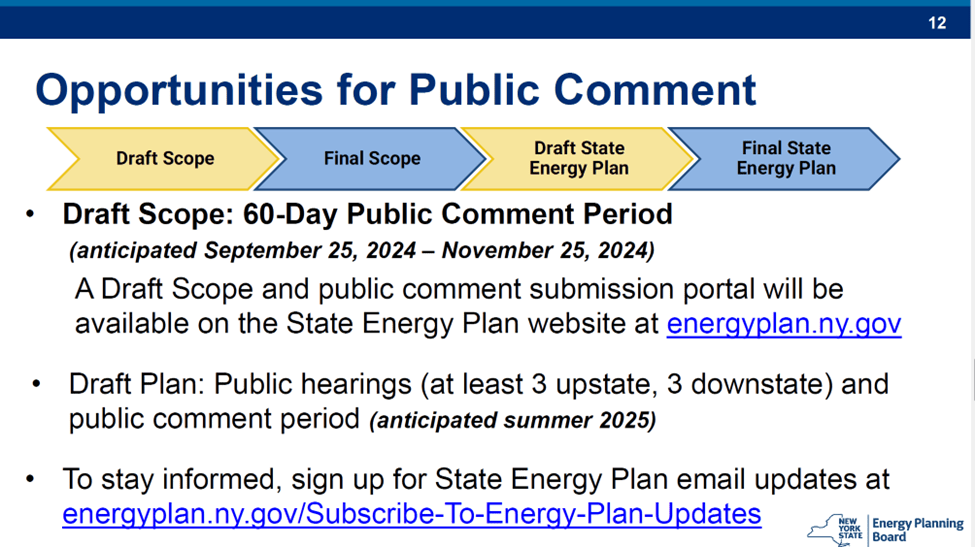
Identification and assessment of the costs, risks, benefits, uncertainties and market potential of energy supply source alternatives is only possible if there is a feasibility study.  There hasn’t been a feasibility study for the Climate Act.  On September 9, 2024 the State Energy Planning Board met to kick off this version of the Energy Plan.  The following slide outlines the schedule.  Note that the comment period on the plan itself is not anticipated until summer 2025.

Given that there is an explicit requirement for a cost assessment my money is on this process sliding until after the 2026 elections.

Conclusion

Everyone wants to do right by the environment to the extent that they can afford to and not be unduly burdened by the effects of environmental policies.  There is no question that the Climate Act costs will test the commitment of most New Yorkers to doing something about climate change once the costs are revealed.

During the Draft Scoping Plan review by the Climate Action Council, members Gavin Donohue and Donna DeCarolis repeatedly asked for consumer price cost projections.  Co-chair Harris did not provide that information then and appears to be stonewalling now.

My cynical take on this is that Scoping Plan contents, the timing for the NYCI carbon tax, the response to the Comptroller’s audit report, the contents of the biennial report, and the timing for the energy plan all are being manipulated to prevent dissemination of expected consumer costs because of the potential for political fallout.  As it stands the bad news will not be let out until after the 2024 election cycle.  Given the enormity of the potential costs I recommend voting against any candidate who supports the Climate Act simply because we deserve to know the costs.

Offshore Wind Costs

Last month I described a flurry of offshore wind related news and last week I provided an update describing additional news.  In my opinion these latest revelations suggest that a reassessment of the viability of offshore wind projects is in order.  I did not address the costs but a couple of articles that have appeared since then do suggest that costs should also be considered in the reassessment.

I have followed the Climate Act since it was first proposed, submitted comments on the Climate Act implementation plan, and have written over 450 articles about New York’s net-zero transition.  The opinions expressed in this article do not reflect the position of any of my previous employers or any other organization I have been associated with, these comments are mine alone.

Overview

The Climate Act established a New York “Net Zero” target (85% reduction in GHG emissions and 15% offset of emissions) by 2050.  It includes an interim 2030 reduction target of a 40% reduction by 2030. Two targets address the electric sector: 70% of the electricity must come from renewable energy by 2030 and all electricity has to be generated be “zero-emissions” resources by 2040. The Climate Action Council (CAC) was responsible for preparing the Scoping Plan that outlined how to “achieve the State’s bold clean energy and climate agenda.” The Integration Analysis prepared by the New York State Energy Research and Development Authority (NYSERDA) and its consultants quantifies the impact of the electrification strategies.  That material was used to develop the Draft Scoping Plan outline of strategies.  After a year-long review, the Scoping Plan was finalized at the end of 2022.  Since then, the State has been trying to implement the Scoping Plan recommendations through regulations, proceedings, and legislation.

Offshore wind developments are a key Climate Act decarbonization strategy.  There is a mandated target of 9,000 MW of offshore wind by 2035.  The Integration Analysis projects that offshore wind capacity will exceed 13 GW by 2040.  However, there are overlooked risks to this strategy that are now becoming obvious.  The fact is that the huge, proposed wind turbines have not been field tested.

Why Is Cheap Wind Power So Expensive?

Willis Eschenbach poses the cost question that is ignored by the green energy activists.  First he describes the overarching Biden Administration goals released in Marh 2021:

Eschenbach is a numbers guy and was immediately suspicious:

Hmmm, sez I, seems a mite ambitious. Current US grid-connected offshore wind is a mere 0.17 gigawatts … so we’d need to do ~ 175 times as much as we’ve done to date and do it in a short six years.

So I divided it out. There are 65 months until 2030. Thirty gigawatts is thirty thousand megawatts, less the 174 megawatts in place, that’s 29,826 megawatts more total generating capacity needed.

29,826 megawatts divided by 65 months means we’d have to add offshore wind generation to the tune of 465 additional megawatts of generation capacity per month. Every month. Starting now.

Get real. That’s not remotely possible. The biggest US offshore windfarm just came on line, 132 MW capacity. To reach the White House goal, every month we’d need to build three new windfarms of that size. No way that can happen. It’s just numbers picked out of the air to gain popular support.

Then he researched the expected time to get an offshore wind farm on line:

The time from the proposal of an offshore wind farm to its grid connection typically ranges from 7 to 10 years. This timeline can be broken down into several phases:

Pre-development and Planning (1-2 years): This phase involves site identification, feasibility studies, and initial environmental assessments.

Permitting and Approvals (3-5 years): Securing the necessary permits and approvals is often the most time-consuming part of the process. This includes detailed environmental impact assessments, consultations with stakeholders, and obtaining state and federal permits.

Construction (2-3 years): Once all approvals are secured, construction of the wind farm, including the installation of turbines and subsea cables, takes place. This phase also includes the grid connection process.

Commissioning and Testing (several months): After construction, the turbines are tested, and the wind farm is gradually brought online.

The bottom line is that if a project is not well along it will not be available by 2030.  He found cost information for South Fork Wind which in New York’s first offshore wind farm:

South Fork Wind just came online. This gives us a chance to look at some actual cost figures. It’s the biggest wind farm to date, a 132-megawatt addition to offshore wind. It cost $637 million.

However, Federal subsidies added $191 million to that, plus another couple of hundred million or so from Bureau of Ocean Energy Management (BOEM), the National Oceanic and Atmospheric Administration (NOAA), and the New York State Energy Research and Development Authority (NYSERDA).

Stop and consider. Some private company is building a six-hundred-million-dollar white elephant in the middle of the ocean, and it’s getting paid four hundred million of taxpayer money to do so.

So … what does the New York consumer get for all of this more than generous support?

The consumer gets wind power costing FOUR TIMES AS MUCH as the current cost of power in New York.

Stop and consider. Even when the developer gets two-thirds of the cost paid by the taxpayer, offshore wind power is still four times as expensive.

Eschenbach sums it up:

What’s next?

Well, I’m sure that what’s next is the Harris/Walz campaign will declare that they are 100% behind expensive, intermittent, unreliable wind power, and will claim that if elected, they’ll do what they already said they’d do when Ms. Harris was last elected, which was to screw the consumer and the taxpayer with the huge subsidies, tax breaks, and electricity costs of offshore wind.

Oh, yeah. They claim that the 30 GW of offshore wind will “avoid 78 million metric tonnes of CO2 emissions”. Tens of millions of tonnes, sounds impressive, right?

But IF the IPCC is correct, and that’s a big if, this will reduce the temperature in the year 2050 by …

… wait for it …

… 0.0016°C. Which is almost three-thousandths of one degree F.

Can we please pass a law saying people proposing any laws or regulations in the name of “climate change” be required to tell us (and show their math) how much actual temperature difference that will make by 2050?

All the points made in this article are direct analogies to what is happening in New York State.

Offshore Trojan Horses

Gordon Hughes from the National Center for Energy Analytics compares the subsidies for offshore wind projects to “the classic warning of the Trojan Horse legend,  “Beware of Greeks bearing gifts”—in other words, the hidden dangers of accepting something that seems too good to be true.”  He argues that “New York State ignored that warning when it agreed to pay very high prices for the electricity to be supplied from its new offshore wind farms—Empire Wind 1 and Sunrise Wind—located off the coast of Long Island.”  He continues:

In announcing the final agreements, New York Governor Kathy Hochul triumphantly claimed that the new projects would create more than 800 jobs during the construction phase and deliver more than $6 billion in economic benefits for the state over 25 years.

Rather less emphasis was given to the fact that New York will pay an average price of over $150 per MWh (megawatt hour) for the electricity generated by Empire Wind 1 and Sunrise Wind.That’s more than four times the average wholesale price of electricity in New York during 2023–24, $36 per MWh. The total annual premium over the wholesale market price for the power from these wind farms will be about $520 million per year at 2024 prices. Over 25 years, New York ratepayers will be paying about $13 billion for alleged benefits of $6 billion.

That is not all. Thanks to tax credits, U.S. taxpayers will cover at least 40% of the costs of constructing the wind farms. At a minimum cost of $5.5 million per MW (million watts) of capacity, the total federal subsidy for New York’s two wind farms will be at least $3.8 billion.

He also evaluates the jobs and economic claims made by the Hochul Administration.  He concludes that “The economic benefits of the two offshore wind farms are much lower than claimed by the governor and the jobs are, in large part, temporary assignments for professional services staff”. I would add that the temporary assignments will probably be filled by experienced staff from out of state.

Conclusion

The offshore wind proposed contracts are unsustainable.  Eschenbach suggests that folks in New York should be asked” “Are you willing to pay four times the going rate for electricity for the rest of your life to MAYBE cool the globe by three-thousandths of one degree Fahrenheit a quarter century from now?” I agree and think that these facts need to be publicized because most New Yorkers have no clue that Climate Act implementation inevitably will increase costs significantly.

Lastly, note that Climate Act proponents have always argued that one of the goals was to demonstrate leadership for the energy transition.  This article presents two examples where New York’s transition leadership is cited.  Unfortunately, both are bad examples showing what to avoid.

Risks of Climate Act Net Zero

I believe the Climate Leadership & Community Protection Act (Climate Act) transition will negatively affect affordability, reliability, and the environment.  I have been meaning to summarize my concerns for quite a while and two recent articles prompted me to write this.  David Turver explains how the transition to Net Zero has negatively affected affordability in the United Kingdom.   Robert Bryce provides an example of how the Climate Act mandates for offshore wind development will negatively affect the endangered North American Right Whale.  Finally, I describe why I worry that the reliance on wind and solar generating resources markedly increases reliability risks.

I have followed the Climate Act since it was first proposed, submitted comments on the Climate Act implementation plan, and have written over 400 articles about New York’s net-zero transition.  The opinions expressed in this article do not reflect the position of any of my previous employers or any other company I have been associated with, these comments are mine alone.

Introduction

David Turver’s Risks of Net Zero article prompted me to write this post.  He is the author of the Eigen Values Substack.  He is a retired consultant, CIO and project management professional. His description says that he is a first principles thinker who is tired of superficial media simply republishing press releases without critical analysis. His Substack incudes articles about contentious issues such as climate, energy, and net zero.

The Introduction to Risks of Net Zero provides an overview of the general concern about the risk.  He states:

We hear a lot about how we are supposedly in a climate crisis and how The Science™ tells us we are about to succumb to global boiling. Most climate activists claim that we must cut emissions by spending more money on windmills and solar panels or we will all burn to a crisp.

I would describe myself as a lukewarmer, by which I mean that I acknowledge the earth is warming and that human emissions of CO2 have made some contribution to that warming. However, it is also true that the climate has changed dramatically without human intervention; clearly, there are other causes of climate change too.

The strategy of reducing emissions of greenhouse gases to Net Zero is classified as a “mitigation strategy” in the parlance of the IPCC. The alternative strategy is adaptation which means taking measures to adjust to climate change such as building flood defences, irrigation systems or developing new strains of crops to cope better with changing weather patterns. Most spending effort in the West is geared towards mitigation. But, what if the Net Zero cure is worse than the disease? What if mitigation is less effective than adaptation?

Before he addresses affordability Turver compares mitigation against adapatation. He and I agree that adaptation is likely to be more effective than mitigation. He explains why in the following.

Mitigation Drawbacks

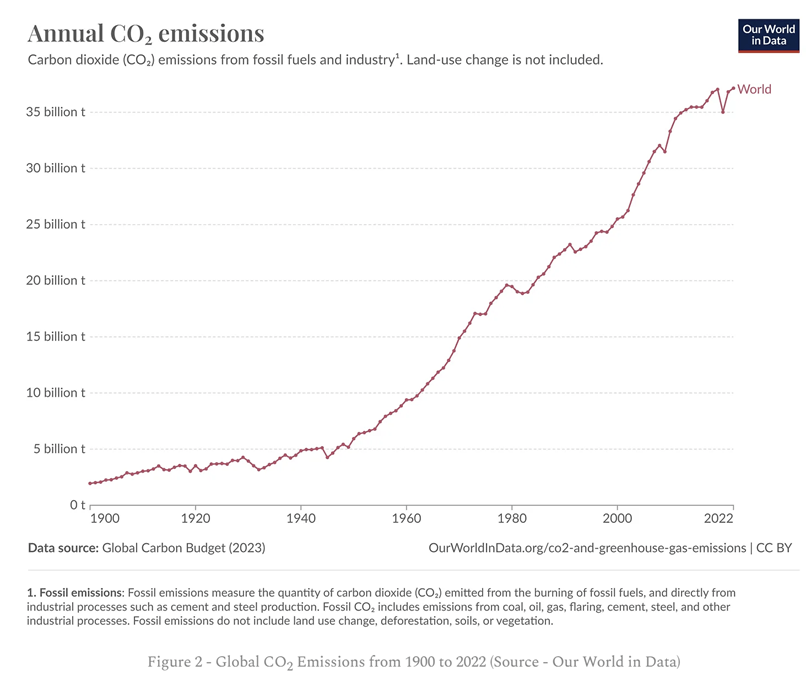
Turver points out issues related to mitigating climate change by reducing emissions.  Mitigation only works if CO2 is the only climate control knob but that cannot be the case because we have observed temperature changes over the last thousand years.   Mitigation can only work if everyone else slashes emissions too and we can see from Figure 2 (from Our World in Data) that this is not happening.

Adaptation Successes

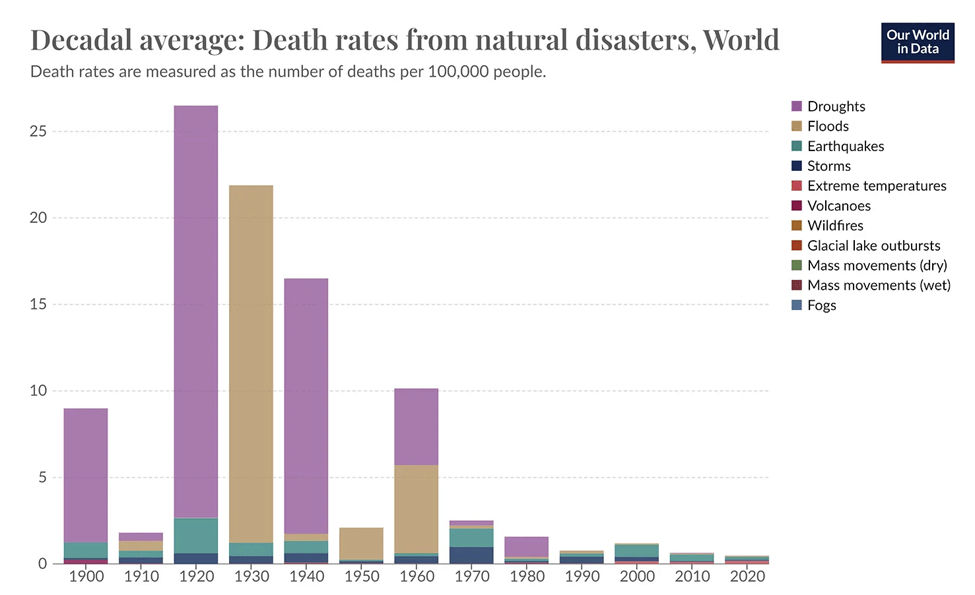
Turver explains that adaptation since 1900 has dramatically decreased death rates.  He includes a figure sourced from  Our World in Data.

Not mentioned but certainly a factor is that the death rate went down in no small part because fossil fuels increased the ability of society to address the causes listed.  Based on past success the obvious alternative is to emphasize adaptation.  Turver explains:

Adaptation measures have many benefits. First, they require no international treaty, and they can be applied locally where they produce results quickly. They also work to protect against changes in the climate that are not driven by CO2. Adaptation measures might also have additional benefits such as more efficient water use or more robust crop varieties. There is no reason why we cannot continue to adapt.

New York Effect on Climate Change

There is another aspect of mitigation that is routinely ignored by proponents of the Climate Act.  New York emissions are tiny relative to global emissions.  In 2021, NYS GHG emissions (GWP-100) were 247 million metric tonnes (MMT).  GHG emissions from China were 13,774 MMT and from India were 3,879 MMT.  The increase in emission from 2020 to 2021 were 498 MMT in China and 265 MMT in India.  New York emissions will be supplanted by emissions from China or India in less than one year.  New York’s net-zero transition plan emission reductions will have no effect on emissions and thus no effect on the purported effects of climate change. Adaptation investments in New York infrastructure to reduce the costs of extreme weather impacts will focus on New York so the benefits will be to New Yorkers.

Climate Act advocates frequently argue that New York must take action because our economy is large.  I analyzed that claim and summarized the data here.  New York’s 2020 Gross State Product (GSP) ranks ninth if compared to the Gross Domestic Product (GDP) of countries in the world.  However, when New York’s GHG 2016 emissions are compared to emissions from other countries, New York ranks 35th.  More importantly, a country’s emissions divided by its GDP is a measure of GHG emission efficiency.  New York ranks third in this category trailing only Switzerland and Sweden. We are already doing our share.

Net Zero Affordability Risks

I think the biggest issue with the Climate Act is affordability.  Everyone wants a clean and safe environment but just how clean, how safe and at what price are all value judgements.  Turver points out that implementation of net-zero policies like the Climate Act have poorly acknowledged risks:

First and most obvious, they cannot work against climatic changes that are driven by forces other than CO2. Second is the outright cost. 

He goes on to describe observed cost increases in the United Kingdom.  He makes the point that additional costs also make manufacturing and other production less competitive, which leads to job losses.  Ultimately the inability to produce basic needs reduces security.  He also points out that renewable energy development requires more materials than alternatives.  That has environmental and cost implications. 

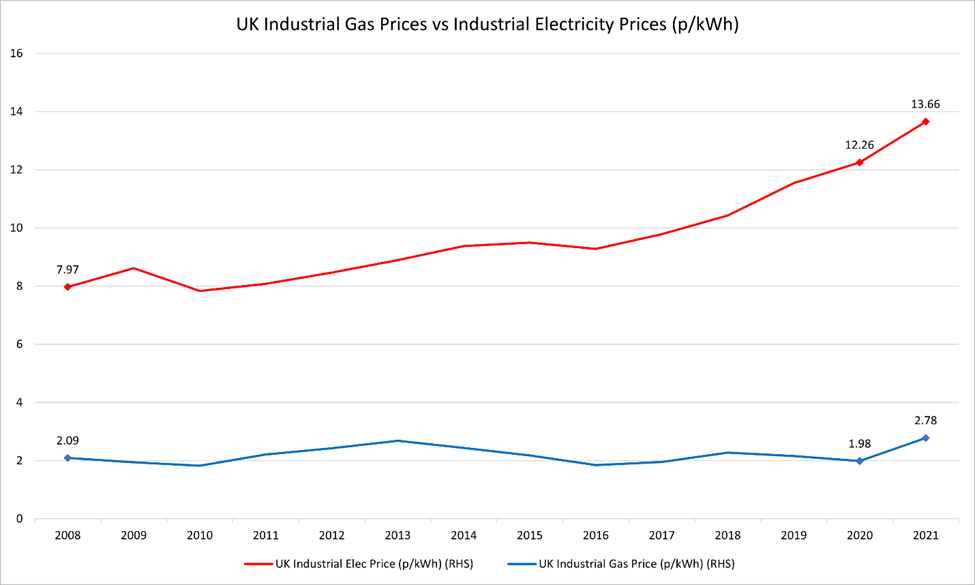
Turver explains that the increased penetration of renewables in the United Kingdom has led to a massive increase in electricity bills. This increase comes from “renewables subsidies as well as grid balancing costs and the massive costs of expanding the grid out to remote offshore wind farms”.  The article compares recent United Kingdom industrial gas prices and industrial electricity prices:

As can be seen in Figure 5, from 2008 to 2020, industrial electricity prices rose 53.8% while industrial gas prices actually fell slightly over the same time period. Both gas prices and electricity rose in 2021 as gas prices started to spike as demand increased after Covid lockdowns ended and supply could not keep up with demand. However, even though there was a spike in gas prices in 2021, the increase from 2008 is still only 33%, whereas electricity prices have surged 71.4% over the same period. The figures for 2022 are not yet available, but we might expect to see a big surge in both gas and electricity prices due to supply shortages resulting from the war in Ukraine.

There is no doubt that all these impacts will inevitably occur in New York as the Climate Act mandates are implemented. A recurring theme of many of my posts is that the Hochul Administration has never provided clear and comprehensive cost estimates for all the control strategies in the Scoping Plan

American Offshore Wind Energy Scandal

I believe that the environmental impacts of wind and solar development are greater than the impacts of fossil-fueled or nuclear resource development.  In my Draft Scoping Plan comments I noted that on September 17, 2020 the Final Supplemental Generic Environmental Impact Statement (SGEIS) for the Climate Leadership and Community Protection Act was released.  It covered the “environmental impacts of the offshore wind and distributed solar procurement goals, and the estimate of utility-scale solar capacity required to meet the meet the 70 by 30 goal” based on the resources estimated necessary at that time.  Since then, considerably more resources have been projected but the cumulative assessment has not been updated.

Robert Bryce published an article entitled The Offshore Wind Scandal is Even Worse Than You Think  that addresses one of the cumulative environmental impacts that the Scoping Plan ignored.  Bryce is an author, filmmaker, and public speaker who has been reporting on the energy sector for more than 30 years.  His background enables him to provide graphical evidence to support his arguments that I think are well done.  In this article he includes 11 charts that “show how America’s biggest NGOs are colluding with foreign corporations that want to industrialize our oceans with thousands of turbines that will hurt whales and ratepayers”.

He writes:

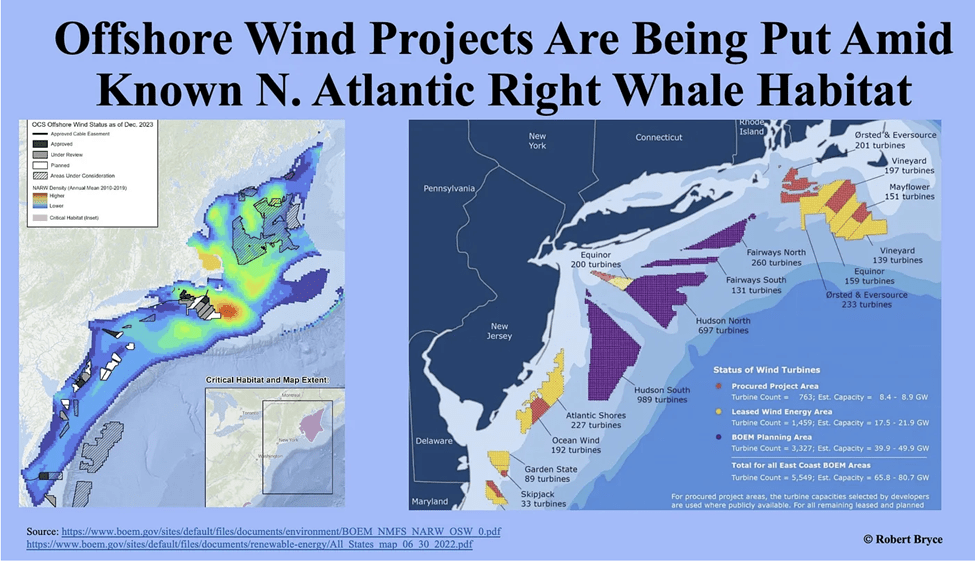
The hard reality is that America’s offshore wind sector is a subsidy-dependent industry that is dominated by foreign companies who are in bed with some of America’s biggest climate NGOs, including the NRDC (gross receipts: $555 million) and Sierra Club (Gross receipts: $184 million).  Those NGOs and others, including the National Wildlife Federation (gross receipts: $142 million) and Conservation Law Foundation (gross receipts: $17.5 million), are leading the most shameful environmental betrayal in modern American history. Rather than seek to protect marine mammals and stop the industrialization of our oceans, they are eagerly promoting the installation of hundreds of offshore wind platforms smack in the middle of the known habitat of the critically endangered North Atlantic Right Whale.

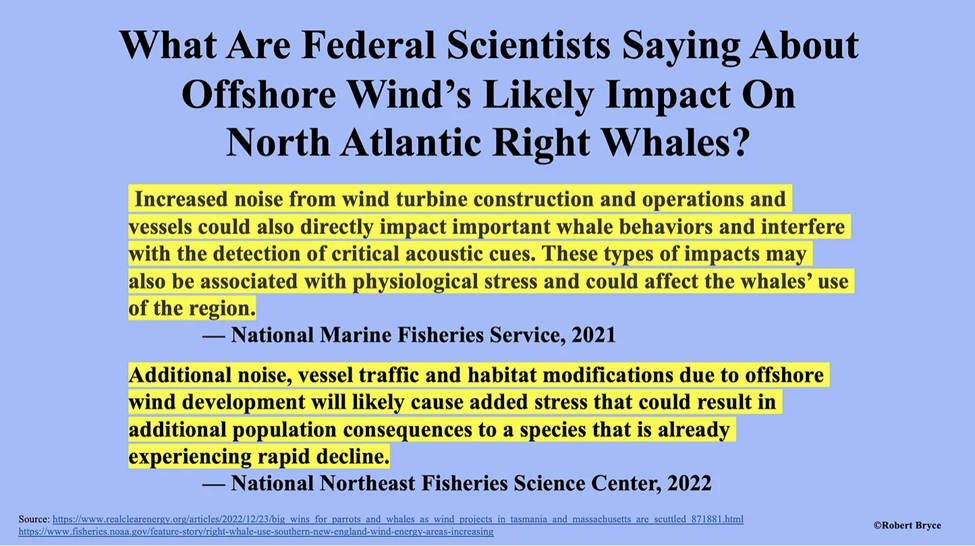
I recommend the article for its details.  In this summation I am not going to address all the charts in detail.  The first four charts support the quotation above.  The fifth chart addresses environmental impacts.  The offshore wind shills claim that there aren’t impacts on whales, but Federal scientists disagree.

Bryce describes Chart 6:

I’m old enough to remember when environmental groups cared about whales. Alas, that was a long time ago. On Sunday, the Daily Mail published an article about Apostolos Gerasoulis, a Rutgers professor emeritus of computer science who built a software system to analyze the dozens of whale deaths that have occurred on the Eastern Seaboard over the past few years. Gerasoulis set out to determine if the whale deaths were related to the loud blasts of sonar used by offshore wind survey vessels. His conclusion: “Offshore wind kills whales…The numbers never lie. There is a cause. We have shown that the cause for death of the whales is offshore wind. Period.” (H/t fellow Substack writer David Blackmon.) 

In Chart 7 Bryce notes that the Massachusetts Sierra Club notes that “Because the North Atlantic Right Whale has such a small population and a low annual reproductive rate, a single whale death can have a significant negative impact on the species’ ability to recover.”  In Chart 8 he provides a plain English translation of a statement in the Bureau of Ocean Energy Management environmental impact statement of Vineyard Wind: “These projects won’t make any difference on climate change. But they are good because they allow state-level bureaucrats to say they met their policy goals.” 

The remaining charts compare offshore wind capacity and costs relative to other resources.  He concludes that these developments will markedly increase costs for states that already have some of the highest electricity rates in the country.

I maintain that the New York State has shirked its commitment to the environment because it has not addressed cumulative environmental impacts of the Scoping Plan buildout of wind and solar.  No where is this more impactful than the effects on whales in general and the remaining North American Right Whales in particular.  Bryce quotes an opponent of offshore wind: “What is Big Wind going to say when they kill the last whale? ‘Sorry’?” 

Reliability Risks

I described my concern about the enormous risk of an electric grid relying on wind and solar resources in this post.  Since then, I have refined my description of the problem.  It boils down to “correlated intermittency”.  Let me explain.

Wind and solar are inherently intermittent – the sun does not shine at night and the wind does not always blow.  That intermittency is correlated.  All the solar in New York is unavailable at night.  It turns out that wind resources across New York also are usually high or low at the same time. There are exceptions but there is a high incidence of similar behavior.

That matters for electric resource planning.  Today electric resource planning relies on decades of performance experience with hydro, nuclear, and fossil plants that do not correlate, that is to say there is no reason to expect that all the nuclear plants will be offline at the same time.  As shown in the following New York Independent System Operator (NYISO) slide, this characteristic enables the resource planners to determine how much generating capacity is necessary to meet the loss of load expectation (LOLE) criterion.  The probability of losing load not more than once in ten years is based on observations of the existing uncorrelated generating resources.  Importantly, I believe that the lack of correlation also means that the capacity needed above firm system load would not change substantially if the LOLE planning horizon was shifted to 1 day in 20 years.

Source: NYISO Amount of Capacity Required, Intermediate ICAP Course, June 2023

The variation in weather that affects wind and solar resource availability will require changes to electric resource planning.  Everyone has heard of a hundred-year flood which is the parameter used for waterway planning.  This is the one in a hundred probability that the water level in a river or lake will exceed a certain level.  Similar estimates of low wind and solar resource availability must be developed and incorporated into electric resource planning.

The unresolved problem is what return period probability is acceptable.  If the resource planning process does not provide sufficient backup resources to provide capacity for a peak load period, then blackouts are inevitable.  Two factors exacerbate the challenge of this problem:

  1. Periods of highest load are associated with the hottest and coldest times of the year and frequently correspond to the periods of lowest wind resource availability. 
  2. The decarbonization strategy is to electrify everything possible so the impacts of a peak load blackout during the coldest and hottest periods will be greater.

In an earlier post I described an analysis by the Independent System Operator of New England (ISO-NE) Operational Impact of Extreme Weather Events.  The study evaluated 1, 5, and 21-day extreme cold and hot events using a database covering 1950 to 2021. Not surprisingly the system risk or “the aggregated unavailable supply plus the exceptional demand” during an event increased as the lookback period increased.  If the resource adequacy planning for New England only looked at the last ten years, then the system risk would be 8,714 MW, but over the whole period the worst system risk was 9,160 and that represents a resource increase of 5.1%.  There is no question that a similar analysis for New York would find a similar result.

The correlated intermittency of wind and solar resources means that we will depend on energy-limited resources that are a function of the weather causing low resource availability at the same time.  The unresolved issue is how to design an affordable and practical system to meet the worst-case weather induced lull. Consider the ISO-NE analysis where it was found that the most recent 10-year planning lookback period consistent with current LOLE evaluations would plan for a system risk of 8,714 MW.  If the planning horizon covered the period back to 1961, the worst-case to 1950, an additional 446 MW would be required to meet system risk.  I cannot imagine a business case for the deployment of electric system resources that will only be needed once in 63 years.  For one thing, the life expectancy of these technologies is much less than 63 years.  Even over a shorter horizon such as the last ten years, how will a required facility be able to stay solvent when it runs so rarely? The only solution is subsidies to build and very high payments when they do run.

Reliability risks have also been identified by the North American Electric Reliability Corporation.  They have expressed concerns that extreme weather events, rapid demand growth, and systemic vulnerabilities pose risks for supply shortfalls and grid reliability.  These are serious risks to the Climate Act net-zero transition plan that must be resolved sooner rather than later.

Conclusion

I believe that the Climate Act will do more harm than good.  Affordability is the first problem. The Hochul Administration has not provided transparent and comprehensive cost estimates for the control strategies proposed for the net-zero transition.  The New York State Comptroller Office audit of costs in Climate Act Goals – Planning, Procurements, and Progress Tracking  agrees with my concern and recommends a detailed analysis of cost estimates to transition to renewable energy sources and meet Climate Act goals. I believe such an analysis will agree with observed results elsewhere that show the costs will be extraordinary and will certainly affect affordability.

The Hochul Administration has not provided a cumulative environmental impact assessment for the generating resources projected in the Scoping Plan.  Nowhere is the potential impact more critical than with respect to whales and the massive deployment of offshore wind proposed.  It is incumbent upon the State to prove that there will not be adverse impacts to the critically endangered North American Right Whales.

Finally, there ae reliability risks inherent in a weather-dependent electric grid when all the wind and solar output is reduced at the same time.  This raises overarching questions that have not been addressed.  Furthermore, even if these weather risks can be addressed in theory, the solution will involve technologies that are not commercially available today.  I have no doubts that the only safe way to decarbonize the electric grid is to rely on nuclear power.  The Hochul Administration needs to confront these issues before it is too late. 

The risks of the Climate Act are all associated with mitigation efforts to reduce GHG emissions.  I agree with Turver that mitigation should be emphasized.  He concludes:

The risks of climate change can be averted by continuing to adapt, just as we have for millennia. It is certain that unilateral action by the UK, or indeed multilateral action by much of the West, will do nothing to change the weather while the developing world continues to increase their consumption of hydrocarbons to make themselves richer. Indeed, even if mitigation measures were adopted globally, it is naïve to believe that bad weather will cease and we will suddenly get the “stable climate” demanded by more than 170 lawyers.

New York Value of Carbon Misinformation

Yesterday, I published an article that summarizes comments I submitted to the New York Department of Environmental Conservation (DEC) in response to a request for feedback.  After I published the article, I received an answer to a question I asked EPA about the calculation methodology used by DEC and that inspired me to reiterate my contention that New York’s application of the societal benefits of greenhouse gas emission reductions results in misinformation.

I have followed the Climate Leadership & Community Protection Act (Climate Act)since it was first proposed, submitted comments on the Climate Act implementation plan, and have written over 400 articles about New York’s net-zero transitionThe opinions expressed in this article do not reflect the position of any of my previous employers or any other company I have been associated with, these comments are mine alone.

Overview

The Climate Act established a New York “Net Zero” target (85% reduction in GHG emissions and 15% offset of emissions) by 2050.  It includes an interim 2030 reduction target of a 40% reduction by 2030 and a requirement that all electricity generated be “zero-emissions” by 2040. The Climate Action Council (CAC) was responsible for preparing the Scoping Plan that outlined how to “achieve the State’s bold clean energy and climate agenda.”  In brief, that plan is to electrify everything possible using zero-emissions electricity. The Integration Analysis prepared by the New York State Energy Research and Development Authority (NYSERDA) and its consultants quantifies the impact of the electrification strategies.  That material was used to develop the Draft Scoping Plan outline of strategies.  After a year-long review, the Scoping Plan was finalized at the end of 2022.  Since then, there have been regulatory and legislative initiatives to implement the recommendations, but progress has been slow.

Yesterday’s post included extensive documentation for the New York Value of Carbon so I will not repeat it here.  For this article the key point is that the DEC Climate Change Guidance Documents webpage notes that it was established for use by State entities to “aid decision-making and for the State to demonstrate the global societal value of actions to reduce greenhouse gas emissions in line with the requirements of the Climate Leadership and Community Protection Act.” 

Methodology Comment

Yesterday’s article described my submitted comment on the Value of Carbon methodology.  In short, I am convinced that the State calculation methodology is incorrect.  I believe that the guidance methodology is wrong because it applies the social cost multiple times for each ton reduced. 

Last weekend I reviewed the EPA webpage description of the ““Report on the Social Cost of Greenhouse Gases: Estimates Incorporating Recent Scientific Advances”.  That page includes links to the following information:

I reviewed the Final Report and thought that their description of the proper benefit calculation methodology supported my arguments.  That webpage also includes a “Contact Us” form for questions.  To confirm my interpretation I submitted the following to EPA.

I have a question about the first two sentences in the first paragraph in Section 4.2 of the Final Report.

The sentences say: “The Social Cost of Greenhouse Gases (SC-GHG) reflects the future stream of damages associated with an additional ton of emissions discounted back to the year of the emissions. Several steps are necessary when using the SC-GHG estimates in an analysis that includes GHG emissions changes in multiple future years in addition to other benefits and costs.”

I interpret that to mean that the SC-GHG benefit value is applied for an additional ton of emission reductions once.  If you are looking at changes over multiple years, the first-year reductions are not applied cumulatively in multiple future years.

Is that the correct interpretation?

I received the following response from Elizabeth Kopits, PhD, Economist, National Center for Environmental Economics, Office of Policy, U.S. EPA:

Thank you for reaching out to our office with your question regarding EPA’s SC-GHG estimates.

The sentences you refer to are just intending to say that if you are analyzing a policy that is expected to result in emission reductions (or increases) in multiple years, then there are several steps to estimating the present value of the full stream of climate benefits (or disbenefits) that are expected from the emissions changes.

If I’m understanding your question correctly then I think the answer is yes.

For example, suppose it has been estimated that a policy will reduce CO2 emissions by 100 tons in 2025, 105 tons in 2026, and 110 tons in 2027, and the analyst is interested in calculating the total climate benefits from these emission reductions and comparing it to the estimated costs and other benefits of the policy. First, one would calculate the climate benefits in each year.

That is, the climate benefits in 2025 from the emission reductions expected in 2025 = 100 tons multiplied by the SC-CO2 for 2025 ($/t). (Recall this SC-CO2 value reflects the present value of the future stream of avoided damages from a one-ton reduction in 2025, so there is nothing more to calculate in 2026 and later related to the emission reductions that occurred in 2025.) Similarly, the climate benefits in 2026 from the emission reductions expected in 2026 = 105 x SC-CO2 in 2026, and the climate benefits in 2027 from the emission reductions expected in 2027 = 110 x SC-CO2 in 2027. 

Finally, one can calculate the present value of the benefits resulting from the full stream of emission changes from the perspective of the base year of analysis (e.g., 2024) by discounting the 3 numbers back to 2024 and summing.

I hope this helps to clarify a bit.  The SC-GHG workbook available on our webpage (https://www.epa.gov/environmental-economics/scghg) contains detailed instructions and example tabs that may be more helpful than my simple example above.  If you continue to have questions, please feel free to reach out any time.

I believe that the key is the “SC-CO2 value reflects the present value of the future stream of avoided damages from a one-ton reduction in 2025, so there is nothing more to calculate in 2026 and later related to the emission reductions that occurred in 2025”.  If the intent is to determine “the present value of the full stream of climate benefits (or disbenefits) that are expected from the emissions changes, then lifetime calculations are inappropriate.  I want to know the value of the climate benefits for New York to reach an 85% reduction of GHG emissions by 2050.

Discussion

The New York Value of Carbon regulatory policy enables the State to “demonstrate the global societal value of actions to reduce greenhouse gas emissions”.   New York’s climate policy making is nearly all political theater.  To justify the costs of the Climate Act, the political slogan is “the costs of inaction are more than the costs of action”.  To make that claim NYSERDA twisted the interpretation of the analyses to minimize the overall costs, biased costs low and benefits high, and, I have no doubt, influenced the Value of Carbon methodology to maximize benefits.

Yesterday’s post also included related correspondence with DEC staff responding to my interpretation.  It stated that “We ultimately decided to stay with the recommendation of applying the Value of Carbon as described in the guidance as that is consistent with how it is applied in benefit-cost analyses at the state and federal level.”  Dr Kopits response letter flatly contradicts the claim relative to the Federal level.  To give the benefit of doubt to DEC staff I will concede that the interpretation of what is appropriate for this benefit-cost analysis may be different.  However, I think that New Yorkers deserve clarification and ultimately get the total costs for the Climate Act mandated reductions.

The DEC response went on to say that “When applying the Value of Carbon, we are not looking at the lifetime benefits rather, we are looking at it in the context of the time frame for a proposed policy in comparison to a baseline.”  Finally, it noted that “The integration analysis will apply the Value of Carbon in a similar manner as it compares the policies under consideration in comparison with a baseline of no-action.”  This is where the interpretation of the policies under consideration were twisted.  In brief, the Hochul narrative that the costs of inaction are more than the costs of action only applies to Climate Act policies and not the total costs to achieve the Climate Act mandates.  The baseline of “no-action” described in the Scoping Plan as “Business as usual plus implemented policies” includes the following programs:

  • Growth in housing units, population, commercial square footage, and GDP
  • Federal appliance standards
  • Economic fuel switching
  • New York State bioheat mandate
  • Estimate of New Efficiency, New York Energy Efficiency achieved by funded programs: HCR+NYPA, DPS (IOUs), LIPA, NYSERDA CEF (assumes market transformation maintains level of efficiency and electrification post-2025)
  • Funded building electrification (4% HP stock share by 2030)
  • Corporate Average Fuel Economy (CAFE) standards
  • Zero-emission vehicle mandate (8% LDV ZEV stock share by 2030)
  • Clean Energy Standard (70×30), including technology carveouts: (6 GW of behind-the-meter solar by 2025, 3 GW of battery storage by 2030, 9 GW of offshore wind by 2035, 1.25 GW of Tier 4 renewables by 2030)

That means that the costs of all these programs that are required to meet the Climate Act mandate of an 85% reduction in emissions by 2050 are not included in the evaluation.  Due to the lack of transparent cost and benefit estimates I cannot determine if the NYSERDA Integration Analysis excluded the benefits associated with those programs.  However, it would be another way to achieve the goal of a sound bite justification of benefits and costs.

Conclusion

New York’s climate policy making is nearly all political theater.  The shenanigans that the Scoping Plan authors used to make sure they could claim benefits were greater than costs and hiding their methodology and results is a long, disappointing story.  The Value of Carbon methodology is dictated by the desire to prove a point rather than provide any rigor in establishing its definition and level.  Given the necessity to maximize benefits to “prove” the costs of inaction are more than the cost of action and the lack of accountability to meaningfully respond to all stakeholders, ignoring my comments is a simply expedient.

I believe the ultimate question is “What are the benefits of New York’s 85% emission reductions mandated by the Climate Act?”  To answer that the value of carbon or social cost of carbon benefits should use the EPA methodology.  I believe that benefit is what all New Yorkers want to know and the Hochul Administration is deliberately covering up those numbers because it runs contrary to their narrative.

National Grid Net-Zero Transition Plans Ignore Ratepayer Concerns

Syracuse Post Standard reporter Tim Knauss recently wrote two articles that expose the disconnect between the executives in the electric industry and their customers.  The Climate Leadership & Community Protection Act (Climate Act) will cost enormous amounts of money at the same time it increases reliability risks.  The politicians supporting it and the leadership of the utility companies all have not admitted just how much it will cost ratepayers.  This post uses National Grid’s “Net-Zero Overhaul” as an example.

I have followed the Climate Act since it was first proposed, submitted comments on the Climate Act implementation plan, and have written over 400 articles about New York’s net-zero transition. The opinions expressed in this post do not reflect the position of any of my previous employers or any other organization I have been associated with, these comments are mine alone.

Overview

The Climate Act established a New York “Net Zero” target (85% reduction in GHG emissions and 15% offset of emissions) by 2050.  It includes an interim 2030 reduction target of a 40% reduction by 2030 and a requirement that all electricity generated be “zero-emissions” by 2040. The Climate Action Council (CAC) was responsible for preparing the Scoping Plan that outlined how to “achieve the State’s bold clean energy and climate agenda.”  In brief, that plan is to electrify everything possible using zero-emissions electricity. The Integration Analysis prepared by the New York State Energy Research and Development Authority (NYSERDA) and its consultants quantifies the impact of the electrification strategies.  That material was used to develop the Draft Scoping Plan outline of strategies.  After a year-long review, the Scoping Plan was finalized at the end of 2022.  In 2023 the Scoping Plan recommendations were supposed to be implemented through regulation, PSC orders, and legislation.  That process is falling behind as the enormity of the challenge becomes clearer.

National Grid Net Zero Overhaul

I live in Upstate New York and National Grid is my electric utility.  National Grid is the electricity system operator for Great Britain.  In 2000 National Grid started purchasing utilities in the United States and now is “an electricity, natural gas, and clean energy delivery company serving more than 20 million people through our networks in New York and Massachusetts.”  They tout plans for National Grid for “a smarter, stronger, cleaner energy future — transforming our networks with more reliable and resilient energy solutions to meet state climate goals and reduce greenhouse gas emissions.”

Someday I may return to this topic and focus on the “more reliable and resilient solutions” claim.  For the time being I will content myself with just saying this is codswallop.  I don’t think it will ever be possible for New York to meet its state climate goals as presently outlined without a catastrophic blackout because the energy storage and dispatchable emissions free resources necessary to meet the worst-case low wind and solar resource drought are impractical. Utility executives know that this is an issue but play along with the plans for their own self-interest not the interests of their customers.

This article will address the proposed plan for the “cleaner energy future”.  In particular, Nation Grid recently announced plans for a  £60bn Net Zero overhaul of National Grid.  That total is for all the National Grid companies.   The US National Grid press release included the following quote:

Group CEO of National Grid John Pettigrew said: “Today’s announcement is a clear illustration that National Grid is committed to playing our part in achieving the ambitious decarbonization targets that New York and Massachusetts governments have set. The increased investment we’re announcing today follows positive engagement with our regulators in these states, reflecting a willingness to upgrade electricity networks to provide long term affordable energy to all, and reduce emissions across our gas networks.”

 Tim Knauss did an article about the New York portion of the investment plan.  He described the New York component of the plan:

The $16 billion plan represents a 60% increase over what National Grid has spent during the past five years. It includes a $4 billion project under way to improve 1,000 miles of transmission lines, which National Grid calls the “Upstate Upgrade.” Other projects have not yet been identified.

Knauss also quoted spokesperson Jared Paventi: ““Will there be an impact for the customer? Yes, but I believe that it’s going to be negligible based on the time period that we’ll be recovering those costs,” Paventi said.” While the quote suggests that this is his personal opinion, I have no doubts that is the story he was charged to say.       

Rate Case Proposal

The press release for the upcoming New York rate case gives the highlights:

  • Critical investments to ensure the reliability and safe operation of the company’s energy delivery system that serves 2.3 million upstate New York residential and business customers.
  • Enhanced system resiliency and reliability measures to manage and reduce the impact of frequent and severe weather and enable continued strong storm response.
  • Integrated energy planning to consider interactions between gas, electric and customer energy systems to achieve long-term climate goals in a safe and affordable way.
  • Infrastructure investments to support economic development, connect clean energy, and enhance security.
  • Targeted programs and dedicated teams to better serve residential, commercial and industrial customers.
  • Enhanced energy affordability programs and services, and programs to enable clean energy and energy efficiency benefits for disadvantaged communities.

Tim Knauss also wrote an article on this announcement.  He wrote:

In 2020 National Grid asked for a $142 million increase in annual electric and gas delivery revenues. This year, the utility is asking for $673 million.  If the Public Service Commission goes along, that would raise National Grid’s electric delivery revenues by 20% and its gas revenues by 28%. A typical household would pay $440 a year more for electricity and gas.

National Grid describes the reasons for the increase as a catchup from the last rate case when “the company and regulators put a top priority on holding down an increase” and “Inflation and supply-chain constraints have raised the cost of transformers, poles, cables and other equipment”  Knauss writes that they also admit that: “the power grid requires significant new investments to make way for more electric vehicles, electric-heat buildings, and other elements of New York’s planned transition away from fossil fuels.”  I doubt that the attribution of costs to these reasons will be readily available.

Discussion

The impetus for this article was spokesperson Jared Paventi’s claim that the costs for the investments will be “negligible”.  Knauss provides the data that suggests otherwise.  He points out that “In an order issued last year to approve $4.4 billion in new transmission lines planned by several utilities, the state Public Service Commission estimated the work could increase residential bills by about $3.50 a month, decreasing over time.”  The New York Net Zero Overhaul estimate is $16 billion.  That will cause residential bills to increase an additional $12.73 per month.  I don’t call that negligible and that is only a small portion of the total increases proposed in the rate case.

The other thing that caught my eye was the comment by Group CEO of National Grid John Pettigrew that the New Zero Overhaul announcement “follows positive engagement with our regulators in these states”.  Cynic that I am, this sounds like the executives got an audience with the Hochul Administration and promised to follow their script for Climate Act implementation right before the rate case was released.  Maybe it is just a coincidence, but it smells like a backroom deal to me that has corporate and political interests at its heart with the welfare of the ratepayers ignored.  Hochul recently nominated three environmental ideologues to the Public Service Commission. I have no doubts where their biases lie and believe that any costs for the great net-zero transition will be approved by those three.

Conclusion

I do not think that there is any question that electric utilities have determined that implementation of net-zero transition plans will be risky and costly for their customers. However, I believe they have also determined that implementation is in their financial best interest.  Similarly, the regulatory agencies certainly have technical experts who understand the risks but the political appointees in charge ignore their counsel because their handlers are catering to a specific constituency. This does not portend well for everybody else.

There is a glimmer of hope.  It is only a matter of time until the cost blowback begins on these rate cases.  On June 5, 2024 Hochul indefinitely paused implementation of the New York City congestion pricing plan.  The rate cases will cause the costs of energy to increase for more people and the Climate Act is a big part of the increase.  Hochul said, “it’s not the right time” for congestion pricing as “New Yorkers face a cost-of-living crisis”.  Hopefully this will be draft language for a walk back on the aspirational Climate Act implementation plan when the true costs become clear.

Separating NRDC “Facts” From Fiction Reality Check

The lead to the Natural Resources Defense Council (NRDC) blog post Separating Fact from Fiction: Setting the Record Straight on New York’s Climate Law states “Don’t be fooled by the fossil-fueled campaigns to delay climate progress. The Climate Leadership and Community Protection Act is New York State’s chance for a cleaner, healthier future.”  It goes on to refute four claims allegedly pushed by fossil fuel industry.  I am only going to respond to one of the responses.

I have followed the Climate Leadership & Community Protection Act (CLCPA) since it was first proposed, submitted comments on the CLCPA implementation plan, and have written over 400 articles about New York’s net-zero transition. I am convinced that the CLCPA will adversely affect affordability, reliability, and that the environmental impacts of the proposed transition are greater than the possible impacts of climate change.  The opinions expressed in this post do not reflect the position of any of my previous employers or any other organization I have been associated with, these comments are mine alone.

Overview

The CLCPA established a New York “Net Zero” target (85% reduction in GHG emissions and 15% offset of emissions) by 2050.  It includes an interim 2030 reduction target of a 40% reduction by 2030 and a requirement that all electricity generated be “zero-emissions” by 2040. The CLCPAion Council (CAC) was responsible for preparing the Scoping Plan that outlines how to “achieve the State’s bold clean energy and climate agenda.”  In brief, that plan is to electrify everything possible using zero-emissions electricity. The Integration Analysis prepared by the New York State Energy Research and Development Authority (NYSERDA) and its consultants quantifies the impact of the electrification strategies.  That material was used to develop the Draft Scoping Plan outline of strategies.  After a year-long review, the Scoping Plan was finalized at the end of 2022.  In 2023 the Scoping Plan recommendations were supposed to be implemented through regulation, PSC orders, and legislation. 

The NRDC blog post describes the Scoping Plan framework as “pathways for a planned and orderly transition to a clean, resilient energy future.”  The Scoping Plan is just a list of potential control strategies that when combined are supposed to meet the CLCPA mandates.  A feasibility analysis has never been completed to show that the list of strategies is practical.  Furthermore, transparent accounting for the costs of the transition have not been provided and the Cumulative Environmental Impact Assessment has not been updated to account for the Scoping Plan estimates of the wind, solar, and energy storage resources needed.

NRDC Setting the Record Straight

The blog post Separating Fact from Fiction: Setting the Record Straight on New York’s Climate Law includes responses to four claims:

  1. The CLCPA will result in higher energy costs for ratepayers because it is costly to implement.
  2. The CLCPA will reduce the reliability of energy delivered to homes and businesses.
  3. Your gas stove is going to be taken away from you.
  4. There will be an adverse impact on the state’s overall economic climate that will discourage new investments and job growth.

I am only going to address the response to the second claim that the CLCPA will “reduce reliability of energy delivered to homes and businesses”.  The response to that claim states:

The framework outlined by the CLCPA-mandated Scoping Plan provides pathways for a planned and orderly transition to a clean, resilient energy future. The idea of a regenerative rather than an extractive economy strikes fear in the fossil fuel industry, which has been making record profits from recent price fluctuations and market volatility; in reality, reliability failures are often due to fossil-fueled superstorms and the historical lack of investment in our nation’s aging infrastructure. By contrast, homegrown renewable energy can and will be more resilient, more plentiful, and more cost-effective than finite oil and gas resources.

I will address each of these statements.  The first sentence states “The framework outlined by the CLCPA-mandated Scoping Plan provides pathways for a planned and orderly transition to a clean, resilient energy future.”  As noted previously there has never been a feasibility analysis to determine if the components of the Scoping Plan are practical.  The Climate Action Council never resolved the discrepancy between the Council faction that believed that no new technology is needed for the transition and the experts responsible for the system that argued otherwise.  A recent technical conference showed that the work of  Prof. C. Lindsay Anderson, Chair of Department of Biological and Environmental Engineering Cornell; Zach Smith, VP System Resource Planning, New York Independent System Operator; and Kevin Steinberger, Director, Energy and Environmental Economics all found that a new resource that can be dispatched when needed, is firmly available, and has no emissions is needed.  Technologies to meet this requirement are not commercially available at this time.  Moreover, no jurisdiction anywhere has been able to convert their electric system to one that relies on wind, solar, and energy storage.  Given the myriad technical issues that must be overcome to provide electricity when it is needed most, I think the most prudent course of action would be a demonstration project because the transition to the energy system mandated by the CLCPA would be unprecedented.

The second sentence unnecessarily questions the motivations of those who worry about reliability “The idea of a regenerative rather than an extractive economy strikes fear in the fossil fuel industry, which has been making record profits from recent price fluctuations and market volatility; in reality, reliability failures are often due to fossil-fueled superstorms and the historical lack of investment in our nation’s aging infrastructure.”  The concern about profiting from price fluctuations and market volatility is naïve.  When the electricity market is dominated by weather dependent generating resources the variability of wind and solar output will increase price fluctuations.  The New York Independent System Operator will have to modify the electric market to address this volatility as they learn how this new aspect of the system affects prices.  I have been involved with the weather-related impacts on the electric system for over 40 years and it has always been true that extreme weather has the greatest impact on system outages.  A common theme throughout this blog post is that all weather events are necessarily related to climate change without acknowledging that extreme weather events exactly like those before the climate change would still have major impacts.  Any increase in severity due to climate change is just a tweak and not the primary driver.

The final sentence got my attention: “By contrast, homegrown renewable energy can and will be more resilient, more plentiful, and more cost-effective than finite oil and gas resources.”  I wondered how the author managed to claim that extreme weather will have more of an effect on today’s generators in weather proof buildings than the exposed wind turbines and solar panels.  The more resilient reference was to the Babcock Ranch a Florida “solar town” that fared well during recent hurricanes.  The article claims the town came out of Hurricane Ian “almost unscathed and notes that one resident says they survived ‘by design.’  Florida Power and Light is proud of the Babcock Ranch solar system:

Babcock Ranch’s clean energy efforts were taken to the next level when FPL created the largest solar-plus-storage system operating in the U.S. today. Each of the ten large gray steel battery storage units at the FPL Babcock Ranch Solar Energy Center can store 1 megawatt of power and discharge for 4 hours. The adjacent 440 acres with 330,000 solar panels can generate up to 74.5 megawatts of power. Currently the solar installation generates more power than the town needs, so the surplus goes into the electric power grid. The new battery storage system ensures a steady output of power even on partly cloudy days.

There are two resiliency features that matter: Babcock Ranch was built 30 feet above sea level and all power lines are buried underground to keep them safe from strong winds.  New York’s net zero transition does not include buried power lines.  The Babcock Ranch website refutes the claim that “homegrown renewable energy can and will be more resilient”:

Electric power always flows from the nearest generation, so during the day the town will use energy from the FPL Babcock Ranch Solar Energy Center. When the sun goes down and the solar plant is not generating energy, Babcock Ranch will pull electricity off the grid from the closest FPL natural-gas power plant.

Babcock Ranch is not clean energy self-sufficient as the Climate Act envisions the entire state will be. The NRDC response also claims that renewable energy is more plentiful and more cost-effective than finite oil and gas resources.  It may be true that solar and wind energy is free but harvesting those resources, storing them for when they will be needed during an extended period of light winds in the winter when solar resources are low is an extraordinary challenge that requires the new resource described above.  Like all the Green Energy solutions advocated by the NRDC, wind and solar may work well most of the time but when you really need them, they don’t work at all.  The concern about finite oil and gas resources ignores the value of their storable concentrated energy and whether running out is a concern in the foreseeable future.

Conclusion

I believe I have shown that the NRDC fact-check claims that the CLCPA energy transition does not threaten reliability are invalid.  Ignoring the mounting evidence that this may be an insurmountable challenge is not in the best interest of New Yorkers.  At a minimum, CLCPA implementation should be delayed until we are sure that we can afford the CLCPA mandates, prove that the transition will not adversely affect reliability, and understand all the cumulative environmental impacts.

As is typical, whenever someone is screaming about misinformation it usually means that they are guilty of that charge.  In addition, trying to respond to this tripe takes an order of magnitude more work to respond.  Finally, whenever I make the effort to check the numbers I find the alarmists have their thumbs on the scale and are peddling a narrative to support their livelihoods.  I only wish that they could be held accountable when reality slaps their aspirational net-zero transition dreams back to earth.

NY Offshore Wind Perspectives February 2024

Offshore wind (OSW) is a key component of the Climate Leadership & Community Protection Act (Climate Act).  This article highlights material on costs and the leasing process that suggests it is not going to end well.  Affordability is a major concern of mine and the costs for offshore wind are extraordinarily high.  David Stevenson prepared a summary of costs that deserves wider distribution.  Bud’s Offshore Energy blog  argued that unrealistic power generation deadlines should not be the focus of the Bureau of Ocean Energy Management (BOEM) leasing policy.

I have followed the Climate Act since it was first proposed, submitted comments on the Climate Act implementation plan, and have written over 400 articles about New York’s net-zero transition. The opinions expressed in this post do not reflect the position of any of my previous employers or any other organization I have been associated with, these comments are mine alone.

Overview

The Climate Act established a New York “Net Zero” target (85% reduction in GHG emissions and 15% offset of emissions) by 2050.  It includes an interim 2030 reduction target of a 40% reduction by 2030 and a requirement that all electricity generated be “zero-emissions” by 2040. Because nothing says sound energy policy like one designed politicians, the Climate Act also includes a requirement for 9 GW of offshore wind by 2035.  The Climate Action Council (CAC) is responsible for preparing the Scoping Plan that outlines how to “achieve the State’s bold clean energy and climate agenda.”  In brief, that plan is to electrify everything possible using zero-emissions electricity. The Integration Analysis prepared by the New York State Energy Research and Development Authority (NYSERDA) and its consultants quantifies the impact of the electrification strategies.  That material was used to develop the Draft Scoping Plan outline of strategies.  After a year-long review, the Scoping Plan was finalized at the end of 2022.  In 2023 the Scoping Plan recommendations were supposed to be implemented through regulation, PSC orders, and legislation.  Not surprisingly, the aspirational schedule of the Climate Act has proven to be more difficult to implement than planned and many aspects of the transition are falling behind. 

Offshore Wind Costs

Richard Ellenbogen recently submitted comments that compared nuclear costs to other proposed dispatchable emissions-free resources which I cover in another post.  His analysis included an assessment of OSW, but he was unable to come up with good cost numbers.  David Stevenson has some numbers available which are shown below.  David has spent the last twelve years as the Director of the Center for Energy & Environment for the Caesar Rodney Institute, a bipartisan free market think tank. He has published over 150 analytic studies including major studies on the Regional Greenhouse Gas Initiative, the EPA Clean Power Plan, electric grid reliability, the public policy drivers of energy cost, offshore wind, electric vehicles, carbon capture, nuclear energy, and climate change. 

Some background on New York’s OSW plans.  The New York State Energy Research & Development Authority (NYSERDA) issues competitive solicitations for offshore wind energy and contracts with offshore wind developers to purchase offshore renewable energy certificates.  Early last summer four previously approved New York OSW projects requested higher price guarantees as shown in the following table.  James Hanley wrote an article The Rising Cost of Offshore Wind that describes two issues affecting all OSW projects across the world that accounts for some of the cost increases requested:

But this recent growth in the offshore wind industry does not necessarily reflect its long-term health. Two substantial headwinds threaten to make projects uneconomical. One is the recent high inflation, which raised the costs of materials and labor across all industries, and the other is bottlenecked supply chains that are causing a bidding-up of the prices of materials and components needed for building wind turbines.

 Hanley explained the ramifications to the OSW projects in New York and linked to the request for increases:

Stevenson produced this summary of the costs associated with these requests for more money.

Requested increased price guarantees in New York

On October 12, 2023 the Public Service Commission turned down this request to raise the prices.  Times Union writer Rick Karlin summarizes:

At issue was a request in June by ACE NY, as well as Empire Offshore Wind LLC, Beacon Wind LLC, and Sunrise Wind LLC, which are putting up the offshore wind tower farms.

All told, the request, which was in the form of a filing before the PSC, represented four offshore wind projects totaling 4.2 gigawatts of power, five land-based wind farms worth 7.5 gigawatts and 81 large solar arrays.

All of these projects are underway but not completed. They have already been selected and are under contract with the New York State Energy Research and Development Authority, or NYSERDA, to help New York transition to a clean power grid, as called for in the Climate Leadership and Community Protection Act, approved by the state Legislature and signed into law in 2019.

Developer response suggests that “a number of planned projects will now be canceled, and their developers will try to rebid for a higher price at a later date — which will lead to delays in ushering in an era of green energy in New York”. Karlin also quotes Fred Zalcman, director of the New York Offshore Wind Alliance: “Today’s PSC decision denying relief to the portfolio of contracted offshore wind projects puts these projects in serious jeopardy,”

Later in October new projects were approved by NYSERDA with an average nominal cost/ MWh of $145.07 which compares to $167.07 in the table above.  Stevenson explains that the table prices were requested in December 2023 while the new projects bids were probably made in early 2023 and may not reflect the true cost needed to obtain financing today.  The original four projects cancelled most likely would have started construction in 2025 while the new projects are slated to start in 2030. 

Here is what NYSERDA reported about the recent projects that include Attentive Energy One at 1,404 MW, Community Offshore Wind at 1,314 MW, and Excelsior Wind at 1,314 MW:

“The weighted average strike price of the awarded offshore wind projects over the (25 year) life of the contracts is $96.72 per megawatt hour in 2023 (real) dollars, which equates to a nominal weighted average strike price of $145.07 per megawatt hour. The strike prices comprising the weighted average cited above are subject to certain adjustments in accordance with the terms of the awarded contracts, including, in some cases, adjustments based on certain price indices, interconnection costs and/or receipt of qualifying federal support.”

Stevenson said “it looks to me that the award allows prices to increase 3% a year”.  The strike price is the guaranteed price.  The premium payment to the wind developer will be reduced by any revenue they receive from selling the wholesale power and any capacity value which might total about $60/MWh over the life of the projects so the net premium price might be about $85/MWh.  In addition, there may be other inflation adders based on NYSERDA’s wording.

Soon after the Public Service Commission refused to approve the higher costs for four contracts last October, the Hochul Administration announced that expedited offshore wind solicitations for the state will be held early in 2024.

Projects that previously petitioned the New York State Public Service Commission for financial relief can choose to participate, though the solicitation will also emphasize competition between these and other projects, ensuring the integrity of the process and best value for New York electricity consumers, according to the press release.

The solicitations were announced in January and the deadline for submittals recently passed.  The results will be announced soon.

Stevenson also provided cost estimated for two new projects have been approved in New Jersey that he expects will be similar to the expedited New York solicitations.  The 2,400 MW Invenergy project will average $152.91/MWh, and the 1,342 MW Attentive One will average $187.83 over their twenty-year life considering their 2.5% and 3% per year allowed price increases.  In addition, each of the 2032 startups expect 30% federal Investment Tax Credits, and New Jersey is allowing up to 15% additional inflation adjusters that could bring average costs to $175.84 and $216.01/MWh.  The New York projects may have a similar inflator. 

He notes that Attentive Wind One is projecting a ridiculously high 56% capacity factor.  Most projects estimate capacity factors of 42% to 44%, like actual results from the five turbine Block Island and two turbine Coastal Virginia projects.  Two factors suggest much lower capacity factors for larger projects.  Below is the annual production curve for six years at Block Island.  Notice the highest generation occurs in the spring and fall when electric demand is lowest.  The Virginia turbines show a similar pattern.  With many large projects all doing the same the regional grids will not be able to take all the power produced so turbines will have to be shut down, or curtailed.  PJM expects average capacity factors will be 37% because of this curtailment.

European studies of offshore wind show a second impact known as the “Wake Effect”.  The first row of turbines absorb wing power leaving succeeding rows with less wind energy.  The impact could be to drop electric generation another 5% to 10%.  Lower generation means higher guaranteed prices will be needed.  We will most likely see future nominal strike prices routinely above $200/MWh.

Deadlines and Wind Deployment

Bud’s Offshore Energy blog  points out that unrealistic power generation deadlines should not be the focus of the Bureau of Ocean Energy Management (BOEM) leasing policy.  This argument also applies to the Climate Act’s arbitrary offshore wind deployment requirements.  In reference to wind leasing issues in Oregon he explained:

As concerns about wind leasing mount, it is becoming increasingly apparent that the rush to hold auctions may not be in the best long-term interest of the wind program. The primary objective should be cost-effective and responsible development, not gigawatt deadlines. The administration’s vision for wind energy capacity, particularly the 15 GW goal for floating turbines by 2035, is unlikely to be achieved and rushing the process is not helpful.

The current wind program is reminiscent of James Watt’s ill-fated approach to oil and gas leasing. Watt’s “lease-everything now” agenda had the opposite effect of that which was intended, the result being that 96.3% of our offshore land is now off-limits to oil and gas leasing.

Affected parties in Oregon have not held back in voicing their displeasure with BOEM’s wind energy announcement.

“BOEM wants offshore wind come hell or high water and they don’t care who they harm to get it.

Heather Mann, executive director of Midwater Trawlers Cooperative

The Confederated Tribes of Coos, Lower Umpqua and Siuslaw tribal council unanimously passed a resolution opposing offshore wind energy development off the Oregon coast.

“The federal government states that it has ‘engaged’ with the Tribe, but that engagement has amounted to listening to the Tribe’s concerns and ignoring them and providing promises that they may be dealt with at some later stage of the process. The Tribe will not stand by while a project is developed that causes it more harm than good – this is simply green colonialism.”

Coos, Lower Umpqua and Siuslaw tribal council Chair Brad Kneaper

Discussion

These two perspectives address my concerns about affordability and reliability.  The Climate Action Council got bogged down in its Scoping Plan review with ideological discussions.  For example, an inordinate amount of time was spent arguing whether natural gas should instead be called fossil gas in the Scoping Plan..  As a result, the Council never established criteria for affordability and reliability presuming that because the Integration Analysis projections supported their narrative that those issues would not arise. 

I believe that the issues are rapidly approaching the fan of reality and they will hit soon.  Soon the reality that the aspirational schedule is untenable, the costs are higher than admitted, and there are ramifications to reliability because no new fossil power are being built to replace the irreplaceable aging fossil plants before the magical resources are developed.  There is a safety valve that can be used by the Public Service Commission that gives me hope that this mess can be averted.   New York Public Service Law  § 66-p (4). “Establishment of a renewable energy program” includes safety valve conditions for affordability and reliability.   § 66-p (4) states: “The commission may temporarily suspend or modify the obligations under such program provided that the commission, after conducting a hearing as provided in section twenty of this chapter, makes a finding that the program impedes the provision of safe and adequate electric service; the program is likely to impair existing obligations and agreements; and/or that there is a significant increase in arrears or service disconnections that the commission determines is related to the program”.  The political ramifications of employing this would be enormous but the impacts of the failure to pause this absurd energy plan would be much worse.  I believe that the Public Service Commission should assure that New Yorkers can continue to have access to reliable and affordable electricity by defining standards for those affordability and reliability criteria.

Conclusion

I cannot over-emphasize how much I agree that the primary objective of offshore wind development “should be cost-effective and responsible development, not gigawatt deadlines”.  With the addition of evolving development costs as supply chain and infrastructure support requirements become clear, it is not in the interests of New York to continue the mad rush to try to meet arbitrary gigawatt deadlines.  This also applies to the development of ll solar and wind.   Legitimate affordability, reliability, and environmental concerns are being ignored in the rush to build as much as possible as soon as possible.