A real short post. I have been following the Climate Leadership & Community Protection Act (Climate Act) since it was first proposed, submitted comments on the Climate Act implementation plan, and have written over 300 articles about New York’s net-zero transition. My boilerplate introductory material notes that I have devoted a lot of time to the Climate Act because I believe the ambitions for a zero-emissions economy embodied in the Climate Act outstrip available renewable technology such that the net-zero transition will do more harm than good. The recommended videos in this post support my position.
The opinions expressed in this post do not reflect the position of any of my previous employers or any other company I have been associated with, these comments are mine alone.
Climate Policies Hurt the Environment
There is very little career upside for anyone in a regulatory agency to speak up about the environmental impacts of wind and solar development. Consequently, there is not much apparent support for my belief that the Climate Act net-zero transition will do more harm than good. This post links to a video interview with John Baker, retired Assistant Chief with California Fish and Wildlife Department who describes double standards he experienced while enforcing California’s environmental laws:
“In the name of green energy, we’re sacrificing wildlife species. Because of the power mandates, we’re unable to enforce the take of that. I don’t think they have thought what that cost is to us as Californians and to the environment as a whole.”
Baker describes the pragmatic tradeoffs that have been ignored in the rush for net-zero transition.
Climate Fearmongering
Paul Homewood introduces a video with Neil Oliver: Weather maps are among the most blatant forms of fearmongering deployed so far. He notes that British weather maps on TV now use daily temperature maps with frightening colors. He calls out the fearmongers by describing historical European heat waves and goes on to call attention to the hypocrisy of the loudest voices. Finally he notes that the 99.7% of scientists meme is a “scam”.
As they say in the investment business, past performance is no guarantee of future profits. Just because the climatistas consistently got it woefully wrong in the past does not mean that this time around they aren’t right. They could be right this time. There may be a wolf for real this time.
But here’s the thing. They got it wrong in the past for a particular set of reasons. Those same reasons continue to apply in the present case too. Therefore, past performance guarantees the present performance to be precisely the same.
A few articles and notices about Off Shore Wind (OSW) came to my attention this week. The contradictions in the viewpoints were so different that I thought a post was appropriate.
I have been following the Climate Act since it was first proposed. I submitted comments on the Climate Act implementation plan and have written over 300 articles about New York’s net-zero transition. I have devoted a lot of time to the Climate Act because I believe the ambitions for a zero-emissions economy embodied in the Climate Act outstrip available renewable technology such that the net-zero transition will do more harm than good. The opinions expressed in this post do not reflect the position of any of my previous employers or any other company I have been associated with, these comments are mine alone.
Climate Act Background
The Climate Act established a New York “Net Zero” target (85% reduction and 15% offset of emissions) by 2050 and an interim 2030 target of a 40% reduction by 2030. The Climate Action Council is responsible for preparing the Scoping Plan that outlines how to “achieve the State’s bold clean energy and climate agenda.” In brief, that plan is to electrify everything possible and power the electric grid with zero-emissions generating resources by 2040. The Integration Analysis prepared by the New York State Energy Research and Development Authority (NYSERDA) and its consultants quantifies the impact of the electrification strategies. That material was used to write a Draft Scoping Plan. After a year-long review the Scoping Plan recommendations were finalized at the end of 2022. In 2023 the Scoping Plan recommendations are supposed to be implemented through regulation and legislation.
Off Shore Wind (OSW) will be a major renewable resource in the net-zero electric energy system. The Climate Act mandates 9,000 MW of Off Shore Wind (OSW) generating capacity by 2035. The Integration Analysis modeling used to develop the Scoping Plan projects OSW capacity at 6,200 MW by 2030, 9,096 MW by 2035 and reaches 14,364 MW in 2040. On the other hand, the New York Independent System Operator 2021-2040 System & Resource Outlook expects 5,036 MW in 2030 and 9,000 MW in 2035 with no additional development after that. By 2030 the Integration Analysis predicts that 14% of the electric energy (GWh) produced will come from OSW and the Resource Outlook predicts nearly as much (12%). This is an extraordinary build-out for a resource that is currently non-existent and there are significant differences in the buildout projections that deserve to be reconciled.
New Yorkers for Clean Power
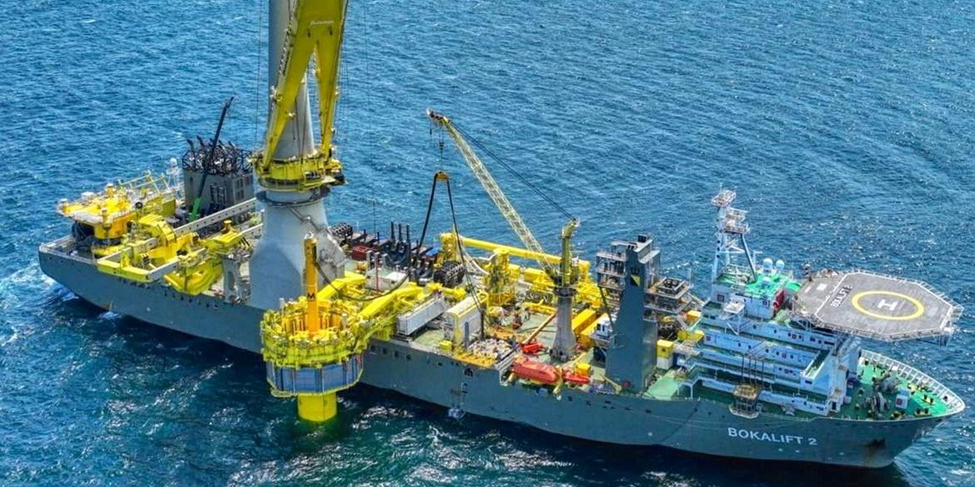
I subscribe to a New Yorkers for Clean Power mailing list. Under the heading “ICYMI: Major Milestone Reached for State’s First Offshore Wind Project!” a recent mailing included this summary describing Governor Hochul announcement on June 22 that “South Fork Wind, New York’s first offshore wind farm, has achieved its “steel in the water” milestone with the installation of the project’s first monopile foundation.”
Late last month, Governor Hochul announced that the South Fork Wind project, New York’s first offshore wind farm, has achieved its “steel in the water” milestone with the installation of the project’s first monopile foundation.
This is the first of many major milestones for New York’s first offshore wind project and South Fork is on track to become the United States’ first completed utility-scale offshore wind project in federal waters.
Once completed, the wind farm will generate enough renewable energy to power roughly 70,000 homes helping New York meet its ambitious Climate Act goals, while eliminating up to six million tons of carbon emissions, or the equivalent of taking 60,000 cars off the road annually over a 25-year period. Hundreds of U.S. workers and three Northeast ports will support South Fork Wind’s construction through late fall helping to stand up a new domestic supply chain that’s creating hundreds of local union jobs across the Northeast.
The description did not add anything beyond what was contained in the press release. The website for the project notes:
What is it?
New York’s first offshore wind farm — with 12 turbines and a state-of-the-art transmission system that will generate enough clean energy to power 70,000 average homes and offset tons of emissions each year
Who’s behind it? 50/50 partnership between Ørsted and Eversource
When is it happening? Expected to be operational by the end of 2023
Where is it? 35 miles east of Montauk Point; the underground transmission line will deliver power to the local grid in the Town of East Hampton, NY
Despite the accolades there are issues associated with OSW as noted in the following.
Offshore Wind Costs
James Hanley wrote an article The Rising Cost of Offshore Wind that describes two issues affecting all OSW projects across the world:
But this recent growth in the offshore wind industry does not necessarily reflect its long-term health. Two substantial headwinds threaten to make projects uneconomical. One is the recent high inflation, which raised the costs of materials and labor across all industries, and the other is bottlenecked supply chains that are causing a bidding-up of the prices of materials and components needed for building wind turbines.
Hanley explains the ramifications to the OSW projects in New York:
The price of offshore wind is about to go up, and electricity users across the Empire State will be on the hook for it. Two firms developing offshore wind projects — Sunrise Wind and Equinor-bp — have gone to the state Public Service Commission asking for an increase in the price they’ll receive per megawatt-hour of electricity produced.
It is not just Hanley that is raising this issue. Sheri Hickok, Chief Executive for onshore wind, GE Renewable Energy Wind farm costs are not falling:
The state of the supply chain is ultimately unhealthy right now. It is unhealthy because we have an inflationary market that is beyond what anybody anticipated even last year. Steel is going up three times…It is really ridiculous to think how we can sustain a supply chain in a growing industry with these kind of pressures…Right now, different suppliers within the industry are reducing their footprint, they are reducing jobs in Europe. If the government thinks that on a dime, this supply chain is going to be able to turn around and meet two to three times the demand, it is not reasonable.
The Climate Act includes language that requires the agencies consider the experiences of other jurisdictions. This mandate is selectively used to justify the preconceived strategies in the Scoping Plan but never to consider the potential for warning signs. As if the request for adjustments to the contracts described by Hanley is not enough, a similar situation is playing out in Great Britain. Net Zero Watch reports that:
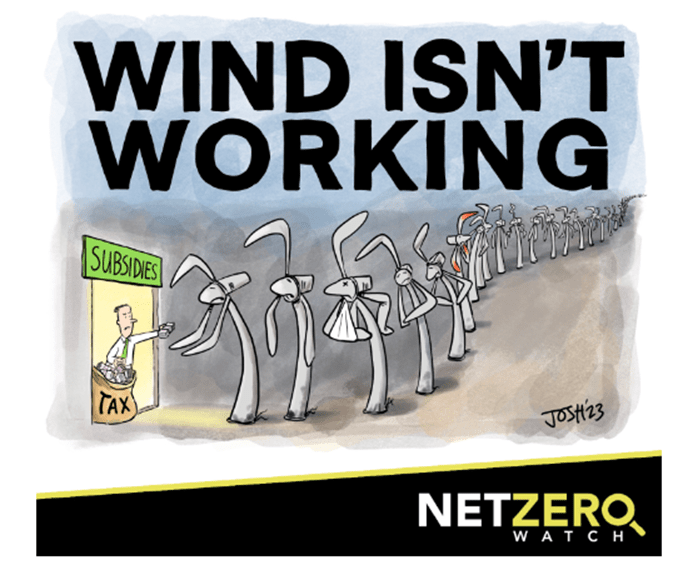
In a move that gives the lie to years of propaganda claiming falling costs, the wind industry’s leading lobbyists have written to the Government, threatening to abandon the UK unless there are hugely increased subsidies for their companies (see RenewableUK press release).
The industry is claiming that unforeseen rising costs now necessitate and justify three actions:
1) A vast increase in the budget for the fifth auction (AR5) of Contracts for Difference subsidies, with an increase of two and half times the current levels for non-floating offshore wind alone;
2) Special new targets and thus market shares for floating offshore wind, one of the most expensive of all forms of generation, and, most importantly of all,
3) a revision to the auction rules so that the winners are not determined by lowest bids but by an administrative decision that weights bids according to their “value” in contributing towards the Net Zero targets.
This would in effect not only increase total subsidy to an industry that was until recently claiming to be so cheap that it no longer needed public support, but also provide it with protected market shares, all but entirely de-risking investors at the expense of consumers.
It would also be an open invitation to graft and corruption.
This blackmail was predicted by Net Zero Watch. Clearly the same playbook will be used by OSW developers here. Hanley explains:
Given the fiscal realities of the situation, PSC’s only two options are to grant the request or delay the development of wind energy while the state seeks new offshore wind construction bids. Either way, costs will rise.
OSW Environmental Impacts
Earlier this year I described the Citizens Campaign for the Environment virtual forum entitled Whale Tales and Whale Facts. The sponsors wanted the public to hear the story that there was no evidence that site survey work was the cause of recent whale deaths. I concluded that the ultimate problem with the forum was that they ignored the fact that construction noises will be substantially different than the ongoing site surveys and will probably be much more extensive when the massive planned construction starts. Jim Lovgren writing at FisheryNation.com describes OSW environmental issues: Offshore Wind Electrical Substations; The Secret, Silent Killers that substantiate my concern:
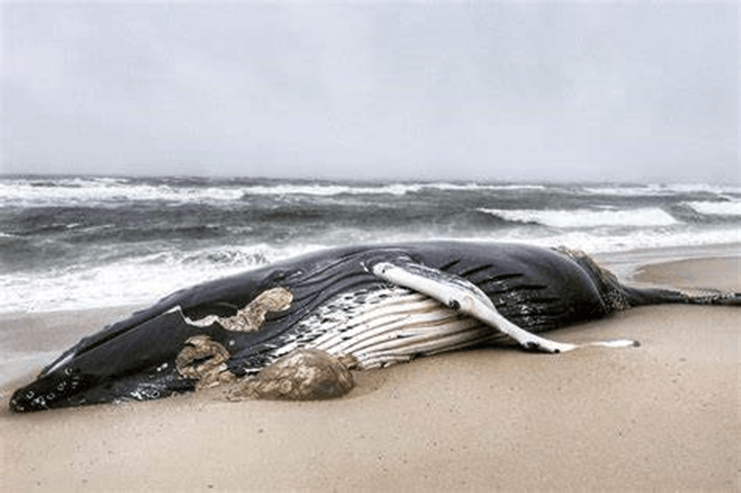
Despite government and wind supporters denying any proof that could link the unseen before amount of strandings to the coincidental use of geological sonar and seismic research, [usually only of a type performed by oil companies] in the near vicinity of the strandings, the evidence mounts. This week, two Humpback Whales washed ashore in Martha’s Vineyard, coincidentally only a few days after Piledriving started at a nearby wind site. Piledriving of the turbine stanchions creates a 260 DBs level sound, that no amount of “Bubble Curtains” can contain. It is deadly. A few weeks before that beaches on the south shore of Nantucket had a carpet of dead crabs, clams, and other benthic organisms that are susceptible to seismic testing, which coincidentally was taking place nearby, [“sparkers” and sub- bottom profilers are seismic equipment]. The relationship of marine animal deaths while unsafe level industrial noises are being produced in the same vicinity are too numerous to ignore, worldwide. So, stop denying them.
Lovgren argues that there is another environmental impact that should be considered. The industrial OSW developments require electrical substations. He explains:
In an official BOEM document written by Pamela Middleton and Bethany Barnhart called, “Supporting National Environmental Policy Act Documentation for Offshore Wind Energy Development related to High Voltage Direct Current Cooling Systems” the authors contend that the only feasible cooling system for a HVDC Substation is a once through, or open system. The kind that is not allowed for new power plant construction, because of its devastating effects on aquatic life. This embarrassing Official BOEM document concerning the effects of offshore wind substations admits it knows nothing about how many substations are planned, how big, and where they will be. NEPA concerns such as environmental and economic costs to other industries are totally ignored within the enormous expanse of information contained within the 4 ½ pages of actual text. Up until the Green new deal a NEPA supporting document would be hundreds, and even thousands of pages long, detailing all aspects of a proposed project.
This is another example of an issue that was the focus of an intense and emotional lobbying effort when it was related to electric power plants using once-through cooling but now this is not an issue by the environmental organizations who demanded the prohibition for new power plants.
Summary of All OSW Issues
Mark Sertoff, a science/technology educator, published an article at Natural Gas Now that argued that the “stampede to build offshore wind turbines to replace fossil fuel generation is loaded with concerns that have not been thought through or been resolved.” I recommend reading the whole article. He made the general points that all this is unnecessary. There is no climate crisis and all the hysterical claims supporting that narrative evaporate upon close examination. He also pointed out that replacing the existing electrical system will lead to higher costs.
The article then documents specific OSW concerns. He lists the many direct environmental impacts, the seabed use requirements, and the disposal problem. Then he addresses the experiences in other countries and notes all the problems that should be a wakeup call for New York. Finally, he offers an alternative approach that will reduce emissions and costs.
Conclusion
The contrast between the positions of New Yorkers for Clean Power and the authors of the articles described here is stark. Most disappointing to me is that the climate activists ignore many issues that caused previous angst. If it was so important in the past, why is it not an issue now? If they don’t demand that all construction work cease when the critically endangered North Atlantic Right Whales migrate through the OSW facilities then they will be exposed as hypocrites. The gulf between a model projection of future weather and its impacts on whales and the imminent and potentially fatal consequences of OSW development on whales is so clear how can the activists claim to be for a sustainable future unless they step up?
I cannot improve on Sertoff’s conclusion:
Entities profiting by promoting renewables are happy to pave the road to hell. Superior solutions exist backed by solid facts. We ignore them at our peril.
On April 4, 2023 Citizens Campaign for the Environment hosted “Lunch & Learn: Whale Tales and Whale Facts”. I have published a couple of articles about whales and offshore wind development recently so I am providing this for more information. I have incorporated comments from a retired fisheries expert who was a colleague of mine and an update of all the recent dead sea mammals washing ashore along the NY/NJ coastline.
I have been following the Climate Act since it was first proposed. I submitted comments on the Climate Act implementation plan and written over 300 articles about New York’s net-zero transition because I believe the ambitions for a zero-emissions economy embodied in the Climate Act outstrip available renewable technology such that the net-zero transition will do more harm than good. The opinions expressed in this post do not reflect the position of any of my previous employers or any other company I have been associated with, these comments are mine alone.
Climate Act Background
The Climate Leadership & Community Protection Act (Climate Act) established a New York “Net Zero” target (85% reduction and 15% offset of emissions) by 2050 and an interim 2030 target of a 40% reduction by 2030. The Climate Action Council is responsible for preparing the Scoping Plan that outlines how to “achieve the State’s bold clean energy and climate agenda.” In brief, that plan is to electrify everything possible and power the electric gride with zero-emissions generating resources by 2040. The Integration Analysis prepared by the New York State Energy Research and Development Authority (NYSERDA) and its consultants quantifies the impact of the electrification strategies. That material was used to write a Draft Scoping Plan. After a year-long review the Scoping Plan recommendations were finalized at the end of 2022. In 2023 the Scoping Plan recommendations are supposed to be implemented through regulation and legislation. The net-zero transition plan anticipates extensive offshore wind development. The Climate Act mandates 9 GW of offshore wind by 2035 and the Integration Analysis recommends 14 GW by 2040. Note that the NYISO projection for offshore wind is 9 GW. I am particularly concerned because the state projects 14GW of offshore wind but has only attempted to address the cumulative environmental impacts of 9 GW – a more than 55 increase.
Dead Sea Mammal Holocaust
There is no question that there has been a marked increase in sea mammal deaths since 2016. Mark Sertoff compiled the following list of recent deaths and suggested that I publish it.
www.nytimes.com/…/east-coast-whale-deaths.html In all, 23 dead whales have washed ashore along the East Coast since early December, including 12 in New Jersey and New York, according to the National Oceanic and Atmospheric Administration….
www.app.com/story/news/local/land-environment/... Across the Jersey Shore, 10 dead whales — mostly humpbacks — washed ashore or have been seen off the coast since Dec. 1, 2022. The strandings are part of what federal authorities are calling…
www.usatoday.com/story/graphics/2023/03/15/east... USA TODAY Since Dec. 1, 23 whales have been found dead along the Atlantic Coast, part of a trend in unusually high deaths among three whale species since 2016-2017. The National Oceanic and…
www.usatoday.com/story/news/nation/2023/02/15/... 78 dead whales were reported in 2017, including humpbacks and right whales, and 59 in 2018, 2019, and 2020. An average of 52 whales have died each year along the coast since 2007. In 2022,…
www.app.com/story/news/local/land-environment/... Six dead whales washed ashore in the past 33 days across New Jersey and New York, according to the environmental group Clean Ocean Action, one of five groups who called for an investigation….
www.wshu.org/long-island-news/2023-01-11/6-dead... Six endangered whales have washed up dead on the shores of Long Island and New Jersey over the past month, an unprecedented number for this area in the last half century. These whales…
nypost.com/2023/02/13/dead-whale-washes-onto... A dead whale was found on a New Jersey beach Monday — the ninth one to wash ashore in the New York-New Jersey area since early December in what activists are calling an alarming uptick. The…
www.nj.com/news/2023/02/another-dead-whale... Since January 2016, 181 dead stranded humpback whales were reported across 13 states, including 24 in New Jersey and 35 in New York. A ship strike or entanglement with fishing gear accounted…
newjersey.news12.com/16-dolphins-dead-along-new... Eight dolphins died Wednesday after getting stranded along a beach in Cape May County. According to the Marine Mammal Stranding Center, a pod of eight dolphins became stranded on the beach on Tuesday. Two dolphins died and the other six were euthanized to prevent further suffering of the animals.
www.nytimes.com/2023/03/22/nyregion/dolphins... March 22, 2023 Eight dolphins were dead after a pod of the marine mammals washed ashore in a mass stranding in Sea Isle City, N.J., on Tuesday, the authorities said, prompting questions over…
www.npr.org/2023/03/22/1165249049 A pod of eight dolphins washed ashore in New Jersey, all of which have died, according to a local animal rescue organization. Two common dolphins, an adult and a calf were first found on a…
abcnews.go.com/US/8-dolphins-dead-after-washing... Eight dolphins were stranded on a beach in Sea Isle, N.J., on March 21, 2023. WPVI A pod of eight dolphins died after being stranded on two beaches in New Jersey on Tuesday, according to an animal rescue and rehabilitation center.
abcnews.go.com/US/wireStory/officials-8-dolphins... Marine animal welfare officials say eight dolphins have died after they became stranded on a beach in New Jersey By The Associated Press March 21, 2023, 4:51 PM SEA ISLE CITY, N.J. — Eight dolphins have died after they became stranded on a beach in New Jersey, marine animal welfare officials said.
www.reddit.com/r/newjersey/comments/115mw4u/wtf... WTF is happening with dead whales and dolphins in NJ? So I just saw that 3 dolphins beached themselves and died in Sandy Hook during low tide TODAY, literally about an hour ago. This on top of the dead whales we’ve seen so far in the past few weeks and also in Long Island.
abc7ny.com/dead-dolphins-sandy-hook-bay-new... The dolphin deaths come after a surge of whales washing up in both New York and New Jersey in recent months. Since the beginning of December, there have been at least nine whale deaths.
www.usatoday.com/story/news/nation/2023/03/21/... 1:15. Six dolphins found off the shore of New Jersey were euthanized Tuesday and another two were found dead after a pod was discovered in a “mass stranding event,” according to a non-profit …
Since 2016, we have witnessed an increase in whale strandings and whale deaths off the coast of America’s shores. These endangered species are under threat from several sources, including ship strikes, fishing gear, plastic pollution, and climate change. Unfortunately, misinformation about whale deaths and an association with offshore wind development has led to concerns about transitioning from fossil fuels to renewable energy. These local wind projects are crucial to combat climate change, which is not only a threat to whales but also to marine mammals, fisheries, and our communities.
CCE works at the local, state, regional, and federal level to advance solutions to the climate crisis. We advocate for comprehensive energy policies that support renewable energy (such as offshore wind and solar power) and energy efficiency, while ending our dependence on dirty, polluting fossil fuels.
In addition, Wind Works Long Island collaborated with CCE for the meeting. Wind Works Long Island is a coalition of environmental, labor, clergy, and community groups, and the force behind educating the Long Island community on the benefits of renewable energy, particularly offshore wind.
The virtual forum had “whale experts” from Atlantic Marine Conservation Society, the New York State Department of Environmental Conservation and the US Bureau of Ocean Energy Management. They talked about the recent whale strandings and deaths, what is being done on the local, state, and federal level to protect whales.
Before the “whale experts” spoke three hosts introduced the topic. Adrienne Esposito, Executive Director, Citizens Campaign for the Environment was the moderator. She argued that there are factors (what are the factors)that have increased the number of whales close to shore and that there are causes of whale deaths that are more likely causes for the observed whale strandings and deaths. Julie Tighe, President, New York League of Conservation Voters, said that disinformation is a problem for the offshore wind industry. Fred Zalcman, Director, New York Offshore Wind Alliance, emphasized that the developers are committed to responsible offshore wind development.
I encourage interested readers to watch the video. I learned a lot and have a better understanding of the situation. However, I still have concerns. In the following I summarize my notes.
Meghan Rickard, Marine Zoologist, NYS Department of Environmental Conservation described the baseline monitoring program that the state did (video at 11:55 of the recording). She said there is no long-term data but they seem to be increasing especially in the New York Bight. The emphasis of the DEC has been on baseline monitoring but they are planning to continue to monitor. Unfortunately, she noted that the funding available is half of what was available for the baseline.
Erica Staaterman, Division of Environmental Assessment and Center for Marine Acoustics, US Bureau of Ocean Energy Management (BOEM) described the fisheries regulations (video starting at 26:51). She explained:
“The term take means to harass, hunt, capture, or kill, or attempt to harass, hunt, capture, or kill any marine mammal” – MMPA. In general for BOEM activities, very little lethal take is ever authorized by NOAA. NOAA is not authorizing any lethal take for offshore wind activities. NOAA fisheries can authorize incidental (unintentional) take of small numbers of marine mammals for certain activities, like offshore wind development. Two types of incidental take:
“Level A” = injury. For acoustics, this is auditory injury, i.e. permanent hearing loss. Acoustic thresholds are established by NMFS and differ by species group.
“Level B” = behavioral disturbance. For acoustics, this includes behavioral disturbance from a sound source and possibly temporary (i.e. recoverable) hearing loss. Threshold is 160 dB re 1 µPa for all species.
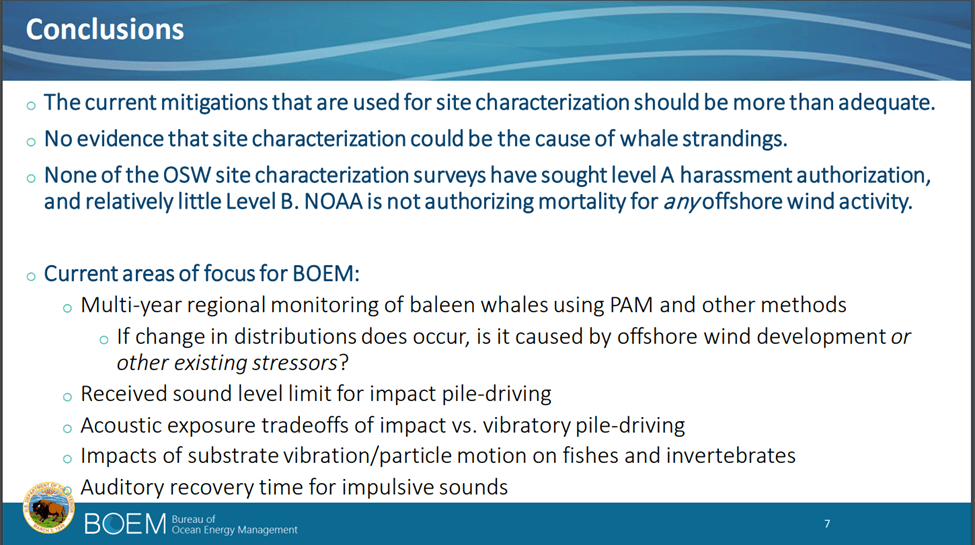
I found her presentation very enlightening. She explained that most of the offshore wind activities to this point are mapping the seafloor using high-resolution geophysical (HRG) sources. They are lower in energy and have key characteristics that set them apart from most other manmade noise sources. Importantly they are directional. She stated that “There is no evidence that HRG sources used by offshore wind companies could cause mortality of whales, nor any evidence that they are responsible for the recent whale strandings.” The following slide presents her conclusions.
Robert DiGiovanni, Founder and Chief Scientist, Atlantic Marine Conservation Society convinced me that this is a complicated issue in his presentation (video starting at 42:18). He explained that the environment has changed recently there are simply many more whales although inter-annual variability of whale locations makes counting the whales difficult. He said that most deaths are due to ship strikes and noted that we cannot use the experience in the European offshore wind farms to project what might happen here because whales there are different.
The question and answer session (video starting at 1:00:00) was interesting but I am not going to take the time to go over it.
Discussion
I am not a fisheries biologist do I asked a former colleague who is an expert to review this post. My takeaway was that that even though there is a correlation between the recent uptick in whale mortality and the offshore wind site characterization work that I do not disagree with the BOEM conclusion that there is no evidence that work is the cause of the recent whale strandings. However, that does not mean that this is still not an issue.
My expert reviewer said that the presentation missed a few key points:
What are the studies underway to identify and build upon the European experience given the ecosystem differences. Do they have the funding to do this work adequately. As we work to decrease the impact of vessel strikes and fishing gear do we understand what the windfarms will do to migratory patterns; feeding; prey behavior etc. Will offshore windfarm noise when the turbines become operational become a problem with new noise pollution. They failed to acknowledge NOAA research identifying chronic anthropomorphic noise as a significant issue for marine mammals.
The presentation showed that there are several reasons that the site characterization work is not a likely cause of the recent observed whale morality. Those reasons include the following: the sounds generated by the mapping equipment do not overlap much with whale hearing ranges, the sounds are intermittent, the mapping uses short pulses of sound with relatively long periods of silence, and the sounds are directional into the seafloor. The problem not addressed in this forum is that these reasons are not characteristic of offshore wind turbine construction. The BOEM is focusing their work now on construction impacts including a sound level limit for impact pile-driving, acoustic exposure tradeoffs of impact vs. vibratory pile-driving, impacts of substrate vibration/particle motion on fishes and invertebrates, and auditory recovery time for impulsive sounds. The following table shows that construction impacts overlap whale hearing ranges.
My reviewer pointed out that the lack of funds for this important effort is appalling (only $2.6 M for both the Great Lakes and Ocean). With billions allocated to green initiatives this makes no sense given the potential impacts. The real issue is what happens when construction starts on the offshore turbines with sound characteristics that are very likely to disorient the whales. The whales may not die from the cacophony of construction noise throughout the New York bight but the likelihood that the din could disorient the whales so that they could become much more susceptible to vessel strikes was not addressed in this forum.
The New York Offshore Wind Alliance claims that the developers are committed to responsible offshore wind development. It is time to stop the slogans and prove it. They should ensure that the New York whale monitoring program is fully funded and be prepared to stop development if their construction activities do adversely affect whales until such time that mitigating activities can be incorporated into their construction plans.
Given all the unknowns the rational approach would be to determine if there are adverse construction impacts before starting the development of the all the infrastructure necessary to build the offshore wind resources proposed. Clearly it is appropriate to accelerate the BOEM analyses of potential construction activities. Moreover, given the immense political pressure to develop offshore wind there should be an independent evaluation of the impact of construction activities. If that work indicates that there any adverse impacts can be mitigated then the development should be allowed to proceed.
My reviewer made some other relevant points.
The lack of funding for independent research is criminal given the enormous public tax funded budgets behind offshore wind development. In a nutshell, why race to install a tiny fraction of electrical resource of offshore wind development that will have no demonstrated impact on the global climate just to feel good or as a symbolic gesture? The Climate Act proposal for 9 GW can in no way be adequate to keep pace with current electrical demand let alone the push for electrification of everything (cars, heat, and cooling) but can have an irreversible impact on the coastal offshore environment.
We clearly have vast information concerning the impacts of terrestrial onshore wind development and operation, primarily because we are terrestrial. The terrestrial environment is comparatively extremely easy to study, we can touch, feel, measure, and observe with our own eyes. This is not so with the ocean and its biota of which we only understand a miniscule amount. We are naïve to think we can hastily dive headlong into the abyss we know so little about to develop a very limited resource when we know we cannot accurately measure the effect of this development on global climate. The use of terms such as misinformation or disinformation in the current political environment when whales are dying and people have common sense concerns is disingenuous and only leads to more distrust. The whale experts provided some valuable insight into the current knowledge of acoustic survey work and its minimal potential to be the cause behind whale deaths. Moving to actual construction should be the primary concern and this was not addressed. Additionally, the current level of funding for monitoring alone was discussed and it appears wholly inadequate for such a significant project and raises concerns that cumulative impact analysis for the proposed offshore wind development will never be sufficient to determine if there are unacceptable adverse impacts.
Conclusion
I have observed that the more vociferous/louder the criticisms made by a stakeholder the more likely that the stakeholder is guilty of the same thing. The introductions to the webinar mentioned that disinformation is a problem for the offshore wind industry. They went on to state that “these endangered species are under threat from several sources, including ship strikes, fishing gear, plastic pollution, and climate change”. They offered no proof how climate change could affect whales but their emotional attachment to that disinformation narrative that the existential threat of climate change affects everything is such that it is just presumed.
They are facing a quandary now that there is a correlation between whale deaths and offshore wind site surveys. They state that it is disinformation to claim that this correlation suggests that there are concerns about transitioning from fossil fuels to renewable energy. The organizers of the forum clung to the conviction that the site survey characteristics are unlikely to be the cause of the whale strandings observed to date. Based on the specific information provided by the experts who spoke I tend to agree. However, I also want to point out that their existential threat narrative is based on a similar correlation between GHG emissions and climate change. If they were willing to consider the possibility that might be similarly flawed then the fact that correlation does not necessarily mean causation could destroy the entire rationale for risking the welfare of the whales.
Ultimately the problem with the forum is that they ignored the fact that construction noises will be substantially different than the ongoing site surveys and will probably be much more extensive when the massive planned construction starts. Those differences are more likely to impact whales. Despite all the talk of responsible offshore wind development no one has offered a plan to ensure that if construction impacts are found that they will change their plans. In my opinion, it is irresponsible to continue the headlong dash to develop offshore wind resources without first determining whether the construction and operation of the massive number of wind turbines will unacceptably affect the whale’s future.
The forum did clearly inform listeners about the lack of funding for monitoring necessary to address the many concerns with massive offshore wind development to allay the concerns of the public. It is particularly galling that the offshore wind proponents who claim to be in favor of responsible offshore wind development are not stepping up to ensure that future monitoring efforts are adequate. Maybe they don’t want to know the answer if the concerns are real.
This is a guest post by Mark Stevens, a regular reader at this blog. Mark is a retired science and technology teacher from Long Island. I have been meaning to do a post on whales and the offshore wind industry so this was timely.
What’s Going On
The NY Post reported a 7th dead whale washed up on the Jersey shore. A humpback washed up on the Amagansett shore in December. Eight dead whales in two months? Moreover, David Wojick recently reported that on January 18, 2023 there was a NOAA fisheries media teleconference that noted:
Since January 2016, NOAA Fisheries has been monitoring an Unusual Mortality Event for humpback whales with elevated strandings along the entire East Coast. There are currently 178 humpback whales included in the unusual mortality event. Partial or full necropsy examinations were conducted on approximately half of the whales. Of the whales examined, about 40% had evidence of human interaction, either ship strike or entanglement. And to date, no whale mortality has been attributed to offshore wind activities.
The transcript makes for fascinating reading. The Fisheries spokespersons went to great lengths to make the point that no whale mortalities have been directly linked to offshore wind development. But there were notable conditions in those statements: “We do not have evidence that would support the connection between the survey work and these recent stranding events or any stranding events in the last several years.” The other key condition is that the offshore wind development is doing survey work now and not construction. The open question is whether or not offshore wind development could kill whales.
Bloomberg reports that planned wind projects off the New England coast threaten to harm the region’s dwindling population of endangered right whales, according to a US government marine scientist.The warning from a top National Oceanic and Atmospheric Administration official, obtained by Bloomberg under a Freedom of Information Act request, underscores the potential legal and environmental perils of offshore wind development along the coast. Both initial construction of wind projects and decades of expected operation threaten to imperil right whales in southern New England waters, Sean Hayes, chief of the protected species branch at NOAA’s National Northeast Fisheries Science Center, said in a May 13 letter to Interior Department officials. The department is weighing at least 10 proposals to install wind turbines in shallow Atlantic waters — projects key to fulfilling Biden’s 2030 goal.
The NOAA fisheries media teleconference claimed that survey work had not been linked to whale strandings. Surveys entail prolonged use of “machine gun sonar” emits an incredibly loud noise several times a second, often for hours at a time, as the ship slowly maps the sea floor.Mapping often takes many days to complete. A blaster can log hundreds of miles surveying a 10-by-10 mile site.
There are lots of ways this sonar blasting might cause whales to die. Simply fleeing the incredible noise could cause ship strikes or fish gear entanglements, the two leading causes of whale deaths. Or the whales could be deafened, increasing their chances of being struck by a ship later on. Direct bleeding injury, like getting their ears damaged, is another known risk, possibly leading to death from infection. So there can be a big time difference between blasting and death. Sonar blasting in one place could easily lead to multiple whale deaths hundreds of miles away. If one of these blasters suddenly goes off near a group of whales they might go off in different directions, then slowly die. It is not guaranteed that the dead whales will wash up on shore.
The NOAA fisheries media teleconference did not address construction impacts. Sound travels 5 times faster in water and humpback whale sounds can travel thousands of miles according to Scientific American. Pile driving the hundreds of enormous monopiles that hold up the turbine towers and blades will be far louder than the sonic blasters, especially with eight sites going at once. These construction sites range from Virginia to Massachusetts, with a concentration off New Jersey and Long Island. This is shown to cause whale mortality.
The impetus for the The NOAA fisheries media teleconference was related to humpback whales strandings. However, some of the dead whales off New Jersey are endangered sperm whales. And there are the severely endangered North Atlantic Right Whales throughout the area where offshore wind developments are planned.
Offshore Wind and the Climate Act
New York’s Climate Leadership and Community Protection Act (Climate Act) established a “Net Zero” target (85% reduction and 15% offset of emissions) by 2050. The Climate Act requires that by 2030, 70% of electricity will be generated from renewable energy sources such as solar and wind and calls for the development of 9,000 megawatts of offshore wind energy by 2035.
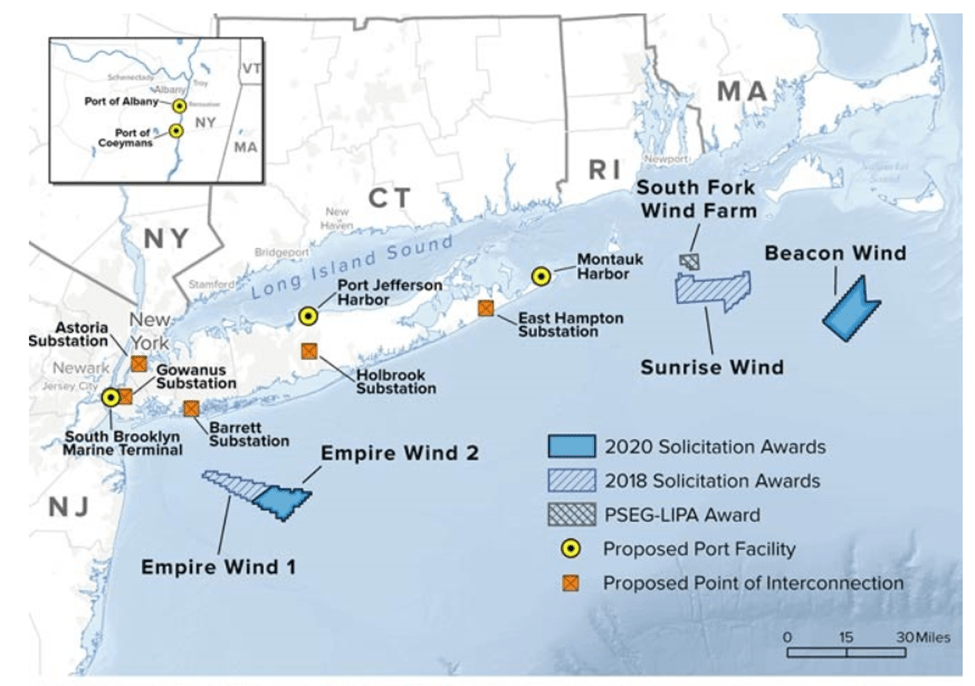
According to the New York State Offshore Wind Overview five projects have been procured: South Fork (132 MW), Empire Wind 1&2 (816 MW and 1,260 MW), Sunrise Wind (924 MW), and Beacon Wind https://www.beaconwind.com/about/(1,230 MW). Unfortunately, the websites do not provide consistent information but the best guess number of turbines is 316 for a total of 4,362 MW. At that rate, the 9,000 MW target will require 652 turbines with capacities between 11 and 15 MW. On January 26, 2023 bids were due for another round of Climate Act offshore wind development.
Is it time to re-think offshore wind?
In order to do the offshore wind development site surveys an incidental harassment authorization is required. The first fact is that the huge 2016 jump in annual humpback mortality coincides with the huge jump in NOAA Incidental Harassment Authorizations. The second fact is that this is just the start of whale harassment when hundreds of enormous monopiles are driven into the seabed for the massive deployment of offshore wind. When construction gets into full swing there will be multiple pile drivers hammering away which can only result in impacts beyond incidental harassment.
In addition to the hundreds of bird strikes including bald eagles and others, wind turbines are massive killing machines here and around the world. And the fact that they produce energy about ¼ of their nameplate capacity, cost hundreds of billions of dollars with huge taxpayer subsidies, are intermittent and still need fossil generation backup when the wind stops, require 10s of thousands of acres, have shortened life in the harsh marine environment; require more steel, concrete, copper, and materials than conventional generation of the same output; have monstrous fiberglass blades which are not recyclable, why are we blindly building them? In addition, most wind projects are built by foreign companies. Do we want billions of ratepayer dollars and taxpayer subsidies going overseas?
According to a study by the Center For Management Analysis of CW Post/LIU, Dr. Matt Cordero determined repowering the Northport Power Station alone with state-of-the-art technology will produce 3500+ MW (more than Empire Wind), cut emissions over 90%, cost less than Empire, use fewer materials, use a fraction of the area that ALREADY EXISTS with a power station and in-place infrastructure, will have zero bird strikes and whale deaths, provide tax benefits for the community, will last decades longer and is on call 24/7 vs. intermittent (20% of the time) wind.
Furthermore, intermittent wind and solar need massive battery backup and storage with huge costs, land requirements, massive pollution and greenhouse gas emissions for ore extraction and fabrication, and pose a deadly hazard to the region if it catches on an unextinguishable fire that emits deadly gasses.
Emission reduction by NYS will have an undetectable effect on global emissions, especially with China, Russia, India and others building dozens of coal power plants. They will have reliable, life-saving, cost-effective electricity generation. States with a large portion of renewables like California, Texas, North Carolina have high rates, power failures, rolling blackouts and a restricted weather operating range, and they IMPORT reliable power from other states, thus relocating emissions to surrounding states. Tesla and others left California for those reasons. Are they really cutting emissions?
Finally, the European Union, especially Germany and the UK have shuttered nuclear and fossil generation, relying on unreliable wind and solar sources. Costs are so high, people must decide whether to buy electric heat or food, and industries are leaving for other countries with cheaper and more reliable electricity, resulting in unemployment, poverty and economic collapse.
We currently have a reliable, cost-effective generation mix of fossil, wind, solar, hydro and nuclear. New York State must seriously rethink replacing that generation with intermittent wind and solar. Our survival and economy depend on it.



 Pragmatic Environmentalist of New York