All Electric Building Act – Affordability

The Climate Leadership and Community Protection Act (Climate Act) has a legal mandate for New York State greenhouse gas emissions to meet the ambitious net-zero goal by 2050. In order to implement the changes needed additional legislation is needed.  Environmental advocates are pushing Renewable Heat Now bills including the All-Electric Building Act.  This post puts that legislation into the context of the current electricity reliability crisis facing New Yorkers.

Everyone wants to do right by the environment to the extent that they can afford to and not be unduly burdened by the effects of environmental policies. I have written extensively on implementation of New York’s response to climate change risk because I believe the ambitions for a zero-emissions economy embodied in the Climate Act outstrip available renewable technology such that it will adversely affect reliability, impact affordability, risk safety, affect lifestyles, and will have worse impacts on the environment than the purported effects of climate change in New York. New York’s Greenhouse Gas (GHG) emissions are less than one half one percent of global emissions and since 1990 global GHG emissions have increased by more than one half a percent per year. Moreover, the reductions cannot measurably affect global warming when implemented.  The opinions expressed in this post do not reflect the position of any of my previous employers or any other company I have been associated with, these comments are mine alone.

Climate Act Background

The Climate Act establishes a “Net Zero” target by 2050. The Climate Action Council is responsible for preparing the Scoping Plan that will “achieve the State’s bold clean energy and climate agenda”. They were assisted by Advisory Panels who developed and presented strategies to the meet the goals to the Council. Those strategies were used to develop the integration analysis prepared by the New York State Energy Research and Development Authority (NYSERDA) and its consultants that quantified the impact of the strategies. That analysis was used to develop the Draft Scoping Plan that was released for public comment on December 30, 2021.

I previously described two bills that address the building sector components that need to be changed for the net-zero transition. According to the Advanced Code Act: “Buildings are the single largest user of energy in the State of New York, accounting for almost 60% of all energy consumed by end-use in the State.” Revisions to building codes will be “directly impacting a building’s energy load and carbon footprint”. The Gas Ban notes that the Climate Act “requires greenhouse gas emission reductions from all sectors, which will entail, among other things, converting buildings throughout the state from heating and cooking with combustible fuels to heating and cooking with non-emitting sources such as energy-efficient air, ground, and water sourced electric heat pumps which also provide cooling, and electric and induction stoves”.  I understand that the Advanced Code Act has already passed.

All Electric Building Act

I described the public hearing for this legislation that establishes the All-Electric Building Act.  As has been the case with other legislation the bill assumes that there are no technology limitations and that all new buildings can be built without fossil fuel infrastructure without any issues. 

The proposed legislation revises the state energy conservation construction code to “prohibit infrastructure, building systems, or equipment used for the combustion of fossil fuels in new construction statewide no later than December 31, 2023 if the building is less than seven stories and July 1, 2027 if the building is seven stories or more”.  It allows the building code council to exempt systems for emergency back-up power, or buildings specifically designated for occupancy by a “commercial food establishment, laboratory, laundromat, hospital, or crematorium, but in doing so shall seek to minimize emissions and maximize health, safety, and fire-protection.”  However, it limits the areas where the combustion of fossil fuels is allowed and the building must be designed as all-electric ready.

The legislation includes a provision for affordability.  It requires state agencies to identify policies to ensure affordable housing and affordable electricity (meaning that electricity costs no more than 6% of a residential customer’s income) for all-electric buildings by February 1st, 2023.  Note that I have been unable to determine the current affordability status of New York.

Affordability

Energy affordability, in general, and electricity affordability, in particular, should be a major concern.  There is no question that there is a home energy crisis:

According to WE ACT for Environmental Justice, an organization whose mission is to combat environmental racism and build healthy communities for people of color, 13 percent of all residential households—about 1,137,000 in total—are 60 days in arrears on their utility bills, with an average of $1,427.71 in debt. The debt level is even higher for Con Ed customers, averaging about $2,085 per residential household/customer.

More than 471,629 disconnection notices were sent out in April 2022 for residential customers across New York State, with Orange and Rockland counties leading the way, with 79 shutoffs that month. For commercial customers, there were more than 77,651 disconnection notices overall, with almost 2,544 already carried out. National Grid (KEDLI) had the highest number of service terminations, 882, followed by Con Edison at 831 terminations and National Grid (KEDNY) at 310. Residential terminations in March were at 131 and commercial terminations stood at 1,688.

The proposed legislation addresses affordability but puts the cart before the horse by evaluating electricity affordability after the bill is enacted:

§ 11-111. Additional reporting. On or before February first, two thousand twenty-three, the department of public service, the division of housing and community renewal, the department of state, and the New York state energy research and development authority shall report jointly to the governor, the temporary president of the senate, the minority leader of the senate, the speaker of the assembly, and the minority leader of the assembly, regarding what changes to electric rate designs, new or existing subsidy programs, policies, or laws are necessary to ensure that subdivisions six and seven of section 11-104 of this article do not diminish the production of affordable housing or the affordability of electricity for customers in all-electric buildings. For the purpose of this subdivision, “affordability of electricity” shall mean that electricity does not cost more than six percent of a residential customer’s income.

In 2016, New York State set a target that low-income New Yorkers should pay no more than 6% of their income toward energy bills and I applaud its inclusion in this legislation. However, I have not been able to find out how New York State stands relative to this target.  I did find an analysis for New York City that showed that over 460,000 low-income families in New York City are paying over 6% of their pre-tax income toward their energy bills.  That works out to 14.6% of the households.

All Electric Building Act Costs

I have yet to see an evaluation of the potential costs of this legislation.  The Integration Analysis spreadsheets that support the Draft Scoping Plan include a table with device costs.  In order to ensure that heat pumps work at all times in New York’s winters upgrades to the building shell (insulation, infiltration and windows) are needed. According to device cost table an air source heat pump runs $14,678 and a deep shell upgrade of $45,136 totaling $59,814 or a ground source heat pump ($34,082) and a basic shell upgrade ($6,409) totaling $40,491 for single family homes.  This legislation would mandate adding those costs above the cost of an efficient furnace or boiler ranging from $3,085 to $8,975.  Obviously, those added costs are going to add to the affordability burden for New Yorkers.

Conclusion

The bill requires a study after the law becomes effective to ensure it does not “diminish the production of affordable housing or the affordability of electricity for customers in all-electric buildings”.  That is an example of the cart before the horse mindset of this legislation and the Climate Act itself. This bill should be amended to include a specific affordability target and only proceed as long as the metric is achieved.  I think that there should be a state-wide goal for the percentage of customers that don’t meet the 6% target and the State should make the current value readily available. Without that information it is inappropriate to implement this legislation.

By any measure New York’s complete elimination of GHG emissions is so small that there will not be any effect on the state’s climate and global climate change impacts to New York.  New York’s emissions are only 0.45% of global emissions.  I have shown that global emissions have increased more than New York’s total share of global emissions since 1995.  In other words, whatever New York does to reduce emissions will be supplanted by global emissions increases in a year.  Against that backdrop it is not clear why any increase in New York energy costs from any renewable heat legislation should be considered until the electricity energy crisis is resolved.

Public Hearing on All-Electric Buildings Act

On May 12, 2022 the New York State Assembly had a legislative hearing for Assembly Bill A8431, the “all-electric building act”.  The recording for the hearing offers a glimpse into New York’s irrational net-zero transition legislation.  This post describes the legislation and the testimony presented by Climate Action Council Co-Chair Doreen Harris and her response to questions about costs of this control strategy.

Everyone wants to do right by the environment to the extent that they can afford to and not be unduly burdened by the effects of environmental policies.  I have written extensively on implementation of New York’s response to that risk because I believe the ambitions for a zero-emissions economy embodied in the Climate Act outstrip available renewable technology such that it will adversely affect reliability, impact affordability, risk safety, affect lifestyles, and will have worse impacts on the environment than the purported effects of climate change in New York.  New York’s Greenhouse Gas (GHG) emissions are less than one half one percent of global emissions and since 1990 global GHG emissions have increased by more than one half a percent per year.  Moreover, the reductions cannot measurably affect global warming when implemented.   The opinions expressed in this post do not reflect the position of any of my previous employers or any other company I have been associated with, these comments are mine alone.

Climate Act Background

The Climate Act establishes a “Net Zero” target (85% reduction and 15% offset of emissions) by 2050. The Climate Action Council is responsible for preparing the Scoping Plan that will “achieve the State’s bold clean energy and climate agenda”.  They were assisted by Advisory Panels who developed and presented strategies to the meet the goals to the Council.  Those strategies were used to develop the integration analysis prepared by the New York State Energy Research and Development Authority (NYSERDA) and its consultants that quantified the impact of the strategies.  That analysis was used to develop the Draft Scoping Plan that was released for public comment on December 30, 2021. Comments on the draft can be submitted until June 10, 2022.  In order to implement these strategies additional legislation is needed.

I recently described two bills.  According to the Advanced Code Act: “Buildings are the single largest user of energy in the State of New York, accounting for almost 60% of all energy consumed by end-use in the State.” Revisions to building codes will be “directly impacting a building’s energy load and carbon footprint”. The Gas Ban notes that the Climate Act “requires greenhouse gas emission reductions from all sectors, which will entail, among other things, converting buildings throughout the state from heating and cooking with combustible fuels to heating and cooking with non-emitting sources such as energy-efficient air, ground, and water sourced electric heat pumps which also provide cooling, and electric and induction stoves”. 

All-Electric Building Act

This legislation establishes the All-Electric Building Act.  As has been the case with other legislation the bill assumes that there are no technology limitations and that all new buildings can be built without fossil fuel infrastructure. 

The proposed legislation revises the state energy conservation construction code to “prohibit infrastructure, building systems, or equipment used for the combustion of fossil fuels in new construction statewide no later than December 31, 2023 if the building is less than seven stories and July 1, 2027 if the building is seven stories or more”.  It allows the building code council to exempt systems for emergency back-up power, or buildings specifically designated for occupancy by a “commercial food establishment, laboratory, laundromat, hospital, or crematorium, but in doing so shall seek to minimize emissions and maximize health, safety, and fire-protection.”  However, it limits the areas where the combustion of fossil fuels is allowed and the building must be designed as all-electric ready.

The legislation includes a provision for affordability.  It requires state agencies to identify policies to ensure affordable housing and affordable electricity (meaning that electricity costs no more than 6% of a residential customer’s income) for all-electric buildings by February 1st, 2023.  Note that I have been unable to determine the current affordability status of New York.

Harris Testimony

The May 12, 2022 legislative hearing for this bill started with testimony from Doreen Harris.  She is the head of the New York State Energy Research & Development Authority (NYSERDA) and co-chair of the Climate Action Council.   Her presentation starts on the video at 4:45.   She explained that buildings are the largest source of greenhouse gas emissions according to the most recent inventory performed using the Climate Act’s unique emission estimation methodology.  In order to eliminate those emissions, the Draft Scoping Plan found that fully electrify buildings are necessary.  Unfortunately, her testimony was long on generalizations and short on specifics relative to what the Draft Scoping Plan requires to meet the net-zero goals.

She noted that in this year’s State of the State the Governor announced a commitment to support two million climate friendly homes.  This includes a plan to achieve one million efficient and electrified homes and up to one million electrification ready homes by 2030.  To achieve this, they plan to increase energy efficiency and deploy clean home heating and cooling technologies. 

Rather than explaining what the Draft Scoping Plan projects is necessary she talked about NYSERDA programs.  For example, she said there is “laser focus” on the combination of heat pumps and energy efficiency because “when installed at scale they are the number one solution for emissions reductions in the sector.  Harris bragged (at 7:40) that the New York Stretch 2020 Energy Code will save homeowners $275 per year.  However, that code change “improves the State Energy Code’s efficacy by roughly 10%”. 

I submitted comments on the Draft Scoping Plan residential heating projections that showed that a primary driver of home heating electrification is the building shell cost.  The Draft Scoping Plan states:

Two bundles of building shell improvements have been included: a basic shell upgrade and a deep shell upgrade. Basic and deep shell upgrades include a variety of measures focused on reducing energy use and increasing occupant comfort; these measures include, for example, varying levels of roof and wall insulation improvements, window treatments such as double or triple paned windows and infiltration improvements. Space heating demands are reduced by 27-44% with the basic shell package and 57-90% with the deep shell package, depending on building type.

Clearly the Stretch 2020 Energy Code is no where close to the basic or deep shell upgrades envisioned in the Draft Scoping Plan.

Most people at the hearing were worried about costs.  Chair Harris lost the opportunity to explain what the Draft Scoping Plan projects as costs for the air source heat pumps, ground source heat pumps, and different building shells.  She said that heat pumps paired with high performing building envelopes will work everywhere in New York. She did not explain how much that might cost.  The following table lists data from the Council’s Plan.  My interpretation of the Scoping Plan is that a ground source heat pump paired with a basic shell upgrade ($40,941) or an air source heat pump paired with a deep shell upgrade ($60,954) should work everywhere.  The reference table gives the price of an efficient gas furnace as $3,085.  That is quite a price premium for zero-emissions.

Given its importance all the assumptions used to generate the numbers should be available but there is insufficient documentation for that. The Draft Scoping Plan claims only 26% of residences need deep shell upgrades.  I estimate that more than half actually will need to have deep shell upgrades using a more refined climatology.  I estimate that the entire building sector component cost is $230 billion relative to the reference case in the Draft Scoping Plan.  I calculated that just the residential retrofit heat electrification costs range between $259 billion and $370 billion using one methodology and between $295 billion and $370 billion based primarily on the number of residences that need deep building shell upgrades.  

Chair Harris also made the claim that all-electric homes will be “more resilient and safer than buildings previously built and supported by fossil fuels as they lose heat during power outages”.  I can only guess that the rationale for this argument is that the building shell improvements will be so good that the buildings will not lose as much heat when the power goes out.  Eventually, however, even the best insulated and sealed home will become too cold to be livable.  That is why people who are truly concerned about safety during power outages incorporate an independent backup system.  For heating many use wood stoves.  In my case I have used a backup electric generating system: first portable and more recently a whole house generator.  A backup system that can be operated indefinitely is the truly “more resilient and safer” alternative.

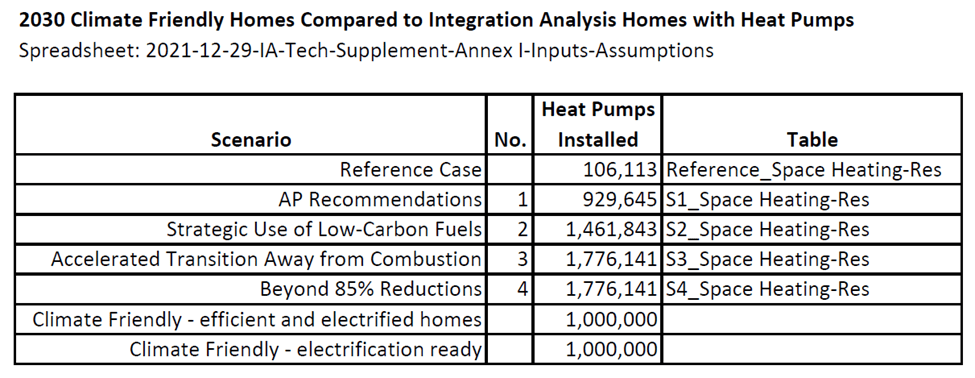
The responses to questions were interesting.  Assemblyman Cusik at 13:00 asked for the timeline for the State’s plan for implementing fully electric.  Rather than explaining what is in the Draft Scoping Plan Chair Harris gave the pitch for Hochul’s two million climate friendly homes by 2030 proposal.  Recall that this includes a plan to achieve one million efficient and electrified homes and up to one million electrification ready homes by 2030.  In my opinion the sign of an “efficient and electrified” home is that it will have a heat pump installed.  The following table shows that the Governor’s plan is 32% less than what the Draft Scoping Plan Integration Analysis projects is necessary. 

She went on to say the plan is 200,000 decarbonized homes per year by 2030 as opposed to 20,000 now.  Assuming that the sign of a decarbonized home is an installed heat pump the following table indicates that this estimate is much less than what is needed.  It is not clear what the metric for today’s electrification metric is but 20,000 is not consistent with the Reference Case.

Affordability questions were asked numerous times.  Cusik asked specifically whether there is a cost analysis in the plan at 14:34. The response was not direct: “Yes, certainly.  Affordability is and will continue to be significant priority and a central focus of our implementation of the Climate Act.”  Harris went on to say that NYSERDA programs are looking at upfront costs.  Those programs found that all-electric homes are on the range of 2 to 4% higher than a building that would be constructed with gas infrastructure at this point”.  She claimed costs will come down in the future but did not mention that the Draft Scoping Plan does not incorporate such a cost reduction.

In response to questions by Assemblyman Zebrowski about existing homes Harris noted that “as existing buildings turnover in ownership or replacement of installed equipment that’s when we would be addressing existing building stock”.  This confirms my expectation that when a homeowner sells a home with gas-fired appliances after 2030 that the home will have to be upgraded to all-electric.  Obviously that cost will be borne by the seller.

In response to Assemblyman Palmesano’s question about affordability Chair Harris claimed that the NYSERDA Building of Excellence found that a single family home built today for $350,000 added $17,000 upfront cost for heat pump and building shell (Video at 33:20).

At (40:49 in video) Assemblyman Lawler asked for a specific cost estimate to electrify a home.  Chair Harris had to respond but only prattled on that she could not provide a specific price.  She said that each home will be different and the building shell improvement for each house can only be determined by doing an energy audit.  This is all baloney because we all understand that it is not possible to predict exactly what our individual home is going to cost to be electrified.  However, the Draft Scoping Plan claims that “The cost of inaction exceeds the cost of action by more than $90 billion” so there are costs estimates available in the Integration Analysis.  It would have been interesting to see the reaction if the Chair Harris had been asked what the Integration Analysis device costs were and what the expected total costs for new housing units and retrofits would be.

Based on my evaluation of the Integration Analysis spreadsheets I can answer those questions.  The 2030 Climate Friendly Homes Compared to Integration Analysis Homes with Heat Pumps table earlier in this post gives an example of the device costs available in the Draft Scoping Plan documentation.  The Plan’s recommended electrification approach is electric heat pumps and building shell improvements (more insulation, infiltration improvements and better windows).  Based on the information in the Plan, I estimate that for a single-family residence, an air source heat pump ($14,678) will need to be coupled with deep shell improvements ($45,136) totaling $60,954 or a ground source heat pump ($34,082) coupled with basic shell improvements ($6,409) totaling $40,491 will be needed to provide adequate comfort similar to those oft-referenced homes in the Nordic countries.  These numbers are much higher than those quoted from the Buildings of Excellence program but the comments I submitted document that they are from the Draft Scoping Plan so it is incumbent on NYSERDA to explain the discrepancies.

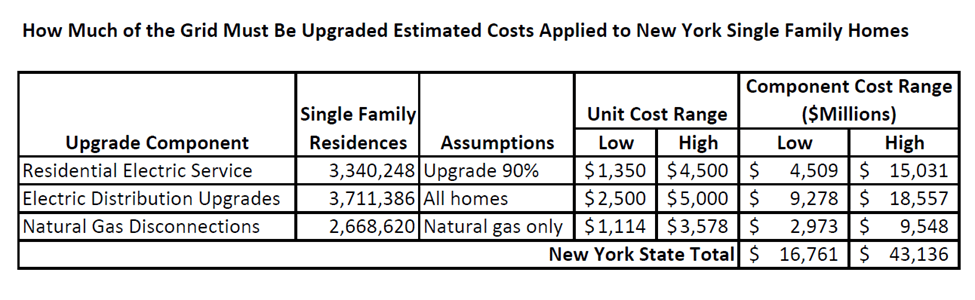
A couple of assemblymen asked about grid upgrades and got another non-responsive reply.  I recently submitted comments on the costs for residential electric service upgrades, electric distribution improvements when everyone is all-electric, and an estimate of the costs for de-commissioning gas service.  The following table presents those numbers which are not based on the Draft Scoping Plan. Presumably, somewhere, someplace similar numbers have been developed but I have not been able to find them. The unit cost ranges for a single-family home is another $3,850 to $9,500.

In addition to the individual homeowner costs, I made a first-order approximation estimate of total costs for residential heating upgrades to all-electric.  Using the Integration Analysis device costs described earlier I estimate the additional cost to electrify home heating and upgrade the building envelopes to the basic and deep shell standards will add $28 billion to new building housing costs between 2023 and 2050.  Depending on the assumptions used for air-source vs. ground source heat pumps and basic building shell vs. deep building shell I project retrofit costs between $240 and $330 billion.  Throw in $30 billion for electric service upgrades, distribution network modifications and residential natural gas disconnections the total residential heating upgrades to all-electric approach at least $300 billion.  This does not include costs for other electric appliances, EV chargers, and all the other things necessary for an all-electric house.

Discussion

In my opinion the fact that the Co-Chair of the Climate Action Council did not provide the Draft Scoping Plan projections was an oversight.  On the other hand, it could be indicative of a deeper problem.  The Climate Action Council draft scoping plan is required to provide “The costs of implementing proposed emissions reduction measures, and the emissions reductions that the council anticipates achieving through these measures” in § 75-0103 (14) (b) (ii).   In order to fulfill that mandate, I believe there should be a summary chapter in the Draft Scoping Plan that describes all the control measures, provides references for the assumptions used, lists the expected costs for those measures and lists the expected emission reductions for the Reference Case, the Advisory Panel scenario and the three mitigation scenarios. I don’t believe that the Integration Analysis developers have provided these numbers to anyone.  If this information was available then legislators would have ready access to the information that both parties requested but did not get at the hearing.  Given the extreme reticence to provide specific numbers and the shenanigans I have uncovered related to the few numbers provided, I worry that this obfuscation is deliberate.  I believe that the Legislature should be demanding this information be included in the Final Scoping Plan.

I want to make one other point.  I have spent a lot of time evaluating the Climate Act Draft Scoping Plan and recently noticed something that is inconsistent with the NYSERDA story that everything is wonderful about heat pumps. According to the Integration Analysis modeling, sales of heat pump for the Reference Case grows to 4% of total sales by 2025 but stays the same until 2050 in the Reference Case Space Heating-Res table. If heat pumps are as good as NYSERDA claims then shouldn’t the rate of adoption be higher in the business-as- usual case? The fact that the NYSERDA claims no increased rate of heat pump sales either means that the modeling is wrong or that these heat pumps are not expected to be purchased by homeowners who make decisions based on economics.

Conclusion

Co-Chair Harris testimony was more about NYSERDA than providing useful testimony for the Assembly.  There were many instances of statements that basically said trust us we have this under control but provided nothing to support those claims.  She should have been able to tell the Hearing attendees the device costs in the Draft Scoping Plan and the explained just what is needed for the building shells. The lack of detailed cost measure information is a major flaw in the Draft Scoping Plan.

Climate Act Implementing Legislation

The Climate Leadership and Community Protection Act (Climate Act) has a legal mandate for New York State greenhouse gas emissions to meet the ambitious net-zero goal by 2050. A couple of pieces of legislation are being considered to implement parts of the transition plan. This post summarizes the Advanced Building Codes, Appliance and Equipment Efficiency Standards Act (Advanced Code Act) and the Gas Transition and Affordable Energy Act (Gas Ban).

Everyone wants to do right by the environment to the extent that they can afford to and not be unduly burdened by the effects of environmental policies. I have written extensively on implementation of New York’s response to climate change risk because I believe the ambitions for a zero-emissions economy embodied in the Climate Act outstrip available renewable technology such that it will adversely affect reliability, impact affordability, risk safety, affect lifestyles, and will have worse impacts on the environment than the purported effects of climate change in New York. New York’s Greenhouse Gas (GHG) emissions are less than one half one percent of global emissions and since 1990 global GHG emissions have increased by more than one half a percent per year. Moreover, the reductions cannot measurably affect global warming when implemented.  The opinions expressed in this post do not reflect the position of any of my previous employers or any other company I have been associated with, these comments are mine alone.

Climate Act Background

The Climate Act establishes a “Net Zero” target by 2050. The Climate Action Council is responsible for preparing the Scoping Plan that will “achieve the State’s bold clean energy and climate agenda”. They were assisted by Advisory Panels who developed and presented strategies to the meet the goals to the Council. Those strategies were used to develop the integration analysis prepared by the New York State Energy Research and Development Authority (NYSERDA) and its consultants that quantified the impact of the strategies. That analysis was used to develop the Draft Scoping Plan that was released for public comment on December 30, 2021.

Two bills address the building sector components that need to be changed for the net-zero transition. According to the Advanced Code Act: “Buildings are the single largest user of energy in the State of New York, accounting for almost 60% of all energy consumed by end-use in the State.” Revisions to building codes will be “directly impacting a building’s energy load and carbon footprint”. The Gas Ban notes that the Climate Act “requires greenhouse gas emission reductions from all sectors, which will entail, among other things, converting buildings throughout the state from heating and cooking with combustible fuels to heating and cooking with non-emitting sources such as energy-efficient air, ground, and water sourced electric heat pumps which also provide cooling, and electric and induction stoves”.

Cart Before the Horse

The authors of the Climate Act and most of the Climate Action Council believe that the transition to net-zero is simply a matter of political will.  The Act did not explicitly mandate a feasibility analysis and the Council has not mentioned anything in its deliberations.  However, I believe that the Climate Action emission reduction targets are contingent upon meeting Public Service (PBS) CHAPTER 48, ARTICLE 4, § 66-p. Establishment of a renewable energy program (4):  “The commission may temporarily suspend or modify the obligations under such program provided that the commission, after conducting a hearing as provided in section twenty of this chapter, makes a finding that the program impedes the provision of safe and adequate electric service; the program is likely to impair existing obligations and agreements; and/or that there is a significant increase in arrears or service disconnections that the commission determines is related to the program”. 

Both of these bills suffer from the same under-estimation of the challenges of a net-zero transition.  Until the New York has proven that the Scoping Plan will not impede the conditions described above, I think it is premature to change building codes and energy efficiency standards or implement a ban on fossil-fuel use.

Advanced Building Codes, Appliance and Equipment Efficiency Standards Act

The Senate version (S. 7176) is available here and Assembly version (A. 08143) here. Note that I am not trying to reconcile any differences between the Senate and Assembly versions in this post. The impetus of this legislation is to support the Climate Act and I believe revised building codes are necessary to improve building shells for electrified residential heating.  Section 3.3 Sectoral Results -Buildings in Appendix G, Integration Analysis Technical Supplement Section I is the primary reference for technical information related to the building sector in the Draft Scoping Plan.  It describes the building shell improvements as follows:

Building shell improvements (such as improved insulation, window treatments, or deep home retrofits) are modeled as reducing service demand for HVAC devices. Improvements to buildings incur costs but improve home and office comfort in addition to reducing energy bills. Two bundles of building shell improvements have been included: a basic shell upgrade and a deep shell upgrade. Basic and deep shell upgrades include a variety of measures focused on reducing energy use and increasing occupant comfort; these measures include, for example, varying levels of roof and wall insulation improvements, window treatments such as double or triple paned windows and infiltration improvements. Space heating demands are reduced by 27-44% with the basic shell package and 57-90% with the deep shell package, depending on building type. Air conditioning demands are reduced 14-27% with the basic shell package and 9-57% with the deep shell package. The total impact of building shell improvements on total HVAC service demand in buildings is a function of the market penetration of each package and distribution of building types. Building shell improvements include both retrofits and new construction, although all new construction in residential and commercial is assumed to be code-compliant and therefore has lower HVAC service demands relative to the existing building stock. (Footnote for this sentence said “E3 calculated the stock rollover of building shells with a 20-year lifetime to reflect improvements in new construction and opportunities for home retrofits.”

There is no reference to building shells in the Advanced Code Act.  Amended Section 2 (a) reads:

The state fire prevention and building code council is authorized, from time to time as it deems appropriate and consistent with the purposes of this article, to review and amend the code, or adopt a new code, through rules and regulations provided that the code remains cost effective with respect to building construction in the state. In determining whether the code remains cost effective, the code council shall consider:

(i) whether the life-cycle costs for a building will be recovered through savings in energy costs over the design life of the building under a life-cycle cost analysis performed under methodology as established by the New York State Energy Research and Development Authority in regulations which may be updated from time to time, and

(ii) secondary or societal effects, such as reductions in greenhouse gas emissions, as defined in regulations. Before publication of a notice of proposed rule making establishing the methodology or defining secondary or societal effects, the president of the authority shall conduct public meetings to provide meaningful opportunities for public comment from all segments of the population that would be impacted by the regulations, including persons living in disadvantaged communities as identified by the climate justice working group established under section 75-0111 of the environmental conservation law.

For residential buildings, the code shall meet or exceed the then most recently published International Energy Conservation Code, or achieve equivalent or greater energy savings; and for commercial buildings, the code shall meet or exceed the then most recently published ASHRAE 90.1, or achieve equivalent or greater energy savings.

The biggest question I have is whether the revised codes are consistent with the Draft Scoping Plan building shell requirements.  If so, what level?  For a single-family residence the Draft Scoping Plan estimates that a basic shell upgrade will cost $6,409 but a deep shell upgrade is expected to cost $45,136.  As you can see this makes a huge difference in the costs.

A few other points.  Note that cost effectiveness test includes “secondary or societal effects, such as reductions in greenhouse gas emissions, as defined in regulations”.  New York mistakenly multiplies its social cost of carbon rates by the avoided carbon emissions for every year over the lifetime of a project.  The social cost of carbon metric estimates the value of a ton of carbon reduced on societal benefits of reduced sea-level rise, reduced diseases, etc. impacts of climate change out to 2300.  Clearly counting this for every year of the lifetime of a project over estimates the benefits. 

One concern of mine is that there are many old buildings that cannot be upgraded to modern building shell standards.  The bill does acknowledge that this is an issue.  However, the exemption is limited to historic buildings related to the national register. That is an issue because there are many old houses that cannot be upgraded easily and cheaply that are not “historic”. In addition, some homeowners don’t want to register their homes because of restrictions on what they can do with their homes.

Gas Transition and Affordable Energy Act

The Assembly version (A 9329) is available here.  In brief, this bill: “Aligns utility regulation with state climate justice and emission reduction targets; repeals provisions relating to continuation of gas service; repeals provisions relating to the sale of indigenous natural gas for generation of electricity.”  A primary focus of the Draft Scoping Plan is to transition off of natural gas.  It has become such a hot button issue on the Climate Action Council that the semantics of labeling natural gas as fossil gas has been a topic of heated debate.

The first goal of the bill is to align utility regulation with state climate justice and emission reduction targets.  The climate justice target requires the state to “invest or direct resources in a manner designed to ensure that disadvantaged communities to receive at least 35 percent, with the goal of 40 percent, of overall benefits of spending on: clean energy and energy efficiency programs and projects or investments in the areas of housing, workforce development, pollution reduction, low-income energy assistance, energy, transportation, and economic development.”  The emission reduction targets require New York to reduce economy-wide greenhouse gas emissions 40 percent by 2030 and no less than 85 percent by 2050 from 1990 levels.

The bill states:

After such plan is established, the commission or other relevant governing authority shall take any such action, after notice and a hearing, as is necessary to facilitate the achievement of the climate justice and  emission  reduction  targets in article seventy-five of the environmental conservation law, but in doing so it shall actively encourage a transition away from combustible fuels and ensure that all residential customers have access to electric heating and cooling services without unreasonable qualifications, unreasonable costs, or lengthy delays with a goal that low-to-moderate income customers, defined as households with annual incomes at or below eighty percent of the area median income of the county or metro area where they reside,  are  adequately  protected  from bearing energy burdens greater than six percent of their income, including any undue burdens imposed by the cost to purchase and operate electric equipment needed to facilitate the termination of gas service.

It seems obvious to me that the bill should be written such that the first step is an analysis to determine if this is feasible.  If it is not then implementation will only exacerbate the energy burden problem.  It is disappointing to me that the environmental justice community has not addressed this aspect of the situation.  As much as they all want to do something about climate change the fact is that ill-considered legislation and regulation can cause more harm than good.

The bill also repeals provisions relating to continuation of gas service.  In order to make the net-zero transition someday, somewhere the State is going to have to force people off their gas appliances.  The details how this will be accomplished are not made clear.

Finally, the bill repeals provisions relating to the sale of indigenous natural gas for generation of electricity.  There are special provisions in current law that relate to an electric generating facility that has its own supply of natural gas.  New York’s irrational war on natural gas precludes the use of the massive shale gas deposits underneath much of the state so this is a moot point.

The bill acknowledges that affordability is an issue.  It states that:

Over two and a half million households in New York struggle to pay their heating bills. The Public Service Commission has declared, but not yet achieved the goal that customers should not pay more than 6% of their income for utility energy services, a number based on a nationally accepted standard. 

Unfortunately, the bill sponsors do not state where the state stands relative to the standard and how the bill could affect it.  Great Britain has similar net-zero transitions but is further along implementing the programs necessary to meet the goals.  According to a recent article, “Britain’s cost-of-living squeeze is starting to bite into the spending power of most parts of the country, with 43% of those who pay energy bills saying they will struggle with the costs”.  The article explains that “The findings underscore the scale of the hit to consumers from a jump in electricity and natural gas prices that has pushed up inflation across the economy to a 30-year high.”   It is not clear how New York can avoid the same outcome.

The biggest question is how much will this cost?  There are 5,889,200 residences that currently use natural gas.  Conversion to heat pumps will not save them money so they will never save enough money to pay off the heat pump conversion costs.    

Finally, there is no acknowledgement that an all-electric energy system is not resilient.   The Council has been silent on a plan for the inevitable ice storm or heavy snow event.  It is bad enough that the fragile transmission system creates health and safety issues when everything possible is electrified.  The Climate Act goes even further.  The current electric generating system that has taken decades to develop into the reliable and affordable system that exists today.  The Council has not acknowledged that transitioning from a system dependent upon dispatchable generating resources to one dependent upon non-dispatchable wind and solar resources in less than 20 years carries enormous risks to reliability.  In February 2021, the Texas electric grid failed when needed most.  Russell Gold’s article “One year after the deadly blackout, officials have done little to prevent the next one—which could be far worse” does an excellent job describing what happened. He explains that as the frigid air behind the winter storm blanketed the state and the electric gird, operators started dealing with problems:

Nobody yet knew just how widespread the blackouts would become—that they would spread across almost the entire state, leave an unprecedented 11 million Texans freezing in the dark for as long as three days, and result in as many as seven hundred deaths. But neither could the governor, legislators, and regulators who are supposed to oversee the state’s electric grid claim to be surprised. They had been warned repeatedly, by experts and by previous calamities—including a major blackout in 2011—that the grid was uniquely vulnerable to cold weather. 

Conclusion

These bills are sneaking through under the radar of most New Yorkers.  They will be expensive, limit personal choice, and risk health and safety because limiting energy use to one source is not a resilient approach.  I have not been able to find out how New York stands relative to the energy affordability policy goal that customers should not pay more than 6% of their income for utility energy services.  Shouldn’t there be a state-wide goal for the percentage of customers that don’t meet that target and shouldn’t bills that will affect that target include a contingency to not exacerbate that metric?  Given that New York’s emissions in context with the rest of the world are less than one half of one percent of total global emissions and that those emissions are increasing by more than one half of one percent per year, it does not seem appropriate to increase energy poverty in the state for emission reductions that will be displaced in a year.