
Wind Energy Reasons to Pause

I am very frustrated with the New York Climate Leadership & Community Protection Act (Climate Act) net zero transition because the reality is that there are so many issues coming up with the schedule and ambition of the Climate Act that it is obvious that we need to pause implementation and figure out how best to proceed.  This article describes reasons to pause implementation associated with wind energy deployment.

I am convinced that implementation of the Climate Act net-zero mandates will do more harm than good because the proposed green energy programs are crimes against physics.  The energy density of wind and solar energy is too low and the resource intermittency too variable to ever support a reliable electric system relying on those resources. I have followed the Climate Act since it was first proposed, submitted comments on the Climate Act implementation plan, and have written over 500 articles about New York’s net-zero transition.  The opinions expressed in this article do not reflect the position of any of my previous employers or any other organization I have been associated with, these comments are mine alone.

Overview

The Climate Act established a New York “Net Zero” target (85% reduction in GHG emissions and 15% offset of emissions) by 2050.  It includes an interim reduction target of a 40% GHG reduction by 2030. The Climate Action Council (CAC) was responsible for preparing the Scoping Plan that outlined how to “achieve the State’s bold clean energy and climate agenda.”  After a year-long review, the Scoping Plan was finalized at the end of 2022.  Since then, the State has been trying to implement the Scoping Plan recommendations through regulations, proceedings, and legislation. 

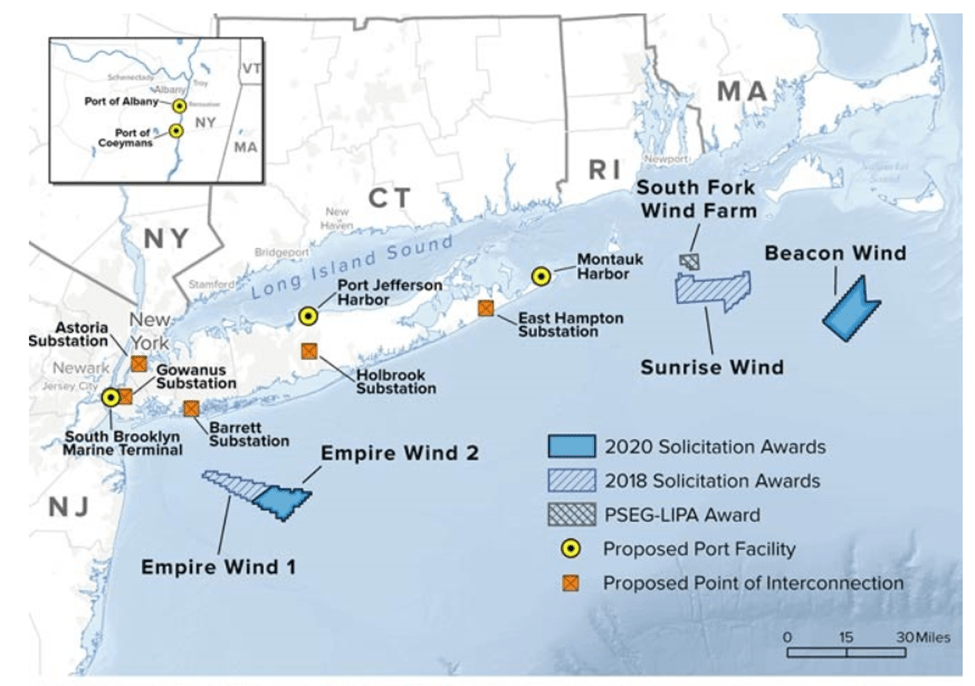
The Scoping Plan Strategic Use of Low-Carbon Fuels scenario projects that 13,096 MW of onshore wind and 13,484 MW of offshore wind will be needed for the electric system to be “zero emissions” in 2040.  If the onshore wind turbines are like the Alle-Catt 340 MW project that has 117 turbines, then each turbine will be 2.9 MW and 4,516 turbines will be needed.  If the offshore wind turbines are similar to the Empire Wind project that proposes 15 MW turbines then  899 offshore turbines will be needed.

This post describes problems with wind energy in recent articles.

Wind Curtailment

Parker Gallant keeps track of wind energy production in Ontario and the problem of what to do with excess wind energy when the production from Ontario exceeds the load.  The current strategy is to dump the excess power into Quebec, New York, and Michigan at a low price which has short-term consumer benefits to those jurisdictions.  However, Gallant has documented that through 4/20/25 dumping the excess wind and solar energy has cost Ontario taxpayers and ratepayers $64 million.  On April 21 the total bill was another $12,3 million.  On April 26, the total for the month had reached $101 million which is about $20 per Ontario household.

He explains what happened on April 21:

Even though our Peak Hour was a little bit higher reaching 16,250 MW at Hour 20 we still didn’t need what the IWT and solar were generating so IESO were selling it for deep discounts to our neighbours as the average HOEP (hourly Ontario energy price) was a piddly $17.80/MWh (1.8 cents/kwh). IESO had forecast those IWT would generate 88,811 MW (75.5% of capacity) but only accepted 81,846 MW meaning they curtailed 7,000 MW which we paid for. Solar generation was small (not much sun) and generated only 1,326 MW! IESO’s intertie data indicates they sold 89,574 MW to our neighbours which means we Ontario ratepayers and taxpayers ate $12.3 million of their respective costs along with a few dollars for the other exported power which probably was baseload nuclear and hydro!

This is another reason to pause the implementation because in 2040 when there are over 5400 wind turbines running, we will have the same problem.  I must believe that the problem will get worse for Ontario because they at least got paid something but, in the future, when our turbines are producing too much we will not be a market so they will just have to eat the curtailment costs.  When our neighbors install their turbines, then we will have to eat our costs too.  How is this supposed to work for New York ratepayers?

European Experience

Tallbloke’s Talkshop poses the renewables question whether “endless subsidies for a so-called ‘energy transition’ are affordable for those forced to cover the costs, especially when the things being subsidised are creating daily problems for electricity supply and grid stability due to the erratic nature of the technology?  He describes an article in the Europe section of an OilPrice.com opinion piece that addresses the question.

Certainly, there are plenty of industries that rely on state subsidies, but how many of these, it’s worth asking, rely on these subsidies for their very survival?

The answer is inconvenient for the transition lobby. These are the only industries that literally cannot survive without massive and consistent state financial support. And that essentially makes them unviable in a natural market environment.

For recent proof, look no further than Europe. There is no anti-transition government in Europe. There is no Trump or anything like him at the helm of any European country. And yet it was in Europe that the chief executive of Danish Ørsted insisted that the government step up their financial support for the offshore wind industry to ensure its survival.

As reported by the Financial Times, which spoke to Rasmus Erbroe, “European capitals to commit to consistent annual support for the industry in order to meet offshore wind targets and help reverse rising costs.”

“If you want to deliver on energy security, energy independence, affordability for Europe for the coming decades and meet the targets, then we need to make this change,” the executive said, quite likely believing every word that came out of his mouth was the holy truth. In fact, there is nothing affordable about an energy that cannot absorb its own costs and turn in a profit without government guarantees of that profit.

Surely the question whether wind energy can ever turn a profit without government guarantees of that profit is a valid question that needs to be addressed before New York squanders more money on this technology.

Wake Physics

I described the Scoping Plan projections for wind energy earlier in this article.  Those are underestimates because the projections for the expected annual output are too optimistic.  In other words, if reasonable estimates were used then even more wind turbines would be needed.  Pierre Gosselin describes another nuance that could affect the number of turbines needed.  Klimanachrichten explains that wakes from upwind turbines reduces the output of downwind turbines.  He notes:

The expansion of offshore wind energy in the North Sea is a central component of the European energy transition. However, two of the biggest players in the industry are now warning of negative effects: Ørsted and Equinor have jointly calculated that the planned 1.5 gigawatt wind farm ‘Outer Dowsing’ could cause significant so-called wake losses. These are yield losses that occur when the wind is weakened by upstream wind farms, causing downstream turbines to produce less electricity.

This might be included in the Scoping Plan, but the documentation is so poor that it is impossible to know.  If I had to bet then I would bet the ranch that this nuance is not included.

Ultimate Problem

Regular readers of this blog are undoubtedly tired of me constantly whining about the insurmountable challenges associated with extended periods of extended periods of light winds.  Chris Morrison describes notes that in the first quarter of 2025 “low levels of renewable generation and high demand drove gas-fired power production to its highest level since 2021”.  He continues:

But this gas rescue act came at a large cost since Britain’s increasingly unstable electricity supply, which provides some of the highest prices in the world, showed wild cost swings in windless days in January. On at least two freezing winter days, wind production was more-or-less zero. Not untypical winter weather conditions also saw the sun fail to shine for a number of consecutive days. Some periods saw the wholesale peak-time electricity price top £160 per megawatt hour ((MWh). On January 8th, when winter high pressure stopped the wind blowing across the UK, the wholesale price soared to £300 MWh, while the sophisticated clearing price needed to balance the non-storable supply with instant demand soared to £2,900 MWh.

Rafe Champion agrees with my concern.  He recently wrote:

The wind and solar system is vulnerable to wind droughts. It is not entirely fanciful to plan a book titled How Wind Droughts Almost Destroyed Civilisation based on these articles: The late discovery of wind droughts, We have to talk about wind droughts, and The “wind drought trap.”

The Scoping Plan analyses were not sophisticated enough to incorporate these costs into their projections.  So this massive problem was downplayed by the Climate Action Council.

Killing Eagles

I recently received an email about a seminar addressing bird kills associated with wind turbines.  Proponents argue that wind turbines kill only “a fraction as many as are killed by house cats, buildings, or even the fossil fuel operations that wind farms replace.”  Of course, when asked about raptor kills there is no response.  David Wojick continues his great coverage of the impacts of wind turbines on eagles with a post about eagle kill offset rules.    He explains the problem:

Every operating wind power facility has a US Fish and Wildlife Service (FWS) permit to kill eagles on an ongoing basis and many do kill eagles. Each permit depends on eagle-kill offset rules which appear to be false. If so then the killing is illegal, a violation of the Bald and Golden Eagle Protection Act.

The eagle kill offset rules are not protecting eagles.  This is another unacknowledged issue in the Scoping Plan.

Accountability for Wind Farms in France

There was an encouraging article.  A court in France took action when an eagle was killed:

The recent shutdown of the Bernagues wind farm in Hérault, France, marks a long-overdue reckoning with the lethal impacts of wind energy on wildlife—particularly raptors like the golden eagle. On April 9, 2025, a French court ordered the entire site to cease operations for one year following the confirmed death of a golden eagle, a protected species, that collided with one of the farm’s turbine blades in January 2023. The decision also slapped Energie Renouvelable du Languedoc (ERL), the farm’s operator, with a €200,000 fine, half of which was suspended, and imposed an additional €40,000 fine on the company’s director.

I don’t think that it is very likely that a New York judge would take such an action.  Nor do I expect that the Department of Environmental Conservation to step up until it has become obvious that 5,000 wind turbines could destroy the comeback of the Bald Eagle in New York State and by then it would probably be too late.

Breaking the Law in the US

Unfortunately in the United States the Federal government has been charging ahead with offshore wind development and it is not clear that they are following the law

The Save the Right Whales Coalition has joined legal challenges to the Bureau of Ocean Energy Management’s (BOEM) approval of the Vineyard Wind 1 project and ten other offshore wind facilities. In a newly filed amicus brief, SRWC argues that BOEM broke federal law by rewriting statutory language, bypassing public rulemaking, and using compensation to justify harm — all to advance offshore wind at any cost.

Despite the offshore wind advocates arguments that the massive development of offshore wind will not affect the endangered Right Whale, I believe that it will.  There are just too many potential impacts that will accumulate and overwhelm the few whales left.

Conclusion

Evidence continues to mount that issues associated with every component of the Climate Act transition plan are so great that a pause to re-assess the plan is necessary.  New York Public Service Law  § 66-p (4). “Establishment of a renewable energy program” includes safety valve conditions for affordability and reliability that are directly related to wind energy deployment.  The failure of the Hochul Administration to establish criteria for those safety vales and provide public tracking of the status must be corrected before implementation proceeds.
Offshore Wind Meets Reality

Last month I described a flurry of offshore wind related news and there have been enough stories since then for another update.  In my opinion these latest revelations suggest that a reassessment of the viability of offshore wind projects is in order.

I have followed the Climate Act since it was first proposed, submitted comments on the Climate Act implementation plan, and have written over 450 articles about New York’s net-zero transition.  The opinions expressed in this article do not reflect the position of any of my previous employers or any other organization I have been associated with, these comments are mine alone.

Overview

The Climate Act established a New York “Net Zero” target (85% reduction in GHG emissions and 15% offset of emissions) by 2050.  It includes an interim 2030 reduction target of a 40% reduction by 2030. Two targets address the electric sector: 70% of the electricity must come from renewable energy by 2030 and all electricity has to be generated be “zero-emissions” resources by 2040. The Climate Action Council (CAC) was responsible for preparing the Scoping Plan that outlined how to “achieve the State’s bold clean energy and climate agenda.” The Integration Analysis prepared by the New York State Energy Research and Development Authority (NYSERDA) and its consultants quantifies the impact of the electrification strategies.  That material was used to develop the Draft Scoping Plan outline of strategies.  After a year-long review, the Scoping Plan was finalized at the end of 2022.  Since then, the State has been trying to implement the Scoping Plan recommendations through regulations, proceedings, and legislation.

Offshore wind developments are a key Climate Act decarbonization strategy.  There is a mandated target of 9,000 MW of offshore wind by 2035.  The Integration Analysis projects that offshore wind capacity will exceed 13 GW by 2040.  However, there are overlooked risks to this strategy that are now becoming obvious.  The fact is that the huge, proposed wind turbines have not been field tested.

Turbine Blade Failures

Bud’s Offshore Energy reports that:

  • The “highly unusual and rare” talking point for turbine blade failures seems to have finally been discarded.
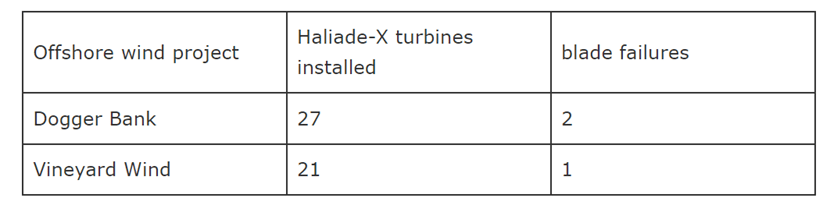
  • 3 new GE Haliade-X blades failed shortly after installation at Dogger Bank and Vineyard Wind. A total of only 48 turbines had been installed.

Bud’s Offshore Energy continues with some other thoughts:

  • The offshore safety regulator (BSEE) has a very capable technical staff and should produce an informed report on the Vineyard Wind blade failure. The concern is with the internal review process that has seriously delayed the publication of accident investigation reports and safety alerts.
  • Presumably, DNV, the Vineyard Wind CVA, will provide input into the BSEE investigation. Perhaps the effectiveness of the CVA process and quality control procedures should be separately considered.
  • Will Equinor, a major oil and gas producer, Dogger Bank partner, and offshore wind advocate, be investigating the Dogger Bank failures?
  • A comprehensive International data base on turbine incidents and performance is needed.
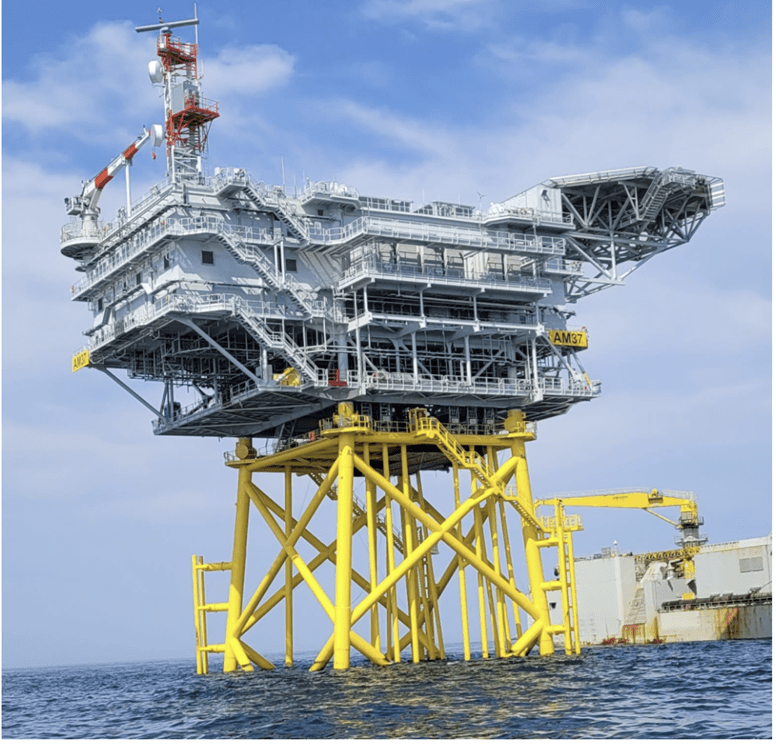
  • As previously noted, offshore substations are large structures. A closeup of the Vineyard Wind 1 substation is pasted below.

Consequences of Turbine Blade Failures

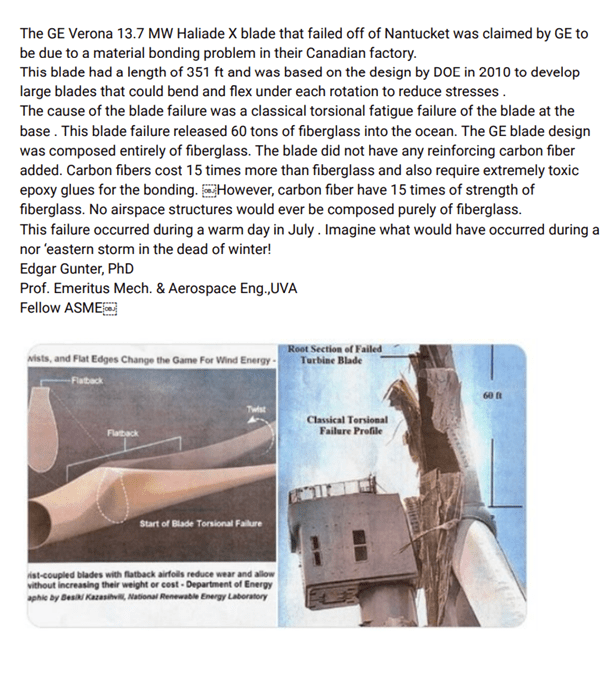
Paul Driessen points out that one broken wind turbine blade shut down Massachusetts beaches and asks what would happen if a hurricane struck.  He describes the impact of the Vineyard Wind failure:

Shards, chunks and finally the rest of a turbine blade fell into the ocean. One blade … from a 62-turbine project that’s only three-fourths completed … broken by its own weight, not by a storm.

And yet beaches had to be closed amid peak tourist season, while crews picked up pieces of fiberglass-resin-plastic-foam blades, and boats dodged big pieces floating in the water. Worse, Vineyard Wind didn’t tell Nantucket officials about the problems until two days after the blade began disintegrating.

Each blade is 350 feet long and 140,000 pounds. That’s more than a fully occupied Boeing 737 jetliner. Vineyard Wind involves 186 blades: 65,000 feet (12 miles) in total combined length, weighing in at a combined 26,000,000 pounds!

Vineyard Wind will have 62 wind turbines and a total capacity of 800 MW.  Driessen notes that:

The Biden-Harris offshore wind plan calls for 30,000 megawatts of generating capacity by 2030. That’s 2,500 gigantic 12-MW offshore turbines. That won’t even meet New York State’s current peak summer electricity needs, before all these extra demands kick in. Offshore wind’s contribution toward meeting future demands for all Atlantic Coast states could easily require 5,000 such turbines: 15,000 blades, weighing a combined 2 billion pounds and spanning a combined 5,250,000 feet (995 miles)!

Source posted by Brian J @Mainsail23

He points out the obvious problem that the planned offshore wind facilities on the East Coast can all be affected by hurricanes:

Even more disturbing, the entire Atlantic coastline is hurricane country. Every year, almost without fail. The only questions are how many hurricanes, how powerful, and where each one will hit.

NOAA records for landfalling hurricanes – those that actually hit US beaches and cities – reveal that 105 Category 1-5 hurricanes struck the Atlantic seaboard, from Florida to Maine, from 1851 through 2023. Add in those that remained at sea, where the turbines will be, and that number could double.

Of that total, 23 were Category 3-5 (111-157 or higher mph winds). Most struck Florida, Georgia and South Carolina. But 39 made landfall between North Carolina and Delaware – and 19 hit Northeastern States, including nine Category 2-3 monsters (96-129 mph winds).

Mind you – these turbines will be weakened by constant corrosive salt spray and frequently by sub-hurricane storms. When the inevitable big hurricane roars up the coast, devastation will follow.

The 1935 Labor Day Hurricane clobbered Florida with 200+ mph devastation, Georgia with Category 1 winds. The Great New England Hurricane of 1938 smashed into New York, Connecticut, Rhode Island and Massachusetts with 115-120 mph force. 1944’s Great Atlantic Hurricane – punished the coast from North Carolina to New Jersey and Massachusetts with Category 2 winds.

Edna hit the Northeast with Category 2 winds in 1954, Donna did it again in 1960, and Gloria clobbered the region with 96-115 mph blasts in 1985, even reaching New Hampshire and Maine! Isabel hit North Carolina and Virginia in 2003. The “minor” Category 1 hurricane of 2012, better known as Superstorm Sandy, was also devastating.

This summary includes just some that hit North and Mid-Atlantic States, and a few that slammed Florida, Georgia and South Carolina – all prime territory for forests of offshore turbines, fixed to the seafloor or insanely sitting atop enormous floating platforms off Maine and other states. They’d all flounder.

I have found one reference to offshore wind turbine expectations relative to hurricanes.  Our EnergyPolicy (OEP) hosted a panel discussion on New York State’s emerging offshore wind market and the policy and business challenges facing this evolving sector, in its Energy Leaders Luncheon Series December 2019 event in New York City.  The question was asked “Will wind turbines in New York be able to withstand a Category 5 storm?”

Clint Plummer who was the head of market strategies and new projects for Ørsted, the world’s largest owner, developer, and operator of offshore wind responded that “wind turbines are designed to withstand a Category 3 hurricane, and they have built into their permit applications an insurance fund that can pay for repairs in cases of catastrophic loss from a storm more severe”. He said “a Category 5 hurricane has a return period in excess of 100 years, while the design life of a wind farm is 30-35 years, so wind turbines are not designed to withstand a Category 5 storm because they are not expected to experience one”. “Anything less than that up to a certain speed is just a really good day for producing a lot of wind power,” he said

At the time of this response the offshore wind turbines proposed were smaller.  Since then, the quest for higher capacity availability has led to bigger turbines that recent events suggest may not be as robust as the smaller designs.  It is conceivable that when a hurricane with intensities like those observed inevitably reoccurs after the massive buildouts proposed are in place that many (most?) wind turbine blades will fail.  Driessen argues that it will take months or years to replace widespread broken wind turbine blades and that it may require the construction of alternative generating sources:

Hopefully, politicians and bureaucrats could expedite new gas turbine and modular nuclear power plants. That would mean only a few years of deprivation and blackouts, instead of many years, perhaps decades.

Otherwise, floating slabs of broken turbine blades would endanger boats for months or years, until they are retrieved, hauled ashore and landfilled. Cleaning up billions of sharp shards of fiberglass – each an inch to a couple feet in length, and nearly invisible – would likely take decades, during which time they would impale and imperil beach walkers, swimmers, fish, whales, dolphins and other marine life.

I’m not a microbiologist, but I’m not aware of any microbes that devour fiberglass, resin or plastic foam.

With no bonds or requirements that Big Wind cover cleanup and turbine removal costs, electricity-bereft taxpayers and ratepayers would be left holding the bag.

Before we rush any further into this “renewable energy transformation,” can we first have some realistic, commonsense analysis? Can we at least think before casting our ballots this fall?

Maine’s Floating Turbines

As if the construction of wind turbines on fixed platforms is not enough of a challenge there are proposals for floating wind turbines. Bud’s Offshore Energy noted that recent bids on lease areas were much lower than previous sales.  

David Wojick describes the curious first lease for floating offshore wind turbines in the Gulf of Maine.  The State of Maine was awarded the lease which is described as a research lease rather than a commercial development lease. 

To begin with, the lease is for a 144 MW “research array” of turbines, as it is called. Well, 144 MW is huge for research. The South Fork Wind site (fixed, not floating) that is already running is a 12-turbine, 132 MW commercial facility, so this array will be bigger than commercial.

It could cost $3 billion-plus the cost of the factory to make the dozen or so floaters. Different websites suggest different turbine sizes from 10 to 12 MW. Of course, if this is really research, they might use a variety of sizes, but the total is still huge.

Why so big is the first mystery, and the official explanations are far too vague to justify it. They mostly talk about research into things like efficiency, supply chain, and even jobs.

Wojick makes a couple of other points.  This “research” lease development is occurring at the same time there are commercial developments underway so the results will not benefit project developments.  The payment structure of this project is mirky: “if a Purchase Power Agreement (PPA) is supposed to pay for the array, plus profit, then it is very much a commercial development meanwhile research is expensive and unpredictable so how can there be an advance PPA to pay for it?”. 

He suggests that there is another possibility: “This project is not about research it is about building the floater factory and demonstrating the University of Maine technology.” 

There is a monster wild card in the floating wind game, and that is the factory. Fixed bottom wind is very simple onshore. All you need is a good dock, a big crane, and a place to sit the components until they are taken to the site and installed. There are just a few simple components — monopile, tower, turbine, and blades. It is all made elsewhere.

Floating wind is made from scratch onshore then towed as a whole to the offshore site. The Uni-patented technology uses concrete floaters which might weigh 15,000 tons or more and are complex structures. Factory construction of floaters will be a huge job.

This fact about floating wind is seldom mentioned, and when it is, the language is usually deceptive. The industry talks about “ports,” not factories, and the Maine floater factory is called a port. See my. note that the factory will be operated by Diamond.

So here is what might happen. As part of the “research” Maine builds the floater factory and enough floaters to demonstrate that the patented Uni- technology works. Developers of the 15,000 MW of commercial Gulf wind have to choose technologies for their various sites. If they choose any other technology, out of over a hundred candidates, they will have to build the factory to make it.

Once the floater factory is built then a powerful incentive to use it exists.  Given that they are talking about $100 billion in floaters the developers, the State of Maine and the University of Maine will make a huge amount of money.  Of course, the money has to come from somewhere so expect the ratepayers in Maine to be on the hook for that.  Wojick concludes:

Mind you I am not claiming this is what is going on, but it certainly makes sense out of this supposed research array. The primary obstacle is that the Uni-technology has never been built at 10-12 MW scale and it might not be feasible. Also, the factory design that I have seen does not work, but that is a separate issue.

Hot Air Renewable Notes

Beege Welborn has a nice overview article: Blade Failures Continue and Don’t Go Missing in an Offshore Wind Farm on the Hot Air website.  The article describes blade failures in Missouri, covers the problems at Vineyard Wind, notes that the plans for huge offshore wind farms require mind-boggling amounts of material, and notes that there are radar interference issues with planes and offshore wind farms.  Finally the article includes a reference to an incident where “wind industry henchmen are showing their true colors during citizen meetings”. The thug” walked up and grabbed” a bag belonging to a woman showing fiberglass shards that washed ashore from the damaged turbine while she attempted to explain her concerns about offshore wind development at a Newport, RI wind farm forum.  The guy had been featured at Senator Sheldon Whitehouse’s website until the incident.  Thankfully, the goon’s facing assault charges.

Conclusion

The Hochul Administration’s Integration Analysis projects that offshore wind capacity will exceed 13 GW by 2040.  These latest revelations suggest that a reassessment of the viability of offshore wind projects is in order. The technology has not been tested on the scale proposed and it sure appears that there are survivability issues even without storms.  What could possibly go wrong?

Floating Offshore Wind

Paul Driessen explains why “the materials, costs and survivability for wind turbines on massive floating platforms defy reality”.  I also learned more about floating turbines and wind turbines in general from the comments on this article.

I have an interest in offshore wind because the resource is a key part of New York’s Climate Leadership & Community Protection Act (Climate Act) net-zero transition plan.  I have followed the Climate Act since it was first proposed, submitted comments on the Climate Act implementation plan, and have written over 400 articles about New York’s net-zero transition. The opinions expressed in this post do not reflect the position of any of my previous employers or any other organization I have been associated with, these comments are mine alone.

Can “clean energy” schemes get any crazier?

Paul Driessen’s article notes that Federal agencies are designating area where the sea bed is so deep that a conventional offshore wind turbine won’t work.

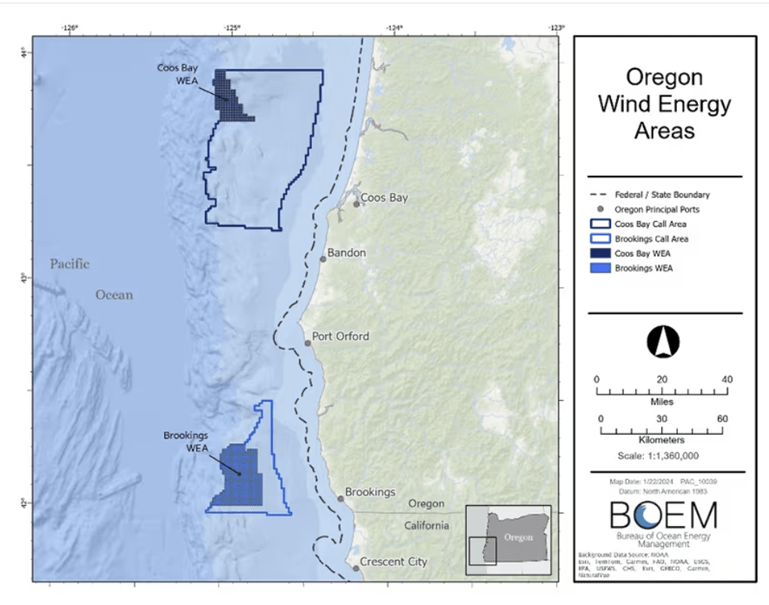
The US Interior Department’s Bureau of Ocean Energy Management recently designated two Wind Energy Areas in deepwater areas off the Oregon coast. BOEM is also reviewing offshore wind energy development options for the Gulf of Maine, Central Atlantic, Gulf of Mexico, and maybe Great Lakes.

They’re part of Team Biden’s plan to deploy 30,000 megawatts of offshore wind energy capacity by 2030 and 15,000 MW of floating offshore wind energy capacity by 2035. Capacity is what the turbines could generate, when the wind is blowing at optimal speeds, perhaps 30-40% of the year.

I was particularly attracted to his article because he used New York as an example of to put these numbers in perspective. For the record, the Climate Act mandates 9,000 MW  of offshore wind and the outline for implementing the transition in the Integration Analysis projects that the 2040 total will be 14,364 MW.  Driessen notes:

30,000 MW is what 2,500 12-MW turbines could generate. It’s enough to meet New York State’s current peak electricity needs on a hot summer day. Add the electricity required to replace gasoline cars and natural gas furnaces and stoves, meet surging AI, data center and streaming video demands, and charge grid-scale backup batteries – and New York alone would likely need 10,000 12-MW offshore turbines.

Meeting the soaring electricity needs of all US states would require hundreds of thousands more.

Not unlike New Yorks shameless promotion of clean energy solutions, Driessen comments on the information accompanying the announcement:

BOEM nevertheless insists that “Offshore wind is a once-in-a-generation opportunity to build a new clean energy industry, tackle the climate crisis, and create good-paying jobs, while ensuring economic opportunities for all communities.”

Note to be outdone in baseless puffery, the Department of Energy extols the Administration’s goal of “decarbonizing” the entire US electric grid by 2035 and says “offshore wind is especially well-suited” for generating “clean energy.” Two-thirds of all US offshore wind potential, it says, exists over ocean areas so deep that turbines must be mounted on floating platforms anchored to the seafloor by mooring lines tied to suction piles sunk into bottom sediments.

DOE even claims it will somehow reduce the cost of floating deepwater wind energy to $45 per megawatt-hour by 2035. (That’s 45¢ per kilowatt-hour, triple what most Americans now pay.) To buttress its claims, DOE presents maps, artist’s renderings and images of floating turbine arrays.

These claims exhibit the same departure from reality as New York:

It’s almost as though these government officials actually believe they can solve the alleged climate crisis by simply issuing proclamations, regulations, drawings, press releases and subsidies – and Voila!

Mines open, raw materials materialize, and millions of wind turbines, billions of solar panels, billions of vehicle and grid-scale batteries, millions of miles of transmission lines, millions of transformers and other technologies get manufactured and installed – affordably and with no fossil fuels, greenhouse gas emissions, toxic air and water pollutants, child and slave labor, or other evils (all at minimal cost), while endangered species and other environmental conflicts disappear (or are relegated to irrelevance) … and cornucopias of clean, renewable, reliable, affordable electricity are rapidly generated worldwide.

Driessen describes some other issues with floating wind turbines:

12-MW offshore turbines are 850 feet tall, carry three 350-foot-long blades, and weigh thousands of tons. To date, few have been installed anywhere, none have been subjected to major hurricanes, and none have been mounted on deepwater floating platforms. Indeed, no such platform-mounted turbines exist outside the realm of concepts and ten-foot models in wind tunnels and test tanks.

The Kincardine floating turbines in the North Sea southeast of Aberdeen, Scotland are much smaller, and the strongest wind gusts recorded there were in the 83–123 mph range. Sustained wind speeds for category 3-5 hurricanes range from 111 to 157 mph and greater. Some of the worst US landfalling hurricanes reached 126 mph (Katrina, 2003) to 167 mph (Andrew, 1997). The strongest winds ever off the Oregon coast exceeded 100 mph (1962 and 1995).

Subsurface and semisubmersible structures for the smaller 2.0–9.5-MW deepwater turbines weigh 2,000 to 8,000 tons. New semisubmersible platforms for deepwater oil production can be over 30,000 tons and cost a billion dollars or more. Yet even they are probably not large enough for the monstrous 15-MW beasts that the Biden Administration, CNN and others are extolling.

The Climate Act mandates that all conceivable associated impacts with fossil fuels are considered.  On the other hand the upstream impacts of the “zero-emissions” resources are ignored.   Driessen points out:

It’s almost impossible to conceive of the amounts of steel and other raw materials that would be needed for each of these gigantic turbines and support systems; the amounts of ore that would have to be extracted to obtain those materials; the fossil fuels required to mine and process the ores, manufacture the turbines, blades and support systems, and transport and install them; the cost to build each of them.

Based on average deposits being mined today, the 110,000 tons of copper required for 30,000 MW of offshore turbine alone would require removing some 65,000,000 tons of ore and overlying rock. That doesn’t include copper for marine cables, transmission lines, transformers and other equipment – or the other metals and minerals.

It is inconceivable that these deepwater wind turbine systems could ever recoup all the energy and costs – or offset all the greenhouse gas emissions – involved in building them, no matter how many years they generate electricity. Indeed, those years may be very short, due to violent storms and constant salt spray. 

Driessen notes that some companies are bailing out of deepwater wind projects but others are still playing the game:

That Shell Oil, among the world’s most experienced offshore oil developers, has dropped out of deepwater wind projects should say a lot about the viability of the far-fetched deepwater schemes Team Biden is promoting, to forcibly transform America’s energy and economic system.

That some companies are still in the game underscores how their risks are being forcibly subsidized and underwritten by taxpayers and consumers, who are being dragooned into these schemes by politicians and bureaucrats who likewise have no real skin in the game. Their leasing bids are plummeting, their electricity price demands soaring.

Interesting Comments

In addition to the article itself there were interesting comments at Watts Up With That.  For example, the following comments provided more background information on floating wind:

David Wojick:

Floating wind is a global craze. DOE has a (long) shot program on it.
https://www.energy.gov/eere/wind/floating-offshore-wind-shot

Here are the basics. There are no utility scale projects in operation.
https://en.m.wikipedia.org/wiki/Floating_wind_turbine#:~:text=The%20technical%20feasibility%20of%20deepwater,oil%20industries%20over%20many%20decades.

My take:
https://www.cfact.org/2023/11/09/cfact-blasts-feds-floating-wind-fantasy/

Dave Andrews:

Orsted have a quick guide to the 4 different types of floating offshore wind – Tension leg platform, Semi submersible, Barge and Spar buoy and their advantages and disadvantages.

https://orsted.com/en/what-we-do/renewable-energy-solutions/floating-offshore-wind-energy

There four interesting comments that addressed issues with these massive machines.

Denis

That salt eats the heck out of everything-a well known fixed data point for all manner of marine (meaning ocean going) structures. Maritime ships, for example, seldom operate more than 30 years because of salt except for some military ships that carry such an abundance of high cost technology that the extraordinary cost to repair salt-induced failures is (or may be) worth it. Ships plying the Great Lakes can easily exceed 50 years or sometimes much more, until their basic economic parameters are exceeded by more recent technology.

Wind turbines fixed in the ocean’s bottom are equally subject to the mayhem caused by salt air in addition to the vagaries of wind speed and direction. Currently, because of these vagaries failure of gears and bearings are the major cost centers in keeping such machines operating. Mount them on floating barges and you add increased bearing and gear loading from the pitch, roll, rise and fall of the barges. Even more maintenance will be required. Yes, maritime ships survive such motions but the bearings and gears (if any) are specifically designed to do this and are truly massive structures, far too heavy to be mounted at the top of a 400 foot tall pole. If the Biden politicians think they barge mounted turbines are a good idea, at the very least, they could build just one or two and see what happens in 10 years before building hundreds.

Their proposal to do the latter is truly truly nutty.

Dr Bob:

I am not a structural engineer, but I can just imagine the torsional loads an 850-foot-tall wind turbine puts on the tower structure and base. The mooring cables would be under tremendous stresses. This paper explores the bucking loads on towers, the most common failure of wind turbines.

Buckling Analysis for Wind Turbine Tower Design: Thrust Load versus Compression Load Based on Energy Methodby Yang Ma,Pedro Martinez-Vazquez andCharalampos Baniotopoulos *
Energies | Free Full-Text | Buckling Analysis for Wind Turbine Tower Design: Thrust Load versus Compression Load Based on Energy Method (mdpi.com)

Eng_Ian:

Torsion is twisting, you can imagine a torsion load if you picture a stuck drill bit or a drive shaft on a car. The bigger load is bending, which is the loading best imagined by the picturing the centre section of the beam in a see-saw. Bending loads try to change the shape of straight beams into bananas, etc.

Since the wind turbine nacelle is going to rotate to orient it into the wind, the torsion loads can be managed. It would be significantly worse if the nacelle was incorrectly aligned, with the blades aligned so that the rotating axis of the fan was at 90 degrees to the wind direction. This would result in large torsion loads but is still quite simple to disperse to the foundations.

The issue I see, with a three bladed fan, is that on every rotation two blades will be on one side and then as the top blade swings over, there are then two blades on the the other, etc This will set up a cyclic torsion load, an even number of blades would have eliminated this load. Strange they did this, cyclic loads lead to fatigue.

I’d be more concerned about BENDING loads, eg the ones caused by a horizontal force applied at the top of a post. These forces get larger as the length of the post increases, or as the load increases. Both obviously increasing as the demand for larger fan diameters and taller towers materialise from the dreams of the renewable fraternity.

And of course, no matter what wind speed you design for, sooner or later that speed will be exceeded, it’s just a matter of time. If we are forced to build them, then who gets to pick up the pieces. With heavy falling objects, NIMBY has real meaning, especially if you are in the drop zone.

In the following comment Rud Istvan addressed the effect of increasing wind speeds with height.  One meteorological phenomenon that I have not heard much about is a nocturnal low-level jet.  Wind speed varies with height due to surface friction.  At times nocturnal radiational cooling decouples the mixed layer from upper layers creating a layer of notably higher wind speeds above a relatively calm layer.  The description below of turbine wobble has to be exacerbated during these conditions.

Rud Istvan:

The primary failure mode of big onshore wind turbines is axial bearing failure. The problem is inherent, since wind speed is higher aloft so the bearings wobble as each of the three blades reaches peak height.

Any wave induced sway on a floating offshore turbine makes the wobble problem worse and axial bearing failure earlier and less predictable. Beefier bearings have not solved this problem onshore; they for sure wouldn’t offshore.

Not a wild guess, just very good intuition.

The final comment did not directly address floating wind but was too good to not include.  One of the hidden challenges of the net-zero transition is staffing.

Hot Scot:

The one ‘Reality’ that almost everyone misses entirely is the workforce required to achieve everything necessary to reach all this wondrous ‘decarbonisation’.

A report recently written by Michael Kelly, the inaugural Prince Philip Professor of Technology at the University of Cambridge, Fellow of the Royal Society and of the Royal Academy of Engineering exposed this a few years ago, and nothing has changed since.

In the UK, at least, we have one third of the skilled workforce to conduct all the changes required by trained engineers, builders, technicians etc. and our education and training system is not geared up to provide more, and won’t be for many years even assuming changes are made now.

A traditional solution to this would be to attract immigrant workers from the continent. The problem here though is, Europe is also short of their own labour to achieve their decarbonisation goals.

The UK’s usual fallback solution (and it’s been done many times before) is to announce to the public, with great fanfare, a job creation scheme where they will launch vocational training at local tech. colleges. Lots of votes in that particular scam.

The routine is, a whole bunch of youngsters are recruited to train up as technicians at local colleges. They recognise an opportunity so rush out and recruit a few untrained mates, start a business to do the rudimentary work like home insulation and perhaps even installing Heat Pumps.

We have seen it all before with the 1970’s double glazing scam, the 1990’s cavity wall insulation scam and the 2010’s domestic Solar Arrays (as they were grandly called) and it all ends with the same result. Thousands of householders spending lots of money to wind up with lots of problems and innumerable Cowboy business suddenly going bust because, well, that’s what Cowboy businesses do. Guarantees are worthless, even if underwritten by the government because the installation was substandard and of course, the government won’t cover that. Caveat emptor.

It takes years for this to manifest itself as an abject failure and the MSM will be recruited by the government to tidy up the loose ends with recognition of the phenomenon, a few cases won in court, and then nothing. It’s all forgotten about.

We already have a shortage of STEM qualified individuals who will be required to deal with the enormous demands of the commercial wind and solar industry. Of course, universities will suddenly take a great deal of interest in STEM subjects instead of Phd’s in Macramé or flower arranging.

Evidence of all this?

My middle aged son landed a job to monitor small scale wind turbines remotely from home. A laptop in his living room. He was a failed musician, dropped out of his college course as an electrician, but excelled as a short order cook in a sandwich bar. He now believes he knows everything there is to know about wind turbines and is, naturally, an passionate advocate for the cause of climate change.

I hasten to add I had no influence on his formative years whatsoever.

These are the rocks the climate scam will perish on, not the theory or counter theory of whether or not CO2 causes warming, it will be the practicalities of implementing the solutions to it.

Conclusion

I published this article because it provides great background information on floating offshore wind turbines.  Fortunately, no one has proposed any for New York yet but there probably is some location serving New York where someone will claim this technology is needed.

I concur with Driessen’s conclusion: “It’s time to say, “Enough! We’re going to keep our nuclear and fossil fuel energy, until you prove beyond a reasonable doubt that your alternatives provide equally abundant, reliable, affordable energy.”

NY Offshore Wind Perspectives February 2024

Offshore wind (OSW) is a key component of the Climate Leadership & Community Protection Act (Climate Act).  This article highlights material on costs and the leasing process that suggests it is not going to end well.  Affordability is a major concern of mine and the costs for offshore wind are extraordinarily high.  David Stevenson prepared a summary of costs that deserves wider distribution.  Bud’s Offshore Energy blog  argued that unrealistic power generation deadlines should not be the focus of the Bureau of Ocean Energy Management (BOEM) leasing policy.

I have followed the Climate Act since it was first proposed, submitted comments on the Climate Act implementation plan, and have written over 400 articles about New York’s net-zero transition. The opinions expressed in this post do not reflect the position of any of my previous employers or any other organization I have been associated with, these comments are mine alone.

Overview

The Climate Act established a New York “Net Zero” target (85% reduction in GHG emissions and 15% offset of emissions) by 2050.  It includes an interim 2030 reduction target of a 40% reduction by 2030 and a requirement that all electricity generated be “zero-emissions” by 2040. Because nothing says sound energy policy like one designed politicians, the Climate Act also includes a requirement for 9 GW of offshore wind by 2035.  The Climate Action Council (CAC) is responsible for preparing the Scoping Plan that outlines how to “achieve the State’s bold clean energy and climate agenda.”  In brief, that plan is to electrify everything possible using zero-emissions electricity. The Integration Analysis prepared by the New York State Energy Research and Development Authority (NYSERDA) and its consultants quantifies the impact of the electrification strategies.  That material was used to develop the Draft Scoping Plan outline of strategies.  After a year-long review, the Scoping Plan was finalized at the end of 2022.  In 2023 the Scoping Plan recommendations were supposed to be implemented through regulation, PSC orders, and legislation.  Not surprisingly, the aspirational schedule of the Climate Act has proven to be more difficult to implement than planned and many aspects of the transition are falling behind. 

Offshore Wind Costs

Richard Ellenbogen recently submitted comments that compared nuclear costs to other proposed dispatchable emissions-free resources which I cover in another post.  His analysis included an assessment of OSW, but he was unable to come up with good cost numbers.  David Stevenson has some numbers available which are shown below.  David has spent the last twelve years as the Director of the Center for Energy & Environment for the Caesar Rodney Institute, a bipartisan free market think tank. He has published over 150 analytic studies including major studies on the Regional Greenhouse Gas Initiative, the EPA Clean Power Plan, electric grid reliability, the public policy drivers of energy cost, offshore wind, electric vehicles, carbon capture, nuclear energy, and climate change. 

Some background on New York’s OSW plans.  The New York State Energy Research & Development Authority (NYSERDA) issues competitive solicitations for offshore wind energy and contracts with offshore wind developers to purchase offshore renewable energy certificates.  Early last summer four previously approved New York OSW projects requested higher price guarantees as shown in the following table.  James Hanley wrote an article The Rising Cost of Offshore Wind that describes two issues affecting all OSW projects across the world that accounts for some of the cost increases requested:

But this recent growth in the offshore wind industry does not necessarily reflect its long-term health. Two substantial headwinds threaten to make projects uneconomical. One is the recent high inflation, which raised the costs of materials and labor across all industries, and the other is bottlenecked supply chains that are causing a bidding-up of the prices of materials and components needed for building wind turbines.

 Hanley explained the ramifications to the OSW projects in New York and linked to the request for increases:

Stevenson produced this summary of the costs associated with these requests for more money.

Requested increased price guarantees in New York

On October 12, 2023 the Public Service Commission turned down this request to raise the prices.  Times Union writer Rick Karlin summarizes:

At issue was a request in June by ACE NY, as well as Empire Offshore Wind LLC, Beacon Wind LLC, and Sunrise Wind LLC, which are putting up the offshore wind tower farms.

All told, the request, which was in the form of a filing before the PSC, represented four offshore wind projects totaling 4.2 gigawatts of power, five land-based wind farms worth 7.5 gigawatts and 81 large solar arrays.

All of these projects are underway but not completed. They have already been selected and are under contract with the New York State Energy Research and Development Authority, or NYSERDA, to help New York transition to a clean power grid, as called for in the Climate Leadership and Community Protection Act, approved by the state Legislature and signed into law in 2019.

Developer response suggests that “a number of planned projects will now be canceled, and their developers will try to rebid for a higher price at a later date — which will lead to delays in ushering in an era of green energy in New York”. Karlin also quotes Fred Zalcman, director of the New York Offshore Wind Alliance: “Today’s PSC decision denying relief to the portfolio of contracted offshore wind projects puts these projects in serious jeopardy,”

Later in October new projects were approved by NYSERDA with an average nominal cost/ MWh of $145.07 which compares to $167.07 in the table above.  Stevenson explains that the table prices were requested in December 2023 while the new projects bids were probably made in early 2023 and may not reflect the true cost needed to obtain financing today.  The original four projects cancelled most likely would have started construction in 2025 while the new projects are slated to start in 2030. 

Here is what NYSERDA reported about the recent projects that include Attentive Energy One at 1,404 MW, Community Offshore Wind at 1,314 MW, and Excelsior Wind at 1,314 MW:

“The weighted average strike price of the awarded offshore wind projects over the (25 year) life of the contracts is $96.72 per megawatt hour in 2023 (real) dollars, which equates to a nominal weighted average strike price of $145.07 per megawatt hour. The strike prices comprising the weighted average cited above are subject to certain adjustments in accordance with the terms of the awarded contracts, including, in some cases, adjustments based on certain price indices, interconnection costs and/or receipt of qualifying federal support.”

Stevenson said “it looks to me that the award allows prices to increase 3% a year”.  The strike price is the guaranteed price.  The premium payment to the wind developer will be reduced by any revenue they receive from selling the wholesale power and any capacity value which might total about $60/MWh over the life of the projects so the net premium price might be about $85/MWh.  In addition, there may be other inflation adders based on NYSERDA’s wording.

Soon after the Public Service Commission refused to approve the higher costs for four contracts last October, the Hochul Administration announced that expedited offshore wind solicitations for the state will be held early in 2024.

Projects that previously petitioned the New York State Public Service Commission for financial relief can choose to participate, though the solicitation will also emphasize competition between these and other projects, ensuring the integrity of the process and best value for New York electricity consumers, according to the press release.

The solicitations were announced in January and the deadline for submittals recently passed.  The results will be announced soon.

Stevenson also provided cost estimated for two new projects have been approved in New Jersey that he expects will be similar to the expedited New York solicitations.  The 2,400 MW Invenergy project will average $152.91/MWh, and the 1,342 MW Attentive One will average $187.83 over their twenty-year life considering their 2.5% and 3% per year allowed price increases.  In addition, each of the 2032 startups expect 30% federal Investment Tax Credits, and New Jersey is allowing up to 15% additional inflation adjusters that could bring average costs to $175.84 and $216.01/MWh.  The New York projects may have a similar inflator. 

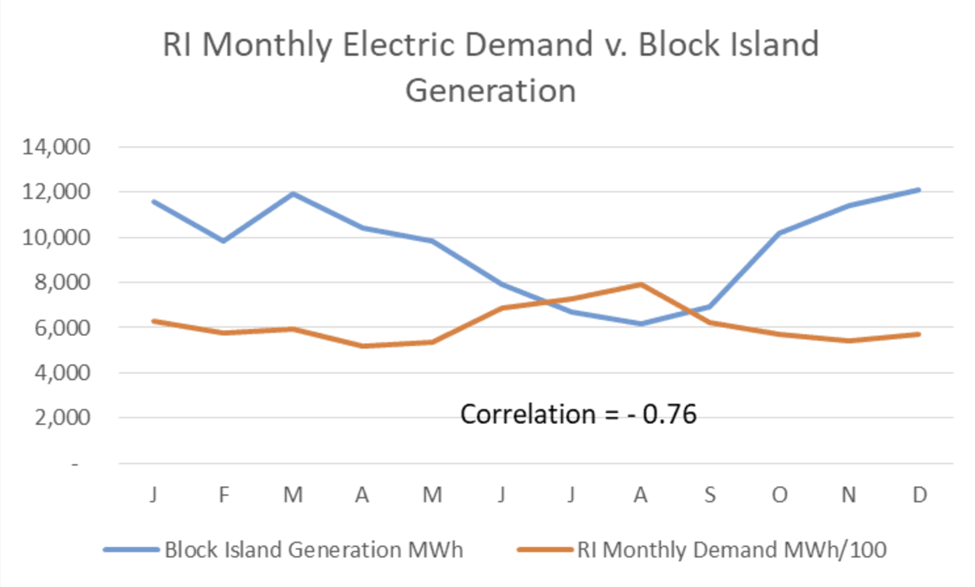
He notes that Attentive Wind One is projecting a ridiculously high 56% capacity factor.  Most projects estimate capacity factors of 42% to 44%, like actual results from the five turbine Block Island and two turbine Coastal Virginia projects.  Two factors suggest much lower capacity factors for larger projects.  Below is the annual production curve for six years at Block Island.  Notice the highest generation occurs in the spring and fall when electric demand is lowest.  The Virginia turbines show a similar pattern.  With many large projects all doing the same the regional grids will not be able to take all the power produced so turbines will have to be shut down, or curtailed.  PJM expects average capacity factors will be 37% because of this curtailment.

European studies of offshore wind show a second impact known as the “Wake Effect”.  The first row of turbines absorb wing power leaving succeeding rows with less wind energy.  The impact could be to drop electric generation another 5% to 10%.  Lower generation means higher guaranteed prices will be needed.  We will most likely see future nominal strike prices routinely above $200/MWh.

Deadlines and Wind Deployment

Bud’s Offshore Energy blog  points out that unrealistic power generation deadlines should not be the focus of the Bureau of Ocean Energy Management (BOEM) leasing policy.  This argument also applies to the Climate Act’s arbitrary offshore wind deployment requirements.  In reference to wind leasing issues in Oregon he explained:

As concerns about wind leasing mount, it is becoming increasingly apparent that the rush to hold auctions may not be in the best long-term interest of the wind program. The primary objective should be cost-effective and responsible development, not gigawatt deadlines. The administration’s vision for wind energy capacity, particularly the 15 GW goal for floating turbines by 2035, is unlikely to be achieved and rushing the process is not helpful.

The current wind program is reminiscent of James Watt’s ill-fated approach to oil and gas leasing. Watt’s “lease-everything now” agenda had the opposite effect of that which was intended, the result being that 96.3% of our offshore land is now off-limits to oil and gas leasing.

Affected parties in Oregon have not held back in voicing their displeasure with BOEM’s wind energy announcement.

“BOEM wants offshore wind come hell or high water and they don’t care who they harm to get it.

Heather Mann, executive director of Midwater Trawlers Cooperative

The Confederated Tribes of Coos, Lower Umpqua and Siuslaw tribal council unanimously passed a resolution opposing offshore wind energy development off the Oregon coast.

“The federal government states that it has ‘engaged’ with the Tribe, but that engagement has amounted to listening to the Tribe’s concerns and ignoring them and providing promises that they may be dealt with at some later stage of the process. The Tribe will not stand by while a project is developed that causes it more harm than good – this is simply green colonialism.”

Coos, Lower Umpqua and Siuslaw tribal council Chair Brad Kneaper

Discussion

These two perspectives address my concerns about affordability and reliability.  The Climate Action Council got bogged down in its Scoping Plan review with ideological discussions.  For example, an inordinate amount of time was spent arguing whether natural gas should instead be called fossil gas in the Scoping Plan..  As a result, the Council never established criteria for affordability and reliability presuming that because the Integration Analysis projections supported their narrative that those issues would not arise. 

I believe that the issues are rapidly approaching the fan of reality and they will hit soon.  Soon the reality that the aspirational schedule is untenable, the costs are higher than admitted, and there are ramifications to reliability because no new fossil power are being built to replace the irreplaceable aging fossil plants before the magical resources are developed.  There is a safety valve that can be used by the Public Service Commission that gives me hope that this mess can be averted.   New York Public Service Law  § 66-p (4). “Establishment of a renewable energy program” includes safety valve conditions for affordability and reliability.   § 66-p (4) states: “The commission may temporarily suspend or modify the obligations under such program provided that the commission, after conducting a hearing as provided in section twenty of this chapter, makes a finding that the program impedes the provision of safe and adequate electric service; the program is likely to impair existing obligations and agreements; and/or that there is a significant increase in arrears or service disconnections that the commission determines is related to the program”.  The political ramifications of employing this would be enormous but the impacts of the failure to pause this absurd energy plan would be much worse.  I believe that the Public Service Commission should assure that New Yorkers can continue to have access to reliable and affordable electricity by defining standards for those affordability and reliability criteria.

Conclusion

I cannot over-emphasize how much I agree that the primary objective of offshore wind development “should be cost-effective and responsible development, not gigawatt deadlines”.  With the addition of evolving development costs as supply chain and infrastructure support requirements become clear, it is not in the interests of New York to continue the mad rush to try to meet arbitrary gigawatt deadlines.  This also applies to the development of ll solar and wind.   Legitimate affordability, reliability, and environmental concerns are being ignored in the rush to build as much as possible as soon as possible. 

Climate Act Offshore Wind Costs

Update (9/17/23): I corrected an error in this post.  Dr. Jonathan Lesser pointed out that I need to adjust the offshore wind costs described here to account for a 30-year accrual. 

One of the important renewable energy components of the net-zero transition in New York’s Climate Leadership & Community Protection Act (Climate Act) is offshore wind. I recently did an update on several offshore wind issues that included a description of an offshore wind cost analysis.  This is a follow up to that discussion with an emphasis on New York offshore wind costs.  The Hochul Administration is doing everything possible to hide the costs of the Climate Act but the immense costs of offshore wind are getting too large to hide.

I have been following the Climate Act since it was first proposed, submitted comments on the Climate Act implementation plan, and have written over 350 articles about New York’s net-zero transition.  I have devoted a lot of time to the Climate Act because I believe the ambitions for a zero-emissions economy embodied in the Climate Act outstrip available renewable technology such that the net-zero transition will do more harm than good.  The opinions expressed in this post do not reflect the position of any of my previous employers or any other company I have been associated with, these comments are mine alone.

Climate Act Background

The Climate Act established a New York “Net Zero” target (85% reduction and 15% offset of emissions) by 2050.  It includes an interim 2030 reduction target of a 40% reduction by 2030 and a requirement that all electricity generated be “zero-emissions” by 2040. The Climate Action Council is responsible for preparing the Scoping Plan that outlines how to “achieve the State’s bold clean energy and climate agenda.”  In brief, that plan is to electrify everything possible using zero-emissions electricity. The Integration Analysis prepared by the New York State Energy Research and Development Authority (NYSERDA) and its consultants quantifies the impact of the electrification strategies.  That material was used to develop the Draft Scoping Plan.  After a year-long review, the Scoping Plan recommendations were finalized at the end of 2022.  In 2023 the Scoping Plan recommendations are supposed to be implemented through regulation and legislation. 

Off Shore Wind (OSW) is supposed to be a major renewable resource in the net-zero electric energy system.  The Climate Act mandates 9,000 MW of Off Shore Wind (OSW) generating capacity by 2035.  The Integration Analysis modeling used to develop the Scoping Plan projects OSW capacity at 6,200 MW by 2030, 9,096 MW by 2035 and reaches 14,364 MW in 2040.  On the other hand, the New York Independent System Operator 2021-2040 System & Resource Outlook expects 5,036 MW in 2030 and 9,000 MW in 2035 with no additional development after that.  By 2030 the Integration Analysis predicts that 14% of the electric energy (GWh) produced will come from OSW and the Resource Outlook predicts nearly as much (12%).  This is an extraordinary build-out for a resource that is currently non-existent.  There are significant differences in the buildout projections that deserve to be reconciled.

OSW Transmission Support

In order to determine the total cost to New Yorkers for OSW it is necessary to consider the transmission upgrade costs.  I posted an article about this component of the OSW implementation requirements earlier this year.  The Department of Public Service has an Order for Public Policy Transmission Need (PPTN) (Case 20-E-0497) regarding Climate Act requirements related to offshore wind that drive the need to expand the number of transmission facilities between Long Island and the rest of the State.  These transmission system upgrades are needed to get the generated offshore wind from where it comes on shore to where it is needed in the state.

The draft NYISO Long Island Public Policy Transmission Need (PPTN) report predicts that the transmission upgrades will provide savings to the system:

The Long Island PPTN project simulations all show improvements in the export capability of Long Island by adding tie lines between Long Island and the lower Hudson Valley. This added transfer capacity and upgrades to the internal Long Island system reduce the amount of curtailment from offshore wind resources. The energy produced through reduced curtailment of offshore wind resources can then be used to offset more expensive generation to meet New York’s energy demand and, therefore, produce a production cost savings. Production cost savings are also created by offsetting high-cost energy imports from neighboring regions with lower cost New York-based generation that was previously inaccessible due to transmission congestion.

In general, all of the proposed projects produce savings by unbottling offshore wind resources in Long Island and reducing the amount of imports from neighboring regions. The figure below shows the estimated production cost savings for each project over a 20-year period in 2022 real million dollars.

The New York Independent System Operator (NYISO) Electric System Planning Working Group  (March 24, 2023 and April 3, 2023) evaluated independent cost estimates developed by NYISO’s consultant for proposed projects to address this issue.  In response to the NYISO’s request for proposals for the PPTN 17 bids were received.   The average total cost estimate was $7.1 billion, the maximum was $16.9 billion and the minimum was $2.1 billion.  In June 2023, NYISO chose the Propel NY transmission project totaling $3.28 billion.

The transmission upgrades are one of the hidden costs of OSW.  Without this connection upgrade as much as 92% of 3000 MW of off-shore wind which costs $15 billion would not be deliverable.  However, it comes at an annual average subsidy of $339 million.  Unfortunately, the indirect subsidy costs described are not the only costs.  These costs are only for the new transmission and do not include additional costs associated with the impacts on the existing transmission and distribution systems on Long Island.  In addition, this is the cost associated with 3,000 MW of offshore wind.  The Climate Act goal is for 9,000 MW and the Scoping Plan Integration Analysis projects that 12,675 MW of offshore wind will be needed by 2040 in the Strategic Use of Low-Carbon Fuels mitigation scenario.  If the transmission costs are proportional that would mean that this indirect subsidy alone would be at least $1,356 million a year for the Integration Analysis.

Offshore Wind Cost Renegotiation

The primary reason for this post is that inflation and supply chain issues have led developers to ask that the contracts be renegotiated.  James Hanley writes:

Multiple offshore wind projects that are not even built yet have asked the state’s Public Service Commission (PSC) to renegotiate their strike prices—the amount they will be paid per megawatt hour (MWh) of electricity produced. (A megawatt hour is roughly enough electricity to power 750 homes for one hour.) 

One of the glaring deficiencies of the Hochul Administration’s Climate Act implementation is the lack of information about ratepayer impacts.  The Informational Report was the first report that provided any estimates of ratepayer impacts and that was a Climate Act mandate.  The report provides as little information as possible.  In order to get a feel for the ratepayer impacts of the contract renegotiations it is up to outside parties to provide estimates.  Multiple Intervenors and the Municipal Electric Utilities Association of New York State2 (“Customer Advocates”) recently submitted Supplemental Comments to the New York State Public Service Commission that includes estimates of the incremental costs to customers for these renegotiated contracts.

The Consumer Advocates comments addressed the NYSERDA submitted comments that estimated the change in contract strike prices that would result from contract modifications requested by offshore wind developers.  NYSERDA did not provide any estimate of the effect on consumer costs so Consumer Advocates made their own.  Their analysis found that the proposed changes could impose on customers incremental costs of at least $20.8 billion, and as much as $37.6 billion.

Discussion

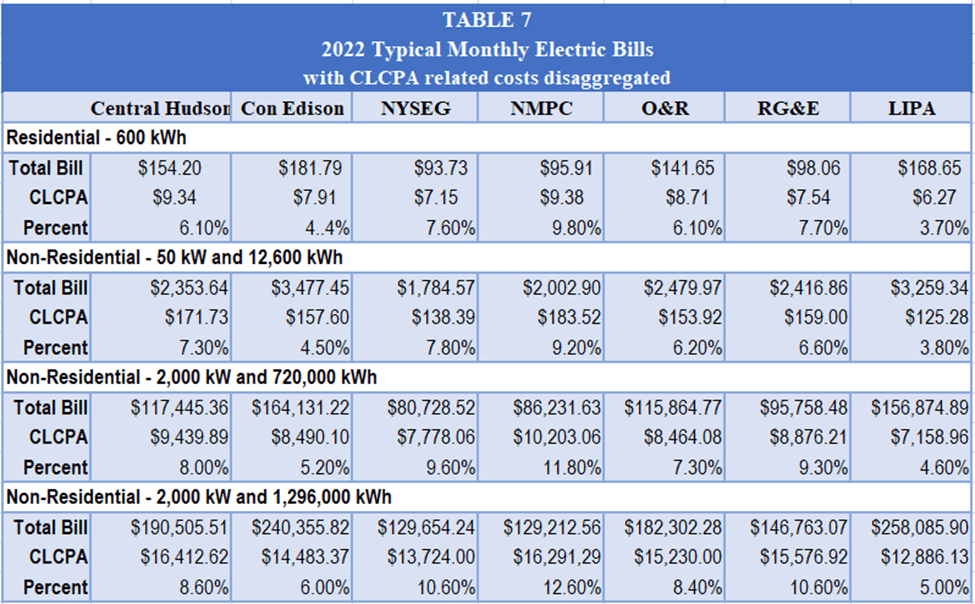
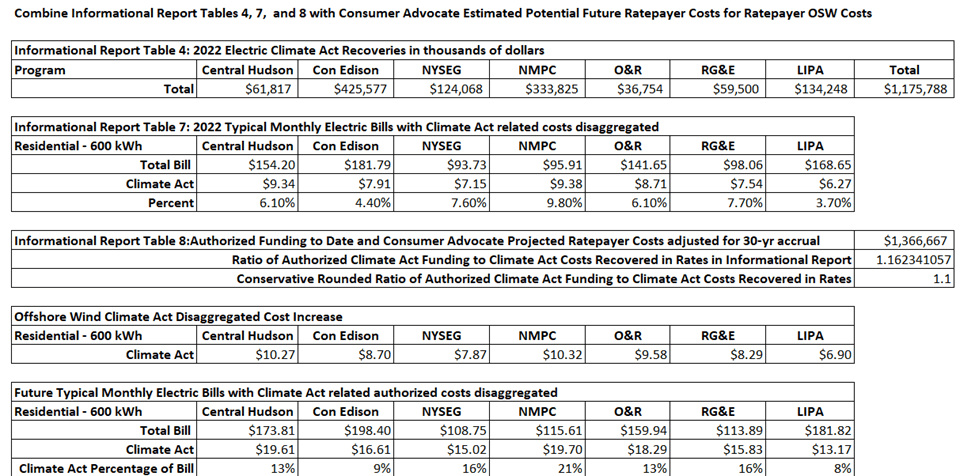
In an earlier post I described the  first annual informational report (“Informational Report”) on the implementation of the Climate Act. It summarizes costs recovered in 2022 by utilities for electric programs and estimates that $1,175,788,000 in Climate Act costs were recovered in 2022 and it shows the amount these costs affected utility bills for seven utilities.  Table 7: “2022 Typical Monthly Electric Bills with Climate Act related costs” from that report shows that residential ratepayer utility bills already are higher by between 9.8% and 3.7% for the 2022 recovered costs.

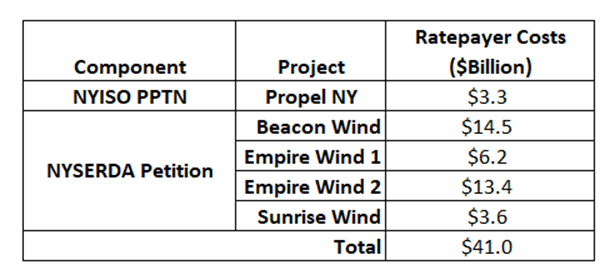
 The following table lists the additional offshore wind authorized and incremental relief ratepayer costs that could be on the backs of New York ratepayers.  The Informational Report did not include the $3.3 billion Propel NY transmission project needed for offshore wind.  The Consumer Advocate petition estimated ratepayer costs for the NYSERDA petitions totaling $37.7 billion.  When all these costs are totaled ratepayers could be on the hook for an additional $41.0 billion for offshore wind.

In a previous post I extrapolated the Informational Report ratepayer Climate Act cost recoveries for $43.8 billion in costs for contracts that have been awarded but not yet authorized for cost recovery.  I simply calculated the ratio of the authorized Climate Act funding to date ($43.8 billion) to the Climate Act costs that have been authorized and were in the 2022 residential bills ($1.2 billion).   I did not account the fact that those costs are not applied to consumer bills in one year but in this analysis, I have assumed a 30-year accrual.  For a rough approximation of impacts by utility I simply multiplied the ratio by each of the monthly Climate Act disaggregated cost components reported by the utilities to determine CLCPA future related impacts on customers. This will not give an exact utility-specific estimate because the money authorizations per utility for 2022 and the future will not necessarily be the same.  The following table uses the same methodology for all the expected ratepayer costs due to these offshore wind projects.  I expect that the supply portion of every electric utility bill will more than double.

In response to similar extraordinary costs the British Government the recent Contracts for Difference (CfD) auction subsidies for renewable electricity generation were specified. Paul Homewood writes:

Participants in the auction bid for guaranteed prices, below a cap set by ministers in advance of the auction. The cap for offshore wind was set at £44/MWh (in 2012 prices, equivalent to around £70/MWh today). This is higher than successful bids in the past, yet no wind farm developers felt able to bid at this price. Wind industry claims that this is due to rising prices are implausible – CfD contracts are index-linked.


While offshore wind’s failure to bid may be surprising to some, perhaps even to the Government, it will come as no shock to those familiar with the long-term capital and operating cost trends for wind power, as revealed in audited financial statements. Costs have not been falling dramatically as the industry claimed. All around the world the wind industry is in trouble for the same reasons; costs remain high, and high levels of subsidy are needed to reward investors.

If New York were to revise its contracts to hold down costs I expect that the results would be the same.  That is to say, no one would bid because the industry is in deep financial trouble.

Conclusion

In conclusion it is important to note that all the ratepayer costs that are described in this post are only for the supply portion of utility bills.  The Hochul Administration is implementing a Cap-and-Invest program that will increase the costs of delivery.  There has been absolutely no hint of the expected costs for this program but it will certainly cause an increase.  Furthermore, this is just for the costs of the electricity.  The plan is to convert homes and transportation too.

Offshore wind is a key part of the planned Climate Act net-zero transition.  The New York Post notes that “In a fresh sign that New York’s state climate agenda is pure fantasy, contractors key to making good on a major piece of the so-called plan just filed to charge 54% more to build their offshore wind farms. “  This post estimates that these costs combined with all the other authorized but as yet unaccounted for ratepayer costs will be extraordinarily high.

The percentage of residential electric bill costs to meet the Climate Act mandates will increase such that between 8% and 21% of bills cover offshore wind costs and other mandates. The only reason that the public is not grabbing pitchforks and torches to march on Albany in protest of these regressive cost increases is that the public is unaware of what is coming. I am extremely disappointed that politicians and the media have not stepped up and demanded transparent accounting of expected Climate Act costs.

Climate Act Offshore Wind Update

One of the important renewable energy components of the net-zero transition in New York’s Climate Leadership & Community Protection Act (Climate Act) is offshore wind. A couple of months ago I wrote an article that described some offshore wind issues.  Since then, other issues have come up that I think deserve to be highlighted.

I have been following the Climate Act since it was first proposed, submitted comments on the Climate Act implementation plan, and have written over 350 articles about New York’s net-zero transition.  I have devoted a lot of time to the Climate Act because I believe the ambitions for a zero-emissions economy embodied in the Climate Act outstrip available renewable technology such that the net-zero transition will do more harm than good.  The opinions expressed in this post do not reflect the position of any of my previous employers or any other company I have been associated with, these comments are mine alone.

Climate Act Background

The Climate Act established a New York “Net Zero” target (85% reduction and 15% offset of emissions) by 2050.  It includes an interim 2030 reduction target of a 40% reduction by 2030 and a requirement that all electricity generated be “zero-emissions” by 2040. The Climate Action Council is responsible for preparing the Scoping Plan that outlines how to “achieve the State’s bold clean energy and climate agenda.”  In brief, that plan is to electrify everything possible using zero-emissions electricity. The Integration Analysis prepared by the New York State Energy Research and Development Authority (NYSERDA) and its consultants quantifies the impact of the electrification strategies.  That material was used to develop the Draft Scoping Plan.  After a year-long review, the Scoping Plan recommendations were finalized at the end of 2022.  In 2023 the Scoping Plan recommendations are supposed to be implemented through regulation and legislation. 

Off Shore Wind (OSW) will be a major renewable resource in the net-zero electric energy system.  The Climate Act mandates 9,000 MW of Off Shore Wind (OSW) generating capacity by 2035.  The Integration Analysis modeling used to develop the Scoping Plan projects OSW capacity at 6,200 MW by 2030, 9,096 MW by 2035 and reaches 14,364 MW in 2040.  On the other hand, the New York Independent System Operator 2021-2040 System & Resource Outlook expects 5,036 MW in 2030 and 9,000 MW in 2035 with no additional development after that.  By 2030 the Integration Analysis predicts that 14% of the electric energy (GWh) produced will come from OSW and the Resource Outlook predicts nearly as much (12%).  This is an extraordinary build-out for a resource that is currently non-existent and there are significant differences in the buildout projections that deserve to be reconciled.

Offshore Wind Environmental Impacts

One of the topics in my last article addressed environmental impacts.   I described Jim Lovgren’s article at FisheryNation.com that covered OSW environmental issues: Offshore Wind Electrical Substations; The Secret, Silent Killers.  One of the key issues is ocean noise from sonar surveys and driving ocean pile foundations.  Kevin Kilty provided some follow up information that I have been meaning to publish since then. 

In his first email Kevin expressed concern with some of the statements in the Fishery Nation piece:

I did find some puzzling statements from your links to FisheryNation.com. First there is the quoted sound level of 260dB. There is no mention of this being sound pressure level or sound intensity, but 260dB is far beyond any noise source that I am familiar with and is not even reasonable. As the 0dB sound intensity level is a power density level of 1.0 picowatt per square meter, 260dB sound intensity would be 26 powers of ten greater which would be 100 billion watts per square meter. No material could transmit such a power level, and no energy source could produce such. Even the Saturn V lift vehicle was estimated as 200 dB on the pad, but this is only a modeled estimate and could not be measured. I have no idea how people arrived at 260dB nor what bit of data they may have mangled or what they were thinking — it’s just not a credible statement as it stands.

Now, this is not to say that pile driving is not a problem. I think it is and particularly so for ocean mammals. Ocean mammals have some air filled cavities, and the acoustic interface between a low density and low speed of sound gas against a high density high speed of sound liquid takes place in living tissue. I think there is potential for trouble, but as yet I have done no literature research to inform me. We’ll see. My experience is with ultrasonic cleaners punching holes in semiconductor materials  when set at too high a power level.

Then there is the issue of AC/DC conversion equipment using a once through cooling scheme. Once through cooling was a problem that old (pre-1960s) power plants presented because of the rise in temperature of discharged water and the amount of water used, especially from rivers. This led to the development of evaporative cooling and the hyperbolic profile cooling towers so visible at thermal plants. A further development along these lines would be fin-fan cooling of thermal power plants but I know of no thermal plants using fin-fans as yet — at least no utility scale plants. AC/DC conversion is an order of magnitude smaller problem than open cycle cooling of turbine discharge in a thermal plant.  It is easier to handle. Take a 1,000MWe nuclear plant as an example. It operates at around 35% efficiency which is to say that 65% of the thermal energy has to be removed from the cycle by the cooling system. As 1000MWe at 35% efficiency is 2,860MWt, the 65% dissipated energy is then 1,860MW heat energy. Now take a power AC/DC converter handling 1,000MWe. Its over 90% efficient (maybe 92%), but let’s just use 90% as an illustration. 10% of the electrical energy is converted to heat and dissipated. Thus, around 100MW. So, you can see it is a much smaller problem that would be more localized. I’m not in favor of a once-through cycle cooling system, but comparing it to the issue that a thermal plant would raise once again leads to statements that aren’t credible.

Subsequently he followed up with another email that provided more detail and three reference papers: (here, here, and here).  Kevin wrote:

I like to think I know quite a lot about acoustics but what I know is acoustics in air. I learned something I didn’t know before, which is that underwater sound pressure levels (SPL) use a different point of reference (0dB) than do SPL values in air. In water the reference is 1 micro-Pascal of pressure and in air the reference is 20 micro-Pascal. This, as one reference points out, has led to confusion upon occasion. Also, in air we use a reference for intensity measurements (0dB) of one picowatt per meter squared. There appears to be no reference for the intensity for underwater sound. In other words, when speaking of dB level underwater we are always speaking of pressure levels.

Pile driving will produce SPL of 200+ dB, but the measurements pertain to a point very close to the pile itself. Moreover, the actual measurements of SPL pertain to the installation of much smaller turbines than what we are now speaking of with the East coast installations. The SPL levels will undoubtedly rise and the radius at which a given level is attained will be larger too.

Both these factors will increase the distance at which sea mammals can hear the sounds and at which these sounds will impact their behavior. Even if construction companies implement the sorts of strategies that the one paper outlines to reduce the possibility of injury to hearing, you and I probably think the changes in behavior are every bit as worrisome. In my case I worry about behavioral changes among mule deer, pronghorn and wapiti leading to reduced range and carrying capacity; in the case of ocean mammals, it is is fear and panic etc., leading to stranding and collisions with ships. 

What I see is that some of the issues raised by Fisherynation.com are due to misunderstanding of acoustics, as I suspected, but I was a bit ignorant about the difference in reference levels between air and water (such is technology). I doubt the level of 260dB is realistic as it appears to be an extrapolation to near zero radius of the sound sources which really have a typical dimension of a meter at least.

Nonetheless, there is real reason to worry about sound sources that don’t drop into background noise level for distances beyond 40km in the ocean, and whose actual values place to place are very difficult to estimate because of the complexities of propagation in shallow water. It is similar to the issues I have with using ISO9613-2 as a “standard” to estimate sound nuisance for wind turbines above the complex terrain of the mountainous West.  You know, I suppose, that ocean mammals are the descendants of land ungulates like the big game in the West?

One of the takeaway messages from my post describing the  Citizens Campaign for the Environment virtual forum entitled Whale Tales and Whale Facts was that ongoing monitoring programs are not being funded adequately.  Meghan Rickard, Marine Zoologist, NYS Department of Environmental Conservation described the baseline monitoring program that the New York State did (video at 11:55 of the recording).  She said there is no long-term data but whale deaths seem to be increasing especially in the New York Bight.  The emphasis of the New York Department of Environmental Conservation has been on baseline monitoring but they are planning to continue to monitor.  Unfortunately, she noted that the funding available is half of what was available for the baseline.  In my opinion, given that there is substantial evidence that offshore wind development could adversely impact whales the failure to adequately monitor this problem is a criminal dereliction of duty by New York State.  The onus is on the State to prove that there is not a problem.  Waiting to see if that is reality may have irreversible consequences.         

Offshore Wind Radar Interference

At a recent meeting a question was raised about offshore wind turbines and radar interference.  Greg Lampman who heads up the New York State Energy Research & Development Authority (NYSERDA) offshore wind program said something along the lines of “it’s a problem for land-based turbines but not for off-shore turbines”.  I followed up asking some questions and include this summary of what I found in my update.

I contacted Greg to see if he had any references.  He didn’t but Liz Hanna at NYSERDA responded  with a couple:

I located this USDOE study completed in 2013:  Assessment of Offshore Wind Farm Effects on Sea Surface, Subsurface, and Airborne Electronic Systems.  It does look like the authors were fairly confident in being able to mitigate any offshore wind project impacts on land-based radar systems in weather, air traffic control, and long-range surveillance.  The study did find some potential impacts on electromagnetic systems (see executive summary).

There was also a Aviation and Radar Assets Study conducted as part of the NYS offshore wind master plan in 2017.

I contacted another source who does radar work for a defense contractor.  He explained:

The big issue with this stuff is that the turbines are moving fast enough to give a radar return with a Doppler response of something much faster than anything that would be considered ground clutter.   His experience is that it is possible to mitigate most of the effects of a nearby wind farm through some signal processing techniques (probably like the “software” changes mentioned in one of the earlier emails here) but it could never completely get rid of the entire issue.  

With respect to modern military radar though they have advanced capabilities, any of which will have the ability to create multiple beams adapted to the environment to help with dealing with this sort of thing.  Their main concern is intentional jamming so dealing with wind turbine clutter is much less of a problem.

He did say that he did not understand the comment that over water is easier than over land.  Off-shore turbines are bigger and moving faster on the ends so should have more of an impact.  Maybe coastal radar looking overwater uses different waveforms that are more susceptible?  I wouldn’t be surprised if it’s really just the end result of no-one bothering with overland stuff.  There’s likely redundant coverage and a lot of overland systems are not looking at the horizon at long ranges the way coastal radars do.

One final note.  He thought that DOD would need to give a final ok on anything if there are military radars nearby.  Commercial radar could overcome any problems with extra radars to provide coverage behind the clutter from one site.

In my opinion, this probably is not that much of an issue.

Offshore Wind Power Isn’t “Clean and Green”

Craig Rucker summarized OSW problems in Offshore Wind Power Isn’t ‘Clean and Green,’ and It Doesn’t Cut CO2 Emissions.  He explains:

A single 12 MW (megawatts) offshore wind turbine is taller than the Washington Monument, weighs around 4,000 tons, and requires mining and processing millions of tons of iron, copper, aluminum, rare earths and other ores, with much of the work done in Africa and China using fossil fuels and near slave labor.

Relying on wind just to provide electricity to power New York state on a hot summer day would require 30,000 megawatts. That means 2,500 Haliade-X 12 MW offshore turbines and all the materials that go into them. Powering the entire U.S. would require a 100 times more than that. 

These numbers are huge, but the situation is actually much worse.

This is because offshore turbines generate less than 40% of their “rated capacity.” Why? Because often there’s no wind at all for hours or days at a time. This requires a lot of extra capacity, which means a lot more windmills will have to be erected to charge millions of huge batteries, to ensure stable, reliable electricity supplies.

Once constructed, those turbines would hardly be earth or human friendly, either. They would severely impact aviation, shipping, fishing, submarines, and whales. They are hardly benign power sources.

He quotes an analysis by David Wojick that when life cycle emissions are considered, OSW “will likely increase global CO2 emissions.”  The first issue is that until magical dispatchable and emissions free resources can backup the intermittent offshore wind, fossil-fired backup plants will have to operate inefficiently with higher CO2 emissions. Rucker explains that Wojick argues:

Second, building huge offshore wind facilities requires mining, processing, smelting, fabrication, installation, repair, replacement, decommissioning, landfilling – and transportation every step of the way. Almost everything up to installation is increasingly done overseas, nearly 100% with fossil fuels and few emission controls.

Wojick calculates that every OSW turbine installation will 14,000 tons of CO2 “just for the steel and concrete – not including the other wind turbine and electricity transmission components”.  Once the development CO2 emissions for energy storage and ancillary services are included the emissions will be even higher.  Rucker concludes: “Dr. Wojick’s study exposes the frightening fact that an honest, complete analysis of offshore wind costs and benefits, including purported atmospheric CO2 reductions, has never even been attempted.”

I want to make one other point.  The Climate Act mandates that all GHG emission sources incorporate life-cycle analyses into the energy planning process.  There is not similar requirement for wind, solar and energy storage technology so any comparisons in the Scoping Plan are biased.

OSW Costs

There have been many recent reports about OSW costs over the summer.  David Wojick describes the OSW cost crisis:

The horrific term “cost crisis” is not from me. It comes down from on high, in this case the mega-conference: US Offshore Wind 2023. Specifically the “DEVELOPER LEADERS KEYNOTE PANEL” which features this chilling title: “Tackling The Cost Crisis Through Assessing Investment Risks”. See https://events.reutersevents.com/renewable-energy/offshore-wind-usa/agenda

So there are three converging factors. Higher material and equipment costs, higher interest rates and political resistance. For example it has not gone unnoticed that the House Republicans are trying to roll back the lush subsidies granted under the amusingly named Inflation Reduction Act.

Local resistance is growing as well. The biggest developer offshore America is Ørsted and they are now suing New Jersey’s Cape May County and Atlantic City for withholding local permits needed to bring a big project’s power ashore. Anti-offshore wind demonstrations are becoming a common occurrence in coastal towns.

Of particular interest is the Dominion Energy project off Virginia. This is a huge 5,200 MW, 300 square mile, proposal just 15 miles off the world’s biggest naval base at Norfolk. Unlike the other projects this one is being built by the regulated utility itself, so there is no PPA. Instead the books are open to a degree. This includes some required cost estimates.

Dominion’s pre-crisis cost estimates for the first 2,600 MW were about $10 billion for construction and a bit over $20 billion including financing. The latter is called the “revenue requirement” which means this is the bill their customers will have to pay.

Presumably Dominion will now be required to do new, crisis-laden estimates. If these come in at, say, $14 billion and $28 billion the political reaction could be quite strong. And this assumes things will get no worse, which they easily could. We await with great interest.

There are similar issues in New York.  I have been accumulating information on New York OSW costs that deserves its own post.  Stay tuned.

Conclusion

Off shore wind development is a key component of the Climate Act net-zero transition.  This post raises points that encapsulate my problems with the whole transition.  There have been inadequate analyses for the environmental impacts.  The costs appear to be out of control.  I did not include a reliability description associated with OSW but consider this.  What happens if we build 14,364 MW of OSW capacity by 2040 and a hurricane comes along the next year and wipes a large portion of it out of service? 

Considering these challenges and risks against the background that New York’s contribution to global GHG emissions is less than the annual rate of increase in global emissions, my frustration is unbounded.  Is it too much to ask Albany politicians and Climate Act proponents to document the the environmental tradeoffs, expected costs, and the potential risks to reliable energy of the net zero transition called for in the Climate Act? 

Offshore Wind Contradictory Views

A few articles and notices about Off Shore Wind (OSW) came to my attention this week.  The contradictions in the viewpoints were so different that I thought a post was appropriate.

I have been following the Climate Act since it was first proposed. I submitted comments on the Climate Act implementation plan and have written over 300 articles about New York’s net-zero transition.  I have devoted a lot of time to the Climate Act because I believe the ambitions for a zero-emissions economy embodied in the Climate Act outstrip available renewable technology such that the net-zero transition will do more harm than good.  The opinions expressed in this post do not reflect the position of any of my previous employers or any other company I have been associated with, these comments are mine alone.

Climate Act Background

The Climate Act established a New York “Net Zero” target (85% reduction and 15% offset of emissions) by 2050 and an interim 2030 target of a 40% reduction by 2030. The Climate Action Council is responsible for preparing the Scoping Plan that outlines how to “achieve the State’s bold clean energy and climate agenda.”  In brief, that plan is to electrify everything possible and power the electric grid with zero-emissions generating resources by 2040.  The Integration Analysis prepared by the New York State Energy Research and Development Authority (NYSERDA) and its consultants quantifies the impact of the electrification strategies.  That material was used to write a Draft Scoping Plan.  After a year-long review the Scoping Plan recommendations were finalized at the end of 2022.  In 2023 the Scoping Plan recommendations are supposed to be implemented through regulation and legislation. 

Off Shore Wind (OSW) will be a major renewable resource in the net-zero electric energy system.  The Climate Act mandates 9,000 MW of Off Shore Wind (OSW) generating capacity by 2035.  The Integration Analysis modeling used to develop the Scoping Plan projects OSW capacity at 6,200 MW by 2030, 9,096 MW by 2035 and reaches 14,364 MW in 2040.  On the other hand, the New York Independent System Operator 2021-2040 System & Resource Outlook expects 5,036 MW in 2030 and 9,000 MW in 2035 with no additional development after that.  By 2030 the Integration Analysis predicts that 14% of the electric energy (GWh) produced will come from OSW and the Resource Outlook predicts nearly as much (12%).  This is an extraordinary build-out for a resource that is currently non-existent and there are significant differences in the buildout projections that deserve to be reconciled.

New Yorkers for Clean Power

I subscribe to a New Yorkers for Clean Power mailing list.  Under the heading “ICYMI: Major Milestone Reached for State’s First Offshore Wind Project!” a recent mailing included this summary describing Governor Hochul announcement on June 22 that “South Fork Wind, New York’s first offshore wind farm, has achieved its “steel in the water” milestone with the installation of the project’s first monopile foundation.”

Boskalis Bokalift 2 wind turbine installation vessel. Photo: Boskalis/South Fork Wind

Late last month, Governor Hochul announced that the South Fork Wind project, New York’s first offshore wind farm, has achieved its “steel in the water” milestone with the installation of the project’s first monopile foundation. 

This is the first of many major milestones for New York’s first offshore wind project and South Fork is on track to become the United States’ first completed utility-scale offshore wind project in federal waters.

Once completed, the wind farm will generate enough renewable energy to power roughly 70,000 homes helping New York meet its ambitious Climate Act goals, while eliminating up to six million tons of carbon emissions, or the equivalent of taking 60,000 cars off the road annually over a 25-year period. Hundreds of U.S. workers and three Northeast ports will support South Fork Wind’s construction through late fall helping to stand up a new domestic supply chain that’s creating hundreds of local union jobs across the Northeast.

Learn more about this exciting development! 

The description did not add anything beyond what was contained in the press release.  The website for the project notes:

What is it?

New York’s first offshore wind farm — with 12 turbines and a state-of-the-art transmission system that will generate enough clean energy to power 70,000 average homes and offset tons of emissions each year

Who’s behind it?
50/50 partnership between Ørsted and Eversource

When is it happening?
Expected to be operational by the end of 2023

Where is it?
35 miles east of Montauk Point; the underground transmission line will deliver power to the local grid in the Town of East Hampton, NY

Despite the accolades there are issues associated with OSW as noted in the following.

Offshore Wind Costs

James Hanley wrote an article The Rising Cost of Offshore Wind that describes two issues affecting all OSW projects across the world:

But this recent growth in the offshore wind industry does not necessarily reflect its long-term health. Two substantial headwinds threaten to make projects uneconomical. One is the recent high inflation, which raised the costs of materials and labor across all industries, and the other is bottlenecked supply chains that are causing a bidding-up of the prices of materials and components needed for building wind turbines.

 Hanley explains the ramifications to the OSW projects in New York:

The price of offshore wind is about to go up, and electricity users across the Empire State will be on the hook for it. Two firms developing offshore wind projects — Sunrise Wind and Equinor-bp — have gone to the state Public Service Commission asking for an increase in the price they’ll receive per megawatt-hour of electricity produced.

It is not just Hanley that is raising this issue.  Sheri Hickok, Chief Executive for onshore wind, GE Renewable Energy Wind farm costs are not falling:

The state of the supply chain is ultimately unhealthy right now. It is unhealthy because we have an inflationary market that is beyond what anybody anticipated even last year. Steel is going up three times…It is really ridiculous to think how we can sustain a supply chain in a growing industry with these kind of pressures…Right now, different suppliers within the industry are reducing their footprint, they are reducing jobs in Europe. If the government thinks that on a dime, this supply chain is going to be able to turn around and meet two to three times the demand, it is not reasonable.

The Climate Act includes language that requires the agencies consider the experiences of other jurisdictions.  This mandate is selectively used to justify the preconceived strategies in the Scoping Plan but never to consider the potential for warning signs.  As if the request for adjustments to the contracts described by Hanley is not enough, a similar situation is playing out in Great Britain.  Net Zero Watch reports that:

In a move that gives the lie to years of propaganda claiming falling costs, the wind industry’s leading lobbyists have written to the Government, threatening to abandon the UK unless there are hugely increased subsidies for their companies (see RenewableUK press release).
 
The industry is claiming that unforeseen rising costs now necessitate and justify three actions:
 
1) A vast increase in the budget for the fifth auction (AR5) of Contracts for Difference subsidies, with an increase of two and half times the current levels for non-floating offshore wind alone;
 
2) Special new targets and thus market shares for floating offshore wind, one of the most expensive of all forms of generation, and, most importantly of all,
 
3) a revision to the auction rules so that the winners are not determined by lowest bids but by an administrative decision that weights bids according to their “value” in contributing towards the Net Zero targets.
 
This would in effect not only increase total subsidy to an industry that was until recently claiming to be so cheap that it no longer needed public support, but also provide it with protected market shares, all but entirely de-risking investors at the expense of consumers.

It would also be an open invitation to graft and corruption.

This blackmail was predicted by Net Zero Watch.  Clearly the same playbook will be used by OSW developers here.  Hanley explains:

Given the fiscal realities of the situation, PSC’s only two options are to grant the request or delay the development of wind energy while the state seeks new offshore wind construction bids. Either way, costs will rise.

OSW Environmental Impacts

Earlier this year I described the Citizens Campaign for the Environment virtual forum entitled Whale Tales and Whale Facts.  The sponsors wanted the public to hear the story that there was no evidence that site survey work was the cause of recent whale deaths.  I concluded that the ultimate problem with the forum was that they ignored the fact that construction noises will be substantially different than the ongoing site surveys and will probably be much more extensive when the massive planned construction starts. Jim Lovgren writing at FisheryNation.com describes OSW environmental issues: Offshore Wind Electrical Substations; The Secret, Silent Killers that substantiate my concern:

Despite government and wind supporters denying any proof that could link the unseen before amount of strandings to the coincidental use of geological sonar and seismic research, [usually only of a type performed by oil companies] in the near vicinity of the strandings, the evidence mounts. This week, two Humpback Whales washed ashore in Martha’s Vineyard, coincidentally only a few days after Piledriving started at a nearby wind site. Piledriving of the turbine stanchions creates a 260 DBs level sound, that no amount of “Bubble Curtains” can contain. It is deadly. A few weeks before that beaches on the south shore of Nantucket had a carpet of dead crabs, clams, and other benthic organisms that are susceptible to seismic testing, which coincidentally was taking place nearby, [“sparkers” and sub- bottom profilers are seismic equipment]. The relationship of marine animal deaths while unsafe level industrial noises are being produced in the same vicinity are too numerous to ignore, worldwide. So, stop denying them.

Lovgren argues that there is another environmental impact that should be considered.  The industrial OSW developments require electrical substations.  He explains:

In an official BOEM document written by Pamela Middleton and Bethany Barnhart called, “Supporting National Environmental Policy Act Documentation for Offshore Wind Energy Development related to High Voltage Direct Current Cooling Systems” the authors contend that the only feasible cooling system for a HVDC Substation is a once through, or open system. The kind that is not allowed for new power plant construction, because of its devastating effects on aquatic life. This embarrassing Official BOEM  document concerning the effects of offshore wind substations admits it knows nothing about how many substations are planned, how big, and where they will be. NEPA concerns such as environmental and economic costs to other industries are totally ignored within the enormous expanse of information contained within the 4 ½ pages of actual text. Up until the Green new deal a NEPA supporting document would be hundreds, and even thousands of pages long, detailing all aspects of a proposed project.

This is another example of an issue that was the focus of an intense and emotional lobbying effort when it was related to electric power plants using once-through cooling but now this is not an issue by the environmental organizations who demanded the prohibition for new power plants.

Summary of All OSW Issues

Mark Sertoff, a science/technology educator, published an article at Natural Gas Now that argued that the “stampede to build offshore wind turbines to replace fossil fuel generation is loaded with concerns that have not been thought through or been resolved.”  I recommend reading the whole article.  He made the general points that all this is unnecessary.  There is no climate crisis and all the hysterical claims supporting that narrative evaporate upon close examination.  He also pointed out that replacing the existing electrical system will lead to higher costs.

The article then documents specific OSW concerns.  He lists the many direct environmental impacts, the seabed use requirements, and the disposal problem.  Then he addresses the experiences in other countries and notes all the problems that should be a wakeup call for New York. Finally, he offers an alternative approach that will reduce emissions and costs.

Conclusion

The contrast between the positions of New Yorkers for Clean Power and the authors of the articles described here is stark.  Most disappointing to me is that the climate activists ignore many issues that caused previous angst.  If it was so important in the past, why is it not an issue now?  If they don’t demand that all construction work cease when the critically endangered North Atlantic Right Whales migrate through the OSW facilities then they will be exposed as hypocrites.  The gulf between a model projection of future weather and its impacts on whales and the imminent and potentially fatal consequences of OSW development on whales is so clear how can the activists claim to be for a sustainable future unless they step up?

I cannot improve on Sertoff’s conclusion:

Entities profiting by promoting renewables are happy to pave the road to hell. Superior solutions exist backed by solid facts.  We ignore them at our peril.

Guest Post: South Shore Long Island Whale Die Off

This is a guest post by Mark Stevens, a regular reader at this blog.  Mark is a retired science and technology teacher from Long Island.  I have been meaning to do a post on whales and the offshore wind industry so this was timely.

What’s Going On

The NY Post reported a 7th dead whale washed up on the Jersey shore. A humpback washed up on the Amagansett shore in December. Eight dead whales in two months?  Moreover, David Wojick recently reported that on January 18, 2023 there was a NOAA fisheries media teleconference that noted:

Since January 2016, NOAA Fisheries has been monitoring an Unusual Mortality Event for humpback whales with elevated strandings along the entire East Coast. There are currently 178 humpback whales included in the unusual mortality event.  Partial or full necropsy examinations were conducted on approximately half of the whales. Of the whales examined, about 40% had evidence of human interaction, either ship strike or entanglement. And to date, no whale mortality has been attributed to offshore wind activities.

The transcript makes for fascinating reading.  The Fisheries spokespersons went to great lengths to make the point that no whale mortalities have been directly linked to offshore wind development.  But there were notable conditions in those statements: “We do not have evidence that would support the connection between the survey work and these recent stranding events or any stranding events in the last several years.”  The other key condition is that the offshore wind development is doing survey work now and not construction.  The open question is whether or not offshore wind development could kill whales.

Bloomberg reports that planned wind projects off the New England coast threaten to harm the region’s dwindling population of endangered right whales, according to a US government marine scientist.  The warning from a top National Oceanic and Atmospheric Administration official, obtained by Bloomberg under a Freedom of Information Act request, underscores the potential legal and environmental perils of offshore wind development along the coast.  Both initial construction of wind projects and decades of expected operation threaten to imperil right whales in southern New England waters, Sean Hayes, chief of the protected species branch at NOAA’s National Northeast Fisheries Science Center, said in a May 13 letter to Interior Department officials.  The department is weighing at least 10 proposals to install wind turbines in shallow Atlantic waters — projects key to fulfilling Biden’s 2030 goal.

The NOAA fisheries media teleconference claimed that survey work had not been linked to  whale strandings.  Surveys entail prolonged use of “machine gun sonar” emits an incredibly loud noise several times a second, often for hours at a time, as the ship slowly maps the sea floor.Mapping often takes many days to complete. A blaster can log hundreds of miles surveying a 10-by-10 mile site.

There are lots of ways this sonar blasting might cause whales to die. Simply fleeing the incredible noise could cause ship strikes or fish gear entanglements, the two leading causes of whale deaths. Or the whales could be deafened, increasing their chances of being struck by a ship later on. Direct bleeding injury, like getting their ears damaged, is another known risk, possibly leading to death from infection. So there can be a big time difference between blasting and death.  Sonar blasting in one place could easily lead to multiple whale deaths hundreds of miles away. If one of these blasters suddenly goes off near a group of whales they might go off in different directions, then slowly die.  It is not guaranteed that the dead whales will wash up on shore.

The NOAA fisheries media teleconference did not address construction impacts.  Sound travels 5 times faster in water and humpback whale sounds can travel thousands of miles according to Scientific American.  Pile driving the hundreds of enormous monopiles that hold up the turbine towers and blades will be far louder than the sonic blasters, especially with eight sites going at once. These construction sites range from Virginia to Massachusetts, with a concentration off New Jersey and Long Island.  This is shown to cause whale mortality.

The impetus for the The NOAA fisheries media teleconference was related to humpback whales strandings. However, some of the dead whales off New Jersey are endangered sperm whales. And there are the severely endangered North Atlantic Right Whales throughout the area where offshore wind developments are planned.

Offshore Wind and the Climate Act

New York’s Climate Leadership and Community Protection Act (Climate Act) established a “Net Zero” target (85% reduction and 15% offset of emissions) by 2050. The Climate Act requires that by 2030, 70% of electricity will be generated from renewable energy sources such as solar and wind and calls for the development of 9,000 megawatts of offshore wind energy by 2035.

According to the New York State Offshore Wind Overview five projects have been procured: South Fork (132 MW), Empire Wind  1&2 (816 MW and 1,260 MW), Sunrise Wind (924 MW), and Beacon Wind https://www.beaconwind.com/about/(1,230 MW).  Unfortunately, the websites do not provide consistent information but the best guess number of turbines is 316 for a total of 4,362 MW.  At that rate, the 9,000 MW target will require 652 turbines with capacities between 11 and 15 MW.  On January 26, 2023 bids were due for another round of Climate Act offshore wind development.

Is it time to re-think offshore wind?

In order to do the offshore wind development site surveys an incidental harassment authorization is required.  The first  fact is that the huge 2016 jump in annual humpback mortality coincides with the huge jump in NOAA Incidental Harassment Authorizations.  The second fact is that this is just the start of whale harassment when hundreds of enormous monopiles are driven into the seabed for the massive deployment of offshore wind.  When construction gets into full swing there will be multiple pile drivers hammering away which can only result in impacts beyond incidental harassment.

In addition to the hundreds of bird strikes including bald eagles and others, wind turbines are massive killing machines here and around the world.  And the fact that they produce energy about ¼ of their nameplate capacity, cost hundreds of billions of dollars with huge taxpayer subsidies, are intermittent and still need fossil generation backup when the wind stops, require 10s of thousands of acres, have shortened life in the harsh marine environment; require more steel, concrete, copper, and materials than conventional generation of the same output; have monstrous fiberglass blades which are not recyclable, why are we blindly building them?  In addition, most wind projects are built by foreign companies. Do we want billions of ratepayer dollars and taxpayer subsidies going overseas?

According to a study by the Center For Management Analysis of CW Post/LIU, Dr. Matt Cordero determined repowering the Northport Power Station alone with state-of-the-art technology will produce 3500+ MW (more than Empire Wind), cut emissions over 90%, cost less than Empire, use fewer materials, use a fraction of the area that ALREADY EXISTS with a power station and in-place infrastructure, will have zero bird strikes and whale deaths, provide tax benefits for the community, will last decades longer and is on call 24/7 vs. intermittent (20% of the time) wind. 

Furthermore, intermittent wind and solar need massive battery backup and storage with huge costs, land requirements, massive pollution and greenhouse gas emissions for ore extraction and fabrication, and pose a deadly hazard to the region if it catches on an unextinguishable fire that emits deadly gasses.

Emission reduction by NYS will have an undetectable effect on global emissions, especially with China, Russia, India and others building dozens of coal power plants.  They will have reliable, life-saving, cost-effective electricity generation.  States with a large portion of renewables like California, Texas, North Carolina have high rates, power failures, rolling blackouts and a restricted weather operating range, and they IMPORT reliable power from other states, thus relocating emissions to surrounding states. Tesla and others left California for those reasons.  Are they really cutting emissions?

Finally,   the European Union, especially Germany and the UK have shuttered nuclear and fossil generation, relying on unreliable wind and solar sources.  Costs are so high, people must decide whether to buy electric heat or food, and  industries are leaving for other countries with cheaper and more reliable electricity, resulting in unemployment, poverty and economic collapse.

We currently have a reliable, cost-effective generation mix of fossil, wind, solar, hydro and nuclear.  New York State must seriously rethink replacing that generation with intermittent wind and solar.  Our survival and economy depend on it.