Climate Leadership & Community Protection Act Scoping Plan Net Direct Cost Estimates

The Climate Leadership and Community Protection Act (Climate Act) establishes a “Net Zero” target by 2050 whereby greenhouse gas emissions in New York will be reduced as much as possible and any remaining emissions offset by sequestering carbon.   The underlying premise of the Climate Act was that transitioning the New York energy system to Net-Zero by 2050 was only a matter of political will.  As a result, the greenhouse gas emissions targets were chosen without doing a detailed engineering analysis to determine how it might work, whether the technology is available for it to work, and how much it could cost.  This post discusses the State’s first description of cost.

I have written extensively on implementation of the Climate Act because I believe the ambitions for a zero-emissions economy outstrip available technology such that it will adversely affect reliability and affordability, risk safety, affect lifestyles, will have worse impacts on the environment than the purported effects of climate change in New York, and cannot measurably affect global warming when implemented.   The opinions expressed in this post do not reflect the position of any of my previous employers or any other company I have been associated with, these comments are mine alone.

Background

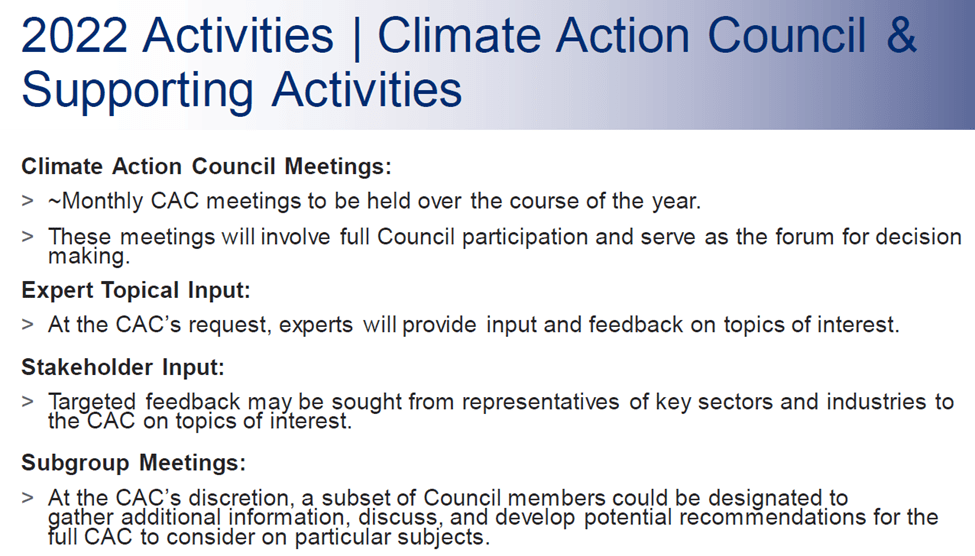
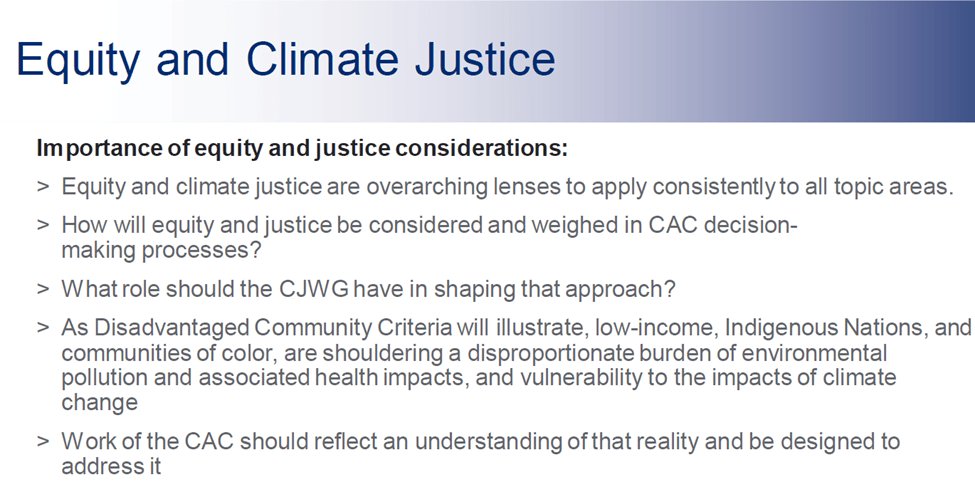
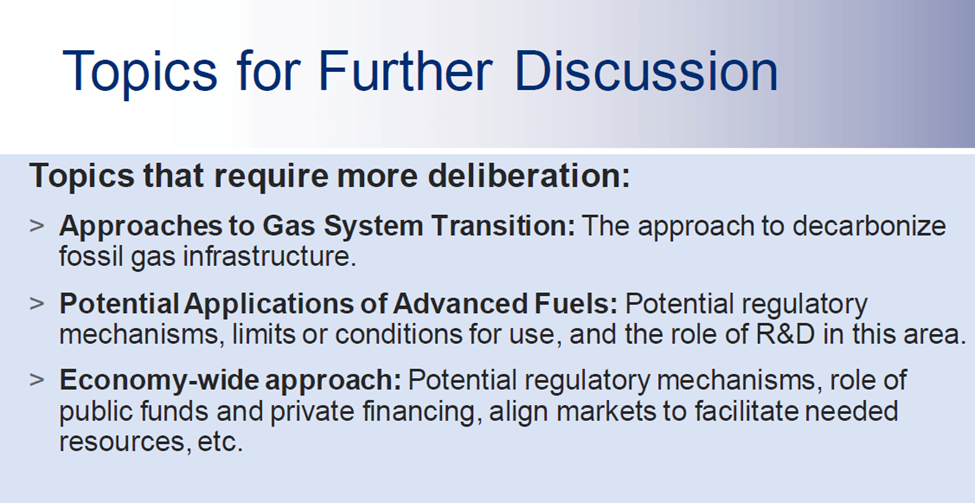
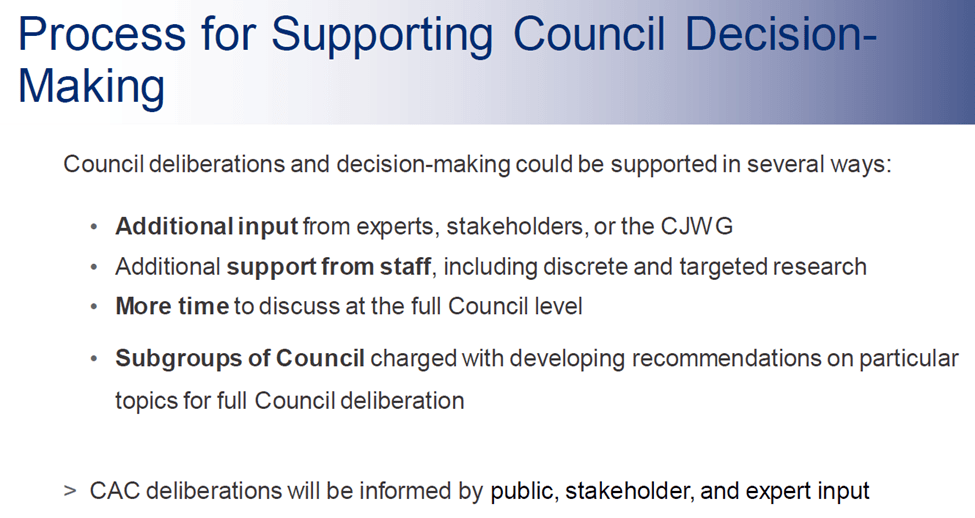
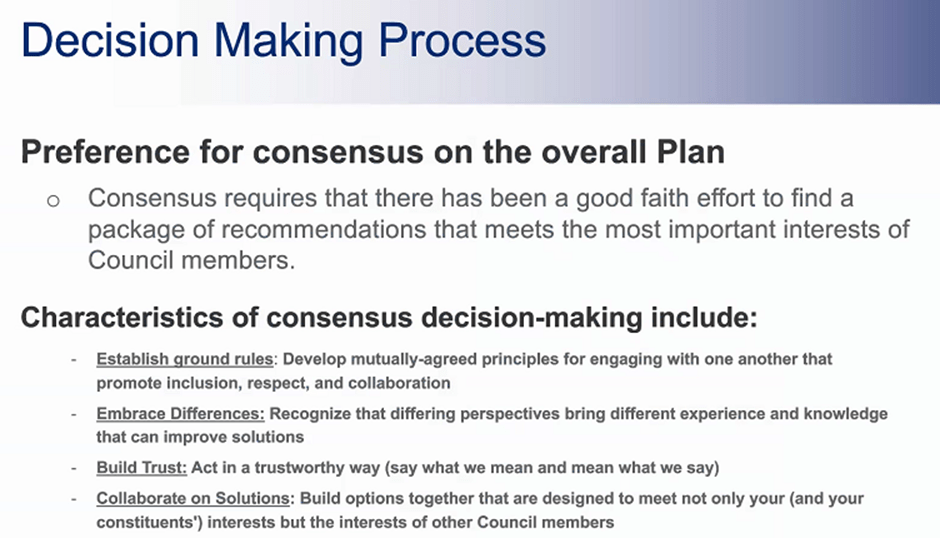
The Climate Action Council is responsible for preparing the Scoping Plan that will “achieve the State’s bold clean energy and climate agenda”.  Starting in the fall of 2020 seven advisory panels developed recommended strategies to meet the targets that were presented to the Climate Action Council in the spring of 2021.  Those recommendations were translated into specific policy options in an integration analysis by the New York State Energy Research and Development Authority (NYSERDA) and its consultants.  An overview of the results of this integration analysis were presented to the Climate Action Council at two October meetings and has since been updated.  This analysis forms the basis of the draft Scoping Plan that is supposed to be released to the public at the end of the year.

The integration analysis models the complete New York energy sector.  The modeling includes a reference case that projects how the economy and energy sector will evolve out to 2050 in the absence of any Climate Act policies or mandates.  The following slide lists the four mitigation scenarios that were developed to compare with the reference case.  Societal costs are available in Integration Analysis – Benefits and Costs Presentation on the resources section of the Climate Act webpage for scenarios 2 and 3.

Previously I wrote about my first impression of the costs and benefits presented, followed up with documentation of the proposed costs, and, more recently, I described how Climate Act cost to consumers has become a topic of discussion for the Climate Action Council.  The authors of the Scoping Plan have argued that they cannot estimate specific costs to consumers, including ratepayer impacts.  At this point the revised staff draft Scoping Plan will make it clear that as specific policies are developed that they will include an assessment of ratepayer or consumer impacts as early as possible.  In the meantime, this post updates the values I calculated in my documentation of the proposed costs post in the expectation that consumer cost impact information will be absent in the Scoping Plan.

Societal Costs

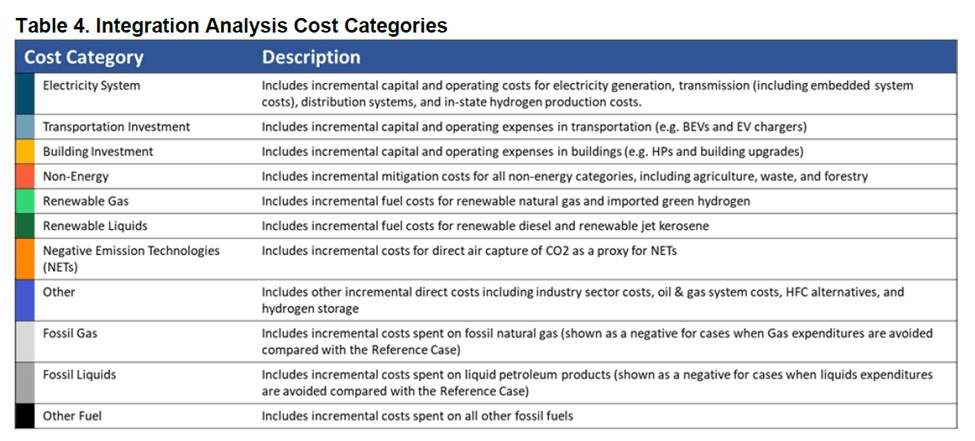
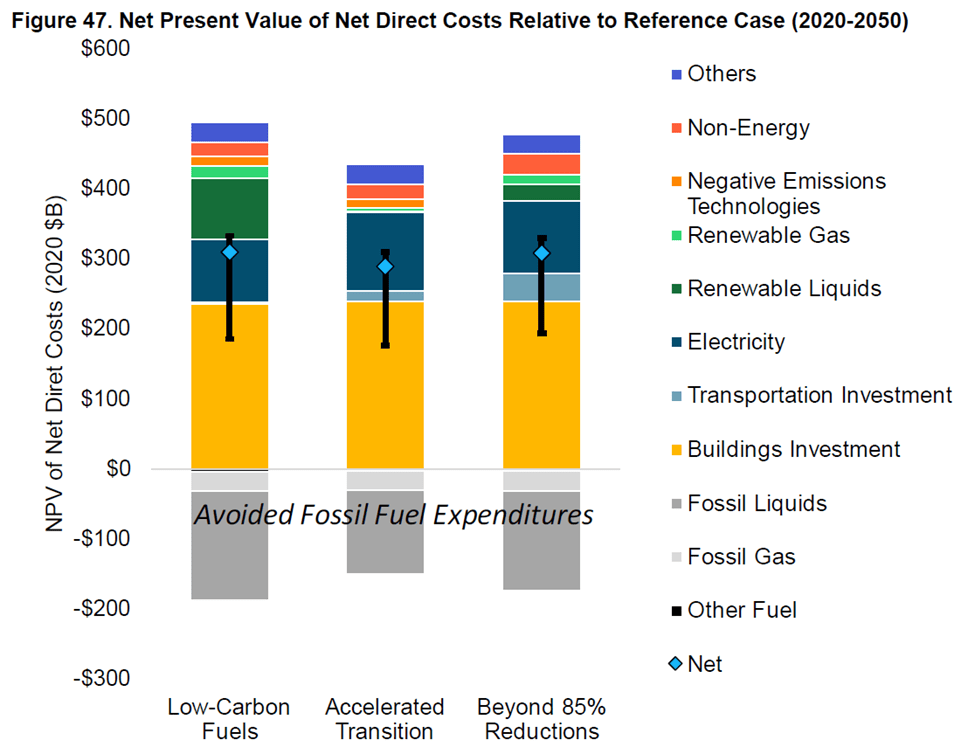
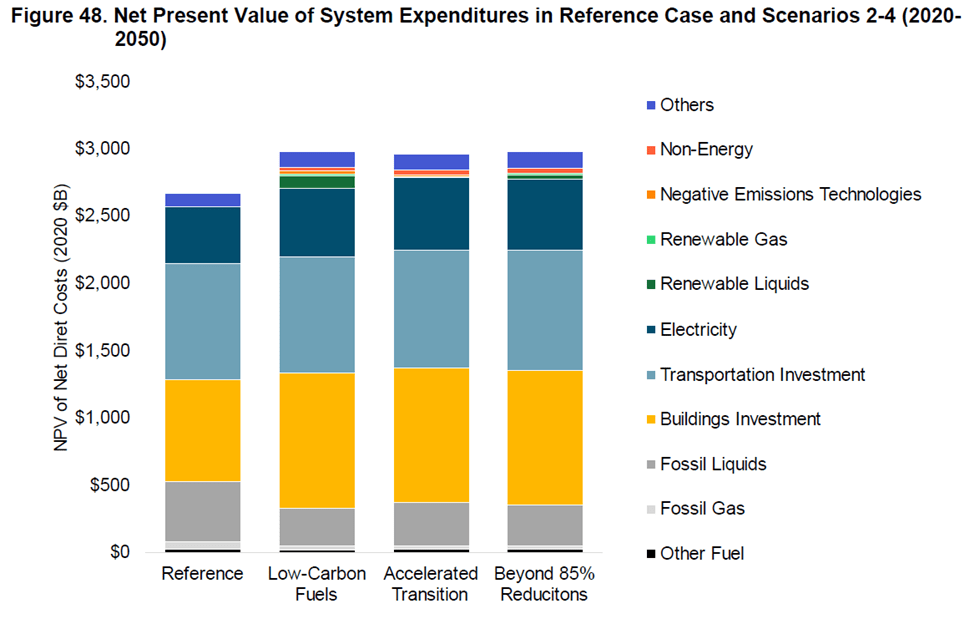
The Integration Analysis – Benefits and Costs Presentation has several slides that discuss costs.   The slides explain that the “Incremental costs in all scenarios are primarily driven by investments in buildings and the electricity system”.  The results presented are net costs that “offset total costs with avoided fossil fuel expenditures due to efficiency and fuel-switching relative to the Reference Case”.  According to the authors they were able to analyze what the incremental cost would be to society.  For example, they estimated the cost to replace a oil-fired furnace with a heat pump, determined the number of oil-fired furnaces that need to be replaced to meet the emission targets, and then multiplied the two numbers to get the direct costs.  Their analysis did something similar for every energy-related aspect of society.

The first cost slide lists the net direct cost for Scenario 2: “Strategic use of low carbon fuels” as $340 billion and Scenario 3: “Accelerated transition away from combustion” as $280 billion.  As an aside, note that the Climate Act Resources page documents the key results, drivers, and assumptions for the Integration Analysis.  However, to the best of my knowledge, the costs numbers are not documented in those resources. 

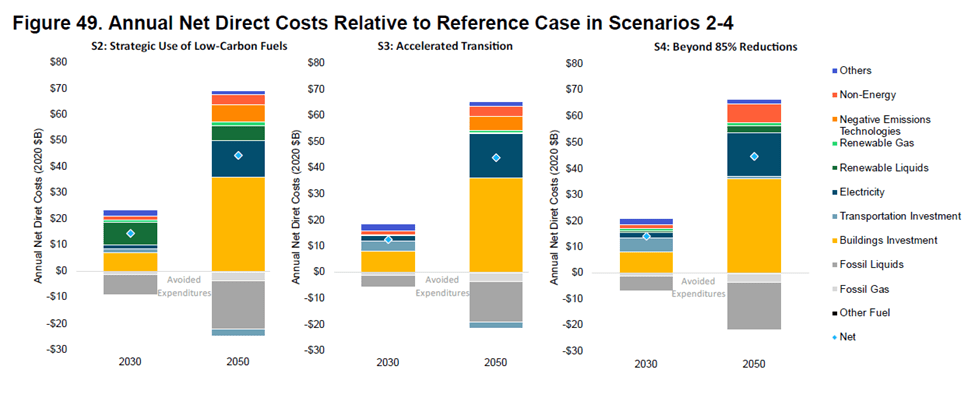
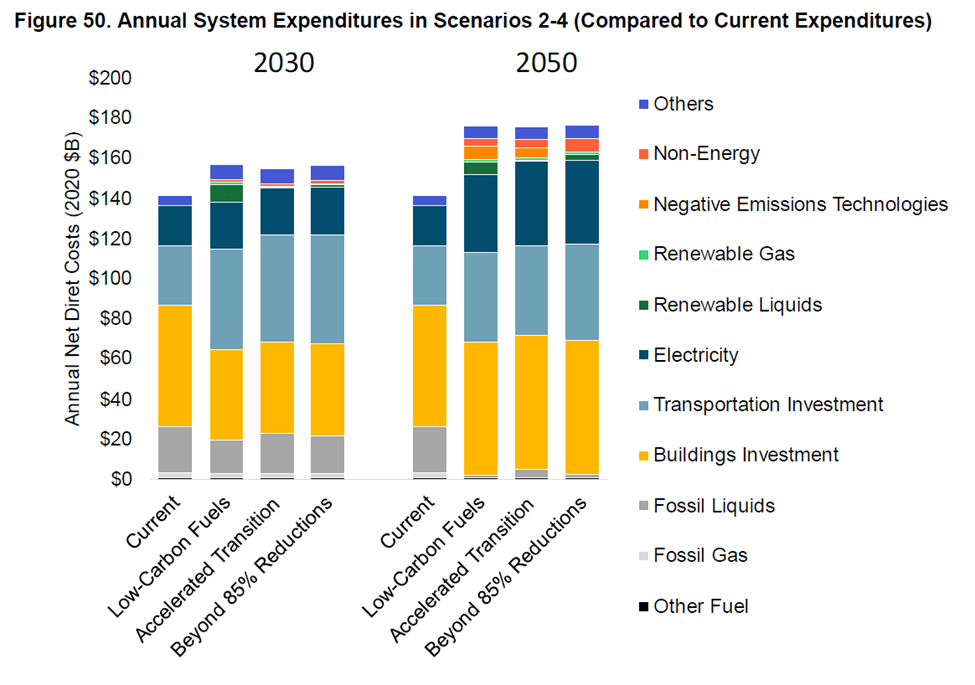
The breakdown of the Scenario 2 costs in the next slide states that the net direct costs in the early years are “on the order of $10 billion per year, equivalent to 0.6% of GSP in 2030” and that in the later years are “on the order of $50 billion per year, equivalent to 2.0% of GSP in 2050”.

The breakdown of the Scenario 3 costs in the next slide states that the net direct costs in the early years are “on the order of $10 billion per year, equivalent to 0.7% of GSP in 2030” and that in the later years are “on the order of $50 billion per year, equivalent to 2.0% of GSP in 2050”.  Recall that the Scenario 2 total cost was $340 billion and the Scenario 3 cost was $280 billion.  My impression is that the detailed breakdown for Scenario 2 would therefore be greater than the breakdown for Scenario 3 but in 2030 the equivalent Gross State Product (GSP) value is greater for Scenario 3.  Without additional documentation it is impossible to speculate about what is going on.

Costs to New Yorkers

I cannot relate to numbers as a percentage of GSP or how a number as large as $10 billion per year relates to the state.  One simple way to think about it is to divide those costs by the number of people in the state to determine a cost per person.  The Integration Analysis Key Drivers and Outputs spreadsheet GSP tab lists values used for the GSP and population from 1990 to 2050.  I divided the $10 billion in 2030 and $50 billion in 2050 values by the population for those years to get an annual cost per New York resident.  Dividing that value by 12 gives a monthly number per person and multiplying by four gets a monthly value for a family of four.  The net direct cost for the scenarios works out to $167 per month in 2030 and $807 per month in 2050 for a family of four. 

Discussion

On October 26,2021, the AP-NORC Center and the Energy Policy Institute at the University of Chicago (EPIC) released the results of a survey that claimed that a majority of Americans regard climate change as a problem of “high importance”.   It also included survey questions asking whether respondents would support, oppose, or neither support or oppose a law that imposed “a fee on carbon to combat climate change”.  The survey question asked “If the law passed, it would increase  the average amount your household pays each month for energy, including electricity, heating gas, and gasoline or diesel for your car by a total of X dollars per month” where respondents were randomly assigned a $1, $10, $20, $40, $75, or $100 cost increase.  For a $1 per month increase, 45% would support, 30% would oppose, and 25% would neither support or oppose.  For a $100 per month increase, 20% would support, 62% would oppose, and 18% would neither support or oppose. 

The Integration Analysis lists societal net direct costs for all aspects of the Climate Act transition to Net-zero.  Those costs include changes to the energy system, including electricity, heating gas, and gasoline or diesel for your car, as well as all the other changes needed for the transition such as switching homes to all electric. I can only conclude that $167 per month for a family of four in the early years of the Climate Act would be opposed by an even greater margin than the 62% opposed in the survey and that the $807 per month cost increase would be opposed by a much greater margin.

It gets worse.  The societal net direct costs only include money spent for the transition technology and operating expenses.  In order to convert societal costs to direct costs to consumers you have to determine how to distribute those costs through, for example: ratepayer programs, State tax credits or incentives or Federal government support.  No matter how the costs are distributed, each approach adds transactional costs and inefficiencies not reflected in the total societal cost.

But that’s not all because when politicians get involved with money bad things generally get worse.  For example, consider New York Senate Bill S4264A, better known as the Climate & Community Investment Act (CCIA) which explicitly is designed to provide funding for the Climate Act by establishing a fee on greenhouse gas emissions.  It was proposed last year, failed to pass, and is up for consideration in this legislative session.  I did several articles  earlier this year and recently wrote another one about the fee structure.  Unfortunately, I never wrote about the distribution of proceeds. Briefly, the proposed law would set up the Climate and Community Investment Authority which would itself add administrative cost.  The Authority would establish the Community Just Transition Fund for 33% of the fees collected, the Climate Jobs and Infrastructure Fund for 30% of the fees collected, the Low-income and Small Business and Household Energy Rebate Fund for 30% of the fees collected, and the Worker and Community Assurance Fund for 7% of the funds collected after the first year.  Assuming that all of the money in the Climate Jobs Infrastructure Fund and the Community Just Transition Fund go to the expenses estimated necessary for the transition, over a third of the money collected does not.  If the CCIA were the only mechanism to pay for the Climate Act costs, then the $167 per month in 2030 shoots up to $265 a month and in 2050 the cost is over $1,200 a month due to the CCIA funding mandates.

Conclusion

New York State is going to test Roger Pielke’s Iron Law of Climate: “While people are often willing to pay some price for achieving climate objectives, that willingness has its limits”. I have never seen a public opinion survey that contradicts the AP-NORC Center and EPIC survey that found that the majority of people oppose a law that imposes a monthly cost to a household of four of $100.  The surveys usually don’t ask about costs higher than that.  It is reasonable to assume when all the costs are accounted for the Climate Act transition that costs will be more than double the highest value in the survey.  Ideally it would be great to have a refined estimate of the consumer cost burden.  However, it is clear even using the societal costs that they would be too large for most New Yorkers.   

New York Independent System Operator Siena College Carbon Pricing Poll

In an example of polling to achieve a desired public relations outcome, on September 28, 2020 the New York Independent System Operator (NYISO) and the Siena College Research Institute released a new poll of New Yorkers which they say found a large majority of respondents are in favor of incorporating a social cost of carbon dioxide emissions into competitive wholesale energy markets.  I have been following and commenting on the NYISO carbon pricing proposal since the beginning and I want to bring up some points that I think would have changed the outcome of the poll.

I first became involved with pollution trading programs nearly 30 years ago and have been involved in the Regional Greenhouse Gas Initiative (RGGI) carbon pricing program since it was being developed in 2003.  During that time, I analyzed effects of these programs on operations and was responsible for compliance planning and reporting.  I write about the issues related to the energy and environmental interface from the viewpoint of staff people who have to deal with implementing these programs.  This represents my opinion and not the opinion of any of my previous employers or any other company I have been associated with.

The basic problem with the Siena poll is that polling on carbon pricing to someone who probably has never heard about carbon pricing or the social cost of carbon (SCC) means that the description of those concepts can bias the results.  In this post I will provide background on carbon pricing and the SCC then discuss the poll itself to show that the description provided biases the poll answers.

Background

I recommend Bjorn Lomborg’s latest book titled “False Alarm: How Climate Change Panic Costs Us Trillions, Hurts the Poor, and Fails to Fix the Planet” and agree with most of his arguments.  His first recommendation for fixing climate change is to “effectively implement a tax on CO2 emissions.  He notes that “Most economists agree that the most effective way to reduce the worst damage of climate change is to levy a tax on CO2 emissions.”  The basic theory is that the true costs of CO2 emissions are not reflected in the cost to the consumer so the solution is to incorporate those costs with a carbon price.  Someday I will explain my issues with the theory of the approach and his reasoning but in this instance the only thing I want to discuss is his description of the carbon tax.  He states that the optimal climate policy requires a globally coordinated carbon tax.  In other words, he advocates a tax on all sectors that emit CO2 across the world.

I have been following the concept of carbon pricing for quite some time.  While I agree that the theory that setting a carbon price could lead to the least-cost decarbonization, I also believe that there are a whole host of practical problems that mean it won’t work as suggested by the theory.  That is especially true if the carbon price is not implemented globally across all sectors.  Those concerns include the following: leakage, revenues over time, theory vs. reality, market signal inefficiency, control options, total costs of alternatives, and implementation logistics.  I will discuss the most pertinent of these concerns to the NYISO carbon pricing proposal: leakage and market signal inefficiency.

Pollution leakage refers to the situation where a pollution reduction policy simply moves the pollution around geographically rather than actually reducing it.  Ideally you want the carbon price to apply to all sectors across the globe so that cannot occur.  Lomborg notes “that is possible only in a fairy-tale world” and that it won’t happen in real life.  As a result, a carbon price in one jurisdiction and not others will very likely cause leakage.  The NYISO carbon price proposal is proposed for just for the New York control area in a highly connected regional electric transmission grid that is designed to operate the lowest cost generation.  Any significant carbon price just in New York will incentivize generation outside New York simply moving the CO2 pollution elsewhere.  Note that it is even worse because the carbon price is only on the electric generating sector. Even worse, if the price gets too high then sources that stay in New York could generate their own electricity outside of the NYISO carbon price market.

Setting the market price is a controversial topic.  Lomborg explains how economists calculate the costs of carbon emissions today on the future.  The theory is that when you have calculated all the climate change costs then you can back-calculate the appropriate carbon price for today to prevent those future losses.  Lomborg strays from the carbon price orthodoxy by arguing that it is appropriate to balance the costs of the program against the climate change costs.  He calculates his carbon price estimates based on “creating the best possible world for the generations that succeed us; that is to create the maximum possible welfare for subsequent generations”.   He advocates a realistic, moderate, and increasing carbon tax policy that starts with a price of around $20 per ton and ends up at $270 per ton by the end of the century.  The NYISO carbon pricing proposes to use a carbon price value determined by New York State.

The Climate Leadership and Community Protection Act includes a provision that mandates the Department of Environmental Conservation develop a value on carbon.  I prepared a non-technical summary on the value of carbon or Social Cost of Carbon (SCC) earlier this year.  The law states that “The social cost of carbon shall serve as a monetary estimate of the value of not emitting a ton of greenhouse gas emissions”. The Social Cost of Carbon (SCC) is the present-day value of projected future net damages from emitting a ton of CO2 today.  The value chosen depends on a lot of assumptions and value judgements.  The Obama Administration Interagency Working Group (IWG) on the Social Cost of Carbon developed a 2020 value of about $50 per ton but the Trump Administration disbanded the IWG and stated that the estimates generated by the Interagency Working Group were not representative of government policy.  Currently, Federal projects use SCC estimates based on the same approach as the IWG that differ in two aspects: the only damages that were considered were those in the United States and different values were used to convert to present costs.  That value is only $7 per ton.

The NYISO claims benefits for their carbon pricing proposal based on the presumption that the funds received will be spent effectively or that the addition of the carbon price will change the viability of CO2 emitting plants relative to carbon-free plants.   I have evaluated the results of the investments made by regulatory agencies to date in New York’s existing carbon pricing program, the Regional Greenhouse Gas Initiative (RGGI).  The RGGI states have been investing investments of RGGI proceeds since 2008 but their investments to date are only directly responsible for less than 6% of the total observed reductions.  Furthermore, from the start of the program in 2009 through 2018, RGGI has invested $2,775,635,415 and reduced annual CO2 emissions by 3,091,992 tons.  The resulting cost efficiency, $898 per ton reduced, far exceeds the $50 per ton IWG SCC that represents the value of reducing CO2 today to prevent damages in the future.  It is also unlikely that the carbon price adder suggested will affect the economic viability of existing plants.

An even more controversial topic is what should be done with the proceeds.  In theory, the costs of the carbon price will be returned to the consumers so that this does not become a regressive tax.  However, I generally have doubts that the State of New York will return a revenue stream of any kind without taking some kind of cut or taking the all the money.  I am particularly worried that the Climate Leadership and Community Protection Act (CLCPA) advisory panels all seem to think that this revenue stream will be available to fund the projects they want developed to meet their sector targets.

The Poll Results

According to the NYISO press release, these were the key findings from the Siena College poll:

When respondents were first asked about the NYISO proposal, a plurality were in favor: 47% support, 36% oppose, and 17% don’t know/no opinion.

After learning more about the proposal and its benefits: 71% of respondents were more likely to support the proposal if they knew the proposal would replace the oldest, most polluting plants with cleaner, less polluting generators; 68% of respondents were more likely to support the proposal when told the growth in clean technology would benefit the state’s economy; 62% of respondents were more likely to support when told the proposal would reduce emissions in urban communities most impacted by power plant emissions; and 54% of respondents were more likely to support the proposal when told investments in new carbon-free energy would increase.

Respondents were then asked again how they felt about the proposal and support increased significantly: 62% support (+15 pts); 27% oppose (-9 pts); and 11% don’t know/no opinion (-6)

The poll, conducted by the Siena College Research Institute, also found that 79% of respondents support the 2030 and 2040 goals laid out in the Climate Leadership and Community Protection Act (CLCPA). Notably, that support extended across all ideological, race, sex, age, geographic, income and religious crosstabs.

The Poll Questions

I am skeptical of polling results because I believe that the poll questions can bias the responses to get the outcome desired.  The Siena Poll Questions provided by the NYISO clearly justify my skepticism.  I will list the questions used in the poll and provide my italicized comments for each.

Q33: Currently, NYS gets about 25% of its electricity from renewable sources.  Do you support or oppose the goal of NYS getting 70% of its electricity from renewable sources by 2030, increasing to 100% from zero-emitting sources by 2040?

I have not been able to get to the Siena College Research Institute web page because it took too long to respond.  The label suggests that there were questions before this one.  If those questions discussed renewable energy it could certainly color the response to this question. 

 More importantly, there is an error in this question. The CLCPA includes nuclear as renewable and that was not included in the question “NYS gets about 25% of its electricity from renewable sources”.  According to the NYISO Annual Net Energy Generation by Zone and Type – 2019 renewable sources including nuclear 61.4% of the total.  That anyone would support a goal that requires increasing energy from renewable resources from 25% to 70% in less than ten years clearly does not understand the electric energy system.

Q34.  One proposal is to add the social cost of carbon to the price of electricity.  The social cost of carbon is an estimate, in dollars, of the economic and public health damages that could result from emitting GHG into the atmosphere.  One estimate is that this proposal could increase customer costs in the short run but return larger cost savings to consumers in the long run.  Do you support or oppose adding the social cost of carbon to the price of electricity?

The definition is adequate but providing only a single defining statement that suggests that costs today will provide savings in the long run is inadequate and biases the responses.  My non-technical summary explains that the increase to customer costs are real but the social cost of carbon “benefit” value depends on the judgement of those developing the numbers. The benefits change if global impacts, nation-wide impacts, or for the sake of argument, just the benefits that would accrue to New Yorkers if NY emissions are reduced because of the carbon price.  This short description does not explain that the IWG costs and benefits are calculated out three hundred years.  Because the biggest climate change impacts occur near the end of that period “returning cost savings to consumers” means consumers many generations in the future.  There is another aspect to paying now for potential damages far in the future.  The money spent today is not available to spend on projects that could alleviate future damages.

Q35.  Industry experts say that adding the SCC to the price of electricity will lead to a number of outcomes.  For each prediction that experts have made, tell me if that outcome makes you more likely to support adding the social cost of carbon to electricity, less likely or that it has no effect on your position.

The NYISO has a vested interest in promoting its carbon pricing proposal.  Naturally the following questions tout the benefits claimed for the proposal.  As shown above there are issues with the NYISO’s benefit claims.

Q35A.  They predict the oldest, most polluting power plants in NY will be replaced with cleaner, less polluting generators.

The NYISO carbon pricing proposal alleges that the added cost from the addition of the SCC price to the sources emitting CO2 will cause the replacement of the old, dirty power plants.  In order for that to happen, then the additional cost has to make the old plants less competitive than other operating plants.  I think there is evidence that is not the case and that means the only effect of the carbon price will be to increase consumer prices to cover the carbon price cost for plants that need to run to maintain reliability.

Q35B.  They predict emissions will be reduced in urban communities most impacted by power plant emissions.

The only NY urban community directly impacted by power plant emissions is New York City.  Because the City is mostly on islands which results in transmission constraints, power plants need to operate in the City.  The old “peaker” units that fulfill this need have been recently targeted as having disproportionate impacts to environmental justice communities.

 The NYISO was put in place to operate the electricity system in a de-regulated market.  The press release says “Carbon pricing uses market-based price signals to achieve reductions in emissions from fossil fuel-based generators”.  The de-regulated market relies on market signals for all its future planning strategies. 

 The NYISO claims “competitive wholesale electricity markets have provided, and continue to provide, significant benefits to electricity consumers, including fuel cost savings, improved generation efficiency, reduced reserve requirements, and reduced emissions.”  However, in the case of the oldest, most polluting power plants in New York City, it has been a failure with respect to the most likely outcome for regulated electric utilities.  There has been a need to replace the old peaking turbines in the City for years and there have been multiple attempts by the merchant owners to develop new and much cleaner replacement units since 2000.  However, none of the units have been built apparently because the market signal was insufficient for the investment.  Because of the clear need I have no doubt that the DEC would have explained the need, a regulated utility would have applied to build replacements, and the Department of Public Service would have approved the construction of clean new power plants to reduce local impacts in the City.  To claim that the carbon price will change the current dynamic in and of itself is wishful thinking.

Q35C.  They predict investments in new carbon free energy technology will increase.

This is true if the carbon price proceeds are directed to investments in new carbon free energy technology.  If that is the case then there will be less and possibly no money available to offset the higher electricity prices for those least able to pay.

35D.  They predict growth in clean technology will benefit New York’s economy.

This is the mantra of the CLCPA.  Who am I to argue that a clean technology economy that depends on subsidies to survive can only grow as long as the subsidies continue?

Q36.  Some experts now predict that adding the social cost of carbon to electricity could result in a savings to consumers within a year.  Regardless of whether or not you accept that prediction, after thinking about this proposal for a moment, do you support or oppose NYS moving towards adding the SCC to the electricity or not.

If I had time, I would like to track down the basis for the statement “Some experts now predict that adding the social cost of carbon to electricity could result in a savings to consumers within a year”.  As noted previously the climate change impact benefits will not be evident for years so that won’t result in any savings in a year.  I cannot imagine a realistic scenario where adding to the cost of electricity to consumers will result in savings to consumers.  The only thing I can think of is that the economic modeling used to support the carbon pricing scenario produced that result.  If so, that is an example of hiring a consultant, hoping for a particular answer, getting the answer, and ignoring the absurdity of the result.

Conclusion

The take home message from the poll was that a “large majority of respondents are in favor of incorporating a social cost of carbon dioxide emissions into competitive wholesale energy markets”.   The announcement came out just before the NYISO goes to the Federal Energy Regulatory Commission’s Carbon Pricing in Organized Wholesale Electricity Markets technical conference and argues for their carbon pricing proposal.  It is the culmination of a public relations campaign that includes a web site, datasheet, and videos extolling the virtues of their plan.  The poll clearly was written to get the desired answer.

Unfortunately, while the theory of carbon pricing is admirable, there are practical reasons why it won’t work in practice.  At the top of the list for the NYISO carbon pricing proposal is the fact that it covers one sector in one area in a highly interconnected system.  If the market signal is strong enough to effectuate change then the most likely change is to leak generation outside New York without actually reducing CO2 emissions.  I believe the most likely outcome for New Yorkers is that the NYISO carbon pricing proposal will simply increase the cost of electricity with few if any offsetting benefits.  This poll made no attempt to explain these concerns.

The poll claims that a “large majority of respondents are in favor of incorporating a social cost of carbon dioxide emissions into competitive wholesale energy markets”.   In the first place they did not discuss competitive wholesale electric markets in the questions that were provided.  They asked the public about other concepts that they very likely were hearing about for the first time.  The description of the social cost of carbon and carbon pricing simplified the concepts so much that the possibility of any negative consequences was not mentioned.  The explanations that caused respondents to increase their support for the carbon pricing were based on benefits that are controversial.  As a result, the claim that there is support for this carbon price proposal is based on a biased poll.  I am sure that rewording the poll to reflect an unbiased explanation of carbon pricing and social cost of carbon would have changed the results.