New York Draft Energy Plan Health Impacts Analysis Scientific Travesty

This post is a revised version of an article posted at Watts Up With That.  It combines information from earlier posts here.  The New York Draft State Energy Plan prepared by the New York State Energy Research & Development Authority (NYSERDA) is currently out for comments.  There is absolutely no indication the New York State is treating the stakeholder comment period as anything but an obligation so I had no plans to invest time and effort developing technical comments that would be ignored.  Then I read the Health Impacts Analysis chapter.  It is so bad that I had to document this embarrassing scientific travesty for the record.

I am convinced that implementation of the New York Climate Leadership & Community Protection Act (Climate Act or CLCPA) net-zero mandates will do more harm than good if the future electric system relies only on wind, solar, and energy storage because of reliability and affordability risks.  I have followed the Climate Act since it was first proposed, submitted comments on the Climate Act implementation plan, and have written over 550 articles about New York’s net-zero transition.  The opinions expressed in this article do not reflect the position of any of my previous employers or any other organization I have been associated with, these comments are mine alone. 

Net-Zero Aspirations

The Climate Act established a New York “Net Zero” target (85% reduction in GHG emissions and 15% offset of emissions) by 2050 and has two electric sector targets: 70% of the electricity must come from renewable energy by 2030 and all electricity must be generated by “zero-emissions” resources by 2040.

According to the New York State Energy Plan website: “The State Energy Plan is a comprehensive roadmap to build a clean, resilient, and affordable energy system for all New Yorkers.”  This is the first update of the Energy Plan since the Climate Act was passed in 2019, so it is being revised to incorporate the net-zero mandates.  I have provided more background information and a list of previous articles on my Energy Plan page

Alberto Brandolini has stated that: “The amount of energy necessary to refute BS is an order of magnitude bigger than to produce it.”  To fully document the problems in the Health Impacts Analysis would require an overly large post so this will previous articles addressing the different components.  Nonetheless I show that the NYSERDA analysis chose its health impact goals and then contrived an analysis to support those claims.

Health Benefits Claims

In a recent article Doreen M. Harris who serves as President and CEO of the New York State Energy Research and Development Authority and Chair of the New York State Energy Planning Board summarized the health benefit message in the Draft Energy Plan.  She said: “Additional analysis shows that continued implementation of the State’s energy policies would provide substantial public health benefits throughout the State in all communities, with the greatest benefits realized in disadvantaged community areas.”   She made some specific claims: “This includes reduced emissions and cleaner air resulting in avoided hospitalizations, work loss days and emergency room visits due to asthma.” 

The relationship between inhalable particulate matter and emergency room visits due to asthma is frequently cited as proof of air quality impacts.  In my analysis I only looked at those parameters because of the frequent references and because I found historical data for both parameters.

Before continuing I should note that asthma health impact claims related to air quality is a shaky proposition from the get-go.  I used Perplexity AI to generate a summary of the confounding factors affecting asthma related emergency room visits.  There are environmental, socio-economic, healthcare access, clinical, comorbidity, behavioral, clinical management and psychosocial confounder factors affecting asthma.  Claiming that any one of the factors affecting emergency room visits is agenda-driven science.

Health Impact Relationship

Correlation does not indicate causation. Claiming causation when then is no correlation is tone-deaf agenda driven science.  I posted an article that documents there is no relationship. 

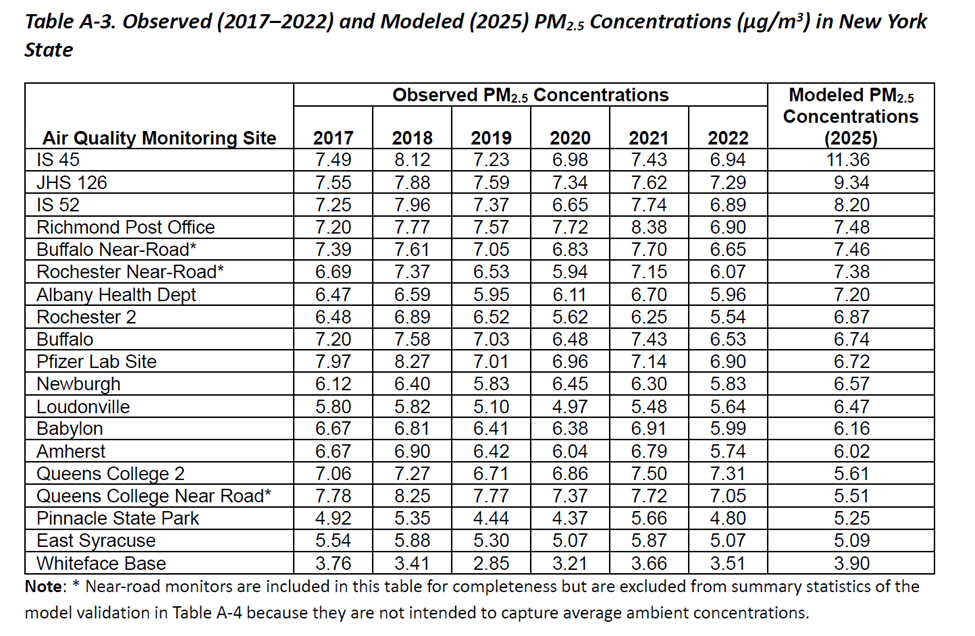
I compared data from two sources.  The New York State Department of Health has developed the New York State Asthma Dashboard that  includes asthma emergency department visits data.  The New York State Department of Environmental Conservation (DEC) operates an ambient air quality monitoring system across the state and prepares annual reports.  The Methodology Appendix in the Health Impact Analysis chapter of the Draft Energy Plan compares the observed inhalable particulate matter (PM2.5) with their model predictions to validate their approach as shown in Table A-3 below.  That analysis used data from 19 monitoring sites.  I used the same sites except for the near-road monitor because they are not intended to capture average ambient concentrations.

Source: Draft Energy Plan Health Impacts Analysis

In my article on this relationship, I provided plots of the observed data for county-level pollution and emergency room visits.  I did not think there would be an obvious relationship, but I was surprised that it was so bad.  Only two of the sixteen comparisons suggested that there was a relationship that indicated that inhalable particulate concentrations influenced asthma emergency department visits.

Air Quality Analysis

I have a long and wide-ranging background in air quality modeling.  When I read that the health analysis estimated benefits from reduced exposure to inhalable particulate matter concentrations at the community scale, I was taken aback because of the level of effort required.  Estimating the impacts of all the sources of air pollution down to the level of 4,911 census tracts in New York State is challenging simply due to numbers.  The second challenge is that they considered five pollutants and the Appendix notes that both primary and secondary pollutants were considered.  Inhalable particulates (PM2.5) can be emitted directly but most of the observed particles are secondary pollutants formed in chemical reactions from NOx, SO2, VOCs, and NH3.  The chemical reactions that create secondary pollutants vary by season, meteorological conditions, and distance/time from the emitting source.  When modeling local impacts, it is sufficient to only consider straight line impacts determined by hourly wind directions. However, secondary upwind pollutant reactions occur over multiple hours necessitating more sophisticated transport patterns to track pollution transport.

The solution to this policy impact challenge is to use a simplified average impact analysis.  EPA’s CO–Benefits Risk Assessment (COBRA) screening model fits the bill.  COBRA uses the well-established and proven Climatological Regional Dispersion Model (CRDM) that categorizes parameters affecting pollutant dispersion and transport.  This approach is best suited for local impacts of primary pollutants.  When used for secondary pollutants it is less appropriate because there are more factors involved.

The Draft Energy Plan needed an analysis that addressed disadvantaged communities at a finer resolution than COBRA provides. This analysis was conducted using a newly developed air quality and health impacts modeling framework—the NY Community-Scale Health and Air Pollution Policy Analysis (NY-CHAPPA) model. My problem with the NY-CHAPPA model is that it over-simplifies the air quality analysis.  The most important air pollution impact parameter is wind direction, because impacts only occur if the wind is blowing from the source to the receptor of concern.  CRDM uses 16 wind categories, but NY-CHAPPA only uses four.  Given all the sources in the analysis I think using only four wind directions is unacceptable.  This gives results that are just too crude to be representative of the actual relationship between sources and receptors.

Given that this is a new modeling approach, I believe it is incumbent upon NYSERDA to verify that their new model is valid.  The Appendix to the Health Impact Analysis chapter purports to validate the model for this reason.  An air quality model verification analysis uses historical meteorology and emissions input to predict air quality concentrations and compares those results with observed concentrations over the same time period.  The process is not complicated.  It is necessary to compare model results against observed concentrations.  Obviously, the observations need to be for the same time period as the predictions.  The NYSERDA analysis does not do that.  On page A-13 the draft states: “Because model projections were only available starting with year 2025, these results were compared against multiple years of observational data”. 

When I first read that statement, I did a double take and read it again. I could not believe it.  It is inconceivable that anyone could claim to evaluate model performance by comparing observed historical concentrations against future predicted concentrations.  It is just plain wrong.  The verification statistics presented are worthless.  The biggest problem describing this situation is finding the right terms to describe the enormity of the error without using profanity. 

Context

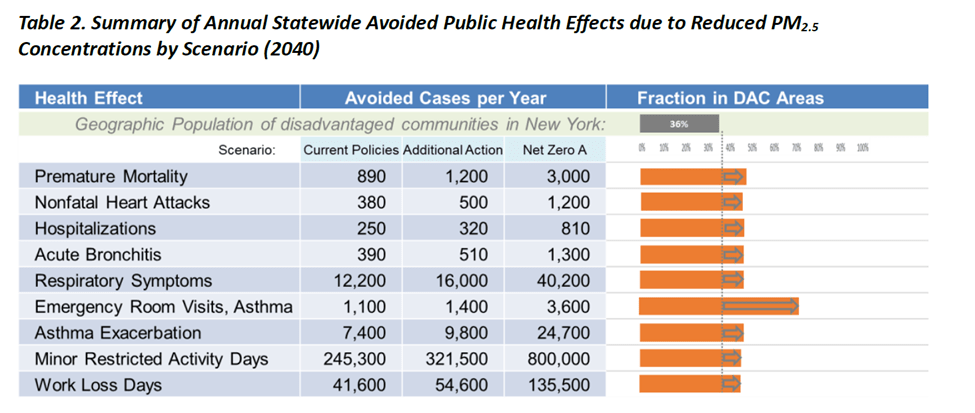
There is no question that reducing air pollutant emissions will provide health benefits, but the relationship is complex, and in my opinion usually exaggerated.  NYSERDA’s claimed public health effects are listed in Table 2 of the Health Impacts Analysis chapter.  I addressed whether the avoided emergency room visits due to asthma benefits which range from 1,100 to 3,600 fewer cases per year are meaningful relative to historical rates.

Source: Draft Energy Plan Health Effects Chapter

I compared the emergency room visits due to asthma health effect relative to observed data from the .New York State Asthma Dashboard.  Table 1 lists the annual asthma emergency room visits for different age groups.  All my analyses used the total asthma emergency department visits.  Of particular interest note that the Covid Pandemic changed the identification of asthma.  In my opinion, limiting the comparison data from 2009 to 2019 would be more representative of an actual relationship.

Table 1: NYSDOH New York State Asthma Dashboard Asthma Emergency Department Visits

Emergency room asthma reporting changed in 2020 due to Covid.  Because this changed the reporting metric, I ran the statistics for the data available from 2009 to 2019. Table 2 lists simple statistics describing the data for that period.  The range of emergency room visits over all 10 years of data before Covid is 47,636.  The maximum number of avoided emergency room visits is 24% of the standard deviation and 7.6% of the range of observed emergency room visits.  The predicted improvement is a small fraction of the observed emergency room visit variation.

Table 2: NYSDOH Asthma Dashboard Asthma Emergency Department Visits Statistics 2009-2019

In my analysis of the context of the predictions I also looked at the inhalable particulate variations.  The average predicted concentration reduction for all three modeling scenarios is less than the range of observed annual concentrations.  This means that the predicted reductions are within the range of inter-annual variation and that, contrary to the messaging, this suggests that the results will not be observable.

Discussion

My recent posts address shortcomings of the NYSERDA analysis of health benefits of the net-zero transition analyzed in the Draft State Energy Plan.  I believe that the air quality analysis used to predict health impacts was overly simplified.  NYSERDA used a new procedure to estimate health impacts that needs to be validated but the alleged verification process was fatally flawed.  One of the key health concerns is the effect of inhalable particulates on asthma related emergency room visits but there is no observed relationship between annual average PM2.5 and emergency room visits related to asthma for the New York State monitoring stations used in the NYSERDA analysis.  I also showed that the predicted impacts on emergency room visits, and inhalable particulate air quality reductions are within the range of observed variations. 

Conclusion

My submitted comments should precipitate, at a minimum, a revision to NY-CHAPPA to include 16 wind directions and a valid verification analysis of the modeling. I don’t expect NYSERDA to respond.  Instead, I expect that my comments will be ignored like all my previous submittals.  It is clear to me that NYSERDA established the public relation slogans for the goals of the program and then perverted the science to get answers to support those claims.  When I described this to one of my friends, he remarked that this is proof that science and NYSERDA cannot be used in the same sentence. 

Articles published at Watts Up with That include illustrations.  While this admittedly appeals to my juvenile sense of humor I do think that my revision to the picture aptly illustrates the clown directing the New York Energy Plan that will work when pigs fly.

Draft Energy Plan Additional Comments Regarding Natural Gas

My last post documented the oral comments I submitted at the Draft State Energy Plan virtual public hearing on September 30, 2025.  The New York State Energy Research & Development Authority (NYSERDA) only allocated two minutes per person, and I had more arguments that I wanted to make so this article documents them.  My comments address plans to eliminate natural gas in the Draft Energy Plan.

I am convinced that implementation of the New York Climate Leadership & Community Protection Act (Climate Act) net-zero mandates will do more harm than good if the future electric system relies only on wind, solar, and energy storage because of reliability and affordability risks.  I have followed the Climate Act since it was first proposed, submitted comments on the Climate Act implementation plan, and have written over 550 articles about New York’s net-zero transition.  The opinions expressed in this article do not reflect the position of any of my previous employers or any other organization I have been associated with, these comments are mine alone. 

Net-Zero Aspirations

The Climate Act established a New York “Net Zero” target (85% reduction in GHG emissions and 15% offset of emissions) by 2050 and has two electric sector targets: 70% of the electricity must come from renewable energy by 2030 and all electricity must be generated by “zero-emissions” resources by 2040.

According to the New York State Energy Plan website: “The State Energy Plan is a comprehensive roadmap to build a clean, resilient, and affordable energy system for all New Yorkers.”  The New York State Energy Planning Board is a “multi-agency entity established under Article 6 of the Energy Law, playing a core role in the State Energy Plan process”. Among its responsibilities is adopting the State Energy Plan: The Board has the authority to adopt the comprehensive statewide energy plan, and the stakeholder process should be an important component of that responsibility.

The driving factor for the updated Energy Plan is net-zero ambitions of the Climate Act.  This is the first update of the Energy Plan since the Climate Act was passed in 2019.  I have provided more background information, links to summaries of previous oral comments, and a list of previous articles on my Energy Plan page.  Because of the importance of this process on the future energy system of New York I am following it closely and will be submitting oral and written comments. 

Oral Comments

My last post documented the oral comments I made arguing that New York’s irrational vilification of natural gas risks an unreliable, unsafe, and unaffordable energy system.  I explained that laboratory measurements showing greater impacts of methane emissions than carbon dioxide (CO2) ignore the fact that in the atmosphere changes in methane concentrations have negligible climate impacts compared to CO2.  I noted my personal experience with the benefits of natural gas when I lived through electric blackouts.  Finally, I pointed out that hoping that a presently unavailable dispatchable, emissions-free resource can be deployed by 2040 is too risky so natural gas generation must be maintained.  The rest of this document describes some of my other concerns about eliminating natural gas.

Transportation

Many argue that air pollution from diesel trucks is an environmental issue.  The Transportation chapter of the Draft Energy Plan states:

Medium and Heavy Duty Vehicles (MHDVs) and non-road vehicles are major energy users within the transportation sector and substantial contributors to the sector’s GHG and local criteria pollutant emissions. Both industry segments have opportunities to electrify and move to ZEVs but are still in the early stages. MHDVs are a priority for New York State to electrify, with particular attention on electrifying school buses.

The chapter goes on to optimistically claim that markets for zero emissions options are “nearing maturity” but the reality is that there are significant issues.  I acknowledge the use of Perplexity AI to generate a summary of substantial barriers to the success of electrification efforts for school buses and MHDVs  That summary listed the following items: financial and economic barriers, technical reliability and performance issues, cold weather performance limitations, infrastructure and grid capacity challenges, manufacturing and industry instability, and workforce issues.  I would add that New York is a single jurisdiction and mandates for long-haul heavy-duty vehicles would require buy-in from many other jurisdictions.

I believe that natural gas use for transportation, particularly heavy-duty trucks and buses, would improve inhalable particulate impacts decades before zero-emission alternatives could be deployed because the technologies involved mature proven technologies.   Another Perplexity AI query described the benefits of adopting CNG trucks.  CNG trucks have up to 90% lower nitrogen oxide emissions and similar reductions of inhalable particulate matter mass emissions.  There are fuel cost savings, a strong return on investment, and reduced maintenance costs while at the same time providing comparable power and performance and enhanced vehicle longevity.   Also note that diesel trucks can be converted to run on CNG which is a claim that electric trucks will never make.

Natural Gas Electric System Advantages

The Draft Energy Plan does not acknowledge benefits of natural gas generation for New York’s electric system.

To address intermittency of wind and solar resources it is cost-effective to over-build capacity.   For example, if we were to rely entirely on solar, then we would have to build enough solar generation to provide the necessary power for the winters shorter days.  In the summer the days are longer, and less capacity would be needed.  It is simply not possible to build a system with sufficient energy storage capacity to avoid over-building.  This results in  curtailment which “involves deliberately reducing renewable energy output below maximum potential, resulting in significant economic losses and underutilization of clean energy resources”.  Because natural gas units can be dispatched as needed curtailment is not an issue.

As noted in my previous post a new Dispatchable Emissions-Free Resource (DEFR) is needed for an electric generating system that relies on wind and solar.  I believe that the most likely DEFR technology is nuclear generation because it is the only candidate resource that is technologically ready, can be expanded as needed and does not suffer from limitations of the Second Law of Thermodynamics. If the only viable DEFR solution is nuclear, then renewables cannot be implemented without it.  But nuclear can replace renewables, eliminating the need for a massive DEFR backup resource.  Nuclear works best as a baseload resource while natural gas generators can provide load-following and peaking services.  It is common sense to replace aging natural gas-fired generating units that are nearing the end of their expected lifetime now rather than investing enormous money in renewables because they could be a false solution.

Arbitrary Permitting Decisions

I believe that environmental policy decisions should balance risks and benefits and that the rationale for permitting decisions should not be based on politics.  The Draft Energy Plan should recognize that historical New York permitting decisions for natural gas pipelines are inconsistent with the on-going plans for renewable energy inspired transmission lines are inconsistent.

In one instance permits for the Constitution pipeline were rejected because of an inadequate water resource analysis for stream crossings.  The Department of Environmental Conservation (DEC) was particularly worried about stream crossings.  Rather than including permit conditions that require directional drilling to minimize impacts, DEC rejected the permit application outright.  The permit denial came on Earth Day April 22, 2016, removing any thought that this was a political decision rather than a technical decision

The Northeast Supply Enhancement (NESE) Gas Pipeline was also rejected by DEC because of water quality concerns.  The project would have caused 17.4 miles of underwater sediment disturbance in New York waters as part of a 23.5-mile total route from New Jersey coast to Rockaway, Queens.  The

26-inch diameter natural gas pipeline required 4-6 feet burial depth.  DEC’s denial of the Water Quality Certification in May 2020 was based on the project’s inability to demonstrate compliance with applicable water quality standards, particularly for mercury and copper contamination.

On the other hand, transmission line projects for renewable energy have managed to get permits.  The Champlain Hudson Power Express (CHPE) successfully obtained permits because they “incorporated comprehensive monitoring and mitigation measures”.  Testing demonstrated that sediment disturbance was brief and temporary, with values remaining below established threshold levels.  However,NESE pipeline installation would also have had brief and temporary impact.

A portion of the CHPE transmission line and lines for two offshore wind facilities will be routed through New York Harbor and presumably would also have mercury and copper contamination issues. On one hand the burial process for the transmission lines is less intrusive but on the other hand the disturbance lengths are longer.  CHPE travels approximately 27.8 miles in New York Harbor. The Queensboro Renewable Express (Rise Light & Power) transmission line will have 18.5 miles of underwater sediment disturbance in New York waters with two HVDC cables within a 200-300 foot wide corridor.  Equinor’s Beacon Wind project had planned a much longer 115+ nautical mile transmission system from the offshore lease area OCS-A 0520 to the Astoria power complex. However, the company withdrew its transmission application in February 2025, citing project economics and regulatory challenges

These permitting decisions were clearly decided because of politics.  New York’s Energy Plan should demand fuel-neutral permitting decisions.

Natural Gas for Peaking Power Plants

The Draft Energy Plan must acknowledge that natural gas peaking power plants provide necessary reliability support.  Environmental justice advocates like the Peak Coalition, have convinced state politicians that New York City peaking power plants are “perhaps the most egregious energy-related example of what environmental injustice means today.”  The enacting law for the New York Power Authority (NYPA) Draft Renewables Strategic Plan specifically directed NYPA to publish a plan by May 3, 2025, to end generating electricity with fossil fuel at its 11 small natural gas power plant (SNGPP) units located at 7 sites in New York City and on Long Island by the end of 2030 if reliability and environmental requirements are met.  I have documented that the presumption of egregious harm is based on selective choice of metrics, poor understanding of air quality health impacts,  and ignorance of air quality trends. In brief, the continued operation of these facilities will have no discernable impact on local neighborhood air quality and shutting them down is solely political virtue-signaling.  On the other hand, these facilities serve specific reliability needs that are not easily replaced. 

Discussion

One of the themes in the Draft Energy Plan is that the Climate Act law mandates compliance deadlines.  However, it does not adequately acknowledge that Public Service Law (PSL) Section 66-P, Establishment of a renewable energy program, is also a law. PSL 66-P requires the PSC to establish a program to ensure the State meets the 2030 and 2040 Climate Act obligations.  It includes provisions stating that the PSC is empowered to temporarily suspend or modify these obligations if, after conducting an appropriate hearing, it finds that PSL 66-P impedes the provision of safe and adequate electric service.  The Draft Energy Plan should recommend that criteria for safe, adequate, and affordable electric service be established so that New Yorkers are assured that current reliability standards are maintained.

Conclusion

The policies incorporated into the Climate Act that drive the Draft Energy Plan are not based on facts or research but ideology. Viewed through a pragmatic lens, the New York obsession with eliminating natural gas is irrational. Increased use of natural gas has been responsible for most electric generation emission reductions observed in the state.  Natural gas provides efficient, resilient, and safe energy to homes and businesses.  Not so long ago the idea that natural gas could also be used a bridge fuel until the aspirational “green” generating resources and energy storage technologies could be tested at the scale needed, perform like a natural gas fired generating unit, and provide power at a similar cost, was generally accepted as a rational approach.  The Draft Energy Plan must ensure that ideological demands to eliminate natural gas do not result in harm to society.

September 30 Draft Energy Plan Comments

This post documents the oral comments I presented at the Draft State Energy Plan virtual public hearing on September 30, 2025.  The New York State Energy Research & Development Authority (NYSERDA) only allocated two minutes per person, so this article documents the statements that I made.  My comments addressed the irrational vilification of natural gas in the Draft Energy Plan.

I am convinced that implementation of the New York Climate Leadership & Community Protection Act (Climate Act) net-zero mandates will do more harm than good if the future electric system relies only on wind, solar, and energy storage because of reliability and affordability risks.  I have followed the Climate Act since it was first proposed, submitted comments on the Climate Act implementation plan, and have written over 550 articles about New York’s net-zero transition.  The opinions expressed in this article do not reflect the position of any of my previous employers or any other organization I have been associated with, these comments are mine alone. 

Net-Zero Aspirations

The Climate Act established a New York “Net Zero” target (85% reduction in GHG emissions and 15% offset of emissions) by 2050 and has two electric sector targets: 70% of the electricity must come from renewable energy by 2030 and all electricity must be generated by “zero-emissions” resources by 2040.

According to the New York State Energy Plan website: “The State Energy Plan is a comprehensive roadmap to build a clean, resilient, and affordable energy system for all New Yorkers.”  The New York State Energy Planning Board is a “multi-agency entity established under Article 6 of the Energy Law, playing a core role in the State Energy Plan process”. Among its responsibilities is adopting the State Energy Plan: The Board has the authority to adopt the comprehensive statewide energy plan, and the stakeholder process should be an important component of that responsibility.

The driving factor for the updated Energy Plan is net-zero ambitions of the Climate Act.  This is the first update of the Energy Plan since the Climate Act was passed in 2019.  I have provided more background information, links to summaries of previous oral comments, and a list of previous articles on my Energy Plan page.  Because of the importance of this process on the future energy system of New York I am following it closely and will be submitting oral and written comments. 

Comments

This section documents the comments I made on September 30, 2025.  I used bullets to differentiate my comments from the explanations. 

  • My name is Roger Caiazza.  Documentation for these comments has been posted on my Pragmatic Environmentalist of NY blog.

As noted in the introduction I am convinced that implementation of the New York Climate Act will do more harm than good.

  • The Draft energy plan must reflect the reality of natural gas attributes and not the dreams of politicians. 

The same ideologues that convinced the politicians that achieving Climate Act mandates would require no new technologies hate natural gas. 

  • New York’s obsession with eliminating natural gas is irrational.  Concerns about the higher observed global warming potential of methane molecules compared to carbon dioxide drive the rationale to control natural gas.  However, laboratory measurements ignore the fact that in the atmosphere changes in methane concentrations have negligible climate impacts compared to CO2.

New York’s war on natural gas or methane is not based on pragmatic balancing of issues of cost, efficiency, and benefits, but only on an ideology built on the hatred of the natural gas industry. Worst of all the foundational argument that controlling methane is necessary because of enhanced impacts on global warming is not correct.

The relative impact of methane and carbon dioxide emissions on longwave radiation that causes the greenhouse gas effect is described in the following references.

Steve Gorham explains that “Because of greenhouse gas saturation in the atmosphere, methane regulations across the world will have no measurable effect on global temperatures.”  This is a good overview of the irrelevance of methane.

Wijngaarden and Happer also did a paper on methane itself.  They argued that the effect of the observed rate of CO2 molecules is so much bigger than the increase in methane atmospheric concentrations so the methane forcing is one tenth that of CO2. The paper is attempts to explain complex relationships for the general public but is still dense. Fortunately Vijay Jararaj summarized their work and conclusions.

Clyde Spencer explained that changes to radiation effects occur on a molecule-by-molecule basis in the atmosphere in an article titled The Misguided Crusade to Reduce Anthropogenic Methane Emissions.  The Climate Act tracks emissions by weight.  In the atmosphere CO2 is more than two orders of magnitude more abundant than CH4 on a molecular basis. The Climate Act uses the global warming potential that estimates the mid-range, long-term warming potential of CH4 is 32 times that of CO2.  However, that equivalence is for equal weights of the two gases!  Using a molecular basis (parts per million-volume mole-fraction) to account for the lighter CH4 molecule reveals that the annual contribution to warming is a fraction of that claimed for CO2.  Methane emissions on a molecular basis are increasing at a rate of 0.58% of CO2 increases.   Therefore, changes in methane emissions have insignificant effects.

Methane molecules affect the outgoing radiation in the same spectral band as water vapor.  The lab measurements are based on a standard dry atmosphere.  In the atmosphere, methane’s two main infrared absorption bands) are completely overlapped by two of the several broader and much stronger water vapor absorption bands. In a world averaging about 2% specific humidity, any methane effect is literally swamped by water vapor effect.  In particular, water vapor reduces the potency of methane by about 82 percent at 80% relative humidity and at 46% relative humidity (from the US Standard Atmosphere) the reduction is 75%.

Ralph B. Alexander describes another molecular consideration ignored in the Climate Act.  Each greenhouse gas affects outgoing radiation differently across the bell-shaped radiation spectrum   One of the reasons that CO2 is considered the most important greenhouse gas is that its effect coincides with the peak of the bell shape.  On the other hand, the effect of CH4 is down in the tail of the bell shape.  As a result, the potential effect of CH4 is on the order of only 20% of the effect of CO2.

Andy May’s excellent summarization of Wijngaarden and Happer’s important paper “Dependence of Earth’s Thermal Radiation on Five Most Abundant Greenhouse Gases” explains that the greenhouse effect of methane is not only related to the effect on longwave radiation itself but also the concentration in the atmosphere.  Because the atmospheric concentration of methane is so small doubling concentrations change the “outgoing forcing by less than one percent”.  In other words, doubling emissions or cutting emissions in half of methane will have no measurable effect on global warming itself. 

The residence time of the two gases is different.  Methane only has a lifetime of about 10-12 years in the atmosphere.  The “consensus” science claim is that 80% of the anthropogenic CO2 emissions are removed within 300 years.  (Note however that there are other estimates of much shorter residence times.) This means that CO2 is accumulating in the atmosphere.  CH4 is converted to CO2 and is then counted in the monthly CO2 measurements as part of the CO2 flux.  Because methane does not accumulate the same way as CO2 it should be handled differently.  However, the Climate Act doubles down on using the same approach.  Climate Act authors claimed it was necessary to use 20-year global warming potential (GWP) values because methane is estimated to be 28 to 36 greater than carbon dioxide for a 100-year time horizon but 84-87 greater GWP over a 20-year period. 

Dr. Mathew Wielicki gives a good, illustrated description that puts methane in perspective. Note that some of the article is behind a paywall.

  • Politicians must recognize the residential reliability benefits of natural gas.  I have lived in my home for over 40 years.  I have never had an outage of natural gas service. There have been many minor electric outages and two multi-day blackouts. We survived the long blackout because we had natural gas for heating and cooking.  Surviving and recovering the grid in an all-electric energy system will be extraordinarily challenging.

I do not think that the Energy Plan has adequately recognized the resiliency value of natural gas and its benefits during electric outages.  My described personal experience is shared by many and ignored in the Draft Energy Plan.  I think it must acknowledge that recovery of an all-electric energy system will be extraordinarily challenging and that natural gas provides the fuel diversity necessary for a resilient energy system.

  • NYSERDA’s recently released GE Grid Performance Gaps Study states that New York needs approximately 25 gigawatts (GW) of capacity contribution by 2040 to replace the fossil fuel fleet.  Politicians must acknowledge that dispatchable emissions-free resources simply will not be available by 2040. 

One of the themes in the Draft Energy Plan is that the Climate Act law mandates compliance deadlines.  However, it does not adequately acknowledge that Public Service Law (PSL) Section 66-P, Establishment of a renewable energy program, is also a law. PSL 66-P requires the Public Service Commission (PSC) to establish a program to ensure the State meets the 2030 and 2040 Climate Act obligations.  It includes provisions stating that the PSC is empowered to temporarily suspend or modify these obligations if, after conducting an appropriate hearing, it finds that PSL 66-P impedes the provision of safe and adequate electric service. 

With Richard Ellenbogen, Constatine Kontogiannis, and Francis Menton I submitted a filing in a PSC generic proceeding.  As described here, our submittal includes the primary filing, two exhibits documenting the customers in arrears safety valve trigger, and five supporting exhibits.  Responsible New York agencies all agree that new Dispatchable Emissions-Free Resource (DEFR) technologies are needed to make a solar and wind-reliant electric energy system viable during extended periods of low wind and solar resource availability.  Two of the supporting exhibits document the implications of this necessity.  Exhibit 4 – Resource Gap Characterization analyzes gaps between Climate Act mandates and available resources, and Exhibit 5 – Dispatchable Emissions-Free Resources explains that the need for a resource that is not currently commercially available risks investments in false solutions.  I maintain that safe and adequate electric service can only be guaranteed if the necessary DEFR technology has been proven feasible.

In my opinion, the most promising DEFR backup technology is nuclear generation because it is the only candidate resource that is technologically ready, can be expanded as needed and does not suffer from limitations of the Second Law of Thermodynamics. If the only viable DEFR solution is nuclear, then renewables cannot be implemented without it.  But nuclear can replace renewables, eliminating the need for a massive DEFR backup resource.  It is common sense to replace aging natural gas-fired generating units now rather than hope that the necessary replacement technologies will appear as needed in the future.

New York State has not developed a plan to ensure DEFR will be available as needed and that means that a natural gas generation must be available.  NYSERDA’s coordinated study to assess future grid reliability and stability under high-renewable scenarios in the GE Grid Performance Gaps Study states that New York needs approximately 25 gigawatts (GW) of capacity contribution by 2040 to replace the retiring fossil fuel fleet.  Politicians must acknowledge that zero-emission resources that provide all the grid reliability services provided by natural gas generation simply will not be available by 2040.  We must use natural gas as a bridge fuel until proven dispatchable emissions-free resources are available.

I am going to follow up with another post on natural gas and the Draft Energy Plan.  The oral comment time constraints prevented me from covering other topics.  I will explain that natural gas has a place in the transportation sector, there are unacknowledged natural gas advantages, and the State used arbitrary permitting decisions to deny permit applications for needed infrastructure improvements.

Conclusion

My oral comments concluded using similar terminology to this.  The policies incorporated into the Climate Act that drive the Draft Energy Plan are not based on facts or research but ideology. They are, in a word, irrational.  Not so long ago the idea that natural gas could be used a bridge fuel until the aspirational “clean” generating resources and energy storage technologies could be tested at the scale needed, perform like a natural gas fired generating unit, and provide power at a similar cost, was generally accepted as a pragmatic approach.  The only rational approach to maintain reliability and lower costs is to go back to that concept.

Draft Energy Plan Air Quality Health Benefits Analysis Shortcomings

The New York Draft State Energy Plan prepared by the New York State Energy Research & Development Authority (NYSERDA) is currently out for comments.  This is one in a series of posts describing my concerns about the Health Benefits chapter that I am planning to consolidate and submit as a written comment.  This post describes issues with the air quality modeling analysis used to predict health benefits.

I am convinced that implementation of the New York Climate Leadership & Community Protection Act (Climate Act) net-zero mandates will do more harm than good if the future electric system relies only on wind, solar, and energy storage because of reliability and affordability risks.  The primary emphasis of my career was air pollution meteorology and air quality analysis which is the focus of my planned comments.  I have followed the Climate Act since it was first proposed, submitted comments on the Climate Act implementation plan, and have written over 575 articles about New York’s net-zero transition.  The opinions expressed in this article do not reflect the position of any of my previous employers or any other organization I have been associated with, these comments are mine alone. 

Net-Zero Aspirations

The Climate Act established a New York “Net Zero” target (85% reduction in GHG emissions and 15% offset of emissions) by 2050 and has two electric sector targets: 70% of the electricity must come from renewable energy by 2030 and all electricity must be generated by “zero-emissions” resources by 2040.

According to the New York State Energy Plan website: “The State Energy Plan is a comprehensive roadmap to build a clean, resilient, and affordable energy system for all New Yorkers.”  This is the first update of the Energy Plan since the Climate Act was passed in 2019, so it is being revised to incorporate the net-zero mandates.  I have provided more background information and a list of previous articles on my Energy Plan page

Health Benefit Chapter Comments

My first post/ draft written comment described my oral comment at the virtual Draft State Energy Plan Public Hearing on September 13, 2025.  I noted that NYSERDA is using a new modeling approach to project the air quality impacts associated with Climate Act implementation that are used to determine health benefits.  Although they claimed that they had verified the approach, the methodology used was invalid, thus undermining the credibility of all the health benefits claims.

The crux of the NYSERDA health benefit claim is that various health effects are exacerbated by air pollution.  If that is true, then observed inhalable particulate matter (PM2.5) should correlate with observed health outcomes.  In my second post I compared observations of the same metrics cited in the Health Benefits chapter. I found no observed relationship between annual average PM2.5 and emergency room visits related to asthma for the New York State monitoring stations used. 

The third post compared the air quality projections and the health benefit claims in context with observed variability.  I showed that the predicted impacts on emergency room visits, and inhalable particulate air quality reductions are within the range of observed variations.  Contrary to the messaging, this suggests that the results will not be observable.

Air Quality Modeling Challenges

I have a long and wide-ranging background in air quality modeling.  When I read that the health analysis estimated benefits from reduced exposure to fine particulate matter (PM2.5) concentrations at the community scale I was taken aback because of the level of effort required.  The Appendix to the Health Benefits Chapter states the analysis modeled “dispersion of primary PM2.5 and secondary PM2.5 precursor pollutants nitrogen oxides (NOx), sulfur dioxide (SO2), volatile organic compounds (VOCs), and ammonia (NH3)”.  All this is needed to determine state-wide impacts on the resolution required to predict impacts to disadvantaged communities.

The first challenge is the large number of sources and receptors.  All significant point sources of air pollution have Title V permits and there are 160 permitted facilities.  The Appendix states: “On-road emissions from major and secondary road categories (interstates, arterials, and major collectors) were modeled as line sources.”  It also notes that the modeling include “the residential, commercial, and non-road sectors, as well as non-point industrial sources.”  All those sources were modeled to estimate impacts on 4,911 census tracts in New York State.

The second challenge is that there are five pollutants and the Appendix notes that both primary and secondary pollutants were considered.  Inhalable particulates (PM2.5) can be emitted directly but most of the observed particles are secondary pollutants formed in chemical reactions from NOx, SO2, VOCs, and NH3.  The chemical reactions that create secondary pollutants vary by season, meteorological conditions, and distance/time from the emitting source.  In many areas of the state, the observed PM2.5 is mostly secondary from upwind sources.  When modeling local impacts, it is sufficient to only consider straight line impacts determined by hourly wind directions, however, secondary upwind pollutant reactions occur over multiple hours necessitating more sophisticated transport patterns to track where the pollution transport.

Finally, it is not simple to characterize emissions for all of society as they claimed to do.  It is hard enough to characterize existing emissions from power plants, factories, homes, businesses, and vehicles over time and space.  In this analysis they also had to project how emissions would change during the transition away from fossil fuels for projections out to 2040.

Health Benefits Modeling Approach

My first hope was that they would try to do the air quality modeling right.  I believe that would require a massive analysis simulating all the processes that affect the air quality concentrations.  The analysis is even more complicated because the air quality analysis was only the first step.  The goal was to predict health impacts and that required additional analysis  The Introduction to the Appendix in the Health Benefits chapter explains that there are two more components in the analysis:

The basic framework of the analysis is:

  • Estimate changes in air pollutant emission reductions based on changes in fuel consumption as modeled in the Pathways Analysis (see Pathways Analysis chapter).
  • Analyze changes in air quality resulting from reductions in air pollutant emissions.
  • Analyze changes in health effects resulting from changes in air quality.
  • Calculate the monetized value of the change in health effects using standard economic values.

This analysis supports claims of Draft Energy Plan “substantial” health benefits for the transition across New York down to disadvantaged community levels.  The first two components in the framework cover the air quality analysis portion that I have personally done in the past.  The other two components listed represent policy support issues that are outside of my experience.  It is apparent that the methodologies were dictated by the desire to prove substantial health benefits.

A key difference from the approach used for the Scoping Plan is that this analysis was conducted using a newly developed air quality and health impacts modeling framework—the NY Community-Scale Health and Air Pollution Policy Analysis (NY-CHAPPA) model —rather than using the Environmental Protection Agency’s (EPA’s) CO-Benefits Risk Assessment Health Impacts Screening and Mapping Tool (COBRA) to analyze health outcomes from changes in fine particulate matter (PM2.5) concentrations. In addition,

The need for impact resolution down to the census tracts required the new NY-CHAPPA model.

COBRA was used to evaluate the impact from changes in ozone concentrations at a county level (this is a new capability now available from COBRA but is limited to the county scale).  The NY-CHAPPA modeling framework estimates benefits at a sub-county scale, which enables evaluation of potential health benefits by community type, allowing evaluation of health effects within geographic disadvantaged communities (DACs) as defined under the Climate Act.

EPA’s COBRA model was used to provide information not available from NY-CHAPPA.

Issues

As noted, a comprehensive air quality modeling analysis would require an enormous effort.  NY-CHAPPA is a screening model like EPA’s COBRA model.  Both include many simplifications to improve computational efficiency. Rather than analyze hour by hour data, COBRA’s core air quality modeling relies on the Phase II Source-Receptor (S-R) Matrix, which establishes fixed transfer coefficients representing the relationship between emission sources and air quality impacts at receptor locations. In my opinion, if the transfer coefficients are based on five years or more of historical meteorological data, then the results are generally acceptable for screening analyses like this health benefits analysis. 

My problem with the NY-CHAPPA model is that it over-simplifies the air quality analysis.  COBRA uses the well-established and proven Climatological Regional Dispersion Model (CRDM) that categorizes atmospheric stability, wind direction and wind speed like NY-CHAPPA..  Both models use the same number of stability and wind speed categories.  The most important air pollution impact parameter is wind direction, because impacts only occur if the wind is blowing from the source to the receptor of concern.  CRDM uses 16 wind categories, but NY-CHAPPA only uses four.  Given all the sources in the analysis I think using only four wind directions is unacceptable.  This gives results that are just too crude to be representative of the actual relationship between sources and receptors.

My other problem is that the health impact emphasis on inhalable particulate matter and ozone amplifies the importance of secondary pollutants. The source receptor matrix approach is not well suited for this application.  This simplification means the results have much uncertainty.  Using them to drive the health benefits and monetized value of change components of the analysis prioritizes getting an answer over getting a defensible answer. One of my problems with the Draft Energy Plan process is that there is no provision for technical meetings to address specific topics where stakeholders could ask questions.  One of the problems with a climatological approach like the one used here is interannual variation of the meteorological parameters.  The Annex explains that the analysis reviewed five years of data from 29 meteorological monitoring stations:

The data from each year was analyzed to determine the interannual variability in the meteorological data, as discussed in the following section, “Meteorological Sensitivities.” Based on the results of this analysis, a single year of meteorological data (2017) was selected for use in NY-CHAPPA.

Discussion

This is the last of my topical health benefit articles.  I will use these posts to prepare a written comment on the Draft Energy Plan.  I have been critical of the stakeholder process because it appears that NYSERDA is treating the process as an obligation and not as an opportunity to improve the Energy Plan.  This example is no different.

In a recent article Doreen M. Harris who serves as President and CEO of the New York State Energy Research and Development Authority and Chair of the New York State Energy Planning Board summarized the health benefit message.  She said:

Additional analysis shows that continued implementation of the State’s energy policies would provide substantial public health benefits throughout the State in all communities, with the greatest benefits realized in disadvantaged community areas. This includes reduced emissions and cleaner air resulting in avoided hospitalizations, work loss days and emergency room visits due to asthma.

My written comment will show that the claim of “substantial public health benefits” is the result of an analysis that was designed to get that answer.  I compared observed inhalable particulate matter emergency room visits related to asthma and found no relationship.  When I compared the air quality projections and the health benefit claims relative to observed variability, I showed that the projections are within the range of observed variations suggesting no observable impact should be expected.  This post describes issues with the modeling approach that can only be ignored if a validation analysis indicates that the simplifications do not affect the observed predictions.  In my first post I showed that the purported verification study did not compare projections using historical inputs to observed air quality.  This makes the methodology invalid, thus undermining the credibility of all the health benefits claims.

Conclusion

All the analyses in NYSERDA used in health benefits chapter of the Draft Energy Plan get a failing grade.  They were designed to get a particular answer without regard to common sense science.  It is incumbent upon NYSERDA to prove that their new methodology is credible.  My comments should precipitate, at a minimum, a revision to NY-CHAPPA to include 16 wind directions and a valid verification analysis of the modeling. I don’t expect NYSERDA to respond.  Instead, I expect that my comments will be ignored like all my previous submittals.

Department of Public Service Second Informational Report on the Climate Act

On September 18, 2025 the Public Service Commission (PSC) announced that they “received an update from Department of Public Service (DPS) staff regarding progress toward the clean energy goals of the 2019 Climate Leadership & Community Protection Act (Climate Act or CLCPA)”.  The Second Informational Report (Report) prepared by Department of Public Service (DPS) staff “focuses on Commission actions from January 2023 through August 2025, and includes the estimated costs and outcomes from 2023 through 2029 to provide the most up to date information.”  This post summarizes my first impressions of the Report.

I am convinced that implementation of the Climate Act net-zero mandates will do more harm than good if the future electric system relies only on wind, solar, and energy storage because of reliability and affordability risks.  I have followed the Climate Act since it was first proposed, submitted comments on the Climate Act implementation plan, and have written over 575 articles about New York’s net-zero transition.  The opinions expressed in this article do not reflect the position of any of my previous employers or any other organization I have been associated with, these comments are mine alone. 

Background

The Climate Act established a New York “Net Zero” target (85% reduction in GHG emissions and 15% offset of emissions) by 2050 and has two electric sector targets: 70% of the electricity must come from renewable energy by 2030 and all electricity must be generated by “zero-emissions” resources by 2040. Proponents of the Climate Act argue that the transition strategies in the law must be implemented to meet these targets.  However, they do not acknowledge that Public Service Law (PSL) Section 66-P, Establishment of a renewable energy program, is also a law. PSL 66-P requires the Commission to establish a program to ensure the State meets the 2030 and 2040 Climate Act obligations.  It includes provisions stating that the PSC is empowered to temporarily suspend or modify these obligations if, after conducting an appropriate hearing, it finds that PSL 66-P impedes the provision of safe and adequate electric service.

Report Summary

DPS Staff prepared a presentation that summarizes the report.  It explains why this report was prepared in the following slide.  Note that although this is an annual report, the previous report came out in July 2023, so it is over a year late.  I found no explanation for the delay in the document.  This absence of any explanation for the delay is notable, particularly given that this report is intended to provide transparency and accountability regarding CLCPA implementation progress to stakeholders and the public.  In my opinion, the reason it is so late is because of the messaging implications associated with explicit estimates of ratepayer costs included in the Report.  I have no doubts that the Hochul Administration reviewed every statement in this document for consistency with the political messaging affordability goal of the Administration.

The presentation includes an outline of the Report. 

  • Introduction
  • Summary of Actions Taken to Reduce Ratepayer Impacts of the Clean Energy Transition
  • Background and Progress to Date (updates since 1st report)
  • Data Collection and General Compliance
  • Summary of Cost Recoveries and Benefits to Ratepayers of CLCPA Investments
  • Conclusion
  • Appendix:
    • Generic Cases related to the Commission’s Implementation of the CLCPA
      • Additional Data Points Regarding NYSERDA’s Clean Energy Standard (CES) Numbers
      • Historical Electric and Gas Bills 2023-2024
      • Forecasted Electric and Gas Bills 2025-2029

The Progress to Date section includes estimates of GHG emission reductions.  I will address those claims in a subsequent post.

2025 CLCPA Report Presentation Conclusion

There is a lot of information in this report making it difficult to decide what points to summarize.  This overview will concentrate on the DPS Staff conclusions because it is indicative of the intended message of the Report.

The conclusions in the presentation and my comments are listed below.

•            The CLCPA was passed by the legislature and the main source of funding to achieve its objectives is through utility rates; although the CLCPA is a component of rates, it is not the primary component of rates.

•            There are also significant compounding factors beyond the legislative directives in the CLCPA that are driving up utility rates.

The first two conclusions introduce the message that even though ratepayer costs are going up don’t blame the CLCPA for the increases.

•            New York’s utility infrastructure is aging and requires significant investment to maintain safety and reliability; replacement and upgrade costs are higher than what was experienced in the past.

•            New York is experiencing unprecedented energy demand due to economic development and electrification which is going to require tens of billions of dollars in investments, including those in generation resources, over the next several years. Investing in any new generation will drive up utility rates.

The other primary message that the Hochul Administration is trying to sell is that utility rate case increases are inevitable because of aging infrastructure.  Two points need to be considered.  Because rate case increases are so politically charged, pressure to bring down costs is huge.  Investments to replace aging infrastructure are easy to defer because there are no stakeholder advocates for them. The result is illustrated by the New York State Electric & Gas/ Rochester Gas & Electric ongoing rate case where the largest component of rate increase projects is for “legacy corrections” which is an euphemism for work that everyone agreed needed to be done in the last rate request but got cut out when the costs got too high.  That decision was made by politicians but do not expect that they will accept responsibility for the impact on costs in the current rate case.

The second point is choosing what costs are associated with state CLCPA policies to eliminate fossil fuel use is a judgement call.  The “unprecedented energy demand due to economic development and electrification” includes demand that, were it not for the push to electrify everything to reduce emissions in the CLCPA, would not be required.  For example, the push to use heat pumps everywhere ignores the reality that total energy costs are higher when heat pumps replace high efficiency gas-fired furnaces.  There will also be increased electric demand for electric vehicle charging.  Apportioning aging infrastructure replacements to upgrades only necessary to provide the extra capacity necessitated by CLCPA electrification goals is a judgement call that I believe is biased to favor keeping the CLCPA costs as low as possible.

•            New York is seeing increases in energy supply costs due to rising commodity prices in the global markets; these macroeconomic pressures directly increase New Yorkers’ utility bills.

I agree with this.  However, cynics like me could point out that if we had developed our own natural gas resources that we would not be so dependent upon global markets.

•            Some of the programs reflected in the report predate the CLCPA, and it is true that we would still be doing some of them—namely the energy efficiency programs—absent the CLCPA because they provide system- wide benefits. This makes it challenging to split out the portion of existing initiatives that are exclusively linked to the CLCPA.

This is an encouraging paragraph.  As far as I can tell, DPS staff did not try to break out costs solely due to the CLCPA law like New York State Energy Research & Development Authority (NYSERDA) did in the Scoping Plan and is doing with the Draft Energy Plan.  NYSERDA’s approach deliberately parses out costs to hide the true cost of the transition.  I applaud DPS staff for considering all costs necessary to meet the CLCPA goals.

•            There are several direct and indirect benefits of CLCPA implementation, including economic and workforce development, improved public health outcomes, and increased tax revenue. These benefits will materialize across a variety of sectors, parties, and timeframes, and are therefore difficult to standardize and quantify in a yearly report.

I am not impressed with these claims.  Proponents of CLCPA implementation tout economic development but the reality is that there are significant downsides related to cost, efficiency, job displacement, and long-term viability for jobs dependent upon subsidies like those associated with CLCPA implementation.  I found no relationship between inhalable particulates and asthma-related emergency room visits and that suggests the health outcome benefits are not as definitive as suggested.

•            The cost recoveries, benefits, and other information reported are focused on the direct effects of CLCPA implementation for which the Commission has oversight authority as well as Federal Energy Regulatory Commission (FERC) jurisdictional transmission projects associated with achieving CLCPA targets.

This is a reminder that the costs described are only a portion of the total.  For example, mandates to electrify homes and transportation will require New Yorkers to purchase more expensive infrastructure that is not included.

•            DPS will continue to explore pathways to refine data definition, collection, comparability, and accessibility.

Ratepayer Costs

I believe costs are the biggest concern of New Yorkers.  With the caveat that the people preparing these estimates have many reasons to bias the CLCPA costs low I include the following tables from the presentation.  Costs presented for typical users are defined in the following figure.

4

The next table describes the 2023 gas utility impacts.  CLCPA impacts are minor

The following table describes the impact of the CLCPA on 2023 electric utility ratepayers.  The numbers are indeed a small component of total costs. 

I will follow up with another post looking at the cost numbers in more detail in a subsequent post.

Discussion

Although the Informational Report quantifies ratepayer impacts, I believe that the pressure to downplay costs attributable to CLCPA projects biases the results.  The projections for the future are frankly unbelievable.  Proving that will be the subject of a later post.

The report advances two claims.  The first is the political message that even though ratepayer costs are going up don’t blame the CLCPA for the increases.  While the CLCPA costs are relatively minor, they are optional at a time when affordability is a crisis.  The second claim is that utility rate case increases are inevitable because of aging infrastructure.  As noted, the lack of investment in infrastructure is at least partially due to political limitations on those programs in previous rate cases. 

Conclusion

In my opinion, this is another New York agency report that is more about messaging than providing New Yorkers with unbiased information.  I plan to follow up on some details in this report so stay tuned.

Article 78 Filing

Enough is enough.  I have submitted over 250 filings and comments to the New York Department of Public Service (DPS) Document and Matter Management (DMM) system.  There has never been any acknowledgment of any submittal much less any sign that DPS staff have considered my concerns about New York’s transition away from fossil fuels.  I recently reached the breaking point and with a like-minded individual who shared my frustration, decided to file an Article 78 judicial review of the May 16, 2025 decision of the New York Public Service Commission (“PSC”) in its Case No. 15-E-0302 approval of a Clean Energy Standard (“CES”) Tier 4 Implementation Plan.  This is an overview.

I am convinced that implementation of the Climate Leadership & Community Protection Act (Climate Act) net-zero mandates will do more harm than good if the future electric system relies only on wind, solar, and energy storage because of reliability and affordability risks.  I have followed the Climate Act since it was first proposed, submitted comments on the Climate Act implementation plan, and have written over 570 articles about New York’s net-zero transition.  I acknowledge the use of Perplexity AI to generate summaries and references included in this document.  The opinions expressed in this article do not reflect the position of any of my previous employers or any other organization I have been associated with, these comments are mine alone. 

Background

The Climate Act established a New York “Net Zero” target (85% reduction in GHG emissions and 15% offset of emissions) by 2050 and has two electric sector targets: 70% of the electricity must come from renewable energy by 2030 and all electricity must be generated by “zero-emissions” resources by 2040. Proponents of the Climate Act argue that the transition strategies must be implemented to meet these targets.  However, they do not acknowledge that Public Service Law (PSL) Section 66-P, Establishment of a renewable energy program, is also a law. PSL 66-P requires the Commission to establish a program to ensure the State meets the 2030 and 2040 Climate Act requirements.  

Over the years my concerns about the transition of the New York electric system have focused on two issues: the failure of the PSC to adequately address its mandate to ensure access to safe, reliable utility service at just and reasonable rates and for the PSC to provide an appropriate solution to the challenge of dark doldrums.  My submittals have argued that the PSC must establish safety valve metrics for affordability and reliability to ensure that the broad mandate for safe and reliable utility service at reasonable rates is accomplished.  I have made numerous submittals that argue that wind and solar resource availability lulls represent the fundamental fatal flaw of renewable energy systems.  Until solutions for this problem are proposed and tested, it is dangerous to proceed with the PSL 66-P renewable energy program.

My co-intervenor is Richard Ellenbogen, CEO of Allied Converters. He intervened in PSC Case No. 15-E-0302 on August 8. 2023 and submitted comments in that PSC case on five occasions.  He is an engineer by training and decarbonized his own factory starting in 1999.  Measurements at the factory resulted in the Public Service Commissions Case 08-E-0751 to reduce power line losses. Ellenbogen was an early adopter of renewable technologies going back to the 1990‘s and decarbonized both his home and business two decades ago.

Article 78

Until this action I have never paid much attention to the Article 78 process.  These proceedings are lawsuits “used mainly to challenge an action (or inaction) by agencies of New York State and local governments.”  According to Perplexity AI four main questions can be raised in an Article 78 proceeding:

  1. Failure to Perform a Duty: Whether the agency or officer failed to perform a duty required by law (mandamus).
  2. Acting Beyond Authority: Whether the agency or officer acted without or in excess of its jurisdiction (prohibition).
  3. Arbitrary or Capricious Action: Whether a determination was made in violation of lawful procedure, was affected by an error of law, or was arbitrary and capricious or an abuse of discretion.
  4. Lack of Substantial Evidence: Whether a determination made after a hearing was supported by substantial evidence

On  September 19, 2025 Rich Ellenbogen and I served papers announcing our intent to litigate.  Our filing states that “The PSC does not appear to have considered or rationally evaluated the evidence presented to it, to the effect that the Tier 4 Implementation Plan is unfeasible and unreasonable.”  The submittal includes a description of our concerns In the “Nature of Action”:

1.           This case seeks judicial review of a May 16, 2025 decision of the New Y ork Public Service Commission (“PSC”) in its Case No. 15-E-0302, which is attached hereto as Exhibit A. In that PSC case, the agency approved a petition by the New York State Energy Research and Development Authority (“NYSERDA”) proposing a Clean Energy Standard (“CES”) Tier 4 Implementation Plan. At least 194 intervening parties appeared before the PSC, and a listing of the PSC’s docket reflecting the identities of such intervenors is attached hereto as Exhibit B. However, there are fundamental mistakes on the PSC’s docket, including that the PSC docket may not accurately reflect all intervenors.

2.           The PSC does not appear to have considered or rationally evaluated the evidence presented to it, to the effect that the Eier 4 Implementation Plan is unfeasible and unreasonable. Mr. Caiazza and Mr. Ellenbogen each submitted comments to the PSC before it adopted the Tier 4 Implementation Plan. Mr. Ellenbogen specifically notified the PSC that:

  • There is a lack of available energy to support the Plan.
  • Costs to implement the Plan will far exceed other, better solutions.
  • These costs accrue based upon shortages of materials and skilled labor, high energy
  • storage costs, and a lack of financial adequacy.
  • Atmospheric Carbon Levels will rise far above what could be achieved using other alternatives.
  • Planned timing mandates are unachievable.
  • There are logical non-sequiturs contained in the agency’s proposal.

3.           The PSC does not appear to have even considered the comments submitted by Mssrs. Ellenbogen and Caiazza, much less adequately developed its decisions in a way that addresses those comments.

4.           It is well established in the Third Department that a combined petition under Article 78 and Complaint for Declaratory Judgment is the proper mechanism to challenge certain agency actions. Matter of Clean Air Coal. ofW. N.Y., Inc. v. N.Y. State Pub. Serv. Comm’n, 2024 NY Slip Op 24288. • 4 m3, 85 Mise. 3d 665. 675, 223 N.Y.S.3d 837, 845 (Albany Co. Sup. Ct. 2024). A combined CPLR article 78 proceeding/declaratory judgment action is commenced “by filing and serving a notice of petition and a summons under a single index number, along with a combined petition/verified complaint.” Matter of Neyvtoii v Town of Middletown, 31 AD3d 1004, 1005. 820 N.Y.S.2d 154 (3d Dept 2006). “The summons invokes jurisdiction for the declaratory-judgment- action component while the notice of petition performs the same function for the Article 78 aspect of the case.” Vincent C. Alexander, Prac Commentaries, McKinney’s Cons. Laws of NY, Book; 7B, CPLR § 7804:5: see also CPLR § 304 (a) and 403 (a).

5.           In part, this is an action under Article 78 of the Civil Law and Practice Rules to set aside the PSC’s May 16, 2025 decision as unreasonable. “The administrative agency charged with enforcing a statutory mandate has broad discretion in evaluating pertinent factual data and inferences to be drawn therefrom, and its interpretation will be upheld so long as not irrational or unreasonable.” Matter of 333 E. 49th Assocs., LP v. N.Y. State Div. of Hous. & Cmty. Renewal,

Office of Rent Admin., 2007 NY Slip Op 4546, “ 1, 40 A.D.3d 516, 516. 837 N.Y.S.2d 63. 64 (1st Dept. 2007). But just because an agency is permitted broad discretion and deference, that does not mean that a reviewing court has no role to play. A “reviewing court must be presented with a record containing factually meaningful findings… Otherwise, this Court’s mandate – intended to be a conscientious review power over governmental action – will be transformed into a superficial habit of ‘rubber stamping” the most vacuous statements paraded before us as findings of fact.” Id. at 66 (Marlow, J, dissenting).

6.           “The very fact that the scope of judicial review with respect to the exercise of discretion by administrative officers or boards is extremely limited makes it imperative that the courts exercise the necessary supervision to assure that the decisional process on the administrative level is free from impermissible or irrelevant considerations or unsupported conclusions.” Rochester Colony, Inc. v. Hostetter, 19 A.D.2d 250. 254, 241 N.Y.S.2d 210, 215 (4th Dept. 1963).

7.           This case is also, in part, a declaratory judgment action. “A declaratory judgment action is unquestionably a proper procedure.. .to review a quasi-legislative act of an administrative agency…” Lakeland Water Dist. v. Onondaga Cnty. Water Auth., 24 N.Y.2d 400, 408, 301 N.Y.S.2d 1, 7, 248 N.E.2d 855, 859 (1969) (internal quotations and citations omitted). To the extent that the PSC has engaged in an arguably legislative or quasi-legislative act by approving the Tier 4 Implementation Plan, petitioners seek declaratory judgment that the Plain is void.

Discussion

This step is the direct result of the lack of a transparent and open Climate Act implementation process.  Both Rich and I have been making our arguments for years.  There has not been any substantive responses, and we agreed that we needed to go to court to be heard.

One of the impediments to this approach is that at some point we will need to back up our talk with money. Neither Rich or myself has received any compensation for the thousands of hours we have committed to trying to get the state to consider science and engineering in its net-zero transition plans.  While we do not begrudge the time, money is another story.  I mention that because there might be a Go Fund Me campaign if we need money to pursue this effort.

Conclusion

Rich and I are extremely frustrated by New York’s planned transition away from fossil fuels.  It is unfortunate that we had to resort to litigation to get e PSC to address our concerns.  Stay tuned.

Draft Energy Plan Health Benefits in Context

The New York Draft State Energy Plan prepared by the New York State Energy Research & Development Authority (NYSERDA) is currently out for comments.  This is one in a series of posts describing my concerns about the Health Benefits chapter that I am planning to consolidate and submit as a written comment.  This post puts the benefit claims in context with the observations.

I am convinced that implementation of the New York Climate Leadership & Community Protection Act (Climate Act) net-zero mandates will do more harm than good if the future electric system relies only on wind, solar, and energy storage because of reliability and affordability risks.  The primary emphasis of my career was air pollution meteorology and air quality analysis which is the focus of my planned comments.  I have followed the Climate Act since it was first proposed, submitted comments on the Climate Act implementation plan, and have written over 575 articles about New York’s net-zero transition.  The opinions expressed in this article do not reflect the position of any of my previous employers or any other organization I have been associated with, these comments are mine alone. 

Net-Zero Aspirations

The Climate Act established a New York “Net Zero” target (85% reduction in GHG emissions and 15% offset of emissions) by 2050 and has two electric sector targets: 70% of the electricity must come from renewable energy by 2030 and all electricity must be generated by “zero-emissions” resources by 2040.

According to the New York State Energy Plan website: “The State Energy Plan is a comprehensive roadmap to build a clean, resilient, and affordable energy system for all New Yorkers.”  This is the first update of the Energy Plan since the Climate Act was passed in 2019, so it is being revised to incorporate the net-zero mandates.  I have provided more background information and a list of previous articles on my Energy Plan page

Health Benefit Chapter Comments

I am drafting the components of my planned written comments in a series of posts.  The first post described my oral comment at the virtual Draft State Energy Plan Public Hearing on September 13, 2025.  I noted that NYSERDA is using a new modeling approach to project the air quality impacts associated with Climate Act implementation that are used to determine health benefits.  Although they claimed that they had validated the approach, the methodology used was invalid, thus undermining the credibility of all the health benefits claims.

The crux of the NYSERDA health benefit claim is that various health effects are exacerbated by air pollution.  If that is true, then observed inhalable particulate matter (PM2.5) should correlate with observed health outcomes.  In my second post I compared observations of the same metrics cited in the Health Benefits chapter. I found no observed relationship between annual average PM2.5 and emergency room visits related to asthma for the New York State monitoring stations used. 

Air Quality and Health Impact Context

One of the key findings in the Health Benefits chapter states:

All communities in New York State would experience public health benefits as a result of implementing State energy policies that would substantially reduce air pollutant emissions relative to the No Action scenario and therefore lower pollutant concentrations. As a result of policies in the Draft Plan’s core planning scenario, Additional Action, population-level health risks associated with exposure to air pollutants would be lower, including cumulatively from 2025–2040 reducing premature mortality by approximately 9,700 cases, along with an estimated 4,100 fewer nonfatal heart attacks and nearly 12,500 fewer emergency room visits for asthma, and further improvements in other metrics. Under all planning scenarios, health benefits are expected to increase over time from 2025 to 2040 and continue beyond 2040.

There is no question that reducing air pollutant emissions will provide health benefits but the relationship is complex, and in my opinion usually exaggerated.  My comments address whether the claimed asthma emergency room visit health benefits from the inhalable particulate air pollution improvements related to Climate Act implementation are credible.  Claimed public health effects are listed in Table 2 of the Draft Energy Plan Health Effects chapter.  I address the avoided emergency room visits due to asthma benefits which range from 1,100 to 3,600 fewer cases per year.

Source: Draft Energy Plan Health Effects Chapter

This analysis compares the emergency room visits due to asthma health effect relative to observed data.  As documented in my previous post the New York State Department of Health (NYSDOH) New York State Asthma Dashboard provides these data.  The Asthma Dashboard provides state-level data for 11 indicators in the “asthma emergency department visits” component.  There is an export function tab on the Main State Dashboard that I used to download a file with state-level data in the Asthma dashboard  to the “Asthma Data Dashboard – State” tab in my AD-State Trend Data RC spreadsheet.  I extracted the asthma emergency department data in the “Data” tab.  Note that no data were reported for 2015.  The “Summary” tab describes the data.  Table 1 lists the annual asthma emergency room visits for different age groups.  All my analyses used the total asthma emergency department visits.  Of particular interest note that the Covid Pandemic changed the identification of asthma.  In my opinion, limiting the comparison data from 2009 to 2019 would be more representative of an actual relationship.

Table 1: NYSDOH New York State Asthma Dashboard Asthma Emergency Department Visits

Table 2 lists some simple statistics describing these data for the entire data record.  NYSERDA modeling claims that avoided emergency room visits due to asthma improve from 1,100 to 3,600 cases per year.  The range between maximum and minimum annual emergency room visits over all 13 years of available data is 107,713.  Importantly, the improvement of 3,600 avoided emergency room visits is 10% of the standard deviation and 3.3% of the range of observed emergency room visits.  I believe the predicted improvement is a negligible fraction of the observed emergency room visit variation.

Table 2: NYSDOH Asthma Dashboard Asthma Emergency Department Visits Statistics 2009-2022

Emergency room asthma reporting changed in 2020 due to Covid.  Because this changed the reporting metric, I re-ran the statistics for the data available from 2009 to 2019. Table 3 lists the same statistics describing these data for that period.  The range of emergency room visits over all 10 years of data before Covid is reduced to 47,636.  The maximum number of avoided emergency room visits is 24% of the standard deviation and 7.6% of the range of observed emergency room visits.  Even with this data set, the predicted improvement is a small fraction of the observed emergency room visit variation.

Table 3: NYSDOH Asthma Dashboard Asthma Emergency Department Visits Statistics 2009-2019

Societal Value

The Draft Energy Plan health benefits chapter includes a section on societal value.  The introductory paragraph notes: “The public health benefits from reductions in air pollutant concentrations described above are also evaluated as a monetized societal value that can be combined into a single metric to evaluate and compare total public health benefits.”   The final key finding states: “The combined societal value of the public health benefits from reductions in PM2.5 and ozone concentrations from 2025 to 2040 is estimated to be nearly $65 billion for Additional Action (net present value 2024$)”.  This section puts the societal values in context.

First, I want to make a general point about NYSERDA documentation.  Jim Shultz described the Scoping Plan as “a true masterpiece in how to hide what is important under an avalanche of words designed to make people never want to read it.”  That extends to the spreadsheet documentation.  In my opinion, spreadsheet documentation should be provided for every graph in the document.  That is not the case. My tables in this section include numbers derived by interpolating numbers off graphs.  In my jaded opinion, NYSERDA is hiding important but inconvenient numbers by not providing the numbers directly.

Figure 11 shows the estimated public health benefits for 2025–2040 (net present value 2024$) from reduced PM2.5 concentrations under each scenario relative to the No Action scenario.  Table 4 lists the PM2.5 net present values for the different scenarios shown on the Health Benefits chapter figure.  To compare the Health Benefits chapter benefits to the air pollution reductions I calculated the average annual benefit by dividing the total by the number of years in the range 2025-2040.  The NYSERDA annual societal benefits range from $1,3 billion for the Current Policies scenario low end estimate to $7.9 billion for the Net Zero A scenario high end estimate.  The aforementioned $65 billion total benefit claim is over 16 years for the Additional Action scenario.

Source: Draft Energy Plan Health Effects Chapter

Table 4: PM2.5 Net Present Value (Billions 2024$) Derived from Figure 11

Health Benefits chapter Figure 4 presents the population-weighted average PM2.5 concentration reductions by scenario relative to the No Action Scenario, 2040 (μg/m3).  Table 5 lists the interpolated concentration values I estimated from the graph.

Source: Draft Energy Plan Health Effects Chapter

Table 5: Population-Weighted Average PM2.5 Concentration (μg/m3) Reductions by Scenario

Table 6 lists the observed (2017-2022) inhalable (PM2.5) particulate matter concentration data included in the Appendix to the Health Benefits chapter.  I calculated the average, standard deviation, and range for each monitor and for the regions used in the chapter.

Table 6: Observed (2017–2022) PM2.5 Concentrations (μg/m3) in New York State

The point of this exercise is to compare the predicted concentrations with the observed concentration variations (Table 7).  The average predicted concentration reduction for all three scenarios is less than the range of observed annual concentrations.  This means that the predicted reductions are within the range of inter-annual variation.  I therefore conclude that is not a significant impact. 

Table 7: Population-Weighted Average PM2.5 Concentration Reductions by Scenario Compared to Observed PM2.5 Concentrations

There is another point of emphasis.  The Health Benefits chapter claims annual benefits of $7.9 billion for emission reductions of up to 1.8 μg/m3.  Although the lack of detail precludes a refined valuation, note that the observed interannual variation exceeds the largest predicted concentration reduction.  If the NYSERDA modeling is correct, then the societal benefits should be observable in the observed annual variation of societal costs.  To prove this is an appropriate approach, NYSERDA should document the observed benefits and how they vary with observed pollution concentrations.

Discussion

The Public Health Impacts Overview states “The draft analysis shows that implementation of State energy policies would continue to provide substantial public health benefits throughout the State in all communities, with the greatest benefits realized in disadvantaged community areas.”  I do not assert this analysis disproves NYSERDA’s claim of substantial public health benefits .  However, I do conclude that NYSERDA justification of their claim for ”substantial public health benefits” has not been adequately justified. 

The rationale to reduce fossil-fired emissions because of the relationship between inhalable particulates and asthma is touted in this analysis and is commonly used in other emission reduction proposals.  This analysis shows that when the NYSERDA numbers are compared to observations, that observed interannual variations exceed the projected changes in PM2.5 concentrations and number of avoided emergency room visits related to asthma.  If these claims are accurate and substantive, then the societal benefits claims should also be observed.  In the absence of any data, I believe that the only value of these efforts is to feel good about an emission reduction.  They are not substantive enough to claim that the net-zero transition is providing health benefits that justify the enormous costs of the proposed emission reductions.

Conclusion

My recent posts address three shortcomings of the NYSERDA analysis of health benefits of the net-zero transitions.  NYSERDA used a new procedure to estimate health impacts that needs to be validated but the alleged verification process was fatally flawed.  One of the key health concerns is the effect of inhalable particulates on asthma related emergency room visits but there is no observed relationship between annual average PM2.5 and emergency room visits related to asthma for the New York State monitoring stations used in the NYSERDA analysis.  This post shows that the predicted impacts on emergency room visits, and inhalable particulate air quality reductions are within the range of observed variations.  This means that the impacts do not justify the investments.

Asthma and Air Quality Relationships in New York

The New York Draft State Energy Plan is currently out for comments.  While I have submitted oral comments at three hearings I have no intention of preparing detailed written comments on many topics because there is no indication that the New York State Energy Research & Development Authority (NYSERDA) will seriously consider stakeholder input.  Because of my experience as an air pollution meteorologist and because of the fundamental flaw in the air quality analysis underpinning the Health Benefits chapter analysis I am preparing written comments on this topic.  This post presents one component of that submittal – the premise that air quality is responsible for observed asthma health impacts.

I am convinced that implementation of the New York Climate Leadership & Community Protection Act (Climate Act) net-zero mandates will do more harm than good if the future electric system relies only on wind, solar, and energy storage because of reliability and affordability risks.  I have followed the Climate Act since it was first proposed, submitted comments on the Climate Act implementation plan, and have written over 575 articles about New York’s net-zero transition.  The opinions expressed in this article do not reflect the position of any of my previous employers or any other organization I have been associated with, these comments are mine alone. 

Net-Zero Aspirations

The Climate Act established a New York “Net Zero” target (85% reduction in GHG emissions and 15% offset of emissions) by 2050 and has two electric sector targets: 70% of the electricity must come from renewable energy by 2030 and all electricity must be generated by “zero-emissions” resources by 2040.

According to the New York State Energy Plan website: “The State Energy Plan is a comprehensive roadmap to build a clean, resilient, and affordable energy system for all New Yorkers.”  The driving factor for the updated Energy Plan is net-zero ambitions of the Climate Act.  This is the first update of the Energy Plan since the Climate Act was passed in 2019.  I have provided more background information and a list of previous articles on my Energy Plan page

Air Quality and Health Impacts

I submitted an oral comment at the virtual Draft State Energy Plan Public Hearing on September 13, 2025, about the health benefits chapter.  Because comments are limited to two minutes it was impossible to justify my submittal so I posted a documentation article here.  The crux of the oral comment was that NYSERDA is using a new modeling approach to project the air quality impacts associated with Climate Act implementation that are used to determine health benefits.  Although the Health Benefits chapter claimed that they had validated the approach, I showed that their analysis was wrong.

In my written comments I intend to explain why the analysis is wrong.  This is important because one key rationale for the transition is health improvements so if their estimates of air quality improvements are wrong the health benefits are wrong too.  The Public Health Impacts fact sheet claims the following health effect benefits. 

All these calculations are based on air quality impacts estimated using a methodology that is based on the premise that air quality is the driver for these health effects.  I have always been uncomfortable with claims like this but haven’t found data for health impacts that I could compare to air quality observations.  This article simply compares asthma and air quality data to see if there is a clear relationship.

Asthma Data

The New York State Department of Health has developed the New York State Asthma Dashboard. There are five component New York State data sets available:

  • Asthma Emergency Department Visits
  • Asthma Hospital Discharge Data
  • Asthma Deaths and Death Rates
  • Asthma Prevalence
  • Asthma Data for the Medicaid Managed Care Population

Note that the health effect “Emergency room visits, asthma” parameter in the Draft Energy Plan health effects analysis and the “asthma emergency department visits” parameter in the first component measure the same thing. Documentation for the data sources notes that there are qualifications on these data. For example, people can have asthma and not go to the emergency department and asthma visits are not only related to exposure but also are related to access and quality of primary care.

The Asthma Dashboard provides county-level data for 11 indicators in the “asthma emergency department visits” component.  There is an export function tab on the Main County Dashboard that I used to download a file with county-level data in the Asthma dashboard – county trend tab in AD-County Trend Data RC spreadsheet.  The annual trend tab lists values for the discrete years 2017-2022.  The County tab lists values for those counties that had ambient air quality monitoring stations listed in the Health Benefits Chapter Appendix Table A-3.     

Ambient Air Quality Data

The New York State Department of Environmental Conservation (DEC) operates an ambient air quality monitoring system across the state and prepares annual reports.  The methodology appendix in the Health Benefits chapter of the Draft Energy Plan compares the observed inhalable particulate matter (PM2.5) with their model predictions to validate their approach as shown in Table A-3 below.  That analysis used data from 19 monitoring sites.  This analysis will use the same sites except for the near-road monitor because they are not intended to capture average ambient concentrations.

Source: Draft Energy Plan Health Impacts Analysis

Asthma and Inhalable Particulates

The presumption in the Health Impacts analysis is that higher pollution levels will result in greater asthma health effects. The purpose of this article is to simply check the data for this relationship. The data used, graphs generated and statistics calculated are available.  I used EXEL to calculate correlation coefficients using the CORREL function.  This coefficient ranges from -1 (perfect negative) to +1 (perfect positive); values near zero indicate little/no linear relationship between the variables. If asthma rates are related to inhalable pollution, then the coefficient should be close to +1. I also plotted the asthma health impacts against the pollution levels to see if there is an obvious relationship.  The relative changes of the parameters over time should indicate if the premise is likely.  Note that I have scaled the inhalable particulate concentrations so that the plots both show differences with time.

The CORREL correlation coefficient for the Albany monitor and the Total asthma emergency department visit rate per 10,000 in Albany County was 0.07 and for Loudonville it was 0.40.  Note that these were the only correlation coefficients that suggested there was a positive relationship between pollution and asthma.  Inhalable particulate (PM2.5) concentrations are multiplied by 5 in the graph.

The CORREL correlation coefficient for the IS-52 monitor and the Total asthma emergency department visit rate per 10,000 in the Bronx was -0.46 and -0.80 for Pfizer Lab Site Botanical Garden.  Inhalable particulate (PM2.5) concentrations are multiplied by 20. 

The CORREL correlation coefficient for the Amherst monitor and the Total asthma emergency department visit rate per 10,000 in Erie County was -0.62 and -0.51 for Pfizer Lab Site Botanical gar.  Inhalable particulate (PM2.5) concentrations are multiplied by 10. 

The CORREL correlation coefficient for the Whiteface Base monitor and the Total asthma emergency department visit rate per 10,000 in Erie County was -0.02.  Inhalable particulate (PM2.5) concentrations are multiplied by 10. 

The CORREL correlation coefficient for the JHS 126 monitor and the Total asthma emergency department visit rate per 10,000 in Kings County was -0.58.  Inhalable particulate (PM2.5) concentrations are multiplied by 10. 

The CORREL correlation coefficient for the IS 45 monitor and the Total asthma emergency department visit rate per 10,000 in Manhattan was -0.63.  Inhalable particulate (PM2.5) concentrations are multiplied by 10. 

The CORREL correlation coefficient for the IS 45 monitor and the Total asthma emergency department visit rate per 10,000 in Monroe County was -0.75.  This relationship was the worst observed.  Inhalable particulate (PM2.5) concentrations are multiplied by 10. 

The CORREL correlation coefficient for the Newburgh monitor and the Total asthma emergency department visit rate per 10,000 in Orange County was -0.45.  Inhalable particulate (PM2.5) concentrations are multiplied by 10. 

The CORREL correlation coefficient for the East Syracuse monitor and the Total asthma emergency department visit rate per 10,000 in Onondaga County was -0.45.  Inhalable particulate (PM2.5) concentrations are multiplied by 10. 

The CORREL correlation coefficient for the Queens College 2 monitor and the Total asthma emergency department visit rate per 10,000 in Queens County was -0.37.  Inhalable particulate (PM2.5) concentrations are multiplied by 10. 

The CORREL correlation coefficient for the Port Richmond monitor and the Total asthma emergency department visit rate per 10,000 in Richmond County was -0.00.  This was the monitor with the least indication of a relationship. Inhalable particulate (PM2.5) concentrations are multiplied by 10. 

The CORREL correlation coefficient for the Pinnacle State Park monitor and the Total asthma emergency department visit rate per 10,000 in Steuben County was -0.08.  Inhalable particulate (PM2.5) concentrations are multiplied by 10. 

The CORREL correlation coefficient for the Babylon monitor and the Total asthma emergency department visit rate per 10,000 in Suffolk County was -0.50.  Inhalable particulate (PM2.5) concentrations are multiplied by 10. 

Asthma, Ozone, and Inhalable Particulates

The Health Benefits chapter calculates benefits based on impacts from inhalable particulates and ozone.  The following graphs include ozone.  I did not calculate the correlation coeffients.  Note that there are fewer ozone monitors.

Inhalable particulate (PM2.5) concentrations are multiplied by 5 and ozone concentrations are multiplied by 1,000. 

Inhalable particulate (PM2.5) concentrations are multiplied by 20 and ozone concentrations are multiplied by 1,000.

Inhalable particulate (PM2.5) concentrations are multiplied by 10 and ozone concentrations are multiplied by 1,000.

Inhalable particulate (PM2.5) concentrations are multiplied by 10 and ozone concentrations are multiplied by 1,000.

Inhalable particulate (PM2.5) concentrations are multiplied by 10 and ozone concentrations are multiplied by 1,000.

Inhalable particulate (PM2.5) concentrations are multiplied by 10 and ozone concentrations are multiplied by 1,000.

Inhalable particulate (PM2.5) concentrations are multiplied by 10 and ozone concentrations are multiplied by 1,000.

Inhalable particulate (PM2.5) concentrations are multiplied by 10 and ozone concentrations are multiplied by 1,000.

Inhalable particulate (PM2.5) concentrations are multiplied by 10 and ozone concentrations are multiplied by 1,000.

Discussion

I believe that NYSERDA has the responsibility to show that their health effect methodology is accurate.  The intent of this post was to simply generate the graphs and run a simple statistic to see if there was an obvious relationship between normalized county-wide total asthma emergency department visits and air quality monitoring station measured concentrations of inhalable particulates and ozone.  I did not think there would be an obvious relationship, but I was surprised that it was so bad.  Only two of the sixteen comparisons suggested that there was a relationship that indicated that inhalable particulate concentrations influenced asthma emergency department visits.

In the oral comments I made on September 13, I stated that to establish credibility the modeling must prove the methodology is accurate by comparing predictions and observations over the same time period. Incredibly, the Draft Energy Plan does not do that.  On page A-13 the draft states: “Because model projections were only available starting with year 2025, these results were compared against multiple years of observational data”.  That is just plain wrong.

The 2017-2022 data set used was listed in their Table A-3.  This is a very limited data set for validating a model.  I did not bother to try to calculate more sophisticated statistics for my evaluation because the level of effort was high and the data sets so small that any result would not be robust.  Nonetheless, these results set a high bar for the Draft Energy Plan health effects analysis validation study.  If there is no observed relationship between observed air quality and asthma effects, then I cannot imagine a scenario where model predictions compared to observations over the same time period could possibly show that the model is working satisfactorily.

Conclusion

I intend to use the information in this post as part of my written comments on the Draft Energy Plan.  I have more concerns that will make the modeling results used in the health benefits analysis even less credible.  As I said in my oral comments last week, I have seen no indication that NYSERDA is going to seriously consider stakeholder input so this will likely be the extent of my written comments.  When I submit my comments, I will conclusively prove that the air quality relationships that are the fundamental driver of the health benefits are wrong. The question is whether NYSERDA and, by extension the Hochul Administration, will concede that there is a problem and revise their analysis.  I do not think that they will even acknowledge that I submitted a contradictory comment.

My comments at the Draft Energy Plan Virtual Hearing 13 September 2023

This post documents the oral comments I submitted at the virtual Draft State Energy Plan Public Hearing on September 13, 2025.  The New York State Energy Research & Development Authority (NYSERDA) only allocated two minutes per person, so this article documents the statements that I made.

I am convinced that implementation of the New York Climate Leadership & Community Protection Act (Climate Act) net-zero mandates will do more harm than good if the future electric system relies only on wind, solar, and energy storage because of reliability and affordability risks.  I have followed the Climate Act since it was first proposed, submitted comments on the Climate Act implementation plan, and have written over 575 articles about New York’s net-zero transition.  The opinions expressed in this article do not reflect the position of any of my previous employers or any other organization I have been associated with, these comments are mine alone. 

Net-Zero Aspirations

The Climate Act established a New York “Net Zero” target (85% reduction in GHG emissions and 15% offset of emissions) by 2050 and has two electric sector targets: 70% of the electricity must come from renewable energy by 2030 and all electricity must be generated by “zero-emissions” resources by 2040.

According to the New York State Energy Plan website: “The State Energy Plan is a comprehensive roadmap to build a clean, resilient, and affordable energy system for all New Yorkers.”  The New York State Energy Planning Board is a “multi-agency entity established under Article 6 of the Energy Law, playing a core role in the State Energy Plan process”. Among its responsibilities is adopting the State Energy Plan: The Board has the authority to adopt the comprehensive statewide energy plan, and the stakeholder process should be an important component of that responsibility.

The driving factor for the updated Energy Plan is net-zero ambitions of the Climate Act.  This is the first update of the Energy Plan since the Climate Act was passed in 2019.  I have provided more background information and a list of previous articles on my Energy Plan page.  Because of the importance of this process on the future energy system of New York I am following it closely and will be submitting oral and written comments. 

Comments

This section documents the comments I made on September 13, 2025.  I used bullets to differentiate my comments from the explanations. 

  • My name is Roger Caiazza.  Documentation for my comments will be posted on my Pragmatic Environmentalist of NY blog

As noted in the introduction I am convinced that implementation of the New York Climate Act will do more harm than good.

  • I have not seen any indication that NYSERDA is going to seriously consider stakeholder input, so I have no plans to submit written comments on all the problems I have seen in the draft.  Air quality modeling is a particular expertise of mine so I have looked at the Public Health Impact Chapter air quality modeling analysis.

I submitted comments at the first virtual meeting on August 19 that argued that there had to be assurances that the process will respond to stakeholder input if the process is to be credible.  There hasn’t been any suggestion that the process will respond to stakeholder input.  Moreover, despite assurances that recordings of the hearings would be posted, links to the first hearing were not posted until September 12.

I have been employed as an air pollution meteorologist since 1976.  According to Perplexity AI that means I am a “specialized atmospheric scientist who applies meteorological principles and techniques to understand, predict, and mitigate air pollution impacts.”  To predict air pollution impacts I have used several models that use source characteristics, emission rates, and meteorological conditions to estimate pollution concentrations.

  • The modeling methodology is new and, in my opinion, flawed because it over-simplifies inhalable particulate air quality source-receptor relationships.  At the same time, it applies the model to an extraordinarily large emission inventory. I will submit written comments addressing those concerns.

I am still working on detailed comments about these flaws.  In brief, they use a simplified approach that cuts down on computer time but I think they have oversimplified the source to receptor metrics.  For example, one of the simplifications is to limit the meteorological inputs to four wind directions.  Given that wind direction is enormously impactful on pollution impacts I think that is unacceptable.  A minimum of 16 wind directions are necessary to represent impacts satisfactorily.

  • To establish credibility the modeling must prove the methodology is accurate.  The appendix to the health impact chapter purports to validate the model for this reason.  An air quality model verification analysis uses historical meteorology and emissions input to predict air quality concentrations and compares those results with observed concentrations over the same time period.

While working for a consulting firm I did extensive air quality model evaluation work.  The process is not complicated.  It is necessary to compare model results against observed concentrations.  Obviously, the observations need to be for the same time period as the predictions.

  • The draft does not do that.  On page A-13 the draft states: “Because model projections were only available starting with year 2025, these results were compared against multiple years of observational data”. 

When I first read that statement, I did a double take and read it again. I could not believe it.  It is inconceivable that a reputable analysis could claim to evaluate model performance by comparing observed historical concentrations against future predicted concentrations.

  • That is just plain wrong.  The verification statistics presented are worthless.  It means that the health benefit claims are unsupportable.

The biggest problem describing this situation is finding the right terms to describe the enormity of the error without using profanity. 

Discussion 

The Public Health Impacts fact sheet claims the following health effect benefits. 

All these calculations are based on air quality impacts estimated using a new methodology that has not been validated.  I have many other questions about this methodology that I need to research before I can comment.  I am not denying that there will be benefits but the magnitude of the claims appears to be exaggerated.  My first impression is that because the range of observed PM2.5 concentrations is greater than the projected emission reductions then these projections are suspect.

There are troubling implications associated with this finding that a critical component in the health impact analysis is incorrect.  It does not speak well for the scientific integrity of the work products.  I presumed that NYSERDA hired experts to review the draft before it was released but the enormity of this error indicates that the review process failed. 

Also consider that in the Scoping Plan analysis NYSERDA estimates of the benefits were deliberately misleading.   The Draft Energy Plan is similarly hiding the true costs needed to meet the Climate Act targets.  In both cases the primary trick was to use an inappropriate future baseline scenario.  I have no doubt that the primary charge given to NYSERDA was to make the costs and benefits look as good as possible.  It appears those marching orders override scientific principles.

The Climate Act includes requirements to address disadvantaged community impacts.  To respond to that requirement NYSERDA needed a new model so they developed the modeling approach used here.  I think it is likely that the pressure to produce favorable benefits at the resolution necessary was greater than the pressure to do so following scientific principles.  They probably assumed that no reader would sift through the documentation and pick up on the fact that their modeling validation study was bogus.  Of course, the fact that NYSERDA does not respond to comments means that they will just ignore the flaw that I documented here.

Conclusion

When I described this to one of my friends, he remarked that this is proof that science and NYSERDA cannot be used in the same science.  I agree completely.

Stay tuned for a follow up post on this component of the Draft Energy Plan.