I am convinced that implementation of the New York Climate Leadership & Community Protection Act (Climate Act) net-zero mandates will do more harm than good if the electric system transition relies on wind, solar, and energy storage. My primary reliability concern is the challenge of providing electric energy during periods of extended low wind and solar resource availability. Experts, including those that are responsible for electric system reliability, agree that a new category of generating resources called Dispatchable Emissions-Free Resources (DEFR) is necessary during those periods. This article summarizes a very readable description of the DEFR problem by Tim Knauss who describes the work done by Cornell’s Anderson Lab headed by Dr. Lindsay Anderson.
I have followed the Climate Act since it was first proposed, submitted comments on the Climate Act implementation plan, and have written over 470 articles about New York’s net-zero transition. The opinions expressed in this article do not reflect the position of any of my previous employers or any other organization I have been associated with, these comments are mine alone.
Takeaway Message – If you don’t have time to read the whole thing
This post summarizes a readable description of DEFR in an article by Tim Knauss. He described the work of Dr. Lindsay Anderson regarding the necessary DEFR component of the proposed transition of the electric system to zero emissions. The article explains how Anderson’s team calculates the gap between future wind, solar, and energy storage generating resources needed and projected electric load during periods of low renewable resource availability. I believe that the work of the Anderson Lab provides support to my contention that renewable development should be paused. A renewable-based electric system needs DEFR, the most likely DEFR solution is nuclear, but if you have zero emissions nuclear then you don’t need renewables. That makes renewables a dead-end approach.
Overview
The Climate Act established a New York “Net Zero” target (85% reduction in GHG emissions and 15% offset of emissions) by 2050. It includes an interim 2030 reduction target of a 40% GHG reduction by 2030. Two targets address the electric sector: 70% of the electricity must come from renewable energy by 2030 and all electricity must be generated by “zero-emissions” resources by 2040. The Climate Action Council (CAC) was responsible for preparing the Scoping Plan that outlined how to “achieve the State’s bold clean energy and climate agenda.” The Integration Analysis prepared by the New York State Energy Research and Development Authority (NYSERDA) and its consultants quantified the impact of the electrification strategies. That material was used to develop the Draft Scoping Plan outline of strategies. After a year-long review, the Scoping Plan was finalized at the end of 2022. Since then, the State has been trying to implement the Scoping Plan recommendations through regulations, proceedings, and legislation. New York Department of Public Service (DPS) Proceeding 15-E-0302 addresses DEFR but there is no schedule for resolving the future plans for DEFR in New York.
Because of its importance to the feasibility of the Climate Act, the subject of DEFR rates its own Pragmatic Environmentalist of New York page. I described the page contents last July in an article that summarized six analyses describing the need for DEFR: the Integration Analysis, New York Department of Public Service (DPS) Proceeding 15-E-0302 Technical Conference, NYISO Resource Outlook, Richard Ellenbogen, Cornell Biology and Environmental Engineering Lindsay Lab, and Nuclear New York. I have updated the page with references to the Tim Knauss article on Cornell Professor Anderson’s work.
Syracuse Post Standard “Mind-Boggling Gap”
On November 19 the article There’s a mind-boggling gap in NY’s plan for a clean electric grid. ‘We are so far behind’ by Tim Knauss was published on the Syracuse dot com website. It is not clear to me whether the official link is accessible by non-subscribers so I have posted a version here and reproduce some of it with some annotations below.
Knauss poses the critical question: “What technology will grid operators turn to when solar and wind fall short?”. He notes:
Maybe it will be advanced nuclear reactors. Or hydrogen-burning power plants. Nobody knows for sure. Operators will need some emission-free power source they can turn on and off at will.
At Cornell University, Professor Lindsay Anderson and fellow researchers have been studying this problem. Given the specific layout of New York’s electric grid, they asked, how much of this new power source would be needed in addition to all the solar and wind?
A staggering amount, it turns out.
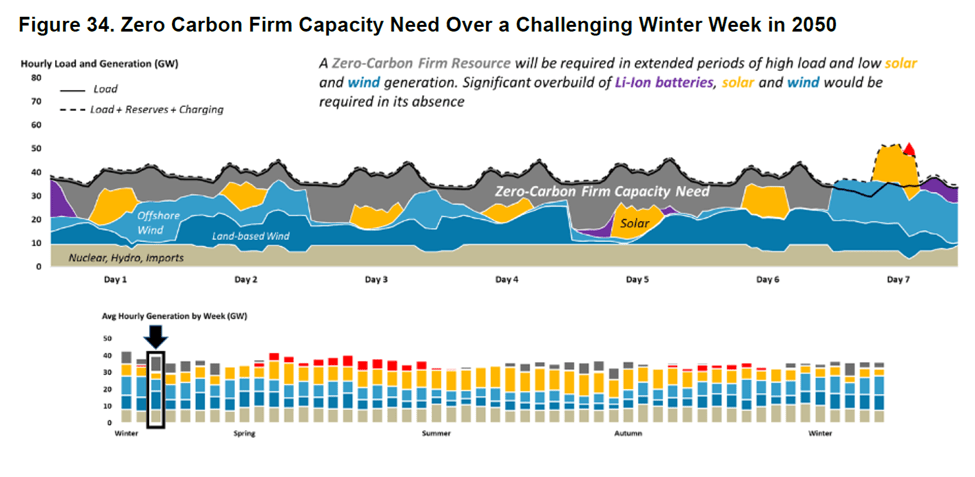
Just 15 years from now, the electric grid will need about 40 gigawatts of new generating capacity that can be activated regardless of wind speeds, cloud cover or other weather conditions, according to Anderson’s research.
How much is that? It’s roughly equal to the total capacity of all of New York’s current power plants – nuclear, natural gas, hydro, wind, all of it.
You read that right. To back up the massive quantities of solar and wind power that will provide most of our future electricity, the state power grid will need some new, mystery resource equal in size to the entire generating fleet of today.
The need for new, mystery DEFR, the potential quantity required, and the technological challenges for the resource are issues well known by those who understand the electric system. However, there is a loud and passionate segment of society who disagree that anything new is needed and reject the scale of the projected resource need. Anderson and Knauss understand that this is a touchy subject. Knauss writes:
Anderson knows that’s not easy to hear.
“That’s the thing, right?’’ she said. “Where people are going to start to worry is (to) say, ‘Okay, wait, so you’re telling us that we’re going to spend all this money building out all this wind and solar and batteries — AND we have to put in 40 gigawatts of this?”
But there will have to be a backup.
Knauss describes the analysis work done to generate the “mind-boggling” projections.
Anderson chairs Cornell’s department of biological and environmental engineering. She has a PhD in applied math and a master’s degree in engineering. For the past decade, she has worked with a shifting assortment of doctoral candidates and other graduate students in her eponymous Anderson Lab, housed in a large room full of cubicles and computers. They examine issues related to the growing importance of renewable energy.
The Anderson Lab is looking at the physics of how all that will work. To do so, they built an elaborately detailed computer model – a “digital twin’’ — of New York’s electric grid.
That level of detail sets their work apart. Many of the studies that look at phasing in renewable energy pretend that the electric grid is a single pool of electrons that flow from point to point without constraint. It‘s known as the “copper plate’’ assumption.
In reality, the New York electric grid is a complex, lopsided network that has been stitched together piece by piece over a century. There are limits on how much electric current can move from one area to another.
The six analyses that are described on my DEFR page all handle the electric system in similar fashions and all unequivocally conclude DEFR is needed. The reference to studies that use the “copper plate” assumption refers to the analysis that was used by the politicians who authored the Climate Act. It is the basis of the Climate Act presumption that implementation was simply a matter of political will because no new technology would be required. New York’s electric grid experts disagree. This contradiction needs to be resolved.
The Knauss article goes on to describe DEFR:
carbon-free generating plant that can be turned on and off as needed. It’s pronounced DEE-fur.
Today, dispatchable power is provided mostly by natural gas power plants. Energy planners hope to replace them with something that does not produce greenhouse gases. Nobody knows what that will be.
“They’ve come up with a name for something that they don’t know what it is, but their modeling shows that they need something. It kind of seems like dark matter in the universe,’’ said environmentalist Tim Judson, executive director of the Nuclear Information and Referral Service.
When the state’s Climate Action Council issued their December 2022 report on how the state will eliminate greenhouse gases from the grid by 2040, they estimated a need for 18 to 23 gigawatts of DEFRs. Anderson’s study concluded that the estimate should be roughly doubled, to 37 to 40 GW. In its most recent forecast, the NYSIO estimated a need for at least 20 GW of DEFRs, and as much as 40 GW, by the year 2040.
Knauss explains that Anderson is concerned about the need for DEFR and the quantity required as well as the ramifications of this new resource:
The need stems from two main vulnerabilities, Anderson said.
First, there will be lulls when the wind dies down for days on end and the skies cloud over, resulting in power shortages that exceed the current ability of batteries to compensate. Second, there will be periods when the state has plenty of renewable energy but not enough transmission capacity to get it where it’s needed.
There would even be times when Upstate produced too much renewable energy, which must be disconnected to keep from overloading the grid, even as blackouts rolled across Downstate due to bottled up transmission lines.
Most of those problems are likely to occur in the coldest part of winter and the hottest part of summer, when demand for electricity will surge to peak levels. And the region most vulnerable to blackouts would be Downstate, where communities with massive electricity needs sit at the end of transmission lines from Upstate that are often overloaded.
These issues raise a concern of mine. I maintain that there are unacknowledged challenges associated with weather variability risks associated with planning for the DEFR resources needed. The first challenge is calculating the resources needed which requires analysis of meteorological data to estimate resource availability and expected loads. I believe no one has done a comprehensive enough analysis because they haven’t used the longest period of data available, and they have not included adjacent regional transmission operator areas. The second challenge is more concerning to me. The evaluation of the meteorological data develops a probabilistic estimate of the resources needed that are analogous to the one in a hundred-year flooding parameter. The problem is that we often see a flood exceeding the one in hundred probabilities. It is inevitable that the weather conditions that caused the worst-case resource drought planning scenario will also be exceeded. When that happens there will not be enough electric energy available, blackouts are likely, and the consequences of blackouts on a society that decarbonized by using electricity will be catastrophic.
There is another issue relative to the aspirational Climate Act mandate to go to “zero emissions” by 2040. We need DEFR but the technology is not available. Knauss describes potential DEFR technologies:
Some experts propose converting power plants to burn hydrogen rather than natural gas. Or hydrogen could be used in fuel cells, which rely on chemical reactions rather than combustion to make electricity.
Others promote the idea of sequestering the carbon emissions from gas plants underground. Or burning “renewable” methane recovered from landfills and other sources.
Recently, New York officials have expressed interest in small advanced nuclear plants, which are under development by various companies. State energy planners are developing a “roadmap’’ that should be released early next year detailing how new nuclear technology might be encouraged.
None of the possible technologies is ready for commercial application. Which will emerge?
“That’s the million-dollar question,’’ said Lanahan Kevin Lanahan, a spokesman for NYISO, the grid operator.
The article goes on to note a difference of opinion regarding DEFR deployment. On one side is the electric industry who are obligated to provide reliable electricity.
New York is long overdue to identify DEFR technologies and to support their development, said Gavin Donohue, executive director of the Independent Power Producers of New York, a trade group representing power plant owners. IPPNY formally asked the Public Service Commission three years ago to decide what it will accept as “zero-emission’’ generating plants. The PSC is still mulling that over in a regulatory proceeding. “The timely development of fully dispatchable zero emitting resources is crucial to maintain reliability as the economy electrifies and reliance on intermittent renewable and duration limited resources increases,’’ the group wrote.
On the other side are the special interests who have no accountability.
But some environmentalists argue against a rush to develop DEFRs, saying it could distract from building wind and solar resources and could lead state officials to hastily subsidize unproven technology such as hydrogen combustion.
Following a technical presentation to the state Public Service Commission last year by Anderson and a NYISO planning director, representatives from Sierra Club and Earthjustice submitted rebuttal comments claiming that NYISO’s forecast of the need for DEFRs was “alarmist.” (The forecast presented by NYISO that day was about 25% lower than the Anderson Lab’s estimate.)
The critics said the state should focus on proven techniques such as importing power from out of state, improving transmission, and encouraging demand response programs under which customers cut their power consumption during peak periods. “Rushing to deploy expensive and untested DEFRs risks committing New York to flawed technologies, as it is unclear at the present time which technologies will emerge as commercially scalable and cost effective,’’ they wrote.
I responded to some of the referenced rebuttal comments because I think their analyses are naïve. In the first place, their analytical methodologies are not as sophisticated as the Anderson Lab. Secondly, they don’t acknowledge the correlation of wind energy across New York so their estimates of the magnitude of the problem are flawed. Knauss mentions the critics “solutions”.
It’s a complicated issue, in part because there are strategies other than adding power plants to help reduce demand for electricity during peak periods. Improvements in meter technology, for example, will enable residential customers to respond during power shortages by reducing their demand, as some commercial and industrial customers do already. Likewise, grid operators could one day draw power from electric vehicle batteries during peak periods.
This line of reasoning is naïve because it ignores the fact that DEFR is needed when the electric system energy requirements are highest. The conditions that cause light winds and low wind power output also cause extreme temperatures which lead to peak electrical loads. Those are the conditions when residential customers are not going to want to reduce power consumption. They will want to keep their homes warm!
The article goes on to discuss practical alternatives to the “mind-boggling” gap and the aspirational Climate Act schedule. Dr. Anderson suggested looking at slightly less stringent emission limits at least as a bridge until a DEFR solution is found.
Knauss also points out that the Anderson Lab work makes the optimistic assumption that all the wind and solar projected by the Hochul Administration actually gets built on schedule.
In reality, siting battles and other issues have stalled many large wind and solar projects for years. And as inflation drives up the capital costs of renewable energy, Gov. Kathy Hochul is under mounting pressure from business and consumer groups to keep the cost of the energy transition under control.
Because of those barriers, there is a vast gap between New York’s renewable energy capacity today and what would be needed to retire all the fossil fuel plants. Developers would have to build about 10 times the wind and solar power that exists now.
“It’s a huge problem, and we are so far behind,’’ Anderson said.
Conclusion
I think that the Knauss article does a great job explaining the intricacies of the DEFR issue and the work of the Anderson Lab. I believe they appropriately describe the challenges of DEFR. However, the article does not address the policy implications of DEFR.
The Hochul Administration has finally started its update of the NY Energy Plan. The draft scope of the plan considers an electric system that relies on wind and solar generation consistent with the Climate Act Scoping Plan. No jurisdiction anywhere has successfully developed such a system. The State agencies responsible for a reliable electric system agree with Professor Anderson that a wind, solar, and energy storage system requires DEFR. I believe that it is prudent to fund a demonstration project to prove that such an electric system will work. At the very least, the energy plan must provide a comprehensive renewable feasibility analysis to determine whether such a system will maintain affordability and reliability standards.
The most likely DEFR backup technology is nuclear generation because it is the only candidate resource that is technologically ready. Nuclear power has a proven record for resilient electric production, development would not require changes to support the transmission system and buildout the system, it is not limited by weather extremes, it has lower environmental impacts, and when life cycle and backup costs are considered is likely cheaper. Its use as backbone energy would eliminate the need for wind, solar, energy storage, and new DEFR deployment to meet Climate Act zero-emissions mandates.
Sierra Club and Earthjustice argue that DEFR is a distraction to their preference for wind and solar development. I believe that the work of the Anderson Lab provides support to my contention that renewable development should be paused because that development cannot work until DEFR is proven feasible. If the DEFR solution is nuclear then renewables are a dead-end approach.



 Pragmatic Environmentalist of New York