Fort Edward Solar Filings

On October 27, 2025, Fort Edward Solar responded to the Issues Statement, Party Status Request, and Public Comments on a Draft Permit. Simultaneously, the Office of Renewable Energy Siting (ORES) staff filed a responsive brief to the Petition for Full Party Status submitted by the Grassland Bird Trust for this project.  I previously described this project and published Gary Abraham’s explanation why ORES ignores local stakeholders.  In conjunction with Gary Abraham, this post describes the ORES responses and confirms my worst-case fears.

Gary Abraham is a lawyer who has been more deeply involved in the renewable energy siting process than I have. He represented a citizen group under State Environmental Quality Review Act (SEQRA) before Article 10 in the Everpower case (Town of Allegany). He represented municipalities or citizen groups in Article 10 proceedings in the cases of Cassadaga (the first Article 10 proceeding), Lighthouse Wind, and Alle-Catt and the Horseshoe Solar matter (Town of Rush) until it transferred to Office of Renewable Energy Siting under Exec. L. 94-c.

Overview

The Climate Leadership & Community Protection Act (Climate Act) established a New York “Net Zero” target (85% reduction in GHG emissions and 15% offset of emissions) by 2050.  The Climate Action Council (CAC) was responsible for preparing the Scoping Plan that outlined how to “achieve the State’s bold clean energy and climate agenda.”  After a year-long review, the Scoping Plan was finalized at the end of 2022.  Since then, the State has been trying to implement the Scoping Plan recommendations through regulations, proceedings, and legislation.  However, this does not mean that there is a feasible plan that includes milestones, acceptability criteria for targets or boundary conditions that must be met to continue. 

I think the crux of the problem is that the State never bothered to develop siting acceptability criteria to guide permitting decisions.  Combined with the ORES monomaniacal focus on permitting renewable projects without consideration of local concerns, environmental protections developed over years are routinely ignored.

Fort Edward Solar Filings

In my previous posts on this topic I have argued that the Fort Edward, Washington Co., PSC No. 23-03023 project is a travesty of ORES environmental siting considerations.  On October 27, 2025, Fort Edward Solar responded to the Issues Statement, Party Status Request, and Public Comments on Draft Permit.  Filings included the Fort Edward Solar cover letter with a memorandum prepared by WSP USA, an engineering and professional services consultant responding to avian issues; a facility location map, their response to public comments, response to issue statements, and a couple of conservation easement documents.  On the same day, ORES staff filed their Responsive Brief and Filing Letter.

Bird Habitats

The main issue with Fort Edward Solar is its location relative to grassland bird habitats.  In my opinion, responsible solar siting would focus first on land that has the least ecological or agricultural value.  As Abraham explains this is not the case:

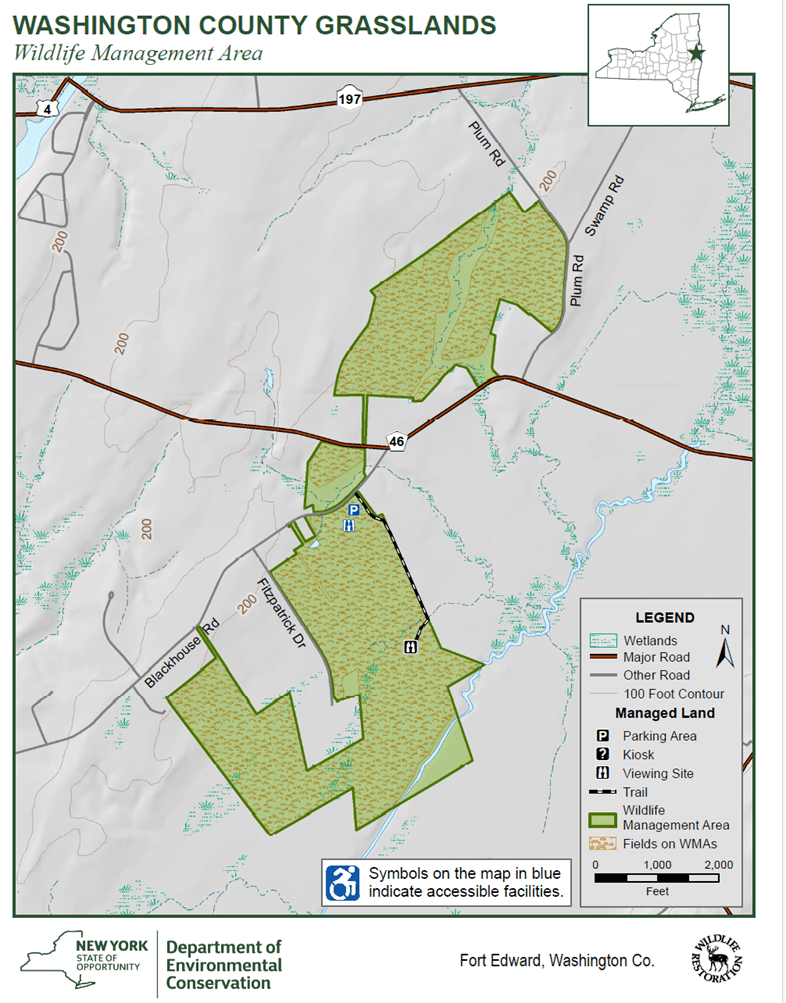
The grassland bird habitat map (Figure 1) was submitted by my colleague Ben Wisniewski, representing the Grassland Bird Trust, Inc., showing that “the Project is proposed to inhabit a unique area of extreme importance to birds. The 1,828-acre project site (the ‘Project Site’) lies within the New York State Department of Environmental Conservation (‘NYSDEC’) Washington County Grassland Bird Conservation Center (‘GBCC’). In addition, within the Washington County GBCC, the Washington County Grassland Wildlife Management Area (‘WMA’) serves as an anchor field for grassland birds.”

Figure 1: Attachment B Grassland Wildlife Conservation Areas near Fort Edward Solar Project
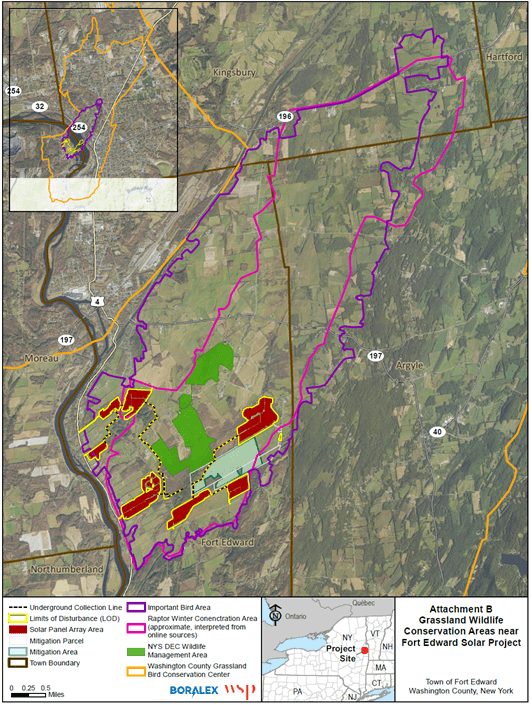
“The proposed Project Site surrounds the WMA and is situated within a recognized ecological area of critical importance for grassland birds . . .” Specifically, the WMA anchors the adjacent Audubon-designated Fort Edward Grasslands Important Bird Area (IBA), the NYNHP Raptor Winter Concentration Area, Grassland Bird Trust (GBT) properties, NYSDEC Grassland Wildlife Management Area, all areas known to be occupied by threatened and endangered bird species.

That’s why these areas are protected locally. The map, submitted with the party application, shows that the proposed solar project surrounds these areas, sharing their property lines. That is, as Ben showed, the project location is “inconsistent with the numerous special conservation designations and initiatives already applicable to the Facility Site.” ORES Staff now says none of that matters.

Avian Memorandum

WSP USA prepared an analysis that addressed the issues raised by Grassland Bird Trust (GBT).  The analysis addresses the following issues presented in the Fort Edward Solar Avian Impact and Mitigation Assessment prepared by GBT:

  • Value of Proposed Project Site for Grassland Birds
  • Impacts of Proposed Project on Grassland Birds
  • No Proof that Proposed Mitigation Provides a Net Conservation Benefit
  • Default Permit Conditions are Insufficient to Mitigate Impacts to Grassland birds in theWildlife Management Area (WMA)

I am not a biologist so I cannot opine upon the quality of the analysis.  However, I am familiar with the process.  Site surveys to determine which birds are in the area to be disturbed must be conducted.  As far as I can tell there is agreement about the species in the area.  Site surveys to determine current and future land use are also necessary and this is the controversial bit.  There isn’t agreement about the value of agricultural fields used as pasture lands or hay production relative to the quality of native forests, shrubland, and wetlands when “analyzed on a terrestrial habitat quality level.”

Another aspect of the process is that developers can mitigate impacts within the areas disturbed by their project by  obtaining protecting land nearby that has the habitat characteristics desired.  GBT argued that Fort Edward Solar would need to conserve substantially more land in order to provide a net conservation benefit.  The WAP USA analysis cited ORES regulation § 1100-6.4(o)(3)(ix) that reads as follows:

If the permittee proposes a NCBP [net conservation benefit plan] involving permittee-implemented grassland bird habitat conservation in lieu of payment of a mitigation fee pursuant to subparagraph (viii) of this paragraph, the required mitigation ratio shall be 0.4 acres of mitigation for every acre of occupied grassland bird breeding habitat determined to be taken and 0.2 acres of mitigation for every acre of occupied grassland bird wintering habitat determined to be taken.

The wetlands offset ratios specified by New York Department of Environmental Conservation (DEC) guidelines are typically 2:1 or 3:1 or much greater than the ORES regulation.  At the risk of stepping outside my expertise, it seems to me that the ecological values of wetlands are greater than grasslands so the mitigation offset ratio should be higher not lower.

Gary Abraham has extensive experience with environmental permitting.  He points out that in DEC permitting processes these tradeoffs would be addressed in the permitting process.  ORES simply ignores the tradeoffs and does not give parties a chance to present their side of the issue.  Abraham explains the differences.

The potential for adverse impacts on protected birds (a “significant” issue) is clearly proven by this map (making it a “substantive” issue, i.e., “a reasonable person would require further inquiry”, 16 NYCRR § 1100-8.3(c)(2)). 

In its response to Ben’s petition for party status on behalf of GBT, ORES Staff issued a brief concluding that there is no reasonable basis to inquire further, and recommending that ORES reject GBT’s issue (which it will undoubtedly do).

I want to reiterate my belief that ORES has shortchanged DEC and other agency recommendations because ORES does not address tradeoffs. The politicians who wrote the law implementing ORES (the RAPID Act) did not write the regulations that are being applied here. The RAPID Act purpose is plainly to “ensur[e] the protection of the environment”. PSL Art. VIII, § 136. ORES simply failed to do that here.  Abraham explains how this works.

Among other things, Staff says that the “NYSDEC Strategy for Grassland Bird Habitat Management and Conservation 2022-2027”, while in conflict with siting the project here, is not a required regulation, but rather a voluntary program. The Strategy (undoubtedly part of the state’s environmental policies) is thus magically not inconsistent with siting the project here (Staff says nothing in the Strategy “speaks to siting of the Facility in the proposed location”). The brief goes on to dismiss factual assertions that the project will adversely impact the other protected bird areas, including an Audubon’s Important Bird Area, despite the fact (acknowledged by Staff) that the project covers “15 percent of the IBA”. There is, according to Staff, no “authority that prohibits or limits siting of the Facility in this designated area.” But that’s because ORES does not site renewable energy facilities. Developers do that and are not required to consider alternative sites. ORES simply permits sites that developers select. It is a misnomer to say ORES sites projects. It does not. –Staff adds that the intervenor party has not “demonstrated that impacts have not been sufficiently identified” in the application. But that’s not the standard. The standard focuses on the potential for adverse impacts on the environment and whether, based on that potential, a reasonable person would want to know more about the impacts, not on legal prohibitions to renewable energy siting (which do not exist) which (as Staff argues) ought to preclude any further inquiry.

ORES Staff says it will be sufficient if the applicant makes a payment to the Endangered and Threatened Species Mitigation Bank Fund. See 19 NYCRR § 900-10.2(f)(1). But the ORES regulations require Staff to consider impacts on “Audubon Important Bird Areas”. NYCRR § 900-10.2(g)(3).

ORES says, for example, that a designated raptor wintering area, protecting endangered Short-Eared Owl and the threatened Northern Harrier, also located within the project area, is identified in the application which already acknowledges that the “wintering occupied habitat will be impacted”, but “the Office’s [ORES’s] Take Determination quantifies the impacts and therefore requires an NCBP [net conservation benefit plan]”, which in turn allows the applicant obtain a taking permit by doing no more than making a payment to the state’s E&T Species Mitigation Bank Fund.

Thus, because impacts on protected bird species are addressed in the application, there can be no significant issue. Therefore, there is no point to considering substantive proof on adverse impacts to the environment.

This is how ORES circumvents the “substantive” and “significant” standard for adjudicating issues that it inherited from NYSDEC (where it was an opportunity for public participation).

Public Comment Response

One of the filings on October 27 was a response to public comments.  I want to note just one example of the hypocrisy of the Fort Edward Solar developers.  The first comment from Janice Teft stated:

I am writing with respect to the plan by Fort Edward Solar to build a more than 1,828 acre solar Facility in Ft. Edward NY.

This project will cause great harm to grassland birds and endangered threatened raptors. It is the worst possible place for a solar facility. It’s time to stop taking land away from Wildlife in general.

I enjoy going there, especially in the Winter, to see the Snowy Owls. It’s an Audubon designated Important bird area.

The thought that this is even a possibly is so disturbing in so many ways.

All conserved land should be located in the important bird area, not some random place in NY.

And, the developer should work with the Grassland Bird Trust which has worked for over 15 years to protect this area.

Thank you for consideration of my comments

Janice Tefft

Here is the response of the developer:

The Applicant shares your commitment to environmental stewardship and has actively engaged with the appropriate regulatory agencies throughout the development of the project. Specifically, the Applicant has conducted consultations with the New York State Office of Renewable Energy Siting (ORES), the New York State Department of Environmental Conservation (DEC), the U.S. Fish and Wildlife Service (USFWS), and the U.S. Army Corps of Engineers (USACE). All documentation related to these consultations has been submitted and is publicly available within the official ORES docket for the Fort Edward Solar Project (Matter No. 23-03023).

The Applicant has been diligent in following the permitting process outlined by the State of New York, including comprehensive environmental assessments, coordination with regulatory agencies, and the development of mitigation strategies to address potential impacts to protected species and habitats. In support of this effort, the Applicant continues to work closely with qualified consultants to ensure thorough evaluation of all project components and the application of best practices.

The Applicant recognizes the ecological significance of the Fort Edward grasslands and understand the concerns regarding habitat loss and its potential effects on declining grassland bird populations. As such, the Applicant is committed to continue working with regulatory agencies, ORES, and stakeholders to develop mitigation measures that reflect the importance of this habitat.

This response has no substance; it simply reiterates that the developer followed the regulations and shows the environmental poverty of regulations. If Fort Edward Solar shared her commitment to environmental stewardship, then they would not have applied to build a solar facility on recognized ecological areas of critical importance.  Presuming that there was no other place in the state for their development then they would have proposed to mitigate their impacts by protecting more critical habitat than the ORES minimum.

Discussion

I believe that the Climate Act net-zero transition plan will do more harm than good because of impacts on affordability, reliability and environment impacts. In my opinion, the Andrew Cuomo and Kathy Hochul Administrations have politicized all the New York agencies.  Speed in approving developers’ sites has eclipsed the purpose of siting, to balance the need for renewable energy sites with the serious environmental degradation they often cause. Ultimately the problem is that the  Hochul Administration has never defined acceptability criteria for such sites.   The Climate Act and its progeny, the RAPID Act, have probably caused greater environmental degradation than it avoided.  As shown here, because ORES is the final arbiter the DEC charged with protecting the environment has little leverage in the siting decisions.

In my opinion, responsible solar siting would focus development in areas that do not affect ecological areas of critical importance period.  The WSP USA analysis incorporates every trick to minimize mitigation ratios.  Because grasslands are an interim successional stage, they argue that were it not for their commitment to maintain the grasslands, then the land would be dominated by woody vegetation.  So why doesn’t the developer build on land that is dominated by woody vegetation?

Conclusion

The ORES process ensures that renewable energy development causes more harm than good.  It is long past time to reconsider a process that prioritizes building as much renewable energy capacity as possible as fast as possible without any siting criteria.
New York Solar Siting Travesty

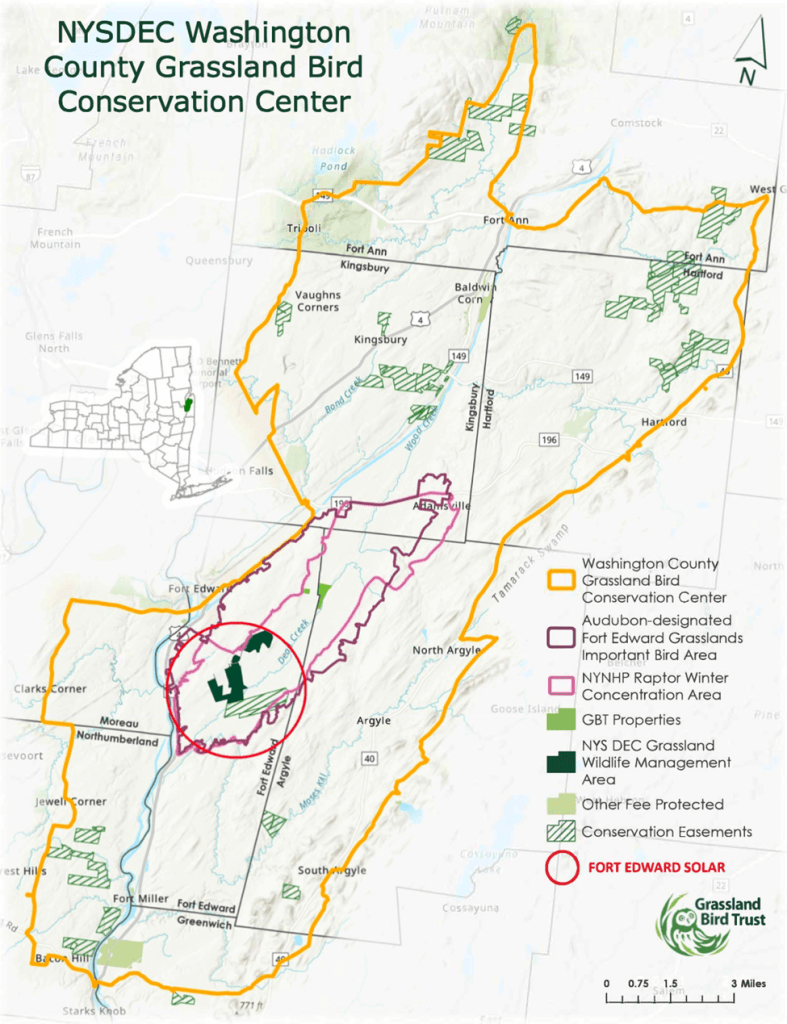
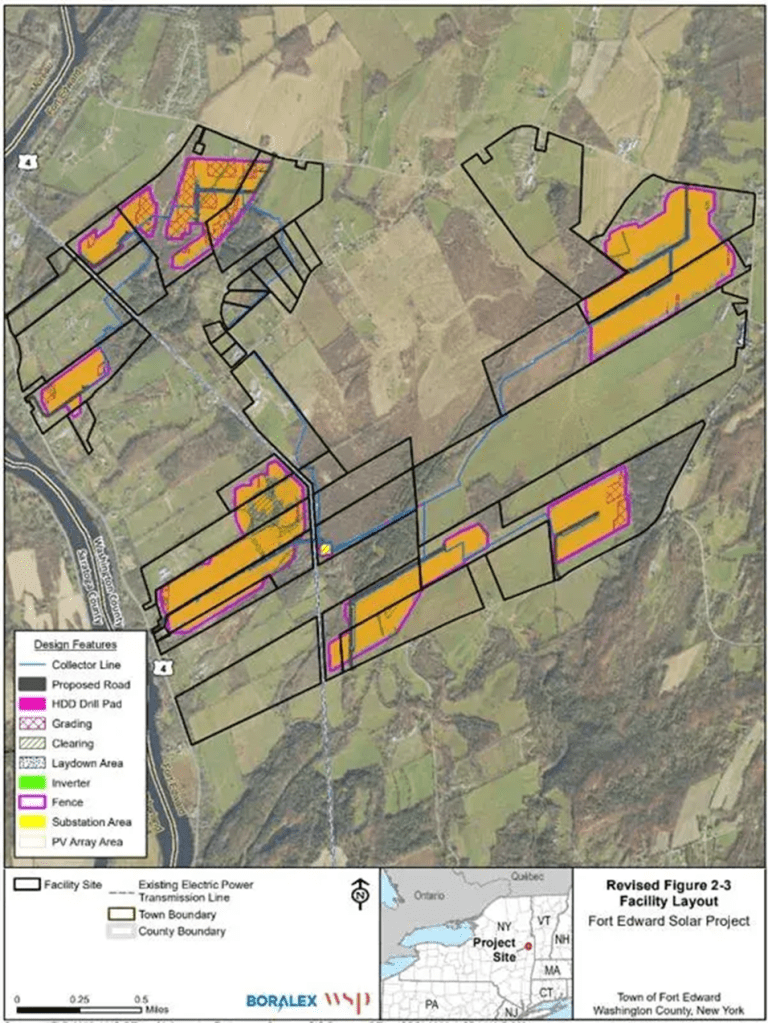
UPDATE 10/18/2025 – In response to a comment the Fort Edward Solar Site Map compared to Washington County Grasslands Wildlife Management Area has been added

In my opinion, the deployment of solar resources exemplifies the poor planning inherent in the Climate Leadership & Community Protection Act (Climate Act) net-zero transition plan.  One of my concerns is that the state process is not emphasizing responsible solar siting because facilities have been built on prime farmland.  I recently found out about a project that is going to be built adjacent to Department of Environmental Conservation (DEC) protected grasslands.  This is another “you have to be kidding me” solar siting travesty and indicates a bigger underlying issue.

I acknowledge the use of Perplexity AI to generate summaries and references included in this document.  Ethics-wise I also acknowledge that I am pushing the bounds of plagiarism simply because I don’t have time to re-write everything to dispel all claims of plagiarism.  I will, however, provide links to the Perplexity source material.  Note that my Perplexity queries are made through my account.  The AI program apparently keeps track of my queries and background so they include disconcerting, to me anyway, references to myself.

I am convinced that implementation of the Climate Act net-zero mandates will do more harm than good because of reliability and affordability risks.  I have followed the Climate Act since it was first proposed, submitted comments on the Climate Act implementation plan, and have written nearly 600 articles about New York’s net-zero transition.  The opinions expressed in this article do not reflect the position of any of my previous employers or any other organization I have been associated with, these comments are mine alone.

Overview

The Climate Act established a New York “Net Zero” target (85% reduction in GHG emissions and 15% offset of emissions) by 2050.  The Climate Action Council (CAC) was responsible for preparing the Scoping Plan that outlined how to “achieve the State’s bold clean energy and climate agenda.”  After a year-long review, the Scoping Plan was finalized at the end of 2022.  Since then, the State has been trying to implement the Scoping Plan recommendations through regulations, proceedings, and legislation.  However, this does not mean that there is a plan that includes milestones, acceptability criteria for targets or boundary conditions that must be met to continue.  As far as I am concerned, Climate Act implementation consists of building as many renewable energy resources as possible, as fast as possible without regard to the wishes of those people affected by those resources and hoping that it will all work out.

Renewable Permitting

Early in the process Climate Act proponents found that the New York State permitting process was slow.  I am familiar with those processes because I was involved with many projects over my career and I admit that they are slow and can be burdensome because there are extensive public participation requirements.  To make progress against those who just don’t want anything in their backyards, responsible State agencies developed extensive siting requirements.  If the proposed facility met all those requirements, then the public participation process incorporated them and worked with the public, so everyone understood what was necessary and made sure the proposal was consistent.

However, that takes time, and the Climate Act has an ambitious schedule.  Climate Act proponents successfully convinced the Legislature that a new siting process was necessary, and the Office of Renewable Energy Siting (ORES) was established.  My Perplexity research explains:

ORES, established under Executive Law Section 94-c through the 2020 Accelerated Renewable Energy Growth and Community Benefit Act, has authority to override local zoning and land use laws for major renewable energy facilities—those 25 megawatts or larger (with projects 20-25 MW able to opt in). This creates a two-tiered system where large solar farms fall under state jurisdiction while smaller projects remain subject to local control.​

The enabling statute explicitly grants ORES power to “elect not to apply, in whole or in part, any local law or ordinance” if it finds such laws “unreasonably burdensome in view of the CLCPA targets and the environmental benefits of the proposed facility”. This waiver authority operates on a case-by-case basis rather than creating blanket preemption.

I have been tracking solar permitting and its impact on prime farmland.  It is extremely disappointing that ORES has ignored guidance from other state agencies.  My latest article provides background on solar mandates   I also have a solar siting issues page that documents my concerns. 

Farmland Protection

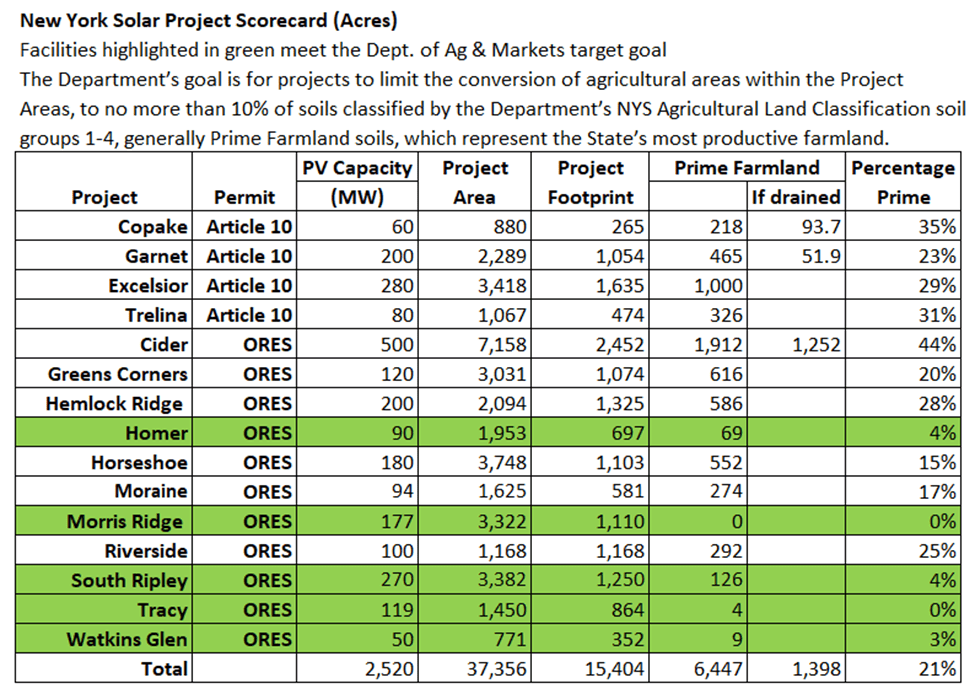
The New York Department of Agriculture and Markets has guidelines for solar siting.  New York Department of Agriculture and Markets testimony notes that “The Department’s goal is for projects to limit the conversion of agricultural areas within the Project Areas, to no more than 10% of soils classified by the Department’s NYS Agricultural Land Classification mineral soil groups 1-4, generally Prime Farmland soils, which represent the State’s most productive farmland.”  That seems reasonable to me because they are the Agency responsible for supporting New York agriculture.

I keep track of the status of projects with this guideline with a Prime Farmland Scorecard.  In May 2025 only 12 of the 25 facilities with data available at the Office of Renewable Energy Permit Applications site meet those guidelines.  Two facilities had no impacts on prime farmland.  If they can do it, why can’t others.

In my last article on the status of prime farmland, I noted that it is extremely frustrating to me that the Department of Ag and Markets recommendation was not adopted as a matter of course for solar development permitting.  Instead, the New York State Energy Research & Development Authority (NYSERDA) is studying the issue.

Last May I noted that I did not see any sign of urgency to finalize and implement farmland protections using the NYSERDA  scorecard.  The Smart Siting Scorecard Specialist Committee had three meetings early in this year but according to the website there hasn’t been any meetings since then.  Worse it does not appear that a solar development can get a failing grade for not doing smart siting.  In my opinion, this is lip service to the issue.

DEC Protected Land

I recently came across another example of ORES ignoring other state agency land use priorities.  In this case the Washington County Grasslands Wildlife Management Area (WMA) is threatened by the development of the Boralex Fort Edward Solar project.  My first Perplexity query produced this description of the WMA:

The Washington County Grasslands Wildlife Management Area (WMA) encompasses 478 acres of protected former agricultural lands in the town of Fort Edward, Washington County. The primary purposes are for wildlife management, wildlife habitat management, and wildlife-dependent recreation. The New York State Department of Environmental Conservation acquired these lands through multiple purchases:​

When I asked Perplexity AI how close the WMA was to the Boralex Fort Edward Solar Farm I got this response: “The Boralex Fort Edward Solar project is not merely “close to” the DEC-protected grasslands—the project is located directly on top of and within these protected areas, creating an unprecedented conflict between renewable energy development and established conservation designations.” 

Source: https://houseofgreen.substack.com/p/no-your-eyes-arent-deceiving-you

Alexandra Fasulo writing at the House of Green Substack has described this situation   She posed the obvious question:   

So how could it be that a New York State DEC Grassland Wildlife Management Area could play host to a solar corporation that plans to clear the vegetation and anchor solar panels deep into the earth’s soil?

I called the DEC to ask them this very question. Their answer was discouraging. The DEC told me that since ORES (Office of Renewable Energy Siting) was created in 2020 to “streamline the environmental review process” and circumvent local town laws/pushback that are deemed “burdensome,” the DEC has been largely shut out of all environmental conversations related to solar and wind “farms.”

The individual at the DEC shared in my exasperation and then told me he had not heard of this Fort Edward Solar project. I said to him, “This is a massive solar project that’s going in on top of DEC-protected and fragile habitat! How could this be?”

Again, he shared in my frustration and told me that the future of this land rests with ORES.

Discussion

I have allied myself with the Stop Energy Sprawl coalition because of our shared concerns.  In fact, this post was prompted by Fasulo’s presentation at a recent meeting.  We all share the same vision of a clean environmental legacy but are convinced that New York State’s implementation of the Climate Act is causing significant and irreparable harm to rural communities.  Everyone in the coalition shares the same frustration with ORES. My Perplexity research condenses our local community concern:

In practice, ORES’s authority creates what amounts to state preemption of home rule for large-scale solar development, though with important procedural protection. The statutory framework acknowledges this by requiring ORES to apply local laws unless they’re found unreasonably burdensome—establishing a presumption in favor of local requirements that must be overcome through specific findings.​

However, the “unreasonably burdensome” standard is evaluated explicitly in relation to statewide CLCPA mandates. This inherently weights the analysis toward state energy policy goals over local land use preferences.

It is not only the home rule implications.  I am positive that staff in the state agencies responsible for prime farmland protection and wildlife management areas share the frustration that their guidance is being ignored as illustrated by the responses to Fasulo.  I believe that all this is the consequence of the failure to plan the transition to Net-zero.  The blame for that can be placed squarely on the Climate Action Council who approved the Scoping Plan without including provisions for the development of a feasible transition consistent with existing environmental guidance and recommendations. 

The failure to plan has had negative consequences.  The decision to not require developers to meet the Department of Ag & Markets prime farmland protection guideline has led to the destruction of 6,650 acres of prime farmland.  Renewable developers have blown off Agency comments by saying that their guidance is only a recommendation.  If Boralex is allowed to destroy rare grassland habitat, then this will be a sad day for the environment of New York.

This was all preventable.  The claim that these programs had to be implemented as fast as possible because of the existential threat of climate change is no excuse.  If New York were able to eliminate all its GHG emissions, the effect of global emission increases elsewhere would supplant our efforts in one year.  New York GHG emissions are less than one half of one percent of global emissions and global emissions have been increasing on average by more than one half of one percent per year since 1990.  It is long past time to pause this process until safeguards consistent with State Agency guidance are incorporated into the ORES permitting decisions.  I also think that the public should be aware of the destruction of home rule actions by ORES.

Conclusion

This finding is a great example why I believe the Climate Act implementation can only do more harm than good.  It is time to hold the politicians who were responsible for this debacle accountable for their actions.  Revisions to the laws are necessary to prevent further harm.

Update 10/18/2025 in response to comment

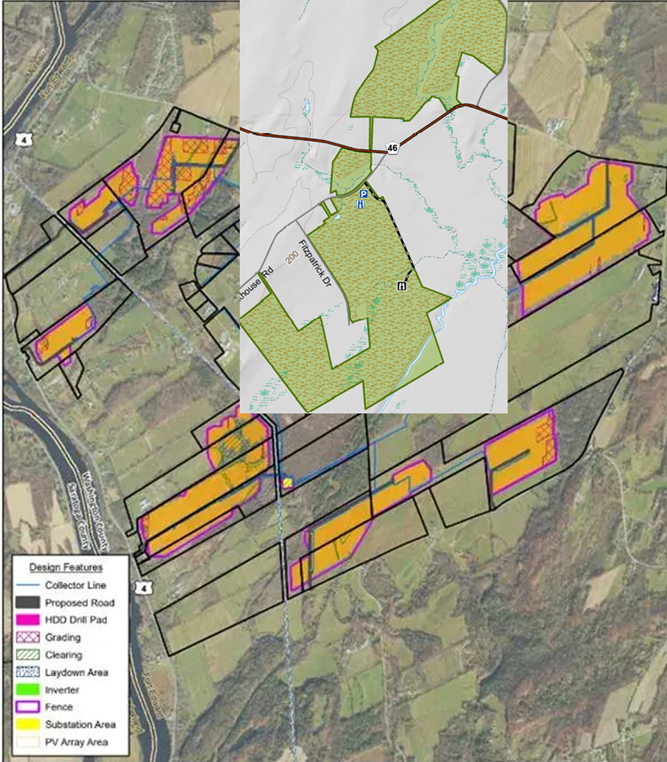
Fort Edward Solar Site Map

Washington County Grasslands Wildlife Management Area

Overlay Two Maps – Approximate Fit- However, the point is that the Boralex Fort Edward Solar panels will be close to the WMA and will impact similar land use types that the DEC is trying to protect. Given all the possible locations for solar projects, why does ORES allow development on this kind of land?

New York Solar Siting Status

I recently had the opportunity to give a briefing on solar siting issues and think it is time to publish an update here.  In my opinion, the deployment of solar resources exemplifies poor planning inherent in the Climate Leadership & Community Protection Act (Climate Act) net-zero transition plan.

I am convinced that implementation of the Climate Act net-zero mandates will do more harm than good because of reliability and affordability risks.  I have followed the Climate Act since it was first proposed, submitted comments on the Climate Act implementation plan, and have written over 500 articles about New York’s net-zero transition.  The opinions expressed in this article do not reflect the position of any of my previous employers or any other organization I have been associated with, these comments are mine alone.

Overview

The Climate Act established a New York “Net Zero” target (85% reduction in GHG emissions and 15% offset of emissions) by 2050.  The Climate Action Council (CAC) was responsible for preparing the Scoping Plan that outlined how to “achieve the State’s bold clean energy and climate agenda.”  After a year-long review, the Scoping Plan was finalized at the end of 2022.  Since then, the State has been trying to implement the Scoping Plan recommendations through regulations, proceedings, and legislation. 

Solar Mandates

Public Service Law Section 66-p requires the Public Service Commission (PSC) to establish a renewable energy program.   Subsection 66-p(2) requires the PSC to establish a program to require that 70% of the

statewide electric generation shall be generated by renewable energy systems; and that by 2040 the statewide electrical demand system will be zero emissions. This basically codifies the Scoping Plan outline for a decarbonized electric system.

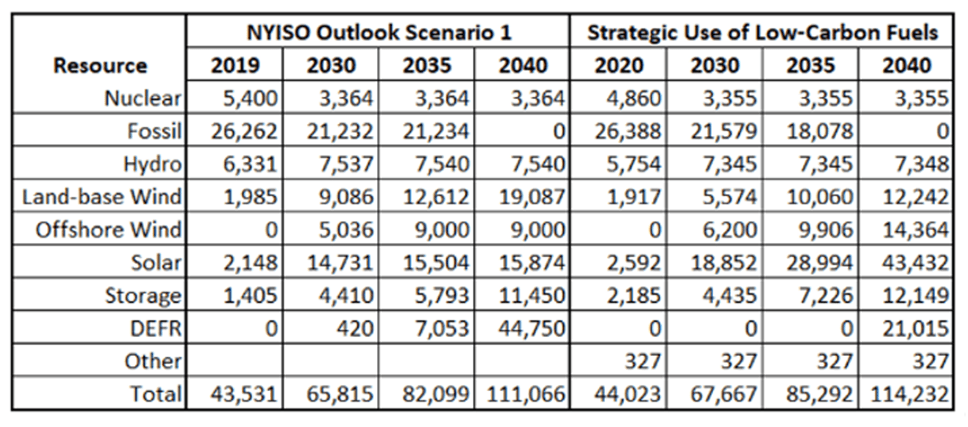
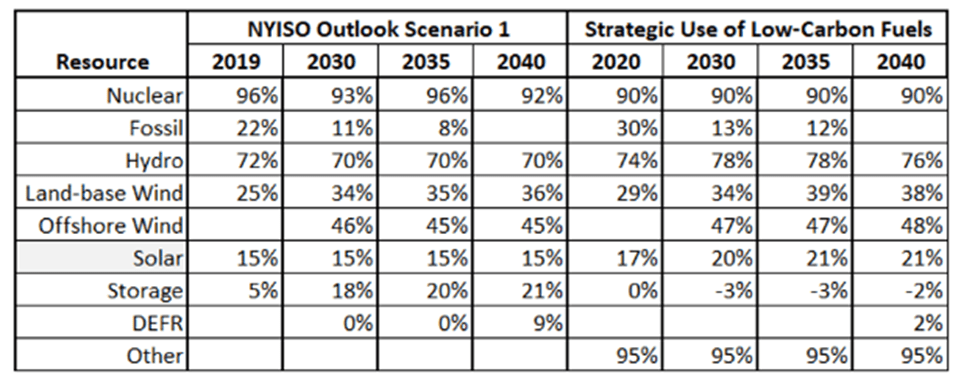
Both the Scoping Plan Key Drivers Output spreadsheet and the New York Independent System Operator (NYISO)  2021-2040 System & Resource Outlook  project a massive increase in New York solar capacity (Table 1).  Note that the solar generating capacity increases to over 20% of total capacity by 2030 for both scenarios.

Table 1: Installed Capacity (MW) NYISO Outlook Scenario 1 and Integration Analysis Mitigation Scenario 2 – Strategic Use of Low-Carbon Fuels

I have a solar siting issues page that documents my concerns.  In my briefing I highlighted three issues with the solar siting policy in New York since the inception of the Climate Act: protection of prime farmland, agrivoltaics policy, and inconsistency with the Scoping Plan,.  The farmland and agrivoltaics issues are addressed by Specialist Committees in the New York State’s Agricultural Technical Working Group.  At their last meeting in November 2024 there were updates for the Regional Agronomic Impacts of Solar Energy (RAISE) Specialist Committee, the Agrivoltaics Specialist Committee, and the Scorecard Specialist Committee that will be discussed below.

Farmland Protection

The New York Department of Agriculture and Markets has guidelines for solar siting.  New York Department of Agriculture and Markets testimony notes that “The Department’s goal is for projects to limit the conversion of agricultural areas within the Project Areas, to no more than 10% of soils classified by the Department’s NYS Agricultural Land Classification mineral soil groups 1-4, generally Prime Farmland soils, which represent the State’s most productive farmland.”  That seems reasonable to me because they are the Agency responsible for supporting New York agriculture.

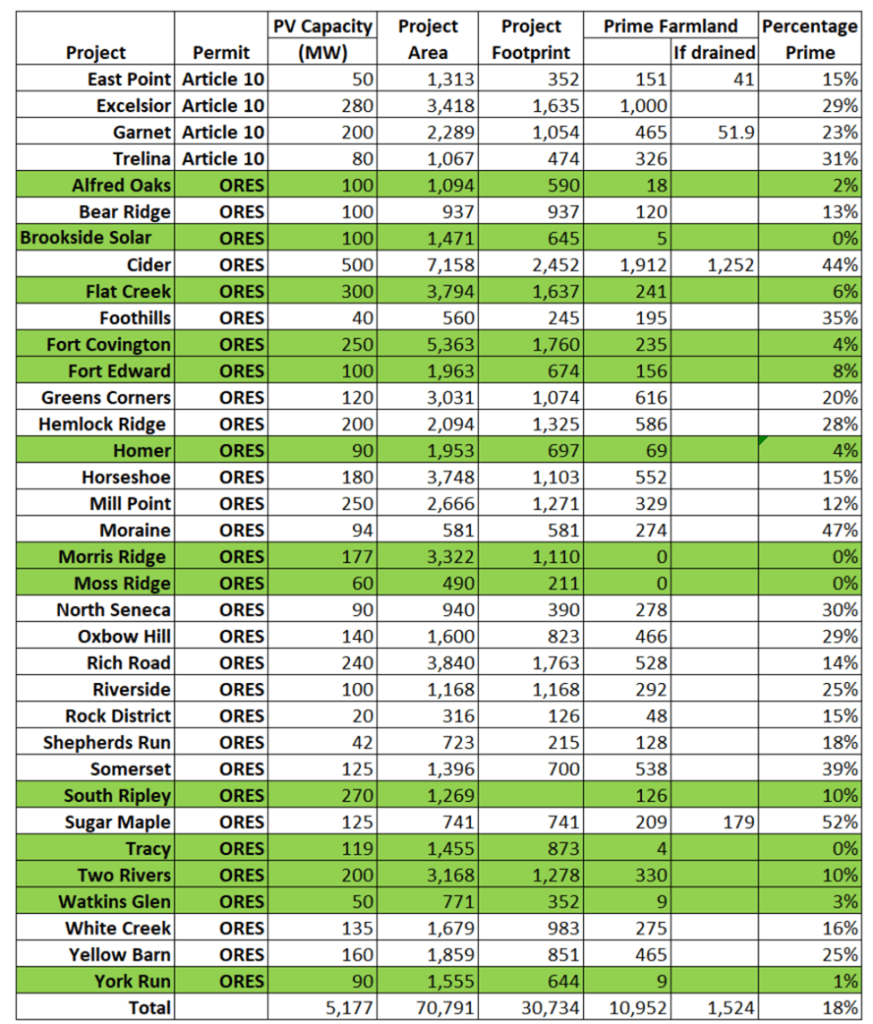
I keep track of the status of projects with this guideline with a Prime Farmland Scorecard.  At this time only 12 of the 25 facilities with available data at the Office of Renewable Energy Permit Applications site meet those guidelines.  Two facilities had no impacts on prime farmland.  If they can do it, why can’t others.

Table 2: Prime Farmland Scorecard Updated May 25, 2025

It is extremely frustrating to me that the Department of Ag and Markets recommendation was not adopted as a matter of course for solar development permitting.  Instead, the New York State Energy Research & Development Authority (NYSERDA) is studying the issue.  The Smart Siting Scorecard considers this siting concern:

NYSERDA has developed the Smart Solar Siting Scorecard to 1) provide a tool to address multiple solar siting considerations and site management practices from the perspective of environmental, agricultural, and climate interests and 2) to provide criteria for renewable energy developers to consider in siting future projects, and include within project design, operations and maintenance, and decommissioning plans to encourage a balanced approach between renewable energy siting and other New York State policies, goals, and objectives. The Scorecard Specialist Committee provides input to NYSERDA on what avoidance and minimization approach to reduce impacts on these lands and how to value these approaches in a Scorecard format.  

I do not see any sign of urgency to finalize and implement farmland protections using the scorecard.  The Smart Siting Scorecard Specialist Committee has had three meetings this year:

Worse it does not appear that a solar development can get a failing grade for not doing smart siting.  In my opinion, this is lip service to the issue.

Agrivoltaics Policy

In my opinion, responsible solar siting policy would include agrivoltaics requirements that would mitigate impacts to agriculture.  NYSERDA is in charge of agrivoltaics policy: 

Agrivoltaics is a new and emerging combination of technologies that enhance climate resilience and allow sustainable food and energy production. From crop production to livestock grazing and pollinator habitat, agrivoltaics can support a wide range of agriculture practices.

This rapidly growing sector of the solar energy industry is undergoing considerable research, development, and demonstration in the United States and across the globe.

For the latest information and guidance, read the Growing Agrivoltaics in New York State report [PDF].

The New York State’s Agricultural Technical Working Group’s (A-TWG) Agrivoltaics Specialist Committee manages the agrivoltaics policy.  Based on the update at the A-TWG meeting last November, they have meetings and train farmers.  NYSERDA is supporting their efforts with the Agrivoltaics Research and Demonstration Request for Proposal (PON 5752).  The deadline to submit proposals was Sept 12th and contracts were supposed to be awarded in the first quarter of 2025. Nothing has been funded yet.

There is another agrivoltaics study: Regional Agronomic Impacts of Solar Energy (RAISE):

In 2022, the State Farmland Protection Working Group recommended the State initiate a study, to determine the potential benefits and/or burdens of renewable energy development related to New York’s agricultural industry. NYSERDA has convened a Specialist Committee under the A-TWG to assist NYSERDA to undertake a study or studies to assess the impact of solar development on the agricultural economy in the state. The study will inform State and regional policy, and will include an assessment of land use conversions, economic pressures, and other factors. The RAISE Specialist Committee shall:

  • Advise on developing scope(s) of work and associated study methodologies.
  • Identify information, data, and resources helpful to undertaking associated agricultural, economic, land use and other analyses.
  • Make recommendations on undertaking additional studies or actions.

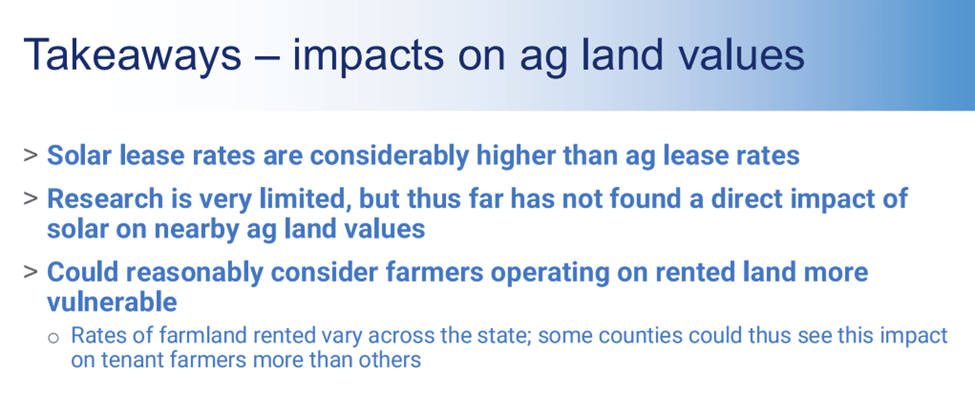
I have found that NYSERDA sponsored research related to the Climate Act is designed to further the narrative that the transition is simple, cheap, and has inconsequential negative impacts.  The RAISE presentation at the last A-TWG meeting described takeaways for the impacts of solar development on agricultural  land values illustrates this on the following slide.  If solar lease rates are higher than agriculture lease rates, then it is obvious that landowners will preferentially lease to the solar developers making it more difficult for farmers who need to lease land to operate.  Note the weasel words – “limited research”, no “direct impact”, and could be “more vulnerable” in the description that try to avoid concluding the obvious.  The longer this report takes to be released the longer these negative impacts will persist and the more the developers can continue to negatively impact agriculture.

Scoping Plan Inconsistency

The capacity factor is a measure of how much energy can be provided by a generating facility in a year.  It is simply the amount of energy produced (MWh) divided by the capacity (MW) times the number of hours in the year.  Table 3 lists the capacity factors for the resources listed in Table 1. In my opinion, the Scoping Plan solar capacity factors are biased high.  I believe the only way these factors can be achieved is if the installed solar facilities use tilting axis solar panels.

Table 3: Capacity Factors (%) NYISO Outlook Study S-1 and Scoping Plan Scenario 2

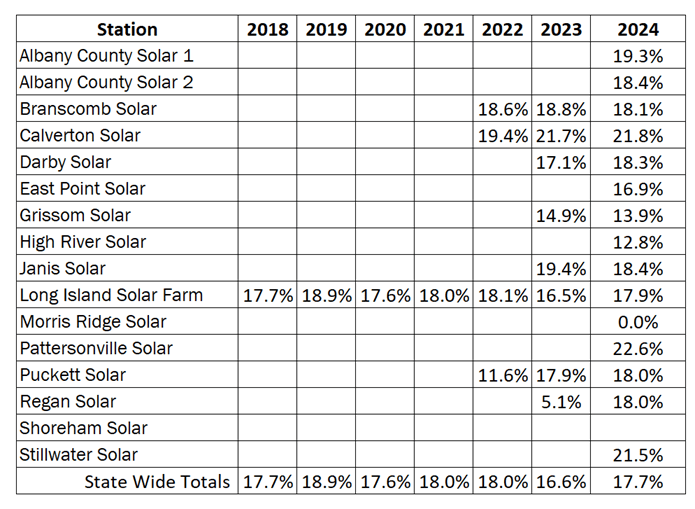
I recently reported on the observed capacity factors of solar facilities.  Table 4 lists individual station factors.

Table 4: New York State Utility-Scale Solar Facility Capacity Factors Based on NYISO “Gold Book” Load & Capacity Data Reports Table III-1

Assuming a linear interpolation between the Scoping Plan Strategic Use of Low Carbon Fuels 2020 capacity factor of 17% and the 2023 factor of 20%, the expected capacity factor was 18.2%.  The observed capacity factors are lower than the Scoping Plan projection and I believe that is likely because NYSERDA does not require solar developers to install tilting axis solar panels to obtain subsidies from the State.

Discussion

The Scoping Plan is just an outline of emission reduction strategies that NYSERDA claims will achieve the goals of the Climate Act.  There never has been a feasibility analysis that proves that the Public Service Law Section 66-p requirement to establish a renewable energy program can work and there are no jurisdictions anywhere that have successfully developed an electric system that relies primarily on wind, solar, and energy storage. As far as I can tell, the Hochul Administration plan is to build as much wind and solar as possible, as fast as possible. That approach meant that there was no provision to develop responsible solar siting guidelines. 

The failure to plan has had negative consequences.  The decision to not require developers to meet the Department of Ag & Markets prime farmland protection guideline has led to the destruction of 6,650 acres of prime farmland.  The lack of an agrivoltaic policy means that very few developers are trying to mitigate the impact of solar panels.  The failure to require utility-scale solar facilities to use tilting-axis solar panels means that even more land will be covered in solar panels.

This was all preventable.  The claim that these programs had to be implemented as fast as possible because of the existential threat of climate change is no excuse.  If New York were able to eliminate all its GHG emissions, the effect of global emission increases elsewhere would supplant our efforts in one year.  New York GHG emissions are less than one half of one percent of global emissions and global emissions have been increasing on average by more than one half of one percent per year since 1990.  

Conclusion

NYSERDA has lost its way as a source of unbiased scientific information to guide energy policy in New York.  Their Climate Act responsibilities are opaque, their work products are biased to support the political narrative, there is no sense of urgency to address obvious deficiencies in current policy, and they do not respond to stakeholder concerns.  This has significant negative consequences for New York.

I cannot help but think that there is another reason for the development policy to build as much as possible as fast as possible.  The developers of these facilities push that narrative because they know that limits on using prime farmland and mandates to use tilting-axis solar panels will hurt their profitability.  It is all about the money.

Solar Developer “Disinformation” Reality

Charles Rotter passed along a link to an article by a solar energy developer in New York that claims disinformation campaigns were hurting New York’s implementation of the Climate Leadership and Community Protection Act (Climate Act).  After I looked at the article, I can safely say that it’s another example of my pragmatic environmental principle Observation on Environmental Issue Stakeholders: The more vociferous/louder the criticisms made by a stakeholder the more likely that the stakeholder is guilty of the same thing.  This post looks at disinformation claims associated with a solar development project in New York.

I have followed the Climate Act since it was first proposed, submitted comments on the Climate Act implementation plan, and have written over 400 articles about New York’s net-zero transition. The opinions expressed in this post do not reflect the position of any of my previous employers or any other organization I have been associated with, these comments are mine alone.

Overview

The Climate Act established a New York “Net Zero” target (85% reduction in GHG emissions and 15% offset of emissions) by 2050.  It includes an interim 2030 reduction target of a 40% reduction by 2030 and a requirement that all electricity generated be “zero-emissions” by 2040. The Climate Action Council (CAC) was responsible for preparing the Scoping Plan that outlined how to “achieve the State’s bold clean energy and climate agenda.”  In brief, that plan is to electrify everything possible using zero-emissions electricity. The Integration Analysis prepared by the New York State Energy Research and Development Authority (NYSERDA) and its consultants quantifies the impact of the electrification strategies.  That material was used to develop the Draft Scoping Plan outline of strategies.  After a year-long review, the Scoping Plan was finalized at the end of 2022. 

Correction 6/13/2024: Keith Schue contacted me to say that I had used the wrong numbers in this statement: “The Integration Analysis projects that 5,574 MW by 2030 compared with 21,058 MW in 2023 so solar deployment must double over the next seven years.”  Boy did I ever use the wrong numbers.  Those are the onshore wind numbers.  The utility-scale solar facility capacity that is included in the NYISO market in 2023 was only 254 MW and the Behind the Meter (BTM) distributed solar included in the Integration Analysis estimate was 5,172 MW for a solar total of 5,426.  NYISO projects that BTM solar in 2030 will be 10,015 MW and the Integrated Analysis projected 2030 solar capacity is 18,646 MW which means that utility-scale solar capacity will have to increase from 254 MW to 8,631 MW.

Hecate Energy Shepherd’s Run Solar Farm

Hecate Energy’s Shepherd’s Run is a 42 MW utility-scale solar facility located in Copake, NY in the Hudson River Valley southeast of Albany.  According to Hecate: “It will be configured as a ground-mounted solar facility with PV panels on galvanized steel tracker racking structures. It will include rows of single-axis trackers, oriented in a north-south direction, that rotate the PV panels from east to west following the sun’s daily path.”  They also claim that “The 42-MW solar farm is expected to annually generate approximately 70,000 MWh of energy — enough to meet the average annual consumption of over 9,500 New York households.”  That works out to a capacity factor of 19.3%.  The permitting documents note that the project area is 880 acres, the project footprint is 267 acres and there will be 138.3 acres “located inside the Project security fencing” which I assume means that is the area to be covered by solar panels.

This area of the Hudson Valley has attracted influential folks with money from New York City because of the beauty and rural character of the region which has led to a couple of things.  I think that contributes to the attention this project has received in the national media.  Bloomberg Opinion described it as “The Solar farm that almost destroyed Copake, NY”.   In a Reveal podcast, The Center for Investigative Reporting also addressed the project in “Sunblocked: Resistance to Solar in Farm Country” with the byline “Across the country, rural communities are pushing back against large-scale solar development”.  The other aspect of the moneyed class influence is the desire and the money to fight against anything that detracts from the reasons the “Citidiots” invaded this area.

In 2017 Hecate identified this area for solar development because it offered room for solar development, a nearby electrical substation, and according to the Bloomberg article “Democratic political leadership, and a relatively liberal bent, Copake seemed poised to be a welcoming environment for renewable energy.”  I believe Hecate originally submitted a permit application under New York’s original electric utility siting program, but I cannot find any links for that application.  However, local opposition sprang up early in that process.  The town changed its zoning rules to stymie large solar developments.  Hecate changed to a new permitting process implemented to expedite renewable energy development.  On November 23, 2021, they submitted a notice of intent to file for an application to the New York State Office of Renewable Energy (ORES) that can overrule any “home rule” regulations by the residents directly affected by a solar or wind facility.

The local NPR account of the status of the project, Shepherd’s Run solar farm moving ahead in Copake, produced last November noted:

In June 2021 the town of Copake joined 12 other municipalities along with some environmental and conservation advocate organizations in filing a lawsuit in state Supreme Court of Albany County against the state Office of Renewable Energy Siting, an agency created to fast-track the permitting process for new renewable energy projects. The suit alleged that the agency was attempting to circumvent local zoning laws. In May 2023, Justices of the Third Department state Appellate Court upheld a lower court ruling dismissing the lawsuit.

The NPR article went on to explain the remaining parts of the permitting process that included public hearings in January.  However in early January the public hearings were called off because the Town of Copake filed a motion to dismiss the application because 60 acres of the project property were sold to someone who did not want anything to do with the project.  The ORES permit application website notes under “denied applications” that the application was denied without prejudice.

Disinformation Campaign

After years of effort and cost, Hecate was not happy with the decision.  The article “Disinformation Campaigns Are Hurting New York’s Clean Energy Future” was published at RealClearEnergy and authored by Matt Levine who is the “project director for the Shepherd’s Run Solar Farm and senior director of development for Hecate Energy.”  He claims that the opposition was the result of disinformation as noted in the excerpts below.

After the obligatory praise for “the ambitious goals set by the landmark climate law passed in 2019” he jumps right into the evils of disinformation campaigns:

Whether or not you support accelerating clean energy projects, we should all be able to agree that disinformation campaigns are a disservice to the public. Honest policy debates demand clear and accurate information. But earlier this year, NPR highlighted the prevalence of disinformation and increasing pressure on local officials, who are often charged with approving renewable energy projects.

Their reporting focused on groups like Citizens for Responsible Solar, who are part of a growing national effort to orchestrate opposition to renewable energy in rural communities across the U.S. The national group has helped smaller local groups fight solar projects in at least 10 states, according to its website.

This NPR article referenced a group called Citizens for Responsible Solar that argues that “Solar belongs on rooftops, near highways, commercial, industrial-zoned land, marginal or contaminated areas, not on rural-agricultural land.”   The organization and a group of locals organized opposition to a solar project in Virginia but there is no indication that there is any link between that group and anything at the Shepherd’s Run Solar Farm.  Levine goes on:

By blocking projects that could generate economic activity and passive tax revenue in rural areas, these campaigns are hurting the communities they purport to protect, both economically and environmentally. Nevertheless, groups like these are becoming so successful at spreading disinformation that a 2022 report by the Sabin Center at Columbia University found 121 local policies around the country that are aimed at blocking or restricting renewable energy development, a 18% increase from the previous year.

Solar developers are quick to point out that a landowner gets revenue when a solar project is developed and there are tax incentives.  However, when land is taken out of production it will reduce farm jobs. While economic activity may be improved during construction once the facility is operational there are very few economic benefits to essential local businesses.  Furthermore, taking the land out of production may make other farmers who have been renting that land to make their operations viable will not be able to support investments they have made in facilities, livestock, or equipment.  Levine continues:

In New York, an investigation by the Public Accountability Initiative found that since 2016, a multifaceted campaign by the fossil fuel industry has spent more than $15.5 million to undermine efforts to promote clean energy. Unfortunately, much of that work has relied on false and misleading information.

The claim that there is an enormous effort by the fossil fuel industry to provide false and misleading information ignores the funding and level of effort by non-governmental organizations who espouse the climate industry’s narrative and the source of their funding.  The Natural Resources Defense Council had a total income of $193,144,386 and paid $125,417,997 in salaries in 2023.  Their experts web page notes a position for the Utility Regulatory Director, New York, Climate & Energy and that 69 other experts have done analyses in New York.  That is just one organization.  There are dozens more organizations in New York that support the climate industry and their work is rife with false and misleading information.

The playbook is usually the same. Groups with innocuous sounding names — New Yorkers for Affordable Energy, for example – claim the mantle of grassroots support while actually doing the bidding of the natural gas industry. They lean heavily on misleading industry talking points that falsely claim the transition to renewable energy would “damage New York’s families and businesses.

I can find nothing to disagree with his characterization that New Yorkers for Affordable Energy is funded by the natural gas industry.  However, the docket for the project does not include anything from the organization or the one individual mentioned on their web page in the 627 filed documents or the 1,000 public comments in the docket for the permit.  He simply names an industry supported organization and suggests that their very existence is unacceptable.

Eventually Levine gets to Shepherd’s run and blames misinformation as the reason that there was so much vociferous opposition.

As a renewable energy developer working in several states in the Eastern U.S., I see the impact of these efforts on the ground. Take the town of Copake in Upstate New York, where Hecate Energy plans to build the 42 GW Shepherd’s Run Solar Farm.

This is exactly the type of project New York must accelerate if the state has any chance of meeting the state’s renewable energy goals. Yet, opponents have implemented tactics that have delayed the project for years, running the now-standard playbook.

See if this sounds familiar: a group with an innocuous sounding name – in this case Sensible Solar for Rural New York – bills itself as a grassroots organization and claims to support clean energy. Media reports and state disclosure forms show them hiring the same lobbying firms and marketing teams employed by the fossil fuel industry and its allies to oppose clean energy projects.

They echo the same talking points used by national opposition groups, relying on false or misleading claims about farmland being permanently destroyed, adverse impacts to nearby watersheds, and reduction in property values.

I recommend the Reveal Podcast “Sunblocked: Resistance to Solar in Farm Country” because it describes the nuances of the Shepherd’s Run support and opposition.  Interviews with one family that sold leases to Hecate, Hecate spokesmen, another farmer who was using the land that will no longer be available, Town Board members, an expert on support and opposition to similar projects, and organizers of Sensible Solar for Rural New York provide a good cross section of those involved.  While some of the opponents were against the project simply because it is in their backyards many argued that they would accept the project if it were done sensibly.

I was involved in many development projects in my career, so I sympathize with the Hecate project developers.  There is no way that you can make everyone happy, and some individuals will never be satisfied.  In my opinion, the solution is to be upfront with the facts and be sure to meet or exceed all the regulatory guidance. 

Prime Farmland

I am not a big fan of solar development in New York and have published a page that describes my concerns.  My biggest concern is that the Hochul Administration has not required solar developers to adhere to all the NYS Department of Agriculture and Markets (NYSDAM) guidelines that have been described in prepared testimony that I believe represent best practices and should be mandatory going forward.  In particular, “The Department’s goal is for projects to limit the conversion of agricultural areas within the Project Areas, to no more than 10% of soils classified by the Department’s NYS Agricultural Land Classification mineral soil groups 1-4, generally Prime Farmland soils, which represent the State’s most productive farmland.”   I think this is a reasonable guideline and one that should be a mandatory requirement for all future projects.

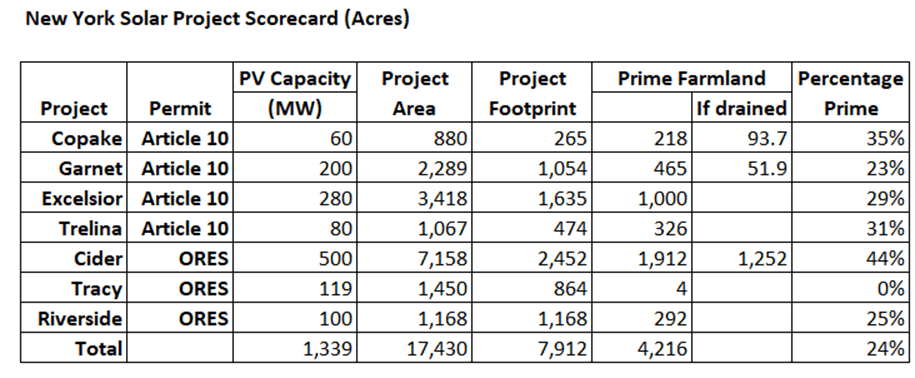
The initial application for the project Agricultural Appendix 15 February 2022 stated that: “Relative to agricultural soils, the Project Area includes approximately 12.41% (218.00 acres) of land classified as Prime Farmland, 5.33% (93.70 acres) as Prime Farmland if Drained, 10.27% (180.42 acres) as Farmland of Statewide Importance, and 21.99% (386.44 acres) as Not Prime Farmland.”   Note that they admit that they exceed the NYSDAM guidelines.

In a revised version of the Agricultural Appendix submitted on January 2023 this discussion is revised:

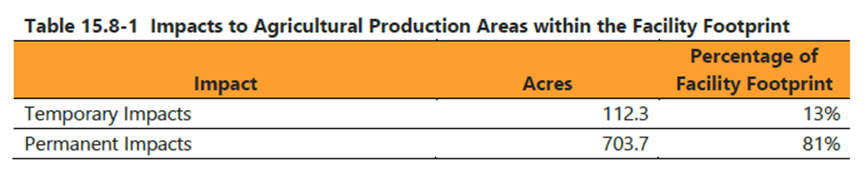
The total Project Footprint will include approximately 265 acres and includes the limits of all temporary and permanent impacts associated with the construction and operation of the Project.  There are 197.69 acres of active agricultural land in the Project Footprint. The Project is designed within a fenced and contained area, and no active agricultural practices will occur within the fenced area containing the solar arrays during the operation of the Project. Therefore, the applicable NYSDAM Guidelines will be followed during construction with respect to temporary features (such as construction laydown yards). If applicable NYSDAM Guidelines cannot be implemented, the Applicant will consult with NYSDAM to discuss acceptable and appropriate alternatives. The Applicant will follow the NYSDAM Guidelines during Project decommissioning and site restoration.

Two comments on this.  The prime farmland numbers are missing and the NYSDAM Guidelines they refer to are the construction guidelines and not the guidelines for the protection of prime farmland that NYSDAM staff references in their prepared testimony for every application.

The final Revised Agricultural Appendix dated June 2023 included the following:

Hecate Energy Columbia County 1 LLC (the Applicant) has developed this Agricultural Plan in accordance with 19 NYCRR § 900-2.16 in order to avoid, minimize, and mitigate agricultural impacts to active agricultural lands within NYS Agricultural Land Classified Mineral Soil Groups (MSG) 1 through 4 to the maximum extent practicable, consistent with the New York State Department of Agriculture and Markets (NYSDAM) Guidelines for Solar Energy Projects (“NYSDAM Guidelines” or “Guidelines”).

Two comments on this section.  The reference to prime farmland has switched to the technical description of soil types and the references to Guidelines are again for the construction impacts.  The phrase that they tried to avoid, minimize, and mitigate agricultural impacts is not exactly true because they picked only the NYSDAM guidance that that they were required to follow.  Furthermore, in response to a notice of incomplete application they were asked to provide the acreages for each soil classification.  Their response in the final revision states:

There are approximately 200 acres of active agricultural land in the Project Footprint. As described in Exhibit 15 Section 15(b) of the Application, of the 199.98 acres of active agricultural land in the Project Footprint, 143.86 acres are classified as MSG 1-4. The Project is designed within a fenced and contained area, and no active agricultural practices will occur within the fenced area containing the solar arrays during the operation of the Project. Of the 162.8 acres of MSG 1-4 in the Project Footprint, and 143.86 acres are identified as active agricultural land. Therefore, the applicable NYSDAM Guidelines will be followed during construction with respect to temporary features (such as construction laydown yards) and permanent features (such as permanent access roads) within the 143.86 acres of active agricultural lands, as defined by 19 NYCRR § 900-2.16(c), within New York State Agricultural Land MSGs 1-4. If applicable NYSDAM Guidelines cannot be implemented, the Applicant will consult with NYSDAM to discuss acceptable and appropriate alternatives. The Applicant will follow the NYSDAM Guidelines during Project decommissioning and site restoration.

Note that the incriminating percentages were not included.  Obfuscation is the name of the game for the acreages.  Elsewhere the project footprint is listed as 267 acres but here they describe the active agricultural land (200 acres).  They do admit that 143.86 acres are prime farmland and that works out to 16% of the project area of 880 acres (also not provide in this paragraph) far exceeding the NYSDAM protection of prime farmland protection guidance of no more that 10%.

Maps of the locations of prime farmland and the location of the solar panels show that the developers chose the expedient and cheapest development option.  If the land is flat and has no trees then installing solar panels is simplified.  The example map below shows why the residents are so exercised by the development.

Figure 15-11. Map 3 of 5 ORES and Local Zoning Requirements with MSG 1-4 Soils-Active June 2023

Discussion

The Hochul Administration has not mandated that utility-scale solar development must comply with all Department of Agriculture and Markets guidelines.  Solar developers routinely ignore that guideline.  My latest scorecard of this parameter shows that only seven of the 20 projects included as updated in March 2024 met the prime farmland guidance and that overall solar projects have destroyed 8,801 acres of prime farmland and totaling 20% of the project areas.  However, it does show that meeting the guideline can be done.

This is not the fault of the solar developers.  In the absence of any requirement to meet that guidance the cost-effective solution for the out-of-state developers is to ignore the guidance.  The fact that the Hochul Administration has instituted that requirement for smaller distributed solar projects is infuriating to me and has the distinct whiff of cronyism and lobbyist influence.  That is not the only missing protection.  There are no requirements for agrivoltaics that at least try to support farming or requirements for tilting axis solar panels consistent with the implementation plans.  To their credit, Hecate was planning to use the tilting axis panels and their projected a capacity factor of 19.3% is better than last year’s statewide average.  Using fixed panels means that more panels must be installed.

I do not have any sympathy for Hecate project manager Matt Levine’s claims that a pervasive cult of fossil-fuel funded disinformation was the primary driver for the opposition to the project.  Clearly, they took the expedient approach to develop the prime farmland in the project area knowing full well that it exceeded New York guidelines for farmland protection.  Moreover, the language in the article and application cover up that decision.  If the application is not above board in every respect, then the locals sense they are being taken for a ride.  Unfortunately, the only reason that the project was rejected was because of a last-minute change in ownership that nullified the application.  If it not for that reason, then the application would have been approved despite the well-founded local opposition.

Conclusion

I do not think that solar energy that will not provide adequate support to the electric grid when it is needed the most (winter peak loads) is a sustainable electric grid resource so I oppose its use for utility-scale applications.  But if that is state policy to develop solar then at least deployment should minimize impacts.  That is not the case in New York. The real disinformation in this instance is the insistence that there are no legitimate problems with solar deployment as suggested by the author of “Disinformation Campaigns Are Hurting New York’s Clean Energy Future”.

Enough Land  How will solar development affect upstate New York agriculture?

I have been writing about the Climate Leadership & Community Protection Act (Climate Act) for over four years and one of my primary concerns is the effect of solar developments on New York agriculture.  Kris Martin sent me the Enough Land:  How will solar development affect upstate New York agriculture? white paper (“White Paper”) on agricultural land use and solar buildout in Upstate NY that she just completed. It is a well-researched analysis that looks at how much solar capacity we need to meet Climate Act goals and how much farmland that will require..  Kris has kindly offered to let me provide it to my readers.

I have followed the Climate Act since it was first proposed, submitted comments on the Climate Act implementation plan, and have written over 350 articles about New York’s net-zero transition.  I have frequently written about issues related to solar development and Upstate agriculture. I have devoted a lot of time to the Climate Act because I believe the ambitions for a zero-emissions economy embodied in the Climate Act outstrip available renewable technology such that the net-zero transition will do more harm than good by increasing costs unacceptably, threatening electric system reliability, causing significant unintended environmental impacts, and adversely affecting the way of life in rural New York.  The opinions expressed in this post do not reflect the position of any of my previous employers or any other organization I have been associated with, these comments are mine alone.

Climate Act Background

The Climate Act established a New York “Net Zero” target (85% reduction and 15% offset of emissions) by 2050.  It includes an interim 2030 reduction target of a 40% reduction by 2030 and a requirement that all electricity generated be “zero-emissions” by 2040. The Climate Action Council is responsible for preparing the Scoping Plan that outlines how to “achieve the State’s bold clean energy and climate agenda.”  In brief, that plan is to electrify everything possible using zero-emissions electricity. The Integration Analysis prepared by the New York State Energy Research and Development Authority (NYSERDA) and its consultants quantifies the impact of the electrification strategies.  That material was used to develop the Draft Scoping Plan.  After a year-long review, the Scoping Plan recommendations were finalized at the end of 2022.  In 2023 the Scoping Plan recommendations are supposed to be implemented through regulation and legislation. 

Kris Martin

Kris sent me the following biographical information:

I grew up in a western NY farming community with three colleges; I’ve had a lifelong interest in agriculture and technology. I earned a BA from SUNY Empire State College and an MS in technical communication from Rensselaer Polytechnic Institute.  After graduating, I worked as a software engineer and technical writer at IBM Research receiving national and international awards for my writing. Upon retiring, I moved back to western NY. 

The preface describes the impetus for the white paper.  She had heard the argument that the solar buildout for New York would only require 1% of the state’s farmland.  She did a quick analysis and realized that a more realistic estimate was needed.  She explains:

Maybe I could come up with more realistic estimates. Supporters of large-scale solar and those who opposed it needed some real numbers. I could produce them in a couple of weekends. That was over three years ago.

I can certainly sympathize with that time estimate.  In my experience, nothing associated with any component of the Climate Act is as simple as it first appears.  As a result, any analysis and documentation takes much longer than I originally thought.  That is especially true if you want to document exactly what you found so that the analysis is credible.  The description of the document includes this disclaimer: “This document is neither a statistical analysis nor an academic work; it should not be used as a formal reference.”  It may not be a peer-reviewed work but it is referenced well, the calculations documented, and the conclusions are supported by the work.  It is citizen-science at its finest and I would have no qualms quoting it in my work.

Enough Land

Martin describes the document:

Many upstate New York residents object to solar development on farmland, arguing that we should prioritize food production over energy generation. Others dismiss these concerns as unnecessary. This paper uses government and industry data—along with stated assumptions—to estimate how much agricultural land New York State’s expected level of solar buildout will require. The assessment also places solar land use in the larger context of the state’s farmland losses.

The chapters that follow address these overall questions:

  • Why do we need to site solar facilities on farmland?
  • How much solar capacity will the state need by 2050?
  • How much farmland will this require?
  • How much agricultural land do we have?
  • What effects does solar buildout have on agriculture?

Appendices provide more information on related topics.

She explains that the questions addressed in the white paper are simple: how much solar energy do we need, and how much farmland will it re-quire and what do these amounts mean for upstate agriculture?

Results

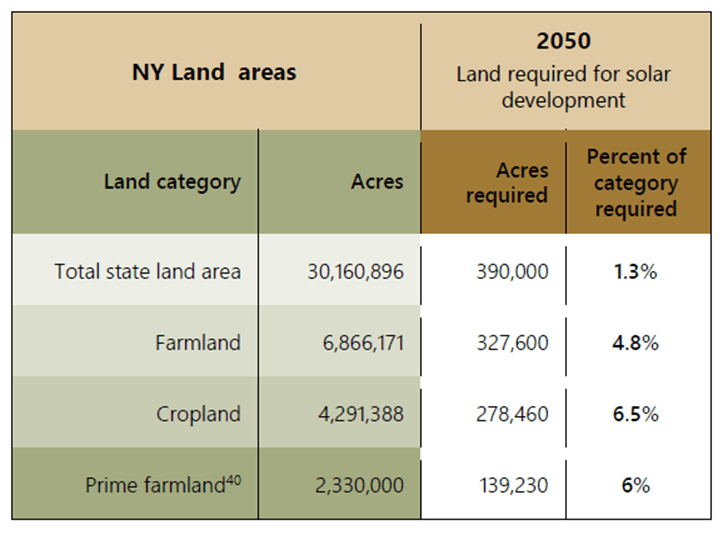
Cutting to the chase, Martin compares the acreage of New York State farmland as of 2017 and the acreage required by 2040 and 2050 for solar development in the following table.  She explains:

The claim that solar development will require only 1% of New York State’s land is roughly correct. On the other hand, solar buildout will require more than 1% of the state’s farmland.

Note that these numbers reflect acreage on the facility site; they do not include land used for mitigation or land taken out of production around facilities because it is less accessible or abandoned for other reasons.

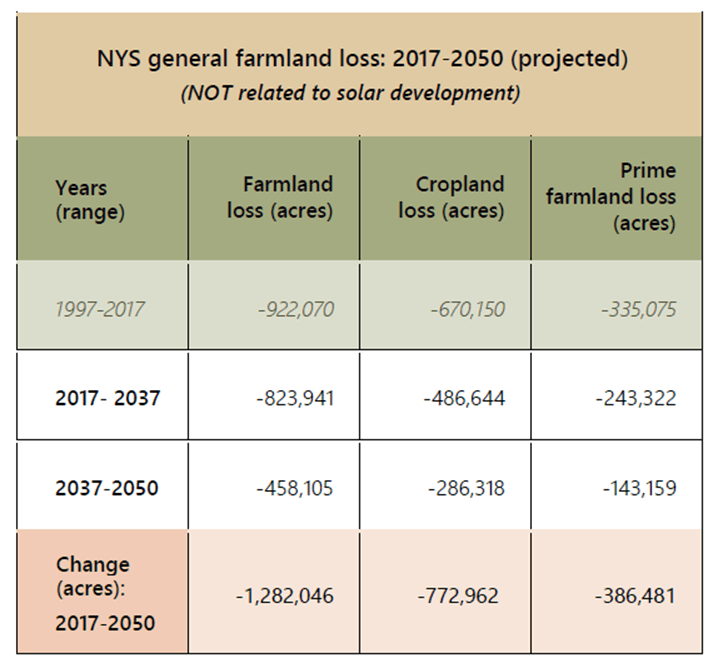
I like the White Paper because it provides context for everything covered.  Estimating the amount of land is dependent upon area per solar panel installation and how much capacity is required for the Climate Act.  Those topics are covered in sufficient detail that it is clear why the numbers used were chosen.  This extends to the results.  There is a chapter that “considers the loss of farmland that has been occurring over the last century and speculates on the reasons for farmland conversion over that period.”  The White Paper provides a projection of expected additional farmland and cropland losses by 2050 not related to solar development.  While there are inconsistencies in the data used such that there is “missing” land, the results are troubling.

The section “How Much Land” assesses cumulative farmland losses from both solar and non-solar causes and puts the estimates in context.  Martin addresses the question whether this is a little or a lot but finds that more context is needed.  She explains: “Let us consider some of the factors relating to our current and future land use, and their relationship to solar development.” 

  • The explanation takes up an entire chapter.  The chapter looks at the following issues:
  • Climate change and agriculture
  • Farmland values in New York and other states
  • Farming and farmers
  • Concentrations of solar development, with examples
  • Agrivoltaic solutions

I really liked this chapter because it frames the issues very well.  My goal as a pragmatic environmentalist is to try to provide the information that I think should be considered when decisions are made.  Invariably there are tradeoffs and the decisions made will reflect value judgements.  This chapter provides the information and avoids making conclusions about which tradeoffs are appropriate. 

One aspect of solar development that I had not considered previously is the effect of co-locating solar developments in the same area.  When several grid-scale solar projects are concentrated in one agricultural area there are adverse impacts to the remaining farmers.  I have long contended that the State has failed to provide a cumulative environmental impact assessment for the currently projected amount of solar and wind development.  The Final Supplemental Generic Environmental Impact Statement (SGEIS) for the Climate Leadership and Community Protection Act was released on September 17, 2020 and only included 13,200 MW of utility-scale solar.  This analysis assumes that utility-scale solar will be on the order of 45,000 MW or over three times what the State analyzed.

Discussion

After three years of extensive work Kris Martin has assembled a great resource on solar development and its potential impacts on New York agriculture.  She confronts the tradeoffs:

Ultimately, we may be facing a conflict between the rights of landowners to use farmland for any legal purpose and our collective need for farmland as a vital resource. Because most of us do respect the long hours, hard work, and inherent risks that farmers take, we naturally sympathize with their decisions to take farmland out of production or change the focus of their operations by leasing or selling land for solar development.

Farming is not an altogether benevolent activity. It can reduce biological diversity, introduce harmful chemicals into the environment, and consume massive subsidies that fail to improve life for many farmers or increase the production of affordable, healthy food and other agricultural products.

Do we have enough farmland for solar buildout on the scale required to meet Climate Act goals? Keep in mind that the Climate Act is a law, not simple policy. Its success depends on our having more farmland than we need in order to produce food, fiber, and fuel.

The answer to this question may be somewhat subjective. We may not even know the answers until it is too late to do much about the issue.

She includes recommendations for state policymakers, solar developers, community leaders, other individuals, and host farmers.

Conclusion

My takeaway from the White Paper is that it provides the context that the Hochul Administration should have provided for solar development.  The fact is that there still is no utility-scale solar development plan for the Climate Act.  There is no mandate to follow the Department of Agriculture & Markets targets for conversion of agricultural lands or explanation why meeting the targets should not be mandated.  The Scoping Plan estimates for solar capacity availability assume that tracking solar panels are used but the that is not mandated so fixed panel systems are being installed.  That means even more land will be taken up by industrial solar development.  Finally, there is no mandate for agrivoltaics.  This White Paper shows what should have been done. 

I agree with Martin’s conclusion:

We cannot afford to make bad decisions about farmland or energy production. Today’s priorities may become tomorrow’s regrets. The conflicts identified here will require all our efforts, open-mindedness, and thoughtful engagement to negotiate.

ACE NY Agrivoltaics Support

In order to implement the Climate Leadership & Community Protection Act (Climate Act) New York must support “unprecedented levels of investment in new generation”.  This post addresses the duplicity of the members of the Alliance for Clean Energy New York (ACE NY) who have organized a campaign to send letters supporting agrivoltaics to the legislators at the same time they are covering swaths of prime farmland with solar panels.

I have been following the Climate Act since it was first proposed. I submitted comments on the Climate Act implementation plan and have written over 300 articles about New York’s net-zero transition because I believe the ambitions for a zero-emissions economy embodied in the Climate Act outstrip available renewable technology such that the net-zero transition will do more harm than good.  The opinions expressed in this post do not reflect the position of any of my previous employers or any other company I have been associated with, these comments are mine alone.

Climate Act Background

The Climate Act established a New York “Net Zero” target (85% reduction and 15% offset of emissions) by 2050 and an interim 2030 target of a 40% reduction by 2030. The Climate Action Council is responsible for preparing the Scoping Plan that outlines how to “achieve the State’s bold clean energy and climate agenda.”  In brief, that plan is to electrify everything possible and power the electric grid with zero-emissions generating resources by 2040.  The Integration Analysis prepared by the New York State Energy Research and Development Authority (NYSERDA) and its consultants quantifies the impact of the electrification strategies.  That material was used to write a Draft Scoping Plan.  After a year-long review the Scoping Plan recommendations were finalized at the end of 2022.  In 2023 the Scoping Plan recommendations are supposed to be implemented through regulation and legislation.

One of the more serious problems with the Hochul Administration net-zero transition is that there is no implementation plan.  The “unprecedented levels of investment in new generation” includes between 14,731 MW (New York State Independent System Operator 2021-2040 System & Resource Outlook) and 18,852 MW (Integration Analysis) of solar development by 2030.  One example of the lack of a plan is that the Integration Analysis projection presumes that the utility-scale solar development will use tracking solar panels with a capacity factor of 20%.  However, most permitted New York solar developments are using fixed solar panels with lower capacity factors because there is no mandate that they use the more expensive technology.  That means that the projection of 18,852 MW is low.  I believe a proper implementation plan would include limitations to protect prime farmland from solar development.

ACE NY

The Alliance for Clean Energy New York (ACE

NY) mission is to “promote the use of clean, renewable electricity technologies and energy efficiency in New York State, in order to increase energy diversity and security, boost economic development, improve public health, and reduce air pollution”.   ACE NY members are “a mix of private companies and non-profit organizations”.  It is a well-connected lobbying organization for the crony capitalist grifters who are building the renewables required by the Climate Act.  Of the 16 organizations on the Board of Directors, six are non-governmental organizations (two based in New York) and of the remaining ten companies only one (Sealed, an insulation and HVAC company that partners with New York utilities) is a New York based company.  The rest are out of state developers who will bear no repercussions when the affordability and reliability of the New York electric system tanks.

The ACE NY 2023 priorities for large-scale, grid-connected renewables defines their agenda.  It includes the following:

  • Continued NYSERDA competitive procurement program, on schedule, under the Clean Energy Standard, to contract for renewable energy at a pace that will achieve 70% renewable electricity by 2030, with a fair and transparent evaluation process for bids, reasonable contract requirements, and contract amendments when necessary.
  • Solid progress on transmission, including Public Service Commission (PSC) approval of local and bulk transmission system upgrades, designation of a public policy transmission need (PPTN) upstate, New York Power Authority contributions to transmission upgrades, selection of a transmission solution for the Long Island Offshore Wind Export PPTN, and decision-making around other transmission needs to enable offshore wind development.
  • For offshore wind project development, the announcement of one or more new contracts, paired with state port and supply chain investments, and the issuance of a 2023 offshore wind solicitation.
  • An efficient and timely interconnection process at the NYISO, including a Class Year that takes one year and significant reforms and improvements to the process.
  • NYISO rules that are fair and favorable for renewables, such as capacity market rules that don’t disadvantage renewable energy or storage.
  • Efficient permitting, as evidenced by steady progress by the Office of Renewable Energy Siting. Our goal is to allow responsible developers to move steadily and predictably through the process in a timely manner, so that there is a healthy pipeline of diverse projects. Also, improvements to the species impact mitigation process.
  • The continued ability of solar developers to lease land from farmers to host the solar projects NY needs to achieve its clean energy and climate goals, plus advancement of co-located solar and agriculture to demonstrate emerging approaches to both.
  • A significant cohort of wind and solar projects successfully reaching the construction phase during 2023 and becoming operational.
  • For offshore wind planning, the establishment of a goal of 15 GW of offshore wind by 2040 and 20 GW by 2050, plus the issuance of an Offshore Wind Power Master Plan 2.0 that includes a roadmap for offshore wind power development in the deep ocean.
  • Standardized and fair taxation of wind and solar projects at the local level, and elimination of unfair renewable energy bans and moratoria at the local level.
  • A successful competitive Tier 2 program to support renewable resources built before 2015, or another means of support for these projects, plus rules that enable and encourage renewables repowering.
  • Reasonable requirements for decommissioning projects and avoidance of end-of-life disposal requirements that vary from town-to-town. Support for the development of solar panel recycling facilities in New York.
  • New York state pursuit of an economy-wide carbon cap-and-invest policy. 

This list of priorities boils down to build as much as possible as fast possible with as few restrictions as we can get away with.  “Efficient” permitting is a euphemism for let us do whatever we want with as few restrictions as possible.  There is a mention of improvements to “species impact mitigation process”.  In other words, some member’s project got slowed down because the rules that have applied to electric generation development to protect the environment and wildlife prior to the Climate Act have not been changed fast enough.  There is another priority to eliminate “unfair renewable energy bans and moratoria on the local level”.  That translates to the State has not over turned home rule enough to suit us.

ACE NY Agrivoltaics Letter to Legislators

The ACE NY website has a section “Support Agrivoltaics in New York State” that provides a way to send a form letter to legislators supporting agrivoltaics:

As New Yorkers, we believe that solar energy and farming can exist alongside one another, and each industry can help to bolster the other in meaningful ways while also supporting individual farmers and their communities.  

The benefits of agrivoltaics are abundant. They include: 

  • A new, stable income source for farmers, to keep NY farmers in farming;
  • Protection and conservation of soil with a reversable use of land;
  • New tax revenue for communities that host solar projects; and
  • Opportunities to host solar projects and produce more clean electricity;

SEND A LETTER TO YOUR LEGISLATORS SUPPORTING AGRIVOLTAICS
 

Please let your legislators know you support agrivoltaics in New York state. New York farmers should be able to host solar installations, if they choose to, and get income to help their farms.

For starters note that the description “as New Yorkers” does not apply to any of the development companies on the Board of Directors so take their beliefs with a grain of salt.  None of them will be affected when New York farming is adversely affected.  The stable income applies to the farmers who no longer want to farm.  It will raise prices for those who choose to continue to farm.  One of the stories perpetuated by the developers is that the solar developments are only temporary.  The reality is that we will continue to need the solar power so it beggars the mind why one can argue that these facilities won’t be re-developed with new panels when the developments reach the end of their useful life.  The next section discusses the status of New York solar development and belies the claims that ACE NY members care about New York agriculture.

New York Solar Development

I have written multiple articles about solar development and impacts to the agricultural sector in New York.  In my opinion the State should provide a plan for responsible siting for all solar facilities. There is a policy option roadmap for the proposed 10 GW of distributed solar development.  However, there is not an equivalent set of policies for utility-scale solar development.   Given the magnitude of the potential impacts to prime farmland I submitted a comment to the Climate Action Council recommending that they impose a moratorium on the development of utility-scale solar projects until permitting requirements have been established for responsible solar siting and protection of prime farmlands. Not surprisingly there has never been any response.

I described a workshop “What’s the Deal with Renewable Energy & Agriculture?” co-hosted by New Yorkers for Clean Power (NYCP) and Alliance for Clean Energy NY (ACENY) that discussed the compatibility of solar energy development and agriculture in New York State late last year.  In my opinion, all the speakers were advocating responsible solar development that minimizes the use of the best agricultural farmland soils.  Whatever your position is with respect to the industrial solar development that to me is a key requirement.  If a project meets all the New York State Department of Agriculture and Markets (Ag and Markets) guidelines and the Office of Renewable Energy Siting requirements then, given the current state law mandating massive buildouts of solar energy, the application should be approved.  The problem is that many of the recently permitted solar facilities do not meet that criterion.

In particulate, I think it is very unfortunate that Department of Agriculture and Markets guidelines to protect prime farmland are ignored.  The guidelines have been described in prepared testimony by Michael Saviola from the Department of Agriculture and Markets that I believe represent best practices and should be mandatory.  In particular, “The Department’s goal is for projects to limit the conversion of agricultural areas within the Project Areas, to no more than 10% of soils classified by the Department’s NYS Agricultural Land Classification mineral soil groups 1-4, generally Prime Farmland soils, which represent the State’s most productive farmland.”   I think this is a reasonable goal and one that should be a mandatory requirement for all projects.

I have started tracking the loss of prime farmland and the ramifications of not enforcing those guidelines.  The following table lists approved solar projects and my estimates of the loss of prime farmland.  Of the 15 recently approved projects listed only five meet the farmland conversion guidelines of the Department of Agriculture and Markets as of May 21, 2023.

Discussion

As noted previously there is no implementation plan.  On December 12, 2022 Governor Hochul announced that “a special working group of state agencies and agricultural community stakeholders will collaborate to support New York farmers and help boost the agricultural industry” that could be a start. The press release stated that “This working group will be critical to tackling several challenges within New York’s agricultural industry, and my administration will continue to work with farmers to address their needs and reimagine farming in our state.”  Searching for any follow up to the announcement five months later yielded no results.  While the Hochul Administration fiddles time away the loss of prime farmland continues.

Conclusion

The New York Office of Renewable Energy Siting (ORES) approved Hecate Energy’s permit for the 500-megawatt (MW) Cider Solar Farm on July 25, 2022.  My article on the project explained that the Cider Solar Farm will be a 500-megawatt photovoltaic solar facility capable of supplying 920,000 MWh (21% capacity factor) located in the towns of Elba and East Oakfield, Genesee County, NY.  Right in line with the ACE NY 2023 priorities, ORES over-ruled the Towns of Elba and Oakfield zoning ordinances that were “unreasonably burdensome” for the developer.  The 4,650 acre Project Site is 41% Prime Farmland (1,912 acres) and another 27% (1,252 acres) would be Prime Farmland if drained.  Until such time that the state develops responsible solar siting mandates that protect prime farmland consistent with the Department of Agriculture and Markets solar siting guidelines projects like this that removes 3,163 acres of prime farmland (68% of the project site!) from production will continue to be built. 

The ACE NY letter writing campaign in support of agrivoltaics suggests that ACE NY members care about the New York agricultural sector.  In reality, it is a public relations gesture.  If ACE NY members truly cared about New York farmers then they should be developing projects that meet the Department of Agriculture and Markets solar siting guidelines and incorporating agrivoltaics in their projects.  As noted, the guidelines can be met but most projects don’t bother to meet them.  Agrivoltaics have been mentioned in some of the permit applications that I have read but it is usually an afterthought or promise to consider it in the future.  I have never seen it included as a permit condition commitment.

Solar Development Prime Farmland Scorecard

I have written enough articles on solar siting issues that I have setup a page that summarizes them all.  The original intent of this blog post was to announce the addition of a scorecard documenting the loss of prime farmland allowed by the Hochul Administration’s solar siting policies.  However, one of the latest solar project approvals was for a project that proposes to build on marginal farmland proving that it can be done so I have added a description of that project.

New York’s Climate Leadership and Community Protection Act (Climate Act) Act establishes a “Net Zero” target (85% reduction and 15% offset of emissions) by 2050.  I have written extensively on implementation of the Climate Act.  Everyone wants to do right by the environment to the extent that efforts will make a positive impact at an affordable level but the current implementation policies are doing more harm than good.  The opinions expressed in this post do not reflect the position of any of my previous employers or any other company I have been associated with, these comments are mine alone.

Solar Siting Issues

I became aware of the particular issues of utility-scale solar development on agriculture after I had a couple of people contact me describing issues that they had and suggested that I look into the issue.  The problems that they raised are real, solutions to mitigate problems are available, but in the rush to develop as many renewable resources as quickly as possible the State of New York has dropped the ball on responsible utility-scale solar development.  Given the massive amount of projected utility-scale solar generation capacity required to meet Climate Act goals the rush to develop solar projects could easily lead to the permanent loss of significant amounts of prime farmland that will hurt farming communities and endanger Climate Act strategies to sequester carbon in soil. 

The New York State Department of Agriculture and Markets (DAM) has guidelines for solar developments.  In prepared testimony Michael Saviola explained: “The Department’s goal is for projects to limit the conversion of agricultural areas within the Project Areas, to no more than 10% of soils classified by the Department’s NYS Agricultural Land Classification mineral soil groups 1-4, generally Prime Farmland soils, which represent the State’s most productive farmland.”  

Solar Siting Farmland Scorecard

In order to document the State’s irresponsible solar siting policies, I have developed a scorecard to track of the loss of prime farmland.  I used Exhibit 15: Agricultural Resources in the solar project permit applications for the data. A list of applications is available at the New York State Office of Renewable Energy Siting that references the docket for each permit.  I have tried to accurately represent the project area, project footprint, and the area of prime farmland in each permit application but the applications do not use the same terminology so my interpretations might be inconsistent. 

The following scorecard table lists the project names and the permitting authority.  The original power sector permits were handled by the Department of Public Service Article 10 process but now the state rams over-rides any local concerns with the New York Office of Renewable Energy Siting (ORES).  The table lists photovoltaic capacity (MW) for each project.  My interpretation of the project area is that it represents the land under contract to the project developer for locations being evaluated for placement of project facilities, including the proposed collection substation and interconnection facilities.  I interpret the Project Footprint as only the area of the project components.  All the applications are required to include an exhibit for agricultural resources that specifies how much of the project area and footprint are soil types that are defined as prime farmland.  Mineral Soil Groups 1 through 4 are considered to be highly productive soils by DAM.  I calculated the Percentage Prime column as the sum of the prime farmland soil categories divided by the Project Area to compare with the  DAM goal for projects to limit the conversion of agricultural areas within the Project Areas, to no more than 10% of soils classified as Prime Farmland soils.

Update: The latest Update of the Scorecard is available here.

At this time, there are seven approved projects that have accessible Agricultural Resources exhibits (Homer Solar’s exhibit is unavailable).  Six of the seven projects exceed the DAM goal for limited conversion.  I should also note the DAM has made the point that once this land is converted to industrial solar panels that is unlikely that it will be converted back to farmland simply because the need for solar power will never go away as the Climate Act net-zero goals are implemented.  The developers piously claim that the most of the project footprint can be converted back but I side with DAM that this is a transparent excuse of no value.

The solar development scorecard lists a total of seven applications that have been approved for a total of 1,339 MW.  The total project areas cover 17,430 acres and the project footprints total 7,912 acres.  Despite the best efforts of Department of Agriculture and Market staff to prevent the loss of Prime Farmland, these projects were approved and the prime area lost for farming in these projects totals 4,216 acres or 24% of the combined project areas.

Discussion

In early January Governor Hochul announced approval of siting permits for three major solar energy centers including Tracy and Riverside.  Frankly I was wondering if any industrial solar development would propose to develop land that met the DAM 10% goal so I was pleased to see the Tracy application.  It is possible to develop solar facilities on marginal farmland.

I think the Agricultural Resources exhibit descriptions of the Riverside Solar and Tracy Solar projects are instructive.

The Riverside Solar application states:

The Applicant has worked with participating landowners to site Facility components in order to minimize impacts and allow for continued agricultural use on land adjacent to the Facility Site. The Facility will be constructed in accordance with the NYSAGM guidance document “Guidelines for Solar Energy Projects – Construction Mitigation for Agricultural Lands”, dated October of 2019 (NYSAGM Guidelines), which is discussed further below in Section 15(c). During the construction and operational life of the Facility 1,012 acres of land within the Facility fence line will be taken out of agricultural production and will be utilized for solar energy components. Additionally, the Facility Site includes approximately 366 acres of land located in areas of MSG 2-4. There are no occurrences of MSG 1 soils at the Facility as is indicated in Table 15-4 below. Areas not within MSG 1-4 were evaluated for the feasibility of siting Facility components as practicable. However, for various reasons such as landowner preferences, presence of wetlands and streams, and efficient siting of Facility components to reduce fragmentation and appropriately consolidate the Facility and minimize the overall footprint, the Applicant was unable to further consolidate or arrange the Facility layout to significantly reduce the use of land in MSG 2-4 areas. Following the decommissioning of the Facility the land can be restored to its agricultural use. While in operation, the Facility will utilize agricultural land for solar energy production. This will ensure that parcels remain intact during the life of the Facility, rather than being sold or subdivided for other purposes that may not allow the land to be reverted to agricultural use. The Facility will allow for continued agricultural use on parcels excluded from the Facility and will protect the viable agricultural land being utilized by the Facility for future use following decommissioning at the end of the Facility’s useful life.

In the absence of a state policy for responsible solar siting, out-of-state developer AES  can come in with these lame excuses and take another 292 acres of prime farmland out of production.  The referenced Table 15-4 is nearly six pages of individual soil types without a summary listing.  I interpret the obfuscation relative to the relevant prime farmland statistics to mean that they know full well just how inappropriate this application is.

On the other hand, the EDF Renewables Tracy Solar project clearly defines their impacts to agriculture:

The Facility footprint consists of 864 acres, defined as the area within the limits of disturbance (LOD). Within the Facility footprint, 816 acres are active agriculture, based on the active agriculture analysis described in Section 15.9.1. Table 15.8-1 summarizes the agricultural areas of the Facility footprint affected by construction and operation. Construction will result in temporary impacts where it will not be feasible to continue farming due to construction laydown areas and temporary workspaces. Operation will remove active agricultural land from farming for the life of the Facility.

Figure 15-8 in Appendix 15-A depicts mineral soil groups present within the Facility Site. Table 15.9-1 identifies the mineral soil coverage within the Facility Site and Facility footprint. Soil groups identified by NYSDAM as Mineral Soil Groups 1 through 4 are considered to be highly productive soils (NYSDAM 2021). Mineral Soil Groups 3, 5, 6, 7, and 8 are present within the Facility Site.

It is apparent that the Tracy Solar project has proposed to install solar panels on marginal farmland.  Surely this is an example that should be the standard for all future development.

Conclusion

The implications of these two projects does not reflect well on the New York State solar siting requirements.  The Tracy Solar projects shows that marginal farmland can be used for solar panels.    As it stands now solar developers are free to come into the state and put up as many solar panels as they want on as much prime farmland as they want in direct contravention of DAM goals.  In addition, there are no solar capability standards so developers are free to install fixed panel racking systems that cost less but do not meet the capacity expectations of the Scoping Plan.  The state has not updated its cumulative environmental impact assessment for the larger renewable energy capacities in the mitigation scenarios so the full consequences of the necessary 40,000 MW of solar development are unknown.  I submitted a comment to the Council in March calling for a moratorium on utility-scale solar siting in March that was ignored.  The most frustrating part to me is that the State has instituted responsible solar siting guidelines in the policy option roadmap for the proposed 10 GW of distributed solar development.  The failure to simply require those requirements for utility scale solar developments is baffling.

Until the Hochul Administration institutes responsible utility-scale solar siting guidelines similar to the roadmap for distributed solar development there will be significant and irreplaceable loss of Prime Farmland and damage to farming communities across the state. 

Agricultural and Farmland Viability and the Climate Act

The last several years I have spent an inordinate amount of time evaluating the Climate Leadership and Community Protection Act (Climate Act) and its legal mandate for New York State greenhouse gas emissions to meet the ambitious net-zero goal by 2050.  I recently published an article describing some of the overarching issues that have not been adequately addressed in the transition plan to meet the net-zero goal.  I used the Climate Action Council’s failure to protect prime farmland from utility-scale solar development as one example.  This post highlights recently signed legislation and an announcement by Governor Hochul that provides further proof that when the government says we are here to help it is likely a day late and a dollar short.

Everyone wants to do right by the environment to the extent that they can afford to and not be unduly burdened by the effects of environmental policies.  I submitted comments on the Climate Act implementation plan and have written over 250 articles about New York’s net-zero transition because I believe the ambitions for a zero-emissions economy embodied in the Climate Act outstrip available renewable technology such that the net-zero transition will do more harm than good.  The opinions expressed in this post do not reflect the position of any of my previous employers or any other company I have been associated with, these comments are mine alone.

Climate Act Background

The Climate Act establishes a “Net Zero” target (85% reduction and 15% offset of emissions) by 2050. The Climate Action Council is responsible for preparing the Scoping Plan that will outline how to “achieve the State’s bold clean energy and climate agenda.”  The Integration Analysis prepared by the New York State Energy Research and Development Authority (NYSERDA) and its consultants quantifies the impact of the strategies.  That material was used to write a Draft Scoping Plan that was released for public comment at the end of 2021. The Climate Action Council is required to finalize the Scoping Plan by the end of the 2022. 

In order to meet the net-zero target the general strategy is to electrify everything primarily using newly developed wind and solar resources.  According to the NYISO 2021-2040 System & Resource Outlook there were 1,985 MW of land-based wind and 2,148 MW of solar in 2019.  The Draft Scoping Plan spreadsheet Appendix G: Annex 2: Key Drivers and Outputs projects that in 2040 when all the electricity in New York must be zero emissions that there will be 12,242 MW of land-based wind and 43,342 MW of solar.  I documented that the solar projects in the Article Ten queue in 2020 averaged 9.3 acres of equipment area per MW.  Using that estimate of land required, the Draft Scoping Plan mitigation scenarios would require over 900 square miles of solar equipment. 

This post explains why the state’s response to the impact of the land needed for these developments is too little and too late to prevent serious issues. I have written enough articles on solar siting issues that I have setup a page that summarizes them all.  Given the massive amount of projected utility-scale solar generation capacity required to meet Climate Act goals the rush to develop solar projects could easily lead to the permanent loss of significant amounts of prime farmland that will hurt farming communities and endanger Climate Act strategies to sequester carbon in soil. Solar developers argue that a landowner gets revenue when a solar project is developed.  However, when land is taken out of production it will reduce farm jobs and the economic activity may be improved during construction but once the facility is operational there are very few economic benefits to essential local businesses.  Furthermore, taking the land out of production may make other farmers who have been renting that land to make their operations viable will not be able to support investments made in facilities, livestock, or equipment.  

State Actions to Protect Farmlands

First, let me describe New York’s inaction.  In a recent post describing the Climate Action Council’s transition plan approach I explained that there are already serious land use issues because there is no implementation plan in place.  Because there is no policy regarding utility-scale solar siting requirements relative to prime farmland the developers are thumbing their noses at the Department of Agriculture and Markets.  The Department has a policy in place to protect prime farmland but developers claim that there is “no statutory or regulatory support” for the policy so it can be ignored. The Hochul Administration permitting authorities have apparently placed renewable development as the highest priority without any assessment of the impacts identified by its regulatory agencies. 

On December 12, 2022 Governor Hochul announced that “a special working group of state agencies and agricultural community stakeholders will collaborate to support New York farmers and help boost the agricultural industry”. The press release stated that “This working group will be critical to tackling several challenges within New York’s agricultural industry, and my administration will continue to work with farmers to address their needs and reimagine farming in our state.”  The press release explains that:

The Task Force will initially focus on, but not be limited to, the following topics:

  • Transportation – address challenges involving the movement of agricultural commodities and products while understanding the needs for investment in roads, bridges and other vital infrastructure to bring products to market.
  • Labor – identify and build the next generation of farmers and farmworkers to support a diverse industry with the skills and workers required to operate modern farms.
  • The environment – address and remove obstacles to capital investments in manure management, on-farm energy production, and the transition to alternative fuel sources that limit the ability of some farms to meet the State’s climate goals and become carbon neutral.
  • Housing for workers – increase worker housing to provide workers with a safe living environment that is close to farms and assures for sustained and daily production.
  • Taxation – provide clearer guidance on property tax administration and improve access to existing tax relief programs.
  • Farmland protection – review existing programs and identify ways that the State can ensure that productive farmland remains accessible, in production, and continues to feed New Yorkers.
  • Expand procurement – of local food products by various state agencies to build local food supply chains and better connect with New York farms.

On December 6, 2022 Senate bill (S8889A) to create the Agricultural and Farmland Viability Protection Fund was signed.  It will bolster efforts to protect agricultural land from being permanently removed from farming to make way for solar development.  The press release for this states:

Currently, all solar projects receiving funding through NYSERDA’s NY-Sun incentive program that site projects on active farmland must pay a penalty, which currently goes into the State’s General Fund. S8889A-Hinchey requires that all penalty money collected be deposited instead into the new Agricultural and Farmland Viability Protection Fund and allocated to state and local farmland protection programs.

I apologize but I am not going to get into the details of this legislation.  I applaud the intent to get the money where it should logically go to try to redress the problem.  However, it does not seem likely that it will be much help to a farmer who lost the land he needed and was renting to a solar developer that can afford to pay more.  Furthermore, NY-Sun is the state’s initiative to expand distributed solar so this law does not cover the utility-scale solar projects that are my primary concern.

The most frustrating thing is that a solution is readily available.  Last December I described a webinar hosted by New Yorkers for Clean Power (NYCP) and Alliance for Clean Energy NY (ACENY) entitled “What’s the Deal with Renewable Energy & Agriculture?” that discussed the compatibility of renewable energy and agriculture in New York State.  One part of the solution discussed during the presentation could be the New York State Energy Research & Development Authority Agricultural Technical Working Group.  This group released an interim final report last May that described “strategies to integrate renewable energy sources into working landscapes with minimal impact on agriculture, including the need for more research; the potential for financial incentives; and proposed tools for State and local governments”.  Protection of prime farmland is a prime component of this report.

Incredibly it gets even more tone deaf in New York.  The NY-Sun program is New York State’s initiative to encourage distributed generation solar. The projects participating in the NY-Sun program are “typically five MW alternating current or smaller, and do not fit the definition of a Major Renewable Energy Facility”.  The interim final report notes that:

On April 19, 2022, the Public Service Commission approved the Roadmap, charting a path towards achieving an expanded goal of at least 10 gigawatts of distributed solar by 2030 and continues the NY-Sun program. NY-Sun Commercial/Industrial (C/I) projects located in an agricultural district must comply with AGM’s Solar Construction Guidelines. If the project utilizes over 30 acres of MSG 1-4, it is required to make Agricultural Mitigation Payment to the fund administered by NYSERDA. Since being implemented, these requirements have already demonstrated their effectiveness. In 2021, all 50 distributed solar projects subject to these requirements, totaling 1,037 acres of affected area, have committed to avoiding and minimizing impacts to important agricultural lands in consideration of the solar layout and complying with the Solar Construction Guidelines.

The bottom line is that there is a solar siting policy that addresses my concerns in place but only for the small solar projects.  Since I started tracking solar development project approvals late last year, a total of five applications have been approved for a total of 1,120 MW.  The total project areas cover 14,812 acres and the project footprints total 5,728 acres.  Despite the best efforts of Department of Agriculture and Markets staff to prevent the loss of Prime Farmland, the area that will be unavailable for farming in these projects totals 3,920 acres or 26% of the combined project areas.  This is bad enough but all three Draft Scoping Plan mitigation scenarios call for over 40,000 MW of solar development and there are no protections.

Conclusion

Hochul’s press release for the special working group included statements of support from New York State Department of Agriculture and Markets Commissioner Richard A. Ball; New York Farm Bureau President David Fisher; Brian Reeves, President of the New York State Vegetable Growers Association; Tonya Van Slyke, Northeast Dairy Producers Association Executive Director; Jim Bittner, owner of Bittner Singer Orchards and Interim Director of the New York State Horticulture Society; and Jeffery M. Fetter, President of Scolaro Fetter Grizanti & McGough, P.C. and Chairman of the Business and Tax Practice and Agricultural Services Groups.  If these people truly care about the agricultural sector, then they should demand a moratorium on utility-scale solar developments until a responsible solar siting policy is put in place for utility-scale solar development. 

The moratorium would be lifted when the special working group develops policy recommendations. At a minimum that utility-scale solar developments should adhere to the Department of Agriculture and Markets goal for projects to limit the conversion of agricultural areas within the Project Areas, to no more than 10% of soils classified by the Department’s NYS Agricultural Land Classification mineral soil groups 1-4, generally Prime Farmland soils, which represent the State’s most productive farmland.  It would be best if the same farmland protection criteria contained in the Public Service Commission distributed solar Roadmap were applied to all solar projects.

I have met people affected by these huge utility-scale solar projects.  It is so frustrating that their concerns and the viability of neighboring farms are being ignored when there are protections in place for smaller solar projects when the solutions are in place for small projects.  I wonder why and the only thing I can think of is that money talks. 

New York Siting Board Garnet Solar Project Application Decision

Last year I was contacted by one of the organizers of Conquest Against Industrial Solar and since then I have been following the Article 10 application of the Garnet Energy Center.  On October 27,2022 the New York State Board on Electric Generation Siting and the Environment (Siting Board) “granted approval to Garnet Energy Center, LLC to build and operate a 200-megawatt (MW) solar farm in the Town of Conquest, Cayuga County, with 20 MWs of battery storage capacity, one of the largest approved to date”.  While I am terribly disappointed with the approval from the standpoint of the local impacts to most of the residents of Conquest there are larger ramifications.  I describe two problems with this approval: the impact on local agriculture across the state and the failure of the Hochul Administration to protect local agricultural communities.

New York’s Climate Leadership and Community Protection Act (Climate Act) Act establishes a “Net Zero” target (85% reduction and 15% offset of emissions) by 2050.  I have written extensively on implementation of the Climate Act.  Everyone wants to do right by the environment to the extent that efforts will make a positive impact at an affordable level but actions like this do more harm than good.  The opinions expressed in this post do not reflect the position of any of my previous employers or any other company I have been associated with, these comments are mine alone.

Solar Siting Issues

I have written enough articles on solar siting issues that I have setup a page that summarizes them all.  I became aware of the particular issues of utility-scale solar development on agriculture after I had a couple of people contact my blog describing issues that they had and suggested that I look into the issue.  The problems that they raised are real, the solutions are available, but in the rush to develop as many renewable resources as quickly as possible the State of New York has dropped the ball on responsible utility-scale solar development.  Given the massive amount of projected utility-scale solar generation capacity required to meet Climate Act goals the rush to develop solar projects could easily lead to the permanent loss of significant amounts of prime farmland that will hurt farming communities and endanger Climate Act strategies to sequester carbon in soil. 

Solar developers are quick to point out that a landowner gets revenue when a solar project is developed.  However, when land is taken out of production it will reduce farm jobs and the economic activity may be improved during construction but once the facility is operational there are very few economic benefits to essential local businesses.  Furthermore, taking the land out of production may make other farmers who have been renting that land to make their operations viable will not be able

to support investments made in facilities, livestock, or equipment.  

Press Release Announcement

The press release announcing the siting decision describes the project:

The project will consist of commercial-scale solar arrays, access roads, buried electric collection lines, a collection substation, and electrical interconnection facilities. Additional facilities would include a 345-kV switchyard which will be transferred to New York Power Authority to own, maintain, and operate. The project will be located on land leased from owners of private property. The project will include a 20 MW energy storage system which will charge exclusively off the solar array.

The press release goes on to say:

The project area is about 2,289 vacant acres, and the project footprint is about 900 acres. The solar farm is expected to begin commercial operation in 2023. Through land agreements, the project developer says it supports the agricultural economy by infusing revenue into family farms and diversifying their income.

The focus of this article will be on these statements.  In the first place the 2,298 “vacant” acres include a “total of approximately 1,234.2 acres of NYSORPS classified Agricultural Land (Code 100)”.  Clearly agricultural land is not vacant.  I hope that was a typo, but if not, it is a sad testament to the disconnect between the Hochul Administration and the agricultural community. 

The bigger issue is the claim that the project supports the agricultural economy.  The New York State Department of Agriculture & Markets (AGM) testimony concluded that the project will have “significant and adverse disproportionate agricultural impact upon the local farming community”.  This article will explain why the best interests of the state as exemplified by the AGM testimony have been cast aside in the unplanned rush to build renewables as part of the transition of the economy to net-zero.

NextEra Response to Testimony

On March 10, 2022 Michael Saviola of the New York State Department of Agriculture & Markets (AGM) submitted prepared testimony on the Garnet Energy Center application.  On April 12, 2022 NextEra Energy Resources responded to the comments in Garnet Rebuttal Panel Testimony.  In the following I am going to discuss two issues where the Siting Board chose the developer’s rationale over the AGM.

The two issues are addressed in the Panel response to Saviola on page 124 at line 6 of their rebuttal testimony. Question: “Please address the direct testimony of AGM staff’s witness Mr. Michael Saviola.”  The answer:

Mr. Saviola states that AGM “discourages the conversion of farmland to a non-agricultural use” (AGM staff Testimony, p. 6, ll. 4–5). With respect to utility-scale renewable energy projects, Mr. Saviola states that “[t]he Department’s goal is for projects to limit the conversion of agricultural areas within the Project Areas, to no more than 10% of soils classified by the Department’s NYS Agricultural Land Classification mineral soil groups 1-4, generally Prime Farmland soils, which represent the State’s most productive farmland” (AGM staff Testimony, p. 7, l. 21–p. 8, l. 2).

On page 125 line 3 the rebuttal testimony poses the question: “Does siting the Project on Prime Farmland soils amount to a permanent conversion of agricultural soils to a non-agricultural use, as Mr. Saviola argues (AGM staff Testimony, p. 8, ll. 18–20)?  The response states:

No. Although agricultural land within the LOD will not be available for farming during the life of the Project, the soils will be suitable for agricultural use after the Project is decommissioned.

Saviola’s testimony explained the AGM concern:

Due to increasing NYS energy goals encouraging renewable energy development, we see no reason facilities will not be upgraded and re-leased to maintain the growing or static renewable energy demand, in this case, 35 years from energization. The Department further asserts that as long as NYS incentives for the development of renewable energy exists, the complete decommissioning of solar electric energy generation, and full resumption to agricultural use is not likely to occur.

The developer’s response to this claimed it was speculation on the part of Saviola and reveals their development rationale and the shortcomings of current State policy.  On Page 127 line 4 the rebuttal testimony states: “In our view, however, it is equally speculative that State incentives will remain constant, that no participating landowners will elect to resume agricultural activities within the Project Area, and that all participating landowners will agree to release their land for solar generation at that time.”  Parsing out “State incentives will remain constant”, it is obvious that the developer believes that without state incentives aka subsidies they would not consider redeveloping the site.  It seems to me that they admit that solar development in the future will still depend on subsidies.  The decision to return to farming or leasing to farmers is primarily driven by money.  While I have no personal animosity towards landowners that offer their land for solar development, the fact is that the NYS solar incentives provide more than enough money to outbid the value and risks of farming so it is an easy choice for land owners.  However, if nearby farmers were renting land used for solar, there is no hope that they can compete with the state money.  AGM developed guidelines so that solar development would not reward a favored few at the expense of the entire agricultural community.  They are saying you have to keep most of the Prime Farmland available for farming purposes.  The Siting Board and Climate Action Council have failed to support the AGM opinion that “the facility will result in or contribute to a significant and adverse disproportionate agricultural impact upon the local farming community”.

NextEra arguments hinge on the definition of permanent.  It points out that on page 126 line 15 that:

As the Siting Board has previously explained, although agricultural lands will be converted to non-agricultural use during the life of the Project, decommissioning and post-decommissioning restoration measures “result in minimal permanent impacts to agricultural resources.”

In my opinion the implicit concern of AGM is that even during the life of this project the loss of Prime Farmland is to be avoided.  Even if the project area is restored the avoided minimal permanent impacts likely are limited to the farmland itself.  It is unlikely that the failed family farms who depended on renting that property and the local businesses that went out of business when all the affected farms stopped farming will startup when the solar leases end and the land becomes available to farm again.  While solar developers want to be able to install panels on land that requires less work to maximize their profits, clearly it is in the best interest of the State to encourage responsible solar development that avoids installation of solar panels on Prime Farmland and directs it towards land with less value. 

On page 124 line 19 the rebuttal testimony gets to the crux of the problem:

Article 10, the State Energy Plan, the CLCPA and the recently enacted Accelerated Renewable Energy Growth and Community Benefit Act (“Accelerated Renewables Act”) do not specify any agricultural standards that must be satisfied, nor do they attempt to usurp the rights of private landowners to voluntarily decide if they wish to grow food on all their land or use a portion of it to allow the generation of renewable electricity in order to support their farm operations.

This is all completely true and is the license which out-of-state developers are using to usurp the AGM’s attempts to protect to protect the state’s most productive farmland.  It is evidence of the Administration and Climate Action Council’s failure to act in the best interests of the state’s agricultural community.  The State has a responsible solar siting  policy option roadmap for the proposed 10 GW of distributed solar development.  However, there is not an equivalent set of policies for utility-scale solar development. Clearly there should have been a moratorium on utility-scale solar development permit approvals until those policies are put in place and I submitted a comment on the Draft Scoping Plan that made that suggestion.  Without responsible solar siting guidelines, the solar developers can thumb their noses at the AGM and the agricultural community they are trying to protect. 

On page 128 line 1 of the rebuttal testimony responds to the question “Does the Project minimize permanent conversion of Prime Farmland soils to the maximum extent practicable in accordance with AGM’s 10% goal (AGM staff Testimony at p. 12, l. 22 – p. 13, l. 3)?”.  The answer:

Yes. The Project’s LOD encompasses approximately 1,054 acres. As a result of the Applicant’s Update to the Application (January 2022), approximately 185 acres of solar arrays have already been eliminated from the Project layout (see App. Ex. 4 Update at 1). This reduction of arrays resulted in an overall reduction of Prime Farmland within the LOD by approximately 37 acres and reduced permanent impacts to Prime Farmland by approximately 2 acres. Approximately 492.2 acres of land within the LOD is classified as Prime Farmland. However, only approximately 12.6 acres (approximately 2.6% of Prime Farmland within the LOD) will be permanently impacted by the installation of Project Components (id.). The rest of the land will be restored and maintained in compliance with the AGM Guidelines to the maximum extent practicable. This permanent impact is well within AGM’s 10% goal.

The Garnet application Updated Exhibit 4. Land Use describes the project area impacts to agricultural land:

The Project Area was evaluated to determine impacts to Agricultural Land, including mapped Agricultural Districts, as part of the Project. A total of approximately 1,234.2 acres of NYSORPS classified Agricultural Land (Code 100) is mapped within the Project Area. The Project will have a fenced-in area of approximately 901.6 acres. Although the Project is sited entirely within mapped Agricultural Districts, the fenced area will only occupy 0.3 percent of all lands designated as mapped Agricultural Districts within Cayuga County and 5.0 percent of all lands designated as Agricultural Districts within the Town of Conquest. Finally, of the 1,054.1 acres of LOD, only 464.7 acres will occur on land classified as Prime Farmland which is only 6.5 percent of all Prime Farmland within the Town of Conquest, and 0.25 percent of all Prime Farmland within Cayuga County.

When I look at the numbers, I get a different result.  The total project area is 2288.7 acres, 464.7 acres of prime farmland will be on Prime Farmland and that works out to 20% of the project.  That is double the AGM guidelines that led to the conclusion that the project will have “significant and adverse disproportionate agricultural impact upon the local farming community”.  The percentages of prime farmland in the town and county are only listed to give the appearance that this is not a big deal but there are not standards for those parameters. 

There was another paragraph responding to this question:

In addition, no statutory or regulatory support is cited for AGM’s proposed 10% or less Prime Farmland soil conversion “goal” that “the production of food is more essential than the generation of [renewable] electricity,” or that soil classifications 1-4 should be avoided, even if it means interfering with the development of a renewable facility contracted to sell renewable energy credits to NYSERDA. The Certificate Conditions conserve and protect agricultural lands; it is the responsibility of AGM, and not private solar developers, to encourage the development of farming. That charge cannot be used to thwart the renewable energy goals of the State.

I was shocked at the tone of this rebuttal to Saviola’s testimony.  In this example we have out-of-state developers lecturing state agencies on policy.  Of course, their only concern is throwing up as many solar panels as possible as soon as possible before the Administration figures out that there are negative consequences to irresponsible solar development that should be considered and not ignored.  Sadly, the lack of a planning by the Climate Action Council has resulted in no regulatory guidelines so developers are free to thumb their noses at the agencies. 

Finally, there is no more tone-deaf response to the AGM arguments than on page 127 line 8: “New York State is combatting the devasting impacts of climate change now”.  This pathetic attempt to appeal to emotions demands a response.  Given that New York’s total annual GHG emissions are less than the annual increase in global emissions averaged since 1990 the likelihood that the climate change value of this solar project is greater than the “significant and adverse disproportionate agricultural impact upon the local farming community” is vanishingly small.

Conclusion

New York State has stacked the deck against home rule and the consequence is going to be a disaster for communities dependent upon local agriculture when vast swaths of Prime Farmland are converted to solar panels over the life of the project.  I am terribly disappointed with the Garnet Energy Center project approval because I believe it will have local consequences that will out-weigh any climate change benefits due to the solar development.  Unfortunately, it is just a symptom of a much larger disease.

Since I started tracking solar development project approvals a total of five applications have been approved for a total of 1,120 MW.  The total project areas cover 14,812 acres and the project footprints total 5,728 acres.  Despite the best efforts of AGM staff to prevent the loss of Prime Farmland the area unavailable for farming in these projects totals 3,920 acres or 26% of the combined project areas.  This is bad enough but all three Draft Scoping Plan mitigation scenarios call for over 40,000 MW of solar development.  Unless the Climate Action Council institutes responsible solar siting guidelines similar to the policy option roadmap for the proposed 10 GW of distributed solar development there will be significant and irreplaceable loss of Prime Farmland and damage to farming communities across the state.

The Garnet Energy Center project approval is an example of the State’s net-zero transition unfolding disaster.  As NextEra states “Article 10, the State Energy Plan, the CLCPA and the recently enacted Accelerated Renewable Energy Growth and Community Benefit Act do not specify any agricultural standards that must be satisfied” so developers are free to use as much Prime Farmland as they want.  In addition, there are no solar capability standards so developers are free to install fixed panel racking systems that cost less but do not meet the capacity expectations of the Draft Scoping Plan.  The state has not updated its cumulative environmental impact assessment for the larger renewable energy capacities in the mitigation scenarios so the consequences of the necessary level of development are unknown.  Finally, the State has not released actual cost estimates of their proposed control strategies. To sum up, current state policy does not protect Prime Farmland, unless guidelines are promulgated even more solar capacity will be required causing even more undefined cumulative environmental impacts, and there is no estimate how much this will all cost.  What could possibly go wrong?

Working with New York Farmers to Ensure Climate Resiliency for the Future

There is a consistent disconnect between reality and the State’s consideration of climate change incorporated in the Climate Leadership and Community Protection Act (Climate Act).  Nowhere is this more obvious than in the op-ed by NYS Department of Environmental Conservation Commissioner Basil Seggos and NYS Department of Agriculture and Markets Commissioner Richard Ball published in the Auburn Citizen on August 30.

New York’s Climate Leadership and Community Protection Act (Climate Act) Act establishes a “Net Zero” target (85% reduction and 15% offset of emissions) by 2050.  I have written extensively on implementation of the Climate Act.  Everyone wants to do right by the environment to the extent that efforts will make a positive impact at an affordable level.  My analysis of the Climate Act shows that the ambitions for a zero-emissions economy outstrip available renewable technology such that the transition to an electric system relying on wind and solar will do more harm than good.  The opinions expressed in this post do not reflect the position of any of my previous employers or any other company I have been associated with, these comments are mine alone.

New York Permitting Requirements

New York’s Article Ten process defines the permitting requirements for all large-scale electric generating new construction or expansion.  It includes extensive and time-consuming public notification and public participation requirements.  The 2011 revisions to the Article Ten law were intended to speed things up but were largely ineffective in that regard.  In early April 2020, NYS passed the Accelerated Renewable Energy Growth and Community Benefit Act (AREGCBA) as part of the 2020-21 state budget.  The legislation was intended to ensure that renewable generation is sited in a timely and cost-effective manner.   Unfortunately, the result has been an unchecked land rush of solar development in the state with no limitations on the conversion of prime farmlands to utility-scale solar development. 

Discussion

The primary purpose of the op-ed was to congratulate Greenfield Farms in Skaneateles, NY for being “the recipient of this year’s prestigious New York Leopold Conservation Award for its extraordinary environmental protection efforts, uses healthy soil practices that enhance water quality and strengthen carbon sequestration”.  That is a great achievement and I believe it should be a keystone component of the state’s efforts for a resilient agricultural economy.

The op-ed also describes New York State’s innovative Climate Resilient Farming Program.  This program “assists farmers who proactively tackle climate concerns by providing cost-shared grants to incentivize transformative management practices that reduce greenhouse gas emissions, draw down carbon dioxide from the atmosphere, and increase carbon storage in soils and woody plants.”  Those are laudable efforts, are necessary for Climate Act implementation, and I support them. 

However, the op-ed goes off the rails when it continues: “At the same time, it helps protect at-risk agricultural land across the State.”  I have written multiple articles about solar siting with respect to agriculture in New York.  Based on that work I believe that the biggest risk to agricultural land in New York State is the lack of a responsible solar siting framework for the massive utility-scale solar projects needed to meet the Climate Act targets.  There is a policy option roadmap for the proposed 10 GW of distributed solar development.  However, there is not an equivalent set of policies for utility-scale solar development.  

On July 25, 2022 a press release from Governor Hochul announced siting approval of New York’s largest solar facility to date.  The release said that the “New York State Office of Renewable Energy Siting has issued a siting permit to Hecate Energy Cider Solar LLC, to develop, design, construct, operate, maintain, and decommission a 500-megawatt solar facility in the Towns of Oakfield and Elba, Genesee County.“  In the press release Commissioner Basil Seggos was quoted as saying:

DEC applauds Governor Hochul’s ongoing prioritization of renewable energy development to support our state’s necessary transition away from fossil fuels. As more solar projects continue to be approved and come online, we are closer to achieving the goals and requirements set in the Climate Leadership and Community Protection Act. This will continue to provide renewable energy benefits here in Genesee County and throughout the state.

In my article on this approval, I noted that according to the exhibit titled “Farmland Classification Mapping” that lists landcover class data.:

According to NLCD data, the dominant landcover class in the Project Site is active agriculture, followed by forestland. Agricultural lands in the Project Site are comprised of active agricultural land (both row crops and mowed/maintained hayfields) and there are numerous family and commercial farms and farm structures in the Project Site. Row crops comprise approximately 68% (3,143 acres) of the Project Site, and less than 1% (23 acres) of the total Project Site is maintained hayfields. Additionally, there is approximately 3.5% (161 acres) of the Project Site where the dominant land cover is grasslands or pasturelands.

Relative to agricultural soils, the Project Site includes approximately 41% (1,912 acres) of land classified as Prime Farmland, 27% (1,252 acres) as Prime Farmland if Drained, 19% (891 acres) as Farmland of Statewide Importance, and 13% (596 acres) as Not Prime Farmland (Natural Cooperative Soil Survey 2020).

The prime farmland and prime farmland if drained categories total 2,143 acres well in excess of 1,400-acre Greenfield Farms.

I believe best practices for solar development should meet the Department of Agriculture and Markets target for prime farmland conversion.  In particular, “The Department’s goal is for projects to limit the conversion of agricultural areas within the Project Areas, to no more than 10% of soils classified by the Department’s NYS Agricultural Land Classification mineral soil groups 1-4, generally Prime Farmland soils, which represent the State’s most productive farmland.”   Four recently approved solar projects totaling 920 MW all exceeded that threshold and converted 3,456 acres of the state’s prime farmland to industrial use.  Overall, those projects converted 28% of the prime farmland in the Project Areas.  In addition, none of these projects propose practicing responsible solar siting consistent with the state’s distributed solar development roadmap.  For example, there are no provisions for agricultural practices consistent with the solar panels.

Conclusion

The current projections for utility-scale solar development call for over 43,000 MW in order to meet the requirements for zero-emissions power.  At the current rate of converted prime farmland to capacity development upwards of 161,000 acres of prime farmland could be lost.  Until such time that the state adopts responsible solar siting guidelines for utility-scale development consistent with existing policies for distributed solar, the impacts of solar development will have bigger impacts on agriculture than those purported to occur because of climate change.

Obviously, Commissioner Seggos recent press releases are hypocritical.  Regarding the massive solar project, he states that “Solar farms of this scope produce enough energy to power thousands of homes while also creating well-paying, family-sustaining jobs and breathing new life into our local economies.”  His op-ed states that the Climate Resilient Farming Program “helps protect at-risk agricultural land across the State”.  The fact is that unbridled utility-scale solar development is the major risk to agricultural land in the State and no amount of protection from any virtue signaling state agricultural program is going to stop that.