
RGGI Cap-and-Invest Emission Reduction Performance in New York

The Regional Greenhouse Gas Initiative (RGGI) is a market-based program to reduce emissions from electric generating units.  On December 18, 2025, New York State Energy Research & Development Authority (NYSERDA) hosted a meeting (agenda, recording) to present proposed changes to the RGGI Operating Plan Amendment (“Amendment”) for 2026.  This post describes the trend of New York’s RGGI emissions that I will use as part of my comments on the draft Amendment.

I have been involved in the RGGI program process since it was first proposed prior to 2008.  I blog about the details of the RGGI program because very few provide any criticisms of the program.   There is no upside for companies affected by RGGI to disparage the program because it has become a sacred cow initiative that is treated as beyond criticism by agencies and activists. I have extensive experience with market-based programs because I have worked on analysis, implementation, and evaluation of every  program affecting electric generating facilities in New York including RGGI and several Nitrogen Oxide programs.  The opinions expressed in these comments do not reflect the position of any of my previous employers or any other organization I have been associated with, these comments are mine alone.

Background

RGGI is a market-based program to reduce greenhouse gas emissions (GHG) (Factsheet). It has been a cooperative effort among the states of Connecticut, Delaware, Maine, Maryland, Massachusetts, New Hampshire, New York, Rhode Island, and Vermont to cap and reduce CO2 emissions from the power sector since 2008.  New Jersey was in at the beginning, dropped out for years, and re-joined in 2020. Virginia joined in 2021 but has since withdrawn and Pennsylvania recently withdrew completely.

According to a RGGI website:

The RGGI states issue CO2 allowances that are distributed almost entirely through regional auctions, resulting in proceeds for reinvestment in strategic energy and consumer programs.

Proceeds were invested in programs including energy efficiency, clean and renewable energy, beneficial electrification, greenhouse gas abatement and climate change adaptation, and direct bill assistance. Energy efficiency continued to receive the largest share of investments.

Proponents of RGGI claim the program has “successfully lowered CO2 emissions intensity and absolute emissions”.  This post will show that this conclusion is not reflected in the New York emissions trends.  In a subsequent post I will explain that ignoring the lessons of the observed reductions is leading to investment strategy decisions in the NY RGGI Operating Plan that will eventually cause serious problems.  Proposed investment descriptions include beneficial electrification, climate change adaptation, and direct bill assistance that do not reduce electric sector emissions.

New York RGGI Emissions

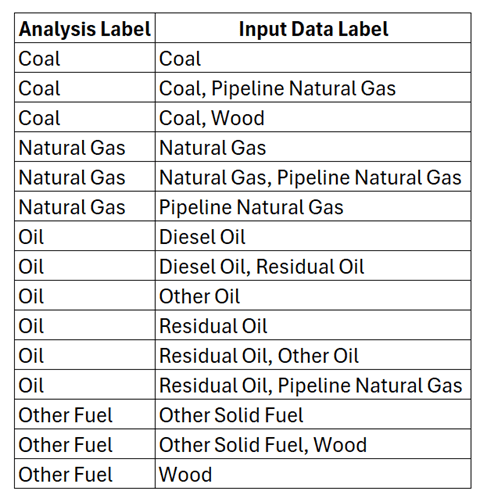
This analysis of annual New York CO2 emissions from electric generating units uses data from the EPA Clean Air Markets Program Data (CAMPD) database.  I downloaded unit-level data for all pollution control programs so that I can compare emissions from the start of RGGI in 2009 to a baseline before the program started.  The data include a record describing the primary fuel type These records are not standardized and include more categories than I need so I consolidated the labels as shown in Table 1.

Table 1: Consolidated Primary Fuel Type Labels

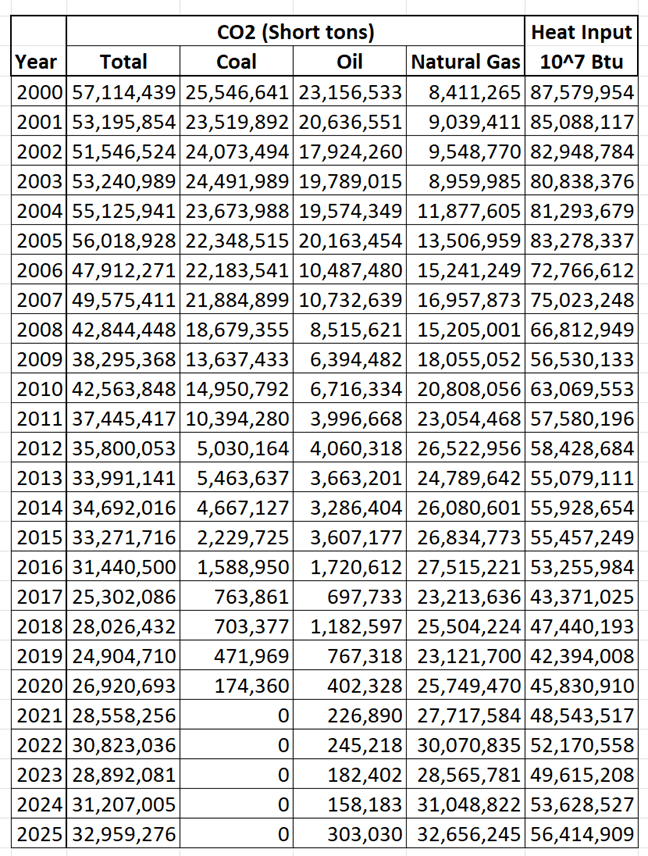
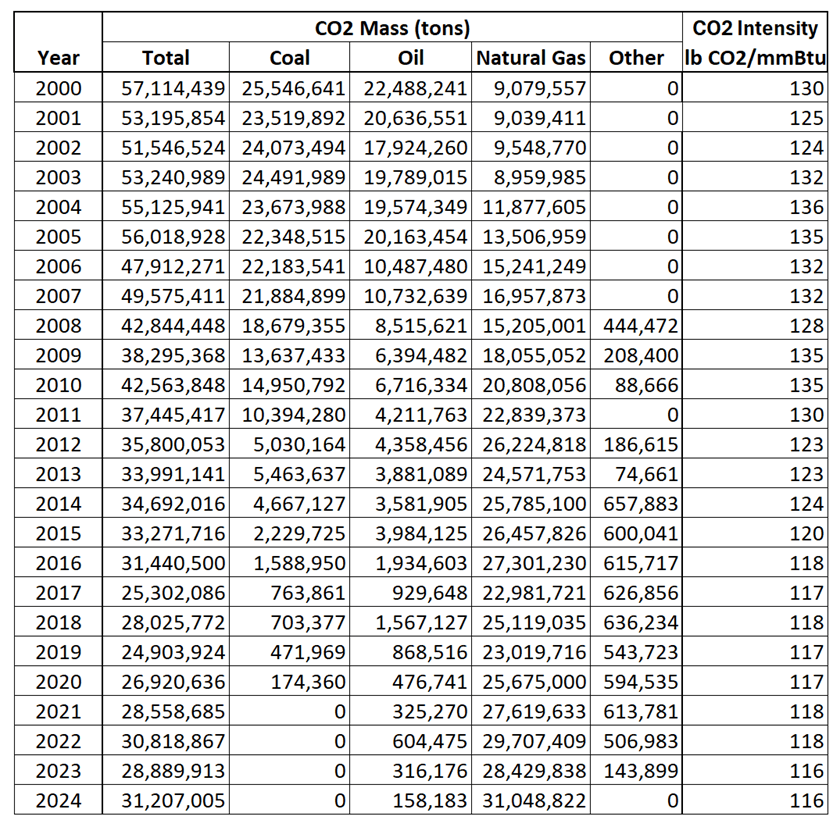
Table 2 lists the annual emissions since 2000 through 2024.  Claims that the program has “successfully lowered CO2 emissions intensity and absolute emissions” are debunked in the following table and figure.   This table lists mass CO2 emissions by fuel type along with the emission rate or intensity.  Both absolute and emissions intensity do go down.

Table 2: New York Clean Air Markets Program Data Emissions Data for All Regulatory Programs

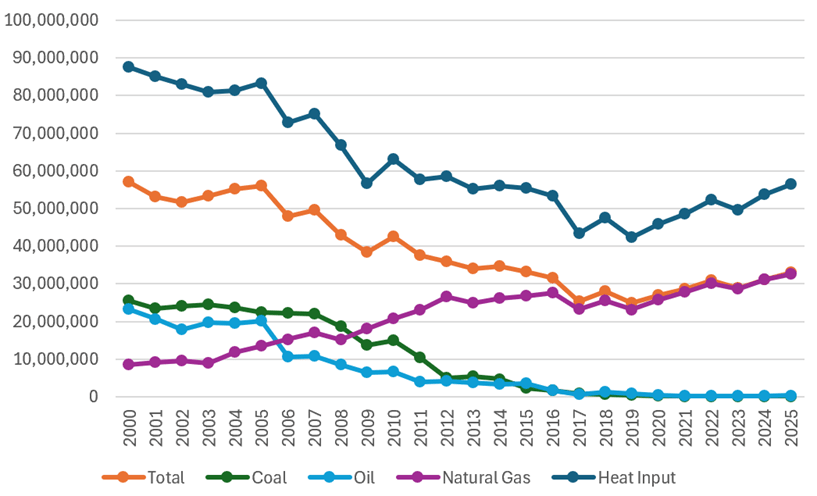
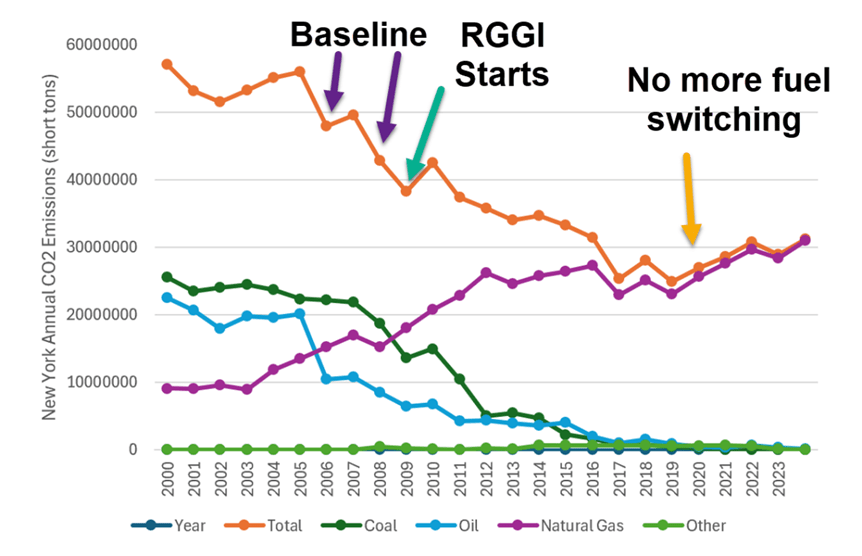
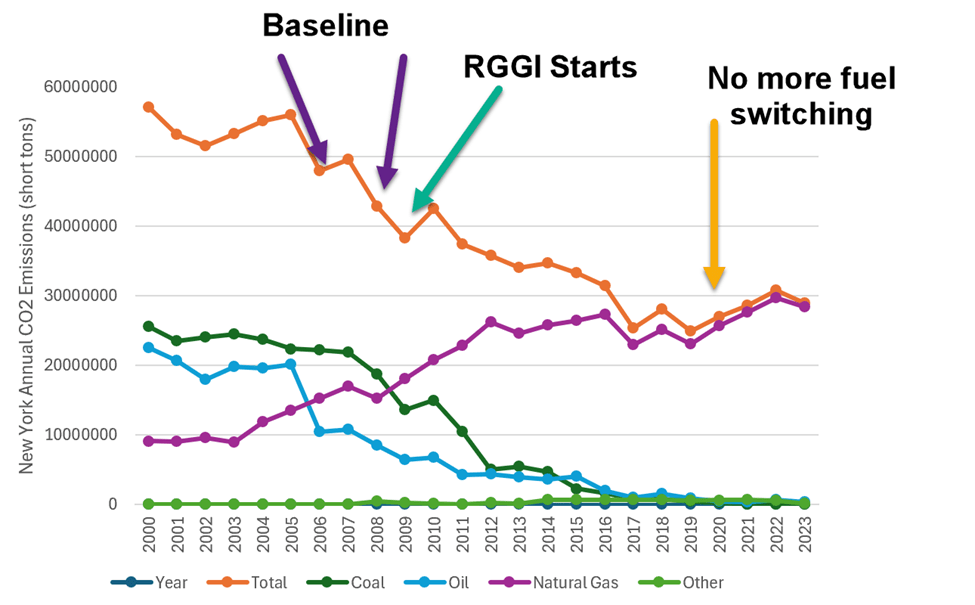
Figure 1 clearly shows the role of fuel switching away from coal and oil and the increasing use of natural gas.  I believe that the fuel price differential for natural gas use was much greater than the added cost of RGGI allowances and thus the main driver of the observed reductions is economic fuel switching.   This figure labels the 2006 to 2008 period that I use as the baseline for “before RGGI”, the start of RGGI, and when the possibility of additional fuel switching became impossible.  If RGGI were the primary driver of emission reductions, then emission reductions would have continued to decrease after the lowest emissions in 2019, and they certainly would not have been increasing since then.  The other big takeaway from this is that 2019 was the year that the inane premature retirement of the Indian Point nuclear station began.  New York has not managed to replace generation from this zero emissions resource as emissions continue to rise.

Figure 1: New York Clean Air Markets Program Data Emissions Trend by Fuel Type

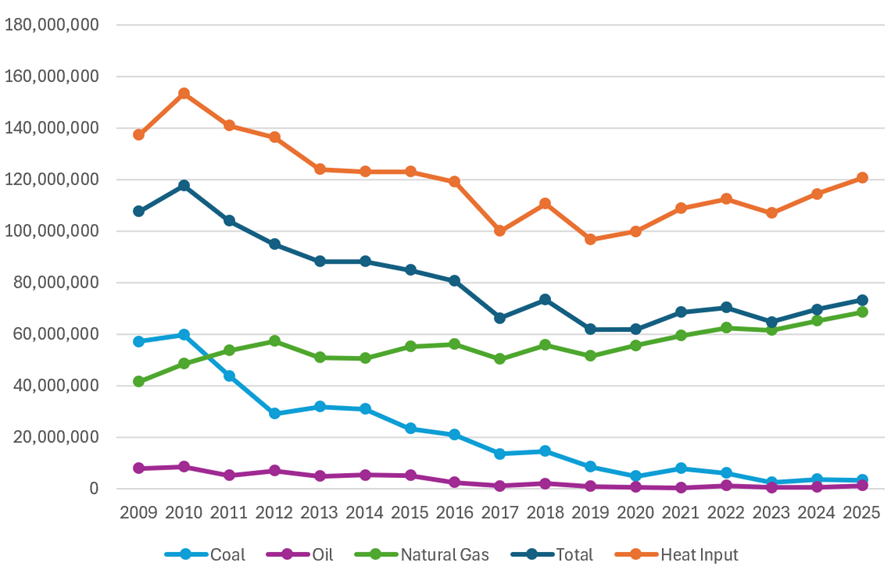
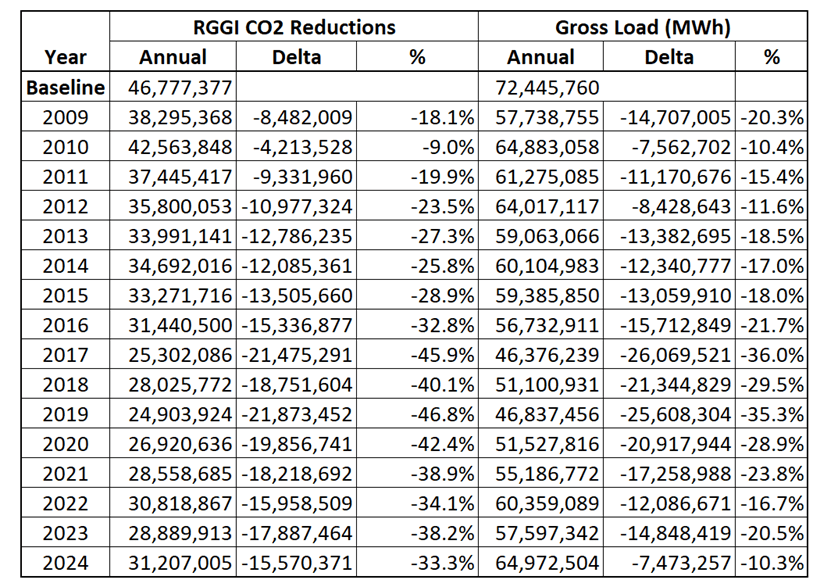
Table 3 lists the emissions reductions since the start of the RGGI program.  I included this because it shows that in 2024 CO2 emissions since the start of RGGI are 33% lower.  Also note that in 2019 emissions were 47% lower.  I included the gross load to show that gross load also decreased.  In theory this could represent displacement of fossil fired units because of RGGI investments. In my next post I will update last year’s analysis of the effect of RGGI investments that shows that is not the reason.  NYSERDA program funding status reports estimate the emission savings from their program investments.  Last year I showed that the total cumulative annual emission savings due to NYSERDA program investments through the end of 2023 that directly or indirectly affect electric generating source emissions  is 1,405,513 tons.  That means that emissions from RGGI sources in New York would have been only 3% higher if the NYSERDA program investments did not occur.  I do not expect that this will change using the 2024 data.

Table 3: New York RGGI Emissions and Gross Load Reductions Since Start of RGGI

Discussion

I have two overarching concerns about the implications of RGGI emission reduction performance.  Firstly, the RGGI cap on emissions essentially rations energy use because if there are insufficient permits to emit (aka allowances) affected generating units have no other options to reduce emissions so they can only shutdown to comply with the law.  If replacement zero emissions generating resources are unavailable, then the electric grid would be placed in an artificial energy shortage that would lead to blackouts.  Therefore, in my comments on the NYSERDA operating plan I will argue that programs that lead to emission reductions should be prioritized to prevent energy rationing.

My second concern is that idolatry of the RGGI as a program that should be replicated because of its success was a primary driver of the Climate Leadership & Community Protection Act’s Scoping Plan recommendation for an economy wide cap-and-invest program.  In my last update on the New York Cap-and-Invest (NYCI) program I explained that there is potential for a judge to order that NYCI be implemented.  These data show that this magical solution will not work as advertised.

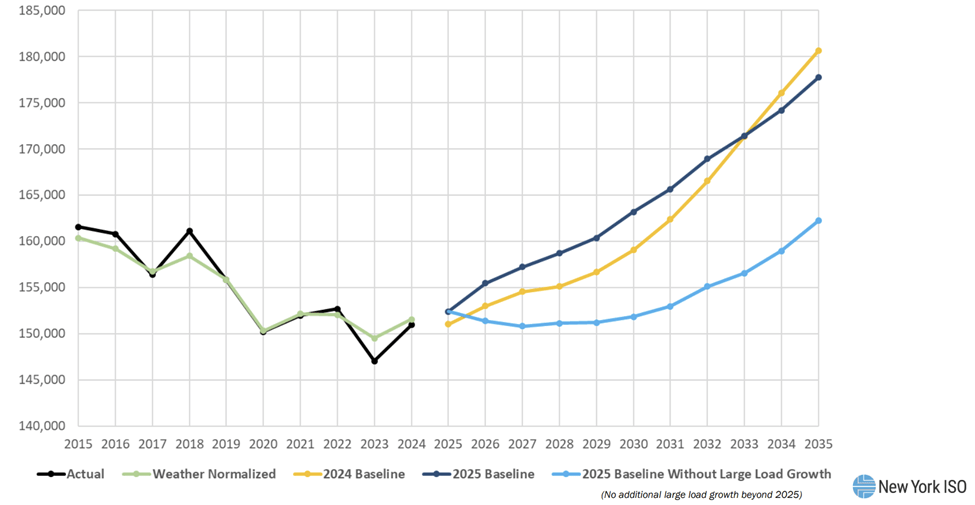
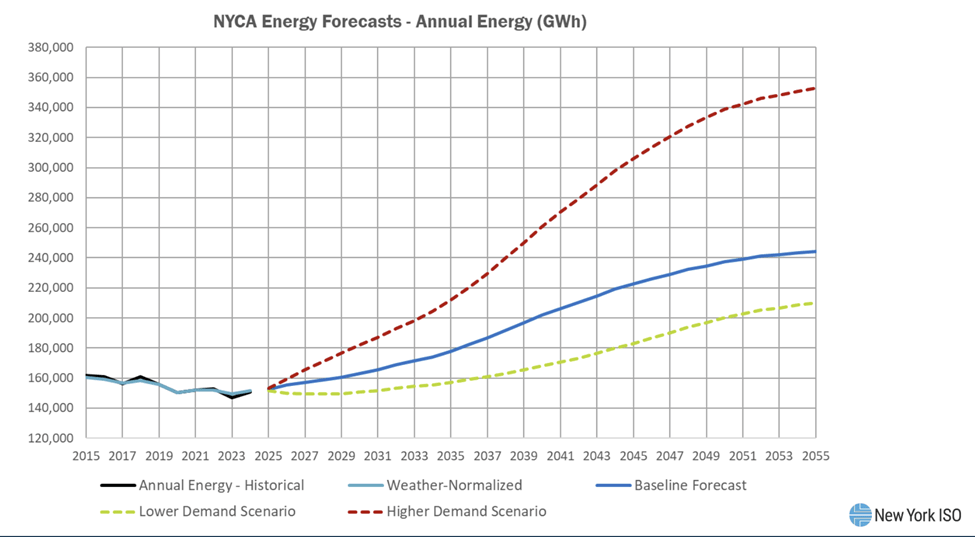
Finally, I want to put the historical and projected generating load in perspective relative to RGGI and NYCI.  The New York Independent System Operator(NYISO) annual load and capacity data report universally known as the “Gold Book” provides input for a couple of relevant graphs in NYISO 2025 Gold Book Forecast Graphs.

Figure 2 lists historical and weather normalized annual loads from 2015 to 2024.  These observed loads closely track the RGGI electric generating unit loads.  The scary issue is that NYISO is projecting significant increases in load going forward without the addition of large load facilities.  The load increases are associated with electrification strategies associated with the Climate Act.

Figure 2: NYISO Historical New York Control Area (NYCA) Annual Energy and 10-Year Forecasts (GWh)

Figure 3 also lists historical and weather normalized annual loads from 2015 to 2024 but includes “additional load growth from large loads”.  This increases the 2035 baseline around 17,000 GWh or another 10%.  This would make it all the more difficult to provide sufficient zero-emission generating resources to comply with the Climate Act mandate to have a 100% zero-emission electric grid by 2040.

Figure 3: NYISO Historical New York Control Area (NYCA) Annual Energy and 10-Year Forecasts (GWh)

Conclusion

This analysis clearly shows that the primary driver of observed emission reductions from RGGI electric generating units was fuel switching.  These results are consistent with similar analyses that I have prepared regarding RGGI emission reductions.  I will incorporate these findings in my comments on the 2026 RGGI Operating Plan Amendment stating that this observations should be reflected in the Operating Plan just like I have for the last several years.  I fully expect that NYSERDA will ignore my comments again and will continue to make investments to appease political constituencies.  Political interference in energy policy will eventually fail, it is only a matter of time.

New York Cap and Invest Litigation

Last March environmental activists sued the State of New York because the Department of Environmental Conservation (DEC) was not promulgating the regulations for the  New York Cap and Invest (NYCI) Program on schedule.  Last Friday, an Ulster County judge heard arguments from the activists and the DEC.  A report suggests that the judge “will likely rule that New York is breaking its climate law.”

I have followed the Climate Act since it was first proposed, submitted comments on the Climate Act implementation plan, and have written over 550 articles about New York’s net-zero transition.  My background is particularly suited for NYCI evaluation.  I have worked on every market-based program that affected electric generating facilities in New York including the Acid Rain Program, Regional Greenhouse Gas Initiative (RGGI), and several Nitrogen Oxide programs. I follow and write about the RGGI and New York carbon pricing initiatives. The opinions expressed in this article do not reflect the position of any of my previous employers or any other organization I have been associated with, these comments are mine alone.

Overview

The Climate Act established a New York “Net Zero” target (85% reduction in GHG emissions and 15% offset of emissions) by 2050.  The Climate Action Council (CAC) was responsible for preparing the Scoping Plan that outlined how to “achieve the State’s bold clean energy and climate agenda.”  After a year-long review, the Scoping Plan that outlines how to achieve the targets was finalized at the end of 2022.  Since then, the State has been trying to implement the Scoping Plan recommendations through regulations, proceedings, and legislation.  NYCI is but one example of that effort.

Cap-and-Invest

The CAC’s Scoping Plan recommended a market-based economywide cap-and-invest program.  NYCI is supposed to work by setting an annual cap on the amount of greenhouse gas pollution that is permitted to be emitted in New York: “The declining cap ensures annual emissions are reduced, setting the state on a trajectory to meet our greenhouse gas emission reduction requirements of 40% by 2030, and at least 85% from 1990 levels by 2050, as mandated by the Climate Act.”  Affected sources purchase permits to emit a ton (also known as allowances) and then surrender them at the end of the year to comply with the rule.  Colin Kinniburgh’s description at New York Focus describes the activist’s theory of a cap-and-invest program as a program that will kill two birds with one stone.  “It simultaneously puts a limit on the tons of pollution companies can emit — ‘cap’ — while making them pay for each ton, funding projects to help move the state away from polluting energy sources — ‘invest.'” 

As is the case with all aspects of the Climate Act, this approach is not simple and is riddled with complications that make it unlikely that it will work as advocates expect.  I have summarized my concerns on my Carbon Pricing Initiatives page.  Furthermore, the implementation timetable promulgated by politicians mandated a schedule at odds to the scope and challenge of an economy-wide market-based program.  Even if a direct charge on fossil emissions was not a politically charged issue, it is no surprise that DEC implementation is late.

NYCI Lawsuit

Colin Kinniburgh, writing at NY Focus, published a series of articles describing the background of this issue.  After Governor Hochul’s State of the State address in January he explained that Hochul promised to release NYCI regulations but back-tracked on that promise.

In March he summarized the lawsuit:

Four environmental and climate justice groups filed a lawsuit Monday in a state court, claiming that New York is “stonewalling necessary climate action in outright violation” of its legal obligations. By not releasing economy-wide emissions rules, the suit alleges, the state Department of Environmental Conservation, or DEC, is “defying the Legislature’s clear directive” and “prolonging New Yorkers’ exposure to air pollution … especially in disadvantaged communities.”

It’s the first lawsuit to charge the state with failing to enforce the core mandate of its 2019 Climate Leadership and Community Protection Act, or CLCPA: eliminating nearly all of New York’s greenhouse gas emissions by 2050. The law tasks DEC with crafting rules to get there and to reach an interim target of 40 percent emissions cuts by 2030.

The state’s deadline to release those rules was Jan. 1, 2024 — a date the agency blew past. More than a year later, New York has yet to issue even draft rules, and it’s becoming less and less clear that it intends to do so, even though, throughout last year, Governor Kathy Hochul’s administration promised that it was working on them as quickly as possible.

Kinniburgh described the hearing as follows:

Ulster County Supreme Court Justice Julian Schreibman on Friday skewered a lawyer for the state Department of Environmental Conservation (DEC) who argued that the state could not issue required regulations to cut greenhouse gases any time soon.

“It seems to me that the core of your argument is that we’re living in a time of change and uncertainty, and DEC needs to be given some leeway to accommodate that,” Schreibman said.

“That’s correct, your honor,” replied Meredith Lee-Clark, of the New York State Attorney General’s office, who was representing DEC.

“I don’t know that I’ve ever lived in a time that wasn’t one of change and uncertainty, so I don’t know how that is a governable standard,” the judge continued.

Schreibman went on to say that the most relevant cases in the record “almost compel” him to side with the plaintiffs: four climate justice groups who sued the state for violating its climate law by failing to issue regulations needed to meet it.

However, he suggested that he is unlikely to force the state to take action on the kind of timeline the plaintiffs’ lawyer suggested in the hearing — as little as 30 days to issue draft regulations and 100 days to finalize them.

I am no lawyer, but it does not seem that the DEC has much of an argument.  They are not meeting the timetable.  Whether that is a “governable standard” is another issue because there have never been a demonstration that the schedule and ambition of the Climate Act has never been shown to be feasible.  It is not clear if that issue can be addressed in this case.

NYCI Implications

In my most recent post discussing NYCI I addressed the first of the three implanting regulations for NYCI.  The regulation establishes reporting requirements necessary to determine how much affected sources will have to pay for the right to emit carbon dioxide emissions.  I made a general point for the uninitiated, that implementing a rule like others already in place elsewhere seemingly should be simple and straightforward.  The reasoning goes something like this: California has a similar program in place, so all New York needs to do is to convert their rules for use in New York.  It is not that easy.  For starters, California took upwards of ten years with a large staff to develop their rules.  NYCI implementation started in early January 2023 and DEC has many fewer staff.  Furthermore, the Climate Act has unique emissions definitions which makes simple substitution impossible. Finally, there are significant differences between the energy system nomenclature in the states.  In my opinion, DEC did a remarkable job getting something out.  Unfortunately, the proposed rule shows signs of haste and lack of understanding of the nuances of emission reporting.

The “30 days to issue draft regulations and 100 days to finalize them” timeline suggested by the plaintiffs’ lawyer is absurd.  It is inconsistent with the New York Administrative Procedure Act timing requirements for starters.  They could argue that it should be subject to an emergency rulemaking, but the implementation regulations are all complex and there is very weak rationale for this as an emergency.   

Unfortunately, there will likely be pressure now on DEC to accelerate a process that already shows signs of poor rulemaking.  Poorly designed regulations will have unintended consequences that will further weaken what I believe is a doomed policy.

Discussion

I have made this point before, but it bears repeating.  I am convinced that no GHG emission reduction cap-and-invest program like NYCI can successfully put a constraining limit on the tons of pollution companies can emit while making them pay to fund projects to help move the state away from polluting energy sources.  Danny Cullenward and David Victor’s book Making Climate Policy Work explains why.    They note that the level of expenditures needed to implement the net-zero transition vastly exceeds the “funds that can be readily appropriated from market mechanisms”. 

The indications are that NYCI regulations will be based on political considerations.  The prices for allowances will be based on what the Hochul Administration expects will be politically feasible not what is needed to fund needed reductions.  In any event, the plan for allocating the proceeds does not set a priority on funding emission reduction programs and includes several set asides to politically connected constituencies.  The politically designed reduction targets are inconsistent with the observed deployment of the control strategies.  NYCI will set a cap that will inevitably be too difficult to achieve, triggering an artificial energy shortage.  This will also exacerbate the designed increase in energy costs.  The end result will be increased costs and increased reliability risks.

Conclusion

I don’t think this lawsuit will have much of an impact on NYCI.  You cannot speed up implementation by issuing an order.  Throw in the political reluctance to speed up the process and I see minimal schedule changes.  In the meantime, the impending energy affordability crisis hopefully will trigger reconsideration of the whole transition.

This lawsuit is the first of many.  When the politicians set emission reduction targets without considering feasibility it was inevitable that they could not be achieved.  Political will is a great slogan but a poor driver for energy policy.

New York Cap and Invest Update

The first regulation associated with the New York Cap and Invest (NYCI) Program is currently out for comment.  The regulation establishes mandatory greenhouse gas (GHG) emission reporting requirements.  Accurate and reliable emissions information is a cornerstone for any market-based p  program, so this is a necessary first step.  This post describes the status of that rulemaking. 

I have followed the Climate Act since it was first proposed, submitted comments on the Climate Act implementation plan, and have written over 540 articles about New York’s net-zero transition.  I have worked on every market-based program that affected electric generating facilities in New York including the Acid Rain Program, Regional Greenhouse Gas Initiative (RGGI), and several Nitrogen Oxide programs. I follow and write about the RGGI and New York carbon pricing initiatives so my background is particularly suited for NYCI.   The opinions expressed in this article do not reflect the position of any of my previous employers or any other organization I have been associated with, these comments are mine alone.

Overview

The Climate Act established a New York “Net Zero” target (85% reduction in GHG emissions and 15% offset of emissions) by 2050.  The Climate Action Council (CAC) was responsible for preparing the Scoping Plan that outlined how to “achieve the State’s bold clean energy and climate agenda.”  After a year-long review, the Scoping Plan that outlines how to achieve the targets was finalized at the end of 2022.  Since then, the State has been trying to implement the Scoping Plan recommendations through regulations, proceedings, and legislation.  NYCI is but one example of that effort.

Cap-and-Invest

The CAC’s Scoping Plan recommended a market-based economywide cap-and-invest program.  NYCI is supposed to work by setting an annual cap on the amount of greenhouse gas pollution that is permitted to be emitted in New York: “The declining cap ensures annual emissions are reduced, setting the state on a trajectory to meet our greenhouse gas emission reduction requirements of 40% by 2030, and at least 85% from 1990 levels by 2050, as mandated by the Climate Act.”  Affected sources purchase permits to emit a ton (also known as allowances) and then surrender them at the end of the year to comply with the rule.  Colin Kinniburgh’s description in New York Focus describes the activist’s theory of a cap-and-invest program as a program that will kill two birds with one stone.  “It simultaneously puts a limit on the tons of pollution companies can emit — ‘cap’ — while making them pay for each ton, funding projects to help move the state away from polluting energy sources — ‘invest.'” 

As is the case with all aspects of the Climate Act, this approach is not simple and is riddled with complications that make it unlikely that it will work as advocates expect.  I have summarized my concerns on my Carbon Pricing Initiatives page.

I have written a couple of articles about the status this year.  Going into the year, the climate activist cult was confident that Governor Hochul would say that NYCI implementation would be a priority and that a schedule for the first auctions would be announced.  However, that did not happen which has goaded the cult into an extensive lobbying campaign.  For example, lobbyists cajoled my Assemblyman into writing a letter to the editor in the Syracuse paper saying that Governor Hochul should “get moving on cap and invest.”  I responded explaining that proponents claims that the program will simultaneously raise money, ensure compliance, and be affordable are wishful thinking. 

Regulation Implementation Status

To implement the carbon pricing initiative, the Department of Environmental Conservation (DEC) has proposed three regulations: mandatory GHG emissions reporting, a cap-and-invest rule that sets the cap or limit on emissions, and an auction rulemaking that establishes how the allowances will be allocated.  There hasn’t been any update on when the cap-and-invest rule and auction rulemaking will be released.  Part 253 Mandatory GHG Reporting was released for comment in late March and comments are due on July 1, 2025.

Colin Kinniburgh recently described the status of the NYCI response by climate activists. They have used every opportunity to push for the cap-and-invest rules to be implemented as quickly as possible.  I made the mistake of attending a Part 253 hearing and lasted through two speakers before I had to leave. The first speaker made the oft-repeated argument that there are dire health effects like asthma that are the result of fossil fuel emissions which was met by cheers from the audience.  Nothing was said about the Part 253 reporting rule that was the subject of the hearing. I could not face listening to other speakers parrot similar talking points, so I left.

Before getting into the specifics, I want to make a general point about NYCI.  For the uninitiated, implementing a rule like others already in place seemingly should be simple and straightforward.  The reasoning goes something like this: California has a similar program in place, so all New York needs to do is to convert their rules for use in New York.  It is not that easy.  For starters, California took upwards of ten years with a large staff to develop their rules.  NYCI implementation started in early January 2023 and DEC has many fewer staff.  Furthermore, the Climate Act has unique emissions definitions which makes simple substitution impossible. Finally, there are significant differences between the energy system nomenclature in the states.  In my opinion, the New York Department of Environmental Conservation has done a remarkable job getting something out.  Unfortunately, the proposed rule shows signs of haste and lack of understanding.

Consider this from my standpoint.  This is the first market-based program proposed rule in 30 years affecting the electric industry that I have no responsibilities to review.  So, I have not spent any time looking at that aspect of the rule.  However, I have a cousin who owns and operates a small heating oil and propane distribution company.  When I glanced at the web page for the draft rule I saw that fuel supply companies were required to report emissions if they supply “any quantity” of fuel.  Programs like this always have reporting thresholds so I thought there had to be a mistake in the summary.  When I dug into the rule, I found it very difficult to follow the rationale and requirements but convinced myself that DEC did intend to require everyone to report emissions.  That is such an extraordinary requirement that I contacted a former colleague who I knew was reviewing the rule to ask for his impression.  He confirmed that it was not just me but everyone was having trouble interpreting the proposed rules and had found similar inconsistencies with past practices.

Mandatory GHG Reporting Rule

This description is limited to fuel suppliers in the Part 253 rule.  I am going to submit comments and draft a letter for my cousin’s company to submit their own comments.  The proposed Part 253 Mandatory Greenhouse Gas Reporting Program rules (“Draft Rule”) would require most if not all small heating oil and propane distributors to report emissions that would be a significant time and expense resource burden.  As a more efficient alternative, I will recommend that primary supply terminals that provide fuel to the small distribution companies be the entities responsible for reporting emissions and complying with the allowance trading rules.

Applicability

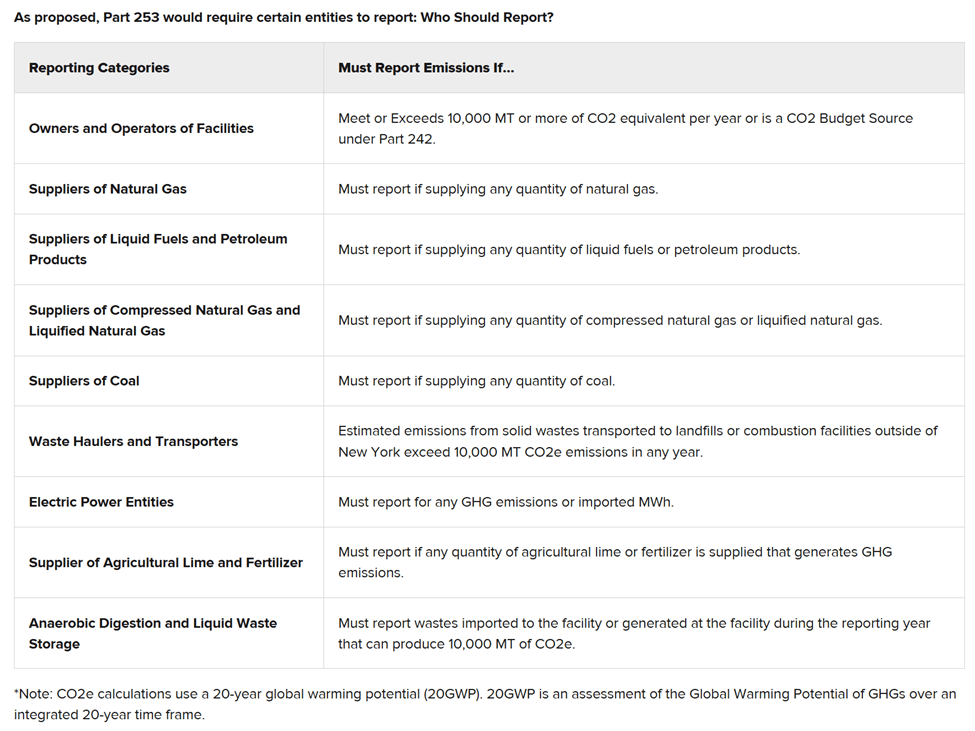
The summary of the Draft Rule includes Figure 1 that describes the entities that must report. There are four categories that “must report emissions” if they supply “any quantity” of fuels.  There is a category for “owners and operators of facilities” that has a 10,000 metric ton (MT) threshold but no threshold is provided for fuel suppliers.  The Draft Rule should be revised to include a consistent reporting threshold for emissions.  Smaller sources could be required to report fuel use instead of emissions.

Figure 1: New York Department of Environmental Conservation (DEC) Mandatory Greenhouse Gas Reporting webpage (accessed on 6/11/25 and last updated 4/30/25)

Large Emission Sources

The rule includes another provision that would require small retail distributors to report emissions. Section 253-1.2 Liquid Fuel Suppliers – Applicability, (f) Large Emission Sources, (2) Fuel supplier has an applicability threshold for suppliers of liquid fuels and petroleum products of 100,000 gallons or more of affected liquid fuels per emission year.

According to the Department of Environmental Conservation GHG Estimation Tool 100,000 gallons of distillate fuel oil number 2 emits 1,351 metric tons of CO2.  The California GHG reporting rule uses a threshold of 10,000 metric tons which is equivalent to 740,126 gallons.  The United States Environmental Protection Agency GHG emission reporting rule threshold is 25,000 metric tons which is equivalent to 1,850,314 gallons.  Using a higher threshold that targets primary supply terminals will cover the fuel emissions while reducing the overall industry reporting burden and the DEC processing burden.  

The 100,000 gallon threshold is so low that it would require most retail distributors to report emissions. These small companies have NO experience reporting GHG emissions.  In addition, the rules include a verification mandate for large emissions sources.  This would require hiring a third party to verify that the data they submit is accurate.  Retail heating oil and propane suppliers do not have ready access to resources to report emissions so this would be burdensome.

Other NYCI Compliance Obligations

The Part 253 GHG reporting rule is one component of the regulations for NYCI.  The reporting emissions requirement for fuel suppliers that process 100,000 gallons suggests that those facilities could be required to participate in the NYCI allowance market.  If that happens then small companies will require significant training or need to hire an experienced consultant to develop a compliance strategy.  They need to estimate their expected emissions. They would then be required to purchase allowances either through an auction or a broker, incorporate the allowance price into their retail price, generate compliance reports, and surrender allowances for compliance.  This would be an extraordinary financial and resource burden for small businesses.

Recommendation

The draft rules impose an unnecessary and expensive burden on retail fuel suppliers because the applicability thresholds are so low.  This challenge to small fuel supply businesses can be addressed by setting the Part 253 emissions reporting and the allowance compliance rule threshold at 25,000 metric tons.  It is more efficient and appropriate to make the primary fuel terminal suppliers responsible for reporting emissions and complying with the NYCI allowance regulation.  The only obligation for small distributors should be reporting annual fuel sales.

I would appreciate it if readers would submit a comment to the online DEC portal.  After filling out your name, location, and other information there is a spot to insert a comment.  Please just copy the preceding paragraph in that location.  Tell them you are not a robot and submit.  Thank you.

Discussion

NYCI is floundering.  Governor Hochul is not pushing to get it implemented.  I suspect that it is because when the other rules are promulgated it will be necessary to set a price on the allowances.  At that point it will become clear to the public that their costs will increase.  Climate activists don’t seem to grasp that raising money by making the “polluters pay” will just mean consumer costs will increase. 

It is also clear that in the rush to get rules drafted, that some decisions were made without considering the ramifications.  The inconsistency between the large emission source GHG associated with 100,000 gallons (1,351 MT) and the 10,000 MT threshold for other sources is unexplained.  As a result, of that definition, many small businesses will be required to learn how to report emissions. If they report their fuel use to DEC, then DEC can calculate the emissions and remove the chance for calculation errors.  If the primary fuel terminals are the reporting entity reporting burdens and processing burdens will be reduced and all the emissions will still be counted.

Conclusion

Activists continue to agitate for implementing NYCI faster in the hopes that this magical solution will work as advertised. However, it is not moving quickly.  Maybe the Administration has caught on to the fact that it won’t work out as advertised and that accounts for the delay.  I have no idea if that is the reason, but I am sure that NYCI has more downside risk than proponents realize.

New York Cap and Invest Status

New York’s Climate Leadership & Community Protection Act (Climate Act) is stalled.  This article updates the current status of NYCI implementation based on a analysis of a comprehensive overview by Samanth Maldonado titled “Green Lawmakers Pressure Hochul to Speed up Action on Climate Act”.

I am convinced that implementation of the New York Climate Act net-zero mandates will do more harm than good if the future electric system relies only on wind, solar, and energy storage because of reliability and affordability risks.  I have followed the Climate Act since it was first proposed, submitted comments on the Climate Act implementation plan, and have written over 500 articles about New York’s net-zero transition.  The opinions expressed in this article do not reflect the position of any of my previous employers or any other organization I have been associated with, these comments are mine alone.

Overview

The Climate Act established a New York “Net Zero” target (85% reduction in GHG emissions and 15% offset of emissions) by 2050.  It includes two 2030 targets: an interim emissions reduction target of a 40% GHG reduction by 2030 and a mandate that 70% of the electricity must come from renewable energy by 2030. The Climate Action Council (CAC) was responsible for preparing the Scoping Plan that outlined how to “achieve the State’s bold clean energy and climate agenda.”  After a year-long review, the Scoping Plan was finalized at the end of 2022.  Since then, the State has been trying to implement the Scoping Plan recommendations through regulations, proceedings, and legislation. 

The New York Cap-and-Invest Program (NYCI) is a key component of Climate Act implementation.  Before the 2025 State of the State was released, I believed that Governor Hochul would announce the next steps associated with the implementation of NYCI. However, the only mention of NYCI in the speech and in the FY2026 NYS Executive Budget Book noted that in the coming months the Department of Environmental Conservation (DEC) and the New York State Energy Research and Development Authority (NYSERDA) will take steps forward on developing the cap-and-invest program by proposing new reporting regulations to gather information on emissions sources.  Not surprisingly, Climate Act proponents were outraged. 

Samanth Maldonado’s article Green Lawmakers Pressure Hochul to Speed up Action on Climate Act is a useful summary of the status of NYCI.  I also realized while reading it that some arguments by people she interviewed deserved a response.

Status

Clearly Governor Hochul is having second thoughts about the Climate Act relative to her re-election ambitions in 2026.  Maldonado summarized the political considerations:

But Hochul has had other priorities and expressed a willingness to “rethink” where climate fits into her agenda. Her current main theme is “Making New York State More Affordable,” and the governor has been sensitive to anything that might hit New Yorkers’ wallets. That includes measures that would advance aspects of the climate law — but could also raise household costs.

“It was a different time,” Hochul said in July, noting that the climate law passed under her predecessor, Andrew Cuomo, adding “I can’t be caught in the past of 2019 into 2024 and 2025 and make decisions based on that, because a lot has changed.” 

She called the climate goals “something I would love to meet but also the costs have gone up so much, I now have to step back and say, “What is the cost on the typical New York family?’ just like I did with congestion pricing.”

Maldonado is clearly a believer in the rationale for the Climate, but she acknowledges that things have changed since it was passed:

That law, enacted in 2019, requires the state to drive down planet-warming emissions and shift away from fossil fuels, touching on nearly every sector of the economy and costing a projected $300 billion.  Nearly six years later, the goals at the heart of the CLCPA remain aligned with what climate scientists agree is urgent and necessary to mitigate and adapt to the impacts of a warming globe, but the political and economic environment have changed. Notably, federal funds supporting New York’s progress may disappear thanks to Trump’s federal funding freeze. 

For the record, the $300 billion dollar figure is Hochul mal-information because that figure only includes an unspecified fraction of the total costs and the projection cost methodologies consistently biased the expected costs low.  As to her deference given to Climate Scientists™ Dr. Matthew Wielicki explains that many ignore long-standing scientific norms to push alarmist narratives.

The implementation problems highlighted by Maldonado can be traced back to the fact that there is no plan that includes a feasibility assessment.  She notes that “an advisory group led by state officials came up with a blueprint to achieve the CLCPA, it did not create a spending plan, nor did it prescribe which actions to take first”.  This is because the CAC Advisory Group was made up of individuals chosen by ideology not technical expertise and limited discussion on issues outside of the narrative.  The Hochul Administration has yet to acknowledge that there is a reliability crisis brewing.  The lack of a plan is evident to others too.    

Andrew Rein, president of the Citizens Budget Commission, said that lack of planning and prioritization means it’s hard to know what the most cost-effective emissions reduction strategies or resiliency investments might be.

“We’ve got to pick and choose what we’re going to spend,” Rein said, referring to the state. “People are advocating for positions and keep debating, which makes it hard to be flexible with circumstances and facts as they change. That’s where I think New Yorkers have to come together and say, ‘We have to balance affordability, the economy and environmental needs. What can we do together?’”

I believe that it is time to pause the implementation process be paused until the issues raised bb Rein are addressed, certain technical issues considered, and proposed emission reduction strategies are defined.

Political Climate

In my opinion, the Climate Act has always been more about catering to political constituencies than reducing greenhouse gas emissions.  The failure to launch NYCI is undoubtedly due to political policy discussions. Maldonado points out:

Hochul’s recent announcement indicated the first cap-and-invest rules, related to emissions reporting, would come out by the end of this year. That means the cap-and-invest program wouldn’t likely take effect until late 2026 or sometime in 2027 — after the next election for governor. 

She also notes that:

New York is falling behind on two key requirements of the Climate Act: sourcing 70% of its electricity from renewables like solar and wind by 2030, and reducing planet-warming greenhouse gas emissions 40% below 1990 levels by 2030 (and 85% by 2050). New York is about three years behind the first target and has so far reduced emissions about 9% below 1990 levels, according to the latest data available.

The clean energy advocates also believe that NYCI’s delay is driven by politics:

Hochul’s slow-walking the cap-and-invest program is “110%” tied to her concerns around her reelection prospects, said John Raskin, president of the Spring Street Climate Fund and a political strategist.  “It’s reasonable she wants to take care of people’s immediate needs, but she’s not doing herself any political favors by rejecting or stepping away from climate action,” Raskin said. “If she wants to improve her poll numbers and for people to see her as a leader, she should move forward on climate action while communicating how it helps to meet people’s needs.”

Of course, there are very few people in the state that have a bigger stake in the Climate Act proceeding quickly than Raskin.  The Spring Street Climate Fund “supports high-impact policy campaigns that can make New York a model state for climate progress. We identify opportunities to win scalable climate solutions and invest in the grassroots climate campaigns that can succeed.”  There is nothing in their business model that addresses affordability, reliability, or environmental impacts that affect New Yorkers.

Raskin is not the only one with a vested interest.  Michael Gerrard is the founder and director of the Sabin Center for Climate Change Law at Columbia University.  The Sabin Center would not exist if there were not a problem.  Maldonado quotes a thinly veiled threat from him:

“I think Gov. Hochul was exceeding her authority much as she did when pausing congestion pricing, and DEC has a legal obligation to issue the regulations,” Gerrard said. “Cap and invest would generate revenues that could be used to build more renewable energy and more energy efficiency — things that the federal government is pulling back on.”

Gerrard spearheaded a lawsuit against Hochul’s congestion pricing pause, and now suggests legal action to challenge the cap-and-invest program delay could be on the horizon.

Advocates for NYCI presume that it would be an effective policy that would provide funding and ensure compliance because existing programs worked.  However, I have shown that results from the Regional Greenhouse Gas Initiative show that cap-and-invest programs can raise money but have not shown success in reducing emissions.  My biggest concern is that the draft NYCI documents have not acknowledged these results.  Past results are no guarantee of future success, especially when past results did not produce the results that advocates claim.

The disconnect between reality and New York Progressive politician’s understanding of the energy system and the effects of climate change is even worse.  Moldonado quotes Sen. Pete Harckham (D-Hudson Valley), chair of the Senate Committee on Environmental Conservation:

Harckham countered criticism of the Climate Act by pointing out that climate change impacts have only worsened since the law was enacted. Some investments could save money down the road, he added, a point NYSERDA staff made during public hearings about the CLCPA in years past.

“We need to be redoubling our efforts,” he told THE CITY. “Clean energy is cheaper than fossil fuel energy. I reject the equivalency that this is more expensive. In the long run, this is going to be much less expensive.”

The price on carbon through a cap-and-invest program could increase fuel costs for New Yorkers, including low- and middle-income households, in the short term, but rebates kicking in could result in net savings, according to a state analysisTwo reports issued by environmental groups in January showed how a cap-and-invest program could benefit low-income New Yorkers, depending on its design.

“We are literally showing you research and making a case that we are helping the exact New Yorkers that you say you want to from an affordability angle,” said New York City Environmental Justice Alliance Deputy Director Eunice Ko, who worked on one of the reports. “This is just one tool. We’re not saying it should be the only tool, but we need things like this, absent federal support and federal funding.”

I already explained that the State’s cost numbers are bogus.  The idea that green energy is cheaper than fossil fuel energy is wrong.  The idea that rebates could result in net savings is a favorite talking point but ignores implementation concerns.  People who are having trouble paying for energy now do not have extra money available and will have difficulty waiting for the rebates to get to them.  The claims that NYCI could benefit low-income New Yorkers are a stretch and ignore the fact that some of the money generated by NYCI must be spent to reduce emissions. 

Conclusion

I agree with those who argue that NYCI deployment has been stalled due to political reasons.  I do not agree that is necessarily a bad thing.  While I have no hope that there will be an epiphany within the Hochul Administration that expectations for NYCI must be tempered by reality.  It cannot support funding commitments to dis-advantaged communities, provide enough rebates to make low-income citizens whole, and fund emission reduction programs.  Funding should be guided by the experience gained with the similar RGGI program and the necessity to support emission reductions must be acknowledged.

The reality is that there is no way to simultaneously achieve the Climate Act emission reduction goals and maintain affordability such that it will not be a campaign issue for Hochul.  How she tries to resolve the irreconcilable will be fascinating to watch in the coming months.  Going forward or stalling for time she cannot win.

Response to New York Cap-and-Invest Delay

Recently I described the status of the New York Cap-and-Invest Program (NYCI).  It was widely accepted that Governor Hochul’s State of the State address would say that NYCI implementation would be a priority and that a schedule for the first auctions would be announced.  However, the only mention of NYCI noted that in the coming months the Department of Environmental Conservation (DEC) and the New York State Energy Research and Development Authority (NYSERDA) will take steps forward on developing the cap-and-invest program by proposing new reporting regulations to gather information on emissions sources.   Nothing was said about implementing an auction.  This post describes reactions to this unexpected development.

I am convinced that implementation of the New York Climate Leadership & Community Protection Act (Climate Act) net-zero mandates will do more harm than good if the future electric system relies only on wind, solar, and energy storage because of reliability and affordability risks.  I have followed the Climate Act since it was first proposed, submitted comments on the Climate Act implementation plan, and have written over 490 articles about New York’s net-zero transition.  The opinions expressed in this article do not reflect the position of any of my previous employers or any other organization I have been associated with, these comments are mine alone.

Overview

The Climate Act established a New York “Net Zero” target (85% reduction in GHG emissions and 15% offset of emissions) by 2050.  It includes an interim 2030 reduction target of a 40% GHG reduction by 2030. The Climate Action Council (CAC) responsible for preparing the Scoping Plan to “achieve the State’s bold clean energy and climate agenda” recommended a market-based economywide cap-and-invest program. 

The program is supposed to work by setting an annual cap on the amount of greenhouse gas pollution that is permitted to be emitted in New York: “The declining cap ensures annual emissions are reduced, setting the state on a trajectory to meet our greenhouse gas emission reduction requirements of 40% by 2030, and at least 85% from 1990 levels by 2050, as mandated by the Climate Act.”  The prevailing perception of NYCI is exemplified by Colin Kinniburgh’s description in his recent article in New York Focus.  He describes the theory of a cap-and-invest program as a program that will kill two birds with one stone.  “It simultaneously puts a limit on the tons of pollution companies can emit — ‘cap’ — while making them pay for each ton, funding projects to help move the state away from polluting energy sources — ‘invest.'” I described questions about NYCI that I believe need to be resolved here.

Kinniburgh also described the last-minute decision to pull any mention of timing about NYCI from the State of the State briefing book.  In the remainder of this post, I will describe the response to the delay by politicians and environmental advocates.

Political Reaction

Kate Lisa described the reaction of New York lawmakers on Spectrum News.  After describing the program, she explained that late last year Hochul’s office “floated a draft plan with varying funding levels to stakeholders, who anticipated a proposal in the upcoming executive budget.”  Lisa believes:

The delay of the program means the system will not be in place to generate revenue for the state’s green energy mandates until at least 2027 and increases the chances lawmakers will have to rollback its ambitious emission reduction mandates set under its climate law.

Her interview with Sen. Kevin Parker, a Democrat from Brooklyn included the following quotes:

“They haven’t talked to anybody. They haven’t had hearings, they don’t know what the community thinks, (and) they haven’t talked to the Legislature with their ideas about it.”  Lisa stated that “The senator said Hochul, and her team failed to tell policymakers about their new hesitancy to impose cap and trade after codifying language in the 2023-24 budget to create a fund to impose the program this year.”   She quoted Parker: “They said: ‘We’ve got it, we’ll come out with rules,’ and now, they said they’re not ready”.

Lisa noted that:

Hochul on Wednesday defended her decision to delay the program’s rollout and said the state needs more pollution data to get the program right. She insisted that her support for New York’s climate mandates have not faltered.

“This simply says we can study here, we’ll get the right information, we’ll get it right,” Hochul told reporters. “But I’m not letting these projects go unfunded. I think that’s an important distinction to make here.”

As I noted in my first article about NYCI in the State of the State address, funding is the key issue.  Lisa quoted Senate Environmental Conservation Committee chair Pete Harckham who said:

What was disappointing was that there was no mention of climate change, the environment, or specifically cap and invest pertaining to climate change.  Let’s hope the approach to climate policy is not changing.  It’s greatly disappointing, but more importantly, it’s a missed opportunity to address climate change and a missed opportunity to address affordability in utility rates.

Lisa noted that “Other top Democrats stand ready to fight back this budget cycle — arguing the policy is critical to bridge the state’s affordability gap that Hochul focused on in her speech.” She noted that Hochul has proposed that the NYCI fee on polluters would “fund rebates for consumers to drive down utility costs.”

Senate Finance Committee chair Liz Krueger expressed her extreme disappointment in a statement that claimed Hochul is “choosing not to save ratepayers billions of dollars every year through NY HEAT or provide low- and middle-income New Yorkers the immediate affordability benefits of cap and invest.”

I am no economist, but politicians are innumerate.  The initiatives to reduce emissions are going to cost money.  The only way that NYCI will address affordability in utility rates is if the money comes from somewhere else.  The more complicated the scheme to fund the initiatives the more likely that the transactional costs will increase overall costs.  NYCI is supposed to fund emission reduction programs, so the proposed rebates decrease the funding available for reductions.  Another problem with rebates is that a fundamental precept for market-based programs is that increasing costs incentivizes people to change behaviors that can reduce emissions.  Rebates ruin that incentive.  Another nonsensical idea pushed by Democratic leadership is the idea that fees on polluters will not get passed on to consumers.

Kate Lisa also recognized that critics worry that the cap-and-invest system would increase gas prices and costs of natural gas and other utilities. “The speed in which they’re moving forward is really unworkable, not feasible and very, very costly,” said Assemblyman Phil Palmesano, the ranking Republican on the Energy Committee. “It’s a radical energy climate agenda that’s really going to be borne by ratepayers and businesses.”

Environmental Advocate Reactions

It is no surprise that environmental advocates are concerned.  The Environmental Defense Fund (EDF) voiced disappointment with the delay in implementing the cap-and-invest program. Kate Courtin, Senior Manager of State Climate Policy & Strategy at EDF, criticized the decision, stating, “By continuing to kick cap-and-invest down the road, Governor Hochul is delaying the benefits that New Yorkers want — cleaner air, lower energy bills and more resilient communities.” The Nature Conservancy in New York released a statement from Jessica Ottney Mahar, policy and strategy director, that included the following:

Unfortunately, in a concerning setback for climate action, Governor Hochul is delaying the implementation of a Cap and Invest Program that would reduce the air pollution that causes global warming. Rather than advancing draft regulations this month, as had been widely discussed, the Governor’s address states that partial program details will be released sometime this year, and then proposes a one-time infrastructure investment of $1 billion. This is insufficient. Policy change is needed to reduce carbon pollution and generate ongoing revenue that can be used to invest in cleaner energy, buildings, transportation and cost reduction programs for New Yorkers. A Cap and Invest program is necessary for the State to meet the goals of the Climate Leadership and Community Protection Act. At a time when our state and our nation face unprecedented impacts from climate change—from flooding to wildfires to droughts—as well as new uncertainty regarding climate policy at the federal level, there is no time to waste. We must address the climate emergency now, and New York must lead the way. The Nature Conservancy urges Governor Hochul to implement a strong Cap and Invest Program this year.

Kinniburgh quoted Patrick McClellan, policy director of the New York League of Conservation Voters, who was dismayed to learn of the change: “There’s really no reason why that rule couldn’t be done this year,” he told New York Focus by text. “If the Governor is unwilling to set a deadline even for that then I think it’s a total capitulation on her part.”

In her Spectrum News segment Kate Lisa referenced lawmakers and environmental advocates who argue the continuing costs of climate change are higher than waiting to address it.” I cannot let that statement go unchallenged.  The idea that the costs of Climate Act inaction are greater than the costs of action is a political sound bite that is is misleading and inaccurate as I documented in my verbal comments and written comments on the Draft Scoping Plan.  I summarized the machinations used to mislead New Yorkers as a shell game in a summary post.

One of the talking points of environmental advocates is the concern that delaying NYCI could impact the strict timeline of the state’s other climate mandates.  Lisa quoted New York League of Conservation Voters President Julie Tighe:

The longer we wait, the harder it will be to meet those targets and generally speaking, the more expensive it will get. Most infrastructure projects don’t get cheaper over time, they get more expensive, so trying to move things along sooner rather than later also provides a longer time frame over which to help get those reductions.

I agree with Tighe that the longer we wait the more expensive infrastructure will get.  However, that is not the position taken in the Scoping Plan.  For example, the Integration Analysis device costs for zero-emissions charging technology and the vehicles themselves is presumed to decrease significantly over time. Home EV chargers and battery electric vehicles both are claimed to go down 18% between 2020 and 2030. Of course, this optimistic scenario is not panning out. 

Conclusion

Democratic legislators and environmental advocates subscribe to the NYCI premise that it would be an effective policy that would provide funding and ensure compliance because of their naïve belief that existing market-based programs worked.  Past results are no guarantee of future success, especially when past results are not triumphs. My evaluation of the Regional Greenhouse Gas Initiative (RGGI) program results show that cap-and-invest programs can raise money but have not shown success in reducing emissions.  That analysis also showed that New York investments in programs are not cost-effective relative to the state’s value of carbon.  Unfortunately, that is not the reason that Hochul is delaying implementation.  It is all about the money.

It is not just NYCI.  The optimistic projections of environmental advocates and the Progressive Democrats who whole-heartedly support the Climate Act are at odds with reality.  When all the transition costs are tallied, massive increases will be found whatever word games and numerical tricks are employed to claim otherwise.  I believe it would be prudent to re-assess the Scoping Plan cost estimates to determine if New York can afford to implement the Climate Act in general and NYCI in particular.

Comments on RGGI Performance and Implications for NYCI

My last three published articles described the status of the New York component of the Regional Greenhouse Gas Initiative (RGGI) as administered by the New York State Energy Research & Development Authority (NYSERDA).  The ulterior motive for those articles was the need to describe the implications of NYSERDA observed performance relative to historical emission trends for two submittals.  NYSERDA’ was taking comments on its Regional Greenhouse Gas Initiative (RGGI) Operating Plan Amendment for 2025 and the New York Assembly Committee on Energy was taking public statements as part of its public hearing on NYSERDA spending and program review.  This post summarizes my submittals because advocates of the New York Cap-and-Invest (NYCI) program frequently refer to RGGI as a successful model.

Although I was tempted to state in my submittals that no one in the state has more experience with RGGI than me, I settled on say I was uniquely qualified to comment on issues related to RGGI. I have been involved in the RGGI Program since it was first proposed and continue to review and comment in stakeholder processes including the NYSERDA RGGI Operating Plan stakeholder processes to this day.   At one time I even purchased RGGI allowances from an auction and held the allowances for several years.  I continue to follow and write about the details of the RGGI program in my retirement because its implementation affects whether I will be able to continue to be able to afford to live in New York.   I have extensive experience with air pollution control theory, implementation, and evaluation of results having worked on every cap-and-trade program affecting electric generating facilities in New York including the Acid Rain Program, Regional Greenhouse Gas Initiative (RGGI) and several nitrogen oxide programs.   The opinions expressed in this post do not reflect the position of any of my previous employers or any other organization I have been associated with, these comments are mine alone.

Background

RGGI is a market-based program to reduce greenhouse gas emissions (GHG) (Factsheet). It has been a cooperative effort among the states of Connecticut, Delaware, Maine, Maryland, Massachusetts, New Hampshire, New York, Rhode Island, and Vermont to cap and reduce CO2 emissions from the power sector since 2008.  New Jersey was in at the beginning, dropped out for years, and re-joined in 2020. Virginia joined in 2021 but has since withdrawn, and Pennsylvania has joined but is not actively participating in auctions due to on-going litigation.

My last three RGGI articles were related. In the first article I evaluated Environmental Protection Agency (EPA) emission data, determined that the primary reason for the observed 49% reduction in electric sector emissions was due to fuel switching from coal and oil to natural gas.  I also evaluated NYSERDA documentation and found that the investments funded by RGGI auction proceeds would have been only 4.2% higher if the NYSERDA program investments did not occur.  In the second article I showed that the cost per ton reduced from the NYSERDA RGGI operating plan investments was $582 per ton of CO2. The final article described the program allocations in the 2025 Draft RGGI Operating Plan Amendment.  There are unacknowledged ramifications of the emission reduction performance, funding program priorities, and RGGI compliance mandates.  I will only summarize the findings in this article because details are available in the previous articles and my comments referenced below.

Operating Plan Amendment

NYSERDA designed and implemented a process to develop and annually update an Operating Plan that summarizes and describes the initiatives to be supported by RGGI auction proceeds.  On an annual basis, the Authority “engages stakeholders representing the environmental community, the electric generation community, consumer benefit organizations and interested members of the general public to assist with the development of an annual amendment to the Operating Plan.”  I have submitted comments on the annual amendments since 2021.  Previously I discussed every program included but because I think the NYSERDA stakeholder process is broken I limited my comments to the implications of the observed emissions trend, the funding program priorities, and RGGI compliance mandates. 

Energy Committee Public Hearing

On December 18, 2024, the New York Assembly Committee on Energy held a public hearing to gather information about NYSERDA’s revenues and expenditures in order to gain a broader perspective on effectiveness of NYSERDA’s programs.  I submitted testimony describing NYSERDA’s RGGI program effectiveness.  My submittal to the Energy Committee included two documents: the public statement and an attachment that documented the analysis of the trends and cost-effectiveness.  I believe that it is appropriate for authors who comment on public policy to provide sufficient information so that readers can check my work and come to their own conclusions so I also included a link to the spreadsheet that generated all the trends and graphs.

Electric Sector Emission Trend

Both submittals discussed the observed emission reduction trend because the effectiveness of RGGI as a pollution control program is determined by the observed emission trend.  Figure 1 describes the annual electric sector emissions and emissions by fuel type.  It clearly shows that the observed emission reductions are due to fuel switching from coal and oil to natural gas.  Natural gas CO2 emissions are lower per MWhr so even though natural gas generation went up the overall CO2 emissions have gone down.  The other important finding in Figure 1 is that fuel switching emission reductions are no longer available. 

Figure 1: New York State Annual Electric Sector Emissions by Fuel Type

On a regular basis NYSERDA publishes a status update of the progress of their program activities, implementation, and evaluation.   According to the latest update, the total cumulative annual emission savings due to NYSERDA program investments through the end of 2023 is 1,976,101 tons.  That means that emissions from RGGI sources in New York would have been only 4.2% higher if the NYSERDA program investments did not occur.  According to the report, cumulative combined costs for those programs was $1,149 million which means that the cost per ton reduced is $582.

The funding status reports also break out emission savings and costs for NYSERDA programs. NYSERDA RGGI proceed investments can produce CO2 emission savings from RGGI-affected electric generating units in two ways: directly by displacing natural gas generation by deploying zero-emissions resources or indirectly by reducing the amount of load that the affected units must provide.  I categorized programs for three categories: direct reductions to RGGI sources, indirect reductions, and those programs that will actually increase electric generating emissions. One program that increases emissions is NYSERDA’s Clean Transportation Program that “has been pursuing five strategies to promote EV adoption by consumers and fleets across New York”.   The results in the Funding status reports show that since the start of the program NYSERDA has allocated 10% of its investments to programs that directly reduce utility emissions by 199,733 tons, 58% to programs that indirectly reduce utility emissions by 1,205,780 tons, and 32% to programs that will increase utility emissions by 678,804 tons.  When those savings that do not affect RGGI source emissions are removed, total savings are 1,297,297 and the emissions from RGGI sources in New York would have been only 2.8% higher if the NYSERDA program investments did not occur.

The proposed Amendment to the Operating Plan does not address the need to focus on emission reductions.  It allocates only 22% to programs that directly, indirectly, or could potentially decrease RGGI-affected source emissions.  Programs that will add load that could potentially increase RGGI source emissions total 37% of the investments.  Programs that do not affect emissions are funded with 29% of the proceeds and administrative costs total another 8%. 

There is one other notable aspect of the NYSERDA funding in the Draft Amendment for 2025. The Funding Status report states that annual cumulative program investments are $1.1 billion through the end of 2023 whereas the cumulative total revenues in the Operating Plan Amendment are $2.4 billion through FY 23-24.  There is no discussion of the differences.  Most of the difference is probably due to collected but unspent revenues.  It is notable that more than half of the money collected has not been spent.

Implications

The Climate Leadership & Community Protection Act (Climate Act) Scoping Plan recommended an economy-wide market-based program as part of the net-zero transition.  In response New York regulators have been developing the NYCI program.  Advocates for this approach frequently refer to RGGI as the successful model for NYCI citing observed emission reductions and the quantity of funds raised.  The prevailing perception of NYCI is exemplified by Colin Kinniburgh’s description in his recent article in New York Focus.  He describes the theory of a cap-and-invest program as a program that will kill two birds with one stone.  “It simultaneously puts a limit on the tons of pollution companies can emit — ‘cap’ — while making them pay for each ton, funding projects to help move the state away from polluting energy sources — ‘invest.'”

In the real world there are issues.

The missing piece for NYCI is that setting a cap on carbon emissions is all well and good in theory, but where are the emission reductions going to come from.  Reducing carbon emissions to zero is hard because the only way to get there is to replace existing technology with something that has zero emissions.   In the electric sector, the owners of the generating units are not building zero-emission replacements.  NYSERDA must motivate somebody else to do it. 

Danny Cullenward and David Victor’s book Making Climate Policy Work describe another related aspect of these programs that has not been acknowledged by NYSERDA or NYCI proponents.  The authors note that the level of expenditures needed to implement the net-zero transition vastly exceeds the “funds that can be readily appropriated from market mechanisms”.  The RGGI experience corroborates these findings and should be considered by the Energy Committee.  It is also concerning that NYSERDA has never addressed my repeated comments describing these issues and the implications on their funding priorities.

There is another inconvenient aspect of cap-and-invest programs.  RGGI and NYCI both have defined emission reduction trajectories that determine how many allowances are offered for sale.  That means that the implementation of the zero-emission technology that must displace existing technology to get the necessary reductions is on a schedule with ramifications.  If the replacement technology deployment is delayed, then it is likely that there will not be enough allowances available for compliance.  The only option available for affected sources is to reduce or stop operations.  In other words, an artificial energy shortage.

Conclusion

The implication of this work is that the proposed NYCI plan to have NYSERDA manage the investments like they do with RGGI is not likely to succeed as shown by their performance to date.

My comments to NYSERDA argued that their RGGI auction proceed investments have done little to reduce emissions.  I always have argued that NYSERDA funding priorities over emphasize Climate Leadership and Community Protection Act (Climate Act) initiatives at the expense of the electric generating unit RGGI emission goals.  I take the simple position that RGGI was promulgated as an emission reduction program for the electric generating sector.  NYSERDA investments must be revised to displace the generation needed from RGGI-affected sources because that is the only compliance option left with no reliability implications. 

My public statement on NYSERDA program effectiveness of the RGGI auction proceeds followed the same reasoning.  Observed reductions are mostly unrelated to the NYSERDA investments so that is not a success.  The observed cost per ton reduced is very high and funding priorities do not recognize the compliance obligations, so these are not accomplishments.  I also argued that the NYSERDA stakeholder process is broken because there are clear problems with the current strategy, but the latest operating plan amendment makes no changes. 

There is one final note.  If NYSERDA provided a comprehensive explanation of all the emission reduction strategies in the Scoping Plan along with the expected emission reductions, anticipated costs, and potential sources of funding for their strategies then it would be possible to determine if NYSERDA has planned for the necessary reductions via other programs.  If NYSERDA published documentation of their response to submitted comments on their Operating Plan amendments, they could have explained their strategy for RGGI compliance. The lack of transparency in both instances precludes any reassurance that NYSERDA can be trusted to continue to operate without more governance and transparency.

June 2024 Update on the New York Cap-and-Invest Plan

In the first two months of 2024 the New York State Department of Environmental Conservation (DEC) and the New York Energy Research & Development Authority (NYSERDA) worked on the  New York Cap-and-Invest (NYCI) Program stakeholder engagement process requesting comments on the pre-proposal outline of the regulations.  Since then, there have not been any signs of progress.  This post describes my recent letter to the editor published at Syracuse.com.

I have followed the Climate Leadership & Community Protection Act (Climate Act)since it was first proposed, submitted comments on the Climate Act implementation plan, and have written over 400 articles about New York’s net-zero transition.  The opinions expressed in this article do not reflect the position of any of my previous employers or any other company I have been associated with, these comments are mine alone.

Overview

The Climate Act established a New York “Net Zero” target (85% reduction in GHG emissions and 15% offset of emissions) by 2050.  It includes an interim 2030 reduction target of a 40% reduction by 2030 and a requirement that all electricity generated be “zero-emissions” by 2040. The Climate Action Council (CAC) was responsible for preparing the Scoping Plan that outlined how to “achieve the State’s bold clean energy and climate agenda.”  In brief, that plan is to electrify everything possible using zero-emissions electricity. The Integration Analysis prepared by the New York State Energy Research and Development Authority (NYSERDA) and its consultants quantifies the impact of the electrification strategies.  That material was used to develop the Draft Scoping Plan outline of strategies.  After a year-long review, the Scoping Plan was finalized at the end of 2022.  Since then, State agencies and the legislature have been attempting to implement the plans.

Cap-and-Invest

The Climate Action Council’s Scoping Plan recommended a market-based economywide cap-and-invest program.  The program works by setting an annual cap on the amount of greenhouse gas pollution that is permitted to be emitted in New York: “The declining cap ensures annual emissions are reduced, setting the state on a trajectory to meet our greenhouse gas emission reduction requirements of 40% by 2030, and at least 85% from 1990 levels by 2050, as mandated by the Climate Leadership & Community Protection Act (Climate Act).”  In addition to the declining cap, it is supposed to limit potential costs to New Yorkers, invest proceeds in programs that drive emission reductions in an equitable manner, and maintain the competitiveness of New York businesses and industries. The stakeholder engagement process was supposed to refine the proposal, DEC will and NYSERDA will propose regulations by summer, and the final rules are supposed to be in place by the end of the year.

Late last year DEC and NYSERDA released the pre-proposal outline of issues that included a long list of topics.  The Agencies said that they were “seeking and appreciate any feedback provided on these pre-proposal program leanings to inform final decisions in the State’s stakeholder-driven process to develop these programs.”  In a post describing my comments I provided additional background information.

Letter to the Editor

Because I knew that NYCI would eventually get released I contacted the editorial staff at the Syracuse Post Standard weeks ago with a proposed commentary (800-word limit).  After no response to that I submitted a letter (250-word limit) and that was published.  In the following I will annotate the letter with background and reference information.

The published letter points out that Governor Hochul’s recent decision to pause implementation of the New York City congestion pricing was based on costs.  I believe that the costs of the Climate Act should be considered in the same light.

On June 7, 2024, Gov. Kathy Hochul explained why she reversed the decision to proceed with the New York City congestion pricing plan, stating: “Now my job is not to make it harder or more expensive for New Yorkers to live in our state — working hard, make ends meet, raise their families.” The ultimate question is whether this concern also should be raised relative to the Climate Leadership & Community Protection Act (Climate Act).

With the word limit it was impossible to provide much detail on the NYCI plan.

This summer, her administration will be rolling out an economy-wide cap-and-invest plan to fund Climate Act decarbonization projects. The New York Cap-and-Invest (NYCI) Program is simply a tax on carbon. It will require large-scale distributors of heating and transportation fuels to purchase permits to pay for carbon emissions in the fuels they sell. Those costs will be passed on to consumers.

At the Energy Access and Equity Research webinar sponsored by the NYU Institute for Policy Integrity on May 13, 2024 Jonathan Binder stated that the New York Cap and Invest Program would generate proceeds of “between $6 and $12 billion per year” by 2030.

Administration officials estimate that NYCI auctions will generate “between $6 [billion] and $12 billion per year” by 2030. The New York City congestion pricing program was projected to raise $1 billion per year.

I used the example of gasoline costs for consumer impacts.

Consider gasoline costs. The current NYCI proposal outline analyzed allowance prices starting at $23 per ton of CO2 in 2025 with 5% escalation for 2026, and an increase to a higher ceiling in 2027, escalating by 6% annually thereafter. According to the U.S. Energy Information Administration, 17.86 pounds of CO2 are emitted per gallon of finished motor gasoline; 112 gallons burned equals 1 ton of CO2. A price of $23 per ton of CO2 translates to an increase in gasoline prices of 21 cents per gallon in 2025, 48 cents per gallon in 2027 and 57 cents per gallon in 2030.

Faced with the word limit, I concluded that New Yorkers want to know how much this will cost.

Raising the cost of fuel makes it harder to make ends meet. It is time to demand a transparent accounting of all Climate Act costs.

Commentary Version

In the longer version that was rejected I made some other points.

I pointed out that there are significant unaddressed issues and insufficient documentation to verify that it will not adversely affect energy affordability.  Everyone wants a cleaner, greener, safer planet, but not at the cost of a decent standard of living and quality of life. There are unacknowledged tradeoffs associated with the Climate Act requirements that its supporters are covering up.  Everyone has a different tolerance for these tradeoffs but resolving them requires much more information than is presently available.  The state needs to provide the public with a clear New York Cap-and-Invest (NYCI) roadmap to achieve the 2030 targets, including additional emission reduction mandates, their costs, and how they will be paid for.

I also included information based on the comments I submitted.  NYCI proponents argue that similar programs are a “well-tested mechanism for addressing climate change.”  Past performance does not guarantee future success especially as the NYCI proposal contains significant revisions to earlier programs.  Differences include proposals for limitations to trading and banking of allowances included in previous programs, emission reduction schedules in NYCI that did not include any evaluation of practicality, and a mandate to reach zero emissions.

I am convinced that affordability is the main concern of New Yorkers, so I addressed that in more detail.  No price adder can drive emission reductions at existing sources because control technology to go to zero emissions does not exist.  The only control strategy available is to displace fossil fuel usage with a different technology.  The entities responsible for NYCI compliance do not control the deployment of the replacement technology and determining the market price necessary to incentivize their development is uncertain.  If the 2030 allowance price is $64.31 the total auction proceeds will be $10.9 billion.  There is a state law that mandates that 30% or $3.3 billion will be allocated to the Consumer Climate Action Account.  The NYCI outline proposes that 63% or $6.8 billion be dedicated to clean energy investments.  The State has not provided an analysis that specifies affordability targets or the requirements for the zero-emissions technology necessary to displace existing fossil fuel use.

There is another underappreciated NYCI risk that I included in the commentary.  The allowances available for auctions will be determined by the Climate Act targets.  If insufficient investments are made for the deployment of replacement zero-emissions technologies or there are issues that delay implementation, then the emissions will not decrease at a rate consistent with allowance availability.  Without a safety-valve provision, the only compliance option available is to stop burning fossil fuels.  If gasoline distributors, for example, think they have insufficient allowances near the end of the year they would stop selling gasoline.  Fortunately, the NYCI outline proposal includes a safety valve provision that will prevent an artificial energy shortage.

Even though there is a safety valve mechanism included, climate activists have argued that is inappropriate.  Their ideological position is inconsistent with reality.  In 2021 CO2 emissions in the Chinese energy sector increased by 400 million tons. Total New York GHG emissions for all greenhouse gases and all sectors in 2021 were 268 million tons. If the safety valve provision is needed it will only cover a small fraction of the total NY emissions.  Insistence on meeting an arbitrary cap when annual emission increases elsewhere are greater than total NY emissions is not in the best interest of New Yorkers.

Conclusion

To meet the promise that NYCI implementing regulations would be in place by the end of the year, the proposed regulations have to be released soon.  I think that the process has been delayed in large part because DEC has staffing issues.  From what I understand the California environmental agency had ten times more staff working on the project and took longer than the time available to meet the end of the year target. This is a very big ask for DEC.

I have no idea whether the pre-proposal outline will have significant changes.  The climate activists have made their position known and the Hochul Administration has given them pretty much whatever they have demanded in the past.  The pragmatic inclusion of a safety valve will ensure that there are consumer safeguards in place but I am not confident it will make the final draft.

Personal Comments Submitted on NYS Value of Carbon Update

This post summarizes comments I submitted to the New York Department of Environmental Conservation (DEC) in response to a request for feedback on “additional updates to the guidance to align methodologies with recent updates from the U.S. Environmental Protection Agency.”

I have followed the Climate Leadership & Community Protection Act (Climate Act)since it was first proposed, submitted comments on the Climate Act implementation plan, and have written over 400 articles about New York’s net-zero transitionThe opinions expressed in this article do not reflect the position of any of my previous employers or any other company I have been associated with, these comments are mine alone.

Overview

The Climate Act established a New York “Net Zero” target (85% reduction in GHG emissions and 15% offset of emissions) by 2050.  It includes an interim 2030 reduction target of a 40% reduction by 2030 and a requirement that all electricity generated be “zero-emissions” by 2040. The Climate Action Council (CAC) was responsible for preparing the Scoping Plan that outlined how to “achieve the State’s bold clean energy and climate agenda.”  In brief, that plan is to electrify everything possible using zero-emissions electricity. The Integration Analysis prepared by the New York State Energy Research and Development Authority (NYSERDA) and its consultants quantifies the impact of the electrification strategies.  That material was used to develop the Draft Scoping Plan outline of strategies.  After a year-long review, the Scoping Plan was finalized at the end of 2022.  Since then, there have been regulatory and legislative initiatives to implement the recommendations, but progress has been slow.

The value of carbon requirement was one of the first initiatives.  Four years ago, I published an article on section § 75-0113 of the Climate Act.  That section explicitly mandates how the value of carbon will be determined:

  1. No later than one year after the effective date of this article, the department, in consultation with the New York state energy research and development authority, shall establish a social cost of carbon for use by state agencies, expressed in terms of dollars per ton of carbon dioxide equivalent.
  2. The social cost of carbon shall serve as a monetary estimate of the value of not emitting a ton of greenhouse gas emissions. As determined by the department, the social cost of carbon may be based on marginal greenhouse gas abatement costs or on the global economic, environmental, and social impacts of emitting a marginal ton of greenhouse gas emissions into the atmosphere, utilizing a range of appropriate discount rates, including a rate of zero.
  3. In developing the social cost of carbon, the department shall consider prior or existing estimates of the social cost of carbon issued or adopted by the federal government, appropriate international bodies, or other appropriate and reputable scientific organizations.

The DEC published the calculation methodology as mandated and has since updated New York’s Value of Carbon Guidance.  The DEC Climate Change Guidance Documents webpage notes that it was established for use by State entities to “aid decision-making and for the State to demonstrate the global societal value of actions to reduce greenhouse gas emissions in line with the requirements of the Climate Leadership and Community Protection Act.”  It includes an Appendix that provides social cost values for the greenhouse gases incorporated into the Climate Act.  Also note that the documents include a report by the New York State Energy Research & Development Authority (NYSERDA) and Resources for the Future that was used to determine the values used.

Comment Process

The bottom line is that the DEC goes through the motions for the comment process.  I pretend that someone will listen when I comment, the agencies pretend to appreciate my comments but inevitably go on to do whatever fits the political narrative, and, in most cases, I never hear anything about my comments.  There is a requirement that requires DEC to respond to comments for proposed regulations so at least I get some feedback.  It is not clear to me whether this request for feedback requires responses to comments received.  When the original draft guidance was proposed DEC went through the regulatory process which included a formal comment period and required them to respond to comments.  I described my November 2020 comments in a post and followed up with commentary on their response to my in January 2021. 

As frustrated as I am with the DEC stakeholder process it is orders of magnitude better than the NYSERDA stakeholder process.  Even when responses are not required, DEC staff acknowledges followup questions and sometimes answers them.  I believe that they are also subject to intense political pressure to maintain the Administration’s narrative on all things climate-related. NYSERDA’s stakeholder process for the Scoping Plan consisted of a list of comments received and a heavily condensed and biased summary of the comments received.  They consistently refuse to answer questions about technical issues or the resolution of comments received.  I appreciate DEC staff for being open to discussion and condemn NYSERDA for ignoring stakeholders that do not agree with the political narrative.

Social Cost of Carbon Comment

Given the unlikelihood of any changes based on my comments, I did not spend a lot of time developing comments.  Moreover, the request for feedback regarded using new information from EPA.  Any attempt to argue that EPA got it wrong after EPA went through a similar process would have no chance of success.

Nonetheless I took the opportunity to argue that the societal value of greenhouse gas emission reductions approach is not in the public consciousness.  I stated:

All the proposed changes will increase the value of greenhouse gas emission reductions.  The contrived metric projects the benefits of reducing GHG emissions on future global warming impacts including those on agriculture, energy, and forestry, as well as sea-level rises, water resources, storms, biodiversity, cardiovascular and respiratory diseases, and vector-borne diseases (like malaria), and diarrhea.  Richard Tol describes the value of greenhouse gas emission reductions thusly: “In sum, the causal chain from carbon dioxide emission to social cost of carbon is long, complex and contingent on human decisions that are at least partly unrelated to climate policy. The social cost of carbon is, at least in part, also the social cost of underinvestment in infectious disease, the social cost of institutional failure in coastal countries, and so on.”

The Request for Feedback notes that “the new approach to discounting addresses public concerns regarding intergenerational equity.”  For the record I have two issues with these concerns.  I do not believe that the public raised concerns about intergenerational equity.  Instead, that concern was raised by climate activists and non-governmental organizations whose monomaniacal focus on the alleged existential threat of climate change disregards any tradeoffs between costs, reliability, and environmental impacts of their favored solutions and the contrived benefits they claim.  The second issue is that the public is unaware of these contrived calculations.  If they were aware that New York’s Value of Carbon calculations project alleged impacts out to 2300, I am sure that they would wonder about the impacts today relative to those ten generations in the future.  They would not look kindly at the hubris involved with claims that we can predict or even imagine what the world would like 275 years in the future. Moreover, Bjorn Lomborg notes in his 2020 book False Alarm – How Climate Change Panic Costs Us Trillions, Hurts the Poor, and Fails to Fix the Planet (Basic Books, New York, NY ISBN 978-1-5416-4746-6, 305pp.)  that the costs of global warming will only reach 2.6% of GDP by 2100 but that global GDP will be so much higher at that time that this number is insignificant.

A recent article by Alex Trembath gives another take about why this metric is troubling.  In response to his views about the social cost of carbon he did not want to disregard it entirely but said:

fundamentally, impossible. And it’s not just the fat tails of climate risk distribution, the controversies about the discount rate, or the other long-standing hurdles to a more robust SCC consensus. It’s that climate change is a slow-moving and massively complex global threat. We simply have no access to essential information, such as the size of the global economy decades from now and its resilience to climate impacts or even the exact sensitivity of the climate to emissions, that would inform a robust cost-benefit analysis. 

Substantive Comment

I only made one substantive comment on the Value of Carbon methodology.  I make this comment every chance I get and so far, have not been able to get a change.  In short, I am convinced that the State calculation methodology is incorrect.

My comment addresses the “Estimating the emission reduction benefits of a plan or goal” section in the 2023 version of the Value of Carbon Guideline that states:

Estimating the emission reduction benefits of a plan or goal. An agency has developed a strategic plan with the goal of reducing carbon dioxide emissions 50% over ten years from current levels, or 50,000 metric tons over 10 years. In order to determine the benefits to society in terms of avoided damages, the agency will need to determine the annual level of emission reductions (or emissions avoided) compared to a no action scenario. If split evenly across all 10 years, the annual reduction is 5,000 metric tons per year (see table).

The net present value of the plan is equal to the cumulative benefit of the emission reductions that happened each year (adjusted for the discount rate). In other words, the value of carbon is applied to each year, based on the reduction from the no action case, 100,000 tons in this case. The Appendix provides the value of carbon for each year. For example, the social cost of carbon dioxide in 2021 at a 2% discount rate is $123 per metric ton. The value of the reductions in 2021 are equal to $123 times 5,000 metric tons, or $615,000; in 2022 $124 times 10,000 tons, etc. This calculation would be carried out for each year and for each discount rate of interest. The results for all three recommended discount rates are provided below. [The table below modifies the Guidance document with updated values of carbon and the correct annual benefits.]

My comments noted that the Climate Act mandates an 85% reduction in greenhouse gas emissions from 1990 levels by 2050.   I believe that New York’s Value of Carbon should be applied in the context of the reduction of greenhouse gas emissions necessary to meet that goal.  In particular, the reduction in annual emissions year to year.  In this context, I believe that the guidance approach is wrong because it applies the social cost multiple times for each ton reduced.  It is inappropriate to claim the benefits of an annual reduction of a ton of greenhouse gas over any lifetime or to compare it with avoided emissions. As shown above, the Value of Carbon methodology sums project benefits for every year for some unspecified lifetime subsequent to the year the reductions.  The value of carbon for an emission reduction is based on all the damages that occur from the year that ton of carbon is reduced out to 2300.  Clearly, using cumulative values for this parameter is incorrect because it counts those values over and over.  I contact social cost of carbon expert Dr. Richard Tol about my interpretaton of the lifetime savings approach and he confirmed that “The SCC should not be compared to life-time savings or life-time costs (unless the project life is one year)”. 

The preceding table calculates the benefits of the example project correctly. Note that if done correctly that the projected benefits are at least 5.5 times less than the in the flawed Value of Carbon methodology.

As mentioned before, although I am frustrated by the DEC stakeholder process, I did manage to get DEC staff to define their position on this topic.  As I described in another article, I wrote to DEC and Climate Action Council about this problem in the guidance document.  I received the following response:

We did consider your comments and discussed them with NYSERDA and RFF. We ultimately decided to stay with the recommendation of applying the Value of Carbon as described in the guidance as that is consistent with how it is applied in benefit-cost analyses at the state and federal level. 

When applying the Value of Carbon, we are not looking at the lifetime benefits rather, we are looking at it in the context of the time frame for a proposed policy in comparison to a baseline. Our guidance provides examples of how this could be applied. For example, the first example application is a project that reduces emissions 5,000 metric tons a year over 10 years. In the second year you would multiply the Value of Carbon times 10,000 metric tons because although 5,000 metric tons were reduced the year before, emissions in year 2 are 10,000 metric tons lower compared to the baseline where no policy was implemented. You follow this same methodology for each year of the program and then take the net present value for each year to get the total net present value for the project. If you were to only use the marginal emissions reduction each year, you would be ignoring the difference from the baseline which is what a benefit-cost analysis is supposed to be comparing the policy to. 

The integration analysis will apply the Value of Carbon in a similar manner as it compares the policies under consideration in comparison with a baseline of no-action. 

I should have explicitly referenced this in my comments.  It does not address my primary concern that the proper cost-benefit analysis is for meeting the Climate Act mandated target of an 85% reduction in GHG since 1990.  Moreover, the benefit-cost analysis argument further biases their societal benefit claims when numbers are presented to the public.

Conclusion

To justify implementation of the Climate Act, the Hochul Administration political narrative is “that the costs of inaction are more than the costs of action”.  The Scoping Plan basis for the claim included air quality health benefits, active transportation, and energy efficiency interventions in low- and middle-income homes.  These benefits were not large enough to prove the case.  The largest benefits claimed were based on the value of carbon avoided cost of GHG emissions.  Absent the incorrect value of carbon methodology, the costs of action are more than the costs of inaction.  I submitted this as a Scoping Plan comment and made the comment in a public hearing but have never received any response.

I do not expect any meaningful response to these comments. Most disappointing however is that despite my documentation of this error and other shenanigans used by the Scoping Plan authors to make sure they could claim benefits were greater than costs there has never been any response to them.  Perhaps they hope that ignoring it means that it will just go away.  It is not for a lack of trying but trying to shift the political narrative of New York’s climate policy is unlikely to succeed.  It does give me something to do in retirement though. 

New York Assembly Cap and Dividend Bill Naiveté

In order to meet the Climate Leadership & Community Protection Act (Climate Act) the Hochul Administration has proposed the New York Cap-and-Invest (NYCI) program.  The regulatory process to set up this market-based emissions trading program is underway.  Not content to let the that process play out Assemblyperson Anna Kelles has introduced a bill to “amend the environmental conservation law and the public authorities law, in relation to establishing an economy-wide cap and invest program to support greenhouse gas emissions reductions in the state”.  Unfortunately, the basis for this legislation is flawed because its authors do not understand what makes market-based emission reduction programs work.

I have followed the Climate Act since it was first proposed, submitted comments on the Climate Act implementation plan, and have written over 400 articles about New York’s net-zero transition. I have worked on every emissions trading program affecting electric generating facilities in New York since 1990 including the Acid Rain Program, Regional Greenhouse Gas Initiative (RGGI), and several Nitrogen Oxide programs since the inception of those programs. I also participated in RGGI Auction 41 and successfully won allowances which I held for several years.  I follow and write about the RGGI cap and invest CO2 pollution control program and New York carbon pricing initiatives so my background is particularly suited for evaluating the NYCI proposal and this proposed legislation. The opinions expressed in this post do not reflect the position of any of my previous employers or any other organization I have been associated with, these comments are mine alone.

Overview

The Climate Act established a New York “Net Zero” target (85% reduction in GHG emissions and 15% offset of emissions) by 2050.  It includes an interim 2030 reduction target of a 40% reduction by 2030 and a requirement that all electricity generated be “zero-emissions” by 2040. The Climate Action Council (CAC) was responsible for preparing the Scoping Plan that outlined how to “achieve the State’s bold clean energy and climate agenda.”  In brief, that plan is to electrify everything possible using zero-emissions electricity. The Integration Analysis prepared by the New York State Energy Research and Development Authority (NYSERDA) and its consultants quantifies the impact of the electrification strategies.  That material was used to develop the Draft Scoping Plan outline of strategies.  After a year-long review, the Scoping Plan was finalized at the end of 2022.  In 2023 the Scoping Plan recommendations were supposed to be implemented through regulation, PSC orders, and legislation.  Not surprisingly, the aspirational schedule of the Climate Act has proven to be more difficult to implement than planned and many aspects of the transition are falling behind.  NYCI is an example of a program that is taking longer to develop than is consistent with the mandates.

Capital Tonight Interview with Kelles

Susan Arbetter interviewed Kelles about her legislation on Capital Tonight.  The description of the interview stated:

New York state Assemblymember Anna Kelles has introduced legislation that serves as an alternative to the state’s emerging cap and trade system.

Cap and trade is a program used to help meet climate goals by capping pollution and then authorizing tradable allowances between companies, creating a new market.

New York is currently creating a cap and trade system under its 2019 climate law.

Assemblymember Kelles is carrying legislation that would transform this system into what she’s calling a “cap and invest” system. She joined Capital Tonight’s Susan Arbetter to discuss her bill.

The video for the interview is embedded in the description.  Arbetter introduced the interview with a slide “Cap and Trade” that made the following points:

  • Caps emissions in New York
  • Emissions credits for sale
  • Companies can sell emissions credits for profit
  • Proposal would reinvest revenues of credit sales in climate projects

Arbetter claims that the Kelles legislative proposal would make the market-based system a cap and invest program.  There is disconnect here.  The NYCI proposal is a cap-and-invest program as I have described previously.  The program will cap emissions in New York.  The permits to emit a ton of GHG emissions, known as allowances, will be distributed primarily though auctions.  The proceeds will be used to invest in projects that reduce GHG emissions and prioritize investments in “frontline disadvantaged communities”.  Arbetter’ s statement that companies can sell the allowances for profit is technically true, but the reality is that the affected companies buy what they need for their own compliance and do not purchase allowances at the auctions to play the market for profit.  On the other hand, there are no limits to participation in the proposed NYCI design so traders can purchase allowances and try to make profits.

Arbetter asked Kelles what she was not happy with in the proposed NYCI design. The first reason she gave was that “instead of what we agreed to in last year’s budget to create a cap-and-invest program this is instead a cap-and-trade program”.  As noted previously, the state plan is a cap-and-invest program.  I think her mis-conception is that NYCI allows trading of the allowances, so it is “cap-and-trade”.  NYCI also allows entities to bank or carry over unused allowances between compliance periods. 

The Kelles legislation includes the following that upends the approach used in all previous market-based emission reduction systems:

§ 75-0123. Use of allowances.

1. Allowances must be submitted to the department for the full  amount of greenhouse gas emissions emitted during a given compliance period. If greenhouse gas emissions emitted during a given compliance period exceed allowances submitted for such compliance period, such shortfall shall be penalized pursuant to section 75-0129 of this article.

2. Any allowances not submitted at the end of the compliance period in which  they  are  issued by the authority shall automatically expire one hundred eighty days after the end  of  such  compliance  period  if  not submitted prior to such date of expiration.

3. Allowances shall not be tradable, sellable, exchangeable, or otherwise transferable.

In addition to these limitations in NYCI there is a three-year compliance period and in the Kelles legislation there is a one-year compliance period.  These differences destroy the flexibility that has made market-based emissions control program successful.  All programs include penalties if an affected source is unable to surrender an allowance for each ton emitted.  The limitations that allowances not used expire and that allowances “shall not be tradable, sellable, exchangeable, or otherwise transferable” are incompatible with previous programs and would be unfair to market participants.

The NYCI proposal builds on the experience of RGGI which New York State claims has been successful and has worked for market participants.  NYCI offers the allowances in quarterly auctions and compliance is for a three-year period.   Participants in the program will develop a bidding strategy to purchase the number of allowances that they expect to use during the compliance period.  Experience in the RGGI cap-and-invest program showed that a three-year compliance period enabled affected sources to effectively match their allowance needs with their emissions.  Because GHG emissions are closely tied to energy use, emissions vary with weather conditions with more emissions and allowances needed in hot or cold years and less in average conditions.  The ability to bank and trade allowances enables entities to correct their projections and account for inter-annual variation.

In the Kelles proposal if each individual source did not match their allowances purchases based on projected operations to their actual emissions, then they would be stuck with excess allowances that they cannot sell or trade and will expire.  That is an unfair approach.  In the first place, allowances are purchased in lots of 1,000.  The odds of any source emissions being in multiples of 1,000 is nearly zero and many sources total emissions are less than 1,000.  As it stands now, a company with multiple sources purchases allowances for them all and allocates them to individual accounts for compliance.  This practice would be outlawed by the prohibition on trading. Many participants rely on emission marketers who purchase allowances at auction for resale or facilitate trades between those companies that have excess allowances and those that need them.  Small companies rely on these marketers for their allowances because they don’t have the expertise to participate in the auctions.  The RGGI cap-and-invest approach enables flexibility that makes compliance cost-effective.

Another issue that Kelles said she was not happy with is that NYCI “creates an extensive secondary market”.  One example she gave was that the limit on the number of allowances purchased is 25% so you “could have a situation potentially where only four entities own all the allowances” and they could exert market control and sell them for profit.  This has been an on-going concern with RGGI, but they included a market monitoring component expressly to address the concern.  RGGI started in 2009 and the problem has not come up.  NYCI proposes to use the same mechanism.

Kelles also said that her legislation would shift the emphasis to investments rather than profits which she wants to see.  When you look at a market-based emissions system from the outside, the activist community that is providing information to Kelles only see dollar signs and believe that somehow industry is profiting from the program at the expense of consumers.  I also think that academics have contributed to this perception because they believe that the allowances are treated as marketable commodities by the compliance entities.  In reality, entities affected by these emissions trading programs prioritize compliance above all and rarely treat the allowances as a source of profit.  It is simply wrong to think of these programs as evil because there are some profits involved.  Those profits incentivize the flexibility that in the big picture reduces overall costs.

The activists who are influencing Kelles rank protections to disadvantaged communities very high.  There are very few examples where emissions market programs have adversely affected those communities and most studies disagree.  The bigger problem with this concern is that market-based emissions programs are not designed to address local issues.  Kelles said that emitters are predominantly in disadvantaged communities, and it is “necessary to reduce the GHG emissions that are negatively impacting those communities”.  Greenhouse gases do not have direct health-based air quality impacts so activists use co-pollutants for the adverse impacts claims.  That ignores the fact that there are programs in place designed to address co-pollutants emitted by sources in disadvantaged communities.  Clearly the reason we are reducing GHG emissions is to influence global climate change so claiming negative local impacts is a stretch.  Moreover, it is necessary to put what we can do to affect climate change impacts in context.  In 2021 CO2 emissions in the Chinese energy sector increased by 400 million tons. Total New York GHG emissions for all greenhouse gases and all sectors in 2021 were 268 million tons so eliminating New York emissions  Anything we do will be completely replace by emissions elsewhere in less than a year.

Kelles also stated that she was not happy that NYCI is considering not obligating the electricity sector to participate in NYCI.  She suggested that because there are power plants in disadvantaged communities that not including them eliminates the ability to protect residents there.  I believe that the decision to exclude the electricity sector at the start is a practicality issue.  They already are covered in RGGI and the agencies do not have sufficient resources to include them and everything else at the same time.  My impression was that the electricity sector will be added later.  With respect to her concern about the power plants in disadvantaged communities that whole issue is a contrived artifact of environmental justice activists.  The presumption of egregious harm from power plants in disadvantaged communities is based on selective choice of metrics, poor understanding of air quality health impacts, and ignorance of air quality trends.

There also was a discussion of the emissions intensive and trade exposed industries provisions.  These are industries that will be put to disadvantage when they try to compete against companies outside New York that do not have the NYCI costs.  Kelles claims that her plan is to encourage them to transition to renewable energy infrastructure without acknowledging the competitive implications of that transition.  I frankly have not followed the particulars of this aspect because I think it is hopeless.  There will be inevitable increased costs and, at some point, industries will not be able to compete.  The Business Council of New York memo in opposition to the legislation addresses these concerns.

Discussion

I am going to limit this article to the issues raised in the Arbetter interview.  There are some other examples where the poor understanding of components of these programs that led to the success of previous programs will be hampered or destroyed by this legislation.  The examples included are sufficient to show the legislation is flawed because its authors do not understand what makes market-based emission reduction programs work.

First, and foremost, market-based emission reduction programs are trading programs.  The ability to buy, sell, or trade allowances and bank them for later use enables the flexibility that makes these programs a cost-effective solution.  Eliminate them and there is no assurance that they will work like previous programs.

NYCI is called a cap-and-dividend program because the primary way that allowances will be distributed is through an auction.  The proceeds from the auction are the dividends that will be invested to reduce emissions and minimize impacts to disadvantaged communities of the inarguably regressive energy costs necessary to implement the zero-emissions by 2040 Climate Act mandate.

In my opinion, the guardrails around the allowance costs are so inflexible that NYCI is basically a carbon tax.  The Kelles legislation would remove any pretense that the program is anything but a tax.  There are some advantages to that and some disadvantages too but I think that if there is any legislation is passed it should be to set a carbon tax because that is the responsibility of the legislature.

There is no question that disadvantaged communities have had disproportionate historical impacts.  However, cap-and-invest programs are not the appropriate tool to protect them and reduce their environmental impacts because cap-and-invest programs are designed for regional and global pollutant reductions.  There are regulations in place that address local impacts and the Department of Environmental Conservation is implementing additional regulations to strengthen and enhance those safeguards.  The demands of environmental justice activists that have influenced this legislation unfortunately demand zero impacts without any consideration of pragmatic tradeoffs.  For example, the focus on peaking power plants ignores the vital role those facilities play to keep the lights on despite results that show that the alleged impacts are over-stated.

Conclusion

The fundamental flaw in the Climate Act is the presumption by its authors that getting to net-zero emissions was only a matter of political will.  There never has been an open and transparent feasibility analysis to clearly account for the necessary costs and threats to system reliability but all indications are that this cannot work as outlined in the Scoping Plan.

On the other hand, the NYCI proposal builds on the existing RGGI model.  That program has shown how a cap-and-invest program can ensure compliance and raise money for investments fairly.  The Kelles legislation ignores the factors that made RGGI work and eliminates them.  That will ensure that the program does not provide any pretense of cost-effective reductions.

The presumption of the Hochul Administration and the Kelles legislation is that a cap-and-dividend program will work as well as previous programs.  I think the real debate should be whether that is a justified position because I think the differences between the ambition of this program and previous programs is far greater.  When the results of previous programs are considered the odds that NYCI will work as hoped are not very good.

Citizens Budget Commission on New York Cap and Invest

On November 28, 2023, the Citizens Budget Commission released Keys to a Cap-and-Invest Design That’s Earth- and Economy-Focused (“Keys Report”) that examines the potential benefits and problems associated with the New York Cap-and-Invest Plan (NYCI).  If you want a summary of this program I recommend reading the report.

NYCI is a primary tool for the Climate Leadership & Community Protection Act (Climate Act or CLCPA) net zero transition mandate.  This report does an excellent job describing the basics of cap-and-invest programs, issues that need to be considered during NYCI implementation, and makes recommendations that I believe should be incorporated.  My comments on this report support their work and provide context that shows that their concerns are warranted. 

I have followed the Climate Act since it was first proposed, submitted comments on the Climate Act implementation plan, and have written over 380 articles about New York’s net-zero transition including a number on various New York cap-and-invest proposals.  In addition, I have been associated with every cap and trade control program affecting the electric generating sector in New York including the Regional Greenhouse Gas Initiative (RGGI) which is frequently touted as a successful prototype for NYCI.  I have written about the details of the RGGI program because very few seem to want to provide any criticisms of the program.  I think that background enables me to provide some added value to the CBC report.  The opinions expressed in this post do not reflect the position of any of my previous employers or any other organization I have been associated with, these comments are mine alone.

Overview

The Climate Act established a New York “Net Zero” target (85% reduction and 15% offset of emissions) by 2050.  It includes an interim 2030 reduction target of a 40% reduction by 2030 and a requirement that all electricity generated be “zero-emissions” by 2040. The Climate Action Council (CAC) is responsible for preparing the Scoping Plan that outlines how to “achieve the State’s bold clean energy and climate agenda.”  In brief, that plan is to electrify everything possible using zero-emissions electricity. The Integration Analysis prepared by the New York State Energy Research and Development Authority (NYSERDA) and its consultants quantifies the impact of the electrification strategies.  That material was used to develop the Draft Scoping Plan.  After a year-long review, the Scoping Plan recommendations were finalized at the end of 2022.  In 2023 the Scoping Plan recommendations are supposed to be implemented through regulation, PSC orders, and legislation.  NYCI is one of these components.

The Keys Report describes the status of NYCI:

New York is currently developing the rules and regulations for NYCI. Very few details are known; almost all programmatic details of NYCI will be determined by forthcoming regulations developed by the Department of Environmental Conservation (DEC), as directed by the CLCPA. The Final Scoping Plan (FSP) provides some insight into potential design parameters. The FSP envisioned a program that would cover all major sectoral emissions sources that can feasibly be regulated and an emissions cap designed to be consistent with CLCPA emissions limits. Furthermore, the New York State Fiscal Year 2024 Enacted Budget established three distinct accounts within a newly created special revenue fund into which any proceeds raised by NYCI would be transferred.

The Keys Report addresses key aspects of NYVI and “provides guidance on how to design and evaluate the effectiveness of NYCI by:

  • Providing context and background on the development of cap-and-invest programs;
  • Explaining major risks to cap-and-invest programs;
  • Identifying the goals that should be used to guide NYCI design choices;
  • Describing the design choices that need to be made; and
  • Recommending specific design choices and features.”

This article supplants that guidance with additional context. Note that I emphasize the issues associated with the electric sector but similar issues will occur in all sectors. I highlight their main points and provide my insights below.

The Basics of Cap-and-Invest

The overview in the Keys Report does a good job describing the fundamental aspects of market based emission reduction programs.  It notes:

The theory behind cap-and-invest is relatively simple: the State sets a cap on allowable emissions, distributes allowances—the permits that allow firms to generate a specified amount of emissions—to large-scale emitters via auction, and uses the proceeds of the auction (and penalties for non-compliance) to invest in programs to reduce emissions. Companies that can reduce their marginal emissions at a lower cost than purchasing allowances will be incentivized to do so, while emitters that cannot reduce their emissions as easily will opt to purchase allowances to cover all of their emissions.

There are three things that should be kept in mind about the theory relative to NYCI. The Keys Report states: “Companies that can reduce their marginal emissions at a lower cost than purchasing allowances will be incentivized to do so.”  In the Environmental Protection Agency trading programs for sulfur dioxide (SO2) and nitrogen oxides (NOx), the allowances are allocated for free but that does not mean that affected companies don’t have to pay anything.  A company can invest in pollution control equipment to reduce their emissions and if they believe that allowances might not be available or could be more expensive than investing in control equipment, then their compliance strategy would be to install control equipment.  If a company does not have a cost-effective control option, then they can decide to purchase allowances as their compliance strategy.  There are some caveats.  This only works if the companies that can install control equipment can create reductions beyond their compliance requirements so that they can sell to those who don’t have that option.  If the compliance obligation or emissions cap is too tight, then too few sources can over-comply and there will not be enough allowances available.  There also are technological considerations to cap limits that must be considered.

The second nuance is that in the proposed cap-and-invest program the allowances must be purchased.  There is no direct incentive to over-control and sell allowances to fund the installation of additional control equipment. You can argue that installing controls to exceed the limits will affect the market price of allowances that will incentivize over-control but that is an indirect effect.  In my opinion, that makes the business case more difficult to justify added expenses for over-control.  The requirement to purchase allowances in cap-and-invest programs adds a complication to the economics of compliance strategies.

The final and most important issue that must be kept in mind is that CO2 compliance strategies are different than SO2 and NOx.  There are no cost-effective add-on control systems for CO2 so affected sources have fewer options to comply.  It boils down to operate less or retire.  In the electric sector, that is only appropriate if an alternative source of electricity is available.  The Scoping Plan proposes to use the revenues from the cap-and-invest program to fund the infrastructure to produce “zero-emissions” generation or reduce the electric load so not as much generation is needed.  If the investments in wind and solar resources are insufficient to deploy the necessary resources, then it is impossible to shut down or reduce operations at electric facilities by limiting allowances.  If existing fossil-fired units cannot run because they don’t have allowances then there will be an artificial energy shortage and a real blackout.

Emissions Leakage and Related Adverse Economic Impacts Can Threaten Effectiveness of Cap-and-Invest Programs

The Keys Report explains the problem of leakage:

Cap-and-invest programs impose new direct or indirect costs on businesses and individuals. In response, those businesses or individuals may seek to avoid costs by looking beyond the borders of the cap-and-invest program. This is called leakage; economic activity continues elsewhere but avoids emissions reduction policies. When leakage occurs, it appears that emissions reductions have taken place, but they have simply been exported outside the borders of the program.

In my opinion, this is an insurmountable flaw to NYCI.  Because of the limited opportunity to reduce GHG emissions, New York companies will simply treat the allowance requirement as a tax and raise their prices to account for the increased cost of doing business.  If the cost of the allowances is sufficient to fund the emissions reductions, then everything I have observed indicates that the costs will be so high that economic activity will be forced to leave in order to stay competitive with jurisdictions that don’t have this tax.

As noted in my introduction I have spent a lot of time analyzing RGGI.  I do not agree with all the discussion of RGGI leakage:

Leakage can affect all emissions trading schemes to some degree, but it is a pronounced threat to the effectiveness of RGGI due to its confinement to the electricity generation sector. Given the interconnected nature of electricity grids, power generated in non-member states can replace generation in member states when their relative costs change. It is difficult to measure leakage, but clearly some occurs. For example, one analysis estimated that between 43 percent and 86 percent of emissions reductions benefits within the RGGI region were offset by increased emissions in neighboring states.

I disagree with the cited analysis that claims emission reductions benefits were largely offset by leakage.  If that were true, then there should be a substantive increase in generation imports displacing RGGI sources.  In late November RGGI released CO2 Emissions from Electricity Generation and Imports in the Regional Greenhouse Gas Initiative: 2020 Monitoring Report.  According to this report: “Annual average net imports into the nine-state RGGI region from 2018 to 2020 increased by 19.4 million MWh, or 34.7 percent, compared to the average for 2006 to 2008.”  However, import levels have not changed over the last seven reporting periods.  The report also notes that: “Changes in these data over time may point to potential CO2 emissions leakage as a result of states implementing the CO2 Budget Trading Program, or a lack thereof, but may also be the result of wholesale electricity market and fuel market dynamics unrelated to the implementation of the CO2 Budget Trading Program, or a combination of these factors.” 

Furthermore, my analysis of RGGI emissions over time directly contradicts the referenced paper and shows that the primary reason for RGGI emission reductions has been fuel switching from coal and residual oil to natural gas.  Most of the load reductions at the coal and oil plants was offset by increases from in-state natural gas production.  Consequently, I believe that while leakage may be occurring its effect on emissions is small relative to wholesale electricity market and fuel market dynamics unrelated to RGGI.

Program Goals to Guide the Design of a Successful Cap-and-Invest Program The Keys Report states that:

NYCI’s primary objective is to reduce greenhouse gas emissions by increasing costs to emit GHGs and spending the proceeds to facilitate further emissions reductions. These higher costs are spread across the economy, and the program must be designed well to prevent possible unintended adverse effects.

I agree that the program must be designed well to prevent adverse effects but think the problem is even more difficult than described because of the differences between a CO2 allowance trading program and other pollutant programs described previously.  NYCI is a blunt pollution control approach.

The report describes five critical goals should be considered when assessing the design choices and proposed NYCI program.

  • Maximize GHG emissions reduction: Cap-and-Invest is likely to be the primary regulatory vehicle for accelerating GHG emissions reduction in New York. The success of the program will largely hinge on how effectively it incentivizes the mitigation of emissions that can feasibly be reduced. However, there are practical limits to what can be achieved, especially in the near-term, due to technological constraints and the availability of low-emissions energy.

This is an excellent summation of the problem.  Unfortunately, the practical limitations may be insurmountable on the mandated schedule.

  • Minimize the financial cost to businesses and households: Regulators should consider how much the program will cost businesses and households, to avoid putting New York’s economic competitiveness and affordability at risk. Pushing to achieve overly aggressive environmental goals would result in substantial and unproductive direct financial costs. Emissions reductions should be brought on by the lowest-cost decarbonization, energy efficiency, and conservation strategies, rather than being the result of declines in economic activity or population.

I completely agree with this recommendation.  In order to implement the recommendation, the Hochul Administration should set affordability standards now and incorporate a feature to modify the auction if the standard is exceeded.

  • Prevent emissions leakage: NYCI’s environmental benefits and cost-effectiveness could be undermined if emissions leakage is not adequately limited. If the emissions reduction targets are set too aggressively, economic activity, jobs, and emissions could be pushed out of the state to neighboring regions with less stringent regulation.

I do not think that emissions leakage can be prevented in any cap-and-dividend program in a small jurisdiction if the allowance prices are high enough to reduce emissions.

  • Minimize adverse economic impacts: Beyond the direct financial costs, wider economic disruptions such as reduced employment or instability in emission-intensive industries must also be considered. The program should aim to prevent these adverse effects to ensure that the energy transition does not come at the cost of economic vitality.

I agree.  The problem is that the prevention program should lay out a plan to prevent the adverse effects which is easier said than done.

  • Maximize benefits to disadvantaged communities: Low-income households spend a greater share of their income on energy, making them more vulnerable to the costs imposed by a cap-and-invest program. At the same time, disadvantaged communities are likely to feel more of the effects of emissions. NYCI should (and is required to) minimize the burden imposed on the communities that are most sensitive to increased costs of necessities, like home heating and transportation, and maximize economic and environmental benefits within those communities.

There will be a balancing act relative to disadvantaged community funding.  In the first place NYCI necessarily will increase energy costs that will affect those least able to afford those increases the most.  Therefore, there is a moral imperative to reduce those affordability impacts as much as possible.  The tradeoff is that funding for low- and middle-income citizens is not a particularly effective way to reduce emissions.  Consequently, there might not be enough funding available to make the reductions necessary to meet the Climate Act mandated schedule.  If the allowance auctions follow the schedule and not the actual emission reduction trajectory, then there might not be enough allowances available which could lead to an artificial energy shortage that will cause blackouts.  Blackouts disproportionately impact the disadvantaged communities so the balancing act must consider this interaction.

Design Parameters

The Keys Report program identified seven program design parameters that will be critical to NYCI’s success.  I agree that these parameters are important.  However, there are aspects of these parameters that run contrary to the climate activist constituency that appear to be driving the Climate Act implementation bus.  It will be fascinating to see how the Hochul Administration resolves the differences between activist demands and the reality of a functioning cap-and-invest program.

Sectoral and Geographic Scope

NYCI will be designed to cover a range of economic sectors, and its rules will determine whether it can be expanded geographically. The geographic and sectoral scope of a cap-and-invest program significantly affects both its emissions reduction potential and imposed costs. An emissions-trading system with broad coverage will be able to tap into a wider array of emissions reduction opportunities that can be achieved at a lower cost, because the tools available to reduce emissions vary across economic sectors or across regions. Including more jurisdictions can also help to reduce the risk of emissions leakage, which arises when regulatory conditions differ among regions. Including more sectors is preferable, as it spreads the cost of emissions reduction, minimizing the financial burden on any single sector.

The reality is that there are advantages to a New York program that is included with programs in other jurisdictions.  In addition to the reasons mentioned, if New York could join the California program, then it would not be necessary to develop a reporting system, an auction system, or a compliance tracking system.   The time, effort, and expense for those three components is significant.

GHG Emissions Accounting and Linkage

New York’s CLCPA employs a unique method for GHG emissions accounting, utilizing a Global Warming Potential (GWP) over a 20-year horizon (GWP-20) and including emissions from electricity imported from other states, exported waste management services, and from biogenic sources. The GWP-20 accounting method emphasizes the short-term impacts of greenhouse gases and is particularly sensitive to gases like methane that have a higher warming potential but shorter atmospheric lifespan.

This is a significant reality slap for NYCI.  New York’s unique GHG emission reporting requirements are incompatible with other jurisdictions so we cannot take advantage of increasing the geographical scope.  I believe that it would be impossible to incorporate New York’s reporting approach into any other cap-and-invest program.  As proof note that last spring the Department of Environmental Conservation floated the idea of changing the GWP approach and the usual suspects melted down.  If this idea is suggested again, the outcry will be the same. 

Emissions Cap Setting

The level of the initial emissions cap and its trajectory over time will play a large role in shaping the price of allowances and the cost of compliance with NYCI. To incentivize investment in emissions reduction, the cap must decline over time. A steeper decline increases the rate of emissions reduction, but also likely leads to a higher price of emissions allowances in auctions and in trade, increasing the financial cost imposed on businesses complying with the program.

This is another reality tradeoff has already been addressed.  Clean energy resources need to be deployed to displace existing sources of GHG emissions.  There are a whole host of reasons that those resources may not be deployed on the schedule necessary to meet the Climate Act legal mandates.  If the emission cap reduction trajectory blindly follows the legal mandate with no provision to account for deployment delays, then there will be insufficient allowances necessary to meet energy demand.  The resulting shortfall would result in consequences more severe than the alleged problems the Climate Act is supposed to mitigate.

Allowance Allocation Method

NYCI regulations must determine how the program will allocate allowances. While that is almost certain to include an auction, it could also include various methods of free allocation. Early cap-and-invest programs, including the European Union ETS, primarily allocated allowances for free to regulated businesses. Over time this has changed; most existing emissions trading systems now utilize auctions to allocate most emissions allowances, while distributing a portion for free to alleviate leakage risk or consumer costs. The benefits of allocation by auction from the perspective of governments is obvious: cap-and-invest can generate substantial revenue. Since it began operating in 2013, California’s system has generated more than $38 billion.

I think this description addresses the issues associated with allowance allocations correctly. 

Price Stability Mechanisms

NYCI’s design can also affect the volatility of allowance prices in the market. Cap-and-invest gives the government some certainty over the level of emissions within the scope of the program, but the price of allowances will be variable. Allowance price volatility is a concern because it adds risk to the decision to invest in technologies that could reduce emissions—especially investments that have high upfront fixed costs. Extreme allowance prices on the high end raise the costs imposed on businesses and households. While businesses may be primarily concerned with high allowance prices, sudden price swings may discourage them from making investments if they expect the cost of compliance in the long-run to change. An excessively low allowance price indicates that the supply of allowances (the emissions cap) may closely mirror, or exceed, market demand for allowances, meaning there’s a weak incentive to invest in emissions reduction. Mechanisms to rein in excessive auction volatility and price extremes can mitigate these risks.

Price stability is important and this description accurately points out why.  However, controversy is inevitable for this mechanism. It appears that NYCI is being modeled after the California cap-and-trade program with many of the same features mentioned for potential inclusion.  California incorporates automatic allowance adjustments to address cost volatility that may be incompatible with the Climate Act and are certainly at odds with an allowance distribution that meets the Climate Act schedule.  The article CA Carbon Cap it not really a cap explains:

You see, the so-called emissions “cap” in the program automatically adjusts so that it is actually very unlikely to set a hard limit on emissions. If the state’s greenhouse gas (GHG) emissions are lower than the emissions cap, the program puts a floor on the price of the tradable emissions allowances, essentially shrinking the cap to soak up extra allowances at the floor price. And if emissions are high, it automatically expands the cap by selling all allowances demanded at a pre-determined ceiling price.

Also see The Limits of Carbon Trading Limits that argues that the cap is elastic for good reasons:

California’s CO2 market has the most sophisticated, and arguably most successful, system of emissions price-collars of any cap-and-trade market. The price-collars are designed to regulate the CO2 price so that it doesn’t reach economically – or politically – unacceptable extremes by making the cap elastic. If the price is too low, the system automatically withholds additional CO2 allowances to tighten supply. If the price is too high, it supplies more of them. This means, as Severin Borenstein and I have laid out in the past, that California’s CO2 “cap” is more accurately thought of as a progressive carbon tax, where the price of CO2 goes up at higher levels of statewide CO2 emissions.

I think these features may be incompatible with the Climate Act law if the Climate Action Council interpretation is followed.

Emitter Compliance Flexibility

Providing emitters with various ways to achieve compliance can improve the overall cost-effectiveness of NYCI without compromising its objective of emissions reduction. Allowance trading, carbon offsets and allowance banking can help to lower compliance costs and enhance the efficiency of the program. These flexibility mechanisms allow the artificial market created by the cap-and-invest program to emulate real market behavior. This can help to ensure that sudden changes in the market don’t lead to extreme price volatility, making the program more predictable and manageable for participating businesses. This adaptability has been key to the success of existing emissions trading systems.

This is another inevitable reality confrontation.  These are absolutely necessary components of any cap-and-invest program but they are opposed by New York’s climate activist constituency.  It is unclear how the Hochul Administration can continue to cater to those folks when they demand to remove the tools that make market trading programs work. 

One of the demands by this constituency is to forbid the use of offsets as noted in the Keys Report description.  I think this is flawed.  The Climate Act is net-zero which is defined as an 85% reduction in GHG emissions with the remaining 15% of emissions counterbalanced by offsetting emissions.  I guess they want to limit offsets to particular sectors, but the following description explains all the benefits that prohibiting offsets will prevent:

Carbon offsets can also be a valuable flexibility tool in a cap-and-invest program. Offsets allow regulated entities to meet a portion of their compliance obligation by investing in or purchasing emission-reduction credits from projects outside of the capped sectors. These might include forestry projects or agricultural practices that sequester carbon, or methane capture from landfills. If the agriculture and waste sectors are not required to comply with NYCI, creating a secondary market for offsets could incentivize these sectors to improve their efficiency. Offsets can provide an affordable alternative for compliance, but they have been the subject of frequent scrutiny due to concerns that the emission benefits they generate would have occurred regardless of investment in the credited activity.40 Research on offsets does indicate establishing equivalency of offset projects to more direct emissions reduction is a challenge. Despite their imperfection, offsets can provide a real value, especially in the near term when strategies to reduce emissions are more limited. The CLCPA addresses these concerns by requiring that DEC verify that any emissions offsets used to comply with environmental regulation are, “real, additional, verifiable, enforceable, and permanent.”

Tradeoffs from Limiting Flexibility

The possibility of including a trading mechanism in NYCI, rather than setting facility-specific caps in the program, has drawn scrutiny. This is largely out of concerns that polluters in or near Disadvantaged Communities (DAC) would be able to continue polluting, and instead simply buy allowances and maintain their current emissions levels. Historically, these communities have often been disproportionately exposed to air and water pollution, giving reasonable rise to this concern.

Another reality is that allowance market programs are trading programs.  The idea that there should be limits on trading is inimical to the very concept of a trading program.  This is a GHG emissions trading program that is appropriate to use for pollutants that influence global warming. The location within New York State for the GHG emissions does not matter.  In order to curry favor with more political constituencies, the Climate Act includes provisions to address disadvantaged communities.  This includes the idea from members of the Climate Action Council who had no trading program experience to somehow include site-specific limits on trading.  I personally see no practical way to implement such a scheme.  As noted below there are other regulations in place that ensure that all regions in the state meet air and water quality standards that protect health and welfare so the idea that GHG emissions trading should also address local effects is counter-productive and unnecessary.

Revenue Management and Use

Ensuring the transparent, accountable, and efficient use of the revenue generated is critical to the success and legitimacy of a cap-and-invest system. If auction prices are similar to those in the state-level cap-and-invest systems in California and Washington, NYCI could generate billions of dollars annually.

I have no doubt that NYCI will generate billions of dollars.  Unfortunately, New York’s record of RGGI investment proceeds has been dismal. According to the New York State Regional Greenhouse Gas

Initiative-Funded Programs report, since the inception of the program, total investments from New York’s RGGI auction proceeds programs is $825 million and the claimed savings are 1,731,823 tons of CO2e with a calculated cost per ton reduced of $476/ton.  At that rate, investments to provide the reductions necessary will be unaffordable.

Monitoring, Evaluation, and Modification

All existing GHG emissions trading systems began operating in the last two decades, and significant changes have been made to all of their structures since being implemented. While evidence supports many of the design parameters discussed in previous sections, it is limited by the short time these policies have been in operation and the unique environmental and economic characteristics within each region. It is crucial that robust monitoring and evaluation mechanisms be incorporated with cap-and-invest to assess the program’s performance over time and inform any adjustments to the program as necessary.

I agree with these comments.

Recommendations

The Keys Report includes recommended cap-and-invest design features.  The following paragraph sums up the issues I believe must be addressed.

While the Cap-and-Invest program proposed by the State could reduce emissions more cost-effectively than other regulatory approaches, its success will depend greatly on its design. Efforts to make the program more stringent by limiting trading of allowances, or imposing source-specific emissions limits, while well intentioned, would ultimately increase the costs imposed on New Yorkers and may exacerbate emissions leakage and economic competitiveness risks.

It is important to also recognize NYCI would not exist in a vacuum. NYCI is a central component of New York’s efforts to reduce emissions, but alone, is unlikely to ensure CLCPA goals are met. If additional regulations are pursued that include facility-specific limits or energy standards, the interaction with cap-and-invest could render it less cost-effective. Traditional regulatory standards could require some firms to reduce their emissions beyond what they otherwise would have under only cap-and-invest. This would reduce demand in the allowance market, pushing down prices and undermining the incentive for businesses only covered by cap-and-invest to reduce their emissions. Facility-specific regulations may still be appropriate if there are local health impacts or other negative externalities not adequately covered by the emissions market.

I want to make one point about the final sentence.  The Climate Action Council health impact arguments ignore the fact that there already are regulations in place to address local impacts.  Every facility in New York has had to prove that its emissions do not cause exceedances of the National Ambient Air Quality Standards.  This condition is ignored in these arguments.  The Department of Environmental Conservation is developing regulations and guidance to deal with these concerns and this has to be considered as NYCI is implemented.

The CBC recommends the State follow these approaches when designing the Cap-and-Invest program:

  1. Allow and pursue linkage with other emissions trading programs. While a national cap-and-invest program that covers all economy-wide emissions is optimal, broadening the scope of Cap-and-Invest beyond the boundaries of New York, by linking with other programs, would enhance the program’s cost-effectiveness by providing a larger pool of emissions reduction opportunities. The State should ensure that NYCI regulations are designed to be consistent with emissions trading systems in other states to enable future linkage.

I agree with this recommendation.

  • Keep sectoral coverage as broad as possible. NYCI should cover emissions from as many sectors as is feasible. Exceptions should only be made if inclusion is exceedingly difficult or expensive to administer. Excluding certain sectors could shift the entire burden of reducing economy-wide emissions onto sectors with a compliance obligation. Sectors that face a greater emissions leakage risk could instead be given a share of allowances for free to alleviate this risk, but they should still have an obligation to comply with the program.

I agree with this recommendation.

  • Maintain flexibility in compliance through trading, banking, and verifiable offsets. An efficient Cap-and-Invest program should provide businesses with multiple options for compliance to accommodate the differences in their conditions. Trading should not be restricted; limiting this critical component of cap-and-invest would add uncertainty to the market, and potentially drive up the price of allowances without increasing the environmental benefits of the program. Permitting banking of allowances can encourage early emission reductions and help companies smooth out their compliance costs over time. Allowing the use of verifiable offsets to meet a portion of firms’ compliance obligation can reduce the cost of compliance and incentivize emissions reduction in non-regulated sectors.

I agree with this recommendation,  If these are not accepted, this is no longer a market trading program and none of the observed benefits of previous successful programs should be expected.

  • Allocate revenue on budget, but free from capture. Revenues generated through NYCI should be included and appropriated within the State’s regular budget process, as other taxes and fees are within the financial plan, to promote transparency and accountability and ensure that funds are not spent wastefully. Furthermore, this revenue should be allocated to costs related to administering and evaluating the program, and investments that further the goals of the program, such as energy efficiency programs, development of low-carbon energy infrastructure, and incentives for the adoption of clean technologies. These investments can accelerate the transition towards a low-carbon economy, reduce the burden of compliance costs, and deliver additional environmental and economic benefits. The revenue generated by NYCI should be free from capture and diversion to short-sighted spending endeavors and unrelated political priorities.

I also agree with this recommendation.  I did not mention that New York has diverted the RGGI allowance proceeds in the past.  In addition, to the overt diversion to the general fund, the Agencies continue to use RGGI revenue as a slush fund to cover costs more appropriately covered by other programs.  Importantly this means less money for the stated purpose of the program.

  • Regularly monitor, publicly report, and evaluate program data and modify the program based on evidence. Effective monitoring and evaluation are key to the success of the Cap-and-Invest program. Regularly reporting on the program outcomes, including emissions reduction progress, the functioning of the allowance auction and secondary market, and the use of auction revenues, can ensure transparency, accountability, and inform adjustments to improve NYCI. Data collected from auctions and programs receiving revenue should be publicized to allow for adequate public scrutiny.

I agree with this recommendation.

  • Align the program with other regulations implemented in accordance with the CLCPA. Any additional climate policies that may be pursued to meet CLCPA goals should be considered holistically when designing Cap-and-Invest to minimize overlapping regulatory costs and improve overall policy effectiveness. This approach can help ensure that the program complements rather than conflicts with, or inappropriately compounds the costs of, other measures.

I think this recommendation makes sense.

  • Finalize clear and comprehensive rules and give adequate time for businesses to prepare. Predictability and certainty are necessary for businesses to plan their compliance and emissions reduction investments. Finalizing clear and comprehensive rules in a timely manner can reduce uncertainty and facilitate a smooth transition for the carbon market. The State should finalize regulations well in advance of the first compliance period.

This is a common sense recommendation but I fear the desire to get something up and running as soon as possible will mean that implementation will be rushed.

Conclusion

The Keys Report is an excellent summation of NYCI and I recommend reading the original document.  I know how much work went into this report because have tried to describe the issues covered in this report myself. I find it encouraging that a non-partisan organization with no preconceived notions on the benefits and risks of the cap-and-invest programs is in close agreement with my concerns.  My comments on this report support their work and provide context that shows that their concerns are warranted.  If anything, their concerns are understated. However, because there are significant differences between their recommendations and the Hochul Administration narrative I am not optimistic that their recommendations will be considered and implemented.

Personally, I think NYCI is not going to work as its supporters think. I agree with Danny Cullenward and David Victor’s book Making Climate Policy Work  that the politics of creating and maintaining market-based policies for GHG emissions “render them ineffective nearly everywhere they have been applied”.  I have no reason to believe that NYCI will be any different even if all the recommendations suggested by the Keys Report are implemented.  Because I think that political considerations will preclude those recommendations, I think that NYCI will cause a dramatic increase in New York energy costs, fritter the revenues away on politically convenient projects, and fail to support renewable energy resource development sufficient to meet the mandated goals of the Climate Act.  I expect no good outcomes.