Assemblyman Phil Palmesano Energy Plan Op-Ed

I believe that the New York Climate Leadership & Community Protection Act (Climate Act) has always been about politics.  It was enacted to cater to specific constituencies and implementation will only change if politicians realize that the majority of New Yorkers have limited appetite for the effects on affordability and personal choice and modify the Climate Act.  This post presents an opinion piece by Assemblyman Phil Palmesano (R,C-Corning) who argues that New York energy policies must ensure energy affordability, reliability, feasibility, safety, choice, and fuel diversity.

I am convinced that implementation of the New York Climate Act net-zero mandates will do more harm than good if the future electric system relies only on wind, solar, and energy storage because of reliability and affordability risks.  I have followed the Climate Act since it was first proposed, submitted comments on the Climate Act implementation plan, and have written over 550 articles about New York’s net-zero transition.  The opinions expressed in this article do not reflect the position of any of my previous employers or any other organization I have been associated with, these comments are mine alone. 

Net-Zero Aspirations

The Climate Act established a New York “Net Zero” target (85% reduction in GHG emissions and 15% offset of emissions) by 2050 and has two electric sector targets: 70% of the electricity must come from renewable energy by 2030 and all electricity must be generated by “zero-emissions” resources by 2040.

In July the Draft Energy Plan was released for public comments.  According to the New York State Energy Plan website: “The State Energy Plan is a comprehensive roadmap to build a clean, resilient, and affordable energy system for all New Yorkers.”  The driving factor for the updated Energy Plan is net-zero ambitions of the Climate Act.  I have provided more background information and a list of my previous articles on my Energy Plan page

The opinion piece released by Palmesano is in response to the Draft Energy Plan public stakeholder process. I present it in its entirety below.  Assemblyman Palmesano represents the 132nd District, which includes Schuyler County, Yates County and Parts of Chemung County, Seneca County and Steuben County. He is the ranking member on the Assembly Energy Committee, a role he has held since 2013. For more information about Assemblyman Palmesano, please follow him on Facebook.

New York Leaders Need to Listen to the People

As you may have seen recently, I have embarked on a statewide energy tour, joining with my Assembly and Senate Republican colleagues at all locations across the state where the New York State Energy Research and Development Authority (NYSERDA) is holding public hearings on the state’s proposed energy plan. The goal of this tour is simple: to make the public aware that Gov. Hochul and Democrats in the Legislature are pushing policies that will continue to increase utility rates for New York families and businesses. The fact of the matter is the policies they continue to advance are designed to dismantle the affordable and reliable natural gas infrastructure, supply and delivery system. This, despite the fact that 60% of New Yorkers heat their homes with natural gas, and 40% of our generation comes from natural gas. Their policies are designed to take away consumer choice on how you heat your home, cook your food, power your buildings and the vehicle you drive. Their policies will jeopardize the reliability of the grid, leading to dangerous and deadly blackouts and will continue our nation-leading outmigration crisis of more families, farmers, small businesses and manufacturers leaving our state. The governor and Democrats in Albany are on mission to fully electrify our state’s energy grid with no concern for energy affordability, reliability, feasibility, safety, energy choice or fuel diversity.x`x`

NYSERDA also needs to expand its hearings to include Central New York, the North Country and the Southern Tier. Currently, in-person hearings are only being held in Buffalo, Rochester, Albany, the Hudson Valley, New York City and Long Island, along with three virtual hearings. It is completely unacceptable and unfair that the citizens and businesses of Central New York, the North Country and the Southern Tier do not get an opportunity to voice their input and concerns at an in-person hearing. Therefore, we have called on NYSERDA to schedule in-person public hearings at these three locations,  as well as grant an extension of the public comment period by 90 additional days until January 4, 2026, so a more thorough process can be achieved. Given the far-reaching impact of our state’s draft energy plan, coupled with the radical energy/climate policies being advanced in Albany, it is critically important more time be granted for New York families and businesses to weigh in on our state’s energy future.

The state’s draft energy plan says we need an “all of the above” approach to our energy plan, including the use of natural gas, nuclear and fuel diversity. Unfortunately, the policies being pushed and advanced in Albany don’t match the words. Gov. Hochul and the Albany Democrat-controlled Legislature continue to side with far-left Green New Deal advocates instead of siding with everyday New Yorkers. Families and businesses across the state have already seen their energy bills sky-rocket while utilities continue to call for even higher rates because of the Democrats’ green energy mandates, with more to come. In fact, in July of 2023, the PSC approved $43B in future ratepayer increases to pay for green energy mandates. The comptroller and others have estimated these green energy mandates will cost more than a quarter-of-a-trillion dollars. 

Some of these costly policies include the following. First, you have the CLCPA (New York Green New Deal), which requires net-zero generation by 2040 regardless of the costs, feasibility or how it jeopardizes energy reliability for families and businesses. In addition, the All- Electric Buildings Act will deny new home construction as of January 2026 the ability to use natural gas or propane and be fully electrified. Then there is the mother of all unfunded mandates, the Electric School Bus Mandate, which is as much as three times more expensive than a near-zero emission-free diesel school bus, which is estimated by the Empire Center to increase replacement costs by as much as $15 billion for school property taxpayers, not to mention the billions of dollars in charging infrastructure and energy grid upgrades. New York is requiring school districts to convert their entire bus fleets to electric by 2035, a full five years before the state is required to convert its fleet. In what world does this make any sense? Why should school districts be the guinea pig for this social experiment? There is Cap and Invest (or Carbon         Tax), which is estimated to increase gas prices at the pump by 62 cents per gallon and natural gas home heating by 80%, according to former DEC Commissioner Basil Seggos. The new electric vehicle purchase requirements, including the Advanced Clean Truck Rule and Advanced Clean Car II rule that mandate electric vehicle and truck purchases regardless of the lack of infrastructure in place, range issues, costs or preferred choice of New Yorkers, just to name a few. In addition, for perspective, the residential electricity rate for New Yorkers in 2019 was 17 cents/kw hr. Today, it is 25 cents/kw hr. or 40% higher than the national average. This is completely unsustainable for New York families and businesses.

To make matters even worse, this plan will barely impact global emissions. New York is already one of the cleanest energy producers in the world; in fact, we contribute just 0.4% of global emissions while China contributes 30%, has 1,000 coal plants and is building more every week. We could literally cut our emissions to zero and have no effect on worldwide global emissions. All this shows that Gov. Hochul is more worried about looking good to her far-left base ahead of next year’s gubernatorial election rather than doing the right thing to advance policies that actually protect ratepayers while ensuring an energy plan that is affordable, reliable, feasible, safe and protects fuel diversity and energy choice. That is what New Yorkers want. 

In fact, there was a poll this past summer where 71% of New Yorkers strongly indicated they did NOT want a ban on natural gas, including 76% of independents. In addition, 66% of New Yorkers indicated they want a balance between renewable energy resources and natural gas, including 74% of Democrats. The decision is clear. New Yorkers want energy choice and the use of natural gas to cook and heat their homes.

It’s long past time for Gov. Hochul and Democrats in Albany to finally listen to New York families and businesses when it comes to our state’s energy plan and policies instead of virtue signaling for votes.

Conclusion

One politician gets it.  I do not know what it will take for enough politicians to accept the inevitable that the Climate Act will adversely affect affordability, reliability, and personal choice for no tangible benefits.  At some point the perceived political benefit of supporting the Climate Act will become an inescapable liability.  To achieve this goal New Yorkers need to know what is happening and then speak up.  Palmesano’s op-ed is a good contribution to that goal.

Implications of the 2025 Spanish Blackout on the Draft Energy Plan

On April 28, 2025, a problem at a photovoltaic plant in Spain triggered a blackout over the Iberian Peninsula.  I believe that this event should be considered in the New York Draft State Energy Plan.

I am convinced that implementation of the New York Climate Leadership & Community Protection Act (Climate Act) net-zero mandates will do more harm than good if the future electric system relies only on wind, solar, and energy storage because of reliability and affordability risks.  I have followed the Climate Act since it was first proposed, submitted comments on the Climate Act implementation plan, and have written over 550 articles about New York’s net-zero transition.  The opinions expressed in this article do not reflect the position of any of my previous employers or any other organization I have been associated with, these comments are mine alone. 

Background

The Climate Act established a New York “Net Zero” target (85% reduction in GHG emissions and 15% offset of emissions) by 2050 and has two electric sector targets: 70% of the electricity must come from renewable energy by 2030 and all electricity must be generated by “zero-emissions” resources by 2040. The Climate Action Council (CAC) was responsible for preparing the Scoping Plan that outlined how to “achieve the State’s bold clean energy and climate agenda.”  The Scoping Plan that outlined how to “achieve the State’s bold clean energy and climate agenda” was based on an Integration Analysis prepared by the New York State Energy Research and Development Authority (NYSERDA). 

The Draft State Energy Plan is being updated for the first time since the Climate Act was promulgated. According to the New York State Energy Plan website: “The State Energy Plan is a comprehensive roadmap to build a clean, resilient, and affordable energy system for all New Yorkers.”  I have provided more background information and a list of previous articles on my Energy Plan page.  Because of the importance of this process on the future energy system of New York I am following it closely and have been developing comments. 

Blackout

The authors of the Climate Act had a very superficial knowledge of the electric system.  The presumption in the academic energy studies that guided the Climate Act is that generation and load are sufficient aspects of the electric system for projecting electric system changes.  They believe that if there is enough generation, no matter the source or where it is located, to balance the load then the system will work.  Meredith Angiwn authored an entire book Shorting the Grid – The Hidden Fragility of Our Electric Grid  devoted to the unacknowledged difficulties associated with wind, solar, and energy storage resources shortcomings related to maintaining voltage and overall system reliability not considered in the Climate Act.  The Spanish blackout should be a wakeup call to New York politicians that the technical experts at the New York Independent System Operator and New York State Reliability Council should be fully integrated into the Energy Plan process.  They are trying to resolve the myriad technical issues associated with integrating wind, solar, and energy storage into the grid and I am uncomfortable that the NYSERDA Draft Energy Plan addresses all their concerns.

Two recent posts at the Watt-Logic blog describe the blackout this spring on the Iberian peninsula that affected Spain, Portugal, and France that I think needs to be considered in the Draft Energy Plan.  The first article looked at the physics of power grids and the general behavior of both synchronous generation (gas, hydro and nuclear) and inverter-based generation (wind, solar and batteries).   Watt-Logic gives an overview explanation of the “importance of voltage control and reactive power” that were the root cause of the Spanish blackout.  In short, the existing system depends upon synchronous generators that convert mechanical energy (spinning turbines) into electrical energy, producing alternating current  that matches the frequency of the electric grid.  These generators inherently provide important electric grid functions that are difficult to replicate with inverter-based resources like wind, solar, and energy storage.  The problem is that not only do inverter-based resources not perform many of these functions, but they can also de-stabilize the grid in certain, poorly understood circumstances.

The second post addressed what we know about the Iberian blackout. Watt-Logic explains that the blackout “demonstrated the importance of voltage control and reactive power, and how a weak grid, with poor controls, was brought down by a single faulty solar inverter.”  The basis of the blog post was a “concise but informative report produced by Red Eléctrica de España (“REE”), the Spanish Transmission System Operator (“TSO”), which is more accessible than the much longer government report (available only in Spanish – rough English translation here).”

Watt-Logic lists the key messages from the REE report:

  • The blackout was triggered by a PV inverter–induced voltage oscillation
  • Inappropriate disconnections of wind and solar generation, and widespread failure of reactive power support, escalated the disturbance
  • REE relied on static controls and failed to deploy dynamic response assets
  • Grid code non-compliance was widespread among renewables, conventional generators, and even REE itself (via non-compliant transformers)
  • The collapse exposes systemic risks in low-inertia grids with high levels of inverter-based resources (“IBRs”) and inadequate voltage control
  • It is notable that, despite confident denials from some renewables advocates in the immediate aftermath, it was in fact a malfunctioning solar installation that triggered the voltage oscillation initiating the collapse. Wind and solar generators failed to meet fault ride-through obligations, and both inverter-based and conventional generators failed to provide the required reactive power support. Crucially, conventional generators did not trip prematurely – they remained online until system conditions breached their design tolerances.

If you want more information about this event then I recommend reading the post.  For the purposes of this article, there are no references in the Draft Energy Plan to the blackout.  That is understandable given that the blackout occurred a couple of months prior to the release of the document.  On the other hand, the consequences of this event have serious implications to New York’s 2040 zero-emissions mandate.

Solar Costs

The second reason that the Spanish blackout should be considered in the Draft Energy Plan is because of the cost implications.  Most of the public still believes the charlatans who claim that solar is the cheapest form of energy.  A recent Doomberg blog explains that after the blackout in Spain earlier this year “the true cost of solar can no longer be hidden from the public.”

The Doomberg post describes the blackout and the attempts by Spanish authorities to deflect blame away from the possibility that the problem was due to the solar facilities.  Their post goes on: “As the results of the investigation became undeniable, responsibility was pinned not on solar but on the grid operators who had failed to make the necessary investments to handle the rapid influx of green electricity.”  They stated that:

Last week, an expansive article in Bloomberg Green—confessionally titled “The Fix For Solar Blackouts Is Already Here”—captured this sentiment. It lamented that the penetration of solar and wind has outpaced the buildout of stabilization technologies such as synchronous condensers and grid-forming inverters. In other words, the renewables worked as designed, but the infrastructure to integrate them safely at such high percentages of supply lagged far behind:

The result is huge spending on new wind and solar capacity, but not enough on grids. The 27 members of the European Union and the UK invest on average $0.7 in grids for every dollar spent on renewables, according to BloombergNEF. Spain ranks the lowest, with only $0.3 spent for every dollar.

Blackouts are causing political backlash against renewables that politicians cannot afford right now. ‘Here’s the problem: Investments in the right infrastructure are not keeping up,’ said António Guterres, head of the United Nations, in a July speech. ‘That ratio should be one to one.’

When you hear someone claim that solar is cheaper than natural gas, tell them that the head of the United Nations says that for every dollar spent on solar capacity, another dollar must be spent on transmission upgrades to prevent blackouts.  Then point out that because of night, another dollar must be spent on energy storage. 

Doomberg sums it up:

In reality, while the marginal cost of sunlight is zero, the true system cost of integrating solar into a modern grid includes the heavy and ongoing capital expenditures needed for transmission, stabilization, balancing services, and energy storage. Without those, the electricity produced cannot be delivered reliably, making it far less “cheap” than advocates claim.

Discussion

This post provides more reasons why solar is not the solution that many believe it to be.  It is time that New York politicians insist that the technical experts at the New York Independent System Operator and New York State Reliability Council be fully integrated into the Energy Plan process.  The experts responsible for providing reliable electricity are working to resolve the myriad technical issues associated with integrating wind, solar, and energy storage into the grid.  I am uncomfortable that the NYSERDA Draft Energy Plan addresses all their concerns.

The Draft State Energy Plan is being updated for the first time since 2017.  While the mandate for the Energy Plan calls for more frequent updates there is no need to rush this update.  This is the first update since the Climate Act was promulgated in 2019, so it is more important that this edition get it right than to meet an arbitrary deadline.  Therefore, the fact that this consequential event is not addressed in the Draft is an important reason to delay the deadline for comments on the draft. 

In my opinion, addressing this event and the changes to Federal support for renewable deployment are important enough that there should be a second draft prepared for comment.  The NYSERDA response to the extremely uncertain current situation could result in a significantly different energy plan.  New Yorkers should have the opportunity to address a draft that addresses these issues.

Conclusion

The Spanish Blackout has important implications for New York’s electric energy plan.  The issues raised here should be addressed and resolved before the Energy Plan is finalized.

Rochester Hearing Personal Comments on the Draft Energy Plan

This post documents the oral comments I submitted at the Draft State Energy Plan Public Hearing on September 4, 2025 in Rochester, NY.  The New York State Energy Research & Development Authority (NYSERDA) only allocated two minutes per person, so this article documents the statements that I made.

I am convinced that implementation of the New York Climate Leadership & Community Protection Act (Climate Act) net-zero mandates will do more harm than good if the future electric system relies only on wind, solar, and energy storage because of reliability and affordability risks.  I have followed the Climate Act since it was first proposed, submitted comments on the Climate Act implementation plan, and have written over 550 articles about New York’s net-zero transition.  The opinions expressed in this article do not reflect the position of any of my previous employers or any other organization I have been associated with, these comments are mine alone. 

Net-Zero Aspirations

The Climate Act established a New York “Net Zero” target (85% reduction in GHG emissions and 15% offset of emissions) by 2050 and has two electric sector targets: 70% of the electricity must come from renewable energy by 2030 and all electricity must be generated by “zero-emissions” resources by 2040.

According to the New York State Energy Plan website: “The State Energy Plan is a comprehensive roadmap to build a clean, resilient, and affordable energy system for all New Yorkers.”  The New York State Energy Planning Board is a “multi-agency entity established under Article 6 of the Energy Law, playing a core role in the State Energy Plan process”. Among its responsibilities is adopting the State Energy Plan: The Board has the authority to adopt the comprehensive statewide energy plan, and the stakeholder process should be an important component of that responsibility.

The driving factor for the updated Energy Plan is net-zero ambitions of the Climate Act.  This is the first update of the Energy Plan since the Climate Act was passed in 2019.  I have provided more background information and a list of previous articles on my Energy Plan page.  Because of the importance of this process on the future energy system of New York I am following it closely and will be submitting oral and written comments. 

Comments

This section documents the comments I made on August 4, 2025.  I used bullets to differentiate my comments from the explanations. 

  • My name is Roger Caiazza.  Documentation for my comments will be posted on my Pragmatic Environmentalist of NY blog

As noted in the introduction I am convinced that implementation of the New York Climate Act will do more harm than good.

  • The Overview for the Draft State Energy Plan states that it is “Advancing abundant, reliable, affordable, and clean energy for all New Yorkers.”

The Overview for the Draft State Energy Plan explains that “the State Energy Plan provides broad policy direction that guides energy-related decision making within New York State”, and includes “an outlook through 2040 with recommendations for meeting future energy demands that prioritize an energy system that is reliable, clean, and affordable while supporting economic development, equity, and a healthy environment.” The Overview also describes broad planning goals including:

Delivering abundant, reliable, resilient, and clean energy through a diverse mix of energy sources and supply infrastructure, while supporting energy efficiency and load flexibility. As clean energy resources ramp up over time, the State will maintain adequate supplies of all major energy sources.

Clearly this is a public relations statement checking all the politically sensitive topics.  There is an interesting statement in the preceding paragraph: “the state will maintain adequate supplies of all major energy sources.”  This hints at the possibility that fossil fueled resources will still be used in 2040.  Another broad planning goal is described:

Providing affordable energy to households and broad clean energy benefits to support continued prosperity, community and economic development, and an equitable energy transition. Policy and market solutions that help New Yorkers make energy-efficient choices and cut energy costs, matching programs to community needs, and inclusive engagement can help ensure that all communities benefit from the energy transition, including disadvantaged communities.

As before, this is just a public relations slogan.

  • Affordability, reliability, and clean energy need to be defined.

All the slogans in the Overview are meaningless unless these terms are defined.  I have long argued that Public Service Law (PSL) Section 66-P, “Establishment of a renewable energy program”, includes bounds on implementation that have not been considered to date.  I have shown that one of the provisions of that regulation and other circumstances warrant the PSC commencing a hearing process to “consider modification and extension” of New York Renewable Energy Program timelines.  Clearly this has an impact on the Draft Energy Plan and must be considered. 

  • The first prerequisite to considering affordability is a clear and transparent accounting of all the projected costs to meet the Climate Act mandates, not just the Climate Act mandated programs.

New Yorkers are starting to see their utility bills increase because of the Climate Act.  The Hochul Administration talks about energy cost concerns but as described in my August 19 comments the Draft Energy Plan continues to hide the costs by cherry picking their Pathways Analysis scenarios.  This should be corrected.

  • The PSC has an affordability metric appropriate for utility costs but that is inadequate for the energy plan that considers other energy costs such as personal transport and heating in homes that do not use electricity or natural gas.  A new metric is needed.

I have been arguing for this in many venues.  I described my search for an affordability metric and I submitted a comment in the Niagara Mohawk/National Grid rate case that also summarizes my concerns.  In short, despite the obvious need, nothing exists.

  • Two aspects of reliability must be addressed.  An electric system that relies on wind and solar is dependent upon weather variability.  The Integration Analysis, Pathways Analysis, PSC, NYISO, and independent work by Cornell’s Lindsay Anderson all agree new dispatchable, emissions free resources (DEFR) will be required to backup wind and solar during dark doldrums.  The relevant reliability question is how much is needed? The second reliability aspect is safety.  What happens to an all-electric energy system when there is an ice storm?

On August 12, 2025 Richard Ellenbogen, Constatine Kontogiannis, Francis Menton, and I submitted a filing to the Public Service Commission that argued safety valves need to be defined that address reliability challenges of a the proposed wind, solar, and energy storage electric system described in the Draft Energy Plan.  The filing included an exhibit that described the resources needed and the challenge associated with determining how much is needed. A recent post summarized the concerns that should be addressed in the Draft Energy Plan.

  • Clean energy needs to be defined too.  The Scoping Plan failed to compare the environmental and life cycle impacts of wind and solar relative to existing alternatives.  In addition, the last update of the cumulative environmental impact statement was completed in 2020 before future energy projections called for many more solar panels and wind turbines. 

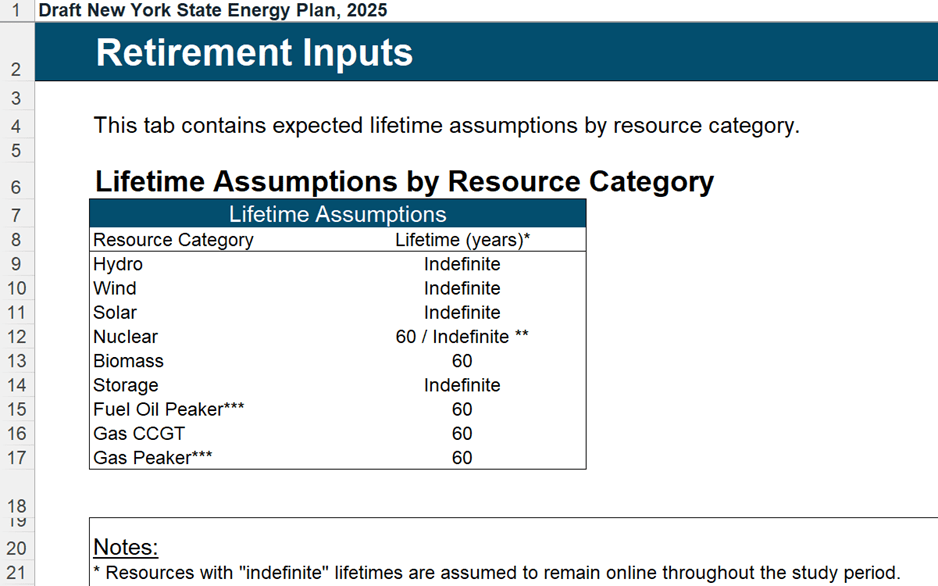
The Scoping Plan considered every possible environmental impact associated with fossil fuels but ignored all the environmental impact associated with the manufacture of wind turbines, solar panels, and energy storage batteries.  That means that there hasn’t been a direct comparison of impacts.  In addition no environmental impact accounting addressed the shorter expected lifetimes of those technologies.  There also is a serious deficiency regarding cumulative environmental impacts.  Consistent with 6 New York Codes, Rules and Regulations (NYCRR) §617.9(a)(7), a Generic Environmental Impact Statement was released on September 17, 2020 .  This Final Supplemental Generic Environmental Impact Statement (SGEIS) for the Climate Leadership and Community Protection Act was released that claimed to evaluate the environmental impacts associated with the incremental resources expected to be needed to comply with the Climate Act.  It built upon and incorporated by reference relevant material from four prior State Environmental Quality Review Act (SEQRA) analyses. 

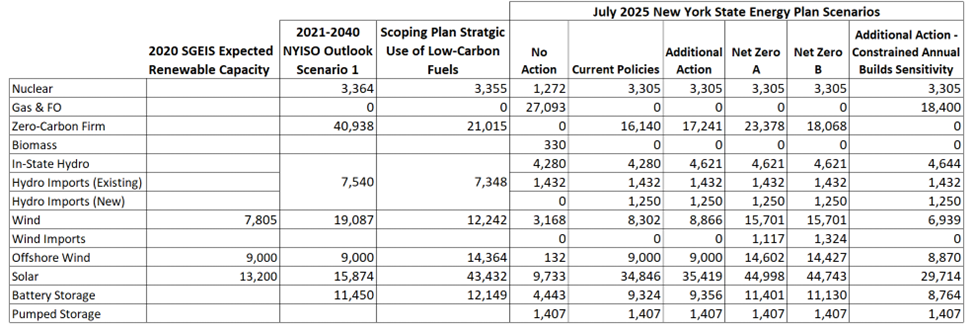
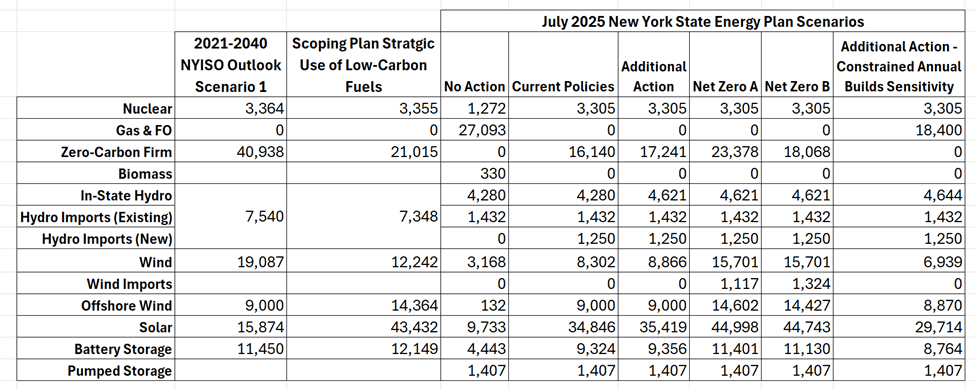
As I documented in the August 12, 2025 PSC filing, the problem is that the original expectations of renewable capacity for the Climate Act falls far short of the renewable capacity requirements in more recent assessments.  The following table compares the capacity (MW) in the 2021-2040 NYISO Outlook Scenario 1, the Scoping Plan Strategic Use of Low-Carbon Fuels Scenario and six scenarios in the July 2025 Draft State Energy Plan.  There are inconsistencies in the categories but the massive increase in renewable resources is obvious.  Onshore wind is projected capacity is 145% higher than analyzed, offshore wind expected capacity is 62% higher than analyzed, and solar is 241% higher than the maximum scenario expectation.  In addition, no previous analysis considered the environmental impacts of massive energy storage facilities or the “zero-carbon firm resource” that the integrated analysis presumes will be provided by hydrogen resources.  The Draft Energy Plan needs to address this failing.

CLCPA Implementation 2040 Fuel Mix Capacity (MW) Compared to 2020 SGEIS Exhibit 2-5 Expected Renewable Capacity

  • If these terms are not defined, then they are just meaningless slogans.

New Yorkers deserve a complete affordability, reliability, and environmental impact accounting.

Discussion

There is no sign to date that NYSERDA is changing anything in its stakeholder process from the unresponsive approach used in the Scoping Plan.  There is another aspect concerning that process and the current outreach.  The public gets slick promotional information and carefully crafted slogans promising abundant, reliable, affordable, and clean energy for all New Yorkers.   These terms are vague enough that the Hochul Administration can continue to avoid responsibility for the impacts of the Climate Act.  The Draft Energy Plan is too important to rely on emotion and political pandering to specific constituencies to not do this process right.

Conclusion

It is troubling that New York energy policy has been dominated by political mandates that ignore physical reality.  I am convinced that nothing from the energy experts responsible for the electric system can say will change the disastrous path of the Draft Energy Plan.  It is going to take a political policy shift to avert disaster.  If you are concerned, demand accountability from the NYSERDA energy plans and please speak out to your elected officials.

The challenges of achieving a 100% renewable electricity system in the United States

I am very frustrated with the New York Climate Leadership & Community Protection Act (Climate Act) net zero transition because the reality is that there are so many issues coming up with the schedule and ambition of the Climate Act that it is obvious that we need to pause implementation and figure out how best to proceed.  In my opinion, the Hochul Administration failed to acknowledge that the observed problems were inevitable during the development of the Scoping Plan.  This post describes an article that came out in June 2021 prior to the preparation of the Draft Scoping Plan that should have guided the development of the plan.

I am convinced that implementation of the New York Climate Leadership & Community Protection Act (Climate Act or CLCPA) net-zero mandates will do more harm than good if the future electric system relies only on wind, solar, and energy storage because of reliability and affordability risks.  I have followed the Climate Act since it was first proposed, submitted comments on the Climate Act implementation plan, and have written over 550 articles about New York’s net-zero transition. 

The opinions expressed in this article do not reflect the position of any of my previous employers or any other organization I have been associated with, these comments are mine alone. 

Net-Zero Aspirations

The Climate Leadership & Community Protection Act (Climate Act) established a New York “Net Zero” target (85% reduction in GHG emissions and 15% offset of emissions) by 2050 and has two electric sector targets: 70% of the electricity must come from renewable energy by 2030 and all electricity must be generated by “zero-emissions” resources by 2040. The Scoping Plan that outlined how to “achieve the State’s bold clean energy and climate agenda” was based on an Integration Analysis prepared by the New York State Energy Research and Development Authority (NYSERDA).  The Climate Act is not the only legislation or regulation that was promulgated to achieve reductions in greenhouse gas emissions to address climate change. 

Challenges for a 100% Renewable Electricity System

The article, The challenges of achieving a 100% renewable electricity system in the United States, (Challenge Article) was authored by staff from the National Renewable Energy Laboratory, Office of Energy Efficiency and Renewable Energy, United States Department of Energy and the University of Colorado Boulder, Renewable and Sustainable Energy Institute.  That means that it represented the mainstream “consensus” of Federal government renewable energy thinking at the time the New York State Energy Research & Development Authority (NYSERDA) was preparing the Scoping Plan.

The following information is the formal citation for the document.

The challenges of achieving a 100% renewable electricity system in the United States,

 Paul Denholm, Douglas J. Arent, Samuel F. Baldwin, Daniel E. Bilello, Gregory L. Brinkman, Jaquelin M. Cochran, Wesley J. Cole, Bethany Frew, Vahan Gevorgian, Jenny Heeter, Bri-Mathias S. Hodge, Benjamin Kroposki, Trieu Mai, Mark J. O’Malley, Bryan Palmintier, Daniel Steinberg, Yingchen Zhang, Joule, Volume 5, Issue 6, 2021, Pages 1331-1352, ISSN 2542-4351,  https://doi.org/10.1016/j.joule.2021.03.028.

Abstract:

Understanding the technical and economic challenges of achieving 100% renewable energy (RE) electric power systems is critical, given the increasing number of United States regional and state commitments toward this goal. Although no detailed study of a major utility of large interconnection under 100% RE system has been published, considerable literature explores the potential to greatly increase RE penetration. This literature, combined with real-world experience with increased RE deployment, points to two main challenges associated with achieving 100% RE across all timescales: (1) economically maintaining a balance of supply and demand and (2) designing technically reliable grids using largely inverter-based resources. The first challenge results in a highly nonlinear increase in costs as the system approaches 100% RE, in large part because of seasonal mismatches. The second challenge might require new inverter designs, depending on the mix of RE technologies. Analysis and experience to date point to no fundamental technical reasons why a 100% RE electric power system cannot be achieved, but the economic challenges indicate the need for advancements in several technologies and careful consideration of the suite of options that could be used to achieve equivalent carbon-reduction goals.

Previous work also points to the need for analytic tool development, and techno-economic feasibility analysis must also consider the host of regulatory, market, and policy issues that might limit the ability to deploy mixes of resources that are suggested by least-cost modeling exercises.

Climate Act Technology

One fundamental flaw in the Climate Act was the mistaken belief by the authors of the law, including Dr. Robert Howarth, that no new technology would be required. I have described this erroneous presumption and its impacts many times but will reference just one example

The Challenge Article provides “a perspective on the most technically and economically challenging

aspects of achieving a 100% RE electric power system while maintaining a reliable, cost-effective balance of electricity supply and demand.”  As noted in the Abstract two challenges were emphasized: the need to balance supply and demand and the engineering challenge of incorporating inverter-based resources.  Both issues were discounted by the Climate Action Council.

The report concludes that:

Understanding the technical and economic challenges of achieving 100% RE electric power systems is critical, given the assumed role of these systems in achieving many regional and state commitments to reduce GHG emissions on aggressive timelines.  Furthermore, these are complex, multidisciplinary challenges that cannot be solved by any individual entity but rather will require collaboration across technical research communities, academia, laboratories, and industry.

In the United States, several regions have met more than half of their load with renewables for multi-hour periods, and studies have indicated pathways to achieve cost-competitive penetrations of RE that are much greater than current levels.

Significant unanswered questions remain regarding moving toward or achieving 100% RE at a national scale for all hours of the year. There is no simple answer to how far we can increase RE penetration before costs rise dramatically or reliability becomes compromised. Studies have found no specific technical threshold at which the grid ‘‘breaks,’’ and we cannot extrapolate from previous cost analyses because of nonlinearities and unknown unknowns. Additional research is needed to evaluate the suite of technologies needed to ensure the supply of RE matches demand patterns across all time periods. Substantial engineering and design are needed to transition the grid from one that is dependent on synchronous machines to one that is based on inverters. This science, analysis, and engineering must consider the interaction of multiple low-carbon technologies to identify least-regrets pathways to decarbonizing both the electricity and energy systems in the United States and internationally.

In my opinion, these findings should have been incorporated into the Scoping Plan.  The impacts of the failure to do so are evident now and will be felt for years to come if there is no pause in implementation to consider how best to proceed.  While the Climate Act mandates a net-zero transition, the Public Service Commission (PSC) also has a broad mandate to “ensure access to safe, reliable utility service at just and reasonable rates.”  It is not at all clear that the Climate Act “zero-emissions” electric system can meet the PSC mandate because of the issues raised in the Challenge Article.

It is Even Worse

The Challenge Article emphasized engineering issues, but I think that they neglected one issue that has received much attention in New York.  The Challenge Article included a section on “Exploring the balance challenge” that includes an important graph:

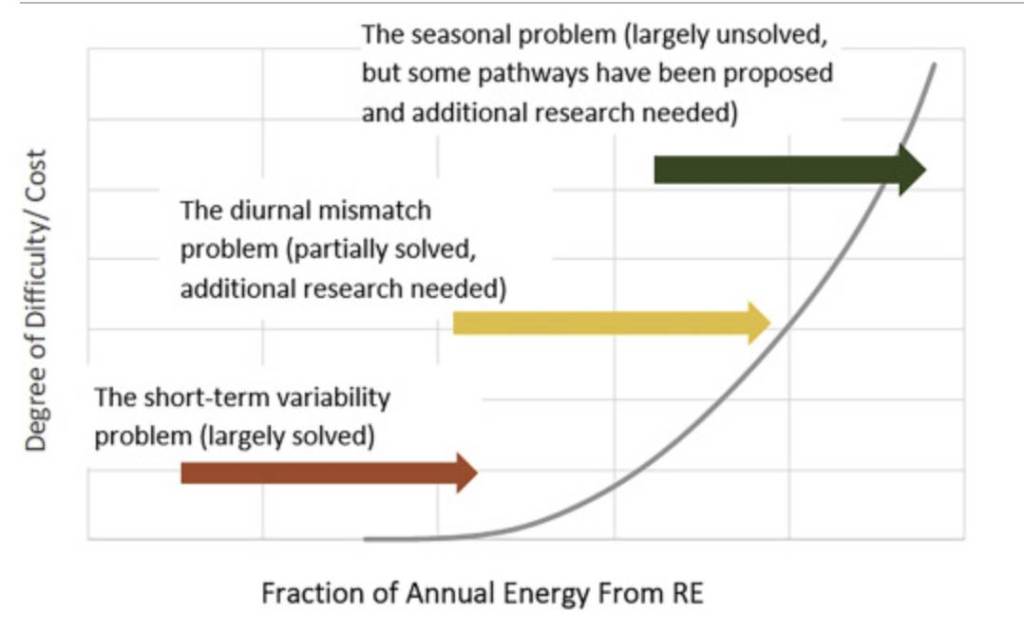
Figure 1 provides a framework to discuss the balance challenge, which conceptually illustrates how the expected costs and challenges might change with increasing penetration of RE. The figure loosely defines regions of annual RE penetration. As discussed in what we know about the balance challenge we know about the balance challenge from real-world re deployment, at current RE penetration levels (18% nationally in 2019), RE is cost competitive with traditional generation sources in many regions of the United States. This is caused by the utility industry cost effectively integrating these resources by addressing the hourly and sub-hourly variability of VRE and load.

Figure 1. A simple framework for discussing the degree of difficulty and cost of increased RE deployment

Beyond these levels, we reach the second zone, where studies discussed in what we think we know about the balance challenge from grid studies have explored how the diurnal mismatch problem might be cost effectively addressed with some combination of current and near-future technologies to reach annual contributions in the range of 80% RE. Beyond this point, in the third zone, the seasonal balance may require technologies that have yet to be deployed on a large scale, with highly uncertain costs and requirements. 

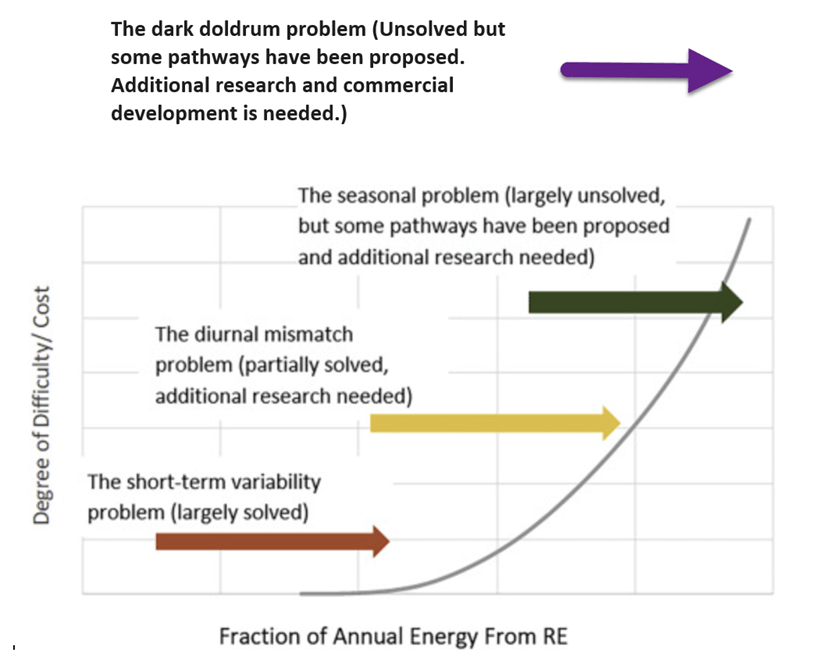
I think a fourth zone is appropriate.  The Challenge Article emphasis on the engineering challenges neglects the weather challenge.  Any electric system reliant on weather-dependent resources like wind and solar must address the dark doldrums, the extended periods of low wind and solar resource availability.  The Scoping Plan, Integration Analysis, New York Independent System Operator (NYISO), and independent analysis by Prof. C. Lindsay Anderson, Chair of Department of Biological and Environmental Engineering Cornell all have noted that a new category of generating resources called Dispatchable Emissions-Free Resources (DEFR) is necessary to keep the lights on during these periods. This topic has received much attention at this blog because of my background as a meteorologist and is covered at my DEFR page.

I have incorporated the DEFR challenge as a fourth zone into the Figure 1 simple framework in Figure 2.  I think that this problem will be more expensive and more challenging than the seasonal problem so it must be added to the figure.  New York is addressing DEFR in Case 15-E-0302 – Proceeding on Motion of the Commission to Implement a Large-Scale Renewable Program and Clean Energy Standard, but progress has been slow given that there is agreement that the resource is needed but there is no state recommendation how to proceed.

Figure 2 Modified simple framework for discussing the degree of difficulty and cost of increased RE deployment

I believe the only likely viable DEFR backup technology is nuclear generation despite its costs because it is the only candidate resource that is technologically ready, can be expanded as needed, and does not suffer from limitations of the Second Law of Thermodynamics. If the only viable DEFR solution is nuclear, then the wind, solar, and energy storage approach cannot be implemented without nuclear power.  Nuclear power works best as a baseload resource so using it solely as DEFR backup is inappropriate.  Developing baseload nuclear eliminates the need for a huge DEFR backup resource and means that the “build as much as we can as fast as we can” wind and solar buildout currently in progress is unnecessary.  When all the costs associated with the proposed Scoping Plan wind, solar, and energy storage approach are compared to an electric system based on nuclear I believe that nuclear will be cheaper especially if life expectancies are considered. 

There is another argument in favor of abandoning weather-dependent resources in favor of nuclear.  To ensure that there are sufficient backup resources the magnitude and duration of a dark doldrum must be determined.  That is a significant challenge because of the tradeoff between the enormous costs of this necessary but infrequently used resource and the risks if insufficient electric energy is available when the de-carbonized energy system is completely electrified.  This economic and safety tradeoff is not an issue in a de-carbonized system that relies on nuclear energy.

Conclusion

I want to emphasize two points.  This comprehensive analysis should have been incorporated into the Scoping Plan discussions because it makes an irrefutable case that there are unsolved issues that require further research.  Given that uncertainty, the Scoping Plan should have incorporated safety valves if the issues are unsolved at certain points in the transition.  The second point is that the article did not address the dark doldrum DEFR problem so it underestimates the challenges of a 100% renewable system.

This is further evidence that a pause is necessary in Climate Act implementation.

Critical Review of Impacts of Greenhouse Gas Emissions on the U.S. Climate

This post is part of my continuing coverage of the draft New York State Energy Plan (Draft Plan).  In late July the United States Department of Energy (DOE) published a draft report titled “A Critical Review of Impacts of Greenhouse Gas Emissions on the U.S. Climate”.  This post describes differences between that report and the Draft Plan Climate Change, Adaptation and Resiliency chapter.

I am convinced that implementation of the New York Climate Leadership & Community Protection Act (Climate Act or CLCPA) net-zero mandates will do more harm than good if the future electric system relies only on wind, solar, and energy storage because of reliability and affordability risks.  I have followed the Climate Act since it was first proposed, submitted comments on the Climate Act implementation plan, and have written over 550 articles about New York’s net-zero transition. 

The opinions expressed in this article do not reflect the position of any of my previous employers or any other organization I have been associated with, these comments are mine alone. 

Net-Zero Aspirations

The Climate Leadership & Community Protection Act (Climate Act) established a New York “Net Zero” target (85% reduction in GHG emissions and 15% offset of emissions) by 2050 and has two electric sector targets: 70% of the electricity must come from renewable energy by 2030 and all electricity must be generated by “zero-emissions” resources by 2040. The Scoping Plan that outlined how to “achieve the State’s bold clean energy and climate agenda” was based on an Integration Analysis prepared by the New York State Energy Research and Development Authority (NYSERDA). 

The rationale of New York’s net-zero transition plan is that climate change is a threat to society that must be addressed by eliminating the use of fossil fuels. Because I believe that the climate change threat narrative has become religious dogma for many, I have not addressed this position much.  However, I believe that climate change is an exaggerated problem that is diverting attention away from other serious environmental and societal issues to the detriment of us all.

The Draft Energy Plan Climate Change, Adaptation and Resiliency (Climate Chapter) document represents the extreme “consensus” view of climate change.  In my opinion, New York’s climate change position represents the extreme end of the consensus because there have been instances (e.g. sea level rise projections) where state policy is based on a more extreme position than that taken by the Intergovernmental Panel on Climate Change.

Critical Review

On July 29, 2025 the Department of Energy released the Critical Review report.  Rather than drafting a summary of the report I am going to quote the Background and Overview from the Federal Register Notice of Availability: A Critical Review of Impacts of Greenhouse Gas Emissions on the U.S. Climate (NOA).  I am also going to highlight differences in the review relative to statements in the Draft Energy Plan chapter on climate change

The draft report was prepared by independent scientists, assembled by Energy Secretary Chris Wright with diverse expertise in physical science, economics, climate science and academic research. The authors are John Christy, Judith Curry, Steven Koonin, Ross McKitrick, and Roy Spencer.  The press release describes their backgrounds.  In my opinion, they are all first-rate experts.  The Background in the Notice of Availability (NOA) states that:

The draft report titled “A Critical Review of Impacts of Greenhouse Gas Emissions on the U.S. Climate” was developed by DOE’s 2025 Climate Working Group, a group of five independent scientists assembled by Energy Secretary Chris Wright with diverse expertise in physical science, academic research and climate science. The landing page for the CWG Report, including a press release, can be found here.

The following quotations are from the NOA “Overview of the CWG Report”. 

The report reviews scientific certainties and uncertainties in how anthropogenic carbon dioxide (CO2) and other greenhouse gas emissions have affected, or will affect, the Nation’s climate, extreme weather events, and selected metrics of societal well-being. Those emissions are increasing the concentration of CO2 in the atmosphere through a complex and variable carbon cycle, where some portion of the additional CO2 persists in the atmosphere for centuries.

Increasing concentration of CO2 is uncontroversial.

Elevated concentrations of CO2 directly enhance plant growth, globally contributing to “greening” the planet and increasing agricultural productivity. They also make the oceans less alkaline (lower the pH). That is possibly detrimental to coral reefs, although the recent rebound of the Great Barrier Reef suggests otherwise.

Many of the other statements are controversial.  The Climate Chapter does not mention any potential benefits to increased CO2 concentrations.  I suspect that the only reason coral reef threats are not mentioned is because New York does not have any coral.

Carbon dioxide also acts as a greenhouse gas, exerting a warming influence on climate and weather. Climate change projections require scenarios of future emissions. There is evidence that scenarios widely-used in the impacts literature have overstated observed and likely future emission trends.

The Climate Chapter references the 2024 New York State Climate Impacts Assessment (NYSCIA).   It claims that it “offers a thorough evaluation of historical climate data”.  The Draft Review reference to a widely-used scenario refers to the use of Representative Concentration Pathway 8.5.  That scenario was used extensively in the NYSCIA apparently because it provided the biggest potential impacts.  In my opinion, that approach invalidates projections in the assessment because the scenario is impossible.

The world’s several dozen global climate models offer little guidance on how much the climate responds to elevated CO2, with the average surface warming under a doubling of the CO2 concentration ranging from 1.8° C to 5.7° C. Data-driven methods yield a lower and narrower range. Global climate models generally run “hot” in their description of the climate of the past few decades. The combination of overly sensitive models and implausible extreme scenarios for future emissions yields exaggerated projections of future warming.

NYSCIA used the “hot” models and the implausible extreme scenarios to claim that “in order to limit the global average increase in temperature to 2°C (if possible, 1.5°C) and minimize the risk of the most severe climate impacts, substantial reductions in GHG emissions by mid-century are required.”  In my opinion, the models that used are not fit for policy decisions.

Most extreme weather events in the U.S. do not show long-term trends. Claims of increased frequency or intensity of hurricanes, tornadoes, floods, and droughts are not supported by U.S. historical data. Additionally, forest management practices are often overlooked in assessing changes in wildfire activity. Global sea level has risen approximately 8 inches since 1900, but there are significant regional variations driven primarily by local land subsidence; U.S. tide gauge measurements in aggregate show no obvious acceleration in sea level rise beyond the historical average rate.

NYSCIA concludes that “New York State’s climate has already changed, with impacts evident across economic sectors, industries, natural systems, communities, and regions.”  The Critical Review directly contradicts these claims. 

Attribution of climate change or extreme weather events to human CO2 emissions is challenged by natural climate variability, data limitations, and inherent model deficiencies. Moreover, solar activity’s contribution to the late 20th century warming might be underestimated.

Ditto.

Both models and experience suggest that CO2-induced warming might be less damaging economically than commonly believed, and excessively aggressive mitigation policies could prove more detrimental than beneficial. Social Cost of Carbon estimates, which attempt to quantify the economic damage of CO2 emissions, are highly sensitive to their underlying assumptions and so provide limited independent information.

The Climate Act is based on a fundamentally different outlook.  The Preamble to the Climate Act legislation claims that: “Action undertaken by New York to reduce greenhouse emissions will have an impact on global greenhouse gas emissions and the rate of climate change.”  The NYSCIA document is completely consistent with the law and there isn’t even a suggestion that there might be uncertainties.

U.S. policy actions are expected to have undetectably small direct impacts on the global climate, and any effects will emerge only with long delays.

This point is not addressed in the Climate Act, NYSCIA, or any New York GHG emission reduction regulation.  Nothing that the United States can do will have a detectable impact on the global climate so anything New York does is going to have an even less detectable impact.  There is no justification whatsoever for the Climate Act schedule even if we must “do something”.

Discussion

In my opinion, the Critical Review is long overdue. I appreciate the commitment of the authors.  An interview with Steven Koonin by John Robson from the Climate Discussion Nexus makes the important point that we don’t know nearly as much as proponents claim and that consideration of what we know and what we don’t know should be reflected in policy approaches.  Roy Spencer and Judith Curry both wrote blog posts explaining why they got involved in the report.  All five authors provided a joint written response to Nature magazine, stating they are “committed to a transparent and fact-based dialogue on climate science” and that they will respond publicly “to all serious scientific comments” during the NOA public comment period.

The usual suspects response has been outrage that anyone could possibly question their “settled science”.   They are demanding systematic fact-checking efforts and a public debate.  All the while hey are oblivious to the point that all five of the authors have been asking for just such an approach for years.  I agree with the need for an open debate of the climate science.

Conclusion

The key point for New York is that we have the same situation here.  The Draft Energy Plan stakeholder process has no forum for public debate.  I believe that the arguments that make the case that the net-zero transition ambition and schedule will result in an affordable and reliable energy system are much weaker than the arguments that GHG emission reductions are necessary to control the climate.  The failure to openly discuss the differences between the Draft Energy Plan and New York Independent System Operator projections is unacceptable.  If the stakeholder process for the Draft Energy Plan continues to ignore public input, then I think New York will be saddled with a false solution that will take years to fix.

Bait and Switch Draft Energy Plan Costs

As part of my continuing coverage of the draft New York State Energy Plan.  I recently explained how the analyses for the Draft Energy Plan are hiding the true costs to meet the Climate Act targets.  Energy Bad Boys Mitch Rolling and Isaac Orr recently published an article that describes a similar evaluation that has the same flaw that does a better job explaining the problem.

I am convinced that implementation of the New York Climate Leadership & Community Protection Act (Climate Act or CLCPA) net-zero mandates will do more harm than good if the future electric system relies only on wind, solar, and energy storage because of reliability and affordability risks.  I have followed the Climate Act since it was first proposed, submitted comments on the Climate Act implementation plan, and have written over 550 articles about New York’s net-zero transition. 

The opinions expressed in this article do not reflect the position of any of my previous employers or any other organization I have been associated with, these comments are mine alone. 

Net-Zero Aspirations

The Climate Leadership & Community Protection Act (Climate Act) established a New York “Net Zero” target (85% reduction in GHG emissions and 15% offset of emissions) by 2050 and has two electric sector targets: 70% of the electricity must come from renewable energy by 2030 and all electricity must be generated by “zero-emissions” resources by 2040. The Scoping Plan that outlined how to “achieve the State’s bold clean energy and climate agenda” was based on an Integration Analysis prepared by the New York State Energy Research and Development Authority (NYSERDA).  The Climate Act is not the only legislation or regulation that was promulgated to achieve reductions in greenhouse gas emissions to address climate change.  That fact has a major bearing on the NYSERDA Draft Energy Plan analyses.

According to the New York State Energy Plan website: “The State Energy Plan is a comprehensive roadmap to build a clean, resilient, and affordable energy system for all New Yorkers.”  The driving factor for the Energy Plan is the net-zero ambitions of New York’s ruling political party.  This is the first update of the Energy Plan since the Climate Act was passed in 2019.  I have provided more background information and a list of previous articles on my Energy Plan page

Costs

In my article about Energy Plan costs, I mentioned that NYSERDA President and CEO Doreen is the Chairperson the Energy Planning Board.  After a presentation regarding the Transmission and Distribution Reliability Study she said.

You may recall during our last meeting in which we discussed the pathways modeling for this plan. And to remind you, the analysis showed that New York’s citizens and businesses will need to invest over one hundred billion dollars each year in the energy system, no matter which future path we take.

I have one immediate response.  There is no future net-zero transition path that would not cost much more than $100 billion.  NYSERDA, ever beholden to the Hochul Administration’s political plans, has prepared a “comprehensive” roadmap using a misleading limited assessment  As was the case with the Integration Analysis and Scoping Plan, NYSERDA is interpreting the “No action” scenario as one that includes all legacy programs in place prior to the passage of the Climate Act.  This reduces the implementation costs.  The appropriate baseline scenario is one that excludes all programs that were promulgated to reduce GHG emissions. 

After publishing my article, I found an analysis of a similar situation by Energy Bad Boys Mitch Rolling and Isaac Orr describing the Environmental Protection Agency (EPA) analysis of its regulations on greenhouse gas (GHG) emissions from existing coal and new natural gas plants.  They describe the same problem with that evaluation as the NYSERDA Energy Plan evaluation.   I think the article does a better job than I did explaining the problem, so this post features their excellent work and its implications to NYS..

B,S. Baseline Modeling

In the Introduction to their article the Rolling and Orr describe the challenge of modeling future energy possibilities.  It is entirely applicable to New York.

Whenever you see a regulatory agency like the Environmental Protection Agency (EPA) or a utility company crow about how much an energy proposal or regulation will save or cost Americans, the first thing you should do is ask: “Oh yeah? Compared to what?”

It’s important to ask this question because these entities never report the true cost of a proposal compared to today’s costs, but instead, they compare the costs to some imaginary future baseline scenario that is often even more expensive.

This deceptive bait-and-switch tactic allows utilities and regulatory agencies to hide the true costs of their onerous regulations or integrated resource plans in a B.S. baseline. It also allows these entities to dishonestly claim their preferred policies will save energy consumers money—when in reality, they won’t.

In New York this tactic was used in the Scoping Plan analysis and is being used again in the Draft Energy Plan analysis.  In my description of the Scoping Plan I referred to this as a shell game.  The Rolling and Orr call it “bait and switch” and describe it thusly:

Imagine you were at Best Buy browsing around, and you saw an advertisement for two TVs—the one on the left has a price tag of $800, and the other on the right has a price tag of $500. The sign reads: “Save $300 by choosing the one on the right!”

Sure, you can save $300 by buying the TV on the right, compared to buying the one on the left, but ultimately, you understand that you’re still spending an extra $500. You could save even more ($500) by not buying a new TV in the first place. These are the kinds of bait-and-switch shenanigans used by regulatory agencies and utilities to sell their energy proposals to the public.

To help understand how this relates to energy modeling, it helps to look at another example involving a government budget.

Let’s say the federal government currently spends $200 billion per year on government programs, but some lawmakers want to increase spending to $1 trillion to pay for more government programs. Ultimately, Congress agrees to spend a total of $700 billion per year instead of $1 trillion.

Most people would probably look at this budget and agree that it increases spending by $500 billion per year, but spending advocates would argue that this bill saves $300 billion per year. This is only true if you read the fine print that says, “compared to the baseline cost estimate that assumed a total of spending $1 trillion.”

In New York, NYSERDA is claiming that the costs of the net-zero transition are a small increment of the one hundred billion annual investments in the energy system, “no matter which future path we take.”  Much to the chagrin of NYSERDA, they have not been able to torture the numbers to the point where they can claim that the net-zero transition will save money so they are left with arguing that it is a small increment.  For New Yorkers the key point is that NYSERDA has not provided a detailed breakdown of costs per emission strategy future path.  As a result, we do not know how the expected costs are allocated so that we cannot check their claim.

Rolling and Orr evaluated the costs of the GHG emission reduction regulations implemented by the Biden Administration

Ordinarily, it would seem reasonable to assume that the benefits of reversing a regulation could be determined by reversing the estimated cost of complying with said regulation.

When the Biden EPA finalized its regulations, they claimed the rules would only cost Americans $19 billion in additional costs, and that these compliance costs would be far outweighed by the benefits of fewer emissions of criteria pollutants and greenhouse gases.

But there was a major problem with their claim: Almost all of the actual compliance costs of the rules were buried in a B.S. Baseline.

The B.S. Biden Baseline is a scenario created by the Biden EPA in 2023 that assumed almost all of the changes to the power generation fleet in the next two decades would be due to the subsidies in the Inflation Reduction Act (IRA), and state wind and solar mandates, not the Biden administration’s greenhouse gas regulations.

Based on our evaluation (let’s be real, Mitch did this part) of the EPA’s slew of Excel spreadsheets, the Biden Admin’s B.S. Baseline accounted for 95 percent of the changes in generation capacity from the MISO grid in 2025 through 2055, compared to the final rules, which you can see in the table below.

Because the Biden administration hid almost all of the new generation capacity in its B.S. Baseline, nearly all of the costs associated with building and operating this generating capacity were hidden, as well.

NYSERDA has not provided sufficient information in their documentation to develop a similar table.  Rolling and Orr went on to explain how the true EPA plan costs were buried.

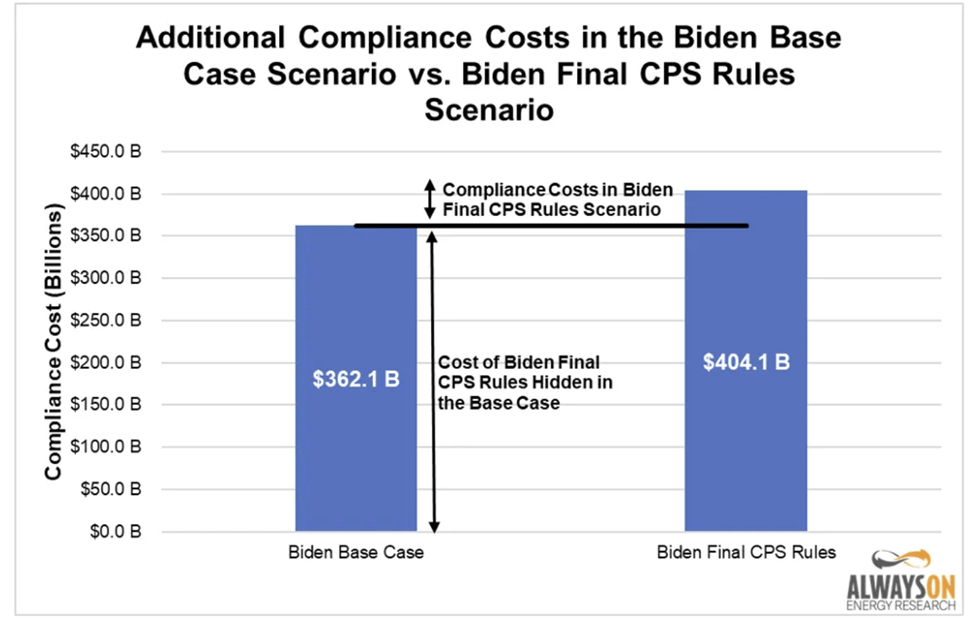
The Biden administration claimed that its final power plant wrule ould only increase costs by $19 billion over a 24-year period, spanning from 2024 through 2047, using a 2 percent discount rate. However, this modest compliance cost is entirely due to the fact that most of the expenses for the modeled MISO grid in the Biden Final CPS Rules IPM output files are incurred in the Biden Base Case.

The graph below shows the costs of building and operating the MISO grids outlined in the Biden administration’s B.S. Baseline and final regulations. Our modeling indicates that the modeled MISO grid in the Biden Baseline would cost $362.1 billion, using the subsidy phaseout timeline established in the One Big Beautiful Bill Act, and the final Biden regulations would cost $404.1 billion.

As a result, the true cost of building and operating the MISO grid under the Biden rules envisioned in Biden’s regulatory impact analysis would be $404.1 billion, but the administration would only consider $42.9 billion as compliance costs.

Ideally at this point I would prepare a similar chart describing New York’s energy cost breakdown and illustrating my point that NYSERDA is using a similar bait and switch tactic.  In theory, I could emulate Mitch Rolling and prepare my own estimate of costs but that would require an enormous amount of time that I do not have for this post.  The NYSERDA Pathways Analysis projects that energy system investments will total $120 billion per year out to 2040.  In my opinion, that is an extraordinary claim that should be justified with transparency that identifies the choices and assumptions made to arrive at that number, including the numbers needed to make a similar chart.

Rollings and Ord concluded:

Long story short, the B.S. Baseline used by the Biden administration hid 90 percent of the costs of its regulations. Because the Biden Base Case is responsible for the vast majority of the changes observed in the modeled MISO grid in the Biden Final CPS Rules, it is responsible for driving the vast majority of the cost of the changing resource portfolio.

Therefore, it is incredibly misleading to suggest that the Final CPS Rules would be cost effective, since the 90 percent of the costs are hidden in its baseline modeling. This is called a Bait & Switch—and it’s completely B.S.

It is impossible to provide a similar breakdown of costs associated with the NYSERDA Draft Energy Plan’s claim that energy system investments will total $120 billion per year out to 2040 whatever future energy path because there insufficient documentation.  I believe that full disclosure would lead to the same conclusion.

Discussion

The Energy Plan Pathways Analysis defines the “No Action” pathway scenario as “reflecting outcomes in the absence of the Climate Act and energy policies enacted from 2019 onwards”.  It includes federal energy incentives and legacy New York State policies (i.e., those in place as of 2019), but it explicitly excludes any state and local climate, decarbonization, or efficiency policies put in place since 2019.  NYSERDA insinuates that this represents the world without New York State driven climate action.  However, as shown in my earlier post, there are many projects in the “No Action” pathway scenario that when included underestimate the cost of achieving net-zero.

For illustrative purposes, the “No Action” scenario includes the Federal electric vehicle mandate emission reduction program.  Switching to electric vehicles is necessary to achieve the Climate Act emission reduction targets but the costs for this program are buried in the $120 billion annual investment because the federal mandate was in place before the law was passed.  The current uncertainty of Federal electric vehicle mandates will affect the implementation ramp rate. 

Conclusion

New York’s B.S. Baseline of the bait and switch tactics described in the Rollings and Orr post improperly includes “no action” projects that only exist because of the Climate Act.  I believe that the majority of New Yorkers agree with me that we want to know the total cost, irrespective of which regulation requirement, of the Energy Plan projects that will be necessary to meet the net-zero and electric system mandates of the Climate Act.  In my opinion, there is no question that those costs would be enormous and no question that that fact is being hidden by NYSERDA in its own B.S. Baseline.

Draft NYS Energy Plan Pathways Scenario Costs

This is part of my continuing coverage of the New York State Energy Plan.  On July 23, 2025, the Draft Energy Plan was released for comment.  This post describes the scanty cost information in the draft.

I am convinced that implementation of the New York Climate Leadership & Community Protection Act (Climate Act or CLCPA) net-zero mandates will do more harm than good if the future electric system relies only on wind, solar, and energy storage because of reliability and affordability risks.  I have followed the Climate Act since it was first proposed, submitted comments on the Climate Act implementation plan, and have written over 550 articles about New York’s net-zero transition. 

I acknowledge the use of Perplexity AI to generate summaries and references included in this document.  The opinions expressed in this article do not reflect the position of any of my previous employers or any other organization I have been associated with, these comments are mine alone. 

Net-Zero Aspirations

The Climate Leadership & Community Protection Act (Climate Act) established a New York “Net Zero” target (85% reduction in GHG emissions and 15% offset of emissions) by 2050 and has two electric sector targets: 70% of the electricity must come from renewable energy by 2030 and all electricity must be generated by “zero-emissions” resources by 2040. The Scoping Plan that outlined how to “achieve the State’s bold clean energy and climate agenda” was based on an Integration Analysis prepared by the New York State Energy Research and Development Authority (NYSERDA). 

Energy Plan Overview

According to the New York State Energy Plan website (Accessed 3/16/25):

The State Energy Plan is a comprehensive roadmap to build a clean, resilient, and affordable energy system for all New Yorkers. The Plan provides broad program and policy development direction to guide energy-related decision-making in the public and private sectors within New York State.

The driving factor for change is the Energy Plan’s net-zero ambitions of New York’s ruling political party.  This is the first update of the Energy Plan since the Climate Act was passed in 2019.  I have provided more background information and a list of previous articles on my Energy Plan page

In this iteration of New York climate policy, the Pathways Analysis is equivalent to the Integration Analysis. Responsibility for implementing the Energy Plan as well as all the Climate Act programs lies with NYSERDA.  Over my multi-decade career, I have seen an ever-increasing level of political influence on NYSERDA’s research priorities and, more recently, the research results. This post describes the cost information in Pathways Analysis scenarios and explains why it is inadequate.

Costs

My last post described how the misleading definition of the “No Action” scenario was being used to hide the true costs of the Draft Energy Plan.  NYSERDA President and CEO Doreen Harris provided one of the few direct references to costs at the last Energy Planning Board meeting when she said.

You may recall during our last meeting in which we discussed the pathways modeling for this plan. And to remind you, the analysis showed that New York’s citizens and businesses will need to invest over one hundred billion dollars each year in the energy system, no matter which future path we take.

Even this reference was misleading because the expected cost is $120 billion.  I consider a 20% difference significant, making this an example of hiding the costs.

Cost References

I reviewed the meeting slides and transcripts for the two Energy Planning Board meetings where the Pathways Analysis was discussed to find explicit references to expected costs.  I searched for “$”, “dollar”, and “billion”.  Searching the June 25, 2025 Board Meeting Slides I found two $ references to Hochul’s $1 billion decarbonization commitment, there were no relevant dollar references, and references to billion were for the decarbonization commitment.  The meeting recording includes a transcript.  When I searched “$” I found a reference to Hochul’s $1 billion decarbonization commitment.  This came up when I searched “billion” along with a second reference to the decarbonization commitment.  Searching for “dollar” provided no additional relevant references.  Also note that there was no reference in the minutes to billions of dollars. My searches in the May 27 meeting materials also did not find references to the costs.  The only relevant reference to billions in the last two meeting materials was the quote by Harris.

 I find it telling that Harris said “you may recall” when she referenced the $100 billion investment figure but there are no actual references for that number in recent meeting materials.  Cynic that I am I believe this is another indication of the cover up.

Legacy Programs

In my previous post I explained that the “No Action” pathway scenario reflects “outcomes in the absence of the Climate Act and energy policies enacted from 2019 onwards”.  The Perplexity description goes on: “It includes federal energy incentives and legacy New York State policies (i.e., those in place as of early 2025), but it explicitly excludes any state and local climate, decarbonization, or efficiency policies put in place since 2019.”  As a result, NYSERDA can claim that costs will be high no matter which future energy path we take.  In no small part the costs in the “no action: case are the result of all the legacy programs that are only included to reduce greenhouse gas emissions.

Nine legacy programs are mentioned in the Draft Energy Plan:

  1. Core Infrastructure Investments
  2. Baseline System-Wide Spending
  3. Continued Investment in All Fuel Systems
  4. Natural Gas System Infrastructure
  5. Electricity System Expansion
  6. Transmission and Distribution Infrastructure
  7. Grid Reliability and Resilience Investments
  8. Load Growth Accommodation
  9. Energy Efficiency and Weatherization

It is impossible to determine how much of the costs in these legacy programs is due to pre-Climate Act GHG emission reduction programs and how much is necessary infrastructure maintenance and capital spending of the energy system in the absence of those initiatives.  The “continued investment in all fuel systems” legacy program clearly does not include programs to reduce GHG emissions.  The electricity system expansion refers to wind, solar, and storage programs that are necessary to achieve the Climate Act goals that clearly only exists to reduce GHG emissions.  The other legacy programs include initiatives that fit both categories so differentiating costs for New York’s climate ambitions is impossible.

Cost Analysis of Pathways Analysis Scenarios

I say that it is impossible to categorize costs to achieve the Climate Act mandates in the Draft Energy Plan not only because there is insufficient explanatory information but also because cost details are not provided to enable the public to determine the costs.  I submitted a Perplexity AI query asking for the costs in the Pathways Analysis “no action” scenario and other scenarios in the Draft New York State Energy Plan’s Pathways Analysis.

The response provided the following information:

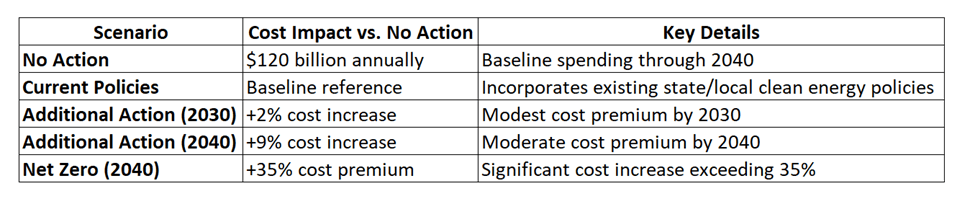
The No Action scenario serves as the baselinefor cost comparisons and represents approximately $120 billion in annual system-wide spending (in 2024 dollars) through 2040. The Energy Plan states that the baseline spending covers:

  • Maintaining and modernizing existing energy infrastructure
  • Replacing aging equipment at the end of its useful life
  • Purchasing fuels to meet energy needs
  • Supporting replacement natural gas generators
  • Continuing with end-use equipment replacement following normal cycles
  • Scenario Cost Comparisons

The Pathways Analysis evaluates five different scenarios with specific cost implications relative to the No Action baseline:

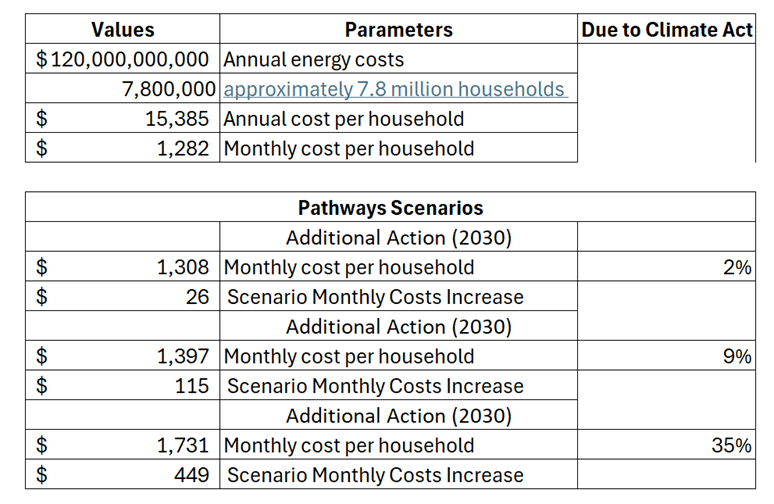
The NYSERDA Pathways Analysis projects that energy system investments will total $120 billion per year out to 2040.  There are approximately 7.8 million households in New York State.  The following table shows that dividing the $120 billion total by the number of households projects results in a $1,282 monthly energy cost per household.   Keep in mind that these are total energy costs including not only utilities but also personal transportation.  There are three Pathways scenarios with projected cost increases.  The “Additional Action” scenario projects a 2% increase in 2030 equivalent to $26 a month extra.  In 2040, the “Additional Action” scenario projects a 9% increase equivalent to $115 a month extra.  To achieve the net-zero transition aspirations the modeling projects a 35% cost premium equivalent to $449 a month extra.

Discussion

As I noted in my previous post, I believe the reason to obscure the costs is because the energy costs necessary to achieve the Climate Act net-zero transition are so large that they are politically untenable.  The cost slogan for the Energy Plan will claim that costs will be high no matter which future energy path we take and the incremental increase for net-zero nirvana is a small addition.  I am sure that most New Yorkers will agree with me that the claimed $1,282 per month energy costs is higher than my personal costs.  Frankly, that claim alone should be addressed because it could be the reason so many people are having trouble paying their utility bills.

With respect to Climate Act implementation, there are buried GHG emission reduction program costs in the $1,282 per month estimate.  It is impossible to estimate how much it is because NYSERDA has not provided transparent and comprehensive cost documentation.  In my opinion, there is very little public appetite for the additional $449 per month increase in costs necessary to achieve the Climate Act net zero targets.  Governor Hochul’s recent admission that the Climate Act might not be affordable and the heretofore unacknowledged fact that there is an affordability safety valve give me some hope that changes are forthcoming.

Conclusion

The Climate Act has always been political theater.  Passage of the law placated the loud and emotional constituency that believes that climate change caused by GHG emissions is an existential threat and enabled the politicians supporting the law to brag that they were leading the nation.  Now that we have experience with the impacts of the rollout of wind and solar sprawl across the countryside and the cost impacts are becoming too large to ignore, the only way to stop the nonsense is for politicians to demand that the Public Service Commission address the safety valve provision in Public Service Law 66-P. That will not happen unless we hold politicians accountable.

Draft NYS Energy Plan Pathways Scenario Scam

This is part of my continuing coverage of the New York State Energy Plan.  On July 23, 2025, the Draft Energy Plan was released for comment.  This post explains how the analyses for the Draft Energy Plan are hiding the true costs to meet the Climate Act targets.

I am convinced that implementation of the New York Climate Leadership & Community Protection Act (Climate Act or CLCPA) net-zero mandates will do more harm than good if the future electric system relies only on wind, solar, and energy storage because of reliability and affordability risks.  I have followed the Climate Act since it was first proposed, submitted comments on the Climate Act implementation plan, and have written over 550 articles about New York’s net-zero transition. 

I acknowledge the use of Perplexity AI to generate summaries and references included in this document.  The opinions expressed in this article do not reflect the position of any of my previous employers or any other organization I have been associated with, these comments are mine alone. 

Net-Zero Aspirations

The Climate Leadership & Community Protection Act (Climate Act) established a New York “Net Zero” target (85% reduction in GHG emissions and 15% offset of emissions) by 2050 and has two electric sector targets: 70% of the electricity must come from renewable energy by 2030 and all electricity must be generated by “zero-emissions” resources by 2040. The Scoping Plan that outlined how to “achieve the State’s bold clean energy and climate agenda” was based on an Integration Analysis prepared by the New York State Energy Research and Development Authority (NYSERDA).  The Climate Act is not the only legislation or regulation that was promulgated to achieve reductions in greenhouse gas emissions to address climate change.  That fact has a major bearing on the NYSERDA Draft Energy Plan Pathways scenario.

Energy Plan Overview

According to the New York State Energy Plan website (Accessed 3/16/25):

The State Energy Plan is a comprehensive roadmap to build a clean, resilient, and affordable energy system for all New Yorkers. The Plan provides broad program and policy development direction to guide energy-related decision-making in the public and private sectors within New York State.

The driving factor for the Energy Plan is the net-zero ambitions of New York’s ruling political party.  This is the first update of the Energy Plan since the Climate Act was passed in 2019.  I have provided more background information and a list of previous articles on my Energy Plan page

In this iteration of New York climate policy the Pathways Analysis is equivalent to the Integration Analysis. Responsibility for implementing the Energy Plan as well as all the Climate Act programs lies with NYSERDA.  Over my multi-decade career, I have seen an ever-increasing level of political influence on NYSERDA’s research priorities and, more recently, the research results. This post explains how the Pathways Analysis scenarios are being used by NYSERDA to hide costs of the Energy Plan net-zero transition.

Costs

I recently gave my first impressions of the Draft Energy Plan released for comment at the most recent Energy Planning Board meeting.  NYSERDA President and CEO Doreen Harris is the Chairperson the Energy Planning Board.  This post focuses on this one aspect of the meeting.  After a presentation regarding the Transmission and Distribution Reliability Study she said.

You may recall during our last meeting in which we discussed the pathways modeling for this plan. And to remind you, the analysis showed that New York’s citizens and businesses will need to invest over one hundred billion dollars each year in the energy system, no matter which future path we take.

I have one immediate response.  There is a future path that would not cost over $100 billion.  NYSERDA, ever beholden to the Hochul Administration’s political plans, has prepared a comprehensive roadmap using a misleading limited assessment  As was the case with the Integration Analysis and Scoping Plan, NYSERDA is interpreting the “No action” scenario as one that includes all legacy programs in place prior to the passage of the Climate Act.  The appropriate baseline scenario is one that excludes all programs that were promulgated to reduce GHG emissions.

Legacy Programs

The Energy Plan Pathways Analysis defines the “No Action” pathway scenario as “reflecting outcomes in the absence of the Climate Act and energy policies enacted from 2019 onwards”.  The Perplexity description goes on: “It includes federal energy incentives and legacy New York State policies (i.e., those in place as of early 2025), but it explicitly excludes any state and local climate, decarbonization, or efficiency policies put in place since 2019.”

I have found that Perplexity is a very useful research tool enabling me to easily find references needed to document my articles.  However, its summaries are colored by the references it finds.  The query response concluded that “This scenario thus serves as a baseline representing a world without recent state-driven climate action”.  No, it does not.  It reflects New York State driven climate action since 2019 not a baseline without climate action. 

The Pathways analysis refers to previous actions as “legacy programs”.    When I requested a Perplexity description of the legacy program investments required no matter which future path New York takes I received the following summary (with my annotations):

Core Infrastructure Investments

According to the pathways modeling presented at the June 25, 2025 New York Energy Planning Board meeting, certain investments will be necessary across all energy scenarios through 2040. These “pathway-independent” investments represent critical infrastructure needs that New York must address regardless of the specific energy future the state ultimately pursues.

NYSERDA has not differentiated between investments necessary for greenhouse gas emission reduction aspirations and those unrelated to climate action.  The failure to differentiate means that the climate action costs are underestimated.

Baseline System-Wide Spending

The pathways analysis revealed that baseline system-wide spending of approximately $120 billion annually (in 2024 dollars) through 2040 will be required to maintain and modernize existing energy infrastructure, replace aging equipment, and purchase fuels to meet energy needs. This represents the foundational investment needed to keep New York’s energy system operational.

Note that when Harris said that investments over $100 billion were required the actual number is $120 billion.  The complication is that there are indeed energy costs that will occur whatever pathway occurs, but they are buried amongst the programs that are included to meet the targets for an 85% emission reduction by 2050, 70% of the electricity must come from renewable energy by 2030, and all electricity must be generated by “zero-emissions” resources by 2040..

Continued Investment in All Fuel Systems

A key finding from the pathways modeling is that all major fuels used in New York today will continue to meaningfully contribute to the state’s energy mix through 2040, including electricity, natural gas, and petroleum fuels. As stated in the Draft Pathways Analysis: “Continued investment in all fuel systems is necessary to assure safe and reliable energy services, in particular to meet peak day needs and to increase resilience”.

Natural Gas System Infrastructure

Despite projected declines in gas consumption across all scenarios, the natural gas system will require continued investment to ensure safe and reliable provision of service. The pathways modeling showed that while gas consumption is projected to decline, it remains a significant resource throughout the relevant period, necessitating ongoing system maintenance and upgrades.

In my opinion, investments in these legacy programs are appropriate for the “no GHG emission reduction mandates” programs.

Electricity System Expansion

The modeling demonstrated that electricity use is expected to grow substantially to power economic growth and expanded use of electric vehicles and heat pumps. This growth requires buildout of a diverse set of resources, including:

  • Wind and solar installations
  • Energy storage systems
  • Advanced nuclear facilities
  • Repowering of aging combustion power plants

Clearly every penny spent on these example buildouts is only included to meet the Climate Act mandates.  Saying anything otherwise is misinformation at best and a lie in my opinion.

Transmission and Distribution Infrastructure

Extensive transmission investments will be necessary to deliver renewable energy across the state and address new constraints appearing across the electric system. The New York Independent System Operator has identified that transmission expansion is “critical to facilitating efficient CLCPA energy target achievement” and noted that “the current New York transmission system, at both local and bulk levels, is inadequate to achieve currently required policy objectives”.

Specific transmission needs include:

  • Major public policy transmission projects already approved by NYISO
  • Local transmission upgrades (Phase 1 and Phase 2 projects approved by the PSC)
  • Infrastructure to accommodate up to 6,000 MW of offshore wind capacity into New York City

This is a mixed bag of programs specifically related to the Climate Act and other necessary infrastructure maintenance.  I have been told that there is a big push to replace aging transmission lines.  If the replacement infrastructure maintains current capacity, it is maintenance but if it is upgraded with additional circuits to collect wind and solar power, then that component is not necessary no matter which energy path we take.

Grid Reliability and Resilience Investments

The pathways analysis emphasized that investments in transmission and distribution systems must be designed to withstand climate change. This includes:

  • Upgrading aging infrastructure
  • Enhancing system reliability metrics
  • Incorporating scenario-based planning processes to address climate change impacts
  • Advanced transmission technologies deployment

These are also a mixed bag of necessary infrastructure programs and programs that would not exist were it not for GHG emission reduction aspirations.

Load Growth Accommodation

All scenarios showed significant new large loads interconnecting to the system, driving growing electricity demand across both annual loads and peaks. Early planning for abundant supply is essential to accommodate this load growth and ensure continued opportunities for economic development.

This is a complicated situation.  If the load growth is due to new manufacturing or cost-effective electrification, then this is true no action energy path cost.  If the upgrades are due to mandated home electrification and electric vehicles, then including the costs in a “no action” Pathway scenario is malfeasance.

Energy Efficiency and Weatherization

Across all pathways, households can lower their overall energy costs by making energy-saving choices such as home weatherization, efficient appliances, and fuel-efficient vehicles. Policy action to reduce up-front costs and other barriers will be necessary to make such choices more accessible.

This is even more complicated.  Energy efficiency and weatherization programs have been in place for decades.  Are they driven by net-zero fantasies or pragmatic cost effectiveness concerns?

Discussion

I believe that the NYSERDA rationale for not including a Pathways scenario that does not include any programs that are only included to address climate change is that there are laws mandating those programs.  Public Service Law Section 66-P Establishment of a Renewable Energy Program is the law that implements the Climate Act renewable energy mandates.  NYSERDA ignores the provisions for bounds on implementation in PSL 66-P. PSL 66-p(2),b states “The commission may, in designing the program, modify the obligations of jurisdictional load serving entities and/or the targets upon consideration of the factors described in this subdivision.”  Section 66-p (4) states: “The commission may temporarily suspend or modify the obligations under such program provided that the commission, after conducting a hearing as provided in section twenty of this chapter, makes a finding that the program impedes the provision of safe and adequate electric service; the program is likely to impair existing obligations and agreements; and/or that there is a significant increase in arrears or service disconnections that the commission determines is related to the program”.

The existence of those safety valve provisions and the current changes in Federal clean energy policies necessitate the inclusion of a Pathways Analysis scenario that does not include any New York or Federal emission reduction programs.  I believe that the majority of New Yorkers agree with me that we want to know the total cost, irrespective of which regulation requirement, that the Energy Plan projects will be necessary to meet the net-zero and electric system mandates of the Climate Act.  In my opinion, there is no question that those costs would be enormous and no question that that fact is being covered up by NYSERDA at the behest of the Hochul Administration.

The NYSERDA Pathways Analysis projects that energy system investments will total $120 billion per year out to 2040.  There are approximately 7.8 million households in New York State.  This equates to over $1200 per month per household.  How much of this is due to net-zero aspirations?

Conclusion

“Fooled me once, shame on you.  Fooled me twice, shame on me.”  NYSERDA is repeating the playbook of the Scoping Plan to hide the costs of Climate Act implementation.  I raised the issue in my Scoping Plan comments but there was no acknowledgement by NYSERDA.  I do not believe that the members of the Climate Action Council who voted to approve the Scoping Plan were told about the comment.  I did not reach enough people to get a scenario included that would represent no emission reduction program costs.  The result was a massive underestimate of the costs of the Climate Act.  The same approach is being used in the Energy Plan.  I believe that the only way to get this to change in the Energy Plan proceeding is for legislators to demand change.   Please contact your legislators and demand a full accounting of all the costs to achieve the Climate Act mandates.

Draft NYS Energy Plan – Need for Real Stakeholder Involvement

This is part of my continuing coverage of the New York State Energy Plan.  On July 23, 2025, the Draft Energy Plan was released for comment.  There is every indication that the Hochul Administration is just going through the motions of a stakeholder process like they did with the Scoping Plan.  This is too important to not do correctly.

I am convinced that implementation of the New York Climate Leadership & Community Protection Act (Climate Act or CLCPA) net-zero mandates will do more harm than good if the future electric system relies only on wind, solar, and energy storage because of reliability and affordability risks.  I have followed the Climate Act since it was first proposed, submitted comments on the Climate Act implementation plan, and have written over 550 articles about New York’s net-zero transition.  The opinions expressed in this article do not reflect the position of any of my previous employers or any other organization I have been associated with, these comments are mine alone.

Energy Plan Overview

According to the New York State Energy Plan website (Accessed 3/16/25):

The State Energy Plan is a comprehensive roadmap to build a clean, resilient, and affordable energy system for all New Yorkers. The Plan provides broad program and policy development direction to guide energy-related decision-making in the public and private sectors within New York State.

I have provided more background information and a list of previous articles on my Energy Plan page

Responsibility for implementing the Energy Plan as well as all the Climate Act programs lies with the New York State Energy Research & Development Authority (NYSERDA).  Over my career I have seen an ever-increasing level of political influence on NYSERDA’s research priorities and, more recently, the research results. This post describes my concerns relative to the energy plan stakeholder process.

Stakeholder Promise and Reality

The July 23, 2025 meeting presentations mentioned public participation multiple times.  The following slide (Figure 1) described the process for Draft Energy Plan involvement.  The Draft Energy Plan website has links for submitting written comments and participation in public hearings.  However, indications are that this is just going through the motions.  The public hearings are only two hours long and speakers are limited to two minutes.  That is not nearly enough time to provide anything meaningful.

Figure 1: Public Review Process Description in July 23, 2025 Meeting Presentation.

I signed up to make a statement soon after the hearing notice was announced.  This article documents the comments I plant to provide about the public comment process.

Concern

My first post describing the Draft Energy Plan mentioned two critical requirements for a satisfactory Energy Plan.  Defining metrics for affordability, reliability, and acceptable environmental impacts should be a primary component of the Energy Plan.  A transparent and comprehensive stakeholder process is also needed for credibility.

My worries that NYSERDA treatment of public input in the Energy Plan stakeholder process will mimic the Scoping Plan process have been a consistent theme in all my articles on the Energy Plan process.  I think that NYSERDA is following the same script where the numbers were tortured to provide the desired analysis then tied up into a pretty package.  Now they will go through the motions of accepting public input but will not respond to comments submitted.  The problem is that many of the same inconsistencies and identified problems that did not get addressed in the draft Scoping Plan are present in the draft Energy Plan.  This is unacceptable.

Example 1

The “Retirement Input” tab in the Pathways Analysis Technical Supplement: Key Drivers and Outputs spreadsheet is shown in Figure 2.  It states that the expected lifetimes for wind, solar, and storage are indefinite.  Most of the existing wind and solar and all of the existing storage will have to be replaced by 2040.  This is an absurd assumption.

Figure 2: Retirement Inputs Table

On June 16, 2022 I submitted a Comment on Retirement Input Assumptions used in the Draft Scoping Plan.

In what appears to be an egregious attempt to reduce the published costs of wind, solar, and battery storage the Integration Analysis assumes that the expected lifetimes of those technologies is indefinite.  As a result, units are assumed to remain online throughout the study period and no costs for replacements between now and 2050 are included.  However. that is a poor assumption because it is totally unreasonable to expect that, for example, the existing land-based resources will still be in operation in 2050.

I estimated the potential impact of this assumption.  Using an indefinite retirement date for these resources underestimates the total builds needed for 2050.  For land-based wind between 3,814 MW and 4,600 MW are not included and for offshore wind between 6,200 and 6,600 MW are not included.  The amount of solar not included ranges between 22,639 MW and 19,983 MW.  Finally, for battery storage between 10,713 MW and 12,207 MW of additional resources will be need to be developed to meet the 2050 projected value. 

The Draft Energy Plan only covers the next 15 years to 2040 so these projections are not completely compatible.  Nonetheless, this is still a uncontestably incorrect assumption.  This error will cause an underestimate of the costs to comply with the Climate Act 2040 mandates.  It is a matter of credibility if it is not acknowledged.

I could go on to provide other examples of issues that I raised in the Draft Scoping Plan that are present in the Draft Energy Plan.  There is no point in bothering to document these issues if there is no commitment to respond to all comments submitted.

Example 2

I have always been concerned about differences between the NYSERDA analyses and the work of the New York Independent System Operator (NYISO).  The NYISO mission is “Ensure power system reliability and competitive markets for NY in a clean energy future”.  As part of that responsibility NYISO performed in-depth analyses of power system data and made projections showing estimated changes as a result of the Climate Act.  There are significant differences (Table 1) between the NYISO projections of future generating resource capacity and the NYSERA sponsored analyses that have never been reconciled in an open and transparent public forum.

Table 1: Comparison of 2040 Fuel Mix Capacity (MW) Projections by NYISO and NYSERDA

I am particularly concerned about the capacity differences for the Zero-Carbon Firm or Dispatchable Emissions-Free Resource.  NYISO projects a significantly higher necessary capacity.  There are fundamental viability issues associated with DEFR and it appears that the two modeling approaches are treating the resource differently.  It is critically important that the differences get resolved.  Failure to do so goes beyond a credibility issue associated with the process.  .If this is not resolved there could be reliability consequences and the potential for catastrophic blackouts. 

There is another aspect of the differences between NYSERDA and NYISO  The NYISO analyses have never revealed their cost estimates for the transition.  That information would either provide reassurance that NYSERDA electric system transition estimates are supportable or suggest they need to be improved.

Recommendation

I believe that the stakeholder process for the Climate Act is broken because NYSERDA and other state agencies treat it as an obligation and not an opportunity.  NYSERDA claims that there was “robust public input” during the draft Scoping Plan process that “included 11 public hearings across the State and more than 35,000 written comments” that supposedly were read, summarized, and presented to the Climate Action Council.  The problem is that Agency staff screened the comments for the Climate Action Council and there is no publicly available documentation of their work.  They only presented generalities at meetings and did not summarize specific comments.  I am convinced that any comments that questioned the narrative espoused by Climate Act proponents were ignored and there is no evidence that I am wrong.

I recently found an example of how a stakeholder process should work.  The Santa Clara County Rapid Transit Development Project includes a master plan for transportation for Silicon Valley.  An interview with the founding manager notes: “Part of the plan is a four-year public stakeholder review process.  In the reviews, if the public came up with good ideas, the ideas went into the plan.  If an idea wasn’t good, we had the responsibility of explaining why” from California’s High-Speed Rail Visionary Bill Buchanan, Trains, Volume 85, No. 1, January 2025, pages 30-37.  The process also included public outreach meetings that included the opportunity to ask questions.

A robust public input process includes public outreach.  The Draft Energy Plan was announced after a series of Planning Board meetings earlier this year.  There hasn’t been any opportunity for stakeholders to ask questions about the assumptions and methodologies used.  If the State was serious about considering public input for an energy plan that affects every New Yorker, then they would hold a series of meetings to cover specific technical topics.  A stakeholder process that does not allow for interaction between stakeholders and NYSERDA staff is nearly useless.

In my opinion, NYSERDA should provide a public response to all the substantive comments made regarding the Draft Energy Plan.  A publicly available summary describing specific comments, responses to the issues raised by comments and the recommendation for resolution in the final Energy Plan should be provided to the Energy Planning Board, the Public Service Commission and the public.  If the State is to have any credibility regarding their Energy plan stakeholder process, then they must provide documentation showing that all the comments were considered and addressed.

Conclusion

My biggest Energy Plan concern is whether the Hochul Administration will use the Energy Plan process as an opportunity to consider the implications of the observed transition so far and if the advice of stakeholders in its stakeholder process will be treated as an opportunity to improve the transition.  Earl indications suggest that they are only going through the motions with no attempt to meaningfully engage with any comments inconsistent with the narrative