NYSERDA Energy Plan Affordability Fact Sheet

On December 11, 2025 the New York State Energy Research & Development Authority (NYSEDA) announced that “Pre-Decisional Materials are Available” for the next meeting of the Energy Planning Board.  It included a link to the Affordability Analysis Overview Fact Sheet that describes affordability impacts.  This post documents differences between the Fact Sheet key points and recent articles on this blog and at Watts Up With That that argued that the projected costs are so great that it is time to reconsider the Climate Leadership & Community Protection Act (Climate Act) and premature for the Energy Planning Board to vote on an energy roadmap that purports to support affordability.

I am convinced that implementation of the Climate Act net-zero mandates will do more harm than good if the future electric system relies only on wind, solar, and energy storage because of reliability and affordability risks.  I have followed the Climate Act since it was first proposed, submitted comments on the Climate Act implementation plan, and have written over 600 articles about New York’s net-zero transition.  The opinions expressed in this article do not reflect the position of any of my previous employers or any other organization I have been associated with, these comments are mine alone.

State Energy Plan

The New York State Energy Plan is a “comprehensive roadmap to build a clean, resilient, and affordable energy system for all New Yorkers”. I have provided background information and a list of relevant articles including summaries of recent meetings on my Energy Plan page.  NYSERDA released the Draft Energy Plan last summer.  Stakeholder comments were accepted until early October.  The Energy Planning Board has the responsibility to approve the document.  After two recent meetings that described stakeholder comments (presentation and recording) and presented findings from analyses completed since the release of the Draft Energy Plan (presentation and recording) they will meet on December 16, 2025 to “consider and act upon a resolution to adopt the State Energy Plan”.

Overview

In addition to the articles arguing that the Climate Act needs to reconsidered, I also published an article describing my thoughts about the State Energy Planning Board (SEP) meeting on December 1, 2025 that described the NYSERDA energy affordability analysis.   The key point made in my articles is that the projected monthly energy cost increase necessary to convert an Upstate household that uses fossil fuel for the home and transportation to the equipment necessary to comply with the emission reductions necessary to achieve the Climate Act is extraordinary.  The monthly energy expense cost difference to replace existing fossil fuel equipment with new equipment relative to “zero emissions” electrification equipment is $593 a month in 2031, which is 43% more than the cost for conventional equipment replacement.  This article also updates the supporting information used consistent with the Energy Affordability Data Annex spreadsheet published on 4 December 2025.  To forestall any complaints that I am making up numbers this documents the numbers and provide context for NYSERDA claims.

Energy Affordability Fact Sheet

The contents of the Affordability Analysis Overview Fact Sheet are reproduced below.

The Fact Sheet includes the following text including highlighting:

Policy and market solutions that focus on lowering upfront costs and other barriers to adoption for a range of energy-saving choices — such as building envelope efficiency, efficient appliances and equipment, and electric vehicles — can enable households to lower their energy bills. This can help to alleviate energy insecurity and energy burdens.

While New Yorkers on average spend less on utility, heating fuel, and transportation fuel bills combined than the average American, New York households and residents across the country face overarching affordability challenges.

Drivers of household affordability include expenditures in areas such as housing, transportation, food, and healthcare. Energy, as a subset of transportation and housing costs, is an important driver of affordability challenges for many households. Low- and moderate-income households are more likely experience substantial cost burdens related to meeting their energy needs.

Due in part to proactive policies to boost energy efficiency and affordability, average utility, heating fuel, and transportation fuel spending for New York households is $700 less every year compared to the national average. These findings are reinforced by recent analysis from the U.S. Energy Information Administration, which finds that New York State has the second lowest per capita energy expenditure in the nation.

There is a stark contrast between the Fact Sheet energy affordability message and mine.  The supporting documentation does support the Fact Sheet takeaway message that  “The energy affordability analysis shows that the use of new, efficient equipment and electrification can cut energy spending by $100 to over $300 every month for many New York households, across energy costs for transportation and heating and utility bills.”  However, the supporting information and a sensitivity analysis  show that the monthly energy expense costs that consider the capital expense (CapEx) for new equipment present a vastly different conclusion.  It is no coincidence that the Fact Sheet emphasizes that “Policy and market solutions that focus on lowering upfront costs” can enable households to lower their energy bills.  Left unsaid is that if upfront capital costs are not lowered that the expected costs are unaffordable.

Energy Affordability Analysis

The December 2025 Energy Affordability Data Annex spreadsheet (Annex Spreadsheet)  and the Energy Affordability Impacts Analysis (Impact Analysis) document provide the supporting documentation for the Fact Sheet. To project potential future costs based on continued use of fossil fuels relative to two levels of electrification and emission reduction, the modelers considered eleven household energy use categories based on location, income levels, and energy equipment.

Figure 3 shows the analysis regions and summarizes household profiles used.  The three income level definitions are:

• Low-income includes households with incomes at or below 60 percent of State Median Income.

• Moderate-income includes households with incomes above 60 percent but below 80 percent of State Median Income or Area Median Income, whichever is higher

• Average income uses the average income of a household in an analysis region to represent households with incomes that fall above the low- or moderate-income range.

Figure 3: Figure 6 from the Impact Analysis

For each of the eleven household profiles four scenarios or journeys were considered:

  • Starting Point using fossil fueled heating and transportation with average existing equipment.
  • Conventional Replacement: Fossil fueled heating and transportation with new, more efficient equipment
  • Moderate Efficient Electrification: Some electrification of heating and transportation, with basic building envelope efficiency measures
  • High Efficient Electrification: More electrification of heating and transportation, with basic or medium building envelope efficiency measures, and efficient electric appliances

Table A-6 in the Impact Analysis document describes the equipment, vehicle, and building shell assumptions by household profile and scenario.  Figure 4 is an excerpt from that table that lists the four Upstate household profiles.  NYSERDA did a sensitivity analysis that included the equipment costs for one household profile: Upstate New York moderate income.  The starting point household for that scenario uses gas space heating with central AC, gas water heating, has two average gasoline vehicles, uses a gas clothes dryer and stove, and has a mixture of incandescent/CFL/LED lighting.  Conventional replacement for that household replaces all these systems with more efficient models.  In the “High Efficient Electrification” scenario existing systems are replaced with a medium building shell, ducted air source heat pump, heat pump water heating, one plugin hybrid electric vehicle and one battery electric vehicle, efficient electric clothes dryer, induction stove, and LED lighting.

Figure 4: Excerpt from Table A6 in the Impact Analysis Document

Energy Affordability Results

The monthly energy costs shown in Figure 1 in the Fact Sheet are derived from the Annex Spreadsheet in tables “Upstate Results” and Downstate Results”. For each of the eleven household profiles, data for the total monthly household energy and expenditures (real 2025 $) breaks down costs by four cost components: household electricity and fuel and vehicle electricity and fuel.  The Fact Sheet simply graphs two examples to illustrate the claim that monthly household expenditures will decrease in 2031 for the four future scenarios.  All the results show the same thing (Table 1).  When an existing household does nothing costs do rise between 2026 and 2031.  If the household upgrades their existing systems with more efficient conventional equipment the monthly energy bills go down.  If the household upgrades with the two electrification scenarios the monthly energy bills go down more.

Table 1: Household Profile Total Monthly Household Energy and Transportation Energy Expenditures (real 2025 $) excluding CapEx

The meeting on December 1 emphasized a similar story.  Figure 5 from that presentation shows the data for the Upstate New York, natural gas, moderate income household using data from Annex Spreadsheet in table “Upstate Results.  The reason for the difference between my work and these NYSERDA results is buried at the bottom of the figure.  There is a notation that states: “Average monthly expenditures. Does not include equipment costs”. 

Figure 5: NYS Energy Planning Board Meeting Presentation Slide 40

It turns out that including equipment costs makes a difference as shown in the Figure 6. This information is in Annex Spreadsheet in table “Equipment Cost Summary”.

Figure 6: NYS Energy Planning Board Meeting Presentation Slide 43

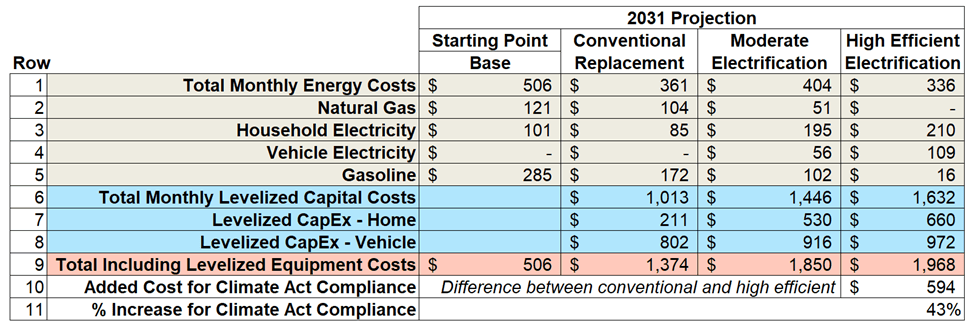
I extracted information from these Annex Spreadsheet “Upstate Results” and “Equipment Cost Summary” tables to prepare Table 2 that was used to prepare these bar chaarts.  Rows 1-4 list the monthly energy expenditures with the total in row 5 from the “Upstate Results” table.  The increase in efficiency decreases monthly energy costs for all three journeys but that changes when CapEx is considered.  The CapEx monthly total costs in rows in row 6-8 are from the “Equipment Cost Summary” table.  Row 9 lists the sum of the total monthly energy costs and rows 6 and 7 the total monthly levelized capital costs for home and vehicle.  The cost of Climate Act compliance is the difference between replacement of conventional equipment and the highly efficient electrification equipment.  Row 10 shows this difference.  It lists the $594 increase in costs necessary for Climate Act compliance and row 11 lists the percentage increase as 43%. 

Table 2: Upstate New York Moderate Income Household That Uses Natural Gas for Heat Projected Monthly Costs and Costs Necessary to Comply with the Climate Act

NYSERDA Affordability Messaging

The Energy Affordability Fact Sheet highlights the point that “The energy affordability analysis shows that the use of new, efficient equipment and electrification can cut energy spending by $100 to over $300 every month for many New York households, across energy costs for transportation and heating and utility bills.”  It acknowledges that New Yorkers face “overarching affordability challenges” and that

“Energy, as a subset of transportation and housing costs, is an important driver of affordability challenges for many households.”   However, it does not acknowledge that when the equipment’s capital expense costs necessary to achieve the Climate Act mandates are included in the projected total monthly energy costs that costs are certainly not affordable.

There is another aspect of the NYSERDA messaging.  I prepared an annotated transcript for the energy affordability presentation at the Energy Planning Board meeting on December 1 that includes a heading for questions made during the meeting with a link to each person who commented or asked a question. Chair Doreen Harris of the Energy Planning Board asked NYSERDA presenter James Wilcox about energy price uncertainty.  He admitted that the key driver of change over the next five years is “change in energy price”.  The modeling shows that this could increase household energy spending 3% to 8% in the starting point base case but could go up to as much as 14% to 19% even if they do nothing as shown in the ”Sensitivity” columns under the Starting Point 2026 and 2031 scenarios shown in Table 2.  Chair Harris extracted a response from him that summarizes the second public message: “That is what I was trying to elicit: What does doing nothing get you?”  These data show that even if you do nothing costs could rise as much as 19% if you exclude the CapEx costs of compliant equipment.  That is misleading because the equipment costs are the main cause of future costs and not changes in energy prices.  It is also emblematic of another NYSERDA message that costs are going to go up anyway and that the costs to comply with the Climate Act are less so we can still continue to pursue this initiative.

Discussion

On Oct. 24, 2025, there was an Albany County New York Supreme Court decision ordering the Department of Environmental Conservation (DEC) to issue final Climate Act implementing regulations establishing economy-wide greenhouse gas emission (GHG) limits on or before Feb. 6, 2026 or go to the Legislature and get the Climate Act 2030 GHG reduction mandate schedule changed.   During the legal proceeding the State Attorney General submitted a letter that argued that it was inappropriate to implement regulations that would ensure compliance with the 2030 40% reduction in GHG emissions Climate Act mandate because meeting the target is “currently infeasible”.  That argument was undoubtedly based on the total cost including CapEx for households results of the single equipment cost sensitivity analysis.

The State Energy Planning Board will meet on December 16, 2025 to “consider and act upon a resolution to adopt the State Energy Plan”.  The Energy Plan is a “comprehensive roadmap to build a clean, resilient, and affordable energy system for all New Yorkers”.  How can the Energy Planning Board members vote to approve something that will increase monthly energy bills nearly $600 a month and claim any credibility for an affordable energy system?  Clearly the answer is they cannot which means the whole process is only for show.

There is no question in my mind that the total cost, including CapEx results are being downplayed as much as possible.  Nowhere in the supporting quantitative information are results presented for all the households evaluated.  I believe that those results were calculated but not presented because of the affordability implications.  Iin addition, there is insufficient information provided that would enable independent analysis to calculate the CapEx costs for the other scenarios.

New York GHG emissions are less than one half of one percent of global emissions and global emissions have been increasing on average by more than one half of one percent per year since 1990.  The fact that New York cannot solve global warming by itself coupled with these extraordinary costs in the face of an acknowledged energy affordability challenge is a very strong case to reconsider the proposed Energy Plan and rethink the Climate Act.

Conclusion

When I tell people that I have spent a lot of time evaluating the Climate Act they usually ask how much is this going to cost.  When I tell them that that the Scoping Plan comprehensive roadmap to “build a clean, resilient, and affordable energy system for all New Yorkers” estimates that when the cost to buy the necessary infrastructure to meet the Climate Act are included households could see an increase of %594 per month they are shocked.  The Affordability Fact Sheet talks about affordability and gives numbers to the suggest affordability.  However, NYSERDA covered up the finding in the Energy Plan modeling that Climate Act compliance is anything but affordable.   This must be addressed.

Time to Reconsider the Climate Act Press Release

UPDATE: Two weeks after this was published I can safely now say that nobody I contacted responded. I thought that showing that $593 per month in added energy expenses would have prompted some kind of response.

A recent court decision and findings presented at the 1 December 2025 State Energy Planning (SEP) Board meeting present overwhelming evidence that implementing the Climate Leadership & Community Protection Act (Climate Act)  as mandated will be unaffordable and the 2030 CLCPA 40% emission reduction target and 70% renewable energy in the electric system mandate will not be achieved.  I don’t think that most New Yorkers are aware of the Climate Act much less its potential impacts, so I prepared a press release that I distributed to various New York press outlets explaining why it is time to reconsider the Climate Act.   This article documents the findings included in the press release and refers to recent articles published on this blog.

I am convinced that implementation of the Climate Act net-zero mandates will do more harm than good if the future electric system relies only on wind, solar, and energy storage because of reliability and affordability risks.  I have followed the Climate Act since it was first proposed, submitted comments on the Climate Act implementation plan, and have written over 600 articles about New York’s net-zero transition.  The opinions expressed in this article do not reflect the position of any of my previous employers or any other organization I have been associated with, these comments are mine alone.

Overview

The Climate Act established a New York “Net Zero” target (85% reduction in GHG emissions and 15% offset of emissions) by 2050 and has two interim 2030 targets: 70% of the electricity must come from renewable energy and GHG emissions must be reduced 40%.  The Climate Action Council (CAC) was responsible for preparing the Scoping Plan that outlined how to “achieve the State’s bold clean energy and climate agenda.” The Integration Analysis prepared by the New York State Energy Research and Development Authority (NYSERDA) and its consultants quantified the impact of the electrification strategies.  That material was used to develop the Draft Scoping Plan outline of strategies.  After a year-long review, the Scoping Plan was finalized at the end of 2022.  Since then, the State has been trying to implement the Scoping Plan recommendations through regulations, proceedings, and legislation. 

Note there is a second implementation law.  Public Service Law (PSL) Section 66-P, Establishment of a renewable energy program, that requires the Public Service Commission to establish a program to ensure the State meets the 2030 and 2040 electric system Climate Act requirements.  

Energy Plan Overview

In 2025 another overarching evaluation of the energy system was initiated.  According to the New York State Energy Plan website (Accessed 3/16/25):

The State Energy Plan is a comprehensive roadmap to build a clean, resilient, and affordable energy system for all New Yorkers. The Plan provides broad program and policy development direction to guide energy-related decision-making in the public and private sectors within New York State.

The New York State Energy Research & Development Authority (NYSERDA) released the Draft Energy Plan last summer.  Stakeholder comments were accepted until early October.  The Energy Planning Board has the responsibility to approve the document. At the November 13, 2025 Board meeting there was a perfunctory description of the comments received.  There was another meeting on December 1 that presented results from additional analyses.  During the wrap up for the latest meeting Chair Doreen Harris said the Board will meet later this month to approve the plan. I have provided background information and a list of relevant articles on my Energy Plan page

Court Decision

On Oct. 24, 2025, there was an Albany County New York Supreme Court decision ordering the Department of Environmental Conservation to issue final regulations establishing economy-wide greenhouse gas emission (GHG) limits on or before Feb. 6, 2026 or go to the Legislature and get the Climate Act 2030 GHG reduction mandate schedule changed.   On November 3, I published an article providing detailed information about the decision. 

In another article I explained that during the legal process the State submitted a letter that addressed “two categories of new developments: (1) the publication of the 2025 Draft New York State Energy Plan by the New York State Energy Planning Board on July 23, 2025 and (2) additional actions by the federal government that impede New York’s efforts to achieve the Climate Act.”  The letter argued that it was inappropriate to implement regulations that would ensure compliance with the 2030 40% reduction in GHG emissions Climate Act mandate because meeting the target is “currently infeasible”. 

Ordering achievement of the 2030 target would equate to even higher costs than the net zero scenarios and would affect consumers even sooner. Undoubtedly, greenhouse-gas reducing policies can lead to longer-term benefits such as health improvements. This does not, however, offset the insurmountable upfront costs that New Yorkers would face if DEC were forced to try to achieve the Legislature’s aspirational emissions reductions by the 2030 deadline rather than proceeding at an ambitious but sustainable pace.

The letter concluded that the Climate Act is unaffordable:

Petitioners have not shown a plausible scenario where the 2030 greenhouse gas reduction goal can be achieved without inflicting unanticipated and undue harm on New York consumers, and the concrete analysis in the 2025 Draft Energy Plan dispels any uncertainty on the topic: New Yorkers will face alarming financial consequences if speed is given preference over sustainability.

The Judge acknowledged that this information was relevant but ruled that DEC must promulgate regulations implementing a law however persuasive their arguments it is inappropriate are. The Hochul Administration and DEC appealed the decision on November 25, 2025 claiming that “it is impossible for the Department to simultaneously comply with both the Court’s order and its substantive statutory obligations.” 

Energy Affordability

In addition to the Attorney General’s supplemental letter arguing that the Climate Act is unaffordable, there were findings presented at the State Energy Planning (SEP) Board meeting on December 1, 2025 that present extraordinary cost estimates.  My article on the Energy Affordability presentation at the meeting documents the projections for a moderate-income household in Upstate New York that uses natural gas.  My article found the difference between replacement of conventional existing equipment and the highly efficient electrification equipment necessary for CLCPA compliance increases monthly average energy expenditures $593 when capital costs are considered. That number was in a slide but there was only passing mention of the cost.

I derived explanatory numbers from information presented at the SEP Board meeting.  The following energy affordability analysis slide summarizes the projection approach.  It explains that for eleven household profiles, NYSERDA evaluated future household and transportation energy expenditures for four cases involving different technology mixes and fuel types.  These “Illustrative Household Journeys” include:

  • Starting Point: Fossil fueled heating and transportation with average existing equipment
  • Conventional Replacement: Fossil fueled heating and transportation with new, more efficient equipment
  • Moderate Efficient Electrification: Some electrification of heating and transportation, with basic building envelope efficiency measures
  • High Efficient Electrification: More electrification of heating and transportation, with basic or medium building envelope efficiency measures, and efficient electric appliances

Slides were presented that describe the four journeys for several profiles.   My numbers were derived from the typical Upstate moderate-income household that uses natural gas for heat household profile.  This was the only profile that included all the information needed to project total cost.  In the following slide,  three projected “household journeys” reduce monthly energy expenditures relative to the current starting point.  However, buried at the bottom of the page is the notation that these values are “Average monthly expenditures. Does not include equipment costs”. 

It turns out that including equipment costs makes a difference as shown in the next slide.

I extracted information from these slides to prepare Table 1.  Rows 1-4 list the monthly energy expenditures with the total in row 5 from the first slide.  The increase in efficiency decreases monthly energy costs for all three journeys but that changes when CapEx is considered.  The CapEx monthly total cost in row 6 is available on the second slide.  However, the breakdown between the costs of a new plugin hybrid electric vehicle (moderate electrification) in row 7 and a battery electric vehicle (high efficiency electrification) relative to home energy electrification row 8 is not listed on the included slides.  I estimated the percentage of home electrification from the size of the blue bars on the right side of the second slide. (Row 10). When the CapEx costs are included all the projected alternative journeys are more expensive.  Row 9 lists the total monthly energy costs including the costs of equipment from the second slide.  The cost of Climate Act compliance is the difference between replacement of conventional equipment and the highly efficient electrification equipment.  Row 12 lists the $593 difference  necessary for Climate Act compliance and row 11 lists the 43% increase in energy costs. 

Table 1: Upstate New York Moderate Income Household That Uses Natural Gas for Heat Projected Monthly Costs and Costs Necessary to Comply with the Climate Act

The affordability messaging is embedded in this table.  I prepared an annotated transcript for this presentation that includes a heading for questions made during the meeting with a link to each person who commented or asked a question. I believe that this presentation and the questions asked was scripted to further the messaging of the Administration.  Chair Doreen Harris of the Energy Planning Board asked NYSERDA presenter James Wilcox about energy price uncertainty.  He admitted that the key driver of change over the next five years is “change in energy price”.  The modeling shows that this could increase household energy spending 3% to 8% in the starting point base case but could go up to as much as 14% to 19% even if they do nothing.  Chair Harris elicited a response from him that summarizes the public messaging: “That is what I was trying to elicit: What does doing nothing get you?”  Even if you do nothing costs could rise as much as 19%.  That is misleading because the equipment costs are the main causes of future cost not changes in energy prices.

The presentations emphasized that Climate Act costs are not the primary energy cost increase driver and that multiple factors beyond climate policy contribute to expected costs.  The other implementation cost message in the NYSERDA presentations is that the additional costs to meet the Climate Act mandates are smaller than expected cost increases.  This table quantifies that claim.  If this example household replaces its internal combustion car with another one and replaces household appliances with natural gas appliances total costs will go up $868 from $506 to $1,374.  The cost to meet the Climate Act mandates beyond conventional replacement is “only”  $593 more which is less than the cost of conventional replacement. 

I think the magnitude of these impacts are being downplayed as much as possible.  After I published my analysis I went to the Draft Energy Plan supporting documentation page and reviewed the Energy Affordability Outputs and Input Data spreadsheet.  The equipment costs are only provided as a sensitivity for one household. I think that this is by design because these costs are so extraordinary.  I believe these numbers indicate a serious energy affordability crisis is coming.  In my opinion, including an additional 43% cost increase is unconscionable.  New York GHG emissions are less than one half of one percent of global emissions and global emissions have been increasing on average by more than one half of one percent per year since 1990.  New York cannot solve global warming by itself. 

Implementation Timing

I summarized my initial thoughts about the Pathways Analysis presentation at the December SEP Planning Board meeting.  The presentation found that neither the CLCPA 40% GHG emission reduction target nor the electric system 70% renewable energy mandate would be achieved on time.  The “Key Takeaways (3/3)” Slide (#31) in the meeting presentation states that “the state is currently not on track to meet the 2030 emission limit – Current Policies is estimated to hit 40% reduction in 2038 while Additional Action is estimated to hit 40% reduction in 2037.” 

The Electric Sector Results: Additional Action slide (#21) states that “Pace of additions leads to delayed achievement of 70% renewable to 2036-2040”.

Discussion

The Court Decision and the Energy Plan findings are not the only reasons given by state agencies that it would be appropriate to reconsider the Climate Act.  I described three other findings in an article last month. The New York State Comptroller Office audit of the NYSERDA and PSC  implementation efforts for the Climate Act was an early acknowledgement that the implementation plan needs to be revised.  The Public Service Commission (PSC) compared the renewable energy deployment progress relative to the Climate Act goal to obtain 70% of New York’s electricity from renewable sources by 2030. The final Clean Energy Standard Biennial Review Report document found that 2030 goal will likely not be achieved until 2033.  Finally, The Second Informational Report prepared by Department of Public Service (DPS) staff described four feasibility concerns: the 2030 renewable energy target is “likely unattainable”, offshore wind faces major obstacles, transmission remains a “critical bottleneck”, and grid reliability challenges are mounting

There have been other recent articles arguing that New York has impossible targets.  David Wojick recently published an article explaining implementation issues that I backed up with observed data.  Tom Shepstone describes a New York Post editorial that cites a Progressive Policy Institute article that calls the Climate Act an “undeniable” failure.

These findings should inspire the Hochul Administration to amend the  Climate Act.  It is troubling that the SEP Board meeting presentations did not mention these ramifications in the presentation.  Furthermore, there has been no sign that the Hochul Administration or the majority leadership in the Legislature are amenable to considering amendments to the Climate Act.

Conclusion

I was motivated to publish this and distribute it to the media because these findings have significant implications for the future New York energy system.  In the near term, something must be done to reconcile the reality that the CLCPA schedule is too ambitious to have any hope of compliance.  More importantly, the findings described should become the basis for a discussion of more New Yorkers.  As it stands now New York energy policy is being guided by a small but extremely vocal and motivated constituency that does not understand the physics of the energy system.  Thomas Sowell has been quoted as saying: “It is hard to imagine a more stupid or more dangerous way of making decisions than by putting those decisions in the hands of people who pay no price for being wrong”.  In this instance, there is nothing more stupid or dangerous than ignoring the people who will pay the price if there are problems with the energy system.

Energy Affordability at Energy Planning Board Meeting on 12/1/2025

On December 6, 2025, I published an article describing my initial thoughts about the State Energy Planning Board (SEP) meeting on December 1 that discussed updated Pathways modeling for the State Energy Plan.  This post describes the presentations at the meeting that covered energy affordability.  I will cover the health benefits and employment analysis in another post.

I am convinced that implementation of the New York Climate Leadership & Community Protection Act (Climate Act or CLCPA) net-zero mandates will do more harm than good if the future electric system relies only on wind, solar, and energy storage because of reliability and affordability risks.  I have followed the Climate Act since it was first proposed, submitted comments on the Climate Act implementation plan, and have written over 600 articles about New York’s net-zero transition.  The opinions expressed in this article do not reflect the position of any of my previous employers or any other organization I have been associated with, these comments are mine alone.

Energy Plan Overview

According to the New York State Energy Plan website (Accessed 3/16/25):

The State Energy Plan is a comprehensive roadmap to build a clean, resilient, and affordable energy system for all New Yorkers. The Plan provides broad program and policy development direction to guide energy-related decision-making in the public and private sectors within New York State.

The New York State Energy Research & Development Authority (NYSERDA) prepared the Draft Energy Plan last summer.  Stakeholder comments were accepted until early October.  The Energy Planning Board has the responsibility to approve the document. At the November 13, 2025 Board meeting there was a perfunctory description of the comments received.  During the wrap up for this meeting Chair Doreen Harris said the Board will meet later this month to approve the plan before the end of the year. I have provided background information and a list of previous articles on my Energy Plan page

Meeting Overview

There were three items on the agenda: approval of last meeting minutes, discuss analyses conducted for the Energy Plan, and consider any new business.  The recording of the meeting available here included a transcript.  I created an edited transcript for the Pathways Analysis presentation and a separate transcript for the energy affordability, health benefits, and employment presentations. These annotated versions include tables and headings.

In this meeting NYSERDA described the updated Pathways Analysis—the modeling exercise that underpins New York’s triennial State Energy Plan. In my opinion, the entire Energy Planning Board process is political theater.  The members of the Board were chosen mostly for political reasons and not technical expertise.  Everyone involved is going through the motions. 

My last post explained that the updated Pathways Analysis described in the first part of this meeting found that the 2030 Climate Act goals will not be achieved on time.  The aspirational schedule of the Climate Act was never realistic, and these results are simply acknowledgement of that fact.  The topics featured in the remaining sessions support the positive spin narrative that the Hochul administration is trying to convey to the public to save some face regarding Climate Act implementation.  This post will highlight key points of the narrative.  I want to emphasize that this narrative is based mostly on political messaging, so it is appropriate to assume that every NYSERDA point has been approved by the Hochul Administration.

Energy Affordability

James Wilcox presented the Household Energy Affordability Analysis Update. He said that NYSERDA “reviewed key analysis structure and assumptions based on stakeholder feedback and new data availability”.  The claim regarding review of stakeholder feedback is the first narrative speaking point.  There will be a subsequent post detailing how New York State agency claim that all stakeholder feedback was considered is unsupported by evidence.  While there are indications that some feedback from outside NYSERDA was incorporated in the updated analyses, later I will detail instances where comments inconsistent with the intended story line were ignored.

Wilcox summarized the updates:

  • For Base Case, moved to an electric and gas price forecast based on the trend of total bills from bill history
  • Added a higher energy price growth sensitivity based on the trend of total bills from recent bill history combined with recent DPS/utility projections
  • Although numbers have shifted, key takeaways remain the same
  • Net result from changes is a higher growth rate for electricity and gas rates

The affordability messaging has been consistent.  NYSERDA acknowledges that there are energy affordability challenges.  The Climate Act embeds environmental justice principles throughout its implementation framework, so descriptions include low- and moderate- income household impacts that are consistent with this narrative talking point,  Unsurprisingly, those households are “more likely to experience energy affordability challenges”.

The following energy affordability analysis slide explains that for eleven household profiles, NYSERDA evaluated future household and transportation energy expenditures for four cases involving different technology mixes and fuel types.  These “Illustrative Household Journeys” include:

  • Starting Point: Fossil fueled heating and transportation with average existing equipment
  • Conventional Replacement: Fossil fueled heating and transportation with new, more efficient equipment
  • Moderate Efficient Electrification: Some electrification of heating and transportation, with basic building envelope efficiency measures
  • High Efficient Electrification: More electrification of heating and transportation, with basic or medium building envelope efficiency measures, and efficient electric appliances

Slides were presented that describe the four journeys for several profiles.   The following example describes monthly expenditures for a typical Upstate moderate-income household that uses natural gas for heat.  Relative to the current starting point all three projected “household journeys” reduce monthly energy expenditures.  However, buried at the bottom of the page is the notation that these values are “Average monthly expenditures. Does not include equipment costs”. 

It turns out that including equipment costs makes a difference as shown in the next slide.

The Hochul/NYSERDA story is that monthly energy expenditures will go down when investments in moderate electrification or high efficiency electrification necessary for Climate Act compliance are made.  The public release sound bite press releases will emphasize that point and barely acknowledge that the costs that include the capital expenses (CapEx) for the equipment costs tell a different story.  I summarized all this information in Table 1.  The first four rows list the monthly energy expenditures with the total in the fifth line.  The CapEx monthly total cost is listed but the breakdown between the costs of a new plugin hybrid electric vehicle (moderate electrification) and a battery electric vehicle (high efficiency electrification) relative to home energy electrification is not provided.  I estimated the percentage of home electrification from the bars in the previous figure.  When those CapEx costs are included all the projected alternative journeys are more expensive.  Note that the difference between replacement of conventional equipment and the highly efficient electrification equipment necessary for Climate Act compliance increases monthly average energy expenditures $593, a whopping 43% increase in energy costs.  That is the cost of Climate Act compliance.

Table 1: Upstate New York Moderate Income Household That Uses Natural Gas for Heat Projected Monthly Costs and Costs Necessary to Comply with the Climate Act

The following key takeaways slide summarizes the messages that NYSERDA and Hochul want the Energy Planning Board and public to accept.  The first statement suggests that if households continue to use existing equipment that energy spending will increase.  But households “see gradually declining rates of energy consumption and total energy spending as more efficient equipment is adopted” then that “can help to offset energy price increases”.  That advocates going forward despite a tacit acknowledgement that it may not save money, just reduce the increase.  The final takeaway points out that according to their numbers transportation energy spending could offset incremental cost increases for home heating.  I cannot overemphasize enough that results from this kind of modeling are completely dependent upon input assumptions.  That means that the modelers can get any answer they want.  It is therefore very telling that these takeaways cannot avoid the conclusion that the transition will incur significant costs. The modelers could not completely avoid reality.

Ultimately, the question is how much will all this cost. During his presentation Wilcox stated: “What we can take away is that the net costs for efficient electrification journeys could be 35% to 40% higher than conventional replacement when accounting for equipment, reinforcing the importance of action to address upfront equipment costs so that households are able to access the benefits of these systems.”   NYSERDA is left hoping that there will be a magical solution that will reduce upfront costs so that the projections might be palatable.

The conclusions sums up the energy affordability messaging.  There is an energy affordability problem that impacts low- and moderate-income households more with the implication that focus on those households will improve the situation.  Energy costs impact both household and transportation spending.  This needs to be emphasized because NYSERDA cannot claim monthly energy benefits for many household profiles if transportation costs are not included.  Wilcox concludes the obvious point that “expected increases in energy prices highlight the importance of actions that can lower energy costs”.  In my opinion the point that doing nothing is the least impactful action is not acknowledged.  The importance of energy savings measures is highlighted.  However, I don’t think this will provide as many benefits as they do because this has been emphasized for decades so the simple fixes and obvious solutions have already been implemented.  It is easy to say that “Policy and market solutions that focus on lowering up-front costs” may make this more affordable, but no suggestions how that can be done or why anyone would expect that this may happen are offered.  Finally, there is the recommendation of all analysts that have no clue how to get the preferred answer to “do further research”.

Presentation Discussion Topics

The annotated transcript for this presentation includes a heading for questions made during the meeting with a link to each person who commented or asked a question. 

Chair Doreen Harris asked about the differences between Upstate and Downstate.  Wilcox explained that there are climatic differences, transportation patterns are different, and the predominant type of housing is different.  Harris followed up stating:

I think that’s important because that’s one of the reasons why we had to produce so many variations, right? Like, it reflects the diversity of our state in a way that means that the answer isn’t the same for everyone, depending on their own experience and the way they live.

Because I believe that this presentation was scripted to further the messaging of the Administration, I think it is telling that she wanted to emphasize impacts are not the same for everyone.  I am not sure why, however. 

The rationale for her second question about what happens if households do not upgrade is obvious.  The projections show that all replacement scenarios doubles costs so doing nothing is an attractive option.  Not only is that a great argument against an implementation schedule, but it establishes a significant public acceptance hurdle.  Wilcox admitted that the key driver of change over the next five years is “change in energy price”.  The modeling shows that this will increase household energy spending 3% to 8% in the starting point base case but could go up to as much as 14% to 19% even if they do nothing. 

The questions and answers went on:

Harris: “And then, James, maybe to kind of take those percentages in context, was it in that higher price sensitivity, a household that did nothing could see as much as one hundred dollars a month increased costs. Is that about right?

Wilcox: “Yeah. That’s correct.”

Harris: “So there’s a substantial increase with these energy prices for folks who don’t take any action. Thank you. That is what I was trying to elicit: What does doing nothing get you?

To summarize, the Chair of the Energy Planning Board was trying to elicit a specific point from her staff that there will be a substantial increase in energy prices even if people don’t take any action.  Her staff person Wilcox could have destroyed his career if he had pointed out that the minimum increase in any of the scenarios that replaced household and transportation equipment is 1.7 times greater than current costs which is far greater than the greatest impact of doing nothing which was 0.19 times greater.

After that the rest of the questions were a comedown.  There were suggestions that the new technologies might offer new opportunities that might somehow, someway, mitigate the cold equations that show this is unaffordable.  There was also a suggestion made that all would work out if New Yorkers used public transit.

Discussion

Presumably the Attorney General Office supplemental letter  that argued that promulgating regulations for the Climate Act target would cause “undue harm” used in the New York Supreme Court litigation was developed with the assistance of NYSERDA.  That letter claimed that the Climate Act mandates are infeasible due to excessive costs that are “unaffordable for consumers”.  All these numbers confirm that there are affordability issues.

This finding sums up Climate Act affordability.  For a moderate-income household in Upstate New York that uses natural gas the difference between replacement of conventional equipment and the highly efficient electrification equipment necessary for Climate Act compliance increases monthly average energy expenditures $593, a whopping 43% increase in energy costs. 

There are ten other household profiles.  The presentation did not provide sufficient information for a similar assessment of any of those other profiles.  The State Energy Plan document web page does not list any updates to the draft materials from last summer so I am not able to develop an overview of all the household profile results.  Also note that the documentation does not provide backup to the graphs and tables presented in the Energy Plan reports so this is no small task.

Conclusion

Any argument that the Climate Act transition will not be extraordinarily expensive can be refuted by using the data included in this presentation.  Coupled with the Pathways Analysis presentation described previously that found that neither 2030 Climate Act target will be met before 2036, the only appropriate course of action is to reconsider the Climate Act.  Given that it will require accountability by the politicians who got New York into this mess I am not optimistic.

Initial Thoughts on Energy Planning Board Meeting on 1 December 2025

Note: Updated on 12/10/2025 to add a slide 32 from the presentation

On November 13 I published an article describing my initial thoughts about the State Energy Planning Board meeting that day that discussed public comments on the Draft State Energy Plan document.  I had intended to follow up with another post providing more detail, but other projects got in the way.  This post describes the latest meeting held on December 1.

I am convinced that implementation of the New York Climate Leadership & Community Protection Act (Climate Act or CLCPA) net-zero mandates will do more harm than good if the future electric system relies only on wind, solar, and energy storage because of reliability and affordability risks.  I have followed the Climate Act since it was first proposed, submitted comments on the Climate Act implementation plan, and have written over 600 articles about New York’s net-zero transition.  The opinions expressed in this article do not reflect the position of any of my previous employers or any other organization I have been associated with, these comments are mine alone.

I acknowledge the use of Perplexity AI to generate summaries and references included in this document.  The focus of this article is how the results of the Pathways Analysis relate to Climate Act goals.  Note that I went so far as to request that the response be written up.

Energy Plan Overview

According to the New York State Energy Plan website (Accessed 3/16/25):

The State Energy Plan is a comprehensive roadmap to build a clean, resilient, and affordable energy system for all New Yorkers. The Plan provides broad program and policy development direction to guide energy-related decision-making in the public and private sectors within New York State.

I have provided background information and a list of previous articles on my Energy Plan page

Meeting Overview

There were three items on the agenda: approval of last meeting minutes, discuss analyses conducted for the Energy Plan, and consider any new business.  The recording of the meeting available here included a transcript.  I created an edited transcript that has headings and includes the slides.

The New York State Energy Research & Development Authority (NYSERDA) prepared a Draft Energy Plan last summer.  Stakeholder comments were accepted until early October.  At the last Energy Planning Board meeting there was a perfunctory description of the comments received.  In this meeting NYSERDA described the updated Pathways Analysis—the modeling exercise that underpins New York’s triennial State Energy Plan.

Implementation Timing

Under New York’s own Climate Act accounting framework—the methodology that matters for compliance—no scenario modeled by NYSERDA hits the 40% economy-wide GHG reduction target by 2030. Not the “current policies” case. Not the “additional action” case. None of them.  Instead, the core planning cases achieve the 40% GHG emission reduction by 2030 mandate in roughly 2037–2038, a full 7–8 years later than the statute requires.  The 70% renewable electricity target by 2030 is also behind schedule.  Offshore wind permitting delays push that into the 2036–2040 window.

This is not a surprise to anyone closely tracking federal policy and state implementation. However, this is the first time that it is not necessary to read between the lines of the NYSERDA presentations.  NYSERDA laid it out in black-and-white.  The State is no longer pretending the Climate Act is on schedule.

Federal Rollbacks and Deployment Headwinds

The updated modeling incorporates two major factors that were not included in the draft plan.

The draft plan was counting on extensive Federal support but there have been policy changes. The modeling breaks this down by sector:

  • Across the electric sector: $25 billion in lost investment tax credit (ITC) and production tax credit (PTC) for renewables and related credits.
  • Buildings: ~$1.5 billion in lost heat pump and efficiency incentives by 2040.
  • Transportation: ~$4.5 billion in lost EV incentives, plus higher long-term fuel costs if the Advanced Clean Car and Advanced Clean Truck programs are also repealed.
  • Offshore wind deployment delays. Federal permitting obstruction and supply-chain headwinds are slowing the pace of offshore wind additions.
  • Offshore wind deployment delays. Federal permitting obstruction and supply-chain headwinds are slowing the pace of offshore wind additions. The 2035 offshore wind capacity in the modeling is below the 9 GW target, which cascades into delays across the entire renewable timeline.

The second factor is that issues with siting constraints are slowing the physical deployment of wind and solar deployment relative to the unrealistic presumptions in the Draft plan.  Offshore wind deployment delays because of changes in Federal permitting and supply-chain issues are slowing the pace of offshore wind additions. The 2035 offshore wind capacity in the modeling is below the 9 GW target, which cascades into delays across the entire renewable timeline.

Policy Implications

The Perplexity AI summary listed six takeaways.

  1. NYSERDA plainly states that the 2030 targets cannot be met using the Climate Act’s accounting as shown on the Key Takeaways (3/3) Slide 32 shown below.. However, the presentation just described this analysis result and not the implication that this means that the Climate Act must be amended to shift the schedule.
  • The building sector urgently need more aggressive policy actions to achieve Climate Act goals. The gap between current-policy building decarbonization and a net-zero-consistent path is large, and it’s growing. Stronger codes, more financing, larger direct-install programs, and targeted support for renters and low-income owners are all needed.
  • The transition of the gas system requires active management and investment. This isn’t a “let the market sort it out” situation. Utilities, the PSC, and the state need coordinated strategies for how gas infrastructure evolves over time—including decisions about when and where to invest in network modernization versus when to accelerate targeted electrification.
  • The presentation noted the importance of Dispatchable Emissions Free Resources (DEFR).  I disagree with the optionality adjective, however. There is nothing optional about the need for these new and unproven resources.  The description of green hydrogen illustrates why it won’t solve the problem. The presentation argues the state should be actively exploring, piloting, and supporting a portfolio of zero-carbon dispatchable technologies. RNG, long-duration storage, ammonia, and others all deserve serious development support.
  • Federal policy is now a binding constraint. New York can optimize its own policies, but it cannot outrun federal rollbacks. The state’s energy strategy increasingly needs to figure out how to replace Federal funding, procure projects to lock in tax credits before phase-outs, and re-structure policy design that works even if federal support evaporates.
  • Nuclear is back in the conversation, and that’s not a bad thing. The modeling shows that nuclear power, where available and deployable, reduces system costs and relieves pressure on renewables and DEFR. The presentation argues that the state should pursue the NYPA project, explore other Small Modular Reactor and advanced reactor opportunities, and think carefully about lifecycle extension of existing assets.

Stakeholder Comments

I am extremely disappointed with the stakeholder process.  In my comments at the first virtual public hearing and a subsequent written comment I explained that the lack of documentation on the disposition of stakeholder comments undermined the credibility of the process and the opportunity to improve the Energy Plan.  The only acknowledgment of the comments received is a promise that “all comments will be posted on the State Energy Plan website as soon as practicable”.  It has been two months since that promise was posted and the comments still are not posted.

This matters because the presentation at this meeting claimed the Pathways Analysis finds that the additional-action case generates net societal benefits of about $18 billion by 2040, with roughly $19 billion in aggregate net-present-value benefits through 2040, when carbon and health benefits are factored in.  However, in my unacknowledged comments I pointed out that the cost accounting in the Pathways Analysis “No Action” scenario only includes costs associated with the Climate Act law, not the cost to meet the Climate Act targets.  The misleading “No Action” scenario is not a baseline that excludes all programs necessary to achieve the Climate Act targets because it includes legacy programs in place prior to the Climate Act.  Furthermore, in other comments I identified issues that reduced the alleged benefits.  If costs and benefits were properly addressed, then I suspect that there would not be net societal benefits.

Discussion

I recently described the Oct. 24, 2025 New York Supreme Court decision and order in a case pitting environmental organizations against the New York State Department of Environmental Conservation (DEC).  The judge ordered DEC to issue final regulations establishing economy-wide greenhouse gas emission (GHG) limits on or before Feb. 6, 2026 or go to the Legislature and get the Climate Act 2030 GHG reduction mandate changed. Importantly, during the trial , the Attorney General Office submitted a supplemental letter  that argued that promulgating regulations for the Climate Act target would cause “undue harm” because the Climate Act mandates are infeasible due to excessive costs that are “unaffordable for consumers” to bear.  Subsequently, DEC appealed the decision which postpones resolution of the problem.

The rationale for the Judge’s decision coupled with the acknowledgement that the costs are unaffordable and the updated Pathways Analysis finding that the 2030 targets cannot be met using the Climate Act’s accounting methodology should mean that the Climate Act itself needs to be amended.  This important finding was not mentioned in the presentation.  Furthermore, there has been no sign that the Hochul Administration or the majority leadership in the Legislature are amenable to considering amendments to the Climate Act.

There is another aspect to this.  The Climate Act is not the only law that includes the mandates for the net-zero transition.  New York Public Service Law § 66 “Establishment of a renewable energy program” describes energy systems that are prohibit some of the findings in the updated Pathways Analysis.  It appears to me that this legislation also needs to be amended.

I will follow up with another post on this meeting because there are more issues that I did not address.

Conclusion

Reality bats last.  The findings of the updated Pathways Analysis reflect that fact.  The aspirational schedule of the Climate Act was never realistic, and these results are simply acknowledgement of that fact.  It remains to be seen how the identified problems and the implicit feasibility concerns described will be addressed.  Given that it will require accountability by the politicians who got New York into this mess I am not optimistic.

Implications of New York State 2025 GHG Emissions Inventory

This post describes the latest New York State (NYS) GHG emission inventory report that provides data through 2023.  A recent post explained why the Climate Leadership & Community Protection Act (Climate Act) 2030 target for a 40% reduction of greenhouse gas (GHG) emissions from 1990 levels was impossible.  It included GHG emissions data through 2022 so this report updates that assessment.  It also describes implications of other aspects of the inventory results.

I am convinced that implementation of the New York Climate Act net-zero mandates will do more harm than good if the future electric system relies only on wind, solar, and energy storage because of reliability and affordability risks.  I have followed the Climate Act since it was first proposed, submitted comments on the Climate Act implementation plan, and have written over 600 articles about New York’s net-zero transition.  The opinions expressed in this article do not reflect the position of any of my previous employers or any other organization I have been associated with, these comments are mine alone.

Overview

The Climate Act established a New York “Net Zero” target (85% reduction in GHG emissions and 15% offset of emissions) by 2050.  In addition GHG emissions are supposed to be 40% lower than the 1990 baseline.  The Climate Action Council (CAC) was responsible for preparing the Scoping Plan that outlined how to “achieve the State’s bold clean energy and climate agenda.” The Scoping Plan was finalized at the end of 2022.  Since then, the State has been trying to implement the Scoping Plan recommendations through regulations, proceedings, and legislation. 

NYS GHG Emissions

The New York State Department of Environmental Conservation (DEC) released the 2025 statewide GHG emissions report (2025 GHG Report) at the end of November, a month earlier than recent releases.  DEC is required by the Climate Act to follow unique inventory requirements.  Four years ago I published an overview post of this greenhouse gas (GHG) inventory that described things that maximize emissions in an apparent attempt to make GHG emissions as large as possible. 

The 2025 GHG Report includes the following documents:

The Summary Report for the GHG Inventory gives an overview of the highlights.

In 2023, statewide gross GHG emissions were 354.06 million metric tons of carbon dioxide equivalent GHGs (mmt CO2e) using CLCPA accounting. Total gross emissions in 2023 were 14.8% lower than the 1990 baseline in this report and 13.6% below the 1990 statewide emission baseline adopted in regulation in 2020. Carbon dioxide (CO2) and methane (CH4) comprised the largest portion of emissions by gas, 58% and 35% respectively, and energy was the largest source of emissions (73%). Net emissions were 316.58 mmt CO2e in 2023, which includes a net 37.48 mmt CO2e removed.

Note that the 1990 total gross emissions calculated in this analysis were different than the those calculated when the 1990 statewide emission baseline was adopted in regulation in 2020.  The implications of this will be discussed later in this post.  The Summary Report goes on:

Emissions in New York State in 2023 have mostly recovered from the effects of the 2020 COVID-19 pandemic. As noted in the two previous versions of this report, 2020 emissions were not considered representative and were expected to normalize to broader trends in future reports. Annual gross emissions in 2023 were less than 0.1% higher than in 2022 and 4% lower than the pre-pandemic levels in 2019. This trend is primarily the result of energy sector changes. Energy emissions in 2023 were 10% higher than in 2020, and 1% lower than in 2022. Within the energy sector, these trends were driven by the gradual recovery of energy sector subsectors such as transportation and a change in electricity generation sources. Some of the trends in energy emissions are also affected by seasonal weather patterns and interannual differences in the demand for heating or cooling.

When a New York state agency says “change in electricity generation sources” they cannot state the obvious that this is the result of poor energy policy.  The changes in sources were caused by the politically motivated decisions to shut down two zero emissions Indian Point nuclear units and reject the permits to repower old and inefficient natural gas fired power plants.  The Draft Energy Plan and multiple New York Independent System Operator reports clearly show that both nuclear power and fossil generation resources are needed to maintain electric system reliability.

The Summary Report goes on:

Greenhouse gas emissions from the extraction, processing, and transmission of imported natural gas greatly decreased for years 2020-2022 relative to the 2024 Statewide GHG Emissions Report due to updated data and methodology. This report uses an updated fuel lifecycle analysis model made available by the National Energy Technology Laboratory (NETL 2025) that estimates GHG emissions from natural gas systems based on year 2020 operating conditions. Note that use of the updated model reduced statewide greenhouse gas emission totals for years 2020-2022 compared to the totals included in the 2024 Statewide GHG Emissions Report. More details about the changes to the data and methodology underlying imported natural gas emissions are included in Sectoral Report #1: Energy.

Two points to keep in mind about this paragraph.  New York’s unique GHG emission accounting methodology not only includes the use of different global warming potential but also includes upstream emissions.  This means that most results cannot be compared to other jurisdictions.  The second point is that this inventory relies on emission factors instead of direct emission measurements.  As a result, updates to data and methodology mean that emission totals change.  This will be discussed below.

2023 GHG Emissions

Table ES.2 in the Summary Report presents emissions for different sectors and different greenhouse gases.  There are four Intergovernmental Panel on Climate Change (IPCC) sectors and there are four  sectoral reports for energy, industrial processes and product use, agriculture, forestry and land use, and waste.  The table also includes United Nations Framework Convention on Climate Change (UNFCCC) totals that use the “conventional accounting used by other governments, applies a 100-year GWP (IPCC 2014), omits biogenic CO2, and does not include emissions outside of New York State.”  These are the only data that can be compared to other jurisdictions. 

In my recent post I claimed that the 2030 40% emission reduction target was impossible. According to the Final DEC Part 496 regulation, 1990 emissions were 409.78 MMTCO2e.  I used DEC’s 2024 Statewide GHG Emissions Report, covering data through 2022, that revealed that New York emissions as of 2022 were 371.08 million metric tons of carbon dioxide equivalent (MMTCO2e) from Table ES.2 in the 2024 report.  Using these numbers NYS had only achieved a 9.3% reduction in gross GHG emissions from 1990 levels.  Table ES.2 in the 2025 report states that NY emissions were 354.06 MMTCO2e) at the end of 2023. 

2030 40% Reduction Mandate

The Climate Act requires a 40% reduction of GHG emissions by 2030.  Table 1 compares the current GHG inventories performance relative to th4 40% reduction mandate.  At the end of 2023 the reductions since 1990 using the Part 496 state limit were only 14% lower.  The fact that 2022 had slightly higher emissions reinforces the observation that the 2030 goal is impossible.

Table 1: Statewide GHG Emission Inventory Report Emissions Relative to Climate Act 2030 Mandate (mmt CO2e GWP20)

Emission Reduction Trend

The 2025 GHG Report describes emission trends:

Total statewide gross emissions in 2023 were 14.8% below 1990 and 24.5% below 2005 levels, when assessed using CLCPA accounting and the most up-to-date methodologies. Figure ES.1 shows overall trends in statewide emissions by gas on an annual basis, including gross and net emission totals, as well as the emission limits for 2030 and 2050 pursuant to ECL § 75-0107 and 6 NYCRR Part 496. Statewide emissions are 13.6% below the 1990 baseline used in the Part 496 regulation. Statewide emissions for 2020 are also described in this report but are not representative of historic nor current conditions due to the impacts of the COVID-19 pandemic.

Currently, the data for Figure ES.1 are not available.  When it becomes available, I will dive into the trends.  In the meantime, Table 3 extracts individual trend tables from each of the sectoral reports for energy, industrial processes and product use, agriculture, forestry and land use, and waste.  The only emission categories that have reduced emissions in excess of 40% are the energy “other fossil fuel use” and “electricity transmission” categories but both total only 1% of the inventory.  Total emissions increased in the Industrial Process and Product Use Sector “product use” category; the AFOLU Agriculture Emission Sector “livestock” category; and the Waste Sector “waste combustion” and “wastewater” categories.  The increases in emissions were in categories that total 14% of the inventory.

Table 3: Summary of Sectoral Emission Trends

Annual Variation of the GHG Emission Inventory

I previously mentioned that 1990 total gross emissions calculated in this analysis were different than the those calculated when the 1990 statewide emission baseline was established by ECL 75-0107 and reflected in 6 NYCRR Part 496. It is important to understand that GHG emission inventories are not based completely on measured emissions.  The power plant emissions used in EPA trading programs are based on direct measurements, but the estimates in this inventory are derived using emission factors and estimates of activities such as fuel use or vehicle miles traveled. 

Table 3 illustrates how this affects the status relative to the 2030 emission limit.  All the emission inventories have estimated a different 1990 value than the regulatory limit in Part 496.  The Sum 1990 Gross Total row lists the different numbers.  The rest of the table shows how these differences affect the comparison of current emissions to the 2030 limit.

Table 3: Annual Statewide GHG Emission Inventory Report Emissions Relative to Climate Act 2030 Mandate (mmt CO2e GWP20)

The variation in the emissions estimates is significant.  The sectoral GHG emission reports list data for 1990, 2005, and the last five years.  Table 4 presents the standard deviation and range of observed data for 1990, 2005, and 2019 for the last five reports for different sector emission categories.  Note that the total range of variation for 2019 emissions is 12.18 million metric tons of CO2e.  In this report the total 2019 emissions were 367.25 million metric tons of CO2e so variations in methodology are about 3% of the total estimated emissions.

If you take the time to dive into the details of Table 4 one thing stands out.  The main driver of the observed variation range is the estimate for the “out of state energy” category in the energy sector. The 2019 variation range was 13.47 million metric tons of CO2e.

Table 4: Standard Deviation and Range of Observed Emissions from Last Five GHG Emission Reports

Implications Discussion

There are several implications for the GHG inventory.  Most important relates to the Climate Act target for a 40% reduction of greenhouse gas (GHG) emissions from 1990 levels by 2030.  In 2023 statewide emissions were only 14% lower than 1990 and there is no suggestion that the rate is increasing so this confirms that the achieving the 2030 goal is impossible.

This article quantifies the variation of emissions estimates. This emission inventory relies on emission factors instead of direct emission measurements, so future variations are to be expected.  Changes due to reporting sources and improvement of the emission factors used will be a feature of program going forward.  The question is how it gets handled.  The report notes “The 6 NYCRR Part 496 regulation may be revised at a later date using updated information.”  For any affected source trying to determine their control strategy this uncertainty complicates planning.  Worse, in the face of changing numbers, New York Cap-and-Invest Program compliance will be more challenging.  Finally, when there is a price on carbon, say $10 per ton, the methodology changes will affect millions of dollars of costs.

Finally, I want to emphasize that this report illustrates that New York “follows the science” when it is convenient but ignores the consensus when politically expedient.  In particular, the GHG emissions accounting is inconsistent with the UNFCCC.  Note that the largest driver of the observed variation in emission estimates across reports is the “out of state energy” category in the energy sector.  There are reasons that the UNFCCC methodology does not include upstream emissions and one of them is the challenge of estimating those emissions consistently.

Conclusion

The 2025 GHG emission inventory reports is another warning regarding Climate Act implementation.  It is clear that the 2030 GHG emission reduction target cannot be met.  There are unacknowledged challenges inherent in the emission inventory approach that will make the Cap-and-Invest program implementation more challenging.

December 2025 New York Cap and Invest Program Update

There have been a couple of developments since my last status update on June 13, 2025 regarding the New York Cap and Invest (NYCI) Program. I previously described the decision issued on Oct. 24, 2025 by the Albany New York Supreme Court.  Last week the Hochul Administration appealed the ruling.  Last June I described the draft regulation that establishes mandatory greenhouse gas (GHG) emission reporting requirements.  The final rule has been released.  This post describes these items.

I have followed the Climate Act since it was first proposed, submitted comments on the Climate Act implementation plan, and have written over 600 articles about New York’s net-zero transition.  I have worked on every market-based program that affected electric generating facilities in New York including the Acid Rain Program, Regional Greenhouse Gas Initiative (RGGI), and several Nitrogen Oxide programs. I follow and write about the RGGI and New York carbon pricing initiatives so my background is particularly suited for NYCI.   The opinions expressed in this article do not reflect the position of any of my previous employers or any other organization I have been associated with, these comments are mine alone.

Overview

The Climate Act established a New York “Net Zero” target (85% reduction in GHG emissions and 15% offset of emissions) by 2050.  The Climate Action Council (CAC) was responsible for preparing the Scoping Plan that outlined how to “achieve the State’s bold clean energy and climate agenda.”  After a year-long review, the Scoping Plan that outlines how to achieve the targets was finalized at the end of 2022.  Since then, the State has been trying to implement the Scoping Plan recommendations through regulations, proceedings, and legislation. 

The CAC’s Scoping Plan recommended a market-based economywide cap-and-invest program.  NYCI is supposed to work by setting an annual cap on the amount of greenhouse gas pollution that is permitted to be emitted in New York: “The declining cap ensures annual emissions are reduced, setting the state on a trajectory to meet our greenhouse gas emission reduction requirements of 40% by 2030, and at least 85% from 1990 levels by 2050, as mandated by the Climate Act.”  Affected sources purchase permits to emit a ton (also known as allowances) and then surrender them at the end of the year to comply with the rule.  As is the case with all aspects of the Climate Act, this approach is not simple and is riddled with complications that make it unlikely that it will work as advocates expect.  I have explained  that proponent claims that the program will simultaneously raise money, ensure compliance, and be affordable are wishful thinking and have described other concerns on my Carbon Pricing Initiatives page.

To implement the carbon pricing initiative, the Department of Environmental Conservation (DEC) has proposed three regulations: mandatory GHG emissions reporting, a cap-and-invest rule that sets the cap or limit on emissions, and an auction rulemaking that establishes how the allowances will be allocated.  The only regulation that was formally proposed this year was the reporting rule.

Court Decision and Order

On Oct. 24, 2025, the New York Supreme Court issued a decision and order in a case pitting environmental organizations against the New York State Department of Environmental Conservation (DEC).  The decision explained that the Climate Act implementation plan has three steps:

  1. DEC was required to set emission limits for the reduction targets;
  2. The Climate Action Council, “an advisory group made up of 22 members with relevant expertise”, was given two years to prepare a Scoping Plan containing recommendations for “attaining statewide greenhouse gas emissions limits”; and
  3. The DEC was required to issue regulations that would achieve the mandated emissions reductions following the findings of the Scoping Plan.

The State met the first two requirements but the regulations that were supposed to be released by January 1, 2024, were not promulgated.  On March 31, 2025, a group of environmental advocates filed a petition pursuant to CPLR Article 78 alleging, among other things, that DEC had failed to comply with the timeframe.

The Attorney General Office submitted a supplemental letter during the trial stated that argued that promulgating regulations for the Climate Act target would cause “undue harm”.  Nonetheless,  the judge ordered DEC to issue final regulations establishing economy-wide greenhouse gas emission (GHG) limits on or before Feb. 6, 2026 or go to the Legislature and get the Climate Act 2030 GHG reduction mandate changed. 

The latest update is that DEC appealed the decision on November 25, 2025.  The table of contents of the argument gives three reasons: mandamus to compel applies only to ministerial acts, promulgation of regulations by the court’s deadline is impossible, and publication of proposed rulemaking by the court’s deadline is impossible.  The appeal concludes that “it is impossible for the Department to simultaneously comply with both the Court’s order and its substantive statutory obligations.”

I agree with the claim that it is impossible to comply with the regulation for the reasons given.  However, the Judge already ruled that DEC does not have the authority, however persuasive its arguments, not to comply with the law.  The law must be changed. 

Cap-and-Invest

The press release announcing the finalization of the proposed rule claimed that the data collected will “inform future strategies to reduce pollution”.

New York State Department of Environmental Conservation (DEC) Commissioner Amanda Lefton today announced the finalization of regulations establishing a Mandatory Greenhouse Gas Reporting Program. This rule will improve New York State’s understanding of the sources of greenhouse gas (GHG) emissions. As a result of the rule and reporting mechanism, New York State will know more about the largest polluters in the State, including those affecting disadvantaged communities and other sensitive populations, and will be able to more effectively monitor the State’s progress toward pollution reduction goals. This effort also supports the production of the annual GHG Emissions Report and will protect against anticipated federal rollbacks to ensure New York’s essential air pollution information remains accessible.

As part of the 2025 State of the State Address, Governor Kathy Hochul directed DEC to advance a Mandatory Greenhouse Gas Reporting Program. DEC released draft regulations in March 2025 and received more than 3,000 public comments through July 1, 2025. DEC also offered informational webinars in May to better inform stakeholders’ public comments on the proposal and held hearings in June to collect feedback

.  

DEC made some changes to the proposal based on comments received that will include additional flexibility for the regulated community. The final regulation extends the verification reporting deadline for the first two years, changed the requirement from three years to one year for reporting from facilities that closed or ceased operations, and clarifies some terms and definitions and better aligns with federal reporting. 

DEC’s Mandatory GHG Reporting Program is for data collection only. It does not impose requirements for facilities to reduce GHG pollution or to obtain emission allowances. A facility required to report emissions will annually provide certain GHG emission data and information to DEC starting in June 2027 to reflect the previous year’s emissions. Certain large emission sources will also be required to verify their emissions data report annually using DEC-accredited third-party verification services. 

The rule also helps minimize potential reporting requirement costs by utilizing data already required to be reported under existing State and federal requirements and other mandatory reporting programs. In light of the U.S. Environmental Protection Agency’s reconsideration of key federal air quality and GHG regulations, including the U.S. Greenhouse Gas Reporting Program, DEC’s regulation will also serve as a backstop to ensure the ongoing availability of critical GHG information. 

I will follow up with another post on the details of the final rule and the responses to the comments I submitted.

Part 253 Schedule

The rulemaking documents for the adopted regulation is Part 253 – Mandatory GHG Reporting Program are available here.  There are so many issues associated with this plan I am going to have to do another post.  For this summary just consider one aspect of the schedule.  These observations are based on my personal experience reporting emissions in Environmental Protection Agency and DEC market-based programs starting in 1993.

A universal component of reporting requirements is the monitoring Plan. In this regulation the definition states:  

Part 253-1.7 Record Keeping (e) GHG Monitoring Plan

(1) The GHG monitoring plan shall include these elements:

(i) identification of positions of responsibility (i.e., job titles) for collection of the emissions data;

(ii) explanation of the processes and methods used to collect the necessary data for the GHG calculations; and

(iii) description of the procedures and methods that are used for quality assurance, maintenance, and repair of all continuous monitoring systems, flow meters, and other instrumentation used to provide data for the GHGs reported under this Part.

The description of the monitoring plan states that affected entities “must submit to the department a GHG monitoring plan by December 31, 2026.  Basically this document just describes how the data will be collected and submitted.

However, according to DEC’s Mandatory GHG Reporting website the first Emissions Data Report is due to the Department. Annual emissions reports are due June 1, 2027, and it states that emission data reports and verification statements for the 2026 emissions data year would be due in 2027.  For all previous market-based program emission reporting requirements iI have worked on, there was a phase-in period before required reporting started.  I did not see any mention of the obvious need for DEC to review and approve the monitoring plans. Part 253-1.7 Record Keeping (e) GHG Monitoring Plan states “Each facility operator or supplier that meets the thresholds in section 1.2(f) of this Part must submit to the department a GHG monitoring plan by December 31, 2026”.  Clearly, requiring emission data starting one month after the regulation was finalized, before affected sources can figure out how they will collect the data consistent with the regulation, before they are required to submit a monitoring plan, and before the DEC approves the monitoring plan is inappropriate and very likely subject to litigation.

Discussion

Even though the Court decision said DEC does not have the authority to not follow the law, the Hochul Administration is appealing the decision.  This is a transparent ploy to prevent the costs of NYCI affecting the regulation.

The first of three implementing regulations has been promulgated.  I will follow up with another post describing the implementation issues that are common throughout the regulation.  As I noted in my last NYCI update stakeholders have had trouble interpreting the proposed rules and have found inconsistencies with past practices that will make this program unnecessarily more complicated and time-consuming than necessary.  The comments from stakeholders who have the most experience with these programs appear to have been ignored.

Also note that this is the easiest of the three regulations.  There are few impactful components of the reporting requirements for the affected sources and almost no impact on the public.  All the tough decisions that will be controversial have been delayed until after the next gubernatorial election.

Conclusion

Activists continue to agitate for implementing NYCI faster in the hopes that this magical solution will work as advertised. However, it is not moving quickly despite litigation designed to quicken the pace.  The first of the three implementing regulations is out, and the results do not inspire confidence that the other rules will be well written.

New York’s Impossible 2030 GHG Emissions Target

David Wojick recently published an article describing why New York’s Climate Leadership & Community Protection Act (Climate Act or CLCPA) 2030 GHG emission mandate to reduce New York State 1990 GHG emissions 40% by 2030.  This article supplements his article with numbers and additional context.

I am convinced that implementation of the New York Climate Act net-zero mandates will do more harm than good if the future electric system relies only on wind, solar, and energy storage because of reliability and affordability risks.  I have followed the Climate Act since it was first proposed, submitted comments on the Climate Act implementation plan, and have written over 600 articles about New York’s net-zero transition.  The opinions expressed in this article do not reflect the position of any of my previous employers or any other organization I have been associated with, these comments are mine alone.

David Wojick is an independent policy analyst and senior advisor to Committee for a Constructive Tomorrow (CFACT). As a civil engineer with a Ph.D. in logic and analytic philosophy of science, he brings a unique perspective to complex policy issues. His specializes in science and technology intensive issues.  I correspond regularly with him on New York issues.

Supplemental Number for the Article

Wojick’s article is an overview of the challenge and impossibility of the Climate Act 2030 interim GHG emission reduction goal. He explains:

New York Governor Hochul has told the Court her administration cannot write the regulations required to enforce the Climate Act’s 2030 emission reduction targets because they would be infeasible and ruinously expensive to New Yorkers. For all practical purposes, they are actually impossible, so the law must be changed. The legal situation is explained in my article “New York’s climate law hits the wall” here:

He provides a brief qualitative analysis of the impossibility.

The law calls for a 40% reduction in CO2 and other greenhouse gas emissions from the 1990 levels by 2030. According to state data, the emissions have already been reduced by 10% leaving a whopping 30% to go in just four years.

The Department of Environmental Conservation’s 2024 Statewide GHG Emissions Report, covering data through 2022, revealed that New York emissions as of 2022 were 371.08 million metric tons of carbon dioxide equivalent (MMTCO2e) from Table ES.2 in the report.  According to the Final Department of Environmental Conservation Part 496 regulation, 1990 emissions were 409.78 MMTCO2e.  Using these numbers NYS has achieved only a 9.3% reduction in gross GHG emissions from 1990 levels.

Table ES-2: 2022 New York State GHG Emissions (mmtCO2e GWP20), by IPCC Sector

Table ES-2 lists data in four CLCPA sector categories.  I acknowledge the use of Perplexity AI to describe and summarize these sectors.  The Energy sector is the dominant source (75%) of GHG emissions in New York State, accounting for about 282 MMTCO₂e in 2022. The Industrial Processes and Product Use (IPPU) sector covers emissions from manufacturing processes and the use of manufactured products, accounting for approximately 6% of total gross emissions (24.29 mmt CO₂e in 2022).  The

Agriculture, Forestry, and Other Land Use (AFOLU) Sector encompasses emissions from agricultural activities, livestock management, and soil practices, as well as carbon sequestration from forests, wetlands, and harvested wood products. In 2022, agricultural emissions totaled 21.49 mmt CO₂e (6% of gross emissions).  The Waste sector covers emissions from managing and treating waste materials, accounting for approximately 12% of total gross emissions (43.45 mmt CO₂e in 2022). This sector is unique in New York’s inventory because it includes emissions from waste exported to out-of-state facilities, addressing potential emission leakage.

Wojick describes the reasons for the observed reductions. 

Most of the reductions occurred in just two ways that are similar to America as a whole. Foremost, is a switch from coal to natural gas in electric power generation. Second, is the loss of manufacturing, helping to make China the industrial center of the world. Neither of these reduction measures is available or feasible to help hit the remaining 30%.

Table 1 from the Part 496 Revised Regulatory Impact Statement lists 1990 emissions for the CLCPA sectors used in ES-2.  The following table has been supplemented with the 2022 observed emissions.  Note that there have been reductions in the energy and waste sectors but increases in the IPPU and AFPLU sectors.   This supports Wojick’s assertions that observed reductions have come from the energy sector.

Table 1. Total Statewide Greenhouse Gas Emissions in 1990 by IPCC Sector and Gas, in GWP20.

Wojick breaks down the potential for additional emission reductions.

According to EIA, roughly 50% of New York’s energy consumption is from petroleum. About 80% of this is transportation fuel, especially gasoline, diesel, and jet fuel. It is clearly impossible to reduce transportation by 30%. In some cases, electrification is technologically feasible, but it cannot possible be done at the needed scale in just four years.

This is especially true given much of the transportation is from out of state vehicles. New York stands between New England and the rest of America, so it gets a huge amount of through traffic.

In addition, an estimated 20% of New York households heat with fuel oil. Winters are very cold, so we are not about to cut that by 30%.

The next biggest source is natural gas, which accounts for about 30% of energy consumption, not counting electricity generation. Roughly 60% of households are heated with natural gas as are most larger buildings, such as apartments, co-ops, offices and stores. Here again, while electrification is theoretically possible, it cannot possibly be done in just four years.

Table ES-3 from the most recent emission inventory lists emissions by economic sector.  The type of fuels used are not included but this table supports Wojick’s arguments.

Table ES-3: 2022 New York State GHG Emissions (mmtCO2e GWP20), by Economic Sector

Wojick points out that the Climate Act accounting includes unique provisions to account for imported fuels and imported electricity.

A big extra complication is that the emissions to be reduced by 30% include those out of state emissions created by producing imported electricity and fossil fuels. This might include emissions from things like Texas refineries and Pennsylvania coal fired power plants. New York obviously has no control over these sources.

Here is the Climate Law’s incredible definition of the emissions that need to be reduced: “”Statewide greenhouse gas emissions” means the total annual emissions of greenhouse gases produced within the state from anthropogenic sources and greenhouse gases produced outside of the state that are associated with the generation of electricity imported into the state and the extraction and transmission of fossil fuels imported into the state.”

New York imports almost all of the huge amounts of petroleum and natural gas that it uses. These out of state emissions are likely to be a significant fraction of those that are required to be reduced 30% in just four years.

Plus of course, there are the emissions from electric power generation. Roughly 40% of the natural gas consumed in New York is used to generate electricity. About 54% of the generated electricity is powered by natural gas versus just 15% from renewables, mostly hydro. These numbers can be little changed in just four years.

The sum of the imported fuels and imported electricity category GHG emissions in Table ES-3 is 63 MMT CO2e or 17% of the total emissions.  Those emissions are beyond the control of New York to reduce. 

Climate Act Global Warming Potential

There is one aspect of the impossible target not addressed by Wojick.  The Climate Act uses a unique GHG accounting methodology.  This is a particular problem for me. I used Perplexity AI to provide a summary of the reasons I have described on this blog why I think the use of 20-year global warming potential emissions accounting is inappropriate.  The reason that these values are used is because the authors of the Climate Act had an irrational obsession with methane because they thought that the global warming potential of methane is much greater than carbon dioxide.  However, as the summary shows, the use of a 20-year global warming potential is scientifically flawed and politically motivated. ​In brief, the parameter measures the ability of a molecule of a greenhouse gas to reduce long wave radiation (the greenhouse effect) in the laboratory.  In the atmosphere where proponents worry about greenhouse effects on global warming, saturation effects, relative impacts on black body radiation and actual concentrations make the global warming potential relative of methane to CO2 insignificant.

Tables ES-2 and ES-3 from the 2024 GHG report list the United Nations Framework Convention on Climate Change (UNFCC) GHG emissions.  This is the International Treaty aimed at addressing climate change.  It includes established specific guidelines to report and compare emissions data using a global warming potential measured over 100 years instead of the 20 year parameter used in the Climate Act.  New York proponents for climate change claim to follow the science but in this instance, they chose to ignore the established science.  As a result, it is impossible to track New York’s progress relative to the rest of the world.

As a practical matter the Climate Act accounting increases emissions.  In 2022, total GHG emissions using the GWP-20 units were 371.08 MMT CO2e but are only 192.13 MMT CO2e using the UNFCC GWP-100 units. Table 2 from the Part 496 Revised Regulatory Impact Statement lists 1990 emissions for the CLCPA sectors used in ES-2.  Note that 1990 emissions were 317.92 MMT CO2e compared to 409.78 MMT CO2e using GWP-20.  Furthermore, when compared to the 2022 emissions total emissions are down 39.6% – very near to the 40% 2030 mandate!

Table 2. Total Statewide Greenhouse Gas Emissions in 1990 by IPCC Sector and Gas, in GWP100

Discussion

Wojick concludes:

New York State cannot cut emissions by the required 30% in just four years, so the 2030 target of the Climate Act is impossible. The legislature must change the law, and the Court has given them until February 6 to do so. After that, the Court says it will impose the Climate Law, which would be incredibly harmful.

When the reported numbers are considered the conclusion that New York State cannot make the 2030 40% GHG emission reduction target is confirmed.  However, if the GWP-100 GHG emission accounting methodology is used a 40% reduction from 1990 by 2030 only needs a further 1% reduction from current emissions.  There is a caveat to this observation.  While this suggests that the 2030 reduction target is possible, the fuel switching and loss of manufacturing emission reductions that were the cause of the observed reductions will not provide significant future reductions.  Future reductions will require replacement with zero emissions resources no matter what the accounting methodology.  Those strategies are much more difficult and costly.

Although changing the accounting methodology would be a potential political approach to achieve compliance for the Hochul Administration, this is unlikely.  In the spring of 2023, her Administration floated the idea of changing the metric undoubtedly because of these numbers.  Climate Act activists melted down when that was proposed and the idea was shelved.

In my opinion, Wojick correctly points out that the law must be changed in response to the recent legal decision he referenced.  These data are just one of a long list of other reasons that I think that Climate Act implementation should be paused and the lessons learned since 2019 incorporated in a new implementation schedule.  I believe that evidence is overwhelming that the aspirational targets should also be modified to include affordability, reliability risk, and environmental impact boundary conditions constraints.

Conclusion

David Wojick and I agree that the Climate Act 40% reduction by 2030 target cannot be met using the existing GHG accounting methodology.  My numbers confirm everything he said in his article.

Zero by 2040 Technoeconomic Assessment Implications

The New York State Energy Research & Development Authority (NYSERDA ) recently announced the completion of its Zero by 40 Technoeconomic Assessment (Zero by 40 Report).  The report directly addresses what I think is the biggest reliability risk of the Climate Leadership & Community Protection Act (Climate Act) net-zero electric system transition.  I previously summarized the report and described the technologies evaluated in a second article. This post describes the implications of the report findings relative to the future of the Climate Act.

I am convinced that implementation of the New York Climate Act net-zero mandates will do more harm than good if the future electric system relies only on wind, solar, and energy storage because of reliability and affordability risks.  I have followed the Climate Act since it was first proposed, submitted comments on the Climate Act implementation plan, and have written over 600 articles about New York’s net-zero transition.  The opinions expressed in this article do not reflect the position of any of my previous employers or any other organization I have been associated with, these comments are mine alone.

I acknowledge the use of Perplexity AI to generate a summary of the report used to outline this commentary and to provide references included in this document. 

Overview

The current focus of Climate Act implementation is on meeting the interim reduction target of a 40% GHG reduction by 2030 and the all electricity must be generated by “zero-emissions” resources by 2040 mandate. My previous post provides more background. 

The Public Service Commission (PSC) initiated a process to “identify technologies that can close the gap between the capabilities of existing renewable energy technologies and future system reliability needs, and more broadly identify the actions needed to pursue attainment of the Zero Emission by 2040 Target.”  This class of technologies has been dubbed Dispatchable Emissions-Free Resources (DEFR).  The Zero by 40 Report responds to that order.

An overview of Climate Act compliance must also consider Public Service Law (PSL) § 66-P (Renewable Energy Program).  That law establishes the 70% by 2030 renewable energy mandate and zero-emissions by 2040 target under the Climate Act. It establishes which technologies qualify as “renewable energy systems”.  Those technologies include solar thermal, photovoltaics, onshore and offshore wind, hydroelectric, geothermal electric, geothermal ground source heat, tidal energy, wave energy, ocean thermal, and hydrogen fuel cells (excluding fossil fuel-based generation).

There is one other Climate Act consideration.  On Oct. 24, 2025, the New York Albany County Supreme Court issued a decision on litigation against the New York State Department of Environmental Conservation (DEC).  The judge ordered DEC to issue final regulations establishing economy-wide greenhouse gas emission (GHG) limits on or before Feb. 6, 2026, or go to the Legislature and get the Climate Act modified.  At the time of this writing, the Hochul Administration has not indicated how it will respond. 

Zero by 2040 Technoeconomic Assessment

I admit that I was not familiar with the term “technoeconomic”.  When I looked it up, I found that there is another similar term “techno-economic analysis”.   The difference is relevant.  Technoeconomic assessment is an adjective that describes an analysis that includes both technical and economic factors.  A techno-economic analysis is a formal process that compares the technical and economic performance that informs decision making.  This report is a technoeconomic assessment but what we need is a techno-economic analysis.

The Zero by 40 Report is like the Scoping Plan and Draft Energy Plan because they all address technical and economic factors but do not include a feasibility analysis supporting a particular proposed pathway.  None of these reports provide comprehensive, technology-specific cost estimates that would allow direct comparison of technologies to each other and to conventional alternatives.  There are also technological considerations that are noted but not resolved in all three reports.  A techno-economic analysis would provide the details necessary to determine feasibility of a future system meeting the legal mandates of PSL 66-P.

DEFR Definition

The Zero by 40 Report expands the situations where DEFR technology will be needed to close the gap between available resources and load projections in the zero-emission electric system.  Prior to this report, DEFR requirements focused on extended periods during coldest and hottest weather events where there will be insufficient generation from renewable energy systems.  This addressed the inconvenient fact that observed peak loads occurred during periods of low renewable resource availability.  The additional DEFR concerns noted in the report reflect increased acknowledgment that there is more to a zero-emissions electric system than the technologies listed in PSL 66-P.

In this report the DEFR technologies were classified into three categories:

  1. Low-capacity factor resources that can be deployed during periods of high demand and low renewable generation, offering reliability, fast-ramping capabilities, and no duration limitations, assuming fuel availability, but are not operated as baseload units due to plant economics.
  2. High-capacity factor resources operate the majority of the year and can provide reliable baseload power, including power during challenging events, but are less suitable for fast ramping or frequent starts and stops.
  3. Gap-rightsizing resources can help balance supply and demand to adjust the capacity gap. While they do not generate electricity directly, they enhance the utilization of other clean resources.

The original DEFR concern focused only on the peaking hours.  The Zero by 40 Report explains that high-capacity factor DEFR is best suited to operate most of the year providing reliable baseload power.  The report notes that these technologies can provide power during challenging events, but these resources are “less suitable for fast ramping or frequent starts and stops.”  This means that to provide the required backup for the PSL 66-P renewable energy systems this category of DEFR will not be used as designed.  When resources are used inefficiently it necessarily means higher costs.

Timing Considerations

An important implication is the lack of urgency with this process.  The report states that “electric system modeling will be needed to understand the least-cost mix of resources and each of their potential unique contributions, which falls outside the scope of this study.”  The PSC order that directed NYSERDA to address this problem was initiated in May 2023.  The Department of Public Service (DPS) convened a two-day technical conference on December 11,  2023, but other than the process that defined “zero emissions” and now the release of this report nothing else happened in this proceeding related to DEFR.

The PSC, New York Independent System Operator and independent analysts all agree that DEFRs are needed.  Before we can determine how to implement the Climate Act electric system consistent with PSL 66-P renewable energy resources it is necessary to determine if it is feasible.  Every day the plan for DEFR backup is delayed the costs associated with what may be a false solution increase.  If there is no viable DEFR solution, then the PSL 66-P renewable energy resources approach cannot be implemented. 

There is another timing consideration.  The conclusions in the Zero by 40 Report describe actions that can facilitate the readiness of DEFR to achieve the scale needed for 2040.  Those actions include:

  • Pursue a diverse set of resources to minimize the risk of overreliance on individual technologies
  • Start early to increase the likelihood of readiness by 2040.
  • Invest in grid-enhancing technologies early to minimize the need for backstop resources.
  • Invest in innovation to enhance resource viability
  • Develop strategies across industries for unlocking key resources with infrastructure hurdles.
  • Engage early with technology developers, end users, and other stakeholders.
  • Conduct grid modeling to understand tradeoffs of relying on different resources.
  • Conduct a regular reassessment of options and remain flexible as new technology options come online.

In my opinion, there is very little reason to expect that the required DEFR support will be available in 2040.  It is not necessary to spend a lot of time referencing quotes in the Zero by 40 Report supporting that position because these recommended actions support that conclusion.  References to early action and the need for innovation are all you need to know that the report implicitly admits the schedule is in doubt. Importantly, if there are delays addressing these recommendations then successful DEFR deployment needed to achieve the 2040 mandate is impossible.

Feasibility

The Zero by 40 Report is proof that DEFR technologies are needed to make the PSL 66-P renewable resource electric energy system viable during extended periods of low wind and solar resource availability.  Clearly a feasibility analysis is needed to determine if acceptable DEFR technologies are possible.  However, before one can begin, definitions for affordability, reliability risk, and environmental impact boundary conditions need to be established because acceptability standards determine “feasibility”.

The New York Albany County Supreme Court decision requires the DEC to issue final regulations establishing economy-wide greenhouse gas emission (GHG) limits on or before Feb. 6, 2026, or go to the Legislature and get the Climate Act modified.  Given all the evidence suggesting that the 2030 GHG emission target cannot be met, establishing regulations that cannot be achieved is inappropriate.  If DEC goes to the Legislature, then both the schedule and the aspirations of the Act should be reassessed based on what has happened since the Climate Act was enacted.  The Zero by 40 Report supports changing the aspirations of the Act. 

If there is a reassessment of the Climate Act, then the Legislature should establish definitions for affordability, reliability risk, and environmental impact boundary conditions, mandate a feasibility analysis, and require that implementation only proceed if feasibility relative to the constraints is proven.  Once implementation begins, status relative to those metrics should be assessed regularly and if the boundary conditions are exceeded, then implementation should be halted.

Discussion

There is a lot of useful information in this report.  I did not address the specifics issues associated with the DEFR technologies evaluated.  The conclusions in the report support my position that DEFR technologies are not ready to support the PSL 66-P renewable energy resources mandated by politicians. 

Importantly, there is still no plan to propose a specific resource mix based on feasibility.  The Zero by 40 Report calls for electric system modeling to “understand the least-cost mix of resources and each of their potential unique contributions” but does not admit that the DEFR technologies might fail a comprehensive feasibility assessment based on affordability, reliability risks, and environmental impacts.

Even if feasible DEFR technologies are found, the Climate Act schedule needs to be re-assessed.  This report calls for additional work, but there is no urgency by the PSC to offer a plan to get there.  The Order that initiated this report was filed 28 months ago in May 2023.  If it takes another 28 months before the recommendations to take early action are evaluated, defined, and implemented that could too late to ensure these resources are available when needed.

Conclusion

This report provides multiple reasons that New York State needs to pause Climate Act implementation.  Future action should only proceed if reliability requirements are ensured and this report identifies issues that may make that impossible.

Zero by 2040 Technoeconomic Assessment – Resource Comparison

The New York State Energy Research & Development Authority (NYSERDA ) recently announced the completion of its Zero by 40 Technoeconomic Assessment (Zero by 40 Report).  The report directly addresses what I think is the biggest reliability risk of the Climate Leadership & Community Protection Act (Climate Act) net-zero electric system transition.  I summarized the report in my previous post.  This is a companion article that does not include the background information in the first article and just compares the technologies evaluated

I am convinced that implementation of the New York Climate Act net-zero mandates will do more harm than good if the future electric system relies only on wind, solar, and energy storage because of reliability and affordability risks.  I have followed the Climate Act since it was first proposed, submitted comments on the Climate Act implementation plan, and have written over 600 articles about New York’s net-zero transition.  The opinions expressed in this article do not reflect the position of any of my previous employers or any other organization I have been associated with, these comments are mine alone.

Overview

The current focus of Climate Act implementation is on meeting the interim reduction target of a 40% GHG reduction by 2030 and the all electricity must be generated by “zero-emissions” resources by 2040 mandate. My previous post provides more background. 

The previous post explains that the Zero by 40 report was prepared in response to the Public Service Commission (PSC) recognition that there is a “need for resources to ensure the reliability of the 2040 zero-emissions electric grid mandated by the Climate Act”.   A May 2023 Order notes that the Climate Act directs the PSC to establish a program to ensure that the electric sector targets are achieved and explains that “there is a gap between the capabilities of existing renewable energy technology and expected future system reliability requirements.”  It concludes: “This Order responds to the Petition and initiates a process to identify technologies that can close the gap between the capabilities of existing renewable energy technologies and future system reliability needs, and more broadly identify the actions needed to pursue attainment of the Zero Emission by 2040 Target.”  This class of technologies has been dubbed Dispatchable Emissions-Free Resources (DEFR).  This Zero by 40 Report responds to that order.

I acknowledge the use of Perplexity AI to generate a summary of the report used as an outline and to provide references included in this document. 

Technologies Evaluated in the Zero by 40 Technoeconomic Assessment

I had originally planned only a second companion article about the implications to the Climate Act to my summary post but decided that I needed to describe the technologies too. Section 1.4 in the Zero by 40 Report describes the technologies evaluated:

This report evaluates potential resources that can provide firm energy and capacity in a zero-emissions power sector. The study examines seven technology categories that could serve as DEFRs. These technologies are grouped into three resource groups based on their expected operational characteristics. While some resources can be configured to serve different roles, these groupings reflect constraints on costs, emissions, and availability in New York State, which are discussed later in the report.

Low-capacity factor resources can be deployed during periods of high demand and low renewable generation, offering reliability, fast-ramping capabilities, and no duration limitations, assuming fuel availability, but are not operated as baseload units due to plant economics. Low-capacity factor Resources include:

  • Hydrogen (H2)
  • Renewable natural gas (RNG) and renewable diesel (RD)

High-capacity factor resources operate the majority of the year and can provide reliable baseload power, including power during challenging events, but are less suitable for fast ramping or frequent starts and stops. High-capacity factor resources include:

  • Advanced nuclear
  • Carbon capture and storage (CCS) on thermal plants
  • Geothermal

Gap-rightsizing resources can help balance supply and demand to adjust the capacity gap. While they do not generate electricity directly, they enhance the utilization of other clean resources. Gap-rightsizing resources include:

  • Long duration energy storage (LDES) – Note that this refers to interday storage 10-36 hours
  • Virtual power plants (VPP)

Figure 1 provides an illustrative example of the role of these different DEFR resource groups. While renewables play a significant role in overall power generation, the high-capacity factor resources supplement renewables by providing an additional source of baseload power. Low-capacity factor resources help to meet peak demand when renewables are insufficient. Gap-rightsizing resources can shift generation or load, increasing the value of renewable generation by mitigating intermittency to balance supply with demand.

Figure 1. Role of DEFR Resource Types in Meeting Electricity Demand

Source: New York State Energy and Research Development Authority (NYSERDA). 2025. “Zero by 40 Technoeconomic Assessment, Final Report.” Prepared by Electric Power Research Institute, Palo Alto, CA. Zero by 40 Technoeconomic Assessment

Operational Characteristics

Figure 2 from the Zero by 2040 Report describes the characteristics of the three functional categories.  It is instructive to consider these resources relative to three categories of generating resource production over time.

Figure 2. Functional Categories of DEFR Resource Types

Source: New York State Energy and Research Development Authority (NYSERDA). 2025. “Zero by 40 Technoeconomic Assessment, Final Report.” Prepared by Electric Power Research Institute, Palo Alto, CA. Zero by 40 Technoeconomic Assessment

Technology Assessment Technologies Summary

Chapter 9 in the Zero by 2040 report compares the potential DEFR technologies.  The report uses the following criteria: performance attributes, readiness by 2040, infrastructure and supply chain readiness dynamics, project lead times, emissions and other considerations, cost, and scalability for 2040. Instead of looking at individual technologies the Chapter 9 summary describes the results for the three functional DEFR categories.

The Report describes Low-capacity factor resources as follows:

Low-capacity factor resources offer high flexibility and responsiveness to grid needs. They can be deployed during periods of high demand and low renewable generation, offering reliability and fast-ramping capabilities without duration limitations, assuming fuel availability. These resources are expected to be critical in any future zero-emission grid. However, they are expected to operate for only a limited number of hours per year due to a high operating-to-capital cost ratio, primarily driven by the cost of fuel, as well as fuel availability constraints. The low capacity factor resources evaluated in this study are H2, RNG, and RD.

The Low-Capacity resource summary states:

Low-capacity factor resources are expected to critical in any future zero-emission grid, offering reliability and fast-ramping capabilities on days with the most extreme system needs. Each technology evaluated has advantages and challenges. Infrastructure constraints and high costs may limit the widespread availability of H2 in 2040, but low GHG emissions, especially for green H2, will likely provide value across various industries in 2040 and beyond, making investments in pilot projects and eventual strategic infrastructure deployment important from an economywide perspective.

RNG and RD may be the most viable low-capacity factor resources for 2040 deployment given their technology readiness, existing fuel transport infrastructure, and ability to serve as drop-in fuels in existing plants. However, the combination of feedstock limitations, competition for fuels from other sectors and states, and GHG considerations necessitates limiting their use to low capacity factor applications.

High-capacity resources are described as follows:

High-capacity factor resources operate the majority of the year, providing reliable baseload power. These technologies can meet existing and growing load, reducing the need for both high-cost low-capacity factor DEFRs and some intermittent renewable deployment, often with a lower land footprint on a per-capacity basis. They also typically provide inertia and other ancillary grid services to support a grid increasingly dependent on variable renewables. While they have some ramping capabilities, they are less suitable for fast ramping or frequent starts and stops. This analysis compares LLWRs, lwSMRs, non-water-cooled reactors, NG combined cycle plants with 95% carbon capture and storage (CCS), and next-generation geothermal systems.

The High-Capacity resource summary states:

High-capacity factor resources are valuable for meeting existing load and expected load growth. While renewables are projected to supply most of the energy demand in 2040, high-capacity factor resources can provide firm power and grid services that support reliability in a predominantly renewable grid. Their high energy density also helps mitigate potential land-use challenges associated with large-scale renewable deployment. High-capacity factor resources could also reduce the need for low capacity factor resources, which are expensive and mostly idle. However, high-capacity factor resource technologies require long lead times, often 10 years or more. To ensure they are operational by 2040, stakeholders must take early action.

Each technology offers unique advantages and faces specific challenges. From a deployment-readiness perspective, LLWRs and CCS are the most prepared for near-term implementation. However, lwSMRs and non-water-cooled reactors could also become commercially viable by 2040. Geothermal, while promising, has lower readiness and limited scalability in New York State.

Gap-Rightsizing Resources are described as:

Gap-rightsizing resources help balance supply and demand, addressing the firm capacity gap. While these technologies do not generate electricity directly, they enhance the potential of other clean resources. They are expected to have significant value even today due to opportunities for energy arbitrage and infrastructure cost avoidance but will not be sufficient on their own to meet all grid needs due to duration limitations and because they do not generate electricity on their own. This study considers two main categories of Gap-Rightsizing Resources: LDES and VPPs. LDES includes mechanical, electrochemical, and thermal storage technologies. Within each of these buckets are several technologies with a range of attributes.

The Zero by 2040 report does not summarize this category.  Both of the gap-rightsizing resources LDES and VPP are largely ready for deployment.  Costs for VPP are lower than other technologies but depend on costumer participation which makes availability uncertain.  Furthermore, there are limits to the energy potential of this technology.  LDES batteries will be more expensive, but “has the potential for longer discharge durations and higher operational certainty, but it is also a net load on the grid due to the need to recharge and round trip efficiency losses.”

Discussion

There are two missing pieces to the path forward for the May 2023 Order.  Someday some is going to have make recommendations about these technologies.  The PSC needs another order specifying how it intends to “identify the actions needed to pursue attainment of the Zero Emission by 2040 Target”

The following caveat in Chapter 9 suggests the other component needed to move forward:

Most of the comparison focuses on comparing technologies within three resource groups: low capacity factor resources (hydrogen and biofuels), high capacity factor resources (advanced nuclear, carbon capture and storage, and next-generation geothermal), and gap-rightsizing resources (LDES and VPPs). Because technologies in different resource groups serve different functions, are expected to operate with very different profiles, and provide fundamentally different value to the grid, direct comparisons across resource groups are difficult and can be misleading. Ultimately, electric system modeling will be needed to understand the least-cost mix of resources and each of their potential unique contributions, which falls outside the scope of this study.

This report says more work is needed.  It states that “electric system modeling will be needed to understand the least-cost mix of resources and each of their potential unique contributions, which falls outside the scope of this study.”  In my opinion, it is not just the least-cost mix, but also the mix that minimizes reliability risks and environmental impacts.  I think that New Yorkers need to know the impacts of this approach relative to impacts of continued use of fossil fuels, a lower-carbon approach that combines increased use of nuclear energy supplemented with fossil fuels where appropriate, and an all-in approach that uses nuclear as much as possible to reduce GHG emissions as much as possible.  This report is committed to a mix of resources that includes massive amounts of wind, solar, and energy storage resources.

I also want to comment on the lack of urgency regarding this initiative.  Responsible New York agencies all agree that the new Dispatchable Emissions-Free Resource (DEFR) technologies described in this report are needed to make a solar and wind-reliant electric energy system viable during extended periods of low wind and solar resource availability.  Every day that a determination whether there is a viable DEFR approach is delayed means the costs, reliability risks, and environmental impacts associated with a wind and solar potentially false solution increase. 

Conclusion

This is another reason that New York State needs to pause Climate Act implementation.  The Legislature is required by a court decision to revisit the Climate Act to modify the schedule.  It would also be appropriate for the politicians who insisted on this course of action to define affordability, reliability risk, and environmental impact boundary conditions that would frame a feasibility analysis be addressed.  I further suggest that appropriate metrics be developed that ensure that implementation stops if those boundary conditions are exceeded.  New Yorkers need to demand that the politicians who passed the Climate Act become accountable for its impact.

Zero by 2040 Technoeconomic Assessment Summary

The New York State Energy Research & Development Authority (NYSERDA ) recently announced the completion of its Zero by 40 Technoeconomic Assessment.  This report directly addresses what I think is the biggest reliability risk of the Climate Leadership & Community Protection Act (Climate Act) net-zero electric system transition so I believe understanding the implications of the report findings is important.  This article provides a summary overview of the report.  I will follow up with another post describing the implications.

I am convinced that implementation of the New York Climate Act net-zero mandates will do more harm than good if the future electric system relies only on wind, solar, and energy storage because of reliability and affordability risks.  I have followed the Climate Act since it was first proposed, submitted comments on the Climate Act implementation plan, and have written over 600 articles about New York’s net-zero transition.  The opinions expressed in this article do not reflect the position of any of my previous employers or any other organization I have been associated with, these comments are mine alone.

Overview

The Climate Act established a New York “Net Zero” target by 2050.  It includes an interim reduction target of a 40% GHG reduction by 2030. Two targets address the electric sector: 70% of the electricity must come from renewable energy by 2030 and all electricity must be generated by “zero-emissions” resources by 2040. The Climate Action Council (CAC) was responsible for preparing the Scoping Plan that outlined how to “achieve the State’s bold clean energy and climate agenda.” The Integration Analysis prepared by NYSERDA and its consultants quantified the impact of the electrification strategies.  That material was used to develop the Draft Scoping Plan outline of strategies.  After a year-long review, the Scoping Plan was finalized at the end of 2022.  Since then, the State has been trying to implement the Scoping Plan recommendations through regulations, proceedings, and legislation. 

One fundamental flaw in the Climate Act is the mistaken belief by the authors of the law that existing wind, solar, and energy storage would be sufficient and that no new technology would be required.  In May 2023 the Public Service Commission (PSC) initiated a process “to examine the need for resources to ensure the reliability of the 2040 zero-emissions electric grid mandated by the Climate Act”  that directly contradicted that presumption.  The Order notes that the Climate Act directs the PSC to establish a program to ensure that the electric sector targets are achieved.  It goes on:

However, several studies indicate that renewable energy resources may not be capable of meeting the full range of electric system reliability needs that will arise as fossil generation is replaced. These studies suggest that there is a gap between the capabilities of existing renewable energy technology and expected future system reliability requirements.

The Order concludes: “This Order responds to the Petition and initiates a process to identify technologies that can close the gap between the capabilities of existing renewable energy technologies and future system reliability needs, and more broadly identify the actions needed to pursue attainment of the Zero Emission by 2040 Target.”  This report responds to that order.

Zero by 40 Technoeconomic Assessment

The announcement for the study stated:

NYSERDA is pleased to share that following yearslong thorough, deliberative analysis in partnership with State agency staff, it has completed its Zero by 40 Technoeconomic Assessment, which is intended to help inform the State’s assessment of the readiness and timing for the introduction of new technologies. The Assessment has been filed with the New York State Public Service Commission to inform stakeholders engaged in the Commission’s proceeding investigating different technologies that could contribute to a zero-emission electricity system.

This article will summarize the report. I acknowledge the use of Perplexity AI to generate a summary of the report and provide references included in this document. 

The study was prepared by the Electric Power Research Institute (EPRI) under contract to NYSERDA. 

The NYSERDA Zero by 40 Technoeconomic Assessment evaluates technologies needed for New York’s goal of a zero-emissions electric grid by 2040. ​ NYSERDA and Department of Public Service staff “provided guidance, review, and strategic prioritization for this project.” 

The Summary of the report gives a good overview.  I have annotated the following quotes from the Summary below.

The Summary explains the reason for the report:

In May 2023, the New York State (NYS) Public Service Commission (PSC) issued an order initiating a process “to identify technologies that can close the gap between the capabilities of existing renewable energy technologies and future system reliability needs, and more broadly identify the actions needed to pursue attainment of [New York State’s] Zero Emission by 2040 target.” New York State has engaged in this process by conducting a study to evaluate candidate technologies that could close the gap.

The authors of the Climate Act relied on analyses that used a simplistic model of the electric system to conclude that no new technologies would be needed.  The Summary describes the nuances not considered by the Climate Act authors:

A 2040 zero-emission grid will require resources with a mix of attributes to maintain reliability requirements. These include resources that can provide energy and capacity for long durations, that are dispatchable and flexible with quick-start and fast ramping capabilities over multiple starts in a day, and that can provide inertial response, frequency control, dynamic reactive control, and high short circuit current contribution to the grid. Every resource does not need to provide every attribute, but the grid needs enough of each to maintain reliability.

Meeting these needs will require a diverse set of resources. This includes intermittent zero-emission energy resources such as solar and land-based and offshore wind, short-duration energy storage, legacy resources like hydropower and existing nuclear, dispatchable emissions free resources (DEFRs), transmission infrastructure, and other technologies that can provide grid services, like grid-forming (GFM) inverters. This report focuses on DEFRs.

The Summary describes the technologies evaluated in the report:

This report evaluates seven candidate DEFR technology categories that could provide clean, firm power to the NYS grid to achieve a zero-emissions power sector. The candidate resources include hydrogen, biofuels (such as renewable natural gas [RNG] and renewable diesel [RD]), advanced nuclear, carbon capture and storage on thermal power plants, next-generation geothermal, long-duration energy storage (LDES), and virtual power plants (VPPs).

The next paragraph in the Summary describes the problem.  In my opinion, the statements also reveal the bias of the EPRI authors and the guidance from NYSERDA and DPS.  There is no consideration of the potential finding that nothing might be affordable and technically feasible within the constraints of the Climate Act.  The report is skewed towards optimism that technologies can solve this challenge within the constraints of a net-zero grid.

Given that these technologies are not currently deployed at scale, each is expected to require a varying degree of innovation and deployment support. However, all of these technologies can still contribute usefully to the grid, and any present challenges faced by an individual technology should not exclude it from consideration. Even as certain technologies may see structural deployment obstacles in some regions—for example, near urban settings—smaller and more targeted deployments remain possible.

I had difficulty interpreting the following paragraph.  I think it ranks the options.    Things like hydrogen that require pipelines and fuel storage facilities are less preferable than the other options. 

To continue reliably serving New York State’s energy needs, the State will need to deploy resources with more limited infrastructure barriers in the near term. Technologies that require significant infrastructure build, such as new pipelines, fuel storage facilities, and additional transmission, add costs and complexity. Therefore, resources with fewer infrastructure needs will play a crucial role in reliably and cost-effectively providing zero-emission electricity.

The next paragraph supports my belief that they are ranking the options.

Each resource has characteristics that make it better suited for some use cases over others. Figures S-1 and S-2 show how these candidate resources were classified for comparison in this report. This classification is based on resource performance, as well as technology-specific supply, cost, and emission constraints that could affect availability. This resource classification approach is a simplification—in some configurations, technologies could fit into multiple classes.

Source: New York State Energy and Research Development Authority (NYSERDA). 2025. “Zero by 40 Technoeconomic Assessment, Final Report.” Prepared by Electric Power Research Institute, Palo Alto, CA. Zero by 40 Technoeconomic Assessment

I think Figure S-2 has important ramifications.  However, if I started to address these categories it would make this document too long.  I will hold off further discussion for a subsequent post.

Source: New York State Energy and Research Development Authority (NYSERDA). 2025. “Zero by 40 Technoeconomic Assessment, Final Report.” Prepared by Electric Power Research Institute, Palo Alto, CA. Zero by 40 Technoeconomic Assessment

Technologies Evaluated

The report assesses seven candidate DEFR technologies based on performance, readiness, emissions, costs, and other factors:

  • Hydrogen: Explored for use in combustion turbines and fuel cells. ​ This was the place holder DEFR technology in the Scoping Plan.
  • Biofuels: Recognized for near-term availability but limited by supply constraints. ​
  • Advanced Nuclear: Including small modular reactors (SMRs), noted for high-capacity factors and flexibility in meeting energy demands. ​
  • Carbon Capture and Storage (CCS): Evaluated for its potential to reduce emissions while utilizing existing fossil-fuel infrastructure. ​
  • Next-Generation Geothermal: Assessed for its capability to provide clean, firm power generation. ​
  • Long-Duration Energy Storage (LDES): Essential for addressing extended periods of low renewable output, beyond typical battery durations. ​
  • Virtual Power Plants (VPPs): Aggregated distributed energy resources that enhance grid flexibility and capacity. ​

Zero by 2050 Report Conclusions

In this summary article I will just list the conclusion highlights.

  • A 2040 zero-emission grid will require a mix of attributes to maintain reliability requirements, and meeting these needs will require diverse resources.
  • A mix of DEFR technologies within and across resource categories will best meet statewide needs, maximize benefits, and minimize the risk associated with overreliance on any one resource.  The following three categories were identified:
  • Low capacity factor DEFR with fast ramping capabilities will play a vital role on days with the most extreme system needs and will be needed throughout New York State.  Potential resources such as hydrogen and biofuels are expected to be needed throughout the State to support the grid during peaking events, but each type of fuel faces distinct geographic limitations and cost challenges.
  • High capacity factor DEFR can help meet growing loads, reduce the need for buildout of some intermittent renewables and mostly idle peaking plants, diversify the energy mix, and provide inertia and other critical grid services to support a grid increasingly dependent on variable renewables.  Potential resources such as nuclear, Natural Gas combustion paired with carbon capture, and geothermal can increase energy diversity while meeting load growth, but projects face geographic limitations, high and uncertain capital costs per project, and timeline challenges.
  • Gap-rightsizing DEFR can balance supply and demand, reduce the need for upgrades to transmission and distribution infrastructure, and provide benefits to consumers even today. Regional variability may require different solutions in different locations.  Potential resources such as VPPs and LDES can provide valuable support in balancing supply and demand and reducing infrastructure buildout needs, but they have inherent duration limitations.

The report described actions that can facilitate the readiness of these resources to achieve the scale needed for 2040.

  • Pursue a diverse set of resources to minimize the risk of overreliance on individual technologies.
  • Start early to increase the likelihood of readiness by 2040.
  • Invest in grid-enhancing technologies early to minimize the need for backstop resources.
  • Invest in innovation to enhance resource viability.
  • Develop strategies across industries for unlocking key resources with infrastructure hurdles.
  • Engage early with technology developers, end users, and other stakeholders.
  • Conduct grid modeling to understand tradeoffs of relying on different resources.
  • Conduct a regular assessment of options and remain flexible as new technology options come online.

Discussion

I think this report is a good first step towards addressing “the need for resources to ensure the reliability of the 2040 zero-emissions electric grid mandated by the Climate Act.”  The question now is where do we go from here?  Just like the Scoping Plan and the Draft Energy Plan, this document lists different technologies and their characteristics but does not include a feasibility analysis suitable for putting together an actual implementation plan.  The Public Service Commission must propose a plan that can guide implementation, project the potential costs, and propose a realistic timeline. The Legislature should then revise the Climate Act to comply with those requirements.

I think there is a major issue with this report.  The document is full of statements that when viewed objectively indicate that the schedule of the Climate Act is not realistic.  That calls out for a re-assessment of the Climate Act itself.  What is missing is that the authors did not address the presumption that an electric system reliant upon weather-dependent wind and solar resources can safely and affordably prevent a blackout during the worst-case renewable resource drought.  I will address my arguments that this is not possible in my next post.  In the meantime, I described the challenges just defining the worst case in a filing earlier this year.

Conclusion

In a rational world, New York politicians would announce that they wanted to develop regulations to achieve a zero emissions electric grid and then go to the organizations in New York responsible for the electric system and ask them for a plan.  This report should be a component of a future plan to achieve zero emissions.  There still is no feasibility analysis, comprehensive estimate of the costs, or realistic timeline to achieve the 2040 zero emissions goal.  Instead, we have a Climate Act mandate to achieve a zero-emission electric grid by 2040 because the New York Legislature naively believed it was only a matter of political will.  It is long past time that the Public Service Commission should break away from the ideology and admit that the Climate Act schedule and aspiration needs to be revisited.