DPS Reviewing Progress Towards Achieving the 2040 Target

This is a lengthy post. If you want a condensed version I recommend the article published at Energy Security and Freedom blog by Tom Shepstone.

On November 4, 2024, the New York Department of Public Service (DPS) staff proposal concerning definitions for key terms (Staff Proposal) in Public Service Law §66-p was released. I described my impression of the draft definitions earlier.  The DPS Staff Proposal also included a section titled “Reviewing Progress Towards Achieving the 2040 Target” that is the subject of this post.    

I have followed the Climate Leadership & Community Protection Act (Climate Act) since it was first proposed, submitted comments on the Climate Act implementation plan, and have written over 470 articles about New York’s net-zero transition.  The opinions expressed in this article do not reflect the position of any of my previous employers or any other organization I have been associated with, these comments are mine alone.

Overview

The Climate Act established a New York “Net Zero” target (85% reduction in GHG emissions and 15% offset of emissions) by 2050.  It includes an interim 2030 reduction target of a 40% GHG reduction by 2030. Two targets address the electric sector: 70% of the electricity must come from renewable energy by 2030 and all electricity must be generated by “zero-emissions” resources by 2040. The Climate Action Council (CAC) was responsible for preparing the Scoping Plan that outlined how to “achieve the State’s bold clean energy and climate agenda.” The Integration Analysis prepared by the New York State Energy Research and Development Authority (NYSERDA) and its consultants quantified the impact of the electrification strategies.  That material was used to develop the Draft Scoping Plan outline of strategies.  After a year-long review, the Scoping Plan was finalized at the end of 2022.  Since then, the State has been trying to implement the Scoping Plan recommendations through regulations, proceedings, and legislation.  The DPS Proceeding on “Motion of the Commission to Implement a Large-Scale Renewable Program and a Clean Energy Standard” case number 15-E-0302 is the primary implementation proceeding.  The Staff Proposal was posted as part of that proceeding.

Background

On November 4, 2024, the DPS staff proposal concerning definitions for key terms (Staff Proposal) in Public Service Law §66-p was released.  I described the definitions earlier.  This post coves the provision to review progress. The Introduction of the Staff Proposal explains:

The primary purpose of this proposal is to clarify what is encompassed within the term “statewide electrical demand system” and articulate broad criteria for compliance with a “zero emissions” standard. In addition to proposing definitions – and in light of the proposed definitions’ implications – Staff also recommends that the Commission direct Staff to develop a review process consistent with the provisions of PSL §66-p that tracks progress toward the power sector energy transition targets.

Reviewing Progress Towards Achieving the 2040 Target

The Staff Proposal acknowledges my fundamental concern that there is no real plan for implementation.  The Scoping Plan is an outline of strategies that NYSERDA’s Integration Analysis claims will reduce emissions consistent with the Climate Act mandates but there never has been a feasibility analysis of the strategies.  DPS Staff “believes that it is timely to interpret provisions of PSL §66-p that authorize the Commission to consider impacts of the zero emissions by 2040 target on safe, reliable, and affordable electric service in the state.”  Unfortunately, the Staff Proposal focused on timeliness and short-changed discussion of safe, reliable, and affordable electric service.

The Hochul Administration and all the state agencies involved with the Climate Act transition have ignored the fact that no jurisdiction has demonstrated that an electric system relying on wind, solar, and energy storage is viable.  Francis Menton, Rich Ellenbogen and I have argued that a demonstration project that proves that the proposed transition will work is necessary before implementation proceeds.  This is a fundamental safety, reliability, and affordability constraint that is not addressed in the Staff Proposal.  At the very least, I believe a feasibility analysis should be the next step.

The Staff Proposal addresses the timeliness of the wind, solar, and energy storage deployment but just assumes that an electric system reliant on wind, solar, and energy storage will somehow work:

Pursuing the 2040 target will require the deployment of novel technologies and their integration into a changing grid. Further, as recent experiences with pandemic, supply chain disruptions, inflation, changes to interest rates, the effects of federal policy on domestic manufacturing, and revised expectations about load growth have made plain, progress toward the target will be heavily contingent on pressures beyond New York State’s control. Staff believes the 2040 target must be interpreted and implemented without compromising resource adequacy, reliability standards, and affordability.

I am concerned with the novel technologies mentioned in this paragraph.  The Staff Proposal mentions the December 2023 technical conference hosted by DPS Staff and NYSERDA discussion of potential technologies.  The New York Independent System Operator 2023-2042 System & Resource Outlook (“Outlook”)  Overview in Appendix F – Dispatchable Emission-Free Resources evaluates three Dispatchable Emissions-Free Resource (DEFR) options that they believe represent the most likely viable approach but concede that there still are concerns even with these:

While DEFRs represent a broad range of potential options for future supply resources, two technology pathways being discussed as potential options for commercialization are: 1) utilization of low- or zero-carbon intensity hydrogen (typically generated by electrolysis derived from renewable generation) in new or retrofit combustion turbine or fuel cell applications or 2) advanced small modular nuclear reactors, which are currently seeking approval from the relevant regulatory bodies to design and operate these resources.  Currently, both technologies have shown limited commercial viability on the proof of concept. Even assuming that they are commercially viable, there remains significant work in the implementation and logistics that must be overcome to economically justify transitioning the dispatchable fleet to some combination of new technologies in the next 15 years. Long-duration energy storage could potentially serve in the role of the modeled DEFRs in the Outlook. In many respects, long-duration energy storage closely mimics various hydrogen production and conversion pathways. Long-duration energy storage adds to load in many hours, similar to electrolysis production of hydrogen. However, a notable difference is that electrolysis production of hydrogen has a lower round-trip efficiency when injecting energy into the system compared to other long duration energy storage technologies under development.

Given that none of these technologies are likely to be available consistent with the needs for the Climate Act schedule, it is understandable that the schedule is a concern.  Nonetheless, I am very frustrated that DPS Staff are only paying lip service to resource adequacy, reliability standards, and affordability because there are unaddressed reasons that the wind, solar, and energy storage approach may never work with those constraints.  First and foremost, the only one of the three DEFR technologies described that has no technology issues is nuclear.  There are commercial readiness issues, but the technology has a proven track record.  On the other hand, there are physical limitations that may prevent hydrogen technology or long-duration storage from ever working.  Because a DEFR technology is needed, it is likely that the DEFR solution will be nuclear.  An assessment of resource adequacy, reliability standards, and affordability impacts of a system using nuclear power would likely find that relying on nuclear instead of weather dependent renewables is a better approach.  Compared to wind and solar, nuclear generation produces synchronous power that requires no additional ancillary service support, has a much lower areal footprint, and fewer life-cycle environmental impacts.

Weather Variability Risk

There is another huge advantage of an electric system relying on nuclear power.  The unacknowledged resource variability risks of the wind, solar, and energy storage electric system proposed would be eliminated.  I believe that there is an enormous risk associated with the specification of just how much DEFR is necessary so bear with me as I describe my concern. The Staff Proposal states that:

Comments filed since the December 2023 technical conference have highlighted the importance and analytical challenges of estimating the size of a potential reliability gap. Staff does not endorse a specific estimate of the potential 2040 gap, but it does take the view that the trends on the supply and demand sides of New York State power sector’s make likely a gap that would require at least 10 to 20 GW of clean firm generating capacity to fill. This view is informed in part by the draft analysis, recently published by Staff and NYSERDA, of recent global disruptions and other factors’ delaying effects on large-scale renewables deployment in New York. As for new technologies that could be deployed in the coming years to help New York hit the 2040 target, panelists at the December 2023 technical conference described how several show promise, but panelists and commenters also noted diverse factors that make deployment at the locations and scale required uncertain.

In my opinion, DPS Staff and NYSERDA have not yet to come to grips with the analytical challenges of estimating the size of the potential reliability gap.  I described analyses of the gap in comments submitted on July 3, 2024 in response to comments submitted by Sierra Club and Earthjustice dated June 14, 2024 in the Case No. 15-E-0302 docket.  I explained that all renewable resource projection analyses should use historical meteorological data to provide the basis for projections of future load and estimates of electric resource availability based on projected deployment of wind, solar, energy storage, and other technologies needed to supply the expected load.  Hourly meteorological data across the state produced using current weather forecast modeling techniques yield hourly demand forecasts and wind and solar energy output profiles for the periods being studied.  I believe that the State must invest in a comprehensive analysis of these data for as long a period as possible.

There has been some analysis that shows the extent of the problem.  The NYISO is working with its consultant DNV to assess New York onshore wind, offshore wind, and solar resource availability.  Their analysis uses a 23-year historical meteorological database for the New York State renewable resource areas. Similar analyses are underway in other regional transmission operator regions.  It has also been recognized that larger areas need to be treated similarly.  The Electric Power Research Institute has a Low-Carbon Resources Initiative that has been evaluating resources across the North America.

All these analyses find there are frequent and extensive periods of low renewable resource availability.  For example, the New York State Reliability Council Extreme Weather Working Group (EWWG) analyzed the high resolution NY offshore wind data provided by NYISO and its consultant DNV for offshore wind resources.  The summary of the report stated:

The magnitude, duration, and widespread geographic impacts identified by this preliminary analysis are quite significant and will be compounded by load growth from electrification. This highlights the importance of reliability considerations associated with offshore wind and wind lulls be accounted for in upcoming reliability assessments, retirement studies, and system adequacy reviews to ensure sufficiency of system design to handle the large offshore wind volume expected to become operational in the next five to ten years.

That analysis used a 21-year database.  I think the DPS staff proposal used a shorter weather analysis database that results in the CGPP estimate being “substantially below the 20-40+ GW range estimate published by NYISO in its 2023-2042 System and Resource Outlook”.  The period of record makes a big difference.  I found that in a similar type of analysis, the Independent System Operator of New England (ISO-NE) Operational Impact of Extreme Weather Events, used a database covering 1950 to 2021 to analyze gap impacts.  The analysis found that if the resource adequacy planning for New England had only looked at the last ten years instead of the period of record that they would have underestimated the resources necessary by 5.1% because there was a longer renewable resource drought outside of the last ten years.

Even if the State uses a longer data period there is a major reliability risk that has not been acknowledged.  Current resource assessments are based on observations of existing generating resources over many years that show that unplanned outages do not happen at the same time.  There is no reason to expect, for example, that all the nuclear plants will be forced offline at the same time.  This characteristic enables the resource planners to conservatively determine how much generating capacity is necessary to meet the probability of losing load not more than once in ten years loss of load expectation (LOLE) reliability criterion.  Importantly, I believe that the lack of correlation also means that the capacity needed above firm system load would not change substantially if the LOLE planning horizon was shifted to a longer period.

Variations in weather affecting wind and solar resource availability will require changes to electric resource planning.  Everyone has heard of a hundred-year flood which is the parameter used for watershed planning.  This is the one in a hundred probability that the water level in a river or lake will exceed a certain level in a given year.  Similar probability estimates of low wind and solar resource availability must be developed and incorporated into electric resource planning.

Electric resource planning is complicated by the observation that the meteorological conditions that cause low wind and solar resource availability are so large that they can affect all of New York and adjacent areas at the same time.  This means that wind and solar outages will be widespread, affecting many facilities at the same time.  The unacknowledged issue is that the design of an affordable and practical system to meet the worst-case weather induced lull will always involve a tradeoff between practicality and affordability versus the probabilistic estimate of the worst-case lull.   

An unresolved problem is what approach is acceptable for addressing these lulls.  If the resource planning process does not provide sufficient backup resources to provide capacity for a peak load period, then reliability issues are inevitable.  Two factors exacerbate the severity of this problem and the importance of the reliability criteria:

  1. Periods of highest load are associated with the hottest and coldest times of the year and frequently correspond to the periods of lowest wind resource availability. 
  2. The decarbonization strategy is to electrify everything possible so the impacts of a peak load blackout during the coldest and hottest periods will be greater.

I think that the reliability planning process should use as much historical data as possible to define the worst case.  Consider the ISO-NE analysis where it was found that the most recent 10-year planning lookback period consistent with current LOLE evaluations would plan for a system risk of 8,714 MW.  If the planning horizon covered the period back to 1950, a worst-case situation in 1961 would be considered and an additional 446 MW would be required to meet system risk. 

The unaddressed issue is the tradeoff between the planning horizon and the resources needed.  I cannot imagine a business case for the deployment of 446 MW electric system resources that will only be needed once in 63 years.  For one thing, the life expectancy of these technologies is much less than 63 years.  Even over a shorter horizon such as the last ten years, how will a required facility be able to stay solvent when it runs so rarely?  Any reliability mandate that requires consideration of the worst-case lull over an extended period of record like this example is going to be expensive.  Consequently, there will be pressure to choose a less restrictive reliability standard even though that means that when the conditions that cause the worst-case lull inevitably occur there will be major problems.

This risk goes away if nuclear resources are used as the backbone of the future electric system.  Given the magnitude of the potential problems when renewable resources are unable to provide reliable power for the extreme weather case, this is a major reason to rely on nuclear power for a zero-emissions electric grid.  The Staff Proposal presumes that an electric system reliant on wind, solar, and energy storage will somehow work and ignores the reliability risk described here.  DPS staff should address this feasibility issue as soon as possible.

Ambiguities in PSL §66-p(2)

I have long argued that implementation of the Climate Act has ignored the safety valve provisions in §66-p (4).  That section of the law states: “The commission may temporarily suspend or modify the obligations under such program provided that the commission, after conducting a hearing as provided in section twenty of this chapter, makes a finding that the program impedes the provision of safe and adequate electric service; the program is likely to impair existing obligations and agreements; and/or that there is a significant increase in arrears or service disconnections that the commission determines is related to the program.”  I believe that the zero emissions resource could be a primary driver of concerns related to the reliability and affordability provisions of § 66-p (4) so it is incumbent upon DPS to address these considerations quickly.  The criteria used to define “safe and adequate electric service” and “significant increase in arrears or service disconnections” must be established to meet this provision. 

It is encouraging that DPS Staff recognize that the definition of some of these terms is appropriate.  The Staff Proposal states:

Staff finds that the Commission’s authority under PSL §66-p(2) to design a program to achieve the 2040 target is ambiguous in several respects. In particular, Staff believes that clarification is needed to determine how and when the Commission should “consider and where applicable formulate the program to address impacts of the program on safe and adequate electric service in the state under reasonably foreseeable conditions,” as called for by the legislature.  While this proposal does not examine this issue, Staff finds that continued proactive evaluation and comparative analysis of potential technologies will play a beneficial role in informing the implementation of PSL §66-p(2).

I agree that the Commission should address impacts of the program on safe and adequate electric service.  It is recognition of the need to address the safety valve provisions.  However, acknowledging that there is an issue and claiming that “continued proactive evaluation and comparative analysis of potential technologies will play a beneficial role” fails to adequately address this issue.  The bottom line is that making progress is a moot point when there are no criteria for checking progress relative to safe and adequate service.  New York could be headed down a policy path that does not provide safe and adequate service, but we cannot make that judgement without established criteria.  The Commission should have addressed the concerns raised by the legislature long ago and further delays are unconscionable.

Conclusion

The implementation planning for the zero-emission electric grid of 2040 is inadequate to protect the mandated provisions for “safe and adequate” electric service.  The Commission acknowledges that a new dispatchable and emissions free resource is needed for the projected gap between wind, solar, and energy storage resource production and expected load during periods of extended low renewable resource availability.  However, the Commission has not done a comprehensive analysis to determine the magnitude and duration of the expected gap or the feasibility of potential gap backup resources. 

Staff also recommends that “the Commission direct Staff to develop a review process consistent with the provisions of PSL §66-p that tracks progress toward the power sector energy transition targets. While the Staff Proposal acknowledges that the acceptability criteria for safe and adequate electric service resources must be defined, it does not fully address this issue. These are fundamental planning requirements that remain unresolved 22 months after the completion of the Scoping Plan.  This should be a priority.

I am convinced that the proposed wind, solar, and energy storage approach will not be able to meet any reasonable acceptability criteria.  The longer the delay in developing the criteria and comparing them to the wind, solar, and energy storage strategy, the more investments will be made in an approach that has never worked in any jurisdiction.  There is no reason to expect it to work in New York.  The Hochul Administration must prove it is possible with a feasibility study or better a demonstration project before continuing with this approach.

The Commission acknowledges that a new DEFR technology is needed to provide backup to wind and solar resources during extended periods of low availability.  I believe that nuclear power is the only viable DEFR technology.  However, using nuclear only as backup to wind and solar is inefficient and not cost effective.  Given the inherent advantages of nuclear over wind and solar the obvious conclusion is that we should stop supporting wind and solar and embrace nuclear as the future backbone of the grid.
DPS Definitions for Establishment of a Renewable Energy Program

I believe that the biggest shortcoming of the Hochul Administration’s implementation of the Climate Leadership & Community Protection Act (Climate Act) is the lack of a plan.  For example, in order to implement a transition to meet the mandate that all electricity must be generated by “zero-emissions” resources by 2040 it is necessary to define “zero emissions”.  On November 4, 2024, the Department of Public Service (DPS) staff finally proposed definitions for two key components of the 2040 target.   This post describes my impressions of the definitions.

I have followed the Climate Act since it was first proposed, submitted comments on the Climate Act implementation plan, and have written over 470 articles about New York’s net-zero transition.  The opinions expressed in this article do not reflect the position of any of my previous employers or any other organization I have been associated with, these comments are mine alone.

Overview

The Climate Act established a New York “Net Zero” target (85% reduction in GHG emissions and 15% offset of emissions) by 2050.  It includes an interim 2030 reduction target of a 40% GHG reduction by 2030. Two targets address the electric sector: 70% of the electricity must come from renewable energy by 2030 and all electricity must be generated by “zero-emissions” resources by 2040. The Climate Action Council (CAC) was responsible for preparing the Scoping Plan that outlined how to “achieve the State’s bold clean energy and climate agenda.” The Integration Analysis prepared by the New York State Energy Research and Development Authority (NYSERDA) and its consultants quantified the impact of the electrification strategies.  That material was used to develop the Draft Scoping Plan outline of strategies.  After a year-long review, the Scoping Plan was finalized at the end of 2022.  Since then, the State has been trying to implement the Scoping Plan recommendations through regulations, proceedings, and legislation.  The DPS Proceeding on “Motion of the Commission to Implement a Large-Scale Renewable Program and a Clean Energy Standard” case number 15-E-0302 is the primary implementation proceeding.

Background

On November 4, 2024, the DPS staff proposal concerning definitions for key terms (Staff Proposal) in Public Service Law §66-p.  The Introduction of the Staff Proposal explains:

In this proposal, the Department of Public Service Staff (Staff) suggests interpretations of key terms in the provisions of the Climate Leadership and Community Protection Act (Climate Act), codified in Section 66-p of the Public Service Law (PSL), which directs the Public Service Commission (Commission) to establish a renewable energy program and design it to achieve particular targets. At issue in this proposal is the language of PSL §66-p(2)(b), which directs the Commission to establish a program pursuant to which, by the year 2040, the “statewide electrical demand system will be zero emissions.” Of particular note, neither of the terms “statewide electrical demand system” nor “zero emissions” are expressly defined in the Climate Act or in the PSL. This lack of statutory definition requires the Commission’s interpretation of these terms to ensure proper regulatory implementation.

The last sentence understates the obvious – it is impossible to implement a plan if we don’t define these terms.  I have highlighted the two terms in the law that are the focus of the definitions, § 66-p, 2:

No later than June thirtieth, two thousand twenty-one, the commission shall establish a program to require that: (a) a minimum of seventy percent of the state wide electric generation secured by jurisdictional load serving entities to meet the electrical energy requirements of all end-use customers in New York state in two thousand thirty shall be generated by renewable energy systems; and (b) that by the year two thousand forty (collectively, the “targets”) the statewide electrical demand system will be zero emissions. In establishing such program, the commission shall consider and where applicable formulate the program to address impacts of the program on safe and adequate electric service in the state under reasonably foreseeable conditions.  The commission may, in designing the program, modify the obligations of jurisdictional load serving entities and/or the targets upon consideration of the factors described in this subdivision.

Note that the program to implement these mandates has already been established so these definitions have not been addressed thus far.  Also note that there is specific language mandating consideration of the implementation program impacts on “safe and adequate electric service”.  On one hand, they have been working on the implementing programs without defining these key terms and on the other hand, they have a mandate to make sure it works.  I do not think they can protect reliability without a plan that addresses definitions of these terms.

Statewide Electrical Demand System

One of the key definitions describes the statewide electrical demand system.  This is an esoteric concern that is less relevant in my opinion because it is basically just concerns emissions accounting.  The definition problem is that the electricity used in the state comes from sources within the state and imported from other states.  DPS has a good handle on the characteristics of power generated within New York but there is much less information for imported power.  The document does a good job explaining the limitations for New York to impose restrictions on imported electricity based on source type.  DPS Staff basically recommended tracking the emissions and accounting for the different source types. 

There are related concerns with facilities and process emissions.  This boils down to accounting for emissions in specific situations such as those related to co-generation facilities that provide both process energy and generate electricity for on-site use. The Staff Proposal concludes “In sum, Staff reads the legislature’s use of “system” as reflective of an intent to not encompass every power-generating resource in the state, but only those that participate in the operation of the statewide electric grid and do so in a routinized or systematic way.”

In my career I spent a lot of time preparing emission compliance reports.  The accounting issues related to the these definitions make me very glad I will not have to address these problems now that I am retired.

Zero Emissions

The more important definition is for “zero emissions”.  The Staff Proposal states:

The Commission’s interpretation of this term will lay the foundation for decisions about planning, investments, and more in the run-up to 2040. That interpretation must address several issues: whether non-greenhouse gas emissions count; which aspects of a resource’s emissions profile to count; whether and how to count emissions from fuel production processes that arguably occur outside the power sector; whether the emissions attributed to a resource should be counted on a gross basis or on a net basis that recognizes the potential for use of particular feedstocks to reduce or wholly avoid emissions that would occur otherwise; how “zero” should be applied as a threshold; and the significance of the Climate Act’s categorization of a fuel cell that does not consume fossil fuels as a “renewable” resource.

Some of these issues are more important than others.  One of the topics during CAC meetings related to whether non-greenhouse gas emissions count.  Members of the Council who were appointed by Democrats ideologically favored the strict interpretation that zero emissions meant no pollutant emissions whatsoever.  Practically speaking the issue was related to the use of hydrogen which is the recommended zero-emissions fuel technology for hard to convert sectors and the place holder for the new Dispatchable Emissions-Free Resource (DEFR) that the Integration Analysis argues is necessary.  Everyone agrees that compliant hydrogen cannot be produced with fossil fuels, but the question was whether the hydrogen had to be used in fuel cells so that the only emission was water or whether it could be burned to produce energy.

I am sure that the ideologues are having fits over the proposed definition:

Staff recommends that the Commission interpret “zero emissions” to refer to greenhouse gases only and not to emissions of other air pollutants. Several points argue in favor of this interpretation. In New York, “unless a contrary intent is clear, lawmakers employ words as they are commonly or ordinarily employed.” Some commenters argue that no ordinary usage of “zero emissions” can be read to exclude particular pollutants, because ordinary usage would specify which are at issue if the intent was to include only some. But, in this instance, at least three aspects of the Climate Act reflect a contrary intent on the part of the legislature. Those are: (1) the Climate Act’s legislative findings; (2) several of its definitions; and (3) its references to “co-pollutants.” As other commenters note, these point to the same conclusion, namely that the legislature’s primary focus in the Climate Act is on the regulation of greenhouse gas emissions, and that it refers to co-pollutants for specific and discrete purposes that complement the regulation of greenhouse gases.

In my opinion this is a pragmatic decision so I support it.  It will be hard enough and expensive enough to produce hydrogen for the uses proposed without adding to the challenge by insisting that it be used in fuel cells.  While fuel cells are a proven technology for limited applications, trying to deploy them on the scale necessary in this instance would be a problem.

I am not particularly concerned with the other zero emissions issues. 

Conclusion

There are two Climate Act electric sector targets: 70% of the electricity must come from renewable energy by 2030 and all electricity must be generated by “zero-emissions” resources by 2040. The DPS has finally defined two terms relevant to those targets in Public Service Law §66-p: statewide electrical demand system and zero emissions. The law mandated that a program be established by 6/30/2021 to meet the targets.  The fact that the terms crucial to the development of an implementation plan were defined 28 months after the program was supposed to be established epitomizes the lack of planning throughout the Hochul Administration’s implementation of the Climate Act.

The definitions themselves are not of particular interest to the public.  The “statewide electrical demand system” definition is an esoteric concern related to emissions accounting.  The practical consequence of the “zero emissions” definition is the pragmatic decision to accept some emissions rather than demanding no emissions for “zero emissions” technologies.  The best example is that this enables the use of technologies that burn hydrogen and emit nitrogen oxides instead of fuel cells that only emit water.

The DPS staff proposal also included a section titled “Reviewing Progress Towards Achieving the 2040 Target” that will be the subject of a future post.  The bottom line for this DPS report is that making progress is a moot point when there is no overall plan.  New York could be headed towards a policy dead-end that could be prevented if a study assessing whether the Scoping Plan outline of strategies is feasible was conducted first.  Given that no jurisdiction anywhere has developed an electric system reliant on wind, solar, and energy storage, a demonstration project would be best.

Citizen’s Budget Commission Comments on New York Cap-and-Invest

The Citizen’s Budget Commission (CBC) new brief, Improving NYS Cap-and-Invest Design: Recommendations for Ambitious, Affordable, Market-Driven Emissions Reductions (CBC Report), finds that the New York Cap-and-Invest (NYCI) pre-proposal includes “some promising design choices” but has limitations.  The report recommends that “the State overhaul its pre-proposal design and fully explain the impacts”.  Based on my experience with market-based programs I agree with many of the findings of the report but believe that the CBC has misplaced faith in the effectiveness of market-based GHG emission reduction programs.

I have followed the Climate Act since it was first proposed, submitted comments on the Climate Act implementation plan, and have written over 470 articles about New York’s net-zero transition.  I worked on every market-based program from the start that affected electric generating facilities in New York including the Acid Rain Program, Regional Greenhouse Gas Initiative (RGGI), and several Nitrogen Oxide programs. I follow and write about the RGGI and New York carbon pricing initiatives so my background is particularly suited for NYCI.   The opinions expressed in this article do not reflect the position of any of my previous employers or any other organization I have been associated with, these comments are mine alone.

Overview

The Climate Act established a New York “Net Zero” target (85% reduction in GHG emissions and 15% offset of emissions) by 2050.  It includes an interim 2030 reduction target of a 40% reduction by 2030. Two targets address the electric sector: 70% of the electricity must come from renewable energy by 2030 and all electricity must be generated by “zero-emissions” resources by 2040. The Climate Action Council (CAC) was responsible for preparing the Scoping Plan that outlined how to “achieve the State’s bold clean energy and climate agenda.” The Integration Analysis prepared by the New York State Energy Research and Development Authority (NYSERDA) and its consultants quantified the impact of the electrification strategies.  That material was used to develop the Draft Scoping Plan outline of strategies.  After a year-long review, the Scoping Plan was finalized at the end of 2022.  Since then, the State has been trying to implement the Scoping Plan recommendations through regulations, proceedings, and legislation.  NYCI is one such implementation initiative.

Cap-and-Invest

The CAC’s Scoping Plan recommended a market-based economywide cap-and-invest program.  The program works by setting an annual cap on the amount of greenhouse gas pollution that is permitted to be emitted in New York: “The declining cap ensures annual emissions are reduced, setting the state on a trajectory to meet our greenhouse gas emission reduction requirements of 40% by 2030, and at least 85% from 1990 levels by 2050, as mandated by the Climate Act.”  In addition to the declining cap, it is supposed to limit potential costs to New Yorkers, invest proceeds in programs that drive emission reductions in an equitable manner, and maintain the competitiveness of New York businesses and industries.         

My experience with market-based emission reduction programs is from the compliance side.  I have tracked New York emissions trends for decades and used that experience to develop comments on the NYCI pre-proposal outline of issues.   My comments showed that New York’s impressive GHG emission reductions to date have come primarily from fuel switching in the electric sector.  That was spurred by lower costs of natural gas that made fuel switching from coal and oil to natural gas economic.  There are very few opportunities for similar economic reductions.  In the future, existing sources of GHG emissions must be displaced by alternative zero-emissions resources.  New York’s experience in the effectiveness of Regional Greenhouse Gas Initiative auction revenues to reduce emissions has not been encouraging.  According to Table 2 in Semi-Annual Status Report through December 31, 2022, the cumulative annual net greenhouse gas emission committed savings are 1,725,544 tons through the end of 2022.  That is 9.5% of the observed reduction of 16,196,531 tons since the three-year baseline before the start of RGGI in 2009.  The difficulty of future emission reductions and cost ineffectiveness of auction revenues will impact NYCI implementation.

There also are issues with the theory behind the NYCI approach.  A Practical Guide to the Economics of Carbon Pricing by Ross McKitrick is at odds with NYCI.  He explains that “First and foremost, carbon pricing only works in the absence of any other emission regulations”, but NYCI is in addition to the emission regulations proposed. This is particularly important because McKitrick is arguing that market-based programs should not be expected to provide reductions on an arbitrary schedule.  He goes to note “another important rule for creating a proper carbon-pricing system is to be as careful as possible in estimating the social cost of carbon”. He argues that “whatever the social cost of carbon is determined to be, the carbon price must be discounted below it by the marginal cost of public funds (MCPF) — that is, the economic cost of the government raising an additional dollar of tax, on top of what is already being raised”. NYCI does not recognize the importance of this aspect of carbon pricing.  He concludes: “There may be many reasons to recommend carbon pricing as climate policy, but if it is implemented without diligently abiding by the principles that make it work, it will not work as planned, and the harm to the Canadian economy could well outweigh the benefits created by reducing our country’s already negligible level of global CO2 emissions.”  Substitute New York economy for Canada’s and I believe this describes the likely outcome for NYCI.

Danny Cullenward and David Victor’s book Making Climate Policy Work describe an unacknowledged NYCI problem.  There are political thresholds that limit how much money can be raised by NYCI before the electorate rebels, but investments must be sufficient to fund emission reduction projects to achieve the aspirational Climate Act schedule.  They note that the level of expenditures needed to implement the net-zero transition vastly exceeds the “funds that can be readily appropriated from market mechanisms”.  That observation and the conclusion that future New York emission reductions will come primarily from the deployment of alternative technologies means that emission reduction investments should be a priority for NYCI revenues.  However, there are competing priorities for funds including investments to advance equity and climate justice, funding for programs to reduce costs for those least able to afford higher energy prices, and funding to develop the new technology necessary for the zero-emissions electric grid.

Comments on CBC Report

In this section I will address the CBC brief, Improving NYS Cap-and-Invest Design: Recommendations for Ambitious, Affordable, Market-Driven Emissions Reductions.   I have annotated the Executive Summary with my comments.  The introductory paragraphs outline the goals of the CBC Report:

The Citizens Budget Commission (CBC) has long advocated for New York State to establish an economy-wide carbon pricing system, a market-based policy to incentivize cost-effective greenhouse gas (GHG) emissions reductions. New York Cap-and-Invest (NYCI) has the potential to be such a program. However, to do so, NYCI must be well designed and implemented, or it risks shifting emissions out of state, causing unnecessary harm to the state’s economy, and/or unduly increasing New Yorkers’ cost of living.

CBC continues to strongly support New York implementing a cap-and-invest program. However, the State’s pre-proposal program design falls short by considering some questionable design choices and not presenting sufficient information to assess the range of effects, which may include significant fiscal and economic impacts on New York’s residents and businesses.

Therefore, the State should modify the proposal in rulemaking to ensure it balances emissions reductions with economic vitality, and present more comprehensive impact information. CBC identifies additional analysis that should be released prior to or along with the NYCI draft rules and recommends specific changes to the program design.

I do not think that the CBC understands the fundamental issues associated with GHG market-based emission reduction programs that I outlined above.   Their recommendations will improve the chances that NYCI will not be a failure, but I think it is a hopeless quest. I endorse their request for additional information.  The CBC Report describes two “fundamental flaws”:

First, the materials do not include estimates of the program’s full fiscal and economic impacts—how much residents and businesses will pay for the new emissions charges and how the new costs will affect jobs and economic growth. They also do not fully explain the methods and assumptions that yield the findings. Absent these, there is no way to know how well the proposed NYCI design would drive down emissions while preserving economic growth or whether it would shift emissions, residents, and/or jobs to other states.

I agree with the concern that the lack of cost estimates and documentation for methods and assumptions makes it impossible to determine whether this will work.  I am not sure whether the CBC Report authors fully understand the Cullenward and Victor argument that the funds needed to drive emissions are so large that it is unlikely the money will be sufficient and my observation that the record of past emission reductions is irrelevant going forward because fuel switching does not reduce emissions to zero.  The CBC Report implication that NYCI has a chance to force emission reductions sufficient to meet the Climate Act goals is my major issue with this report. 

The program as presented would levy a massive new charge, economically akin to a new tax—potentially reaching $12 billion annually by 2030—which will have significant impacts on consumers and the State’s economy. This new cost is in addition to costs already passed on to utility ratepayers to fund climate-related investments and Local Law 97 compliance costs that will be paid by large building owners in New York City. Excessive costs could unduly burden businesses and families and push some to leave, especially as New York State and its localities collect more taxes per person than any other state

I agree with the authors that NYCI is essentially a new tax and a large one at that.  Their concerns that NYCI is only one component of the many costs of Climate Act implementation is important and must be addressed because of the consequences they describe.

Second, since the State’s extremely ambitious 2030 emissions reduction target would drive too-costly emissions charges, the State proposes a NYCI design in which emissions reductions ultimately are uncertain. Meeting the 2030 target would have required producers to pay prohibitive costs for the right to emit, so instead of allowing the market to set the price, the State proposes to set a lower, artificially suppressed price for the right to emit GHGs, and then allow businesses to purchase emissions allowances at that lower price, beyond what the program’s emissions cap would otherwise permit, should they choose. Ultimately, this design does not let the State determine how much emissions are reduced and makes balancing environmental benefits with program affordability and economic growth harder.

In my opinion, this paragraph makes the right point but for the wrong reason.  The CBC Report subscribes to the market theory that higher prices will drive emissions down and does not recognize that there are other factors affecting the cost of allowances.  The CBC Report is appropriately concerned about the schedule.  All the market-based programs that I have followed had an initial period of high allowance prices due to the uncertainty of the program that will mask the theoretical link between market price and emission reductions.  Based on my observations I believe the practicality of emission reductions must also be considered.  Affected source emissions must be displaced by alternative sources which NYCI advocates argue will be funded by the proceeds from the NYCI auctions. This means that there is a lag between the time proceeds are collected and invested to displace existing source emissions.  I suspect that the pace of emission reductions will also result in higher prices.  Given all these reasons NYCI is including provisions to limit prices that I think are appropriate.

Importantly, without regard to NYCI, the State already has acknowledged that it will not meet 2030 renewable electricity generation goals. This sharpens the point that NYCI’s design should not be constrained by the requirement to meet current interim goals.

I agree that the schedule is problematic.  It is not clear whether CBC understands the ramifications of the NYCI allowance reduction trajectory.  The only practical compliance option for affected sources on the Climate Act schedule is to limit operations and this leads to unintended consequences.  For example, if fuel suppliers do not have sufficient allowances, they will stop selling gasoline, creating an artificial energy shortage.  NYCI’s design must not be constrained by the current interim goals.

Reducing New York’s GHG emissions is very important; it should be done wisely by carefully balancing trade-offs to avoid damaging the State’s economy and competitiveness, and ensuring emissions are actually lowered, not just relocated out of state.

I agree that NYCI should not damage the State’s economy and competitiveness.  Those tradeoffs should keep in mind that New York’s GHG emissions are less than half a percent of global emissions and global emissions have been increasing by more than a half a percent per year for a long time.  Insisting on strict adherence to an arbitrary reduction schedule that will have a minimal effect on global emissions is not in the best interests of New York.

The CBC Report makes some reasonable recommendations that I endorse.  They argue that New York should:

  • Conduct and publicly release, before or with the draft rules, a more robust assessment of NYCI’s potential fiscal and economic impacts that details:
    • The portion of the cost borne by businesses with a direct compliance obligation and how much is passed on to other businesses and households;
    • NYCI’s costs and their impacts on various types of businesses;
    • NYCI’s impact on the economy overall, specific sectors, and by location;
    • NYCI’s impacts on households, by income and geography

I agree and would expand on this to insist on documented comprehensive numbers.  The Hochul Administration has previously provided misleading numbers that compare costs relative to alleged benefits and only cover certain cost components.  New Yorkers deserve to know the costs of all components of the entire Climate Act transition including NYCI.

  • Recalibrate the 2030 emissions reduction goal to be ambitious but feasible, so New York can leverage market-driven, cost-effective emissions reductions that are balanced with economic growth; and
    • Consider switching to the conventional emissions accounting methodology;

I agree with both these recommendations.  Note that the suggestion to switch to conventional emissions accounting is necessary to link NYCI to similar programs in other jurisdictions.

  • Proceed with rulemaking only when comprehensive assessments are public and based on recalibrated targets; and
    • Periodically evaluate and adjust the program based on experience.

I agree with both these recommendations.

Furthermore, the State should present a detailed plan to use the program’s revenue—which could exceed $30 billion over the next 5 years. Ideally, this would be part of a comprehensive State plan, incorporating the other available funds that will support the transition away from carbon-emitting energy sources.

This is a good point.  There has been very little planning for the Climate Act implementation.  Given the breadth of the proposed changes to the energy system this is unacceptable.  A comprehensive proof of concept that shows that they have enough money available to make the reductions necessary is a rational approach.

However, the State should modify several parameters to improve the pre-proposal. These include:

  • Permitting banking of allowances from the start, instead of after the first compliance period;
  • Allowing limited use of rigorously verified offsets; and
  • Modifying design elements to facilitate linkage with other systems and broaden coverage.

All these recommendations are appropriate.

Lastly, to address concerns about local health impacts, the Department of Environmental Conservation could consider regulating co-pollutants separately from NYCI, rather than including firm-specific emissions caps or limitations on emissions trading, as these could have unintended effects on program compliance costs.

I agree with this too.

Conclusion

I agree with many of the findings of the CBC Report.  It is unacceptable that the Hochul Administration has not been forthcoming on the costs of Climate Act implementation.  NYCI will add an immediate direct cost to all New Yorkers, so the documentation recommendations are appropriate.  The CBC Report recognizes that the emission reduction schedule is important and that it could have ramifications relative to NYCI.  I think that they underestimate the potential for disastrous impacts.   I applaud the CBC for supporting necessary parameters for any market-based program that have somehow become debatable.  If the allowance trading, banking, and site-specific limitations up for consideration are incorporated then the program would have no link whatsoever to previous programs. 

I do have one significant difference in opinion. Unlike the CBC Report I do not think that any GHG emissions reduction market-based programs like NYCI are likely to succeed.  The differences between emission control options and the inclusion of a zero-emissions target are too different from previous market-based programs to expect that past performance is any indication of future success.

The most important finding of my work and the CBC analysis is that we agree that the Hochul Administration rollout of NYCI has been incomplete.  Given the potential cost ramifications, we think a comprehensive State plan describing expected revenues relative to projected emission reduction costs is needed to determine if this approach is feasible.

Offshore Wind Cumulative Environmental Impacts

On October 26, 2024, Charles Rotter mentioned the availability of the Bureau of Ocean Energy Management (BOEM) final Programmatic Environmental Impact Statement (PEIS) for the offshore wind development in the New York Bight.  I have long complained that New York State has failed to consider the cumulative environmental impacts of New York’s offshore wind plans, so I reviewed the PEIS to see whehter BOEM addressed the problem.

I have followed the Climate Leadership & Community Protection Act (Climate Act)since it was first proposed, submitted comments on the Climate Act implementation plan, and have written over 450 articles about New York’s net-zero transition. The opinions expressed in this article do not reflect the position of any of my previous employers or any other organization I have been associated with, these comments are mine alone.

Overview and Background

The Climate Act established a New York “Net Zero” target (85% reduction in GHG emissions and 15% offset of emissions) by 2050.  It includes an interim 2030 reduction target of a 40% reduction by 2030. Two targets address the electric sector: 70% of the electricity must come from renewable energy by 2030 and all electricity must be generated by “zero-emissions” resources by 2040. The Climate Action Council (CAC) was responsible for preparing the Scoping Plan that outlined how to “achieve the State’s bold clean energy and climate agenda.” The Integration Analysis prepared by the New York State Energy Research and Development Authority (NYSERDA) and its consultants quantifies the impact of the electrification strategies.  That material was used to develop the Draft Scoping Plan outline of strategies.  After a year-long review, the Scoping Plan was finalized at the end of 2022.  Since then, the State has been trying to implement the Scoping Plan recommendations through regulations, proceedings, and legislation. 

The Integration Analysis Technical Supplement Appendix G Annex 2: Key Drivers and Outputs spreadsheet describes the projected resources necessary to implement the Climate Act targets.  The projections dated September 21, 2022, estimate that in 2030 New York State offshore wind will comprise 8.0% of the capacity (6,200 MW) and 15.3% of the energy production (GWh) and the percentages will increase to 12.0% of the capacity (13,484 MW) and 22.2% of the energy production in 2040.  Clearly the Scoping Plan is counting on offshore wind to be a major contributor to the future electric system.

In my Draft Scoping Plan comments I noted that on September 17, 2020 the Final Supplemental Generic Environmental Impact Statement (SGEIS) for the Climate Leadership and Community Protection Act was released.  It covered the “environmental impacts of the offshore wind and distributed solar procurement goals, and the estimate of utility-scale solar capacity required to meet the meet the 70 by 30 goal” based on the resources estimated necessary at that time.  The expected total offshore wind capacity considered was 9,000 MW.  This is much less than the Integration Analysis 2050 expected capacity of 16,905 MW.

New York Bight Offshore Wind Projections

Unfortunately, the scope of this document is limited and does not address cumulative impacts from all the projects expected.  The Executive Summary states:

This Final Programmatic Environmental Impact Statement (PEIS) assesses the potential biological, socioeconomic, physical, and cultural impacts that could result from development activities for six commercial wind energy leases in an area offshore New Jersey and New York known as the New York Bight (NY Bight), as well as the change in those impacts with avoidance, minimization, mitigation, and monitoring (AMMM) measures.

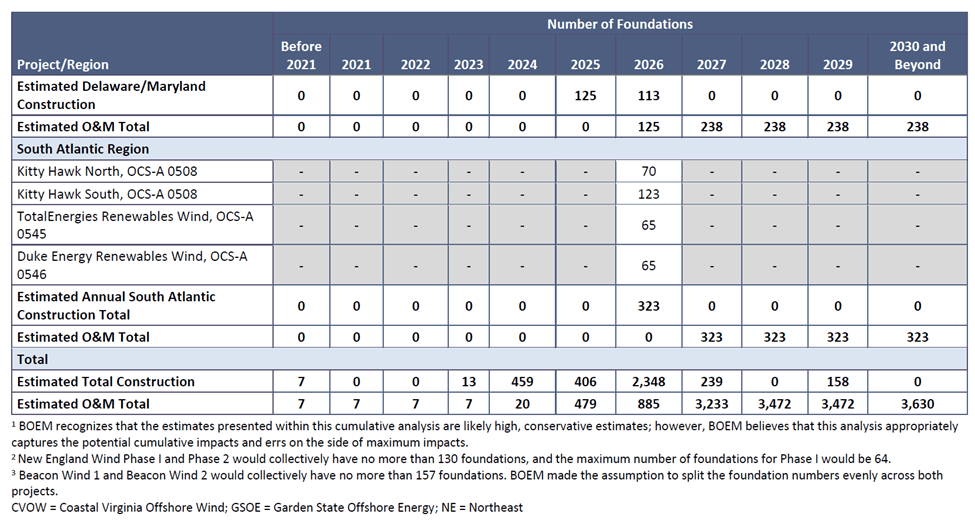
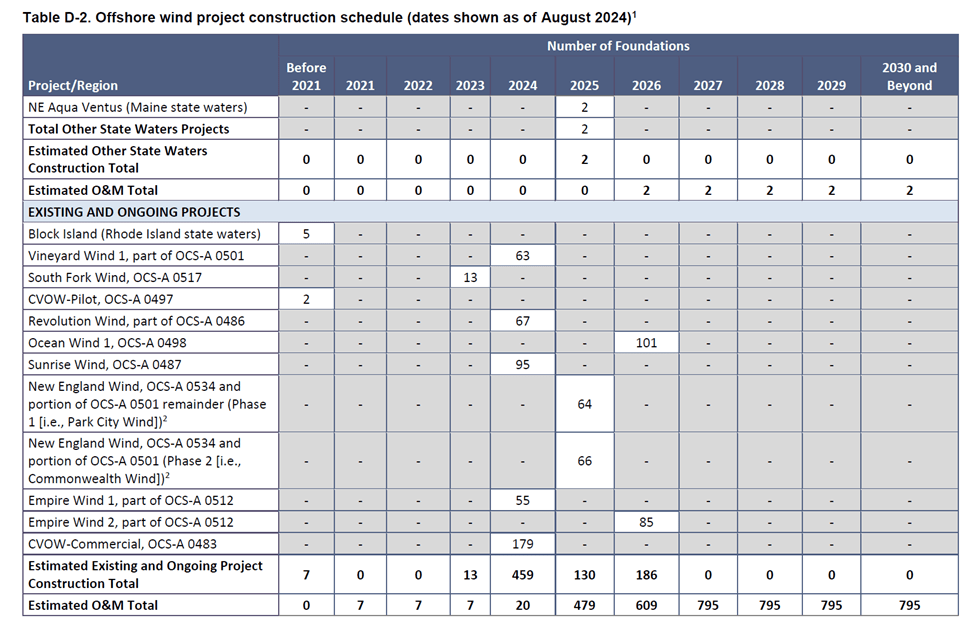
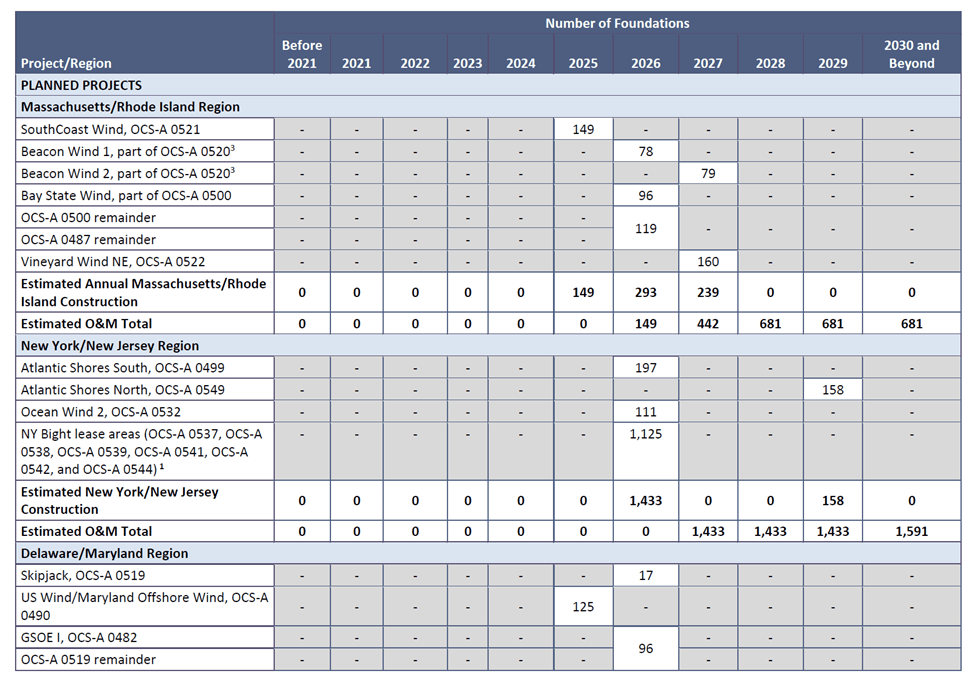
In PEIS Appendix D: Planned Activities Scenario there is a table that describes offshore wind project construction schedules.  It lists the number of foundations expected from Massachusetts to Delaware which is the same thing as estimating the number of turbines.  document describes the ongoing and planned activities that could occur in the New York Bight.  Table D-2 shows that 795 wind turbine foundations are expected by the end of 2026 for existing and ongoing projects.  Planned projects along the mid-Atlantic coast bring the total to 3,630 wind turbines by the end of 2029.  However, the PEIS only considers the 1,125 foundations/wind turbines in the New York Bight.

The Executive Summary explains that:

The PEIS assesses the potential biological, socioeconomic, physical, and cultural impacts that could result from development activities for six commercial wind energy leases in an area offshore New Jersey and New York known as the New York Bight (NY Bight), as well as the change in those impacts with avoidance, minimization, mitigation, and monitoring (AMMM) measures. The six commercial leases analyzed in this Final PEIS are OCS-A 0537, 0538, 0539, 0541, 0542, and 0544 (hereafter referred to as the NY Bight leases or NY Bight lease areas), totaling over 488,000 acres (197,486 hectares) (Figure ES-1), which were issued by the Bureau of Ocean Energy Management (BOEM) on May 1, 2022.

I conclude that the PEIS does not address the cumulative impacts of all future potential offshore wind development.

Goal of PEIS

It turns out that the PEIS was not intended to address cumulative impacts.  The Executive Summary describes the goals of the analysis:

BOEM has prepared this Final PEIS to (1) identify and analyze AMMM measures that could avoid, minimize, mitigate, and monitor impacts on resources in the six NY Bight lease areas and (2) focus future project-specific environmental analyses. This Final PEIS evaluates the potential impacts from anticipated wind energy development within the NY Bight lease areas to inform BOEM in identifying AMMM measures that BOEM may require as conditions of approval for activities proposed by lessees in Construction and Operation Plans (COPs). This Final PEIS will also facilitate the timely review of COPs submitted for the NY Bight lease areas by focusing the project-specific environmental analysis on project impacts not considered in the PEIS or those impacts that warrant further consideration. The project-specific analyses will occur after this PEIS is issued and may tier from or incorporate by reference this PEIS and could also incorporate revised, additional, or different AMMM measures as needed. This PEIS does not, by itself, impose any mitigation measures on future COPs, and instead depends on subsequent COP-specific environmental analysis. This PEIS is therefore not the consummation of the agency’s decision-making for these measures as applied to specific COPs.

The Executive Summary explains that the document describes expected issues and potential impacts to identify the AMMM measures that can mitigate impacts when the COPs are proposed.  BPEM chose this subset of projects because they are close to each other and their expected development times are similar.  They indicate that this will enable them to focus on site-specific issues for future project applications.  It describes four objectives:

  • Analyzing potential impacts if development is authorized in the six NY Bight lease areas.
  • Analyzing AMMM measures for the six NY Bight lease areas.
  • Analyzing focused, regional cumulative effects.
  • Tiering of project-specific environmental analyses.

Impacts Summary

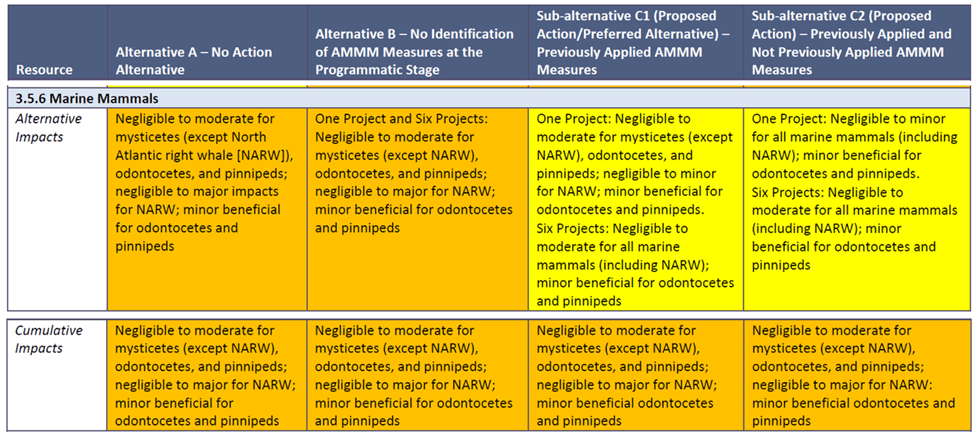
Table ES-2 summarizes and compares impacts among alternatives that includes an assessment of cumulative impacts for different alternatives.  The following excerpt from the table lists the impacts to marine mammals.  Note that the impacts to North Atlantic Right Whales (NARW) all suggest that major impacts are possible for all the alternatives in the New York Bight.  The PEIS only considers about a third of the wind turbines expected by 2030.

North Atlantic Right Whale

Last spring Bud’s Offshore Energy (BOE) “Energy Production, Safety, Pollution Prevention, and More” website reviewed the Bureau of Ocean Energy Management and National Oceanic and Atmospheric Administration Fisheries North Atlantic Right Whale and Offshore Wind Strategy.  His key takeaways:

The document effectively summarizes the dire state of the North Atlantic Right Whale.

  • The BOEM/NOAA strategy is to monitor and further assess the impacts.
  • The need for mitigation will be determined through collaborative processes.
  • This industry-friendly strategy contrasts sharply with the restrictive operating requirements proposed for the more speculative Rice’s whale expanded area in the Gulf of Mexico.

He describes the status of the Right Whales:

NARW status (pages 7-14):

  • Roughly 237 NARWs have died since the population peaked at 481 in 2011, exceeding the potential biological removal (PBR) level on average by more than 40 times for the past 5 years (Pace III et al. 2021).
  • Human-caused mortality is so high that no adult NARW has been confirmed to have died from natural causes in several decades (Hayes et al. 2023).
  • Most NARWs have a low probability of surviving past 40 years even though the NARW can live up to a century.
  • There were no first-time mothers in 2022.
  • About 42% of the population is known to be in reduced health (Hamilton et al. 2021)
  • A NASEM study confirmed that offshore wind has the potential to alter local and regional hydrodynamics
  • “Effects to NARWs could result from stressors generated from a single project; there is potential for these effects to be compounded by exposure to multiple projects.” (p. 14)

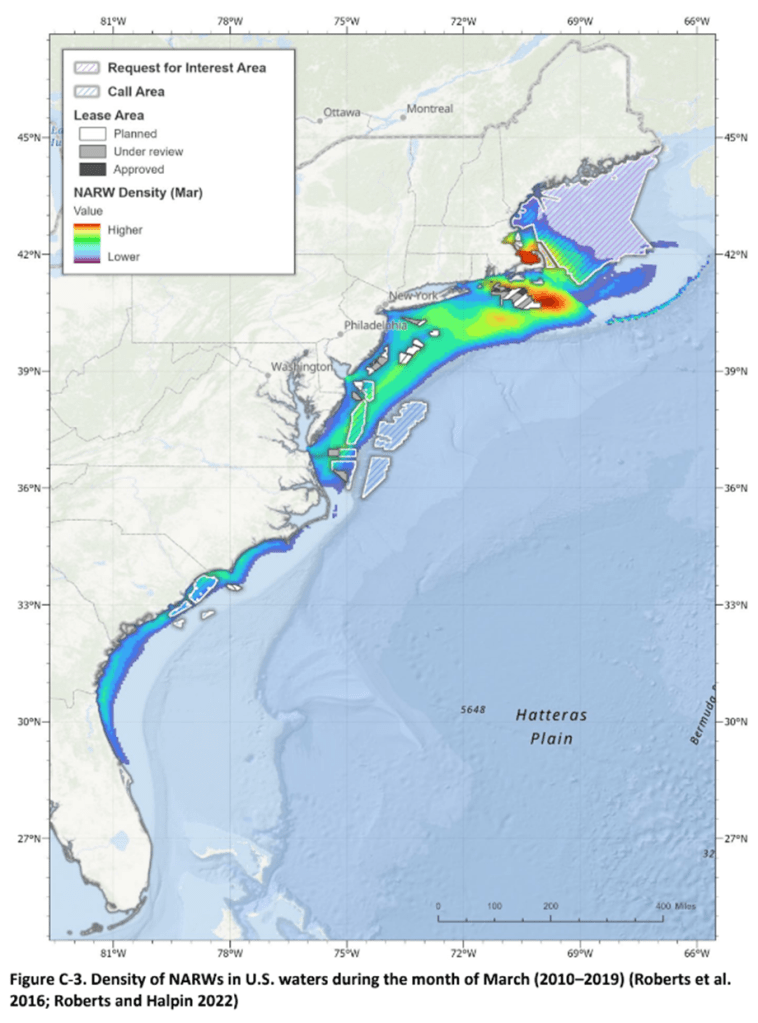
The following map shows where the whales are expected in March.  Note that the migration route will run the gauntlet of all the wind turbine facilities expected.

Conclusion

The PEIS scope was only intended to address Construction and Operation Plans for the New York Bight.  Given that BOEM expects a total of 3,630 wind turbine foundations by 20230 and only 1,125 are expected in the New York Bight, it is notable that the PEIS acknowledged that major impacts from offshore wind development to the NARW are possible for all alternatives.

It is unfortunate that the cumulative impacts of all the wind turbines to the critically endangered NARW are being ignored.  I cannot imagine any scenario where a species this stressed will survive when thousands of massive wind turbines are built across the migration routes. 

Commentary on Recent Articles October 25, 2024

Frequent readers of this blog know that many of my posts are long because I document all my statements.  This is because of my background in industry where it is necessary to prove my arguments to have credibility.  This is an update of articles that I have read that I want to mention but do not require a detailed post.  I have also included links to some other items of interest.  Previous commentaries are available here

I have been following the Climate Leadership & Community Protection Act (Climate Act) since it was first proposed and most of the articles described below are related to the net-zero transition.  I have devoted a lot of time to the Climate Act because I believe the ambitions for a zero-emissions economy embodied in the Climate Act outstrip available renewable technology such that the net-zero transition will do more harm than good. The opinions expressed in this article do not reflect the position of any of my previous employers or any other company I have been associated with, these comments are mine alone.

Videos

Delusions of Energy Storage

John Robson interviews Judith Curry

Chocolate Teapot Fallacy

David Turver writing at Eigen Values Substack described his attendance at the Battle of Ideas Festival in London.  He had the opportunity to respond to the argument that renewables were a viable alternative to nuclear power.  He made the points that has the smallest overall environmental footprint of all energy sources because it doesn’t take up much land and has very low mineral intensity. The physics of nuclear power are far superior to any other energy source because of its extremely high energy return on energy invested, meaning we get far more energy out than we expend building the power plants, and the output is reliable.

He also made the point about the chocolate teapot fallacy.

Arguing for wind and solar in place of nuclear power is akin to arguing in favour of chocolate teapots because you cannot wait for a ceramic one. No matter how many chocolate teapots you buy, you can never make tea; just like no matter how many wind turbines and solar panels you install you can never run a modern economy on intermittent electricity.

Mistake to Abandon Fossil Fuels

CFact explains Ron Stein believes it would be a mistake to abandon fossil fuels.  I have been meaning to raise this issue for a while.  It boils down to the fact that fossil fuels are not only used for transportation and electricity production and the “world’s rush to reduce carbon emissions is overlooking an irreplaceable reality: the petrochemical foundations of modern society.”

“If we stop using crude oil, we’re working backwards – back to the 1800s,” Mr. Stein states. He isn’t being hyperbolic. From today’s phones and medical devices to clothing, packing, and the very infrastructure of homes, most of the products that define modernity are either made from or rely heavily on oil derivatives. It’s not just a matter of cutting down on gasoline or heating oil – reducing crude oil production affects the manufacturing of everything from electric vehicle batteries to renewable electricity infrastructure itself.

Many energy policy makers mistake electricity generation for the sole metric of electricity transition. But electricity is only one aspect of energy consumption. The more difficult truth is that fossil fuels don’t just keep the lights on; they’re embedded in nearly every stage of the supply chain, from raw material extraction to the production of finished goods. While the turbines and solar panels provide electricity, they do not replace the oil-derived components necessary to build those same renewable technologies.

Mr. Stein points to this gap in understanding as a critical oversight: “Policymakers are talking about energy as if it’s synonymous with electricity, but that’s not the case. Everything that needs electricity, from the smallest lightbulb to the most advanced microchip, is made from petrochemicals.”

………………………..

Truly, Ronald Stein’s perspective is a refreshing reminder: the answer to Earth’s energy crisis isn’t a zero-sum game. Rather, it’s about striking a delicate balance – one that safeguards the progress humans have made while building a sustainable future that works for everyone.

Hydrogen Follies

Francis Menton writing at the Manhattan Contrarian summarizes the costs of hydrogen storage. as a dispatchable emissions free resource (DEFR).  The Climate Act Scoping Plan uses hydrogen as the placeholder DEFR for New York’s 2040 zero-emissions fantasy.

Menton describes a new study that appeared in the scientific journal Joule on October 8 with the title “Carbon abatement costs of green hydrogen across end-use sectors.”  He quotes the introduction:

Although low costs of hydrogen storage and distribution (<$1/kgH2) are possible through economies of scale, this requires high utilization of storage and distribution infrastructure, which is not applicable to all end-use sectors. If storage and distribution infrastructure is used at a low rate, costs increase significantly. Salt cavern storage costs increase from less than $0.50/kgH2 to $6/kgH2, on average, if stores are cycled fewer than 10 times per year, for example, in the context of seasonal changes in demand (e.g., heating or electricity generation).

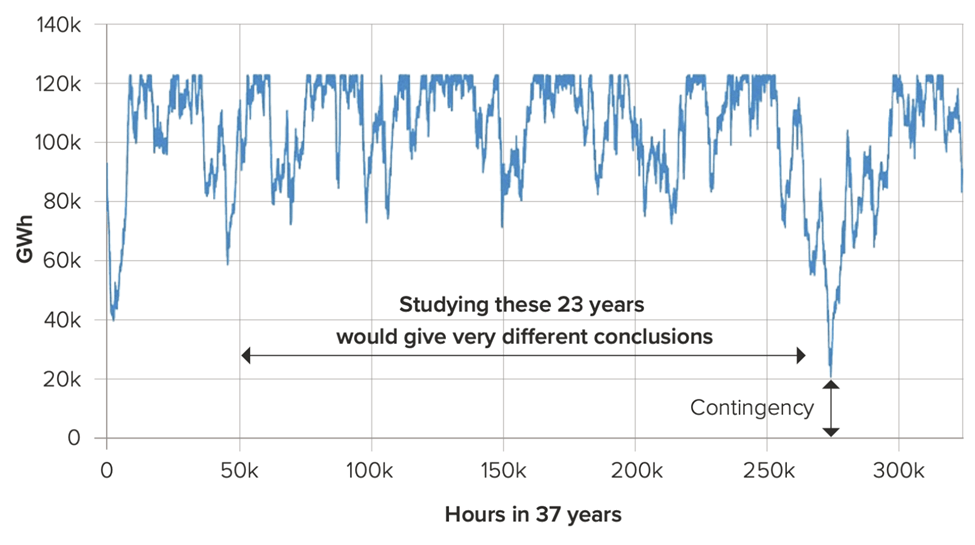
Menton refers to his post on September 28, 2023 that covered a Report then just out from Britain’s Royal Society dealing with issues of long-term energy storage to back up wind and solar generators. He explains that the Royal Society had collected weather data for Britain for some 37 years and documented that “there are worst-case wind and sun “droughts,” comparable to rain droughts, that may occur only once every 20 years or more.”  Similar analysis in New York was used to determine that DEFR is necessary to back up wind and solar electricity generation without fossil fuel back-up to cover these worst-case droughts.  Menton argued that these data indicate that over the 37-year period half of the full storage backup would have been required twice and a quarter only once.  This would raise the cost of storage a lot.  The Royal Society Report includes the following graph of potentially needed withdrawals from storage to cover these worst case droughts:

For context the New York Independent System Operator (NYISO) 2023-2042 System Resource Outlook projected that between 26 and 32.5 GW of hydrogen DEFR generating between 2 and 4 GWh of energy would be needed in 2040 and the Integration Analysis projected that 17.5 GW of DEFR generating 2 GWh would be needed.  Those numbers do not account for the frequency that the full backup will be used.

Menton concludes:

I understand that there are people moving forward on setting up some of this hydrogen infrastructure, funded with government subsidies. It’s almost impossible to imagine how much subsidies it would take to make such a system fully functional. It will never happen.

The Big Lie – Solar and Wind are Cheapest Forms of Energy

Ed Reid describes the big lie:

The solar and wind industries and their government and NGO supporters continually assert that a renewable plus storage grid would be more economical and more resilient than the current grid. Both assertions are demonstrably false. These assertions are not merely misinformation. Rather, they are intentional disinformation.

He summarizes the reasons concisely in one place.  Although the capital costs per unit of rated capacity of fossil fired generators and wind and solar facilities may be comparable, and even if renewables are lower, there are five reasons why that does not matter.  Over a year renewables are limited by the amount of energy they produce.  Reid uses one number, but I think that in round numbers solar produces around 20% of its rated capacity and wind about one third.  A fossil generator can produce 90% of its rated capacity.  Therefore, it takes three times as much wind capacity to produce the same amount of energy and solar at least four times as much.

To provide reliable power energy storage is needed for short term variations, seasonal variations, and worst-case variations in renewable resource output.  The useful lives of wind and solar are shorter than fossil units and storage useful life is even less.  He also points out that wind and solar are less resilient than conventional generation.

Nantucket Wind Update

Bud’s Offshore Energy website compares the Bureau of Safety and Environmental Enforcement (BSEE) latest statement and recent GE Venova (GE) statements:

  • BSEE: Vineyard Wind is still prohibited from installing blades, producing power or conducting any activity on the damaged A-38 turbine.
  • GE: We are “really now getting to a point of shifting back to execution out at sea.” (Not at all what BSEE said.)
  • BSEE: BSEE may permit other specific activities after a risk analysis has been performed and mitigations adopted.
  • GE: We were “granted approval to return to installing new blades on turbines at the project once stringent safety and operational conditions are met.” (Positive spin of the BSEE statement implying that approval is assured.)
  • BSEE: Root cause analysis of the blade failure has not yet been provided to BSEE.
  • GE: “We have finalized root cause analysis and confirm the blade at issue at Vineyard Wind was caused by a manufacturing deviation from our factory in Canada.” (Then why doesn’t BSEE have the analysis? Is the Canadian plant being scapegoated?)
  • BSEE: No timetable for completion of BSEE investigation (This could present a dilemma for BSEE. How do you allow the resumption of blade installation and power generation before the investigation has been completed? Will the report be held until the Harris or Trump administration gives the go-ahead?)

Finally, as expected, we can now conclude that the blades being shipped from New Bedford to France were defective.

Meanwhile the Town and County of Nantucket describe this issue as the Vineyard Wind Turbine Crisis.  The Rhode Island Current updates the current plan.  I think this may have widespread ramifications.

Navigating the physical realities of the energy transition

This post was also published at Watts Up With That

A recent McKinsey Global Institute report The hard stuff: Navigating the physical realities of the energy transition (McKinsey Report) describes the challenges of the energy transition transformation for those who want a decarbonized society.  This post describes my review of the description of the power sector with respect to my primary concerns for the New York Climate Leadership & Community Leadership Act transition of the electric grid to zero-emissions by 2040.  Those concerns are the need for a dispatchable emissions-free resource (DEFR) and the enormous risk associated with determining how much DEFR must be deployed to prevent blackouts in electric grids that depend on variable renewable energy resources, .i.e., wind and solar.

I have followed the Climate Leadership & Community Protection Act (Climate Act)since it was first proposed, submitted comments on the Climate Act implementation plan, and have written over 450 articles about New York’s net-zero transition. The opinions expressed in this article do not reflect the position of any of my previous employers or any other organization I have been associated with, these comments are mine alone.

The McKinsey Report describes the realities of the global clean energy transition that proponents claim is necessary to address the existential threat of climate change.  I think the authors did a good job explaining many of the complicated issues associated with the energy transition.  The scope of the report is enormous because they are trying to cover the entire global energy system:

The energy system consists of the production, conversion, delivery, and consumption of energy resources across sectors as both fuels and feedstocks (that is, inputs for the production of different materials).  The system is a massive, interlocking physical entity that has been optimized over centuries. It has served billions of people—if not yet all of humanity—well. But in an era in which countries and companies around the world are aspiring to address climate change, the high emissions resulting from the current energy system are now firmly in focus. The world has duly embarked on a huge transformation, centered on switching from the high-emissions assets and processes on which the system is largely based to new low-emissions solutions.

The summary describes the key points in the report:

  • The energy transition is in its early stages, with about 10 percent of required deployment of low-emissions technologies by 2050 achieved in most areas. Optimized over centuries, today’s energy system has many advantages, but the production and consumption of energy account for more than 85 percent of global carbon dioxide (CO2) emissions. Creating a low-emissions system, even while expanding energy access globally, would require deploying millions of new assets. Progress has occurred in some areas, but thus far has largely been in less difficult use cases.
  • Twenty-five interlinked physical challenges would need to be tackled to advance the transition. They involve developing and deploying new low-emissions technologies, and entirely new supply chains and infrastructure to support them.
  • About half of energy-related CO2 emissions reduction depends on addressing the most demanding physical challenges. Examples are managing power systems with a large share of variable renewables, addressing range and payload challenges in electric trucks, finding alternative heat sources and feedstocks for producing industrial materials, and deploying hydrogen and carbon capture in these and other use cases.
  • The most demanding challenges share three features. First, some use cases lack established low-emissions technologies that can deliver the same performance as high-emissions ones.  Second, the most demanding challenges depend on addressing other difficult ones, calling for a systemic approach. Finally, the sheer scale of the deployment required is tough given constraints and the lack of a track record.
  • Understanding these physical challenges can enable CEOs and policy makers to navigate a successful transition. They can determine where to play offense to capture viable opportunities today, where to anticipate and address bottlenecks, and how best to tackle the most demanding challenges through a blend of innovation and system reconfiguration.

I am only going to consider the power sector and not the other six end-use sectors discussed.  Twenty-five physical challenges are described for these sectors.  Each of the challenges is described relative to the difficulty of the challenge.  This review focuses on the power sector energy transition physical challenges that are shown in the following figure.

Exhibit E1: McKinsey Global Institute The hard stuff: Navigating the physical realities of the energy transition

The description of the power sector physical challenges explains:

Addressing physical challenges in power is fundamental to the entire transition because abating emissions in the huge energy-consuming sectors—mobility, industry, and buildings—requires sweeping electrification under typical decarbonization scenarios. Two difficult challenges arise: managing the variability of renewables such as solar and wind, as they grow their share of total generation; and doing so specifically for emerging power systems that need to grow, often more rapidly and by more than advanced power systems. These two are classified as Level 3 because addressing variability challenges would require the use of novel technologies that have not yet been deployed commercially and face other substantial barriers. Four other challenges, classified as Level 2, relate to constraints on scaling more established technologies, inputs, and infrastructure, where accelerated progress would be needed for the transition.

Quality Review Concerns

The two review concerns for a power sector depend upon weather-dependent resources that I think must be addressed in any assessment of the quality of the report are the need for a new resource to address long-term wind and solar deficits and the challenge of specifying how much of those resources is needed.

In my opinion, all credible analyses of future electric energy systems depending upon wind and solar must acknowledge the need for a new resource to backup up weather dependent resources that New York has named DEFR.  Francis Menton explains that this creates a likely impossible challenge: 

The reason is that the intermittency of wind and solar generators means that they require full back-up from some other source. But the back-up source will by hypothesis be woefully underused and idle most of the time so long as most of the electricity comes from wind and sun. No back-up source can possibly be economical under these conditions, and therefore nobody will develop and deploy such a source.

There is another aspect of DEFRs that needs to be considered.  Menton also did a post on September 28, 2023 that covered a Report then just out from Britain’s Royal Society dealing with issues of long-term energy storage to back up wind and solar generators that concisely describes my other quality concern.  He explains that the Royal Society had collected weather data for Britain for some 37 years and documented that “there are worst-case wind and sun “droughts,” comparable to rain droughts, that may occur only once every 20 years or more.” 

The Royal Society: Large-scale electricity storage, Issued: September 2023 DES6851_1, ISBN: 978-1-78252-666-7

To be a credible analysis of future power sector projected needs, ten both of these concerns need to be considered.  If they are not included, then the complexity will be underestimated and the magnitude of resources required overlooked.

McKinsey Report Analysis of Concerns

For the power sector the McKinsey report addressed six challenges.  I will describe the relevant challenges and mention the challenges that affect the global system but not the New York power sector.

Challenge 1: Managing renewables variability (Level 3):

With the energy transition, Variable Renewable Energy (VRE) sources, such as solar and wind, would be required to grow and reach a relatively high share of total generation. As this happens, the output of power systems would become progressively more variable, exceeding demand on some days but falling substantially short on others. Consider Germany. VRE could potentially account for 90 percent of all power generation by 2050, in the McKinsey 2023 Achieved Commitments scenario. Nonetheless, there could still be about 75 days a year when VRE generation would be insufficient to meet a large share of demand (meaning that at least one-quarter of demand would have to be met by other sources) (Exhibit 6). VRE-heavy power systems would therefore require much more supply-side flexibility. This could come from storage (both power and heat), backup generation capacity (including thermal generation like gas power and beyond), and interconnections. Such flexibility solutions may need to scale by as much as two to seven times faster than overall power demand globally in the next three decades.  However, these forms of flexibility in turn face significant barriers relating, for example, to critical inputs (for some forms of energy storage) and other factors such as market design mechanisms (for backup generation). Most critically, some of the technologies that would be crucial for providing flexibility to the power system over the course of seasons, including novel long-duration energy storage (LDES) and hydrogen-based generation, would need to scale hundreds of times by 2050 from a negligible base today.

The Challenge 1 description emphasizes the need for supply-side flexibility.  Exhibit 6 notes that at least one quarter of the days will require backup resources to resolve VRE intermittency explaining that “novel long-duration energy storage (LDES) and hydrogen-based generation” is needed “over the course of seasons”.  The example resources can be used for DEFR but it does not address my second concern, the worst-case wind and sun drought.  This study appears to only consider average conditions, which is a common flaw in academic assessments.  For electric system resource planners, the emphasis on reliability for all periods mandates that the analysis addresses extreme conditions.    As a result, the magnitude of DEFR support necessary to keep the lights on at all times is underestimated in this analysis.

The second challenge, “scaling emerging power systems”, is also rated as Level 3. The description notes that “Many countries, especially those that are lower-income, need faster and more significant growth in their power systems to increase access to electricity.”  This is not an issue for New York. 

The description of Challenge 3: Flexing power demand (Level 2) notes thatAlongside supply-side flexibility, there may be more opportunity for demand-side flexibility in power as the world electrifies” and does not address either concern. The McKinsey Report claims that this kind of flexibility could provide as much as 25 percent of the total amount needed to accommodate VRE in 2050, in the IEA’s Net Zero scenario.  However, it exposes a weakness in studies that use averages.  Industry planners do not rely on demand-side flexibility because in the worst-case scenarios the capability of those resources is much lower and can be essentially worthless.  This means that studies that only look at averages miss the point that to keep the lights on demand-side resources may not displace as many supply-side resources during the worst-case scenario as they project.  In my opinion, the value of any resource that does not provide firm energy during the worst-case scenario should be downrated.

Challenge 4, “securing land for renewables” is rated as Level 2.  This is a problem for any jurisdiction that tries to rely on VRE because wind and solar resources are diffuse.  This challenge does not address either of my concerns.

Challenge 5: Connecting through grid expansion (Level 2):

With the growth of the power system and the addition of more geographically dispersed energy sources such as VRE, grids would need to become larger and more distributed, interconnected, and resilient. They may need to more than double in size by 2050, growing 40 to 50 percent faster than they are currently. However, lead times for the permitting and construction of transmission lines are long, especially in mature markets such as the EU and the United States, where they have tended to be between five and 15 years. Among other initiatives, accelerating permitting with new streamlined processes could facilitate the expansion of grids.

This challenge does not address either of my concerns.

Challenge 6: Navigating nuclear and other clean firm energy (Level 2):

Increased deployment of clean firm power, such as nuclear, geothermal, and low-emissions thermal plants (for example, hydrogen, biogas, and natural gas with CCUS), could reduce the challenges of variability, land use, and grid expansion. Nuclear is an example of a clean firm technology that is mature and gaining momentum. At COP28, for example, a group of economies announced commitments to triple nuclear capacity by 2050.  Nonetheless, increasing the deployment of nuclear requires managing complex engineering, supply chain, skills, and siting issues as well as safety considerations. In combination, these issues could result in long lead times, frequent delays, and cost overruns. Addressing these would require, for instance, standardizing the design of nuclear plants and building multiple plants using the same designs to leverage shared learning, training workforces in the skills they need, and developing necessary supply chains.

These issues affect the deployment of DEFR but do not address my concerns directly.

Discussion

Although there is useful information in this report, it fails to address my concerns about the need for a new resource to address the specific problem of worst-case wind and solar “droughts” and the related problem of defining just how much of the new resources will be needed to prevent blackouts for the worst of the worst-case periods.

I think the main problem can be traced to the use of averages rather than worst-case conditions for evaluation of resource requirements.  I searched the document for the terms “worst” and “extreme”.  The term “worst” did not appear.  The term “extreme” did show up relative to battery electric vehicle use and heat pumps.  The McKinsey Report noted that special considerations were needed for the worst-case extremes for those applications.  Unfortunately, the authors did not extend that consideration to the power sector.

There is one other consideration unmentioned in the power sector challenges.  Wind and solar resources do not provide the ancillary services necessary to support the transmission system.  The McKinsey Report did note that transmission requirements would be a challenge but overlooked this aspect.

Conclusion

The report concludes that:

The path of the energy transition will not be straightforward, and stark trade-offs and consequences lie ahead. Taking time for the transition to play out, as in many physical transformations of the past, could allow for the physical realities of the transformation to be confronted more gradually with time to innovate and scale new low-emissions technologies, address bottlenecks, and reconfigure the system. While this may make navigating the physical challenges easier, such a path would almost certainly involve compromising on the climate goals that countries and companies across the world have agreed to, with consequences for rising physical risks. However, driving the transition forward without confronting physical realities would most likely compromise the performance of the energy system—and as a result challenge energy access, growth, prosperity, and support for the transition itself.

Alternatively, stakeholders could confront difficult physical challenges head-on—in fact, they could use an understanding of physical realities to guide the way forward to an affordable, reliable, competitive path to net zero. While many open questions remain on what precise path would enable the physical challenges to be addressed, this analysis sheds light on some crucial ingredients that would have to be present in a successful energy transition.

The power sector analysis appears to use averages to project future needs.  As a result, it fails to address my concerns about the need for DEFR and the related risk that improper assessment of the amount of DEFR needed threatens the reliability of the electric system.  The ultimate concern is that the conditions associated with extreme wind and solar droughts are also associated with extreme hot and cold weather when the electrified society will be most vulnerable if there is a blackout.  The report sheds some light on crucial ingredients but overlooks a potential fatal flaw.

Clearly there is no question in the minds of the authors that the transformation to net-zero is necessary. The conclusion talks about trade-offs and consequences but does not acknowledge that there may not be an “affordable, reliable, competitive path to net zero” using VRE.   Given the vulnerability risk, I remain convinced that the VRE transition will do more harm than good in New York and elsewhere.  I think the nuclear option is the only path forward for those who want to decarbonize.

Draft NY Documents Requiring Public Comment

Keith Schue sent me an email with the following information that I believe would be of interest to readers here.  New York State agencies have recently announced several draft documents that are out for public comment. It is confusing.  When Keith sent this clarifying information, I asked for permission to send it out as a post and he graciously gave me permission.

Keith Schue is an electrical engineer and technical adviser on energy policy. Keith advocates for nuclear power.  He recently co-authored a commentary in the Albany Times Union with climate scientist James Hansen, making a persuasive case for using nuclear in the future. 

Overview

The Climate Leadership & Community Protection Act (Climate Act) established a New York “Net Zero” target (85% reduction in GHG emissions and 15% offset of emissions) by 2050.  It includes an interim 2030 GHG reduction target of 40%. Two targets address the electric sector: 70% of the electricity must come from renewable energy by 2030 and a requirement that all electricity generated be “zero-emissions” resources by 2040. The Climate Action Council (CAC) was responsible for preparing the Scoping Plan that outlined how to “achieve the State’s bold clean energy and climate agenda.” The Integration Analysis prepared by the New York State Energy Research and Development Authority (NYSERDA) and its consultants quantifies the impact of the electrification strategies.  That material was used to develop the Draft Scoping Plan outline of strategies.  After a year-long review, the Scoping Plan was finalized at the end of 2022.  Since then, the State has been trying to implement the Scoping Plan recommendations through regulations, proceedings, and legislation.

Keith describes three related documents and opportunities for public comments in the following sections.  I have made some minor edits and added a few links.  He describes each document and includes a suggestion for a possible comment.

Draft Blueprint for Consideration of Advanced Nuclear Technology

A number of states throughout the country are encouraging the development of advanced next generation nuclear reactors to meet our growing energy needs, remain economically competitive, significantly reduce greenhouse gas emissions, conserve farmland, and protect nature. During last month’s Future Energy Summit in Syracuse, Governor Hochul announced that New York ought to consider advanced nuclear power, too. However, several misguided “environmental” groups who either don’t understand energy or don’t care about those things have launched a misinformation campaign involving form-letters to the governor and NYSERDA intended to create the appearance that New Yorkers oppose nuclear power.  They would rather see the state pursue an unproven, inefficient, ecologically-destructive energy strategy dominated by massive amounts of solar, wind, and batteries.

The due date for comments is Nov 8th.  A useful comment would be to say that if New York is serious about addressing climate change, providing ample reliable electricity essential for a growing economy, and protecting the integrity of rural land and nature, then it needs to join the 21st century by investing in dependable, compact carbon-free nuclear power. 

Click here to read the draft Blueprint: Read Draft Blueprint

Click here to comment on the draft Blueprint: Comment on Draft Blueprint

Draft Scope of NYS Energy Plan 

Although related, this should not be confused with the Climate Action Council’s Scoping Plan for implementation of the CLCPA that was adopted in Dec 2022.  Every several years the New York Energy Planning Board is required to update its overall energy plan for the state. The process begins with an initial document that identifies a “scope” of work–meaning the set of things to be evaluated in the plan. That draft “scope” was released last month for public comment with a defined planning horizon of 2040. This makes the CLCPA’s 2040 goal of carbon-free electricity particularly relevant. Unlike the CLCPA’s 70% renewable goal which only applies in 2030, the 2040 goal does not mandate an arbitrary quota of “renewables”. Instead, it simply mandates carbon-free electricity, which can include nuclear power. 

The due date for comments is Nov 25th.  An important comment would be to say that if New York is serious about achieving carbon-free electricity as electricity demand doubles, it needs to invest in reliable and resilient nuclear power that is made in America, instead of focusing predominantly on wasteful, fragile, intermittent, and ecologically-harmful sources of energy made mostly in China.


Click here to read the draft Scope: Read Draft Scope

Click here to comment on the draft Scope: Comment on Draft Scope

Draft NYPA Renewables Strategic Plan

Historically, the New York Power Authority (NYPA) has been a well-run public entity that has provided NY residents and business with reliable, affordable electricity by building and operating large hydropower plants and various electric infrastructure projects. In the past, NYPA even helped to develop nuclear power. However, the Build Public Renewables Act adopted last year now forces NYPA to try installing solar, wind, and batteries even faster than the private sector is already doing with subsidies. NYPA’s draft plan appears to leverage its good credit to help rescue or expedite about 31 private-sector large-scale solar/wind/battery projects. It would also build about 9 such projects itself.

The due date for comments is around Dec 8th.  A useful comment would be to say that achieving carbon-free electricity requires firm reliable power. Therefore, throwing more public money and resources at intermittent generation not only jeopardizes reliability and affordability, but also ensures that NY will remain dependent on fossil fuels. Instead of focusing on solar panels and wind turbines that the private sector can install on its own, NYPA should do what it has historically done best by working on reliable public projects for the common good, like nuclear energy, hydropower, and utility infrastructure.

Click here to read the draft NYPA Renewables Plan: Read Draft NYPA Renewables Plan
Click here to comment on the draft NYPA Renewables Plan and see the schedule of Public Hearings: https://www.nypa.gov/renewables

Conclusion

Keith’s overview is apropos and I agree with him.  I am on vacation so publishing someone else’s work is an easy way to keep the hits to the blog coming.  All of these documents and issues are of interest to me, and I intend to comment.  The bottom line is that if New York really wants to decarbonize, then nuclear must be part of the future energy mix or it will be impossible to achieve the aspirational targets.

Draft NYISO Reliability Needs Assessment Regulatory Policies Affecting Reliability

It has been a while since I have written about New York Independent System Operator (NYISO) reliability planning process documents.  This post summarizes the section describing regulatory policies affecting reliability in the draft October 2024 draft Reliability Needs Assessment (RNA). 

I have followed the Climate Leadership & Community Protection Act (Climate Act)since it was first proposed, submitted comments on the Climate Act implementation plan, and have written over 450 articles about New York’s net-zero transition. The opinions expressed in this article do not reflect the position of any of my previous employers or any other organization I have been associated with, these comments are mine alone.

Overview

The rationale for the Climate Act is the existential threat of climate change and the Hochul Administration never misses an opportunity to describe every weather extreme as a more proof.  The Climate Act established a New York “Net Zero” target (85% reduction in GHG emissions and 15% offset of emissions) by 2050.  It includes an interim 2030 reduction target of a 40% reduction. Two targets address the electric sector: 70% of the electricity must come from renewable energy by 2030 and a requirement that all electricity generated be “zero-emissions” resources by 2040. The Climate Action Council (CAC) was responsible for preparing the Scoping Plan that outlined how to “achieve the State’s bold clean energy and climate agenda.” The Integration Analysis prepared by the New York State Energy Research and Development Authority (NYSERDA) and its consultants quantifies the impact of the electrification strategies.  That material was used to develop the Draft Scoping Plan outline of strategies.  After a year-long review, the Scoping Plan was finalized at the end of 2022.  Since then, the State has been trying to implement the Scoping Plan recommendations through regulations, proceedings, and legislation.

NYISO Reliability Planning

The NYISO reliability planning process consists of two analyses: the Reliability Needs Assessment (RNA) and Comprehensive Reliability Plan (CRP). The RNA evaluates the adequacy and security of the bulk power transmission facilities over a ten-year planning period, the resources in megawatts (MW), and the locations where required to meet projected needs.  If necessary, the NYISO will request solutions for identified needs.  The CRP determines if the proposed solutions are viable and sufficient then documents the solutions meet the identified reliability needs. 

As part of this continuous process the NYISO has released a “draft for discussion purposes only” of the 2024 RNA on October 4, 2024.  The Regulatory Policies Affecting Reliability section caught my attention, so I wrote this article.

Regulatory Policies Affecting Reliability

A common theme in this blog is the risks to reliable electricity posed by political machinations.  Although the NYISO is technically an independent organization there is tremendous political pressure for the organization to comport with the politically driven narrative of the Hochul Administration.  The section discussing regulatory policies is carefully written so as not to offend the politicians:

Increasingly ambitious environmental and energy policies, evolving market rules, technological advancements, and economic factors impact the decisions by market participants and are accelerating the transition in the state’s resource supply mix. During this transition, the pace of both the addition of new resource additions and the retirement of older, higher-emitting resources are projected to exceed historical levels. Changes to demand patterns and the generation fleet driven by federal, state, and local government regulatory programs may impact the operation and reliability of New York’s bulk power system.

“May impact” operation and reliability is a massive understatement.  Consider the following:

Compliance with federal and state regulatory initiatives and environmental and permitting requirements may require investment by the owners of New York’s existing thermal power plants in order to continue operation. If the owners of those plants must make significant investments to comply, the increased cost to continue operating could lead to the retirement of these resources needed to maintain the reliability of New York’s bulk power system and, therefore, could necessitate replacement.

The document lists eight public policy initiatives that could require investment.  One of the initiatives is the “Peaker Rule:” that targets Nitrogen Oxide (NOx) emission limits for simple cycle and regenerative combustion turbines that provides an example of the challenges.  This initiative should be a model for New York energy policy.  The rule was needed for the state to comply with EPA requirements to reduce NOx to help reduce ozone concentrations.  On the other hand, the simple cycle “peaker” turbines fulfill a critical reliability function.  Recognizing this tradeoff the NY Department of Environmental Conservation (DEC), the generating companies, and NYISO worked out a plan to ensure that the facilities would eventually retire or install control equipment to reduce emissions on a proscribed schedule.  The non-regulated owners of the facilities all determined that the market would not support control equipment investment and submitted plans to retire.  The NYISO determined that temporarily retaining the peaker generators on the Gowanus 2 & 3 and Narrows 1 & 2 barges is necessary to address a reliability requirement, but the others have retired.

Another of the initiatives, “New York Power Authority (NYPA) Small Gas Power Plant Phase Out” is an example of an inappropriate energy planning initiative.  The document describes it as impacting 517 MW nameplate capacity in New York City and Long Island. It requires a plan to phase out production of electricity from fossil fuels, considering clean replacement resources and impacts on emissions and system reliability.  In particular,

NYPA is required to publish a plan by May 2025 to phase out the production of electricity from its seven small natural gas plants (simple-cycle combustion turbines) in New York City and Long Island by December 31, 2030, unless those plants are determined to be necessary for electric system reliability or emergency power service or energy from other sources that may replace energy from NYPA’s small plants would result in more than a de minimis net increase in emissions within a disadvantaged community.

The peaking power plant issue has become a major point of focus of the environmental justice community and proponents managed to convince politicians to include this legislation in the 2023-2024 enacted state budget.  I described many issues with this bogus problem last February.  In short, while there is no question that power plants do affect adjacent neighborhoods, their impacts are all less than the National Ambient Air Quality Standards and the contributions from buildings and transportation sectors are more impactful.  In my opinion, that means that they are not as evil as portrayed,  Furthermore, a DEC Cap and Invest program presentation noted that the power plants had negligible emissions relative to total state-wide emissions.  On the other hand, they fulfill a critical reliability need. 

The draft RNA explains that there are challenges for the replacing these resources:

Balancing the grid throughout this transition not only requires maintaining sufficient capacity to meet demand but also requires that new resources entering service comparably replace the capabilities and attributes of the resources leaving the system (e.g., fast starting/ramping and dispatchable both up and down, available when and for as long as needed, providing essential reliability services such as voltage and frequency control, support system’s stability during disturbances). Continued dialogue and engagement among Market Participants, policymakers, and the NYISO will be essential to support the planning processes in order to identify the needs and services required to maintain a reliable system during and after this transition period.

The NYPA Small Gas Power Plant Phase Out regulation affects modern units that have emission rates far lower than the old units affected by the Peaker Rule.  The environmental justice advocates have the mistaken impression that they can be replaced by battery energy storage powered by wind and solar resources.  This description lays down a marker. The bottom line is that the only resource that can provide the necessary attributes at this time is a fossil-fired generating unit.  Wind, solar, and battery energy storage cannot replace the capabilities and attributes described.

However, given that there have been multiple attempts to permit new replacement fossil-fired generating units to replace the existing peaker units do not underestimate political attempts to deny reality..  The DEC has, under considerable political pressure in my opinion, refused to permit any of these proposed resources citing nothing more than the project being inconsistent with the Climate Act.  Consequently, nothing to replace the old resources has been built.

Conclusion

The “Peaker Rule” promulgation and implementation predated the Climate Act.  It was a common sense approach that provided environmental benefits and protected electric system reliability, Since then reliability concerns have been given short shrift and practical reliability solutions have not been permitted.  The NYPA Small Gas Power Plant Phase Out regulation codifies the irrational New York energy policy approach whereby politicians claim to know better than the electric planner professionals responsible for maintaining a reliable electric system.  Now the NYISO must deal with this legislation that is supposed to shut down existing power plants in favor of a magical resource that does everything needed without any environmental impacts in response to a mostly non-existent problem.  At some point the Hochul Administration is going to have to step up and support the resources necessary to keep the lights on.

Catastrophic Costs of Green Energy

The New York State Comptroller Office released an audit of the NYSERDA and PSC  implementation efforts for the Climate Leadership & Community Protection Act (Climate Act) titled Climate Act Goals – Planning, Procurements, and Progress Tracking.  The audit found that: “The costs of transitioning to renewable energy are not known, nor have they been reasonably estimated”.  This post describes a couple of articles that suggest that when the costs of the Climate Act transition are finally revealed they will be extraordinarily high.

I have followed the Climate Act since it was first proposed, submitted comments on the Climate Act implementation plan, and have written over 450 articles about New York’s net-zero transition.  The opinions expressed in this article do not reflect the position of any of my previous employers or any other organization I have been associated with, these comments are mine alone.

Overview and Background

The Climate Act established a New York “Net Zero” target (85% reduction in GHG emissions and 15% offset of emissions) by 2050.  It includes an interim 2030 reduction target of a 40% reduction by 2030. Two targets address the electric sector: 70% of the electricity must come from renewable energy by 2030 and all electricity must be generated by “zero-emissions” resources by 2040. The Climate Action Council (CAC) was responsible for preparing the Scoping Plan that outlined how to “achieve the State’s bold clean energy and climate agenda.” The Integration Analysis prepared by the New York State Energy Research and Development Authority (NYSERDA) and its consultants quantifies the impact of the electrification strategies.  That material was used to develop the Draft Scoping Plan outline of strategies.  After a year-long review, the Scoping Plan was finalized at the end of 2022.  Since then, the State has been trying to implement the Scoping Plan recommendations through regulations, proceedings, and legislation. 

To date, however, the costs of the transition have not been revealed.  The Comptroller Report audit found that: “While PSC and NYSERDA have taken considerable steps to plan for the transition to renewable energy in accordance with the Climate Act and CES, their plans did not comprise all essential components, including assessing risks to meeting goals and projecting costs.”  It noted that the “PSC is using outdated data, and, at times, incorrect calculations, for planning purposes and has not started to address all current and emerging issues that could significantly increase electricity demand and lower projected generation”.  Regarding costs the audit notes that “The costs of transitioning to renewable energy are not known, nor have they been reasonably estimated” and goes on to point out that the sources of funding have not been identified.

Crippling Costs of Electrification and Net-Zero Energy Policies in the Pacific Northwest

Jonathan Lesser and Mitchell Rolling have released a new research report from Discovery Institute’s Reasonable Energy program that will “produce staggering costs to individuals and businesses without providing any meaningful environmental benefits”.  The Discovery Institute announcement of the report summarizes the report as follows.

  • Authors Jonathan Lesser and Mitchell Rolling conclude that policies in Oregon and Washington State that require their state electrical utilities to eliminate fossil-fuel energy sources to produce 100% of electricity from zero-emissions sources by 2040 (Oregon) and 2045 (Washington) will double existing electricity demand.
    • Both states have adopted California’s Advanced Clean Car rules, which require 100% of all new cars and light trucks sold to be electric by 2035.
    • Both states intend to reach zero energy-related greenhouse gas emissions by 2050, including replacing all fossil-fuel space- and water-heating systems with electric heat pumps.
    • Both states envision replacing existing fossil fuel generation and meeting the projected increase in electricity demand with thousands of megawatts (MW) of wind turbines and solar photovoltaics.

The Climate Act mandates are similar to those in Oregon and Washington.

The inherent intermittency of wind and solar power, together with peak electric demands taking place in the early evening hours when there is no solar generation available (and often no wind), means the two states will require large amounts of storage capacity, in addition to the existing hydroelectric storage dams that have been built on the Columbia River and its tributaries.

New York electric system projections highlight the same problem with intermittency as described here.

Because no new hydroelectric dams will be built, the additional storage capacity required will need to come from large-scale battery storage facilities and perhaps a few new pumped hydroelectric storage facilities, whose siting remains controversial.

New York also has no ability to build more hydro so will have to rely on battery energy storage.

  • Their research considered the costs by 2050 associated with three scenarios: 1) the renewables-only strategy; 2) a lower-cost renewable strategy (a more optimistic low-cost renewables scenario in which wind, solar, and storage capital costs decrease by 50% in real (inflation-adjusted) terms by 2050); and 3) an alternative scenario in which the electricity goal is achieved with new nuclear plants and additional natural gas generators. The assessed total costs (in inflation-adjusted dollars) are as follows:
    • Renewables Only: $549.9 Billion
    • Lower-cost Renewables: $418.5 Billion
    • Natural Gas and Nuclear: $85.9 Billion

The Climate Act precludes the pragmatic option to consider natural gas and nuclear so our costs will be closer to the high end.

  • Their research indicates that the effects on electricity bills will be devastating.
    • A typical residential customer’s bill will increase by 450%, from about $110 per month today to over $700 per month in 2050 (assuming a modest inflation rate of just 2.0% annually).
    • Commercial customers will see their monthly bills increase from an average of about $600 per month today to approximately $3,800 per month in 2050.

The Hochul Administration has not provided any ratepayer impacts, but I expect the costs will be similar in New York.

  • The negative economic impacts will not be limited to soaring electricity bills.
    • Prices for virtually all goods and services will dramatically increase.
    • Jobs will be lost as businesses relocate to other states with lower-cost energy.
    • Energy poverty rates will soar.

Negative economic impacts are a feature not a bug of net-zero transition efforts.

  • The enormous costs to consumers and businesses will be accompanied by negligible environmental benefits.
    • The reduction in greenhouse gases (GHGs) from the policies would total about 1.8 billion metric tons between 2024 and 2050, which is a small fraction of estimated 35 billion metric tons world carbon emissions in just one year.
    • If both states eliminated all energy-related GHG emissions by 2040, the resulting decrease in world temperatures would be only 0.003 ⁰C. By comparison, the best outside thermometers have an accuracy of about +/- 0.5 ⁰C, about 170 times larger.

I estimate that New York reduction in GHG emissions is about the same (1.5 billion metric ton reduction) as the reduction projected from Oregon and Washington so the estimates of environmental benefits are similar.

The report concludes that the two states would be best served by abandoning these goals, focusing instead on providing reliable and far less costly electricity from new natural gas and nuclear plants.

I believe this conclusion would be appropriate for New York.

Catastrophic Costs of Green Energy

Alex Epstein described his testimony in front of the House Budget Committee on the topic “The Cost of the Biden-Harris Energy Crisis.”  You can watch his testimony and the Q&A at the link.

The transcript of his testimony states:

The basic idea of government-dictated green energy is that the government should force us to rapidly reduce our use of fossil fuel energy and replace it with so-called “green energy,” mostly solar and wind, such that we reach net zero greenhouse gas emissions by 2050 at the latest.

There are three basic truths you need to know about the costs of government-dictated green energy. And I think these are really under-appreciated even by critics.

One is they have been enormous so far.

Two is they would have been catastrophic had it not been for the resistance of their opponents. This is very important when you hear the Biden administration has record production. That’s in spite of them, not because of them.

And three, they will be apocalyptic if not stopped in the future.

He goes on to summarize the reason for the cost increases:

So let’s talk about the cost so far of government-dictated green energy. All the energy related problems we have experienced in recent years, which have been a lot: high gasoline prices, higher heating bills, higher electricity bills, and unreliable electricity, which is a huge problem we need to talk much more about, are the result of government-dictated green energy.

And its very simple. When you shackle the most cost effective and scalable source of energy, fossil fuels, and you subsidize unreliable solar and wind, that wouldn’t otherwise be competitive, energy necessarily becomes more expensive, less reliable and less secure. So again, it’s very simple.

This is exactly what will happen in New York because of the Climate Act net-zero transition.  He goes on to explain why inflation and increased energy costs are inextricably linked:

Prices are determined by supply and demand. If oil and gas companies could control energy prices in their favor, why didn’t they do this from 2015 to 2020 when they were losing money? The truth is that government-dictated green energy policies are fundamentally responsible for all the energy related costs we experience today compared to a decade ago.

And in fact, it’s worse than that. There’s an opportunity cost. Because were it not for these policies, energy would have gotten considerably cheaper and more reliable, especially with lower natural gas prices, which should have lowered electricity prices. Instead, they’ve gone up because we’ve added a bunch of wasteful energy and unreliable stuff. And it gets worse, since energy is the industry that powers every other industry. By making energy more expensive and less reliable, we make everything more expensive and less reliable, which means government-dictated green energy drives price inflation. Very important point.

His testimony notes that at least on the Federal level that the attempts to rapidly eliminate fossil fuel use have failed.  Consequently, the nation has been spared energy ruin and a third-world grid.  Of course, reality has not stopped the Climate Act.  His testimony is a grim warning of our future if this madness continues.

Conclusion

In the absence of a clear accounting of costs for the Climate Act we can only guess what will happen here.  I believe that the crippling and catastrophic adjectives used by these authors will surely describe our energy costs.

Personal Comments on RGGI Program Review October 2024

The Regional Greenhouse Gas Initiative (RGGI) is a market-based program to reduce emissions from electric generating units.  One aspect of RGGI is a regular review of the program status and need for adjustments.  This article describes my latest comments on the Third Program Review process.

I have been involved in the RGGI program process since its inception.  I blog about the details of the RGGI program because very few seem to want to provide any criticisms of the program.   I submitted comments on the Climate Act implementation plan and have written over 450 articles about New York’s net-zero transition because I believe the ambitions for a zero-emissions economy embodied in the Climate Act outstrip available renewable technology such that the net-zero transition will do more harm than good.  The opinions expressed in this post do not reflect the position of any of my previous employers or any other organization I have been associated with, these comments are mine alone.

Background

RGGI is a market-based program to reduce greenhouse gas emissions (GHG) (Factsheet). It has been a cooperative effort among the states of Connecticut, Delaware, Maine, Maryland, Massachusetts, New Hampshire, New York, Rhode Island, and Vermont to cap and reduce CO2 emissions from the power sector since 2008.  New Jersey was in at the beginning, dropped out for years, and re-joined in 2020. Virginia joined in 2021 but has since withdrawn, and Pennsylvania has joined but is not actively participating in auctions due to on-going litigation. According to a RGGI website:

The RGGI states issue CO2 allowances that are distributed almost entirely through regional auctions, resulting in proceeds for reinvestment in strategic energy and consumer programs.

Proceeds were invested in programs including energy efficiency, clean and renewable energy, beneficial electrification, greenhouse gas abatement and climate change adaptation, and direct bill assistance. Energy efficiency continued to receive the largest share of investments.

The RGGI States regularly review successes, impacts, and design elements of the program.  This is the third iteration of the review program.  It started in February 2021 and there is no schedule for its completion.  The description states:

To support the Third Program Review, the states will:

  • Conduct technical analyses, including electricity sector modeling, to inform decision-making related to core Program Review topics, such as the regional CO2 emission cap.
  • Solicit input from communities, affected groups, and the general public on the Program Review process and timeline, core topics and objectives, modeling assumptions and results, and other policy and design considerations.
  • Convene independent learning sessions with experts and other interested parties on key design elements.

I have previously posted an article describing my earlier comments to RGGI addressing the disconnect between the results of RGGI to date relative to the expectations in the RGGI Third Program Review modeling.  I have also described other comments submitted to RGGI.

The overarching problem with GHG emission market-based programs is that carbon dioxide emissions are directly tied to fossil-fuel combustion and energy production.  If for any number of reasons, the zero-emissions are not deployed fast enough there won’t be enough credits within the cap available to cover the emissions necessary to provide the energy needs.  In the worst case, an electric generating unit needed to keep the lights on will refuse to operate because they have insufficient allowances. I do not think that this program review pays sufficient attention to this problem.

The Program Review Update describes the September 23, 2024 update.  There are two distinct components to this update: the release of another modeling scenario and a request for suggestions on how to accommodate other states without upsetting the “environmental ambition” of the states currently participating in RGGI.

IPM Emission Modeling Comments

The basis of the RGGI state program review proposal is modeling done by ICF using the Integrated Planning Model (IPM).  There is not much documentation for the IPM analysis.  The Program Review Update is the only documentation and that consists of “informational slides”.  The “detailed modeling results” are presented in a spreadsheet that does not include a table with explanations of the data provided.  Even though I have reviewed every previous iteration of RGGI IPM modeling results, I had to spend a lot of time trying to decipher what they were doing.  If someone decided to review the modeling analysis without any experience, they would have a very hard time trying to figure out what is going on.  I do not think this lack of documentation is appropriate.

The presentation slides note that “The RGGI states have conducted modeling analysis of an additional exploratory policy scenario”.  In this type of analysis, the policy scenario results are compared to a base case or business as usual scenario. Two cap scenarios were modeled:

  • Flat Cap Scenario consistent with current program design
  • Exploratory Policy Scenario with an increased reserve price, declining cap to 2037 and a new two-tier CCR.

Results from two cases of the “Exploratory Policy Scenario” are presented in the spreadsheet.  Case A includes “currently contracted renewables only” and Case B includes “on-the-books policies and mandates”.  The Flat Cap Scenario includes on-the-book policies and mandates and the exploratory scenario projects what would happen with the policy changes.  The documentation also notes that renewable cost data has been updated to align with NREL’s 2024 release of the Annual Technology Baseline dataset.  I believe that the updated data were different enough that it was appropriate to do a new current program design base case, i.e., the Flat Cap Scenario. 

I have reservations about the analysis because the IPM projected emissions in 2028 are not credible.  Table 1 lists the observed EPA Clean Air Markets Division annual CO2 emissions for the last three years and the Integrated Planning Model (IPM) projected 2028 emissions for the three modeling scenarios from the results spreadsheet.  IPM projects an overall reduction of more than 50% in four years for Case A  I believe that the analysis over-estimates potential CO2 reductions in the ten RGGI states.  Reductions in this time frame can only occur when wind and solar resources displace the RGGI source generation. My first impression is that it is unlikely that enough wind and solar can be built in that time frame.

Table 1: Comparison of Observed RGGI CO2 Emissions and IPM Projected Emissions (million tons)

Modeling scenario Case A includes “currently contracted renewables only and Case B, used in the Flat case, includes “on-the-books policies and mandates”.  I do not believe that the modeling addresses the fact that renewable rollouts are not going according to contracted renewable plans.  The New York Department of Public Service (DPS) Case Number: 15-E-0302,: Proceeding on Motion of the Commission to Implement a Large-Scale Renewable Program and a Clean Energy Standard recently asked for comments on the DPS staff and the New York State Energy Research and Development Authority’s (NYSERDA) July 1, 2024, filing of the Draft Clean Energy Standard Biennial Review.  Comments submitted by EDF Renewables noted that:

Reflecting on Sections 4 and 5 of the Draft Review with a look at the current state of contracted

renewables and the path to achieving the 70% Goal:

  • Out of 156 RES Tier 1 projects that have been awarded, approved, or are pending approval by NYSERDA since 2004, 30 are operational and 23 are still under development.
  • 11 of 25 land‐based wind projects are operational and 9 of 116 solar projects are operational. Operational projects have added 1,016 MW of capacity, 821 MW of which are land based wind projects.

11,000 MW of capacity has been cancelled or is still under development.

The Draft Clean Energy Standard Biennial Review itself acknowledged this problem.  It concludes that New York’s Climate Leadership & Community Protection Act 70% renewable energy by 2030 target will not be met until 2033.  The Biennial Review notes:

New York’s progress has been and will continue to be affected by conditions in the larger global markets.  The complex renewable energy supply chain is a global network of materials procurement, processing, production, materials recovery, infrastructure, and logistics operations. As the United States and other nations raise their goals for emission reductions, those supply chains are stressed. Geopolitical tensions and policies incentivizing domestic production of major energy generation equipment also impact the cost and availability of materials and components. High interest rates and inflation – which were prevalent from mid-2021 through mid-2023 across the renewable energy supply chain – also play a role in raising the baseline for renewable energy input prices. While such prices have recently stabilized, input prices are higher than what was forecasted prior to the 2021-2023 inflationary period.

The IPM modeling does not address this reality.  In the absence of documentation citing just how much solar PV, onshore wind, and offshore wind resources were assumed to be deployed in the RGGI IPM modeling analysis I made my own estimate.

My projection of necessary renewable energy is based on evaluation of historical emissions data.  Table 2 lists the observed annual CO2 emissions from the ten-state RGGI region from the EPA Clean Air Markets Division (CAMD) database.  Details on the methodology are available in my comments, a supplementary attachment, and a spreadsheet that describes the analysis details.  Note that there has been a significant drop in CO2 emissions in the RGGI region, but a large portion of those reductions were due to fuel switching from coal and oil to natural gas and retirements of fossil-fired units.  Importantly, the opportunity for further fuel switching reductions is small.  This is the basis for my assertion that most future emission reductions must come from reduced operations at existing fossil-fired power plants due to displacement by renewable deployments. 

Table 2: 10-State EPA CAMD All Program Annual CO2 Emissions by Fuel Type

I used these data and the IPM modeling results to make a projection out to 2028.  I assumed the coal, oil, and other fuel types would go to zero by 2028 and that natural gas emissions equal the emissions projected by IPM in 2028.  I also used these data to project renewable requirements. I used the EPA load data and emissions to calculate the load per ton of CO2 for each fuel type.  I used those parameters to estimate the load associated with the IPM projected emissions in 2028.

In Table 3 I list the estimated renewable displacement load (MWh) value for each scenario.  At the top of the tables, the fossil fired generation load that must be displaced by renewable energy is listed.  For example, 88,630,916 MWh is the amount in the Case A, Exploratory Policy Scenario.  I determined the relative contributions of solar PV, onshore wind, and offshore wind based on results in the IPM modeling spreadsheet.  Those percentages were multiplied by the total load that renewables must displace to estimate how much each type would be needed  I assumed some conservatively high capacity factors for the renewable resources and calculated the capacity (MW) of each resource.  In my opinion, there is very little chance that these levels of solar PV, onshore wind and offshore wind can be deployed by 2028 because of the problems noted in the Biennial Review.

Table 3: Estimated Renewable Deployment Necessary to Achieve IPM RGGI 2028 Emissions

There are other potential problems that could have bigger ramifications.  IPM integrates “wholesale power, system reliability, environmental constraints, fuel choice, transmission, capacity expansion, and all key operational elements of generators on the power grid in a linear optimization framework”.  I think that the optimization process presumes that wind and solar resources can be freely substituted for other dispatchable resources in its estimates of the future electric power system.  However, wind and solar resources are not dispatchable.  It is not clear whether the IPM approach is appropriate for an electric system that has a large renewable component.

Furthermore, I do not know how IPM handles weather dependency of wind and solar in its projections.  My back-of-the-envelope projection for renewable generation necessary to displace fossil fueled resource generation assumes that the replacement is on a one for one MWh basis.  Presently, wind and solar generation is dispatched first because there is no fuel cost.  Fossil resources are being used more and more only as backup when wind and solar is unavailable.  As a result, wind and solar resources displace less and less fossil, as more resources are added.  For example, fossil support for solar resources can never be eliminated at night.  The same holds true for wind because there is a significant correlation of wind facilities across large areas.  For example, on 9/13/2024 at hour 1200 the New York Independent System Operator (NYISO) real-time fuel mix generation from over 2,500 MW of wind capacity across the state, including an offshore wind facility, was zero. 

To accurately project future fossil generation in an electric grid with increasing amounts of intermittent wind and solar, dispatchability and weather dependency must be incorporated.  I understand that the NYISO resource planners use historical meteorological data and associated wind and solar output to account for weather dependency and their resource planning approach incorporates dispatchability concerns.  If IPM does not address this issue correctly, then the results for the future projections have little value and should not be relied on to make future predictions of the RGGI electric system. It would be prudent to compare the IPM modeling results with the projections for future resources developed by regional transmission operators in the region before completing the Third Program review process.

Allowance Price Modeling Comments

One of the key outputs in the Program Design modeling is the price of allowances.  As described in my comments I am not enamored of the ability of the IPM analysis to project allowance prices.  The documentation notes that IPM considers “long-term fundamentals, generation assumptions & costs, economic growth forecast, and government policies.”  I think this is a fatal flaw of the approach because the model has no way to incorporate uncertainty, and the model has perfect foresight.  This is a problem in the first place because the assumptions used for the considerations are subject to change. For example, cost predictions necessarily are affected by future rates of inflation, and no one predicted the recent large changes.  Secondly, these considerations introduce significant uncertainties that affect the deployment of the renewable resources necessary to displace fossil generating units and reduce their emissions.  This in turn affects the scarcity of allowances relative to emissions and that affects allowance prices.   As shown earlier, there are limited remaining opportunities to switch fuels so any delays in renewable deployment will affect future emissions and allowance prices.  The IPM allowance modeling estimates cannot handle these uncertainties, so they are little more than educated guesses.   

Modeling Scenario Comment Conclusion

Given the enormous uncertainties of the transition to zero-emissions in the RGGI states it would be prudent to address this issue directly.  I commend the states for proposing a two-tier CCR solution that, depending on how it is implemented, could deal with the problem simply. 

RGGI has already adopted the Cost Containment Reserve (CCR).  The CCR established a “quantity of allowances in addition to the cap which are held in reserve.”  If allowance prices exceed predefined price levels, these allowances are sold. The CCR is replenished at the start of each calendar year.

Table 4 lists CCR and trigger prices over time.  Note that the March 13, 2024 allowance auction clearing price was $16.00 so the CCR allocation was completely used up.  In the most recent auction, the clearing price was $25.75 which exceeds the 2030 trigger price.  In the two-tier approach another set-aside of allowances will be available for sale in an auction if the price exceeds the second trigger.

Table 4: RGGI Cost Containment Reserve

The ultimate issue is how the allowances allocated for the annual caps compare and the bank of already allocated allowances held compare with actual emissions.  Environmental activists demand that the allowance cap “bind” emissions to ensure that the reductions occur on their arbitrary trajectory.  They don’t accept that a binding cap will limit emissions even if the zero-emissions resources are not available to displace the existing emissions and that the ramifications of that situation are enormous.  In the worst case, an electric generating unit needed to keep the lights on will refuse to operate because they have insufficient allowances.  The two-tier CCR resolves this problem.

Response to “Environmental Ambition” Questions

The second component notes that: “The RGGI states are interested in exploring potential market solutions that could enable such states to link to the RGGI market in the future, including potentially at a cap trajectory which may not align with the RGGI cap trajectory resulting from the Third Program Review.”  In particular, the RGGI states seek stakeholder feedback on potential accommodation mechanisms such as:

  • The potential application of allowance trading or compliance ratios between entities in states that have and have not adopted the cap trajectory resulting from the Third Program Review.
  • The potential application of volume limits in trading or compliance between entities in states that have and have not adopted the cap trajectory resulting from the Third Program Review.
  • The proper basis to determine such potential allowance trading/compliance ratios, or volume limits, including respective emissions cap levels, reduction trajectories, price levels, and/or other relevant factors.
  • Other potential mechanisms that would allow for participation by states implementing a cap trajectory that is different than the cap trajectory resulting from the Third Program Review, such as a cap trajectory previously adopted in regulations to be consistent with the current RGGI program, while safeguarding any new environmental ambition achieved by the current RGGI participating states as a result of the Third Program Review.

These mechanisms all would introduce significant logistical tracking and reporting issues.  In addition, the accommodation mechanisms create an incongruous compliance system.  Consider two trading regions:

  • Region 1 starting emissions are 1,000 and the region target is zero in ten years, so the allowance reduction trajectory is 100 allowances per year
  • Region 2 starting emissions are 2,000 and the region target is zero in twenty years, so the allowance reduction trajectory is also 100 allowances per year

In the first year the sum of the allowance caps for the two regions is 2,800.  If in the first year Region 1 emissions are 1,000 and the Region 2 emissions are 1,800 the sum of the emissions is 2,800 and the two regions are in overall compliance with the combined limit.  However, within Region 1 the sources are out of compliance if they are treated differently.  The desired environmental impact is achieved but all the accommodation mechanisms proposed penalize the sources.

What is the point of all the additional complexity?  The only rationale is that the ambition is different for timing in two different regions and that needs to be considered.  However, the difference in a ton reduced now versus a ton reduced in 2050 is inconsequential to global climate change.  Therefore, I do not think that any of the potential accommodation mechanisms are necessary.

Conclusion

In the comments submitted I address problems I see with the IPM modeling that underpins the Third Program Review proposals.  IPM estimates that CO2 emissions will be 50% lower across the RGGI region by 2028.  I do not think that is reasonable.  I estimated how many renewable resources would need to be deployed to displace RGGI-affected source emissions and this confirmed my concerns. 

I think the results are related to the limitations of IPM.  Documentation related to the New York biennial review of the observed progress of its GHG emission reduction goals has identified supply chain, higher interest rates, inflation, and workforce limitations that have delayed progress in the rollout of New York wind and solar resource deployment.  All these issues add significantly to model input uncertainty.

I have serious concerns with the modeling results.  My comments note that the IPM modelling approach cannot reconcile the deployment uncertainties observed in New York.  Furthermore, it is not clear how well IPM addresses issues related wind and solar weather related dispatchability.   These ambiguities compound the inherent challenges related to allowance price estimates.  As a result, I believe that the limitations of the IPM projections must be addressed in the Program Design elements.

I commend the RGGI proposal to add second CCR tier.  It is a reasonable response to the intractable uncertainties.  It should be an effective response to my concerns if the parameters are chosen correctly.

Finally, I review the proposed solutions to address environmental ambition if other jurisdictions join RGGI.  I do not believe that the additional complexity and logistical implementation issues associated with the proposals is warranted because the difference in ambition is more symbolic than real.