Note: This post was updated to add a revised link to the spreadsheet that lists all the clarifying information update on May 29, 2022.
The Climate Leadership and Community Protection Act (Climate Act) has a legal mandate for New York State greenhouse gas emissions to meet the ambitious net-zero goal by 2050. The Draft Scoping Plan that describes how to meet those goals was released to the public at the end of 2021 and the comment period is open until June 10, 2022. This post announces the fact that the with two weeks left in the comment period the numbers that were used in the Benefits and Costs chapter of Appendix G of the documentation are now available.
Everyone wants to do right by the environment to the extent that they can afford to and not be unduly burdened by the effects of environmental policies. I have written extensively on implementation of New York’s response to that risk because I believe the ambitions for a zero-emissions economy embodied in the Climate Act outstrip available renewable technology such that it will adversely affect reliability, impact affordability, risk safety, affect lifestyles, and will have worse impacts on the environment than the purported effects of climate change in New York. New York’s Greenhouse Gas (GHG) emissions are less than one half one percent of global emissions and since 1990 global GHG emissions have increased by more than one half a percent per year. Moreover, the reductions cannot measurably affect global warming when implemented. The opinions expressed in this post do not reflect the position of any of my previous employers or any other company I have been associated with, these comments are mine alone.
The Draft Scoping Plan claims that “The cost of inaction exceeds the cost of action by more than $90 billion”. In my recent verbal comments at the Syracuse Climate Act public hearing I said that statement is inaccurate and misleading. I recently published an article that consolidates documentation that supports my contention that the costs far exceed the benefits. A main finding in my cost-benefit analysis is that most of the values in the supporting documentation (Section 3.4 Benefits and Costs, Appendix G Integration Analysis Technical Supplement Section I) are only presented in bar charts. In other words, the values of the numbers are not included.
At a recent meeting there was an opportunity for the public to ask questions about the New York State Energy Research & Development Authority (NYSERDA) work supporting the Draft Scoping Plan. I asked about the cost information and John Williams, Vice President, Policy and Regulatory Affairs, responded. He indicated that detailed information was available and suggested that I follow up for more information. I sent him an email asking for specific information. I explained that, for example, in Appendix G, Section I, Figure 48 lists the net present value of system expenditures in Reference Case and Scenarios 2-4. The only associated number given in the text is a mention that the Reference Case totals $2.7 trillion. I said that I believe that at a minimum the values of the cost categories listed on the right-hand side of the bar charts should be available in a table somewhere for each of the scenarios. I also said that detailed control measure costs should also be available so that the public can check the category costs and critique specifics.
On May 27 Mr. Williams responded:
In response to your inquiry for additional cost information, we have added clarifying information to the existing Excel document, “Appendix G Annex 2: Key Drivers and Outputs,” which can be found on the Climate Action Council Draft Scoping Plan website. At the end of the workbook, you will see a series of green tabs. The “Cost Methods Overview” tab describes how costs were calculated throughout the analysis. Accompanying tabs provide the data associated with the cost figures published in the Draft Scoping Plan.
We hope this will help you and all stakeholders better understand how our cost analyses were performed. Please reach out if there are any questions.
My hats off to Mr. Williams for responding to my request. He is the only one in the Administration that has responded to any of my comments.
Conclusion
While I really appreciate the response it is a problem that this obvious need was not included until there are only two weeks left in the comment period. Unfortunately, only two things were provided: the numbers associated with the cost figures in Section 3.4 Benefits and Costs of Appendix G and a table summarizing the cost methods. I also believe that it is problematic that a casual reader would have no idea that this new information has been included in an update because the appendices listing on the Climate Act Draft Scoping Plan page does not mention that an update is available. Finally, tacking 15 tables at the end of an already huge spreadsheet does not foster easy use. I have extracted all the new tables in a separate spreadsheet. The spreadsheet table summarizing the cost methods is difficult to read so I have also extracted that information in a document.
I will follow up with another post later regarding the information provided.
The Climate Leadership and Community Protection Act (Climate Act) has a legal mandate for New York State greenhouse gas emissions to meet the ambitious net-zero goal by 2050. One of the targets is a zero-emissions electricity grid by 2040. In order to meet that target the plan is to expand wind and solar generating resources. This post looks at the 2021 wind resource availability relative to Climate Act expected wind resource builds.
Everyone wants to do right by the environment to the extent that they can afford to and not be unduly burdened by the effects of environmental policies. I have written extensively on implementation of New York’s response to climate change risk because I believe the ambitions for a zero-emissions economy embodied in the Climate Act outstrip available renewable technology such that it will adversely affect reliability, impact affordability, risk safety, affect lifestyles, and will have worse impacts on the environment than the purported effects of climate change in New York. New York’s Greenhouse Gas (GHG) emissions are less than one half one percent of global emissions and since 1990 global GHG emissions have increased by more than one half a percent per year. Moreover, the reductions cannot measurably affect global warming when implemented. The opinions expressed in this post do not reflect the position of any of my previous employers or any other company I have been associated with, these comments are mine alone.
Climate Act Background
The Climate Act establishes a “Net Zero” target by 2050. The Climate Action Council is responsible for preparing the Scoping Plan that will “achieve the State’s bold clean energy and climate agenda”. They were assisted by Advisory Panels who developed and presented strategies to the meet the goals to the Council. Those strategies were used to develop the integration analysis prepared by the New York State Energy Research and Development Authority (NYSERDA) and its consultants that quantified the impact of the strategies. That analysis was used to develop the Draft Scoping Plan that was released for public comment on December 30, 2021.
Draft Scoping Plan Wind Resources
The Integration Analysis has three mitigation scenarios. The Mitigation Scenarios Summary Fuel Mix table projects that 9,445 MW of on-shore wind capacity will need to be developed in the Scenario 2, “Strategic Use of Low-Carbon Fuels”; 10,154 MW in Scenario 3, “Accelerated Transition Away from Combustion”; and 11,052 MW in Scenario 4, “Beyond 85% Reductions”.
At this time the New York Independent System Operator (NYISO) is preparing its capacity expansion projections. I previously described that effort and noted that the analysis includes 27 sensitivity cases in addition to the preliminary baseline. With the caveat that those projections are the first draft and could change significantly, it is important to note that the preliminary baseline projection for land-based wind is 22,789 MW and that the sensitivity cases range from 16,702 MW to 31,678 MW. Clearly, at some point the differences between the Integration Analysis and the NYISO projections have to be resolved given that the NYISO is projecting on the order of double the Integration Analysis.
2021 Wind Resources
The NYISO Gold Book summarizes New York load & capacity data. It includes a table that lists pertinent information for every generating unit in New York. I have been extracting wind facility information so that I could calculate capacity factors for many years as shown in this table. In 2021 two new facilities came on line. At the start of the year the nameplate capacity of all the wind facilities was 1,985 MW and it increased to 2,191 MW after the new facilities came on line. However, the capacity factor, the actual generation produced relative to the maximum possible generation was only 22.3%.
I found another NYISO resource dated March 31, 2021 that provides the 2021 wind production the 2021 wind curtailment. The data sets list the hourly total wind production and curtailments for the entire New York Control Area (NYCA). I have summarized the data in the following table. Curtailments are those hours when the system load is small enough that wind production is greater than what is needed so the wind power is curtailed, i.e., not used.
With respect to production, I believe that these data show that the New York wind resource is not particularly good. The percentiles are shown in the first column and the data indicate that wind power is greater than 78% of the total capacity only 87 hours (99th percentile) in 2021. Three quarters of the time the production is less than 696 MW equivalent to one third of the total capacity. If you assume that production less than 10% is the threshold for no value then wind won’t be producing appreciable power 30% of the time.
Discussion
These results have an important ramification for resource planning. The existing wind facilities are spread across the state. NYISO cannot provide individual unit generation so I cannot definitively say that those facilities are highly correlated. However, given that half the time the total generation capacity is only 16% of the total I am sure that is the case. As a result, that improving energy production at the lower levels requires a lot more generation capacity. For example, at the 25th percentile the total capacity is 151.6 MW. If planners predict we need wind generation capacity to equal 1,000 MW 75% of the time. then, based on 2021 data, the state land-based wind capacity would have to increase to 13,900 MW, over six times greater than current capacity
The key point of this article is that there are limitations to New York’s wind resource capability. Dietmar Detering and I have corresponded about the Integration Analysis wind resource projections. He has found that “The Integration Analysis predicts between 10,997 MW and 13,239 MW of land-based wind installed within New York by 2050, and estimates annual generation between 31,224 GWh and 37,896 GWh which corresponds to a capacity factor of about 33%. My capacity factor table shows that the maximum state-wide capacity was 28% in 2014 and was only 22.3% in 2021. The Climate Action Council needs to reconcile those differences.
There are a few possible explanations. New York’s decreasing capacity factors could reflect the age of the fleet. The Integration Analysis could reflect larger wind turbines that have higher capacity factors because they can reach higher wind speed layers. In either case that suggests that all the New York existing land-based wind facilities need to be replaced. There is insufficient documentation available in the Draft Scoping Plan to confirm whether the Plan assumes complete replacement. As far as I can tell the Integration Analysis assumes “indefinite” expected lifetimes for energy storage, wind and solar infrastructure and assigns lifetimes to other resources despite the fact that renewable resource lifetimes are half that of other resources. Given that creative bookkeeping I doubt that existing resource replacements are included in the total costs of the mitigation scenarios.
Conclusion
The Climate Act 2040 zero-emissions target will require much greater reliance on wind and solar generating resources. Unfortunately, the authors of the Climate Act did not recognize limitations for those resources. These results show that land-based wind in New York is not a particularly good resource. Winter time solar is poor because of New York’s high latitude with short days in the winter and excess cloudiness downwind of the Great Lakes. Overall, New York’s has a poor wind and solar resource capability.
It is imperative that the State conduct a detailed evaluation of renewable energy resource availability to determine the generation and energy storage requirements of the future New York electrical system. As these results show, the annual wind resources capabilities are low. I submitted comments in March that explain that in order to ensure electric system reliability for an energy system that depends on renewable generators and energy storage, the resources available during periods of low wind and solar energy production must be known. To date, many studies do not consider the importance of worst-case conditions on reliability planning and I believe that the Draft Scoping Plan also fails to address this issue. The comments explained that there is a viable approach that could robustly quantify the worst-case renewable energy resources and provide the information necessary for adequate planning.
The Climate Leadership and Community Protection Act (Climate Act) has a legal mandate for New York State greenhouse gas emissions to meet the ambitious net-zero goal by 2050. In order to implement the changes needed additional legislation is needed. Environmental advocates are pushing Renewable Heat Now bills including the All-Electric Building Act. This post puts that legislation into the context of the current electricity reliability crisis facing New Yorkers.
Everyone wants to do right by the environment to the extent that they can afford to and not be unduly burdened by the effects of environmental policies. I have written extensively on implementation of New York’s response to climate change risk because I believe the ambitions for a zero-emissions economy embodied in the Climate Act outstrip available renewable technology such that it will adversely affect reliability, impact affordability, risk safety, affect lifestyles, and will have worse impacts on the environment than the purported effects of climate change in New York. New York’s Greenhouse Gas (GHG) emissions are less than one half one percent of global emissions and since 1990 global GHG emissions have increased by more than one half a percent per year. Moreover, the reductions cannot measurably affect global warming when implemented. The opinions expressed in this post do not reflect the position of any of my previous employers or any other company I have been associated with, these comments are mine alone.
Climate Act Background
The Climate Act establishes a “Net Zero” target by 2050. The Climate Action Council is responsible for preparing the Scoping Plan that will “achieve the State’s bold clean energy and climate agenda”. They were assisted by Advisory Panels who developed and presented strategies to the meet the goals to the Council. Those strategies were used to develop the integration analysis prepared by the New York State Energy Research and Development Authority (NYSERDA) and its consultants that quantified the impact of the strategies. That analysis was used to develop the Draft Scoping Plan that was released for public comment on December 30, 2021.
I previously described two bills that address the building sector components that need to be changed for the net-zero transition. According to the Advanced Code Act: “Buildings are the single largest user of energy in the State of New York, accounting for almost 60% of all energy consumed by end-use in the State.” Revisions to building codes will be “directly impacting a building’s energy load and carbon footprint”. The Gas Ban notes that the Climate Act “requires greenhouse gas emission reductions from all sectors, which will entail, among other things, converting buildings throughout the state from heating and cooking with combustible fuels to heating and cooking with non-emitting sources such as energy-efficient air, ground, and water sourced electric heat pumps which also provide cooling, and electric and induction stoves”. I understand that the Advanced Code Act has already passed.
All Electric Building Act
I described the public hearing for this legislation that establishes the All-Electric Building Act. As has been the case with other legislation the bill assumes that there are no technology limitations and that all new buildings can be built without fossil fuel infrastructure without any issues.
The proposed legislation revises the state energy conservation construction code to “prohibit infrastructure, building systems, or equipment used for the combustion of fossil fuels in new construction statewide no later than December 31, 2023 if the building is less than seven stories and July 1, 2027 if the building is seven stories or more”. It allows the building code council to exempt systems for emergency back-up power, or buildings specifically designated for occupancy by a “commercial food establishment, laboratory, laundromat, hospital, or crematorium, but in doing so shall seek to minimize emissions and maximize health, safety, and fire-protection.” However, it limits the areas where the combustion of fossil fuels is allowed and the building must be designed as all-electric ready.
The legislation includes a provision for affordability. It requires state agencies to identify policies to ensure affordable housing and affordable electricity (meaning that electricity costs no more than 6% of a residential customer’s income) for all-electric buildings by February 1st, 2023. Note that I have been unable to determine the current affordability status of New York.
Affordability
Energy affordability, in general, and electricity affordability, in particular, should be a major concern. There is no question that there is a home energy crisis:
According to WE ACT for Environmental Justice, an organization whose mission is to combat environmental racism and build healthy communities for people of color, 13 percent of all residential households—about 1,137,000 in total—are 60 days in arrears on their utility bills, with an average of $1,427.71 in debt. The debt level is even higher for Con Ed customers, averaging about $2,085 per residential household/customer.
More than 471,629 disconnection notices were sent out in April 2022 for residential customers across New York State, with Orange and Rockland counties leading the way, with 79 shutoffs that month. For commercial customers, there were more than 77,651 disconnection notices overall, with almost 2,544 already carried out. National Grid (KEDLI) had the highest number of service terminations, 882, followed by Con Edison at 831 terminations and National Grid (KEDNY) at 310. Residential terminations in March were at 131 and commercial terminations stood at 1,688.
The proposed legislation addresses affordability but puts the cart before the horse by evaluating electricity affordability after the bill is enacted:
§ 11-111. Additional reporting. On or before February first, two thousand twenty-three, the department of public service, the division of housing and community renewal, the department of state, and the New York state energy research and development authority shall report jointly to the governor, the temporary president of the senate, the minority leader of the senate, the speaker of the assembly, and the minority leader of the assembly, regarding what changes to electric rate designs, new or existing subsidy programs, policies, or laws are necessary to ensure that subdivisions six and seven of section 11-104 of this article do not diminish the production of affordable housing or the affordability of electricity for customers in all-electric buildings. For the purpose of this subdivision, “affordability of electricity” shall mean that electricity does not cost more than six percent of a residential customer’s income.
In 2016, New York State set a target that low-income New Yorkers should pay no more than 6% of their income toward energy bills and I applaud its inclusion in this legislation. However, I have not been able to find out how New York State stands relative to this target. I did find an analysis for New York City that showed that over 460,000 low-income families in New York City are paying over 6% of their pre-tax income toward their energy bills. That works out to 14.6% of the households.
All Electric Building Act Costs
I have yet to see an evaluation of the potential costs of this legislation. The Integration Analysis spreadsheets that support the Draft Scoping Plan include a table with device costs. In order to ensure that heat pumps work at all times in New York’s winters upgrades to the building shell (insulation, infiltration and windows) are needed. According to device cost table an air source heat pump runs $14,678 and a deep shell upgrade of $45,136 totaling $59,814 or a ground source heat pump ($34,082) and a basic shell upgrade ($6,409) totaling $40,491 for single family homes. This legislation would mandate adding those costs above the cost of an efficient furnace or boiler ranging from $3,085 to $8,975. Obviously, those added costs are going to add to the affordability burden for New Yorkers.
Conclusion
The bill requires a study after the law becomes effective to ensure it does not “diminish the production of affordable housing or the affordability of electricity for customers in all-electric buildings”. That is an example of the cart before the horse mindset of this legislation and the Climate Act itself. This bill should be amended to include a specific affordability target and only proceed as long as the metric is achieved. I think that there should be a state-wide goal for the percentage of customers that don’t meet the 6% target and the State should make the current value readily available. Without that information it is inappropriate to implement this legislation.
By any measure New York’s complete elimination of GHG emissions is so small that there will not be any effect on the state’s climate and global climate change impacts to New York. New York’s emissions are only 0.45% of global emissions. I have shown that global emissions have increased more than New York’s total share of global emissions since 1995. In other words, whatever New York does to reduce emissions will be supplanted by global emissions increases in a year. Against that backdrop it is not clear why any increase in New York energy costs from any renewable heat legislation should be considered until the electricity energy crisis is resolved.
On May 12, 2022 the New York State Assembly had a legislative hearing for Assembly Bill A8431, the “all-electric building act”. The recording for the hearing offers a glimpse into New York’s irrational net-zero transition legislation. This post describes the legislation and the testimony presented by Climate Action Council Co-Chair Doreen Harris and her response to questions about costs of this control strategy.
Everyone wants to do right by the environment to the extent that they can afford to and not be unduly burdened by the effects of environmental policies. I have written extensively on implementation of New York’s response to that risk because I believe the ambitions for a zero-emissions economy embodied in the Climate Act outstrip available renewable technology such that it will adversely affect reliability, impact affordability, risk safety, affect lifestyles, and will have worse impacts on the environment than the purported effects of climate change in New York. New York’s Greenhouse Gas (GHG) emissions are less than one half one percent of global emissions and since 1990 global GHG emissions have increased by more than one half a percent per year. Moreover, the reductions cannot measurably affect global warming when implemented. The opinions expressed in this post do not reflect the position of any of my previous employers or any other company I have been associated with, these comments are mine alone.
Climate Act Background
The Climate Act establishes a “Net Zero” target (85% reduction and 15% offset of emissions) by 2050. The Climate Action Council is responsible for preparing the Scoping Plan that will “achieve the State’s bold clean energy and climate agenda”. They were assisted by Advisory Panels who developed and presented strategies to the meet the goals to the Council. Those strategies were used to develop the integration analysis prepared by the New York State Energy Research and Development Authority (NYSERDA) and its consultants that quantified the impact of the strategies. That analysis was used to develop the Draft Scoping Plan that was released for public comment on December 30, 2021. Comments on the draft can be submitted until June 10, 2022. In order to implement these strategies additional legislation is needed.
I recently described two bills. According to the Advanced Code Act: “Buildings are the single largest user of energy in the State of New York, accounting for almost 60% of all energy consumed by end-use in the State.” Revisions to building codes will be “directly impacting a building’s energy load and carbon footprint”. The Gas Ban notes that the Climate Act “requires greenhouse gas emission reductions from all sectors, which will entail, among other things, converting buildings throughout the state from heating and cooking with combustible fuels to heating and cooking with non-emitting sources such as energy-efficient air, ground, and water sourced electric heat pumps which also provide cooling, and electric and induction stoves”.
All-Electric Building Act
This legislation establishes the All-Electric Building Act. As has been the case with other legislation the bill assumes that there are no technology limitations and that all new buildings can be built without fossil fuel infrastructure.
The proposed legislation revises the state energy conservation construction code to “prohibit infrastructure, building systems, or equipment used for the combustion of fossil fuels in new construction statewide no later than December 31, 2023 if the building is less than seven stories and July 1, 2027 if the building is seven stories or more”. It allows the building code council to exempt systems for emergency back-up power, or buildings specifically designated for occupancy by a “commercial food establishment, laboratory, laundromat, hospital, or crematorium, but in doing so shall seek to minimize emissions and maximize health, safety, and fire-protection.” However, it limits the areas where the combustion of fossil fuels is allowed and the building must be designed as all-electric ready.
The legislation includes a provision for affordability. It requires state agencies to identify policies to ensure affordable housing and affordable electricity (meaning that electricity costs no more than 6% of a residential customer’s income) for all-electric buildings by February 1st, 2023. Note that I have been unable to determine the current affordability status of New York.
Harris Testimony
The May 12, 2022 legislative hearing for this bill started with testimony from Doreen Harris. She is the head of the New York State Energy Research & Development Authority (NYSERDA) and co-chair of the Climate Action Council. Her presentation starts on the video at 4:45. She explained that buildings are the largest source of greenhouse gas emissions according to the most recent inventory performed using the Climate Act’s unique emission estimation methodology. In order to eliminate those emissions, the Draft Scoping Plan found that fully electrify buildings are necessary. Unfortunately, her testimony was long on generalizations and short on specifics relative to what the Draft Scoping Plan requires to meet the net-zero goals.
She noted that in this year’s State of the State the Governor announced a commitment to support two million climate friendly homes. This includes a plan to achieve one million efficient and electrified homes and up to one million electrification ready homes by 2030. To achieve this, they plan to increase energy efficiency and deploy clean home heating and cooling technologies.
Rather than explaining what the Draft Scoping Plan projects is necessary she talked about NYSERDA programs. For example, she said there is “laser focus” on the combination of heat pumps and energy efficiency because “when installed at scale they are the number one solution for emissions reductions in the sector. Harris bragged (at 7:40) that the New York Stretch 2020 Energy Code will save homeowners $275 per year. However, that code change “improves the State Energy Code’s efficacy by roughly 10%”.
I submitted comments on the Draft Scoping Plan residential heating projections that showed that a primary driver of home heating electrification is the building shell cost. The Draft Scoping Plan states:
Two bundles of building shell improvements have been included: a basic shell upgrade and a deep shell upgrade. Basic and deep shell upgrades include a variety of measures focused on reducing energy use and increasing occupant comfort; these measures include, for example, varying levels of roof and wall insulation improvements, window treatments such as double or triple paned windows and infiltration improvements. Space heating demands are reduced by 27-44% with the basic shell package and 57-90% with the deep shell package, depending on building type.
Clearly the Stretch 2020 Energy Code is no where close to the basic or deep shell upgrades envisioned in the Draft Scoping Plan.
Most people at the hearing were worried about costs. Chair Harris lost the opportunity to explain what the Draft Scoping Plan projects as costs for the air source heat pumps, ground source heat pumps, and different building shells. She said that heat pumps paired with high performing building envelopes will work everywhere in New York. She did not explain how much that might cost. The following table lists data from the Council’s Plan. My interpretation of the Scoping Plan is that a ground source heat pump paired with a basic shell upgrade ($40,941) or an air source heat pump paired with a deep shell upgrade ($60,954) should work everywhere. The reference table gives the price of an efficient gas furnace as $3,085. That is quite a price premium for zero-emissions.
Given its importance all the assumptions used to generate the numbers should be available but there is insufficient documentation for that. The Draft Scoping Plan claims only 26% of residences need deep shell upgrades. I estimate that more than half actually will need to have deep shell upgrades using a more refined climatology. I estimate that the entire building sector component cost is $230 billion relative to the reference case in the Draft Scoping Plan. I calculated that just the residential retrofit heat electrification costs range between $259 billion and $370 billion using one methodology and between $295 billion and $370 billion based primarily on the number of residences that need deep building shell upgrades.
Chair Harris also made the claim that all-electric homes will be “more resilient and safer than buildings previously built and supported by fossil fuels as they lose heat during power outages”. I can only guess that the rationale for this argument is that the building shell improvements will be so good that the buildings will not lose as much heat when the power goes out. Eventually, however, even the best insulated and sealed home will become too cold to be livable. That is why people who are truly concerned about safety during power outages incorporate an independent backup system. For heating many use wood stoves. In my case I have used a backup electric generating system: first portable and more recently a whole house generator. A backup system that can be operated indefinitely is the truly “more resilient and safer” alternative.
The responses to questions were interesting. Assemblyman Cusik at 13:00 asked for the timeline for the State’s plan for implementing fully electric. Rather than explaining what is in the Draft Scoping Plan Chair Harris gave the pitch for Hochul’s two million climate friendly homes by 2030 proposal. Recall that this includes a plan to achieve one million efficient and electrified homes and up to one million electrification ready homes by 2030. In my opinion the sign of an “efficient and electrified” home is that it will have a heat pump installed. The following table shows that the Governor’s plan is 32% less than what the Draft Scoping Plan Integration Analysis projects is necessary.
She went on to say the plan is 200,000 decarbonized homes per year by 2030 as opposed to 20,000 now. Assuming that the sign of a decarbonized home is an installed heat pump the following table indicates that this estimate is much less than what is needed. It is not clear what the metric for today’s electrification metric is but 20,000 is not consistent with the Reference Case.
Affordability questions were asked numerous times. Cusik asked specifically whether there is a cost analysis in the plan at 14:34. The response was not direct: “Yes, certainly. Affordability is and will continue to be significant priority and a central focus of our implementation of the Climate Act.” Harris went on to say that NYSERDA programs are looking at upfront costs. Those programs found that all-electric homes are on the range of 2 to 4% higher than a building that would be constructed with gas infrastructure at this point”. She claimed costs will come down in the future but did not mention that the Draft Scoping Plan does not incorporate such a cost reduction.
In response to questions by Assemblyman Zebrowski about existing homes Harris noted that “as existing buildings turnover in ownership or replacement of installed equipment that’s when we would be addressing existing building stock”. This confirms my expectation that when a homeowner sells a home with gas-fired appliances after 2030 that the home will have to be upgraded to all-electric. Obviously that cost will be borne by the seller.
In response to Assemblyman Palmesano’s question about affordability Chair Harris claimed that the NYSERDA Building of Excellence found that a single family home built today for $350,000 added $17,000 upfront cost for heat pump and building shell (Video at 33:20).
At (40:49 in video) Assemblyman Lawler asked for a specific cost estimate to electrify a home. Chair Harris had to respond but only prattled on that she could not provide a specific price. She said that each home will be different and the building shell improvement for each house can only be determined by doing an energy audit. This is all baloney because we all understand that it is not possible to predict exactly what our individual home is going to cost to be electrified. However, the Draft Scoping Plan claims that “The cost of inaction exceeds the cost of action by more than $90 billion” so there are costs estimates available in the Integration Analysis. It would have been interesting to see the reaction if the Chair Harris had been asked what the Integration Analysis device costs were and what the expected total costs for new housing units and retrofits would be.
Based on my evaluation of the Integration Analysis spreadsheets I can answer those questions. The 2030 Climate Friendly Homes Compared to Integration Analysis Homes with Heat Pumps table earlier in this post gives an example of the device costs available in the Draft Scoping Plan documentation. The Plan’s recommended electrification approach is electric heat pumps and building shell improvements (more insulation, infiltration improvements and better windows). Based on the information in the Plan, I estimate that for a single-family residence, an air source heat pump ($14,678) will need to be coupled with deep shell improvements ($45,136) totaling $60,954 or a ground source heat pump ($34,082) coupled with basic shell improvements ($6,409) totaling $40,491 will be needed to provide adequate comfort similar to those oft-referenced homes in the Nordic countries. These numbers are much higher than those quoted from the Buildings of Excellence program but the comments I submitted document that they are from the Draft Scoping Plan so it is incumbent on NYSERDA to explain the discrepancies.
A couple of assemblymen asked about grid upgrades and got another non-responsive reply. I recently submitted comments on the costs for residential electric service upgrades, electric distribution improvements when everyone is all-electric, and an estimate of the costs for de-commissioning gas service. The following table presents those numbers which are not based on the Draft Scoping Plan. Presumably, somewhere, someplace similar numbers have been developed but I have not been able to find them. The unit cost ranges for a single-family home is another $3,850 to $9,500.
In addition to the individual homeowner costs, I made a first-order approximation estimate of total costs for residential heating upgrades to all-electric. Using the Integration Analysis device costs described earlier I estimate the additional cost to electrify home heating and upgrade the building envelopes to the basic and deep shell standards will add $28 billion to new building housing costs between 2023 and 2050. Depending on the assumptions used for air-source vs. ground source heat pumps and basic building shell vs. deep building shell I project retrofit costs between $240 and $330 billion. Throw in $30 billion for electric service upgrades, distribution network modifications and residential natural gas disconnections the total residential heating upgrades to all-electric approach at least $300 billion. This does not include costs for other electric appliances, EV chargers, and all the other things necessary for an all-electric house.
Discussion
In my opinion the fact that the Co-Chair of the Climate Action Council did not provide the Draft Scoping Plan projections was an oversight. On the other hand, it could be indicative of a deeper problem. The Climate Action Council draft scoping plan is required to provide “The costs of implementing proposed emissions reduction measures, and the emissions reductions that the council anticipates achieving through these measures” in § 75-0103 (14) (b) (ii). In order to fulfill that mandate, I believe there should be a summary chapter in the Draft Scoping Plan that describes all the control measures, provides references for the assumptions used, lists the expected costs for those measures and lists the expected emission reductions for the Reference Case, the Advisory Panel scenario and the three mitigation scenarios. I don’t believe that the Integration Analysis developers have provided these numbers to anyone. If this information was available then legislators would have ready access to the information that both parties requested but did not get at the hearing. Given the extreme reticence to provide specific numbers and the shenanigans I have uncovered related to the few numbers provided, I worry that this obfuscation is deliberate. I believe that the Legislature should be demanding this information be included in the Final Scoping Plan.
I want to make one other point. I have spent a lot of time evaluating the Climate Act Draft Scoping Plan and recently noticed something that is inconsistent with the NYSERDA story that everything is wonderful about heat pumps. According to the Integration Analysis modeling, sales of heat pump for the Reference Case grows to 4% of total sales by 2025 but stays the same until 2050 in the Reference Case Space Heating-Res table. If heat pumps are as good as NYSERDA claims then shouldn’t the rate of adoption be higher in the business-as- usual case? The fact that the NYSERDA claims no increased rate of heat pump sales either means that the modeling is wrong or that these heat pumps are not expected to be purchased by homeowners who make decisions based on economics.
Conclusion
Co-Chair Harris testimony was more about NYSERDA than providing useful testimony for the Assembly. There were many instances of statements that basically said trust us we have this under control but provided nothing to support those claims. She should have been able to tell the Hearing attendees the device costs in the Draft Scoping Plan and the explained just what is needed for the building shells. The lack of detailed cost measure information is a major flaw in the Draft Scoping Plan.
New York’s Climate Leadership and Community Protection Act (Climate Act) has a legal mandate for New York State greenhouse gas emissions to meet the ambitious net-zero goal by 2050. The Climate Action Council is responsible for preparing the Scoping Plan that will “achieve the State’s bold clean energy and climate agenda”. As part of their responsibilities the Council was required to hold public hearings as I described in March. This post describes my impression of the Syracuse Public Hearing.
I have written extensively on implementation of the Climate Act because I believe the ambitions for a zero-emissions economy outstrip available renewable technology such that it will adversely affect reliability and affordability, risk safety, affect lifestyles, will have worse impacts on the environment than the purported effects of climate change in New York, and cannot measurably affect global warming when implemented. The opinions expressed in this post do not reflect the position of any of my previous employers or any other company I have been associated with, these comments are mine alone.
Climate Act Background
The Climate Act establishes a “Net Zero” target (85% reduction and 15% offset of emissions) by 2050. The Climate Act requires the Climate Action Council to “[e]valuate, using the best available economic models, emission estimation techniques and other scientific methods, the total potential costs and potential economic and non-economic benefits of the plan for reducing greenhouse gases, and make such evaluation publicly available” in the Scoping Plan. The integration analysis developed by the New York State Energy Research and Development Authority (NYSERDA) and its consultants was used to develop the Draft Scoping Plan that was released for public comment on December 30, 2021.
Public Hearings
The last of 11 public hearing was on May 12, 2022. Nine of the hearings were held in person across the state and there were two virtual meetings. I am aware of a couple of hearing summaries that also described impressions of the meetings.
Climate Action Council member Peter Iwanowicz attended every one of the meetings that I checked out. At 2:41:54 on the video (use the double arrow option to move to that point in the recording) of the All-Electric Building legislation hearing he gave testimony for the proposed legislation that included a summary of the hearings he attended. He said that the number of people who supported the Draft Scoping Plan “far outweigh” those speaking in opposition. For most of the meetings he said that it is typical that two thirds of the speakers support it. At the last virtual hearing 83% supported it.
Francis Menton writing at the Manhattan Contrarian wrote a couple of articles about his experiences at the Brooklyn public hearing. In his first article he described position of the commenters he heard speak:
A summary of the 60 or so comments before me will give you readers an idea of what we are up against. Of the 60, exactly 4 were not fully on board with the crash program to replace all fossil fuels in New York with some combination of wind and solar “renewables,” storage, and/or the magical not-yet-invented “DEFR” (Dispatchable Emissions Free Resource) often mentioned in the Scoping Plan. The four who were not fully on board consisted of two advocates for nuclear power (note that New York just closed its last downstate nuclear plant last year, well before the end of its useful life — so nuclear is clearly going nowhere), plus one representative of each of the two large utilities, Con Edison and National Grid. In the case of the utilities, the message was, of course we’re on board, but we’ll just have to work together, and maybe you might need to go a little slower and maybe allow for some so-called “green” hydrogen in the mix, or something.
I managed to sit through the entire Syracuse Public Hearing so I can give my impression of the commenters (video recording) there. Like Mr. Menton, I kept score on the positions of the speakers. My notes indicate that there were 79 speakers but I am not going to sit through the recording to check my numbers. Overall, three quarters supported the Climate Act.
I broke down the speakers as follows. Twelve were opposed and eight were opposed because they supported nuclear power. I count the eight nuclear supporters as “agenda-driven”. In other words, their comment was driven not directly because they oppose the Climate Act but because they have caught on that there are loud voices on the Climate Action Council that oppose nuclear power. I counted 26 in support of the Climate Act and another 17 supporters that supported it because they had an agenda that appeared to me to be the primary motive for supporting the net-zero transition. I was kind of surprised that only four crony capitalists showed up to encourage the state to fill their trough with more slop.
The Syracuse public hearing was held at the School of Environmental Science and Forestry so I expected that there would be a large number of students. There were only 12 and most of those came from a class at Cornell University associated with the Climate Change Minor. Apparently, the assignment for the class was to read a section of the Draft Scoping Plan and provide a comment. Everyone picked up on an inconsistency or other problem with the section they reviewed. It was a useful exercise for the students but I would put their class right up alongside my son’s courses in wine appreciation for future career applicability.
Speaker Themes
Menton also described the common themes of the supporters which I believe capture the beliefs of the supporters at the Syracuse hearing too:
The overriding message was an emotional plea to the Climate Council to please, please save us from these evil fossil fuels before it is too late for ourselves and our children and our planet. Several used the opening line, “I’m here today because I’m scared.” Multiple speakers choked back tears. Easily 20 speakers invoked Hurricanes Sandy (2012) and Ida (2021), as if reducing usage of natural gas could somehow end the risk of severe storms. An overlapping group of at least 20 went on about the increasing incidence of childhood asthma, as if atmospheric CO2 has something to do with that. Another overlapping group of at least 20 asserted that climate change was differentially harming what they called “justice communities” (when did that term come into vogue?); and therefore “justice demands” the elimination of fossil fuels. One lady focused specifically on the increasing rate of teen suicide, which she asserted was entirely attributable to fossil-fuel-induced climate change.
In his second post on the public meeting he described the drivers for those themes. As shown above fear was a driver. In the second post he explained that another emotional driver was anger that was also present at the Syracuse hearing. He explained that:
The anger is directed at the fossil fuel producers and distributors who the commenters, with near unanimity, seemed to believe were hell-bent on destroying the planet. A substantial majority of the 60 or so comments that I listened to expressed this anger in one form or another, and it was an implicit undercurrent in most of the rest.
He went on to explain that this anger with fossil fuels is despite that all of these peoples use them.
They use fossil-fuel-burning cars and furnaces and stoves because those vehicles and appliances are cheaper and/or work better than the alternatives. And yet, somehow these people have convinced themselves that they have no responsibility at all, and the use of gasoline and natural gas by them and others is a fault of evil producers and utilities.
Reflections
Climate Action Council member Peter Iwanowicz is the Executive Director of Environmental Advocates of New York. There are a couple of applicable points to be made about his complete video testimony for the all-electric buildings act. Organizations like his have turned the New York comment process into a charade because the political hacks that run the agencies use the number of supporting comments as an indication of how their preferred political base at the moment will vote so those numbers matter. Environmental NGOs are very good at getting out those numbers so his argument that most people support the Climate Act just reflects that reality. Iwanowicz mentions that the gas and oil PR campaign against the Climate Act seems to be “inspiring people” who have electrified their homes with limited incentives to come out and make comments at the meetings. He emotionally states “They come to share the true cost of electrification” and implies that those speakers represent reality. I have no doubt whatsoever that the environmental organizations put out a call to their minions to find people who have electrified their homes to ask them to testify. However, think about that subset of the population. In the first place you have to have disposable income to spend on the electric alternatives. To this point NYS subsidies have been for more efficient equipment and you can spend less on a furnace upgrade rather than a conversion. You have to have excess disposable income to pick the more expensive alternative. I also believe that many of those who have gone electric are signaling their virtue. I don’t think the inspired people represent most New Yorkers.
Menton and I agree that emotional anecdotes are a primary rationale for most of the speakers who voiced support for the Climate Act at the public hearings. The Iwanowicz testimony relies on emotional anecdotes because it is a very effective approach. Given the large number of people who turned out to support the Draft Scoping Plan, it appears to be working. The ultimate problem is that reality often conflicts with the dreams. For just one example, consider the magical not-yet-invented “DEFR” (Dispatchable Emissions Free Resource) mentioned by Menton. In the most recent New York Independent System Operator (NYISO) projections for the future, the power capacity for this not-yet-invented technology is projected to be approximately equal the total of today’s entire generation capacity. In addition, the projections for power capacity indicate an enormous amount of generation is also needed. Experts called that result “stunning” and asked whether anyone on the Council is looking at what this means. I believe that the number of people who provided comments supporting the Climate Act at all the public hearings and actually understand what the NYISO projections mean could be counted on one hand.
I ran into a colleague from long-ago at the hearing. His testimony at 3:22:15 of the video recording is worthwhile for two reasons. He made his point in a very effective and unique way and the energy transition point he made is very important. In particular, Gary Schoonmaker argued that the proposed energy transition to net-zero is very different than past transitions. He persuasively argued that in the past the transitions occurred because they were advantageous and cheaper so people wanted to do it. However, the net-zero transition has disadvantages and will be more expensive so now the government is going to have to force compliance. Gary and I agree that it is very unlikely that this will end well.
Conclusion
In my opinion, the Climate Action Council is going through the motions of the public comment process. I have no doubt that the final tally will show more support than opposition. That clearly will be used by supporters to say that we should proceed. The real question is whether anything will change in the final scoping plan.
There is a major flaw in the energy policy by popularity approach. Physics. The fact is that there are physical and technological constraints for an electric grid system that is dependent upon wind and solar generation needed for the Draft Scoping Plan transition. The Climate Action Council and the Advisory Panel membership included very few people who had the relevant education and background to understand those constraints. Consequently, the Council approved a Draft Scoping Plan that does not adequately address the risks and uncertainties of the proposed zero-emissions electric grid by 2040 target.
The ultimate question for the comment response is whether the minority comments that rely on physics to argue for changes to maintain current affordability and reliability standards will be considered. The environmental advocacy community is well-organized and can turn up the volume and quantity of comments at will. Is someone in the current Administration going to have the courage to step up and take the tremendous heat from the environmental advocates when they don’t get their way. Thomas Sowell said “It is hard to imagine a more stupid or more dangerous way of making decisions than by putting those decisions in the hands of people who pay no price for being wrong”. That is exactly what we will be doing if the Council does not listen to the minority comments from the experts.
For what it is worth I described my comments in an earlier post. My high school speech teacher would be horrified to see how poorly I made my points at 43:50 in the video recording. I blame the two minute limit.
This post describes the comments submitted on the Draft Scoping Plan by David L. Dibble. If I knew how to do guest posts on this site, I would have made this a guest post. My apologies but I am going to have to wing it.
David L. Dibble is a retired engineer and technical consultant who has read my blog material. He sent the comment below in this weekend. He took the approach of directly exposing the core error of the entire climate movement, as he sees it.
Dibble Comment
In Chapter 10, Figure 12, the NPV of assumed GHG benefits ranges from $235 billion to $250 billion in 2020 dollars. From Chapter 3, the “value of carbon” being used in this analysis is $121 per ton of CO2. All such claims of GHG benefits are based on an incomplete and therefore misleading concept of what non-condensing GHGs are capable of doing in the atmosphere. These claims are therefore entirely speculative, and are based on inadequate and unsound attribution of a reported warming trend to emissions of GHGs. This error is compounded by unsound attribution of storm and flood events to warming from GHGs. Therefore, the claimed net benefits are not reliable for such an important matter of state policy.
To address this core error, I refer to the publicly available images and animations for the NOAA geostationary satellite “GOES-EAST”. Please see the link below, which is for Band 16 (the “CO2″ band”) and animates the most recent 8-hour series of visualizations of radiance data for the full disk (i.e. the full view of the planet.) The resolution is 2 km. Band 16 is centered at 13.3 microns wavelength in the infrared spectrum, which is the same band of wavelengths from which concerns about the GHG “heat-trapping” effect have arisen for CO2. To convert radiance values into colors, a brightness temperature scale is used. The radiance (i.e. the strength of the longwave emission being detected in the imaging sensor) at 50C on the color scale is 13 times the radiance at -90C on the scale. (This was determined from the equations and constants in the user manual. I can provide details on request.)
So when viewed this way, it becomes clear that the concept of the atmosphere as a passive “trap” in respect to the absorption and emission of infrared energy by CO2 and other GHGs is incomplete. Rather, the planet is directly observed as a huge array of highly variable emitter elements. The motion and the resulting variation in time, location, and altitude are readily seen. The formation and dissipation of clouds as a lot to do with this, and convective weather is especially powerful in the tropics. The end result is that it is all highly self-regulating as heat energy is transported from the equator to the poles and from the surface to high altitude for longwave radiation to be more easily emitted to space. In concept, it is the performance of the atmosphere as the compressible working fluid of its own heat engine operation that overwhelms the static GHG warming effect arising from the emission and absorption of infrared energy experienced at the surface, looking toward space. Put the working fluid into motion, and one grasps that heat energy cannot reasonably be expected to accumulate at the surface to harmful effect by what GHGs do in the atmosphere. Rather, the incrementally stronger radiative coupling of the lower atmosphere to the surface simply makes it easier for energy to be transferred to the working fluid of the heat engine to be circulated in three dimensions.
The IPCC attributes recent warming to GHGs based on large-grid, discrete-layer, step-iterated, parameter-tuned computer simulations of atmospheric motion which inherently cannot produce a realistic output – not even close! The crude modeling of clouds is one reason for this, and the inability to directly compute the physics of convective weather is another. Therefore, these models have no diagnostic or predictive authority at all concerning GHGs. But we can “watch” the real outputs of the planet’s emitter array from space using the most up-to-date imaging and data processing capabilities. And we can trust that the atmosphere is the perfectly authentic model of its own performance as a heat engine to produce the motion.
I would be glad to discuss this with NYSERDA or anyone reading this comment. I realize perfectly well that this goes against the climate beliefs held firmly by many in government and academic roles. Those beliefs are based on a misconception. So please watch the animation and think through the implications.
The ultimate problem with the climate modeling is that it cannot simulate clouds. In order to solve the physical equations in a global climate the world has to be divided up into a three-dimensional grid. The equations are calculated for each grid cell and repeated to generate a forecast. My particular problem is that the grid cell size needed in order to do these calculations are on the order of 100 km horizontally, the vertical height is often 1 km and they do the calculations every 30 minutes or so. As a result, the models cannot simulate clouds. Instead the climate modelers develop parameters to project the effect of global warming on clouds. That single parametrization is a big enough driver of climate that this model component alone could dominate the GCM projections. This uncertainty is well understood in climate science by those who have worked with these models. However, the problems with parameterization is not well understood and its ramifications on the policy decisions is poorly understood by most of those who advocate eliminating fossil fuel use.
Unfortunately, New York State only invokes “science” when it is consistent with their pre-conceived notions. As a result, the points made by Dibble and Koonin will likely be ignored.
The Climate Leadership and Community Protection Act (Climate Act) has a legal mandate for New York State greenhouse gas emissions to meet the ambitious net-zero goal by 2050. The comment period for the Draft Scoping Plan is open until June 10, 2022. The Council requested feedback on the components of three mitigation scenarios. The overview summary of the components described the scenarios. This post discusses the control measures in the building sector
Everyone wants to do right by the environment to the extent that they can afford to and not be unduly burdened by the effects of environmental policies. I have written extensively on implementation of New York’s response to that risk because I believe the ambitions for a zero-emissions economy embodied in the Climate Act outstrip available renewable technology such that it will adversely affect reliability, impact affordability, risk safety, affect lifestyles, and will have worse impacts on the environment than the purported effects of climate change in New York. New York’s Greenhouse Gas (GHG) emissions are less than one half one percent of global emissions and since 1990 global GHG emissions have increased by more than one half a percent per year. Moreover, the reductions cannot measurably affect global warming when implemented. The opinions expressed in this post do not reflect the position of any of my previous employers or any other company I have been associated with, these comments are mine alone.
Climate Act Background
The Climate Act establishes a “Net Zero” target (85% reduction and 15% offset of emissions) by 2050. The Climate Action Council is responsible for preparing the Scoping Plan that will “achieve the State’s bold clean energy and climate agenda”. They were assisted by Advisory Panels who developed and presented strategies to the meet the goals to the Council. Those strategies were used to develop the integration analysis prepared by the New York State Energy Research and Development Authority (NYSERDA) and its consultants that quantified the impact of the strategies. That analysis was used to develop the Draft Scoping Plan that was released for public comment on December 30, 2021. Comments on the draft can be submitted until June 10, 2022.
Integration Analysis Reference Case and Scenarios
Appendix G: Integration Analysis Technical Supplement of the Draft Scoping Plan was prepared by Energy and Environmental Economics (E3) and Abt Associates in December 2021. The primary reference for the scenario descriptions is Appendix G Section I: Techno-Economic Analysis (Section I). The Integration Analysis initially “evaluated a future that represents business-as-usual inclusive of implemented policies (Reference Case) and a representation of a future based on the recommendations from the Council’s Advisory Panels (Scenario 1)” (Section I p.11). The initial analysis found that the Advisory Panel recommendations in Scenario 1 did not meet the Act emissions limits (Figure 1).
The consultants developed three mitigation scenarios that were “designed to meet or exceed GHG limits and achieve carbon neutrality”. The three mitigation scenarios are described in Section I on page 14. This article describes the building sector actions.
The Annex 2: Key Drivers and Outputs Spreadsheet, Tab: Scenario Definitions table lists specific programs in the Reference Case. The entire description of the contents of this information in Appendix G text is: “Scenario assumptions and level of transformation by sector and action for mitigation scenarios 2, 3, and 4 are summarized in the tables below.” The lack of documentation makes it difficult to provide meaningful comments.
Table 1 extracts assumption data from that spreadsheet so that the Reference Case and four scenarios can be compared. The table lists data for four categories of energy efficiency and electrification. Note that I have added some numbers from the IA-Tech-Supplement-Annex-2-Key-Drivers-Outputs spreadsheet Space Heating-Res tables. There are some slight differences between those tables and the Scenario Definitions table which could be because the table lists data for all buildings and I am only using the data for residences because that is my primary interest.
New Sales of Heat Pumps
The primary difference for new heat pump sales for the scenarios is the ramp rate. Note that according to this modeling that the rate of heat pump sales for the Reference Case stays at 4% through 2030 in the table and until 2050 in the Reference Case Space Heating-Res table. If heat pumps are all that they are cracked up to be then shouldn’t the rate of adoption be higher in the business-as- usual case? As it is it seems to confirm that heat pump adoption cannot stand on its own.
Scenarios 3 and 4 accelerate the deployment of heat pumps in 2030 by mandating early retirement of existing furnaces instead of waiting until their end of useful life. It is easy to include this in a framework but there are at least a couple of implementation issues. What criteria would be used to determine who would get stuck with the added expense for premature retirements? Shouldn’t the affected owners get an additional subsidy to cover their costs?
The final condition in this category combines multi-family/commercial sales. These numbers are not listed together anywhere in the Space Heating-Res tables. Moreover, in 2030 none of the commercial or multi-family residential building sub-sectors are 100% so there is an inconsistency between the Space Heating-Res tables and Scenario Definitions table.
Mix of Heat Pump Technologies
I believe that this category represents the mix of heat pump technologies sold. Another problem with the residential heating documentation is that the types of heating technology are not the same across all the different tables. For example, the table that lists device costs provides values for four kinds of heat pumps (air source, hybrid oil electric heat pump, hybrid gas electric heat pump, and ground source heat pump). The Space Heating-Res tables add ductless air source heat pump. Unfortunately, for Scenarios 2-4 the ductless air source heat pump is the most common type of heat pump sold in the modeling results. It was not my understanding that the ductless air source heat pumps were the primary choice for air source heat pumps. Instead, I thought that the plan was to replace an existing furnace with an air source heat pump furnace. The lack of documentation makes it impossible to determine the intent of the Integration Analysis modeling.
The biggest difference between mitigation Scenario 2 and Scenarios 3 and 4 is that Scenario 2 includes an option to use air source heat pumps with fuel backup. This option is included to address the following statement in the Draft Scoping Plan:
In the State’s coldest regions, where heating systems are designed for temperatures of zero (0F) or lower, some homes that install cold climate ASHPs may therefore use supplemental heat (wood, home heating oil, propane, or gas) for peak cold conditions to avoid unnecessary oversizing of heat pumps and to mitigate electric grid impacts.
I agree that this is necessary but I think that there are issues with this option. In the first place I presume that in Scenarios 3 and 4 these homes will have to rely on electric resistance heating for the supplemental backup needed. What are the impacts of oversizing heat pumps and the electric grid impacts on affordability? Oversizing the heat pump adds direct costs which are not reflected in device cost table. If too many people have to rely on electric resistance heating, then there will be a spike in energy demand during the coldest periods. That could mean the electric distribution system will have to be over built for those conditions.
In order for heat pumps to work they have to transfer energy. At some extreme of cold weather air source heat pumps won’t have enough energy to provide heat. This issue is an example of a clean energy technology that doesn’t work all of the time and the time when it does not work it is needed the most. Advocates for the net-zero transition often ignore the significant costs needed to provide a reliable system for these worst-case conditions. In this instance homeowners can address the problem by installing a ground source heat pump ($34K instead of $15K), installing a deep shell insulation and infiltration envelope instead of a basic shell ($45K instead of $6K), or adding electric resistance heat ($1K). The problem with just adding electric resistance heat is that electric service to the home and neighborhood will have to be upgraded and that adds between ($4K and $9K) and who knows how much more for the added generation needed. The alleged lower costs of Scenarios 3 and 4 suggest that this issue has not been included in the costs.
The other issue with this option is that the alternative to use home heating oil, propane, or gas may not be viable when most homes have converted to electricity. Fuel oil and propane dealers probably won’t have enough customers to remain in business. Delivering natural gas to an ever-decreasing number of homes will also likely have similar viability issues.
Share of Electrified Buildings
In 2050 the percentage of electrified buildings is 92% for all three mitigation scenarios. Scenario 2 projects that 631,351 housing units will still use combustion heating sources and in Scenarios 3 and 4 634,66 housing units will use combustion sources. First point is that it is not clear that the two scenarios that are supposed to get away from combustion are projected to have more residences on combustion sources. The same viability issues with oil, propane and gas suppliers are also a concern.
Share of Buildings with Efficient Shell
The Draft Scoping Plan approach depends upon “making energy efficiency improvements in all buildings, with the emphasis on improvements to building envelopes (air sealing, insulation, and replacing poorly performing windows) to reduce energy demand by 30% to 50%.” The Plan documentation describes building shell improvement characteristics but does not describe the rationale for applying basic vs. deep shell packages. There is an enormous difference ($45K instead of $6K) between the costs of the two types of building shells and there is insufficient documentation to determine how the Integration Analysis apportioned the technology across buildings in the state. I submitted comments earlier that addressed the types of building shells. I concluded that the Draft Scoping Plan underestimates the number of buildings that need deep shell upgrades. That affects the cost projections significantly.
There is no difference in the percentage of building shell types for all three mitigation scenarios. Importantly, note that 8% of the buildings are projected to not receive shell upgrades. I guess that the same 8% of buildings that are not electrified don’t get building shell upgrades.
Conclusion
The Climate Action Council is obligated to provide a Draft Scoping Plan to fully account for costs. I believe that means that all the control measures should be listed, the assumptions used referenced, the expected costs for those measures and the expected emission reductions for the Reference Case, the Advisory Panel scenario and the three mitigation scenarios. That information is not available.
Because this information is not available it is not possible to comment on the glaring inconsistency that Scenario 3: Accelerated Transition Away from Combustion and Scenario 4: Beyond 85% Reductions are projected to cost less than Scenario 2: Strategic Use of Low-Carbon Fuels. As shown here if combustion is prohibited in more homes, then residential heating costs will have to go up significantly to address the problem of performance of air source heat pumps in extreme cold.
In my opinion, it is necessay to do a feasibility analysis for all three mitigation scenarios. I think a properly done analysis will show that Scenario 2 has tremendous reliability and affordability risks. I cannot believe that Scenarios 3 and 4 would not increase those risks. The only rational scenario choice is number 2.
Everyone wants to do right by the environment to the extent that they can afford to and not be unduly burdened by the effects of environmental policies. I have written extensively on implementation of New York’s response to climate change risk because I believe the ambitions for a zero-emissions economy embodied in the Climate Act outstrip available renewable technology such that it will adversely affect reliability, impact affordability, risk safety, affect lifestyles, and will have worse impacts on the environment than the purported effects of climate change in New York. New York’s Greenhouse Gas (GHG) emissions are less than one half one percent of global emissions and since 1990 global GHG emissions have increased by more than one half a percent per year. Moreover, the reductions cannot measurably affect global warming when implemented. The opinions expressed in this post do not reflect the position of any of my previous employers or any other company I have been associated with, these comments are mine alone.
Climate Act Background
The Climate Act establishes a “Net Zero” target by 2050. The Climate Action Council is responsible for preparing the Scoping Plan that will “achieve the State’s bold clean energy and climate agenda”. They were assisted by Advisory Panels who developed and presented strategies to the meet the goals to the Council. Those strategies were used to develop the integration analysis prepared by the New York State Energy Research and Development Authority (NYSERDA) and its consultants that quantified the impact of the strategies. That analysis was used to develop the Draft Scoping Plan that was released for public comment on December 30, 2021. The public can comment until June 10, 2022.
The overall question for the speakers was whether the state can meet its energy needs under the new law and what will be the cost to New Yorkers? Six speakers made brief presentations followed by questions and answers addressing those questions. I have described my impressions of the speaker presentations below. If a recording of the meeting is provided, I will update this post.
Introductory remarks
James Hanley, Senior Policy Analyst, Empire Center for Public Policy gave some brief introductory remarks but focused on his new research. Hanley recently completed an analysis he did for the Empire Center titled Cold and Dark? New York’s Risky Energy Future. It is a good summary of the essential problem that the Climate Act will increase demand at the same time New York is retiring existing nuclear and natural gas-fired generation. He shows that the state is on track for an energy shortage equal to “almost three New York Cities without power”. He explains that wind and solar cannot make up the gap because of their variable output. The Draft Scoping Plan notes that 15 to 25 GW of installed dispatchable emissions-free generation capacity is “needed in 2040 to meet demand and maintain reliability”. However, as Hanley points out, the Plan does not identify a source for this generation capacity. The report is well-researched and gives a good overview of the problems inherent in the net-zero transition.
Panel Discussion: Meeting New York’s Energy Needs Under Climate Act.
Three speakers addressed the question: How do we deliver what’s needed and how soon can we get there?
Donald Chahbazpour, Director of Policy and Regulator Strategy, National Grid talked up the National Grid plan that was recently announced. He explained that there are three components of their plan: energy efficiency, hybrid heat pumps, and a fossil free gas network. Among the benefits expected are that it is more cost-effective and will require 60 GW less electric generation capacity. At some point I will try to do a post on the plan but want to point out a couple of points he made about the natural gas system. The gas peak load is 3 to 4 times higher than the size of the electric peak load. That makes sense because heating makes up such a large proportion of natural gas load. He also said that heating with natural gas is cheaper: thirty cents on the dollar cheaper than electric with natural gas. Part of the National Grid plan is to use renewable natural gas and he admitted that will be more expensive than natural gas. The last statistic that I wanted to mention is that he gave a number for the daily conversion rates necessary to meet the Scoping Plan for just New York City. I did not get the exact number but it was so large that it was clearly unreasonable.
Gavin Donohue, President of the Independent Power Producers of New York is a member of the Climate Action Council. He said his top issue with Climate Act was that there was no funding mechanism. He also made the point that there is no dispatchable emissions-free resource available today so the schedule is ambitious. Gavin has been arguing since the beginning that reliability is critical but he pointed out that it still has not received adequate attention. He made another point that is often overlooked. New York City has special considerations that have not been addressed. He claimed that one hidden cost is that 25% of homes will require electric service upgrades. Donohue also made the point that the Climate Action Council does not make the final decision on the strategies. At the end of the year the Scoping Plan goes to the Governor and legislature for them to pick policies for implementation in 2023.
Ken Pokalsky, Vice President of the Business Council of New York, was the third speaker on the panel. He pointed out that most business owners are unaware of implications. When told about it they go through the five stages of grief: denial, anger, bargaining, depression, and acceptance. He explained that New York businesses are finally starting to get involved.
Panel Discussion: Consumer Effects Of Climate Act;
The second panel discussion addressed costs, benefits and consumer impacts. Due to a scheduling problem, there were only two speakers.
Michael Butler, Mid-Atlantic Regional Director of the Consumer Energy Alliance discussed consumer effects. His presentation is available. He made the point that the reason that emissions have gone down so much is because of natural gas. Therefore, he argued that it is inappropriate to ban natural gas at this time. He also commented on Pennsylvania’s recently joining the Regional Greenhouse Gas Initiative by executive decree. He thinks that the Pennsylvania governorship will flip Republican next election and that will end the state’s membership in RGGI
Commissioner John Howard, New York State Public Service Commission, made some interesting points and his answers to questions were very illuminating. If there is a recording, I will do a post just on his remarks. One of the great mysteries to me has been how this will affect rate payer costs. He said that he thought the existing REC, ZEC, OREC programs and possibly some other similar programs currently add 10% to consumer bills. He emphasized the four tenets of Public Service Commission concern are safe, reliable, just and reasonable electricity for all rate payers. He noted that New Yorkers are intolerant of blackouts for any reason. After claiming that peaking power plants have significant health impact, he said he thought that they would be needed much longer than many want. By the way I am working on a post about that issue to follow up my latest post describing the New York City peaking power plant controversy. One of his best comments was that he said that unelected bureaucrats should not be in control of the scoping plan. He clearly he has figured out that there are issues with the ambition and schedule of the Plan.
I asked the penultimate question.
We have heard a lot about costs today and the large number of pages in the scoping plan and appendices. I am a numbers guy and want to point out that in addition of the upwards of 600 pages in the text documentation there are two spreadsheets with over 100 tables provided. Based on my analysis of those spreadsheets there are no control measure cost numbers provided. I think the Scoping Plan should describe, list the costs, and estimate the emissions reductions for all the control measures. What do you think should be provided?
Commissioner Howard responded. He basically said that it does seem that they are obfuscating the costs. He also said that people should be outraged that those numbers are not available.
Conclusion
Unfortunately, attendance was light so there was not a lot of coverage. That is too bad because the speakers made some excellent points that deserve wider coverage. If a recording is provided I will update this post with more information.
The Climate Leadership and Community Protection Act (Climate Act) has a legal mandate for New York State greenhouse gas emissions to meet the ambitious net-zero goal by 2050. I was interviewed for a segment on the home heating electrification component of the Climate Act on Spectrum Cable’s Capital Tonight program hosted by Susan Arbetter. This post provides documentation for the information I provided in the interview.
Everyone wants to do right by the environment to the extent that they can afford to and not be unduly burdened by the effects of environmental policies. This blog emphasizes that pragmatic environmentalism is all about balancing the risks and benefits of both sides of issues. The opinions expressed in this post do not reflect the position of any of my previous employers or any other company I have been associated with, these comments are mine alone.
Climate Act Background
The Climate Leadership and Community Protection Act (Climate Act) establishes a “Net Zero” target by 2050. The Climate Action Council is responsible for preparing the Draft Scoping Plan that defines how to “achieve the State’s bold clean energy and climate agenda”. They were assisted by Advisory Panels who developed and presented strategies to the meet the goals to the Council. Those strategies were used to develop the Integration Analysis prepared by the New York State Energy Research and Development Authority (NYSERDA) and its consultants that quantified the impact of the strategies. That analysis was used to develop the Draft Scoping Plan that was released for public comment on December 30, 2021.
Earlier this year I watched an episode of Spectrum Cable’s Capital Tonight program where Susan Arbetter was interviewing someone about the costs associated with the home heating electrification component of the Climate Act. I got the impression she was not getting the specifics that she wanted so I followed up with an email suggesting that I might be able to help her understand what is in the Draft Scoping Plan. She called me the next day and we agreed that most New Yorkers have no clue what is coming at them. I offered to help provide her with information based on my evaluation of the Climate Act’s Draft Scoping Plan and this interview was the result.
In order to educate the public, she posed some questions beforehand that enabled me to track down the answers. The interview did not follow the scripted questions very closely. The numbers provided in this interview are all derived from the Draft Scoping Plan and Integration Analysis spreadsheets as documented here.
What does the scoping plan say about the building sector?
The Plan estimates that the buildings sector is the largest source of greenhouse gas emissions at this time. Buildings and transportation account for over 54% of total emissions. Digging deeper it turns out that space heating is nearly 20% of the total and is the largest sector exceeding even electric generating emissions. The Plan proposes to electrify building sector space heating to eliminate those emissions.
What options are proposed as an alternative to oil and gas heat?
The preferred electrification alternative is heat pumps. Heat pumps are more efficient than combustion heaters because they move energy around rather than create it. A refrigerator is a type of heat pump. It extracts energy or heat out of the refrigerator cooling the inside. Heat pumps work in reverse extracting energy outside the home and bringing it in to warm the inside.
There are two kinds of heat pumps. Air source heat pumps extract energy out of the atmosphere and ground source heat pumps extract energy out of the ground. Air source heat pumps are simpler to install so are less costly. Ground source heat pumps have to install a heat exchanging ground loop underground which is more complicated and may not be possible due to site constraints. The Scoping Plan modeling projects that about 75% of the heat pumps installed will be air source.
I keep hearing that heat pumps may not be good in the winter. What’s your take?
The problem with heat pumps is that they can only heat your home if there is energy to transfer. This is not an issue with ground source heat pumps because if the underground heat exchanger is installed properly the is always sufficient energy. During the coldest periods of the winter there isn’t sufficient energy in the atmosphere to heat your house. The Scoping Plan includes a supplemental resistance heating unit to address that.
There is another aspect of this that doesn’t get much attention. Refrigerators work so well in large part because there are insulated well and sealed so well that there is little air infiltration. When you hear about homes in Norway and Alaska that use heat pumps, they have upgraded building shells. Building shell refers to the insulation, air infiltration, and window treatments needed to minimize energy use within the building. The Draft Scoping Plan describes two bundles of building shell improvements: basic and deep (Appendix G, Section I page 34). There is only a brief discussion of the two types so it is not clear just what is expected of homeowners. The Scoping Plan projects that 64% of homes will install basic shells, 27% will have deep shells and 7% will have reference shells. Reference shells are for homes that cannot be upgraded without great cost and effort.
How much?
In my opinion the Climate Action Council should describe all the control measures, provide references for their expected control strategies, and list the estimated costs projected emission reductions. In the absence of that information, I estimated costs based on my evaluation of the Integration Analysis spreadsheets. The device costs listed for single family homes are $14,678 for an air source heat pump and another $1,140 for electric resistance backup. Ground source heat pump cost is $34,082. For a basic shell upgrade the Plan device cost is $6,409 and a deep shell is $45,136. Table “Furnace Costs” lists the information needed to estimate individual retrofit costs.
I estimate the costs to retrofit heat pumps to existing residential furnaces in 2018 would total $96.9 billion if they were all converted to air source heat pumps and $202,6 billion if they were all converted to ground source heat pumps. The Draft Scoping Plan assumes 75% air source and 25% ground source and that totals $123.3 billion.
The Draft Scoping Plan mitigation scenarios assume that in 2050 64% of the residences will have basic shells, 27% will have deep shells and 7% will have reference shells. The total cost to implement those residential upgrades will be $115 billion.
The Draft Scoping Plan estimates that from 2022 to 2050 the state will have to spend each year $4.25 billion to replace existing furnaces with heat pumps and $3.97 billion to upgrade building shells for a total of $8.22 billion.
Is there anything else we should know?
The implementation timeline is still evolving. Also note, that additional legislation will be needed to mandate that when your existing furnace reaches its end of life at some future date, then you will have to install a heat pump. I imagine that building codes will change so you will also have to upgrade your building shell at some point too.
If you are concerned about this then you should go to Climate.ny.gov for more information. There also is a link to provide comments. I encourage everyone to comment because whatever happens will have major impacts in the not-too distant future. I also suggest that you contact your legislators to let them know how you feel.
One final note is that no one is claiming that converting a home using natural gas heating to heat pumps will actually save the homeowner money. Consequently, 5.8 million residences will be paying a hidden tax. Furthermore, there is a safety concern. The reliability of the gas system is much higher than that of the electric system particularly in the aftermath of heavy snow or ice storms. It is not clear what is supposed to happen when everything is electrified and there is a major outage.
Documentation
The numbers provided are documented in a spreadsheet that extracts data from the Integration Analysis spreadsheet then consolidates and summarizes it. There are five tables. “Emissions” lists the total greenhouse gas emissions by sectors. “2018 Stocks” consolidates the current heating stocks used in the Draft Scoping Plan. “Bldg_Shell Costs” lists the types of building shells projected for the different Plan analysis scenarios and estimates state-wide costs for those upgrades. The “Furnace Costs” table projects state-wide costs to retrofit heat pumps to existing furnaces. For individual homeowner costs I put together a table that can be used to estimate the cost to replace all the furnace types included in the Draft Scoping Plan. For example, if a homeowner wants an estimate of the retrofit cost to replace a distillate boiler with an air source heat pump using a basic building shell, read down column D. The heating electrification cost is the sum of the heat pump, the electric backup, and building upgrade is $22,227. The cost of a replacement distillate boiler ($9,260) is subtracted from that total to get $12,967 as the retrofit cost.
Conclusion
Ms. Arbetter was upfront with her audience that I am skeptical of the Climate Act. I responded to her questions using only information from the Draft Scoping Plan text, appendices and the Integration Analysis spreadsheets. Therefore, my personal opinion should not taint the interview responses.
I am convinced that very few people are aware of the Climate Act, fewer understand the implications, and only a handful have dug into the Draft Scoping Plan in enough detail to provide meaningful comments. Given that I have written over 190 posts about various aspects of the Climate Act on this blog I am one of that handful. Based on my work I am convinced that it is very likely that the Climate Act will do more harm than good due to increased costs, reliability risks, and environmental impacts.
In my personal conversations with people about this particular aspect of the Climate Act the typical response when I tell them that someday they will have to replace their gas, propane, or oil-fired furnace with an electric heat pump is incredulity. Frequently, the response is “What will I do when the power goes out?” I can only tell them it is going to be the law so you have to speak up now. Hopefully the information provided in this interview will spur people to comment.
I have argued repeatedly on this blog that the proponents of New York’s Climate Leadership and Community Protection Act (Climate Act) need to listen to the experts. Recently Governor Hochul announced that New York would be the first state to set an electric school bus requirement. This article describes an interview with a bus electrification expert about this plan.
Everyone wants to do right by the environment to the extent that they can afford to and not be unduly burdened by the effects of environmental policies. I have written extensively on implementation of New York’s response to climate change risk because I believe the ambitions for a zero-emissions economy embodied in the Climate Act outstrip available renewable technology such that it will adversely affect reliability, impact affordability, risk safety, affect lifestyles, and will have worse impacts on the environment than the purported effects of climate change in New York. New York’s Greenhouse Gas (GHG) emissions are less than one half one percent of global emissions and since 1990 global GHG emissions have increased by more than one half a percent per year. Moreover, the reductions cannot measurably affect global warming when implemented. The opinions expressed in this post do not reflect the position of any of my previous employers or any other company I have been associated with, these comments are mine alone.
Climate Act Background
The Climate Act establishes a “Net Zero” target by 2050. The Climate Action Council is responsible for preparing the Scoping Plan that will “achieve the State’s bold clean energy and climate agenda”. They were assisted by Advisory Panels who developed and presented strategies to the meet the goals to the Council. Those strategies were used to develop the integration analysis prepared by the New York State Energy Research and Development Authority (NYSERDA) and its consultants that quantified the impact of the strategies. That analysis was used to develop the Draft Scoping Plan that was released for public comment on December 30, 2021. According to the Plan the transportation sector is responsible for 27% of current greenhouse gas emissions so strategies to electrify the sector are planned.
Zero-Emission School Buses
On April 9, 2022 New York Governor Hochul announced fiscal year 2023 investments in clean energy infrastructure, climate resiliency and preservation that New York will become the first state in the nation to set an electric school bus requirement. According to the press release:
In order to improve air quality for school-age New Yorkers, the State Budget requires that all new school bus purchases be zero-emissions by 2027 and all school buses on the road be zero-emissions by 2035. The State Budget will provide $500 million through the Environmental Bond Act to support school districts in purchases of zero-emission buses and related charging infrastructure including charging stations. Additionally, the State Budget authorizes school districts to lease or finance zero-emission buses for 12 years, more than double the current five-year limitation for diesel buses, in order to help districts meet this goal, and ensures Transportation Aid is provided on zero-emission buses and related charging infrastructure.
While doing research for this article I found a series of webinars on electric school buses put together by the Center for Transportation and the Environment (CTE). They are a “member-supported 501(c)(3) nonprofit organization that develops, promotes, and implements advanced transportation technologies, vehicles, and fuels that reduce environmental pollution and fossil fuel dependency”. “In partnership with the U.S. Departments of Defense, Energy, Interior, and Transportation, the U.S. Armed Services, and NASA, among many others”, CTE and its 89 member companies work together to improve transportation technologies and fuels while reducing their environmental impacts. Despite the fact that CTE’s primary interest is foisting their “zero-emission” transportation vision on us all, the webinars (Bus Technology, Charging Infrastructure, and Program Funding) are a useful overview of the technology needed for zero-emissions school buses.
What Do the Experts Say?
Jeff Sweet is an engineer at the Niagara Frontier Transportation Authority (NFTA). His last task before retirement is to get the first electric buses and charging infrastructure operational for NFTA. He has a lot of experience making buses work for their customers and, importantly, working with Metro Rail light rail vehicles in the NFTA. Over the past couple of years, NFTA has begun the process to add battery-electric buses (BEB) to their fleet. We recently talked about the challenges of bus electrification using the CTE webinar slides as a guide.
NFTA took the position that converting the 323 buses currently in operation to battery electric vehicles should not lower the bar. The BEBs need to achieve diesel bus efficiencies and standards of performance. The more I think about that approach the more I approve. Why should we have to accept lower performance standards especially given that New York’s GHG emissions are lower than the average annual increase in global emissions over the last 30 years.
The first webinar includes a slide that explains why electric school buses are being considered now:
Zero criteria emissions around vulnerable populations
Quiet operation
Lower Greenhouse Gas emissions
Funding availability
Lower fuel and maintenance costs
Vehicle availability
There are issues with each of these points. Zero emissions at the point of release ignores the environmental impacts of the materials needed for battery technology. Most of the time quiet operation is an advantage but it also means pedestrians might not hear them coming. The difference in GHG emissions when total life cycle emissions are compared is pretty small. Current funding availability only works when someone, somewhere else is paying the bill. The last two claims, lower costs and availability, are frequently pointed out by advocates. Sweet explained that electric buses don’t have transmissions so that reduces maintenance. However, he noted that the lower day-to-day maintenance costs advantage can disappear when it comes time for battery replacement. Ultimately, when everything is considered, these advantages are not as big as they appear at first glance.
The bus technology CTE presentation includes a good overview description of electric vehicle batteries. A couple of good points were made. In a series of slides the limitations of the nameplate capacity were discussed. It turns out that buses won’t move unless they have more than 5% charge, below 10% they have derated performance and that charging them over 90% reduces longevity. In other words, actual battery capacity is down 20% from the get go. In addition, there are many factors that cause batteries to age that also reduce performance. Among the factors are age since production; charging rates and number of cycles; discharging rates and number of cycles; high temperatures; cyclic depth of discharge; sitting at high state of charge; and sitting at low state of charge.
Sweet explained that those battery considerations are not the only things that school districts will have to plan for when they switch to electric buses. The specifications for buses must consider the duty cycle. It is not just range but also the bus route terrain. If the buses have routes with many hills that will affect battery use. Specifications must also consider how they will be used: how many stops, location and terrain are factors. Based on his experience NFTA is planning to use traction motors like the ones used in their trolley buses.
In order for this all to work the school districts must have specifications for the life and usage of their buses to have the batteries meet the duty cycle. Financing is another practical consideration. Sweet explained that given their high rate of use when a bus is leased there is no residual value of the bus at the end of the lease. On the other hand, car leases can have lower rates because the cars have residual value and can be sold at lease end. Ultimately, he thinks the leases will be a financing scheme for batteries.
The issue of charging is an important consideration for school districts. There are different kinds of chargers and there is a premium cost for faster charging. There also different types of charging connections. Cables are cheaper but pantograph chargers are more flexible. In addition, the power requirements must be considered. We agreed that most school district bus garages would need to upgrade their electric service to a higher capacity. For a large district getting sufficient power could mean upgrades not only to the service to the bus garage but the serving utility might also have to make changes to the electric distribution system.
New York State School Buses
My primary concern is how school bus electrification will affect New York’s Climate Act implementation. In the second CTE set of slides there is a presentation titled “White Plains Electric School Bus Vehicle to Grid (V2G) Project” that describes a pilot study with Consolidated Edison. The utility’s main concern is charging equipment. The presentation notes that it needs to meet bus needs, funding constraints, and “charge management platform compatibility”. It goes on to explain that school buses will use a mix of AC and DC charging:
AC, Level 2 (most, but not all school buses) Slower charging, up to 22kW, cheaper, smaller
DC, Level 3 (becoming more common) Fast charging, 50-60kW typ., expensive, big, better vehicle to grid
My ultimate concern is how much money will be needed and how much is available. The presentation states that in New York State the plan is to cover up to $120K of the cost of a Type C school bus. A commentary advocating for more funding claims that there are 45,000 school buses in New York and that the Senate budget plan proposes $1 billion for school and transit bus electrification. The following table combines that information with the costs for school buses and the costs for charging infrastructure to estimate how much money will be needed. Depending on the types of chargers used there will be a funding shortfall of between $3 and $5 billion to replace 45,000 diesel school buses.
Conclusion
The costs of electric buses are significantly higher than diesel buses and there is insufficient money available to cover those higher costs. As a result, the electric bus conversion is an unfunded mandate to New York schools of at least $3 billion. Furthermore, Sweet’s impression is that the manufacturers and many of the consultants don’t have the practical experience necessary to keep school districts from avoiding potential pitfalls that will further increase costs. Consequently, it is likely that this is another virtue signaling “great” idea that will end up doing more harm than good.


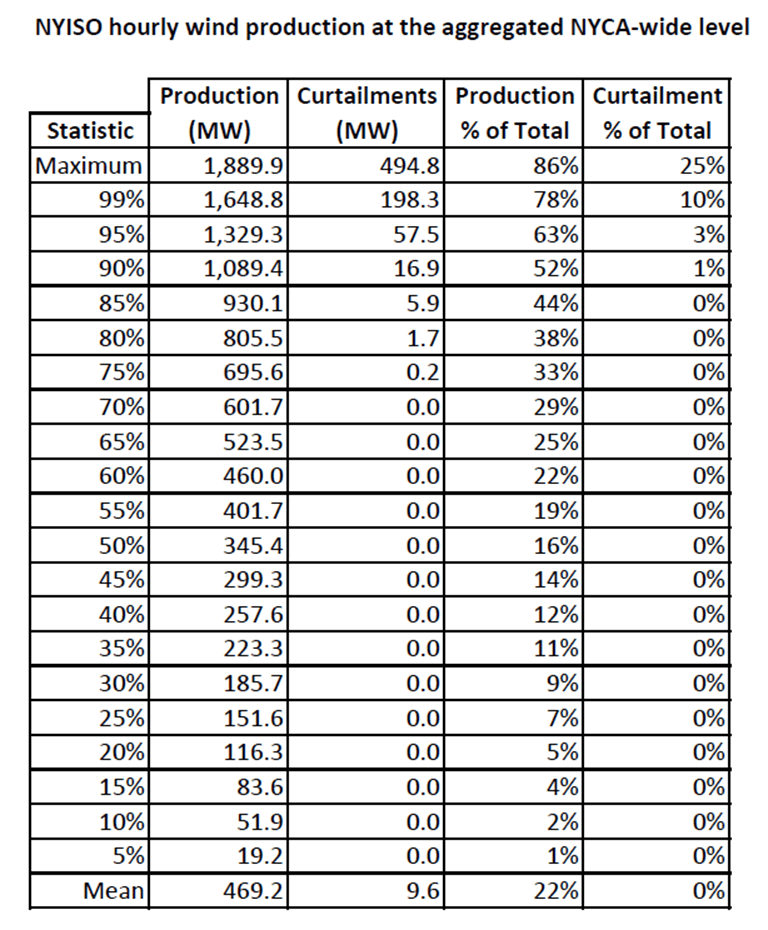

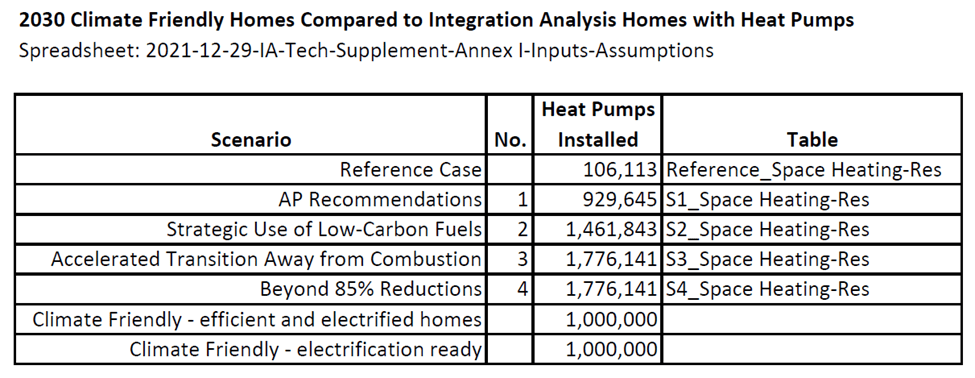

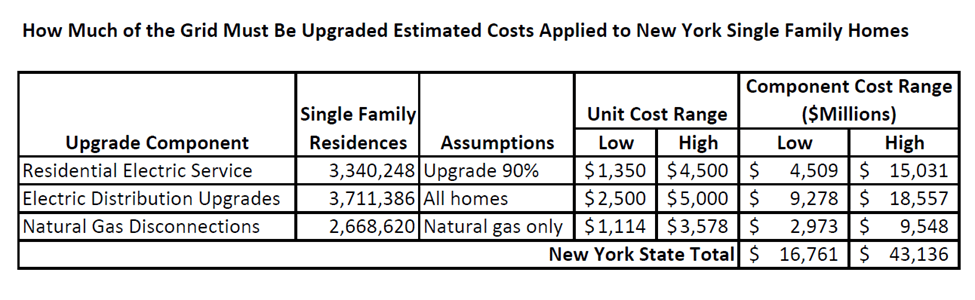


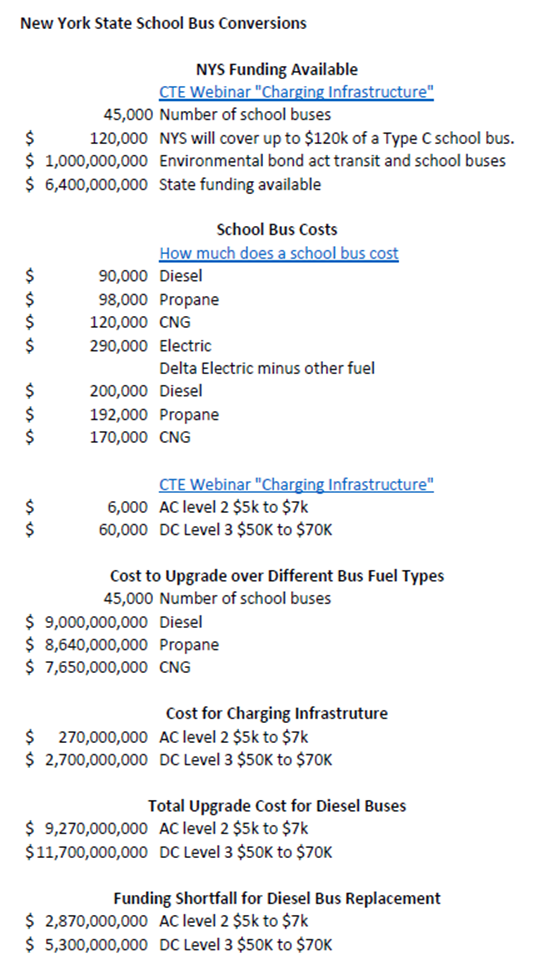
 Pragmatic Environmentalist of New York