
Limits to Green Energy Are Becoming Much Clearer

The Climate Leadership and Community Protection Act (Climate Act) establishes a “Net Zero” target by 2050. The Draft Scoping Plan defines how to “achieve the State’s bold clean energy and climate agenda”.  However, there is increasing evidence that this dream is unrealistic.  This post describes an article by Gail Tverberg at Our Finite World that explains that “It is becoming clear that modelers who encouraged the view that a smooth transition to wind, solar, and hydroelectric is possible have missed some important points”.

I have written extensively on implementation of the Climate Act because I believe the ambitions for a zero-emissions economy outstrip available technology such that it will adversely affect reliability and affordability, risk safety, affect lifestyles, will have worse impacts on the environment than the purported effects of climate change in New York, and cannot measurably affect global warming when implemented.   The opinions expressed in this post do not reflect the position of any of my previous employers or any other company I have been associated with, these comments are mine alone.

Background

The Climate Action Council is responsible for preparing the Scoping Plan that will “achieve the State’s bold clean energy and climate agenda”.  The Climate Act requires the Climate Action Council to “[e]valuate, using the best available economic models, emission estimation techniques and other scientific methods, the total potential costs and potential economic and non-economic benefits of the plan for reducing greenhouse gases, and make such evaluation publicly available” in the Scoping Plan. Starting in the fall of 2020 seven advisory panels developed recommended strategies to meet the targets that were presented to the Climate Action Council in the spring of 2021.  Those recommendations were translated into specific policy options in an integration analysis by the New York State Energy Research and Development Authority (NYSERDA) and its consultants.  The integration analysis was used to develop the Draft Scoping Plan that was released for public comment on December 30, 2021.

The Climate Act authors presumed that implementing the net-zero target was simply a matter of political will.  The Draft Scoping Plan does not incorporate a feasibility analysis to determine if this transition can occur without impacting reliability and affordability.  This post describes an independent analysis of the feasibility of any similar transition.

Gail Tverberg is an actuary interested in finite world issues – oil depletion, natural gas depletion, water shortages, and climate change. She argues that oil limits look very different from what most expect, with high prices leading to recession, and low prices leading to financial problems for oil producers and for oil exporting countries. We are really dealing with a physics problem that affects many parts of the economy at once, including wages and the financial system. She tries to look at the overall problem.  I have found her work to be insightful and compelling.  However, I think she downplays the potential for human ingenuity to resolve energy depletion problems.

Discussion

Tverberg describes six different reasons why she thinks the net-zero transition is not going as advocates claimed that it would.  I summarize her points below but encourage readers to go to her article for a more complete description.  Where appropriate I comment on the applicability to New York’s Climate Act.

Her first point is that variability is a major problem. She explains that the belief was that with the use of enough intermittent renewables or by using long transmission lines it would enable enough transfer of electricity between locations to largely offset variability. However, in the third quarter of 2021, weak winds were a significant contributor to a European power crunch. Europe’s largest wind producers (Britain, Germany and France) produced only 14% of installed capacity during this period, compared with an average of 20% to 26% in previous years. Because no one had planned for this kind of three-month shortfall prices skyrocketed.

Secondly, she states:

Adequate storage for electricity is not feasible in any reasonable timeframe. This means that if cold countries are not to “freeze in the dark” during winter, fossil fuel backup is likely to be needed for many years in the future.

One workaround for electricity variability is storage. A recent Reuters’ article is titled, Weak winds worsened Europe’s power crunch; utilities need better storage. The article quotes Matthew Jones, lead analyst for EU Power, as saying that low or zero-emissions backup-capacity is “still more than a decade away from being available at scale.” Thus, having huge batteries or hydrogen storage at the scale needed for months of storage is not something that can reasonably be created now or in the next several years.

This is of particular concern for New York’s implementation of the Climate Act.  In particular, the fossil fuel phaseout on a date-certain schedule is going to run up against the timing of the “still more than a decade away from being available at scale” outlook.  In my opinion, the outlook she quoted is optimistic for the availability of the technology.  Permitting, acquisition and construction for new technology is almost certain to take longer than proposed by the New York Draft Scoping Plan.

She goes on to point out that capacity for multiple months of electricity storage is needed. “Such storage would require an amazingly large quantity of materials to produce.”  She goes on to point out that: “Needless to say, if such storage were included, the cost of the overall electrical system would be substantially higher than we have been led to believe.”  I have found no indication whatsoever that these costs are adequately addressed in the Draft Scoping Plan.

Her third point is that despite many years of subsidies and mandates, today’s green electricity is only a tiny fraction of what is needed to keep our current economy operating.  Advocates have simply underestimated how difficult it would be to ramp up green electricity.  While New York may be ahead of many jurisdictions in its proportion of renewable energy that is primarily due to the hydro power resources at Niagara Falls and the Saint Lawrence River.  Any addition renewable development is going to be much more difficult to ramp up.

Tverberg s fourth point is renewables comprised a relatively small share of percentage of electricity in 2020.  She explains why this is important:

Wind and solar don’t replace “dispatchable” generation; they provide some temporary electricity supply, but they tend to make the overall electrical system more difficult to operate because of the variability introduced. Renewables are available only part of the time, so other types of electricity suppliers are still needed when supply temporarily isn’t available. In a sense, all they are replacing is part of the fuel required to make electricity. The fixed costs of backup electricity providers are not adequately compensated, nor are the costs of the added complexity introduced into the system.

If analysts give wind and solar full credit for replacing electricity, as BP does, then, on a world basis, wind electricity replaced 6% of total electricity consumed in 2020. Solar electricity replaced 3% of total electricity provided, and hydro replaced 16% of world electricity. On a combined basis, wind and solar provided 9% of world electricity. With hydro included as well, these renewables amounted to 25% of world electricity supply in 2020.

Her final two points paint a very pessimistic view of the future of the world economy.  Both are based on the idea that resource availability will eventually lead to shortages because there is no way the system can ramp up needed production in a huge number of areas at once so supply lines will break. She argues that this means “Recession is likely to set in.”  This is based on the following:

The way in which the economy would run short of investment materials was simulated in the 1972 book, The Limits to Growthby Donella Meadows and others. The book gave the results of a number of simulations regarding how the world economy would behave in the future. Virtually all of the simulations indicated that eventually the economy would reach limits to growth. A major problem was that too large a share of the output of the economy was needed for reinvestment, leaving too little for other uses. In the base model, such limits to growth came about now, in the middle of the first half of the 21st century. The economy would stop growing and gradually start to collapse.

She goes on to argue that there are signs that this is happening now.

I don’t want to debate this worldview so I will just point out that The Limits to Growth states: “If all the policies instituted in 1975 in the previous figure are delayed until the year 2000, the equilibrium state is no longer sustainable. Population and industrial capital reach levels high enough to create food and resource shortages before the year 2000.”  This did not happen and I am uncomfortable accepting this belief completely.  If Chicken Little said “the sky is falling – this time for sure” I don’t think I would have more confidence in the projection. As a result, I am more inclined to support the analysis of Robert Bradley who disagrees with the Limits to Growth outlook.

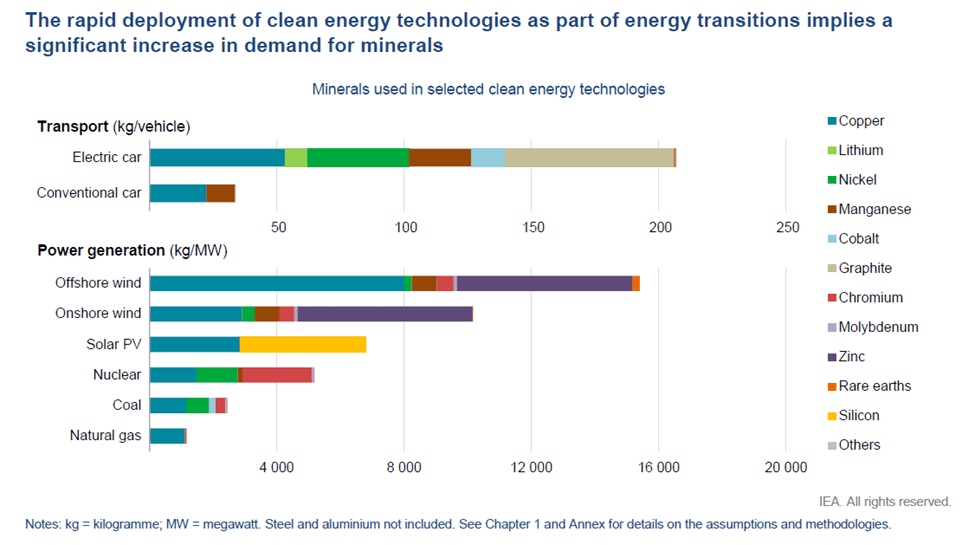
One of the arguments for switching to renewable energy is that fossil fuels will eventually run out and we need to have a sustainable source of energy in place.  However, Tverberg’ s analysis explains that the same resource availability concerns are relevant for the materials needed to produce electricity from wind and solar facilities.  In particular, production of the rare earth elements needed for the magnets and batteries that are critical to wind and solar deployment may be less sustainable than continued development of fossil fuels.  Although these elements aren’t all that rare, they are assigned that descriptor because economically feasible deposits are difficult to come by – when the elements are discovered in high enough concentrations to be mined, they are found together in complex mixtures that require substantial effort to further purify. For instance, to manufacture each electric auto battery 25,000 pounds of brine for the lithium, 30,000 pounds of ore for the cobalt, 5,000 pounds of ore for the nickel, and 25,000 pounds of ore for copper must be processed. All told, you dig up 500,000 pounds of the earth’s crust for just – one – electric vehicle battery.  In my opinion, the combination of few locations where the elements are in high enough concentrations to economically process, the mass of ore needed to extract the elements and the environmental effects of the purification process combine to make their resource availability concern larger than fossil fuel availability.

Conclusion

I think that the points she makes about renewable variability, energy storage, and the lack of substantial progress implementing renewable energy despite many years of subsidies are important.  I don not believe that the Draft Scoping Plan adequately addresses those issues.

Although I disagree with some of the issues raised by Tverberg, I find her conclusion that “Modelers and leaders everywhere have had a basic misunderstanding of how the economy operates and what limits we are up against” compelling. This is especially important in the context that these modelers and leaders want to completely change the current energy system.  She argues that:

The real problem is that diminishing returns leads to huge investment needs in many areas simultaneously. One or two of these investment needs could perhaps be handled, but not all of them, all at once.

Despite the lack of historical evidence that resource availability problems cannot be resolved by human ingenuity, I think it is still appropriate to consider those problems.  In the context of a green energy transition, the question becomes which is the more feasible approach for the huge investments needed for global energy? In my opinion, I think that investments in fossil fuel infrastructure are the better choice because of the rare earth element sustainability issues described here.  That is an ironic conclusion given that one of the reasons that Climate Act proponents want to transition away from fossil fuels is because of their belief that fossil fuels will run out soon.

Climate Act Scoping Plan Cost Documentation Failures

The Climate Leadership and Community Protection Act (Climate Act) establishes a “Net Zero” target by 2050 and the Draft Scoping Plan defines how to “achieve the State’s bold clean energy and climate agenda”.   It is the right of every New Yorker to know how the agenda will affect affordability and reliability.  This post documents my fruitless search for the cost number documentation that would enable me or anyone else to evaluate their cost claims.

I have written extensively on implementation of the Climate Act because I believe the ambitions for a zero-emissions economy outstrip available technology such that it will adversely affect reliability and affordability, risk safety, affect lifestyles, will have worse impacts on the environment than the purported effects of climate change in New York, and cannot measurably affect global warming when implemented.   The opinions expressed in this post do not reflect the position of any of my previous employers or any other company I have been associated with, these comments are mine alone.

Background

The Climate Action Council is responsible for preparing the Scoping Plan that will “achieve the State’s bold clean energy and climate agenda”.  The Climate Act requires the Climate Action Council to “[e]valuate, using the best available economic models, emission estimation techniques and other scientific methods, the total potential costs and potential economic and non-economic benefits of the plan for reducing greenhouse gases, and make such evaluation publicly available” in the Scoping Plan. Starting in the fall of 2020 seven advisory panels developed recommended strategies to meet the targets that were presented to the Climate Action Council in the spring of 2021.  Those recommendations were translated into specific policy options in an integration analysis by the New York State Energy Research and Development Authority (NYSERDA) and its consultants.  The integration analysis was used to develop the Draft Scoping Plan that was released for public comment on December 30, 2021. This draft includes results from the integration analysis on the benefits and costs to achieve the Climate Act goals. The public comment period extends through at least the end of April 2022, and will also include a minimum of six public hearings. The Council will consider the feedback received as it continues to “discuss and deliberate on the topics in the Draft” as it works towards a final Scoping Plan for release by January 1, 2023.

The Climate Action Council claims that the integration analysis was developed to estimate the economy-wide benefits, costs, and GHG emissions reductions associated with pathways that achieve the Climate Act greenhouse gas emission limits and carbon neutrality goal. It incorporates and builds from Advisory Panel and Working Group recommendations, as well as inputs and insights from complementary analyses, to model and assess multiple mitigation scenarios. In addition, there is historical/archived information is available through the Support Studies section of the Climate Resources webpage, and can found as part of the Pathways to Deep Decarbonization in New York State – Final Report.

During the development of the Draft Scoping Plan, consumer affordability was a major Climate Action Council feedback topic of discussion.  The Draft Scoping Plan provides societal net direct costs but does not provide any consumer costs.  The leader of the Integration Analysis effort at NYSERDA is Carl Mas.  At 17:45 of the Climate Action Council meeting recording where this issue was debated, he explained that they were able to analyze for the technologies and the system changes in the scenarios to determine incremental cost to society. 

In order to determine the actual costs to society you need to have specificity to distribute those costs.  Is it going to be a ratepayer program?  It is going to be a tax credit or incentive?  How much is the Federal government going to weigh in to help buy down some of the cost.  Without those types of programmatic specifics, we can’t actually analyze how much individual parts of our society should pay. 

He went on to claim that: “It is really important to have articulated what the incremental costs would be and what the benefit cost analysis is, which is that we’ve done.”  He concluded at 18:37 that:

I hope people don’t walk away thinking that waiting for implementation means that somehow there is kind of a done deal at that point.  I mean, at that point is when we see the specific policy proposals that flow from a scoping plan.  That’s when we can continue to debate and discuss how we implement these proposals.

Draft Scoping Plan Documentation

The purpose of this post is to document what information was provided for stakeholder assessment of costs.  Starting on page 80 the Draft Scoping Plan section 10.3 Key Benefit-Cost Assessment Findings describes costs.  However, the technical documentation is in Appendix G: Integration Analysis Technical Supplement and two spreadsheets:

The following section lists all references to “direct costs” in the Appendix G text with some clarifying additions and my indented and italicized comments.

Page 61:  Estimated system expenditures do not reflect direct costs in some sectors that are represented with incremental costs only. These include investments in industry, agriculture, waste, forestry, and non-road transportation.

No comment

Pages 64-68: Integration Analysis Costs

This whole section is included because it is the primary documentation source.

The integration analysis includes calculations for three different cost metrics: Net Present Value (NPV) of net direct costs, annual net direct costs, and system expenditure.

  • NPV of Net Direct Costs: NPV of levelized costs in each scenario incremental to the Reference Case from 2020-2050. All NPV calculations assume a discount rate of 3.6%. This metric includes incremental direct capital investment, operating expenses, and fuel expenditures.
  • Annual Net Direct Costs: Net direct costs are levelized costs in a given scenario incremental to the Reference Case for a single year snapshot. This metric includes incremental direct capital investment, operating expenses, and fuel expenditures.
  • System Expenditure: System expenditure is an estimate of absolute direct costs (not relative to Reference Case). Estimates of system expenditure do not reflect direct costs in some sectors that are represented with incremental costs only. These include investments in industry, agriculture, waste, forestry, and non-road transportation.

I don’t have the appropriate background, so cannot speak to the calculation choices for these different cost metrics.  However, I have been unable to find any numerical documentation (e.g., spreadsheets) that support the estimated cost metric expenditures.

Cost categories included in the metrics listed above are shown in Table 4.


The spreadsheet Annex G: Inputs and Assumptions lists some of these costs and some of the assumptions made for these categories.

The NPV of net direct costs in Scenarios 2, 3, and 4 are in the same range given uncertainty and are primarily driven by investments in buildings and the electricity system (Figure 47). All scenarios show avoided fossil fuel expenditures due to efficiency and fuel-switching relative to the Reference Case (shown in the chart as negative costs). Scenario 2: Strategic Use of Low-Carbon Fuels includes significant investment in renewable diesel, renewable jet kerosene, and renewable natural gas. Scenario 3: Accelerated Transition Away from Combustion meets emissions limits with greater levels of electrification, which results in greater investments in building retrofits, zero-emission vehicles, and the electricity system. Scenario 4: Beyond 85% Reductions includes additional investment in transportation (rail, aviation, VMT reductions) and methane mitigation, and mitigates the need to invest in any negative emissions technologies. Scenario costs are sensitive to the price of fossil fuels and technology cost projections, as reflected in error bars.

In order to provide meaningful comments on these estimates much more information is needed.  At an absolute minimum there should be a table that lists the values of the components of the Figure 47 bar charts.  The Appendix G spreadsheet annexes document many of the figures in the Scoping Plan but none of the figures with direct costs are documented. 

When viewed in from a systems expenditure perspective (Figure 48), the NPV of net direct costs for Scenarios 2, 3, and 4 are moderate, ranging from 11-12% as a share of the NPV of reference case system expenditures ($2.7 trillion). Because significant infrastructure investment will be needed to maintain business as usual infrastructure within the state irrespective of further climate policy, redirecting investment away from status quo energy expenditures and toward decarbonization is key to realizing the aims of the Climate Act.

Not only are the Draft Scoping Plan Integration Analysis cost calculations undocumented but there is mis-leading reporting as in this paragraph.  These numbers represent the total costs of all their mitigation actions minus all the costs of a reference case.  The statement “redirecting investment away from status quo energy expenditures and toward decarbonization is key to realizing the aims of the Climate Act” overlooks their estimate that status quo expenditures are already $2.7 trillion.  There is no discussion whether that $2.7 trillion only represents current consumer costs or includes additional infrastructure spending.  I expect that investments above and beyond what consumers are already are paying are needed so the actual consumer costs are being understated by this way of presenting the societal costs.

Annual net direct costs show the timing of key investments required to meet Climate Act emissions limits. Scenario 2 includes significant investment in renewable diesel, renewable jet kerosene, and renewable natural gas starting in the mid-2020s. Scenario 3 includes greater levels of electrification compared to Scenario 2, which results in greater investments in building retrofits, zero-emission vehicles, and the electricity system. Scenario 4 layers on even further investments in transportation and non-energy mitigation than Scenario 3 and includes a targeted investment in low-carbon renewable fuels, although not as intensive as that in Scenario 2. Both Scenarios 2 and 3 include investment in negative emissions technologies (NETs) to achieve net zero emissions by 2050, while Scenario 4 does not require any NETs to meet carbon neutrality by 2050. In 2030, annual net direct costs are on the order of $15 billion per year, approximately 0.6% of GSP; in 2050, costs increase to $45 billion per year, or roughly 1.4% of GSP.

This represents the description of the cost differences between the three scenarios.  In order to provide full documentation, all the numbers associated with the assumptions used to derive the numbers have to be presented and they don’t even list the component numbers of the bar charts.  For example, consider NETs.  Obviously, the final cost needs to be presented but we also need to know the costs per type of negative technology, the control efficiency expected, the number of these magical technology systems that do not exist at commercial scale that will be needed, and the assumed location assume for them because all those factors affect cost.  I could find no reference to these technologies in the Appendix G appendices.  Moreover, I have been unable to find the necessary documentation for any of the technologies proposed for the mitigation scenarios at a level where it is possible to provide meaningful comments.

Net direct costs are measured relative to the Reference Case, but system expenditures are evaluated on an absolute basis. System expenditures increase over time as New York invests in infrastructure and clean fuels to meet Climate Act emissions limits. As a share of overall system expenditures, costs are moderate: 9-11% in 2030 and 25-26% in 2050 relative to current estimated expenditure levels.

This figure also demonstrates the need for more information for meaningful comments.  If the current system expenditures were documented then we could understand what is incorporated in their numbers.  It would also be possible to verify their approach by comparing their estimates to other sources of data.  It might also be possible to figure out whether their reference estimated expenditure costs represent increases to current levels? 

Page 70: Benefit-Cost Findings

  • Net direct costs are small relative to the size of New York’s economy. Net direct costs are estimated to be 0.6-0.7% of GSP in 2030, and 1.4% in 2050.

No comment

Page 70: 3.5 Uncertainty and Sensitivity Analysis

There also are references to “direct cost” associated with the following figures in this section:

  • Figure 52. NPV of Net Benefit of Mitigation Scenarios (2020-2050): Range Including Uncertainty in Fuel Cost, Technology Cost
  • Figure 53. NPV of Scenario Net Direct Costs: Fuel cost sensitivity for Scenarios 2 through 4 For biofuels
  • Figure 54. NPV of Scenario Net Direct Costs: Biofuel cost sensitivity for Scenarios 2 through 4
  • Figure 55. NPV of Scenario Net Direct Costs: Technology cost sensitivity

This represents the Integration Analysis information that is supposed to address the concerns I raised here.  Clearly without complete documentation it is impossible to agree or disagree that these cost sensitivities are complete or accurate.

Integration Analysis Documentation

The Integration Analysis technical documentation is in Appendix G: Integration Analysis Technical Supplement and two spreadsheets:

This section describes the cost information provided in these spreadsheets.

As noted previously, neither spreadsheet documents the numbers presented in Figures 45-55 in Appendix G: Integration Analysis Technical Supplement.  In addition, there is insufficient information to determine how the numbers were calculated.  Some of the assumed technology costs are included but there are gaps in either information or methodology that prevent replication of the values presented.  Consequently, it is impossible to provide substantive comments on the costs claimed.

Conclusion

The Climate Act requires the Climate Action Council to “[e]valuate, using the best available economic models, emission estimation techniques and other scientific methods, the total potential costs and potential economic and non-economic benefits of the plan for reducing greenhouse gases, and make such evaluation publicly available” in the Scoping Plan (my emphasis added).  The fact that the only description of the net direct cost is a bar chart without a breakdown of the cost components clearly demonstrates that this Climate Act requirement has been ignored in the Draft Scoping Plan.

If it were not so important for the future of New York State it would be tempting to laugh at the coverup of the numbers.  Unfortunately based on everything I have seen the coverup is deliberate because the projected costs are extremely high.  This is an inevitable result as shown in the United Kingdom where “the press seems to have finally woken up to the huge damage already being wreaked on the country, all as a result of successive governments’ climate policies”.  It is almost as if the authors of the Draft Scoping Plan are hoping to get the plan approved before the public catches on.

In the absence of sufficient publicly available information to evaluate the cost projections, New Yorkers are expected to trust these numbers.  I was able to evaluate the Draft Scoping Plan benefit numbers to verify whether trust is warranted.  The Draft Scoping Plan claims that “The cost of inaction exceeds the cost of action by more than $90 billion.”  I have shown that the Integration Analysis incorrectly calculates avoided GHG emissions benefits by applying the value of an emission reduction multiple times.  If only that error is corrected the total benefits range from negative $74.5 to negative $49.5 billion instead of net benefits ranging from $90 billion to $120 billion.  I conclude that New Yorkers should not trust the cost values in the Draft Scoping Plan and that comments demanding adequate documentation be provided are appropriate.

Scoping Plan Reliability Feasibility – Renewable Variability Costs

Note: the last paragraph in the conclusions was updated on 2/9/2022

The Climate Leadership and Community Protection Act (Climate Act) establishes a “Net Zero” target by 2050 and the Draft Scoping Plan defines how to “achieve the State’s bold clean energy and climate agenda”.   However, there hasn’t been a feasibility plan that fully addresses the cost and technology necessary to provide reliable energy in the future all-electric net-zero New York energy system.  This is the fourth post in a series of posts describing the problem and the Scoping Plan’s failure to provide a proposal that adequately addresses the problem.  This post shows why extremely high prices are a feature and not a bug for any electric system that relies on intermittent wind and solar generation for the majority of its power.

I have written extensively on implementation of the Climate Act because I believe the ambitions for a zero-emissions economy outstrip available technology such that it will adversely affect reliability and affordability, risk safety, affect lifestyles, will have worse impacts on the environment than the purported effects of climate change in New York, and cannot measurably affect global warming when implemented.   The opinions expressed in this post do not reflect the position of any of my previous employers or any other company I have been associated with, these comments are mine alone.

Background

The Climate Action Council is responsible for preparing the Scoping Plan that will “achieve the State’s bold clean energy and climate agenda”.  The Climate Act requires the Climate Action Council to “[e]valuate, using the best available economic models, emission estimation techniques and other scientific methods, the total potential costs and potential economic and non-economic benefits of the plan for reducing greenhouse gases, and make such evaluation publicly available” in the Scoping Plan. Starting in the fall of 2020 seven advisory panels developed recommended strategies to meet the targets that were presented to the Climate Action Council in the spring of 2021.  Those recommendations were translated into specific policy options in an integration analysis by the New York State Energy Research and Development Authority (NYSERDA) and its consultants.  The integration analysis was used to develop the Draft Scoping Plan that was released for public comment on December 30, 2021. This draft includes results from the integration analysis on the benefits and costs to achieve the Climate Act goals. The public comment period extends through at least the end of April 2022, and will also include a minimum of six public hearings. The Council will consider the feedback received as it continues to discuss and deliberate on the topics in the Draft as it works towards a final Scoping Plan for release by January 1, 2023.

The Climate Action Council claims that the integration analysis was developed to estimate the economy-wide benefits, costs, and GHG emissions reductions associated with pathways that achieve the Climate Act greenhouse gas emission limits and carbon neutrality goal. It incorporates and builds from Advisory Panel and Working Group recommendations, as well as inputs and insights from complementary analyses, to model and assess multiple mitigation scenarios. In addition, there is historical/archived information is available through the Support Studies section of the Climate Resources webpage, and can found as part of the Pathways to Deep Decarbonization in New York State – Final Report.

This is one of a series of posts describing the reliability problem and the Scoping Plan’s failure to provide a plan that adequately addresses the problem.  In the first post I described how the Texas blackouts of February 2021 are the inevitable outcome if the Scoping Plan does not address renewable variability correctly.  The second post explained why renewable variability requires massive amounts of over-building to replace existing firm capacity.  The New York Independent System Operator’s Comprehensive Reliability Plan documents reliability issues that one of the state’s organizations responsible for reliability is worried about relative to the transition to an emissions-free generating system.  This post shows why extremely high prices are an inevitable feature and not a bug for any electric system that relies on intermittent wind and solar generation for the majority of its power.

Renewable Variability and High Electricity Prices

A recent article at Timera Energy, Wind intermittency driving requirement for UK flexibility, includes the following figure.   The graph plots the daily wind generation in the United Kingdom and the electricity market day ahead (DA) price.  According to the article:

The UK requires significant wind capacity growth in order to reach challenging 2030 & 2035 decarbonisation targets. This renewable rollout comes with challenges however, with the grid already required to cope with periods of wind generation above 14 GW, and below 1 GW. Low wind events (which are often synchronised across NW Europe) have been driving prices upwards in an already high price environment, with only 3 GW of average wind generation coinciding with a National Grid electricity capacity market notice called on 24th Jan (the shaded grey area on the chart) and a £110/MWh day on day increase in DA prices.

The graph highlights why intermittent wind and solar will always lead to high prices.  First point is that there is tremendous variation in the wind energy resource.  Adding significant solar to the mix changes things a bit but the point is that there will always be times when renewable energy resources are very low.  When those resources are low, the price of electricity goes up a lot because the replacement resources are so expensive.  Importantly, also note that when the renewable resources are high, the price of electricity goes down a lot.  The remainder of this article will consider each of these issues in more detail.

Renewable Variability

As a meteorologist I am particularly concerned about the variability of wind and solar resources.  My over-riding concern is the need to develop a robust estimate of the minimum amount available.  If we don’t know that, then it is impossible to develop adequate resources that can provide electricity when it is needed most.  Unfortunately, it turns out that the highest loads (very cold and very hot weather) correlate very well to the lowest wind energy resources. 

I plan to eventually write an article about this issue in the context of New York.  For this post I will describe the issue by referring to a recent article:  Storage requirements in a 100% renewable electricity system: Extreme events and inter-annual variability reference that uses a German example.  The authors found that this issue is getting increased academic and political attention. Their analysis “explores how such scarcity periods relate to energy storage requirements”. The authors hypothesized a German 100% renewable electricity system and estimated how large the wind, solar, and energy storage components would have to be to provide reliable electricity at all times.  Their analysis used 35 years of hourly time series data. Interestingly, “While our time series analysis supports previous findings that periods with persistently scarce supply last no longer than two weeks, we find that the maximum energy deficit occurs over a much longer period of nine weeks”. This occurred because they found that multiple scarce periods can closely follow each other. This means that the energy storage systems have problems re-charging between energy deficit periods.  They conclude that focusing on short-duration extreme events or single years can lead to an underestimation of storage requirements and costs of a 100 % renewable system.

Low Renewable Resource Availability Impacts

The ultimate problem with low renewable resource periods is that backup resources are needed to maintain reliability.  The German example highlights a couple of points: an extensive time period is needed to find the worst case and the worst case is rare.  In my opinion, the Integration Analysis that supports the Draft Scoping Plan document did not evaluate a long enough time period to determine the worst case and I am sure that it did not address the re-charging problem identified in the German example.  In the current New York State electric system there are generating units that only operate to provide power during the several times a year when the load peaks.  In the future this kind of resource will be needed not only for peak load periods but also low renewable resource availability periods.

In an emissions-free electric system there are two possible solutions.  Most straight-forward is to use energy storage during low wind and solar resources periods because the storage could be built in New York such that it is integrated into the existing network.  Renewable advocates often argue that if there was a more extensive transmission system that power from locations where the wind and solar resources aren’t low could be used.

I believe that energy storage is the more likely solution for New York.  New York has unique reliability constraints because New York City and Long Island are essentially a load pocket.  Experience based on historical blackouts has led to the nation’s strictest set of reliability standards designed to promote reliability for New York consumers, including specific reliability rules for the New York City metropolitan area.  I believe that those rules will ultimately mean that energy storage resources will have to be used.

Unfortunately, there are issues with energy storage.  In the first place, long-duration energy storage batteries that would be a solution for wind and solar deficits are not commercially available. It is difficult to size currently available batteries properly and they are expensive.  One alternative is to overbuild wind and solar resources using the rationale that if the resources only can produce half as much expected then build twice as much to avoid energy storage costs.  However, as the German example shows the worst case is essentially no wind and solar so over-building is not a complete solution.  This is the first inevitable reason that an electric system dependent upon renewable resources is going to be expensive.

The advocates who claim that the wind is always blowing someplace overlook the logistics of such a solution.  The worst-case meteorological situation is a large high-pressure system that causes light winds over large areas.  Weather patterns are governed by atmospheric longwaves (Rossby waves) that affect the jet stream and pressure systems.  The point for this discussion is that “The length of longwaves vary from around 3,700 mi (6,000 km) to 5,000 mi (8,000 km) or more”.  In the worst case it is possible that a high-pressure system could cover a significant fraction of the longwave.  In other words, to get energy from where the wind is blowing for a wind lull on the East Coast you would have to go to the Rocky Mountains.  Imagine all the wind turbines and transmission lines needed to provide all the power needed for the eastern seaboard and all points in between for the worst case.  Worse, understand that these resources have to be there but won’t be used except for the, for example, one in ten-year wind lull.  A US graph similar to the UK graph example above would show prices much, much higher.

High Renewable Resource Availability Impacts

There is another aspect of over-building as a solution.  Current electric pricing schemes pay generators for their cost to operate.  Fuel costs are a main driver of their fees and wind has no fuel cost.  Consequently, wind generators can offer their power generated at little to no cost.  The UK graph shows that effect when the prices are low during periods of high wind generation availability.

This affects overall costs in multiple ways.  Because wind and solar displace dispatchable generation sources like nuclear and hydro, it affects their cost recovery.  Those resources are needed for reliability so subsidies are needed to keep them solvent. Those subsidies increase overall costs.

Donn Dears explained that there are other hidden costs.  For example, the latest natural gas combined cycle (NGCC) power plants can have efficiencies as high as 63%, but with wind and solar on the grid these plants would have to operate in following mode where they respond to wind and solar output ups and downs and adjust output to match intermittent variability.  This decreases their efficiency.  At some point this inefficiency will lead to higher consumer costs.

Conclusion

In my opinion, the biggest electricity planning problem is ensuring that resources are available for the worst case.  In the past this planning has focused on the annual peak load.  Decades of experience has led to a resilient system based on dispatchable resources that can meet load during these periods in New York but the experience in Texas in February 2021 indicates that problems can still arise. 

In the future, this planning will become more difficult because many of the generating resources are not dispatchable.  The Draft Scoping Plan does not adequately address the feasibility of meeting this challenge. The New York Independent System Operator 2021-2030 Comprehensive Reliability Plan notes: “While there are hundreds of projects in the NYISO interconnection queue, there are none that would be capable of providing dispatchable emission-free resources that could perform on a multi-day period to maintain bulk power system reliability. Such resources are not yet widely commercially available.”  This concern is basically ignored.

The United Kingdom graph of electricity prices and wind generation output illustrates the inevitable problem with renewable resource prices.  There are further examples that costs are increasing markedly there (here and here) and no sign that the Climate Action Council is aware of the problem.

I conclude that maintaining current reliability standards with an electric system that relies heavily on renewable energy sources must increase prices significantly.  This is because providing power during peak loads relies on a small set of resources that are rarely used.  In the current system when new resources are needed for this application combustion turbines were used because they are the cheapest dispatchable generating technology.  In any future zero-emissions system, the required resources will probably be energy storage which is much more expensive and has not been deployed for this application at scale.  Proponents that claim that because the wind is always blowing somewhere that all we need to do is develop more transmission underestimate the scale of the resources needed or the distances to locations where the wind is “always” blowing.  As a result, this “solution” would be even more expensive..

New York Climate Act: Is Anyone Listening to the Experts?

This article was published at Watts Up with That on February 6, 2022: New York Climate Act: Is Anyone Listening to the Experts? 

A couple of recent posts here have highlighted the difficulties of a transition to an electric grid powered primarily by wind and solar using New York’s Climate Leadership and Community Protection Act (Climate Act) as an example.  This post describes the New York Independent System Operator’s latest relevant report on this topic.  The difficulties raised are so large that the question becomes is any leader in New York listening to this expert opinion.

Background

The Climate Act was passed in 2019 and became effective on 1/1/2020. The Climate Action Council has been working since then to develop plans to implement the Act.  Over the summer of 2021 the New York State Energy Research & Development Authority (NYSERDA) and its consultant Energy + Environmental Economics (E3) prepared an Integration Analysis to “estimate the economy-wide benefits, costs, and GHG emissions reductions associated with pathways that achieve the Climate Act GHG emission limits and carbon neutrality goal”.  Three Integration Analysis implementation strategies were incorporated into the Draft Scoping Plan when it was released at the end of 2021.  The focus of the recent posts has been the Climate Act target for a carbon free electric generating system by 2040.

The two recent posts showed that the benefits are over-stated and the costs under-estimated in the Draft Scoping Plan.  My last post here explained that there is a new Draft Scoping Plan Overview available and showed that their claim that the “cost of inaction exceeds the cost of action by more than $90 billion is bogus.  More recently the Manhattan Contrarian post More Focus on The Impossible Costs of a Fully Wind/Solar/Battery Energy System looked at the feasibility and costs of such a system using just solar resources as an example.  The costs projected are far in excess of the Draft Scoping Plan estimates.

At the same time that the State has been developing its implementation plans for the Climate Act, the New York Independent System Operator (NYISO) has augmented their regular reliability planning process with supplementary analyses addressing the Climate Act challenge.  The 2021-2030 Comprehensive Reliability Plan (CRP) report (appendices) released late year includes an excellent overview chapter “Beyond the Comprehensive Reliability Plan – Road to 2040” on this topic that is the focus of this post.

NYISO Reliability Planning

Appendix G of the CRP report describes the NYISO reliability planning process.  The reliability planning component of the process consists of two analyses: the Reliability Needs Assessment (RNA) and Comprehensive Reliability Plan (CRP). The RNA evaluates the adequacy and security of the bulk power transmission facilities over a ten-year planning period, the resources in megawatts (MW), and the locations where required to meet projected needs.  If necessary, the NYISO will request solutions for identified needs.  The CRP determines if the proposed solutions are viable and sufficient then documents the solutions meet the identified reliability needs. 

The CRP report itself provides an exhaustive description of all the reliability planning aspects considered in the existing process.  The report describes reliability risk factors: “The Reliability Planning Process findings reflect the base case assumptions, which were set in accordance with applicable reliability rules and procedures. There are, however, numerous risk factors that could adversely affect the implementation of the plan and hence system reliability over the planning horizon. These risk factors may arise for several reasons including climate, economic, regulatory, and policy drivers.” 

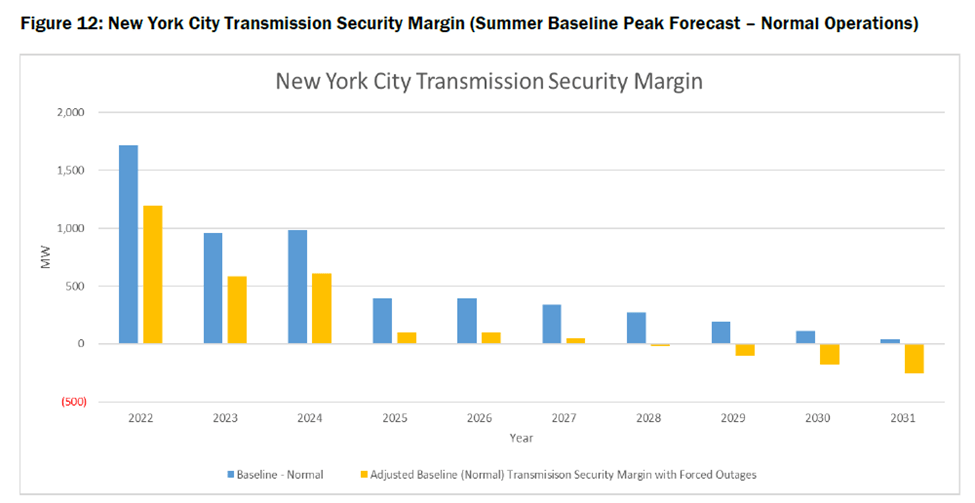
The report highlights some of the risk factors and provides the first instance where it is not clear whether New York State is listening to these experts.  The CRP states “A growing amount of New York’s gas-turbine and fossil fuel-fired steam-turbine capacity is reaching an age at which, nationally, a vast majority of similar capacity has been deactivated and then concludes that “While transmission security within New York City (Zone J) is maintained through the ten-year period in accordance with design criteria, the margin would be very tight starting in 2025 and would be deficient beginning in 2028 if forced outages are experienced at the historical rate”.  At the same time the New York State Department of Environmental Conservation (DEC) has rejected permits for new replacement generating facilities that addresses this risk factor.  For example, the Danskhammer Energy Center proposed a replacement gas-fired combustion turbine but DEC denied the permit  “The proposed project would be inconsistent with or would interfere with the statewide greenhouse gas emissions limits established in the Climate Act.”

Draft Scoping Plan

The Scoping Plan is supposed to provide the Climate Action Council with the information necessary to make decisions.  The CRP describes several critical issues that must be addressed if the Climate Act transition to emissions-free generation is to succeed without creating a reliability crisis.  The first is how to handle renewable resource intermittency.  The second is whether battery storage devices will work as needed.  It also raises issues with asynchronous wind and solar power and concludes with a discussion of the zero-emissions dispatchable resource needed to keep the system working. These are described in more detail in the addendum to this post.  For the most part the Draft Scoping Plan ignores or glosses over all these issues.

The CRP defines renewable resource intermittency well.  It notes that “the variability of meteorological conditions that govern the output from wind and solar resources presents a fundamental challenge to relying on those resources to meet electricity demand. Solar resources will have little to no output during the evening and nighttime hours and reduced output due to cloud cover, while wind resources can experience significant and sustained wind lulls.”  Additionally, it notes that “With high penetration of renewable intermittent resources, the system will need dispatchable, long-duration resources to balance intermittent supply with demand especially during extended periods where the intermittent resources are not available. These types of resources will need to be significant in capacity and have attributes such as the ability to come on-line quickly, stay on-line for as long as needed, maintain the system’s balance and stability, and adapt to meet rapid, steep ramping needs.”  I don’t think the Draft Scoping Plan does an acceptable job describing the magnitude of this problem.

There is a section devoted to storage resources. It explains that seasonal power capability is the main consideration when evaluating most generation resources for their ability to serve load and provide for reliability. It goes on to explain that with energy storage resources, there are two other critical aspects that need to be considered. The first is the duration needed from the storage device and the second involves charging the storage device. Energy storage has been touted as the preferred alternative to peaking power plants but the CRP notes that “Since the ‘fuel’ for storage is electricity from local resources and the grid, the surplus energy in the ‘load pocket’ where storage is located needs to be more than the energy that is needed from the storage device including losses.”  Furthermore, the CRP highlights the point that “battery storage resources help to fill in voids created by reduced output from renewable resources, but periods of reduced renewable generation rapidly deplete battery storage resource capabilities resulting in the need for longer running dispatchable emission-free resources”.   Lastly, the CRP notes that Pathways to Carbon-Neutral NYC found “a stringent regulatory and siting regime for storage in New York City, including site-based limitations and fire codes regarding siting of battery storage”.  I don’t think any of the people touting battery storage as a solution to intermittency understand the implications of these statements.  For its part the Draft Scoping Plan ignores all the issues associated with energy storage.

The CRP section on Inverter Resources covers an aspect of the renewable transition that is very rarely considered.  In short, existing generation is synchronized with the electric grid but wind and solar provide asynchronous power.  This difference must be considered in order to maintain a reliable system.  The Eastern Interconnection Planning Collaborative (EIPC) recently described a decline in grid performance when inverter-based resources displace conventional synchronous machines. The degradation in performance is due to a number of factors, including the loss of, or change in, location of reactive power resources, the lack of transmission facilities to transmit the energy to load, and/or the reduction in primary frequency response due to the loss of system inertia from the retirement of legacy synchronous generation. The Draft Scoping Plan does not address the implication of the following statement; “The ability of inverter-based resources to function properly often depends on the strength of the grid at or near the interconnection of the resources”.   That means that if inverter-based resources are connected to a “weak” portion of the grid they “may be subject to instability, adverse control interactions, and other issues”.  I think that it would be appropriate for the Draft Scoping Plan to discuss a situation where limitations of the transmission grid could cause wind and solar generation to not provide power to the grid but it does not.

The final relevant section of the CRP discusses the need for dispatchable, emissions-free resources.  The CRP notes that the amount of dispatchable emission-free resources needed in their scenarios is over 32,000 MW in 2040, approximately 6,000 MW more than the total fossil-fueled generation fleet on the grid in 2021.  The CRP states that providing this resource will “require an unprecedented level of investment in newand replacement infrastructure, and/or the emergence of a zero-carbon fuel source for thermal generating resources”.  Furthermore, the CRP notes that the one-hour ramp requirements could be over 10,000 MW and a six-hour ramp of over 25,000 MW.  Finally, they conclude that “While there are hundreds of projects in the NYISO interconnection queue, there are none that would be capable of providing dispatchable emission-free resources that could perform on a multi-day period to maintain bulk power system reliability. Such resources are not yet widely commercially available.”  The Draft Scoping Plan response to this is claim that this resource could use green hydrogen as a place holder.  Aside from the fact that it is not commercially available, the Scoping Plan does not address whether it can meet the technical criteria specified in the CRP.

Conclusion

There were many good comments to the post More Focus on The Impossible Costs of a Fully Wind/Solar/Battery Energy System replying to some comments that suggested the transition to zero emissions electricity is easily achievable.  Subsequently I found the NYISO Comprehensive Reliability Plan document.  It supports those who argued that such a transition will be difficult and included some additional arguments that I thought would be of interest to readers here.  I encourage interested readers to download that document.

Ultimately, the question in this post is whether any of these concerns are being considered by the Hochul Administration and New York’s Climate Action Council. These political appointees are supposed to be guided by the Scoping Plan but based on my evaluation to date of the Draft Scoping Plan most of the key issues are over-looked. I showed a specific example where current DEC policy and actions directly contradict the concerns expressed in the CRP.  I can only conclude that no one in power is listening to the reliability experts in New York.  I cannot imagine how this can possibly end well.

—————————————————–

Roger Caiazza blogs on New York energy and environmental issues at Pragmatic Environmentalist of New York.  More details on the Climate Leadership & Community Protection Act are available here. This represents his opinion and not the opinion of any of his previous employers or any other company with which he has been associated.

————————————————–

Addendum: Highlights from NYISO Climate Act Planning Analyses

The biggest risk to future electric system reliability is the Climate Act.  In order to respond, NYISO commissioned a couple of studies.  The 2019 Climate Change Study – Phase I examined the impacts that climate change will have on temperature and the resultant impact on load as well as expected changes due to new policies.  The most recent winter peak load was 22,542 MW and summer load was 31,723 MW.  The study projects that load will increase in the winter to over 56,000 MW and in the summer to over 47,000 MW when the Climate Act is implemented.  In 2020, the NYISO commissioned phase II of the Climate Change Study (“Climate Change Impact and Resilience Study”) that examined the resources needed to meet load in a 2040 scenario.  That report concluded: “that the variability of meteorological conditions that govern the output from wind and solar resources presents a fundamental challenge to relying on those resources to meet electricity demand. Solar resources will have little to no output during the evening and nighttime hours and reduced output due to cloud cover, while wind resources can experience significant and sustained wind lulls.” 

The CRP did additional work looking at the wind lull problem during development. These analyses considered an arbitrary wind lull of week-long loss of wind energy of either projected NY on-shore or off-shore wind energy.  Not surprisingly, they found that this type of event could exceed the loss of load expectation reliability criterion.  The CRP concludes:

With high penetration of renewable intermittent resources, the system will need dispatchable, long-duration resources to balance intermittent supply with demand especially during extended periods where the intermittent resources are not available. These types of resources will need to be significant in capacity and have attributes such as the ability to come on-line quickly, stay on-line for as long as needed, maintain the system’s balance and stability, and adapt to meet rapid, steep ramping needs.

NYISO Executive Summary Road to 2040 – Storage Resources (Verbatim)

Solar and wind resources are dependent on variable meteorological conditions, and thus their generating output does not always coincide with demand. Energy storage allows for time shifting of generation to meet the timing of demand. Storage resources charge during times of surplus and then discharge at other times when the power is needed.

The seasonal power capability of suppliers would typically be the main consideration when evaluating most generation resources for their ability to serve load and provide for reliability. With energy storage resources, there are two other critical aspects that need to be considered. The first is the duration needed from the storage device. Load duration curves can provide the context for how long a storage device may be needed for reliability. The duration of need can be a significant amount of time during a given day. The second critical aspect involves charging the storage device. Since the “fuel” for storage is electricity from local resources and the grid, the surplus energy in the “load pocket” where storage is located needs to be more than the energy that is needed from the storage device including losses. The NYISO Climate Change Study noted that battery storage resources help to fill in voids created by reduced output from renewable resources, but periods of reduced renewable generation rapidly deplete battery storage resource capabilities resulting in the need for longer running dispatchable emission-free resources. Additionally, the “Pathways to Carbon-Neutral NYC,” which was commissioned by the New York City Mayor’s Office of Sustainability, Con Edison, and National Grid, noted a stringent regulatory and siting regime for storage in New York City, including site-based limitations and fire codes regarding siting of battery storage.

NYISO Executive Summary Road to 2040 – Inverter-Based Resources

There is so much detail in this section that I chose not to reproduce it verbatim. The first two paragraphs state:

With the planned increased to renewable energy resources on the system, there are several important considerations to evaluate in addition to traditional steady state and dynamics analysis. It is expected that many renewable generators will be connected to the grid asynchronously through power electronic devices (i.e., inverter-based resources). The Eastern Interconnection Planning Collaborative (EIPC) recently issued the “Planning the Grid for a Renewable Future” whitepaper indicating a decline in grid performance when inverter-based resources displace conventional synchronous machines. The paper finds that degradation in performance is due to a number of factors, including the loss of, or change in, location of reactive power resources, the lack of transmission facilities to transmit the energy to load, and/or the reduction in primary frequency response due to the loss of system inertia from the retirement of legacy synchronous generation.

The ability of inverter-based resources to function properly often depends on the strength of the grid at or near the interconnection of the resources. Grid strength is a commonly used term to describe how the system responds to system changes (e.g., changes in load, and equipment switching). In a “strong” system, the voltage and frequency are relatively insensitive to changes in current injection from the inverter-based resource. Inverter-based resources connecting to a portion of the system rich in synchronous generation that is electrically close or relatively large is likely connecting to a strong part of the system. Inverter-based resources connected to a “weak” portion of the grid may be subject to instability, adverse control interactions, and other issues.

This section goes on to describe measures related to this issue and where they are problems in New York.  “The prevailing measure of system strength is the short-circuit ratio calculation. Short-circuit ratio is defined as the ratio of short-circuit apparent power (SCMVA) at the point of interconnection (POI) from a three-phase fault at the POI to the power rating of the resource.”  “Another measure of system strength is voltage flicker caused by the connection of large reactive devices (such as a shunt reactive device or a large motor). Flicker not only affects lighting but has the potential to disrupt industrial processes and consumer electronics.”   The document shows that there are some locations in New York where these problems will have to be addressed.

NYISO Executive Summary Road to 2040 – Dispatchable Resources

The final portion of this section discusses the need for significant amounts of dispatchable resources to address the intermittency of wind and solar.  Results from several studies are mentioned.

The Climate Change Study looked at 100 x 40 (emission-free electric grid by 2040). It noted the significant amount of dispatchable resources that would be needed to meet that goal but did not describe the technology that would be able to provide a dispatchable resource, instead choosing to refer to generic dispatchable, emission-free resources. Not surprisingly, the Climate Change report found that a similar amount of dispatchable resources as the RNA case would be needed to maintain reliability under baseline assumptions. However, under CLCPA assumptions, the amount of dispatchable emission-free resources needed increases to over 32,000 MW in 2040, approximately 6,000 MW more than the total fossil-fueled generation fleet on the grid in 2021. The Climate Change Study noted that the current system is heavily dependent on existing fossil-fueled resources to maintain reliability and eliminating these resources from the mix “will require an unprecedented level of investment in new and replacement infrastructure, and/or the emergence of a zero-carbon fuel source for thermal generating resources” (emphasis added). The Climate Change Study did note that while the amount of installed capacity (MW) of dispatchable resources is significant, the amount of energy generated (MWh) required from such resources would likely not be significant, with the percent of total energy being in the range of 10% ― 20% range depending on the penetration level of intermittent resources.

The report Pathways to Carbon-Neutral NYC,” issued April 2021 stated “Both low carbon gas and battery storage can supply dispatchable electricity to the grid. However, both technologies are untested at the scale required to deeply decarbonize the city. Batteries are limited by the amount of energy that they can store and how fast that energy can be discharged. Batteries also require capital to build and space to occupy. At the same time, low carbon gas availability is uncertain, and there is no policy framework to develop these resources at scale. While maintaining gas-fired electricity generation assets can avoid new capital expenditures, sources of renewable natural gas (RNG) would need to be connected to the existing pipeline gas transmission and distribution system, requiring investments. Additionally, RNG combustion still generates air pollutant emissions, which must be considered (emphasis added).”

The NYISO Grid in Transition study noted that it is generally recognized today that meeting New York load with high levels of intermittent renewable resource output, particularly solar and wind generation, will require the NYISO to have sufficient flexible, dispatchable and potentially fast ramping supply to balance variations in intermittent resource output. These variations will include not only short-term variations in output during the operating day as a result of changes in wind speed and cloud cover but also a sustained ramp up of solar output at the beginning of the day as the sun rises and a sustained ramp down of solar output at the end of the day as the sun sets. The Climate Change Study noted in the winter under the CLCPA scenario that the one hour ramp rate requirements could be over 10,000 MW and a six-hour ramp of over 25,000 MW.

This section of text concludes with the following text:

While there are hundreds of projects in the NYISO interconnection queue, there are none that would be capable of providing dispatchable emission-free resources that could perform on a multi-day period to maintain bulk power system reliability. Such resources are not yet widely commercially available.

Climate Act Draft Scoping Plan Overview – Next Steps

The Climate Leadership and Community Protection Act (Climate Act) establishes a “Net Zero” target by 2050 and the Draft Scoping Plan defines how to “achieve the State’s bold clean energy and climate agenda”.   The Climate Action Council has released a Draft Scoping Plan Overview that summarizes the plan.  This article addresses Slide 17 of the Overview document that describes the next steps.  I suspect that what I think should be done is different than what the State thinks should be done.

I have written extensively on implementation of the Climate Act because I believe the ambitions for a zero-emissions economy outstrip available technology.  The opinions expressed in this post do not reflect the position of any of my previous employers or any other company I have been associated with, these comments are mine alone.

Climate Act Background

According to the Climate Action Council Draft Scoping Plan page:

The Climate Leadership and Community Protection Act (Climate Act) was signed into law in 2019 as one of the most ambitious climate laws in the world. The law created the Climate Action Council (the Council), which is tasked with developing a draft scoping plan that serves as an initial framework for how the State will reduce greenhouse gas emissions and achieve net-zero emissions, increase renewable energy usage, and ensure climate justice. On December 20, the Council voted to release the draft scoping plan for public comment.  January 1, 2022 marks the beginning of a 120-day public comment period to receive feedback from the public as the Council works to develop and release a final scoping plan by the end of 2022.

If you have reservations about the impact of the Climate Act on reliabilityaffordability, impacts on lifestylesenvironmental impacts of alternate energy sources and understand that New York’s emission reductions cannot measurably affect global warming when implemented then you should submit comments.  The Draft Scoping Plan Overview (Overview) summarizes the plan.  If you agree with this discussion and conclusions, please consider submitting a comment making the same points.

Next Steps

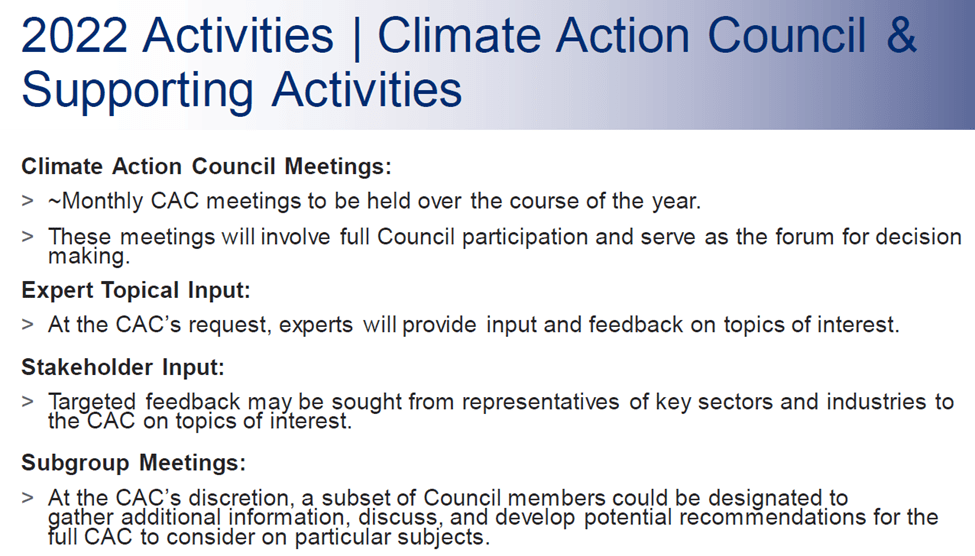
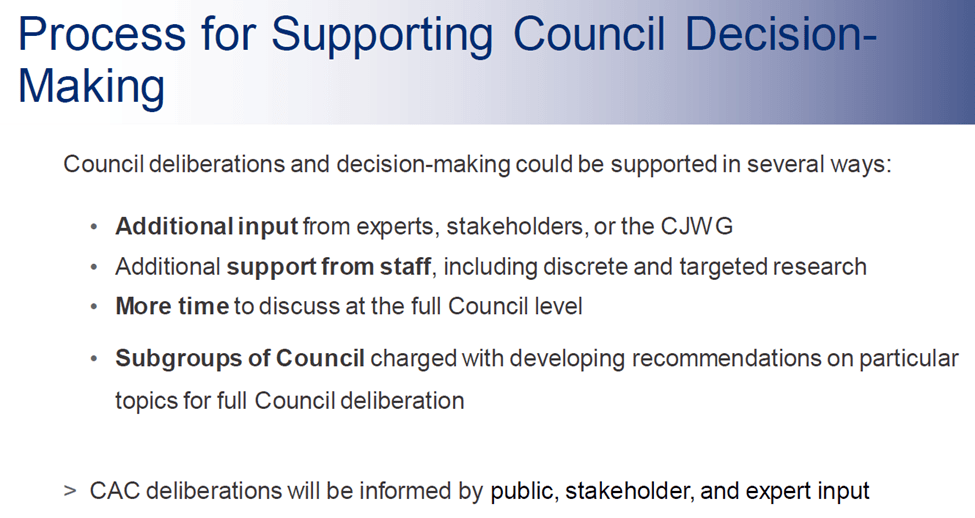
Slide 17 of the Draft Scoping Plan Overview presentation is titled “Nest Steps” and states that the public comment period is open through end of April 2022.  Three bullet points are included that describe what they expect for the comment period:

  • To identify areas where additional clarity is needed in the scoping plan
  • To further understand relevant needs and priorities of members of the public and how they connect to existing (or additional) climate strategies
  • Highlight where New York residents and businesses can participate in achieving the State’s climate goals

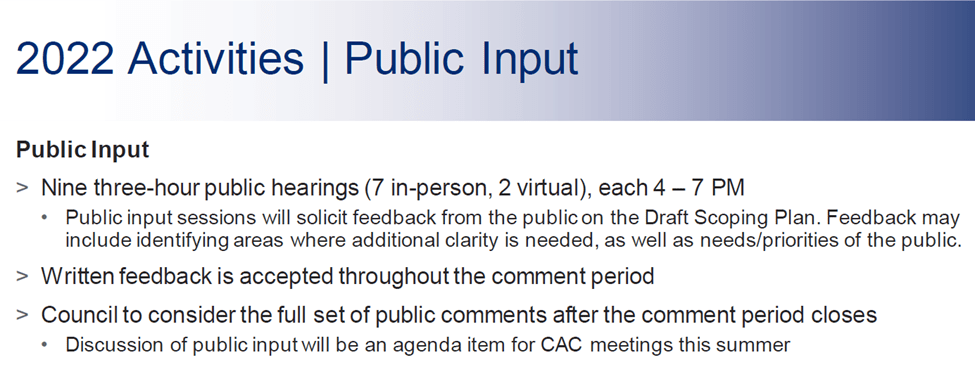
I don’t understand how the public comment period is supposed to work.  I have submitted five comments since the comment period opened.  My first comment submitted as soon as the comment period opened was to ask for a longer time to comment.  The next three comments pointed out logistical problems: the latest integration analysis spreadsheets were not available, it would be nice if the scoping plan chapters were available separately, and an error in the PM2.5 spreadsheet.  Most recently, I submitted a more substantive comment that included questions and pointed out an error in the Integration Analysis methodology. 

It is not clear to me how my comments will be handled.  The submittal form notes that “Please consider that all comments or any additional documents submitted will be made public and posted to the New York State Climate Act website.”  As far as I can tell that capability is not available yet.  More importantly, then what?  In New York Department of Environmental Conservation regulatory proceedings, the comments are categorized and summarized.  When the final rule is promulgated responses to the comments are published as part of the regulatory package of documentation.  What will the Scoping Plan process do?

I believe my comments identified areas where more clarity is needed, but it is not clear how those issues will be resolved.  I think the Draft Scoping Plan comments process has to be different than the regulatory process because there are missing pieces and parts in the evolving plan.  The amount of material and complexity of the components is so large that the Draft Scoping Plan Overview (Overview) states that outreach will include information sessions and a speaker series.  It seems obvious that something needs to be included to address important questions during the comment period so that the public, stakeholders, and Climate Action Council all have a complete understanding of issues related to the implementation plan.

As an example, consider the comments I submitted on February 1, 2022.  My comments address two issues with the Draft Scoping Plan Social Cost of Carbon benefit calculations.  In my first comment I noted that I cannot reproduce the values claimed for avoided societal costs from GHG emission reductions in the Scoping Plan.  While the integration analysis spreadsheet documentation provides numerical backup for many of the graphics in the Draft Scoping Plan, similar documentation for numbers I consider critically important, such as anything related to costs and the societal benefits calculations, are not included.  My comment specifically asked questions about the methodology and requested the backup numbers for the claim that these societal benefits were between $235 and $250 billion. 

It seems obvious to me that an iterative process is necessary.  I identified a data gap, they have to respond to the data gap in some way, and then I need time to develop a comment using the new information.  In the DEC regulatory process there are no responses to comments during the comment period itself.  If the Council follows that template, then it would prevent development of refined comments.  That is unacceptable.  Instead, it has to be an on-going process.

Once comments have identified areas where more clarity is needed, the Council has to provide explanations to the public.  The overview notes that “Public and stakeholder input will occur in parallel to complementary continued analysis, speaker series input, and CAC discussion”.  I see a timing issue here.  Unless there is a cutoff for issues raised where more clarity is needed, how does the “complementary continued analysis, speaker series input, and CAC discussion” respond to those issues in sufficient time for stakeholders to comment.  The Council may respond with something but they may not respond such that further commentary is not required.  I think this supports my belief that the comment period has to be extended.

Consider for example, the second point of my comments. All the presentations and documents claim that the “Cost of inaction exceeds the cost of action by more than $90 billion”.  The avoided economic impacts of damages caused by climate change provide the largest societal benefits for GHG emission reductions in the Scoping Plan.  However, as I summarized in a blog post, that claim relies on an incorrect interpretation of the calculation methodology for this benefit.  In order to increase the societal benefits, the Scoping Plan artificially increases the social cost benefits by counting them multiple times. The correct way to calculate the benefit is to multiply some estimate of NY GHG emission reductions by the DEC value of carbon values. For example, if all NY GHG emissions were eliminated in 2021 the benefits range from $46.7 and $56.4 billion depending on the emissions total used (1990, maximum annual between 1990 and 2019, or the most recent).  Using the flawed lifetime approach in the Scoping Plan is analogous to someone who lost 10 pounds five years ago, kept it off and now claims that they lost 50 pounds.  When just this over-counting error is corrected, the total societal benefits are negative not positive.  The details supporting my argument are in my comments and in a white paper, Scoping Plan Costs and Benefits.

I think that the Council and the Draft Scoping Plan has to address this issue.  Unless there is some kind of mechanism in the Scoping Plan comment process that mandates responses, then this result could be buried and ignored. As it stands now it is not clear that this issue will be discussed much less addressed as part of the process.

Discussion

The Overview presentation requests comments that identify areas where additional clarity is needed in the Draft Scoping Plan.  It is supposed to lay out a path to meet the aspirational targets of the Climate Act.  The overarching clarification needed is a feasibility analysis that demonstrates current levels of reliability and affordability can be maintained.  

The Overview presentation also notes that public and stakeholder input will occur in parallel to complementary continued analysis, speaker series input, and Council discussion.  It isn’t clear what that means.  The public needs more information to provide meaningful comments.  Speaker overview presentations should be designed to give them that information.  Those presentations should specify the expected programs needed to meet the targets.  For example, home heating electrification is a strategy that needs to be described along with the proscriptive measures necessary.

There also is a need to provide more detailed information for technical stakeholders.  For example, last summer the New York State Energy Research and Development Authority (NYSERDA) held a Reliability Planning Speaker Session to describe New York’s reliability issues to the advisory panels and Climate Action Council.  There never was any follow up for the Scoping Plan authors to explain how they addressed the concerns raised at that meeting.  While many of the graphics in the Draft Scoping Plan are supported by Integration Analysis spreadsheets that document the numbers, none of the cost numbers are similarly supported.  My comment about the social cost of carbon calculation is a third example of detailed information that is not currently available.  These issues and others are so important and so complicated that structured and focused workshops are appropriate to fully understand what is proposed for the Scoping Plan for these and other issues raised.

Clearly, an iterative process needs to be incorporated into the comment process.  The opportunity to ask questions and get answers is a necessary prerequisite to develop meaningful comments.   If the process does not develop a robust Scoping Plan the resulting Energy Plan may not get it right.  In February 2021 Texas blackouts spread across almost the entire state, left an unprecedented 11 million Texans freezing in the dark for as long as three days, and resulted in as many as seven hundred deaths.  If New York’s unprecedented transition to a system that relies primarily on wind and solar resources gets its reliability planning wrong then the potential for a similar debacle is likely.

According to a Gothamist summary of the Climate Act: “Seggos, the DEC commissioner, said the draft plan is meant to generate a framework and solicit input on how the state can meet its climate goals, not provide a policy-by-policy cost estimate.”  With all due respect to the commissioner, I believe it is inappropriate to rely on a “framework” to claim that renewable energy resources can provide adequate and reliable electric service affordably.  Furthermore, a critically important criterion for the public is cost and this response suggests that they don’t plan to provide ratepayer cost impacts.

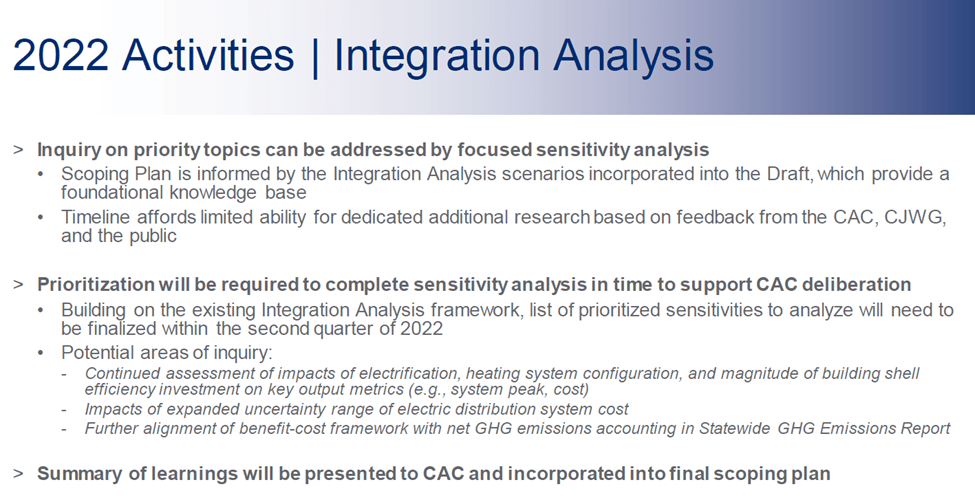
Conclusion

The Overview lists some talking points to describe the Draft Scoping Plan comment process.  However, there is no substance so it is not clear how the process will proceed.  It has been a month since the start of the comment period and the only information provided is the Overview.

I submitted a comment that addressed the main points of this post.  The points in my comment included  the following.  A feasibility analysis accepted by all the organizations responsible for New York electric system reliability is the most important clarification item that needs to be addressed.  The Council should prepare overview presentations of various aspects of the strategies needed to meet the Climate Act.  The comment process also has to address technical issues related to reliability, affordability and benefits such that questions raised are answered is sufficient time that comments can be prepared based on the responses.  Those technical issues are so important that it would be appropriate to schedule workshops that can focus on them.

If you agree with this discussion and conclusions, please consider submitting your own comment. The more people that comment the better and I am sure that the environmental advocacy organizations are asking their members to comment.  I deliberately did not suggest specific comments for others because comments reflecting your personal take on the issue are more persuasive than copying someone else’s text.

New York State Net Zero Plan

The Draft Scoping Plan Overview was recently posted and it included a figure with GHG emissions that I thought would reinforce my recent articles showing that the Draft Scoping Plan benefit claims are overblown.  Instead of putting it on this website I decided to get the following published at Watts Up With That.  

It has been a month since I updated Watts Up With That readers on New York’s net-zero by 2050 plan the Climate Leadership and Community Protection Act (Climate Act).  My last post explained that the Draft Scoping Plan that defines how to “achieve the State’s bold clean energy and climate agenda” had been released and is available for comment.  This post notes that there is a new Draft Scoping Plan Overview available.  I also want to address their claim that the “cost of inaction exceeds the cost of action by more than $90 billion.

Background

The Climate Act was passed in 2019 and became effective on 1/1/2020. The Climate Action Council has been working since then to develop plans to implement the Act.  Starting in the fall of 2020 seven advisory panels developed recommended policies to meet the targets that were presented to the Climate Action Council in the spring of 2021.  Over the summer of 2021 the New York State Energy Research & Development Authority (NYSERDA) and its consultant Energy + Environmental Economics (E3) prepared an Integration Analysis to “estimate the economy-wide benefits, costs, and GHG emissions reductions associated with pathways that achieve the Climate Act GHG emission limits and carbon neutrality goal”.  Three Integration Analysis implementation strategies were incorporated into the Draft Scoping Plan when it was released at the end of 2021. 

The Draft Scoping Plan document is huge.  The document is 861 pages long and the body of the Scoping Plan report itself is 330 pages.  There are eight appendices available individually:

  • Appendix A: Advisory Panel Recommendations
  • Appendix B: CJWG Feedback on Advisory Panel Recommendations
  • Appendix C: JTWG Recommendations to the Council on Measures to Minimize the Carbon Leakage Risk and Minimize Anti-Competitiveness Impacts of Potential Carbon Policies and Energy Sector Mandates
  • Appendix D: Power Generation Sites Identified by the JTWG
  • Appendix E: JTWG Recommendations to the Council on Issues and Opportunities Related to the EITE Entities
  • Appendix F: Environmental and Health Data for Quantifying Health Benefits of Climate Policy
  • Appendix G: Integration Analysis Technical Supplement
  • Appendix H: Adaptation & Resilience Recommendation Components

The newly released Draft Scoping Plan Overview gives some more details on the implementation plan and is a pretty good introduction to New York’s green new deal law.  Not only does the law mandate net-zero GHG emissions by 2050 but there are social justice components as well.  I am only going to touch on one aspect of the overview because it epitomizes the charade of the Climate Act.

Cost of Inaction Exceeds the Cost of Action

Slide 9 Key Benefit-Cost Findings in the Overview summary claims that the “Cost of Inaction Exceeds the Cost of Action by more than $90 billion”.  It goes on to explain: “There are significant required investments to achieve Climate Act GHG Emissions Limits, accompanied by even greater external benefits and the opportunity to create hundreds of thousands of jobs”. 

Slide 10, Benefit-Cost Assessment, in the Overview provides some details for the costs and benefits.  It is telling that the numbers behind the $310 billion, $290 billion and $305 billion number labels of the columns in the figure are not available.  The only representation of the breakdown of how those costs were apportioned across all energy sectors of New York is another graph.  That makes providing meaningful comments nearly impossible and also, in my opinion, represents a deliberate attempt to obfuscate the cost calculations.

I have written several posts on Scoping Plan benefits at my blog over the last couple of months.  Climate Act Scoping Plan Benefits summarized all the findings in those articles.  I also prepared a white paper, Scoping Plan Costs and Benefits,  that describes all the calculations and provides details. 

In brief, the benefits are over-stated.  The Plan describes health benefits totaling $165 to $170 billion due to improvements in air quality.  Air quality has improved markedly since 2000 and the observed reductions from 2000 to 2019 are 16 times greater than the improvements projected for the Climate Act in the Scoping Plan.  Until such time that the State can show benefit improvements from the observed air quality changes since 2000 are 16 times greater than the benefits claimed here, then I am dubious of the claim.  The increased active transportation benefit of $39.5 billion is based on a “first-order approximation based on state-wide numbers” that translates to “we guessed a benefit ignoring the fact that this will claim could only occur in certain areas not the whole state”.  As a result, the benefit estimate is far too high.  Energy efficiency interventions benefits in low- and middle-income homes are claimed to total $8.7 billion but $2.4 billion of that is from non-energy interventions and should not be claimed as benefits for Climate Act GHG emission reduction programs. 

The boast that the Climate Act has more benefits than costs is based on the claimed benefits for the avoided cost of GHG emissions that range between $235 and $250 billion.  The Climate Act manipulates emissions to increase benefits and uses a lower discount rate than current Federal guidance resulting in societal benefits of GHG emission reductions that are 4.5 times higher for 1990 emissions and 5.4 times higher for 2019 emissions than other jurisdictions. 

Calculation of Societal Benefits of Avoided Impacts for GHG Emission Reductions

All the aforementioned machinations and dubious attempts to inflate the benefits of the Climate Act so that the costs of inaction out-weigh the costs of action failed to get a positive number so the authors used an inaccurate method to calculate social cost of carbon benefits.  This section explains how they cheated.

Slide 3, GHG Emissions Reductions, graphically shows current (2019) estimated GHG emissions, 1990 base year emissions and the targets in 2030 and 2050.  Consistent with the lack of documentation for the cost figures, the calculation of the societal benefits numbers are unavailable. I could not reproduce the $235 billion to $250 billion estimates from the information available.  I believe this represents a deliberate attempt to cover up the “on thin ice” calculations.

It does not matter to my point that the claim of positive impacts is bogus however.  Figure ES.1 in the New York Department of Environmental Conservation (DEC) GHG inventory shows the annual statewide emissions from 1990 to 2019.  DEC did not provide the actual numbers used to generate this graphic and you will forgive me for pointing out the obvious tendency to avoid any numbers that could embarrass the narrative.  The only numbers provided are the 1990 baseline value of 402.54, the maximum in 2005 of 458.55 and the 2019 value of 379.43.  All these values are in million metric tons of carbon dioxide equivalent in terms of GWP20. 

For the sake of this argument, we can even ignore New York’s unconventional gaming of the value of carbon system that gives different numbers than any other jurisdiction.  The only reference to values comparable to other inventories states “As a point of comparison, when applying the conventional, or UNFCCC, format for governmental accounting, emissions declined 21% percent from 1990 to 2019, or from a net emission rate of 210.43mmt to 165.46 mmt CO2e GWP100”.

The Social Cost of Carbon (SCC) or Value of Carbon is a measure of the avoided costs from global warming impacts out to 2300 enabled by reducing a ton of today’s emissions.  We don’t even have to worry about the biases in the values of the SCC calculations used to show their claim is bogus.  We know that the NYS GHG inventory numbers are the 1990 baseline value of 402.54, the maximum in 2005 of 458.55 and the 2019 value of 379.43 million metric tons of CO2 equivalent in terms of GWP20.  We also know the New York values of carbon in the same unit of measure.   If the Climate Act eliminates New York GHG emissions from any of the three values listed, the societal benefit is that emission total multiplied by the NY value of carbon. The state recommends using the 2% discount rate which gives societal benefits ranging between $46.7 billion and $56.4 billion using the 2021 values depending on which historical emission value is used. 

Despite all the machinations the societal benefits in the Scoping Plan are not large enough to claim positive net benefits. The Scoping Plan games the system by relying on flawed DEC Value of Avoided Carbon Guidance.  In the Guidance section entitled “Estimating the emission reduction benefits of a plan or goal” an example is included:

“The net present value of the plan is equal to the cumulative benefit of the emission reductions that happened each year (adjusted for the discount rate). In other words, the value of carbon is applied to each year, based on the reduction from the no action case, 100,000 tons in this case. The Appendix provides the value of carbon for each year. For example, the social cost of carbon dioxide in 2021 at a 2% discount rate is $127 per metric ton. The value of the reductions in 2021 are equal to $127 times 5,000 metric tons, or $635,000; in 2022 $129 times 10,000 tons, etc. This calculation would be carried out for each year and for each discount rate of interest.”

I believe that the guidance approach is wrong because it applies the social cost multiple times for each ton reduced. As shown above, using any of the observed total GHG emission values multiplied by a social cost number representing all the societal benefits if those emissions are reduced out to the year 2300 gives benefits between $46.7 billion and $56.4 billion.  Using the DEC  guidance comes up with benefits of between $235 billion and $250 billion.  If only that error is corrected the total benefits range from negative $74.5 to negative $49.5 billion instead of net benefits ranging from $90 billion to $120 billion.

Conclusion

Despite their best efforts to game their numbers to claim that the cost of inaction exceeds the cost of action for the Climate Act New York State has to rely on obviously incorrect guidance.  Using their lifetime approach someone who lost 10 pounds five years ago can claim that they lost 50 pounds.  It is absurd and illustrates the lengths the supporters of the Climate Act will go to in order to get the “right” answer.

It is also telling that the Draft Scoping Plan and the technical documentation does not provide any numerical backup information for these societal benefits of GHG emission reductions or the cost projections.  Cynics like me believe that indicates that they know their numbers are bogus.

There is nothing preventing anyone from commenting on the Draft Scoping Plan.  Comments submitted now in New York may prevent some similar atrocity coming to your jurisdiction in the future so please comment.

—————————————————————————————————————————————

Roger Caiazza blogs on New York energy and environmental issues at Pragmatic Environmentalist of New York.  This represents his opinion and not the opinion of any of his previous employers or any other company with which he has been associated.

Climate Leadership & Community Protection Act Residential Heating Cost Assumptions Update

New York’s Climate Leadership and Community Protection Act (Climate Act) has a legal mandate for New York State greenhouse gas emissions to meet the ambitious net-zero goal by 2050. Late last year before the  Draft Scoping Plan was released I published an article that included a table that could be used to estimate the costs to replace existing home heating systems with all electric systems using their assumptions  This post updates that information using the latest version of the integration analysis used in the Draft Scoping Plan and highlights another analysis of home heating electrification costs.

I have written extensively on implementation of the Climate Act because I believe the ambitions for a zero-emissions economy outstrip available technology such that it will adversely affect reliability and affordability, risk safety, affect lifestyles, will have worse impacts on the environment than the purported effects of climate change in New York, and cannot measurably affect global warming when implemented.   The opinions expressed in this post do not reflect the position of any of my previous employers or any other company I have been associated with, these comments are mine alone.

Climate Act Background

The Climate Act establishes a “Net Zero” target by 2050. The Climate Action Council is responsible for preparing the Scoping Plan that will “achieve the State’s bold clean energy and climate agenda”.  The Climate Act requires the Climate Action Council to “[e]valuate, using the best available economic models, emission estimation techniques and other scientific methods, the total potential costs and potential economic and non-economic benefits of the plan for reducing greenhouse gases, and make such evaluation publicly available” in the Scoping Plan. Starting in the fall of 2020 seven advisory panels developed recommended strategies to meet the targets that were presented to the Climate Action Council in the spring of 2021.  Those recommendations were translated into specific policy options in an integration analysis by the New York State Energy Research and Development Authority (NYSERDA) and its consultants.  The integration analysis was used to develop the Draft Scoping Plan that was released for public comment on December 30, 2021. The public comment period extends through at least the end of April 2022, and will also include a minimum of six public hearings. The Council will consider the feedback received as it continues to discuss and deliberate on the topics in the Draft as it works towards a final Scoping Plan for release by January 1, 2023.

The Integration Analysis estimates that the buildings sector is the largest source of existing GHG emissions.  In all the future scenarios building emissions reductions are driven by rapid electrification, increased energy efficiency, and improved building shells.  For home heating electrification that means conversion to heat pumps and improvements to building shells to minimize the energy needed to heat homes.  I refer readers to the previous article for additional background information.

Home Heating Electrification Cost Update

This estimate of electrification conversion costs for an individual home is based on data in the 2021-12-29-IA-Tech-Supplement-Annex I-Inputs-Assumptions spreadsheet, Tab: Bldg_Res Device Cost.  The data are consolidated and the calculated values are available in a spreadsheet. The Scoping Plan Electrified Home Heating Integration Analysis Device Cost Assumptions table lists device costs for three categories of residential households: large multi-family, small multi-family and single family.  Costs are listed for the three types of building shell upgrades and for air source heat pumps, electric resistance backup heat, and ground source heat pumps.  The only data that changed in this table from the mid-November spreadsheet were the basic and deep shell device costs for large and small multi-family homes.  The Scoping Plan Inputs Assumptions Workbook Residential Home Heating Electrification Costs table looks at the resulting combination of costs per household, building shell type, and type of existing heating system.  I assumed in the table that ground source heat pumps would not require backup heat but if you disagree simply add that cost. 

There is a lot of information on this table so I will explain how to I determined potential costs for my situation below.  I live in a single-family residence heated with an efficient natural gas furnace.  In my opinion one of the disadvantages of heat pump technology is that the output heat is relatively low compared to a combustion sourced furnace.  The temperature at the register for a heat pump system is around 90oF whereas in my house the temperature is around 120oF.  However there some cold rooms in my house even when the furnace if providing hot air despite my best attempts to adequately insulate and reduce air infiltration.   I believe that in order to maintain safety and comfort throughout the entire winter my house would need improved thermal insulation, spots where there are thermal bridges would have to be fixed, airtightness improved, my double-glazed windows replaced with triple glazed windows, a heat recovery exchange system would have to be installed and that means a deep shell installation.  I live in a suburb where I don’t believe that a ground source heat pump has enough yard space for installation so the Climate Act option is an air source heat pump. 

According to the Integration Analysis used in Draft Scoping Plan the cost per device to replace my existing efficient gas-fired furnace is $3,085 more than another gas-fired furnace.  In order to provide backup heat, the cost of electric resistance heat also has to be added to the cost of the air source heat pump.  The cost differential is in the deep shell, single family, ASHP column on the efficient gas furnace row.  The expected cost to replace my natural gas furnace with an air source heat pump would be $57,869.  Note that for a “basic shell” upgrade the cost is “only” $19,142, or $38,727 less.  These numbers did not change from the previous article.

My previous article went on to estimate total costs for electrification and determined that the total cost for residential electrification was on the order of $155 billion.  Using the same methodology with the 2021-12-29-IA-Tech-Supplement-Annex I-Input-Assumptions spreadsheet data, the total cost for residential electrification drops down to $135 billion because of the basic and deep shell device costs for large and small multi-family homes.  Note that this highlights the importance of the building shell upgrades as a main driver of cost.

The previous article noted issues with the documentation that were not addressed in the more recent Scoping Plan documentation.  I noted that there wasn’t enough descriptive information to be able to determine the rationale for basic and deep shell upgrades necessary for a typical homeowner.  I also noted that there wasn’t a spreadsheet table available that lists the net present value of net direct costs.  I explained that while the graphics in many of the presentation figures and charts are backed up with spreadsheet tables this, arguably one of the most important set of numbers, has no spreadsheet table for documentation.  This problem still exists.

Smarter NY Energy Residential Electrification Costs

There is an assessment of costs to convert to electric heating at the Smarter NY Energy website that was completed in September 2021. According to the assessment description:

It is still unclear whether CLCPA implementation will force you to pay big surcharges for putting in a new natural gas, propane gas or heating oil furnace, or actually force you to convert to a heat pump. Either way, the cost is likely to be huge.

Pragmatic Environmentalist Update: In Governor Hochul’s 2022 State of the State book released in January 2022, Part VI-B:  Decarbonize New York’s Buildings, explains that the strategy to cut emissions from buildings will be “anchored by a robust legislative and policy agenda”.  This includes changes to building codes to “commit to zero on-site greenhouse gas emissions for new construction no later than 2027 and enact nation-leading building codes legislation”.  I interpret this to mean that in the 2022 legislative session we will see laws proposed to force New Yorkers to convert to electric heating first for new construction and eventually for all homes.

Proponents of heat pumps like to say that it only costs $7,000 to install a new heat pump. But that’s incredibly misleading. A single head heat pump might heat/cool a room or two. But an entire house? Get ready to shell out upwards of $20,000+ for a complete conversion. It is no simple thing.

Results reported from three different heat pump conversion programs run by the New York State Energy Research Development Agency (NYSERDA) and the Massachusetts Clean Energy Center (MCEC) confirm that typical homeowners would need to pay $20,00-$25,000 for a whole house conversion to heat pumps. A high efficiency gas furnace might cost ⅓ to ½ of this. Now consider that NY already has the 9th highest electric rates in the country source.

And cost doesn’t even address how uncomfortable many people feel using a heat pump in cold temperatures. Perhaps that’s why the Boston Globe reported that despite significant incentives, less than 500 homes had been converted to Heat Pump in MA in 2020, despite a goal of 100,000 per year.

The analysis of results from three different heat pump conversion programs is especially interesting in this context.  Joe Uglietto from Diversified Energy Specialists, Inc. authored the report.  He found that the MassCEC Whole-Home Air-Source Heat Pump Pilot Program included 53 existing building projects, the average conditioned square footage of home was 1,590 sq. ft., and the average project cost was $21,479.  In the MassCEC Residential Air-Source Heat Pump Rebate Program 2014-2019 He estimated that 622 homes were given rebates that could provide 80% or more of the residences annual heat load.  and the average conditioned square footage of home was 1,502 sq. ft. with an average project cost of $20,428.  In the NYSERDA Residential Air-Source Heat Pump Rebate Program 2017-2019, 386 whole house installations were completed with an average conditioned square footage of home was 1,663 sq. ft. with an average project cost of $16,272. 

There are several considerations for comparison with the Scoping Plan estimated costs.  An air source heat pump in the Scoping Plan is estimated to cost $14,678 which is less than the cost than in these programs.  However, I believe that all three programs included the cost of installation and because of the lack of documentation I don’t know if the Scoping Plan includes that cost.  The author notes that in all three programs the existing systems were retained because “The existing heating system is typically retained as a supplementary heat source to compensate for the inadequacy of air-source heat pumps on cold days.”  In the Scoping Plan the existing systems are removed and replaced with a supplemental electric heating system but this analysis notes that there is a cost for removal of the existing system.  Again, I do not know if that cost is included in the Scoping Plan.  Finally, note that the average conditioned space in these studies is 10 to 20% smaller than the median size of homes in Massachusetts and New York.  That suggests that these estimates are smaller than could be expected for the New York for most homes.

Conclusion

This article updates my previous estimates for electrifying an existing residence using the integration analysis data.  The table and spreadsheet can be used to estimate the costs to convert residences to electric heating consistent with the Climate Act mandates.

Because of changes in just basic and deep shell device costs for large and small multi-family homes the total estimated costs dropped from $155 billion to $135 billion.  Due to a lack of understandable documentation, it is not clear how these numbers relate to the total net direct costs of on the order of $300 billion.  Understanding that is important because these costs are over one third the total costs and just cover residential single, small multi-family and large multi-family electrification costs.  It does not seem likely that this category would account for one third of the total costs.

The Smarter NY Energy assessment of costs to convert to electric heating analysis suggests the Scoping Plan estimates are low.  In order to be credible the Climate Action Council needs to address the inconsistencies noted in this analysis.

Climate Leadership & Community Protectin Act Wood Burning Ban?

Late last year there was a story going around that New York State was planning to ban firewood in 2022.  This post describes the reporting of that rumor and my interpretation of the effect of the Climate Leadership and Community Protection Act (Climate Act) on wood burning. 

I have written extensively on implementation of the Climate Act because I believe the ambitions for a zero-emissions economy outstrip available technology such that it will adversely affect reliability and affordability, risk safety, affect lifestyles, will have worse impacts on the environment than the purported effects of climate change in New York, and cannot measurably affect global warming when implemented.   The opinions expressed in this post do not reflect the position of any of my previous employers or any other company I have been associated with, these comments are mine alone.

Climate Act Background

The Climate Act establishes a “Net Zero” target by 2050. The Climate Action Council is responsible for preparing the Scoping Plan that will “achieve the State’s bold clean energy and climate agenda”.  The Climate Act requires the Climate Action Council to “[e]valuate, using the best available economic models, emission estimation techniques and other scientific methods, the total potential costs and potential economic and non-economic benefits of the plan for reducing greenhouse gases, and make such evaluation publicly available” in the Scoping Plan. Starting in the fall of 2020 seven advisory panels developed recommended strategies to meet the targets that were presented to the Climate Action Council in the spring of 2021.  Those recommendations were translated into specific policy options in an integration analysis by the New York State Energy Research and Development Authority (NYSERDA) and its consultants.  The integration analysis was used to develop the Draft Scoping Plan that was released for public comment on December 30, 2021. The public comment period extends through at least the end of April 2022, and will also include a minimum of six public hearings. The Council will consider the feedback received as it continues to discuss and deliberate on the topics in the Draft as it works towards a final Scoping Plan for release by January 1, 2023.

The Climate Action Council claims that the integration analysis was developed to estimate the economy-wide benefits, costs, and GHG emissions reductions associated with pathways that achieve the Climate Act greenhouse gas emission limits and carbon neutrality goal. This integration analysis incorporates and builds from Advisory Panel and Working Group recommendations, as well as inputs and insights from complementary analyses, to model and assess multiple mitigation scenarios that could be used to implement programs to achieve the emission reduction targets of the Climate Act.

Wood Burning Ban News Reports

A quick internet search for New York wood burning ban found four television station reports in response to viewer questions about a possible ban on wood burning in 2022.  Syracuse WSYR, Utica WKTV and Watertown WWNY all ran segments that talked to DEC or other state officials and concluded that nothing was imminent.  In this post I will use the Rochester News10 article as the illustrative example of the other news reports.

In the article: “Does the new law called the Climate Leadership and Community Protection Act (or “Climate Act“), outlaw woodstoves and fireplaces or just outdoor furnaces?” on 1/5/22, News10NBC’s Nikki Rudd looked into the question:

New York’s Climate Action Council has what’s called a Draft Scoping Plan. Click here to read it.

In scenarios analyzed wood consumption decreases by about 40%. That has led to headlines like this making the rounds online: “No More Heating with Firewood in New York?”

However, Haley Viccaro, a DEC spokesperson, says that 40% decrease in wood consumption is driven by building and device efficiency and increases in electrification of primary heating across all fuel types over time.

“Additionally, the analysis remains consistent across scenarios as to the contribution of remaining high-efficiency, low-emissions wood burning (for example, wood use for primary and secondary heating or industrial use) as well as some recreational wood combustion,” Viccaro said.

In layman’s terms, the plan right now does not include any recommendations specifically about wood burning. Viccaro wants to make it clear, the state is not considering legislation that would ban heating your home with firewood.

So if you read or heard that claim, it’s false.

Frankly, the response from DEC to this and the other reports might be true as presented but in the bigger picture they lack context.  In the remainder of this post, I will provide background information for context so readers can judge for themselves whether or not a wood burning ban is inevitable.

Climate Act and Wood Burning

The Draft Scoping Plan document is huge.  The document is 861 pages long and the body of the Scoping Plan report itself is 330 pages.  There are eight appendices:

  • Appendix A: Advisory Panel Recommendations
  • Appendix B: CJWG Feedback on Advisory Panel Recommendations
  • Appendix C: JTWG Recommendations to the Council on Measures to Minimize the Carbon Leakage Risk and Minimize Anti-Competitiveness Impacts of Potential Carbon Policies and Energy Sector Mandates
  • Appendix D: Power Generation Sites Identified by the JTWG
  • Appendix E: JTWG Recommendations to the Council on Issues and Opportunities Related to the EITE Entities
  • Appendix F: Environmental and Health Data for Quantifying Health Benefits of Climate Policy
  • Appendix G: Integration Analysis Technical Supplement
  • Appendix H: Adaptation & Resilience Recommendation Components

In order to determine how the Scoping Plan treats the future it is necessary to delve into Appendix G that contains two sections with extensive documentation.  Section I Techno-Economic Analysis has five chapters, 76 figures, and 22 tables in its 122 pages.  Appendix G Section II Health Co-Benefits Analysis two chapters, 3 tables and 14 figures in its 39 pages. The Inputs Workbook spreadsheet has 49 tabs with data and the Key Drivers spreadsheet has 68 tabs with data.  I am 100% sure that DEC spokesperson Haley Viccaro does not know exactly what the Scoping Plan has to say about wood burning.  Instead, she is just responding from the public narrative script.  I am also sure that most readers have no desire to sift through the document to figure out what the document says about wood burning.  In this section I will provide that information.

I believe the primary consideration for those people who asked the question whether the Climate Act would ban wood burning as an energy source were worried about home heating.  Home heating is addressed in Chapter 12, Buildings.  It (page 129 of 861 in the document) states that:

Decarbonizing building operations describes the elimination of GHG emissions from building end uses through improving the building envelope and switching from equipment and systems powered by burning gas, oil, or other fossil fuels to highly efficient equipment and systems powered by emissions-free energy sources. In addition, embodied carbon associated with building construction can be reduced through building reuse and through using lower carbon materials or carbon-sequestering products.

In this context the question of the wood heating ban comes down to interpretation of the phrase “elimination of GHG emissions from building end uses”.  If wood burning emissions are considered GHG emissions then they will be banned someday, somehow.

The Buildings Chapter in the Scoping Plan goes on to describe the vision for 2050, the target date for the net-zero target.  The Scoping Plan is all in for heat pump technology:

The Integration Analysis indicates that by 2050, the large majority of buildings statewide will need to use electric heat pumps for heating and cooling to meet the Climate Act requirements. This approach depends upon 100% zero-emissions electricity by 2040 and making energy efficiency improvements in all buildings, with the emphasis on improvements to building envelopes (air sealing, insulation, and replacing poorly performing windows) to reduce energy demand by 30% to 50%. The Integration Analysis finds that widespread building electrification is needed even with the strategic utilization of low carbon fuels that are projected to be available, notably the use of renewable natural gas to meet back-up heating demands in a small proportion (less than 10%) of electrified buildings and the utilization of green hydrogen to power a smaller Con Ed district system by 2050. To manage the impacts of widespread electrification on the State’s electric grid, it will be important for buildings to adopt smart controls, energy storage, and other load flexibility measures. Policymakers also should assess the differential grid impact, costs, and benefits of cold climate air source, ground source, and community thermal heat pump systems; at this writing, related analysis in underway.

In this context the reference to “large majority of buildings” leaves the possibility that a minority of buildings could use wood burning for space heating but the strategic utilization clause does not mention wood burning as an option.

Because it provides context to the emission reduction strategies, let me unpack what they are saying in the rest of this section in layman’s terms.  The Scoping Plan presumes that converting the majority of homes to electric heat pumps and upgrading building envelopes will be affordable and safe.  Note, however, that the Scoping Plan does not include any cost estimates for consumers which I believe is major criterion for affordability.  The safety question boils down to one over-riding concern.  What are we supposed to do when there is an extended electricity outage if, for example,  there is an ice storm or their plans for 100% zero-emissions that rely on intermittent wind and solar don’t work?  When they say “To manage the impacts of widespread electrification on the State’s electric grid, it will be important for buildings to adopt smart controls, energy storage, and other load flexibility measures” what they mean is they want to be able to control your electric appliances to the point that when there are electric system issues, they will decide how much energy you get.  When they mention “Policymakers also should assess the differential grid impact, costs, and benefits” of the electric heating options, what they mean is we are not sure this will work but we are crossing our fingers and hoping that it will.  In February 2021, there were extended, widespread, expensive, and deadly electric outages in Texas because energy planners there did not develop a resilient energy system.  If New York’s plan gets any one of many novel aspects of the Scoping Plan wrong the same thing will happen here.

In Section 12.2 of the Buildings Chapter, strategies are listed for the relevant theme for wood burning in Table 9.  The theme is titled “adopt zero emission codes and standards”.  The first strategy is to adopt new building codes for new construction that are “all-electric”.  The second strategy specifies

“zero emissions equipment” for existing buildings.  In my opinion this strategy explicitly prohibits wood burning because it is neither “all-electric” or “zero emissions”.

One final point with respect to the buildings sector strategies is relevant.  In Governor Hochul’s 2022 State of the State book, Part VI-B:  Decarbonize New York’s Buildings, explains that the strategy to cut emissions from buildings will be “anchored by a robust legislative and policy agenda”.  This includes changes to building codes to “commit to zero on-site greenhouse gas emissions for new construction no later than 2027 and enact nation-leading building codes legislation”.  I interpret this to mean that in the 2022 legislative session we will see laws proposed to enact whatever they mean by this language.  Also note that the interpretation of wood burning as a greenhouse gas affects a possible ban.

Health Benefits

There is another aspect that indirectly bears on the possibility of a potential ban on wood burning.  The Scoping Plan claims health benefits totaling $165 to $170 billion across the three mitigation scenarios due to improvements in air quality. According to Appendix G Integration Analysis Technical Supplement Section II page 30: “The health benefits are driven by reductions in all air pollutant emissions, but reductions of primary PM2.5 are the strongest driver of the benefits.” It goes on to say that “Of the one quarter of the PM2.5 emissions that is from combustion sources, nearly all of it is due to residential or industrial wood combustion.”  Importantly: “When all fuels are considered, the residential and commercial sector accounts for the majority of the PM2.5 emission reductions, due mostly to reductions in residential wood combustion.”  These impacts are illustrated in Figure 11 from the supplement document.

On page 29 in Section II of Appendix G the Scoping Plan states: “approximately 40% of the projected benefits are associated with reduced wood combustion in industrial, commercial, and residential uses.”.  It is not clear to me and I have been unable to find an explicit statement describing how the Plan intends to get that 40% reduction.  On one hand the authors could be so enamored with the purported benefits of electric heat pumps for heating that they think everyone will willingly convert.  I think that it is naïve to believe that many people using firewood for heating will voluntarily convert because heating reliability and affordability is valued so highly by them that they won’t be convinced to switch. 

With respect to the wood burning ban, the health results could be used to justify it.  There also has been a push to develop “benefits” from the Climate Act so that could also mean they will decide that a ban is appropriate.  This is certainly an unresolved issue.

Council and Advisory Panel Membership

The final driver for a wood burning ban comes from some of the more vocal members of the Climate Action Council.  The Council has 22 voting members: 12 political appointees who head various state agencies and the rest non-agency experts: two appointed by the governor, three each appointed by majority leaders of the Assembly and Senate and one each appointed by the minority leaders of the Assembly and Senate.  All the governor appointments were made by former governor Andrew Cuomo. The ten at large members shall “include at all times individuals with expertise in issues relating to climate change mitigation and/or adaptation, such as environmental justice, labor, public health and regulated industries”. The two minority appointments are from regulated industries.  All the other appointees allegedly have expertise in issues related environmental justice, labor, public health or renewable energy.  The bottom line is that the recommendations and comments from these people were clearly biased against combustion energy sources.

There is another aspect of the membership of the Council and the Advisory Panels that is relevant for a potential wood burning ban.  I have previously described how the precautionary principle is driving the CLCPA based on the work of David Zaruk, an EU risk and science communications specialist, and author of the Risk Monger blog.  In a recent post, part of a series on the Western leadership’s response to the COVID-19 crisis, he described the current state of policy leadership that is apropos to this discussion: 

“The world of governance has evolved in the last two decades, redefining its tools and responsibilities to focus more on administration and being functionary (and less on leadership and being visionary). I have written on how this evolution towards policy-making based on more public engagement, participation and consultation has actually led to a decline in dialogue and empowerment. What is even more disturbing is how this nanny state approach, where our authorities promise a population they will be kept 100% safe in a zero-risk biosphere, has created a docilian population completely unable and unprepared to protect themselves.”

His explanation that managing policy has become more about managing public expectations with consultations and citizen panels driving decisions describes the membership of the Advisory Panels and Climate Action Council.  He says now we have “millennial militants preaching purpose from the policy pulpit, listening to a closed group of activists and virtue signaling sustainability ideologues in narrowly restricted consultation channels”.  That is exactly what has happened during the development of the Scoping Plan.  Facts, strategic vision, and risk trade-offs were not core competences for the panel members.  The elimination of combustion emissions and social justice concerns of many, including the most vocal, were more important than affordable and reliable energy.  For example, some of these people argue that the Climate Act bans combustion and when reliability issues are raised, the response is basically tough – it’s the law.  At its core people who rely on wood burning for home heating are doing so because they want reliable energy that they can afford.  In my opinion, many of the council and advisory panel members just do not relate to the reasons why people rely on wood burning for heat.

Conclusion

Based on my research and review of the Climate Act and the Scoping Plan I agree with the strict interpretation that there will not be a ban on wood burning in 2022.  However, the real question is whether a wood burning ban is inevitable someday as part of the Climate Act implementation process.  This post lists enough conflicting information to make the point that the answer is not clearly obvious.

There are multiple reasons to believe a wood burning ban is inevitable.   If wood burning emissions are considered GHG emissions, then interpretation of the phrase “elimination of GHG emissions from building end uses” means a ban is likely.  I believe this is more likely than not. In the Scoping Plan Buildings Chapter, strategies to adopt new building codes for new construction explicitly say “all-electric” and the second strategy specifies “zero emissions equipment” for existing buildings.  In my opinion this strategy explicitly prohibits wood burning because it is neither “all-electric” or “zero emissions”.  I suspect that the health benefit claims with respect to eliminating wood burning ban will be used to justify it, but this is certainly an unresolved issue.  Motivated members of the Climate Action Council clearly advocate for banning all combustion and that includes wood burning.  

On the other hand, there is nothing specific that clearly indicates that wood burning bans are necessary.  There is clear language noting that wood consumption decreases by about 40% for all the scenarios but I could not figure out how that is supposed to occur.  In the description of building description there is a reference suggesting that decarbonization applies to a “large majority of buildings” and that leaves the possibility that a minority of buildings could use wood burning for space heating. 

In conclusion, I admit that this is an unresolved issue but I believe the preponderance of information suggests that a wood firing ban is inevitable at some point.  The uproar at the end of last year indicates that this is a hot button issue with many people.  The official story for the Scoping Plan that there will be no immediate ban on wood burning is consistent with the Scoping Plan.  However, if the implementation plan eventually bans the sale of wood stoves wood boilers, or fireplace inserts that is consistent with the Scoping Plan and not a direct ban on wood burning either.  Of course it also means that someday you will no longer be able to burn wood because your wood burning appliance is worn out and cannot be replaced.

If you are concerned about a potential ban on wood burning for heating, I recommend that you do the following.  Get educated about the Climate Act so that you understand exactly what is involved for New Yorkers to meet the Climate Act targets.  Submit comments saying that banning wood burning is a safety risk when there is an electrical outage and will be more expensive so there should be no ban.  Contact your legislators to let them know that you are concerned.  Of special interest in 2022 is the commitment to zero on-site greenhouse gas emissions for new construction no later than 2027 and to “enact nation-leading building codes legislation” proposed by Governor Hochul.  If you aren’t ready for all-electric home mandates then comment.  I suggest you also make the point that the Climate Act targets and schedule need to be reassessed with respect to wood burning and many other issues.

Scoping Plan Reliability Feasibility – Renewable Variability

The Climate Leadership and Community Protection Act (Climate Act) establishes a “Net Zero” target by 2050 and the Draft Scoping Plan defines how to “achieve the State’s bold clean energy and climate agenda”.   However, there hasn’t been a feasibility plan that fully addresses the cost and technology necessary to provide reliable energy in the future all-electric net-zero New York energy system.  This is the second post of a series of posts describing the problem and the Scoping Plan’s failure to provide a proposal that adequately addresses the problem.  In the first post I described how the Texas blackouts of February 2021 are the inevitable outcome if the Scoping Plan does not address renewable variability correctly.  This post shows that solar variability markedly increases the resources needed.

I have written extensively on implementation of the Climate Act because I believe the ambitions for a zero-emissions economy outstrip available technology such that it will adversely affect reliability and affordability, risk safety, affect lifestyles, will have worse impacts on the environment than the purported effects of climate change in New York, and cannot measurably affect global warming when implemented.   The opinions expressed in this post do not reflect the position of any of my previous employers or any other company I have been associated with, these comments are mine alone.

Background

The Climate Action Council is responsible for preparing the Scoping Plan that will “achieve the State’s bold clean energy and climate agenda”.  The Climate Act requires the Climate Action Council to “[e]valuate, using the best available economic models, emission estimation techniques and other scientific methods, the total potential costs and potential economic and non-economic benefits of the plan for reducing greenhouse gases, and make such evaluation publicly available” in the Scoping Plan. Starting in the fall of 2020 seven advisory panels developed recommended strategies to meet the targets that were presented to the Climate Action Council in the spring of 2021.  Those recommendations were translated into specific policy options in an integration analysis by the New York State Energy Research and Development Authority (NYSERDA) and its consultants.  The integration analysis was used to develop the Draft Scoping Plan that was released for public comment on December 30, 2021. This draft includes results from the integration analysis on the benefits and costs to achieve the Climate Act goals. The public comment period extends through at least the end of April 2022, and will also include a minimum of six public hearings. The Council will consider the feedback received as it continues to discuss and deliberate on the topics in the Draft as it works towards a final Scoping Plan for release by January 1, 2023.

The Climate Action Council claims that the integration analysis was developed to estimate the economy-wide benefits, costs, and GHG emissions reductions associated with pathways that achieve the Climate Act greenhouse gas emission limits and carbon neutrality goal. This integration analysis incorporates and builds from Advisory Panel and Working Group recommendations, as well as inputs and insights from complementary analyses, to model and assess multiple mitigation scenarios. In addition, there is historical/archived information is available through the Support Studies section of the Climate Resources webpage, and can found as part of the Pathways to Deep Decarbonization in New York State – Final Report.

Renewable Variability

I have called the renewable resource adequacy problem the ultimate problem for the Climate Act as early as September 2020.  On August 2, 2021, the New York State Energy Research and Development Authority (NYSERDA) held a Reliability Planning Speaker Session to describe New York’s reliability issues to the advisory panels and Climate Action Council.  All the speakers but one made the point that today’s renewable energy technology will not be adequate to maintain current reliability standards and that a “yet to be developed technology” will be needed.  A recent article by David Wojick at PA Pundits International titled Unreliability Makes Solar Power Impossibly Expensive does a great job describing how renewable resource availability affects reliability.

Wojick explains that meteorological variability strongly affects renewable resource availability.  In order to reliably provide electricity from an electric grid that depends on wind and solar planners have to determine the worst case.  In his article he illustrates the problem using an example for solar energy of five days of cloudy weather that reduces the energy available to essentially zero.  In the following I excerpt his description, highlight key points and provide indented and italicized comments.

Unreliability Makes Solar Power Impossibly Expensive

How many successive days of dark cloudiness to design for is a complex question of local and regional meteorology. Here we simply use 5 days but it easily could be more. Five dark days certainly happens from time to time in most states. In Virginia’s case it can happen over the whole Mid-Atlantic region, so no one has significant solar power. This rules out buying solar power from the neighbors.

The Scoping Plan projects 2050 solar capacity between 60,604 and 65,210 MW for three mitigation scenarios.  Given the latitude of New York which translates into short days in the winter, the effect of the Great Lakes on Upstate cloudiness in the winter, and potential for significant snowfall over the entire state, it is reasonable to expect that none of this capacity will be available for at least five days.

Reliability requires designing for these relatively extreme events. With conventional generation you design for maximum need for power but with wind and solar you also have to design for minimum supply. That minimum case is what I am looking at here.

The required battery capacity is simple. Five days at 24 hours a day is 120 hours. To supply a steady 1,000 MW that is a whopping 120,000 MWh of storage. We already have the overnight storage capacity for 16 hours so we now need an additional 104 hours, which means 104,000 MWh of additional storage.

Keep in mind that today the available Li ion batteries only provide 4 hours of energy.

However, the required additional generating capacity to charge these dark days batteries is far from simple. It all depends on how long we have to do the charging. The more time we have the smaller the required generating capacity.

It is vital to get the dark days batteries charged before the next dark days arrive, which in some cases might be very soon. This too is a matter of meteorology. To be conservative we here first assume that we have two bright sunny days to do the job.

Two days gives us 16 hours of charging time for the needed 120,000 MWh, which requires a large 7,500 MW of generating capacity. We already have 3,000 MW of generating capacity but that is in use providing round the clock sunny day power. It is not available to help recharge the dark days batteries. Turns out we need a whopping 10,500 MW of solar generating capacity.

This 10,500 MW is a lot considering we only want to reliably generate 1,000 MW around the clock. Moreover, some of this additional generating capacity will seldom be used. But reliability is like that due to the great variability of weather. In conventional fossil fueled generation the extreme event that drives design is peak need (also called peak demand). Special generators called “peakers” are used for this case. In the solar case the special equipment is batteries or other forms of storage.

This is an important point.  In order to provide electricity when it is needed a significant fraction of generating capacity will seldom be used.  If it is not used much it will be difficult to pay for it.  Inevitably, it will mean very high electricity prices during those peak periods.

Note that if we have 5 days to recharge the dark days batteries then the amount of required generation is a lot less. Five days gives us 40 hours to charge the 120,000 MWh so one only needs 3,000 MW of additional generating capacity, added to the 3,000 MW we need to produce daily power on sunny days.

I cannot over emphasize the importance to determine the frequency, duration, and intensity of low wind and solar resource availability.  If it is found that New York can only expect 2 full days will be available to recharge the batteries, then the Scoping Plan projected 2050 solar capacity between 60,604 and 65,210 MW only produces between 5,772 and 6,211 MW of reliable solar energy.  On the other hand, if New York can expect 5 full days will be available to recharge the batteries that same capacity produces between 10,101 and 10,868 MW of reliable solar energy.

At this point we need 120,000 MWh of battery storage and from 6,000 to 10,500 MW of generating capacity, in order to reliable supply 1,000 MW of round the clock power.

If it is found that New York can only expect 2 full days will be available to recharge the batteries, then the Scoping Plan projected 2050 solar capacity between 60,604 and 65,210 MW will require between 692,619 MWh and 745,260 MWh of energy storage to produce the 5,772 and 6,211 MW of reliable solar energy.

These large numbers occur because following a period of dark cloudy days we are doing three things simultaneously during the daylight generating hours. We are (1) generating 1,000 MW of immediately used electricity, while recharging both the (2) nighttime batteries and the (3) dark days batteries.

Note too that the numbers should actually be bigger. Batteries are not charged 100% and then drained to zero. The standard practice is to operate between 80% and 20%. In that case the available storage is just 60% of the nameplate capacity. This turns the dark days 120,000 MWh into a requirement for 200,000 MWh.

If it is found that New York can only expect 2 full days will be available to recharge the batteries, then with this constraint the Scoping Plan projected 2050 solar capacity between 60,604 and 65,210 MW will require between 1,154,364 MWh and 1,242,100 MWh of energy storage to produce the 5,772 and 6,211 MW of reliable solar energy.

The cost of the dark days case

Wojick also calculates costs in his article.

A standard figure from EIA for the cost of grid scale battery arrays is $250 per kWh, which gives $250,000 per MWh. At this cost the required 200,000 MWh of storage for around the clock 1,000 MW is $50 billion.

In order to provide adequate energy storage for the Scoping Plan solar capacity costs range between $288.6 billion and $310.5 billion for the three mitigation scenarios.

A standard EIA figure for PV solar capacity is $1300 per kW or $1,300,000 per MW. This makes the 6,000 to 10,500 MW cost $7.8 to 13.7 billion.

The Scoping Plan solar capacity costs range between $78.8 billion and $84.8 billion.

This makes $60 billion for just 1,000 MW a good rough estimate for stand-alone solar capacity to meet the 5 dark cloudy days case. (Adding wind power does not reduce this number because the 5 dark days may also see zero wind output.)

The total Scoping Plan solar capacity costs range $367.4 billion and $395.3 billion!

 There is a major disconnect between Wojick’s cost estimate and the values presented in the Scoping Plan.  According to Figure 51 from Appendix G, Section I, the Scenario 2, “Strategic use of low-carbon fuels” net present value of costs relative to the reference case (2020-2050) are $310 billion; Scenario 3, “Accelerated transition away from combustion”, costs are $290 billion; and Scenario 5, “Beyond 85%” costs are $305 billion.  If just the cost for the solar resources necessary are over $367 billion, then something has to be reconciled. 

Scoping Plan Appendix G, Section I states that “The integration analysis includes calculations for three different cost metrics: Net Present Value (NPV) of net direct costs, annual net direct costs, and system expenditure” and notes that “the NPV of levelized costs in each scenario incremental to the Reference Case from 2020-2050”.  Depending on the Reference Case costs that could account for some of the difference.  However, the Scoping Plan does not include any tables that list costs for the Reference Case and Scenarios.  The only data available are in figures.  At the time of this writing, January 23, 2022, the spreadsheet resources that provide numbers used in most figures are not available for any of the figures with cost numbers.  As a result, I cannot reconcile the cost numbers shown here and the Scoping Plan costs.

Conclusion

Wojick’s analysis provides a simple, easily replicated description of the effect of day length on solar resource availability.  He demonstrates that accurately determining the expected solar resource availability is critically important for reliability planning.  It is also obvious from his work that someone says solar generation is cheaper than fossil-fired generation, that person is not considering all the reliability requirements.

There are implications to the Scoping Plan.  Scenario 2, “Strategic use of low-carbon fuels” projects 2050 solar capacity of 64,621 MW; Scenario 3, “Accelerated transition away from combustion”, projects 60,604 MW; and Scenario 5, “Beyond 85%” projects 65,210 MW.  Wojick shows that if it is found that New York can only expect 2 full days will be available to recharge the batteries needed to provide power when the sun isn’t shining, then the Scoping Plan projected 2050 solar capacity range of 60,604 to 65,210 MW only produces between 5,772 and 6,211 MW of reliable solar energy.  On the other hand, if New York can expect 5 full days will be available to recharge the batteries the Scoping Plan capacity produces between 10,101 and 10,868 MW of reliable solar energy. 

I have been unable to determine how the Scoping Plan addresses the issues raised.  I don’t think the integration analysis that forms the basis of the Scoping Plan adequately determined the worst-case meteorological conditions for wind and solar availability.  I don’t know how the integration analysis addressed the reliability issues associated with wind and solar resource availability but I am sure that the New York Independent System Operator and New York State Reliability Council have not reconciled their reliability responsibilities with the Scoping Plan.  Clearly the Climate Action Council must address this problem.

Scoping Plan Reliability Feasibility – Scope of the Problem

The Climate Leadership and Community Protection Act (Climate Act) establishes a “Net Zero” target by 2050 and the Draft Scoping Plan defines how to “achieve the State’s bold clean energy and climate agenda”.   However, there hasn’t been a feasibility plan that fully addresses the cost and technology necessary to provide reliable energy in the future all-electric net-zero New York energy system.  This is the first post of a series of posts describing the problem and the Scoping Plan’s failure to provide a proposal that adequately addresses the problem.

I have written extensively on implementation of the Climate Act because I believe the ambitions for a zero-emissions economy outstrip available technology such that it will adversely affect reliability and affordability, risk safety, affect lifestyles, will have worse impacts on the environment than the purported effects of climate change in New York, and cannot measurably affect global warming when implemented.   The opinions expressed in this post do not reflect the position of any of my previous employers or any other company I have been associated with, these comments are mine alone.

Background

The Climate Action Council is responsible for preparing the Scoping Plan that will “achieve the State’s bold clean energy and climate agenda”.  The Climate Act requires the Climate Action Council to “[e]valuate, using the best available economic models, emission estimation techniques and other scientific methods, the total potential costs and potential economic and non-economic benefits of the plan for reducing greenhouse gases, and make such evaluation publicly available” in the Scoping Plan. Starting in the fall of 2020 seven advisory panels developed recommended strategies to meet the targets that were presented to the Climate Action Council in the spring of 2021.  Those recommendations were translated into specific policy options in an integration analysis by the New York State Energy Research and Development Authority (NYSERDA) and its consultants.  The integration analysis was used to develop the Draft Scoping Plan that was released for public comment on December 30, 2021. This draft includes results from the integration analysis on the benefits and costs to achieve the Climate Act goals. The public comment period extends through at least the end of April 2022, and will also include a minimum of six public hearings. The Council will consider the feedback received as it continues to discuss and deliberate on the topics in the Draft as it works towards a final Scoping Plan for release by January 1, 2023.

The Climate Action Council claims that the integration analysis was developed to estimate the economy-wide benefits, costs, and GHG emissions reductions associated with pathways that achieve the Climate Act greenhouse gas emission limits and carbon neutrality goal. The integration analysis incorporates and builds from Advisory Panel and Working Group recommendations, as well as inputs and insights from complementary analyses, to model and assess multiple mitigation scenarios. In addition, there is historical/archived information is available through the Support Studies section of the Climate Resources webpage, and can found as part of the Pathways to Deep Decarbonization in New York State – Final Report.

February 2021 Texas Electricity Debacle

A recent article in Texas Monthly describes the deadly blackout that hit Texas in February 2021. Russell Gold’s article “One year after the deadly blackout, officials have done little to prevent the next one—which could be far worse” does an excellent job describing what happened. He explains that as the frigid air behind the winter storm blanketed the state and the electric gird operators started dealing with resulting problems:

Nobody yet knew just how widespread the blackouts would become—that they would spread across almost the entire state, leave an unprecedented 11 million Texans freezing in the dark for as long as three days, and result in as many as seven hundred deaths. But neither could the governor, legislators, and regulators who are supposed to oversee the state’s electric grid claim to be surprised. They had been warned repeatedly, by experts and by previous calamities—including a major blackout in 2011—that the grid was uniquely vulnerable to cold weather. 

The integration analysis recognizes that the future New York electric grid will be more vulnerable to cold weather.  When electricity is universally used for heating, cooking, hot water, and transportation the peak loads will occur in winter.  The analysis also recognizes that solar energy resources will be reduced in the winter if for no other reason the days are shorter and that multi-day wind lulls mean that non-fossil fuel energy resources availability will be an issue. However, the reality is that the integration analysis does not provide enough detail to be considered a cost and technology feasibility study, particularly with regards to how the cold weather wind lull problem will be handled. 

I highly recommend reading Gold’s article for its description of how the blackouts unfolded.  There is a gripping description of how the blackout disaster unfolded for the grid operators and a very good explanation of the issues they faced.

Two days before Mecke was awakened in his office, ERCOT had held an emergency conference call to warn the state’s utilities and rural electric cooperatives that blackouts were likely. ERCOT officials said the grid might have to shed as much as 7,500 megawatts—effectively darkening roughly one of every eight homes in the state. That’s nearly twice as much as the last controlled load shed, in 2011, when rolling blackouts had lasted as long as eight hours, which in turn was four times longer than the previous large-scale blackout, in 2006. 

The worst-case scenario ERCOT had gamed out, what it called “extreme winter,” contemplated a record-setting demand of 67.2 gigawatts. Electricity consumption blew past that mark at 7 p.m. on February 14. Meanwhile, electricity supply continued to dwindle as underinsulated power plants went down, one after another.

For the grid to function properly, the supply of electricity must always match demand; this equilibrium is reflected in the grid’s frequency, which usually remains steady at 60 hertz. Power plants across the state are tuned in to the frequency, and they automatically increase or decrease generation to maintain equilibrium. The grid is like a giant synchronized machine, its components linked across hundreds of miles, from Midland to Houston, from Amarillo to Brownsville. On this night, as demand drastically outpaced supply, the frequency dropped and the vast machine began churning faster. But eventually it couldn’t compensate on its own.

By 1:23 a.m., ERCOT could no longer delay action. An operator in its control room picked up the hotline phone, which was wired to sixteen of the state’s utility companies, and ordered a thousand-megawatt load shed statewide. “You practice for this for years,” Mecke said. “You hope it never happens.” 

In fact, a few hours earlier, he’d run his coworkers through a simulation of a nearly identical load shed. When the time came to carry out the operation for real, there were no hiccups. “It was surprisingly calm,” he said. “It was smooth.” Within seconds, electricity in parts of San Antonio began to blink off. Mecke, hopeful that the grid would stabilize, breathed a sigh of relief. The calm was short-lived.

The frequency should have risen after the load shed, but instead it kept falling. It was “nerve-racking,” said Mecke. 

At 1:47 a.m., the hotline phone rang again. Everyone in the CPS control center stopped what they were doing. ERCOT needed another thousand megawatts cut. Because of coronavirus precautions, CPS executives weren’t in the control room. Rudy Garza, the chief customer officer, tracked the frequency’s dangerous decline on his phone, texting back and forth with industry friends and former coworkers from across the state. “We were scared,” he said.

CenterPoint Energy, a utility in Houston, runs a control room similar to that of CPS. Eric Easton, CenterPoint’s vice president of real-time operations, was hastening to execute the second round of blackouts when the hotline phone rang for the third time, at 1:51 a.m. ERCOT ordered another three thousand megawatts—more than the first two combined. “Calls started coming in so fast that they were overlapping,” said Easton. “When are we going to stop shedding load?” he wondered.

But the situation was only growing more dire. At the precise time of the third call, the frequency reached a critical threshold: 59.4 hertz. The Texas grid, which has been around in some form since World War II, had only once in its history fallen this low. Automated turbines across the state began spinning even faster to produce more electricity, but when the frequency dips below 59.4 hertz, the turbines reach speeds and pressures that can cause catastrophic damage to them, requiring that they be repaired or replaced. This scenario was unlikely because, to prevent it, the grid automatically triggers a nine-minute countdown when it strikes 59.4 hertz. If the frequency did not rise in time, power plants would shut down and the grid would begin turning itself off completely. This would leave all 26 million Texans who relied on the ERCOT grid without power for weeks or months. 

A few more minutes ticked by. The frequency kept falling, touching 59.302 hertz, yet another alarming precipice. At 59.3 hertz, human operators are taken out of the equation: they are too slow to make the urgent adjustments that are needed to stabilize the grid. The system is programmed to automatically start blacking out as many areas as are necessary to balance power supply and demand. But in this scenario, that fail-safe may not have worked because so many areas had already been manually cut off. “We were on the very edge,” said Easton. 

In a last-ditch effort to prevent the grid’s collapse, ERCOT placed a fourth hotline call, at 1:55 a.m., and ordered another 3,500 megawatts. All across Texas, grid operators were moving as quickly as they could, blacking out more and more neighborhoods, but they were running out of options. As the countdown approached zero, the frequency suddenly shot back up. The immediate crisis was over—the last-second load shed had worked—but for most of the following day, the grid remained dangerously unstable. 

It is hard to fathom the devastation a total shutdown would have wreaked. Bill Magness, then the CEO of ERCOT, would explain as much to the Texas Senate ten days later. Magness is a lawyer with a buzz cut and ramrod-straight posture who spent time in the nineties and aughts as a practicing Buddhist. “What my team and the folks at the utilities in Texas would be doing is an exercise called ‘black start,’ ” he said. A black start would have required carefully rebooting a few power plants at a time and using them to jump-start others, thereby restoring the grid piece by piece. It’s not a matter of flipping switches. The steps required for a black start are numerous, complex, and delicate. No one knows how long that process would take, because no one has ever needed to do it. Magness said it would have been weeks at least. 

Discussion

Gold also gives his opinion why it happened and how to fix it.  I am not familiar enough with the Texas electric energy system to support or dispute his arguments.  In this instance it does not matter.  For whatever reason the Texas electric system did not have enough generating resources available to meet the peak load requirements when Texans needed it most.  If New York’s implementation plan for net-zero leads to a similar situation where there isn’t enough energy available the result will be the same: massive costs and deaths due to a lack of heat.

I have called the renewable resource adequacy problem the ultimate problem for the Climate Act as early as September 2020.  On August 2, 2021, the New York State Energy Research and Development Authority (NYSERDA) held a Reliability Planning Speaker Session to describe New York’s reliability issues to the advisory panels and Climate Action Council.  All the speakers but one made the point that today’s renewable energy technology will not be adequate to maintain current reliability standards and that a “yet to be developed technology” will be needed.  It is my understanding that the New York Independent System Operator and the New York State Reliability Council have reliability planning responsibilities.  How can the Climate Action Council propose a Scoping Plan without reconciliation with those entities? 

According to a Gothamist summary of the Climate Act: “Seggos, the DEC commissioner, said the draft plan is meant to generate a framework and solicit input on how the state can meet its climate goals, not provide a policy-by-policy cost estimate.”  With all due respect to the commissioner, I believe it is inappropriate to rely on a “framework” to claim that renewable energy resources can provide adequate and reliable electric service affordably.

Conclusion

At the September 13, 2021 meeting of the Climate Action Council a requirement to consider carbon reduction measures in other jurisdictions was discussed.  The fact is that the situation in Europe this winter is a harbinger of things to come in New York.  The Draft Scoping Plan considers control measures in isolation and ignores the ramifications observed elsewhere for the measures.  The Draft Scoping Plan’s strategies to decarbonize the economy are a classic example of the ancient political strategy of “winging it”. Sadly, the Climate Action Council is basing the future of New York’s electricity grid on a plan that relies, to a very great extent, on a collective crossing of fingers.  If this problem is not resolved then the impacts observed in the Texas blackouts disaster of February 2021 will be the inevitable outcome.  In subsequent posts I will explain why this is the case and offer some suggestions for addressing the problem.