
On July 20, 2023 the first annual informational report on the implementation of the Climate Leadership & Community Protection Act (Climate Act)) was released. There is a lot of information in this report that needs to be parsed out but because this is the first report that provides any Climate Act implementation estimated costs for ratepayers, I am publishing this initial summary.
I have been following the Climate Act since it was first proposed, submitted comments on the Climate Act implementation plan, and have written over 300 articles about New York’s net-zero transition. I have devoted a lot of time to the Climate Act because I believe the ambitions for a zero-emissions economy embodied in the Climate Act outstrip available renewable technology such that the net-zero transition will do more harm than good. The opinions expressed in this post do not reflect the position of any of my previous employers or any other company I have been associated with, these comments are mine alone.
Climate Act Background
The Climate Act established a New York “Net Zero” target (85% reduction and 15% offset of emissions) by 2050. It includes an interim 2030 reduction target of a 40% reduction by 2030 and a requirement that all electricity generated be “zero-emissions” by 2040. The Climate Action Council is responsible for preparing the Scoping Plan that outlines how to “achieve the State’s bold clean energy and climate agenda.” In brief, that plan is to electrify everything possible and power the electric grid with zero-emissions generating resources. The Integration Analysis prepared by the New York State Energy Research and Development Authority (NYSERDA) and its consultants quantifies the impact of the electrification strategies. That material was used to write a Draft Scoping Plan. After a year-long review the Scoping Plan recommendations were finalized at the end of 2022. In 2023 the Scoping Plan recommendations are supposed to be implemented through regulation and legislation.
According to the press release:
The Climate Act’s directives require the Commission to build upon its existing efforts to combat climate change through the deployment of clean energy resources and energy storage technologies, energy efficiency and building electrification measures, and electric vehicle charging infrastructure. In recognition of the scale of change and significant work that will be necessary to meet the Climate Act’s aggressive targets, the Commission directed DPS staff to assess the progress made in line with its directives under the Climate Act and to provide guidance, as appropriate, on how to timely meet the requirements of the Climate Act.
The Scoping Plan does not provide any ratepayer cost impacts but the New York State Department of Public Service First Annual Informational Report on Overall Implementation of the Climate Leadership and Community Protection Act does provide that information. This post summarizes the ratepayer impacts provided in this report. I will follow up with another post that delves into the details of this report later.
Programs
One of the difficulties trying to understand what expenses have been authorized to date that are covered by this report is the number of programs involved. Seven authorized programs are covered: Clean Energy Standard (CES) Clean Energy Fund (CEF), certain Value of Distributed Energy Resources (VDER), Electric Vehicle Make Ready Program, Clean Heat programs, Integrated Energy Data Resource (IEDR), and Utility Energy Efficiency programs. In a subsequent post I will try to address these programs and their place in the Scoping Plan strategies in detail.
The seven authorized programs support various components of Climate Act mandated strategies. The Clean Energy Standard was originally adopted in 2016 and set a goal for 50% of the electricity consumed in the State by 2030 to be generated by renewable energy sources. There were subsequent revisions and the initiatives been expanded, where necessary, to support Climate Act mandates. The Clean Energy Fund provides support for innovation & research, market development, the NY Green Bank, and NY Sun. Value of Distributed Energy Resources programs support energy generated by distributed energy resources such as solar photovoltaic, energy storage, combined heat and power, anaerobic digesters, wind turbines and small hydro and fuel cells. The Electric Vehicle Make Ready Program funds infrastructure for electric vehicles. Clean Heat programs and promote the electrification of space and water heating by offering contractor and customer incentives for the installation of air- and ground-source heat pumps. The Integrated Energy Data Resource will be a “statewide resource to securely collect, integrate, and provide access to energy related information”. The Utility Energy Efficiency programs support energy conservation and efficiency programs.
Cost Recoveries
According to the press release:
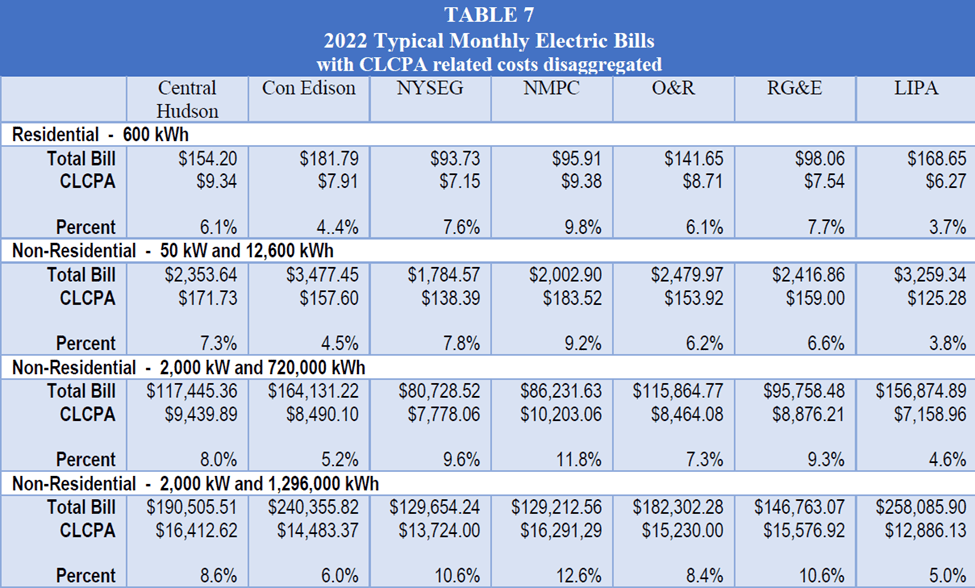
For the average residential electric customer, the rate impacts for these critically important investments, not accounting for the overall societal benefits, range from 3.7 percent to 9.8 percent, depending on the utility. The rate impacts for non-residential customer varies depending on the utility and the amount of electricity consumed.
I am not familiar with the jargon of the Department of Public Service (DPS) rate descriptions. I believe that when DPS talks about cost recovery they are referring to costs that the utilities have incurred to implement the Climate Act requirements that have been charged back to the ratepayers. The report notes:
For purposes of estimating the cost recoveries of CLCPA related initiatives in 2022, Staff issued information requests to each of the utilities. Specifically, Staff requested the utilities provide 2022 cost recoveries for: CES (electric only), CEF (electric only), certain VDER (electric only), Electric Vehicle Make Ready Program (electric only), Clean Heat programs (electric only), Integrated Energy Data Resource (electric only), and Utility Energy Efficiency programs (electric and gas).
The following figure summaries the costs recovered in 2022 by the utilities associated with these gas and electric programs. The Climate Act program costs paid by New York gas ratepayers totaled $112,967,498 in 2022 (Table 3). Electric ratepayers paid $1,175,788,000 in 2022 (Table 4).

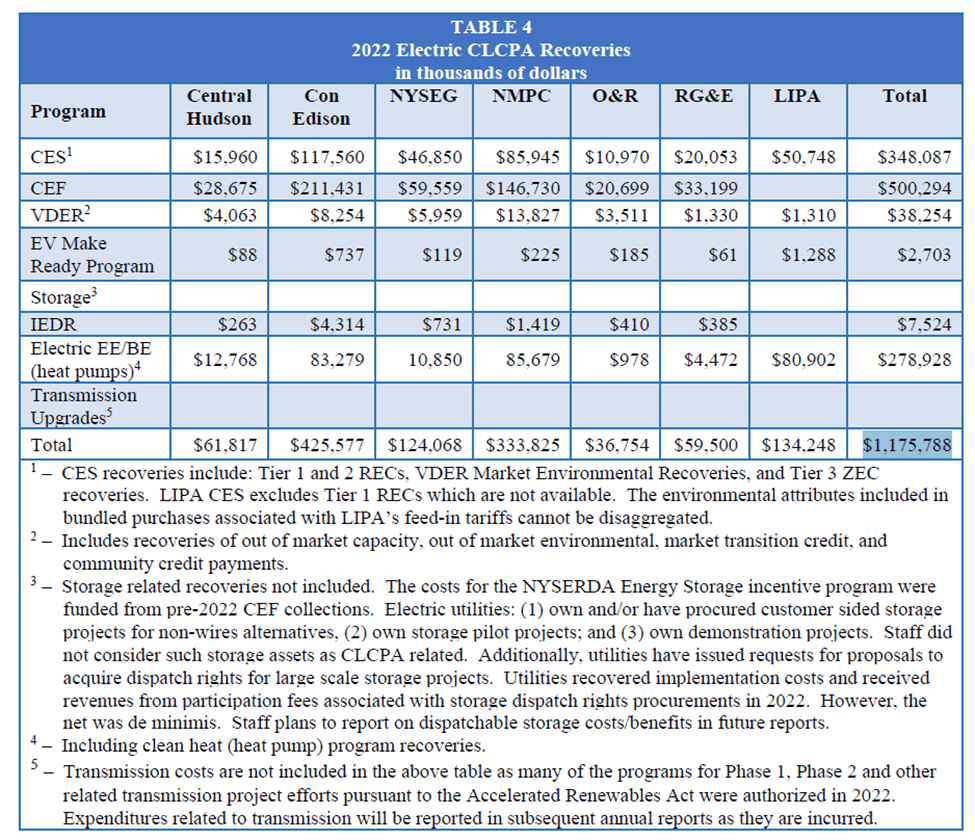
These totals were converted to gas and electric ratepayer impacts in the report.
The report estimates the effect of the Climate Act programs typical monthly gas bills in Table 6 using the following assumptions:
Staff issued information requests to each of the utilities to help estimate the bill impacts associated with the CLCPA related cost recoveries. Staff requested the utilities provide typical gas delivery and supply bills for 2022 for the following customer types:
A. Residential heating customers (83 therms per month),
B. Small commercial customers (2,500 therms per month),
C. Commercial customers (10,000 therms per month), and
D. Industrial customers (100,000 therms per month).

The report estimates the effect of the Climate Act programs on typical monthly electric bills in Table 7 using the following assumptions:
Staff requested the utilities provide typical electric delivery and supply bills for 2022 for the following customer types:
A. Residential customers (600 kWh per month),
B. Non-residential customers (50 kW & 12,600 kWh per month),
C. Non-residential customers (2,000 kW & 720,000 kWh per month), and
D. Non-residential high load factor customers (2,000 kW & 1,296,000 kWh per month).
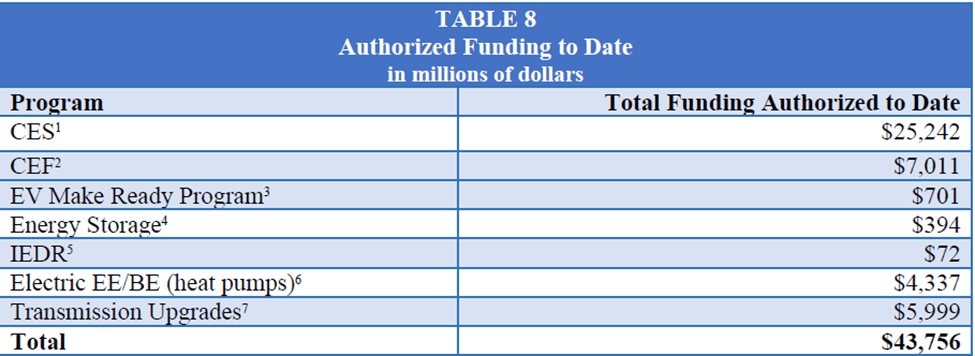
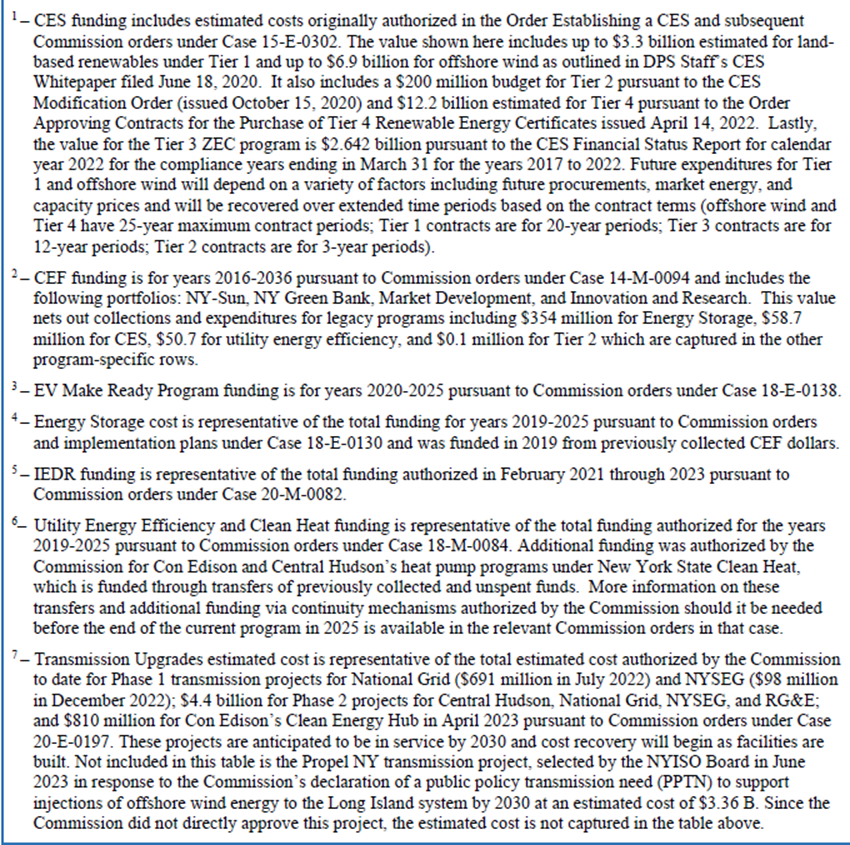
The 2022 combined total costs recovered from gas and electric ratepayers is $1,288,755,498. Table 8 lists the costs that have been authorized but not yet captured and that total is 43,756,000,000. Clearly ratepayer costs will have to increase more to cover these additional costs. The report states:
This annual report is a review of actual costs incurred by ratepayers to date in support of various programs and projects to implement the CLCPA and does not fully capture potential future expenditures, including estimated costs already authorized by the Commission but not yet recovered in rates. To complement this overview of cost recoveries incurred to date, we also present below a table of the various programs and the total amount of estimated costs associated with each authorized by the Commission to date. Table 8 gives a sense of expenditures that ratepayers could ultimately see recovered in rates. These values are conservative and reflect both past and prospective estimated costs.
Conclusion
There is a lot to unpack in this report. I plan to look at the numbers in various programs and try to reconcile them with other cost estimates. The report also includes estimates of benefits that need to be addressed.
Based on this first review it is already obvious that costs are significant and this is only the beginning. Many more programs will be required to implement the net-zero transition. Stay tuned.

 Pragmatic Environmentalist of New York
One thought on “Implementation and Compliance with Climate Act Requirements and Targets – First Impression”