

Pragmatic Environmentalist of New York Principle 6 is Roger Pielke Jr’s: Iron Law of Climate: “While people are often willing to pay some price for achieving climate objectives, that willingness has its limits.” A recent Facebook comment to a National Grid Facebook social media campaign post provides a perfect example related to New York’s Climate Leadership & Community Protection Act (Climate Act).
I have followed the Climate Act since it was first proposed, submitted comments on the Climate Act implementation plan, and have written over 400 articles about New York’s net-zero transition. The opinions expressed in this post do not reflect the position of any of my previous employers or any other organization I have been associated with, these comments are mine alone.
Overview
The Climate Act established a New York “Net Zero” target (85% reduction in GHG emissions and 15% offset of emissions) by 2050. It includes an interim 2030 reduction target of a 40% reduction by 2030 and a requirement that all electricity generated be “zero-emissions” by 2040. The Climate Action Council (CAC) was responsible for preparing the Scoping Plan that outlines how to “achieve the State’s bold clean energy and climate agenda.” In brief, that plan is to electrify everything possible using zero-emissions electricity. The Integration Analysis prepared by the New York State Energy Research and Development Authority (NYSERDA) and its consultants quantifies the impact of the electrification strategies. That material was used to develop the Draft Scoping Plan outline of strategies. After a year-long review, the Scoping Plan was finalized at the end of 2022. In 2023 the Scoping Plan recommendations were supposed to be implemented through regulation, PSC orders, and legislation. Not surprisingly, the aspirational schedule of the Climate Act has proven to be more difficult to implement than planned and many aspects of the transition are falling behind. There is growing evidence that the state will be unable to achieve its goals without significantly affecting the cost of living and doing business in New York and harming the reliability of its electric grid.
National Grid
In my opinion no company doing in business can publicly question the Climate Act narrative without facing the wrath of emotion-driven activists and getting crosswise with the Hochul Administration. Although the Public Service Commission utility rate-making process to establish “just and reasonable” rates is supposed to be apolitical, the old days when governors appointed Commissioners from both parties to maintain balance are gone. I have no doubt whatsoever that any utility that does not encourage electrification to save the environment at every opportunity would find itself not getting their rate case proposals approved. Moreover, an electric utility has incentives to sell more electricity. The problem is that electrification everywhere is not a pragmatic solution.
I am in the former Niagara Mohawk Power Corporation service territory now served by National Grid New York. Given the political climate of New York it is no surprise that National Grid advocates for the “Journey to net-zero”. I am not a big social media person but do get on Facebook occasionally. Frequently, there are posts from National Grid advocating for the latest and greatest gadgets for electrification. For example, the following recently showed up.
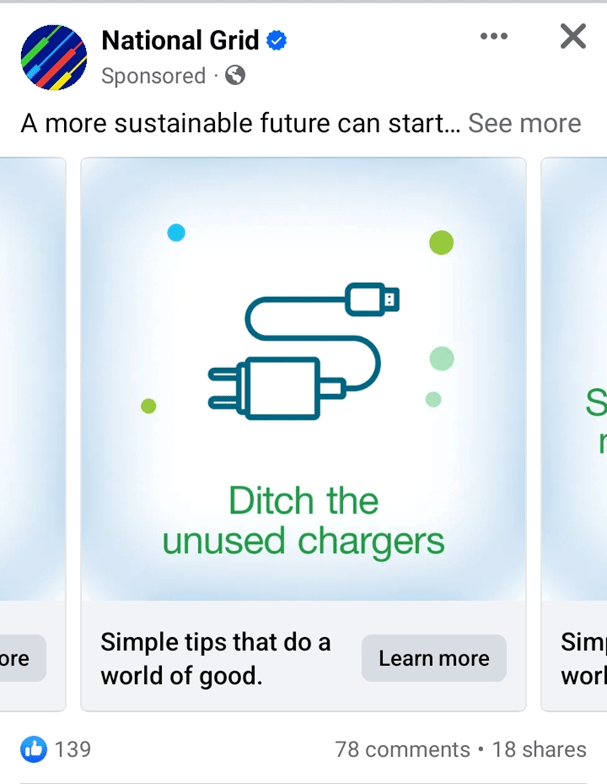
There were options for different “learn more” links. What caught my eye was the following comment to this post. It the perfect example of Pielke’s Iron Law:
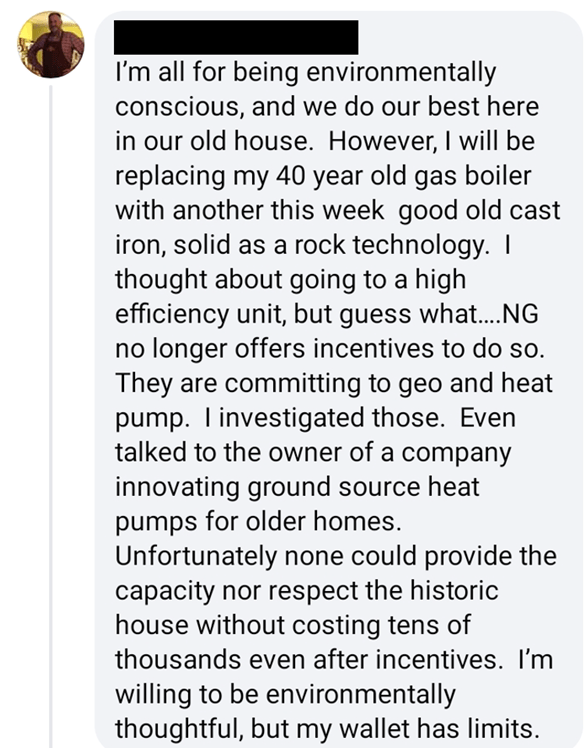
The Iron Law can be described as wallets have limits. Beyond the simple cost impacts there is another concern. The National Grid Upstate New York Residential Gas Heating program is paused and not accepting rebate applications. National Grid is forgoing efficiencies now to encourage adoption of cold-climate heat pumps. This is disservice to National Grid ratepayers because it does not acknowledge thatthe State’s Scoping Plan to implement the Climate Act notes that not all homes will be able to electrify home heating safely and affordably. Exactly the case in this example. It is not only that there is a cost factor but there is a safety factor for electrification. Removing incentives for homeowners that have no other choices is short-sighted.
Conclusion
Implementation of the Climate Act is going to affect affordability and safety. The public is starting to catch on to these impacts. It is time to pause implementation until the Hochul Administration provides comprehensive and transparent cost estimates for the transition and the Public Service Commission provides a plan to ensure safe and reliable service to electric customers for an electric system that relies on wind and solar. The utility industry is not going to step up and ask for an implementation pause so it is up to the voters of the state to make their concerns known.

 Pragmatic Environmentalist of New York
I keep hearing there are heat pumps that will keep your homes in places like NY warm, but I doubt that unless you spend tens of thousands of dollars to “winterize” your home/building to an extreme you’re not going to be comfortable with either the temperature or your electric bill.
LikeLiked by 1 person
Exactly – they work great until you really need them and then you need an expensive building shell that makes it even more unaffordab;e
LikeLike