

I believe the Climate Leadership & Community Protection Act (Climate Act) transition will negatively affect affordability, reliability, and the environment. I have been meaning to summarize my concerns for quite a while and two recent articles prompted me to write this. David Turver explains how the transition to Net Zero has negatively affected affordability in the United Kingdom. Robert Bryce provides an example of how the Climate Act mandates for offshore wind development will negatively affect the endangered North American Right Whale. Finally, I describe why I worry that the reliance on wind and solar generating resources markedly increases reliability risks.
I have followed the Climate Act since it was first proposed, submitted comments on the Climate Act implementation plan, and have written over 400 articles about New York’s net-zero transition. The opinions expressed in this article do not reflect the position of any of my previous employers or any other company I have been associated with, these comments are mine alone.
Introduction
David Turver’s Risks of Net Zero article prompted me to write this post. He is the author of the Eigen Values Substack. He is a retired consultant, CIO and project management professional. His description says that he is a first principles thinker who is tired of superficial media simply republishing press releases without critical analysis. His Substack incudes articles about contentious issues such as climate, energy, and net zero.
The Introduction to Risks of Net Zero provides an overview of the general concern about the risk. He states:
We hear a lot about how we are supposedly in a climate crisis and how The Science™ tells us we are about to succumb to global boiling. Most climate activists claim that we must cut emissions by spending more money on windmills and solar panels or we will all burn to a crisp.
I would describe myself as a lukewarmer, by which I mean that I acknowledge the earth is warming and that human emissions of CO2 have made some contribution to that warming. However, it is also true that the climate has changed dramatically without human intervention; clearly, there are other causes of climate change too.
The strategy of reducing emissions of greenhouse gases to Net Zero is classified as a “mitigation strategy” in the parlance of the IPCC. The alternative strategy is adaptation which means taking measures to adjust to climate change such as building flood defences, irrigation systems or developing new strains of crops to cope better with changing weather patterns. Most spending effort in the West is geared towards mitigation. But, what if the Net Zero cure is worse than the disease? What if mitigation is less effective than adaptation?
Before he addresses affordability Turver compares mitigation against adapatation. He and I agree that adaptation is likely to be more effective than mitigation. He explains why in the following.
Mitigation Drawbacks
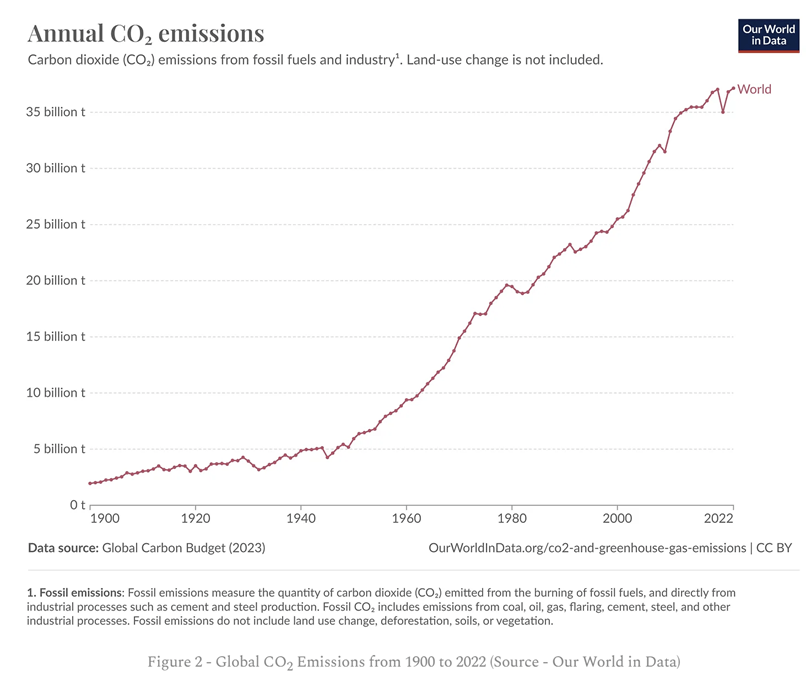
Turver points out issues related to mitigating climate change by reducing emissions. Mitigation only works if CO2 is the only climate control knob but that cannot be the case because we have observed temperature changes over the last thousand years. Mitigation can only work if everyone else slashes emissions too and we can see from Figure 2 (from Our World in Data) that this is not happening.
Adaptation Successes
Turver explains that adaptation since 1900 has dramatically decreased death rates. He includes a figure sourced from Our World in Data.
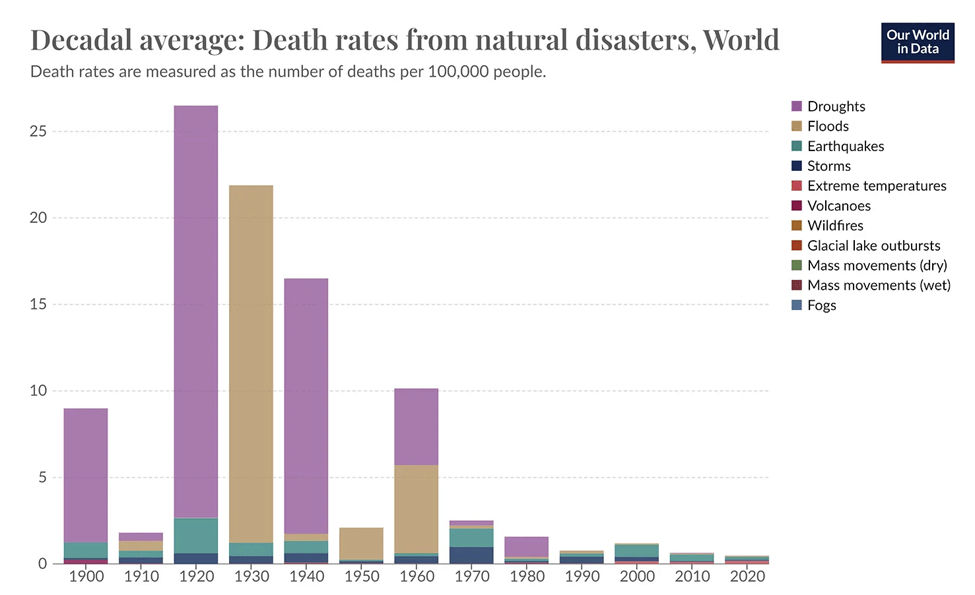
Not mentioned but certainly a factor is that the death rate went down in no small part because fossil fuels increased the ability of society to address the causes listed. Based on past success the obvious alternative is to emphasize adaptation. Turver explains:
Adaptation measures have many benefits. First, they require no international treaty, and they can be applied locally where they produce results quickly. They also work to protect against changes in the climate that are not driven by CO2. Adaptation measures might also have additional benefits such as more efficient water use or more robust crop varieties. There is no reason why we cannot continue to adapt.
New York Effect on Climate Change
There is another aspect of mitigation that is routinely ignored by proponents of the Climate Act. New York emissions are tiny relative to global emissions. In 2021, NYS GHG emissions (GWP-100) were 247 million metric tonnes (MMT). GHG emissions from China were 13,774 MMT and from India were 3,879 MMT. The increase in emission from 2020 to 2021 were 498 MMT in China and 265 MMT in India. New York emissions will be supplanted by emissions from China or India in less than one year. New York’s net-zero transition plan emission reductions will have no effect on emissions and thus no effect on the purported effects of climate change. Adaptation investments in New York infrastructure to reduce the costs of extreme weather impacts will focus on New York so the benefits will be to New Yorkers.
Climate Act advocates frequently argue that New York must take action because our economy is large. I analyzed that claim and summarized the data here. New York’s 2020 Gross State Product (GSP) ranks ninth if compared to the Gross Domestic Product (GDP) of countries in the world. However, when New York’s GHG 2016 emissions are compared to emissions from other countries, New York ranks 35th. More importantly, a country’s emissions divided by its GDP is a measure of GHG emission efficiency. New York ranks third in this category trailing only Switzerland and Sweden. We are already doing our share.
Net Zero Affordability Risks
I think the biggest issue with the Climate Act is affordability. Everyone wants a clean and safe environment but just how clean, how safe and at what price are all value judgements. Turver points out that implementation of net-zero policies like the Climate Act have poorly acknowledged risks:
First and most obvious, they cannot work against climatic changes that are driven by forces other than CO2. Second is the outright cost.
He goes on to describe observed cost increases in the United Kingdom. He makes the point that additional costs also make manufacturing and other production less competitive, which leads to job losses. Ultimately the inability to produce basic needs reduces security. He also points out that renewable energy development requires more materials than alternatives. That has environmental and cost implications.
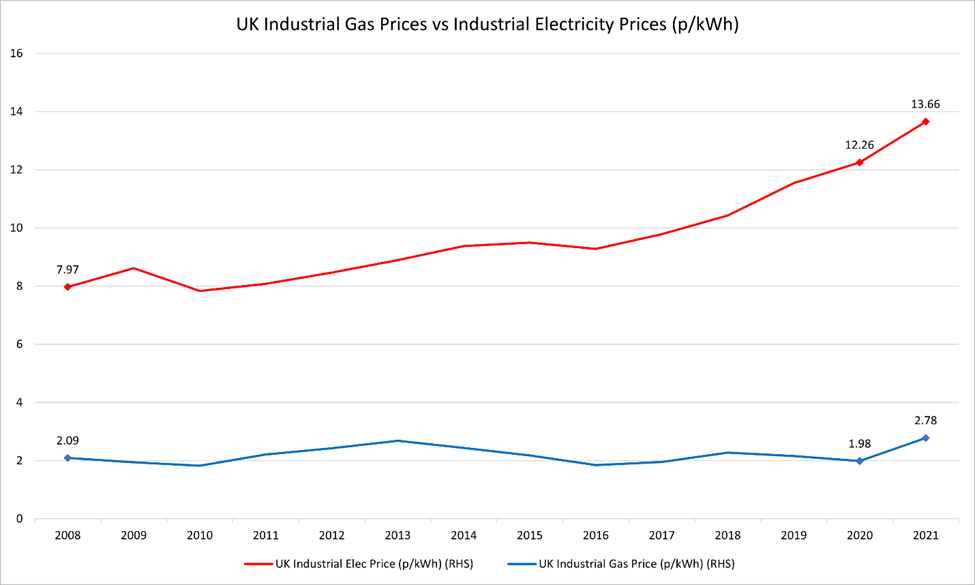
Turver explains that the increased penetration of renewables in the United Kingdom has led to a massive increase in electricity bills. This increase comes from “renewables subsidies as well as grid balancing costs and the massive costs of expanding the grid out to remote offshore wind farms”. The article compares recent United Kingdom industrial gas prices and industrial electricity prices:
As can be seen in Figure 5, from 2008 to 2020, industrial electricity prices rose 53.8% while industrial gas prices actually fell slightly over the same time period. Both gas prices and electricity rose in 2021 as gas prices started to spike as demand increased after Covid lockdowns ended and supply could not keep up with demand. However, even though there was a spike in gas prices in 2021, the increase from 2008 is still only 33%, whereas electricity prices have surged 71.4% over the same period. The figures for 2022 are not yet available, but we might expect to see a big surge in both gas and electricity prices due to supply shortages resulting from the war in Ukraine.
There is no doubt that all these impacts will inevitably occur in New York as the Climate Act mandates are implemented. A recurring theme of many of my posts is that the Hochul Administration has never provided clear and comprehensive cost estimates for all the control strategies in the Scoping Plan
American Offshore Wind Energy Scandal
I believe that the environmental impacts of wind and solar development are greater than the impacts of fossil-fueled or nuclear resource development. In my Draft Scoping Plan comments I noted that on September 17, 2020 the Final Supplemental Generic Environmental Impact Statement (SGEIS) for the Climate Leadership and Community Protection Act was released. It covered the “environmental impacts of the offshore wind and distributed solar procurement goals, and the estimate of utility-scale solar capacity required to meet the meet the 70 by 30 goal” based on the resources estimated necessary at that time. Since then, considerably more resources have been projected but the cumulative assessment has not been updated.
Robert Bryce published an article entitled The Offshore Wind Scandal is Even Worse Than You Think that addresses one of the cumulative environmental impacts that the Scoping Plan ignored. Bryce is an author, filmmaker, and public speaker who has been reporting on the energy sector for more than 30 years. His background enables him to provide graphical evidence to support his arguments that I think are well done. In this article he includes 11 charts that “show how America’s biggest NGOs are colluding with foreign corporations that want to industrialize our oceans with thousands of turbines that will hurt whales and ratepayers”.
He writes:
The hard reality is that America’s offshore wind sector is a subsidy-dependent industry that is dominated by foreign companies who are in bed with some of America’s biggest climate NGOs, including the NRDC (gross receipts: $555 million) and Sierra Club (Gross receipts: $184 million). Those NGOs and others, including the National Wildlife Federation (gross receipts: $142 million) and Conservation Law Foundation (gross receipts: $17.5 million), are leading the most shameful environmental betrayal in modern American history. Rather than seek to protect marine mammals and stop the industrialization of our oceans, they are eagerly promoting the installation of hundreds of offshore wind platforms smack in the middle of the known habitat of the critically endangered North Atlantic Right Whale.
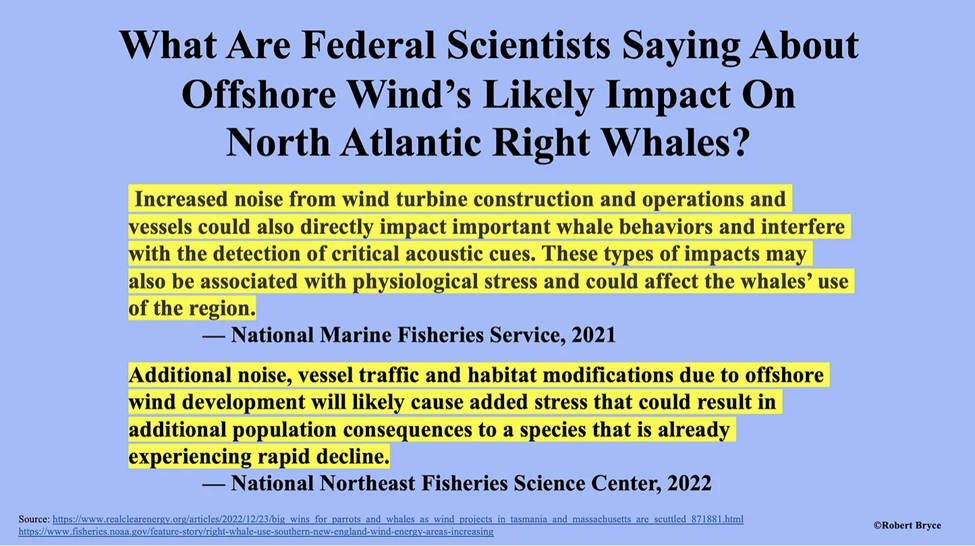
I recommend the article for its details. In this summation I am not going to address all the charts in detail. The first four charts support the quotation above. The fifth chart addresses environmental impacts. The offshore wind shills claim that there aren’t impacts on whales, but Federal scientists disagree.
Bryce describes Chart 6:
I’m old enough to remember when environmental groups cared about whales. Alas, that was a long time ago. On Sunday, the Daily Mail published an article about Apostolos Gerasoulis, a Rutgers professor emeritus of computer science who built a software system to analyze the dozens of whale deaths that have occurred on the Eastern Seaboard over the past few years. Gerasoulis set out to determine if the whale deaths were related to the loud blasts of sonar used by offshore wind survey vessels. His conclusion: “Offshore wind kills whales…The numbers never lie. There is a cause. We have shown that the cause for death of the whales is offshore wind. Period.” (H/t fellow Substack writer David Blackmon.)
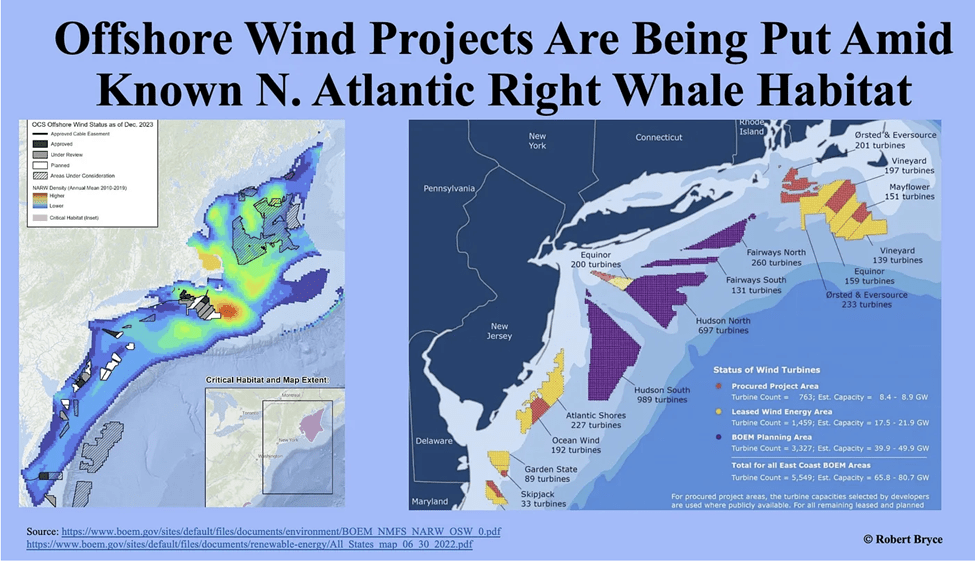
In Chart 7 Bryce notes that the Massachusetts Sierra Club notes that “Because the North Atlantic Right Whale has such a small population and a low annual reproductive rate, a single whale death can have a significant negative impact on the species’ ability to recover.” In Chart 8 he provides a plain English translation of a statement in the Bureau of Ocean Energy Management environmental impact statement of Vineyard Wind: “These projects won’t make any difference on climate change. But they are good because they allow state-level bureaucrats to say they met their policy goals.”
The remaining charts compare offshore wind capacity and costs relative to other resources. He concludes that these developments will markedly increase costs for states that already have some of the highest electricity rates in the country.
I maintain that the New York State has shirked its commitment to the environment because it has not addressed cumulative environmental impacts of the Scoping Plan buildout of wind and solar. No where is this more impactful than the effects on whales in general and the remaining North American Right Whales in particular. Bryce quotes an opponent of offshore wind: “What is Big Wind going to say when they kill the last whale? ‘Sorry’?”
Reliability Risks
I described my concern about the enormous risk of an electric grid relying on wind and solar resources in this post. Since then, I have refined my description of the problem. It boils down to “correlated intermittency”. Let me explain.
Wind and solar are inherently intermittent – the sun does not shine at night and the wind does not always blow. That intermittency is correlated. All the solar in New York is unavailable at night. It turns out that wind resources across New York also are usually high or low at the same time. There are exceptions but there is a high incidence of similar behavior.
That matters for electric resource planning. Today electric resource planning relies on decades of performance experience with hydro, nuclear, and fossil plants that do not correlate, that is to say there is no reason to expect that all the nuclear plants will be offline at the same time. As shown in the following New York Independent System Operator (NYISO) slide, this characteristic enables the resource planners to determine how much generating capacity is necessary to meet the loss of load expectation (LOLE) criterion. The probability of losing load not more than once in ten years is based on observations of the existing uncorrelated generating resources. Importantly, I believe that the lack of correlation also means that the capacity needed above firm system load would not change substantially if the LOLE planning horizon was shifted to 1 day in 20 years.
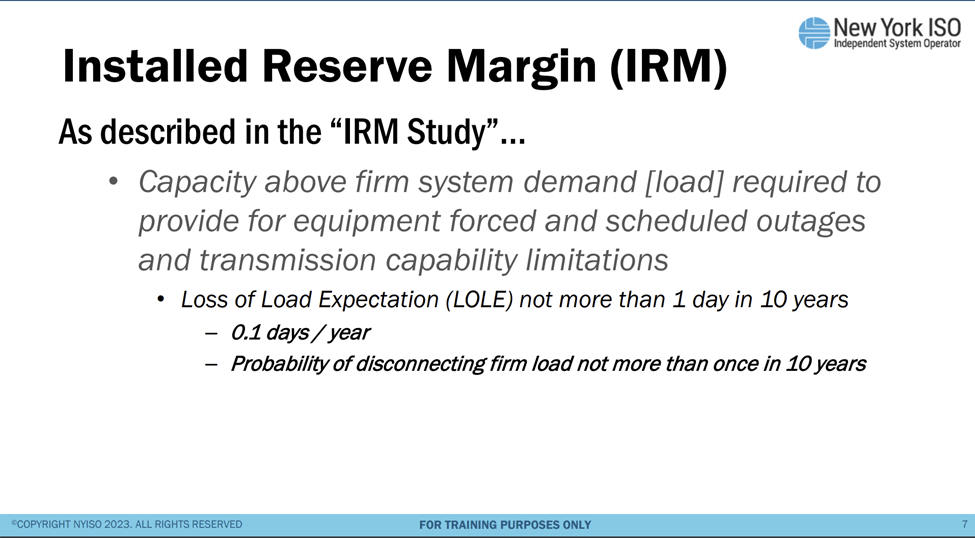
Source: NYISO Amount of Capacity Required, Intermediate ICAP Course, June 2023
The variation in weather that affects wind and solar resource availability will require changes to electric resource planning. Everyone has heard of a hundred-year flood which is the parameter used for waterway planning. This is the one in a hundred probability that the water level in a river or lake will exceed a certain level. Similar estimates of low wind and solar resource availability must be developed and incorporated into electric resource planning.
The unresolved problem is what return period probability is acceptable. If the resource planning process does not provide sufficient backup resources to provide capacity for a peak load period, then blackouts are inevitable. Two factors exacerbate the challenge of this problem:
- Periods of highest load are associated with the hottest and coldest times of the year and frequently correspond to the periods of lowest wind resource availability.
- The decarbonization strategy is to electrify everything possible so the impacts of a peak load blackout during the coldest and hottest periods will be greater.
In an earlier post I described an analysis by the Independent System Operator of New England (ISO-NE) Operational Impact of Extreme Weather Events. The study evaluated 1, 5, and 21-day extreme cold and hot events using a database covering 1950 to 2021. Not surprisingly the system risk or “the aggregated unavailable supply plus the exceptional demand” during an event increased as the lookback period increased. If the resource adequacy planning for New England only looked at the last ten years, then the system risk would be 8,714 MW, but over the whole period the worst system risk was 9,160 and that represents a resource increase of 5.1%. There is no question that a similar analysis for New York would find a similar result.
The correlated intermittency of wind and solar resources means that we will depend on energy-limited resources that are a function of the weather causing low resource availability at the same time. The unresolved issue is how to design an affordable and practical system to meet the worst-case weather induced lull. Consider the ISO-NE analysis where it was found that the most recent 10-year planning lookback period consistent with current LOLE evaluations would plan for a system risk of 8,714 MW. If the planning horizon covered the period back to 1961, the worst-case to 1950, an additional 446 MW would be required to meet system risk. I cannot imagine a business case for the deployment of electric system resources that will only be needed once in 63 years. For one thing, the life expectancy of these technologies is much less than 63 years. Even over a shorter horizon such as the last ten years, how will a required facility be able to stay solvent when it runs so rarely? The only solution is subsidies to build and very high payments when they do run.
Reliability risks have also been identified by the North American Electric Reliability Corporation. They have expressed concerns that extreme weather events, rapid demand growth, and systemic vulnerabilities pose risks for supply shortfalls and grid reliability. These are serious risks to the Climate Act net-zero transition plan that must be resolved sooner rather than later.
Conclusion
I believe that the Climate Act will do more harm than good. Affordability is the first problem. The Hochul Administration has not provided transparent and comprehensive cost estimates for the control strategies proposed for the net-zero transition. The New York State Comptroller Office audit of costs in Climate Act Goals – Planning, Procurements, and Progress Tracking agrees with my concern and recommends a detailed analysis of cost estimates to transition to renewable energy sources and meet Climate Act goals. I believe such an analysis will agree with observed results elsewhere that show the costs will be extraordinary and will certainly affect affordability.
The Hochul Administration has not provided a cumulative environmental impact assessment for the generating resources projected in the Scoping Plan. Nowhere is the potential impact more critical than with respect to whales and the massive deployment of offshore wind proposed. It is incumbent upon the State to prove that there will not be adverse impacts to the critically endangered North American Right Whales.
Finally, there ae reliability risks inherent in a weather-dependent electric grid when all the wind and solar output is reduced at the same time. This raises overarching questions that have not been addressed. Furthermore, even if these weather risks can be addressed in theory, the solution will involve technologies that are not commercially available today. I have no doubts that the only safe way to decarbonize the electric grid is to rely on nuclear power. The Hochul Administration needs to confront these issues before it is too late.
The risks of the Climate Act are all associated with mitigation efforts to reduce GHG emissions. I agree with Turver that mitigation should be emphasized. He concludes:
The risks of climate change can be averted by continuing to adapt, just as we have for millennia. It is certain that unilateral action by the UK, or indeed multilateral action by much of the West, will do nothing to change the weather while the developing world continues to increase their consumption of hydrocarbons to make themselves richer. Indeed, even if mitigation measures were adopted globally, it is naïve to believe that bad weather will cease and we will suddenly get the “stable climate” demanded by more than 170 lawyers.

 Pragmatic Environmentalist of New York
Again, great article.
Judith Curry’s book “Climate Risk and Uncertainty” goes into quite some detail about the decision processes involved in the Mitigation vs. Adaptation debate. For readers of this column who have not done so, I highly recommend it.
Mike Dee
LikeLiked by 1 person
Nicely summed up Roger, pointing out the fallacy of politicians who seem to be overtaken by the climate change activists. I also find it annoying those who manage the grid don’t speak up to point out the dangers we put ourselves in by pushing the elimination of fossil fuels in our daily lives including generating electricity that is not weather dependent. Cold weather is a lot more responsible for human deaths then warm weather but that doesn’t seem to jibe with the climate change activists!
LikeLike