

The Climate Leadership & Community Protection Act (Climate Act) was passed five years ago and the Scoping Plan that outlines how the to implement the required transition was completed 20 months ago. However, the Hochul Administration still has not admitted how much it will cost the consumers of New York. In my opinion, the reason this information is not available is because the costs are politically toxic. This post describes the requirements to provide costs that have been ignored by Governor Hochul.
I have followed the Climate Act since it was first proposed, submitted comments on the Climate Act implementation plan, and have written over 450 articles about New York’s net-zero transition. The opinions expressed in this article do not reflect the position of any of my previous employers or any other organization I have been associated with, these comments are mine alone.
Overview
The Climate Act established a New York “Net Zero” target (85% reduction in GHG emissions and 15% offset of emissions) by 2050. It includes an interim reduction target of a 40% GHG reduction by 2030, and two targets that address the electric sector: 70% of the electricity must come from renewable energy by 2030 and all electricity must be generated by “zero-emissions” resources by 2040. The Climate Action Council (CAC) was responsible for preparing the Scoping Plan that outlined how to “achieve the State’s bold clean energy and climate agenda.” The Integration Analysis prepared by the New York State Energy Research and Development Authority (NYSERDA) and its consultants quantifies the impact of the electrification strategies. That material was used to develop the Draft Scoping Plan outline of strategies. After a year-long review, the Scoping Plan was finalized at the end of 2022. Since then, the State has been trying to implement the Scoping Plan recommendations through regulations, proceedings, and legislation.
Scoping Plan Costs
The Scoping Plan outline for achieving the “State’s bold clean energy and climate agenda” should have provided substantive cost information. Although costs to ratepayers and citizens were requested frequently by several Climate Action Council members the Scoping Plan went to great lengths to obfuscate the expected costs for the net-zero transition. The Scoping Plan supporting documentation does not provide a transparent description of the information needed to estimate consumer costs. At a minimum it should have provided clear descriptions of all proposed control measures, the assumptions made for those control measures, the expected costs for each measure, and the expected emission reductions projected for them. The Scoping Plan does not even summarize sectoral expected costs for the different projection scenarios. The numbers that are provided are buried in an enormous spreadsheet with inadequate documentation so it is impossible to determine what was used.
Instead of providing substantiated numbers the Scoping Plan cost benefit projections provided nothing more than support for the oft-repeated sound bite: the costs of inaction are more than the costs of action. I summarized the machinations used to support this statement in a blog post and argued that the statement was misleading and inaccurate in my Draft Scoping Plan verbal comments and written benefit, and cost/benefit comments. There never has been a response to my comments.
There are substantive problems with the claim that the costs of inaction are more than the costs of action. It is misleading because the Scoping Plan did not include all the costs to meet the Climate Act mandates. Instead, it only included costs directly related to the Climate Act itself and not already implemented programs such as the Clean Energy Standard including 6 GW of behind-the-meter solar, 3 GW of battery storage, and 9 GW of offshore wind. As a result, the acknowledged costs are much less than the total costs of implementation. Also note that this accounting trick was very poorly referenced to hide this chicanery.
The overarching thing to keep in mind is that the costs are real, but the benefits are based on value judgements with a wide range of possible values. Worse, the calculation of the societal benefits expected from carbon dioxide emission reductions was incorrectly applied. The societal benefit was incorrectly applied multiple times rather than just once. Their approach is equivalent to claiming that a wight loss of five pounds five years ago should be counted as a loss of 25 pounds if it was kept off.
All this results in unrealistically low-cost estimates and value-laden high benefit estimates to “prove” the costs of inaction are more than the costs of action.
New York Cap and Invest
The Climate Action Council’s Scoping Plan recommended a market-based economywide cap-and-invest program. The New York State Department of Environmental Conservation (DEC) and NYSERDA are developing the New York Cap-and-Invest (NYCI) Program. In March they took comments on the pre-proposal outline of the regulations but have only had one stakeholder meeting since. On August 15, 2024 a webinar presented “a draft proposed framework for guiding the allocation of these funds and identification of potential areas that could receive investments.” During the webinar they claimed that draft rules would be out later this year and that appropriations and spending of NYCI proceeds would begin in the next fiscal year beginning April 2025. In the stakeholder engagement process at the beginning of the year DEC and NYSERDA claimed they would propose regulations by summer and the final rules would be in place by the end of the year. Clearly this is not happening according to plan.
Implementing a program like this is a major undertaking and I believe that the DEC is unable to respond as quickly as they would like simply because of staffing issues. On the other hand, this program is a carbon tax. There is no way that it will not affect prices significantly so I doubt very much there is any desire to get the program details out quickly. At the Energy Access and Equity Research webinar sponsored by the NYU Institute for Policy Integrity on May 13, 2024 Jonathan Binder stated that the New York Cap and Invest Program would generate proceeds of “between $6 and $12 billion per year” by 2030. In my opinion, these costs are one reason that the Hochul Administration is not in a hurry to release the regulations and proceed with the implementation process.
Comptroller Report
On July 16, 2024 the New York State Comptroller Office released an audit of the New York State Energy Research and Development Authority (NYSERDA) and Public Service Commission (PSC) of their implementation efforts for the Climate Act titled Climate Act Goals – Planning, Procurements, and Progress Tracking. The key finding summary states: “While PSC and NYSERDA have taken considerable steps to plan for the transition to renewable energy in accordance with the Climate Act and Clean Energy Standard, their plans did not comprise all essential components, including assessing risks to meeting goals and projecting costs.”
The Audit Highlights section of the Comptroller Report listed cost-related key findings and key recommendations. The summary of the key findings included a cost-related specific finding:
- The costs of transitioning to renewable energy are not known, nor have they been reasonably estimated. Moreover, funding sources to cover those costs have not been identified, leaving the ratepayers as the primary source of funding. The lack of alternative funding sources adds additional risk to whether the State can meet its goals timely. Data shows utility costs have already risen sharply over the last two decades and more New Yorkers are having difficulty paying their utility bills.
There were three key recommendations related to costs:
• Begin the required comprehensive review of the Climate Act, including assessment of progress toward the goals, distribution of systems by load and size, and annual funding commitments and expenditures.
• Conduct a detailed analysis of cost estimates to transition to renewable energy sources and meet Climate Act goals. Periodically update and report the results of the analysis to the public.
• Assess the extent to which ratepayers can reasonably assume the responsibility for covering Climate Act implementation costs. Identify potential alternative funding sources.
There has been no formal response directly to these findings. Susan Arbetter’s Capital Tonight show featured an interview with NYSERDA President and CEO Doreen Harris and Rory Christian, Chair and CEO of the PSC where the cost findings came up. I wrote an article that focused on Arbetter’s attempts to get either one of them to open up about the costs. Arbetter asked: “I just want make sure that while there are factors that have contributed to the delay in implementation of our energy goals, is there anything leading the Administration to delay this because of cost.” (Note that this is not an exact quote but it is pretty close – check out the video at 1:40/9:00). Harris responded (2:00/9:00 of the video): “The proceeding that is before the PSC is intended to look at just that”. Harris explained: “How much progress have we made, do we need to make, and specifically they look at all this in the context of consumer cost”.
Biennial Report
The Climate Act requires the Public Service Commission (PSC) issue a biennial review for notice and comment that considers “(a) progress in meeting the overall targets for deployment of renewable energy systems and zero emission sources, including factors that will or are likely to frustrate progress toward the targets; (b) distribution of systems by size and load zone; and (c) annual funding commitments and expenditures.” I believe this is the PSC proceeding referenced by Harris. The draft Clean Energy Standard Biennial Review Report released on July 1, 2024 fulfills this requirement.
However, contrary to the Harris claim, I do not think that this report addresses the progress “in the context of consumer cost”. I searched the Biennial Report for “consumer” and only got three results: one for consumer price index and the other two in a paragraph describing the motivation for deregulating the power sector of New York. That may not disprove the claim that the report looks at all of this in the context of consumer costs, but I have not found any sections addressing consumer costs.
The timing is convenient for the election cycle. My cynical take on this is that the draft did not include consumer costs because of the potential for political fallout. By the time that costs are added to the document the current election cycle will be over.
Energy Plan
According to the New York State Energy Plan website:
The State Energy Plan is a comprehensive roadmap to build a clean, resilient, and affordable energy system for all New Yorkers. The Plan provides broad program and policy development direction to guide energy-related decision-making in the public and private sectors within New York State.
The current Plan was initially published in 2015, and updated in 2020, when it was amended to align with the objectives of the 2019 Climate Leadership and Community Protection Act (Climate Act). Since the last update, the Climate Action Council produced its Scoping Plan, examining many of the energy issues that contribute to climate change and offering recommendations that are currently being implemented by the State.
In recognition of the State’s historic clean energy transition, the State Energy Planning Board will now convene, chaired by the New York State Energy Research and Development Authority (NYSERDA), to begin the process of developing a new Plan. Stakeholder engagement is an integral component in the development of the State Energy Plan, and the public will have the opportunity to provide comments on the draft scope and the draft plan throughout the process.
The Energy Plan is a political construct. The Board consists of ten Commissioners all appointed by the Governor, three appointed by the Governor, the President of the Senate, and Speaker of the Assembly, and a non-voting member from the New York Independent System Operator. Given the make up of the Board I expect that all decisions will fit the Governor’s energy narrative.
With respect to the schedule § 6-106. Conduct of the state energy planning proceeding (1) states:
Every four years, the board shall adopt a state energy plan, which addresses each item identified in subdivision two of section 6-104 of this article provided, however, the board may adopt such a plan more frequently for good cause shown. The board shall prepare biennial reports, every second year following the issuance of the final state energy plan, including a discussion and evaluation of the ability of the state and private markets to implement the policies, programs, and other recommendations as found in the state energy plan, and recommendations for new or amended policies as needed to continue successful movement towards implementation and realization of such policies and programs.
The 2015 Energy Plan was the latest edition and the last biennial report came out in 2017. In 2019 the Climate Act was promulgated and in April 2020 an amendment to the plan was adopted that incorporated the new targets. I have never heard an explanation why the plan was not updated. Clearly the Climate Act has a major impact on energy planning but it has been 20 months since the Scoping Plan was completed.
The energy plan required analyses have not been updated since 2015. § 6-104, State Energy Plan (2) (b) says the state energy plan shall include:
(b) Identification and assessment of the costs, risks, benefits, uncertainties and market potential of energy supply source alternatives, including demand-reducing measures, renewable energy resources of4 electric generation, distributed generation technologies, cogeneration technologies, biofuels and other methods and technologies reasonably available for satisfying energy supply requirements which are not reasonably certain to be met by the energy supply sources identified in paragraph (a) of this subdivision, provided that such analysis shall include the factors identified in paragraph (d) of this subdivision;
Identification and assessment of the costs, risks, benefits, uncertainties and market potential of energy supply source alternatives is only possible if there is a feasibility study. There hasn’t been a feasibility study for the Climate Act. On September 9, 2024 the State Energy Planning Board met to kick off this version of the Energy Plan. The following slide outlines the schedule. Note that the comment period on the plan itself is not anticipated until summer 2025.
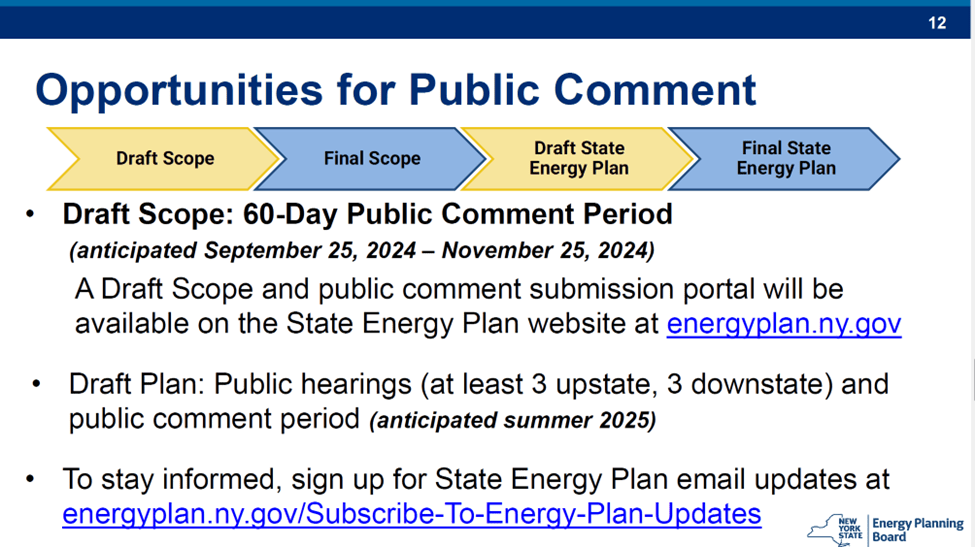
Given that there is an explicit requirement for a cost assessment my money is on this process sliding until after the 2026 elections.
Conclusion
Everyone wants to do right by the environment to the extent that they can afford to and not be unduly burdened by the effects of environmental policies. There is no question that the Climate Act costs will test the commitment of most New Yorkers to doing something about climate change once the costs are revealed.
During the Draft Scoping Plan review by the Climate Action Council, members Gavin Donohue and Donna DeCarolis repeatedly asked for consumer price cost projections. Co-chair Harris did not provide that information then and appears to be stonewalling now.
My cynical take on this is that Scoping Plan contents, the timing for the NYCI carbon tax, the response to the Comptroller’s audit report, the contents of the biennial report, and the timing for the energy plan all are being manipulated to prevent dissemination of expected consumer costs because of the potential for political fallout. As it stands the bad news will not be let out until after the 2024 election cycle. Given the enormity of the potential costs I recommend voting against any candidate who supports the Climate Act simply because we deserve to know the costs.

 Pragmatic Environmentalist of New York
I’m an old, retired, man-made climate change skeptic, power company bulk power (fossil, nuclear, et al) engineer/manager/consultant who’s biased, but it’s obvious to me eliminating CO2 with solar, wind and other intermittent renewables is going to at least 2 to 4 times the cost with fossil fuels plus nuclear and hydro. Intermittent renewables: 1) require a back-up system of the same size; 2) have to be replaced more often; 3) require a much larger transmission system; and 4) increase maintenance costs of back-up generation. There are probably many other costs I’ve overlooked, but these prove my case. In addition, if you go “all electric” and eliminate most combustion sources, you have to rebuild the entire distribution system to handle the increased load. Politicians and activists who think this can be done “at no extra cost to the consumer” are stark raving mad.
LikeLiked by 1 person