
The basis of the emotion driven narrative that there is an existential threat of climate change is fueled by endless articles and opinion pieces in the mass media that conflate every extreme weather event with climate change. Remember climate is what you expect, and weather is what you get. This article describes how the hucksters incorrectly make the extreme weather devastation caused when a rare weather pattern caused the storm to stall into an example of climate change impacts when a hurricane in hurricane alley during the hurricane season occurred.
I have followed the Climate Leadership & Community Protection Act (Climate Act)since it was first proposed, submitted comments on the Climate Act implementation plan, and have written over 450 articles about New York’s net-zero transition. The difference between weather and climate has been a theme in many articles. The opinions expressed in this article do not reflect the position of any of my previous employers or any other organization I have been associated with, these comments are mine alone.
Overview
The rationale for the Climate Act is the existential threat of climate change and the Hochul Administration never misses an opportunity to describe every weather extreme as a more proof. The Climate Act established a New York “Net Zero” target (85% reduction in GHG emissions and 15% offset of emissions) by 2050. It includes an interim 2030 reduction target of a 40% reduction. Two targets address the electric sector: 70% of the electricity must come from renewable energy by 2030 and a requirement that all electricity generated be “zero-emissions” resources by 2040. The Climate Action Council (CAC) was responsible for preparing the Scoping Plan that outlined how to “achieve the State’s bold clean energy and climate agenda.” The Integration Analysis prepared by the New York State Energy Research and Development Authority (NYSERDA) and its consultants quantifies the impact of the electrification strategies. That material was used to develop the Draft Scoping Plan outline of strategies. After a year-long review, the Scoping Plan was finalized at the end of 2022. Since then, the State has been trying to implement the Scoping Plan recommendations through regulations, proceedings, and legislation.
Good Energy Hype
I was prompted to write this post when I came across an opinion piece in the LA Times: Helene destroyed my hometown. I don’t want climate change stories of false hope by Anna Jane Joyner. She is the founder and chief executive of the “story support nonprofit” Good Energy. Last March I did an article about Irina Slaw’s article “Burn, Hollywood, burn” where she called out the blatant indoctrination and propaganda associated Good Energy – “Story support for the age of climate change”.
After noting that she had been checking on the weather and evacuation plans while preparing to board a plane on her way to NYC Climate Week Joyner writes:
The hurricane didn’t come for my partner and me this time, but it destroyed my hometown in the mountains of North Carolina. I’ve spent 20 years working on climate and I live between Los Angeles and the Gulf Coast of Alabama, where I’ve reckoned with the likelihood of one day losing our home. I’ve also accepted that worsening fires, droughts and heat waves could make Southern California unlivable. But Asheville was considered a climate haven. I’ve always told family members we can never sell our homes there. It is utterly unfathomable that it would be devastated first by one of the worst climate disasters in U.S. history. Helene showed us nowhere is safe.
Joyner went on to provide descriptions of the destruction caused by storm. This was followed by her attempt to link the storm to climate change and her climate change false hope argument:
Scientists estimate that climate change increased Hurricane Helene’s rainfall by up to 50% in parts of the Carolinas and Georgia, dumping more than 40 trillion gallons of water. At NYC Climate Week, the annual awareness event held alongside the U.N. General Assembly, the disconnect from this shattering reality was surreal. There were fancy parties, cheerful sun imagery and giant signs reading “HOPE.” The dominant theme was: We can solve this! We need to tell hopeful climate stories! But there’s no “solving” a hurricane wiping out western North Carolina, hundreds of miles from the sea. Only focusing on optimism is like telling a cancer patient that everything will be OK if they just stay positive. At best, it comes across as out of touch; at worst, it feels callous. Yes, we can still prevent the worst impacts and must demand our governments scale solutions and act urgently, but we cannot minimize the horrors unfolding now, or that it will get worse in the coming years.
It gets worse:
Fossil fuel executives have known since the 1970s that burning oil, coal and gas would cause escalating climate catastrophes and worldwide suffering. Yet they lied, sacrificed our safety for their greed and just unleashed an apocalypse on my hometown. Their actions will condemn children today to a planet that’s more hell than Earth by the end of the century if we don’t stop them. It isn’t just a tragedy; it’s a crime against humanity.
Not to worry Joyner will be available to solve this problem by providing stories:
What’s happening in North Carolina doesn’t feel real. I have no emotional framework for this, no story to help me. Right now, what I desperately need are authentic stories that help us figure out how to be human in this changing world, to face this overwhelming crisis with bravery. Stories that help us navigate our very understandable fear, anxiety, grief, despair, uncertainty and anger in a way that allows us to feel seen. Stories that make us laugh — not in ignoring our reality, but in the midst of it — and stories that remind us there’s still so much beauty here to fight for. That capture how, in the living nightmare of climate disasters, people demonstrate extraordinary kindness and creativity, as they’re doing in Asheville and Black Mountain at this very moment. And we need stories that expose the guilt of the fossil fuel industry.
Reality
A quick review of recent articles at Watts Up With That demonstrates that the devastation of the remnants of Helene in the Asheville region was an extreme weather event and not evidence of climate change.
Paul Homewood did a nice summary of the data for Hurricane Helene. His description of the Asheville rain notes:
In Asheville, North Carolina, a total of 13.98 inches (35.52 centimeters) of rain fell from September 25 to 27, according to National Weather Service records. The storm swamped neighborhoods, damaged roads, caused landslides, knocked out electricity and cell service, and forced many residents to evacuate to temporary shelters. Record flood crests were observed on multiple rivers in the state. Flooding was widespread across the southern Appalachians; preliminary rainfall totals neared or exceeded 10 inches (25 centimeters) in parts of Georgia, North Carolina, South Carolina, Tennessee, and Virginia.
Note that the 14 inches of rain occurred over three days. Joyner referenced a statement that climate change increased Hurricane Helene’s rainfall by up to 50% in parts of the Carolinas and Georgia. I found that the reference stated that “In one provisional rapid attribution statement, a trio of scientists at the Lawrence Berkeley National Laboratory said the rainfall over the 24 hours Helene moved through was made up to 20 times more likely in these areas because of global warming.” Comparing the 24 hours in this reference to the three-day storm total makes it clear that storm motion was not considered in rapid attribution statement.
Charles Rotter’s article on the observations of Steve McIntyre and Andy Revkin about the real lessons to be learned from the storm completes the destruction of the arguments in Joyner’s op-ed. McIntyre explains that flood control dams were planned for some of the rivers that had devastating floods but were not built. Clearly there are negative consequences of building dams and positive benefits associated with keeping the rivers open. But if you want to prevent flood damage when you keep the rivers free of dams then you should take prudent actions. Revkin points out that was not the case:
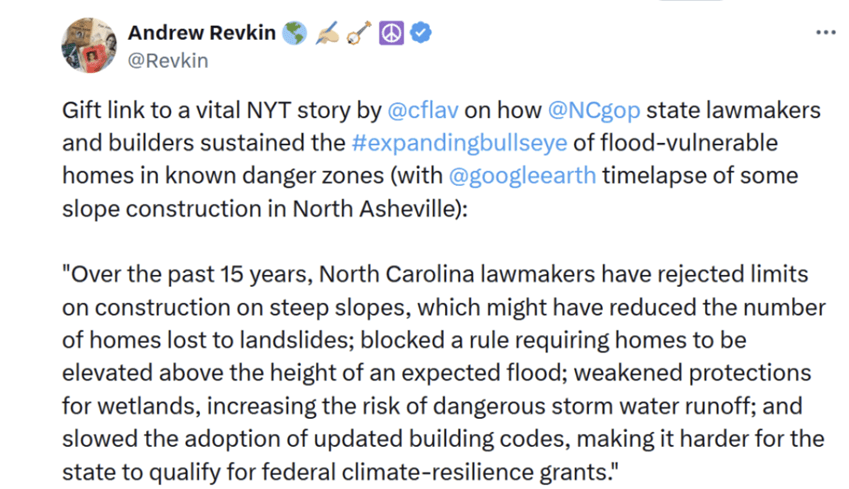
Finally, Revkin described a 1960 report “Floods on French Broad and Swannanoa Rivers around Asheville” explaining what was likely to happen:
Andy reported that the report stated that developments around Asheville “would cause these great floods of the past to be higher if they occurred again. Land fills and buildings in the flood plain and the many bridges across the streams have seriously reduced flood flow capacity.” “On the French Broad River, a flood of the same discharge as the 1916 flood would today be 3 to 4 feet higher between Pearson Bridge and West Asheville Viaduct than the actual flood elevation. On the Swannanoa River, a repetition of the 1916 flood would be up to 2. 5 feet higher today at Biltmore and up to 15 feet higher upstream from the Recreation Park dam.”
Anthony Watts described a couple of articles from Climate Realism that debunked the media claims about climate change effects on the storm. He shows that the claims of climate change worsening storms such as Helene just don’t hold up. Of particular note, is the reference to a massive flood in Asheville in 1916. Matthew Wielicki provides a good comparison of this storm and the 1916 storm. He found that the 1916 flood peaked at 23 feet. In this storm the peak was 24.7 feet.
Note that the 1960 report projected that if there was another 1916 storm that the flood would be between 3 to 4 higher because of development. Hurricane Helene flood waters peaked at less than two feet higher than the 1916 storm. It was development and not climate change.
Conclusion
Joyner concluded her article:
I need help making meaning of all this, and stories have always been how humans make sense of our world. But as I grieve an unimaginable loss, the last thing I want are optimistic stories about hope. As climate scientist Kate Marvel says: “We need courage, not hope, to face climate change.”
I find it difficult to sympathize with the grief of someone who provides Hollywood “story support for the age of climate change” because reality paints a different picture of the world. The data show that Helene was a rather typical hurricane in hurricane alley that occurred in the hurricane season. Devastating floods in Asheville have occurred before and evidence suggests that the greater observed flood peak was probably due to development. There is nothing to suggest that this is anything but an extreme weather event and it certainly is no evidence of any kind of worsening climate change impacts.
In my opinion, the worst part of this is that the usual suspects are using this tragedy to call for US reductions in fossil fuel to prevent this from happening again. Putting aside the lack of a causal link between GHG emissions and specific weather events, the relative magnitude of US and global emissions, and the rate of change of those emissions, the indisputable fact is that storms causing this kind of devastation have happened before and will happen again whatever is done to mitigate emissions. If nothing is done to adapt to this observed extreme weather, then the tragedy will inevitably occur again. Obviously we need to reassess where we are making our investments.

 Pragmatic Environmentalist of New York