

Note: A version of this article was posted at Watts Up With That
I am convinced that implementation of the New York Climate Leadership & Community Protection Act (Climate Act) could have devastating impacts on New York residents as long if proponents ignore lessons that could be learned elsewhere and continue down the current path. This post describes work done in Great Britain that has direct bearing on New York’s implementation plans and shows we need to re-think the tradeoffs of Climate Act implementation.
I believe that implementation of the Climate Act net-zero mandates will do more harm than good if the future electric system relies only on wind, solar, and energy storage because of reliability and affordability risks. I have followed the Climate Act since it was first proposed, submitted comments on the Climate Act implementation plan, and have written over 500 articles about New York’s net-zero transition. The opinions expressed in this article do not reflect the position of any of my previous employers or any other organization I have been associated with, these comments are mine alone.
Overview
The Climate Act established a New York “Net Zero” target (85% reduction in GHG emissions and 15% offset of emissions) by 2050. It includes an interim reduction target of a 40% GHG reduction by 2030. The Climate Action Council (CAC) was responsible for preparing the Scoping Plan that outlined how to “achieve the State’s bold clean energy and climate agenda.” After a year-long review, the Scoping Plan was finalized at the end of 2022. Since then, the State has been trying to implement the Scoping Plan recommendations through regulations, proceedings, and legislation. Recently, the State initiated the State Energy Plan process to update it to be consistent with the Climate Act. It is not clear whether this proceeding will consider stakeholder comments that were ignored during the Scoping Plan process.
Renewable Resource Lulls
The Scoping Plan, Integration Analysis, New York Independent System Operator (NYISO), New York Department of Public Service, the New York State Reliability Council, and others all have noted that a new category of generating resources called Dispatchable Emissions-Free Resources (DEFR) is necessary to keep the lights on during periods of extended low wind and solar resource availability. The frequency, duration, and intensity of wind and solar availability gaps must be known to properly plan to provide the generation, storage, and DEFR resources necessary to maintain reliable service. Analyses done by the New York State Reliability Council Extreme Weather Working Group have shown that extended periods of low wind and solar resource availability will be challenging for the future New York electric system.
On December 24, 2024 I submitted testimony for the December 18, 2024, Assembly Standing Committee on Energy Public Hearing regarding NYSERDA Spending and Program Review. I noted that the biggest feasibility challenge is the identified “gap” when wind and solar resources are low for long periods. As one example of appropriate feasibility funding, I recommend analyzing the variability in low wind and solar resource availability. The characteristics of the resource gaps must be quantified not only for New York but also for adjoining regional systems presuming that they also transition to an electric system with a similar reliance on wind and solar.
The Independent System Operator of New England (ISO-NE) Operational Impact of Extreme Weather Events completed an analysis that addresses this need for New England. The study evaluated 1-, 5-, and 21-day extreme cold and hot events using a database covering 1950 to 2021. The results found that the system risk or “the aggregated unavailable supply plus the exceptional demand” during an event increased as the lookback period increased. If the resource adequacy planning for New England only looked at the last ten years, then the system risk would be 8,714 MW, but over the whole period of record, the worst system risk was 9,160 MW which represents a resource increase of 5.1%. This means that the low renewable resource analysis should cover as long a period as possible to determine the longest period of exceptional demand and low renewable resources.
Great Britain Renewable Assessment
David Turver blogs about energy issues in Great Britain. In an October 2023 post he describes a report from the Climate Change Committee (CCC), their equivalent to New York’s Climate Action Council. He explains that the Royal Society (RS) Large Scale Electricity Storage report authored by Professor Chris Llewellyn-Smith claims that Great Britain can meet its demand for electricity with wind and solar, supported by large-scale hydrogen storage. Large-scale hydrogen storage is the placeholder DEFR technology in the Scoping Plan, so this analysis is directly applicable to New York’s DEFR resource issue.
Turver argues that the report is deeply flawed. Among his concerns are the following:
They begin by assuming that electricity demand will be 570TWh in 2050 which represents roughly halving the energy demand across residential, transport and industrial and commercial categories. The evidence from Our World in Data shows that rich economies require high energy consumption to thrive. There are no rich countries with low energy consumption and those countries that have reduced energy consumption have grown more slowly, or even shrunk. The first extraordinary claim of low energy consumption fails because the evidence shows that if we allow that to happen, we will be much poorer.
The report then goes on to assume that the profile of electricity demand will be the same as today. However, as we move from gas to electricity to heat our homes and offices, the winter surge in electricity demand will be further exaggerated. Moreover, demand will change from year to year such as during the cold winter in 2010 that also coincided with a calm period when we would have generated much less renewable electricity. These variations in demand profile will lead to more generation capacity and an even bigger energy store than RS assumes, pushing up costs.
He goes on to argue that there are other flaws. the report assumes unrealistic load factors for both onshore and offshore wind. It underestimates the amount of offshore wind needed and goes on to assume efficiencies and costs for hydrogen electrolysers, storage, and generation that do not stand up to scrutiny. He also points out that the economic assumptions are flawed.
He describes the “main positive aspect of the report”:
The thing that stands out most is the painstaking analysis that has been conducted to understand the very significant changes in the weather that occur on yearly and decadal timescales. They analysed wind and solar records over 37 years to estimate the level of variation we might expect from wind power.
In a recent article Turver includes a graphic that shows this issue using the 37 year database.
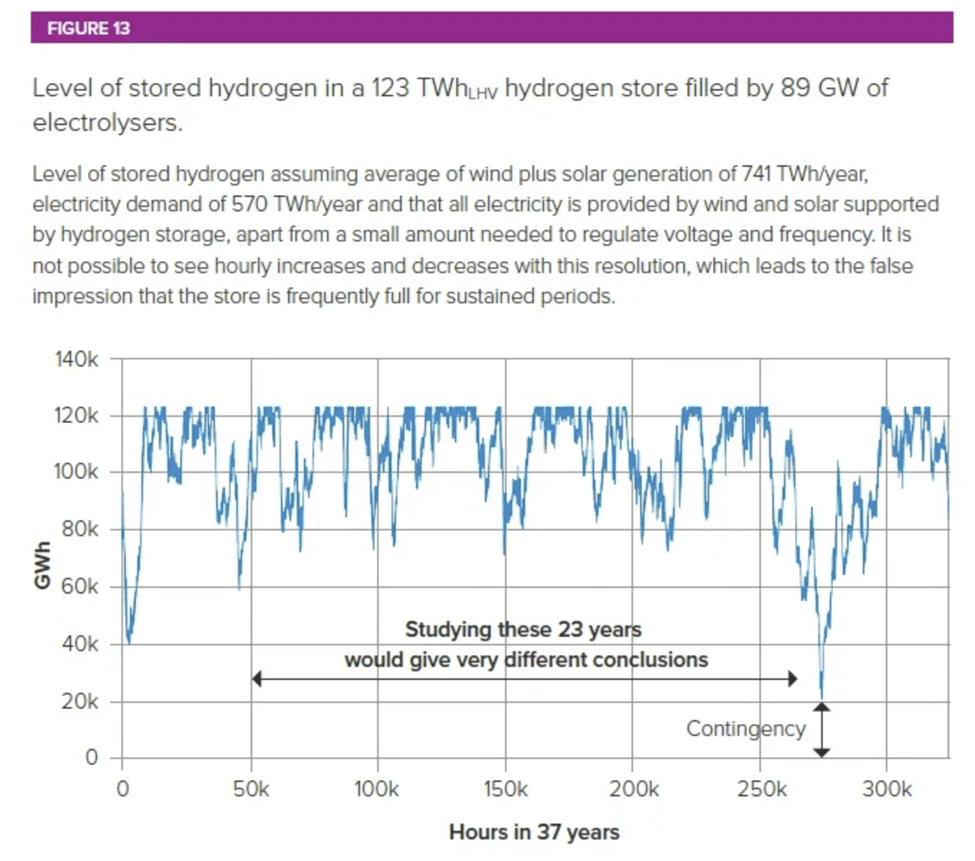
The analysis of 37 years is longer than anything done to date for New York. He also points out an aspect of DEFR that relies on hydrogen storage that I had not considered previously. It is not just the annual worst-case episode but there can be multi-year issues:
They found that we can sometimes have several consecutive years where the wind speed is lower than average. This means that if we are to have a grid powered solely by wind, solar and storage, then we need to build up massive stores of energy in the windy years to be used in the calmer years. They conclude that to consistently deliver their 570TWh of electricity each year, we would need 123TWh of hydrogen storage. Some of that hydrogen may have to be stored for a decade or more before it is used.
He also points out that the requirement for decadal storage is another flaw for any DEFR backup resource:
This has important implications for the economics of storage and effectively rules out batteries as the storage medium. Who would want to spend millions on building a battery or hydrogen storage cavern, even more to fill it and maintain it, yet not see any revenue from it for years after it was completed?
DEFR Backup Reliability Risk
Turver’s article raises the ultimate reliability risk for a weather-dependent electric system. Today’s electric system resource planners for a conventional system base the amount of capacity that they think will be needed based on decades of observations of the fallibility of power plants. The result is that they know the probability there will be a shortage of available capacity to meet load when the installed reserve system capacity margin is a fixed percentage of the expected load very well. In New York State the installed reserve margin to meet the accepted probability of a loss of load expectation of an outage no more than once in ten years reliability metric is around 20%.
A fundamental observation is that there is no expectation that the failure of conventional power plants will be correlated. We do not expect that many will fail at the same time. That in turn means that even if we decided to set the reliability metric based on a one in thirty-year probability that there would not be much of an increase in the installed reserve margin.
That all changes when the electric system transitions to one dependent upon wind and solar weather-dependent resources. We know that solar energy is zero and night and much lower in the winter. Similarly, we know that wind energy is much lower in a high-pressure system, and that those systems are huge and cover all Great Britain and much of western Europe or eastern North America at the same time. Exacerbating the problem is the fact that those conditions are associated with the hottest and coldest episodes with the greatest expected electric loads.
Turver’s post shows that looking at one year is absurd. Not looking at the worst year on record is nearly as bad: “They used 1987 as a 1-in-20 year stress test, when they admit that 2010 was a 1-in-50 year event”. The insurmountable problem is that we know that if an even longer period of record was used there would very likely be an even worse event. Instead of the confidence in the current planning process that increasing the lookback period will not markedly change the resources needed for the worst case, relying on weather-dependent resources means that inevitably there will be a period of extreme weather that exceeds the planning criteria chosen and the expected resources based on those criteria. The costs to provide DEFR backup support will be extraordinary and building excess capacity for a very rare event will significantly add to those costs. This trade-off means that eventually there will be a catastrophic blackout when the load exceeds the storage capacity.
Conclusion
Turver’s articles are further evidence of the DEFR “gap” problems for any electric system that relies upon weather-dependent renewable resources. The first problem is that you have to determine how much DEFR capacity is needed using as long record as possible. The second problem is that there is no commercially available DEFR technology that is available to deploy for the aspirational Climate Act targets. Thirdly, until a DEFR strategy is proposed we have no idea how much this will all cost so any claims that the Climate Act will be “affordable” are incomplete. Finally, there is the insurmountable weather-related probability that eventually there will be a unusual set of weather conditions and load requirements that exceed the DEFR resources deployed.
To sum up: we know that a new resource will be needed, we don’t know how much, what it will be, how much it will cost, and that whatever we do eventually it won’t be enough so people will die in a catastrophic blackout. This is insanity.

 Pragmatic Environmentalist of New York
None of this has been demonstrated at any reasonable scale. It likely will not be because a demonstration would likely fail and expose its massive costs. The ultimate implementation at full-state scale would likely be “exciting” and perhaps “inciting”. I think Albany would be a fitting demonstration site.
LikeLike