I recently published a status update on New York State wind and solar capacity factors. Peter Carney alerted me to New York Independent System Operator hourly wind and wind curtailment data for 2024. I have not been able to find those data sets since I evaluated the 2021 data so this article summarizes 2024 wind data.
I am convinced that implementation of the Climate Act net-zero mandates will do more harm than good because the energy density of wind and solar energy is too low and the resource intermittency too variable to ever support a reliable electric system relying on those resources. I have followed the Climate Act since it was first proposed, submitted comments on the Climate Act implementation plan, and have written over 540 articles about New York’s net-zero transition. The opinions expressed in this article do not reflect the position of any of my previous employers or any other organization I have been associated with, these comments are mine alone.
Overview
The Climate Act established a New York “Net Zero” target (85% reduction in GHG emissions and 15% offset of emissions) by 2050. It includes an interim reduction target of a 40% GHG reduction by 2030 and a mandate for zero-emissions electricity by 2040. The Climate Action Council (CAC) was responsible for preparing the Scoping Plan that outlined how to “achieve the State’s bold clean energy and climate agenda.” After a year-long review, the Scoping Plan was finalized at the end of 2022. Since then, the State has been trying to implement the Scoping Plan recommendations through regulations, proceedings, and legislation.
This article summarizes the hourly wind production (MW), hourly wind curtailments (MW) and capacity factors for 2024. Production is simply the generation from all industrial wind turbines each hour. The New York Independent System Operator (NYISO) describes curtailment of wind as limits on their output when it is economically or operationally necessary to reduce wind generation. The capacity factor is a useful metric to understand electric generation resources. The annual capacity factor for a generator equals the actual observed generation (MWh) divided by maximum possible generation (capacity in MW times the hours in a year).
2024 Wind Resources
The New York Independent System Operator (NYISO) 2024 Load & Capacity Data Report (also known as the “Gold Book”) is now available at the NYISO website: 2025 Load & Capacity Data Report. Table 1 lists the capacity data and net energy produced for the wind generating units in New York from that report.
Table 1: NY 2024 Wind Facilities in the 2025 Gold Book
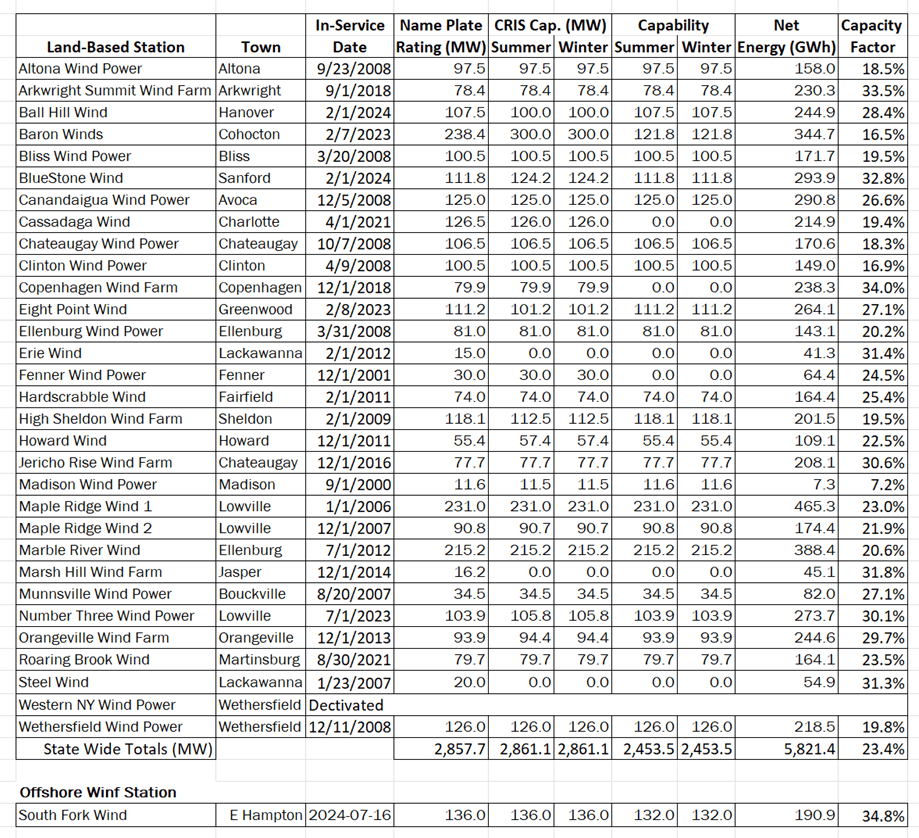
Table 2 summarizes the hourly NYISO wind production and curtailments in 2024. I do not think that the production results are particularly impressive. The percentiles are shown in the first column and the data indicate that wind power is greater than 71% of the total capacity only 87 hours (99th percentile) in 2024. Three quarters of the time, the production is less than 1,053 MW equivalent to about one third of the total capacity. If you assume that less than 10% of production is the threshold for appreciable support to the grid, then wind was not producing meaningful power 30% of the time. I calculated that there was a period of 107 consecutive hours when the wind production was less than 10% of the total. Curtailments do not appear to be an issue in New York yet.
Table 2: 2024 NYISO Hourly Wind Production Summary for the Entire New York Control Area
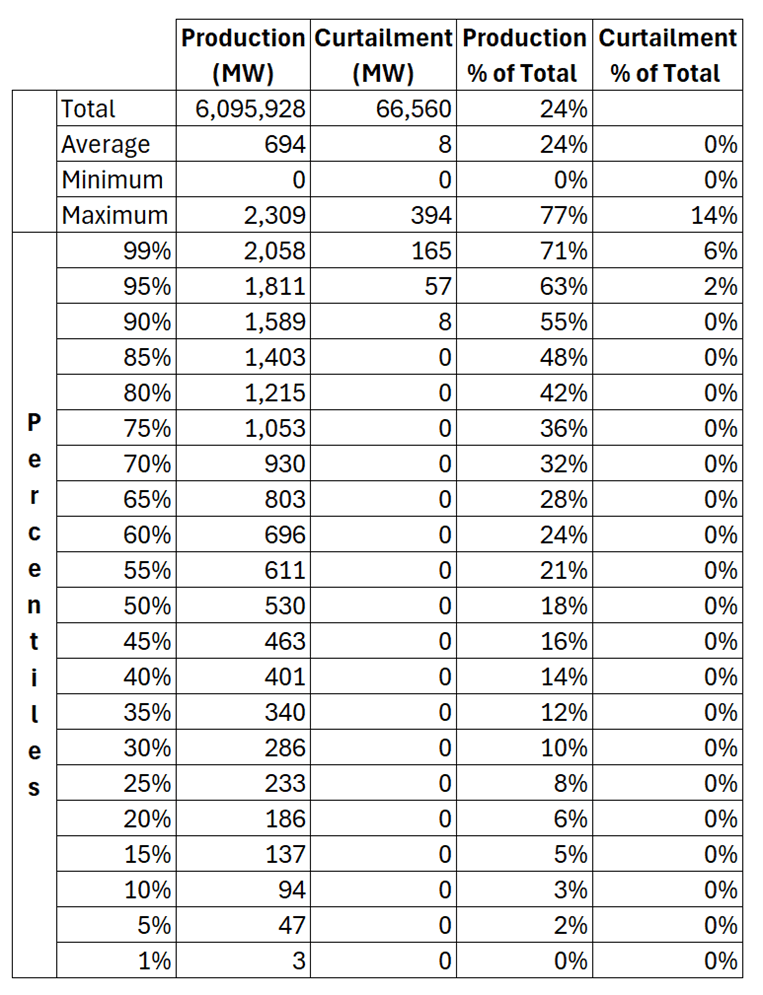
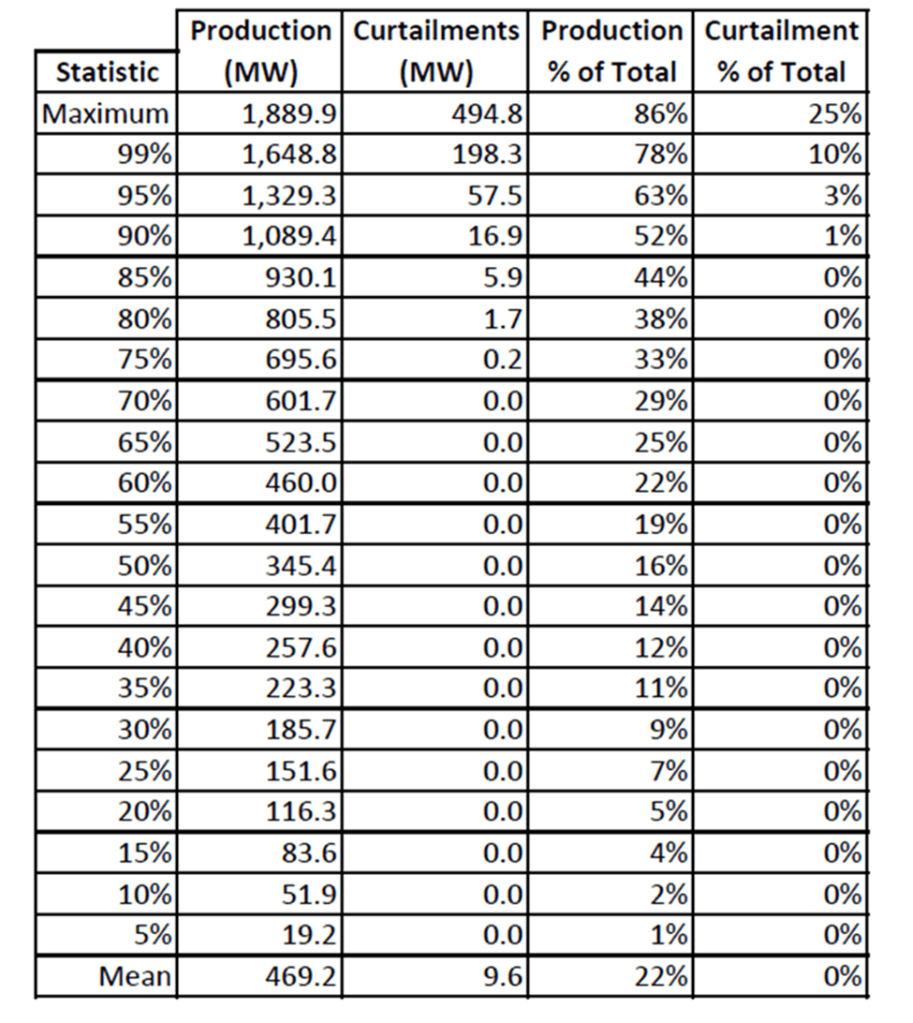
Table 3 summarizes the hourly production in 2021 and is useful to show interannual variation. In 2021 the 99th percentile was slightly better at 78% compared to 71% in 2024. At the 75th percentile production was 33% of the total in 2021 and in 2024 it was 36%. The 10% threshold was 30% in both years. In my opinion there was no substantive difference between 2021 and 2024.
Table 3: 2021 NYISO Hourly Wind Production Summary for the Entire New York Control Area
Curtailment Discussion
Parker Gallant keeps track of wind energy production in Ontario and the problem of what to do with excess wind energy when the production from Ontario exceeds the load. The current strategy is to dump the excess power into Quebec, New York, and Michigan at a low price which has short-term consumer benefits to those jurisdictions. However, Gallant has documented that through 4/26/25 dumping the excess wind and solar energy cost Ontario ratepayers a total for the month had reached $101 million which is about $20 per Ontario household. I suspect that when New York builds all the wind capacity needed for the Climate Act that similar problems will occur in New York. How that affects Ontario the curtailment situation in Ontario is open for discussion.
Production Discussion
The production results have an important ramification for resource planning. The existing wind facilities are spread across the state and wind production is highly correlated. Half the time the total generation capacity is around 17% of the total. This means that improving energy production substantially requires a lot more generation capacity. For example, in 2021 the production at the 25th percentile was 151.6 MW and in 2024 the production at the 25th percentile was 233 MW an increase of 81 MW. However, the nameplate capacity in 2021 was 2,191 and in 2024 it was 2,858 MW an increase of 667 MW. The investment of 667 MW of wind capacity only increased production 81 MW at the 25th percentile.
In my previous article I discussed the unreconciled differences between the Integration Analysis and observations. Three years later there still hasn’t been any acknowledgement that the Integration Analysis overestimated the production capability of wind investments. This means that more wind development is necessary to meet the Climate Act goals.
Conclusion
The Climate Act 2040 zero-emissions target will require much greater reliance on wind and solar generating resources. Unfortunately, the authors of the Climate Act did not recognize limitations for those resources. These results show that land-based wind in New York is not a particularly good resource. Wintertime solar is poor because of New York’s high latitude with short days in the winter and cloudiness downwind of the Great Lakes. The ramifications on reliability and affordability of these poor resources has not been acknowledged.
Three years ago, I noted that it is imperative that the State conduct a detailed evaluation of renewable energy resource availability to determine the generation and energy storage requirements of the future New York electrical system. There has been some progress in the evaluation of renewable resources, but the ramifications have not inspired any reaction by the those responsible for future energy planning. In my opinion, resolving the issues shown in this article need to be addressed sooner rather than later.

 Pragmatic Environmentalist of New York
We should be sure that as New York and Ontario are neighbours that we both experience the same variable generation from wind and solar. The grid operator here in Ontario is IESO and they used to forecast that wind generation in the shoulder months (spring and fall) would average 45% of their capacity and 15% in the winter and summer months but they have abandoned forecasts. Perhaps they realized our peak demands occur in the summer when it is hot and in the winter when it’s cold but that is when wind is basically absent. It is hard to understand why those running the grids so easily bow to the beliefs of the politicians and bureaucrats instead of using facts to plan for our energy needs!
We are now seeing a push for battery storage in Ontario but many municipalities are saying NO after seeing what has happened in California and elsewhere around the world due to nasty fires!
LikeLiked by 1 person
Roger,
I do not think that the production results are particularly accurate. In my neck of the woods, The Bliss Windpark, the Orangeville Wind farm, and the Weathersfield Wind project are contiguous and create one large wind energy are in western NY. They are so close together (and btw Alle-Catt turbines would reach to within 1/4 mile of the Bliss project) that the substantial differences on capacity factor reported by NYISO are suspect: 19.5%, 29.7%, and 19.8%, respectively, All three projects use 450-foot-tall wind turbines.
LikeLiked by 1 person
Interesting. i agree that the differences are concerning. I will look into it
LikeLike
Ah yes, no mention of the cost of nuclear. In NYS 20 billion dollars for the numerous cost over runs over the past 25 years. Please read my articles on the subject. This could help bring a more realistic evaluation. Wind is actually quite predictable. Properly placed wind turbines can produce power 55% of the time. With a proper grid system even higher. Offshore wind could easily produce sufficient electricity to the whole state. But NIMBYs don’t want it. Curiously you don’t offer a solution either.
LikeLike
Note that of the 30 land-based projects operational in 2024, none produced more than 34 percent of their rated capacity (Table 1). The one off-shore project was 34.8 percent. NYS wind has averaged in the low 20s for many years. Larger capacity factors are obtained off-shore and in the High Plains, but even there the annual average production rates are in the 40s.
LikeLike