
This is part of my continuing coverage of the New York State Energy Plan. My intent is to describe most of the sections of the June 25, 2025, meeting presentation. As part of my attempt to reduce the size of my articles I will focus this article on the Pathways Analysis modeling approach scenarios. A previous article introduced the Pathways Analysis that is being used for the draft Energy Plan
I am convinced that implementation of the New York Climate Leadership & Community Protection Act (Climate Act or CLCPA) net-zero mandates will do more harm than good if the future electric system relies only on wind, solar, and energy storage because of reliability and affordability risks. I have followed the Climate Act since it was first proposed, submitted comments on the Climate Act implementation plan, and have written over 550 articles about New York’s net-zero transition. The opinions expressed in this article do not reflect the position of any of my previous employers or any other organization I have been associated with, these comments are mine alone.
Energy Plan Overview
According to the New York State Energy Plan website (Accessed 3/16/25):
The State Energy Plan is a comprehensive roadmap to build a clean, resilient, and affordable energy system for all New Yorkers. The Plan provides broad program and policy development direction to guide energy-related decision-making in the public and private sectors within New York State.
I have provided more background information and a list of previous articles on my Energy Plan page. My biggest concerns are whether the Hochul Administration will use the Energy Plan process as an opportunity to consider the implications of the observed transition so far and if the advice of stakeholders in its stakeholder process will be treated as an opportunity to improve the transition or an obligation with no attempt to meaningfully engage with any comments inconsistent with the narrative
June 25, 2025 Board Meeting
The materials for the meeting include the following:
- Meeting Notice [PDF]
- Board Meeting Presentation [PDF]
- Board Meeting Recording Meeting Recording
I have included links to the locations of the video in the following descriptions. Also note that a transcript of the presentations is included at the meeting recording video platform. There is a nice feature for this video. If you set auto scroll on then you can follow the presentation transcript. All quotes below come from that transcript.
I previously summarized this meeting’s presentations that described the analyses conducted for the State Energy Plan and described the electricity topic area. I also published an overview of the Pathways Analysis. This article addresses the bottom-up modeling framework.
Pathways Analysis Introduction
Karl Mas introduced the modeling framework discussion. It is notable that he acknowledged that there are issues:
I’d first like to acknowledge that conducting such analysis during a time of uncertainty is challenging, as Chair Harris noted. And it’s true with all aspects of our economy, the energy system has been impacted by the supply chain disruptions, high interest rates, inflation, and changing federal policy landscape. Yet the work must provide a rigorous economy wide view of how New York will meet the energy needs over the planning horizon while making progress on the state’s policy objectives.
Unfortunately, there is a difference between saying there is uncertainty and applying that constraint to the modeling analysis. After acknowledging uncertainty, Mas said the “the work must provide a rigorous economy wide view of how New York will meet the energy needs over the planning horizon while making progress on the state’s policy objectives.” My primary concern with this kind of modeling is that I know that the results are affected by modeler biases and their choice of assumptions. This sentence all but explicitly admits that NYSERDA is going to get an answer consistent with the Climate Act schedule and ambition. Even though Mas went on to qualify his assertion, I remain unconvinced:
Looking out over fifteen years requires assumptions regarding technology progress and policy achievement. To address uncertainties in both these areas, the analysis takes a realistic yet ambitious approach and explores several potential scenarios to better understand the full spectrum of possible outcomes.
One of the significant failings of the Scoping Plan modeling is that NYSERDA did not show their work, especially the assumptions made. When there were enough details for explicit stakeholder comments showing issues, they were ignored. I fully expect that NYSERDA will continue that approach. If that happens then “realistic yet ambitious approach” is no more than a slogan.
Pathways Analysis Modeling Approach
Nick Patane, Assistant director for policy analysis at NYSERDA described the pathways analysis modeling approach in more detail. His description of the modeling approach never mentioned which model was being used which leads me to believe that this is an in-house analysis. He explained:
There’s two main modules that we use in the analysis. The first is our economy wide model. This model takes as input, key data from other NYSERDA industry studies and programs. It models stock turnover and sales of, key equipment across, the buildings, transportation, and other demand sectors. This allows us to develop a perspective on fuel use as well as electric loads and peaks, and net emissions.
Our information on electric loads is then passed off to the second module, which is our electric sector model. This module, builds out an electric system to meet those loads, maintain reliability, and achieve any scenario specific, policy constraints.
That information on the electric system costs and emissions then feeds back to the economy wide model, for an aggregated roll up of economy wide benefits and costs.
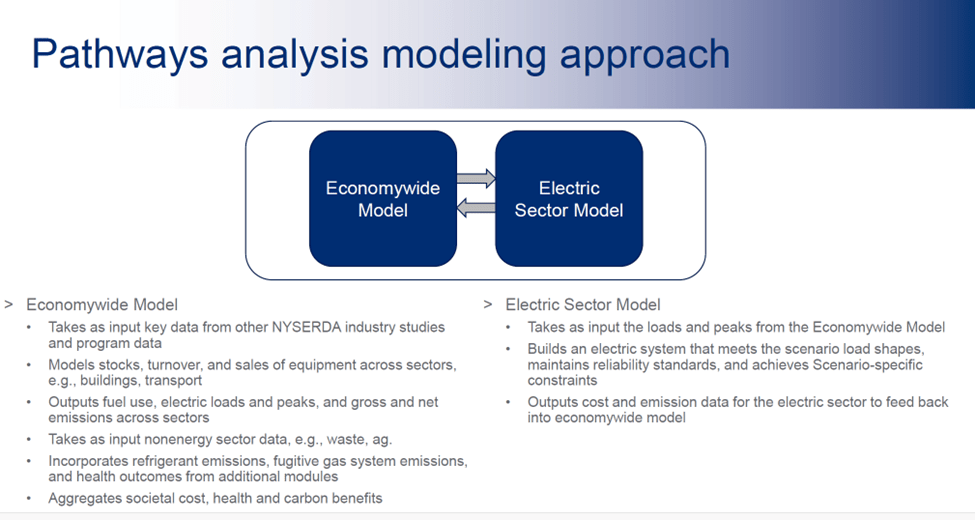
This is an enormous effort and full of opportunities to tweak results towards a desired outcome. NYSERDA analysts must interpret each of these factors for every energy component across every sector of the economy. The description of the economywide model describes six factors that affect the results. Consider just “Models stocks, turnover, and sales of equipment across sectors, e.g., buildings, transport”. Later in his presentation Patane mentions building shells, the protective envelope of a building that includes insulation and energy efficiency windows and doors. To model that NYSERDA must estimate the New York building shell status across the state, determine what could be done to improve the building stock, and how much increased efficiency will change the energy use. Clearly, reasonable people can make different assumptions about these factors that in aggregate and over time can generate significantly different results. With all due respect, if I was the analyst charged with determining “how New York will meet the energy needs” in a politicized organization, my choices might be guided by the desired results. This reinforces the absolute need for clear and transparent documentation.
After describing current energy use noting that buildings (50%) and transportation (40%) are the primary energy uses today, Patane described five energy future scenarios to estimate the potential impact of different policies. The first scenario is “No Action”:
Our first case is what we call the no action case. You could think of this as sort of the world absent the climate act and the New York, state and local energy policies that have stemmed from it. It includes an extension of historic policy interventions, native market adoption, and federal policies as of the time of the modeling earlier this year.
Recognize here again that there’s significant uncertainty on the future of many federal clean energy policies, and we plan to explore any impacts of future changes, as we go into the final energy plan.
This case will act as a point of comparison against which we can compare the other scenarios to understand what are the net benefits and that costs and other trade offs of New York’s clean energy policies.

The results of the modeling are affected by the definition of the strategies used in the No Action case. In my opinion, I want to know what reduction strategies will be imposed on me and how much it is going to cost me to achieve the Climate Act goals. I do not care which clean energy policy requires them. This is another opportunity that NYSERDA used in the Scoping Plan analysis to modify the results to fit the desired outcome. In the Scoping Plan impacts of the policies were compared to a Reference Case that included “already implemented programs” that resulted hid significant costs to meet Climate Act targets. The interpretation of “extension of historic policy interventions, native market adoption, and federal policies” all could have similar impacts to the point where claiming this is a “no action” scenario is misleading. In my opinion, there should be a sixth case that excludes all programs necessary to achieve Climate Act goals.
I agree with the other strategy scenarios They cover the full gamut of potential outcomes. Note that the “Current Policies” scenario includes “deployment of clean electric generation in line with the Clean Energy Standard biennial review”, which concedes that the 2030 70% renewable grid target cannot be achieved until 2033. The third scenario is “Additional Action”:
This case includes all the policies from current policies and then layers on top of that, continued acceleration of adoption of clean energy technologies out to the future from some mix of future policies.
These can include things like environmental markets, increasing investments, and other recommendations, from the individual sectors of the the state energy plan.
As Doreen noted in her introductory remarks, current policies and additional actions are our core planning cases for this exercise. They represent a more bottoms up accounting.
For example, current policies reflecting the energy system that we expect under current policies, additional action reflecting achievable, but ambitious further progress.

This is where the modeling analysis starts to get into wishful thinking. Are there any indications that “achievable, but ambitious further progress” is possible? Even without the Federal policy changes that threaten the anticipated renewable deployments it has become clear that affordability and reliability issues can no longer be ignored.
The two remaining scenarios address pathways to net zero by 2050. Reading between the lines there is acknowledgement that this target will be an enormous challenge.
These scenarios continue to lean on similar levers like electrification and efficiency, but to much greater extent Also introducing new levers that aren’t contemplated by current policies.
In our work, we have two different net zero scenarios. The primary difference here is the use of hybrid heating for buildings that retain a gas connection for use on the coldest days.
Net Zero A has limited use of this hybrid heat pump, and more all electric customers. Net Zero B has expanded use of customers that retain a supplemental gas heating system. And this allows us to sort of explore the potential value of a larger residual gas network on mitigating, electric system peaks, and the associated building costs.
The inclusion of a scenario that maintains gas supply is a good starting point to acknowledge that going to zero emissions massively increases costs and complexity. I believe that this is entirely appropriate to include.
Discussion
The recent passage of the Big, Beautiful Bill Act will have massive implications for the Climate Act net-zero transition. In the meantime, the Energy Plan proceeding goes on. The presentations are a mixed bag. There are acknowledgements of the potential impacts of uncertainty which is good. I am disappointed by the similarities to the Pathways Analysis “No Action” scenario and the Scoping Plan “Reference Case”. NYSERDA is not following standard practice with this and the potential for misleading results looms large.
I cannot over emphasize the necessity of clear and transparent documentation. If it is not provided, then the results will not be credible. I hope, but do not expect, that NYSERDA will address the comments of stakeholders.
It has become clear to me that addressing all the issues in this meeting’s presentations while keeping my articles to around 2,000 words is going to mean more posts than I originally anticipated. Stay tuned.
Conclusion
New York is at a crossroads The inevitability of Climate Cost affordability being a political liability has been acknowledged even by Hochul. Saying that there is “significant uncertainty on the future of many federal clean energy policies” is quite the understatement. Frankly, the potential for existential changes to renewable energy development must now be considered. This is the perfect opportunity for politicians to stop a program that even they must realize is not working according to plan. Throw in the ability to blame somebody else now, I bet we soon see something along the line of we wanted to do this but Bad Trump made us stop. The alternative is to use this process and conclude the schedule and aspirations of the Climate Act need to be reconsidered. That will take a lot of time though.


