
Note: This post was updated on 7/22/25 to note that the “Limited Building Rate Scenario” projects a zero-emissions grid in 2045, five years later than the Climate Act target.
This is part of my continuing coverage of the New York State Energy Plan. My intent is to describe most of the sections of the June 25, 2025, meeting presentation. As part of my attempt to reduce the size of my articles I will focus this article on a portion of the modeling results with a follow up post with the rest. Previous articles described the Pathways Analysis that is being used to project energy scenarios for the draft energy plan and the modeling scenarios used in the Pathways Analysis.
I am convinced that implementation of the New York Climate Leadership & Community Protection Act (Climate Act or CLCPA) net-zero mandates will do more harm than good if the future electric system relies only on wind, solar, and energy storage because of reliability and affordability risks. I have followed the Climate Act since it was first proposed, submitted comments on the Climate Act implementation plan, and have written over 550 articles about New York’s net-zero transition. The opinions expressed in this article do not reflect the position of any of my previous employers or any other organization I have been associated with, these comments are mine alone.
Energy Plan Overview
According to the New York State Energy Plan website (Accessed 3/16/25):
The State Energy Plan is a comprehensive roadmap to build a clean, resilient, and affordable energy system for all New Yorkers. The Plan provides broad program and policy development direction to guide energy-related decision-making in the public and private sectors within New York State.
I have provided more background information and a list of previous articles on my Energy Plan page. My biggest concerns are whether the Hochul Administration will use the Energy Plan process as an opportunity to consider the implications of the observed transition so far and if the advice of stakeholders in its stakeholder process will be treated as an opportunity to improve the transition or as an obligation with no attempt to meaningfully engage with any comments inconsistent with the narrative
June 25, 2025 Board Meeting
The materials for the meeting include the following:
- Meeting Notice [PDF]
- Board Meeting Presentation [PDF]
- Board Meeting Recording Meeting Recording
I have included links to the locations of the video in the following descriptions. Also note that a transcript of the presentations is included at the meeting recording video platform. There is a nice feature for this video. If you set auto scroll on, then you can follow the presentation transcript. All quotes below come from that transcript.
I previously summarized this meeting’s presentations that described the analyses conducted for the State Energy Plan, the modeling approach, and described the electricity topic area. This article will describe the load projections and electric sector’s economywide results.
Economywide Results
Nick Patane, Assistant Director for policy analysis at NYSERDA presented the preliminary economywide results from the modeling analyses. This modeling analysis is consistent with the Integration Analysis in the Scoping Plan and the New York Independent System Operator (NYISO) projections. They all expect significant increases in total and peak electric loads due to electrification of buildings and transportation. There need to be transformational changes to all sectors to meet the Climate Act goals.
Figure 1 graphs the annual load projections. The presentation slide states:
- Loads grow in all cases over the study period, driven especially by new large loads (+16 TWh) and to various extents vehicle electrification
- Vehicle electrification drives significant additional load growth (+14-17 TWh) in Current Policies and Additional Action
- Building efficiency plays an important role in offsetting building electrification load growth in Current Policies and Additional Action, underscoring the importance of these investments The Net Zero cases see the greatest load growth driven by significant additional building and industrial electrification which would require a transformational infrastructure buildout
In my previous posts I pointed out that the Pathways Analysis scenario “Current Policies” includes programs that are necessary to meet Climate Act targets. I expect that when NYSERDA presents costs they will present them relative to current policies rather than to “no action”. If added loads are proportional to costs, then this graph shows that approach will underestimate total consumer costs.
Figure 1: Annual Loads

Figure 2 describes the annual peak load. The presentation slide states:
- New large loads (+2.5 GW) and vehicle electrification to varying degrees will drive peak load growth in all cases, necessitating a system expansion
- Vehicle electrification further increases peak growth in the Current Policies and Additional Action cases (+3.5 GW)
- Accelerated heat pump adoption in the Net Zero cases drives further peak growth, but the effects are somewhat mitigated in Net Zero B due to the increased hybrid heating
- No Action, Current Policies, and Additional Action remain summer peaking through 2040. Net Zero A becomes winter peaking, while Net Zero B becomes dual peaking
- Flexible loads can play an important role in mitigating peak growth (contributing up to 1 GW in peak reductions by 2040 in Current Policies and Additional Action)
In the past NYSERDA has classified vehicle electrification as a “current policy” because it was a federal policy. The Trump Administration has made it known that they are going to stop the electric vehicle mandates of the prior Administration, so this removes support of 3.5GW that New York is now going to have to deploy without help. One of the magic tricks of the NYSERDA plan is using flexible loads to mitigate peak growth. That consists of assuming that 2.5 GW new large loads will be willing to shut down operations at the whim of low wind and solar resource production. That is not conducive to manufacturing profitability.
Figure 2: Annual Peak Loads

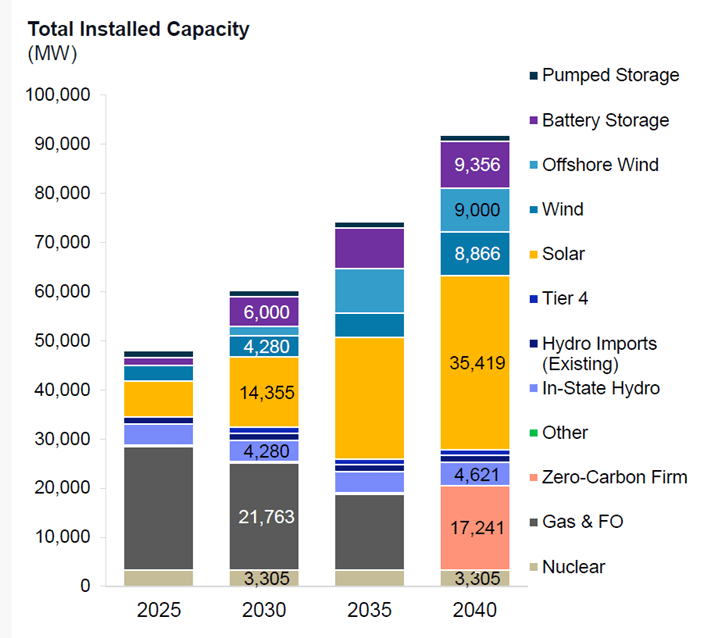
Figure 3 contains some eye-opening points about the additional actions needed in the electric sector to meet the Climate Act mandates. NYSERDA mentions that the Pathways Analysis agrees with the CES Biennial Review that the 70% renewable goal cannot be met until 2033. In a massive under statement they note that “A significant ramp up of deployment will be needed to achieve zero by 2040”. NYSERDA again mentions a “significant buildout of a diverse set of resources” is required. Existing hydro and nuclear must be kept online to meet the zero emissions by 2040 mandate. In a major concession they admit that while “Many aging combustion units retire over the model period. 6 GW are repowered, and the 17 GW fleet is converted to run on Hydrogen by 2040”. Assuming that hydrogen will be available is sufficient quantities in 2040 is magical thinking as is claiming that the combustion fleet will be smaller due to “availability of other firm resources, like storage and Tier 4 hydro imports”. If there is such a thing as wishful and magical thinking, then this bullet exemplifies it: “Zero emission resource definition is under development and hydrogen serves as an illustrative resource for firm dispatchable power”.
Figure 3: Electric Sector Capacity (MW) Buildout
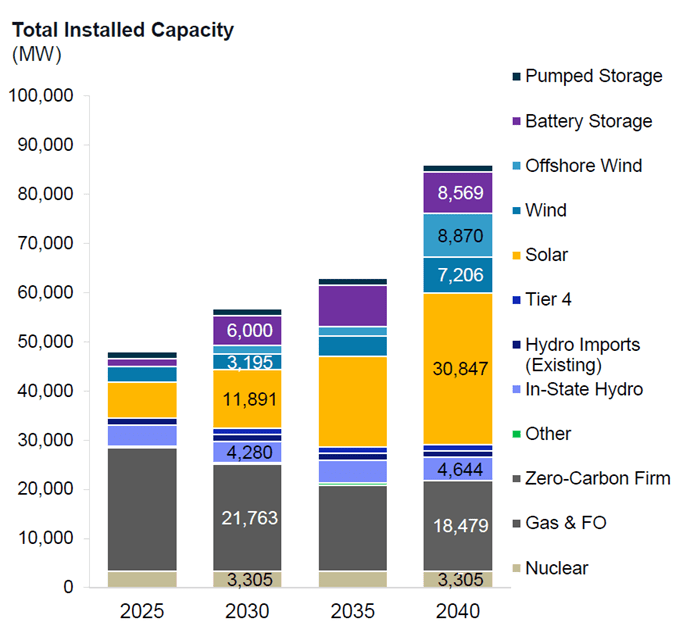
It is notable that NYSERDA concedes, without admitting all the ramifications, that the electricity capacity buildouts in their original scenarios are wishful thinking. I say this because there is another projection included – the “Limited Building Rate Scenario”. Figure 4 shows the installed capacity projections for it but true to their perfect record of making things difficult for reviewers the colors in the columns for different technologies change. If you were like me and wondered what the difference in the zero-carbon firm resources (called dispatchable emissions-free resources (DEFR) by everyone else in the state) drop from 17,241 MW to 4,644 MW. The description notes that:
• Deployment challenges (including federal impact on attrition and permitting) could lead to a meaningful reduction in renewable build rates
• While there are still significant additions of renewables, this sensitivity shows a meaningful reduction in solar and wind capacity compared to the core scenario in 2040
There is no admission that among the deployment challenges was an unrealistic schedule and no implementation plan was developed. They try to save some face by saying that they still build out solar and wind capacity, oblivious to the fact that might not be a good thing.
Environmental Justice organizations have made the peaking power plants in New York City a non-negotiable issue, insisting that all peaking power plants must be shut down as soon as possible. Even though the presumption of egregious harm from these plants is based on selective choice of metrics, poor understanding of air quality health impacts, and ignorance of air quality trends, pressure by this special interest constituency resulted in the Build Public Renewables Act of 2023 that mandates shutdown of New York Power Authority peaking power plants by 2030. This modeling by NYSERDA found that reliability considerations will prevent the shutdown of all the peaking power plants:
• Zone J repowers 2.2 GW of combustion units in 2035, and overall combustion needs in 2040 are 1.2 GW higher than the core scenario, but still lower than the start of the modeling period
• While gas generation is 50 TWh lower than 2025, 15 TWh of natural gas generation is needed in 2040 to meet energy needs. Alternately this need could be met via:
• ~2 GW of new nuclear and likely additional transmission,
- RNG combustion in the power sector, or
• Some blend of these two resource options (new nuclear and RNG)
The alternatives to the fossil plants are not likely to occur. 2 GW of new nuclear is never going to get developed in New York by 2040 and there isn’t enough renewable natural gas (RNG) to provide the necessary power.
At the end of the description of this slide, there is an admission that the existing schedule is unlikely. Patane notes that this sensitivity scenario provides a zero-emissions grid in 2045.
Figure 4: Limited build rate sensitivity
Discussion
The results presented in this presentation admit that there are enormous challenges confronting the Hochul Administration’s implementation of the Climate Act. It is still necessary to read between the lines and understand the implications of some statements, but the handwriting is on the wall.
The presentation concedes that New York State is not on target to meet the 2030 70% renewable goal and probably will not meet it until 2033. The inclusion of an alternate scenario that keeps fossil-fired units in operation post 2040 is the between the lines” admission that the present strategy is not going to work as envisioned by the authors of the Climate Act. That scenario is supposed to provide a zero-emissions grid by 2045, five years late.
Unfortunately, there are unacknowledged fundamental issues. There are references to electric system strategies that sound fine in theory but have not been shown to work in practice. For example, the presentation states that the plan is to use flexible loads to mitigate peak growth. Assuming that 2.5 GW new large loads will be willing to shut down operations at the whim of low wind and solar resource production is not likely viable. That is not conducive to manufacturing profitability.
In my opinion, the biggest problem is that the wind, solar, and energy storage approach advocated in the Climate Act requires backup resources for capacity, energy, and ancillary support services not present in wind, solar, and current energy storage systems. Nuclear power is mentioned as a solution several times but if that is the only viable backup solution, then renewables cannot be implemented without it. But nuclear can completely replace renewables, eliminating the need for massive backup resource. Therefore, it would be prudent to pause renewable development until feasibility is proven because nuclear generation may be the only viable path to zero emissions.
There are political ramifications. The New York Independent System Operator (NYISO) Power Trends 2025 report “underscores the heightened uncertainty of future system conditions and key assumptions such as population and economic growth, installation of behind-the-meter renewable resources, electric vehicle adoption and charging patterns.“ Environmental organizations have responded by claiming that NYISO’s “conclusions and messaging in Power Trends are not supported by the evidence and perpetuate the false narrative that more gas is needed or is less costly.” Reality bats last and the Pathways Framework is reflecting reality that gas is needed. Politically however, the environmental zealots will never change their minds and concede that corrections and adjustments are necessary much less admit that the whole endeavor is fatally flawed. Given that the Climate Act has always been about politics, how this plays out will be fascinating political theater.
Conclusion
New York is at a crossroads The inevitability of Climate Act implementation viability being a political liability has been acknowledged even by Hochul. The modeling analysis concedes that the schedule and ambition of the Climate Act is not achievable. This is the perfect opportunity for politicians to stop a program that even they must realize is not working according to plan. The Energy Plan could be used to conclude the schedule and the aspirations of the Climate Act need to be reconsidered. The political implications to that approach are significant.


A roadmap is only valuable if the roads actually exist.
LikeLiked by 1 person