I want to thank Alexandra Fasulo (@alex_fasulo on X) and Amy Lavine for finding NYSERDA’s just-released “Build-Ready Program Five-Year Review, October 2020–September 2025.” This is a remarkable document because it is a rare case of a New York State clean-energy agency admitting, in its own words, that one of its signature programs did not work and recommending that its ratepayer-funded version be shut down.
I am convinced that implementation of the Climate Leadership & Community Protection Act (Climate Act) net-zero mandates will do more harm than good if the future electric system relies only on wind, solar, and energy storage because of reliability and affordability risks. The opinions expressed in this article do not reflect the position of any of my previous employers or any other organization I have been associated with, these comments are mine alone. I acknowledge the use of Perplexity AI to research and organize the material summarized in this article.
What the Build-Ready Program Was Supposed to Do
The Build-Ready Program grew out of the Accelerated Renewable Energy Growth and Community Benefit Act, which directed the New York State Energy Research and Development Authority (NYSERDA) to identify landfills, brownfields, abandoned industrial sites, and other previously developed properties, take them partway through the development process, and then auction the “build-ready” sites to private developers. The Public Service Commission approved a $71.8 million budget for the effort in October 2020, drawing on up to $50 million from the Clean Energy Fund (CEF), with the expectation that the program would eventually become “evergreen” — self-sustaining from auction proceeds. The Order also envisioned NYSERDA advancing six large-scale renewable projects to solicitation every year starting in 2022 or 2023.
Five years and roughly $16.5 million in Clean Energy Fund draws later, the program has completed exactly one project: a 12-MW solar array on an iron ore tailings pile at the Benson Mines site in St. Lawrence County.
Section 3.1 Is Where the Report Gets Honest
The most important part of this document, in my opinion, is Section 3.1, “Program Challenges.” This is NYSERDA acknowledging, on the record, that the premise behind the program didn’t hold up. As the report puts it:
“The program was established on the hypothesis that New York State had readily available landfills, brownfields, and other previously utilized sites capable of supporting LSR energy projects throughout the State. During five years of program development work, however, the team found that very few sites in New York State both meet all of Build-Ready’s requirements (e.g. brownfield, landfill, no agricultural land, no competition with the private sector) and also can support economically viable LSR energy projects.”
Most previously developed sites turned out to be too small once wetlands and other non-buildable areas were excluded — frequently under 20 acres — and the adjacent land needed to expand them was overwhelmingly active farmland that program rules put off limits. The result: most identified Build-Ready projects came in under 10 MWac, well below the roughly 20 MWac NYSERDA considers the threshold for an economically viable large-scale solar project.
But the statement that should get the most attention from anyone who pays a New York electric bill is this one:
“Sites that met Build-Ready’s criteria also required significantly higher REC strike prices. Forecasts showed that future Build-Ready project REC prices could be roughly double those for Tier 1 greenfield projects. These high REC costs would place a significant financial burden on NYS ratepayers.”
Read that again. NYSERDA is telling the Public Service Commission, in its own five-year review, that the very sites that satisfied the Build-Ready Program’s siting criteria are the ones that would have cost ratepayers roughly twice as much per Renewable Energy Certificate as an ordinary Tier 1 greenfield solar project procured through the Clean Energy Standard. This is not a hypothetical concern raised by a critic of the Climate Act — it is the program administrator’s own forecast, buried in the “challenges” section of a report whose stated purpose is to justify winding the ratepayer-funded version of the program down.
Section 3.1 goes on to explain why: developing on previously used land is inherently more expensive than greenfield development because of environmental remediation, complicated site control (absent landowners, property liens), more intensive community engagement and permitting, specialized construction techniques to avoid ground penetration, and higher interconnection costs — all layered on top of smaller project sizes that limit the economies of scale developers need to absorb those costs. On top of all of that, the report notes that the federal One Big Beautiful Bill Act’s accelerated phase-out of the Investment Tax Credit — requiring construction starts before July 5, 2026, or in-service dates by the end of 2027 — will make it even harder for any future Build-Ready project to pencil out.
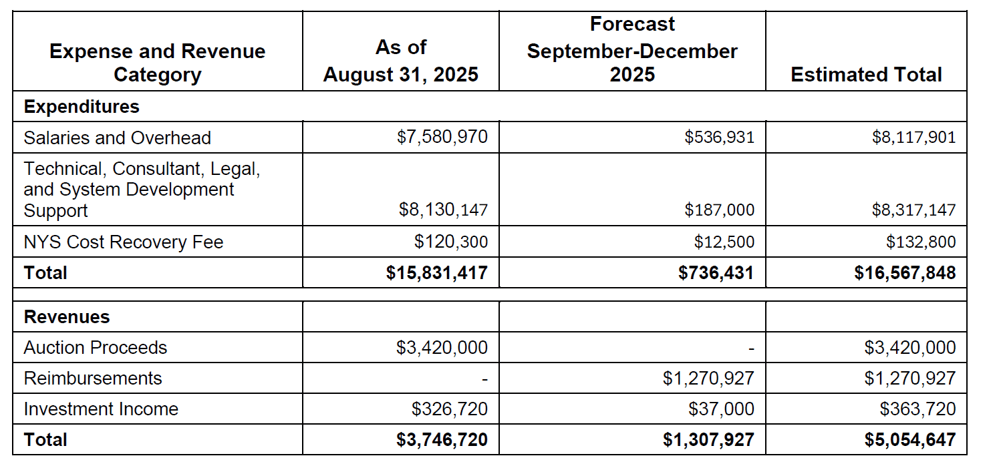
Table 1 in the report describes the financial reality. Through the end of 2025, NYSERDA projects total Build-Ready expenditures of about $16.57 million — split roughly evenly between salaries/overhead ($8.1 million) and technical, consultant, legal, and system-development support ($8.3 million) — against total revenues of only about $5.05 million, most of which came from the single Benson Mines auction. Table 2 shows that leaves roughly $11.5 million in Clean Energy Fund draws still to be repaid, which NYSERDA says it will cover from “non-ratepayer funding sources including but not limited to project development consulting payments, Regional Greenhouse Gas Initiative (RGGI), or other third-party payments subject to all required approvals and authorizations.”
Table 1. Build-Ready Program Actual and Forecasted Expenditures and Revenues through
December 31, 2025 from Build-Ready Program Five-Year Review, October 2020–September 2025
My primary concern with how New York invests RGGI proceeds in the NYSERDA 2026 RGGI operating plan amendment was that RGGI is an electric sector emissions reduction program, but NYSERDA does not prioritize emission reduction investments. This finding is evidence of yet another instance where RGGI auction revenues are being invested on programs that are not reducing emissions. The RGGI Operating Plan doesn’t specify a dollar amount, a mechanism, or a timeline. But it does make it clear how easily this could happen, because RGGI money already flows into the Clean Energy Fund as a matter of routine practice, not as an emergency backstop.
NYSERDA’s Draft 2025 Three-Year RGGI Operating Plan Amendment shows a line item called “Transfer to (from) Clean Energy Fund” that has already moved a cumulative $208.2 million in RGGI allowance-auction proceeds into the CEF through fiscal year 2023-24, with another $22.0 million budgeted for FY 2024-25 and $19.8 million for FY 2025-26 — bringing the all-time total to a planned $250 million (NYSERDA 2025 RGGI Operating Plan Amendment). On top of those permanent transfers, the same plan authorizes NYSERDA to use RGGI cash balances for “interfund liquidity management purposes” — temporary cross-fund borrowing of up to $200 million at any one time, with RGGI compensated at a pooled-investment interest rate, expressly so that it “will not interfere with RGGI work scope or program delivery.” In other words, NYSERDA has already built the plumbing to move RGGI allowance money into the CEF, both permanently and on a revolving basis, well before Build-Ready ever needed a bailout.
Put those two documents side by side and the concern comes into focus. RGGI allowance auction revenue is supposed to fund the specific categories set out in the RGGI Operating Plan — energy efficiency, renewable and non-emitting technologies, innovative carbon-abatement projects, and administrative costs, with a Climate Act mandate that at least 35 percent (and a goal of 40 percent) of the benefits flow to disadvantaged communities. In my opinion, those categories do not allocate sufficient revenues to emission reductions. RGGI auction proceeds are forecast at roughly $305–$375 million a year through FY 2027-28, so $11.5 million is a rounding error against that total. But it is also money that will not be available for any of the programs the Operating Plan lists if it instead gets redirected, however indirectly, to closing out a siting program NYSERDA’s own report says failed to deliver economically viable projects. Because the CEF commingles funding from RGGI, System Benefits Charge assessments, and other ratepayer-funded sources, once RGGI dollars land in the CEF general pool, tracing exactly which dollars repay the Build-Ready draw becomes essentially impossible from the outside. That opacity is itself worth flagging: a ratepayer-funded program’s failure gets absorbed into a much larger fund without any public accounting of which RGGI-funded initiative effectively lost the $11.5 million.
The Bottom Line
NYSERDA’s own five-year review recommends that the Public Service Commission terminate the PSC-funded, ratepayer-backed version of the Build-Ready Program and confirm that NYSERDA will reimburse the roughly $16.5 million already drawn from the Clean Energy Fund. NYSERDA says it intends to keep operating a version of Build-Ready through 2030 using other funding, repositioned as an economic-development tool rather than a ratepayer-funded clean-energy procurement program. That pivot is a tacit admission that the original approach could not deliver comparably priced renewable energy at the scale the Order envisioned.
Given how often ratepayer-funded clean-energy programs are defended based on optimistic projections, it is notable to see NYSERDA’s own report concede that REC prices for its flagship siting program would run roughly double those of ordinary Tier 1 solar — and recommend pulling the plug on ratepayer funding as a result. In my opinion, this suggests that the optimistic projections in the NYSERDA Scoping Plan and State Energy Plan could end up failing as well.
Credit again to Alexandra Fasulo and Amy Lavine for uncovering this report. As Fasulo notes “Commercial solar cannot stand on its own in an open market. We’re paying for its lofty financial protections while they steam-roll our home rule and force these complexes into our rural communities.”


