

The September “Rise of Influencers and Misinformation” webinar was part of New Yorkers for Clean Power’s Renewable Energy Supporter Speaker Series. Barry Wygel, communications director for the Alliance for Clean Energy New York (ACE NY), framed the presentation as “glass half full, glass half empty”: renewable development is proceeding, but resistance to renewable-energy projects is becoming more coordinated, more visible, and more politically consequential. In this post I will address a clear double standard whereby the advocates condemn “misinformation” but make claims and cite references that are misinformation. It is a long post because I document seven examples.
I am convinced that implementation of the Climate Leadership & Community Protection Act (Climate Act) net-zero mandates will do more harm than good if the future electric system relies only on wind, solar, and energy storage because of reliability and affordability risks coupled with the cumulative environmental impacts of those resources. The opinions expressed in this article do not reflect the position of any of my previous employers or any other organization I have been associated with, these comments are mine alone. I acknowledge the use of Perplexity AI to research and organize the material summarized in this article.
Background
New Yorkers for Clean Power (NYCP) hosted a September 2026 webinar, The Rise of Influencers and Misinformation examining organized and social-media-driven opposition to renewable-energy development in New York. The seminar focuses on the communication environment surrounding utility-scale solar, wind, battery storage, transmission, and the State’s clean-energy transition. The recording is available here, the slide deck is available here, and a transcript that I prepared that includes the slides is available here. The transcript provides video links at the beginning of the discussion of each slide and for quotations that I consider particularly notable.
The principal subject of the webinar is Alexandra Fasulo, the Schuylerville-area farmer, online personality, and publisher of the House of Green Substack. Fasulo has built a large online following describing her concerns about the conversion of farmland and rural landscapes to utility-scale renewable-energy facilities. Her advocacy emerged from opposition to large solar development near her community, particularly the proposed Fort Edward Solar project in Washington County, NY. She now uses social-media videos, public-record requests, public testimony, Substack posts, and legal or quasi-legal participation in siting proceedings to challenge the Office of Renewable Energy Siting and Electric Transmission (ORES), developers, and state renewable-energy policy. House of Green presents itself as a platform focused on protecting American farmland, while Fasulo’s advocacy has broadened to encompass wildlife impacts, solar leases, rural property rights, local land-use authority, and the transparency of the state’s permitting process.
Fasulo’s central criticism is not limited to whether an individual solar project is appropriate. Rather, she argues that New York’s centralized permitting framework sacrifices meaningful local decision-making, transparent environmental review, and protection of farmland and wildlife habitat in the interest of rapidly meeting statewide climate and renewable-energy targets. In the Fort Edward proceeding, for example, she and allied advocates have objected to redacted threatened-and-endangered-species information, questioned the adequacy of proposed habitat mitigation, and argued that the siting process permits industrial development in environmentally sensitive rural areas. ORES responds that sensitive species-location information is legally confidential, that affected parties may obtain access through protective-order procedures, and that Article VIII requires a “net conservation benefit,” not complete avoidance of every project impact. Unfortunately ORES never specified limits that defined acceptable development which I believe has left impacted communities few protection options.
ACENY and NYCP are worried about Fasulo because she has become an effective and influential communicator for a broader anti-renewable-development narrative. Her messaging can connect local anxieties about farmland loss, visual impacts, wildlife, property rights, and distrust of Albany with arguments that portray renewable-energy development and its permitting system as inherently corrupt, environmentally destructive, or imposed on unwilling communities. For both organizations, this is consequential because such claims can reduce local support for projects, intensify organized opposition, delay permitting and construction, and make achievement of the Climate Act’s renewable electricity targets more difficult for their members who think that it is necessary.
The NYCP concern is therefore as much about information and political mobilization as it is about one farmer or one project. Fasulo’s combination of personal credibility as a local farmer, a compelling social-media style, a rapidly expanding audience, and attention to real siting controversies gives her an ability to shape public perceptions beyond Washington County. Wygel repeatedly suggests that Fasulo uses misinformation in her arguments. However, this argument is a double standard because his presentation includes misinformation. The remainder of this post addresses specific instances of misinformation presented in the seminar and evaluates whether NYCP’s criticisms of Fasulo and her claims is supported by the available evidence.
Misinformation Examples
Video Link Claim – Savings from Solar Generation
On June 3rd NYS hourly solar generation set a record providing 29% of the power for New York. “That also means savings for the ratepayers. I think it was $200 million saved in in one day. You have to Google that NYSERDA quote that’s been out there.”
The NYSERDA reference is a July 2, 2026 news release, Eight Gigawatts of Distributed Solar Installed in New York. It says that on June 3, 2026, solar supplied “approximately 29 percent of statewide electricity demand during the noon hour,” which NYSERDA characterized as a new solar-generation record. The release does not say that the June 3 solar-generation record produced $200 million in savings. It says that “Last summer,” solar generation “helped save New Yorkers an estimated $90 million” by reducing grid demand during peak-use periods.” It also says “The FY 2027 state budget secured $200 million to expand NY-Sun.” NYSERDA cited an estimated $90 million in peak-period savings from solar generation last summer and separately noted a $200 million FY 2027 appropriation for NY-Sun, but it did not attribute $200 million in savings to the June 3, 2026, solar record.
Video Link Permitting History and Renewable Climate Resiliency
And now we need to have thousands of new generation sources from rooftop solar to community solar to utility solar to wind to offshore wind. There was no permitting or way to do that. So it took this amount of time to build up a permitting regime in ores, to build up the way to go from a couple large generators to a distributed grid with generation all over the state, which is much, much better in the long run for resiliency for climate.
New York did not need the new ORES permitting regime because it lacked a permitting process. Article 10 already provided statewide siting for major electric generation, including renewable projects, with environmental review and meaningful public participation. ORES was a policy decision to speed and standardize renewable siting and to give the State greater ability to override local requirements—not the invention of permitting itself.
Distributed wind and solar are not automatically more “resilient for climate.” They can improve local outage resilience only when paired with sufficient storage, islanding capability, grid-forming controls, critical-load management, and hardened local infrastructure. Even then, the benefit is limited by storage duration, renewable output during the event, and the ability to operate safely as an islanded microgrid.
It is therefore spurious to characterize a weather-dependent electric system as inherently more resilient. Wind and solar output depends on the same weather conditions that can cause outages or stress the grid. Resilience must be evaluated by whether the system can reliably serve critical loads through credible, extended extreme-weather events—not by whether it includes distributed renewable resources.
Video Link Renewable Energy is Fastest Resource to Deploy
We’re actually net losing power sources to the grid. And this is something that’s, you know, been flagged as a problem and is being used by opponents of renewable energy to say that we’re not the way forward when we know that renewable energy is the quickest and fastest to deploy technologies if everything is allowed to go forward and there’s been a lot of hang-ups in there which we’ll get to later in the presentation.
Wind and solar facilities may be among the faster generation technologies to construct once projects are fully permitted, interconnected, financed, and supported by transmission. However, they are not dispatchable and therefore cannot, on their own, replace the capacity, energy security, ramping capability, and essential grid services supplied by retiring dispatchable generators. The New York Independent System Operator has argued that retirements should not occur until replacement resources providing equivalent reliability attributes are physically in service and demonstrated capable of meeting system needs.
Wygel claim treats nameplate renewable megawatts as interchangeable with dependable dispatchable megawatts. They are not. New York can add renewable energy, but reliability requires that it retain or replace dispatchable capability until long-duration, emissions-free, commercially proven alternatives are actually operating at the necessary scale and locations.
Video Link The Need for DEFRs
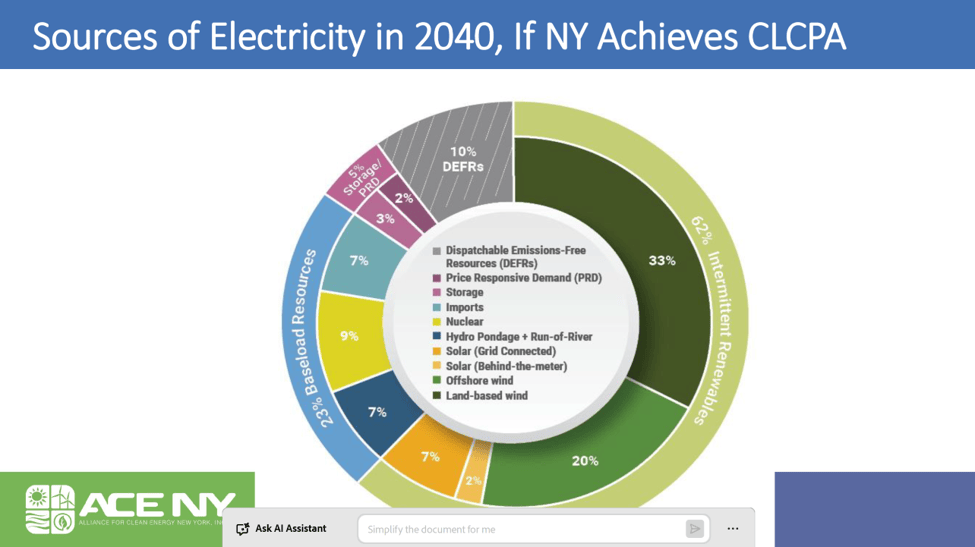
This is what a potential grid could look like if we meet our CLCPA goals in 2040. It’s not impossible. It’s doable. Might not happen by 2040 and it 70% isn’t going to happen by 2030, but there’s no reason to think we’ll be that far off if we keep progress and keep moving forward and keep moving projects forward. Um, so people have modeled what a grid could look like and it is achievable to make the transition and meet the demand and needs that we have in the future.
This paragraph is misinformation by omission because the claim that it is doable presumes that the 10% DEFRs will be available. The chart shows a prospective New York energy strategy that relies heavily on weather-dependent wind and solar generation, and battery energy storage systems with implicit new transmission, imports, demand-side resources, and a future resource category called Dispatchable Emission-Free Resources, or “DEFRs.” The problem is that “DEFR” is a planning category, not a resource. New York State has not identified a specific technology that has been built, financed, permitted, interconnected, tested, and demonstrated at the scale New York needs to fulfill the resources required.
In my opinion the as yet-to-be-identified DEFR resource is an enormous risk to the wind, solar, and energy storage plans of NYCP and ACE-NY. If that scale of dependable capacity is necessary, State policymakers should answer basic questions now:
- What technologies will provide the capacity?
- Where will projects be located?
- What will fuel, charge, or otherwise sustain them?
- How long can they operate continuously?
- Can they be permitted, financed, supplied, interconnected, and built in time?
- Can their electricity be delivered to the locations where it is needed?
- What will they cost customers?
- How will they perform when weather-dependent generation is low, demand is high, and imports are constrained?
The presumption that this is “doable” should not presume that a future technology will be available simply because planners have assigned it a useful name. The fact is that without a viable DEFR the wind, solar, and energy storage plan is a false solution.
Solar Farms Comments
The following claims are introduced in this slide.
Video Link Leaseholder Investments
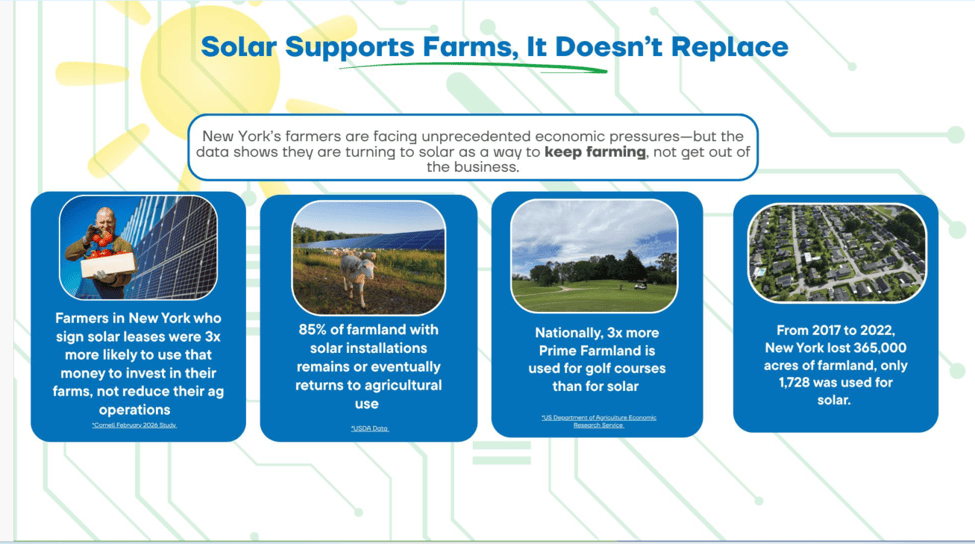
There was a survey done by Cornell of farmers who had signed solar leases in New York. And when they surveyed them, they found that three times farmers in New York were three times more likely to say they were going to use their solar money to invest in their farms and not stop it. So, farmers that are getting money from solar are not getting out of the farming game. They’re using it to improve their farming.
I think this is misleading. Solar-lease income may help some host landowners remain in farming or invest in their remaining operations. However, that individual financial benefit does not eliminate the loss of productive farmland, the harm to tenants and neighboring farmers who need leased acreage, the loss of food-production capacity, or the risk that construction and soil disturbance compromise future agricultural use. In my opinion, New York policy should therefore prioritize solar siting on marginal land, rooftops, parking areas, brownfields, and other lower-conflict locations—not treat lease payments as a justification for converting prime farmland.
Video Link Conversion Back to Farming
A national study found that 85% of farmland with solar, the owners of the land said they plan to either use it during the solar farm or eventually return it to agricultural use. Unlike permanent development, which is things like golf courses, where three times more prime farmland nationally is being used for golf courses than solar. And this um is about the same in New York. and takes a lot more water, too.
Solar equipment may be removable, but that does not mean a solar complex is cost-free, temporary in any meaningful agricultural sense, or assuredly reversible. The relevant loss is not merely the acreage under panels; it is the loss of farmable land for 25 to 40 years, plus the risks from grading, compaction, drainage disruption, access roads, collection lines, pile installation, and topsoil disturbance. New York’s detailed agricultural mitigation rules—including topsoil handling, drainage protection, monitoring, and decommissioning requirements—are an admission that restoration is not automatic.
The cited survey measures what landowners say they intend to do, not whether solar-project acreage will be returned with the same soils, drainage, productivity, and field utility it had beforehand. The reported observations at Excelsior Solar in Byron—where residents and landowners allege that topsoil was removed and crushed material brought in—underscore why the issue is construction performance and enforceable restoration, not simply the promise that panels can someday be taken away. Those allegations require independent verification, but they are exactly the sort of concern that environmental advocates should investigate rather than dismiss.
Video Link Comptroller Farmland Protection Audit
The comptrollers office did a really great analysis of land use in New York, and in their survey, they found that from 2017 to 2022, a bunch of farmland was lost in New York. 365,000 acres of farmland was lost, but only 1,700 acres of that was actually used for solar. And that doesn’t even mean it was taken out of farm production. It just impacted that land. So the vast vast vast majority of land in New York of farmland being lost is from permanent development. It’s from housing. It’s from other uses. And these are the facts that we need to get out there because farming is not being killed by the solar industry.
The New York State Comptroller’s 2025 Farmland Protection Program audit, citing the USDA Census of Agriculture, reported that New York lost almost 365,000 acres of farmland and roughly 2,800 farms between 2017 and 2022. The audit identifies solar development and residential conversion as potential pressures on farmland, but it does not state that solar accounted for only 1,700 acres of the loss.
My prime farmland solar scorecard is a simple accountability device: it asks whether a solar project respects the New York State Department of Ag and Markets 10% prime-farmland conversion goal. Its May 2025 results indicate that the guideline was often not met, leading me to conclude that New York’s solar-permitting system has not adequately protected productive farmland and that NYSERDA’s broader scorecard process needs enforceable standards, not simply voluntary siting guidance. I was not able to figure how much prime farmland was lost between 2007 and 2022 consistent with the Comptroller report. However, the total loss of prime farmland for projects in the permit queue in May 2025 was 12,476 acres.
Conclusion
This analysis of Wygel’s misinformation in his rebuttal of Fasulo’s arguments demonstrates his double standard. There is every reason to be suspicious of a spokesperson from ACE-NY because their membership is only interested in developing as much renewable power as possible as soon as possible to maximize the profits of their members.
What is a continuing mystery to me is why environmental advocates like NYCP do not demand environmental accountability from the developers. The fatal flaw of ORES is that there are no clearly defined standards for acceptable development. The authors of that law failed New Yorkers because they did not ask agency staff what was acceptable. For example, the Department of Agriculture & Markets would have undoubtedly said make our recommendation that no more than 10% of the project area be prime farmland a requirement. I am sure other agencies would have other recommendations for wildlife protections, health impacts, and development limits. If the developers understood those limits coming in then they would not even try to permit development that did not meet the agency mandates. Instead, we have a situation where ORES has permitted environmental impacts that are unacceptable and the developers are taking advantage of that situation.
In this environment it is no surprise that Fasulo’s messaging finds an audience. That environmental advocacy organizations are not demanding the same protections she is advocating for is a conspicuous—and troubling—failure to hold renewable-energy developers to the environmental standards they claim to champion.


do you think ORES or the developers will listen and respond favorably to your common sense analysis? It seems they are focused entirely on making as much money as they can before people figure out a way to MAKE ALL OF THEM ACCOUNTABLE! I highly respect Alexandra Fasulo’s efforts to bring the unfairness and sneakiness to the attention of the public. And thank you for breaking down the misinformation so we can all see the truth.
LikeLiked by 1 person
The only way to get meaningful change in ORES is for the politicians that are pulling the strings to modify the rules and their mandates.
Developers site and build facilities that meet requirements. The problem is the politicians did not ask agency staff to develop standards for wind and solar deployment when they set up ORES. As a result there are no rules and developers will make as much money as they can as long as they can exploiting that.
ORES, NYS agencies and developers will only be held accountable when the politicians revise their inane laws. The only way to get that to change is to shine the light on the issues Alexandra is raising and hold the politicians accountable.
I will keep trying to call out the misinformation. Thank you for recognizing my work.
LikeLike