

On September 2, 2026, the five Independent Intervenors—Roger Caiazza, Morris Cox, Richard Ellenbogen, Francis Menton, and Constantine Kontogiannis—participated in the New York Power Authority’s annual Climate Leadership and Community Protection Act (“CLCPA”) conferral process.
New York Power Authority’s (NYPA’s) conferral process is intended to collect information and stakeholder views on the State’s progress toward CLCPA goals and to help inform NYPA’s renewable-development strategies. The Independent Intervenors’ presentation was titled “Reliability-first implementation of New York’s clean-energy transition.” Our message was straightforward: New York should not retire dependable electricity resources or assume that future technologies will solve known reliability problems before replacements are actually available, deliverable, and proven under stressed system conditions.
I am convinced that implementation of the Climate Act net-zero mandates will do more harm than good if the future electric system relies only on wind, solar, and energy storage because of reliability and affordability risks coupled with cumulative environmental impacts of those resources. These comments are based on those concerns. The opinions expressed in this article do not reflect the position of any of my previous employers or the personal opinions of the Independent Intervenors, these comments are mine alone. I acknowledge the use of Perplexity AI to research and organize the material summarized in this article.
This is the first in a series of posts describing our NYPA presentation. This overview summarizes the central message and major issues raised at the conferral session. Subsequent posts will examine the supporting evidence and specific policy questions in greater detail.
The reliability-first message
The CLCPA requires New York to obtain 70 percent of its electricity from renewable resources by 2030 and to move to a zero-emissions electric system by 2040. Those goals are being pursued while electric demand is expected to increase because of building and transportation electrification, economic development, and other new loads.
The issue is not whether New York should reduce emissions. The issue is whether the State has developed a credible plan to do so without compromising reliable and affordable electricity service.
At present, the State’s energy strategy relies heavily on weather-dependent wind and solar generation, battery energy storage systems, new transmission, imports, demand-side resources, and a future resource category called Dispatchable Emission-Free Resources, or “DEFRs.” The problem is that “DEFR” is a planning category, not a resource. New York State has not identified a specific technology that has been built, financed, permitted, interconnected, tested, and demonstrated at the scale New York needs.
The basic principle presented to NYPA was therefore simple:
Dependable generation should remain available until replacement resources, transmission facilities, fuel arrangements, operating reserves, and distribution-system upgrades are physically in service, deliverable to load, and proven under stressed operating conditions.
This is not a rejection of nuclear power, hydropower, transmission improvements, or renewable development. It is an argument that those resources must be evaluated according to whether they can provide the electric system services that New Yorkers need. This need is especially acute during the difficult hours and days when demand is high, weather-dependent generation is low, equipment fails, or imports are limited.
New York has two different grid challenges
Much of the State’s energy-policy discussion focuses on the New York Independent System Operator NYISO’s “Tale of Two Grids”: the difference between upstate and downstate system conditions. That distinction is important. Upstate New York generally has more existing generation and opportunities for renewable development, while the downstate area has large load centers, constrained transmission interfaces, and special locational reliability requirements.
However, our presentation emphasized a second distinction that deserves much more attention: the difference between the bulk-power system and the distribution system.
The bulk-power system includes generation, high-voltage transmission, resource adequacy, operating reserves, imports, fuel availability, system frequency, and NYISO’s responsibility for operating the grid. A bulk-system reliability issue asks whether sufficient dependable resources are available and deliverable to load, including after credible equipment outages and during adverse weather.
The distribution system includes the substations, transformers, feeders, local circuits, voltage equipment, and utility infrastructure that physically deliver electricity to homes, businesses, hospitals, elevators, water and wastewater facilities, and other customers. The question of distribution-system resilience is whether local facilities can accommodate growing loads without compromising delivered electric quality (e.g. voltage) or service reliability.
These are related but separate challenges. A NYISO conclusion that New York has adequate statewide generating capacity does not mean that a particular substation, feeder, or transformer bank can serve growing local electric-heating and electric-vehicle load. Conversely, a local outage or voltage-quality problem should not automatically be attributed to NYISO bulk-system operations.
New York needs transparent accountability. NYISO, the Public Service Commission (PSC), NYPA, transmission owners, distribution utilities, local governments, and State agencies all have roles. The public should be able to determine which entity is responsible for identifying, planning for, funding, and correcting a particular reliability deficiency.
“The Grid Is Already Broken”
A central part of our presentation was the argument that recent events should be treated as warning signs. The grid does not have to experience a statewide blackout before reliability problems are real. Voltage reductions, localized brownouts, unstable frequency, equipment overheating, impaired restoration, and local system failures can cause significant damage and disruption.
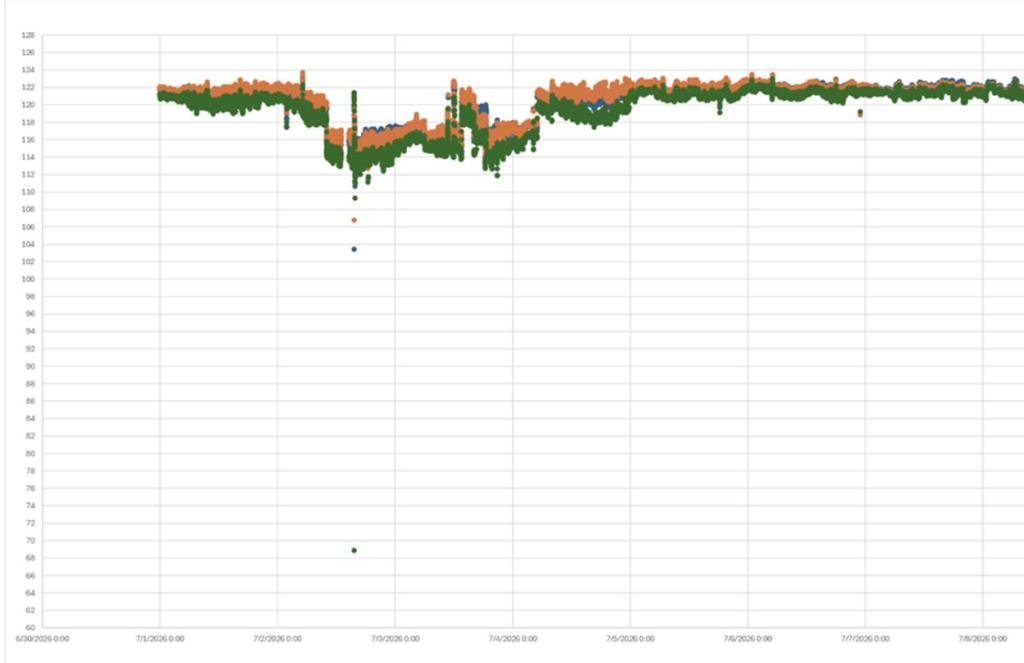
The presentation referenced reported distribution-level problems during the June 2025 period and voltage and frequency concerns during the July 2026 heat wave. The purpose was not to claim that every incident has the same cause, or to assign responsibility before complete factual investigation. It was to explain why actual system performance should inform energy policy.
Figure 1: July 1 – July 7, 2026 Voltage Measured at the Ellenbogen Factory Showing Con Edison Voltage Instability
Source: Data provided by Rich Ellenbogen
The July 2026 experience is particularly important because modern electricity use differs from the system conditions of previous decades. Much of today’s equipment contains power electronics, electronic controls, variable-frequency drives, LED lighting, elevator-control systems, and other loads that can respond poorly to abnormal voltage conditions. In some cases, constant-power devices draw greater current as voltage falls, which can add stress to already overloaded distribution equipment.
Similarly, solar inverters, battery inverters, and generator transfer equipment cannot be assumed to provide the same support during abnormal voltage or frequency conditions that they provide during routine grid operation. These are engineering and operational questions that require transparent investigation, not assumptions based solely on nameplate capacity or annual energy estimates.
The presentation also discussed information from the late-June and early-July 2026 heat-wave period. At peak load, imports reportedly supplied roughly 10 percent of actual generation; fossil generation averaged approximately 59 percent; and wind generation ranged from roughly 1 percent to 4.6 percent. Solar-generation information should be examined with the relevant NYISO operational data when it is available.
A future post will examine these events and what can and cannot be concluded from them. The central point for this overview is that New York’s energy policy should be based on evidence from the conditions that challenge the system—not just average annual performance.
The unresolved DEFR question
New York’s planning framework assumes that a large quantity of dispatchable emission-free capacity will be necessary as fossil generation retires and electrification increases demand. Our presentation argued that this may be the most important unanswered question in CLCPA implementation.
The presentation cited a potential need for more than 10 GW of yet-to-be-identified DEFR capacity within the next several years. If that scale of dependable capacity is necessary, State policymakers and NYPA should answer basic questions now:
- What technologies will provide the capacity?
- Where will projects be located?
- What will fuel, charge, or otherwise sustain them?
- How long can they operate continuously?
- Can they be permitted, financed, supplied, interconnected, and built in time?
- Can their electricity be delivered to the locations where it is needed?
- What will they cost customers?
- How will they perform when weather-dependent generation is low, demand is high, and imports are constrained?
The State should not presume that a future technology will be available simply because planners have assigned it a useful name. Before existing dependable resources are retired, replacements should be specific, operational, and stress-tested.
This does not mean that every current fossil facility should operate indefinitely. Some older units may be inefficient, costly, or environmentally undesirable. But the correct question is whether a unit’s capacity, locational value, voltage support, fuel flexibility, and restoration contribution can be replaced by resources that are actually in service and deliverable to customers.
Wind, solar, batteries, and difficult weather
Wind, solar, and battery energy storage all have valuable roles. They can reduce fuel use and emissions, provide energy when available, assist with balancing, offer rapid response, and—in suitable locations—improve local reliability.
But a resource that is useful is not necessarily a substitute for multi-day firm capacity.
The presentation highlighted the importance of planning for weather conditions sometimes described as “dark doldrums”: prolonged periods with low wind generation, limited solar generation, and high or rising demand. These periods can be particularly difficult when combined with equipment outages, limited imports, and fuel constraints.
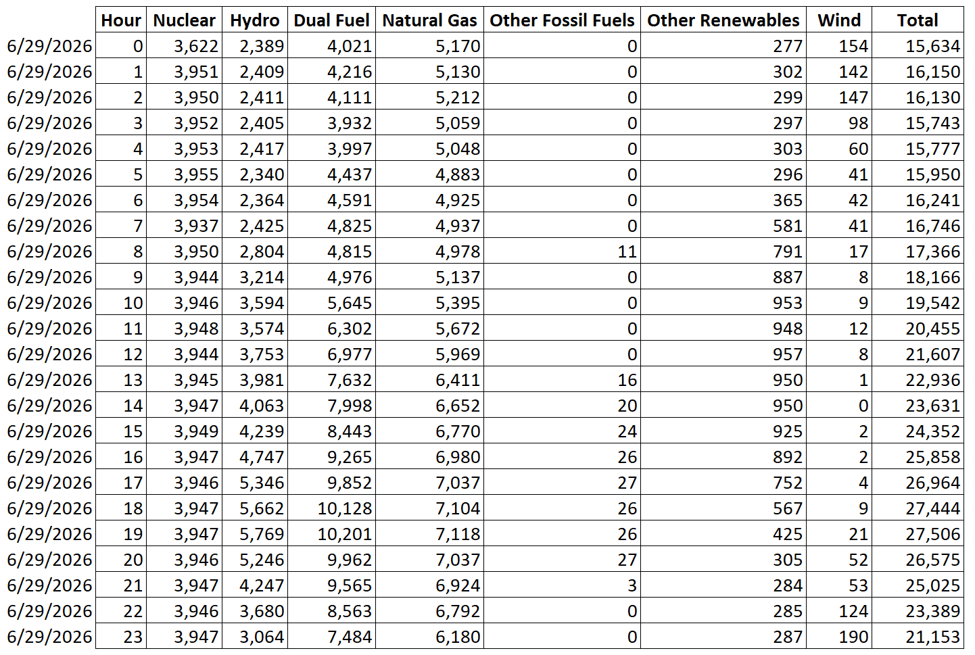
The July 1, 2026 example cited in the presentation showed wind generation below two percent of nameplate capability should have referred to June 29 (Table 1). It is important to note that even though July 1 wind resources were better the average generation was only 1,000 MW which represents 35% of the total NYS wind capacity of 2,858 MW. The presentation also raised concerns about smoke haze reducing solar production and referred to a January 2026 low-renewable-output period associated with critical grid risks and high consumer energy costs.
Table 1: Hourly Data for June 29, 2026
The presentation used an illustrative worst-case planning scenario involving more than 110 continuous hours with combined wind and solar output below 25 percent of nameplate capacity. The exact duration and assumptions must be documented and evaluated carefully, but the broader reliability point is indisputable: New York must be able to serve demand during prolonged periods when weather-dependent generation is unavailable.
A four-hour battery cannot provide 72 hours of firm electricity. An eight-hour battery cannot carry the grid through a 110-hour shortage. A storage plan must address not only discharge capacity but also the energy required to recharge batteries, the generation needed for charging, transmission capability, degradation, replacement costs, backup resources, and the ability to restore the batteries after a prolonged system event.
Nuclear and the transition gap
The Independent Intervenors support the State’s renewed attention to nuclear generation. Nuclear energy is a proven zero-emission source of large-scale, dependable electricity. It is not dependent on daily wind conditions or solar irradiance, and it can contribute to the long-term energy needs associated with electrification and economic growth.
However, nuclear development takes time. The presentation noted that new large-scale nuclear generation may not be available for 15 to 20 years and that the proposed 5 GW nuclear increase could be largely offset by expected resource retirements and load growth during the same period.
New nuclear generation should therefore be treated as a necessary long-term element of New York’s resource strategy, not as a near-term solution to the immediate DEFR and resource-adequacy challenge. Small modular reactors and other advanced designs should be researched and demonstrated, but should not be counted as commercially available capacity until their licensing, supply-chain, financing, construction, and operational challenges are resolved.
The State must answer a practical interim question: how will it maintain reliable service between now and the time that substantial new nuclear capacity can realistically enter service?
A constructive role for NYPA
NYPA should help answer that question. Its role should not be limited to supporting renewable projects in isolation. NYPA has financing capability, development experience, familiarity with complex infrastructure, and a public-interest mission that can be used to advance reliability as well as emissions reductions.
The presentation identified several areas for NYPA consideration:
- Retaining and repowering needed downstate dispatchable generation, including evaluation of modern CCGT opportunities at Newburgh, Island Park, Northport, Port Jefferson, and East River locations.
- Supporting long-term nuclear development with realistic schedules and procurement practices suited to major infrastructure projects.
- Evaluating floating solar at Schoharie and Upper Blenheim-Gilboa reservoirs in coordination with the existing pumped-storage facility.
- Improving the Central East interface with the CHPE converter station at New Scotland.
- Evaluating transmission development using existing transportation corridors where practical, including an NYS Thruway route from Leeds to Dunwoodie and a possible Athens-to-Buchanan path.
- Identifying additional hydroelectric and pumped-storage opportunities.
- Supporting a reliability-focused planning process involving NYPA, NYISO, NYSRC, the PSC, utilities, local governments, and affected stakeholders.
Every option should be assessed transparently. The relevant questions are not simply whether a project is renewable, zero-emission, or consistent with a target. The questions are whether it is reliable, affordable, feasible to build, environmentally defensible on a lifecycle basis, and acceptable to affected communities.
Conclusion
New York needs a transition strategy based on engineering reality, transparent costs, demonstrated technology, and accountability for reliability. The State can reduce emissions, but it cannot do so responsibly by assuming away the resources and infrastructure necessary to keep electricity dependable. That is the central message we brought to NYPA: reliability must be the binding constraint on CLCPA implementation.


