Governor Hochul and Climate Act Affordability

I have argued that Climate Leadership & Community Protection Act (Climate Act) affordability would become a political issue soon.  My previous article concluded that there is no way to simultaneously achieve the Climate Act emission reduction goals and maintain affordability such that it will not be a campaign issue for Governor Hochul 2026 re-election campaign.  This article follows that up with the ramifications of this news “The New York Power Authority (NYPA) backed down from a significant rate increase proposed for hydropower after facing bipartisan backlash, but it was an order from Gov. Kathy Hochul herself that ultimately doomed the plan.”

I am convinced that implementation of the New York Climate Act net-zero mandates will do more harm than good if the future electric system relies only on wind, solar, and energy storage because of reliability and affordability risks.  I have followed the Climate Act since it was first proposed, submitted comments on the Climate Act implementation plan, and have written over 500 articles about New York’s net-zero transition.  The opinions expressed in this article do not reflect the position of any of my previous employers or any other organization I have been associated with, these comments are mine alone.

Overview

The Climate Act established a New York “Net Zero” target (85% reduction in GHG emissions and 15% offset of emissions) by 2050.  It includes two 2030 targets: an interim emissions reduction target of a 40% GHG reduction by 2030 and a mandate that 70% of the electricity must come from renewable energy by 2030. The Climate Action Council (CAC) was responsible for preparing the Scoping Plan that outlined how to “achieve the State’s bold clean energy and climate agenda.”  After a year-long review, the Scoping Plan was finalized at the end of 2022.  Since then, the State has been trying to implement the Scoping Plan recommendations through regulations, proceedings, and legislation. 

NYPA Rate Hike 

According to the Governor’s press release:

Governor Kathy Hochul today announced that she is demanding the New York Power Authority suspend its proposed electric rate hike, protecting consumers from sky-high utility costs that are making New York State less affordable.

“Today, I’m calling for an end to the Power Authority’s unacceptable proposal to raise electric rates on its customers statewide,” Governor Hochul said. “Too many New Yorkers are already falling behind on their energy bills and I will do everything in my power to reign in these astronomical costs. While I recognize the Power Authority’s critical importance in providing invaluable, clean, baseload power from its large hydroelectric power plants Upstate, I expect NYPA to go back to the drawing board, shelve this existing proposal, and figure out a better way forward.”

Spectrum News provided background on the news:

The New York Power Authority backed down from a significant rate increase proposed for hydropower after facing bipartisan backlash, but it was an order from Gov. Kathy Hochul herself that ultimately doomed the plan.

The increase, which was in the midst of a lengthy implementation process, would have sent hydropower rates from $12.88/MWh to $33.05 over the next four years before settling back to a rate of $24.26 by 2029.

Republican lawmakers in Western New York pushed back on the proposal.

Sen. George Borrello told Spectrum News 1 he is thankful that NYPA called the rate hike off.

“As a business owner in New York state, this is one of he few things that is actually a positive when doing business in New York, the ability to get low cost power,” Borrello said.

Spectrum News noted that:

“At Governor Hochul’s request, NYPA will move to withdraw the 2025 proposed rate increase. We understand that New Yorkers are struggling right now, and we intend to make every effort to collaborate with our customers and stakeholders to find a way forward,” NYPA told Spectrum News 1 in a statement

NYPA had said the increases were necessary to keep pace with maintenance and operational costs.

I question the claim that the costs were primarily related to maintenance and operational costs.  I am not alone.  Spectrum News said that:

Borrello and others have blamed both instances on the state’s drive toward clean energy to meet its climate goals.

“It’s all directly related to the [Climate Leadership and Community Protection Act] then you add to it the reliability, the fact that we’ve shut down reliable forms of energy like Indian Point which supplies 20% of New York City’s power,” Borrello said.

Not surprisingly Hochul has pushed back on that premise.  When discussing the large proposed Con Ed hike, she said: “It is a factor, but to increase rates to this percentage is not supported by that.”

New NYPA Climate Act Responsibilities

In the magical world of political cost accounting, adding responsibilities to state agencies is free. In the last year Governor Hochul has placed significant mandates on NYPA related to the Climate Act.   According to the NYPA Strategic Renewables Plan dated January 28, 2025:

The 2023-24 State Budget authorized the most significant expansion of NYPA’s authority under the Power Authority Act in a generation. This expanded authority builds on the day-to-day work of NYPA staff to supply the state with reliable electricity, expand New York’s transmission system, and provide clean, affordable power and innovative energy services to our customers.

The enactment included four new areas of responsibility for NYPA, one of which expanded our authority to develop, own, and operate renewable energy generation projects to help meet the state’s clean energy goals. The expanded authority directed NYPA– beginning in 2025 and biennially thereafter– to develop and publish a renewable energy generation strategic plan that identifies our renewable energy generating priorities for the next two years. In addition, NYPA is directed to update the plan annually and may update the plan more often than annually if needed.

Beyond directing NYPA to build renewables, the budget enactment contained several other mandates:

  • NYPA will work with the New York State Public Service Commission (PSC) to establish the REACH program to provide renewable energy bill credits to low- or moderate-income New Yorkers in disadvantaged communities;
  • NYPA will invest up to $25 million annually in workforce training in collaboration with the New York State Department of Labor (DOL);
  • NYPA will cease fossil fuel generation at its small natural gas power plants by the end of 2030, so long as electric system reliability and environmental conditions allow.

In addition, NYPA will lead the Decarbonization Leadership Program, which calls for the development of energy and emissions profiles for state government’s largest carbon-emitting facilities and decarbonization action plans that will guide state agencies on facility improvements that will reduce carbon emissions.

If I was a betting man, I would wager that the costs of these efforts are a significant chunk of the revenues raised by increasing hydropower rates from $12.88/MWh to $33.05 over the next four years before settling back to a rate of $24.26 by 2029. 

Time for a Cost Reckoning

It is time for the Hochul Administration to acknowledge the total costs of all the programs associated with Climate Act implementation.  The Climate Act requires that the Public Service Commission (PSC) issue a biennial review for notice and comment that considers “(a) progress in meeting the overall targets for deployment of renewable energy systems and zero emission sources, including factors that will or are likely to frustrate progress toward the targets; (b) distribution of systems by size and load zone; and (c) annual funding commitments and expenditures.”  The draft Clean Energy Standard Biennial Review Report released on July 1, 2024 will fulfill this requirement.  The final report was due at the end of 2024 but was delayed on December 17, 2024.

On December 18, 2024, the New York Assembly Committee on Energy held a public hearing where the status of the Biennial Report was discussed.  At 28:01 of the video, Jessica Waldorf, Chief of Staff & Director of Policy Implementation, New York State Department of Public Service (DPS) explained the decision to delay:

The decision to pull the report yesterday was really based on the fact that we did a major review of the main program that would have otherwise been included in that report – the Clean Energy Standard that governs all the renewable energy programs.  That report is currently under consideration by the Commission.  Rather than do things piece meal we’re going to release the next version of the CLCPA annual report once the commission has acted on that CES biennial review.  We will include one comprehensive review report that will look back two years and also respond to other stakeholder feedback that we’ve received in response to the issuance of the first report.

My interpretation of this statement is that there is no commitment when the costs report is coming out.  If they could get away with delaying the report, they would wait until after the 2026 election.  More troubling was her comment about NYSERDA spending increases:

It also can’t be attributed to just the Climate Act.  Many of the initiatives go back several years all the way to 1996 when we started authorizing funds for things like energy efficiency investments and so a lot of programs and initiatives preceded the Climate Act. 

My concern is that this suggests that the DPS is going to hide the total costs of all the programs needed to achieve Climate Act mandates when the biennial report cost estimates are released.  The emphasis on the Clean Energy Standard when describing the review suggests that they will try to list only the costs of that component of New York’s energy plan net-zero transition. If the costs of programs and initiatives like the Clean Energy Standard, that preceded the Climate Act are not included, then Hochul can claim lower costs but New Yorkers are still on the hook for all the costs.   I recently described this as mal-information because while the costs listed are based on reality it is misleading and harms New Yorkers because it improperly excludes necessary costs to achieve all the goals of the energy transition.  New Yorkers deserve to know all the costs associated with Climate Act implementation.

Discussion

The costs of green energy policies has become an issue elsewhere as well.  Gordon Tomb of the Commonwealth Foundation recently explained that

Last October, electric grid operator PJM Interconnection received a joint letter from five Democrat governors—Pennsylvania’s Josh Shapiro, Illinois’ JB Pritzker, New Jersey’s Phil Murphy, Maryland’s Wes Moore, and Delaware’s John Carney. According to them, PJM, which supplies electricity to 13 states and the District of Columbia, has gouged customers with its annual capacity auctions

Just like Hochul rather than take accountability for destructive policies that produced the higher costs these Democrat governors are playing the blame game.  Tomb concludes:

It is time for policymakers to face the economic and physical realities of energy production. Their misguided efforts to reduce carbon emissions—from cap-and-trade schemes to government mandates favoring solar and wind—have proved costly to consumers and damaging to the reliability of power systems.

This perfectly exemplifies Progressive New York Democrats led by the Governor Hochul.  Their Climate Act fantasies are going to cost enormous amounts of money and risks to reliability have been largely ignored by them.  So far, the Hochul Administration has not fulfilled the mandate to document the “annual funding commitments and expenditures” and I suspect that they when they finally provide numbers they will continue the mal-information coverup used to minimize Scoping Plan costs y excluding costs not associated with the Climate Act itself.

There is another missing piece in the cost assessments.  The cost projections in the Scoping Plan are approaching several years old now.  It is time that those numbers were updated.  To do it right, clear documentation for all the energy use and emission reduction strategies proposed that includes assumptions, expected costs, and projected emission reductions is necessary.

Conclusion

Hochul was quoted as saying “Too many New Yorkers are already falling behind on their energy bills and I will do everything in my power to reign in these astronomical costs.”  It is inconceivable that her Administration does not understand that these new NYPA responsibilities will cost a lot of money.  That makes her actions hypocritical.  She was indignant that the companies and NYPA would hike rates when people are struggling but conveniently overlooks all the costs for renewables and other Climate Act mandates that are buried in the rate cases. It is time for transparency.  There should be a line on consumer bills that documents Climate Act costs.

New York Cap and Invest Status

New York’s Climate Leadership & Community Protection Act (Climate Act) is stalled.  This article updates the current status of NYCI implementation based on a analysis of a comprehensive overview by Samanth Maldonado titled “Green Lawmakers Pressure Hochul to Speed up Action on Climate Act”.

I am convinced that implementation of the New York Climate Act net-zero mandates will do more harm than good if the future electric system relies only on wind, solar, and energy storage because of reliability and affordability risks.  I have followed the Climate Act since it was first proposed, submitted comments on the Climate Act implementation plan, and have written over 500 articles about New York’s net-zero transition.  The opinions expressed in this article do not reflect the position of any of my previous employers or any other organization I have been associated with, these comments are mine alone.

Overview

The Climate Act established a New York “Net Zero” target (85% reduction in GHG emissions and 15% offset of emissions) by 2050.  It includes two 2030 targets: an interim emissions reduction target of a 40% GHG reduction by 2030 and a mandate that 70% of the electricity must come from renewable energy by 2030. The Climate Action Council (CAC) was responsible for preparing the Scoping Plan that outlined how to “achieve the State’s bold clean energy and climate agenda.”  After a year-long review, the Scoping Plan was finalized at the end of 2022.  Since then, the State has been trying to implement the Scoping Plan recommendations through regulations, proceedings, and legislation. 

The New York Cap-and-Invest Program (NYCI) is a key component of Climate Act implementation.  Before the 2025 State of the State was released, I believed that Governor Hochul would announce the next steps associated with the implementation of NYCI. However, the only mention of NYCI in the speech and in the FY2026 NYS Executive Budget Book noted that in the coming months the Department of Environmental Conservation (DEC) and the New York State Energy Research and Development Authority (NYSERDA) will take steps forward on developing the cap-and-invest program by proposing new reporting regulations to gather information on emissions sources.  Not surprisingly, Climate Act proponents were outraged. 

Samanth Maldonado’s article Green Lawmakers Pressure Hochul to Speed up Action on Climate Act is a useful summary of the status of NYCI.  I also realized while reading it that some arguments by people she interviewed deserved a response.

Status

Clearly Governor Hochul is having second thoughts about the Climate Act relative to her re-election ambitions in 2026.  Maldonado summarized the political considerations:

But Hochul has had other priorities and expressed a willingness to “rethink” where climate fits into her agenda. Her current main theme is “Making New York State More Affordable,” and the governor has been sensitive to anything that might hit New Yorkers’ wallets. That includes measures that would advance aspects of the climate law — but could also raise household costs.

“It was a different time,” Hochul said in July, noting that the climate law passed under her predecessor, Andrew Cuomo, adding “I can’t be caught in the past of 2019 into 2024 and 2025 and make decisions based on that, because a lot has changed.” 

She called the climate goals “something I would love to meet but also the costs have gone up so much, I now have to step back and say, “What is the cost on the typical New York family?’ just like I did with congestion pricing.”

Maldonado is clearly a believer in the rationale for the Climate, but she acknowledges that things have changed since it was passed:

That law, enacted in 2019, requires the state to drive down planet-warming emissions and shift away from fossil fuels, touching on nearly every sector of the economy and costing a projected $300 billion.  Nearly six years later, the goals at the heart of the CLCPA remain aligned with what climate scientists agree is urgent and necessary to mitigate and adapt to the impacts of a warming globe, but the political and economic environment have changed. Notably, federal funds supporting New York’s progress may disappear thanks to Trump’s federal funding freeze. 

For the record, the $300 billion dollar figure is Hochul mal-information because that figure only includes an unspecified fraction of the total costs and the projection cost methodologies consistently biased the expected costs low.  As to her deference given to Climate Scientists™ Dr. Matthew Wielicki explains that many ignore long-standing scientific norms to push alarmist narratives.

The implementation problems highlighted by Maldonado can be traced back to the fact that there is no plan that includes a feasibility assessment.  She notes that “an advisory group led by state officials came up with a blueprint to achieve the CLCPA, it did not create a spending plan, nor did it prescribe which actions to take first”.  This is because the CAC Advisory Group was made up of individuals chosen by ideology not technical expertise and limited discussion on issues outside of the narrative.  The Hochul Administration has yet to acknowledge that there is a reliability crisis brewing.  The lack of a plan is evident to others too.    

Andrew Rein, president of the Citizens Budget Commission, said that lack of planning and prioritization means it’s hard to know what the most cost-effective emissions reduction strategies or resiliency investments might be.

“We’ve got to pick and choose what we’re going to spend,” Rein said, referring to the state. “People are advocating for positions and keep debating, which makes it hard to be flexible with circumstances and facts as they change. That’s where I think New Yorkers have to come together and say, ‘We have to balance affordability, the economy and environmental needs. What can we do together?’”

I believe that it is time to pause the implementation process be paused until the issues raised bb Rein are addressed, certain technical issues considered, and proposed emission reduction strategies are defined.

Political Climate

In my opinion, the Climate Act has always been more about catering to political constituencies than reducing greenhouse gas emissions.  The failure to launch NYCI is undoubtedly due to political policy discussions. Maldonado points out:

Hochul’s recent announcement indicated the first cap-and-invest rules, related to emissions reporting, would come out by the end of this year. That means the cap-and-invest program wouldn’t likely take effect until late 2026 or sometime in 2027 — after the next election for governor. 

She also notes that:

New York is falling behind on two key requirements of the Climate Act: sourcing 70% of its electricity from renewables like solar and wind by 2030, and reducing planet-warming greenhouse gas emissions 40% below 1990 levels by 2030 (and 85% by 2050). New York is about three years behind the first target and has so far reduced emissions about 9% below 1990 levels, according to the latest data available.

The clean energy advocates also believe that NYCI’s delay is driven by politics:

Hochul’s slow-walking the cap-and-invest program is “110%” tied to her concerns around her reelection prospects, said John Raskin, president of the Spring Street Climate Fund and a political strategist.  “It’s reasonable she wants to take care of people’s immediate needs, but she’s not doing herself any political favors by rejecting or stepping away from climate action,” Raskin said. “If she wants to improve her poll numbers and for people to see her as a leader, she should move forward on climate action while communicating how it helps to meet people’s needs.”

Of course, there are very few people in the state that have a bigger stake in the Climate Act proceeding quickly than Raskin.  The Spring Street Climate Fund “supports high-impact policy campaigns that can make New York a model state for climate progress. We identify opportunities to win scalable climate solutions and invest in the grassroots climate campaigns that can succeed.”  There is nothing in their business model that addresses affordability, reliability, or environmental impacts that affect New Yorkers.

Raskin is not the only one with a vested interest.  Michael Gerrard is the founder and director of the Sabin Center for Climate Change Law at Columbia University.  The Sabin Center would not exist if there were not a problem.  Maldonado quotes a thinly veiled threat from him:

“I think Gov. Hochul was exceeding her authority much as she did when pausing congestion pricing, and DEC has a legal obligation to issue the regulations,” Gerrard said. “Cap and invest would generate revenues that could be used to build more renewable energy and more energy efficiency — things that the federal government is pulling back on.”

Gerrard spearheaded a lawsuit against Hochul’s congestion pricing pause, and now suggests legal action to challenge the cap-and-invest program delay could be on the horizon.

Advocates for NYCI presume that it would be an effective policy that would provide funding and ensure compliance because existing programs worked.  However, I have shown that results from the Regional Greenhouse Gas Initiative show that cap-and-invest programs can raise money but have not shown success in reducing emissions.  My biggest concern is that the draft NYCI documents have not acknowledged these results.  Past results are no guarantee of future success, especially when past results did not produce the results that advocates claim.

The disconnect between reality and New York Progressive politician’s understanding of the energy system and the effects of climate change is even worse.  Moldonado quotes Sen. Pete Harckham (D-Hudson Valley), chair of the Senate Committee on Environmental Conservation:

Harckham countered criticism of the Climate Act by pointing out that climate change impacts have only worsened since the law was enacted. Some investments could save money down the road, he added, a point NYSERDA staff made during public hearings about the CLCPA in years past.

“We need to be redoubling our efforts,” he told THE CITY. “Clean energy is cheaper than fossil fuel energy. I reject the equivalency that this is more expensive. In the long run, this is going to be much less expensive.”

The price on carbon through a cap-and-invest program could increase fuel costs for New Yorkers, including low- and middle-income households, in the short term, but rebates kicking in could result in net savings, according to a state analysisTwo reports issued by environmental groups in January showed how a cap-and-invest program could benefit low-income New Yorkers, depending on its design.

“We are literally showing you research and making a case that we are helping the exact New Yorkers that you say you want to from an affordability angle,” said New York City Environmental Justice Alliance Deputy Director Eunice Ko, who worked on one of the reports. “This is just one tool. We’re not saying it should be the only tool, but we need things like this, absent federal support and federal funding.”

I already explained that the State’s cost numbers are bogus.  The idea that green energy is cheaper than fossil fuel energy is wrong.  The idea that rebates could result in net savings is a favorite talking point but ignores implementation concerns.  People who are having trouble paying for energy now do not have extra money available and will have difficulty waiting for the rebates to get to them.  The claims that NYCI could benefit low-income New Yorkers are a stretch and ignore the fact that some of the money generated by NYCI must be spent to reduce emissions. 

Conclusion

I agree with those who argue that NYCI deployment has been stalled due to political reasons.  I do not agree that is necessarily a bad thing.  While I have no hope that there will be an epiphany within the Hochul Administration that expectations for NYCI must be tempered by reality.  It cannot support funding commitments to dis-advantaged communities, provide enough rebates to make low-income citizens whole, and fund emission reduction programs.  Funding should be guided by the experience gained with the similar RGGI program and the necessity to support emission reductions must be acknowledged.

The reality is that there is no way to simultaneously achieve the Climate Act emission reduction goals and maintain affordability such that it will not be a campaign issue for Hochul.  How she tries to resolve the irreconcilable will be fascinating to watch in the coming months.  Going forward or stalling for time she cannot win.

Wind Blowing Somewhere Does Not Solve the Intermittency Problem

A version of this article was published at Watts Up With That

In October 2023 an article of mine was published that addressed the wind is always blowing somewhere fallacy used by green energy proponents to argue that large amounts of storage and any new dispatchable emissions-free resources are not necessary in a future electric system that relies on wind and solar generating resources.  I recently discovered the US Energy Information Administration Hourly Electric Grid Monitor that provides hourly net generation by energy source for the Lower 48 states.  This article describes 2024 energy source data with an emphasis on wind energy relative to the “wind is always blowing somewhere” claim.

I am convinced that implementation of the Climate Act net-zero mandates will do more harm than good if the future electric system relies only on wind, solar, and energy storage because of reliability and affordability risks.  I have followed the Climate Act since it was first proposed, submitted comments on the Climate Act implementation plan, and have written over 500 articles about New York’s net-zero transition.  The opinions expressed in this post do not reflect the position of any of my previous employers or any other organization I have been associated with, these comments are mine alone.

Overview

The Climate Act established a New York “Net Zero” target (85% reduction in GHG emissions and 15% offset of emissions) by 2050.  Two targets address the electric sector: 70% of the electricity must come from renewable energy by 2030 and all electricity must be generated by “zero-emissions” resources by 2040. The Climate Action Council (CAC) was responsible for preparing the Scoping Plan that outlined how to “achieve the State’s bold clean energy and climate agenda.” The Scoping Plan was finalized at the end of 2022.  Schussler’s article is relevant because the Scoping Plan proposes to meet the zero-emissions mandate using wind, solar, and energy storage.  In 2040, the Scoping Plan projected that39% of the electric energy would be provided by wind generation and 30% by solar.

Wind Lulls

CAC member Dr. Robert Howarth claims that he played a key role in the drafting of the Climate Act and his statement  at the meeting where the Scoping Plan was approved claims that: ”A decade ago, Jacobson, I and others laid out a specific plan for New York (Jacobson et al. 2013). In that peer-reviewed analysis, we demonstrated that our State could rapidly move away from fossil fuels and instead be fueled completely by the power of the wind, the sun, and hydro. We further demonstrated that it could be done completely with technologies available at that time (a decade ago)”.  More recently, Mark Jacobsen of Stanford acknowledges that wind intermittency is a challenge but claims that it can be simply addressed by developing interconnections, a mix of renewable energy sources, including wind, water, and solar, and implementing energy storage solutions.  The question addressed here is the extent of the interconnections needed to get to the wind blowing somewhere from New York

In the real world most analysts are not claiming that there is a simple solution to extended periods of low wind and solar resources.  In September Parker Gallant noted that industrial wind turbines (IWT) in Ontario “show up at the party, almost always, after everyone has left” in a post that described poor performance of the province’s wind turbines over a five day period in September 2024.  I evaluated the performance of New York’s 2,454 wind turbine fleet and found that there was an hour when the total generation was 0.2 MW during this September event.  David Theilen directly addressed the wind is always blowing somewhere argument with this graph using data from the US Energy Information Administration Hourly Electric Grid Monitor.

Figure 1: US Energy Information Administration Hourly Electric Grid Monitor December 2024

EIA data

I used the data dashboard at the US Energy Information Administration Hourly Electric Grid Monitor as the source of the hourly 2024 generation by energy source data used in this analysis.  EIA notes that this is “Hourly total net generation and net generation by energy source for the Lower 48 states.”   The settings widget enables a user to change the time and period albeit hourly data are only available for up to 31 days, so I had to import data by month.  There is another issue.  January generation categories included Wind, Solar, Hydro, Unknown, Other, Petroleum, Natural Gas, Coal, and Nuclear.  December generation categories changed to Battery storage, Solar with integrated battery storage, Pumped storage, Unknown energy storage, Wind, Solar, Hydro, Unknown, Other, Petroleum, Natural Gas, Coal, and Nuclear.  I made no attempt to account for the different categories when I downloaded the data.

Figure 2: US Energy Information Administration Hourly Electric Grid Monitor

I wanted to show the installed capacity for the different energy sources but I was only able to find EIA values for solar – 107,400 MW.  Figure 3 shows the Maximum Hourly Generation (MW) in 2024 for the primary energy source categories that gives an idea how much capacity is installed for each energy source.  Note the maximum solar is 75% of the EIA installed capacity.  I expect the percentage of installed wind relative to the observed maximum hourly MW would be even less.

Figure 3: US Energy Information Administration Hourly Electric Grid Monitor 2024 Maximum Hourly Generation (MW)

Figure 4 lists the US Energy Information Administration Hourly Electric Grid Monitor 2024 Total Energy (GWh).  I was frankly surprised how much wind capacity was generated on an annual basis.  However, totals and averages are not the primary planning issue – determining how much energy is needed in the worst case is a prerequisite for reliability planning.

Figure 4: US Energy Information Administration Hourly Electric Grid Monitor 2024 Total Energy (GWh)

Table 1 summarizes nationwide energy source hourly data for 2024.  Solar has the most hourly variability because it is unavailable at night.  Wind has 95% variability and petroleum that is used for peaking purposes has 99% variability.  Only nuclear has less variability than the total energy.  The distribution of wind energy hourly output is notable. 

Table 1: US Energy Information Administration Electric Grid Monitor 2024 Hourly Data Distribution

For a general idea of the variability of the wind resource across the Lower 48 consider Figure 5 a graph of annual hourly data.

Figure 5: US Energy Information Administration Hourly Electric Grid Monitor 2024 Hourly Wind Energy Production (MW)

I could not find a map of wind energy facilities at the EIA website.  Synapse Energy has developed an interactive map of U.S. power plants, including wind facilities which is shown as Figure 6.

Figure 6: Synapse Energy Map of U.S. Wind Power Plants

Assuming that the EIA wind energy facilities are similar to those used by Synapse Energy, it is clear that there is a wide spatial distribution across the Lower 48.  Consider that if a wind lull in New York City was caused by a high-pressure system that covers everything east of the Mississippi that dedicated transmission to dedicated wind turbines 1,000 miles away would be required to ensure that New York State wind energy could be supplanted by wind elsewhere.  In the next step I analyzed temporal variation. 

Table 2 provides an estimate of wind lulls at different thresholds.  I evaluated the hourly data to determine the total available wind energy (GWh) available when the total available wind capacity was less than six percentile thresholds.  At the first percentile only 14,440 MW or less was generated.  This level is 15% of the maximum observed hourly wind capacity.  There were 14 episodes that met this threshold and total energy generated during those periods was 988 GWh.  From a planning standpoint the maximum duration is important.  There was a 14-hour period when all the Lower 48 wind facilities produced less than 15% of the maximum observed capacity and the total energy generated was only 29 GWh which is only 2% of the capability over that period.  At the 25th percentile, all the wind facilities produced 40% of the maximum observed capacity.  There were 180 episodes that met this threshold and total energy generated during those periods was 63,430 GWh.  For the maximum duration there was a 115-hour period when all the Lower 48 wind facilities produced less than 40% of the maximum observed capacity and the total energy generated was 2,319 GWh which is 21% of the capability over that period.

Table 2: US EIA Electric Grid Monitor 2024 Hourly Wind Lulls

Discussion

It is a stretch to try to extrapolate these data for planning purposes to determine the resource gap for a specific area.  A sophisticated analysis that addresses the location of the wind facilities, the interconnections between the facilities, and the generation from other resources on an hour-by-hour basis is required.  Nonetheless, using the data to guess the impacts is instructive.

To take advantage of the wind blowing somewhere argument it would be necessary to upgrade the transmission system.  Assuming that transmission is available there is still a clear need for backup energy.  If the entire wind energy system would need to produce 50% of the maximum observed capacity to cover both local and distant energy needs note that this analysis found that 25% of the time only 40% of the maximum was available. The worst case was a 115-hour period when all the Lower 48 wind facilities produced only b2,319 GWh of a possible 11,150 GWh.  Assuming 50% of the maximum is needed to support the system there would be an energy gap of 3,256 GWh over this 115-hour period.  At a cost of $148/kWh to $400/kWh the storage needed for this event would be $482 to $1,302 billion.

Recently, Russ Schussler (the Planning Engineer) published an article that argued that the intermittency issue addressed here might be solvable: “The long-term problems associated with wind and solar due to their intermittency could and may likely be made manageable with improved technology and decreasing costs.”  In my opinion, practically speaking it is not possible.  It would be necessary to upgrade the electric transmission system, deploy short-term storage, and develop and deploy a dispatchable emissions-free resource all to address short and infrequent periods and to somehow finance those resources with those constraints.

Importantly, even if intermittency can be addressed Schussler argues that there is a fatal flaw:

Overcoming intermittency though complex and expensive resource additions at best gets us around a molehill which will leave a huge mountain ahead. Where will grid support come from?  Wind, solar and batteries provide energy through an electronic inverter. In practice, they lean on and are supported by conventional rotating machines. Essential Reliability Services include the ability to ramp up and down, frequency support, inertia and voltage support. For more details on the real problem see this posting. “Wind and Solar Can’t Support the Grid” describes the situation and contains links to other past postings provide greater detail on the problems.

Conclusion

Green energy advocates who minimize the challenge of transitioning the electric grid to wind and solar rely on the claim that the “wind is always blowing somewhere”.   The 2024 wind energy data suggest otherwise.  I have no doubt that a proper electric reliability resource planning analysis would verify that my intermittency concerns are real and that revolving the issues would be prohibitively expensive.  Coupled with the grid support issues, the green dream of a wind and solar electric generating system is a fantasy that will never be viable.

Commentary on Recent Articles February 9, 2025

This is an update of articles that I have read that I want to mention but only have time to summarize.  I have also included links to some other items of interest.  Previous commentaries are available here

I have been following the New York  Climate Leadership & Community Protection Act (Climate Act) since it was first proposed and most of the articles described below are related to the net-zero transition.  I have devoted a lot of time to the Climate Act because I believe the ambitions for a zero-emissions economy embodied in the Climate Act outstrip available renewable technology such that the net-zero transition will do more harm than good. The opinions expressed in this article do not reflect the position of any of my previous employers or any other organization I have been associated with, these comments are mine alone.

Videos

  • Mike Rowe’s podcast interviews Alex Epstein to talk about the greatest climate myths and misconceptions.
  • John Robson from Climate Discussion Nexus describes the origin of the LA fires.
  • Matthew Wielicki notes that alarmists blame every weather event on climate change and explains why this is erroneous in a Prager University video.

Ill Wind

Robert Bryce notes that wind energy projects are taking a hammering.  He notes that:

A few days ago, Jason Grumet, the head of the American Clean Power Association (annual revenue: $62.3 million), told Heatmap News that “probably more than half” of all new wind projects under development in the US could be killed due to President Trump’s executive order requiring a “comprehensive assessment” of federal permitting. Heatmap explained that Trump’s policies pose “a potential existential threat to the industry’s future. Just don’t expect everyone to say it out loud.

This has big ramifications for New York State’s net-zero transition efforts.  The NY plan calls for zero emissions from the electric sector by 2040.  State 2040 capacity (MW) projections call for 12% onshore wind, 12% offshore wind and 36% solar.  State energy generation (GWh) projections call for 17% onshore wind, 22% offshore wind, and 30% solar.  Solar in New York in the winter is a horrible resource due to latitude and the fact that a large portion of the state is affected by lake-effect clouds and snow that reduce solar irradiance.  Solar cannot be expanded to cover the lack of wind development so now what?

Bryce also published an article noting that:

The bad news for offshore wind keeps coming. On Monday, New Jersey canceled plans for another offshore wind solicitation, citing Shell’s decision to abandon the Atlantic Shores wind project “as well as uncertainty driven by federal actions and permitting.” Recall that New Jersey has some of the most ambitious offshore wind plans of any state on the Eastern Seaboard. And now, all those plans appear headed for Davy Jones’ Locker. But it’s not just New Jersey. This week, Danish wind giant Ørsted said it was slashing its planned investments through 2030 by 25% due to its beleaguered US offshore projects and said it would take a “stricter, more value-focused approach to capital allocation.” The same day Ørsted made its announcement, Equinor, Norway’s state-owned oil company, said it was slashing its renewable energy targets and increasing its focus on… wait for it…oil and gas production.

Vermont Insanity

Mark Whitworth describes Vermont’s Global Warming Solutions Act (GWSA). Incredibly it includes an extraordinary requirement that not even New York has incorporated.  Whitworth explains the essence of the GWSA;\: “I’m gonna flap my arms and fly over the Statehouse dome. And if I should fail, I will punch myself in the face.”  He goes on:

The “flap my arms and fly” portion of the GWSA is a set of unachievable carbon emissions reduction targets. The “punch myself in the face” part is the GWSA’s invitation to sue Vermont at taxpayer expense when the unachievable targets are not met. We will then face the prospect of a judge ordering the Secretary of Vermont’s Agency of Natural Resources to make rules that accomplish the impossible. It won’t be pretty.

Just like in New York proponents of the law established aspirational targets that cannot be met.  New York does not have an explicit mandate for a lawsuit funded by the state if the targets are not met.  However, on November 2, 2021, New York voters approved an Amendment to the State Constitution’s Bill of Rights providing that: “Each person shall have the right to clean air and water, and to a healthful environment.”  In those sixteen words, “the right to a healthy environment was, for the first time, cloaked in constitutional protection in New York and deemed the equivalent to the sixteen current constitutional guarantees in the state Bill of Rights.”  There is no doubt in my mind that someone will sue when New York’s targets are not met citing this amendment.

Oil Merits

Meredith Angwin describes the importance of oil generation in New England.  Everything she says is relevant to New York too.  Her article is notable also because it nicely describes how generating plants are dispatched.  She explains why even though natural gas is cheaper than oil, there are times when oil must be burned because natural gas is simply not available.  Green energy proponents look at this situation and argue that it proves the desirability of wind, solar, and energy storage but always ignore a key point.  They claim that these weather-dependent resources increase resiliency, but the resources invariably fail to show up when needed the most so that won’t work.  Angwin concludes “we need to think about being overly dependent upon any one fuel”. 

Natural Variability

Jamie Jessop explains that two natural climate drivers were the primary drivers of the recent global temperature peak.  The world warmed because of the Hunga Tonga undersea volcano that injected water vapor in the upper atmosphere, then some more because of a strong El Nino. She notes that “The effect of both natural events is now fading rapidly.”  Now we are at an inflection point.  If the climate models are correct such that the alarmists screeching about an existential threat has some basis, then temperatures will cool to a plateau maintaining or even accelerating the long-term warming trend. 

On the other hand, if “nature is in control of our climate”, then two climate cycles will cause global temperatures to fall.  According to Perplexity AI: “The Atlantic Multidecadal Oscillation (AMO) and Pacific Decadal Oscillation (PDO) are two important climate cycles that significantly influence global weather patterns and temperatures.”  Jessup concludes:

If you’re not a natural climate change denier and you consider that a positive AMO plus PDO has contributed significantly to global warming since 1950, then you might expect the globe to cool significantly in the coming decades. In that case, the end of the Era of Global Boiling might turn out to be the far more significant end of the era of global warming – which will mean that the climate crisis loons will be trying to convince us all that warming really means cooling (because AMOC shutdown or something).

CO2 Cannot Explain Current Warming

Matthew Wielicki explains that because during the last interglacial period global temperatures were significantly warmer than today but CO₂ levels were much lower CO₂ levels cannot be the primary driver of global warming.

This glaring inconsistency should give pause to anyone who accepts the idea that CO₂ is the sole or even primary climate control knob. If CO₂ is truly the driving force behind global temperature, why was it hotter 120,000 years ago when CO₂ was only 275-280 ppm? Why have climate models consistently failed to accurately recreate past climate conditions? If climate models cannot reliably reproduce known historical warm periods like the Eemian, how can we trust their projections for the future? These discrepancies highlight fundamental flaws in the assumptions underpinning climate modeling, raising serious doubts about their ability to predict long-term climate trends with precision.

In his article he explains that natural factors such as orbital shifts, solar insolation, ocean circulation, and long-term feedback mechanisms have played a much greater role in shaping past climate changes than CO₂. This is completely consistent with Jamie Jessup’s article mentioned above and I think his explanation is readable.  Wielicki concludes “Ignoring these factors in today’s climate debate is not just bad science; it’s deliberate deception.”

How the Green Energy Narrative Confuses the Climate Act

Russ Schussler, aka Planning Engineer, has published a prequel to an upcoming article discussing the narrative around the green energy transition that is a prominent component of the Climate Leadership & Community Protection Act (Climate Act).

I am convinced that implementation of the Climate Act net-zero mandates will do more harm than good if the future electric system relies only on wind, solar, and energy storage because of reliability and affordability risks.  I have followed the Climate Act since it was first proposed, submitted comments on the Climate Act implementation plan, and have written over 500 articles about New York’s net-zero transition.  The opinions expressed in this post do not reflect the position of any of my previous employers or any other organization I have been associated with, these comments are mine alone.

Overview

The Climate Act established a New York “Net Zero” target (85% reduction in GHG emissions and 15% offset of emissions) by 2050.  Two targets address the electric sector: 70% of the electricity must come from renewable energy by 2030 and all electricity must be generated by “zero-emissions” resources by 2040. The Climate Action Council (CAC) was responsible for preparing the Scoping Plan that outlined how to “achieve the State’s bold clean energy and climate agenda.” The Scoping Plan was finalized at the end of 2022.  Schussler’s article is relevant because the Scoping Plan proposes to meet the zero-emissions mandate using wind, solar, and energy storage.

Green Energy Narrative

Schussler describes the narrative of the wind and solar proponents aka green energy:

The green energy narrative works somewhat like a magician’s patter, overemphasizing many things of irrelevance and distracting the audience from the important things going on. Misdirection ensures small truths are misinterpreted and magnified, leading to completely unrealistic hopes and expectations.

For example, there have been many simple studies examining how much energy might be produced by a green resource, or set of green resources, such as wind and solar power. These studies ignore important issues such as deliverability, timing, reliability and costs. Based on simple studies the media, activists and policy makers frequently conclude that such resources can be used near universally on a large scale to provide electric service to consumers effectively, efficiently and economically.

This is precisely what happened in New York when the Climate Act authors developed the targets and mandates of the law.  These ideologues misinformed the Legislature and Governor Hochul with claims that “our State could rapidly move away from fossil fuels and instead be fueled completely by the power of the wind, the sun, and hydro” and “that it could be done completely with technologies available at that time (a decade ago), that it could be cost effective, that it would be hugely beneficial for public health and energy security, and that it would stimulate a large increase in well-paying jobs.”

Schussler explains the problem with this argument:

In the green energy narrative costs have been demonstrated, environmental impacts have been demonstrated, reliability has been demonstrated, deliverability has been demonstrated and all shown to possibly work, BUT NOT AT THE SAME TIME. In the eyes of many, such demonstrations cumulatively strengthen the green energy narrative. However, the gullible audience will be shocked when wind, solar and batteries are not at all well suited to support electric generation on their own.

Schussler highlights three tricks of the green energy narrative: misleading language, false problem and narrative control.

Misleading Language

Schussler addresses the term “renewable” calling it “one of the most misleading bits of language advancing the green agenda.”  He notes:

Different “renewable” resources have vastly differing capabilities. There is vast potential to develop some ‘renewables”. Some “renewables do a great job supporting the grid. Some “renewables” have low energy costs in some areas. Some “renewables” are environmentally sound in some areas. No matter how well individual “renewable” resources might be combined to tick off all the boxes of importance, that doesn’t mean that any combination of “renewable” resources can be found that will work well for any given area. It means little that hydro and geothermal provide excellent support for the grid in an area where you can only add wind and solar. Similarly, just because solar and wind have potential environmental benefits that doesn’t cancel out environmental concerns around hydro in delicate ecosystems.

The problem is that in most areas including New York, “there are no compatible combinations of renewables that at any significantly high penetration level that can provide  affordable, environmentally responsible energy in a reliable manner. Referring broadly to what “renewables” can and might do, serves to hide this inconvenient truth.”

The False Problem – Intermittency is not THE problem for Wind and Solar

Schussler argues that:

It is a fallacy to assume that because part or some of the difficulties associated with a technology can be overcome, that therefore all of the problems associated with a technology can be overcome. Worst case for a “partial solutions fallacy” is when a major problem is hidden by presenting a minor problem as the major stumbling block. Primarily focusing on the minor problem incorrectly implies that there will be smooth sailing once this solvable problem is overcome by hiding the large problem.

To implement a green transition bolstered by heavy wind and solar, all associated problems must be addressed. The major problem associated with wide-scale use of these resources  cannot be ignored.

Schussler goes on to argue:

The real problem is that wind, solar and batteries do not readily provide essential reliability services and support the grid. Most of the talk is around addressing intermittency through batteries and other storage approaches. Misdirection here focuses on intermittency, the smaller problem, while ignoring the major problem.

Schussler believes that it may be possible to address intermittency:

The long-term problems associated with wind and solar due to their intermittency could and may likely be made manageable with improved technology and decreasing costs. But such changes will not make wind, solar and batteries comparable to more conventional generating resources, such that they can play a large role in a green energy transition, because the large problem is not intermittency.

The point of his discussion is that there is another, more serious problem that is a fatal flaw:

Overcoming intermittency though complex and expensive resource additions at best gets us around a molehill which will leave a huge mountain ahead. Where will grid support come from?  Wind, solar and batteries provide energy through an electronic inverter. In practice, they lean on and are supported by conventional rotating machines. Essential Reliability Services include the ability to ramp up and down, frequency support, inertia and voltage support. For more details on the real problem see this posting. “Wind and Solar Can’t Support the Grid” describes the situation and contains links to other past postings provide greater detail on the problems.

I think that in an electric system that is reliant on weather dependent wind and solar resource, intermittency creates an unacceptable reliability risk.  Current resource assessments are based on observations of the existing uncorrelated generating resources over many years that show that unplanned outages do not happen at the same time.  There is no reason to expect, for example, that all the nuclear plants will be forced offline at the same time.  This characteristic enables the resource planners to determine how much generating capacity is necessary to meet the probability of losing load not more than once in ten years loss of load expectation (LOLE) reliability criterion.  Importantly, I believe that the lack of correlation also means that the capacity needed above firm system load would not change substantially if the LOLE planning horizon was shifted to 1 day in 20 years or more.

The problem with weather intermittency is that it is correlated over large areas at the same time. As a result, variations in weather affecting wind and solar resource availability will require changes to electric resource planning.  Everyone has heard of a hundred-year flood which is the parameter used for watershed planning.  This is the one in a hundred probability that the water level in a river or lake will exceed a certain level in a given year.  Similar estimates of low wind and solar resource availability must be developed and incorporated into electric resource planning. Based on New York data I think a hundred-year planning horizon is appropriate.  The problem is that the costs for such a threshold are huge and the resources will be used less than their expected operating lifetimes.  The resulting reliability risk is that affordable backup resources will be insufficient to support the load during the hundred-year low wind and solar availability event and a catastrophic blackout will result.

Russ and I discussed my interpretation of this reliability risk, and we agreed that we are making the same point in different ways.  If money is not an issue, then it is possible that the intermittency issue can be overcome by overbuilding wind and solar resources, short-term energy storage, long-term energy storage to deal with extended low wind and solar resource periods, and transmission.  However, affordability is a fatal flaw because the costs necessary would be astronomical for a resource that would only be used less than the expected lifetime of the resources.  On the other hand, the grid support requirements cannot be resolved by throwing any amont of money at the problem so that is unsolvable.

Narrative Control – Shameless Hucksterism and the Media

The last green energy narrative trick is controlling the narrative.  Schussler explains:

The green energy narrative is propelled by stories of success. Often these “successes” are very different from what seemed to be represented. We see great stories of planned projects that should do wonderful things, but they go down the memory hole as they prove not to work out. We see incomplete stories where they talk of power generated but not of associated costs or how much better other alternatives might have been.

He goes on to describe an example headline that claims that seven countries get 99.7% of their electricity from geothermal, hydro, solar, and wind power. However, he points out:

Without the spin, collectively those countries get close to 99% of their energy from rotating synchronous geothermal and hydro resources and less that 2% of their combined electric energy from wind and solar. The fact that some countries have high amounts of hydro, does not provide evidence that we are approaching a tipping point involving wind and solar. In fact, one could observe that high levels of renewable penetration are associated with low levels of wind and solar.

Conclusion

Schussler and I agree that it is becoming increasingly apparent that wind, solar and batteries when pursued at high penetration levels result in high costs, lower reliability and poorer operational outcomes. He points out that “Expectations from the green energy narrative and real-world results are not consistent and this gulf will continue to widen as long as policy makers continue to reflexively buy into the green energy narrative.”

The high expectations in the green energy narrative shaped the promulgation of the Climate Act and is driving its implementation.  Schussler describes the inherent misinformation and other various deceptions to hide the real-world challenges for New York’s net-zero transition. As reality sets in, proponents must push this narrative harder and louder to hide the obvious flaws.  I look forward to Schussler’s follow up article that “will more systemically examine the components of the green energy narrative and raise many items of critical importance considerations that the green energy narrative ignores.”

New York State Electric Sector Emissions Trends

This is my annual update of electric utility sector emission trends in New York State.  The data presented are derived from the Environmental Protection Agency Clean Air Markets Division database.

I am convinced that implementation of the New York Climate Leadership & Community Protection Act (Climate Act) net-zero mandates will do more harm than good if the future electric system relies only on wind, solar, and energy storage because of reliability and affordability risks.  I have followed the Climate Act since it was first proposed, submitted comments on the Climate Act implementation plan, and have written over 500 articles about New York’s net-zero transition.  The opinions expressed in this article do not reflect the position of any of my previous employers or any other organization I have been associated with, these comments are mine alone.

Overview

The Climate Act established a New York “Net Zero” target (85% reduction in GHG emissions and 15% offset of emissions) by 2050.  It includes two electric sector targets: 70% of the electricity must come from renewable energy by 2030 and all electricity must be generated by “zero-emissions” resources by 2040. The Climate Action Council (CAC) was responsible for preparing the Scoping Plan that outlined how to “achieve the State’s bold clean energy and climate agenda.” The Scoping Plan was finalized at the end of 2022.  Since then, the State has been trying to implement the Scoping Plan recommendations through regulations, proceedings, and legislation.  Not surprisingly, the aspirational schedule of the Climate Act has proven to be more difficult to implement than planned.  This article shows that electric sector emissions increased in 2024 relative to 2023.

Electric Generating Unit Emission Trends

Electric generating units report emissions to the Environmental Protection Agency Clean Air Markets Division as part of the compliance requirements for the Acid Raiin Program and other market-based programs that require accurate and complete emissions data.  The 2024 emissions data submittal deadline was January 31, and I downloaded the data on 2/3/2025. 

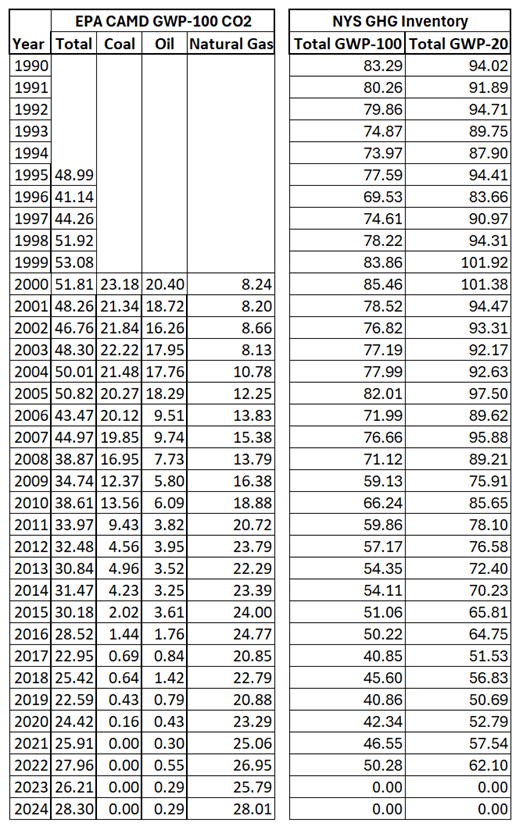
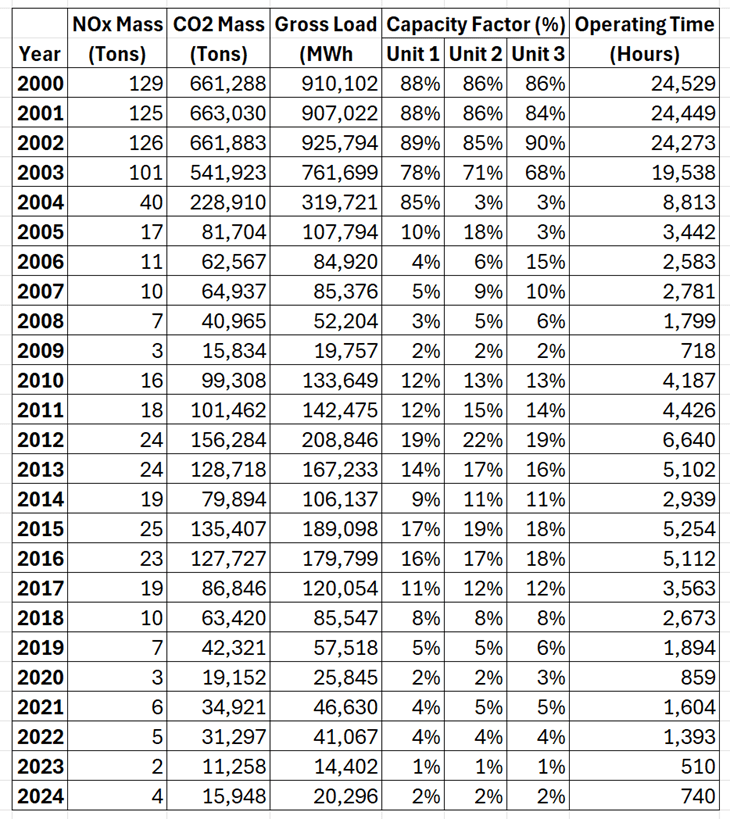
The following table lists emissions and operating data since 2009 when the Regional Greenhouse Gas Initiative started.  Emissions of CO2, SO2, and NOx are down dramatically over this period. 

Table 1: New York State Emissions and Operating Parameter Trends

Table 2 lists CO2 emissions by fuel type since 2000.  It shows the impact of fuel switching.  The primary reason for the observed fuel switching is that the fracking revolution made the cost of natural gas so cheap relative to other fuels that every facility that could convert to natural gas did so.  New York banned the use of coal in 2021 which forced the retirement of the remaining coal plants.  The state still has some facilities that primarily burn residual oil but those run infrequently.  The takeaway message is that the fuel switching options are no longer available so future reductions will only come as zero-emissions resources displace facilities burning fossil fuels.

Table 2: New York State CO2 Emissions by Fuel Type

The following graph illustrates emission trends.  Note that I divided the CO2 emissions by 1,000 so that all the parameters would show up on the same plot.  The impact of the closure of the Indian Point nuclear facility starting in 2020 is clearly shown.  CO2 levels in 2024 were nearly as high as the 2016 levels.    Inter-annual variability is primarily due to weather variations but the primary reason for the higher CO2 emissions is the closure of Indian Point.

Figure 1: NYS Emission Trends – SO2 (tons), NOx (tons) & CO2 (1000 tons)

New York State GHG Emission Trends

The Climate Act requires the Department of Environmental Conservation to issue an annual report on statewide greenhouse gas emissions.   The current report covers the years 1990 through 2022 and was posted late last year. Inexplicably, the emission data are unavailable.  When it is available for download from Open Data NY I will update this summary to include GHG emission trends.

Discussion

New York has significantly reduced pollution emissions from the electric sector.  However, the reductions were due to fuel switching to natural gas.  There are two implications.  There are no more significant opportunities to reduce emissions via fuel switching.  That means New York State must provide the emission reductions by investments in zero-emissions technology that can displace existing generation.  New York’s policy decisions for emission reductions have been poor to date.  The natural gas fuel switching was driven by the economics of fracking natural gas which drove prices down elsewhere but not in New York because fracking is prohibited. The other emissions policy error was the closure of Indian Point.  According to the 2024 data, that decision set back emissions progress by years. 

Conclusion

When you look at the numbers shown in this post, the enormity of the emissions reduction challenge is clear. The Climate Act has been in place for five years.  The crash program to replace fossil fuels with wind and solar has shown no sign of emission reduction success.

Climate Whiplash and California Wildfires

The difference between weather and climate is constantly mistaken by Climate Leadership & Community Protection Act (Climate Act) advocates and has been the subject of articles at this blog.  Recently Southern California wildfires have been blamed on climate change.  Patrick Brown addressed the question how much did “Climate Whiplash” impact the Los Angeles fires.  His excellent analysis raises issues that I want to highlight.

I have been a practicing meteorologist for nearly 50 years, was a Certified Consulting Meteorologist, and have B.S. and M.S. degrees in meteorology.  My particular expertise is air pollution meteorology in the electric utility sector with a focus on meteorological and pollution measurements.  The opinions expressed in this post do not reflect the position of any of my previous employers or any other organization I have been associated with, these comments are mine alone.

Weather vs. Climate

The Climate Act legislation and the implementation meetings confuse weather and climate.  According to the National Oceanic and Atmospheric Administration’s National Ocean Service “Weather reflects short-term conditions of the atmosphere while climate is the average daily weather for an extended period of time at a certain location.”  The referenced article goes on to explain “Climate is what you expect, weather is what you get.” 

Hydroclimate Volatility

Patrick Brown described the Swain et al. (2025): Hydroclimate Volatility on a Warming Earth Nature review paper. He quoted the first line of the UCLA Press Release for the paper: “Los Angeles is burning, and accelerating hydroclimate whiplash is the key climate connection.”  He then stated: “Thanks in no small part to the huge journalistic audience that lead author Dr. Daniel Swain commands, the “climate whiplash” vernacular was immediately adopted in international headlines covering the recent Los Angeles fires.”  This is a classic example of an extreme weather event that is linked to climate change by organizations and individuals that have a vested interest in advancing the threat of climate change.

Brown noted that: “the paper has demonstrated incredible reach and is in the 99.99th percentile in terms of online attention for all research (not just climate research) of a similar age.”  However he echoes my concern: “But as is the case for so much high-profile climate science, there is a large gap between the impression conveyed by the coverage and the impression left from the observational data.”

Climate Whiplash

I have never heard of the concept of climate whiplash before this story broke.  Brown explains:

Dangerous, intense wildfires require dry vegetation. The idea behind the climate whiplash connection to the Los Angeles fires is that very wet winters in Southern California in 2022-2023 and 2023-2024 enabled a great deal of vegetation growth but that the very dry beginning of the 2024-2025 winter allowed that vegetation to dry out, resulting in a landscape primed for uncontrollable wildfires. Swain explains the mechanism in interviews with Adam Conover and Neil deGrasse Tyson.

In order for this to be a climate change problem, we need to know whether these events are increasing.  Brown noted that:

The idea being conveyed is that these climate whiplash events are dramatically increasing not just in Southern California, but globally.  “Every fraction of a degree of warming speeds the growing destructive power of the transitions” Swain said.

Brown described background for this concept:

Taking a step back, the fundamental theory undergirding changing “hydroclimate” (think water cycle where we are considering not just how precipitation provides moisture but also how evaporation takes moisture) whiplash is nothing new. It is a basic fact of atmospheric physics that a warmer atmosphere can “hold” more water vapor (about 7% more per °C of warming). This warming influence on the water cycle has been discussed in detail since at least the 1980s (e.g., Manabe, & Wetherald, 1986)). At first, most research discussed a general intensification of the water cycle, typically emphasizing that already dry areas would get drier and already wet areas would get wetter as the globe warmed. However, by the mid-2000s, studies like Trenberth et al. (2003), Chou & Neelin (2004), Meehl et al. (2005), and Held & Soden (2006) began pointing out that the same physics (warmer atmosphere holds more moisture) can drive larger variability in the same place—heavier rain events juxtaposed with prolonged and/or more intense dry spells.

These concepts are taught regularly as a part of Climate Change 101 classes, including my own, and they are accepted as consensus climate science, articulated with “high confidence” in the IPCC’s most recent assessment report:

“A warmer climate increases moisture transport into weather systems, which, on average, makes wet seasons and events wetter (high confidence)”

“Warming over land drives an increase in atmospheric evaporative demand and the severity of droughts (high confidence).”

The reason I wanted to highlight Brown’s analysis of this paper is because he highlights a key complication for the general public’s understanding of climate change.  It is accepted that a warmer climate increases moisture in the atmosphere and drought severity.  The implications of those mechanisms are important with respect to GHG emission reduction policies.  The question is so what? What is the magnitude of the change, what impacts might result from these mechanisms, and do we expect that changes in global temperatures due to GHG emissions will result in significant impacts from these mechanisms are all questions that should be addressed.

I fully endorse Brown’s explanation:

However, I like to point out that it is useful to break down lines of evidence in climate science into categories of

  1. Historical observations/trends
  2. Fundamental theory
  3. Mathematical modeling

I know from teaching the “wet gets wetter, dry gets drier” concept that the evidence for increased variability in the same location is much stronger in the theory and modeling categories than it is in observations. This is important because observations should take precedence over the other two. Focusing on observations tells us a lot about how big of an effect we’re talking about (i.e., do we see major trends emerge through the noise of the observation system and natural variability?). Furthermore, a fundamental point of doing science is to explain observations. The canonical order of operations is that first you observe some phenomenon, and then you use the tools of theory and modeling to make sense of it.

I cannot over-emphasize the point that observations should take precedence over theory or modeling.

Observations

Brown goes on to evaluate observations of the whiplash where increased precipitation enabled a great deal of vegetation growth followed by a period of decreased precipitation that allowed that vegetation to dry out, “resulting in a landscape primed for uncontrollable wildfires”.  I am only going to summarize two of the results.

Brown evaluated observations of year-to-year water cycle variability following the methodology of the Swain et al. (2025) paper. Note that he only evaluated the effect over land because it has no effect on wildfires if it occurs over the ocean.  He did not find any compelling evidence for an increase in these events in California.  The results for global land were described:

So, over all global land, at the timescale that is most relevant to the Los Angeles fires (annual), in the premiere observational dataset (ERA5), using Swain et al. (2025)’s own data, we have seen a long-term decrease in whiplash frequency (this, by the way, is acknowledged in passing in the text of Swain et al. (2025) on page 37).

Let’s pause for a second to recall the first line of the UCLA press release (“Los Angeles is burning, and accelerating hydroclimate whiplash is the key climate connection.”) and the global news coverage it generated. Would any reader of this coverage have any idea about the incredibly important caveats above? Not that I can tell.

In the next section Brown discussed the magnitude of changes in annual water cycle variability.  He stated that:

Now, to be fair, Swain et al. (2025) purport to show evidence of increasing whiplash frequency at multiple timescales, spatial extents (over the ocean, for example), and in other datasets.

However, highlighting changes in arbitrarily-defined “event” frequency without reporting changes in “event” magnitude is misleading, and it goes against one of the core recommendations of the National Academies of Sciences 2016 report on Attribution of Extreme Weather Events in the Context of Climate Change. As Ted Shepherd recently put it in his presentation to the committee responsible for the next such report: “Frequency is the more impressive number, but magnitude is perhaps the more physically interpretable number.”

Brown’s analysis of the magnitude of the changes found: “1 we see no long-term increase in water cycle variability at the location and timescale relevant to the Los Angeles fires.”

Patrick Brown Summary

Brown’s summary is important.  He notes that the choice of analysis data used affects the conclusion:

While “climate whiplash events” may be increasing in frequency under most of the very specific, selected definitions used and datasets investigated in Swain et al. (2025), the general idea that annual precipitation (or more generally, the water cycle, which includes evaporation) is becoming dramatically more variable is not supported when a broader set of datasets and definitions are used.

Brown worries that this analysis and the publicity it received is a problem:

Would a reader of Swain et al. (2025), or especially its coverage, have any idea about the weakness of its broader conclusions or the lack of robustness of its results to different definitions and datasets? Almost certainly not, and I contend that this is a major problem for public understanding and trust in climate science.

One of my over-arching issues with the existential threat narrative is that the accepted science is distorted with respect to reality of natural variability.  Brown explains:

Why don’t we see a robust increase in water cycle variability given the strong theory underpinning “wet gets wetter, dry gets drier”? For one thing, the theoretical size of the effect is known to be quite small relative to natural, unforced variability, making it inherently difficult to detect. For example, we see in Figure 7 above that year-to-year rainfall in Los Angeles naturally varies by as much as 300%, yet the signal we are looking for is one to two orders of magnitude less than this. It is also apparently the case that observational uncertainty is larger than the signal (or there would not be such disagreement between datasets). Physically, perhaps increasing mean precipitation is offsetting the increase in calculated evaporation in the SPEI index, reducing its variability. Maybe reduced temperature variability (via arctic amplification) is reducing calculated evaporation variability.

I agree with Brown’s concluding remark:

My main discomfort with Swain et al. (2025) and its rollout is that it appears that the primary goal was to create and disseminate the “climate whiplash” meme rather than conduct a truly rigorous evaluation of the evidence, including countervailing evidence. Ultimately, this makes the research a much larger advance in marketing than an advance in science.

Conclusion

Patrick Brown does an excellent job eviscerating the climate whiplash headlined stories based on Swain et al. (2025)’s recent paper.  It is frustrating that biased analyses that confirm pre-conceived get so much attention.  It will require many evaluations like Brown’s to address the misinformation.

There is another important point.  There is no question that adding greenhouse gases to the atmosphere will result in warming and that the warming will result in “wet gets wetter, dry gets drier”.  However, Brown shows that the magnitude of these effects is important and that checks based on historical observations indicate that those effects are about the same as natural variability.  Whenever I have evaluated similar claims, I found the same result.  Claims that climate change impacts are observable now are not supported by historical observations.

Climate Leadership & Community Protection Act Mal-Information

I recently evaluated the New York Affordable Energy Future proposal for revenues generated by the New York Cap-and-Invest (NYCI) program.    Their report includes a perfect example of New York State Energy Research & Development Authority (NYSERDA) mal-information created by NYSERDA’s intentional misrepresentation of their cost estimates for the Climate Leadership & Community Protection Act (Climate Act) implementation plan. 

I am convinced that implementation of the New York Climate Act net-zero mandates will do more harm than good if the future electric system relies only on wind, solar, and energy storage because of reliability and affordability risks.  I have followed the Climate Act since it was first proposed, submitted comments on the Climate Act implementation plan, and have written over 490 articles about New York’s net-zero transition.  The opinions expressed in this article do not reflect the position of any of my previous employers or any other organization I have been associated with, these comments are mine alone.

Overview

The Climate Act established a New York “Net Zero” target (85% reduction in GHG emissions and 15% offset of emissions) by 2050.  It includes an interim 2030 reduction target of a 40% GHG reduction by 2030.  The Climate Action Council (CAC) was responsible for preparing the Scoping Plan that outlined how to “achieve the State’s bold clean energy and climate agenda.” The Integration Analysis prepared by the New York State Energy Research and Development Authority (NYSERDA) and its consultants quantified the impact of the electrification strategies.  After a year-long review, the Scoping Plan was finalized at the end of 2022. 

NYSERDA claims that there was “robust public input” during the draft Scoping Plan process that “included 11 public hearings across the State and more than 35,000 written comments” that supposedly were read, summarized, and presented to the CAC.  However, the summary was a slide presentation.   The public comment period for the Draft Scoping Plan closed on July 1, 2022.  The CAC reviewed the feedback received from stakeholders over a series of five meetings from August 23, 2022 to October 25, 2022.  The presentations for all CAC meetings are posted and all public comments received by the CAC are available. However, NYSERDA did not summarize the comments or provide a response to them.

False Information

There is a bigger problem with the Scoping Plan implementation process than the lack of documentation.  The Hochul Administration and NYSERDA are guilty of peddling false information.  Media Defence defines three false information terms:

  • Disinformation: Disinformation is information that is false, and the person who is disseminating it knows it is false. “It is a deliberate, intentional lie, and points to people being actively disinformed by malicious actors”.
  • Misinformation: Misinformation is information that is false, but the person who is disseminating it believes that it is true.
  • Mal-information: Mal-information is information that is based on reality, but it is used to inflict harm on a person, organization or country.

I am not going to assign motives to the agencies and staff responsible for the Scoping Plan component of Climate Act implementation, so I am not going to accuse anyone of disinformation.  However, there are examples of misinformation and mal-information on the record in the Scoping Plan process.

Misinformation

At the May 26, 2022 Climate Action Council meeting the topic of misinformation came up as I documented here.  CAC Co-Chair Basil Seggos discussed his thoughts starting at 19:50 of the recording and brought up the subject of public engagement.  He admitted that when they got out into public that they gained a better appreciation of the scale of the challenge.  He said it was tough to communicate the challenges but when on to say there is lots of “misinformation and misunderstanding but also lots of excitement and support”. 

One topic for misinformation according to CAC member comments was concerns about the reliability of an electric system that relies on wind and solar.  Paul Shepson (starting at 23:39 of the recording said:

Mis-representation I see as on-going.  One of you mentioned the word reliability.  I think the word reliability is very intentionally presented as a way of expressing the improper idea that renewable energy will not be reliable.  I don’t accept that will be the case.  In fact, it cannot be the case for the CLCPA that installation of renewable energy, the conversion to renewable energy, will be unreliable.  It cannot be.

Robert Howarth, starting at 32:52 of the recording) picked up on the same issue.  He said that fear and confusion is based on misinformation, but we have information to counter that and help ease the fears.  He stated that he thought reliability is one of those issues: “Clearly one can run a 100% renewable grid with reliability”, although he did admit it had to be done carefully. 

Since then, the claims that the conversion to renewable energy had no reliability challenges that could not be overcome with existing technology have been shown to be false.  The CAC members who dismissed anyone who disagreed as purveyors of misinformation were clearly wrong.  I have documented that experts, including those that are responsible for electric system reliability, agree that a new category of generating resources called Dispatchable Emissions-Free Resources (DEFR) is necessary during extended periods of low wind and solar resource availability.  The fact that this requirement was included in the Integration Analysis and Co-Chair Seggos did not call out the CAC members who claimed that no new technologies would be needed and allowed them to enter those statements in the record is clear misinformation.

Mal-Information

The authors of the New York Affordable Energy Future proposal were tricked by mal-information in the Scoping Plan.  The report notes that “NYSERDA has estimated that decarbonizing the state will cost $11 billion in 2030, counting both private and public spending.  That statement was document with the following reference: “According to p. 131 of the NY Climate Action Scoping Plan (NYS Climate Action Council 2022).”  The Scoping Plan states “In 2030, annual net direct costs relative to the Reference Case are around $11 billion per year, approximately 0.5% of GSP; in 2050, costs increase to $41 billion per year, or 1.3% of GSP. 

Lest you think this is an isolated reference, Governor Hochul’s executive budget described in the FY2026 NYS Executive Budget Book included the following paragraph:

From the beginning of her administration, Governor Hochul has made it clear that responding to climate change remains a top priority for New York State. Acknowledging that the cost of inaction greatly outweighs the cost of any actions we can take together, New York will continue to pursue an aggressive agenda in transitioning to a sustainable green energy economy, in a way that is both environmentally effective and economically affordable for all New Yorkers.

Unfortunately, the statement is deliberately misleading.  The Hochul Administration wanted to be able to say that implementing the Climate Act would be beneficial.  NYSERDA provided support for the sound bite “The costs of inaction are more than the costs of action” that has been the mantra of the Administration.  However, that statement is misleading and inaccurate as I documented in my verbal comments and in my written comments on the Draft Scoping Plan.  I described the machinations based on reality used to mislead and harm New York as a shell game in a summary post.

The reason that this claim is a shell game is that the cost estimate everyone wants to know is how much it is going to cost to achieve the New York “Net Zero” target (85% reduction in GHG emissions and 15% offset of emissions) by 2050 and all the other targets in the Climate Act. The “New York Affordable Energy Future” authors said “NYSERDA has estimated that decarbonizing the state will cost $11 billion in 2030, counting both private and public spending” I believe that they presumed that number included all the costs of all the decarbonization programs needed to achieve the Climate Act targets.

The NYSERDA gimmick used to support the narrative picks and chooses what control strategies are included in the costs of de-carbonization.  To evaluate the effects of different policy options, this kind of modeling projects future conditions for a baseline case.  The evaluation analysis makes projections for different policy options, and then the results are compared relative to the baseline.  The standard operating procedure is to use a business-as-usual or status quo case for the baseline. 

NYSERDA did not do that.  In my review of the Draft Integration Analysis supplement, I showed that NYSERDA conjured up a Reference Case to fulfill their imperative to “prove” Climate Act benefits.  Instead of a typical baseline case, the Reference Case used in the scenario excluded programs that are needed to meet the Climate Act targets but were implemented before the Climate Act was passed.  I think it is troubling that this approach was hidden.  I identified the problem only after I searched the Scoping Plan documents for the phrase “reference case” to try to determine what “already implemented” decarbonization programs were included in the Reference Case.  The following figure reproduces the page with the documentation on page 12 in Appendix G Integration Analysis Technical Supplement Section I. The documentation is buried in the footnote for the circled reference for the blank caption to Figure 4. 

Given its importance to the cost/benefit claim, my Draft Scoping Plan comment noted that this reference case caveat should have been clearly described in the text rather than in a footnote.  The Final Scoping Plan document included explanatory text in section 5.3 of the document.  However, that text was not even included in the draft document!  

The appropriate descriptive text is in the final Appendix G section 5.3: Scenario Assumptions chapter and lists the “already implemented” programs.  It states:

The integration analysis evaluated a business-as-usual future (Reference Case) a representation of recommendations from CAC Advisory Panels (Scenario 1), and three scenarios designed to meet or exceed GHG limits and carbon neutrality (Scenarios 2 through 4). Scenarios 2, 3, and 4 all carry forward foundational themes based on findings from Advisory Panels and supporting analysis but represent distinct worldviews. A detailed compilation of scenario assumptions can be found in Annex 2.

For the record Annex 2 refers to a massive spreadsheet that is certainly detailed but most certainly does not provide an easily accessible compilation of scenario assumptions.  In particular, the documentation does not provide explicit information to determine what costs are specifically included in the Reference Case relative to the other scenarios.

The Reference Case described as “Business as usual plus implemented policies” includes the following:

  • Growth in housing units, population, commercial square footage, and GDP
  • Federal appliance standards
  • Economic fuel switching
  • New York State bioheat mandate
  • Estimate of New Efficiency, New York Energy Efficiency achieved by funded programs: HCR+NYPA, DPS (IOUs), LIPA, NYSERDA CEF (assumes market transformation maintains level of efficiency and electrification post-2025)
  • Funded building electrification (4% HP stock share by 2030)
  • Corporate Average Fuel Economy (CAFE) standards
  • Zero-emission vehicle mandate (8% LDV ZEV stock share by 2030)
  • Clean Energy Standard (70×30), including technology carveouts: (6 GW of behind-the-meter solar by 2025, 3 GW of battery storage by 2030, 9 GW of offshore wind by 2035, 1.25 GW of Tier 4 renewables by 2030)

Mal-information is information that is based on reality, but it is used to make misleading statements that improperly convey a false narrative.  In this case, the uncommon definition of the base case used for the implementation cost modeling led most New Yorkers to believe that annual net direct costs to achieve the Climate Act targets were around $11 billion per year.  The Scoping Plan mentions that those costs are “relative to the Reference Case” but the draft Scoping Plan did not document what programs were included in the Reference Case.  This is why I believe that the “costs of inaction and more than the costs of action” narrative is mal-information. 

Discussion

This post was prompted by my realization that the authors of the New York Affordable Energy Future report were misled by NYSERDA mal-information related to the expected annual net direct costs needed to achieve the Climate Act mandated targets.  When I did some background research I found Media Defence definitons of three false information terms and realized that NYSERRDA was guilty of two out of three.

NYSERDA is guilty of misinformation because the Scoping Plan was approved because information fundamental to the implementation schedule was known to be false.  The only way to justify the Climate Act schedule is to believe that no new technology is needed so the only constraint is deployment.  CAC member Dr. Robert Howarth is the primary source of that presumption, and I am sure he believes that no new technology is needed.  However, the Integration Analysis recognized that during extended periods of low wind and solar resource availability that a new DEFR technology is needed.  The leadership of the CAC should have addressed this fundamental issue.  That they didn’t was likely because acknowledging the problem is tantamount to admitting that the Climate Act law was deeply flawed. 

NYSERDA and Governor Hochul are guilty of peddling mal-information.  Their oft-repeated sound bite that the “costs of inaction are more than the costs of inaction” is based on reality but mis-leads and harms New Yorkers because it does not include all the costs necessary to meet the Climate Act mandates.  No one cares which regulation, or law mandates a specific portion of the total costs necessary to meet the goals.  The total costs are all we care about.

NYSERDA claims that there was “robust public input” during the draft Scoping Plan process that “included 11 public hearings across the State and more than 35,000 written comments” that supposedly were read, summarized, and presented to the CAC.  The problem is that NYSERDA and DEC staff screened the comments and only presented generalities and not specific comments that questioned any of the narrative that the Administration wanted pushed. I specifically addressed this issue in my verbal and written comments but have never seen any evidence that anyone on the

I recently found an example of how a stakeholder process should work.  The Santa Clara County Rapid Transit Development Project includes a master plan for transportation for Silicon Valley.  An interview with the founding manager notes: “Part of the plan is a four-year public stakeholder review process.  In the reviews, if the public came up with good ideas, the ideas went into the plan.  If an idea wasn’t good, we had the responsibility of explaining why.”[1] 

That commitment to responding to comments is sorely needed in New York.  In my opinion, the CAC should have been informed about this issue.  A summary describing what I claimed, their response to my concern, and a recommendation for the CAC is necessary to assure public confidence in Climate Act implementation.  If NYSERDA is to have any credibility regarding their stakeholder process, then they must provide better documentation showing that all the comments were considered and addressed.

Conclusion

The Hochul Administration has been the first to pitch a fit and throw around the misinformation label when anyone says something contrary to their narrative.  They are not only guilty of pushing misinformation but worse, they spout egregious mal-information whenever they claim the costs of inaction are more than the costs of action.


[1] “California’s High-Speed Rail Visionary” Bill Buchanan, Trains, Volume 85, No. 1, January 2025, pages 30-37.

Peak Coalition: Current Grid is Not Reliable

In my post about the implications of the Moss Landing Battery Plant fire I discussed the implications of the fire on the proposal by the PEAK Coalition to the shutdown of New York City peaking power plants.  I also quoted comments made at their webinar entitled “Replacing NYC’s Peaker Plants with Clean Alternatives: Progress, Barriers, and Pathways Forward”.  The subject of this post is one of the comments made at the webinar that illustrates the gulf between the emotion-driven ideologues who make are responsible for these proposals and reality.

I am convinced that implementation of the New York Climate Act net-zero mandates will do more harm than good if the future electric system relies only on wind, solar, and energy storage because of reliability and affordability risks.  I have followed the Climate Act since it was first proposed, submitted comments on the Climate Act implementation plan, and have written over 490 articles about New York’s net-zero transition.  The opinions expressed in this article do not reflect the position of any of my previous employers or any other organization I have been associated with, these comments are mine alone.

Overview

The PEAK coalition has stated that “Fossil peaker plants in New York City are perhaps the most egregious energy-related example of what environmental injustice means today.”  The influence of this position on current New York State environmental policy has led to this issue finding its way into multiple environmental initiatives. I have prepared a summary of this issue that explains why the presumption of egregious harm is based on selective choice of metrics, poor understanding of air quality health impacts,  and ignorance of air quality trends.  The page documents my concerns based on my background in air pollution control theory, implementation, and evaluation over my 45+ year career as an air pollution meteorologist and extensive personal experience with peaking power plants and their role during high energy demand days.

Reality Disconnect

The Peak Coalition webinar entitled “Replacing NYC’s Peaker Plants with Clean Alternatives: Progress, Barriers, and Pathways Forward” included a presentation by Megan Carr, Skadden Fellow – Environmental Justice Program, New York Lawyers for the Public Interest.  She talked about regulatory barriers for battery storage.  She claimed the current grid is not reliable:

When we talk about reliability concerns, we also have to remember that our current grid is not reliable. Having over 70% of our downstate energy generated by fossil fuels that we’re buying on a volatile global market that’s subject to price spikes is not actually reliable.  When we’re talking about uncertain economics, the cost of peak electricity in New York City is 1300% higher than the average cost of other electricity in the state.  Those are not reasonable economics.  That means there are over 600,000 New Yorkers paying over 6% of their annual income in energy payments. That is untenable.  Most importantly as Sebastian and Victor already touched on, it is unacceptable because it requires that some of our communities are sacrificed and regularly exposed to harmful air quality which has devastating health effects.  

Her interpretation of reliability is absurd.  It is what you would expect from an environmental justice lawyer who received her master’s degree in childhood education from Canisius College, and her B.A. from Kenyon College.  There certainly is a link between keeping the lights on and being able to afford to turn on the lights.  However, connecting fuel costs to reliability shows just how weak advocate arguments concerning reliability really are.

Wind, solar, and energy storage advocates like the New Yorkers for Clean Power who want to “rapidly shift to an equitable clean energy economy” acknowledge that reliability is a real issue.   At a webinar titled “Get Charged Up for the New York Energy Plan” Janet Joseph is a former employee at the New York State Energy Research & Development Authority (NYSERDA) who managed work associated with the Climate Act Scoping Plan.  She correctly recognized that reliability and affordability are real issues for the proposed wind and solar reliant electric grid and must be addressed. She said that “the advocacy community must be armed to fight that battle and address the impact on reliability and affordability as best you can.”

Reliability Reality

The Peak Coalition does not acknowledge the reliability challenges of the electric grid, which I think is because they do not understand the system.  More importantly they dismiss the enormous reliability risks of an electric grid relying on weather-dependent generators backed up by energy storage resources. I talked about my fears of such a system in this post and later I refined my concerns noting that it boils down to “correlated intermittency”. 

Wind and solar are inherently intermittent – the sun does not shine at night and the wind does not always blow.  That intermittency is correlated.  All the solar in New York is unavailable at night.  It turns out that wind resources across New York also are usually high or low at the same time. There are exceptions but there is a high incidence of similar behavior.  That matters for electric resource planning.  Today electric resource planning relies on decades of performance experience with hydro, nuclear, and fossil plants that do not correlate, there is no reason to expect that all the nuclear plants will be offline at the same time. 

The variation in weather that affects wind and solar resource availability will require changes to electric resource planning.  It will be necessary to develop weather dependent probabilistic energy production estimates.  The unresolved problem is what return period probability is acceptable.  If the resource planning process does not provide sufficient backup resources to provide capacity for a future peak load period that occurs when wind and solar resources are low, then blackouts are inevitable.  Two factors exacerbate the challenge of this problem:

  1. The periods of highest load are associated with the hottest and coldest times of the year and frequently correspond to the periods of lowest wind resource availability. 
  2. The decarbonization strategy is to electrify everything possible so peak loads will be larger and the impacts of a peak load blackout during the coldest and hottest periods will be greater.

The New York Independent System Operator 2024 Reliability Needs Assessment identified reliability risks.  Risks have also been identified by the North American Electric Reliability Corporation.  Both have expressed concerns that extreme weather events, rapid demand growth, and systemic vulnerabilities pose risks for supply shortfalls and grid reliability.  In a rational world these reliability issues would be at the forefront of New York energy policy and a complete feasibility analysis would be completed before the state proceeds with a wind, solar, and energy storage grid.  Sadly, New York is not rational.

Advocacy Reliability

In the absence of anything rational to address the impact on reliability and affordability the supporters of the Climate Act are left with argument that volatile global markets affect fossil fuel prices so much that it is not affordable.  I see no way that has anything to do with reliability. 

The volatile fuel prices affecting electric affordability argument came up at last month’s New York Assembly Committee on Energy hearing addressing NYSERDA’s revenues and expenditures effectiveness.  Jessica Waldorf, Chief of Staff & Director of Policy Implementation, New York State Department of Public Service said that there are reasons “to build renewable energy resources in New York that are not just related to emissions.”  She gave two reasons: energy security and price volatility.  Waldorf’s explanation of energy security mentioned “localizing energy production here”.  She went on to state:

The other thing I would say about energy security is price volatility.  Customers are beholden to the winds of the fossil fuel industry and the up and down markets that we see from fossil fuels.  Localizing our energy production and renewables allows us for price stability.  That is definitely a benefit of building resources here. 

In a post describing this testimony I noted that at first glance, the price volatility argument is persuasive because we have all experienced the impact of increased fuel costs in recent memory.  However, in the last two months the European electric market has shown what happens when an electric system becomes overly dependent upon wind and solar:

From November 2 to November 8 and from December 10 to December 13, Germany’s electricity supply from renewable energies collapsed as a typical winter weather situation with a lull in the wind and minimal solar irradiation led to supply shortages, high electricity imports and skyrocketing electricity prices.

The electric transmission connections to other countries raised prices elsewhere when German wind and solar failed to provide sufficient energy.  Prof. Fritz Vahrenholt says they went up so much in Norway that the energy minister “wants to cut the power cable to Denmark and renegotiate the electricity contracts with Germany”.  Swedish Energy Minister Ebba Busch stated: “It is difficult for an industrial economy to rely on the benevolence of the weather gods for its prosperity.” He went on to respond directly to Habeck’s green policy: “No political will is strong enough to override the laws of physics – not even Mr. Habeck’s.

There is no question that the same thing will happen in New York.  Note that the technologies proposed as backup for extended periods of low wind and solar resource availability are expected to operate even less than the peaking power plants have operated historically.  Those resources will have to be paid very high rates during those hours to be economically viable.  High spot prices is one of the problems identified by the Peak Coalition to vilify peaking power plants.  The price volatility argument that Megan Carr claims causes reliability issues will be a more pronounced feature of the system she advocates.

It is also notable that responsible New York agencies all agree that new Dispatchable Emissions-Free Resource technologies are needed to make a solar and wind-reliant electric energy system work reliably during extended periods of low wind and solar resource availability.  No one knows what those technologies are.  At the New York State Energy Research & Development Authority (NYSERDA) Regional Greenhouse Gas Initiative Operating Plan Advisory Stakeholder meeting held on December 5, 2024  NYSERDA Staff  mentioned that they were working with the Department of Public Service to start a five-year plan to address DEFR. The NYSERDA projections for renewable energy and the New York Independent System Operator (NYISO) projections do not anticipate deployment of DEFR starting before 2035.  However, those analyses also assume that existing generators in New York City do not retire as the Peak Coalition recommends. 

Comments submitted by NYISO on the DPS zero emissions proceeding warned:

Electric system reliability margins are already close to minimum reliability requirements in certain areas across New York and are tightening. If these margins are totally depleted, the reliability of the grid would be at an unacceptable risk and power outages could disrupt normal life or negatively impact public health, welfare, and safety. 

I believe that the most likely reason that New York City reliability will degrade would be implementation of Peak Coalition recommendations.

Conclusion

I have never been impressed with the technical background and experience of the ideologues who represent the Peak Coalition.  This is exemplified by baseless claims that “We also have to remember that our current grid is not reliable” and “Having over 70% of our downstate energy generated by fossil fuels that we’re buying on a volatile global market that’s subject to price spikes is not actually reliable.”  If the system was not reliable then blackouts would be common.  They are not.  Fuel prices affect affordability but there is no link to reliability.  That biased organizations like this catch the attention of politicians and affect New York policy is a sad commentary on New York energy policy.