New York Agencies Ignore Climate Act Reality

In a recent post I observed that Governor Hochul is becoming aware that reality always wins relative to New York’s Climate Leadership & Community Protection Act (Climate Act).  In particular, the governor said the state’s climate goals are something she “would love to meet, but also the cost has gone up so much. I now have to step back and say, ‘What is the cost on the typical New York family?’ Just like I did with congestion pricing.”  I also referenced Susan Arbetter’s Capital Tonight  interview with a couple of agency heads and noted that there was enough material for a follow up post.  This post addresses the agency head’s refusal to address reality.

I have followed the Climate Leadership & Community Protection Act (Climate Act) since it was first proposed, submitted comments on the Climate Act implementation plan, and have written over 400 articles about New York’s net-zero transition.  The opinions expressed in this article do not reflect the position of any of my previous employers or any other company I have been associated with, these comments are mine alone.

Overview

The Climate Act established a New York “Net Zero” target (85% reduction in GHG emissions and 15% offset of emissions) by 2050.  It includes an interim 2030 reduction target of a 40% reduction by 2030 and a requirement that all electricity generated be “zero-emissions” by 2040. The Climate Action Council (CAC) was responsible for preparing the Scoping Plan that outlined how to “achieve the State’s bold clean energy and climate agenda.” The Integration Analysis prepared by the New York State Energy Research and Development Authority (NYSERDA) and its consultants quantifies the impact of the electrification strategies.  That material was used to develop the Draft Scoping Plan outline of strategies.  After a year-long review, the Scoping Plan was finalized at the end of 2022.  Since then, State agencies and the legislature have been attempting to implement the plans.

The original article suggesting that Hochul seems to accept that several recent reports show that implementation of the Climate Act is not going as planned.  The Public Service Commission (PSC) recently released Clean Energy Standard Biennial Review Report (“Biennial Report”) compares the renewable energy deployment progress relative to the Climate Act goal to obtain 70% of New York’s electricity from renewable sources by 2030.  It projects that the goal will not be achieved until 2033 when historic renewable resource deployments are considered.  The New York State Comptroller Office released an audit of the NYSERDA and PSC implementation efforts for the Climate Act titled Climate Act Goals – Planning, Procurements, and Progress Tracking. It found that “the costs of transitioning to renewable energy are not known, nor have they been reasonably estimated”.  The final report by the New York Independent System Operator (NYISO) is its annual Power Trends that describes factors influencing New York State’s power grid and wholesale electricity markets.  The findings suggest that there will be reliability risks for the Climate Act transition on the mandated schedule.  I also referred to a couple of articles that suggest that Hochul has broached the possibility that the Climate Act might have to be paused.

Arbetter Interview

Susan Arbetter interviewed  NYSERDA President and CEO Doreen Harris and Rory Christian, Chair and CEO of the PSC for Capital Tonight.  For me it was a frustrating interview because the responses to the questions posed did not reflect the issues raised in the recent reports. 

Arbetter opened the interview obliquely referencing the question on everybody’s minds who is following the Climate Act – how much is this going to cost?  She noted that Hochul paused the New York City congestion pricing initiative because as she stated: “Now my job is not to make it harder or more expensive for New Yorkers to live in our state – working hard, make ends meet, raise their families.”   Arbetter asked if Hochul was “preparing to pause or delay the state’s clean energy goals”.

Harris did not directly respond to the question.  Instead, she said: “we look at our goals objectively”.  She referenced the Clean Energy Standard Biennial Review Report and its evaluation of progress towards the 2030 goal of 70% renewable energy saying that it “did reveal specific challenges that we are facing”.  She went on to say that since implementation it has been “tumultuous” with respect to a global energy crisis, Covid and supply chain constraints, etc.”.  Then she said that report reveals that “we are making very good progress”.  She also admitted that it is not just renewables that are an issue.  It is also EV adoption, but she claimed that has improved 400% since 2021.

The Biennial Report admits that the schedule will not be met and Arbetter asked if this meant there would have to be a pause.  Harris just gave obviously scripted excuses.  The final version of the Scoping Plan was completed in the Fall of 2021 at which time issues related to Covid were well known.  The global energy crisis following the Russian invasion of Ukraine started in February 2022 so that could not have been included in the implementation plan.  Supply chain issues were triggered by the Covid epidemic, but it should have been obvious that when New York started competing with all the other jurisdictions for limited amounts of renewable energy equipment that delays would be inevitable. So at least two out of the three excuses are marginal.

My bigger issue with NYSERDA and Harris is the use of unverifiable and misleading claims.  She claimed EV adoption has gone up 400% since 2021 but did not qualify that to mean the number of EVs sold or the number on the road.  It is a number that cannot be easily checked using the NYSERDA Electric Vehicle Registration Map because the data are presented in diagrams and the original values are not available except in a database with every vehicle registration in the state.  A table with EVs sold or on the road by year is not available.  Nonetheless, I was able to compare the Integration Analysis projection that there would be 215,935 battery-electric and plug in hybrids on the road in Scenario 2: Strategic Use of Low-Carbon Fuels to the NYSERDA data.  That data indicated that there are only 154,766 EVs presently on the road.  Even if sales are up 400% that boast is misleading because they are 28% behind the planned adoption levels.

The Harris response did not address the question, so Arbetter tried again: “I just want make sure that while there are factors that have contributed to the delay in implementation of our energy goals, is there anything leading the Administration to delay this because of cost.” (Note that this is not an exact quote but it is pretty close – check out the video at 1:40/9:00).  Harris responded: “The proceeding that is before the PSC is intended to look at just that”.  Harris explained: “How much progress have we made, do we need to make, and specifically they look at all this in the context of consumer cost”. 

While this may be apropos of nothing, but a search in the Biennial Report for “consumer” yields three results: one for consumer price index and the other two in a paragraph describing the motivation for deregulating the power sector of New York.  That may not disprove the claim that the report looks at all of this in the context of consumer costs, but my review of the Biennial Report so far has not found any sections addressing consumer cost.  During the Draft Scoping Plan review by the Climate Action Council, members Gavin Donohue and Donna DeCarolis repeatedly asked for consumer price cost projections.  Co-chair Harris did not provide that information then and appears to be stonewalling now.

Arbetter accepted the claim that the Biennial Review addressed consumer cost and asked when the Proceeding will be finished.  Christian responded: “Well it has begun and what we try to do in the released report is to highlight progress to date and the various challenges that we need to overcome”.  He went to expand the list of excuses used by Harris saying that rising inflation and interest rates were factors as well as significant load growth.  He pivoted the load growth challenge into an argument that load growth represents a “great opportunity” for the economy. 

Arbetter paraphrased Christian saying that it is great that the economic development is happening, but it means we must catch up by producing more electricity.  He came back with the argument that this means “we have to look at the progress we have made to date and understand what we can do to get to that next step”.  He went on to suggest that the load growth was a primary driver of whether the 2030 goal could be met.  It “looks like 2033 if the load growth happens the way we are seeing it, but the 2030 goal could still be met if load growth is lower or higher if load growth increases”.

I interpret this to mean that the Christian is arguing that the primary reason that the schedule will not be met is unanticipated load growth since the time the Integration Analysis implantation schedule was developed.  One way to compare how the expected load in 2030 has changed over time is to compare the annual energy reports in the NYISO annual load and capacity data report (universally known as the “Gold Book”) from 2021 when the Integration Analysis projections were prepared to projections in more recent years.  The following table shows that load forecasts for New York have increased markedly since 2021 or 2022 for that matter.  Regarding Christain’s claim however note that the load projection increased 13,090 GWh in 2030 but that the Biennial Report gap between the 70% goal and anticipated renewable energy is 42,145 GWh.  The projected increase in load is less than a third of the expected gap so deflecting blame to unanticipated load growth is misleading.

Arbetter confirmed with Christian that the Biennial Report essentially said that the State is three years behind the 2030 70% renewable energy goal but it could possibly meet it or miss by more.  He said that the Biennial Report is part of the planning process and that the released report is not final.  It’s “a report highlighting where we are listing a number of recommendations and options for how best to proceed”.  As far as I can tell he did not answer Arbetter’s question about the timing of the response to the draft Biennial Report.

In my opinion, at this point the interview switched from asking questions about reaching the Climate Act goals to lobbying support for the Act. Arbetter said: “When the climate blueprint was created, the overarching reason, the fundamental thing that held it up was that it would be much more costly to do nothing than to actually create this climate transition”.  Then she asked if that was still the case. 

This is a paraphrase of the cost benefit slogan repeated at every opportunity by Harris: “The costs of inaction are more than the costs of action”.  I have argued for years, including my verbal comments on the draft Scoping Plan to Harris and Climate Action Council Co-Chair Basil Seggos, that the slogan is  misleading and inaccurate.  I described some of the manipulations used to contrive the slogan here.  The biggest problem is that it does not account for the full costs to implement the Climate Act targets.  Instead, it only evaluates the costs of the Climate Act mandates and excludes decarbonization programs that were “already implemented”.  The already implemented programs included Zero-emission vehicle mandate (8% LDV ZEV stock share by 2030) and the Clean Energy Standard, including technology carveouts: (6 GW of behind-the-meter solar by 2025, 3 GW of battery storage by 2030, 9 GW of offshore wind by 2035, 1.25 GW of Tier 4 renewables by 2030).  That means that the slogan really means that the costs of inaction are more than the costs of action excluding the costs of 6 GW of behind-the-meter solar, 3 GW of hattery storage and 9 GW of offshore wind among other things.   

Harris responded to the setup question that the benefits outweigh the costs: “It certainly is” and “We look carefully at costs but we also look at benefits.”  She then claimed that there are very strong reasons for doing what we are doing.  In my opinion, NYSERDA’s Scoping Plan evaluation has never been held accountable.  The agency has never responded to technical comments on issues, never addressed my comments on the cost-benefit analysis, and has never reconciled the differences between their projections for the electric system with the NYISO projections.  The public should be aware that the costs were underestimated in most instances and the benefits were overestimated in every instance.

Next Arbetter parroted the common claim that we are already seeing the effects of climate change.  She said the “climate is changing in a bad way”.  For examples she cited the tornado in Rome, NY, Hurricane Beryl, and Canadian wildfire smoke.  “We are seeing this all the time”.  After listing the examples of alleged climate change, she went on to say: “This is all costing taxpayers money, Right?”.  

Christian agreed saying “We look at these costs in making determinations for what actions to take”.  I waited in vain for Arbetter to ask just how much of an effect the Climate Act emission reductions would have on the alleged effects.  After all, if the state is looking at the costs of climate impacts, then we should look at the potential benefits for our actions on those climate impacts.  The fact is that the State has never acknowledged that New York GHG emissions are less than one half of one percent of global emissions and global emissions have been increasing on average by more than one half of one percent per year since 1990.  Anything we do will be supplanted by emissions elsewhere in less than a year. Neither has the State estimated how much NY emission reductions would affect global temperatures.  I believe that is because the change would be too small to measure.

It gets worse.  One of my problems with the existential threat of climate change narrative is the consistent linking of any extreme weather event to climate change.  On my list of articles to write is a review of Roger Pielke, Jr’s multi-part series (Part 1 here Part 2 herePart 3 here, and  Part 4) on climate fueled extreme weather. He explains that “the Intergovernmental Panel on Climate Change (IPCC) spends much time and effort on assessing the science of the detection and attribution of changes in climate.“  Then he notes that “Given widespread popular beliefs and media-friendly experts willing to cater to those beliefs, many are surprised, shocked even, to learn that the IPCC has arrived at conclusions on extreme events and climate change that are completely at odds with conventional wisdom and popular opinion.”  The point that is universally ignored by the Hochul Administratin and, in this case by Arbetter, is “In fact, the IPCC currently concludes that we will not this century be able to detect with high confidence changes in the statistics of most weather events beyond internal variability”.  The IPCC concluded that there is no climate change signal for tropical cyclones, severe windstorms, or fire weather.  Point of emphasis that means the IPCC says there is no current climate impact signal for any of the weather events cited by Arbetter and confirmed by Christian. 

Christian went on to argue that the existing system must be changed: “Very few of us are willing to tolerate technology from the 1950’s” and said the grid today is built on that foundation.  He said: “We are modernizing the grid not to just take on the challenge of adopting more renewable energy but to create greater flexibility, greater resiliency and the ability to recover more quickly in the face of these extreme climate events”. 

I disagree with all those arguments.  Most of us don’t care about the age of the technology.  We just want affordable electricity that is always available.  Note that this age of technology argument ignores the fact that wind power is a centuries old technology so why are we going there?  I am not sure how renewables provide more flexibility, so I am not going to respond to that.  The claim that the proposed electric system will provide greater resiliency is absurd.  Going from a New York system that is largely unaffected by weather conditions using generating units that independently produce power to the proposed system that relies on wind and solar that are completely at the whim of weather conditions and are strongly correlated with each other is anything but resilient.  I believe that the approach is fatally flawed.  Designing the electric grid for weather related low resource events will always have to consider the tradeoff between practical limitations say for planning based on an event that occurs once every 25 years and the consequences of a catastrophic blackout when a less frequent low resource event inevitably occurs.  The claim that a weather-dependent electric system will be able to more quickly respond to extreme weather events is beyond absurd.  Just imagine what will happen when a hurricane roars through the 9GW of offshore wind turbines. There is a strong possibility that most turbines will be damaged, and some destroyed completely.  How long will it take to rebuild them?  It boils down to the fact that the Climate Act “solution” do not work all the time and the periods when they don’t work are the times they are needed most.

Arbetter returned to asking questions when she said “Everybody wants this” but specifically asked about the Comptroller Audit report noting that it was critical of some of what they are doing.  She asked then if the criticisms were warranted and are you taking corrective action. 

Christian responded: “I want to start with where they acknowledged success” citing their “recognition of the efforts that both of our organizations have made in moving us towards those goals”.  I am sure that if the Comptroller had given them a participation trophy as part of that acknowledgment the irony would have gone over his head.  He responded to the criticisms by claiming that they are doing many of the things that they are recommending already.  He claimed the problems cited were due to miscommunication and said that they will work with them to get the issues resolved.

The Comptroller’s audit report made the following key recommendations:

•            Begin the required comprehensive review of the Climate Act, including assessment of progress toward the goals, distribution of systems by load and size, and annual funding commitments and expenditures.

•            Continuously analyze the existing and emerging risks and known issues to ensure they are evaluated and addressed to minimize impact on the State’s ability to meet Climate Act goals.

•            Conduct a detailed analysis of cost estimates to transition to renewable energy sources and meet Climate Act goals. Periodically update and report the results of the analysis to the public.

•            Assess the extent to which ratepayers can reasonably assume the responsibility for covering Climate Act implementation costs. Identify potential alternative funding sources.

I have seen no evidence that any of those reviews, analyses, or assessments are available anywhere.  I have no doubt that the work has been done but the fact is that it does not count if it is unavailable.  Moreover, it is not acceptable if questions raised about the assumptions, methodologies and results are ignored.  I would bet a lot that the reason these results are unavailable is that they are so damning that if they were released the whole net-zero transition would implode.

I will give credit to Arbetter because she tried again to get an answer whether Hochul was “preparing to pause or delay the state’s clean energy goals”.  This time Harris responded:

Absolutely not. And instead, what we are seeing is this market response. Clearly, change takes time but at the same time, when we set these goals, we see the market responding in ways that are truly transforming our economy and, and, benefitting New Yorkers. So, our commitment remains firm.

I cannot help but draw a comparison between this situation and the Biden presidential bid.  Bari Weiss masterfully describes the “Era of the noble lie” that has created a crisis of trust.  With regards to Biden withdrawing from the presidential race she notes: “the reason the most basic elements of the Democratic (and democratic) process are being so dramatically challenged—is because of the lie that everyone around Joe Biden told themselves and then told the public.”  Weiss explains

It’s not just that they knew about Biden’s condition and lied about it. They knew they were lying and believed they could dupe their supporters at least through November 5, 2024. In other words: double talk. One message in public. A different message in private. Until it became impossible to sustain.

I think Harris and Christian are doing the same thing.  The implementation of the Climate Act is not going to plan and the costs are so extraordinary that if they were honestly reported the outrage would be universal.  Their responses in this interview attempted to dupe the public.  They avoided answering the questions directly and responded with platitudes and slogans.  They can continue to pretend that this will work but reality is catching up fast.

The remainder of the interview went back to lobbying for the Climate Act.  The availability of programs and funding for home electrification were presented.

Conclusion

The Climate Act has always been a political ploy with little basis for reality.  This interview was an honest attempt to get substantive answers, but the responses were political theater.  The recent reports hint at the reality to come.  The agencies can continue to downplay the obvious and say everything is fine, but reality will inevitably destroy the narrative. 
Governor Hochul Confronts Climate Act Reality

Several recent reports show that New York’s Climate Leadership & Community Protection Act (Climate Act) is not going as planned.  It appears that Governor Hochul is becoming aware that reality always wins but the climate activists will explode if she acknowledges reality. Interesting times.

I have followed the Climate Leadership & Community Protection Act (Climate Act) since it was first proposed, submitted comments on the Climate Act implementation plan, and have written over 400 articles about New York’s net-zero transition.  The opinions expressed in this article do not reflect the position of any of my previous employers or any other company I have been associated with, these comments are mine alone.

Overview

The Climate Act established a New York “Net Zero” target (85% reduction in GHG emissions and 15% offset of emissions) by 2050.  It includes an interim 2030 reduction target of a 40% reduction by 2030 and a requirement that all electricity generated be “zero-emissions” by 2040. The Climate Action Council (CAC) was responsible for preparing the Scoping Plan that outlined how to “achieve the State’s bold clean energy and climate agenda.” The Integration Analysis prepared by the New York State Energy Research and Development Authority (NYSERDA) and its consultants quantifies the impact of the electrification strategies.  That material was used to develop the Draft Scoping Plan outline of strategies.  After a year-long review, the Scoping Plan was finalized at the end of 2022.  Since then, State agencies and the legislature have been attempting to implement the plans.

Three recent relevant reports have come out in the last month.

Climate Act Reality Flashes

The Public Service Commission (PSC) recently released the Clean Energy Standard Biennial Review Report (“Biennial Report”) that compares the renewable energy deployment progress relative to the Climate Act goal to obtain 70% of New York’s electricity from renewable sources by 2030 (the 70% goal).  It found that “there is a renewable energy supply deficit of 42,145 GWhthat would have to be addressed through future procurements in order to reach the 70% goal amount of 115,437 GWh.  This gap is greater than the sum of the operational renewable generation in 2022, imports of renewable energy in that year, and generation from projects operational since then.  The report admits that “the maximum annual new project development rate would likely be in the range of 6,000-7,000 GWh per year at least in the near term” and projects that the 70% renewable energy goal will not be achieved until 2033 when the historic renewable resource deployments are considered. 

The New York State Comptroller Office released an audit of the NYSERDA and PSC  implementation efforts for the Climate Act titled Climate Act Goals – Planning, Procurements, and Progress Tracking (“Comptroller Report”).  The audit found that: “While PSC and NYSERDA have taken considerable steps to plan for the transition to renewable energy in accordance with the Climate Act and CES, their plans did not comprise all essential components, including assessing risks to meeting goals and projecting costs.”  It noted that the “PSC is using outdated data, and, at times, incorrect calculations, for planning purposes and has not started to address all current and emerging issues that could significantly increase electricity demand and lower projected generation”.  Regarding costs the audit notes that “The costs of transitioning to renewable energy are not known, nor have they been reasonably estimated” and goes on to point out that the sources of funding have not been identified.

In June the New York Independent System Operator (NYISO) released the latest edition of its Power Trends report that describes factors influencing New York State’s power grid and wholesale electricity markets.  The report described current and future challenges for the electric system.  The description of the system status concludes that “electricity supplies are adequate to meet expected summer demand under normal conditions, but extreme weather and other factors pose reliability risks” but also noted that declining reliability margins are concerning.  The report notes that increases in load are expected due to Climate Act electrification strategies and new energy-intensive projects. Power Trends addressed the Climate Act schedule and noted that there have been delays in projects and planning processes take time.  Of particular concern is that new technologies, collectively referred to as Dispatchable Emission Free Resources (DEFRs), must be deployed as wind and solar resources are developed but these technologies do not exist yet on a commercial scale. Taken as a whole, these findings suggest that there will be significant reliability risks for the Climate Act transition on the mandated schedule.

Comptroller Report Reality

Marie French from Politico wrote that Gov. Kathy Hochul was asked by the Times Union’s Dan Clark about Comptroller Tom DiNapoli’s audit finding issues with the planning for the 70% goal the governor herself has touted. She said those goals were set based on information at the time and “predates” the then-lieutenant governor. “That was pre-pandemic, pre-supply chain disruptions,” she said.  We continue to power forward, but there’s some things that are out of our control,” Hochul said, noting the public isn’t rapidly adopting electric vehicles despite the state’s efforts. The governor said the state’s climate goals are something she “would love to meet, but also the cost has gone up so much. I now have to step back and say, ‘What is the cost on the typical New York family?’ Just like I did with congestion pricing.”

Politico also noted that her comments would raise even more concerns from environmental groups about Hochul’s commitment to meeting the statutory targets. It also raises more questions about whether the state will move forward with a cap-and-trade program. “if you’re a family with three kids living in upstate New York … and your energy source is oil or even natural gas, what is the cost of that transition to you?” Hochul asked.  “We’re going to get to our goals. If we miss it by a couple of years, which is probably what will happen, the goals are still worthy, but we have to think about the collateral damage of these decisions,” Hochul said. “Either mitigate them or rethink them.”

The Politico article included responses from climate activists:

NYLCV president and CEO Julie Tighe said it was “mind-boggling” to hear Hochul’s comments a day after she toured storm damage in Rome. “I had not heard her say that before. I think some of the goals are obviously near term, but we have a long-term goal, and that is still well within reach,” Tighe said. “Coming on the heels of her pausing congestion pricing, you start to wonder if this is a trend.”

The Nature Conservancy’s New York executive director, Bill Ufelder, urged the governor to commit to the goals in the law and zeroed in on her opening the door to “rethink” the goals. “The science on climate change has not changed; we are at a critical moment in the fight to ensure the health, well-being, and economic strength of our state,” he said in a statement.

Democratic Sen. Liz Krueger posted on X in response to Hochul’s comments: “The passage of time does not change the law and it doesn’t make the climate crisis magically disappear. We are dangerously behind on the science-based mandates in CLCPA. It’s time to redouble our efforts, and build a more affordable, healthier, livable future for New Yorkers.”

Clean Energy Standard Biennial Report Reality

POLITICO’s Marie J. French also wrote about the effect of the Biennial Report on the schedule noting that “New York is on track to miss most of the looming targets the legislation set. Gov. Kathy Hochul’s administration acknowledged in a July 1 report that the state was not going to meet the 70 percent renewable electricity by 2030 target — as offshore wind projects and upstate wind and solar development have faltered.”

French noted that other targets are in danger:

New York is expected to miss targets for energy efficiency, energy storage and electrification of vehicles and homes. Overall, the state as of 2021 had only reduced emissions 10 percent from the 1990 baseline. Much more progress will be needed to meet the 2030 target of a 40 percent reduction in the climate law.

She also noted that:

Environmental advocates worry Hochul won’t commit the resources needed to get New York on track to slash emissions and avoid the worsening impacts of climate change. “How many heat waves are we going to experience, and how many people are going to die in those heat waves?” said Jessica Azulay, program director of Alliance for a Green Economy. “We’re in a race against time, and we can’t really negotiate with greenhouse gas emissions.”

A North Country Public Radio interview with Colin Kinniburgh, a climate journalist with New York Focus, acknowledged that the “total overhaul of basically how we run our economy” has forced the Hochul Administration to “wobble on some aspects of the law” particularly relative to costs.  He believes that the building out rooftop and smaller-scale solar is going well.  On the other hand, he noted that the rollout of the proposed cap-and-dividend program will be the biggest signal of the Administration’s commitment to the Climate Act:

It’s going to affect the entire state’s economy. It’s called a price ceiling. They set a limit on how expensive it would be to pollute. That’s pretty crucial because if it’s low then you could argue that it gives polluters a pass. So that’s by far the biggest thing.

Agency Response

Marie French interviewed NYSERDA President and CEO Doreen Harris who claimed that the state is making headway. Harris said: “We have moved these markets in a very significant way”.  “The whole reason for setting goals … is to provide market sizing for the private sector to respond to.”

Susan Arbetter Capital Tonight also interviewed Harris and Rory Christian, chair and CEO of the PSC.  There is so much material in this interview that I am going to devote an article to it.  The highlight came when Arbetter asked if the Hochul Administration had plans to pause the implementation of its already delayed climate goals.   Harris responded:

“Absolutely not. And instead, what we are seeing is this market response. Clearly, change takes time but at the same time, when we set these goals, we see the market responding in ways that are truly transforming our economy and, and, benefiting New Yorkers. So, our commitment remains firm,” she said.

Both Harris and Christian maintained that everything is fine and gave a very optimistic interpretation of the Comptroller and Biennial Reports.  I wonder if they hope that the politicians bail them out when reality strikes and it is no longer possible to ignore the three reports described.  In the meantime, they are following the narrative.

Conclusion

In the last month three reports have raised concerns about meeting the schedule, documenting the costs, and potential risks to reliability.  Climate activists and their considerable lobbying power deny the importance of these reports.  The Administration will be forced to choose between the expert conclusions and the pervasive and emotional demands of the activists.  I think that Hochul has caught on to the fact that the biggest force, the unsuspecting populace of New York, is starting to realize how much this will affect their lives and bank accounts.  These irresistible forces are converging so stay tuned because when they collide the shocks will reverberate around New York.

Commentary on Recent Articles – 21 July 2024

Frequent readers of this blog know that many of my posts are long because I get document all my statements.  This is because of my background in industry where it is necessary to prove my arguments to have credibility.  This is an update of articles that I have read that I want to mention but do not require a detailed post.  Previous commentaries are available here

I have been following the Climate Leadership & Community Protection Act (Climate Act) since it was first proposed and most of the articles described below are related to the net-zero transition.  I have devoted a lot of time to the Climate Act because I believe the ambitions for a zero-emissions economy embodied in the Climate Act outstrip available renewable technology such that the net-zero transition will do more harm than good. The opinions expressed in this article do not reflect the position of any of my previous employers or any other company I have been associated with, these comments are mine alone.

Videos

  • There is no question that the global climate has been warming since the end of the Little Ice Age circa 1850.  There are two questions that I think are important: why it has warmed and how much has it warmed.   CO2 Coalition released a short video about the urban heat island that addresses the second question.  If we are worried about global temperatures, then local effects should not be included.  For example, temperature measurements in New York City’s Central Park have warmed by some amount due to development around the park in addition to the global driver causing warming.  The video correctly describes the issue but, in my opinion, does not completely explain why the urban heat island occurs.  I think the video over-emphasizes the impact of direct heat releases relative to the impact of buildings and other structures absorbing heat from the sun.  Even with that caveat this is still a worthwhile video.

Betting on the Energy Transition

Mark Mills notes that policies that ignore the fact that modern civilization depends on abundant, affordable, and reliable energy do not turn out well.  The tremendous energy requirements of artificial intelligence means that the energy use will continue to grow.  He notes that “For context, today’s global cloud already consumes ten times more electricity than all the world’s EVs combined.”  Given the challenges that renewable energy impose on energy abundance, affordability, and reliability he bets that fossil fuel use will force abandonment of the “energy transition”.

Hydrogen Dreams are Falling Apart

Paul Homewood explains How the West’s big bet on hydrogen fell apart.  He notes that Andrew “Twiggy” Forrest, an Australian billionaire who made big bets on green hydrogen, has “dropped a target to produce 15 million tons by 2030, blaming high costs and weak demand.”  Homewood goes on to explain:

Across the West, politicians have pledged to meet ambitious climate targets partly through developing different sources of the fuel, such as “blue” hydrogen made from natural gas, and “green” hydrogen derived through electrolysis of water.

Collectively, they have pledged to produce millions of tonnes of hydrogen in the coming decades – despite there being no proven path to doing so commercially.

On the same day that Forrest pulled back, the European Union was told that its plan to make and import 10 million metric tons of green hydrogen by the end of this decade was unrealistic as well – despite the bloc making €18.8bn (£15.8bn) available for a slew of projects.

The European Court of Auditors dismissed the target as one based on “political will” rather than concrete data, and said it had been partly spurred on by lobbyists.

Recall that the Climate Act Scoping Plan placeholder solution for dispatchable, emissions free resources is green hydrogen.  Homewood’s conclusion sums it up perfectly:

It is a mystery why politicians have allowed themselves to be fooled into thinking that hydrogen is a “superfuel”. The whole idea is ridiculous.

On all levels, it is hopelessly energy inefficient, massively expensive, and extremely difficult to store and transport.

Above all it is simply illogical to take one form of energy and then waste some of that energy turning into another form at huge cost.

Energy experts have known about this all along.

Offshore Wind Conundrums

David Wojick has been on a roll lately describing issues with offshore wind.  He notes that “Biden’s Bureau of Ocean Energy Management (BOEM) proposes to build a huge amount of floating offshore wind in the Gulf of Maine.”  The problem is that the draft Environmental Assessment of the area designated for this monster project insanely ignores the cumulative environmental impacts of all the potential lease areas.  This problem is also a feature of New York’s offshore wind development. His description of the proposed floating offshore wind platforms proposed for Maine boggles the mind: “Simple physics says that if you want to put a 2,000-ton generator on top of a 500-foot tower with three 300-foot wings attached on a boat and have it still stand up in hurricane-force winds, it will have to be a mighty big boat.” 

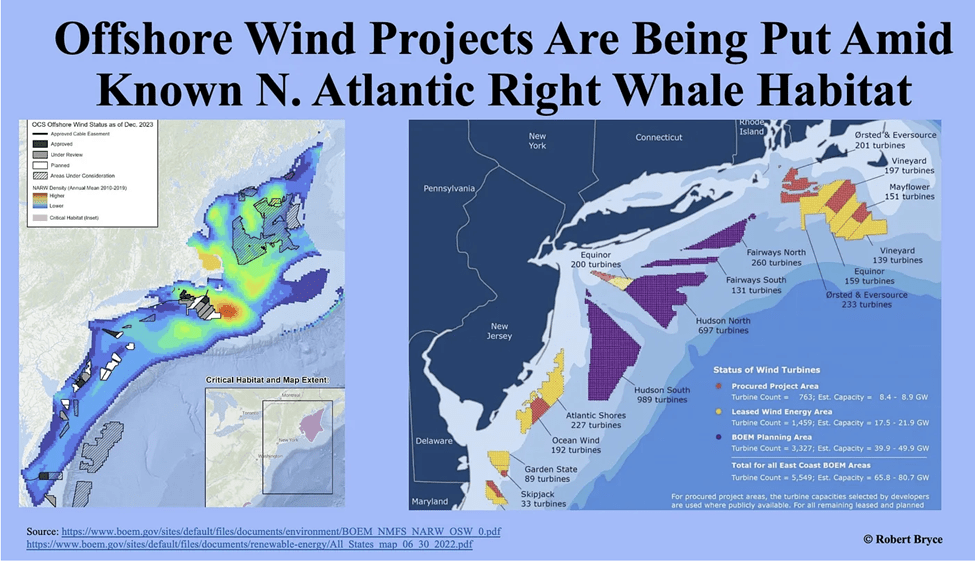
Robert Bryce published an article entitled The Offshore Wind Scandal is Even Worse Than You Think  that addresses one of the cumulative environmental impacts that New York and the BOEM are ignoring. In charts he explains where the money is flowing, describes potential impacts to whales, and includes a map showing that New York’s offshore wind developments overlap the migration paths of the critically endangered North American Right Whale.  The big green environmental organizations are abandoning whales in general and the remaining North American Right Whales in particular.  Bryce quotes an opponent of offshore wind: “What is Big Wind going to say when they kill the last whale? ‘Sorry’?” 

Balanced View of Fossil Fuels

Alex Epstein explains why we should look at fossil fuels in a balanced way.  Here is a sample:

  • Most “experts” look at the negatives of fossil fuels but ignore huge positives.
  • Many “experts” ignore that much of the world would starve without fertilizer from natural gas.
  • Fixating on the negatives and ignoring the positives of any technology is deadly.
  • If we just looked at the negatives of antibiotics and ignored the positives, billions would die.
  • To decide what to do about fossil fuels we must be balanced, looking at both negatives and positives.
  • Fossil fuels do impact climate—but even there we must consider positives along with negatives.
  • A huge, ignored climate positive we get from fossil fuels is the ability to master climate danger.
  • Fossil fueled climate mastery has helped us become safer than ever from climate.
  • In weighing fossil fuels’ positives and negatives, we must be precise—not exaggerate or fabricate.
  • Sadly many “experts” exaggerate the negatives of fossil fuels in addition to ignoring the positives.
  • If we carefully weigh fossil fuels’ positives and negatives, it becomes clear we need more of them.

Greenhouse Effect Misinformation

Harold D. Pierce, Jr. sent me a note about a paper by Joel Kaufmann titled Climate Change Reexamined that makes the very good point that CO2 is not the only greenhouse gas.  Proponents of climate change action typically ignore the implications of water on the GHG effect.  Pierce explains:

Shown in Fig. 7, is the infrared (IR) absorption spectrum of a sample of Philadelphia city air from 400 to 4,000 wavenumbers. The wavenumber scale linear in energy and spans an order of magnitude in energy.

Integration of spectrum determined that water absorbed 92% of the IR light and carbon dioxide only 8 % of the IR light. Since the wavenumber scale is linear in energy, water absorbed much more IR light energy than carbon dioxide. Since the air sample was city air, it is likely that the concentration of carbon dioxide was higher than that of remote location such a rural area. Kauffman did not measure the concentration of carbon dioxide in the city air.

In 1999 at the MLO in Hawaii, the concentration of carbon dioxide in air was about 367 ppm by volume. This is only 0.721 grams of carbon dioxide per cubic meter of air. At 28 deg. C and 76% RH the concentration of water in was about 28,044 ppm by volume. This is about 22.5 grams of water cubic meter of air. For these weather conditions, water is about 98.7% of the greenhouse effect.

Based on the above analysis and calculations and on Kauffman’s essay, I have concluded that since 1988, the claim by the IPCC carbon dioxide has caused and is still causing “global warming” is a lie. Water is by far the major greenhouse gas and carbon dioxide is a very minor greenhouse gas.

Risks of Climate Act Net Zero

I believe the Climate Leadership & Community Protection Act (Climate Act) transition will negatively affect affordability, reliability, and the environment.  I have been meaning to summarize my concerns for quite a while and two recent articles prompted me to write this.  David Turver explains how the transition to Net Zero has negatively affected affordability in the United Kingdom.   Robert Bryce provides an example of how the Climate Act mandates for offshore wind development will negatively affect the endangered North American Right Whale.  Finally, I describe why I worry that the reliance on wind and solar generating resources markedly increases reliability risks.

I have followed the Climate Act since it was first proposed, submitted comments on the Climate Act implementation plan, and have written over 400 articles about New York’s net-zero transition.  The opinions expressed in this article do not reflect the position of any of my previous employers or any other company I have been associated with, these comments are mine alone.

Introduction

David Turver’s Risks of Net Zero article prompted me to write this post.  He is the author of the Eigen Values Substack.  He is a retired consultant, CIO and project management professional. His description says that he is a first principles thinker who is tired of superficial media simply republishing press releases without critical analysis. His Substack incudes articles about contentious issues such as climate, energy, and net zero.

The Introduction to Risks of Net Zero provides an overview of the general concern about the risk.  He states:

We hear a lot about how we are supposedly in a climate crisis and how The Science™ tells us we are about to succumb to global boiling. Most climate activists claim that we must cut emissions by spending more money on windmills and solar panels or we will all burn to a crisp.

I would describe myself as a lukewarmer, by which I mean that I acknowledge the earth is warming and that human emissions of CO2 have made some contribution to that warming. However, it is also true that the climate has changed dramatically without human intervention; clearly, there are other causes of climate change too.

The strategy of reducing emissions of greenhouse gases to Net Zero is classified as a “mitigation strategy” in the parlance of the IPCC. The alternative strategy is adaptation which means taking measures to adjust to climate change such as building flood defences, irrigation systems or developing new strains of crops to cope better with changing weather patterns. Most spending effort in the West is geared towards mitigation. But, what if the Net Zero cure is worse than the disease? What if mitigation is less effective than adaptation?

Before he addresses affordability Turver compares mitigation against adapatation. He and I agree that adaptation is likely to be more effective than mitigation. He explains why in the following.

Mitigation Drawbacks

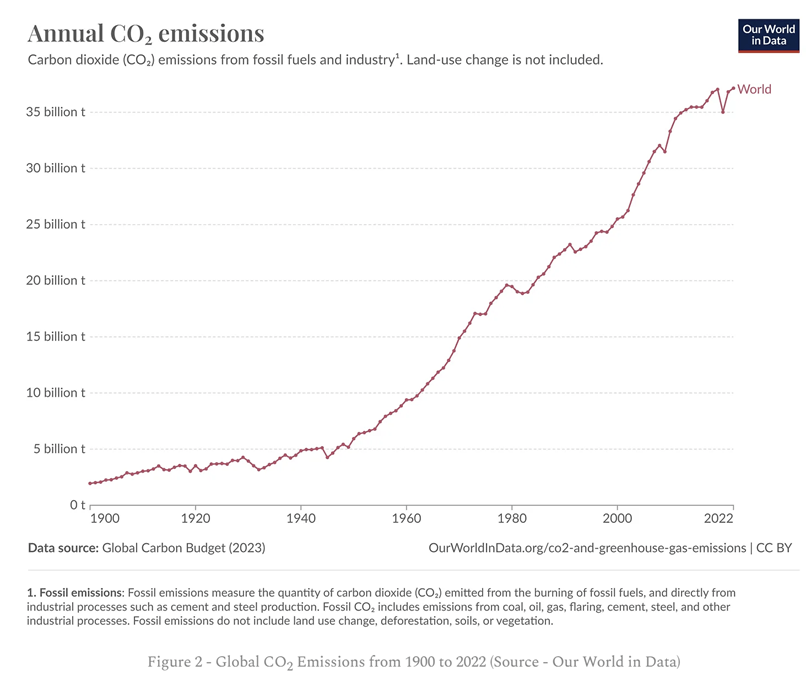
Turver points out issues related to mitigating climate change by reducing emissions.  Mitigation only works if CO2 is the only climate control knob but that cannot be the case because we have observed temperature changes over the last thousand years.   Mitigation can only work if everyone else slashes emissions too and we can see from Figure 2 (from Our World in Data) that this is not happening.

Adaptation Successes

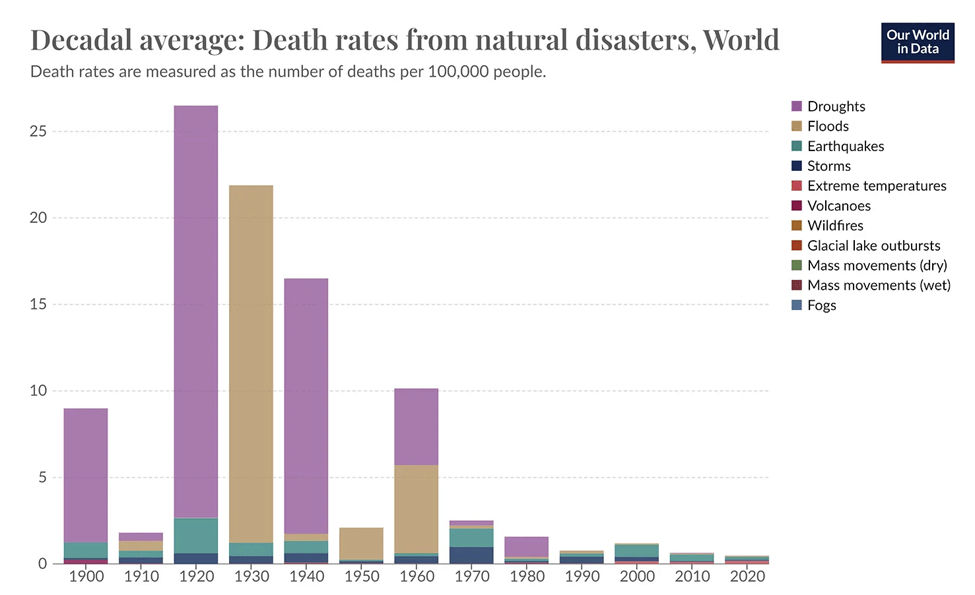
Turver explains that adaptation since 1900 has dramatically decreased death rates.  He includes a figure sourced from  Our World in Data.

Not mentioned but certainly a factor is that the death rate went down in no small part because fossil fuels increased the ability of society to address the causes listed.  Based on past success the obvious alternative is to emphasize adaptation.  Turver explains:

Adaptation measures have many benefits. First, they require no international treaty, and they can be applied locally where they produce results quickly. They also work to protect against changes in the climate that are not driven by CO2. Adaptation measures might also have additional benefits such as more efficient water use or more robust crop varieties. There is no reason why we cannot continue to adapt.

New York Effect on Climate Change

There is another aspect of mitigation that is routinely ignored by proponents of the Climate Act.  New York emissions are tiny relative to global emissions.  In 2021, NYS GHG emissions (GWP-100) were 247 million metric tonnes (MMT).  GHG emissions from China were 13,774 MMT and from India were 3,879 MMT.  The increase in emission from 2020 to 2021 were 498 MMT in China and 265 MMT in India.  New York emissions will be supplanted by emissions from China or India in less than one year.  New York’s net-zero transition plan emission reductions will have no effect on emissions and thus no effect on the purported effects of climate change. Adaptation investments in New York infrastructure to reduce the costs of extreme weather impacts will focus on New York so the benefits will be to New Yorkers.

Climate Act advocates frequently argue that New York must take action because our economy is large.  I analyzed that claim and summarized the data here.  New York’s 2020 Gross State Product (GSP) ranks ninth if compared to the Gross Domestic Product (GDP) of countries in the world.  However, when New York’s GHG 2016 emissions are compared to emissions from other countries, New York ranks 35th.  More importantly, a country’s emissions divided by its GDP is a measure of GHG emission efficiency.  New York ranks third in this category trailing only Switzerland and Sweden. We are already doing our share.

Net Zero Affordability Risks

I think the biggest issue with the Climate Act is affordability.  Everyone wants a clean and safe environment but just how clean, how safe and at what price are all value judgements.  Turver points out that implementation of net-zero policies like the Climate Act have poorly acknowledged risks:

First and most obvious, they cannot work against climatic changes that are driven by forces other than CO2. Second is the outright cost. 

He goes on to describe observed cost increases in the United Kingdom.  He makes the point that additional costs also make manufacturing and other production less competitive, which leads to job losses.  Ultimately the inability to produce basic needs reduces security.  He also points out that renewable energy development requires more materials than alternatives.  That has environmental and cost implications. 

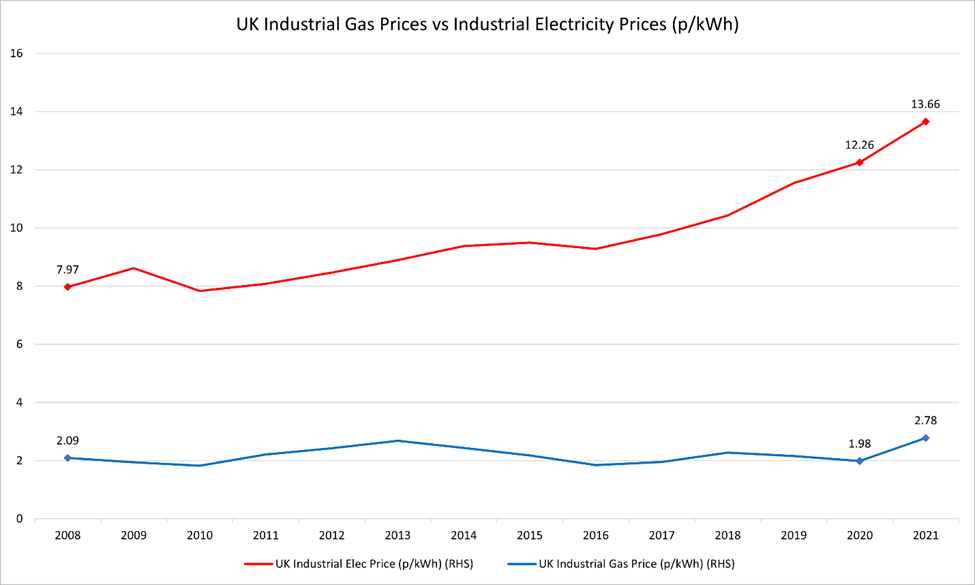
Turver explains that the increased penetration of renewables in the United Kingdom has led to a massive increase in electricity bills. This increase comes from “renewables subsidies as well as grid balancing costs and the massive costs of expanding the grid out to remote offshore wind farms”.  The article compares recent United Kingdom industrial gas prices and industrial electricity prices:

As can be seen in Figure 5, from 2008 to 2020, industrial electricity prices rose 53.8% while industrial gas prices actually fell slightly over the same time period. Both gas prices and electricity rose in 2021 as gas prices started to spike as demand increased after Covid lockdowns ended and supply could not keep up with demand. However, even though there was a spike in gas prices in 2021, the increase from 2008 is still only 33%, whereas electricity prices have surged 71.4% over the same period. The figures for 2022 are not yet available, but we might expect to see a big surge in both gas and electricity prices due to supply shortages resulting from the war in Ukraine.

There is no doubt that all these impacts will inevitably occur in New York as the Climate Act mandates are implemented. A recurring theme of many of my posts is that the Hochul Administration has never provided clear and comprehensive cost estimates for all the control strategies in the Scoping Plan

American Offshore Wind Energy Scandal

I believe that the environmental impacts of wind and solar development are greater than the impacts of fossil-fueled or nuclear resource development.  In my Draft Scoping Plan comments I noted that on September 17, 2020 the Final Supplemental Generic Environmental Impact Statement (SGEIS) for the Climate Leadership and Community Protection Act was released.  It covered the “environmental impacts of the offshore wind and distributed solar procurement goals, and the estimate of utility-scale solar capacity required to meet the meet the 70 by 30 goal” based on the resources estimated necessary at that time.  Since then, considerably more resources have been projected but the cumulative assessment has not been updated.

Robert Bryce published an article entitled The Offshore Wind Scandal is Even Worse Than You Think  that addresses one of the cumulative environmental impacts that the Scoping Plan ignored.  Bryce is an author, filmmaker, and public speaker who has been reporting on the energy sector for more than 30 years.  His background enables him to provide graphical evidence to support his arguments that I think are well done.  In this article he includes 11 charts that “show how America’s biggest NGOs are colluding with foreign corporations that want to industrialize our oceans with thousands of turbines that will hurt whales and ratepayers”.

He writes:

The hard reality is that America’s offshore wind sector is a subsidy-dependent industry that is dominated by foreign companies who are in bed with some of America’s biggest climate NGOs, including the NRDC (gross receipts: $555 million) and Sierra Club (Gross receipts: $184 million).  Those NGOs and others, including the National Wildlife Federation (gross receipts: $142 million) and Conservation Law Foundation (gross receipts: $17.5 million), are leading the most shameful environmental betrayal in modern American history. Rather than seek to protect marine mammals and stop the industrialization of our oceans, they are eagerly promoting the installation of hundreds of offshore wind platforms smack in the middle of the known habitat of the critically endangered North Atlantic Right Whale.

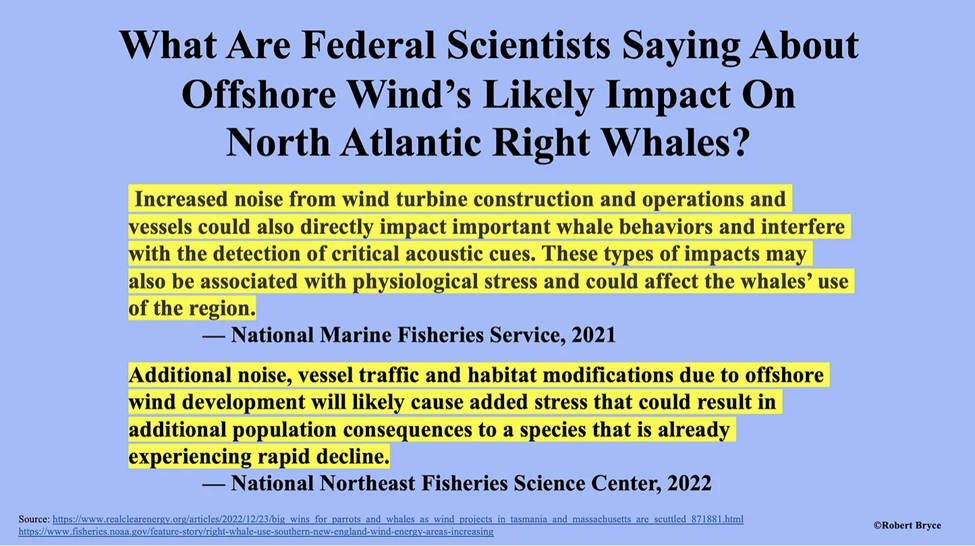
I recommend the article for its details.  In this summation I am not going to address all the charts in detail.  The first four charts support the quotation above.  The fifth chart addresses environmental impacts.  The offshore wind shills claim that there aren’t impacts on whales, but Federal scientists disagree.

Bryce describes Chart 6:

I’m old enough to remember when environmental groups cared about whales. Alas, that was a long time ago. On Sunday, the Daily Mail published an article about Apostolos Gerasoulis, a Rutgers professor emeritus of computer science who built a software system to analyze the dozens of whale deaths that have occurred on the Eastern Seaboard over the past few years. Gerasoulis set out to determine if the whale deaths were related to the loud blasts of sonar used by offshore wind survey vessels. His conclusion: “Offshore wind kills whales…The numbers never lie. There is a cause. We have shown that the cause for death of the whales is offshore wind. Period.” (H/t fellow Substack writer David Blackmon.) 

In Chart 7 Bryce notes that the Massachusetts Sierra Club notes that “Because the North Atlantic Right Whale has such a small population and a low annual reproductive rate, a single whale death can have a significant negative impact on the species’ ability to recover.”  In Chart 8 he provides a plain English translation of a statement in the Bureau of Ocean Energy Management environmental impact statement of Vineyard Wind: “These projects won’t make any difference on climate change. But they are good because they allow state-level bureaucrats to say they met their policy goals.” 

The remaining charts compare offshore wind capacity and costs relative to other resources.  He concludes that these developments will markedly increase costs for states that already have some of the highest electricity rates in the country.

I maintain that the New York State has shirked its commitment to the environment because it has not addressed cumulative environmental impacts of the Scoping Plan buildout of wind and solar.  No where is this more impactful than the effects on whales in general and the remaining North American Right Whales in particular.  Bryce quotes an opponent of offshore wind: “What is Big Wind going to say when they kill the last whale? ‘Sorry’?” 

Reliability Risks

I described my concern about the enormous risk of an electric grid relying on wind and solar resources in this post.  Since then, I have refined my description of the problem.  It boils down to “correlated intermittency”.  Let me explain.

Wind and solar are inherently intermittent – the sun does not shine at night and the wind does not always blow.  That intermittency is correlated.  All the solar in New York is unavailable at night.  It turns out that wind resources across New York also are usually high or low at the same time. There are exceptions but there is a high incidence of similar behavior.

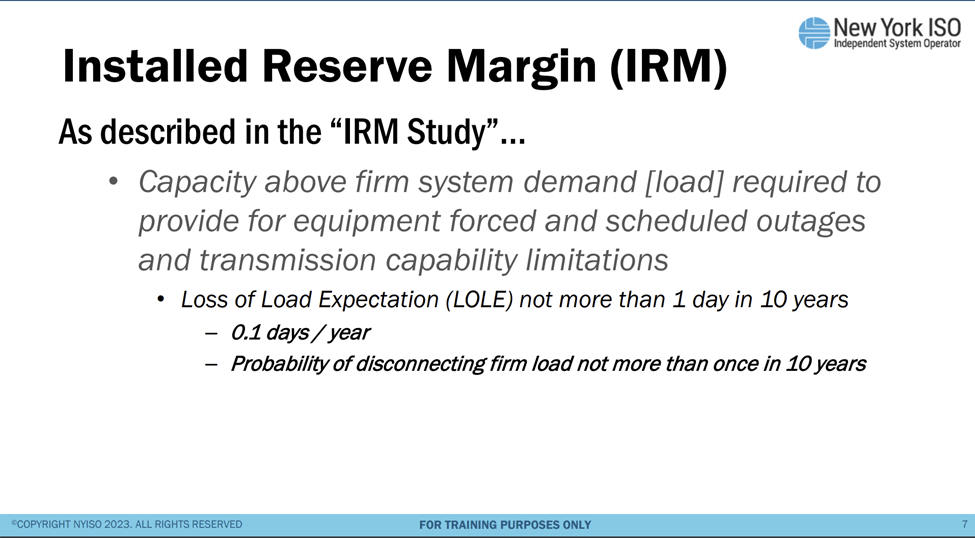
That matters for electric resource planning.  Today electric resource planning relies on decades of performance experience with hydro, nuclear, and fossil plants that do not correlate, that is to say there is no reason to expect that all the nuclear plants will be offline at the same time.  As shown in the following New York Independent System Operator (NYISO) slide, this characteristic enables the resource planners to determine how much generating capacity is necessary to meet the loss of load expectation (LOLE) criterion.  The probability of losing load not more than once in ten years is based on observations of the existing uncorrelated generating resources.  Importantly, I believe that the lack of correlation also means that the capacity needed above firm system load would not change substantially if the LOLE planning horizon was shifted to 1 day in 20 years.

Source: NYISO Amount of Capacity Required, Intermediate ICAP Course, June 2023

The variation in weather that affects wind and solar resource availability will require changes to electric resource planning.  Everyone has heard of a hundred-year flood which is the parameter used for waterway planning.  This is the one in a hundred probability that the water level in a river or lake will exceed a certain level.  Similar estimates of low wind and solar resource availability must be developed and incorporated into electric resource planning.

The unresolved problem is what return period probability is acceptable.  If the resource planning process does not provide sufficient backup resources to provide capacity for a peak load period, then blackouts are inevitable.  Two factors exacerbate the challenge of this problem:

  1. Periods of highest load are associated with the hottest and coldest times of the year and frequently correspond to the periods of lowest wind resource availability. 
  2. The decarbonization strategy is to electrify everything possible so the impacts of a peak load blackout during the coldest and hottest periods will be greater.

In an earlier post I described an analysis by the Independent System Operator of New England (ISO-NE) Operational Impact of Extreme Weather Events.  The study evaluated 1, 5, and 21-day extreme cold and hot events using a database covering 1950 to 2021. Not surprisingly the system risk or “the aggregated unavailable supply plus the exceptional demand” during an event increased as the lookback period increased.  If the resource adequacy planning for New England only looked at the last ten years, then the system risk would be 8,714 MW, but over the whole period the worst system risk was 9,160 and that represents a resource increase of 5.1%.  There is no question that a similar analysis for New York would find a similar result.

The correlated intermittency of wind and solar resources means that we will depend on energy-limited resources that are a function of the weather causing low resource availability at the same time.  The unresolved issue is how to design an affordable and practical system to meet the worst-case weather induced lull. Consider the ISO-NE analysis where it was found that the most recent 10-year planning lookback period consistent with current LOLE evaluations would plan for a system risk of 8,714 MW.  If the planning horizon covered the period back to 1961, the worst-case to 1950, an additional 446 MW would be required to meet system risk.  I cannot imagine a business case for the deployment of electric system resources that will only be needed once in 63 years.  For one thing, the life expectancy of these technologies is much less than 63 years.  Even over a shorter horizon such as the last ten years, how will a required facility be able to stay solvent when it runs so rarely? The only solution is subsidies to build and very high payments when they do run.

Reliability risks have also been identified by the North American Electric Reliability Corporation.  They have expressed concerns that extreme weather events, rapid demand growth, and systemic vulnerabilities pose risks for supply shortfalls and grid reliability.  These are serious risks to the Climate Act net-zero transition plan that must be resolved sooner rather than later.

Conclusion

I believe that the Climate Act will do more harm than good.  Affordability is the first problem. The Hochul Administration has not provided transparent and comprehensive cost estimates for the control strategies proposed for the net-zero transition.  The New York State Comptroller Office audit of costs in Climate Act Goals – Planning, Procurements, and Progress Tracking  agrees with my concern and recommends a detailed analysis of cost estimates to transition to renewable energy sources and meet Climate Act goals. I believe such an analysis will agree with observed results elsewhere that show the costs will be extraordinary and will certainly affect affordability.

The Hochul Administration has not provided a cumulative environmental impact assessment for the generating resources projected in the Scoping Plan.  Nowhere is the potential impact more critical than with respect to whales and the massive deployment of offshore wind proposed.  It is incumbent upon the State to prove that there will not be adverse impacts to the critically endangered North American Right Whales.

Finally, there ae reliability risks inherent in a weather-dependent electric grid when all the wind and solar output is reduced at the same time.  This raises overarching questions that have not been addressed.  Furthermore, even if these weather risks can be addressed in theory, the solution will involve technologies that are not commercially available today.  I have no doubts that the only safe way to decarbonize the electric grid is to rely on nuclear power.  The Hochul Administration needs to confront these issues before it is too late. 

The risks of the Climate Act are all associated with mitigation efforts to reduce GHG emissions.  I agree with Turver that mitigation should be emphasized.  He concludes:

The risks of climate change can be averted by continuing to adapt, just as we have for millennia. It is certain that unilateral action by the UK, or indeed multilateral action by much of the West, will do nothing to change the weather while the developing world continues to increase their consumption of hydrocarbons to make themselves richer. Indeed, even if mitigation measures were adopted globally, it is naïve to believe that bad weather will cease and we will suddenly get the “stable climate” demanded by more than 170 lawyers.

Ellenbogen on the Comptroller Audit of the Climate Act

On July 16, 2024 the New York State Comptroller Office released an audit of the New York State Energy Research and Development Authority (NYSERDA) and Public Service Commission (PSC) of their implementation efforts for the Climate Leadership and Community Protection Act (Climate Act) titled Climate Act Goals – Planning, Procurements, and Progress Tracking.  The key finding summary states: “While PSC and NYSERDA have taken considerable steps to plan for the transition to renewable energy in accordance with the Climate Act and CES, their plans did not comprise all essential components, including assessing risks to meeting goals and projecting costs.”  As much as I would like to do a post on this, I am stretched too thin.  Fortunately, Richard Ellenbogen sent along his thoughts that I have incorporated into my overview of the background and context of this report.

Ellenbogen is the President [BIO] Allied Converters and frequently copies me on emails that address various issues associated with the Climate Act I have published other articles by Ellenbogen and collaborated on a position paper on New York City’s Local Law 97 with him. There are only a few people in New York that are trying to educate people about the risks of the Climate Act with as much passion as I am, but Richard certainly fits that description.  He comes at the problem as an engineer who truly cares about the environment and how best to improve the environment without unintended consequences.  He has spent an enormous amount of time honing his presentation summarizing the problems he sees but most of all the environmental performance record of his business shows that he is walking the walk.  

Overview

The Climate Act established a New York “Net Zero” target (85% reduction in GHG emissions and 15% offset of emissions) by 2050.  It includes an interim 2030 reduction target of a 40% reduction by 2030 and a requirement that all electricity generated be “zero-emissions” by 2040. The Climate Action Council (CAC) was responsible for preparing the Scoping Plan that outlined how to “achieve the State’s bold clean energy and climate agenda.” The Integration Analysis prepared by the New York State Energy Research and Development Authority (NYSERDA) and its consultants quantifies the impact of the electrification strategies.  That material was used to develop the Draft Scoping Plan outline of strategies.  After a year-long review, the Scoping Plan was finalized at the end of 2022.  Since then, State agencies and the legislature have been attempting to implement the plans through regulations, PSC orders, and legislation. 

The New York State Comptroller Office audit of NYSERDA and PSC is available in  Climate Act Goals – Planning, Procurements, and Progress Tracking as a pdf format file.  The Audit Highlights section of the report lists the key findings and key recommendations:

Key Findings

While PSC and NYSERDA have taken considerable steps to plan for the transition to renewable energy in accordance with the Climate Act and CES, their plans did not comprise all essential components, including assessing risks to meeting goals and projecting costs. Specifically:

  • PSC is using outdated data, and, at times, incorrect calculations, for planning purposes and has not started to address all current and emerging issues that could significantly increase electricity demand and lower projected generation, such as increased push to transition to electric vehicles by 2035 and the cancellation or delay in renewable energy projects. Between 2005 and April 2023, 12% of contracted large-scale renewable projects were canceled. 
  • The costs of transitioning to renewable energy are not known, nor have they been reasonably estimated. Moreover, funding sources to cover those costs have not been identified, leaving the ratepayers as the primary source of funding. The lack of alternative funding sources adds additional risk to whether the State can meet its goals timely. Data shows utility costs have already risen sharply over the last two decades and more New Yorkers are having difficulty paying their utility bills. 
  • PSC has taken steps to address some risks and issues; however, it has not yet begun to formally review progress toward Climate Act goals with updated generation and electricity demand forecasts. While PSC noted it has until July 2024 to begin this assessment, waiting until that point to fully review all efforts and costs of the transition to renewable energy increases the risk that Climate Act goals will not be met within the established time frame.

Finally, a formal backup plan has not been established in the event Climate Act goals are found to be unachievable within the prescribed time frames, other than PSC suspending or modifying the obligations under the Climate Act and relying on the continued use of fossil fuels to generate electricity until sufficient renewable electric generation is developed. However, continuing to use fossil fuels as a backup plan would delay emission reductions and increase the burden on ratepayers by forcing them to continue to support fossil-fuel generation that otherwise could be retired—including the additional cost of the infrastructure to safely transport the fossil fuels to where they will be used to generate energy.

Key Recommendations

•            Begin the required comprehensive review of the Climate Act, including assessment of progress toward the goals, distribution of systems by load and size, and annual funding commitments and expenditures.

•            Continuously analyze the existing and emerging risks and known issues to ensure they are evaluated and addressed to minimize impact on the State’s ability to meet Climate Act goals.

•            Conduct a detailed analysis of cost estimates to transition to renewable energy sources and meet Climate Act goals. Periodically update and report the results of the analysis to the public.

•            Assess the extent to which ratepayers can reasonably assume the responsibility for covering Climate Act implementation costs. Identify potential alternative funding sources.

Note that the key finding that states that the PSC “has not yet begun to formally review progress toward Climate Act goals with updated generation and electricity demand forecasts.”  It goes on to say that “While PSC noted it has until July 2024 to begin this assessment, waiting until that point to fully review all efforts and costs of the transition to renewable energy increases the risk that Climate Act goals will not be met within the established time frame.”  A couple of weeks ago the PSC released the Clean Energy Standard Biennial Review Report.  I do not think that report uses “updated generation and electricity demand forecasts” but it does conclude that the 2030 goal requiring 70% of the electricity supplied to the grid come from renewable sources will not be met without extraordinary efforts.

In addition, the biennial report does not address costs.  It states that:

Appendix A also provides CES funding and expenditures for recent years through 2023. Forward-looking cost estimates for the CES and other costs associated with pursuit of the CLCPA goals are provided separately in the Department of Public Service (DPS) Annual CLCPA Report.  The most recent such report was filed on July 20, 2024. Case 22-M-0149, Proceeding on Motion of the Commission Assessing Implementation of and Compliance with the Requirements and Targets of the Climate Leadership and Community Protection Act, New York State Department of Public Service First Annual Informational Report on Overall Implementation of the Climate Leadership and Community Protection Act (filed July 20, 2024). The next report is expected to be filed later in 2024.

In other words the biennial reports are not going to provide the cost data that the Comptroller audit recommends.

Ellenbogen Commentary

The following was included in an email from Ellenbogen on 17 July 2024.  I have made a few edits for consistency with this article and have added a couple of annotations.

Regarding DiNapoli’s request for more transparent information mentioned in the audit report, he is correct but he is directing his arrows at the wrong targets.  While I have major issues with some of the things that NYSERDA has done over the past couple of years, primarily their silence on the CLCPA, the PSC and NYSERDA are not the ultimate culprits here.  At the BCNYS Renewable Energy Conference, I asked the NYISO speaker why they were screaming between the lines and not just coming out and saying that the entire process is devoid of reality because the people that need to hear it can’t, or are unwilling to, read between the lines.  The NYISO says that, “Because we shut down gas generation too quickly, the system is compromised and has inadequate excess generation during times of extremely high load” which translates to, “If we have too many hot days in a row, there is going to be a blackout and people are going to die.”

In their 2022 6 GW storage report, NYSERDA stated that to get the system to work would require 1000+ hours of storage and the cost at the time was $560 per KWh.  Doing the math, that was $3.36 Trillion dollars for storage that would last only ten years.  That doesn’t include the renewables and transmission that would be required or the hundreds of billions of dollars to electrify the buildings.  The actual cost will be at least ten times NY State’s annual budget, if not more.   It will impose a tax burden on every New Yorker that none of them will be able to afford.  NYSERDA put the number out there, but everyone ignored it and just plowed along as though they could somehow overcome that little detail.  The cost also ignores logistical issues that I have mentioned on numerous occasions.

The problem with agency cost estimates is that they are buried in different reports. The Scoping Plan that outlined how to “achieve the State’s bold clean energy and climate agenda” is the logical place to provide comprehensive cost estimates for all the strategies proposed to achieve the Climate Act mandates.  However, the cost documentation is incomplete, sparsely referenced, and misleading, in short it does not provide the necessary information for estimating ratepayer costs to New Yorkers. 

This is a problem because New York Public Service Law  § 66-p (4), “Establishment of a renewable energy program”, states: “The commission may temporarily suspend or modify the obligations under such program provided that the commission, after conducting a hearing as provided in section twenty of this chapter, makes a finding that the program impedes the provision of safe and adequate electric service; the program is likely to impair existing obligations and agreements; and/or that there is a significant increase in arrears or service disconnections that the commission determines is related to the program”.  It is only possible to determine the impact on ratepayers in arrears or service disconnections if full cost estimates are available.  The Comptroller audit appropriately addresses this shortcoming with the recommendation to “Conduct a detailed analysis of cost estimates to transition to renewable energy sources and meet Climate Act goals” and “Periodically update and report the results of the analysis to the public.”

I agree with Ellenbogen’s following explanation why this information is not available:

No one wants to put the actual number into the public domain because it is so astronomical that the minute it was announced, the project would implode, and the political fallout will be staggering.  Further, I’m sure that the lesson of what happened to Justin Driscoll of NYPA when he told the truth about the process is fresh in everyone’s mind.  The acolytes of this process wanted to hang him upside down from a light pole, as was done to Mussolini.  He was just telling them the truth but that evidently doesn’t mean anything in NY State.  No sane person wants to put that number down on paper and get pilloried for it and called a liar.  Everyone at the state level that knows better is required by law to implement this ridiculous plan that can’t be implemented.  So, they can tell the truth and get fired or they can duck and cover and hope that the law gets changed when it becomes brutally obvious how flawed it really is.  In the interim, everyone is finger pointing, including the state comptroller.

The real targets for DiNapoli should be the Climate Action Council and the legislature that proposed this insanity based upon fantasies with no grounding in reality.  No realistic cost analysis was ever done prior to voting to pass the Climate Act.  The cost analysis for the Draft Scoping Plan was inadequate but the Climate Act Scoping Plan was still approved and that is the fault of the Climate Action Council (CAC).  The few numbers that I have seen in the Climate Act Scoping Plan are so devoid from reality that they would be funny if the situation wasn’t so serious.   You can make stuff up as the Climate Action Council did, but with math and physics, reality will eventually rear its ugly head and that is what is happening now.

In a second email Ellenbogen continued:

The issue isn’t that the PSC and NYSERDA aren’t planning properly.  If you look at the three key findings quoted from the Audit highlights above, they are unachievable under any circumstances.  It wouldn’t matter what NYSERDA and the PSC did.  They can’t pull rabbits out of hats last I checked.

There is a Climate Action Council mandate (section 16 of § 75-0103) to consider efforts at other jurisdictions: “The council shall identify existing climate change mitigation and adaptation efforts at the federal, state, and local levels and may make recommendations regarding how such policies may improve the state’s efforts”. Ellenbogen points out the there are lessons to be learned at other jurisdictions that have attempted to decarbonize using wind and solar that have been ignored.  Why?

The math behind the solar and wind utility system doesn’t work.  It hasn’t worked anywhere it has been tried and the time frames have been measured in decades to get to a fraction of a renewable system, not 10 years or 20 years like the CLCPA requires.  Germany is 34 years in, controls the banking system in their jurisdiction which NY State does not, and they’ve only gotten to 34% renewables after about 34 years with energy costs twice those of France next door.  Their politicians are paying for that.  The costs are rising because they are being required to install transmission that only operates 15% of the time for solar or 30% for wind where it would operate 93% of the time for fossil or nuclear.  That increases the transmission cost per megawatt-hour.   Offshore wind bids are coming in at three times the price of current generation.  Projects are being canceled because of high transmission costs and material costs.  Building electrification is prohibitively expensive.  How can you plan for that?  

Why didn’t the legislature request a cost analysis prior to passing the bill?  Why didn’t the Climate Action Council do a cost analysis of what they were proposing?  It’s because it was driven by a couple of college professors that have absolutely no understanding of procurement, energy, economics, or basically anything else in the real world.  In their minds, no cost was too high to eliminate fossil fuels from the state.  The question for politicians today is whether spiraling energy costs brought on by this bill are going to make re-election more difficult.

The net-zero transition plan requires “Distributed Emission Free Resources” or DEFR’s that don’t exist in the present day aside from nuclear and that is a dirty word in NY State.  Even if the State made the rational decision to decarbonize the electric sector with nuclear instead of wind and solar, it would also take about 30 – 40 years to build enough nuclear capacity to meet the state’s needs if they started today.  Waiting for an alternative new technology to fulfill the DEFR requirement will take even longer.  None of these time frames fits within the CLCPA mandate.

The only mistake that the PSC and NYSERDA made was not speaking up in 2019 before this mess was passed but Cuomo was ruling with an iron hand at the time.  What makes this all so senseless is that nothing NY State does is going to impact Climate Change.  I’m not saying that we should do nothing, but we should be intelligent in our planning.  Saying that NY State is an energy leader is a joke.  We’re only a leader in chasing our businesses to other states where they are assured of an adequate energy supply.  In 20 years NY State is going to be an example of what not to do.

The backup plan for the near term to ensure sufficient generation would require the construction of fossil fuel plants which will draw the ire of the lunatic fringe that has no understanding of energy or math.  I gave them a backup plan in comments I submitted to the record for Department of Public Service Proceeding 15-E-0302 but numerous groups will fight against that.  When the level of desperation gets high enough, they will be implemented.  Unfortunately, there may have to be a major blackout to bring people to their senses.

Conclusion

The Comptroller Climate Act Goals – Planning, Procurements, and Progress Tracking and the PSC Clean Energy Standard Biennial Review Report both acknowledge that Climate Act implementation is not going as planned.  I believe Ellenbogen agrees with me that all the recommendations in the audit report should be implemented as soon as possible:

•            Begin the required comprehensive review of the Climate Act, including assessment of progress toward the goals, distribution of systems by load and size, and annual funding commitments and expenditures.

•            Continuously analyze the existing and emerging risks and known issues to ensure they are evaluated and addressed to minimize impact on the State’s ability to meet Climate Act goals.

•            Conduct a detailed analysis of cost estimates to transition to renewable energy sources and meet Climate Act goals. Periodically update and report the results of the analysis to the public.

•            Assess the extent to which ratepayers can reasonably assume the responsibility for covering Climate Act implementation costs. Identify potential alternative funding sources.

Richard Ellenbogen and I have long argued that a clear and transparent accounting of all the costs to meet the Climate Act goals is not available.  It is heartening to see that the Comptroller audit agrees with our position that this information is necessary.  The biennial review report concludes that the 2030 electric grid goal for 70% renewable energy is not likely.  It is time for New York State to acknowledge these problems should be resolved before continuing.  I recommend a pause in implementation until all the recommendations in the audit report are implemented and a feasibility study reconciles the electric system projections in the Scoping Plan and the New York Independent System Operator resource adequacy analyses.

Ellenbogen sums up the situation:

There is nothing happening now that I didn’t tell them would happen five years ago.  I’m not Nostradamus.  I just know how to count.

Climate Act Presumption That DEFR is Unnecessary

The New York Department of Public Service (DPS) Proceeding 15-E-0302 addresses among other things  a new category of generating resources called Dispatchable Emissions-Free Resources (DEFR).  All credible analyses of the future New York electric system agree that new technologies are necessary to keep the lights on during periods of extended low wind and solar resource availability.  This article describes the presumption of the authors of the Climate Leadership & Community Protection Act (Climate Act) that no new technologies would be required.

I have followed the Climate Act since it was first proposed, submitted comments on the Climate Act implementation plan, and have written over 400 articles about New York’s net-zero transition.  The opinions expressed in this article do not reflect the position of any of my previous employers or any other company I have been associated with, these comments are mine alone.

Overview

The Climate Act established a New York “Net Zero” target (85% reduction in GHG emissions and 15% offset of emissions) by 2050.  It includes an interim 2030 reduction target of a 40% reduction by 2030 and a requirement that all electricity generated be “zero-emissions” resources by 2040. The Climate Action Council (CAC) was responsible for preparing the Scoping Plan that outlined how to “achieve the State’s bold clean energy and climate agenda.” The Integration Analysis prepared by the New York State Energy Research and Development Authority (NYSERDA) and its consultants quantifies the impact of the electrification strategies.  That material was used to develop the Draft Scoping Plan outline of strategies.  After a year-long review, the Scoping Plan was finalized at the end of 2022.  Since then, the State has been trying to implement the Scoping Plan recommendations through regulations and legislation.

I have written about the out-sized and misleading impact that Robert W. Howarth, Ph.D., the David R. Atkinson Professor of Ecology & Environmental Biology at Cornell University had on many of the members of the Climate Action Council.  His statement supporting the approval of the Draft Scoping plan claimed that he played a key role in the drafting of the Climate Act and explained why he believes that no new technologies are needed to meet the Climate Act goals:

I further wish to acknowledge the incredible role that Prof. Mark Jacobson of Stanford has played in moving the entire world towards a carbon-free future, including New York State. A decade ago, Jacobson, I and others laid out a specific plan for New York (Jacobson et al. 2013). In that peer-reviewed analysis, we demonstrated that our State could rapidly move away from fossil fuels and instead be fueled completely by the power of the wind, the sun, and hydro. We further demonstrated that it could be done completely with technologies available at that time (a decade ago), that it could be cost effective, that it would be hugely beneficial for public health and energy security, and that it would stimulate a large increase in well-paying jobs. I have seen nothing in the past decade that would dissuade me from pushing for the same path forward. The economic arguments have only grown stronger, the climate crisis more severe. The fundamental arguments remain the same.

The presumption that “it could be done completely with technologies available at that time (a decade ago)” was a primary driver of the Climate Act schedule and confidence of success by the legislature and the Climate Action Council.  The feeling was that all it takes is a matter of political will because the professor said it will work.  Howarth appealed to the authority of peer-reviewed science to provide credibility for the Jacobson analysis that is the basis of his claims. However, science is a continuous process where hypotheses are constantly challenged and confirmed.  In this instance Howarth neglected to mention the analyses that discredit the Jacobson work. 

Jacobson Wind, Water, and Solar

The Jacobson analysis cited was a continuation of previous work broadly labeled as Wind, Water, and Solar.  For example, in a widely publicized November 2009 Scientific American article, Mark Jacobson and Mark Delucchi suggested all electrical generation and ground transportation internationally could be supplied by wind, water and solar resources as early as 2030. However, other contemporary projections were less optimistic, for example two examples: the 2015 MIT Energy and Climate Outlook has low carbon sources worldwide as only 25% of primary energy by 2050, and renewables only 16% and the International Energy Agency’s two-degree scenario has renewables, including biomass, as less than 50%.

Howarth’s statement cites a specific plan for New York (Jacobson et al. 2013) that he and Jacobson laid out a decade ago.  He says that “In that peer- reviewed analysis, we demonstrated that our State could rapidly move away from fossil fuels and instead be fueled completely by the power of the wind, the sun, and hydro.”   Table 2 from that report follows.  This analysis includes power from exotic resources such as waves, geothermal, tidal turbines, and concentrated solar power but no energy storage.  It is significantly different than the projections in the Integration Analysis and the New York Independent System Operator (NYISO) 2021-2040 System & Resource Outlook that exclude all the exotic renewable generating capacity, contain significant amounts of energy storage, and include a new dispatchable, emissions-free resource for a set of resources that they think can provide sufficient electrical power for the future.  Furthermore, Jacobson and Howarth claim that end-use power demand can be decreased by 37%.   In my opinion, there are many flaws in his claims.  For example, any analysis that suggests that concentrated solar power is a viable source of energy in New York is simply not credible because that resource would never work in New York.  It is too cloudy to operate enough to cover costs and the environmental impacts would be too great.

There was a formal rebuttal paper to this analysis by Nathaniel Gilbraith, Paulina Jaramillo, Fan Tong, and Felipe Faria. The rebuttal paper argued that: 

The feasibility analysis performed by Jacobson et al. (2013) is incomplete and scientifically questionable from both the technical and economic perspectives, and it implicitly assumes, without sufficient justification, that social criterion would not produce even larger feasibility barriers.

Jacobson et al. responded to that rebuttal claiming  that “The main limitations are social and political, not technical or economic.”  Given the significant differences between that analysis and the most recent projections by the organization responsible for keeping the lights on, I agree with the Gilbraith et al. conclusion cited above.  I do not believe that the 2013 WWS analysis includes a defensible feasibility analysis.

Using Jacobson as the basis for the idea that the Climate Act transition needs no new technology gets worse.  Unmentioned by Dr. Howarth is that in a 2015 article for a different iteration of the wind, water, and solar roadmap Clack et al, 2017 discredited the Jacobson approach:

In this paper, we evaluate that study and find significant shortcomings in the analysis. In particular, we point out that this work used invalid modeling tools, contained modeling errors, and made implausible and inadequately supported assumptions. Policy makers should treat with caution any visions of a rapid, reliable, and low-cost transition to entire energy systems that relies almost exclusively on wind, solar, and hydroelectric power.

In the scientific process, when issues with your work are noted, the proper response is to provide more evidence supporting your modeling tools, explain why the claimed errors are not errors, and defend your assumptions.  Instead, Jacobson filed a lawsuit, demanding $10 million in damages, against the peer-reviewed scientific journal Proceedings of the National Academy of Sciences and the authors for their study showing that Jacobson made improper assumptions in order to make his claims that he had demonstrated U.S. energy could be provided exclusively by renewable energy, primarily wind, water, and solar. In my opinion this is an appalling attack on free speech and scientific inquiry but want to emphasize that the bad actions by Jacobson in no way should be attributed to Howarth.

In February 2018, following a hearing at which PNAS argued for the case to be dismissed, Jacobson dropped the suit.  The defendants then filed, based on the anti-SLAPP — for “Strategic Lawsuit Against Public Participation” — statute in Washington, DC, for Jacobson to pay their legal fees. In September 2022, he was ordered to pay the defendants’ legal fees based on a statute “designed to provide for early dismissal of meritless lawsuits filed against people for the exercise of First Amendment rights.”  Jacobson appealed that award but lost that appeal in February 2024 thus closing this sad tale of academic controversy.

In Meredith Angwin’s 2020 book Shorting the Grid: The Hidden Fragility of Our Electric Grid (Carnot Communications, Wilder, VT, 422 pp.) she also addressed the Jacobson analysis.  Her description in a section entitled Hard-Core Renewables at page 195 is consistent with my portrayal above:

Wind and solar are the technologies that most people think about when they think of “renewables.” Indeed, many hard-core renewables advocates accept only solar, wind, and (sometimes) hydro as renewables. Biomass rarely makes the cut as a true renewable. Professor Mark Z. Jacobson of Stanford plans WWS (Wind Water Solar) as the energy sources for the world. In 2015, Jacobson and others published an article in the Proceedings of the National Academy of Sciences on using WWS for all purposes.125

In 2017, a group of professors headed by Christopher Clack responded with an evaluation article also in the Proceedings.126 The first paragraph of the Clack article stated that “We find that their (Jacobson analysis) involves errors, inappropriate methods, and implausible assumptions.” For example, their rebuttal paper pointed out that the Jacobson paper describes hydro power as providing 700 to 1300 GW. However, existing installed hydro capacity is 87 or 145 GW, depending on whether pumped hydro is included, and the most useful sites have already been exploited.127

When the Clack paper appeared, Jacobson published a letter in the same issue of the Proceedings, claiming “The premise and all error claims (of the Clack paper)… are demonstrably false.”128 Jacobson said that his assertion on the availability of hydro power was an “assumption,” not an error. As Jacobson wrote in the published letter: “The value of 1,300 GW is correct, because turbines were assumed added to existing reservoirs to increase their peak instantaneous discharge rate without increasing their average annual energy consumption.” Shortly after the Clack paper and the Jacobson rebuttal were published in the Proceedings, Jacobson sued Clack and the Proceedings for defamation.

Jacobson later dropped his lawsuit. On the Greentech Media website, Julian Spector wrote an article about the controversy and the lawsuit.129 In his article, Spector notes that “this ‘assumption’ (about hydro) was unwritten” in the original Jacobson article. In other words, in his original paper, Jacobson did not describe his assumption that multiple turbines would be added to existing dams. Frankly, adding about ten times as many turbines to existing powerhouses seems very unlikely to me. Dam construction is a massive undertaking. Putting many more turbines in an existing powerhouse … well, I can’t see how that could even work.130

Jacobson did drop his lawsuit, which should be a happy ending, I suppose. However, many people, including myself, feel that the fact that Jacobson even brought a lawsuit has had a chilling effect on the whole renewable-energy debate. If scientists can’t debate each other in peer-reviewed journals without fear of lawsuits, science will not be able to move forward very well.

There are two books directly refuting the Jacobson plan. Roadmap to Nowhere: The Myth of Powering the Nation With Renewable Energy by Mike Conley and Tim Maloney is available as a free PDF download on the web.131 Mathijs Beckers, of the Netherlands, wrote The Non-Solutions Project, available as an ebook or paperback.132 The work of these authors is clear and easy to follow.

Footnotes

  1. Mark Z. Jacobson, Mark A. Delucchi, Mary A. Cameron, and Bethany A. Frew, “Low-cost solution to the grid reliability problem with 100% penetration of intermittent wind, water, and solar for all purposes,” Proceedings of the National Academy of Sciences, 112, no. 49 (December 8, 2015): 15060-15065, https://wwu .pnas.org/’content/112149115060.
  2. Christopher T. M. Clack et al., “Evaluation of a proposal for reliable low- cost grid power with 100% wind, water, and solar,” Proceedings of the National Academy of Sciences 114, no. 26 (June 27, 2017): 6722-2627, https://www.pnas . o rg/con tent/114/2 6/6722.
  3. Supporting information for the above article by Clack et al., https://www.pnas .org/content/pnas/suppl/2017/06/16/16103 81114. DCSupplemental/pnas. 1610381114 .sapp.pdf
  4. Mark Z. Jacobson, Mark A. Delucchi, Mary A. Cameron, and Bethany A. Frew, “The United States can keep the grid stable at low cost with 100% clean, renewable energy in all sectors despite inaccurate claims” (letter), Proceedings of the National Academy of Sciences 114, no. 26 (June 27, 2017), https://www.pnas .org/content 1114126/P5021.
  5. Julian Spector, “Mark Jacobson Drops Lawsuit Against Critics of His 100% Renewables Plan,” gtm: (website of Greentech Media), February 26, 2018. https://www.greentechmedia.com/articles/read/mark-jacobson-drops-lawsnit- against-critics-of-his-100-renewables.
  6. Besides my general knowledge of the grid and several visits to working dams, I also headed a project on predicting and preventing corrosion in the penstocks of several medium-size dams in mountainous country. This project was not published: it was only a report to the client, so I cannot provide a link. While I would not claim hydro power as an area of deep expertise for me, I have enough knowledge to be seriously skeptical about the idea of adding ten times as many turbines to existing hydro plants.
  7. Mike Conley and Tim Maloney, “Road Map to Nowhere: The Myth of Powering the Nation with Renewable Energy,” Road Map to Nowhere (website), December 2017, https://www.roadmaptonowhere.com.
  8. Mathijs Beckers, “The non-solutions project,” CreateSpace Independent Publishing Platform January 18, 2017), https://www.amazon.com/gp/product/ B01N6SN5El/re/=dbs_a_def_rwt_hsch_vapi_tkin_pl_il.

Conclusion

Much of this material was published 18 months ago.  I wrote this article for two reasons.  I wanted to update some information and add the reference by Angwin.  The other reason is that I am compiling articles about DEFR to be used in a reference page.

Howarth’s argument that no new technology is needed has been refuted in the peer reviewed literature but also in other work.  When I publish the reference page it will include multiple examples of other analyses that conclude that the new DEFR technology is required for New York’s electric grid zero-emissions transition.  Successful implementation is not just a matter of political will.

It is unsettling that Howarth continues to claim that no new technology is needed in that light and relative to the lawsuits associated with Jacobson’s work.  Angwin and I agree that Jacobson’s attempted lawsuit was because his work could not stand on its own.  It is time for the Climate Action Council to disavow itself from any suggestions that DEFR will not be needed.

Lessons from the RGGI Investment Proceeds Reports

I have prepared seven annual updates on the Regional Greenhouse Gas Initiative (RGGI) annual Investments of Proceeds report.  While preparing the most recent edition I realized that there were some lessons to be learned concerning the relative emission reduction effectiveness of the different investments categories used in the reports.  This post compares the dollars per ton of CO2 reduced for five investment categories.

I have been involved in the RGGI program process since its inception.  I blog about the details of the RGGI program because very few seem to want to provide any criticisms of the program. The opinions expressed in this post do not reflect the position of any of my previous employers or any other company I have been associated with, these comments are mine alone.

Background

RGGI is a market-based program to reduce greenhouse gas emissions (Factsheet). It has been a cooperative effort among the states of Connecticut, Delaware, Maine, Maryland, Massachusetts, New Hampshire, New York, Rhode Island, and Vermont to cap and reduce CO2 emissions from the power sector since 2008.  New Jersey was in at the beginning, dropped out for years, and re-joined in 2020. Virginia joined in 2021 and dropped out at the end of 2023.  Pennsylvania has joined but is not actively participating in everything due to on-going litigation. According to a RGGI website: “The RGGI states issue CO2 allowances which are distributed almost entirely through regional auctions, resulting in proceeds for reinvestment in strategic energy and consumer programs. Programs funded with RGGI investments have spanned a wide range of consumers, providing benefits and improvements to private homes, local businesses, multi-family housing, industrial facilities, community buildings, retail customers, and more.”

Proceeds Investment Report

The 2022 investment proceeds report was released on July 8, 2024.  For general information I refer you to my most recent  update.  In this article I am going to present data from the last five reports.  Each report breaks down the investments into major categories.  The 2022 investment report explains:

Energy efficiency makes up 49% of 2022 RGGI investments and 61% of cumulative investments. Programs funded by these investments in 2022 are expected to return about $1.5 billion in lifetime energy bill savings to more than 189,000 participating households and over 2,000 businesses in the region and avoid the release of 6.5 million short tons of CO2.

Clean and renewable energy makes up 7% of 2022 RGGI investments and 6% of cumulative investments. RGGI investments in these technologies in 2022 are expected to return over $139 million in lifetime energy bill savings and avoid the release of more than 660,000 short tons of CO2.

Beneficial electrification makes up 12% of 2022 RGGI investments and 4% of cumulative investments. RGGI investments in beneficial electrification in 2022 are expected to avoid the release of 315,000 short tons of CO2 and return over $97 million in lifetime savings.

Greenhouse gas abatement and climate change adaptation makes up 3% of 2022 RGGI investments and 8% of cumulative investments. RGGI investments in greenhouse gas (GHG) abatement and climate change adaptation (CCA) in 2022 are expected to avoid the release of more than 11,000 short tons of CO2.

Direct bill assistance makes up 21% of 2022 RGGI investments and 15% of cumulative investments. Direct bill assistance programs funded through RGGI in 2022 have returned over $77 million in credits or assistance to consumers.

Emission Reduction Cost Efficiency

Ultimately RGGI is supposed to be a CO2 emission reduction program. GHG emission reduction efforts are complicated by the fact that there are no cost-effective add-on GHG emission controls available for existing sources.  That means the owners of the electric generating units in RGGI have only two options to reduce emissions: switch to lower CO2 emitting fuels or operate less.  Importantly, in order maintain reliability in the electric system when facilities run less, somebody else must develop replacement zero-emissions generating resources to replace their output. Proponents of cap-and-dividend programs like RGGI tout the use of the auction proceeds to fund the deployment of alternative resources and load reduction programs.  However, as is the case with any source of funding controlled by a political bureaucracy, money can get diverted away from the original purpose of the program in many ways.  There always is a rationale for all the other purposes but if insufficient resources are not available to support the deployment of alternative resources there will be problems providing sufficient load when it is needed while complying with the RGGI requirements.

All my summaries of the RGGI Investment Proceeds reports have found the same results.  Since the beginning of the RGGI program RGGI funded control programs have been responsible for a small fraction of the observed reductions (e.g., only 7.5% in 2022).  The primary reason for the observed reductions has been fuel switching away from coal and oil to natural gas.  Importantly, the availability of potential fuel switching in the RGGI fleet of electric generating units is running out.  Consequently, future reductions will have to rely on the deployment of zero-emission generating resources and load reductions which makes cost-effective emission investments important. 

This makes the cost-effective investment for alternative resources all the more important.  I calculate cost effectiveness by dividing the RGGI total investments divided by the estimated avoided CO2 emissions. In my annual summaries I only looked at the overall values.  In 2022 the CO2 emission reduction efficiency was $941 per ton of CO2 reduced.  In 2023 NY RGGI emissions totaled 28,654,177. If RGGI investments were the sole approach for emission reductions, then it would cost $27.0 billion to go to zero.

There is one more complication that I should note.  I believe that the appropriate methodology to calculate the CO2 emissions reduction efficiency is to use the annual investment and avoided emission estimates.  The problem is that the RGGI reports provide annual values and expected lifetime values.  The metric for net-zero is annual emissions so it is inappropriate to consider lifetime values.  The Proceeds reports always include a caveat that the states continually refine their estimates and update their methodologies, but the historical annual numbers are not included in the proceed reports so my estimates do not reflect subsequent refinements. 

In the following sections I will provide specific information for each of the investment categories

Energy Efficiency

The RGGI report glossary describes energy efficiency programs as follows:

Programs designed to improve energy efficiency by reducing overall energy use without degrading functionality. This includes programs directed at assisting low-income families and small businesses. Program costs include evaluation and measurement. Examples: home energy audit programs, home and building weatherization, energy efficient appliance or industrial equipment rebate programs, compact fluorescent light bulb programs, and energy efficiency workforce training programs.

The following table lists information for this investment category for the last five years.  Note that the effectiveness ($ per ton removed) ranges from $249 per ton to $1,665 per ton and the five-year average is $687 per ton.  The range is so large that it suggests that there is an inconsistency.  It could be differences due to different methodologies amongst the state agencies who prepared data for the report and interannual variation between analysts.  Based on my experience with similar estimates this is more art than science because the assumptions and input data used can lead to markedly different estimates. In addition, the states included in the analysis varies so the effects of methodological differences changes.  In my opinion, those issues would not account for the this wide a range so the possibility that there were typos in the data could also be a factor.  The RGGI state decision to not update the annual values also could be a factor inasmuch they might have identified an error that subsequent analyses corrected.  It is also possible that I made an error that is responsible for the variation.

Clean and renewable energy

The RGGI report glossary describes clean and renewable programs as follows:

Programs directed at accelerating the deployment of renewable or other non-carbon emitting energy technologies. Program costs include evaluation and measurement. Examples include incentives for residential solar panels, financing of commercial renewable energy projects through green banking, research and development of new energy technologies.

The following table lists information for this investment category for the last five years.  Note that the effectiveness ($ per ton removed) ranges from $158 per ton to $862 per ton with a 5-year average of $429.  Because of the wide range in values the previously mentioned caveats for potential errors are also relevant here.

Beneficial electrification

The RGGI report glossary describes beneficial electrification programs as follows:

Programs designed to reduce fossil fuel consumption by implementing or facilitating fuel-switching to replace direct fossil fuel use with electric power. Examples include incentives for electric vehicles and home appliances, and installation of electric vehicle infrastructure. Program costs include evaluation and measurement.

This category is complicated.  The report notes that:

Often, these programs result in an increase in MWh, but do reduce carbon emissions overall. As the grid becomes cleaner, the emissions from electrified appliances become cleaner, as opposed to the fixed emissions intensity of fossil-powered appliances.

The report argues that net emissions are lower, but the details of the calculations are not provided.  The net emissions calculation is highly dependent upon the characteristics of the electric generation resources that are displaced so I am skeptical with this claim.  The reported values may also be affected if the power and energy estimates consider the energy losses between the generating stations and the electrification applications.  This category was added in 2020 so the following table lists information for this investment category for the last three years.  The cost effectiveness ranges from $1,769 to $2,198 per ton with a 3-year average of $1,986 per ton. Note that there is not as much variation in the cost per ton reduced effectiveness but that the cost efficiencies are much higher than the other investment categories.

Greenhouse gas abatement and climate change adaptation

The RGGI report glossary describes GHG abatement and climate change adaptation programs as follows:

Programs promoting the research and development of advanced energy technologies, the reduction of vehicle miles traveled, the reduction of emissions in the power generation sector, tree-planting projects designed to increase carbon sequestration, other initiatives to reduce greenhouse gases, and climate adaptation and community preparedness initiatives. Some projects can support multiple functions, such as natural area restoration that also serves flood mitigation planning purposes. Program costs include evaluation and measurement.

The following table lists information for this investment category for the last five years.  Note that the 2021 and 2022 reports did not include avoided power and bill savings information.  There is a huge variation in the cost effectiveness values with 2021 listed as 100 times higher than the lowest value.  It appears that the avoided CO2 value is much lower than the other values.  If that value is incorrect then it would explain the high outlier.  The average value excluding the outlier is $842 per ton removed.

Direct bill assistance

The RGGI report glossary describes direct bill assistance programs as follows:

Programs providing energy bill payment assistance, including direct bill assistance to low-income ratepayers. Program costs include evaluation and measurement.

This category does not provide any emission reductions.  The following table lists information for this investment category for the last five years.  Note that the total direct bill assistance totals $243 million.

Administration and RGGI, Inc.

There are two other categories for administrative costs that do not provide any emission reduction benefits.  The RGGI report glossary describes administration as “Funds directed to administrative overhead expense associated with all RGGI-funded programs, including outsourced and in-house overhead expenses” and RGGI Inc. as: “Funds provided to RGGI, Inc. to support and implement state CO2 Budget Trading programs.”

The following tables show the information for the last five years.  Administration costs total $89 million and RGGI costs total $13 million.

Summary

I summed the values for each category over the last five years to provide the following summary.  Note that the overall cost effectiveness is $959 per ton avoided.

Cost Effectiveness Implications

RGGI is supposed to be an emissions reduction program.  One of my big concerns about any cost on carbon emissions is that it is a regressive stealth tax on energy.  There is a tradeoff between trying to minimize those impacts and reducing emissions.  In the last five years $243 million or 17.4% of the RGGI auction proceeds went to direct bill assistance which is good but that means that much less was available to reduce emissions.  Throw in the $102 million over the last 5 years for administration that means that 24.7% of the RGGI auction proceeds were not used to reduce emissions.

The primary goal of this article is to compare the cost effectiveness of emission reductions for the following investment categories: energy efficiency, clean and renewable energy, beneficial electrification, greenhouse gas abatement and climate change adaptation.  The following table summarizes the cost effectiveness.  For the investment categories that provided emission reductions Clean and Renewable Energy was the most effective way to reduce emissions.  As far as I can tell this category provides the most funding for projects that directly reduce emissions.  It is encouraging that the energy efficiency is right around the average over all the categories.  This means that energy efficiency programs targeted at low- and middle-income households most affected by this energy tax will still provide effective emission reductions. 

On the other hand, programs promoting the research and development of GHG abatement and climate change adaptation are less effective at reducing emissions.  Perhaps a greater emphasis on programs promoting reduction of emissions in the power generation sector and advanced energy technologies and less emphasis on programs for the reduction of vehicle miles traveled, tree-planting projects designed to increase carbon sequestration, and climate adaptation and community preparedness initiatives would improve emission reduction efforts consistent with the emission reduction goal of RGGI.

The worst emission reduction programs are associated with beneficial electrification that are “designed to reduce fossil fuel consumption by implementing or facilitating fuel-switching to replace direct fossil fuel use with electric power.“  This category was added recently.  There are two ways to look at the high numbers.  On one hand, it could be that it recognizes that reductions of overall fossil fuel consumption require efforts across all sectors.  On the other hand, I think it inappropriately transfers costs to the electric sector that do not provide efficient emission reductions.

Discussion

As noted previously, since the beginning of the RGGI program RGGI funded control programs have been responsible for a small fraction of the observed reductions (e.g., only 7.5% in 2022).  The primary reason for the observed reductions has been fuel switching away from coal and oil to natural gas. There are limited opportunities to make further fuel switching changes.   Consequently, future reductions will have to rely on the deployment of zero-emission generating resources.  This means that compliance with the RGGI emission caps is out of the control of the affected generating units and that RGGI investments must fund much of the reductions needed.

There are associated ramifications with the  RGGI Third Program Review currently underway but stalled for months.  The Acadia Center has been lobbying to resolve the impasse and “Set a new cap that is in line with the States’ goals, we are in support of a cap that goes to zero by 2040”. The most effective compliance strategy to date, fuel switching, cannot reduce emissions to zero.   The affected sources are unable to guarantee compliance because the deployment of zero-emissions resources are out of their control.  The recently released Clean Energy Standard Biennial Review Report found that New Yorks deployment of renewable resources is incompatible with the 2030 Climate Act goal to reach 70% by 2030.  Combined with the inefficient emission investment results, it is clear that Acadia’s position is incompatible with the reality of these findings.

Conclusion

To this point RGGI implementation has been able to rely on emission reductions from fuel switching at affected sources.  In the current program review process, climate activists are demanding that the future emission reduction trajectory be consistent with a zero-emissions electric grid at some point.  This means that fuel switching will eventually not be a viable option and, given that fuel switching opportunities are more limited than in the past, the ramifications are likely soon.  This is troubling because the ultimate compliance strategy for an affected source that has insufficient allowances due to an inappropriate reduction strategy is to simply stop running.

If RGGI investments could effectively support the development of zero-emissions resources or reduce load efficiently, then the affected sources could meet reasonable emission reduction trajectories.  Unfortunately, the results shown here suggest that RGGI investments have not been particularly cost efficient.  The bigger issue is that pressure to use RGGI funds to support electrification of other sectors not only causes an increase in load and likely emissions for the affected sources, but these results show that those investments have the worst cost per ton removed efficiencies.  Coupled with pressure to make equity-based investments that may or may not be efficient, this means that RGGI investments may be inadequate to support aspirational emission reductions targets.  All this suggests that the likelihood that RGGI compliance requirements will cause artificial energy shortages when units stop operating because they have inadequate allowances is increasingly likely.

Commentary on Recent Articles 14 July 2024

Frequent readers of this blog know that many of my posts are long because I get document all my statements.  This is because of my background in industry where it is necessary to prove my arguments to have credibility.  This is an update of articles that I have read that I want to mention but do not require a detailed post.  Previous commentaries are available here

I have been following the Climate Leadership & Community Protection Act (Climate Act) since it was first proposed and most of the articles described below are related to the net-zero transition.  I have devoted a lot of time to the Climate Act because I believe the ambitions for a zero-emissions economy embodied in the Climate Act outstrip available renewable technology such that the net-zero transition will do more harm than good. The opinions expressed in this article do not reflect the position of any of my previous employers or any other company I have been associated with, these comments are mine alone.

Basic Economics and Renewable Energy Development

This is a great article I recommend that you read the whole thing.  Irina Slav explains a fundamental factor affecting the deployment of wind and solar. 

The biggest developer of wind and solar in Europe, Norway-based Statkraft, said last month that electricity prices in Europe have gone too low and production costs have gone too high, so it’s planning fewer projects for the immediate future.

“The transition from fossil to renewable energy is happening at an increasing pace in Europe and the rest of the world. However, the market conditions for the entire renewable energy industry have become more challenging,” Statkraft’s chief executive told the Financial Times.

Obviously, she was being modest and if she was being honest instead, the quote would have gone as follows: “The attempted transition to renewable energy is happening at an increasing pace, so market forces are kicking in more noticeably than before, making conditions for the industry more challenging.”

Slav goes on to argue that supply and demand is the fundamental driver of economic growth:

presence of so many massively huge corporations) supply and demand play equal roles as fuel for the growth engine. When supply for a product goes too high, demand lags behind, supply declines and, unless demand remains low and the product is replaced by another, demand begins to exceed supply and causes a supply rebound.

Of course this is as basic an explanation as is possible to produce but it serves my purpose, which is a comparison with planned economies. In planned economies, demand is a secondary concern. In planned economies, you buy what’s in front of you and don’t ask for a choice because there is none.

I encourage you to read the article because her arguments that the net-zero transition planned economy is destined to fail are compelling.  She concludes:

Twenty years of transition attempts and we are still at the “wind and solar are free” stage of denial. The market will fix all this eventually but the signs are multiplying that the pain during the healing process will be of the more rather than less severe variety.

Gaslighting of the Year Nominee

Gaslighting refers to “the act or practice of grossly misleading someone especially for one’s own advantage”.  The Free Press TGIF edition describes Jack Schlossberg:

Jack Schlossberg is Vogue’s newest political correspondent. But besides being insanely hot and the only surviving grandson of JFK, Schlossberg’s contribution to the political landscape amounts to a series of bizarre videos on Instagram where he puts on different accents to tell his followers why they should vote Biden. There’s one where he’s pretending to be a guy from Southie who cares about reproductive rights and another where he plays a British character called Reginald who wants to tell you about oil production under our current president.

In his monologue about oil production, he claims that it has reached record levels under Biden.  Bud’s Offshore Energy notes that the opinions of State and local governments and tribes are fully considered as long as they are aligned with the preordained political decision.  The example given was the Bureau of Land Management (BLM) rule making the National Petroleum Reserve in Alaska (NPR-A) off limits to oil and gas development.  To claim that Biden contributed to the record oil production when in the first week of his administration he introduced  a moratorium on new oil and gas leasing on federal lands makes Schlossberg a gaslighter of the year nominee.

Crude oil isn’t just for electricity

Ronald Stein makes a very good case that ridding the world of crude oil without a replacement is global suicide.  The fact is that there are so many products produced with oil that society would basically would come to a stop without them.

The world has also experienced significant economic growth and prosperity, benefiting from the more than 6,000 products that are derived from fossil fuels. These products support the following infrastructures and were not around a few short centuries ago because they all need components and parts made from fossil fuels that were NOT available in the pre-1800s.

  • Non-animal powered Transportation
  • Airports
  • Hospitals
  • Electronics
  • Telecommunications
  • Communications systems
  • Militaries
  • Space programs

I am continually amazed by the folks that think we can go cold turkey from fossil fuels that provide so many benefits.  This article is a good reminder of those benefits.

Methane

One of the most glaring examples of the misinformed “science” behind the Climate Act is the irrational obsession with methane.  Steve Gorham explains that “Claims about the global warming potential of methane are accurate in the laboratory, but not in the atmosphere.”  He goes on to point out “Because of greenhouse gas saturation in the atmosphere, methane regulations across the world will have no measurable effect on global temperatures.”  The article is a good overview of the irrelevance of methane. There is more information on this topic on my methane page

Ithaca NY Climate Goal

Rich Ellenbogen describes the link between a Christian Science Monitor article on the Ithaca climate goal and our warning about New York City’s Local Law 97.  One recommendation in our report is the necessity of a test case to prove the viability of wholesale electrification relying on renewables.  We arbitrarily picked Ithaca because I knew they had some climate goals, but I did not realize how ambitious the Ithaca plan was.

On July 10, there was a puff piece in the Christian Science Monitor regarding Ithaca’s electrification plan.  It discusses building retrofits for electrification but totally ignores all of the associated infrastructure that will be needed to support the electrified buildings.  Infrastructure that does not presently exist at utility scale, and won’t for decades.  It also shows all of the difficulties that a city of 33,000 – 40,000 is having achieving this, and despite having large amounts of funding lavished upon them, they are missing their deadlines.

For a city of over 8 million, those issues will be orders of magnitude greater and funding will run out well before the process is even 5% completed.  Ithaca also does not have the major power transmission issues that exist in the downstate region that will make the transition even more difficult.

This is nothing that hasn’t been obvious for over 5 years but as the implementation deadlines approach, it is more critical than ever to educate people as to the mess that the city and state government have placed us in so that we can hopefully prevent loss of life.

New York City Local Law 97 – Don’t Do It

I have the pleasure to announce the availability of a new report prepared for New York Co-op and Condo Boards and Trade Associations regarding New York City Local Law 97 mandated conversion to electric heat.  Local Law 97 mandates that “most buildings over 25,000 square feet are required to meet new energy efficiency and greenhouse gas emissions limits as of 2024, with stricter limits coming into effect in 2030.” Our report (“LL97 Impacts Report”) argues that in the absence of a credible and feasible plan demonstrating where the electricity will come from, backed up by a functioning Demonstration Project showing how the transformed grid will work and how much the electricity will cost, Co-op and Condo Boards cannot responsibly undergo the enormously costly process of conversion to electric heat. 

I have followed the Climate Leadership & Community Protection Act (CLCPA) since it was first proposed, submitted comments on the CLCPA implementation plan, and have written over 400 articles about New York’s net-zero transition. I am convinced that the CLCPA will adversely affect affordability, reliability, and that the environmental impacts of the proposed transition are greater than the possible impacts of climate change.  The opinions expressed in this post do not reflect the position of any of my previous employers or any other organization I have been associated with, these comments are mine alone.

Background

Co-authors Francis Menton, Richard Ellenbogen, and I prepared this report without compensation and on a pro bono basis because we felt duty-bound to warn people of the significant impending threat to their health and safety.  We received no funding of any kind from the real estate industry, the energy industry, or anyone else for this report.

I believe that the three of us represent different but complementary backgrounds that provide a unique take on the implementation of this law.  Francis Menton retired from the law firm Willkie Farr & Gallagher LLP after 31 years as a partner and brings a legal background to our team.  He has written about climate and energy issues for publications including the City Journal, Gatestone Institute, Real Clear Energy, and others, and is the main author at ManhattanContrarian.com with many of his articles reposted here.  Richard Ellenbogenhas a Bachelor’s degree and a Master’s Degree in Electrical Engineering from Cornell University.  He worked at Bell Telephone Laboratories in their Power Systems Laboratory, before joining Allied Converters, a plastic food packaging manufacturer in New Rochelle, N.Y.  As president of Allied Converters, Ellenbogen has overseen the company’s transformation into a green manufacturer with 100% waste recycling/repurposing, a 65 KW CHP System, and a 50-kilowatt solar array. Very few if any people in New York bring as much practical experience related to reducing energy use and lowering GHG emission.  For nearly the past two decades, Allied Converters has generated approximately 80% of its electric energy onsite and has operated with a Carbon Footprint 40% lower than the utility system. I am a retired air pollution meteorologist who started working at the interface between the electric utility industry and New York regulatory agencies starting in 1981.  I still closely follow New York regulatory initiatives and provide personal comments on energy and environment topics for regulatory proceedings and policy proposals.  I author the Pragmatic Environmentalist of New York blog and occasionally post articles here.

Francis Menton’s daughter Jane lived in a Queens co-op and was on their Board when Local Law 97 (LL97) was passed.  She and the members of her Board had an analysis done of the costs to meet the LL97 mandates.  In short, it was unaffordable. Not only that, but Jane also knew, based on her understanding of energy constraints in NYC, that it was unworkable and would result in an energy catastrophe. She recruited her father to write a report explaining the limitations of the electric grid.  Menton contacted me, I contacted Ellenbogen and the three of us agreed that, based on our backgrounds and experiences, we had a moral obligation to document the problems we expect will occur.  This report is intended to provide information for a grass roots organization, directed by Jane, that we hope will coordinate a response by co-ops and condo boards throughout New York City (NYC).

Local Law 97

The goal of LL97 is to reduce the emissions produced by the city’s largest buildings 40 percent by 2030 and net zero by 2050.  Similar to New York’s Climate Leadership and Community Protection Act (Climate Act) this is political theater without regard to practicality.  The law also established the Local Law 97 Advisory Board and Climate Working Groups which are supposed to advise the city on how best to meet the LL97 mandates.

In December 2022, the NYC Buildings Department released a report (“NYC LL97”) from the LL97 Advisory Board.  The NYC LL97 report “represents the culmination of hundreds of hours of work of the Advisory Board, Working Groups, and staff members who dedicated their time and expertise to help the City advance building energy efficiency and emissions reduction efforts”.  This is a political document.  LL97 mandated the appointment of sixteen people – eight appointed by the mayor and eight of appointed by the speaker of the City Council.  In theory the membership was supposed to represent “key stakeholder interests from the building sector” but I can guarantee that the primary qualification for membership was alignment with the political goals – just like the advisory panels for the Climate Act’s planning process. 

There were seven Climate Working Groups. These Working Groups “leveraged subject-matter experts in a variety of fields to present proposals to the Board on specific issue areas.  I do not want to disparage the work of these folks but the basic working premise of all these efforts is that we must do this because it is the law.  There are plenty of organizations that are happy to provide experts that can develop implementation plans that purport to show that it will work.  Pursuant to LL97, the NYC LL97 report included “recommendations regarding several issues related to implementation of the law, including improving performance requirements to achieve at least a 40% reduction in aggregate GHG emissions by 2030”. The report provides these recommendations.

The NYC LL97 report includes chapters on calculating and reporting GHG emissions; recommendations for “tailored emission reduction approaches based on different building types; mechanisms for maximizing emission reductions; assistance to “assist properties, especially those in high need areas, with compliance, rather than to fine them for noncompliance” approaches to maximize “compliance with LL97 through clear communications to the public and robust, direct outreach to covered property owners and stakeholders”; achieving consistency across existing regulations; and recommendations for further analysis.  The bottom line is that to meet the mandated emission limits buildings will eventually have to electrify their heating, cooking, and hot water systems.

The NYC LL97 report is incomplete.  Like the Climate Act Scoping Plan, the report does not address feasibility.  This is a particularly critical point because at the same time as this law is mandating increased use of electricity, the Climate Act mandates 70% renewable electrical generation by 2030 and 100% zero emissions generation by 2040.   Our report (“LL97 Impacts Report”) argues that credible and feasible plan must be prepared that demonstrates where the electricity will come from.  In order to guarantee health and safety a functioning Demonstration Project showing how the transformed grid will work and how much the electricity will cost is needed before Co-op and Condo Boards can responsibly undergo the enormously costly process of conversion to electric heat.

Report to Co-op and Condo Boards and Trade Associations regarding New York City Local Law 97

The LL97 Impacts Report points out that LL97 mandates that most large residential buildings in the City must convert to electric heat by 2030, and all of them by 2035.  Such conversions, should they occur, will add substantially to the demand on the City’s electrical grid.  Simultaneously, New York State has enacted the Climate Act, an even more comprehensive climate statute, that mandates that power plants that run on natural gas — the generators of most of the City’s reliable electricity — must be closed during the 2020s and 30s, and all of them closed by 2040.  The State has also mandated that a portion of new vehicle sales be zero-emissions vehicles starting in 2026, ramping up to 100% of all such sales by 2035, further dramatically increasing the demand on the City’s grid.  These several mandates are in irreconcilable conflict.  They cannot all be met simultaneously; and, in combination, they will inevitably undermine the reliability of the City’s electric grid.

The LL97 Impacts Report points out that neither the State nor the City of New York has presented any credible plan demonstrating that in the early to mid-2030s there will be sufficient reliable electricity generation to meet the demands anticipated from both current uses, and from the large additions that have been mandated.  Indeed, the State has admitted that, in lieu of a definitive plan, it relies instead on a speculative hope for new technologies not yet invented or deployed at scale to bridge the large gap in electricity supply that will inevitably arise from the conflicting mandates.  The State can point to no Demonstration Project showing how its hope for a de-carbonized electrical grid can succeed, nor to any detailed projection of the anticipated costs.

Even the New York Independent System Operator (NYISO) – the entity responsible for maintaining the reliability of the grid it oversees – has recently issued warnings as to the looming dangers ahead from insufficient and unreliable electricity supply.  In its recent 10-year Power Trends study, NYISO sees the danger of unreliability of the grid as arising no later than the phasing out by December 31, 2030 of the New York Power Authority’s small natural gas plants located in New York City. The NYISO report states:

 “If demand on the grid grows at a rate greater than the buildout of new generation and transmission, reliability deficiencies could arise…”. 

In addition, the Public Service Commission recently released its Clean Energy Standard Biennial Review Report that admits that the Climate Act 70% renewable electrical generation by 2030 goal will not be met until 2033 at the earliest.  The report cites global interest rates, inflation, and supply chain pressures as factors affecting the progress needed to meet the 2030 mandate.  Those factors also impact LL97 implementation.

The LL97 Impacts Report provides detailed descriptions of the issues raised in the NYISO and PSC report.  It explains that the ongoing pursuit of New York’s irreconcilable energy mandates creates especially severe potential consequences for the City’s large co-ops and condominiums. The boards of most of these buildings currently face a mandatory 2030 deadline for conversion to electric heat.  Complying with this mandate can only be done at very large cost, indeed a cost so large that it would stretch the finances of nearly all buildings to the breaking point.  Boards also have under New York law a fiduciary duty to their shareholders and members, which encompasses protecting the health and safety of all residents, and not squandering their constituents’ money.

The LL97 Impacts Report notes that in the absence of a credible and feasible plan demonstrating where the electricity will come from, backed up by a functioning Demonstration Project showing how the transformed grid will work and how much the electricity will cost, Boards cannot responsibly undergo the enormously costly process of conversion to electric heat.  Because of their fiduciary duties, Board members can face severe personal liability if, for example, they put their residents in the position of losing heat when the electrical grid fails on the coldest days of winter; or if they commit their building to borrowing large sums that must be repaid to install a heating system that then does not work when needed.

Conclusion

The NYC LL97 report falls far short of what is needed to provide Co-op and Condo Boards and the residents of those buildings with any assurance that the LL97 mandates can be met at the same time the Climate Act is transforming the electric energy system with massive deployments of wind, solar, and energy storage as well as not yet commercially available resources.  This means extraordinary risks for keeping the heat on in the winter in NYC.

The fines that are slated to be imposed on buildings failing to convert by 2030, although substantial, are small compared to the combined exposures of conversion costs plus potential liabilities.  Moreover, when it becomes apparent that the grid cannot handle the mandated demands, the laws imposing impossible and irreconcilable mandates must inevitably be modified.  The LL97 Impacts Report concludes that no responsible Board can go down the road of converting a large building to electric heat until NYC proves that the mandates are demonstrably feasible without threatening the safety and welfare of affected residents.

Investment of RGGI Proceeds Report for 2022  

This is the seventh installment of my annual updates on the Regional Greenhouse Gas Initiative (RGGI) annual Investments of Proceeds report.  This post compares the claims about the success of the investments against reality.  As in my previous posts I have found that the claims that RGGI successfully provides substantive emission reductions are unfounded and that the revenue investments cost per ton reduced far exceed all social cost of carbon estimates.

I have been involved in the RGGI program process since its inception.  I blog about the details of the RGGI program because very few seem to want to provide any criticisms of the program. The opinions expressed in this post do not reflect the position of any of my previous employers or any other company I have been associated with, these comments are mine alone.

Background

RGGI is a market-based program to reduce greenhouse gas emissions (Factsheet). It has been a cooperative effort among the states of Connecticut, Delaware, Maine, Maryland, Massachusetts, New Hampshire, New York, Rhode Island, and Vermont to cap and reduce CO2 emissions from the power sector since 2008.  New Jersey was in at the beginning, dropped out for years, and re-joined in 2020. Virginia joined in 2021 and dropped out at the end of 2023.  Pennsylvania has joined but is not actively participating in everything due to on-going litigation. According to a RGGI website: “The RGGI states issue CO2 allowances which are distributed almost entirely through regional auctions, resulting in proceeds for reinvestment in strategic energy and consumer programs. Programs funded with RGGI investments have spanned a wide range of consumers, providing benefits and improvements to private homes, local businesses, multi-family housing, industrial facilities, community buildings, retail customers, and more.”

Proceeds Investment Report

The 2022 investment proceeds report was released on July 8, 2024  According to the press release:

The participating states of the Regional Greenhouse Gas Initiative (RGGI) today released a report tracking the investment of proceeds generated from RGGI’s regional CO2 allowance auctions. The report tracks investments of RGGI proceeds in 2022, providing state-specific success stories and program highlights. The RGGI states have individual discretion over how to invest proceeds according to state-specific goals. Accordingly, states direct funds to a wide variety of programs, touching all aspects of the energy sector.

In 2022, $364 million in RGGI proceeds were invested in programs including energy efficiency, clean and renewable energy, beneficial electrification, greenhouse gas abatement, and direct bill assistance. Over their lifetime, these 2022 investments are projected to provide participating households and businesses with $1.8 billion in energy bill savings and avoid the emission of 6.6 million short tons of CO2.

The largest share of the investments was directed to energy efficiency, with 49% of the 2022 total. Other categories receiving significant investments include direct bill assistance, clean and renewable energy programs, beneficial electrification, and greenhouse gas abatement and climate adaptation programs. Approximately 30% of these investments went towards environmental justice and equity focused programs. For more details on both 2022 and cumulative investments and benefits, see the full report, Investment of RGGI Proceeds in 2022.

The report breaks down the investments into five major categories:

Energy efficiency makes up 49% of 2022 RGGI investments and 61% of cumulative investments. Programs funded by these investments in 2022 are expected to return about $1.5 billion in lifetime energy bill savings to more than 189,000 participating households and over 2,000 businesses in the region and avoid the release of 6.5 million short tons of CO2.

Clean and renewable energy makes up 7% of 2022 RGGI investments and 6% of cumulative investments. RGGI investments in these technologies in 2022 are expected to return over $139 million in lifetime energy bill savings and avoid the release of more than 660,000 short tons of CO2.

Beneficial electrification makes up 12% of 2022 RGGI investments and 4% of cumulative investments. RGGI investments in beneficial electrification in 2022 are expected to avoid the release of 315,000 short tons of CO2 and return over $97 million in lifetime savings.

Greenhouse gas abatement and climate change adaptation makes up 3% of 2022 RGGI investments and 8% of cumulative investments. RGGI investments in greenhouse gas (GHG) abatement and climate change adaptation (CCA) in 2022 are expected to avoid the release of more than 11,000 short tons of CO2.

Direct bill assistance makes up 21% of 2022 RGGI investments and 15% of cumulative investments. Direct bill assistance programs funded through RGGI in 2022 have returned over $77 million in credits or assistance to consumers.

Emissions Reductions

In my previous articles on the Proceeds reports, I have argued that RGGI mis-leads readers when they claim that the RGGI states have reduced power sector CO2 pollution over 50% since 2009. In the following table, I list the 9-state RGGI emissions and percentage reduction from a three-year baseline before the program started in 2009.

I have argued that the implication in the report’s 50% claim is that the RGGI program investments were primarily responsible for the observed reduction even as the economy grew (Chart 1 from the report).

I believe that their insinuation that RGGI was primarily responsible for the emission reductions is wrong.  The following table lists the emissions by fuel types for ten RGGI states.  It is obvious that the primary cause of the emission reductions was the fuel switch from coal and residual oil to natural gas.  This fuel switch occurred because it was economic to do so.  I believe that RGGI had very little to do with these fuel switches because fuel costs are the biggest driver for operational costs and the cost adder of the RGGI carbon price was too small to drive the use of natural gas over coal and oil. 

I believe that the appropriate measure of RGGI emissions reductions is the decrease due to the investments made with the auction proceeds so I compared the annual reductions made by RGGI investments.  The biggest flaw in the RGGI report is that it does not provide the annual RGGI investment CO2 reduction values accumulated since the beginning of the program.  In order to make a comparison to the CO2 reduction goals I had to sum the values in the previous reports to provide that information. 

The following table lists the annual avoided CO2 emissions generated by the RGGI investments from previous reports.  The accumulated total of the annual reductions from RGGI investments is 4,277,230 tons while the difference between the three-year baseline of 2006-2008 and 2022 emissions is 56,704,448 tons.  The RGGI investments are only directly responsible for 7.5% of the total observed annual reductions over the baseline to 2022 timeframe! 

Although proponents claim that this program has been an unqualified success I disagree.  Based on the numbers there are some important caveats to the simplistic comparison of before and after emissions.   The numbers in the previous paragraph show that emission reductions from direct RGGI investments were only responsible for 6.7% of the observed reductions.   In a detailed article I showed that fuel switching was the most effective driver of emissions reductions since the inception of RGGI and responsible for most of the reductions.

Benefits

Table 1 from the report lists two benefits of 2022 RGGI Investments: emission reductions and energy bill savings.  Energy bill savings derive from investments in energy efficiency savings and other efforts that directly reduce costs to consumers.  These energy saving benefits typically account for total savings over the lifetime of the project investment.  RGGI does the same thing with the CO2 emission reductions but I think that is misleading because the emission reduction metric is annual emissions and not lifetime emissions. 

Emission Reduction Cost Efficiency

There is another aspect of this report that is mis-leading and after arguing with RGGI and New York State about the issue, I have concluded that the deception is intentional.  I believe that a primary concern for GHG emission reduction policies is the cost effectiveness of the policies and I have argued that this report should provide the information necessary to determine a cost per ton reduced value for control programs for comparison to the social cost of carbon.  If the societal benefits represented by the social cost of carbon for GHG emission reductions are greater than the control costs for those reductions, then there is value in making the reductions.  If not, then the control programs are not effective.

Recall that RGGI provides lifetime CO2 emission reductions but I think that is misleading because it suggests that the emission reduction cost efficiency of the investments is the total investments divided by the lifetime benefits of those benefits.   For example, dividing the 2022 investments of $364 million by the lifetime avoided CO2 emissions (7,507,128) yields a value of $49.  The Biden administration is re-evaluating the social cost of carbon values but for the time being has announced an initial estimate of $51 per ton and this suggests that RGGI investments are close to being cost effective relative to the Federal social cost of carbon.

However, the social cost of carbon value is calculated for an annual reduction of one ton.  In particular,

the social cost of carbon is an estimate, in dollars, of the present discounted value of the benefits of reducing annual emissions by a metric ton. I believe that using the lifetime emissions approach is wrong because it applies the social cost multiple times for each ton reduced.  It is inappropriate to claim the benefits of an annual reduction of a ton of greenhouse gas over any lifetime or to compare it with avoided emissions. In my comments on the New York Climate Act Scoping Plan, I explained that the value of carbon for an emission reduction is based on all the damages that occur from the year that the ton of carbon is reduced out to 2300.  Clearly, using cumulative values for this parameter is incorrect because it counts those values over and over.  I contacted social cost of carbon expert Dr. Richard Tol about my interpretation of the use of lifetime savings and he confirmed that “The SCC should not be compared to life-time savings or life-time costs (unless the project life is one year)”. 

In order to calculate the CO2 emissions reduction efficiency consistent with the social cost of carbon, the proper estimate is the total investments since the start of the program divided by sum of the annual emission reductions.  The problem is that the RGGI reports do not provide that total and instead only provide the sum of the annual lifetime CO2 avoided emissions.  The Proceeds reports always include a caveat that the states continually refine their estimates and update their methodologies, but the annual numbers are not updated to reflect those changes.  Ideally to get the best estimate of the annual numbers the RGGI states should provide the revised annual numbers for each year of the program. Because that is not the case, I have had to rely on the original annual numbers provided in previous editions of the report.  I summed the values in the previous reports to provide that information as shown in the Accumulated Annual Regional Greenhouse Gas Initiative Benefits Through 2022 table shown above.  The accumulated total of the annual reductions from RGGI investments is 4,277,230 tons through December 31, 2022. The sum of the RGGI investments in the previous table is $4,023,548,913 over that time frame.  The appropriate comparison to the social cost of carbon is $4.024 billion divided by 4,277,230 tons or $941 per ton reduced. 

Conclusion

The 2022 RGGI Investment Proceeds report tries to put a positive spin on the poor performance of RGGI auction proceeds reducing CO2.  The alleged purpose of the program is to reduce CO2 from the electric generating sector to alleviate impacts of climate change.  Since the beginning of the RGGI program RGGI funded control programs have been responsible for 7.5% of the observed reductions.  The report does not directly provide the numbers necessary to calculate that estimate which I have come to believe is deliberate.  When the sum of the RGGI investments is divided by the sum of the annual emission reductions the CO2 emission reduction efficiency is $941 per ton of CO2 reduced.  I conclude that although RGGI has been effective raising revenues it is not an effective CO2 emission reduction program.