
New York Response to Part 490 Sea-Level Rise Amendment Comments

I submitted comments last April on the Department of Environmental Conservation (DEC) proposed Amendment to Part 490 Projected Sea-Level Rise (Amendment).  DEC stated that: “The goal of the proposed amendments is to provide up-to-date science-based projections of future sea level rise.”  This article responds to the replies to the comments I submitted.

This is one component of the Climate Leadership & Community Protection Act (Climate Act) mandate to do something about the “existential threat” of climate change.  I am convinced that implementation of the New York Climate Act net-zero mandates will do more harm than good if the future electric system relies only on wind, solar, and energy storage because of reliability and affordability risks.  I have followed the Climate Act since it was first proposed, submitted comments on the Climate Act implementation plan, and have written over 480 articles about New York’s net-zero transition.  The opinions expressed in this article do not reflect the position of any of my previous employers or any other organization I have been associated with, these comments are mine alone.

Part 490 Projected Sea-Level Rise

DEC’s Climate Change Regulatory Revisions webpage describes the Amendment to the regulation:

On September 22, 2014, the Community Risk and Resiliency Act was signed into law — Chapter 355 of the Laws of 2014 (CRRA). CRRA is intended to ensure that decisions regarding certain State permits and expenditures consider climate risk, including sea-level rise. Among other things, CRRA requires the Department of Environmental Conservation (Department) to adopt regulations establishing science-based State sea-level rise projections. Therefore, the Department proposed a new 6 NYCRR Part 490, Projected Sea-Level Rise (Part 490). Part 490 establishes projections of sea-level rise in three specified geographic regions over various time intervals, but does not impose any requirements on any entity. An amended Part 490 was adopted in September 2024 with no revisions to the draft released for public comment in January 2024.

While DEC loses no opportunity to say that this regulation imposes no requirements on any entities, I believe there are implicit requirements. 

Last April I was prompted to respond to the proposed Amendment by some articles that were published early in 2024.  Kip Hansen wrote a post entitled New York State Sea Level Rise:  Fantasy as Law.   A few days later Anthony Watts responded to a New York Post article by Carl Campanile with the headline: Sea levels around NYC could surge up to 13 inches in 2030s due to climate change: state study. I prepared comments which I summarized in a post.  In September 2024 DEC adopted the Amendment.  Surprising no one, their Assessment of Public Comments blew off all the concerns expressed.  

Part 490 Projected Sea-Level Rise

Kip Hansen summarized New York sea level rise history and the DEC projections in detail in his post.  What you need to know here is that New York City’s sea level has been increasing 3 mm per year over 167 years.  Enough of that observed increase is caused by local subsidence so that the remainder is “very close to the standardly cited Global Sea Level Rise figure for the 20th Century of 1.7 or 1.8 mm/yr.  (opinions vary – see NOAA here.)”   Kip explains that the projected increases included in the Amendment” have not been seen in the decade since the 2014 update report and, based on the historical record, are extremely unlikely to be seen in the near future.” He points out that “all the projections, in the Amendment, in the NYSERDA 2014 report and in the NYS Climate Assessment require doubling and tripling of long-term sea-level rise rates in New York City.”

RCP8.5 Comments

Kip, Anthony, and I agree that the projections are flawed because the methodology estimates an unrealistically high projected sea-level dependent upon an impossible climate model scenario.  Depending upon which version of the Intergovernmental Panel on Climate Change report being used the modeling scenarios are known either as a Representative Concentration Pathway (RCP) or Shared Socio-economic Pathways (SSP).  The RCP-8.5 scenario has been debunked by many as Anthony reported here and here.  My comments focused on the misuse of RCP-8.5 using some of those references and adding others. 

The Amendment revises the projections of future sea-level rise required by New York regulations. 

I raised the RCP-8.5 concerns in the pre-proposal draft of the amendment.  The Regulatory Impact Statement (RIS) uses the label SSP5-8.5 for this scenario and admits that those emission scenarios are implausible:

The Department acknowledges that current GHG emissions policies would result in actual emissions lower than projected by SSP5-8.5. Thus, the inclusion of higher projections of sea level rise, especially those based on SSP5-8.5, could lead to consideration of conditions that are unlikely to occur, at least in the more immediate future.

So how did DEC justify the continued use of SSP5-8.5?  The RIS goes to considerable lengths to justify its use with statements like the following: “Unfortunately, current literature does not provide a basis for assessment of the emissions levels at which ice shelf and marine ice cliff instability, important factors in sea level rise in high emissions scenarios, such as SSP5-8.5, become significant.” 

Response to RCP8.5 Comments

DEC is required to respond to submitted comments.  The Assessment of Public Comments document addressed my arguments in their response to Comment 6.  They summarized my concerns saying that “SSP5-8.5 is not plausible, and model outputs based on this SSP, including the rapid ice melt scenario, should not be included in the projections.”   The reply stated:

Response to Comment 6: DEC has described its rationale for including SSP5-8.5 model outputs in its projections, including the rapid ice melt scenario, in the RIS. To summarize here, the emission-reduction gap noted above, uncertainties in the causal chain to sea level heights, including ice cliff and ice shelf stability, and reports of accelerating Antarctic and Greenland ice loss reduce confidence that SLR will be limited to the levels projected by SSP2-4.5 models.  The CIA methodology report (p. 21) provides additional rationale for including projections based on SSP5-8.5:

• Continuity with previous New York State projections, which were based on representative concentration pathways with the same end-of-century radiative forcing.

• Stakeholder interest in these projections, based on CIA Needs Assessment.

• Value of identifying a broad range of plausible outcomes.

• Current climate impact models’ underestimation of plausible outcomes when driven by only moderate GHG forcing.

DEC maintains that inclusion of high, albeit unlikely, projections to enable consideration of the consequences of low-probability but high-consequence events to be the more prudent alternative to limiting projections to those based on SSP2-4.5.

The crux of my disagreement is the value of incorporating what is essentially an impossible scenario.  All the reasons cited attempt to justify what is essentially an executive decision to perpetuate the narrative that there is an existential threat of climate change exemplified, in this case, by extraordinary sea-level rise projections. 

It is telling that the response claims that the extreme projections are included because of “Stakeholder interest in these projections, based on CIA Needs Assessment.”  New York State agencies love to claim that they have a robust stakeholder process.  However, the stakeholder process operates with a loaded deck.  The New York Research & Development Authority (NYSEDA) CIA Needs Assessment Steering Committee is a relevant example.  The report states “The assessment has been guided by a Steering Committee of climate scientists, assessment experts, and representatives from nonprofit organizations and state and municipal government agencies.”  I am very critical of the review process because I know that there is immense pressure to adhere to the narrative within NYSERDA and I am sure no one skeptical of the extreme impact narrative was allowed anywhere near the Steering Committee. In addition, technical analyses performed for NYSERDA will not be funded in the future if the answers do not support the narrative.

Another reason given for using the impossible scenario is the “value of identifying broad outcomes”.  In this instance I think the value is primarily for the “scare the bejesus out of the populace” narrative needed to perpetuate the story that New York politicians are here to save the planet even in the face of increasingly obvious enormous costs, threats to reliability, and inevitable reduction in personal choice.  This will only stop when there is a change in the political balance of New York.

Amendment Mandate

I also submitted comments on the use of the projections.  

The Assessment of Public Comments document summarized my concern about how the projections will be used in Comment 7: “Although Part 490 may not directly create a mandate on local governments, many permits must consider the SLR climate hazard, which is a clear mandate affecting all governmental agencies.”  The response stated:

Commenter is correct that the Community Risk and Resiliency Act (CRRA) requires that applicants for all permits regulated pursuant to the Uniform Procedures Act (UPA) demonstrate consideration of climate change, including SLR. However, local governments are not required to incorporate the State’s climate change projections, including projected SLR, into local decision making. Local governments may be required to incorporate projected SLR into siting and design for projects for which a UPA permit is required. However, the manner in which projected SLR must be incorporated is described in program-specific regulations, policies, guidance and permit conditions.

This response basically abdicated their responsibilities with a “well it really doesn’t matter” claim.  I don’t think that local governments have the time or the expertise to address sea level rise with their own approach.  Part 496 will be approach used to define sea level rise in most cases.

DEC responded to my comment about where the extremely high projection will be used in Comment 9:  “The proposed amendments would require that all projects along the tidal shoreline must protect against 114 inches of SLR.”

Comment is not accurate. SLR of 114 inches is the proposed end-of-century projection under the rapid ice melt scenario. However, as stated in the RIS, DEC does not intend to require consideration of the rapid ice melt scenario in its permitting. The State Flood Risk Management Guidance (SFRMG) recommends consideration of the medium SLR projection (36 inches by 2100) over the expected service life of the project for non-critical projects and recommends use of the high projection (65 inches by 2100) over the expected service life of the project only for critical projects. Lower projections would be applicable according to the expected service life of the project.

The DEC responses focused on the rapid ice melt scenario, but the intent of my comments was that all the scenario results were way too high because they use RCP-8.5.  At the observed rate over the last 167 the likely total sea-level rise by 2100 is only 9 inches which is four times higher than the medium SLR projections and over seven times higher than the high SLR projections they recommend.  This must have an impact on costs.  DEC responded to my recommendation that the RIS should include an accounting of costs associated with the different SLR projections in Comment 10:

No reasonable accounting of costs associated with these projections can be provided due to uncertainty regarding the number and types of projects that might be affected. Although municipalities could incorporate the proposed projections into local planning and zoning, CRRA does not require them to do so. Thus, most residential projects would not be directly affected by these projections. Rather, these projections are most applicable to projects under the Department’s regulatory purview, which are more likely to be unique in their siting and design considerations and warrant consideration of costs and benefits on a case-by-case basis. Further, as discussed in the revised RIS, the differences between the scenario recommended by the commenter as the basis of projections and the approach selected by the Department are relatively small and represent a reasonable additional element of safety to account for uncertainty and the gap between GHG emission reduction commitments and implementation for the projections that are most likely to be used in regulatory contexts.

I have two problems with this response.  Refusing to include costs because it would be hard simply avoids responsibility.  Secondly, I do not think that projections that are four to seven times higher than the observed trend are “relatively small”.  I think this response represents a different interpretation of the intent of my comments that the modeling approach used by DEC over-estimates the possible sea-level rise compared to the observed trend.  The changes in the observed trend necessary for the models to be reasonably accurate are so great that the trend would have to exhibit marked acceleration today.  It is not happening.

My cost concerns were summarized in Comment 11: “The RIS is flawed because it does not weigh data against benefits and consequences for the intended application, i.e., developments with near-term life expectancies. All the other steps for appropriately addressing risk are hindered by not considering the applicability of the time frame. Ultimately the precautionary principle is applied without any other considerations.”  DEC responded:

The comment is incorrect in that it implies that projections of SLR far into the future, beyond the life expectancy of the project, must be incorporated into siting and design of the project. In fact, every one of the flood risk management guidelines for tidal areas included in the SFRMG includes consideration of the “sea-level rise projection over the expected service life of the structure.”

This might be another instance where DEC and I are talking past each other.  I tried to argue that the probability of problems with sea-level rise that their projections imply is very low compared to a reasonable expectation of the life expectancy of the project.  The observed sea-level rise expectation in 2100 will likely not occur until 2300 which is far beyond any reasonable expectation for life expectancy planning.

Conclusion

This process is an indictment of New York State’s regulatory mandates for stakeholder participation.  State agencies treat the stakeholder process as an obligation and not as an opportunity to improve their programs.  In this instance the lack of pre-proposal comments from the affected jurisdictions should have prompted more outreach.  The response to comments suggests that the extreme projections that prompted the New York Post article mentioned in the introduction will not necessarily affect SFRMG planning as much as I fear.  The question is whether the affected jurisdictions know that or not.  There are some instances where my comments and their responses could have led to further discussions if there was genuine interest in improving either the regulation or their description of why they are doing what they propose. 

Surprising no one, their Assessment of Public Comments blew off our concerns.  There is no reasonable defense for using RCP-8.5.  As long as New York State continues to claim they follow the science but ignore it when it is inconvenient, the more likely the rush to the bottom will become a death spiral. 

Why New York Renewables?

On December 18, 2024, the New York Assembly Committee on Energy held a public hearing to gather information about New York State Research & Development Authority (NYSERDA) revenues, expenditures, and the effectiveness of NYSERDA’s programs.  During questioning, members of the committee asked NYSERDA and New York Department of Public Service staff questions about implementation of the Climate Leadership & Community Protection Act (Climate Act).  This article discusses the response to the question can New York rely solely on wind and solar.

This is the 800th post at this blog.  I am convinced that implementation of the New York Climate Act net-zero mandates will do more harm than good if the future electric system relies only on wind, solar, and energy storage because of reliability and affordability risks.  I have followed the Climate Act since it was first proposed, submitted comments on the Climate Act implementation plan, and have written over 480 articles about New York’s net-zero transition.  The opinions expressed in this article do not reflect the position of any of my previous employers or any other organization I have been associated with, these comments are mine alone.

Overview

The Climate Act established a New York “Net Zero” target (85% reduction in GHG emissions and 15% offset of emissions) by 2050.  It includes an interim 2030 reduction target of a 40% GHG reduction by 2030. Two targets address the electric sector: 70% of the electricity must come from renewable energy by 2030 and all electricity must be generated by “zero-emissions” resources by 2040. The Climate Action Council (CAC) was responsible for preparing the Scoping Plan that outlined how to “achieve the State’s bold clean energy and climate agenda.” The Integration Analysis prepared by the New York State Energy Research and Development Authority (NYSERDA) and its consultants quantified the impact of the electrification strategies.  That material was used to develop the Draft Scoping Plan outline of strategies.  After a year-long review, the Scoping Plan was finalized at the end of 2022.  Since then, the State has been trying to implement the Scoping Plan recommendations through regulations, proceedings, and legislation. 

The New York Assembly Committee on Energy hearing was intended to gather information about NYSERDA’s revenues and expenditures in order to gain a broader perspective on effectiveness of NYSERDA’s programs.  I submitted written testimony describing NYSERDA’s RGGI program effectiveness that included two documents: my public statement and an attachment that documented the analysis of the trends and cost-effectiveness.  I also included a link to the spreadsheet that generated all the trends and graphs.

At the end of this article is a complete transcript of the questions and responses.  The body of the article is not going to provide specific references.  Assembly Member Philip Palmesano asked the question about renewables that is the subject of this article.  Jessica Waldorf, Chief of Staff & Director of Policy Implementation, New York State Department of Public Service and John Williams, Executive Vice President, Policy and Regulatory Affairs, New York State Energy Research and Development Authority responded.

Why Renewables

I frequently make the point that New York GHG emissions are less than one half of one percent of global emissions and global emissions have been increasing on average by more than one half of one percent per year since 1990.  Even if New York were to successfully eliminate its GHG emissions the increases elsewhere we supplant our efforts in less than a year. 

Palmesano made the same point that New York emissions are not going to affect global warming and asked what impact the emission reduction programs are going to have.  I think that is an obvious question and it appeared that Waldorf and Williams had prepared to respond to it.

Waldorf said that there are other reasons “to build renewable energy resources in New York that are not just related to emissions.  She gave two reasons: energy security and price volatility.  Palmesano followed up early in her response questioning whether the emphasis on wind and solar was putting all our eggs in one basket provided energy security. 

Waldorf’s explanation of energy security mentioned “localizing energy production here”.  She went on to state:

The other thing I would say about energy security is price volatility.  Customers are beholden to the winds of the fossil fuel industry and the up and down markets that we see from fossil fuels.  Localizing our energy production and renewables allows us for price stability.  That is definitely a benefit of building resources here. 

With regards to energy security, my interpretation is that the Agency position believes that if we develop the wind and solar resources called for in the Scoping Plan that we will not be dependent upon other jurisdictions for our electricity.  That ignores the fact that the supply chain for the rare earth elements necessary for wind, solar, and energy storage has significant risks:

Despite their global importance, the production of rare earth elements has become increasingly concentrated in China over recent years. Not only does this present a geopolitical and economic risk to most of the developed world, but it is also indicative of possible future supply constraints which could interrupt progress toward a decarbonized future.

There is another flaw in this vision for New York electricity system independence using wind and solar – weather variability.  In my comments on the Draft Scope of the Energy Plan I argued that this is an unresolved issue that must be addressed sooner rather than later.  All solar goes away at night and wind lulls can affect all of New York and adjoining regional transmission organization (RTO) areas at the same time. Therefore, when a future electric grid relies on wind and solar those resources will correlate in time and space.  This issue is exacerbated by the fact that the wind lulls occur at the same time the highest load is expected.  I do not believe we can ever trust a wind, solar, and energy storage grid because if we depend on energy-limited resources that are a function of the weather, then a system designed to meet the worst-case is likely impractical.  For example. I believe that in the last 70 years the worst-case weather lull occurred in 1961.  I cannot imagine a business case for the deployment of enough of any Dispatchable Emissions Free Resources (DEFR) technology that will only be needed once in 63 years.  For one thing, the life expectancy of the candidate technologies is much less than 63 years

At first glance, the price volatility argument is persuasive because we have all experienced the impact of increased fuel costs in recent memory.  However, in the last two months the European electric market has shown what happens when an electric system becomes overly dependent upon wind and solar:

From November 2 to November 8 and from December 10 to December 13, Germany’s electricity supply from renewable energies collapsed as a typical winter weather situation with a lull in the wind and minimal solar irradiation led to supply shortages, high electricity imports and skyrocketing electricity prices.

The electric transmission connections to other countries raised prices elsewhere.  Prof. Fritz Vahrenholt says they went up so much in Norway that the energy minister “wants to cut the power cable to Denmark and renegotiate the electricity contracts with Germany”.  Swedish Energy Minister Ebba Busch stated: “It is difficult for an industrial economy to rely on the benevolence of the weather gods for its prosperity.” He went on to respond directly to Habeck’s green policy: “No political will is strong enough to override the laws of physics – not even Mr. Habeck’s.

Finally, note that the DEFR technologies are proposed as backup with expected operations of under ten percent per year.  Those resources will have to be paid very high rates during those hours when needed to be economically viable.  That makes price volatility of a wind and solar electric system inevitable.

Waldorf also responded to Palmesano’s question about over-reliance on wind and solar:

The other thing I would say is we’re not putting all our eggs in one basket when it comes to generation resources.   The points that were discussed earlier and in the zero by forty proceeding, we are looking at other zero emission resources and the value that they can bring into the grid.  So, it’s not the case that we’re just looking at solar and wind.  We are looking at energy storage, at nuclear, and at other resources and how they fit into the picture.

At other times during their response to questions Waldorf and Williams touched on the need for DEFR to back up wind and solar resources during extended periods of calm winds and low solar availability.  In that context, they said the state was looking at these other resources.  They are trying to make the need for DEFR resources a feature not a flaw. 

Responsible New York agencies all agree that new DEFR technologies are needed to make a solar and wind-reliant electric energy system work reliably.  No one knows what those technologies are.  I believe the only likely viable DEFR backup technology is nuclear generation because it is the only candidate resource that is technologically ready, can be expanded as needed, and does not suffer from limitations of the Second Law of Thermodynamics. I do concede that there are financial issues that need to be resolved for nuclear, but this is an issue for any of the DEFR options. 

Waldorf and Williams ignore the following point.  If the only viable DEFR solution is nuclear, then the wind, solar, and energy storage approach they are advocating cannot be implemented without nuclear.  I estimate that 24 GW of nuclear can replace 178 GW of wind, water, battery storage.  Developing nuclear eliminates the need for a huge DEFR backup resource and massive buildout of wind turbines and solar panels sprawling over the state’s lands and water.  If I had the opportunity to ask them a question I would have asked if it would be prudent to pause renewable development until a DEFR technology is proven feasible because the choice and even the viability of any DEFR technology will affect the entire design of the future electric structure necessary to meet the Climate Act net-zero energy system.  Throwing money at renewable energy without knowing that there is a viable backup resource is the last thing we should do because New York cannot afford to invest in “false solutions”.

One last point, Waldorf and Williams did not mention the effect of global warming conceding the fact that New York emission reductions are not going to make any difference.

Conclusion

I have always wondered how state agencies would respond to the point that New York GHG emissions are smaller than the observed increase in global emissions thus making our efforts inconsequential.  The energy security and price volatility response given at this hearing was rehearsed and flawed. 

The “localized” energy security advantage for the wind, solar, and energy storage approach is easily rebutted.  Deployment of the resources is dependent upon supply chains that are anything but secure.  Because all New York wind and solar resource availability is correlated, that means we will be reliant upon resources outside of New York for support.  Finally it is hardly secure that we must develop and deploy new DEFR technologies that are not currently commercially available on an ambitious schedule.

The intermittency of wind and solar has two impacts on price volatility.  During peak demands and likely low renewable resource availability we need DEFR technologies that will likely be expensive.  Even in the absence of DEFR, European experience shows that extreme price volatility occurs during these periods.

There are so many unanswered questions and unresolved issues that the only logical next step is a pause in Climate Act implementation until we truly understand how to decarbonize our electric system without adversely affecting affordability and current reliability standards.    

Transcript of the Why Renewables Question

There is a video of the entire presentation available at the NYS Assembly website.  The question and response is in the video available in the sub-listing of questions in Assemblyman Palmesano’s second link.  The following is a transcript of the entire exchange that I captured using the Dictate application in Microsoft Word and then edited for clarity.

Palmesano Question during second round of questions at 2:05:32

New York contributes 0.4% of total global missions.  China contributes 30%, has 1000 coal plants and is building more every week.  In fact they expanded their coal generating capacity actually by 70 gigawatts, double our total generating capacity including wind, solar, hydro, nuclear, and natural gas.  What true impact are we really making with this process?  Are we just driving out more families, farmers, small businesses, and manufacturers because this only affects New York.  It doesn’t affect China, India, or Russia which is 42% of total emissions.  It doesn’t affect Pennsylvania.  What impact are we truly going to make?

Waldorf response at 2:06:11

I’ll respond to that first and say that there are other reasons to build renewable energy resources in New York that are not just related to emissions.  Some of them relate to things like energy security so localizing energy production here.  Some of them also relate to a point that one of my colleagues made earlier which is a lot of the different fuel sources that provide our energy today are …. 

Palmesano interrupted her here.

Palmesano follow up question at 2:06:32

You mentioned energy security.  I’m supportive of wind and solar and support wind and solar as part of the energy portfolio but you’re putting all your eggs in one basket of full electrification. We don’t have the technology out there for 2040.  Natural gas is used by 60% percent of New York homes for heating.  Natural gas should be a part of the portfolio just like the diversified 401K.  That’s what we should be doing with her energy portfolio if you want to stabilize prices and have energy security in New York You’re going away from that.  It’s not gonna work.  It’s not very successful.  It’s gonna be very costly.

Waldorf response at 2:07:10

The other thing I would say about energy security is price volatility.  Customers are beholden to the winds of the fossil fuel industry and the up and down markets that we see from fossil fuels.  Localizing our energy production and renewables allows us for price stability.  That is definitely a benefit of building resources here.  The other thing I would say is we’re not putting all our eggs in one basket when it comes to generation resources.   The points that were discussed earlier and in the zero by forty proceeding we are looking at other zero emission resources and the value that they can bring into the grid.  So, it’s not the case that we’re just looking at solar and wind we looking at energy storage, at nuclear, and at other resources and how they fit into the picture.

On electrification we’re certainly mindful of the breakdown of how customers get their heating and electricity services today.  In things like gas transitioning and our gas policy planning proceeding we are looking at the best way to make an equitable transition and what that looks like for the current customers that rely on those fuels today.  It is not the case that we’re asking everybody to make the switch tomorrow.  We see this as a transition that’s going to span several years, several decades in terms of meaningful returns transitioning away those customers that currently rely on natural gas to a cleaner source.  It’s not the case that it is an overnight switch.  We are really looking at the long term and trying to achieve those objectives.  

Williams response at 2:08:35

If I could just add on the long-term objectives, focusing particularly on the generation aspects.  We are in the midst of an energy plan process.   We recently launched that and we had a meeting of the planning committee last week where we brought in a representative of the North American electric reliability council and representatives from the New York independent system operator.  What we were asking them to really inform us about was how we should be approaching planning, over the next 15 years that’s our energy plan horizon.  We asked what the nature of the resources that we should be bringing in.  They responded that we must look at all the attributes that various resources can bring into the system.   The emissions aspect is one thing, but we have to understand the varying different contributions to all of the engineering that’s necessary to run a secure and reliable electricity system.  It’s not just a question of just the energy but we need to look at all of those other aspects of electricity whether it’s frequency or voltage. What are the nature of the resources that are necessary to do that.   We are going to be taking a look at that through our energy plans.

Measuring Global Temperature Trends

The subject of global warming has been a primary focus of this blog since the beginning.  I think it is obvious that I am skeptical of the narrative that there is an existential threat of climate change.  This post describes one of the reasons for my skepticism – the unrecognized difficulty of measuring long-term temperature trends. 

The opinions expressed in this article do not reflect the position of any of my previous employers or any other organization I have been associated with, these comments are mine alone.

Background

My fifty-odd year career as an air pollution meteorologist in the electric utility sector has always focused on meteorological and pollution measurements.  Common measurement challenges are properly characterizing the parameter in question, measuring it in such a way that the location of the sensor does not affect the results,  and, when operating a monitoring system, verifying the data and checking for trends.  On the face of it, that is easy.  In reality, it is much more difficult than commonly supposed.

According to the Britannica website global warming is “the phenomenon of increasing average air temperatures near the surface of Earth over the past one to two centuries” and states “the best estimate of the increase in global average surface temperature between 1850 and 2019 was 1.07 °C (1.9 °F).” This post will only address the how it is warming and not the why it is warming.  However, keep in mind that the interest in global temperature trends is related to the supposition that mankind has added greenhouse gases to the atmosphere that impact temperature trends everywhere. 

Temperature Trend Measurement Issues

It has been my experience that anything associated with climate change issues is more complicated than it appears at first.  Britannica claims global warming has been the change in the surface temperature since 1850.  When I was responsible for setting up a meteorological monitoring network my first concern was the general location of the monitoring sites relative to the goal of the problem.  I wanted to site monitors evenly across the area of concern to represent what was happening.  In this case where and how should we sample for a global average.

The first global warming measurement challenge is representativeness.  Consider that 70% of the earth’s surface is covered by water and that long-term measurements are only available where people have been living.  Long-term measurements in the oceans are on islands and human settlements are not evenly distributed across the globe.  The Argo program addresses the ocean temperature representativeness issue with a system of 3,000 instrumented floats but it only has data since November 2007.    The Britannica global average temperature is not based on a representative global sample since 1850.

There is another representativeness issue that is even more of a concern.  The location of the monitor is critical if we are to compare measurements at one location to another.  Sensors should not be unduly affected by their surroundings.  For example, it is inappropriate to put a temperature sensor next to an external source of heat like an air conditioning system.  Another issue is that building and paved areas retain heat more than rural areas in what is called the urban heat island.  Temperature sensors should also be a minimum distance away from trees. 

The National Weather Service and the World Meteorological Organization (WMO) both have standards and guides for siting instruments that address these concerns.  Finally note that the WMO has a classification system for measuring stations.  Ideally, the only sites used for the global average would be those that meet the most stringent WMO acceptability criteria.  Using sites that do not meet those criteria in a trend analysis means local factors other than greenhouse warming could be influencing the observed trend.

A final representativeness trends concern is that siting standards should be constant over the period of record.  Consider that the longest measuring site in New York City is in Central Park.  The surroundings for that sensor have changed over time so there should not be high confidence that the warming trend observed there is caused solely by global greenhouse gas warming.

There is another long-term trend concern – measurement methodology.  The longest running instrumental temperature record is the Central England Temperature (CET) series.  The United Kingdom’s Met Office notes that “By collating and combining early instrumental records, the series charts monthly temperature statistics from 1659.”  Suffice to say that the temperature data collected for most of the record were observations of a thermometer, so this introduces human eyeball error.   

For locations where temperature records are still manually collected, observers note the maximum and minimum temperature recorded on an instrument that measures both values daily.  The first reliable max-min thermometer was invented in 1780 by James Six.  I do not know when the measurements used for the CET switched to this technology but the change in technique affects interpretation of the trend.  A bias can be introduced if the time of observation changes.  If observations are taken and the max-min thermometers are reset near the time of daily highs or lows, then an extreme event can affect two days and the resulting long-term averages.

Today many locations report temperature measured at locations with data acquisition computers.  Typically, those instrumental systems make observations every second, compute and save minute averages that are used to calculate and report hourly and daily averages.  Locations that have been measuring temperature for a long time may have started with manual observations and now use electronic observations.  This shift in methodology will affect the trend.

Trend Reporting

My focus in this article is the measurement of long-term temperature trends.  In the case of a daily average the issues described are small but cumulatively I believe are on the order of the observed trend.  However, unscrupulous advocates have been known to breathlessly report a new record temperature that they use to incite action.  For example, if a temperature sensor is improperly located so close to an airport runway that jet exhaust affects the temperature, and the maximum temperature reported is a one-minute average value, then the soundbite record temperature likely only represents the effect of jet exhaust.

I want to mention one final aspect of measuring programs that epitomizes an acceptable monitoring system.  There must be a quality assurance and quality control system in place.  Those programs include routine checks on the instruments and a verification process for the data itself.  For example, data verification was one of my responsibilities and I developed a program to evaluate data for potential problems.  If the observed wind direction data was constant for hours, the temperature was below freezing and there was precipitation, that indicated that freezing rain had frozen the wind vane in place.  I believe that climatological temperature reporting protocols include this step.  It is only when someone with a mission goes for the headline and unscrupulously reports data out of context that this can be a problem.

Conclusion

I prepared this article to highlight recognized instrumental and observational biases in the temperature measurements.  Individually the instrumental effects are small but cumulatively they can be on the same order as the trend.  The siting representativeness issues are a much bigger concern.  I have no doubts that the trends observed in many locations are primarily caused by increased urbanization and other local infrastructure changes affecting the measurements.

The Britannica website states, “the best estimate of the increase in global average surface temperature between 1850 and 2019 was 1.07 °C (1.9 °F).”  I believe that it is absurd to claim that level of precision given the issues I described.  Saying 1 °C (2 °F) is all you should say with any confidence but even that is low confidence in my opinion.  There is no question that there has been warming since the end of the Little Ice Age in 1850 but the amount and reason for the warming is debatable. 

Comments on RGGI Performance and Implications for NYCI

My last three published articles described the status of the New York component of the Regional Greenhouse Gas Initiative (RGGI) as administered by the New York State Energy Research & Development Authority (NYSERDA).  The ulterior motive for those articles was the need to describe the implications of NYSERDA observed performance relative to historical emission trends for two submittals.  NYSERDA’ was taking comments on its Regional Greenhouse Gas Initiative (RGGI) Operating Plan Amendment for 2025 and the New York Assembly Committee on Energy was taking public statements as part of its public hearing on NYSERDA spending and program review.  This post summarizes my submittals because advocates of the New York Cap-and-Invest (NYCI) program frequently refer to RGGI as a successful model.

Although I was tempted to state in my submittals that no one in the state has more experience with RGGI than me, I settled on say I was uniquely qualified to comment on issues related to RGGI. I have been involved in the RGGI Program since it was first proposed and continue to review and comment in stakeholder processes including the NYSERDA RGGI Operating Plan stakeholder processes to this day.   At one time I even purchased RGGI allowances from an auction and held the allowances for several years.  I continue to follow and write about the details of the RGGI program in my retirement because its implementation affects whether I will be able to continue to be able to afford to live in New York.   I have extensive experience with air pollution control theory, implementation, and evaluation of results having worked on every cap-and-trade program affecting electric generating facilities in New York including the Acid Rain Program, Regional Greenhouse Gas Initiative (RGGI) and several nitrogen oxide programs.   The opinions expressed in this post do not reflect the position of any of my previous employers or any other organization I have been associated with, these comments are mine alone.

Background

RGGI is a market-based program to reduce greenhouse gas emissions (GHG) (Factsheet). It has been a cooperative effort among the states of Connecticut, Delaware, Maine, Maryland, Massachusetts, New Hampshire, New York, Rhode Island, and Vermont to cap and reduce CO2 emissions from the power sector since 2008.  New Jersey was in at the beginning, dropped out for years, and re-joined in 2020. Virginia joined in 2021 but has since withdrawn, and Pennsylvania has joined but is not actively participating in auctions due to on-going litigation.

My last three RGGI articles were related. In the first article I evaluated Environmental Protection Agency (EPA) emission data, determined that the primary reason for the observed 49% reduction in electric sector emissions was due to fuel switching from coal and oil to natural gas.  I also evaluated NYSERDA documentation and found that the investments funded by RGGI auction proceeds would have been only 4.2% higher if the NYSERDA program investments did not occur.  In the second article I showed that the cost per ton reduced from the NYSERDA RGGI operating plan investments was $582 per ton of CO2. The final article described the program allocations in the 2025 Draft RGGI Operating Plan Amendment.  There are unacknowledged ramifications of the emission reduction performance, funding program priorities, and RGGI compliance mandates.  I will only summarize the findings in this article because details are available in the previous articles and my comments referenced below.

Operating Plan Amendment

NYSERDA designed and implemented a process to develop and annually update an Operating Plan that summarizes and describes the initiatives to be supported by RGGI auction proceeds.  On an annual basis, the Authority “engages stakeholders representing the environmental community, the electric generation community, consumer benefit organizations and interested members of the general public to assist with the development of an annual amendment to the Operating Plan.”  I have submitted comments on the annual amendments since 2021.  Previously I discussed every program included but because I think the NYSERDA stakeholder process is broken I limited my comments to the implications of the observed emissions trend, the funding program priorities, and RGGI compliance mandates. 

Energy Committee Public Hearing

On December 18, 2024, the New York Assembly Committee on Energy held a public hearing to gather information about NYSERDA’s revenues and expenditures in order to gain a broader perspective on effectiveness of NYSERDA’s programs.  I submitted testimony describing NYSERDA’s RGGI program effectiveness.  My submittal to the Energy Committee included two documents: the public statement and an attachment that documented the analysis of the trends and cost-effectiveness.  I believe that it is appropriate for authors who comment on public policy to provide sufficient information so that readers can check my work and come to their own conclusions so I also included a link to the spreadsheet that generated all the trends and graphs.

Electric Sector Emission Trend

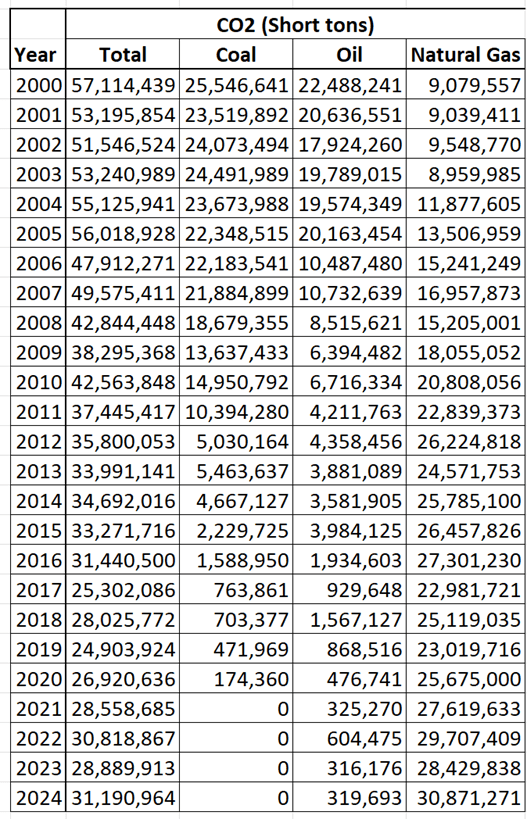
Both submittals discussed the observed emission reduction trend because the effectiveness of RGGI as a pollution control program is determined by the observed emission trend.  Figure 1 describes the annual electric sector emissions and emissions by fuel type.  It clearly shows that the observed emission reductions are due to fuel switching from coal and oil to natural gas.  Natural gas CO2 emissions are lower per MWhr so even though natural gas generation went up the overall CO2 emissions have gone down.  The other important finding in Figure 1 is that fuel switching emission reductions are no longer available. 

Figure 1: New York State Annual Electric Sector Emissions by Fuel Type

On a regular basis NYSERDA publishes a status update of the progress of their program activities, implementation, and evaluation.   According to the latest update, the total cumulative annual emission savings due to NYSERDA program investments through the end of 2023 is 1,976,101 tons.  That means that emissions from RGGI sources in New York would have been only 4.2% higher if the NYSERDA program investments did not occur.  According to the report, cumulative combined costs for those programs was $1,149 million which means that the cost per ton reduced is $582.

The funding status reports also break out emission savings and costs for NYSERDA programs. NYSERDA RGGI proceed investments can produce CO2 emission savings from RGGI-affected electric generating units in two ways: directly by displacing natural gas generation by deploying zero-emissions resources or indirectly by reducing the amount of load that the affected units must provide.  I categorized programs for three categories: direct reductions to RGGI sources, indirect reductions, and those programs that will actually increase electric generating emissions. One program that increases emissions is NYSERDA’s Clean Transportation Program that “has been pursuing five strategies to promote EV adoption by consumers and fleets across New York”.   The results in the Funding status reports show that since the start of the program NYSERDA has allocated 10% of its investments to programs that directly reduce utility emissions by 199,733 tons, 58% to programs that indirectly reduce utility emissions by 1,205,780 tons, and 32% to programs that will increase utility emissions by 678,804 tons.  When those savings that do not affect RGGI source emissions are removed, total savings are 1,297,297 and the emissions from RGGI sources in New York would have been only 2.8% higher if the NYSERDA program investments did not occur.

The proposed Amendment to the Operating Plan does not address the need to focus on emission reductions.  It allocates only 22% to programs that directly, indirectly, or could potentially decrease RGGI-affected source emissions.  Programs that will add load that could potentially increase RGGI source emissions total 37% of the investments.  Programs that do not affect emissions are funded with 29% of the proceeds and administrative costs total another 8%. 

There is one other notable aspect of the NYSERDA funding in the Draft Amendment for 2025. The Funding Status report states that annual cumulative program investments are $1.1 billion through the end of 2023 whereas the cumulative total revenues in the Operating Plan Amendment are $2.4 billion through FY 23-24.  There is no discussion of the differences.  Most of the difference is probably due to collected but unspent revenues.  It is notable that more than half of the money collected has not been spent.

Implications

The Climate Leadership & Community Protection Act (Climate Act) Scoping Plan recommended an economy-wide market-based program as part of the net-zero transition.  In response New York regulators have been developing the NYCI program.  Advocates for this approach frequently refer to RGGI as the successful model for NYCI citing observed emission reductions and the quantity of funds raised.  The prevailing perception of NYCI is exemplified by Colin Kinniburgh’s description in his recent article in New York Focus.  He describes the theory of a cap-and-invest program as a program that will kill two birds with one stone.  “It simultaneously puts a limit on the tons of pollution companies can emit — ‘cap’ — while making them pay for each ton, funding projects to help move the state away from polluting energy sources — ‘invest.'”

In the real world there are issues.

The missing piece for NYCI is that setting a cap on carbon emissions is all well and good in theory, but where are the emission reductions going to come from.  Reducing carbon emissions to zero is hard because the only way to get there is to replace existing technology with something that has zero emissions.   In the electric sector, the owners of the generating units are not building zero-emission replacements.  NYSERDA must motivate somebody else to do it. 

Danny Cullenward and David Victor’s book Making Climate Policy Work describe another related aspect of these programs that has not been acknowledged by NYSERDA or NYCI proponents.  The authors note that the level of expenditures needed to implement the net-zero transition vastly exceeds the “funds that can be readily appropriated from market mechanisms”.  The RGGI experience corroborates these findings and should be considered by the Energy Committee.  It is also concerning that NYSERDA has never addressed my repeated comments describing these issues and the implications on their funding priorities.

There is another inconvenient aspect of cap-and-invest programs.  RGGI and NYCI both have defined emission reduction trajectories that determine how many allowances are offered for sale.  That means that the implementation of the zero-emission technology that must displace existing technology to get the necessary reductions is on a schedule with ramifications.  If the replacement technology deployment is delayed, then it is likely that there will not be enough allowances available for compliance.  The only option available for affected sources is to reduce or stop operations.  In other words, an artificial energy shortage.

Conclusion

The implication of this work is that the proposed NYCI plan to have NYSERDA manage the investments like they do with RGGI is not likely to succeed as shown by their performance to date.

My comments to NYSERDA argued that their RGGI auction proceed investments have done little to reduce emissions.  I always have argued that NYSERDA funding priorities over emphasize Climate Leadership and Community Protection Act (Climate Act) initiatives at the expense of the electric generating unit RGGI emission goals.  I take the simple position that RGGI was promulgated as an emission reduction program for the electric generating sector.  NYSERDA investments must be revised to displace the generation needed from RGGI-affected sources because that is the only compliance option left with no reliability implications. 

My public statement on NYSERDA program effectiveness of the RGGI auction proceeds followed the same reasoning.  Observed reductions are mostly unrelated to the NYSERDA investments so that is not a success.  The observed cost per ton reduced is very high and funding priorities do not recognize the compliance obligations, so these are not accomplishments.  I also argued that the NYSERDA stakeholder process is broken because there are clear problems with the current strategy, but the latest operating plan amendment makes no changes. 

There is one final note.  If NYSERDA provided a comprehensive explanation of all the emission reduction strategies in the Scoping Plan along with the expected emission reductions, anticipated costs, and potential sources of funding for their strategies then it would be possible to determine if NYSERDA has planned for the necessary reductions via other programs.  If NYSERDA published documentation of their response to submitted comments on their Operating Plan amendments, they could have explained their strategy for RGGI compliance. The lack of transparency in both instances precludes any reassurance that NYSERDA can be trusted to continue to operate without more governance and transparency.

Implications of NYSERDA RGGI Operating Plan Investments

This is the third article in a series of three on the status of the New York component of the Regional Greenhouse Gas Initiative (RGGI) as administered by the New York State Energy Research & Development Authority (NYSERDA).  This is timely because on December 18, 2024, the New York Assembly Committee on Energy held a public hearing to gather information about NYSERDA’s revenues and expenditures in order to gain a broader perspective on effectiveness of NYSERDA’s programs. 

In the first article I evaluated Environmental Protection Agency (EPA) emission data and NYSERDA documentation and found that the investments funded by RGGI auction proceeds would have been only 4.2% higher if the NYSERDA program investments did not occur.  In the second article I showed that the cost per ton reduced from the NYSERDA RGGI operating plan investments was $582 per ton of CO2. This article describes the program allocations in the 2025 Draft RGGI Operating Plan Amendment.  There are unacknowledged ramifications of the emission reduction performance, funding program priorities, and RGGI compliance mandates. 

Background

I have been involved in the RGGI program process since its inception.  I blog about the details of the RGGI program because very few seem to want to provide any criticisms of the program.   I submitted comments on the Climate Act implementation plan and have written over 480 articles about New York’s net-zero transition because I believe the ambitions for a zero-emissions economy embodied in the Climate Act outstrip available renewable technology such that the net-zero transition will do more harm than good because of impacts on reliability, affordability, and environmental impacts.  The opinions expressed in this post do not reflect the position of any of my previous employers or any other organization I have been associated with, these comments are mine alone.

RGGI is a market-based program to reduce greenhouse gas emissions (GHG) (Factsheet). It has been a cooperative effort among the states of Connecticut, Delaware, Maine, Maryland, Massachusetts, New Hampshire, New York, Rhode Island, and Vermont to cap and reduce CO2 emissions from the power sector since 2008.  New Jersey was in at the beginning, dropped out for years, and re-joined in 2020. Virginia joined in 2021 but has since withdrawn, and Pennsylvania has joined but is not actively participating in auctions due to on-going litigation. According to a RGGI website:

The RGGI states issue CO2 allowances that are distributed almost entirely through regional auctions, resulting in proceeds for reinvestment in strategic energy and consumer programs.

Proceeds were invested in programs including energy efficiency, clean and renewable energy, beneficial electrification, greenhouse gas abatement and climate change adaptation, and direct bill assistance. Energy efficiency continued to receive the largest share of investments.

NYSERDA Operating Plan

NYSERDA designed and implemented a process to develop and annually update an Operating Plan which summarizes and describes the initiatives to be supported by RGGI auction proceeds.  On an annual basis, the Authority “engages stakeholders representing the environmental community, the electric generation community, consumer benefit organizations and interested members of the general public to assist with the development of an annual amendment to the Operating Plan.”

The latest Draft RGGI Operating Plan Amendment explains that

New York State invests RGGI proceeds to support comprehensive strategies that best achieve the RGGI greenhouse gas emissions reduction goals pursuant to 21 NYCRR Part 507.  The programs in the portfolio of initiatives are designed to support the pursuit of the State’s greenhouse gas emissions reduction goals by:

  • Deploying commercially available energy efficiency and renewable energy technologies;
  • Building the State’s capacity for long-term carbon reduction;
  • Empowering New York communities to reduce carbon pollution, and transition to cleaner energy;
  • Stimulating entrepreneurship and growth of clean energy and carbon abatement companies in New York; and
  • Creating innovative financing to increase adoption of clean energy and carbon abatement in the State.

The latest Operating Plan process is on-going at the time of this writing.  The Advisory Stakeholder meeting was held Thursday, December 5, 2024.  The presentation and webinar recording for the meeting are available.  The meeting described the proposed programs for the latest amendment.  Comments are due on December 23, 2024.

2025 Amendments to Operating Plan

The Stakeholder presentation notes that the 2025 Amendment assumes a future auction allowance price of $15.71.  This value is a conservative estimate based on the average price of the past ten auctions.  Note, however, that the auction price has settled higher in the most recent auctions so the FY25 Operating Plan budget assumes the allowance price of $19.59 which is the average of actual prices for first two RGGI auctions conducted this fiscal year and $15.71 per ton allowance estimate for the second two auctions.

It is notable that there is no mention of the total revenues expected.  That value equals the number of New York allowances in the auctions times the expected allowance prices.  I believe that New York will auction 21,783,380 allowances next year which means that the proceeds available in the Amendment total somewhere between $342,216,900 and $426,736,414 for FY 25.  At the Assembly Committee on Energy public hearing John Williams, Executive Vice President, Policy and Regulatory Affairs, NYSERDA stated that in the NYSERDA budget “RGGI allowance sales account for $191 million” at 15:30 in the video.  I have no idea why there is such a discrepancy between the actual proceeds and the NYSERDA RGGI Budget or why the 2025 Amendment presentation did not provide the totals expected.

Implications

Note that only one of the five goals described previously to “support the pursuit of the State’s greenhouse gas emissions reduction goals” addresses emission reductions.  The others are vague cover language to justify the use of RGGI auction proceeds to bury administrative expenses, force ratepayers to cover inconvenient costs related to Climate Act implementation and provide funding for other politically favored projects at the expense of programs that affect CO2 emissions from RGGI affected sources.  The question I tried to answer is just how much is allocated to reducing emissions.

Table 1 from the 2025 Draft RGGI Operating Plan Amendment lists all the proposed programs.  Highlighted programs indicate newly funded programs or additional funding to existing programs.  The original table highlights programs that “indicate newly funded programs or additional funding to existing programs”.  The notes to the table also explain that “Totals may not sum exactly due to rounding and that the fiscal years begin on April 1st and end on March 31st.  The document provides brief descriptions of the proposed programs in most instances, but not all the programs have descriptions.

As part of my annual comments, I evaluated these programs in the Operating Amendment relative to their value for future EGU emission reductions.  In my comment analysis, I reviewed each proposed program and classified each program relative to six categories of potential RGGI source emission reductions.  The first three categories cover programs that directly, indirectly or could potentially decrease RGGI-affected source emissions.  I also included a category for programs that will add load that could potentially increase RGGI source emissions such as programs to incentivize electrification.  The two other categories consider programs that do not affect emissions and administrative costs respectively.

Table 2 presents the results of my interpretation of the potential for RGGI EGU emission reductions for the programs in the proposed amendment.  The five programs without documentation highlighted in yellow.  The orange highlighted programs will be discussed in a later post.  The first three categories cover programs that directly, indirectly, or could potentially decrease RGGI-affected source emissions.  They account for only 22% of the investments.  Programs that will add load that could potentially increase RGGI source emissions and whose emissions savings are unrelated to the electric sector total 37% of the investments.  Programs that do not affect emissions are funded with 29% of the proceeds and administrative costs total another 8%.  Clearly there is no preference for reducing emissions.

Table 2: Potential for RGGI Reductions for Funding Allocations for 2025 Operating Plan Amendments

Discussion

In the previous two RGGi status articles I made the point that the observed emission reductions are the primary reason for the observed reductions.  Figure 1 clearly shows this.  Since the start of the RGGI program I estimate that emissions from RGGI sources in New York would have been only 4.2% higher if the NYSERDA program investments did not occur and only 2.8% higher when projected savings that do not affect RGGI source emissions are removed.

Figure 1: New York State Emissions by Fuel Type

To date the lack of investment in electric sector emission reduction programs has not been an issue because fuel switching has provided the emission reductions necessary to comply with RGGI reduction requirements.  However, eventually there will be a problem because no more fuel switching reductions are available while RGGI allowance allocations continue to decrease. 

NYSERDA has shown no indication that it is aware of this concern.  In my previous article, I pointed out that the observed investments have not made emission reductions a priority.  Since the start of the program NYSERDA has allocated $98.8 million to programs that directly reduce utility emissions by 199,733 tons, $702.7 million for programs that indirectly reduce utility emissions by 1,205,780, and $348.1 million for programs that will increase utility emissions by 678,804 tons.  In the last category, the GHG emission savings listed are the benefits for switching from gasoline and diesel to electric vehicles.   

Furthermore, this post shows that NYSERDA has not addressed this concern for future investments either.  The proposed Amendment to the Operating Plan allocates only 22% to programs that directly, indirectly, or could potentially decrease RGGI-affected source emissions.  Programs that will add load that could potentially increase RGGI source emissions total 37% of the investments.  Programs that do not affect emissions are funded with 29% of the proceeds and administrative costs total another 8%. 

There is one other notable aspect of the NYSERDA funding in the Draft Amendment – there is no mention of the total revenues expected.  That value equals the number of New York allowances in the auctions times the expected allowance prices.  I believe that NYSERDA will have between $342 and $426 million in FY25-26.  John Williams stated that in the NYSERDA budget “RGGI allowance sales account for $191 million” at 15:30. Also note that the Funding Status report annual cumulative investments for the programs described with benefits totals $1.1 billion whereas the cumulative total revenues in the Operating Plan Amendment are $2.4 billion.  The difference in those two values represents even more money not likely to address the need for electric sector emission reduction programs.  In my opinion, the lack of a clear description reconciling these differences is at least in part due to NYSERDA recognizing that there is no non-incriminating way to explain it.

Conclusion

Given my decades-long background in the electric sector, it is not surprising that I have compliance concerns.  In all my comments to NYSERDA on their operating plan amendments I have argued that funding priorities over emphasize Climate Leadership and Community Protection Act (Climate Act) initiatives at the expense of the electric generating unit RGGI emission goals.  I take the simple position that RGGI was promulgated as an emission reduction program for the electric generating sector.  The failure of affected sources to comply with the RGGI compliance requirements has ramifications.  Sas a final point of emphasis, NYSERDA does not acknowledge that because fuel switching opportunities are no longer available that affected sources can only comply by reducing or stopping operations. To prevent that from occurring, NYSERDA investments must displace the generation needed from RGGI-affected sources because that is the only compliance option left with no reliability implications.

I conclude that NYSERDA must reassess its program funding priorities to ensure that sufficient funding is available for programs that displace electric sector generation to zero-emissions sources.  If NYSERDA provided a comprehensive explanation of all the emission reduction strategies in the Scoping Plan along with the expected emission reductions, anticipated costs, and potential sources of funding for their strategies then it would be possible to check that NYSERDA has planned for the necessary reductions via other programs.  If NYSERDA published documentation of their response to submitted comments on their Operating Plan amendments, they could have explained their strategy for RGGI compliance. The lack of transparency precludes that reassurance.

Implications of NYSERDA RGGI Funding Status Report Status Results

This is the second article in a series of three on the status of the New York component of the Regional Greenhouse Gas Initiative (RGGI) as administered by the New York State Energy Research & Development Authority (NYSERDA).  This is timely because on December 18, 2024, the New York Assembly Committee on Energy held a public hearing to gather information about NYSERDA’s revenues and expenditures in order to gain a broader perspective on effectiveness of NYSERDA’s programs. 

In the first article I evaluated Environmental Protection Agency (EPA) emission data and NYSERDA documentation and found that the investments funded by RGGI auction proceeds would have been only 4.2% higher if the NYSERDA program investments did not occur.  There are unacknowledged ramifications of this emission reduction performance relative to future NYSERDA program investments and RGGI compliance mandates.

Background

I have been involved in the RGGI program process since its inception.  I blog about the details of the RGGI program because very few seem to want to provide any criticisms of the program.   I submitted comments on the Climate Act implementation plan and have written over 480 articles about New York’s net-zero transition because I believe the ambitions for a zero-emissions economy embodied in the Climate Act outstrip available renewable technology such that the net-zero transition will do more harm than good because of impacts on reliability, affordability, and the environment.  The opinions expressed in this post do not reflect the position of any of my previous employers or any other organization I have been associated with, these comments are mine alone.

RGGI is a market-based program to reduce greenhouse gas emissions (GHG) (Factsheet). It has been a cooperative effort among the states of Connecticut, Delaware, Maine, Maryland, Massachusetts, New Hampshire, New York, Rhode Island, and Vermont to cap and reduce CO2 emissions from the power sector since 2008.  New Jersey was in at the beginning, dropped out for years, and re-joined in 2020. Virginia joined in 2021 but has since withdrawn, and Pennsylvania has joined but is not actively participating in auctions due to on-going litigation. According to a RGGI website:

The RGGI states issue CO2 allowances that are distributed almost entirely through regional auctions, resulting in proceeds for reinvestment in strategic energy and consumer programs.

Proceeds were invested in programs including energy efficiency, clean and renewable energy, beneficial electrification, greenhouse gas abatement and climate change adaptation, and direct bill assistance. Energy efficiency continued to receive the largest share of investments.

On a quarterly basis permits to emit a ton of CO2 or allowances are auctioned by RGGI.  The electric generating units that have RGGI compliance obligations must surrender one allowance for each ton emitted during the compliance period.  In theory, States invest the proceeds to reduce emissions indirectly through energy efficiency programs and directly through the deployment of renewable energy that displaces fossil fired generation and supporting carbon abatement technology.  This article describes the implications of NYSERDA RGGI program emission reduction effectiveness and funding priorities on these compliance obligations.

NY Electric Generating Unit Emission Reductions

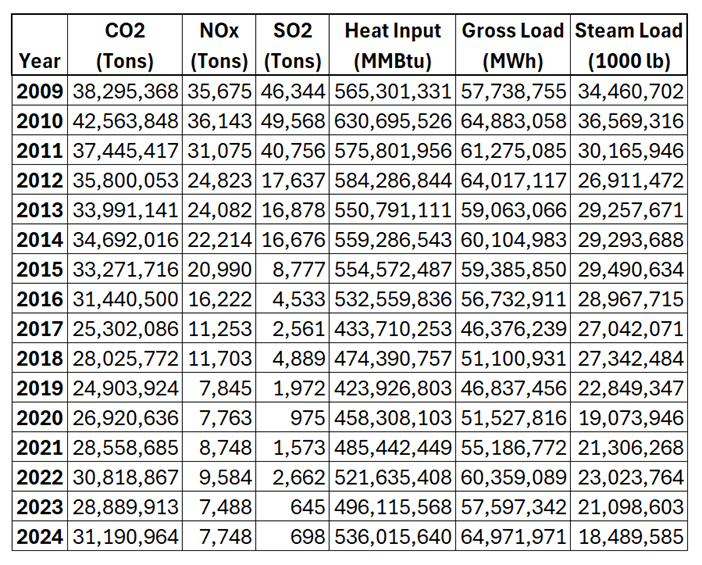
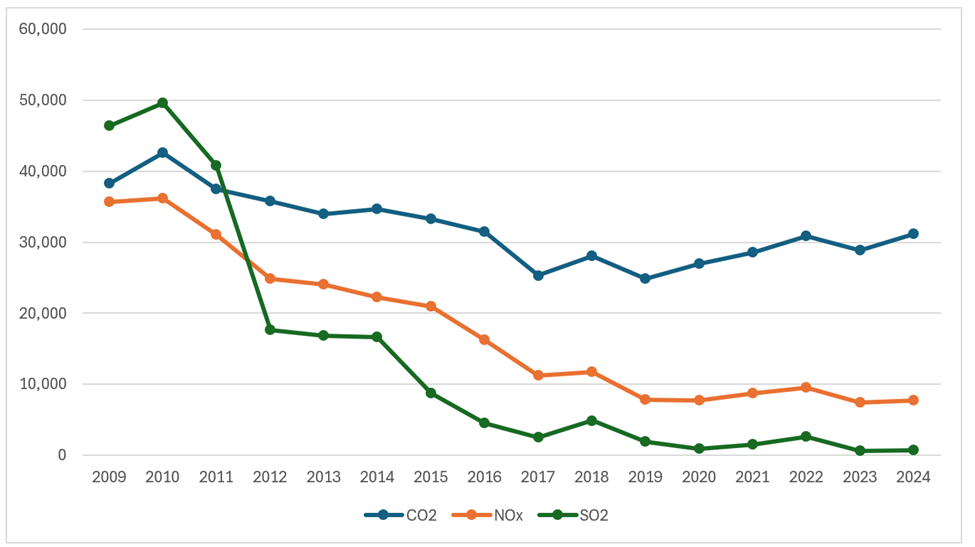
In my New York RGGI Funding Status Report Status Through 2023 post I used EPA emission data and NYSERDA documentation to determine the effect of the investments funded by RGGI auction proceeds.    In 2000, New York EGU emissions were 57,114,439 tons and in 2023 they were 28,889,913 tons, a decrease of 49%.  Figure 1 plots these data and shows emissions by fuel type.  Clearly, fuel switching is the primary driver of the observed reductions.  Since the start of the RGGI program I estimate that emissions from RGGI sources in New York would have been only 4.2% higher if the NYSERDA program investments did not occur.  The Figure 1 graph also shows that the opportunity to make further emission reductions by switching fuels is no longer available.

Figure 1: New York State Emissions by Fuel Type

New York RGGI Program Investment Reductions

Table 1 lists data from Semi-Annual Status Report through December 2023  Table 2: Summary of Total Expected Cumulative Annual Program Benefits including the cumulative annual costs of investment programs and annual tons of carbon dioxide equivalent (CO2e) saved by the investments.. The report notes that: “NYSERDA begins tracking program benefits once project installation is complete and provides estimated benefits for projects under contract that are not yet operational (pipeline benefits).“   The report presents “expected quantifiable benefits related to carbon dioxide equivalent (CO2e) reductions, energy savings, and participant energy bill savings with expended and encumbered funds” but I only consider the CO2e reductions.  Note that the emission savings evaluated in the report include carbon dioxide, methane, and nitrous oxide.  In the original table “lifetime” savings are included.  I did not use “lifetime” savings data because I am trying to compare the RGGI program benefits emission savings reductions to the RGGI compliance metric of an annual emission cap.  Lifetime reductions are clearly irrelevant. 

Table 1: RGGI Funding Status Report Table 2: Summary of Total Expected Cumulative Annual Program Benefits

NYSERDA RGGI proceed investments can produce CO2 emission savings from RGGI-affected electric generating units in two ways: directly by displacing natural gas generation by deploying zero-emissions resources or indirectly by reducing the amount of load that the affected units must provide.  I assumed that the indirect investments reduced load that directly offset RGGI-affected sources.  This has been a good assumption because load growth has been stalled but with electrification of buildings and transportation and the addition of data centers and large load centers, the presumption that indirect NYSERDA investments will reduce emissions will become weak. 

Table 2 compares the observed emissions to the NYSERDA emission savings.  These results show that emissions from RGGI sources in New York would have been only 4.2% higher if the NYSERDA program investments did not occur.  However, that estimate is an overestimate of the capability of NYSERDA investments to reduce RGGI-affected source emissions.  NYSERDA estimates of emission savings include methane and nitrous oxides, but RGGI compliance is only for CO2.  The presumption that programs that indirectly reduce emissions has qualifications that reduce the actual reductions.  The NYSERDA savings number also includes savings from programs that will not reduce RGGI-affected units’ emissions as shown in the next section.

Table 2: NY Electric Generating Unit Emissions, NYSERDA GHG Emission Savings from RGGI Investments, and Emissions by Fuel Type

NYS RGGI Funding Priorities

Table 2 overestimates relevant savings because of RGGI funding program priorities.  The October 2024 New York State Funded Programs report describes the funding priorities for the auction proceeds:

The State invests RGGI proceeds to support comprehensive strategies that best achieve the RGGI CO2 emission reduction goals. These strategies aim to reduce global climate change and pollution through energy efficiency, renewable energy, and carbon abatement technology. Deploying commercially available renewable energy and energy efficiency technologies help to reduce greenhouse gas (GHG) emissions from both electricity and other energy sources in the short term. To move the State toward the goals enacted by the Climate Leadership and Community Protection Act (Climate Act) and a more sustainable future, RGGI funds are used to empower communities to make decisions that prompt the use of cleaner and more energy-efficient technologies that lead to both lower carbon emissions as well as economic and societal co-benefits. RGGI helps to build capacity for long-term carbon reduction by training workers and partnering with industry. Using innovative financing, RGGI supports the pursuit of cleaner, more efficient energy systems and encourages investment to stimulate entrepreneurial growth of clean energy companies. All these activities use funds in ways that accelerate the uptake of low- to zero-emitting technologies.

Table 2 is misleading in the context of RGGI compliance obligations because not all the savings will affect RGGI emission sources.  There is a significant fraction of RGGI funds that goes to programs that increase rather than decrease electric generating unit emissions.  In Table 3, I categorized programs relative to RGGI compliance obligations.  The table breaks down the program allocations and expected annualized CO2 savings for three categories: direct reductions to RGGI sources, indirect reductions, and those programs that will actually increase electric generating emissions. For example, Charge NY is NYSERDA’s Clean Transportation Program that “has been pursuing five strategies to promote EV adoption by consumers and fleets across New York”.   The results in the Funding status reports show that since the start of the program NYSERDA has allocated $98.8 million to programs that directly reduce utility emissions by 199,733 tons, $702.7 million for programs that indirectly reduce utility emissions by 1,205,780, and $348.1 million for programs that will increase utility emissions by 678,804 tons.  In the last category, the GHG emission savings listed are the benefits for switching from gasoline and diesel to electric vehicles.   When those savings that do not affect RGGI source emissions are removed, total savings are 1,297,297 and the emissions from RGGI sources in New York would have been only 2.8% higher if the NYSERDA program investments did not occur.

Table 3: Summary of Expected Cumulative Annualized Program Benefits through 31 December 2023 for Programs that Directly, Directly, or Do Not Affect RGGI CO2 Emissions

Discussion

The results of NYSERDA RGGI funding have important and unacknowledged ramifications.

The comparison of observed electric generating unit emission reductions by fuel type clearly show that historical reductions were the result of fuel switching.  In addition, it is obvious that all that low-hanging fruit is gone.  Nonetheless, many ill-informed voices are clamoring for stricter RGGI emission reduction trajectories begging the question – where will the emission reductions come from?  It does not seem that NYSERDA RGGI investments will help the affected sources meet their compliance obligations.

I did not mention the observed cost per ton saved in Table 1.  It is not very encouraging that NYSERDA program investments cost $582 for each ton saved.  At that rate, New York will have to invest $16.8 billion to achieve the Climate Leadership & Community Protection Act 2040 electric sector zero-emissions mandate.  In the first 15 years New York RGGI auction proceeds are a little over $2 billion based on the sale of 480.4 million allowances.  Assuming a RGGI straight line reduction to zero by 2040, 231 million total allowances will be allotted by 2040.  At the $582 cost per ton rate the RGGI allowance price would have to be $73 per ton to provide sufficient funding to meet the compliance targets.

There is a huge assumption relative to the $73 allowance price funding necessary to achieve the zero-emissions by 2040 mandate.  I assumed that all the RGGI proceeds would be allotted to programs that directly or indirectly reduce emissions at electric generating stations.  Table 3 shows that for the programs that produce quantifiable benefits 32.6% of the proceeds goes to programs that increase RGGI emissions.  It is much worse than that.  In my next article in this series I will document how the latest Draft RGGI Operating Plan Amendment allocates funds to programs.  Spoiler alert only 22% goes to programs that will provide direct or indirect emission reductions.

Conclusion

This analysis of the latest NYSERDA RGGI funding plan document has important implications to New York’s plans to implement a Cap-and-Invest (NYCI) program.  RGGI is touted as a successful model for NYCI to emulate but the poor emission reduction performance suggests that the presumption that NYCI will be an effective emission reduction program is misplaced. 

There is another important issue.  NYSERDA has not acknowledged that electric generators have no options to reduce their emissions to comply with RGGI.  In the future those facilities can only meet compliance requirements if zero-emissions resources displace their generation and emissions.  If there are insufficient investments to reduce generation at the RGGI-affected sources there will be compliance issues.  The only option for affected sources to comply is to reduce or stop operations.

New York NYSERDA RGGI Funding Status Report Status Through 2023

In response to claims by New York State officials that the Regional Greenhouse Gas Initiative (RGGI) has been instrumental in reducing electric generating unit emissions I have evaluated the latest New York State Energy Research & Development Authority (NYSERDA) funding status report.  This article addresses the observed CO2 emissions reductions relative to the claimed CO2 emission reductions in the NYSERDA reports. There are ramifications of the emission reduction claims and NYSERDA program investments affecting compliance mandate requirements for RGGI that will be addressed in a subsequent article.

Background

I have been involved in the RGGI program process since its inception.  I blog about the details of the RGGI program because very few seem to want to provide any criticisms of the program.   I submitted comments on the Climate Act implementation plan and have written over 480 articles about New York’s net-zero transition because I believe the ambitions for a zero-emissions economy embodied in the Climate Act outstrip available renewable technology such that the net-zero transition will do more harm than good because of impacts on reliability, affordability, and environmental impacts.  The opinions expressed in this post do not reflect the position of any of my previous employers or any other organization I have been associated with, these comments are mine alone.

RGGI is a market-based program to reduce greenhouse gas emissions (GHG) (Factsheet). It has been a cooperative effort among the states of Connecticut, Delaware, Maine, Maryland, Massachusetts, New Hampshire, New York, Rhode Island, and Vermont to cap and reduce CO2 emissions from the power sector since 2008.  New Jersey was in at the beginning, dropped out for years, and re-joined in 2020. Virginia joined in 2021 but has since withdrawn, and Pennsylvania has joined but is not actively participating in auctions due to on-going litigation. According to a RGGI website:

The RGGI states issue CO2 allowances that are distributed almost entirely through regional auctions, resulting in proceeds for reinvestment in strategic energy and consumer programs.

Proceeds were invested in programs including energy efficiency, clean and renewable energy, beneficial electrification, greenhouse gas abatement and climate change adaptation, and direct bill assistance. Energy efficiency continued to receive the largest share of investments.

I have written multiple articles that argue that RGGI advocates mis-lead the public when they imply that RGGI programs were the driving force behind the observed 50% reduction in power sector CO2 emissions since 2000.  I did an article on CO2 emissions based on the funding status reports in December 2022.  This article updates the information through 2023.

New York Power Sector CO2 Emissions

The first step in evaluating the effect of RGGI on CO2 emissions is to determine the observed trend of New York electric utility emissions.  EPA’s Clean Air Markets Division maintains a database of all the emissions data collected by every power plant in the United States since the mid-1990’s.  I used that data for this analysis. 

The EPA database includes information such as the primary fuel type of each generating unit. Table 1 lists the total annual CO2 data from all New York units that are required to report to EPA for any air pollution control program by fuel type.  In 2000, New York EGU emissions were 57,114,439 tons and in 2023 they were 28,889,913 tons, a decrease of 49%.  Figure 1 plots these data.  Table 2 lists the reductions in New York since the start of RGGI.  I calculated a pre-RGGI baseline by averaging annual data from 2006-2008.  In NYS 2023 CO2 emissions are 38% lower than baseline emissions.  Note that the reduction percentage peaked in 2019 before Indian Point shut down and emissions increased.  The most important feature of these tables is that coal and oil emission reductions are the primary drivers of the total emission reductions.  Natural gas has increased to cover the generation from those fuels but because it has lower CO2 emission rates the New York emissions have gone down.

Table 1: New York Clean Air Markets Division Emissions Data for All Regulatory Programs

Figure 1: New York State Emissions by Fuel Type

Table 2: New York State Emission Reductions

NYSERDA RGGI Funding Status Reports

The latest New York RGGI funding report prepared by the New York State Energy Research & Development Authority (NYSERDA) is the Semi-Annual Status Report through December 2023.  It states that:

This report is prepared pursuant to the State’s RGGI Investment Plan (2022 Operating Plan) and provides an update on the progress of programs through the quarter ending December 31, 2023. It contains an accounting of program spending; an estimate of program benefits; and a summary description of program activities, implementation, and evaluation. An amendment providing updated program descriptions and funding levels for the 2022 version of the Operating Plan was approved by NYSERDA’s Board in January 2023.

The State invests RGGI proceeds to support comprehensive strategies that best achieve the RGGI CO2 emission reduction goals. These strategies aim to reduce global climate change and pollution through energy efficiency, renewable energy, and carbon abatement technology.

Table 3 from Table 1 in the latest the Semi-Annual Status Report summarizes the effectiveness of the NYSERDA investments and lists expected cumulative portfolio benefits including emissions savings.  This report notes that NYSERDA “begins tracking program benefits once project installation is complete and provides estimated benefits for projects under contract that are not yet operational (pipeline benefits).”  There is an important distinction between the cumulative annual committed savings and the expected lifetime total benefits.  For the purposes of this analysis, I did not use “lifetime” savings data because I am trying to compare the RGGI program benefits emission savings reductions to the RGGI compliance metric of an annual emission cap.  Lifetime reductions are clearly irrelevant to that metric.  Similarly, the Climate Act emission reduction metrics are annual emissions relative to a 1990 baseline so expected lifetime benefits are immaterial.

Table 3. Summary of Expected Cumulative Portfolio Benefits through December 31, 2023

Comparison of NYSERDA Cumulative Emissions Savings to Observed Emission Reductions

Table 4 presents the relevant data to compare the observed reductions and NYSERDA RGGI investment emission savings.  I list the last five years of data starting in 2019 when the emissions went up because of the closure of Indian Point but the decreases since the 2006-2008 average baseline are listed.  The emissions savings listed are cumulative annual emissions.  If the RGGI investments were not made then the total emissions would be higher by the amount of the savings.  The total cumulative annual emission savings through the end of 2023 is only 1,976,101 tons and that represents a reduction of 4.2% from the pre-RGGI baseline.  Emission reductions by fuel type clearly show that fuel switching is the primary cause of reductions.

Table 4: NY Electric Generating Unit Emissions, NYSERDA GHG Emission Savings from RGGI Investments, and Emissions by Fuel Type

Discussion

Whenever there is a public meeting about RGGI, the overview presenters state that there has been a large reduction in electric sector emissions.  For example, at the NYSERDA RGGI Stakeholder meeting on 5 December 2024, Jon Binder from the New York Department of Environmental Conservation said:

Together, we have cut New York’s power sector emissions of carbon dioxide by more than 50 %. And we’ve done this by establishing regulations that set limits on pollution while also making investments through this operating plan process in parallel with so many other critical policies at the state level and commitments to implement the Climate Leadership and Community Protection Act.

EPA emission data and NYSERDA documentation on the results of the investments funded by RGGI auction proceeds contradict this narrative that RGGI has substantially reduced emissions. This article shows that the primary reason for the observed 38% reduction from the start of RGGI is fuel switching and retirements caused by low natural gas prices.  Since the start of the RGGI program I estimate that emissions from RGGI sources in New York would have been only 4.2% higher if the NYSERDA program investments did not occur.

On December 18, 2024, the Assembly Committee on Energy held a public hearing on New York State Energy Research & Development Authority (NYSERDA) spending and program review.  John Howard, a seasoned Albany hand who retired from his post on the Public Service Commission earlier this year gave a statement.  He opened his remarks noting that “the subject of today’s hearing is the fiscal and operational oversight of NYSERDA” and went on to explain that NYSERDA is now exclusively responsible for procuring vast amounts of renewable energy consistent with the Climate Act mandates but there is no oversight of the contracts.  The RGGI investments are one example of the programs managed by NYSERDA.  I will follow this post with another article describing the unacknowledged implications of these numbers.

Conclusion

Implementing the net-zero transition mandated by the Climate Leadership & Community Protection Act is a massive challenge consisting of many moving parts.  The RGGI program is touted as a successful model for proposed components of the transition.  However, upon close review the narrative that RGGI Auction proceed investments have substantially contributed to the observed emission reductions is not true.

DEFR Implications on Solar Power Viability

I recently published an article summarizing a Syracuse Post Standard description of the transition problem by Tim Knauss who described the work done by Cornell’s Anderson Lab headed by Dr. Lindsay Anderson. I submitted a letter to the editor describing the implications of Anderson’s work arguing that pausing renewable energy development would be appropriate.  This post responds to the rebuttal of my letter by Peter Wirth, Vice President, Climate Change Awareness and Action who claims that pausing renewable energy is the last thing we should do.

I am convinced that implementation of the New York Climate Leadership & Community Protection Act (Climate Act) net-zero mandates will do more harm than good if the electric system transition relies on wind, solar, and energy storage because of reliability and affordability issues.  I have followed the Climate Act since it was first proposed, submitted comments on the Climate Act implementation plan, and have written over 480 articles about New York’s net-zero transition.  The opinions expressed in this article do not reflect the position of any of my previous employers or any other organization I have been associated with, these comments are mine alone.

Overview

The Climate Act established a New York “Net Zero” target (85% reduction in GHG emissions and 15% offset of emissions) by 2050.  It includes an interim 2030 reduction target of a 40% GHG reduction by 2030. Two targets address the electric sector: 70% of the electricity must come from renewable energy by 2030 and all electricity must be generated by “zero-emissions” resources by 2040. The Climate Action Council (CAC) was responsible for preparing the Scoping Plan that outlined how to “achieve the State’s bold clean energy and climate agenda.” The Integration Analysis prepared by the New York State Energy Research and Development Authority (NYSERDA) and its consultants quantified the impact of the electrification strategies.  That material was used to develop the Draft Scoping Plan outline of strategies.  After a year-long review, the Scoping Plan was finalized at the end of 2022.  Since then, the State has been trying to implement the Scoping Plan recommendations through regulations, proceedings, and legislation.  New York Department of Public Service (DPS) Proceeding 15-E-0302 addresses DEFR but there is no schedule for resolving the future plans for DEFR in New York.

My primary reliability concern is the challenge of providing electric energy during periods of extended low wind and solar resource availability.  Experts, including those that are responsible for electric system reliability, agree that a new category of generating resources called Dispatchable Emissions-Free Resources (DEFR) is necessary during those periods.  I have dedicated a page to DEFR which I described in an article that summarized six analyses describing the need for DEFR: the Integration Analysis, New York Department of Public Service (DPS) Proceeding 15-E-0302 Technical Conference, NYISO Resource Outlook, Richard Ellenbogen, Cornell Biology and Environmental Engineering Anderson Lab, and Nuclear New York. 

My Letter to the Editor

On the same day that the Syracuse Post Standard published the Knauss article they published the following letter to the Editor:

The Tim Knauss article on Cornell Professor Anderson’s evaluation of the future New York electric grid is a readable summary of the issues associated with the need for a new dispatchable emissions-free resource (DEFR). 

However, it does not address the implications on current NY energy policy.

The Hochul Administration has finally started its update of the NY Energy Plan.  The draft scope of the plan describes an electric system that relies on wind and solar generation.  No jurisdiction anywhere has successfully developed such a system.  The State agencies responsible for a reliable electric system agree with Professor Anderson that a wind, solar, and energy storage system requires DEFR.  It is prudent to fund a demonstration project to prove that such an electric system will work or, at the very least, complete a comprehensive renewable feasibility analysis to determine whether such a system will maintain affordability and reliability standards.

The most likely DEFR backup technology is nuclear generation because it is the only candidate resource that is technologically ready.  Nuclear power has a proven record for resilient electric production, development would not require changes to the rest of the electric system, it is not limited by weather extremes, it has lower environmental impacts, and when life cycle costs are considered is likely cheaper.   Its use as backbone energy would eliminate the need for wind, solar, energy storage, and new DEFR deployment to meet Climate Act mandates.  Renewable development should be paused until proven feasible because it is likely a dead-end approach.

Rebuttal to My Letter

Two weeks later the Syracuse Post Standard published a rebuttal to my letter by Peter Wirth entitled “Pausing cheap, renewable energy is the last thing NY should do

Roger Caiazza’s letter, “NY must not rely on wind, solar to meet its energy needs” (Nov. 20, 2024), might make sense if it were written in 1954, when Bell Labs announced the invention of the first silicon solar cell.

Today, solar power is the least expensive form of energy, growing in leaps and bounds and the technology improving year by year.

In 1954, the cell developed by Bell Labs was about 6% efficient at converting sunlight into electricity. Today’s solar cells convert 20% to 22% of sunlight into electricity. Advanced research panels have reached as high as 30% efficiency. Every year the rate of efficiency improves.

Solar energy per kilowatt is cheaper than coal, which is less expensive than gas. Nuclear energy is, by far, the most expensive. In 2019, it was reported that New York utility customers subsidized nuclear reactors in Upstate NY to the tune of $540 million.

Given that solar energy is the least expensive, we should not be surprised that solar power has seen massive growth in the U.S. Between 2000 and 2022, solar capacity increased by an average of 37% per year, doubling every 2.2 years. As of the end of 2023, the United States had nearly 210 gigawatts (GW) of solar capacity installed, enough to power 36 million homes.

Solar energy is the energy of the future!

The study by Cornell Professor Lindsay Anderson does raise valid, serious questions. The grid needs to be upgraded. Storage capacity needs to be increased. Can we bring enough renewable energy on line quick enough? What is the role of nuclear energy in the short run? This is a complex problem with many moving parts.

However, to pause renewable energy — which has a track record of being the least expensive, becoming more efficient every year and emitting no greenhouse gases, the cause of climate change — is the last thing we want to do.

My Response

There are two problems with Wirth’s response.  If the consumer cost for delivered energy is considered, then solar is not the “least expensive”.  Secondly, Wirth did not acknowledge that until the feasibility of DEFR technology is resolved solar and wind resources may not be viable.

First, I will address the Wirth claim that the “solar energy per kilowatt is cheaper” than coal or natural gas which are both cheaper than nuclear.  I agree that is true.  For example, in this Energy Information Agency analysis the total overnight cost (2022$/kW) states that nuclear is 5.8 times more expensive than solar.  However, I think most consumers care about the cost of getting electric energy delivered to their homes on a kilowatt-hour basis which is what we pay for.  When that metric is used solar is not cheaper than nuclear

For starters in 2023 the New York Independent System Operator reported in the  2024 Load & Capacity Data Report that the energy produced by all the New York utility-scale solar facilities relative to the maximum they could have produced was only 16.6% whereas the nuclear facilities generated 92.5% (Table 1).  Using the two years of data available it is reasonable to say that the ratio between nuclear capacity and solar capacity is around five.  That means to get the same kilowatt-hour production you need five times as much capacity. 

Table 1: Comparison of New York Nuclear and Solar Capacity Factors

Wind and solar resources are intermittent, and energy storage must be included to address that.  Nuclear units operate at full load for months at a time.  Solar only works during daylight.  The cost of energy storage for diurnal variations and seasonal variations must be included in the costs to deliver energy to our homes.  The implication of the study by Cornell Professor Lindsay Anderson is that DEFR is also needed beyond the short-term energy storage capacity. 

Consider the Scoping Plan projected capacity of different resources shown in Table 2.  In 2040 the Climate Act mandates that all electricity generated be 100% “zero emissions”.  The Scoping Plan projects that 40,860 MW of solar capacity and 26,580 MW of wind from various sources will be required.  To back that up an additional 15,388 MW of battery storage and 17,868 MW of zero-carbon firm resource, aka DEFR, are needed.  The cost of the solar share of the backup sources need to be considered for a “apples to apples” comparison of the cost of solar relative to nuclear.

Table 2: Scoping Plan Mitigation Scenario Summary Fuel Mix (Capacity)

But wait there is more.  The life expectancy of solar panels is on the order of 25 years whereas nuclear is at least 50 years.  Solar facilities are spread out and require transmission development. There are additional ancillary support services provided by nuclear that are not provided by solar so there are additional costs there as well.

To sum up, the solar capacity needed to produce the same capacity as nuclear is five times larger.  It is reasonable to assume that the short-term energy storage costs needed for solar and the DEFR requirement will another doubling of capacity costs.  Solar lasts half as long as nuclear so over the long-term, so there is another doubling of capacity costs.  I have no idea what the costs to provide ancillary support services would be or how much the additional transmission development would cost so I won’t include them in the total.  Overall, the long-term cost of solar power is roughly 15 times as much as nuclear power.  Even if solar energy per kilowatt is six times less than nuclear power, the delivered cost over the long term is 2.5 times higher than nuclear.

It is more disappointing that Wirth missed the point I tried to make about the implications of DEFR feasibility on the viability of solar.  Assuming that the reason was my poor description, let me try another way to explain that DEFR is a necessary requirement for renewables deployment as envisioned by the Climate Act.

Anderson and responsible agencies all agree that new DEFR technologies are needed to make a solar and wind-reliant electric energy system work reliably.  No one knows what those technologies are.  I believe the only likely viable DEFR backup technology is nuclear generation because it is the only candidate resource that is technologically ready, can be expanded as needed, and does not suffer from limitations of the Second Law of Thermodynamics. I do concede that there are commercial issues that need to be resolved. 

Here is the key point, if the only viable DEFR solution is nuclear, then the wind, solar, and energy storage approach favored by Wirth cannot be implemented without nuclear.  I estimate that 24 GW of nuclear can replace 178 GW of wind, water, battery storage, and DEFR which eliminates the need for a huge DEFR backup resource and even more massive buildout of wind turbines and solar panels sprawling over the state’s lands and water.  I suggested that it be prudent to pause renewable development until a DEFR technology is proven feasible because the choice and even the viability of any DEFR technology will affect the entire design of the future electric structure necessary to meet the Climate Act net-zero energy system.  Throwing money at renewable energy is the last thing we should do because New York cannot afford to invest in “false solutions”.

Conclusion

Over the years I have had many conversations with people who understand the electric system.  Universally they all agree that the wind, solar, battery storage, and DEFR electric system will never work.  Most also agree that the momentum of the political mandates for this approach will only be checked when there is a catastrophic blackout caused by over-reliance on renewable resources.  I have no doubt that advocates like Wirth will argue that such a blackout was caused by industry not transitioning to renewables correctly despite evidence to the contrary. 

In a recent meeting, someone from the New York State Energy Research & Development Authority suggested that there would be a five-year plan to address DEFR technologies.  In a rational world, the fact that New York is proceeding to implement a “zero emissions” electric system by 2040 that requires a new technology to be developed, tested, and deployed in that time frame would concern the Hochul Administration enough to pause implementation until a DEFR technology is proven feasible in the suggested five year plan.  The fact is that without such technology the renewables approach cannot work, and  if nuclear power is determined to be the only viable DEFR technology, then renewable investments are not needed.

Commentary on Recent Articles December 8, 2024

This is an update of articles that I have read that I want to mention but only have time to provide a brief summary.  I have also included links to some other items of interest.  Previous commentaries are available here

I have been following the Climate Leadership & Community Protection Act (Climate Act) since it was first proposed and most of the articles described below are related to the net-zero transition.  I have devoted a lot of time to the Climate Act because I believe the ambitions for a zero-emissions economy embodied in the Climate Act outstrip available renewable technology such that the net-zero transition will do more harm than good. The opinions expressed in this article do not reflect the position of any of my previous employers or any other company I have been associated with, these comments are mine alone.

California Transition

Ron Stein describes Governor Newsom’s “obliviousness to the reality that the so-called energy transition is only an electricity transition”.  California is further down the road than New York so this problem is not evident in New York yet.  Stein explains:

Governor Newsom has no comprehension that wind turbines and solar panels can only generate electricity occasionally. Wind turbines and solar panels cannot make any of the more than 6,000 products now made from crude oil, or fuels for all forms of transportation.  The Governor does not comprehend that wind turbines and solar panels are themselves 100% made from the products from oil derivatives manufactured from crude oil! Further, electricity CANNOT exist without crude oil as all the parts and components of every electricity generation system (coal, natural gas, nuclear, hydro, wind, and solar) are also made from the oil derivatives manufactured from oil.

He concludes that “It is appalling that wealthy California, with its ‘green mandates,’ continues to burden its residents with humongous costs to transition to just electricity and support unethical, immoral, and hypocritical actions to obtain exotic minerals and metals from poorer developing countries to achieve that electricity transition.”  New York is headed down the same path.

Carbon Credit Markets

Recall that New York hopes to reach “net-zero” by 2050 and that means that carbon credits will be needed.

Carbon credits are created from projects that avoid the generation of GHG emissions or that remove GHGs from the atmosphere. These projects include “nature-based solutions,” such as reforestation and regenerative agriculture efforts, and “engineered solutions,” such as combusting methane emitted from landfills to generate electricity and direct air capture.

Many climate activists including the most vocal Climate Act proponents insist upon stringent limits on the use of these credits in New York.  I believe they oppose all but the “nature-based” solutions and want stringent limits on those. 

Irina Slav has a knack for making me laugh when she describes idiotic climate transition policies.  In this post she describes the latest climate policy meeting (the Conference of Parties) created a global carbon market.  In theory this would enable countries around the world will be able to buy and sell carbon credits. 

Could they have put it in an even more needlessly complicated way? Probably, but they must have been in a hurry to make their contribution to global carbon market efforts, as in, subvert these efforts by arguing one side of the carbon trading equation is actually a trick and it should not be included in said equation until we make it a lot more complicated because it is clearly nowhere near complicated enough. We all know what sort of people like to make things complicated, don’t we? That’s right — the smart, confident erudites who work to make the world a better place for all of us with no thought of personal gain.

Many of the loudest voices in Climate Act debates are the erudites mentioned by Slav.

CO2 and Temperature

Thomas Shepstone describes an analysis by William Kininmonth, the former head of Australia’s National Climate Centre, that asks the question whether CO2 is really raising temperatures. He published the short paper raising and answering a key question: Does warm air warm the oceans or do warm oceans warm the air.  Kinimonth points out that the air temperature in the tropics is regulated by the temperature of the ocean.  He argues that the only physical mechanism for increasing concentration of atmospheric carbon dioxide to impact on tropical ocean temperature is through an increase in temperatures due to the greenhouse effect.  He concludes that “Recent global warming has its origins in ocean warming, is natural, and has nothing to do with changing atmospheric carbon dioxide concentrations.” 

This issue is one of the reasons why I am skeptical of the claims that observed warming is caused by GHG emission.  I don’t know why anyone would expect that warmer air over oceans would heat the water. Last time I boiled water I made sure the heat source was under the pan. On the other hand, changes in cloud cover and the amount of sunlight reaching the ocean sure as heck could warm the oceans. Cycles in cloud cover are not understood nor are the natural ocean cycles. Given that we do not understand natural variability claiming GHG changes are causing warming is baloney.

Weather is Not Climate

Weather is not climate – two examples.  The first example of the mainstream media mistakenly claiming an extreme weather event is caused by climate change was written by Dr. Cliff Mass.  He is a fellow of the American Meteorological Society and professor of Atmospheric Sciences at the University of Washington.  He explained that when the press has reached out to him for comments about the recent extreme weather events in the Pacific NW, he refuted their claims that bomb cyclones and atmospheric rivers have become either more frequent or more powerful. “The data just doesn’t support such claims.”   

Roger Pielke, Jr. describes an instance where the Washington Post pushes the same narrative that extreme weather events are incontrovertibly exacerbated by climate change.  His article includes quotes from the Intergovernmental Panel on Climate Change (IPCC) that say there is no evidence of trends and then presents data supporting that conclusion.  He also shows how the choice of data used can lead to a different answer.  He notes:

The Post’s reporting reminds us that there is a lot of misinformation out there related to climate, and hurricanes in particular. With The Washington Post and an IPCC author apparently willing to misrepresent what the IPCC concluded on hurricanes in service of a political hit, it can be very difficult for curious non-experts to know what’s what.

Follow the Money

Daniel Greenfield points out that the 2024 United Nations Climate Change Conference of Parties 29th edition held in Baku was all about money. 

In accordance with demands from Azerbaijan, Saudi Arabia and other Muslim oil states, COP29, as the UN conference is known, didn’t actually agree to move away from oil and gas.

It did however agree to give third world countries a whole lot of money.

The Biden-Harris administration had started out by offering $200 billion to third world kleptocracies. Azerbaijan demanded $250 billion. The Saudis called for a $500 billion payout. Eventually a deal was set at $300 billion: far short of the $1.3 trillion the third worlders wanted.

He concludes that “COP29 has demonstrated that the only purpose of the UN climate conferences is wealth redistribution from the first world to the third.”

In another example, Project Veritas notes that EPA is getting money out for climate change things before the Trump Administration comes in.  Key Quotes from Brent Efron, Special Advisor for Implementation, Environmental Protection Agency:

“Now it’s how to get the money out as fast as possible before they [Trump Administration] come in … it’s like we’re on the Titanic and we’re throwing gold bars off the edge.”

“Over the last year we’ve given out $50 billion dollars for climate things…so to go work for one of these places would be really cool.”

“We gave them [nonprofits] the money because… it was an insurance policy against Trump winning. Because they aren’t [a government agency], they’re safer from Republicans taking the money away.”

The Physics of Net Zero

Richard Lyon describes the underlying reason why Great Britain cannot run on “renewable energy”.  I think he does a good job giving examples of the concepts that he uses to make his argument that even though there is a massive quantity of wind and solar energy available it does not matter.  “But while energy quantity is necessary, it’s not sufficient.”  He explains that to do work we need a change in energy from one place to another. It might be the difference in gravitational energy between the top of a hill and the bottom. Or in chemical energy between a battery and a toy.  He notes that the energy gradient is created by a difference in energy density and defines energy density as the amount of energy stored per unit of “stuff”.  He concludes that “It’s this energy density that limits the usefulness of an energy source.”  Through the use of examples he explains an important physical reality that shows that no jurisdiction can ever run on renewable energy.