
Hochul Announces a Clean Energy Summit

This is an intriguing development.  On August 5 Governor Hochul announced a Future Energy Economy Summit that will “gather feedback on strategies to accelerate renewable energy deployment and explore the potential role of next generation clean energy technologies”.  In this post I offer some thoughts on the reason for the summit and possible outcomes.

I have followed the Climate Act since it was first proposed, submitted comments on the Climate Act implementation plan, and have written over 400 articles about New York’s net-zero transition.  The opinions expressed in this article do not reflect the position of any of my previous employers or any other organization that I have been associated with, these comments are mine alone.

Overview

The Climate Act established a New York “Net Zero” target (85% reduction in GHG emissions and 15% offset of emissions) by 2050.  It includes an interim 2030 reduction target of a 40% GHG reduction by 2030, a 70% electric system renewable energy mandate by 2030, and a requirement that all electricity generated be “zero-emissions” resources by 2040. The Climate Action Council (CAC) was responsible for preparing the Scoping Plan that outlined how to “achieve the State’s bold clean energy and climate agenda.” The Integration Analysis prepared by the New York State Energy Research and Development Authority (NYSERDA) and its consultants quantifies the impact of the electrification strategies used to reduce greenhouse gas emissions.  That material was used to develop the Draft Scoping Plan outline of strategies.  After a year-long review, the Scoping Plan was finalized and approved by the CAC at the end of 2022.  Since then, the State has been trying to implement the Scoping Plan recommendations through regulations, Public Service Commission orders, and legislation.   However, recent reports have raised problems with the implementation process and Hochul has threatened to pause the process due to costs.

Announcement for Clean Energy Technology Summit

The press release for the Clean Energy Technology Summit stated:

Governor Kathy Hochul today announced New York State will convene global experts to discuss the role of next generation clean energy technologies and strategies to accelerate renewable energy deployment while collectively supporting economic development in New York. The “Future Energy Economy Summit,” to be held on September 4-5, will convene relevant state agencies and authorities, global and federal leaders, power producers, technical experts, labor groups, environmental groups, business groups and other interested stakeholders. The summit will explore how next generation clean energy technologies can support the establishment and expansion of commercial and industrial enterprises, as well as how the state can accelerate the deployment of dispatchable emissions-free resources that will be needed to bolster its notable and ongoing efforts to scale renewable energy.

Note that the summit is only one day.  Registration is the only activity available the evening before the meeting.  After the obligatory political bragging that I am not going to include, the press release went on to say:

The Governor has appointed New York State Energy Research and Development Authority (NYSERDA) Board Chair, Richard Kauffman, to serve as chair of the summit with contributions from leadership and staff from NYSERDA, the Department of Public Service (DPS), Empire State Development (ESD), New York Power Authority (NYPA), Department of Environmental Conservation (DEC), Department of Health (DOH), Division of Homeland Security and Emergency Services (DHSES) and Department of Labor (DOL).

I find it troubling that there will be so many agencies involved in the summit.  The heavy involvement of different agencies suggests that his may end up being no more than a dog and pony show to highlight the Administration’s commitment to fighting climate change.  Among the real issues that have to be addressed are those raised at last December’s technical conference entitled Zero Emissions by 2040 held as part of the Department of Public Service Proceeding 15-E-0302.  The conference confirmed the need for a new category of generating resources called Dispatchable Emissions-Free Resources (DEFR) but there hasn’t been any public progress addressing this resource.  The problem is DEFR technologies simply do not exist yet on a commercial scale, and it is very unlikely that the they will be available when needed to meet the arbitrary Climate Act schedule.  There are hints in the next paragraph that the summit might be intended to address this problem.

New York State anticipates major growth in electric demand in coming years driven by historic economic development projects and the increased adoption of electrification technologies in the building and transportation sectors. Building upon New York State’s unprecedented and continued commitment to scaling up and accelerating renewable energy such as offshore wind, hydropower, solar and onshore wind statewide, a key component of the summit will be gathering further input on technologies including next generation geothermal, advanced nuclear, clean hydrogen, long duration energy storage, as well as other emerging technologies. The input received will inform State strategies in the use of these technologies to support economic development across the state and provide context for the Public Service Commission (Commission) proceeding that is investigating technologies that can help meet the 2040 zero-emissions electricity system target established through New York’s Climate Act.

The technologies mentioned, next generation geothermal, advanced nuclear, clean hydrogen, and long duration energy storage are all potential DEFR solutions.  The following paragraph reinforces the idea that the summit is intended to address the need to implement currently unavailable DEFR technologies.

NYSERDA and DPS staff are currently developing technology and economic studies of diverse generation technologies that could complement the state’s wide scale deployment of renewable energy and play an expanded role in a decarbonizing economy. These studies will gather information and examine technologies ranging from small modular nuclear reactors to long-duration energy storage technologies to grid-forming inverters. The studies will complement the outputs from this summit and inform the State’s options for future generation including through the Commission’s proceeding.

So far the NYSERDA and DPS studies like the Scoping Plan are long on ambition and short on facts.  Worse, there hasn’t been any meaningful attempt to engage stakeholders by responding to comments submitted.  I worry that this summit is part of the packaging for whatever the Administration has already decided to do.  We can only wait and see what happens at this meeting.

Unfortunately, resolving the technological challenge for DEFR development and implementation is not the only implementation problem.  The green new deal aspect of the Climate Act mandates investments in disadvantaged communities which complicates implementation.  While I agree that all the factors described in the following paragraph are important, I am worried that there is no mention of a feasibility analysis.  The presumption of the state is that once they set a goal, it will happen despite the lack of any evidence that it is possible.

This summit will address advancing key factors to develop these technologies’ supply chain investments in New York, workforce opportunities, and how these investments can be leveraged to support large load growth and low-carbon economic development across New York while benefiting disadvantaged communities. The summit will also inform the development of a blueprint to advance issues and considerations for the deployment of advanced nuclear power generation and potentially leverage federal funding programs, including but not limited to, nuclear planning grants.

Summit Agenda

The only information on the summit itself is the following list of sessions:

  • Welcome Remarks and Morning Keynote
  • State of Technology
  • Status of Next Generation Energy Technologies
  • Luncheon Keynote
  • Insights from Large Consumers of Electricity
  • Global Perspectives: Representatives from other states and nations who are pursuing advanced nuclear installations.
  • New Nuclear Blueprint: Vet Draft Blueprint as framework for New Nuclear Master Plan
  • Wrap up and Nest Steps

Tim Knauss described the meeting for Syracuse.com. 

Two of the five panel discussions at the daylong conference will be focused on “new nuclear” technology such as small advanced nuclear reactors, according to a draft agenda.

The meeting also will include discussions about accelerating the deployment of renewable power sources like wind and solar. And there will be a focus on developing new power sources that can be dispatched when renewable power falls short.

Knauss interviewed Doreen Harris, president and CEO of the New York State Energy Research and Development Authority.  She said the summit “will explore a wide variety of technologies for achieving a clean system” and went on to say:

At this point, nuclear power is a more mature technology than many alternatives, she said.

“It is actually a more, I’d say, advanced area of commercial viability, as opposed to some of the other resources that we see on the technical horizon at this point,’’ Harris said in an interview Monday.

NYSERDA plans to develop a roadmap for the potential deployment of new nuclear power, similar to the Offshore Wind Master Plan the authority crafted to guide development of that resource, Harris said. NYSERDA plans to gain expert feedback at the Syracuse summit to help prepare a policy for new nuclear power, she said.

“New nuclear is a resource that we see strong federal support for,’’ Harris said. And frankly, we see deployment of these technologies — such that it is, I would say, ripe for consideration. Is this a resource that New York would consider? But it’s not to say we have the answer to that.”

Discussion

Three recent reports all have suggested that reassessment is necessary.  The Public Service Commission (PSC) Clean Energy Standard Biennial Review Report found that the 70% renewable energy goal will likely not be achieved until 2033.  The New York State Comptroller Office Climate Act Goals – Planning, Procurements, and Progress Tracking audit found that the PSC and NYSERDA implementation plans did not comprise all essential components, including “assessing risks to meeting goals and projecting costs.”  The New York Independent System Operator (NYISO) 2023-2042 System & Resource Outlook described issues that threaten reliability and resilience of the current and future electric system.

As a result of these findings and perhaps pressure by the business community, the governor said the state’s climate goals are something she “would love to meet, but also the cost has gone up so much. I now have to step back and say, ‘What is the cost on the typical New York family?’ Just like I did with congestion pricing.”  The Department of Public Service Proceeding 15-E-0302 may also be influencing the Governor and precipitating the need for the summit. 

The fact is that reality is an energy policy that was promulgated by motivated politicians without a vetted analysis of the scope and schedule was never going to be successful.  This summit might be an attempt to provide political cover to broach the need for schedule adjustments and to consider alternatives that have thus far not been considered seriously in the implementation process.  At the top of the list is the nuclear power that is the only technology that has a proven record of deep decarbonization success but most certainly cannot be deployed on the Climate Act schedule.  It will be interesting to see how legislators, the Big Green NGOs, and the renewable energy shills react to this development.  Will they acknowledge that nuclear is necessary for the Climate Act goals?  Stay tuned.

Commentary on Recent Articles 4 August 2024

Frequent readers of this blog know that many of my posts are long because I get document all my statements.  This is because of my background in industry where it is necessary to prove my arguments to have credibility.  This is an update of articles that I have read that I want to mention but do not require a detailed post.  Previous commentaries are available here

I have been following the Climate Leadership & Community Protection Act (Climate Act) since it was first proposed and most of the articles described below are related to the net-zero transition.  I have devoted a lot of time to the Climate Act because I believe the ambitions for a zero-emissions economy embodied in the Climate Act outstrip available renewable technology such that the net-zero transition will do more harm than good. The opinions expressed in this article do not reflect the position of any of my previous employers or any other company I have been associated with, these comments are mine alone.

Vermont Clean Heat Standard

Robert Roper publishes the Behind the Lines Substack where he writes about Vermont politics. His latest article describes the Vermont Clean Heat Standard which is their equivalent to the New York HEAT Act.  I recommend reading it highly. 

Roper explains that when the “Agency of Natural Resources secretary, Julie Moore, testified to the Senate Natural Resources & Energy Committee back in January 2023 that the cost of the Clean Heat Standard program would be $2 billion over the first five years, 2026-2030, — an amount that she said would result in an additional 70¢ per gallon for home heating fuels– oh, did she catch hell!  Supporters of the program decried her “back of the envelope” calculations and demanded that a proper study be done:

Critics seized on Moore’s honest assessment of the limitations of her own calculations, “I’m confident this is wrong. I could easily be off by a factor of two here,” to imply that her assumptions were not just wildly wrong but wildly high.

So the State did a professional study that was just completed and the draft released.  Roper writes:

The Clean Heat Standard Potential Study, Final Draft Results were presented to the Public Utilities Commission’s Technical Advisory Group (TAG) on July 25, and according to their professional (let’s see if Senator Bray gives them weight) calculations, the Clean Heat Standard program will cost Vermonters $17.3 billion between 2026 and 2050. In the up-front years that Secretary Moore analyzed (2026-2030), the report shows the cost at being around $7.25 billion, or over three and a half times more than Moore’s estimates.

Roper concludes with the point that these costs are just for the home heating sector.  No costs yet for the transportation sector.

Green Hydrogen

The placeholder technology to provide the necessary dispatchable emissions-free resource is green hydrogen.  However, there are physical constraints that make this an impossible dream.  At Stop These Things two articles describing those constraints were describedJohn Gideon Hartnett describes the ways hydrogen can be generated and concludes “It is pure fiction to believe you can somehow separate water into its natural component gases and then burn them again to produce energy efficiently.”  An article by Graham Lloyd describes the demise of an Australian green hydrogen project.

Electric School Buses

This news article gives a good overview of the New York electric school bus program.  It makes the point that when New York school districts borrow money to buy buses they must get specific approval from the voters.  As a result, there is local veto power over an unfunded state mandate.

Even proponents admit that electric bus costs are higher and that there are range limitations today.  One quote by a National Grid spokesperson epitomizes a common belief amongst advocates: “The technology is going to drastically improve by 2035,” she said. “So we don’t encourage you right now to be thinking about the field trips or the state championships, because we need time to build out the infrastructure.” The first problem is that for the technology to improve a lot it might be necessary to repeal some laws of physics.  School districts have pointed out that current technology is incompatible with long trips such as field trips. The cavalier wait until “they” build more infrastructure remark ignores the amount of infrastructure needed and the costs. 

CO2 Impact on Global Temperatures

Stephen Heins references a study published in Science Direct, concludes that even though most publications attempt to depict a catastrophic future for the planet due to an increase in CO2, there is serious doubt that this is, in fact, the case.

Judith Curry notes that calling warming is dangerous is questionable:

“This whole issue of ‘dangerous’ is the weakest part of the whole argument,” Curry, Professor Emeritus and former chair of the School of Earth and Atmospheric Sciences at the Georgia Institute of Technology, said. “What is dangerous? Everybody has a different idea of what’s good. The only harm from warming is rising sea levels. And that’s a slow creep unless something catastrophic happens, say, to the West Antarctic ice sheet. And if something catastrophic happens there, that’s as likely to be associated with under-ice volcanoes as it is to be with global warming.”

Residential Solar

Norman Rogers looks at residential solar from three points of view:

Three points of view are relevant, of the homeowner, of the utility company, and of society. The homeowner is usually pleased because in most cases he thinks he pays less for electricity. This is not because solar energy is cheap, but because the rest of world is subsidizing him. He may not realize the true cost of the solar electricity. The utility doesn’t like residential solar because it makes the utility lose money and lose control of the grid subjected to uncontrollable input from thousands of residential solar installations. From the viewpoint of the larger society, it is a waste of resources that accomplishes nothing for the economy while making the public incorrectly think solar is a bargain.

I do not like residential solar installations because I subsidize them.  Rogers explains that residential solar owners do not contribute to the utility’s cost of capital investment. “The utility must have infrastructure sufficient to handle the hottest day in July. The rest of the time the equipment is underutilized.”  Solar owners expect that the rest of this will provide them with power on the hottest day when the grid is most stressed but do not pay their fair share for that infrastructure.

Rogers goes on to explain why he thinks that it is time to kill the residential solar industry.

Calling for a Pause to the Climate Act

In the past couple of weeks there have been calls to conduct a comprehensive assessment of the Climate Act.  The Business Council of New York issued a statement calling for a pause.  The Orlean Times Herald   quoted Ken Pokalsky: ““Stakeholders in the state’s climate policy implementation efforts are increasingly concerned about the achievability of key (Climate Act) mandates, and what that means for the future reliability and cost of the state’s energy system.”

Responding to the comptroller’s report, Upstate United Executive Director Justin Wilcox stated, “Following the release of the New York State Comptroller’s most recent audit, we reiterate our calls to pause the implementation of the Climate Leadership and Community Protection Act (CLCPA) until critical issues are addressed. Moreover, the report shared today highlights what we have been saying publicly for years – utility bills are rising dramatically, and New Yorkers continue to be left in the dark when it comes to the true costs associated with the CLCPA.”

Senator Tom O’Mara opined in the Hornell Sun that “Doubts continue to grow over New York’s climate mandates”.  He called for a public discussion of the Climate Act:

That discussion must start out with what the Albany Democrats failed to do in the first place six years ago: a true cost-benefit analysis of New York State eliminating our 0.4% of global carbon emissions and what impact that will have on the climate change issues we have been dealing with. While I fully support efforts to lower emissions, it must be done in a responsible manner that will actually make a difference on climate. If that answer is nil, which I believe it will be, we should focus our resources toward resiliency on the effects of climate change.

Senator George Borrello urged state leaders to hit the pause button on this effort in order to devise workable, affordable plan:

Now is a good time to hit the pause button on this collapsing house of cards. A climate agenda developed primarily by bureaucrats and environmental activists was bound to be unworkable in the real world. Rather than continuing to flounder in the face of unachievable goals and burdening ratepayers, businesses, school districts and organizations with the costs of poorly supported mandates, I urge the governor and majorities in the legislature to reassess and authorize a thorough study, led by energy experts and engineers, of how our state can pursue green energy goals in a way that is affordable and achievable.

How Much?

Institute for Energy Research describes Treasury Secretary Janet Yellen’s recent statement that the global energy transition will cost $78 trillion through 2050 or $3 trillion a year, of which the United States should spend $1 trillion per year–more than it spends for national defense.  The article notes that:

Under President Biden, the climate change spending movement began with the Democrat-passed Inflation Reduction Act that was supposed to cost taxpayers $369 billion in climate spending. But the congressional budget estimators misjudged the number of firms and consumers wanting to reduce their taxes by capturing tax credits and other incentives of the bill with estimates now showing the bill will cost over a trillion dollars—three times the original estimate.

Meredith Angwin explains how the capacity market in the adjoining PJM market capacity market clearing price went from $28.92/MW-day for the 2024-2025 auction to $269.92/MW-day for the 20205-2026 auctions.  Angwin does a good job describing the policy framework of electric markets like PJM.  I recommend reading the article and the comments to understand what will eventually come to NY.

New York Might Not be the First

I have always thought that either New York or California would be the first states to see a catastrophic blackout due to the energy transition away from fossil fuels.  Isaac Orr and Mitch Rolling presented slides from their presentation on the state of the Midcontinent Independent System Operator (MISO) for the Energy Policy Research Foundation’s Electricity Policy Working Group.  They describe issues resulting from premature retirement of resources in favor of renewable energy and demand response programs to reduce load.  They conclude:

Obviously, something will have to give. The region will either need to scale back the scheduled retirements of coal, nuclear, and natural gas power plants to meet this rising demand or forego the economic growth that would accompany the increase in electricity consumption.

This reality exposes the silliness of arguments that rely heavily on demand response—or, as we like to call it, the opposite of Motel 6: We’ll turn the lights out on you—to keep the grid solvent. Not consuming energy comes at a cost, and states like Michigan are currently bending over backward to get these energy-hungry projects.

Unless MISO states get their energy policies in order, there won’t be any room at the inn.             

NYISO 2023-2042 System & Resource Outlook

The New York Independent System Operator recently released the 2023-2042 System & Resource Outlook (“Outlook”).  It examines “a wide range of potential future system conditions and compares possible pathways to an increasingly greener resource mix.”  This post summarizes the key findings of the report.

I have followed the Climate Act since it was first proposed, submitted comments on the Climate Act implementation plan, and have written over 400 articles about New York’s net-zero transition.  The opinions expressed in this article do not reflect the position of any of my previous employers or any other organization have been associated with, these comments are mine alone.

Overview

The Climate Act established a New York “Net Zero” target (85% reduction in GHG emissions and 15% offset of emissions) by 2050.  It includes an interim 2030 reduction target of a 40% GHG reduction by 2030, a 70% electric system renewable energy  mandate by 2030, and a requirement that all electricity generated be “zero-emissions” resources by 2040. The Climate Action Council (CAC) was responsible for preparing the Scoping Plan that outlined how to “achieve the State’s bold clean energy and climate agenda.” The Integration Analysis prepared by the New York State Energy Research and Development Authority (NYSERDA) and its consultants quantifies the impact of the electrification strategies used to reduce greenhouse gas emissions.  That material was used to develop the Draft Scoping Plan outline of strategies.  After a year-long review, the Scoping Plan was finalized at the end of 2022.  Since then, the State has been trying to implement the Scoping Plan recommendations through regulations, Public Service Commission orders, and legislation.

Recently two reports have come out that raise specific concerns about Climate Act implementation: schedule ambition and costs to implement.

The Public Service Commission (PSC) recently released the Clean Energy Standard Biennial Review Report (“Biennial Report”) that compares the renewable energy deployment progress relative to the Climate Act goal to obtain 70% of New York’s electricity from renewable sources by 2030 (the 70% goal).  It found that 2030 goal will likely not be achieved until 2033

The New York State Comptroller Office released an audit of the NYSERDA and PSC  implementation efforts for the Climate Act titled Climate Act Goals – Planning, Procurements, and Progress Tracking (“Comptroller Report”).  The audit found that: “The costs of transitioning to renewable energy are not known, nor have they been reasonably estimated”.

The Outlook provides a third analysis that addresses issues that could affect electric system reliability. 

Overview of the Outlook Report

The document and 11 appendices are available at the NYISO website:

The Executive Summary explains that:

The Outlook examines a wide range of potential future system conditions and compares possible pathways to an increasingly greener resource mix. By simulating several possible future system configurations and forecasting the transmission constraints for each, the NYISO:

  • Postulates possible resource mixes that achieve New York’s public policy mandates, while maintaining reserve margins, and capacity requirements;
  • Identifies regions of New York where renewable or other resources may be unable to generate at their full capability due to transmission constraints;
  • Quantifies the extent to which these transmission constraints limit delivery of renewable energy to consumers; and
  • Highlights potential opportunities for transmission investment that may provide economic, policy, and/or operational benefits.

This overview uses slides included in  the presentation made by Zachary Smith from the NYISO to the New York State Reliability Council on July 12, 2024.  I include all the slides in the presentation with my comments.  The first slide is the introduction.

The analysis identified key findings that are grouped into three main drivers of the changes to the system: demand, resources, and transmission.  The presentation described nine themes that characterize the state of the grid and incorporate the key findings.

The first theme is that “Public policies continue to drive rapid change in the electric system in the state.”  As shown in the following slide there are numerous specific mandates in the Climate Act that will affect the electric grid.  Another key theme is that “The wholesale electricity markets administered by the NYISO exist as an important tool to attract necessary investments to facilitate the transition of the grid in the coming decades.”  The NYISO is a product of the de-regulated electric system that relies on market-based policies to maintain a “reliable, sustainable grid”.  I mention this because the following slide states: “Competitive markets will channel investment to achieve these goals while maintaining reliability at the lowest possible cost” and I want to make a point.  Transforming the electric grid to the extent mandated by the Climate Act is an enormous technological challenge.  It is hard enough to figure out how this can be accomplished, but the NYISO has the added task of creating market mechanisms to implemeent the proposed technological solutions.  Despite my tremendous respect for the technical capabilities of the NYISO I am worried that these two challenges may be too great to maintain reliability at a reasonable cost.

Two key findings were described relative to demand. 

Electric energy consumption is projected to increase significantly in response to the economic development and decarbonization energy policies. The figure showing the new large load projects lists 10 projects totaling 1,846 MW.

Another of the Demand key findings was “Siting large loads in electrical proximity to renewable resources, or siting resources near large loads, may benefit both the loads and the resources, particularly if located upstream of known constraints.”  It is not clear to me whether this has any relevance to the new load projects.  The four North Country projects are near the St Lawrence hydro projects but all the power there is spoken for.  On the other hand, there are no obvious renewable resources close to the 480MW Micron project in Central New York.  The projected increase in demand shown in the next slide is extraordinary. 

The NYISO has been arguing for a long time that the peak annual load will shift from the summer to the winter.  The timing of the shift depends on the electrification of heating and transportation.

The next slide shows that the summer peak will increase due to building and transportation electrification.  Note that the increase in load is not large.

One of the key themes in the presentation was that “New York is projected to become a winter-peaking system in the 2030s, primarily driven by electrification of space heating and transportation.”  The next slide shows that they expect demand to nearly double in the winter.

The second main driver of changes to the system is supply resources.  The following slide identifies four key findings.

A primary NYISO concern is narrowing reliability margins.  One of the key themes noted that “electrification programs and economic development initiatives are driving projected demand higher” and at the same time “Generator deactivations are outpacing new supply additions.”  This was addressed as a key finding for supply resources: “The coordination of new generator additions and existing generator retirements is essential to maintain the reliability of the New York power system while simultaneously pursuing achievement of CLCPA” and “Uncertainty in siting new renewable generation could lead to delays in or inefficient expansion of the transmission and distribution systems.” The following slide illustrates the problem.

Another key finding for supply resources is that “New York will require three times the capacity of the current New York generation fleet to meet projected future electricity demands.”  The following slide shows the expected changes in capacity.

A key point is that the challenge is not just building more capacity there are other features needed in the future grid.  The following slide notes that renewable energy needs to be supported by dispatchable resources.  Those resources need to be able to respond quickly and be ‘energy secure”.  In addition, there are other grid support services required to support “power system stability, strength, and minimize operational risk”.

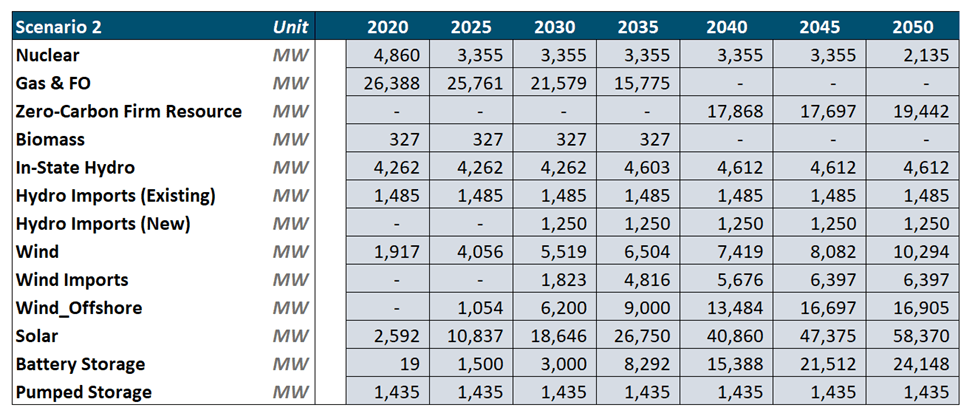
One of the key themes for the transition is “To achieve the mandates of the CLCPA, new emission-free supply capable of providing the necessary reliability services are needed to replace the capabilities of today’s generation. Such new supply is not yet available on a commercial scale. “  One of the key findings for supply resources states “Dispatchable emission-free resources must be developed to provide the capacity, energy, and other essential grid services required to achieve the policy mandate for a zero-emissions grid by 2040.”  In other words, this is the resource that is needed to provide the system needs described in the previous slide.  Appendix F is devoted to this resource. Dispatchable Emissions-Free Resources (DEFR) are needed for a future grid that depends upon wind, solar, and energy storage resources to keep the lights on during periods of extended low wind and solar resource availability.  In my opinion, one of the important unresolved issues is the resource allocation difference between the NYISO projections and the Integration Analysis State Scenario shown in the following slide. 

There are enough issues associated with this topic that I will come back to this in a subsequent post  For this overview I will continue with the final main driver of electric system change – transmission.  The following slide lists four key findings.

The first key finding is that “Historic levels of investment in the transmission system are happening but more will be needed.”  The following slide lists seven ongoing transmission projects.

As noted, more transmission will be needed.  The following slide describes the process for more transmission projects.

Another key finding is that there are “Actionable expansion opportunities: To fully utilize the transmission facilities already in place, additional dynamic reactive power support must be added to the grid in upstate New York to alleviate curtailment over the Central East interface.”  This is illustrated in the following slide.  I am not conversant in the technical details of this issue so I will quote from the Outlook report:

To fully utilize the transmission facilities already in place, additional dynamic reactive power support must be added to the grid in upstate New York to alleviate congestion caused by the Central East interface voltage performance. Reactive power supports the overall voltage performance of the grid and maybe provided by generators, dedicated fast responding dynamic reactive power devices, such as synchronous condensers or other power electronics (e.g., STATCOMs], or potentially other specialized Grid-Enhancing Technologies (GETs). This kind of specialized technology can improve the delivery of electricity via existing transmission lines. As the fossil fuel generators tied to the Central East voltage collapse limit are deactivated by 2040 to comply with the CLCPA mandate, the full benefits of the Segment A transmission project will be diminished leading to transmission congestion and renewable curtailment if left unaddressed.

The Outlook finds that by replacing the dynamic support services from these fossil fuel generators to support the Central East interface voltage performance, the future potential congestion across Central East could be largely eliminated and curtailment of renewable energy reduced by approximately 40-220 GWh in 2035.

The important point is that someone is going to have to pay for the dynamic support services necessary to get the renewable electric energy to where it is needed.  When wind and solar supports brag about the low costs of solar and wind generation they are most certainly not including hidden costs like this in their estimates.

There were no slides specifically associated with the following key themes.  Three themes address current reliability concerns:

  • The potential for delays in construction of new supply and transmission, higher than forecasted demand, and extreme weather are threatening reliability and resilience to the grid
  • Summer 2024: Electricity supplies are adequate to meet expected summer demand under normal conditions, but extreme weather and other factors pose reliability risks.
  • On the coldest days, the availability of natural gas for power generation may be limited and significant interruptions to natural gas supply can disrupt reliable operations.

Lastly, in order to expedite new renewable development, the NYISO processes have to be accelerated.  Note however, that NYISO must worry about the unintended consequences of these new resources so there are limits on this:

  • NYISO’s interconnection processes continue to evolve to balance developer flexibility with the need to manage the process to more stringent timeframes.

Discussion

The key themes that describe the Resource Outlook state of the grid outline potential issues.  In this section I describe the themes that posed issues threatening reliability and resilience to the grid but add some context that was not included in the slide presentation. 

The themes describe the status of the electric system.  This summer the electric system should be able to meet demand but “extreme weather and other factors pose reliability risks.”  In the winter, “the availability of natural gas for power generation may be limited and significant interruptions to natural gas supply can disrupt reliable operations.”  Unsaid were the ramifications of State policy decisions to limit natural gas pipelines to alleviate this availability problem.

The themes also address changes to the electric system.  Public policies are one of the causes of rapid changes to New York’s electric system in the state.  One of the consequences of the electrification mandate is that New York peak loads will occur in the winter in the 2030s.  Another driver of change is the marked increase in loads partially due to electrification mandates but also due to economic initiatives and increased demand for computing resources.  These changes have resulted in narrower reliability margins compounded by the unmentioned State policy decisions to force generator deactivations and preclude replacement with new fossil-fired generation.

Another issue raised in the themes is the schedule.  There have been and will be delays in construction of new supply and transmission.  NYISO recognizes that the interconnection process must change to keep up with the schedule but in this presentation did not describe  the technological changes that complicate interconnection of inverter-based intermittent wind and solar resources. 

I maintain that NYISO does not acknowledge that the need for “significant changes to the wholesale electricity markets administered by the NYISO” significantly complicates the transition.  NYISO not only must identify the technology needed to provide a reliable and resilient system but must also conjure up a market mechanism that will entice developers to provide those resources.

A primary concern expressed in the presentation was the need for “new emission-free supply capable of providing the necessary reliability services are needed to replace the capabilities of today’s generation.”  NYISO descriptions of DEFR always mention that “such new supply is not yet available on a commercial scale” but never articulate the risk to the reliability and resilience of the system of a policy that presumes that the resource will be developed as required.  Another related concern is that planning for this resource in a weather-dependent electric grid must address the challenge that wind and solar resource output is frequently low at the same time.  Alarmingly, the low resource availability typically occurs when the loads are highest which exacerbates the importance of a reliable DEFR solution.

Conclusion

The NYISO System and Resource Outlook describes issues that threaten reliability and resilience of the electric system.  In my opinion, it is frustrating that the issue descriptions are couched in qualifying statements that disguise the magnitude of the challenges.  It is left up to the reader to figure out that it is unlikely that the Climate Act mandates can be implemented without causing reliability crises.  In my opinion, the requirements of the Climate Act demand too much, too soon and the proposed plan to rely on wind and solar will cause catastrophic blackouts.

Offshore Wind Risks in the News

In the past couple of weeks there has been a flurry of offshore wind related news.  This post consolidates several of the important items.  Climate Change Dispatch describes an analysis that implicates offshore wind surveys with whale deaths.  Bud’s Offshore Energy has posted numerous articles describing the recent Nantucket offshore wind turbine failure and David Wojick explains the risk implications to further development.

I have followed the Climate Act since it was first proposed, submitted comments on the Climate Act implementation plan, and have written over 400 articles about New York’s net-zero transition.  The opinions expressed in this article do not reflect the position of any of my previous employers or any other company I have been associated with, these comments are mine alone.

Overview

The Climate Act established a New York “Net Zero” target (85% reduction in GHG emissions and 15% offset of emissions) by 2050.  It includes an interim 2030 reduction target of a 40% reduction by 2030 and a requirement that all electricity generated be “zero-emissions” resources by 2040. The Climate Action Council (CAC) was responsible for preparing the Scoping Plan that outlined how to “achieve the State’s bold clean energy and climate agenda.” The Integration Analysis prepared by the New York State Energy Research and Development Authority (NYSERDA) and its consultants quantifies the impact of the electrification strategies used to reduce greenhouse gas emissions.  That material was used to develop the Draft Scoping Plan outline of strategies.  After a year-long review, the Scoping Plan was finalized at the end of 2022.  Since then, the State has been trying to implement the Scoping Plan recommendations through regulations, Public Service Commission orders, and legislation.

Offshore wind developments are a key decarbonization strategy.  There is a target of 9,000 MW of offshore wind by 2035.  However, there are overlooked risks to this strategy has described here.

Offshore Wind Impact on Whales

Climate Change Dispatch reports that a recent study finds that offshore wind survey vessels are causing whale deaths.  The article explains:

Apostolos Gerasoulis, a Rutgers professor emeritus of computer science who co-created the search engine that powers Ask.com developed a software system dubbed Luna to identify any relationship between the dead whales and offshore wind survey vessels.  He loaded NOAA data on whale deaths, the zigzag courses of survey ships, and even wave action into his computer system.  Luna revealed patterns that Gerasoulis believes point to offshore wind survey vessels as the cause of the whale deaths.

Luna generates maps of the U.S. East Coast and plots the locations of offshore wind farms; the deaths of whales, dolphins, and porpoises; and the routes taken by various survey ships.  The central region, including New York, New Jersey, and Rhode Island, had minimal survey traffic before 2016.  After [2016], survey vessel traffic was an average of 50,300 miles per year, double the amount of the southern region. The number of humpback whale deaths also doubled, to 10.625 per year.

‘When comparing the south and central regions after offshore wind surveying started, the averages show an almost linear increase in humpback whale deaths – doubling the traffic results in doubling the whale deaths.”

Nantucket Wind Turbine Blade Failure

Bud’s Offshore Energy (BOE) blog covers “Energy Production, Safety, Pollution Prevention, and More” topics with an emphasis on offshore projects.  In the last couple of weeks he has posted 12 articles about the wind turbine blade failure off Nantucket.  I have briefly summarized them below.

On July 17 he described the Vineyard Wind turbine blade incident.  He noted:

On Saturday night (7/13) the Coast Guard warned Mariners as follows: “Coast Guard received a report of 03 floating debris 10 meters by 2 meters in the vicinity of approximately 26 NM SE of Marthas Vineyard and 22 NM SW of Nantucket in position 40 59.559N 070 25.404W. All marines are requested to use extreme caution while transiting the area.

On Monday (7/15), Vineyard Wind confirmed that a turbine blade incident occurred on 7/13: “On Saturday evening, Vineyard Wind experienced blade damage on a wind turbine in its offshore development area. No personnel or third parties were in the vicinity of the turbine at the time, and all employees of Vineyard Wind and its contractors are safe and secure.”

On 7/16, Vineyard Wind issued another statement advising that they were deploying teams to Nantucket to clean up debris from the incident.

BOE followed up with another post on July 17 Vineyard Wind operations shut down.  He noted that “Late Tuesday afternoon, the Bureau of Safety and Environmental Enforcement (BSEE) said all operations are shut down until further notice.”  “A team of BSEE experts is onsite to work closely with Vineyard Wind on an analysis of the cause of the incident and next steps,” the agency said in a statement.  

He also described the risks to marine mammals in Debris poses a significant risk to marine mammals.  He said that the debris is a particular concern for baleen whales, like the endangered right whale, which filter large amounts of waterPer NOAA:

Marine Mammals: Many species of marine mammals have also been confirmed to eat marine debris. A review by Kühn and van Franeker found that 69 species of marine mammals have been found to ingest debris – that’s 56% of all marine mammals! This includes 44 species of odontocetes (toothed whales), manatees, and multiple seal species. Marine mammals are highly protected, which can make it difficult to research them. Most research on marine mammals takes place after an animal dies, making it difficult to understand what marine debris live animals eat. However, we do know that because baleen whales filter extremely large amounts of water while feeding, they may get plastic debris entangled in their baleen plates. 

On July 19 BOE described Vineyard Wind: regulatory observations.  He made the following observations:

Vineyard Wind statement (7/18):

  • “This morning, a significant part of the remaining GE Vernova blade detached from the turbine. Maritime crews were onsite overnight preparing to respond to this development, though current weather conditions create a difficult working environment.”
  • We are staying apprised of GE Vernova’s efforts to manage the situation, including the removal and recovery of the remaining blade attached to the turbine.”
  • Staying apprised? As operator, Vineyard Wind is fully responsible. This is their situation to manage.

BSEE statement:

  • BSEE has ordered Vineyard Wind to suspend power production and wind turbine generator construction.
  • Kudos to BSEE for their decisive and timely action. They need to better understand what happened before allowing operations and construction to continue.
  • Imagine the pressure on the regulator if the project was providing a significant portion of the region’s electricity.
  • BSEE’s comment that there has been “no harm to any marine resources or mammals from the incident” is premature given the extensive marine debris and the associated risks to mammals.

What about the CVA?

  • The regulations at 30 CFR § 285.707-712 assign important responsibilities to Certified Verification Agents (CVAs), independent third parties with established technical expertise. These responsibilities include detailed reviews of the design, fabrication, and installation plans.
  • Oddly, the CVA’s “Statement of Qualifications” and “Scope of Work and Verification Plan” have been redacted in their entirety from Vineyard Wind’s Construction and Operations Plan (COP) (see Appendix I-C and I-D).
  • Who was the CVA and why was that important information redacted?
  • Were any of the CVA requirements waived per 258.705?

BOEM:

  • Will BOEM, the lessor and Federal wind program manager, be making a statement? Will they be reassessing their COP review procedures?
  • BOEM should temper their over-the-top promotion of offshore wind. The complete shutdown of the first utility scale offshore wind farm heightens public concerns about the intermittency of this power source, and the need for reliable backup sources.

On July 22 BOE discussed financial implications in: Vineyard Wind’s financial assurance waiver cites robust insurance policies, proven technology, and guaranteed electricity sales.  He posted an excerpt from the BOEM letter waiving the“pay as you build” financial assurance requirement for the Vineyard Wind project.

The post included BOE’s comments on the three factors listed in the excerpt:

  • Factor 1: Those “robust insurance policies” may soon be tested given the costs associated with the turbine blade incident and potential law suits. (The notice pasted below informs that Nantucket officials will meet on Tuesday to consider litigation. A question for attorneys is the extent to which Nantucket is compromised by their good “Good Neighbor Agreement” with Vineyard Wind. That agreement essentially calls on Nantucket to promote the Vineyard Wind projects in return for payments that seem modest relative to the economic benefits from tourism and fishing.)
  • Factor 2: To the extent that GE Vernova Haliade-X 13 megawatt turbines are proven technology (and that is very much in doubt), the use of proven technology doesn’t prevent premature abandonment associated with unexpected incidents.
  • Factor 3: Reliable power generation and predictable long-term income remain to be demonstrated.

On July 23, 2024 BOE posed the question: Should wind leasing and development be paused until the Vineyard Wind investigation is completed?:

The Vineyard Wind turbine incident, which littered Nantucket beaches, has also tarnished the US offshore wind program. BSEE has prudently halted Vineyard Wind operations and construction pending an investigation into the blade failure.

Offshore wind development is structure rich, so public confidence in the design of turbines and support platforms is critical. BOEM lists 37 active wind leases on the US OCS. Most of these leases have not yet reached the construction phase. A hold on the approval of any Construction and Operations Plans would seem to be appropriate pending completion of the Vineyard Wind investigations.

Per the leasing schedule below, BOEM intends to hold 4 wind sales during the remainder of 2024, all within a 3 month period. Only 1 sale is scheduled for each of the following 2 years. Deferring the 2024 sales until the investigations are complete would assist potential lessees by ensuring that the issues of concern were fully understood.

Unfortunately, BOEM’s failure to conduct a 2024 oil and gas lease sale has boxed in the wind program. The Inflation Reduction Act prohibits BOEM from issuing wind leases unless an oil and gas sale has been held within the previous year. Lease Sale 261 was held on 12/20/23 meaning that no wind leases may be issued after 12/20/24. BOEM has compressed the wind leasing schedule, presumably to beat the legislative deadline. It would have been better for both the oil and gas and the wind programs if at least one oil and gas sale had been held in 2024 as has been customary since the 1950s.

In another post, Aquinnah (Gay Head, Martha’s Vineyard) tribe calls for moratorium on offshore wind development, on July 23, 2024 BOE noted that “In the aftermath of a broken turbine blade off their coast, the Wampanoag Tribe of Gay Head (Aquinnah) is calling for a moratorium on all offshore wind development in the United States until further research can be done on the impact of wind farm construction.”  He explained that a letter to BSEE Director Kevin Slighm from Aquinnah  brought up the following points Wampanoag chairwoman Cheryl Andrews-Maltais brought up the following points:

  • expressed “strong concerns and outrage” over the fractured Vineyard Wind turbine blade and the debris that washed ashore on Nantucket.
  • said the foam and fiberglass debris have “potential negative and adverse impact[s]” on the environment, marine life, and human health.
  • said fragments in the water pose a threat to shellfish, which are a crucial part of both the marine food web and also ingested by humans.
  • commented that the potential contamination of shellfish with fiberglass and other materials could have severe consequences for human consumption and public health.
  • criticized the lack of communication from federal officials to the tribe.
  • called for an “immediate stoppage” of offshore wind construction in U.S. waters until they can be evaluated for microfractures and other damages.

On July 24, BOE provided a link to the initial assessment of the damage in Initial environmental assessment of Vineyard Wind blade debris.  He noted that “GE Vernova retained Arcadis US, Inc., to perform an initial assessment of environmental considerations associated with the presence of the blade debris in the water and along the shoreline and linked to a Nantucket Current article on the assessment.

In the July 25 post,  BOE described the developer’s excuse for the failure and the decision by the Nantucket Select Board to renegotiate their “Good Neighbor Agreement” with Vineyard Wind.

Quotes from Nantucket Current article (emphasis added):

“While we continue to work to finalize our root cause analysis, our investigation to date indicates that the affected blade experienced a manufacturing deviation,” said GE Vernova CEO Scott Strazik. “We have not identified information indicating an engineering design flaw in the blade or information of a connection with the blade event we experienced at an offshore wind project in the UK, which was caused by an installation error out at sea. We are working with urgency to scrutinize our operations across offshore wind. Pace matters here. But we are going to be thorough, instead of rushed.”

“It’s been 11 days since the event, and just to reinforce from the start, we have no indications of an engineering design flaw,” Strazik said. “We have identified a material deviation or a manufacturing deviation in one of our factories that, through the inspection or quality assurance process, we should have identified. Because of that, we’re going to use our existing data and reinspect all of the blades we’ve made for offshore wind. For context, this factory in Gaspé, Canada where the material deviation existed we’ve made about 150 blades. 

On July 26 BOE observed that the wind turbine company GE Vernova stock has taken a hit.  The Vineyard Wind turbine blade incident, the main reason for the sharp decline in their stock value in mid-July, is described as follows:

VINEYARD WIND OFFSHORE WIND FARM. We are the manufacturer and supplier of turbines and blades and the installation contractor for Vineyard Wind 1 offshore wind farm in the Atlantic Ocean (Vineyard Wind), at which we have installed 24 of 62 Haliade-X 220m wind turbines to date. Subsequent to the period covered by this report, a wind turbine blade event occurred at Vineyard Wind. Debris from the blade was released into the Atlantic Ocean and some has washed ashore on nearby beaches. On July 15, 2024, the U.S. Bureau of Safety and Environmental Enforcement (BSEE) issued a suspension order to cease power production and the installation of new wind turbines at the project site, pending an investigation of the event. As of the date of the filing of this report, we are currently engaged in a root cause analysis of the incident. We do not have an indication as to when BSEE will modify or lift its suspension order. Under our contractual arrangement with the developer of Vineyard Wind, we may receive claims for damages, including liquidated damages for delayed completion, and other incremental or remedial costs. These amounts could be significant and adversely affect our cash collection timelines and contract profitability. We are currently unable to reasonably estimate what impact the event, any potential claims, or the related BSEE order would have on our financial position, results of operations and cash flows.

He also noted that GE is also being sued by American Electric Power (AEP) for breach of contract and breach of warranty on turbine purchases for wind projects in Oklahoma:

“Within only two to three years of commercial operation, the GE wind turbine generators have exhibited numerous material defects on major components and experienced several complete failures, at least one turbine blade liberation event, and other deficiencies,”

On July 29 BOE described a new Order from BSEE to Vineyard Wind:

“The order comes as the bureau continues its oversight and investigation into the July 13, 2024, turbine generator blade failure. The order continues to prohibit Vineyard Wind 1 from generating electricity from any of the facilities or building any additional wind turbine generator towers, nacelles, or blades. This order also requires Vineyard Wind 1 to submit to BSEE an analysis of the risk to personnel and mitigation measures developed prior to personnel boarding any facility. Vineyard Wind 1 is not restricted from performing other activities besides those specifically directed for suspension or additional analysis. For example, Vineyard Wind 1 is still permitted to install inter-array cables and conduct surveys outside of the damaged turbine’s safety exclusion zone.” 

On July 30, 2024 BOE complimented the Nantucket Current for their coverage of the incident.  He quoted a a recent Current article (emphasis added):

The technology may not be new, but the size and scale of the Haliade-X turbine is novel for the offshore wind industry. And these jumbo-sized turbines have only recently been installed in just two locations in the world within the last year – at Vineyard Wind off Nantucket, and the Dogger Bank Wind Farm off the northeast coast of England. The Haliade-X turbine blades – which are supposed to have at least a 25-year lifespan – have suffered failures in both locations.

At the Dogger Bank Wind Farm – which is being completed in three sections which combined will make up the largest offshore wind farm in the world – the first GE Vernova Haliade-X turbine was installed in the fall of 2023 and began producing power on Oct. 10. But little is known about the blade failure that occurred just months later during the first week of May 2024. The damaged blade was disclosed by Dogger Bank’s owners – SSE Renewables, Equinor, and Vårgrønn – a week after the incident. In a statement, the companies said only that “damage was sustained to a single blade on an installed turbine at Dogger Bank A offshore wind farm.”

One reason the turbine blade incident at the Dogger Bank may not have generated more attention at the time is that the wind farm is located 100 miles off the coast of England, rather than just the 15 miles in the case of Vineyard Wind and Nantucket. If any debris was generated, it would have a far wider area to disperse in before nearing land – if it made it that far at all.

Risk of Offshore Wind Turbine Failure is Serious

David Wojick described the implications of the Nantucket failure on the development of Virginia’s offshore wind project.  In his article Wojick provides background information:

In this article, I present some technical background on that risk. The facility will be one of the world’s biggest, with 176 enormous turbines. It is just getting started with pile driving, so no turbine blades have been installed to date. This is an opportune time to undertake caution.

The Nantucket turbines are made by GE, and they are the world’s largest in operation today at 13 MW, each driven by three huge 107-meter-long blades. That is 351 feet for those of us who do not speak metric. The Virginia turbines will be even bigger at 14 MW with 108 meters (354+ feet) long. They are made by Siemens Gamesa, or SG for short.

The GE turbines and blades have been in production for going on two years, so have some operational experience. The SG turbines and blades just came into production so there is no experience with them. One could say they are being beta tested off Virginia.

This newness in itself is a great concern. At three blades each, there are an incredible 528 blades with a combined length of over 57,000 meters (187,000 feet or 35 miles) of blades. To take first production blades to these huge lengths is surely very risky.

For context consider that the Nantucket Current article referenced by BOEM noted that:

  • The Haliade-X turbine is the same one Orsted – a partner in Vineyard Wind – is planning to use for offshore wind farms slated for the waters off New Jersey and Maryland.
  • GE Vernova has allegedly refused to acknowledge responsibility for repairing the damaged turbines and generators in Oklahoma.
  • Land-based turbines have come apart in Sweden, Germany, Lithuania, Cypress, Brazil, and the US (and presumably elsewhere).

With respect to New York, there are two New York projects that plan to use large turbines.  Equinor’s Empire Wind 810 MW project provides comprehensive wind turbine information:

Vestas is the preferred supplier for wind turbine generators for Empire Wind.  Vestas will deliver 138 V236-15MW wind turbine generators with a total generating capacity of around 2GW.

  • 15 MW capacity
  • 774 feet rotor diameter
  • 886 feet high tip height
  • 463,000 sqf swept area

On the other hand the 924 MW Sunrise Wind project developed by  Ørsted and Eversource does not provide readily accessible turbine information.  I could not find what kind of turbines are planned or any details on their characteristics.

Wojick goes on to explain some of the problems with these immense turbine blades. 

Now let’s look at the blade stress physics just a bit, as it is amazing. SG has a quick look on their website, saying this:

“The rotational forces found in offshore wind turbines in operation put IMMENSE STRAIN ON THE BLADES and the rest of the wind turbine structure. (Emphasis added) At a tip speed of approximately 90 meters per second – equivalent to 324 kilometers per hour! (201 mph!) – and a projected lifetime of more than 25 years, high-quality and innovative design is imperative. For a 108-meter-long blade, the rotational forces are around a staggering 80 million newton meters, and the strain on the blades and the structure is intense! To put this into perspective, the force pulling on a human shoulder while spinning a 1 kg object around in an outstretched arm is only about 10 newton meters!”

Wojick sums up:

In summary, we have a newly huge blade, subject to immense stresses, made for the first time in an unusual way with a new composition and never tested in a hurricane. The high novelty risk to Virginia is obvious.

Conclusion

As noted by Robert Bryce the offshore wind scandal is even worse than you think.    These recent articles all reinforce his argument that it is time to pause the hurried rush to deploy offshore wind turbines.

I have no doubts that the proposed offshore wind development will have enormous impacts on whales and other mammals. The big green environmental organizations are abandoning whales in general and the remaining North American Right Whales in particular.  Bryce quotes an opponent of offshore wind: “What is Big Wind going to say when they kill the last whale? ‘Sorry’?” 

Red flag warnings abound for New York’s offshore wind development using these unproven huge wind turbines.  Wojick states the obvious “A sound engineering approach would be to build a few and see how they did over time.”  He also points out that the existing turbines of this size are in Europe where the dangers of hurricanes are not present. 

BOE provides a great concluding statement:

Greater transparency regarding turbine incidents, both in the US and internationally, is clearly needed. As we have learned from decades of experience with the oil and gas industry, most companies prefer reporting systems (if any) that protect details and information about the responsible parties from public disclosure. It’s the responsibility of the regulators to make sure that incident data and investigation reports are timely, complete, and publicly available. This is made more difficult by the promotional role that government agencies have assumed for offshore wind.

Compendium of DEFR Analyses

This article summarizes published posts describing a new category of generating resources called Dispatchable Emissions-Free Resources (DEFR) that many reputable electric energy analysts believe is necessary for a future grid that depends upon wind, solar, and energy storage resources. The reputable analyses of the future New York electric system agree that new technologies are necessary to keep the lights on during periods of extended low wind and solar resource availability.  However there still is an influential group of people who maintain otherwise.  Hence the need to document the reputable analyses.

I have followed the Climate Act since it was first proposed, submitted comments on the Climate Act implementation plan, and have written over 400 articles about New York’s net-zero transition.  The opinions expressed in this article do not reflect the position of any of my previous employers or any other company I have been associated with, these comments are mine alone.

Overview

The Climate Act established a New York “Net Zero” target (85% reduction in GHG emissions and 15% offset of emissions) by 2050.  It includes an interim 2030 reduction target of a 40% reduction by 2030 and a requirement that all electricity generated be “zero-emissions” resources by 2040. The Climate Action Council (CAC) was responsible for preparing the Scoping Plan that outlined how to “achieve the State’s bold clean energy and climate agenda.” The Integration Analysis prepared by the New York State Energy Research and Development Authority (NYSERDA) and its consultants quantifies the impact of the electrification strategies.  That material was used to develop the Draft Scoping Plan outline of strategies.  After a year-long review, the Scoping Plan was finalized at the end of 2022.  Since then, the State has been trying to implement the Scoping Plan recommendations through regulations and legislation.

Compendium of DEFR Analyses

The following descriptions have been integrated into a Pragmatic Environmental of New York page that I can update as necessary and use as a reference.  This article summarizes six analyses describing the need for DEFR: the Integration Analysis, New York Department of Public Service (DPS) Proceeding 15-E-0302 Technical Conference, NYISO Resource Outlook, Richard Ellenbogen, Cornell Biology and Environmental Engineering, and Nuclear New York.  I also include the Jacobson and Howarth work that forms the basis for those who believe that no new technology is needed.

DEFR is not Required

When the Climate Action Council voted to accept the Scoping Plan draft, council members made statements justifying their positions. The statement of Robert W. Howarth, Ph.D., the David R. Atkinson Professor of Ecology & Environmental Biology at Cornell University argued that no new technologies are needed and was uncritically accepted by some members of the Council. Importantly, the leadership of the Council did not object to the following:

A decade ago, Jacobson, I and others laid out a specific plan for New York (Jacobson et al. 2013). In that peer-reviewed analysis, we demonstrated that our State could rapidly move away from fossil fuels and instead be fueled completely by the power of the wind, the sun, and hydro. We further demonstrated that it could be done completely with technologies available at that time (a decade ago), that it could be cost effective, that it would be hugely beneficial for public health and energy security, and that it would stimulate a large increase in well-paying jobs. I have seen nothing in the past decade that would dissuade me from pushing for the same path forward.

This is the reason I am compiling DEFR analyses because it simply is not consistent with any of the organizations accountable for New York energy policy.  The basis of the no new technology claim is the “Wind, Water, and Solar” work of Professor Mark Jacobson of Stanford.  In my summary of this belief, I showed that Howarth’s argument that no new technology is needed has been refuted in the peer reviewed literature.  In the remainder of this article I describe six other analyses that conclude that DEFR is required.

The Jacobson approach wass described in a widely publicized November 2009 Scientific American article by Mark Jacobson and Mark Delucchi that suggested all electrical generation and ground transportation internationally could be supplied by wind, water and solar resources as early as 2030. However, other contemporary projections were less optimistic, for example two examples disagreed: the 2015 MIT Energy and Climate Outlook has low carbon sources worldwide as only 25% of primary energy by 2050, and renewables only 16% and the International Energy Agency’s two-degree scenario has renewables, including biomass, as less than 50%.

Howarth’s statement cites a specific plan for New York (Jacobson et al. 2013) that he and Jacobson laid out a decade ago.  He says that “In that peer- reviewed analysis, we demonstrated that our State could rapidly move away from fossil fuels and instead be fueled completely by the power of the wind, the sun, and hydro.”   There was a formal rebuttal paper to this analysis by Nathaniel Gilbraith, Paulina Jaramillo, Fan Tong, and Felipe Faria. The rebuttal paper argued that: 

The feasibility analysis performed by Jacobson et al. (2013) is incomplete and scientifically questionable from both the technical and economic perspectives, and it implicitly assumes, without sufficient justification, that social criterion would not produce even larger feasibility barriers.

Jacobson et al. responded to that rebuttal claiming  that “The main limitations are social and political, not technical or economic.”  Given the significant differences between that analysis and the most recent projections by the organizations responsible for keeping the lights on, I agree with the Gilbraith et al. conclusion cited above.  I do not believe that the 2013 WWS analysis includes a defensible feasibility analysis proving that a dispatchable, emissions free resource is not needed during extended periods of low wind and solar resource availability.

Three books include analyses that also refute the Jacobson work.  Meredith Angwin’s 2020 book Shorting the Grid: The Hidden Fragility of Our Electric Grid cites academic work rebutting the Jacobson premise.  Angwin also describes two other books that directly refute it.  Roadmap to Nowhere: The Myth of Powering the Nation With Renewable Energy by Mike Conley and Tim Maloney is available as a free PDF download on the web. Mathijs Beckers, of the Netherlands, wrote The Non-Solutions Project, available as an ebook or paperback.

I conclude that the basis for the influential position that no new technology is needed is not supported by the Jacobson work.  More importantly, the following analyses all conclude new technology is needed.

Integration Analysis

The Final Scoping Plan is the “official” Hochul Administration strategy description of the Climate Act transition.  The Scoping Plan directly contradicts the statement that technologies available when the Howarth paper was written and today are sufficient for the transition away from fossil fuels.  In particular, the Final Scoping Plan Appendix G, Section I page 49 states:

During a week with persistently low solar and wind generation, additional firm zero-carbon resources, beyond the contributions of existing nuclear, imports, and hydro, are needed to avoid a significant shortfall; Figure 34 demonstrates the system needs during this type of week. During the first day of this week, most of the short-duration battery storage is quickly depleted, and there are still several days in which wind and solar are not sufficient to meet demand. A zero-carbon firm resource becomes essential to maintaining system reliability during such instances. In the modeled pathways, the need for a firm zero-carbon resource is met with hydrogen-based resources; ultimately, this system need could be met by a number of different emerging technologies.

The analysis also recommends technologies for this resource:

Hydrogen effectively provides a form of storage to the system on the order of hundreds of hours. Large quantities of fuel can be produced during the spring and summer and then utilized over the course of the winter provided that there is sufficient fuel storage. In addition to hydrogen-based resources, the analysis also examined the potential to meet reliability needs with a long-duration battery storage solution. In this assessment, the firm zero-carbon capacity, as well as renewable resources needed to produce hydrogen, were removed from the system, and the analysis identified a need for 25 GW of 100-hour battery storage to replace the contributions of 21 GW of a fully dispatchable hydrogen-based resource, along with 14 GW of incremental renewable resources to provide storage charging.40 A 100-hour battery resource can provide firm capacity to meet system needs over several days. However, in contrast to a hydrogen-based resource, if sufficient excess energy is not available to fully recharge the batteries following a challenging stretch, their ability to meet a similar system need in subsequent weeks of the winter is diminished. As a result, a higher amount of 100-hour battery capacity is needed to meet the same level of reliability as hydrogen-based resources.

At the Zero Emissions by 2040 Technical Conference session Gap Characterization  Kevin Steinberger, Director, Energy and Environmental Economics (E3) stated that their modeling consistently showed the need for a new resource that is firm, dispatchable, and has no emissions that can power the system for days without significant recharge from wind and solar resources. 

NYISO Resource Outlook In all the resource analyses prepared by the New York Independent System Operator (NYISO) since Climate Act implementation began, the necessity of DEFR has been mentioned.  In the spring of 2024 the Power Trends 2024 report notes:

Renewable energy generation, subject to sudden changes in weather, also provides new challenges to grid operators that must balance supply and demand in real time. These variables highlight the need for new generation technologies that can fill in when weather-dependent resources are unavailable. Such new technologies, collectively referred to as Dispatchable Emission Free Resources (DEFRs), must be dispatchable, emissions free, and able to respond quickly to changing grid conditions. Such technologies do not exist yet on a commercial scale.

The NYISO described this resource in the 2021-2040 System & Resource Outlook:

DEFRs are a classification of emission- free resources that provide the reliability attributes of synchronous generation and can be dispatched to provide both energy and capacity over long durations. DEFRs must be developed and added to the system at scale to reliably serve demand when intermittent generation is unavailable. The lead time necessary for research, development, permitting, and construction of DEFR supply will require action well in advance of 2040 if state policy mandates under the CLCPA are to be achieved.

I described the presentation by Zachary Smith that gave an overview summary presentation of the DEFR issue.  In his first slide (shown below) he gave an overview of the generating resource outlook to make the point that a large amount of new generating resources needs to be developed.  The estimates shown are from the 2021-2040 System & Resource Outlook and represent two plausible load projections.  He noted that there are “a lot of attributes that fossil fuel resources provide today that wind, solar, and energy storage simply cannot provide”.  He also made the point that the DEFR replacements do not have to be a single technology but could be several technologies that in aggregate can replace the fossil generation.

Smith listed the attributes needed by DEFR in his presentation.  In my description of his discussion I offered comments on this list of attributes.

Smith’s presentation lists the attributes of twelve sample technologies in the following slide.  This represents the NYISO opinion of the capability of different technologies to meet the attributes necessary to maintain a reliable system.  In the future grid the insistence that all fossil fired units must be shut down means that numerous technologies that meet some of the necessary attributes will be required.  The added complexity of these technologies does not increase resiliency because wind, solar, battery and demand response are all energy limited.  Ancillary support services will be a major consideration because wind, solar and battery do not provide those services.  Just from this overview, it is clear that affordability and reliability will be challenges.

Attributes of Sample DEFR Technologies

Richard Ellenbogen

I described Richard Ellenbogen’s comments as part of the record for the Department of Public Service Proceeding 15-E-0302 related to the net -zero mandate of the Climate Leadership and Community Protection Act (CLCPA). His comments discuss “a viable, affordable, and rapidly executable Plan B to assist NY State in reducing its carbon footprint using technologies that actually exist at scale, unlike the technologies proposed by the CLCPA which only exist at scale in the fantasies of its proponents.”

Ellenbogen lays out reasons that things have changed as the Climate Act is implemented that could affect the schedule and viability of the Scoping Plan list of control strategies.  He concludes that an alternative that does not go to zero provides a better solution. He argues that Interim Combined Cycle Natural Gas Generation phasing to nuclear over time is a far more cost effective and secure way to power the state than what the CLCPA is mandating. Recovering the Combined Cycle emissions in greenhouses will mitigate the negative effect of the carbon emissions. That will also provide energy security that renewables can’t, while simultaneously providing food security as climate change makes food production more challenging.

Cornell Biology and Environmental Engineering

In a post describing the Zero Emissions by 2040 Technical Conference session Gap Characterization  I summarized work by Prof. C. Lindsay Anderson, Chair of Department of Biological and Environmental Engineering Cornell.  Professor Anderson described an analysis her group did using a model they developed.  They made projections for expected loads and potential resources then used 22 years of hourly historical data to model the system.  Without considering cost constraints they assessed system vulnerabilities to evaluate periods where there was insufficient generation to meet projected loads.  Even with optimistic projections they found there will be periods during the coldest and hottest periods where there will be insufficient generation from wind, solar, and energy storage resources.  That gap must be filled with DEFR.

Nuclear New York

I described the independent analysis of the future grid found that New York State has seriously underestimated the need for DEFR. The Filling the Gap in New York’s Decarbonization Plan: A New View of the Electric Grid report was authored by Leonard Rodberg, PhD, Research Director, Nuclear New York, Inc.; Consultant, Energy Policy; Reiner Kuhr, Founder, Center for Academic Collaborative Initiatives (CAIC); and Ahmad Nofal, Co-founder, CAIC. 

The report describes the results of a new modeling tool that allows an hour-by-hour analysis of electric system behavior.  This approach enabled the authors to see details of the hourly operation of each energy source, features not disclosed by existing models.  In my opinion, the CAIC analysis treats DEFR differently than the Integration Analysis does.  I believe that when the Integration Analysis determines which resources should be applied to meet load for each hour, they use DEFR as a last resort.  On the other hand, CAIC uses DEFR much more frequently.  That could be due to a difference in the hourly projections of wind, solar, energy storage, and load for the two models or presumptions in the models.

They found that:

Our hour-by-hour analysis shows that the firm dispatchable source has to run two-thirds of the year. The total load has increased from today. The summer peak has been replaced by a much higher winter peak. That greater demand is met by the extended operation of the DEFR which runs during most evenings in the cooler portion of the year. In fact, we find a capacity factor — the fraction of potential output actually used –of 14.4%.

The report concludes:

We have shown, with a modeling tool capable of performing an hour-by-hour analysis, that dispatchable emission-free resources are essential to meeting the goal of a reliable, zero-emission grid.  Further, this clean dispatchable source must be able to run a large portion of the year. The only such source likely to be available within the next several decades is nuclear power.

Conclusion

There is overwhelming evidence that a new category of generating resources is necessary for a future grid that depends upon wind, solar, and energy storage resources. Most analysts of the future New York electric system agree that DEFR is necessary to keep the lights on during periods of extended low wind and solar resource availability.   At this point the only questions should be how much, what technologies can be used, and whether any technologies can provide the necessary services affordably.  The Hochul Administration Scoping Plan does not provide that information in sufficient detail.

Finally, the work done since the completion of the Scoping Plan should put the myth that no new technologies are necessary to death.  The Proceeding on Motion of the Commission to Implement a Large-Scale Renewable Program and a Clean Energy Standard – Zero Emissions Target Case No. 15-E-0302 addresses the need for DEFR.  However,there does not appear to be a schedule to resolve the issues raised at the PSC technical conference Zero Emissions by 2040 session titled Gap Characterization last December.  They should be resolved sooner rather than later.

Assemblyman Stirpe and the NY Heat Act

Recently I posted two articles about the New York Home Energy Affordable Transition Act, or NY HEAT, legislation that was being considered by the New York legislature but did not pass in the legislative session.  At the same time I posted the last article (13 May 2024) I sent the following to my NYS Assemblyman Al Stirpe: “I am opposed to the NY HEAT Act for the reasons in documented in this article: NY HEAT is not so hot”.  This post describes the response I received on 11 July 2024.

I have followed the Climate Leadership & Community Protection Act (CLCPA) since it was first proposed, submitted comments on the CLCPA implementation plan, and have written over 400 articles about New York’s net-zero transition. I am convinced that the CLCPA will adversely affect affordability, reliability, and that the environmental impacts of the proposed transition are greater than the possible impacts of climate change.  The opinions expressed in this post do not reflect the position of any of my previous employers or any other organization I have been associated with, these comments are mine alone.

 Overview

The CLCPA established a New York “Net Zero” target (85% reduction in GHG emissions and 15% offset of emissions) by 2050.  It includes an interim 2030 reduction target of a 40% reduction by 2030 and a requirement that all electricity generated be “zero-emissions” by 2040. The Climate Action Council (CAC) was responsible for preparing the Scoping Plan that outlines how to “achieve the State’s bold clean energy and climate agenda.”  In brief, that plan is to electrify everything possible using zero-emissions electricity. The Integration Analysis prepared by the New York State Energy Research and Development Authority (NYSERDA) and its consultants quantifies the impact of the electrification strategies.  That material was used to develop the Draft Scoping Plan outline of strategies.  After a year-long review, the Scoping Plan was finalized at the end of 2022.  In 2023 and 2024 the Scoping Plan recommendations were supposed to be implemented through regulation, PSC orders, and legislation.  NY HEAT is an example of Climate Act legislation. 

NY HEAT Act Response
As noted I did a couple of articles about the HEAT act a couple of months ago.  The first described Rich Ellenbogen’s  response to Sane Energy Voice claims that NY HEAT Act should be enacted.  The second article referenced additional op-eds that argue this legislation is not a good idea. 

While I appreciate the fact that someone on Stipe’s staff responded to my note, the response was unsatisfactory.  As is always the case, the amount of energy necessary to refute BS is an order of magnitude bigger than to produce it.  In the following I provide my annotated comments to the email received from Assemblyman Stirpe.

The first paragraph was the usual boilerplate response:

Thank you for reaching out to me with your concerns regarding the NY HEAT Act. I greatly value the feedback I receive from my constituents, as it plays a crucial role in my decision-making process.

The meat of the response addressed NY HEAT:

First, I want to address some misconceptions about the NY HEAT Act. The Act will not eliminate existing gas services; it will end subsidies for new gas hookups. Currently, when a new home is constructed, the first 100 feet of gas hookup is free for the homeowner, with the cost being distributed among all ratepayers. The NY HEAT Act aims to remove this subsidy to encourage home builders to consider alternative energy sources, such as geothermal systems. If a developer chooses a geothermal system for a neighborhood instead of gas, the monthly heating and cooling costs could be 40%-50% lower, benefiting both the environment and New York homeowners.

The suggestion that NY HEAT will not eliminate existing gas services is solely concerned with the new gas hookups is either deliberate misinformation or outstanding naiveté.  Consider the following sections of NY HEAT with my highlights:

  • Section 5: Amends section 30 of the public service law. Removes a residential customer’s legal entitlement to utility gas services, while maintaining this entitlement for electric service.
  • Section 7: Amends section 31, subdivisions 1,3, and 4, of the public service law. Implements the policy established in section 5 with respect to applications for electric and gas services.   Acknowledges gas service may be limited or discontinued to facilitate achievement of the CLCPA climate justice and emission reduction mandates.
  • Section 8: Amends section 12 of the transportation corporations law. Removes the entitlement of non-residential customers to utility gas service, but maintains it for electric service.
  • Section 9: Amends section 66, subdivision 2, of the public service law and creates a new subdivision 12-e. Grants the commission authority to order the curtailment or discontinuance of the use gas for any customer, group of customers, or section of the gas distribution system, where the commission has determined that such curtailment or discontinuance is reasonably required to implement state energy policy.
  • Section 11: Repeals section 66-b of the public service law. Removes the entitlement to continuation of gas service following the demolition and reconstruction of any structure owned by a customer.

I am not a lawyer, but this language seems clear to me that the legislation is intended to do more than just change new gas hookup requirements.  The only possible excuse is that the legislation does not explicitly include language to eliminate existing gas service.  However, it clearly provides the enabling legislation to make it possible for the State to shut down gas service to existing customers.  The claim that NY HEAT is solely concerned with the 100 foot rule is incorrect.

The rationale to eliminate the subsidy for new hookups claims that: “If a developer chooses a geothermal system for a neighborhood instead of gas, the monthly heating and cooling costs could be 40%-50% lower, benefiting both the environment and New York homeowners.”  My response to that is show me the numbers.  I am not going to take the time to find alternate numbers.  However, my understanding is that geothermal systems are expensive to install and the oft-repeated narrative that a neighborhood system would bring down costs is long on wishful thinking and short on real world examples.

The response from Stirpe went on to provide the narrative rationale for NY HEAT:Addressing the climate crisis is essential, as record-breaking temperatures and fossil fuel emissions significantly contribute to global warming. The NY HEAT Act did not pass during this session, but it is important to take measures for mitigating the impact of fossil fuels on our planet. We all want our kids and grandkids to exist in a livable world.

Addressing the climate crisis is essential, as record-breaking temperatures and fossil fuel emissions significantly contribute to global warming. The NY HEAT Act did not pass during this session, but it is important to take measures for mitigating the impact of fossil fuels on our planet. We all want our kids and grandkids to exist in a livable world.

It is a Sisyphean task to try to debunk the emotional “existential” climate crisis rationale and the climate porn argument that every record-breaking temperature is proof that the climate is changing due to fossil fuel emissions that significantly contribute to global warming.  There are many attempts to address those claims amongst my articles on the Climate Act but I think it is impossible to change many minds on those claims. 

Importantly however is my unaddressed concern is about New York’s role in this global problem.  Using GHG emissions data from Our World In Data I looked at emissions in the last year with global data.  In 2021, NYS GHG emissions (GWP-100) were 247 million metric tonnes (MMT).  GHG emissions from China were 13,774 MMT and from India were 3,879 MMT.  The increase in emission from 2020 to 2021 were 498 MMT in China and 265 MMT in India.  New York emissions will be supplanted by emissions from China or India in less than one year.  New York’s emissions are less than a half a percent of global emissions.  This does not necessarily mean that we should not do something, but it does mean that NY HEAT is not going to make a bit of difference to climate change impacts.

I also want to address the last emotional argument: “We all want our kids and grandkids to exist in a livable world”.  I agree that we should be worried about our children and grandchildren.  On the other hand, I know that the societal cost of carbon benefits are based on contrived calculations and that New York’s Value of Carbon calculations project alleged impacts out to 2300.  The children and grandchildren argument changes when you understand that we are talking about the impacts today relative to those ten generations in the future.  The emotional argument is less impactful when you consider the hubris involved with claims that we can predict or even imagine what the world will like 275 years in the future.

One final point about New York’s efforts to go to net-zero.  My work indicates that New York’s Climate Act will do more harm than good.  There are enormous challenges associated with the proposed energy plan that relies on wind and solar energy that have not been resolved and will undoubtedly affect reliability.  Because the proposed energy plan relies on intermittent and diffuse generating resources the costs of just wind and solar capacity do not tell the whole story.  When solutions are proposed for intermittent and diffuse wind and solar the costs involved skyrocket.  It is also not clear that when all the environmental impacts are considered that the proposed energy sources will not cause more environmental harm than the alleged impacts of climate change.

Discussion

I distribute a fortnightly summary of my recent posts to an email distribution.  I think one of the recipients is the Assemblyman’s communications director.  The last paragraph suggests that the Assemblyman is aware of my work:

Thank you for your advocacy and engagement on behalf of our community’s well-being. If you have any questions about this or other issues, please feel free to contact me.

I doubt that there is a constituent in his district that has a greater understanding of the Climate Act and its ramifications for the state and its residents than I do.  If I was asked to provide the Assemblyman one question that needs to be addressed, it would be how much will it cost to meet the 2040 target for 100% carbon-free emissions.  The Hochul Administration claims that the costs of inaction are less than the cost of action.  Does Assemblyman Stirpe know that claim only refers to the costs associated with the Climate Act itself?  The baseline of “no-action” described in the Scoping Plan as “Business as usual plus implemented policies” includes the following programs:

  • Growth in housing units, population, commercial square footage, and GDP
  • Federal appliance standards
  • Economic fuel switching
  • New York State bioheat mandate
  • Estimate of New Efficiency, New York Energy Efficiency achieved by funded programs: HCR+NYPA, DPS (IOUs), LIPA, NYSERDA CEF (assumes market transformation maintains level of efficiency and electrification post-2025)
  • Funded building electrification (4% HP stock share by 2030)
  • Corporate Average Fuel Economy (CAFE) standards
  • Zero-emission vehicle mandate (8% LDV ZEV stock share by 2030)
  • Clean Energy Standard (70×30), including technology carveouts: (6 GW of behind-the-meter solar by 2025, 3 GW of battery storage by 2030, 9 GW of offshore wind by 2035, 1.25 GW of Tier 4 renewables by 2030)

That means that the costs of all these programs that are required to meet the Climate Act mandate of 100% carbon-free emissions by 2040 are not included in the evaluation “proving” that the costs of inaction are more than the costs of action.  Sadly that is not the only deceptive analysis or down right incorrect approach used to make the claim.

It is also becoming clear that those of us that have argued that NY HEAT is dangerous and represents something too far, too soon are right.  I would be willing to provide briefings that support my concerns.  The Public Service Commission recently released its Clean Energy Standard Biennial Review Report.  That report admits that the 2030 goal for 70% renewable energy will not be met.  The New York State Comptroller Office released an audit of the NYSERDA and PSC implementation efforts for the Climate Act titled Climate Act Goals – Planning, Procurements, and Progress Tracking. It found that “the costs of transitioning to renewable energy are not known, nor have they been reasonably estimated”.    Concerns raised by the New York Independent System Operator in its Power Trends 2024 report include decreasing reliability margins, electrification of heating and transportation will increase loads and shift the maximum to winter, the ambitious schedule, and the need for a new category of electric resources that are not yet commercially available.  The issues raised in these reports mean that the mandates in NY HEAT are premature.

Conclusion

It is long past due for the Hochul Administration to provide New Yorkers with the real costs.  My Assemblyman has not looked at the Scoping Plan in enough detail to understand the shortcomings and dangers of the current path.  I think it would be prudent for New York to take a deep breath and pause implementation until questions about reliability, affordability, and environmental impacts are addressed openly and comprehensively.  I would welcome the opportunity to explain why to him or anyone else.

New York Agencies Ignore Climate Act Reality

In a recent post I observed that Governor Hochul is becoming aware that reality always wins relative to New York’s Climate Leadership & Community Protection Act (Climate Act).  In particular, the governor said the state’s climate goals are something she “would love to meet, but also the cost has gone up so much. I now have to step back and say, ‘What is the cost on the typical New York family?’ Just like I did with congestion pricing.”  I also referenced Susan Arbetter’s Capital Tonight  interview with a couple of agency heads and noted that there was enough material for a follow up post.  This post addresses the agency head’s refusal to address reality.

I have followed the Climate Leadership & Community Protection Act (Climate Act) since it was first proposed, submitted comments on the Climate Act implementation plan, and have written over 400 articles about New York’s net-zero transition.  The opinions expressed in this article do not reflect the position of any of my previous employers or any other company I have been associated with, these comments are mine alone.

Overview

The Climate Act established a New York “Net Zero” target (85% reduction in GHG emissions and 15% offset of emissions) by 2050.  It includes an interim 2030 reduction target of a 40% reduction by 2030 and a requirement that all electricity generated be “zero-emissions” by 2040. The Climate Action Council (CAC) was responsible for preparing the Scoping Plan that outlined how to “achieve the State’s bold clean energy and climate agenda.” The Integration Analysis prepared by the New York State Energy Research and Development Authority (NYSERDA) and its consultants quantifies the impact of the electrification strategies.  That material was used to develop the Draft Scoping Plan outline of strategies.  After a year-long review, the Scoping Plan was finalized at the end of 2022.  Since then, State agencies and the legislature have been attempting to implement the plans.

The original article suggesting that Hochul seems to accept that several recent reports show that implementation of the Climate Act is not going as planned.  The Public Service Commission (PSC) recently released Clean Energy Standard Biennial Review Report (“Biennial Report”) compares the renewable energy deployment progress relative to the Climate Act goal to obtain 70% of New York’s electricity from renewable sources by 2030.  It projects that the goal will not be achieved until 2033 when historic renewable resource deployments are considered.  The New York State Comptroller Office released an audit of the NYSERDA and PSC implementation efforts for the Climate Act titled Climate Act Goals – Planning, Procurements, and Progress Tracking. It found that “the costs of transitioning to renewable energy are not known, nor have they been reasonably estimated”.  The final report by the New York Independent System Operator (NYISO) is its annual Power Trends that describes factors influencing New York State’s power grid and wholesale electricity markets.  The findings suggest that there will be reliability risks for the Climate Act transition on the mandated schedule.  I also referred to a couple of articles that suggest that Hochul has broached the possibility that the Climate Act might have to be paused.

Arbetter Interview

Susan Arbetter interviewed  NYSERDA President and CEO Doreen Harris and Rory Christian, Chair and CEO of the PSC for Capital Tonight.  For me it was a frustrating interview because the responses to the questions posed did not reflect the issues raised in the recent reports. 

Arbetter opened the interview obliquely referencing the question on everybody’s minds who is following the Climate Act – how much is this going to cost?  She noted that Hochul paused the New York City congestion pricing initiative because as she stated: “Now my job is not to make it harder or more expensive for New Yorkers to live in our state – working hard, make ends meet, raise their families.”   Arbetter asked if Hochul was “preparing to pause or delay the state’s clean energy goals”.

Harris did not directly respond to the question.  Instead, she said: “we look at our goals objectively”.  She referenced the Clean Energy Standard Biennial Review Report and its evaluation of progress towards the 2030 goal of 70% renewable energy saying that it “did reveal specific challenges that we are facing”.  She went on to say that since implementation it has been “tumultuous” with respect to a global energy crisis, Covid and supply chain constraints, etc.”.  Then she said that report reveals that “we are making very good progress”.  She also admitted that it is not just renewables that are an issue.  It is also EV adoption, but she claimed that has improved 400% since 2021.

The Biennial Report admits that the schedule will not be met and Arbetter asked if this meant there would have to be a pause.  Harris just gave obviously scripted excuses.  The final version of the Scoping Plan was completed in the Fall of 2021 at which time issues related to Covid were well known.  The global energy crisis following the Russian invasion of Ukraine started in February 2022 so that could not have been included in the implementation plan.  Supply chain issues were triggered by the Covid epidemic, but it should have been obvious that when New York started competing with all the other jurisdictions for limited amounts of renewable energy equipment that delays would be inevitable. So at least two out of the three excuses are marginal.

My bigger issue with NYSERDA and Harris is the use of unverifiable and misleading claims.  She claimed EV adoption has gone up 400% since 2021 but did not qualify that to mean the number of EVs sold or the number on the road.  It is a number that cannot be easily checked using the NYSERDA Electric Vehicle Registration Map because the data are presented in diagrams and the original values are not available except in a database with every vehicle registration in the state.  A table with EVs sold or on the road by year is not available.  Nonetheless, I was able to compare the Integration Analysis projection that there would be 215,935 battery-electric and plug in hybrids on the road in Scenario 2: Strategic Use of Low-Carbon Fuels to the NYSERDA data.  That data indicated that there are only 154,766 EVs presently on the road.  Even if sales are up 400% that boast is misleading because they are 28% behind the planned adoption levels.

The Harris response did not address the question, so Arbetter tried again: “I just want make sure that while there are factors that have contributed to the delay in implementation of our energy goals, is there anything leading the Administration to delay this because of cost.” (Note that this is not an exact quote but it is pretty close – check out the video at 1:40/9:00).  Harris responded: “The proceeding that is before the PSC is intended to look at just that”.  Harris explained: “How much progress have we made, do we need to make, and specifically they look at all this in the context of consumer cost”. 

While this may be apropos of nothing, but a search in the Biennial Report for “consumer” yields three results: one for consumer price index and the other two in a paragraph describing the motivation for deregulating the power sector of New York.  That may not disprove the claim that the report looks at all of this in the context of consumer costs, but my review of the Biennial Report so far has not found any sections addressing consumer cost.  During the Draft Scoping Plan review by the Climate Action Council, members Gavin Donohue and Donna DeCarolis repeatedly asked for consumer price cost projections.  Co-chair Harris did not provide that information then and appears to be stonewalling now.

Arbetter accepted the claim that the Biennial Review addressed consumer cost and asked when the Proceeding will be finished.  Christian responded: “Well it has begun and what we try to do in the released report is to highlight progress to date and the various challenges that we need to overcome”.  He went to expand the list of excuses used by Harris saying that rising inflation and interest rates were factors as well as significant load growth.  He pivoted the load growth challenge into an argument that load growth represents a “great opportunity” for the economy. 

Arbetter paraphrased Christian saying that it is great that the economic development is happening, but it means we must catch up by producing more electricity.  He came back with the argument that this means “we have to look at the progress we have made to date and understand what we can do to get to that next step”.  He went on to suggest that the load growth was a primary driver of whether the 2030 goal could be met.  It “looks like 2033 if the load growth happens the way we are seeing it, but the 2030 goal could still be met if load growth is lower or higher if load growth increases”.

I interpret this to mean that the Christian is arguing that the primary reason that the schedule will not be met is unanticipated load growth since the time the Integration Analysis implantation schedule was developed.  One way to compare how the expected load in 2030 has changed over time is to compare the annual energy reports in the NYISO annual load and capacity data report (universally known as the “Gold Book”) from 2021 when the Integration Analysis projections were prepared to projections in more recent years.  The following table shows that load forecasts for New York have increased markedly since 2021 or 2022 for that matter.  Regarding Christain’s claim however note that the load projection increased 13,090 GWh in 2030 but that the Biennial Report gap between the 70% goal and anticipated renewable energy is 42,145 GWh.  The projected increase in load is less than a third of the expected gap so deflecting blame to unanticipated load growth is misleading.

Arbetter confirmed with Christian that the Biennial Report essentially said that the State is three years behind the 2030 70% renewable energy goal but it could possibly meet it or miss by more.  He said that the Biennial Report is part of the planning process and that the released report is not final.  It’s “a report highlighting where we are listing a number of recommendations and options for how best to proceed”.  As far as I can tell he did not answer Arbetter’s question about the timing of the response to the draft Biennial Report.

In my opinion, at this point the interview switched from asking questions about reaching the Climate Act goals to lobbying support for the Act. Arbetter said: “When the climate blueprint was created, the overarching reason, the fundamental thing that held it up was that it would be much more costly to do nothing than to actually create this climate transition”.  Then she asked if that was still the case. 

This is a paraphrase of the cost benefit slogan repeated at every opportunity by Harris: “The costs of inaction are more than the costs of action”.  I have argued for years, including my verbal comments on the draft Scoping Plan to Harris and Climate Action Council Co-Chair Basil Seggos, that the slogan is  misleading and inaccurate.  I described some of the manipulations used to contrive the slogan here.  The biggest problem is that it does not account for the full costs to implement the Climate Act targets.  Instead, it only evaluates the costs of the Climate Act mandates and excludes decarbonization programs that were “already implemented”.  The already implemented programs included Zero-emission vehicle mandate (8% LDV ZEV stock share by 2030) and the Clean Energy Standard, including technology carveouts: (6 GW of behind-the-meter solar by 2025, 3 GW of battery storage by 2030, 9 GW of offshore wind by 2035, 1.25 GW of Tier 4 renewables by 2030).  That means that the slogan really means that the costs of inaction are more than the costs of action excluding the costs of 6 GW of behind-the-meter solar, 3 GW of hattery storage and 9 GW of offshore wind among other things.   

Harris responded to the setup question that the benefits outweigh the costs: “It certainly is” and “We look carefully at costs but we also look at benefits.”  She then claimed that there are very strong reasons for doing what we are doing.  In my opinion, NYSERDA’s Scoping Plan evaluation has never been held accountable.  The agency has never responded to technical comments on issues, never addressed my comments on the cost-benefit analysis, and has never reconciled the differences between their projections for the electric system with the NYISO projections.  The public should be aware that the costs were underestimated in most instances and the benefits were overestimated in every instance.

Next Arbetter parroted the common claim that we are already seeing the effects of climate change.  She said the “climate is changing in a bad way”.  For examples she cited the tornado in Rome, NY, Hurricane Beryl, and Canadian wildfire smoke.  “We are seeing this all the time”.  After listing the examples of alleged climate change, she went on to say: “This is all costing taxpayers money, Right?”.  

Christian agreed saying “We look at these costs in making determinations for what actions to take”.  I waited in vain for Arbetter to ask just how much of an effect the Climate Act emission reductions would have on the alleged effects.  After all, if the state is looking at the costs of climate impacts, then we should look at the potential benefits for our actions on those climate impacts.  The fact is that the State has never acknowledged that New York GHG emissions are less than one half of one percent of global emissions and global emissions have been increasing on average by more than one half of one percent per year since 1990.  Anything we do will be supplanted by emissions elsewhere in less than a year. Neither has the State estimated how much NY emission reductions would affect global temperatures.  I believe that is because the change would be too small to measure.

It gets worse.  One of my problems with the existential threat of climate change narrative is the consistent linking of any extreme weather event to climate change.  On my list of articles to write is a review of Roger Pielke, Jr’s multi-part series (Part 1 here Part 2 herePart 3 here, and  Part 4) on climate fueled extreme weather. He explains that “the Intergovernmental Panel on Climate Change (IPCC) spends much time and effort on assessing the science of the detection and attribution of changes in climate.“  Then he notes that “Given widespread popular beliefs and media-friendly experts willing to cater to those beliefs, many are surprised, shocked even, to learn that the IPCC has arrived at conclusions on extreme events and climate change that are completely at odds with conventional wisdom and popular opinion.”  The point that is universally ignored by the Hochul Administratin and, in this case by Arbetter, is “In fact, the IPCC currently concludes that we will not this century be able to detect with high confidence changes in the statistics of most weather events beyond internal variability”.  The IPCC concluded that there is no climate change signal for tropical cyclones, severe windstorms, or fire weather.  Point of emphasis that means the IPCC says there is no current climate impact signal for any of the weather events cited by Arbetter and confirmed by Christian. 

Christian went on to argue that the existing system must be changed: “Very few of us are willing to tolerate technology from the 1950’s” and said the grid today is built on that foundation.  He said: “We are modernizing the grid not to just take on the challenge of adopting more renewable energy but to create greater flexibility, greater resiliency and the ability to recover more quickly in the face of these extreme climate events”. 

I disagree with all those arguments.  Most of us don’t care about the age of the technology.  We just want affordable electricity that is always available.  Note that this age of technology argument ignores the fact that wind power is a centuries old technology so why are we going there?  I am not sure how renewables provide more flexibility, so I am not going to respond to that.  The claim that the proposed electric system will provide greater resiliency is absurd.  Going from a New York system that is largely unaffected by weather conditions using generating units that independently produce power to the proposed system that relies on wind and solar that are completely at the whim of weather conditions and are strongly correlated with each other is anything but resilient.  I believe that the approach is fatally flawed.  Designing the electric grid for weather related low resource events will always have to consider the tradeoff between practical limitations say for planning based on an event that occurs once every 25 years and the consequences of a catastrophic blackout when a less frequent low resource event inevitably occurs.  The claim that a weather-dependent electric system will be able to more quickly respond to extreme weather events is beyond absurd.  Just imagine what will happen when a hurricane roars through the 9GW of offshore wind turbines. There is a strong possibility that most turbines will be damaged, and some destroyed completely.  How long will it take to rebuild them?  It boils down to the fact that the Climate Act “solution” do not work all the time and the periods when they don’t work are the times they are needed most.

Arbetter returned to asking questions when she said “Everybody wants this” but specifically asked about the Comptroller Audit report noting that it was critical of some of what they are doing.  She asked then if the criticisms were warranted and are you taking corrective action. 

Christian responded: “I want to start with where they acknowledged success” citing their “recognition of the efforts that both of our organizations have made in moving us towards those goals”.  I am sure that if the Comptroller had given them a participation trophy as part of that acknowledgment the irony would have gone over his head.  He responded to the criticisms by claiming that they are doing many of the things that they are recommending already.  He claimed the problems cited were due to miscommunication and said that they will work with them to get the issues resolved.

The Comptroller’s audit report made the following key recommendations:

•            Begin the required comprehensive review of the Climate Act, including assessment of progress toward the goals, distribution of systems by load and size, and annual funding commitments and expenditures.

•            Continuously analyze the existing and emerging risks and known issues to ensure they are evaluated and addressed to minimize impact on the State’s ability to meet Climate Act goals.

•            Conduct a detailed analysis of cost estimates to transition to renewable energy sources and meet Climate Act goals. Periodically update and report the results of the analysis to the public.

•            Assess the extent to which ratepayers can reasonably assume the responsibility for covering Climate Act implementation costs. Identify potential alternative funding sources.

I have seen no evidence that any of those reviews, analyses, or assessments are available anywhere.  I have no doubt that the work has been done but the fact is that it does not count if it is unavailable.  Moreover, it is not acceptable if questions raised about the assumptions, methodologies and results are ignored.  I would bet a lot that the reason these results are unavailable is that they are so damning that if they were released the whole net-zero transition would implode.

I will give credit to Arbetter because she tried again to get an answer whether Hochul was “preparing to pause or delay the state’s clean energy goals”.  This time Harris responded:

Absolutely not. And instead, what we are seeing is this market response. Clearly, change takes time but at the same time, when we set these goals, we see the market responding in ways that are truly transforming our economy and, and, benefitting New Yorkers. So, our commitment remains firm.

I cannot help but draw a comparison between this situation and the Biden presidential bid.  Bari Weiss masterfully describes the “Era of the noble lie” that has created a crisis of trust.  With regards to Biden withdrawing from the presidential race she notes: “the reason the most basic elements of the Democratic (and democratic) process are being so dramatically challenged—is because of the lie that everyone around Joe Biden told themselves and then told the public.”  Weiss explains

It’s not just that they knew about Biden’s condition and lied about it. They knew they were lying and believed they could dupe their supporters at least through November 5, 2024. In other words: double talk. One message in public. A different message in private. Until it became impossible to sustain.

I think Harris and Christian are doing the same thing.  The implementation of the Climate Act is not going to plan and the costs are so extraordinary that if they were honestly reported the outrage would be universal.  Their responses in this interview attempted to dupe the public.  They avoided answering the questions directly and responded with platitudes and slogans.  They can continue to pretend that this will work but reality is catching up fast.

The remainder of the interview went back to lobbying for the Climate Act.  The availability of programs and funding for home electrification were presented.

Conclusion

The Climate Act has always been a political ploy with little basis for reality.  This interview was an honest attempt to get substantive answers, but the responses were political theater.  The recent reports hint at the reality to come.  The agencies can continue to downplay the obvious and say everything is fine, but reality will inevitably destroy the narrative. 

Governor Hochul Confronts Climate Act Reality

Several recent reports show that New York’s Climate Leadership & Community Protection Act (Climate Act) is not going as planned.  It appears that Governor Hochul is becoming aware that reality always wins but the climate activists will explode if she acknowledges reality. Interesting times.

I have followed the Climate Leadership & Community Protection Act (Climate Act) since it was first proposed, submitted comments on the Climate Act implementation plan, and have written over 400 articles about New York’s net-zero transition.  The opinions expressed in this article do not reflect the position of any of my previous employers or any other company I have been associated with, these comments are mine alone.

Overview

The Climate Act established a New York “Net Zero” target (85% reduction in GHG emissions and 15% offset of emissions) by 2050.  It includes an interim 2030 reduction target of a 40% reduction by 2030 and a requirement that all electricity generated be “zero-emissions” by 2040. The Climate Action Council (CAC) was responsible for preparing the Scoping Plan that outlined how to “achieve the State’s bold clean energy and climate agenda.” The Integration Analysis prepared by the New York State Energy Research and Development Authority (NYSERDA) and its consultants quantifies the impact of the electrification strategies.  That material was used to develop the Draft Scoping Plan outline of strategies.  After a year-long review, the Scoping Plan was finalized at the end of 2022.  Since then, State agencies and the legislature have been attempting to implement the plans.

Three recent relevant reports have come out in the last month.

Climate Act Reality Flashes

The Public Service Commission (PSC) recently released the Clean Energy Standard Biennial Review Report (“Biennial Report”) that compares the renewable energy deployment progress relative to the Climate Act goal to obtain 70% of New York’s electricity from renewable sources by 2030 (the 70% goal).  It found that “there is a renewable energy supply deficit of 42,145 GWhthat would have to be addressed through future procurements in order to reach the 70% goal amount of 115,437 GWh.  This gap is greater than the sum of the operational renewable generation in 2022, imports of renewable energy in that year, and generation from projects operational since then.  The report admits that “the maximum annual new project development rate would likely be in the range of 6,000-7,000 GWh per year at least in the near term” and projects that the 70% renewable energy goal will not be achieved until 2033 when the historic renewable resource deployments are considered. 

The New York State Comptroller Office released an audit of the NYSERDA and PSC  implementation efforts for the Climate Act titled Climate Act Goals – Planning, Procurements, and Progress Tracking (“Comptroller Report”).  The audit found that: “While PSC and NYSERDA have taken considerable steps to plan for the transition to renewable energy in accordance with the Climate Act and CES, their plans did not comprise all essential components, including assessing risks to meeting goals and projecting costs.”  It noted that the “PSC is using outdated data, and, at times, incorrect calculations, for planning purposes and has not started to address all current and emerging issues that could significantly increase electricity demand and lower projected generation”.  Regarding costs the audit notes that “The costs of transitioning to renewable energy are not known, nor have they been reasonably estimated” and goes on to point out that the sources of funding have not been identified.

In June the New York Independent System Operator (NYISO) released the latest edition of its Power Trends report that describes factors influencing New York State’s power grid and wholesale electricity markets.  The report described current and future challenges for the electric system.  The description of the system status concludes that “electricity supplies are adequate to meet expected summer demand under normal conditions, but extreme weather and other factors pose reliability risks” but also noted that declining reliability margins are concerning.  The report notes that increases in load are expected due to Climate Act electrification strategies and new energy-intensive projects. Power Trends addressed the Climate Act schedule and noted that there have been delays in projects and planning processes take time.  Of particular concern is that new technologies, collectively referred to as Dispatchable Emission Free Resources (DEFRs), must be deployed as wind and solar resources are developed but these technologies do not exist yet on a commercial scale. Taken as a whole, these findings suggest that there will be significant reliability risks for the Climate Act transition on the mandated schedule.

Comptroller Report Reality

Marie French from Politico wrote that Gov. Kathy Hochul was asked by the Times Union’s Dan Clark about Comptroller Tom DiNapoli’s audit finding issues with the planning for the 70% goal the governor herself has touted. She said those goals were set based on information at the time and “predates” the then-lieutenant governor. “That was pre-pandemic, pre-supply chain disruptions,” she said.  We continue to power forward, but there’s some things that are out of our control,” Hochul said, noting the public isn’t rapidly adopting electric vehicles despite the state’s efforts. The governor said the state’s climate goals are something she “would love to meet, but also the cost has gone up so much. I now have to step back and say, ‘What is the cost on the typical New York family?’ Just like I did with congestion pricing.”

Politico also noted that her comments would raise even more concerns from environmental groups about Hochul’s commitment to meeting the statutory targets. It also raises more questions about whether the state will move forward with a cap-and-trade program. “if you’re a family with three kids living in upstate New York … and your energy source is oil or even natural gas, what is the cost of that transition to you?” Hochul asked.  “We’re going to get to our goals. If we miss it by a couple of years, which is probably what will happen, the goals are still worthy, but we have to think about the collateral damage of these decisions,” Hochul said. “Either mitigate them or rethink them.”

The Politico article included responses from climate activists:

NYLCV president and CEO Julie Tighe said it was “mind-boggling” to hear Hochul’s comments a day after she toured storm damage in Rome. “I had not heard her say that before. I think some of the goals are obviously near term, but we have a long-term goal, and that is still well within reach,” Tighe said. “Coming on the heels of her pausing congestion pricing, you start to wonder if this is a trend.”

The Nature Conservancy’s New York executive director, Bill Ufelder, urged the governor to commit to the goals in the law and zeroed in on her opening the door to “rethink” the goals. “The science on climate change has not changed; we are at a critical moment in the fight to ensure the health, well-being, and economic strength of our state,” he said in a statement.

Democratic Sen. Liz Krueger posted on X in response to Hochul’s comments: “The passage of time does not change the law and it doesn’t make the climate crisis magically disappear. We are dangerously behind on the science-based mandates in CLCPA. It’s time to redouble our efforts, and build a more affordable, healthier, livable future for New Yorkers.”

Clean Energy Standard Biennial Report Reality

POLITICO’s Marie J. French also wrote about the effect of the Biennial Report on the schedule noting that “New York is on track to miss most of the looming targets the legislation set. Gov. Kathy Hochul’s administration acknowledged in a July 1 report that the state was not going to meet the 70 percent renewable electricity by 2030 target — as offshore wind projects and upstate wind and solar development have faltered.”

French noted that other targets are in danger:

New York is expected to miss targets for energy efficiency, energy storage and electrification of vehicles and homes. Overall, the state as of 2021 had only reduced emissions 10 percent from the 1990 baseline. Much more progress will be needed to meet the 2030 target of a 40 percent reduction in the climate law.

She also noted that:

Environmental advocates worry Hochul won’t commit the resources needed to get New York on track to slash emissions and avoid the worsening impacts of climate change. “How many heat waves are we going to experience, and how many people are going to die in those heat waves?” said Jessica Azulay, program director of Alliance for a Green Economy. “We’re in a race against time, and we can’t really negotiate with greenhouse gas emissions.”

A North Country Public Radio interview with Colin Kinniburgh, a climate journalist with New York Focus, acknowledged that the “total overhaul of basically how we run our economy” has forced the Hochul Administration to “wobble on some aspects of the law” particularly relative to costs.  He believes that the building out rooftop and smaller-scale solar is going well.  On the other hand, he noted that the rollout of the proposed cap-and-dividend program will be the biggest signal of the Administration’s commitment to the Climate Act:

It’s going to affect the entire state’s economy. It’s called a price ceiling. They set a limit on how expensive it would be to pollute. That’s pretty crucial because if it’s low then you could argue that it gives polluters a pass. So that’s by far the biggest thing.

Agency Response

Marie French interviewed NYSERDA President and CEO Doreen Harris who claimed that the state is making headway. Harris said: “We have moved these markets in a very significant way”.  “The whole reason for setting goals … is to provide market sizing for the private sector to respond to.”

Susan Arbetter Capital Tonight also interviewed Harris and Rory Christian, chair and CEO of the PSC.  There is so much material in this interview that I am going to devote an article to it.  The highlight came when Arbetter asked if the Hochul Administration had plans to pause the implementation of its already delayed climate goals.   Harris responded:

“Absolutely not. And instead, what we are seeing is this market response. Clearly, change takes time but at the same time, when we set these goals, we see the market responding in ways that are truly transforming our economy and, and, benefiting New Yorkers. So, our commitment remains firm,” she said.

Both Harris and Christian maintained that everything is fine and gave a very optimistic interpretation of the Comptroller and Biennial Reports.  I wonder if they hope that the politicians bail them out when reality strikes and it is no longer possible to ignore the three reports described.  In the meantime, they are following the narrative.

Conclusion

In the last month three reports have raised concerns about meeting the schedule, documenting the costs, and potential risks to reliability.  Climate activists and their considerable lobbying power deny the importance of these reports.  The Administration will be forced to choose between the expert conclusions and the pervasive and emotional demands of the activists.  I think that Hochul has caught on to the fact that the biggest force, the unsuspecting populace of New York, is starting to realize how much this will affect their lives and bank accounts.  These irresistible forces are converging so stay tuned because when they collide the shocks will reverberate around New York.

Commentary on Recent Articles – 21 July 2024

Frequent readers of this blog know that many of my posts are long because I get document all my statements.  This is because of my background in industry where it is necessary to prove my arguments to have credibility.  This is an update of articles that I have read that I want to mention but do not require a detailed post.  Previous commentaries are available here

I have been following the Climate Leadership & Community Protection Act (Climate Act) since it was first proposed and most of the articles described below are related to the net-zero transition.  I have devoted a lot of time to the Climate Act because I believe the ambitions for a zero-emissions economy embodied in the Climate Act outstrip available renewable technology such that the net-zero transition will do more harm than good. The opinions expressed in this article do not reflect the position of any of my previous employers or any other company I have been associated with, these comments are mine alone.

Videos

  • There is no question that the global climate has been warming since the end of the Little Ice Age circa 1850.  There are two questions that I think are important: why it has warmed and how much has it warmed.   CO2 Coalition released a short video about the urban heat island that addresses the second question.  If we are worried about global temperatures, then local effects should not be included.  For example, temperature measurements in New York City’s Central Park have warmed by some amount due to development around the park in addition to the global driver causing warming.  The video correctly describes the issue but, in my opinion, does not completely explain why the urban heat island occurs.  I think the video over-emphasizes the impact of direct heat releases relative to the impact of buildings and other structures absorbing heat from the sun.  Even with that caveat this is still a worthwhile video.

Betting on the Energy Transition

Mark Mills notes that policies that ignore the fact that modern civilization depends on abundant, affordable, and reliable energy do not turn out well.  The tremendous energy requirements of artificial intelligence means that the energy use will continue to grow.  He notes that “For context, today’s global cloud already consumes ten times more electricity than all the world’s EVs combined.”  Given the challenges that renewable energy impose on energy abundance, affordability, and reliability he bets that fossil fuel use will force abandonment of the “energy transition”.

Hydrogen Dreams are Falling Apart

Paul Homewood explains How the West’s big bet on hydrogen fell apart.  He notes that Andrew “Twiggy” Forrest, an Australian billionaire who made big bets on green hydrogen, has “dropped a target to produce 15 million tons by 2030, blaming high costs and weak demand.”  Homewood goes on to explain:

Across the West, politicians have pledged to meet ambitious climate targets partly through developing different sources of the fuel, such as “blue” hydrogen made from natural gas, and “green” hydrogen derived through electrolysis of water.

Collectively, they have pledged to produce millions of tonnes of hydrogen in the coming decades – despite there being no proven path to doing so commercially.

On the same day that Forrest pulled back, the European Union was told that its plan to make and import 10 million metric tons of green hydrogen by the end of this decade was unrealistic as well – despite the bloc making €18.8bn (£15.8bn) available for a slew of projects.

The European Court of Auditors dismissed the target as one based on “political will” rather than concrete data, and said it had been partly spurred on by lobbyists.

Recall that the Climate Act Scoping Plan placeholder solution for dispatchable, emissions free resources is green hydrogen.  Homewood’s conclusion sums it up perfectly:

It is a mystery why politicians have allowed themselves to be fooled into thinking that hydrogen is a “superfuel”. The whole idea is ridiculous.

On all levels, it is hopelessly energy inefficient, massively expensive, and extremely difficult to store and transport.

Above all it is simply illogical to take one form of energy and then waste some of that energy turning into another form at huge cost.

Energy experts have known about this all along.

Offshore Wind Conundrums

David Wojick has been on a roll lately describing issues with offshore wind.  He notes that “Biden’s Bureau of Ocean Energy Management (BOEM) proposes to build a huge amount of floating offshore wind in the Gulf of Maine.”  The problem is that the draft Environmental Assessment of the area designated for this monster project insanely ignores the cumulative environmental impacts of all the potential lease areas.  This problem is also a feature of New York’s offshore wind development. His description of the proposed floating offshore wind platforms proposed for Maine boggles the mind: “Simple physics says that if you want to put a 2,000-ton generator on top of a 500-foot tower with three 300-foot wings attached on a boat and have it still stand up in hurricane-force winds, it will have to be a mighty big boat.” 

Robert Bryce published an article entitled The Offshore Wind Scandal is Even Worse Than You Think  that addresses one of the cumulative environmental impacts that New York and the BOEM are ignoring. In charts he explains where the money is flowing, describes potential impacts to whales, and includes a map showing that New York’s offshore wind developments overlap the migration paths of the critically endangered North American Right Whale.  The big green environmental organizations are abandoning whales in general and the remaining North American Right Whales in particular.  Bryce quotes an opponent of offshore wind: “What is Big Wind going to say when they kill the last whale? ‘Sorry’?” 

Balanced View of Fossil Fuels

Alex Epstein explains why we should look at fossil fuels in a balanced way.  Here is a sample:

  • Most “experts” look at the negatives of fossil fuels but ignore huge positives.
  • Many “experts” ignore that much of the world would starve without fertilizer from natural gas.
  • Fixating on the negatives and ignoring the positives of any technology is deadly.
  • If we just looked at the negatives of antibiotics and ignored the positives, billions would die.
  • To decide what to do about fossil fuels we must be balanced, looking at both negatives and positives.
  • Fossil fuels do impact climate—but even there we must consider positives along with negatives.
  • A huge, ignored climate positive we get from fossil fuels is the ability to master climate danger.
  • Fossil fueled climate mastery has helped us become safer than ever from climate.
  • In weighing fossil fuels’ positives and negatives, we must be precise—not exaggerate or fabricate.
  • Sadly many “experts” exaggerate the negatives of fossil fuels in addition to ignoring the positives.
  • If we carefully weigh fossil fuels’ positives and negatives, it becomes clear we need more of them.

Greenhouse Effect Misinformation

Harold D. Pierce, Jr. sent me a note about a paper by Joel Kaufmann titled Climate Change Reexamined that makes the very good point that CO2 is not the only greenhouse gas.  Proponents of climate change action typically ignore the implications of water on the GHG effect.  Pierce explains:

Shown in Fig. 7, is the infrared (IR) absorption spectrum of a sample of Philadelphia city air from 400 to 4,000 wavenumbers. The wavenumber scale linear in energy and spans an order of magnitude in energy.

Integration of spectrum determined that water absorbed 92% of the IR light and carbon dioxide only 8 % of the IR light. Since the wavenumber scale is linear in energy, water absorbed much more IR light energy than carbon dioxide. Since the air sample was city air, it is likely that the concentration of carbon dioxide was higher than that of remote location such a rural area. Kauffman did not measure the concentration of carbon dioxide in the city air.

In 1999 at the MLO in Hawaii, the concentration of carbon dioxide in air was about 367 ppm by volume. This is only 0.721 grams of carbon dioxide per cubic meter of air. At 28 deg. C and 76% RH the concentration of water in was about 28,044 ppm by volume. This is about 22.5 grams of water cubic meter of air. For these weather conditions, water is about 98.7% of the greenhouse effect.

Based on the above analysis and calculations and on Kauffman’s essay, I have concluded that since 1988, the claim by the IPCC carbon dioxide has caused and is still causing “global warming” is a lie. Water is by far the major greenhouse gas and carbon dioxide is a very minor greenhouse gas.

Risks of Climate Act Net Zero

I believe the Climate Leadership & Community Protection Act (Climate Act) transition will negatively affect affordability, reliability, and the environment.  I have been meaning to summarize my concerns for quite a while and two recent articles prompted me to write this.  David Turver explains how the transition to Net Zero has negatively affected affordability in the United Kingdom.   Robert Bryce provides an example of how the Climate Act mandates for offshore wind development will negatively affect the endangered North American Right Whale.  Finally, I describe why I worry that the reliance on wind and solar generating resources markedly increases reliability risks.

I have followed the Climate Act since it was first proposed, submitted comments on the Climate Act implementation plan, and have written over 400 articles about New York’s net-zero transition.  The opinions expressed in this article do not reflect the position of any of my previous employers or any other company I have been associated with, these comments are mine alone.

Introduction

David Turver’s Risks of Net Zero article prompted me to write this post.  He is the author of the Eigen Values Substack.  He is a retired consultant, CIO and project management professional. His description says that he is a first principles thinker who is tired of superficial media simply republishing press releases without critical analysis. His Substack incudes articles about contentious issues such as climate, energy, and net zero.

The Introduction to Risks of Net Zero provides an overview of the general concern about the risk.  He states:

We hear a lot about how we are supposedly in a climate crisis and how The Science™ tells us we are about to succumb to global boiling. Most climate activists claim that we must cut emissions by spending more money on windmills and solar panels or we will all burn to a crisp.

I would describe myself as a lukewarmer, by which I mean that I acknowledge the earth is warming and that human emissions of CO2 have made some contribution to that warming. However, it is also true that the climate has changed dramatically without human intervention; clearly, there are other causes of climate change too.

The strategy of reducing emissions of greenhouse gases to Net Zero is classified as a “mitigation strategy” in the parlance of the IPCC. The alternative strategy is adaptation which means taking measures to adjust to climate change such as building flood defences, irrigation systems or developing new strains of crops to cope better with changing weather patterns. Most spending effort in the West is geared towards mitigation. But, what if the Net Zero cure is worse than the disease? What if mitigation is less effective than adaptation?

Before he addresses affordability Turver compares mitigation against adapatation. He and I agree that adaptation is likely to be more effective than mitigation. He explains why in the following.

Mitigation Drawbacks

Turver points out issues related to mitigating climate change by reducing emissions.  Mitigation only works if CO2 is the only climate control knob but that cannot be the case because we have observed temperature changes over the last thousand years.   Mitigation can only work if everyone else slashes emissions too and we can see from Figure 2 (from Our World in Data) that this is not happening.

Adaptation Successes

Turver explains that adaptation since 1900 has dramatically decreased death rates.  He includes a figure sourced from  Our World in Data.

Not mentioned but certainly a factor is that the death rate went down in no small part because fossil fuels increased the ability of society to address the causes listed.  Based on past success the obvious alternative is to emphasize adaptation.  Turver explains:

Adaptation measures have many benefits. First, they require no international treaty, and they can be applied locally where they produce results quickly. They also work to protect against changes in the climate that are not driven by CO2. Adaptation measures might also have additional benefits such as more efficient water use or more robust crop varieties. There is no reason why we cannot continue to adapt.

New York Effect on Climate Change

There is another aspect of mitigation that is routinely ignored by proponents of the Climate Act.  New York emissions are tiny relative to global emissions.  In 2021, NYS GHG emissions (GWP-100) were 247 million metric tonnes (MMT).  GHG emissions from China were 13,774 MMT and from India were 3,879 MMT.  The increase in emission from 2020 to 2021 were 498 MMT in China and 265 MMT in India.  New York emissions will be supplanted by emissions from China or India in less than one year.  New York’s net-zero transition plan emission reductions will have no effect on emissions and thus no effect on the purported effects of climate change. Adaptation investments in New York infrastructure to reduce the costs of extreme weather impacts will focus on New York so the benefits will be to New Yorkers.

Climate Act advocates frequently argue that New York must take action because our economy is large.  I analyzed that claim and summarized the data here.  New York’s 2020 Gross State Product (GSP) ranks ninth if compared to the Gross Domestic Product (GDP) of countries in the world.  However, when New York’s GHG 2016 emissions are compared to emissions from other countries, New York ranks 35th.  More importantly, a country’s emissions divided by its GDP is a measure of GHG emission efficiency.  New York ranks third in this category trailing only Switzerland and Sweden. We are already doing our share.

Net Zero Affordability Risks

I think the biggest issue with the Climate Act is affordability.  Everyone wants a clean and safe environment but just how clean, how safe and at what price are all value judgements.  Turver points out that implementation of net-zero policies like the Climate Act have poorly acknowledged risks:

First and most obvious, they cannot work against climatic changes that are driven by forces other than CO2. Second is the outright cost. 

He goes on to describe observed cost increases in the United Kingdom.  He makes the point that additional costs also make manufacturing and other production less competitive, which leads to job losses.  Ultimately the inability to produce basic needs reduces security.  He also points out that renewable energy development requires more materials than alternatives.  That has environmental and cost implications. 

Turver explains that the increased penetration of renewables in the United Kingdom has led to a massive increase in electricity bills. This increase comes from “renewables subsidies as well as grid balancing costs and the massive costs of expanding the grid out to remote offshore wind farms”.  The article compares recent United Kingdom industrial gas prices and industrial electricity prices:

As can be seen in Figure 5, from 2008 to 2020, industrial electricity prices rose 53.8% while industrial gas prices actually fell slightly over the same time period. Both gas prices and electricity rose in 2021 as gas prices started to spike as demand increased after Covid lockdowns ended and supply could not keep up with demand. However, even though there was a spike in gas prices in 2021, the increase from 2008 is still only 33%, whereas electricity prices have surged 71.4% over the same period. The figures for 2022 are not yet available, but we might expect to see a big surge in both gas and electricity prices due to supply shortages resulting from the war in Ukraine.

There is no doubt that all these impacts will inevitably occur in New York as the Climate Act mandates are implemented. A recurring theme of many of my posts is that the Hochul Administration has never provided clear and comprehensive cost estimates for all the control strategies in the Scoping Plan

American Offshore Wind Energy Scandal

I believe that the environmental impacts of wind and solar development are greater than the impacts of fossil-fueled or nuclear resource development.  In my Draft Scoping Plan comments I noted that on September 17, 2020 the Final Supplemental Generic Environmental Impact Statement (SGEIS) for the Climate Leadership and Community Protection Act was released.  It covered the “environmental impacts of the offshore wind and distributed solar procurement goals, and the estimate of utility-scale solar capacity required to meet the meet the 70 by 30 goal” based on the resources estimated necessary at that time.  Since then, considerably more resources have been projected but the cumulative assessment has not been updated.

Robert Bryce published an article entitled The Offshore Wind Scandal is Even Worse Than You Think  that addresses one of the cumulative environmental impacts that the Scoping Plan ignored.  Bryce is an author, filmmaker, and public speaker who has been reporting on the energy sector for more than 30 years.  His background enables him to provide graphical evidence to support his arguments that I think are well done.  In this article he includes 11 charts that “show how America’s biggest NGOs are colluding with foreign corporations that want to industrialize our oceans with thousands of turbines that will hurt whales and ratepayers”.

He writes:

The hard reality is that America’s offshore wind sector is a subsidy-dependent industry that is dominated by foreign companies who are in bed with some of America’s biggest climate NGOs, including the NRDC (gross receipts: $555 million) and Sierra Club (Gross receipts: $184 million).  Those NGOs and others, including the National Wildlife Federation (gross receipts: $142 million) and Conservation Law Foundation (gross receipts: $17.5 million), are leading the most shameful environmental betrayal in modern American history. Rather than seek to protect marine mammals and stop the industrialization of our oceans, they are eagerly promoting the installation of hundreds of offshore wind platforms smack in the middle of the known habitat of the critically endangered North Atlantic Right Whale.

I recommend the article for its details.  In this summation I am not going to address all the charts in detail.  The first four charts support the quotation above.  The fifth chart addresses environmental impacts.  The offshore wind shills claim that there aren’t impacts on whales, but Federal scientists disagree.

Bryce describes Chart 6:

I’m old enough to remember when environmental groups cared about whales. Alas, that was a long time ago. On Sunday, the Daily Mail published an article about Apostolos Gerasoulis, a Rutgers professor emeritus of computer science who built a software system to analyze the dozens of whale deaths that have occurred on the Eastern Seaboard over the past few years. Gerasoulis set out to determine if the whale deaths were related to the loud blasts of sonar used by offshore wind survey vessels. His conclusion: “Offshore wind kills whales…The numbers never lie. There is a cause. We have shown that the cause for death of the whales is offshore wind. Period.” (H/t fellow Substack writer David Blackmon.) 

In Chart 7 Bryce notes that the Massachusetts Sierra Club notes that “Because the North Atlantic Right Whale has such a small population and a low annual reproductive rate, a single whale death can have a significant negative impact on the species’ ability to recover.”  In Chart 8 he provides a plain English translation of a statement in the Bureau of Ocean Energy Management environmental impact statement of Vineyard Wind: “These projects won’t make any difference on climate change. But they are good because they allow state-level bureaucrats to say they met their policy goals.” 

The remaining charts compare offshore wind capacity and costs relative to other resources.  He concludes that these developments will markedly increase costs for states that already have some of the highest electricity rates in the country.

I maintain that the New York State has shirked its commitment to the environment because it has not addressed cumulative environmental impacts of the Scoping Plan buildout of wind and solar.  No where is this more impactful than the effects on whales in general and the remaining North American Right Whales in particular.  Bryce quotes an opponent of offshore wind: “What is Big Wind going to say when they kill the last whale? ‘Sorry’?” 

Reliability Risks

I described my concern about the enormous risk of an electric grid relying on wind and solar resources in this post.  Since then, I have refined my description of the problem.  It boils down to “correlated intermittency”.  Let me explain.

Wind and solar are inherently intermittent – the sun does not shine at night and the wind does not always blow.  That intermittency is correlated.  All the solar in New York is unavailable at night.  It turns out that wind resources across New York also are usually high or low at the same time. There are exceptions but there is a high incidence of similar behavior.

That matters for electric resource planning.  Today electric resource planning relies on decades of performance experience with hydro, nuclear, and fossil plants that do not correlate, that is to say there is no reason to expect that all the nuclear plants will be offline at the same time.  As shown in the following New York Independent System Operator (NYISO) slide, this characteristic enables the resource planners to determine how much generating capacity is necessary to meet the loss of load expectation (LOLE) criterion.  The probability of losing load not more than once in ten years is based on observations of the existing uncorrelated generating resources.  Importantly, I believe that the lack of correlation also means that the capacity needed above firm system load would not change substantially if the LOLE planning horizon was shifted to 1 day in 20 years.

Source: NYISO Amount of Capacity Required, Intermediate ICAP Course, June 2023

The variation in weather that affects wind and solar resource availability will require changes to electric resource planning.  Everyone has heard of a hundred-year flood which is the parameter used for waterway planning.  This is the one in a hundred probability that the water level in a river or lake will exceed a certain level.  Similar estimates of low wind and solar resource availability must be developed and incorporated into electric resource planning.

The unresolved problem is what return period probability is acceptable.  If the resource planning process does not provide sufficient backup resources to provide capacity for a peak load period, then blackouts are inevitable.  Two factors exacerbate the challenge of this problem:

  1. Periods of highest load are associated with the hottest and coldest times of the year and frequently correspond to the periods of lowest wind resource availability. 
  2. The decarbonization strategy is to electrify everything possible so the impacts of a peak load blackout during the coldest and hottest periods will be greater.

In an earlier post I described an analysis by the Independent System Operator of New England (ISO-NE) Operational Impact of Extreme Weather Events.  The study evaluated 1, 5, and 21-day extreme cold and hot events using a database covering 1950 to 2021. Not surprisingly the system risk or “the aggregated unavailable supply plus the exceptional demand” during an event increased as the lookback period increased.  If the resource adequacy planning for New England only looked at the last ten years, then the system risk would be 8,714 MW, but over the whole period the worst system risk was 9,160 and that represents a resource increase of 5.1%.  There is no question that a similar analysis for New York would find a similar result.

The correlated intermittency of wind and solar resources means that we will depend on energy-limited resources that are a function of the weather causing low resource availability at the same time.  The unresolved issue is how to design an affordable and practical system to meet the worst-case weather induced lull. Consider the ISO-NE analysis where it was found that the most recent 10-year planning lookback period consistent with current LOLE evaluations would plan for a system risk of 8,714 MW.  If the planning horizon covered the period back to 1961, the worst-case to 1950, an additional 446 MW would be required to meet system risk.  I cannot imagine a business case for the deployment of electric system resources that will only be needed once in 63 years.  For one thing, the life expectancy of these technologies is much less than 63 years.  Even over a shorter horizon such as the last ten years, how will a required facility be able to stay solvent when it runs so rarely? The only solution is subsidies to build and very high payments when they do run.

Reliability risks have also been identified by the North American Electric Reliability Corporation.  They have expressed concerns that extreme weather events, rapid demand growth, and systemic vulnerabilities pose risks for supply shortfalls and grid reliability.  These are serious risks to the Climate Act net-zero transition plan that must be resolved sooner rather than later.

Conclusion

I believe that the Climate Act will do more harm than good.  Affordability is the first problem. The Hochul Administration has not provided transparent and comprehensive cost estimates for the control strategies proposed for the net-zero transition.  The New York State Comptroller Office audit of costs in Climate Act Goals – Planning, Procurements, and Progress Tracking  agrees with my concern and recommends a detailed analysis of cost estimates to transition to renewable energy sources and meet Climate Act goals. I believe such an analysis will agree with observed results elsewhere that show the costs will be extraordinary and will certainly affect affordability.

The Hochul Administration has not provided a cumulative environmental impact assessment for the generating resources projected in the Scoping Plan.  Nowhere is the potential impact more critical than with respect to whales and the massive deployment of offshore wind proposed.  It is incumbent upon the State to prove that there will not be adverse impacts to the critically endangered North American Right Whales.

Finally, there ae reliability risks inherent in a weather-dependent electric grid when all the wind and solar output is reduced at the same time.  This raises overarching questions that have not been addressed.  Furthermore, even if these weather risks can be addressed in theory, the solution will involve technologies that are not commercially available today.  I have no doubts that the only safe way to decarbonize the electric grid is to rely on nuclear power.  The Hochul Administration needs to confront these issues before it is too late. 

The risks of the Climate Act are all associated with mitigation efforts to reduce GHG emissions.  I agree with Turver that mitigation should be emphasized.  He concludes:

The risks of climate change can be averted by continuing to adapt, just as we have for millennia. It is certain that unilateral action by the UK, or indeed multilateral action by much of the West, will do nothing to change the weather while the developing world continues to increase their consumption of hydrocarbons to make themselves richer. Indeed, even if mitigation measures were adopted globally, it is naïve to believe that bad weather will cease and we will suddenly get the “stable climate” demanded by more than 170 lawyers.