
The Problem with Averages

The Climate Leadership & Community Protection Act (Climate Act) net-zero transition plan mandates a 40% reduction in Greenhouse Gas (GHG) emissions from a 1990 baseline.  It is not clear how that target is supposed to be interpreted and much less clear what resources need to come on-line in order to make those targets.  For the electric sector, however, there is a resource that provides a projection of future generating resource deployments.  This post looks at that data and whether it can be used to simply estimate the status of wind and solar development relative to Climate Act targets.

I have been following the Climate Act since it was first proposed. I submitted comments on the Climate Act implementation plan and have written over 300 articles about New York’s net-zero transition. The opinions expressed in this post do not reflect the position of any of my previous employers or any other company I have been associated with, these comments are mine alone.

Climate Act Background

The Climate Act established a New York “Net Zero” target (85% reduction and 15% offset of emissions) by 2050 and an interim 2030 target of a 40% reduction by 2030. The Climate Action Council is responsible for preparing the Scoping Plan that outlines how to “achieve the State’s bold clean energy and climate agenda.”  In brief, that plan is to electrify everything possible and power the electric gride with zero-emissions generating resources by 2040.  The Integration Analysis prepared by the New York State Energy Research and Development Authority (NYSERDA) and its consultants quantifies the impact of the electrification strategies.  That material was used to write a Draft Scoping Plan.  After a year-long review the Scoping Plan recommendations were finalized at the end of 2022.  In 2023 the Scoping Plan recommendations are supposed to be implemented through regulation and legislation. 

Interconnection Queue

The electric power grid is the world’s largest machine.  New York’s electric system is connected to the Eastern Interconnection which spans the country from Nova Scotia to Louisiana and Key West Florida to Saskatchewan.  The complications associated with ever increasing dependence upon intermittent wind and solar is a major reason why I am skeptical about the Climate Act. When any new generating resource wants to connect to the New York transmission system, the New York State Independent System Operator (NYISO) must go through a detailed interconnection process to ensure compatibility between the new resource and the existing system.  One product of that process is a list of all proposed projects in the Interconnection Queue available at the interconnection process website.  The spreadsheet lists the projects by electrical output, type of resource and fuel used, the location, the licensing and approval status, and the proposed in-service date.

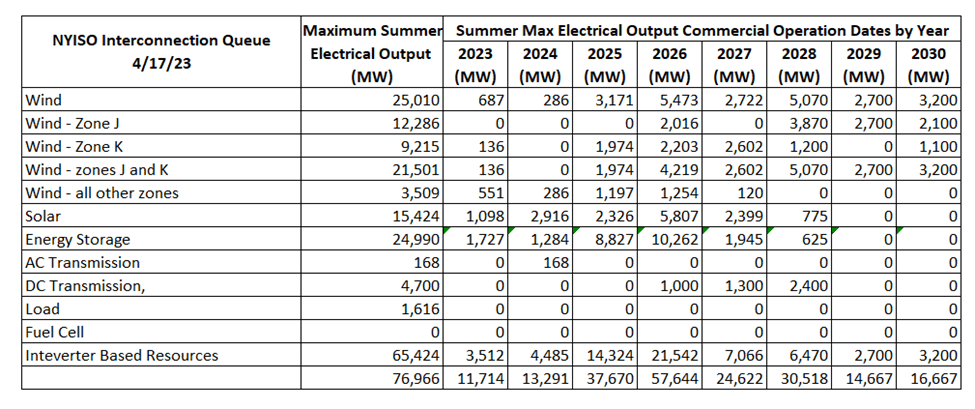
I downloaded the interconnection queue data in mid-April and summarized the current status of expected new resources.  I eventually figured out that the queue included all interconnections from proposed generating resources not just one interconnection per development so I could not simply sum up the resource capacity totals.  This primarily affected the offshore wind facilities that hookup to the transmission system in multiple locations.  In order to address this, I manually went through the queue spreadsheet and removed projects that I thought represented multiple connections. The following table shows the generation capacity in MW expected to be developed for projects in the queue and the expected power capacity by in service year.  There are relevant caveats to this information for our purpose.  There is no distinction between onshore and offshore wind but all the wind proposed to interconnect in Zone J (New York City) and Zone K (Long Island) is offshore wind so the onshore wind component is the difference between the total and the sum of those zones.  The NYISO process is only concerned with utility-scale solar resources that connect directly to the grid so the solar total does not include distributed solar.
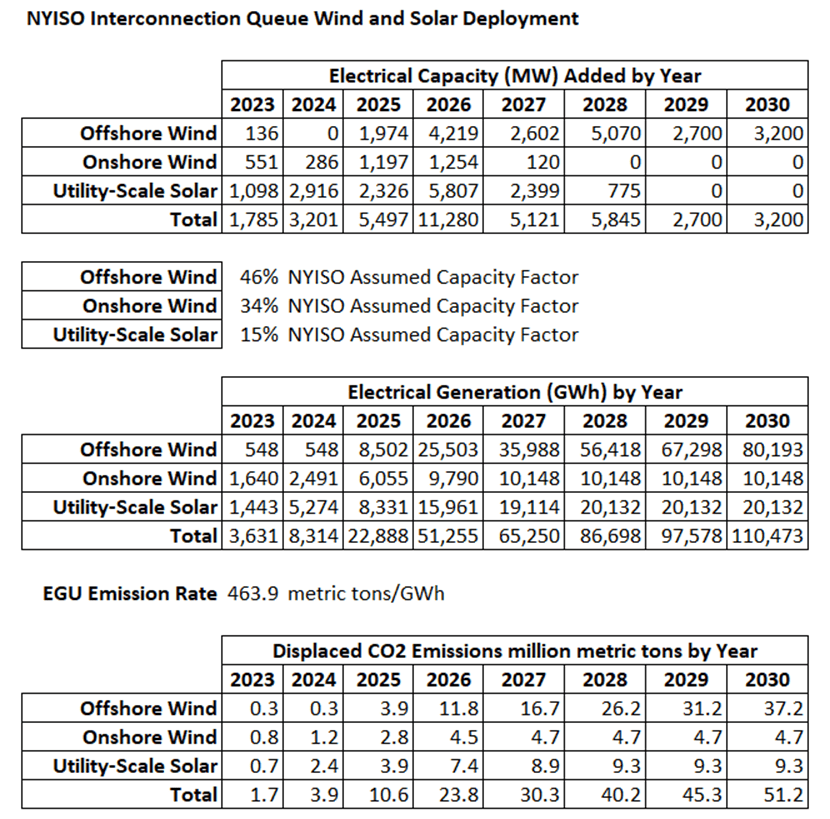
The question for this post is whether this information can be used to simply estimate the status of wind and solar development relative to Climate Act targets. If we assume that the development of these resources directly displaces fossil-fired resources then we can compare the results to the target.  In order to displace existing fossil-fired generation the power capacity must be converted to energy.  The following tables consider only the wind and utility-scale solar power capacity (MW) in the interconnection queue accumulated by year.  I converted this capacity (MW) to energy GWh by using the NYISO assumed capacity factors.  The capacity factor is the average expected energy production divided by the maximum possible energy production. The cumulative expected electric generation per year is shown in the next table.  Assuming that every GWh produced by these renewable resources displaces fossil generation that emits 463.9 metric tons per GWH enables an estimate of the annual displacement per year can be made.  Using this methodology, the wind and solar resources in the interconnection queue will displace 51.2 million metric tons of CO2 in 2030.
Electric Sector Emissions and Targets

I estimated the 2030 target by using data from the DEC annual GHG emission inventory. The latest inventory of the Statewide GHG Emissions Report (available at this website) was published in December 2022 and contains data for 2020.  The emission information is also available for download from Open Data NY.  The Climate Act mandates unique emissions accounting procedures that include emissions from imported electricity, imported fossil fuels, and electric transmission as well as the direct emissions of CO2. 

The following table lists the 1990 baseline, the 2030 target (40% reduction of the baseline, and the observed emissions data from the most recent inventory.  DEC makes the point that the 2020 emissions were not representative and suggests using 2019 data for the current status.  The electric sector total baseline emissions were 94.5 million metric tons of CO2e (MMT CO2e) so the 2030 40% reduction target is 56.7.  In 2019 the total sector emissions were 50.7 MMT CO2e.  Emissions for all the subsectors including the Open Data NY data are also shown.  However, New York State shut down 2,000 MW of zero emissions nuclear generation at Indian Point and that increased direct fuel combustion emissions to 27.7 MMT CO2e.  Assuming that the imported fossil fuels for electric power would increase in proportion to the 2019 to 2022 change in emissions and that all the other sub-sector emissions stays the same results in an overall estimate of 60.5 MMT CO2e for 2022.

Open Data NY Greenhouse Gas Emissions Electricity Sector Emissions
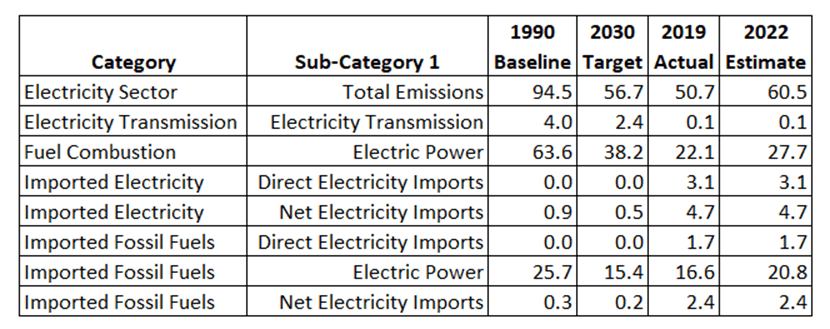
The previous section estimated the emissions from generation displaced by the development of the wind and solar resources in the NYISO interconnection queue.  According to this crude estimate the new resources will displace fossil generation expected to produce 51.2 MMT CO2e for the fuel combustion in the electric power subsector.  That is more than the combined 2022 fuel combustion and imported fossil fuels for electric power subsectors which implies that if these resources get built that compliance will be ensured.  Unfortunately, this approach does not tell the whole story because it relies on averages.

Problem with Averages

In September 2021, Terry Etam wrote an article that I think clearly explained the problem with using averages like I did in the analysis above.  While his predictions that there would be a European energy shortage in the winter of 2021 -2022 did not turn as he predicted, the concepts he described are relevant.

His article introduced the problem:

Well, maybe I’d like to talk about statisticians, as in the old joke about the one that drowned because he forded a river that was only three feet deep, on average. See, isn’t that better than politics already? However, as funny as a drowned statistician may be, there is a serious side to the problem with relying on averages. You really can die, for starters.

Before getting back to death and/or politics again (redundancy, I know), let’s think about the use of averages. A car may be designed for the average – one doesn’t find the tallest person on earth and design an interior to accommodate them. The exceptions get to either bang their shins or dangle their feet, but that’s the way it has to be.

In other areas, it can’t work that way. Do you insulate your house for average conditions? No, of course not. Do you install an air conditioner for average conditions? Same. And on it goes. When the risk of harm goes up, we design for the extremes, not the averages. Or we should.

A whole world of trouble will come your way if your plans are built on averages but you cannot live with the extremes. Or even with substantial variations. Europe, and other progressive energy parts of the world, are finding this out the hard way. 

Etam then explained how this issue is relevant to the net-zero transition:

In the race to decarbonize the energy system, wind and solar have taken a dominant lead. Nuclear is widely despised. Hydrogen has potential, but is a long way out, as a major player. On the assumption that Hydrocarbons Must Go At Any Cost, wind and solar are the winners. Bring on the trillions. Throw up wind turbines everywhere. Blanket the countryside in solar panels.

The media loves the wattage count as fodder for headlines; big numbers dazzle people. “The United States is on pace to install record amounts of wind and solar this year, underscoring America’s capacity to build renewables at a level once considered impossible…The U.S. Energy Information Administration expects the U.S. will install 37 gigawatts of new wind and solar capacity this year, obliterating the previous record of almost 17 GW in 2016,” bleated the ironically named Scientific American website. Wow, gigawatts. No idea what those are but they sound huge. 

What is the problem with all that capacity? Well, how good is it? Let’s see…at a 33 per cent capacity factor (used by the US government as apparently reasonable), that 37 GW is just over 12 GW of power contributed to the grid, on average. The assumption seems to be then that 12 GW of dirty old hydrocarbons have been rendered obsolete, and, for the energy rube, the number is an even more righteous 37 GW, because, you know, some days it is really windy all over.

But, what happens when that load factor is…zero? Because it happens.

This is the critical point.  In the existing system outages are independent of each other.  If there are five 100 MW gas turbines each with an 80% capacity factor it is reasonable to expect that four of the turbines will be available at any one time.  That is not the case for solar and wind.  None of the solar resources will be available at night.  With regards to wind, it turns out that the reason for light winds is a high-pressure system and those systems are typically bigger than New York so when one wind turbine is producing low power due to light winds, odds are most of the others are too.  Etam explains what has happened in Great Britain:

The current poster child for the issue is Great Britain. The UK has 24 GW of wind power installed. The media loves to talk about total renewable GW installed as proof of progress, and the blindingly rapid pace of the energy transition. 

However over the past few weeks wind dropped almost to zero, and output from that 24 GW of installed capacity fell to about 1 or 2 GW. 

Ordinarily, that would be no problem – just fire up the gas fired power plants, or import power from elsewhere.

But what happens when that isn’t available? 

More pertinently, what happens when the likelihood of near-zero output happens to coincide with the times when that power is needed most – in heat waves, or cold spells? That brings us to the current grave situation facing Europe as it heads towards winter. Gas storage is supposed to be filling rapidly at this time of year, but it’s not, for a number of reasons.

This happens everywhere.  It is exactly the issue that the Integration Analysis, New York Independent System Operator (NYISO), and New York State Reliability Council all said required an entirely new generating resource to solve but the Climate Action Council chose to ignore because one Council member with an out-sized influence but little relevant experience claimed was not an issue.  Etam goes on to pull no punches when he describes the resulting impacts. 

Let’s drive this energy conundrum home a little better for all these people who are, as Principal Skinner put it on the Simpsons, “furrowing their brows in a vain attempt to comprehend the situation.”

The world has been sold a faulty bill of goods, based on a pathetically simplistic vision of how renewable energy works. A US government website highlights the problem with this example: “The mean turbine capacity in the U.S. Wind Turbine Database is 1.67 megawatts (MW), At a 33% capacity factor, that average turbine would generate over 402,000 kWh per month – enough for over 460 average U.S. homes.”

Thus armed, bureaucrats and morons head straight to the promised land by multiplying the number of wind turbines by 460 and shocking-and-awing themselves with the results. Holy crap, we don’t need natural gas anymore (as they tell me in exactly those words).

So they all start dismantling the natural gas system – not directly by ripping up pipelines, but indirectly by blocking new ones, by championing ‘fossil-fuel divestment campaigns’, by taking energy policy advice from Swedish teenagers – and then stand there shivering in dim-witted stupor when the wind stops blowing, and the world’s energy producers are not in any position to bring forth more natural gas.

It’s not just Britain that is squirming. A Bloomberg article (which I cannot link to as I will never willingly send Bloomberg a cent) notes the following unsettling news: “China is staring down another winter of power shortages that threaten to upend its economic recovery as a global energy supply crunch sends the price of fuels skyrocketing. The world’s second biggest economy is at risk of not having enough coal and natural gas – used to heat households and power factories – despite efforts over the past year to stockpile fuel as rivals in North Asia and Europe compete for a finite supply.”

In my opinion this is a good representation of the situation facing New York State as a result of the Climate Act.

Conclusion

The assumption that an overall capacity factor can be used with the projected new generation capacity in the interconnection queue to estimate the displacement of fossil fuel resources is wrong because of the strong correlation between all the solar resources and all the wind resources in New York.  The only way to address this is with detailed resource modeling like the analyses from the NYISO.  I don’t even think that the NYISO resource adequacy modeling is currently capable of completely addressing the problem of the correlated renewable generating resources for the worst case.  I know that the wind and solar variability issue is a priority for improvements.  In the meantime, the NYISO modeling is the best resource we have and should be used to determine how the wind and solar resources in the queue will displace fossil-fired resource emissions.  Clearly, the state deserves an analysis that shows where we stand relative to these targets using the NYISO model results.

Etam goes on to make the point that this mis-understanding is going to lead to energy shortages in worst case situations that will result if the Climate Act implementation fails:

Hundreds of millions of people without adequate heating fuel in the dead of winter is not particularly funny. If a cold winter strikes, all the yappiest energy-transition-now dogs will fade into the woodwork, distancing themselves from the disinformation they’ve propagated and the disaster they’ve engineered. People in position of responsibility will have no choice but to speak out loud the words they’ve dared not utter for a decade: you need hydrocarbons, today, tomorrow, and for a very long time yet. So start acting like it.
Our Chaotic Climate System

The rationale for the Climate Leadership & Community Protection Act (Climate Act) net-zero transition plan is based on model assessments that project an existential threat.  Ron Clutz writing at Science Matters does an excellent job explaining why it is difficult to predict the effects of greenhouse gases on the climate system.  A recent National Review article draws the implications: “The range of predicted future warming is so enormous – apocalyptism is unwarranted”

I have been following the Climate Act since it was first proposed. I submitted comments on the Climate Act implementation plan and have written over 300 articles about New York’s net-zero transition. The opinions expressed in this post do not reflect the position of any of my previous employers or any other company I have been associated with, these comments are mine alone.

Climate Act Background

The Climate Act established a New York “Net Zero” target (85% reduction and 15% offset of emissions) by 2050 and an interim 2030 target of a 40% reduction by 2030. The Climate Action Council is responsible for preparing the Scoping Plan that outlines how to “achieve the State’s bold clean energy and climate agenda.”  In brief, that plan is to electrify everything possible and power the electric gride with zero-emissions generating resources by 2040.  The Integration Analysis prepared by the New York State Energy Research and Development Authority (NYSERDA) and its consultants quantifies the impact of the electrification strategies.  That material was used to write a Draft Scoping Plan.  After a year-long review the Scoping Plan recommendations were finalized at the end of 2022.  In 2023 the Scoping Plan recommendations are supposed to be implemented through regulation and legislation.  I submitted comments on Scoping Plan Section 2.1 Scientific Evidence of Our Changing Climate that refuted many of the apocalyptic claims made in Section 2.1 of the Draft Scoping Plan. 

Chaotic Systems

The first Intergovernmental Panel on Climate Change report stated: “The climate system is a coupled non-linear chaotic system, and therefore the long-term prediction of future climate states is not possible. Rather the focus must be upon the prediction of the probability distribution of the system’s future possible states by the generation of ensembles of model solutions.”  But what does that mean?

Edward Lorenz discovered the underlying mechanism of deterministic chaos.  In brief: “Chaos theory is the study of how systems that follow simple, straightforward, deterministic laws can exhibit very complicated and seemingly random long-term behavior.”  This is the so-called butterfly effect in which a butterfly’s wings can disturb the atmosphere in Brazil such that a tornado eventually results in Texas.

The reason for this post is Ron Clutz’s clear example of how this works in a short article.  I recommend that you read his post to see the animation examples.  He gives examples of simple systems and how the addition of one new variable creates a much more complex system.  In particular, adding a pendulum to the ball of another pendulum creates a complex trajectory that with significant effort “complex equations have been developed that can and do predict the positions of the two balls over time”.  The kicker to this:

If you arrive to observe the double pendulum at an arbitrary time after the motion has started from an unknown condition (unknown height, initial force, etc) you will be very taxed mathematically to predict where in space the pendulum will move to next, on a second to second basis. Indeed it would take considerable time and many iterative calculations (preferably on a super-computer) to be able to perform this feat. And all this on a very basic system of known elementary mechanics

Climate System

Clutz goes on to point out:

This is a simple example of chaotic motion and its unpredictability. How predictable is our climate with so many variables and feedbacks, some known some unknown? Consider that this planet’s weather/climate system is chaotic in nature with many thousands (millions?) of loosely coupled variables and dependencies, and many of these variables have very complex feedback features within them.

The central question underpinning the Climate Act net-zero transition is the effect of GHG emissions on the radiation budget of the world.  He sums up by quoting climate scientist Richard Lindzen’s summary from a presentation:

I haven’t spent much time on the details of the science, but there is one thing that should spark skepticism in any intelligent reader. The system we are looking at consists in two turbulent fluids interacting with each other. They are on a rotating planet that is differentially heated by the sun. A vital constituent of the atmospheric component is water in the liquid, solid and vapor phases, and the changes in phase have vast energetic ramifications. The energy budget of this system involves the absorption and reemission of about 200 watts per square meter. Doubling CO2 involves a 2% perturbation to this budget. So do minor changes in clouds and other features, and such changes are common. In this complex multifactor system, what is the likelihood of the climate (which, itself, consists in many variables and not just globally averaged temperature anomaly) is controlled by this 2% perturbation in a single variable? Believing this is pretty close to believing in magic. Instead, you are told that it is believing in ‘science.’ Such a claim should be a tip-off that something is amiss. After all, science is a mode of inquiry rather than a belief structure.

Conclusion

I cannot improve on Clutz’s summation:

For now, though, navigating the climate debate will require translating the phrase “climate denier” to mean “anyone unsympathetic to the most aggressive activists’ claims.” This apparently includes anyone who acknowledges meaningful uncertainty in climate models, adopts a less-than-catastrophic outlook about the consequences of future warming, or opposes any facet of the activist policy agenda. The activists will be identifiable as the small group continuing to shout “Denier!” The “deniers” will be identifiable as everyone else.

Articles Related to the Climate Act June 9, 2023

This post describes some articles I have noted recently that relate to the Climate Leadership & Community Protection Act (Climate Act) net-zero transition plans.  At the core of the Climate Act the key questions are is there a problem that warrants the complete conversion of our energy system and can the alternatives proposed replace the existing system affordably while maintaining current standards of reliability.  The articles referenced here address those questions.

I have been following the Climate Act since it was first proposed. I submitted comments on the Climate Act implementation plan and have written over 300 articles about New York’s net-zero transition. The opinions expressed in this post do not reflect the position of any of my previous employers or any other company I have been associated with, these comments are mine alone.

Climate Act Background

The Climate Act established a New York “Net Zero” target (85% reduction and 15% offset of emissions) by 2050 and an interim 2030 target of a 40% reduction by 2030. The Climate Action Council is responsible for preparing the Scoping Plan that outlines how to “achieve the State’s bold clean energy and climate agenda.”  In brief, that plan is to electrify everything possible and power the electric gride with zero-emissions generating resources by 2040.  The Integration Analysis prepared by the New York State Energy Research and Development Authority (NYSERDA) and its consultants quantifies the impact of the electrification strategies.  That material was used to write a Draft Scoping Plan.  After a year-long review the Scoping Plan recommendations were finalized at the end of 2022.  In 2023 the Scoping Plan recommendations are supposed to be implemented through regulation and legislation.

Health Impacts

Health impacts are a rallying call by activists opposed to most sources of electricity.  One of the driving factors relative to the public fear of nuclear power is the argument that there is no safe level of radiation.  The basis of that argument is the linear no-threshold (LNT) model.  Steve Milloy writing at JunckScience.Com describes the extensive research by Dr. Edward Calabrese of UMass Amherst on the origins and development of the LNT.   He recommends that that readers “first watch and have their minds blown by the amazing 22-part Health Physics Society (HPS) video series featuring the incomparable Calabrese’s unparalleled research: HPS.org | YouTube.com. It is 10 hours of truly incredible content. No exaggeration. A written summary of the video series is here (Web | PDF).”

The LNT model approach claims that there are no thresholds for cancer risk associated with radiation exposure.  It has been used by regulatory agencies to set permitted exposure standards for radiation.  .  The article documents how “Calabrese’s research and video series expose the dishonest way the LNT was developed and cemented into regulatory risk assessment, these emails expose the dishonesty, scheming and unscientific behavior of those trying to keep the LNT cemented in place.”

It is of particular interest to me because the concept is also applied to air pollutants.  The result is that now we have environmental justice advocates claiming that even if air quality levels meet the National Ambient Air Quality Standards that further reductions are necessary because of alleged health effects calculated using the LNT approach.  The mindless pursuit to eliminate risk from ever lower pollution levels at the expense of reliability, affordability, and unintended adverse environmental impacts of the proposed solutions is exemplified by the Climate Act.

Climate Change Problem

There are three items related to the climate change problem of interest.  Judith Curry announced that her new book Climate Uncertainty and Risk  has been published.  I am waiting for my copy to arrive so a review will have to wait until later but I am sure it will be a must read.

In the last summary of articles I described The Frozen Climate Views of the IPCC: report that reviews the latest Intergovernmental Panel on Climate Change reports on the state of the climate.  The Clintel Newsletter describes reactions to the report that provide overview summaries in different formats:

Coverage of our report in the blogosphere and alternative media has been fine. WUWTJudith CurryRoger Pielke Jr all paid attention to it and Scott Morrison wrote several articles about it on the Daily Sceptic.

Andy May (co-editor of the report) gave a talk/interview about the report at the excellent Tom Nelson Podcast show. You can find the written version of the talk here and the full interview here.


Marcel Crok (co-editor of the report) gave a talk for the really interesting lecture series of the Irish Climate Science Forum (run by Jim O’Brien). In his talk Marcel gave an overview of the Clintel report.

Finally, I want to call attention to work by Roger Pielke, Jr. on hurricanes and climate change.  His latest analysis updates earlier work that tells the story about hurricanes that the media doesn’t tell.  He makes five points:

  1. In short —trends in hurricane activity outside the range of documented variability have not been detected, nor is there high confidence in connections of hurricane behavior to greenhouse gas emissions.
  2. Hurricane landfalls along the continental U.S. show no trends since at least 1900.
  3. Development and growth are sufficient to explain why hurricane damage has increased dramatically
  4. Climate change is important, but far more important for understanding trends and causes of increasing disaster costs is societal change, especially what we build, where we build and how we build.
  5. The largest climate signal — by far — in the damage record of U.S. hurricanes is the El Niño/Southern Oscillation or ENSO

Proposed Solutions

One of the common narratives supporting the transition to solar and wind power is that the development costs for those resources are cheaper than fossil-fired resources.  Willis Eschenbach describes the Lazard April 2023 annual report on the Levelized Cost of Energy (LCOE) that is often used as a reference for that narrative.  He summarizes the problem with the approach:

The LCOE estimates the total capital, operations, and maintenance costs for new electric power plants coming into service. People use the Lazard LCOE all the time to claim that renewable electricity sources are now cheaper than fossil fuel electricity. However, the Lazard data has a problem—it doesn’t include the cost of backup and other costs for renewable energy. These costs fall into four groups: backup costs, balancing costs, grid connection costs, and grid reinforcement/extension costs.

Another article looks at this issue differently but comes to the same conclusion.  Gail Tverberg’s  article analyzes renewable energy development at her blog Our Finite World.  Her blog highlights her research on “figuring out how energy limits and the economy are really interconnected, and what this means for our future”.  She looks at the modeling rationale for using renewable energy and finds that “if a person looks at them narrowly enough–such as by using a model–wind and solar look to be useful”.   However, she concludes that energy modeling misses important points and finds that “profitability signals are much more important.”

Robert Bryce explains that “onshore and offshore, from Iowa to Ireland, and Colombia to New Jersey, renewable projects have been getting hammered by a tidal wave of opposition”.  He concludes:

I will end by repeating two points that I’ve been making for years. First, the key problem with wind and solar (in addition to their incurable intermittency) is their low power density. For wind, it is 1 watt per square meter. Solar’s power density is about 10 watts per square meter. That low power density means they need lots of land (or ocean) to produce significant quantities of electricity. And we don’t have any “vacant” land available. Indeed, the Renewable Rejection Database proves that local communities from Maine to Hawaii have been resisting the energy sprawl that comes with wind and solar for years.

Second, if we are serious about reducing emissions, the way forward is obvious. It is N2N: natural gas to nuclear. Both technologies are low- or no-carbon, mature, affordable, and scalable. Better still, they have power densities that are measured in hundreds, or even thousands, of watts per square meter.

Alas, big business, big banks, and big law firms can’t make as much money off of natural gas and nuclear as they can from wind and solar. Indeed, Congress has dropped a neutron bomb of cash on the wind and solar industries that I have calculated will cost federal taxpayers some $240 billion between now and 2031 –– and that number is almost certainly too low.

Charlie Munger famously said, “show me the incentive and I’ll show you the outcome.” The multi-billion-dollar incentive for Big Wind and Big Solar is to continue pushing their landscape- and marine-mammal-destroying projects on our landscapes and oceans. Given that incentive, we shouldn’t be surprised at the outcome.

New York’s Climate Act Scoping Plan claims that the costs of inaction are greater than the costs of action.  The largest claimed benefit is from the societal impacts of reducing carbon using the social cost of carbon (SCC) parameter.  Canada recently raised their SCC rate from $54 to $247.  Ross McKitrick describes the shenanigans that resulted in the higher numbers:

Countless SCC estimates already exist ranging from small negative amounts (i.e. carbon dioxide emissions are beneficial) to many thousands of dollars per tonne. Every such estimate is like a complex “if-then” statement: if the following assumptions hold, then the SCC is $X. Yale economist William Nordhaus won the 2018 Nobel Memorial Prize in economics for developing some of the first methods for combining all the “if” statements into systems called Integrated Assessment Models or IAMs. And using conventional economic and climate modelling methods, he tended to get pretty low SCC values over the years, which has long been a sore point among climate activists and the politicians who share their agenda.

But economists are on the case. The $247 figure referenced by Guilbeault comes from a new report from the Biden administration that tossed out all the previous models, including Nordhaus’s, and instead cobbled together a set of new models that when run together yield much higher SCC values.

In many ways the new models are just like the old ones. For example, they persist in using an Equilibrium Climate Sensitivity of 3 degrees C. This refers to the warming expected from doubling the amount of CO2 in the atmosphere. The authors cite the Sixth Assessment Report of the Intergovernmental Panel on Climate Change as the basis for this decision, apparently unaware that that estimate has already been shown in the climate literature to be flawed. Using the IPCC’s own method on updated data yields a sensitivity estimate of about 2.2 C or less, and as I have shown in a recent publication this is enough to cause the SCC estimate in a standard model to drop to nearly zero.

New York State has a mandate to go all electric for school buses.  From what I hear the school districts are adopting a “you go first” approach.  Duggan Flanakin explains that is probably because the costs are extraordinary.  He includes the following example:

Take the Dallas (TX) Independent School District, which has about 860 buses. To replace the entire fleet with large diesel buses would cost, therefore, about $86 million.  But those 860 buses, if battery-electric, would cost a minimum of $275 million. And that does not include the cost of charging stations and retraining mechanics. That’s over three times as many taxpayer dollars the school district would have to extract from voters.

I have a friend who is in the car business and he is unimpressed with the future of electric vehicles.  One problem he has mentioned is that the used EV market is non-existent for a variety of reasons.  The implications of that problem have yet to be addressed by the Hochul Administration.  In this vein I found this article by an early adopter who is becoming increasingly disillusioned interesting:

I bought my first electric hybrid 18 years ago and my first pure electric car nine years ago and (notwithstanding our poor electric charging infrastructure) have enjoyed my time with both very much. Electric vehicles may be a bit soulless, but they’re wonderful mechanisms: fast, quiet and, until recently, very cheap to run. But increasingly, I feel a little duped. When you start to drill into the facts, electric motoring doesn’t seem to be quite the environmental panacea it is claimed to be.

Shuttering LIs Power Stations   

Mark Stevens, a regular reader at this blog, send me an article suitable for a post that got pushed to the bottom of the pile.  In the meantime, it was picked up at Natural Gas Now.  Mark is a retired science and technology teacher from Long Island.  I am including it in its entirety below because it is a topic that is on my list to address:

The EPA’s proposed rules for cutting emissions are so onerous that older generators like Northport and Port Jefferson as well as hundreds around the country will be shut down because the expense to upgrade would be prohibitive. Electricity costs will massively increase. These power stations have operated since the ‘60’s with incredible reliability and cost-effectiveness. They have blessed Long Island and the communities that host them with tax income and life-sustaining, consistent energy.  The developed world survives on this. A main difference between our society and the third world is their lack of affordable, reliable energy.  It is also a matter of survival; one can broil in the heat and freeze in the cold. One can starve for lack of food and water. One can die from inadequate health care facilities and resources. 

Note well that these power plants have operated within EPA pollution regulations. Now the EPA is moving the goal posts.  Companies, towns and cities that have relied on the energy for our civilization will be in mortal danger. 

It is extremely difficult, costly and lengthy to site, plan, permit and build a new power station.  The real estate is gone. The possibility of rebuilding an old power station to new standards, repowering, may not be cost-effective, especially if there are the preferential power purchase agreements that put wind and solar electricity ahead of fossil fuel generation.

Another consideration is ChinaRussia, India, and the Global South in general are building fossil-fueled power plants, including coal, at a breathtaking rate, hundreds a year. Why do China, with one of the biggest industrial economies in the world and IndiaSouth AfricaThailand, Cambodia and even Germany and the UK open coal-fueled power plants?  Did they consider prosperity and survival paramount? Decarbonization of NYS and US power plant emissions will have no effect.

Furthermore, wind and solar power operate on average, about 20% of the nameplate capacity of generation. Spinning reserves are mandatory.  Battery backup, aside from the huge expense, child labor and devastation to the environment in obtaining rare earths, may work for a few hours. Where is that coming from if Northport, PJ and other power stations are closed?

Planet Earth, throughout its billions of years, experienced much higher temperatures and CO2.  In fact the Holocene Period, the greatest explosion of flora and fauna in history, flourished with way higher temperatures and CO2.  Life adapted and thrived.  In fact, thousands of scientists confirm there is NO CO2 crisis.

Buy some candles if this goes through.

Wildfire Smoke in New York

I have been an air pollution meteorologist for over 40 years and the recent wildfire smoke event is unprecedented in my career.  Not surprisingly the usual suspects have claimed that there is a link to climate change.  This article addresses whether this event is linked to climate change.

I have a page of other examples of weather affected by climate change claims that fail upon close examination.  I have been following the rationale that uses examples like this for the Climate Leadership & Community Protection Act (Climate Act) since it was first proposed and have written over 300 articles about New York’s net-zero transition. The opinions expressed in this post do not reflect the position of any of my previous employers or any other company I have been associated with, these comments are mine alone.

June Air Pollution Episode

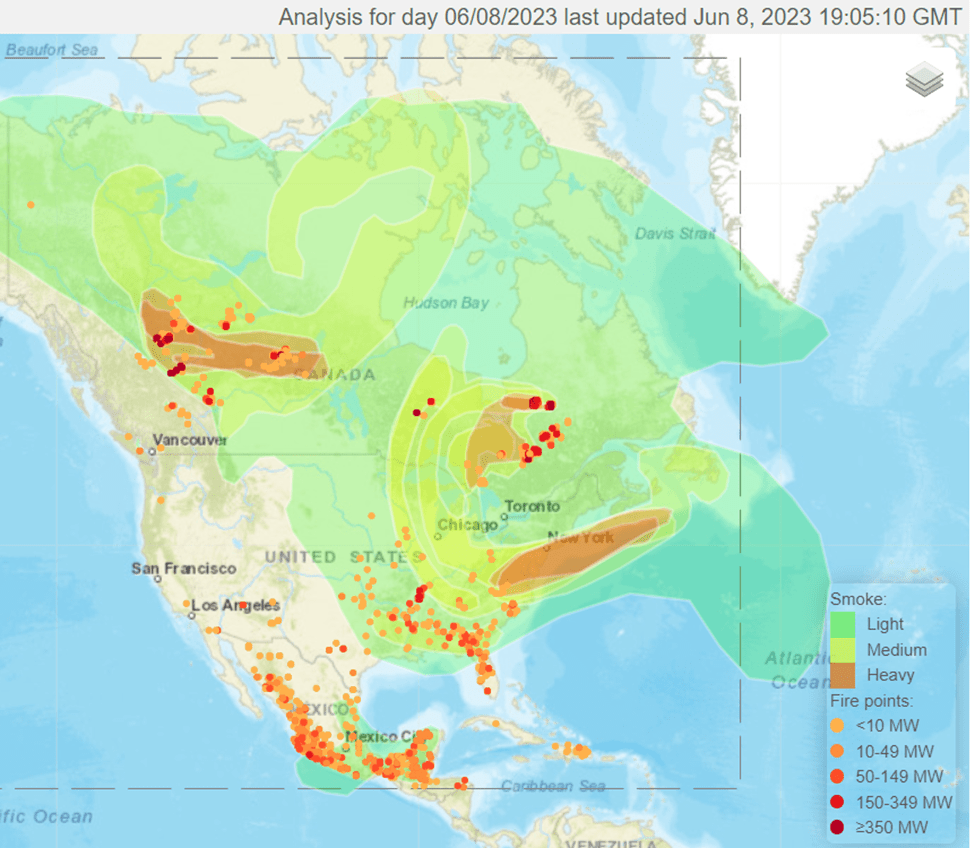
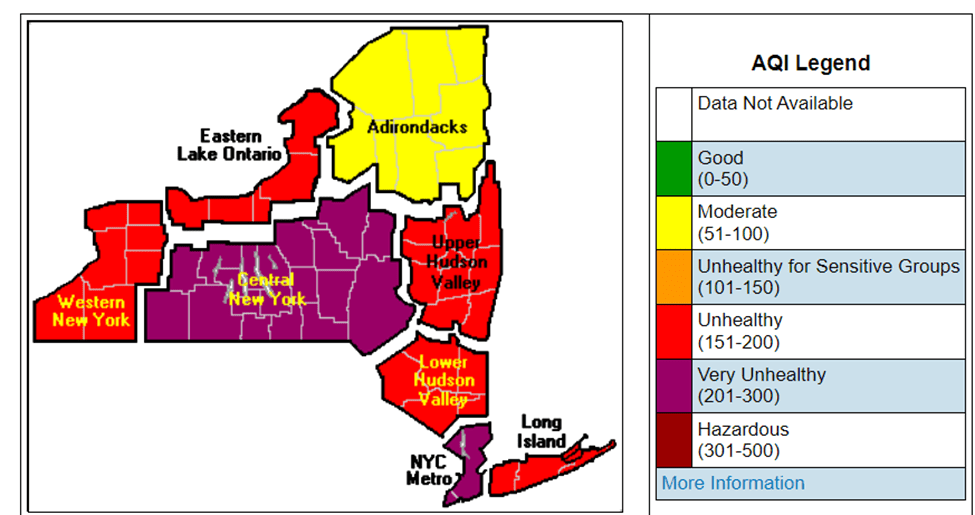
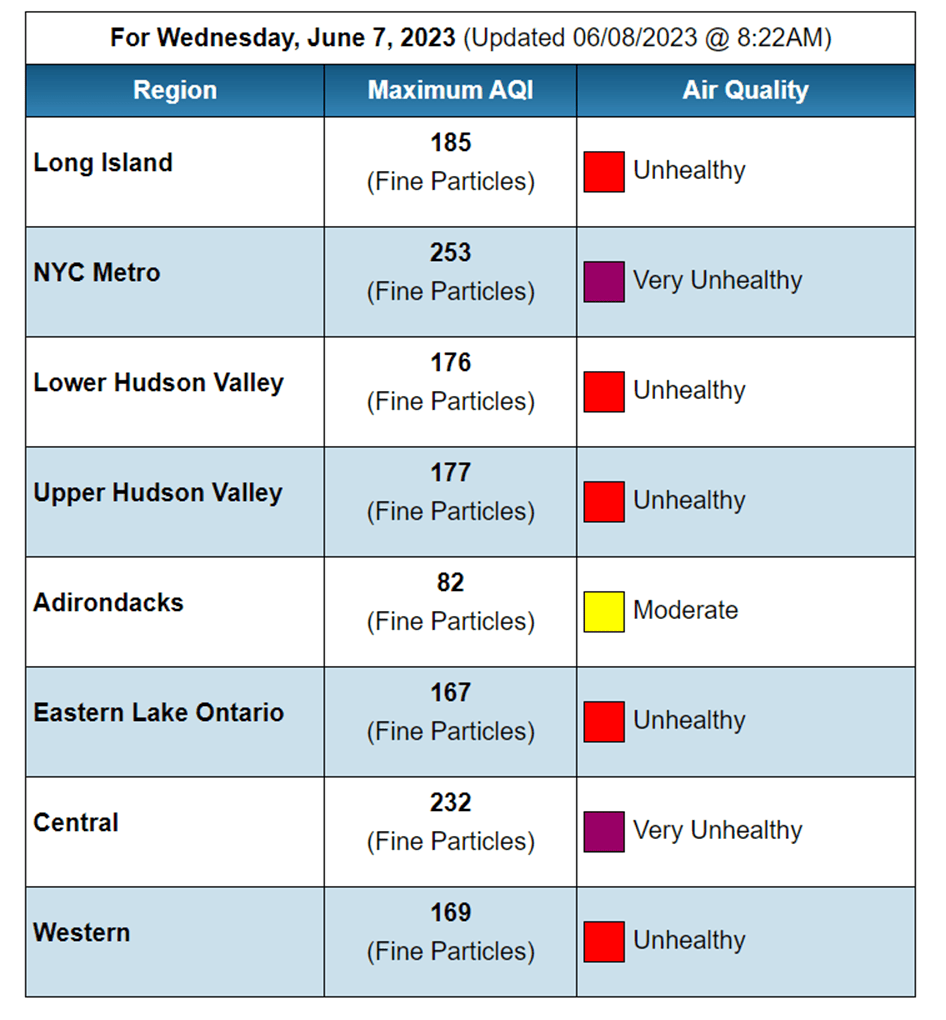
On June 7, 2023 the smoke and air quality impacts of wildfires in Quebec and Ontario were very high in New York State.  I live in the Central New York region and I can attest that you could smell the smoke and taking a deep breath made me want to cough.  The following information from the New York Department of Environmental Conservation summarize the air quality index observations.

Satellite imagery shows the location of the fires.  Note this is for the day after the data listed above.

Climate Change Links

Per usual whenever there is unusual weather there are claims that climate change was a factor:

The smoke was coming from Canada, where more than four hundred wildfires are currently burning. We do not know what caused many of them—a dropped cigarette, lightning, a downed electrical wire—but they are raging through the boreal forests of British Columbia, Alberta, and now Quebec. Wildfires are nothing new in these woodlands, but these are much earlier and larger than usual. And, like so many recent fires, they are directly linked to weeks of anomalous extreme heat. Climate change has created longer, hotter summers; worsened droughts; and fuelled vast bark-beetle infestations that have killed billions of trees.

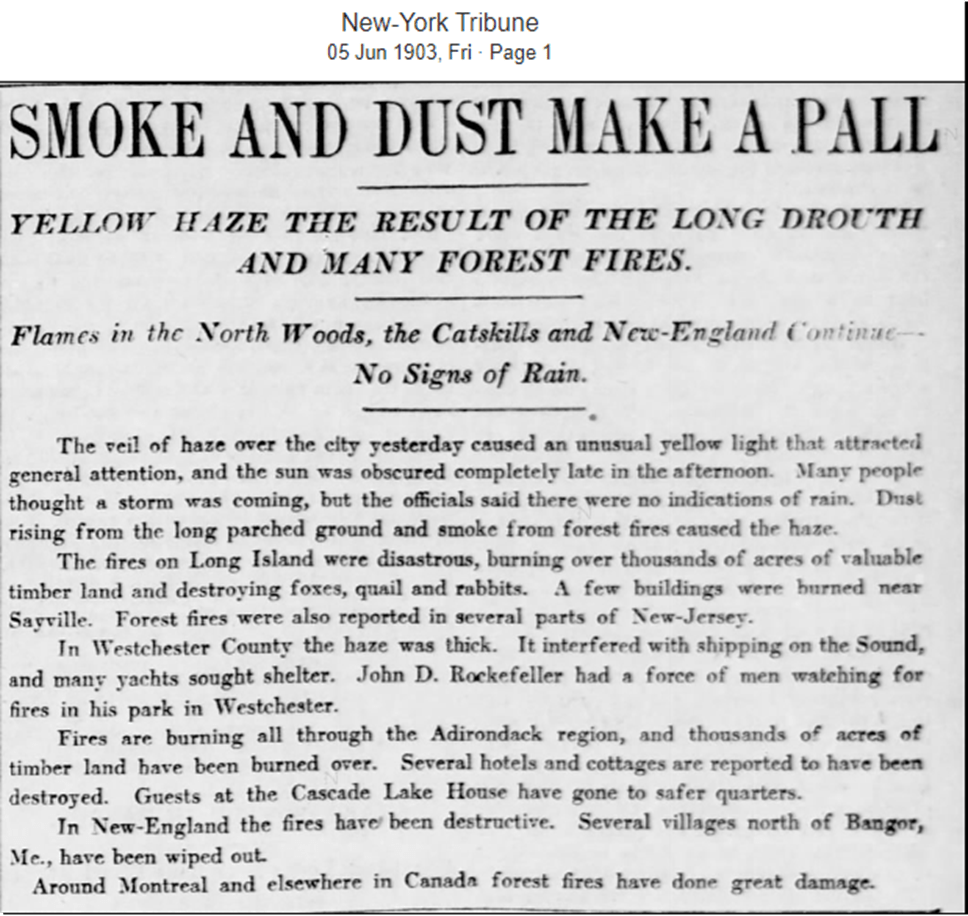
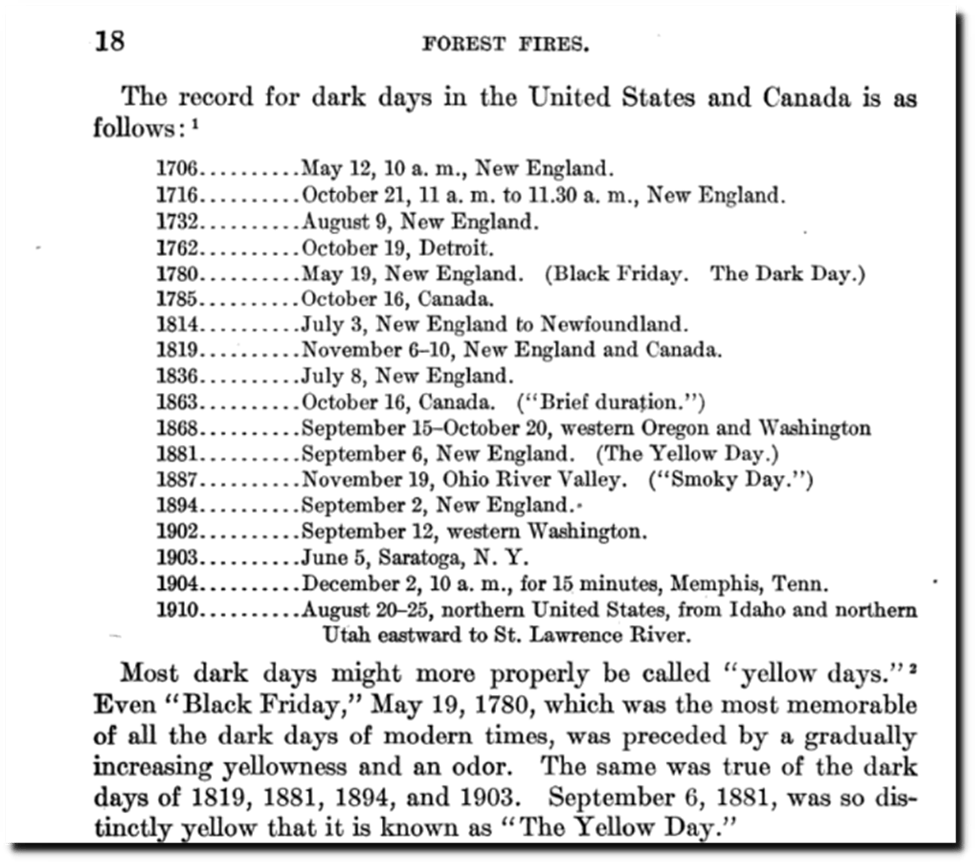
Consider the claims: wildfires are earlier and larger than usual and directly linked to weeks of extreme heat.  In order to associate these with the climate change narrative then the claim that these are unusual compared to the past.  Tony Heller writing at Real Climate Science does a great job combing through historical accounts of weather events.  In this case he described Dark Days In New England that included the following:

05 Jun 1903, 1 – New-York Tribune at Newspapers.com

He found a list of similar historic “dark days” that affected New York and New England earlier than this event in May 1706, May 1780, and June 1903.  Other similar events occurred in 1716, 1732, 1814, 1819, 1836, 1881, and 1894. 

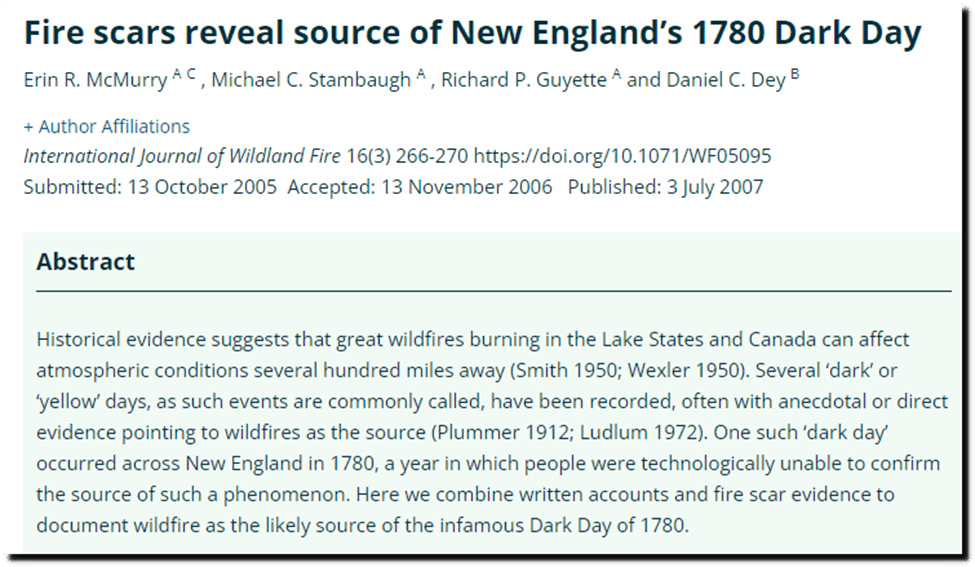
A published paper provides detail about the 1780 dark day in New England.

When considering the claim that climate change’s higher temperatures contribute to these wildfires that have obviously been happening in the Northeastern US for centuries is that in the 1700’s temperatures were much colder.  The Little Ice Age lasted from the fourteenth century until the mid 1800’s. 

Wildfires are a complex phenomenon and the media does not tell the whole story.  Roger Pielke, Jr. explains discusses aspects of wildfires that he sees as missing in the public discussion.  He makes the following points in his article.

The Intergovernmental Panel on Climate Change has not detected or attributed fire occurrence or area burned to human-caused climate change but does see a potential effect on fire weather in the USA: 

The IPCC expresses “medium confidence” (about 50-50) that in some regions there are positive trends in conditions of “fire weather”: “There is medium confidence that weather conditions that promote wildfires (fire weather) have become more probable in southern Europe, northern Eurasia, the USA, and Australia over the last century”

Globally, emissions from wildfires has decreased globally over recent decades, as well as in many regions.  He explains:

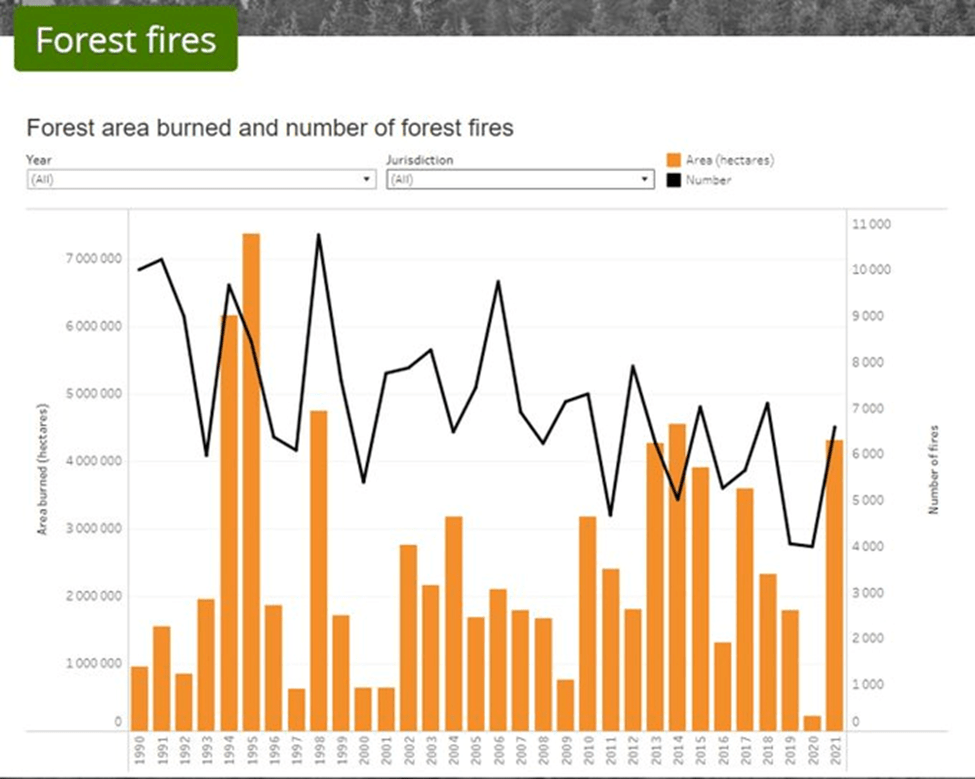
Canada — the focus of extensive fire activity this week polluting the air in the eastern U.S. and elsewhere — has not seen an increase in fire activity in recent decades, as you can see in the figure below, showing official data.

He concludes:

What you should take from it is the following:

  • Wildfire globally has decreased in recent decades;
  • Still, some regions have seen increases;
  • Neither Canada nor Quebec have not seen such increases this century;
  • Fire incidence across Canada is lower today than in centuries past.

Conclusion

Just because there is an extreme weather-related event that is unprecedented in one’s experience that does not mean that there is any evidence of climate change.  In this example, as with all the similar events I have researched, there is little to no suggestion that climate change could possibly be related to the event.  There were similar days of heavy smoke in the Northeastern US during the Little Ice Age which directly contradicts the narrative that the current warm period is any kind of a factor in these wild fires.

RGGI Third Program Review

This is version of an article that was published at Watts Up With That.

The Regional Greenhouse Gas Initiative (RGGI) is a carbon dioxide control program in the Northeastern United States.  One aspect of the program is a program review that is a “comprehensive, periodic review of their CO2 budget trading programs, to consider successes, impacts, and design elements”.  Because it is often cited as a successful cap and invest control program it is worthwhile to review the status of the Third Program Review after the March 29, 2023 public meeting.

I have been involved in the RGGI program process since its inception.  I blog about the details of the RGGI program because very few seem to want to provide any criticisms of the program.  The opinions expressed in this post do not reflect the position of any of my previous employers or any other company I have been associated with, these comments are mine alone.

Background

RGGI is a market-based program to reduce greenhouse gas emissions. According to RGGI:

The Regional Greenhouse Gas Initiative (RGGI) is a cooperative effort among the states of Connecticut, Delaware, Maine, Maryland, Massachusetts, New Hampshire, New Jersey, New York, Pennsylvania, Rhode Island, Vermont, and Virginia to cap and reduce power sector CO2 emissions. 

RGGI is composed of individual CO2 Budget Trading Programs in each participating state. Through independent regulations, based on the RGGI Model Rule, each state’s CO2 Budget Trading Program limits emissions of CO2 from electric power plants, issues CO2 allowances and establishes participation in regional CO2 allowance auctions.

Proponents tout RGGI as a successful program because participating states have “cut carbon pollution from their power plants by more than half, improved public health by cutting dangerous air pollutants like soot and smog, invested more than $3 billion into their energy economies, and created tens of thousands of new job-years”.  Others have pointed out that RGGI was not the driving factor for the observed emission reductions.  My latest evaluation of RGGI results found that the investments from RGGI auction proceeds were only directly responsible for 6% of the total observed annual reductions over the baseline to 2020 timeframe and that those investments reduced emissions at a rate of $818 per ton of CO2.  The primary driver of observed reductions was cost-efficient fuel switching from coal and residual oil to natural gas not RGGI.  I concluded that RGGI successfully raised money but has not provided cost-effective emission reductions or has had much to do with the observed CO2 emission reductions in the electric generating sector of the NE United States.

Third Program Review

The RGGI states periodically review the “successes, impacts, and design elements” of the program.  On March 29, 2023 RGGI Inc. and the participating states gave an update on the status of the third program review.  The presentation gave an overview of the program, explained how the review process works, described state activities, and described the electric sector analysis.  Meeting materials including comments submitted after the meeting are available:

The March 29 public meeting was more of an overview than anything else.  Nonetheless a couple of interesting points made.  The overview emphasized that program components allow for regional compatibility because each state has its own implementing regulations.  I believe this is recognition of the fact that different state emission targets need to be considered in the program more than in the past.  There is a new environmental justice (EJ) component that includes a regional CO2 mapping tool.  I think this component will be of particular interest to WUWT readers because EJ considerations are a component of all recent environmental initiatives.

The primary technical considerations for the planned program review modeling are the regional cap trajectory, Cost Containment and Emissions Containment Reserves changes, and  adjustments for banked allowances.  This round of modeling must contend with the “fluidity of state participation” which translates to what to do about Pennsylvania and Virginia.  Pennsylvania participation is “still in effect” but it is still in litigation so there is a major uncertainty relative to the modeling.  Virginia is going to cease participation at the end of 2023 and they have told RGGI that their participation should not be included in the modeling.  The emissions from these two states are a significant portion of the current inventory so participation affects the potential for regional emission reductions as shown in the following table.  In 2022 Pennsylvania emissions were 42.5% of the total CO2 emissions of all RGGI states and Virginia was another 13% as shown below. From the standpoint of potential emission reductions note that Pennsylvania still had a significant amount of coal in 2022.  Note that the recently announced retirement of Homer City will result in a 2% reduction of overall RGGI emissions.

There are two other factors that complicate this modeling effort.  The presentation noted that “climate and complementary energy policies will dramatically impact electricity load”.  In other words, when transportation and residential/commercial  energy use is converted to electricity the load will go up. In addition, the decarbonization timeline for the electricity sector in states vary.  The presentation also highlighted the implementation of offshore wind deployment and grid-scale battery storage deployment, duration, and supply as factors that add challenges and uncertainty to the modeling.

In order to address these issues, they are looking at different ways of dealing with the uncertainty by developing “assumption sets based on load forecasts and availability of low-emitting generation” and various allowance supply scenarios.  They think that adding cases will cover the range of outcomes given current electricity-sector developments and that the “results will inform development of potential policy cases”.

The load forecast and availability of low-emitting generation discussion (video at 21:20) provides the modeling framework.  As shown in the slide below they are considering three assumption sets ranging from “procured” clean energy and energy forecasts in line with ISO baseline estimates to two levels of additional clean energy and load growth.  I think this is particularly important because the timelines have major implications.  An increasingly large percentage of future electric generation unit emission reductions is only possible if clean energy deployment displaces fossil generating facilities.  There are significant uncertainties associated with clean energy development because of supply chain issues, lack of experienced personnel, and the need for extensive supporting infrastructure.  If allowance supply trajectories presume greater displacement of emitting sources than occurs, then there will not be enough permits to emit which could lead to artificial energy shortages.  The assumption sets should consider those timing issues.

Stakeholder Comments

Four specific questions for input from stakeholders were posed (video at 30:19)

  • How comfortable are you with the assumptions that have been included?
  • Are there other assumptions that need to be included in these scenarios?
  • Is there anything that we can do to improve the understanding of the differences between the cases?
  • For which scenarios are stakeholders most interested in seeing results for further Program Review consideration?

Written comments were submitted in response to the request for input from, an emissions trading group, an organization representing New York generating companies, one individual (that would be me), one affected generating company, and six environmental/social justice organizations.  The International Emissions Trading Association (IETA), Environmental Energy Alliance of New York, and myself addressed the specific questions raised as the primary focus.  LS Power Development mentioned the questions asked but was more interested in furthering their own renewable energy development agenda.  The six environmental/social justice organizations (Alternatives for Community & Environment et al., Conservation Law Foundation et al., Earthjustice et al., Environmental Defense Fund, Interreligious Eco-Justice Network et al., and RGGI Advocates Coalition) were primarily concerned with the EJ component.

RGGI Environmental Justice

Environmental justice (EJ) is a featured component of recent environmental policies. It also is a feature of the Green New Deal that “has been used to describe various sets of policies that aim to make systemic change”.  In my opinion the rationale that the transition away from fossil fuels is required is only  a pretext for all the systemic changes desired by advocates who are a primary constituency of the Progressive Democrats.  The question is how do these factors get integrated into environmental policy.

Democrats are not the only ones trying to cater to “environmental justice communities, tribal groups, the labor sector, and other equity groups” that the Conservation Law Foundation mentions in its comments.  It turns out that the big green environmental organizations are going out of their way to cater to these groups as part of a larger goal to impact the nation’s culture.  Environmental organizations are trying to align with social justice organizations to strengthen their bona fides with the Progressives.  The Acadia Center report RGGI Findings and Recommendations for the Third Program Review was referenced by four of the six organizations so I will use it to illustrate the objectives.  .

The Acadia report claims that RGGI states have experienced both a more rapid increase in GDP per capita and a more rapid decline in both power sector CO2 emissions and retail electricity prices relative to other states.  I am not going to address this because I don’t have time and it does not directly address the EJ concerns.  Instead consider the following quotes from the Executive Summary:

The objective of RGGI is, first and foremost, reducing greenhouse gas emissions while supporting economic growth. Although RGGI is not directly an air quality program, because it applies to power plants, it can be an effective vehicle to deliver reductions in criteria air pollutants and better outcomes to communities that are located near power plants. RGGI has delivered important ancillary benefits like an 85% reduction in nitrogen oxides (NOx) in RGGI-regulated power plants over the entire region. Criteria emissions, particularly NOx, can have significant detrimental health impacts including damaging the respiratory tract and increasing vulnerability to respiratory infections and asthma.

In order to connect GHG emission reductions with immediate effects, the relationship with other air pollutants is used.  As mentioned previously RGGI was not the primary driver for the CO2 reductions observed and the situation is the same for NOx.  Moreover, during this period there were NOx-specific control programs that contributed to the observed reductions.

However, the approach of reducing CO2 emissions in aggregate across the region does not necessarily result in a more rapid rate of decline in NOx emissions in EJ communities compared to other areas. Acadia Center analysis found that, between 2008 and 2021:

  • NOx emissions from power plants within 3 miles of a community with high EPA Environmental Justice Socioeconomic Indicators (“EPA EJSI community,”see sidebar for more information) declined by 85%, compared to the rest of the RGGI power plant fleet, where NOx emissions declined by 88%
  • Over a third of RGGI plants that are releasing NOx emissions near communities suffering from disproportionately high rates of asthma
  • Over two-thirds of RGGI plants do not have any active air quality monitoring sites within a 3-mile  radius to measure the impact on neighboring communities – and over three quarters of these unmonitored plants are located near an EPA EJSI community or high asthma communities (see the highlight at the end of this section for more details on both community classifications)

Organizations like the Acadia Center are selectively choosing what information to present both in these comments and to the environmental justice community.  The suggestion that there is a significant difference between communities within three miles of a power plant with “only” an 85% decrease as compared to an 88% decrease elsewhere suggests greater accuracy than warranted.  Unremarked is whether the 85% reduction in emissions had any observable effect on the asthma rates.  I would be more sympathetic if they could show a relationship.  In order to prove or disprove the relationship claimed emissions are only part of the picture.  The bigger point is that NOx impacts are local and must be assessed using air quality modeling. The final bullet about air quality monitoring is a bogus argument.  State and Federal air quality monitoring programs have a long history.  Every power plant in the country has been modeled to confirm local air quality impacts do not exceed the National Ambient Air Quality Standards and most also had an ambient air quality monitoring network at one time to verify that the modeling was correct.  I know this because I did work as a consultant to EPA evaluating the models using the monitoring data and later was responsible for monitoring networks at four power plants.  The bottom line is that the history of modeling and monitoring is so extensive that if there was any question that there could be an issue with these facilities, then it was laid to rest long ago.  That is why there are no nearby air quality monitors today.  Despite this history one of the EJ recommendations is to do community air quality modeling which I believe is not up to the same standard as regulatory air monitoring programs.

In addition to the demand for local air quality monitoring, commenters argued that more public participation is necessary.  For example, the Conservation Law Foundation comments argued that “It is imperative that equity and environmental justice considerations be more thoroughly integrated into modeling, rather than treated as a separate issue for resolution”.  They went on to suggest:

More specifically, the RGGI program and the RGGI Program Review process must be reformed to improve the amount and quality of public participation, develop and conduct equity analyses, and increase investments in overburdened communities.

We must ensure that environmental justice communities, tribal groups, the labor sector, and other equity groups have access to the financial and technical resources they need to meaningfully participate in the RGGI Program Review process. RGGI, Inc. can accomplish this by publishing public notices of RGGI Program Review meetings and comment periods more widely, including by social media and using physical notices in high-traffic gathering places such as grocery stores and community centers.

Color me skeptical but I doubt that any individual who hears about RGGI public meetings from a public notice posted in a grocery store is going to be able to provide meaningful comment on the design elements of RGGI.   The suggestion that these groups have “access to the financial and technical resources” necessary to participate seems to be a recommendation designed to garner funding so the environmental organizations can, for example, “develop and conduct equity analyses” for problems that the environmental justice communities did not even know they had. 

The other major component in the EJ comments was a recommendation to allocate a major share of the proceeds in the disadvantaged communities.  The Conservation Law Foundation comments state that “By taking the funds received from RGGI and reinvesting them in communities most unduly burdened by lack of resources, unequal access to energy infrastructure, and who pay a disproportionate amount of their income to necessities such as utility bills, these monies can have an additive effect that will help to accelerate state and federal decarbonization goals in a just and equitable manner.”  In my opinion these organizations are doing a dis-service to these communities by pushing these decarbonization goals despite over-whelming evidence that the costs to decarbonize are enormous.  I cannot imagine that investments in energy efficiency, retrofitting and electrifying homes in these areas, and providing other energy reduction measures in these communities will offset the increased costs to those least able to afford them.

Conclusion

The third RGGI program review process has some difficult technical issues to address.  At the top of the list is that in order to further reduce electric generation CO2 emissions it is necessary to rely on wind and solar resources to displace the need for the existing units to operate as much.  If the future RGGI allowance caps don’t consider the feasibility of the transition to alternative generation, then it is possible that the caps will limit generation simply because in the absence of permits to emit aka allowances, the only way for an affected source to comply with the regulations is to stop running.

In order to address this concern, the feasibility of the wind and solar implementation schedule should be assessed and consider supply chain, trained personnel, and permitting limitations.  Obviously, the costs are also a factor.  There is an unrecognized RGGI auction revenue dynamic between the need to invest in the control strategies that reduce emissions and the demands of the environmental activists claiming to act in the best interests of the disadvantaged communities.  The money spent on community air quality monitoring, reaching out to EJ communities, and evaluating equity access all do not reduce CO2 emissions directly or indirectly by reducing energy use.  If too much money is spent on programs that do not lead to emission reductions, then the necessary investments won’t be made and the targets won’t be met.

The addition of the environmental justice component to the program review is a diversion to the RGGI CO2 emission reduction efforts.  I think an emphasis on energy efficiency and energy conservation efforts in disadvantaged communities is necessary to limit the effect of the transition to more expensive electricity.  However, RGGI auction funding should prioritize emission reductions over funding any other EJ programs that do not reduce emissions.  The state emission reduction targets are arbitrary and failing to consider technical feasibility and the funding necessary to provide zero-emissions resources to displace energy from the RGGI-affected sources will not end well.

New York Cap & Invest Webinar 1 – Where Are We?

On June 1, 2023 the Department of Environmental Conservation (DEC) and New York State Energy Research and Development Authority (NYSERDA)  hosted the first webinar in a series “to inform the public and encourage written feedback during the initial phase of outreach” for New York’s proposed cap and invest program.  At the time of this writing the only documentation available for the webinar are the slides so this article only addresses one question.  Where does the state stand relative to the 2030 transition target of a 40% reduction of GHG emissions from the 1990 baseline.

I have been following the Climate Leadership & Community Protection Act (Climate Act) since it was first proposed. I submitted comments on the Climate Act implementation plan and have written over 300 articles about New York’s net-zero transition because I believe the ambitions for a zero-emissions economy embodied in the Climate Act outstrip available renewable technology such that the net-zero transition will do more harm than good.  The opinions expressed in this post do not reflect the position of any of my previous employers or any other company I have been associated with, these comments are mine alone.

Climate Act Background

The Climate Act established a New York “Net Zero” target (85% reduction and 15% offset of emissions) by 2050 and an interim 2030 target of a 40% reduction by 2030. The Climate Action Council is responsible for preparing the Scoping Plan that outlines how to “achieve the State’s bold clean energy and climate agenda.”  In brief, that plan is to electrify everything possible and power the electric grid with zero-emissions generating resources by 2040.  The Integration Analysis prepared by the New York State Energy Research and Development Authority (NYSERDA) and its consultants quantifies the impact of the electrification strategies.  That material was used to write a Draft Scoping Plan.  After a year-long review the Scoping Plan recommendations were finalized at the end of 2022.  In 2023 the Scoping Plan recommendations are supposed to be implemented through regulation and legislation.  The cap and invest initiative is one of those recommendations.

DEC and NYSERDA have developed an official website for cap and invest.  It claims:

An economywide Cap-and-Invest Program will establish a declining cap on greenhouse gas emissions, limit potential costs to New Yorkers, invest proceeds in programs that drive emission reductions in an equitable manner, and maintain the competitiveness of New York businesses and industries. Cap-and-Invest will ensure the state meets the greenhouse gas emission reduction requirements set forth in the Climate Leadership and Community Protection Act (Climate Act).

I recently posted my All Otsego Commentary overview on cap and invest published in early May that was written for a non-technical audience. In late March I summarized my previous articles on the New York cap and invest proposal in a post designed to brief politicians about the proposal if you want more technical information.  There also is a page that describes all my carbon pricing initiatives articles that includes a section about the New York Cap and Invest (NYCI) proceeding.

NYS GHG Emissions

One of the fundamental issues relative to NYCI is the status of New York State GHG emissions.  The DEC is required to prepare an annual report for statewide greenhouse gas emissions, pursuant to Section 75-0105 of the Environmental Conservation Law.  The DEC website described the report issued at the end of 2022:

This current report covers the years 1990 through 2020. The emission information will also be made available for download from Open Data NY (leaves DEC website).

Supplemental Information

According to the Environmental Protection Agency, one of the necessary components for an effectively designed emissions trading program is “accountability for reducing, tracking and reporting emissions”.  While on the face of it the DEC annual GHG emissions report might seem to fulfill that condition, it does not.  The DEC annual report takes two years to develop so it is unusable for the proposed program.  The data provided are not detailed enough to breakdown emissions by potential NYCI sectors.  Finally, there are insufficient supporting data to document the accuracy of the reported emissions.

The impetus for this article is slide 7, GHG Emissions Reduction Requirements, in the presentation.  The slide includes two figures: current emissions by sector and New York State GHG emissions.  My concern is the numbers used for the figures. 

The New York State GHG emissions figure includes three numbers from Part 496 the statewide GHG emission limits for the Climate Act.  In 2030 the statewide greenhouse gas emission limit (in million metric tons of carbon dioxide equivalent or MMT CO2e) is 245.87 and in 2050 it is 61.47.  Those limits are 60% and 15% respectively of the 1990 baseline emissions which works out to 410 MMT CO2e.  The 2019 emissions (376.18 MMT CO2e are from the 2022 GHG emissions inventory.  Note that the State uses 2019 instead of 2020 for trends analysis because 2020 values are anomalous due to the pandemic shutdowns.

My concern is that the numbers used to derive the graph “Current estimated GHG emissions by sector are not publicly available.  The DEC annual report does not break out emissions from the different sectors by the categories shown.  For example, for the buildings sector there is no table that lists space heating, water heating, other, and cooking sub-category emissions.  The emission information available from Open Data NY does not include those categories either.  The DEC 2022 report references  supplemental reports available through the NYSERDA Greenhouse Gas Emissions Studies website.  There are no relevant references to emissions from those categories in those reports.

Emissions Reporting

I have been dealing with emissions reporting for cap-and-trade programs for three decades starting with  the Acid Rain Program in the early 1990’s.  The Environmental Protection Agency standard for the accountability for tracking and reporting emissions is very high.  Developing the infrastructure to record, report, and comply with their standards took enormous effort but the data are completely transparent and verifiable to national standards.  Note, however, that this high level is only possible because the emissions are measured directly.  That approach is not possible for many sectors covered by the Climate Act but it does not mean that there should not be accountability for the emissions.

Instead of directly measuring the pollution emissions at the source, many sectors must rely on emission  factors.  EPA describes emissions factors as follows:

An emissions factor is a representative value that attempts to relate the quantity of a pollutant released to the atmosphere with an activity associated with the release of that pollutant. These factors are usually expressed as the weight of pollutant divided by a unit weight, volume, distance, or duration of the activity emitting the pollutant (e.g., kilograms of particulate emitted per megagram of coal burned). Such factors facilitate estimation of emissions from various sources of air pollution. In most cases, these factors are simply averages of all available data of acceptable quality, and are generally assumed to be representative of long-term averages for all facilities in the source category (i.e., a population average).

In order to calculate emissions using an emission factor the following equation is used:

E = A x EF x (1-ER/100)

where:

  • E = emissions;
  • A = activity rate;
  • EF = emission factor, and
  • ER =overall emission reduction efficiency, %

In order for the NYCI emissions to be accountable, all four of those values should be documented and available to the public.  Unfortunately, the state has net even provided the data used to generate the graphics used much less this supporting information.

There is another important difference between the emissions reported based on direct measurements at the source and emissions derived from emission factors.  The measured values cannot change but if there are refinements to the emission factors or activity rate measurements the values can change.  For example, the 2022 Sectoral Report 1: Energy  report has a chapter entitled Planned Improvements that lists known issues where improved estimates are desired.  In my opinion, there are numerous examples where the DEC emission factors used are questionable and I expect that affected sources will likely make the investments to improve the emission factors for more realistic emission estimates.  There have already been changes such that the Part 496 1990 baseline value of 410 MMT is different than the 2022 GHG emission inventory estimated 1990 emissions of 404.26 MMT.

Where Do We Stand?

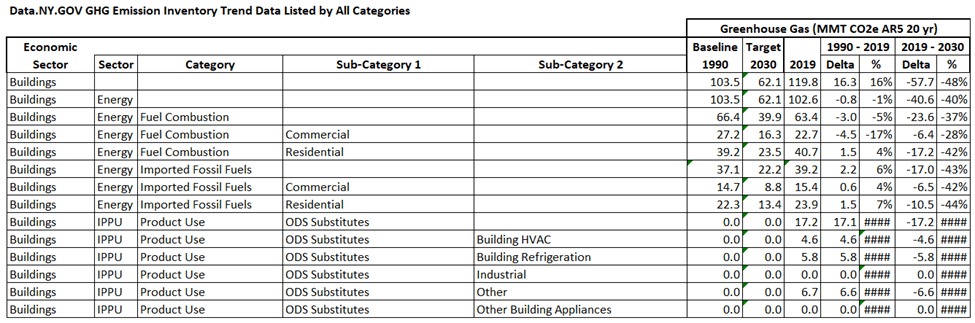
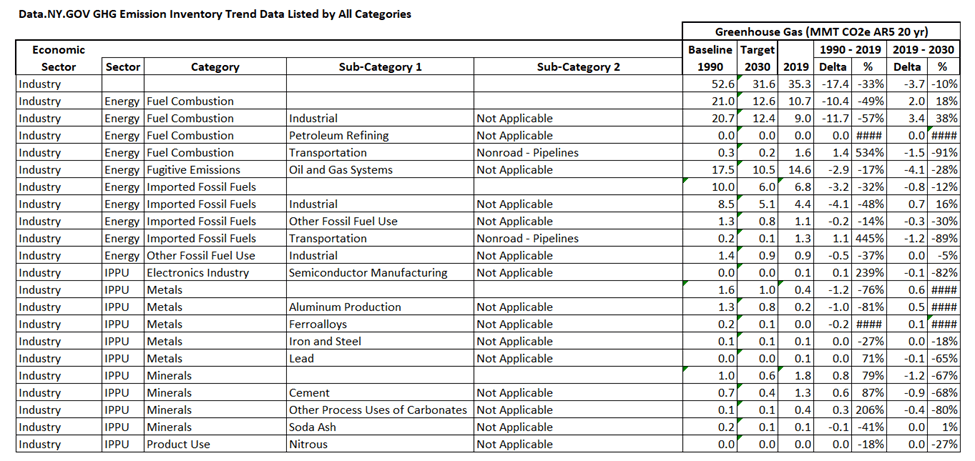
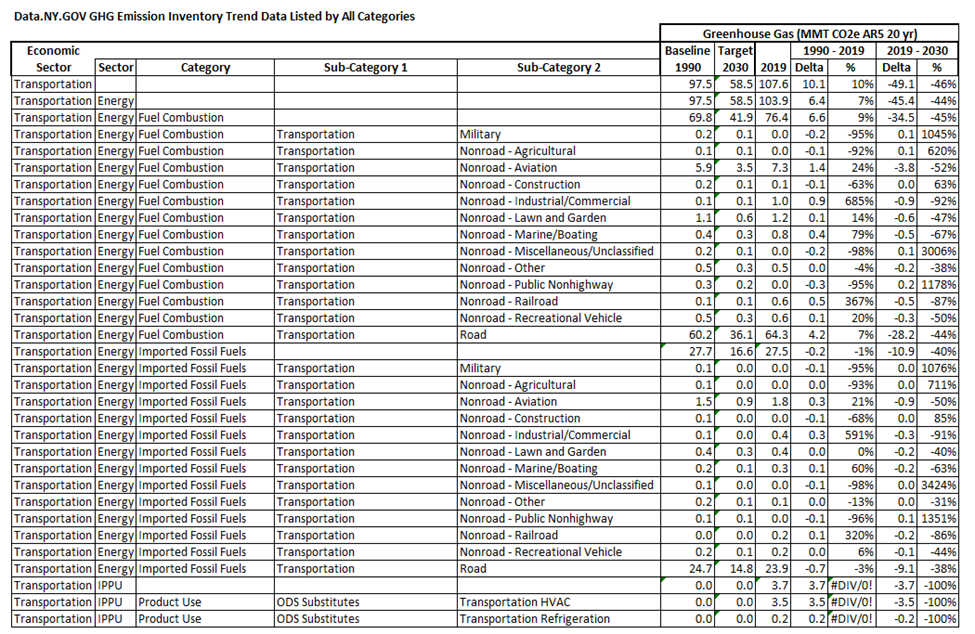
In the absence of data from the DEC and NYSERDA that can be used to determine where the sectors stand relative to the 2030 Climate Act targets,  I used the Data NY and the Statewide GHG Emissions dataset available there to breakdown the differences between the 1990 baseline and the 2019 and 2020 emissions for various sub-sectors and fuels.  The caveat is that these are only estimates and not the official sub-sector emissions.  The following tables present data by the agriculture, buildings, electricity, industry, transportation, and waste economic sectors. 

The first table summarizes the emissions using the New York State global warming potential accounting approach for 20 years and the Intergovernmental Panel on Climate Change accounting for 100 years for each of the sectors and the overall totals.  It is not clear exactly which components of each sector will be subject to NYCI obligations but the totals suggest that the aspirational goals will be a challenge to meet.  The agriculture, buildings, transportation, and waste sectors all need to reduce emissions over 40% between 2019 and 2030.  While the electricity sector seems to be in good shape relative to the target the 2019 data does not reflect the shutdown of 2,000 MW of zero-emissions nuclear generation at Indian Point which raised the sector emissions by over 20%. 

Statewide Greenhouse Gas Emissions (MMT) by Sector Relative to 2030 Target

The following tables list data for unique combinations within each sector for the category, and sub-category labels   For example, within the agriculture economic sector there were two categories: livestock and soil management.  Within those categories there were five additional sub-categories. I listed data for the entire agriculture sector in the first row of the table.  The baseline 1990 emissions were 15.3 million metric tons CO2e using the global warming potential 20 year approach.  The 2030 limit is 9.2 MMT CO2e 20yr.  In 2019 the emissions were 21.3 MMT CO2e 20yr which represents a 6.0 MMT CO2e 20yr 39%) increase from the 1990 baseline.  In order to get to the 2030 limit a reduction of 12.1 MMT CO2e 20yr -57% is needed.  Note that DEC has mentioned that due to the pandemic that 2020 is not a representative year so I only show 2019 data.  .  Within the agriculture sector I list the livestock 1990 emissions (13.6 MMT CO2e 20yr) and the soil management 1990 emissions (1.7 MMT CO2e 20yr).  Note that the sum of these categories equals the total of the sector.  The data for the sub-categories is also presented.  In the agriculture sector I believe some of the categories will be exempt.  Nonetheless it is obvious that there is a long way to go to meet the 2030 target.

Agriculture Sector GHG Emissions Trends Relative to 2030 Target

The buildings sector has the largest emissions of any sector.  Note that the Climate Act mandates that emissions from upstream sources as well as direct emissions.  This places an emphasis on eliminating the use of fossil fuels because New York sources have no way to reduce emissions from upstream sources other than to stop importing the fuel.  I doubt very much that the proposed goals can be met by displacing the use of fossil fuels with electrification.  The compliance certainty feature associated with the cap means that the ultimate compliance strategy will be to limit fossil fuel use even if the replacement electrification technologies are not available.

Building Sector GHG Emissions Trends Relative to 2030 Target

The inherent biases in the Climate Act GHG emissions accounting approach is evident in the electricity sector trends.  Note that in 2019 the New York accounting claims that direct GHG emissions are only slightly more than the upstream imported fossil fuel emissions.  Those numbers are not credible and I predict that there will be concerted efforts to refine the emission factors used to generate them.

Electricity Sector GHG Emissions Trends Relative to 2030 Target

The industry sector also appears to be relatively close to the 2030 target.  However, it is not clear if this is due to decarbonization efforts or New York’s de-industrialization since 1990.  More importantly is the question whether the 10% overall reduction necessary to get to the 2030 target is feasible for the remaining industrial operations.

Industry Sector GHG Emissions Trends Relative to 2030 Target

It is not clear how the Hochul Administration plans to decarbonize the transportation sector to the extent necessary in the next seven years.  Transportation emissions went up 10% from 1990 to 2019 and need to decrease 49% by 2030.  According to the webinar “Large-scale GHG emitters and distributors of heating and transportation fuels will be required to purchase allowances for the emissions associated with their activities”.  For the transportation sector that means when the allowances for transportation fuels run out, suppliers will not provide gasoline and diesel fuel to the retailers.  The resulting fuel shortage will be entirely due to the non-existent feasibility planning by the state.

Transportation Sector GHG Emissions Trends Relative to 2030 Target

I am glad I am not associated with the waste sector.  It is my impression that there are very few options available for solid waste management.  So what did the Scoping Plan suggest.  Increased recycling and waste minimization to reduce the waste stream.  In this case the only option I can think of when the allowances run out is to stop accepting waste.

Waste Sector GHG Emissions Trends Relative to 2030 Target

Conclusion

There are many questions about the NYCI proposal that must be addressed this year.  Frankly I think the Hochul Administration is going down the wrong path in its implementation plan because they are already mired in details but have not addressed fundamental issues. 

Before proceeding it is necessary to determine what has to be done to meet the 2030 target and whether it is feasible to make the reductions on the required schedule.  If it is feasible that is one thing but given these numbers that appears to be a high hurdle.  The compliance certainty “feature” of NYCI is great as long as the targets are achievable but if they are not met, then the draconian compliance alternatives are going to cause a backlash of monumental proportions.

The other thing that should be done before proceeding any further is to determine the costs of the technologies necessary to achieve the goals using the compliance strategies in the feasibility analysis.  Even if the technologies are deemed feasible, if investments are insufficient to deploy the technologies as needed then the targets won’t be met.  If it turns out that the revenues necessary for successful  investments are politically unpalatable, then it is time to reconsider the implementation plan.

I am not optimistic that this could possibly end well.  Watch this space for more information as this unfolds.

New York Pre-Proposal Cap and Invest Webinars

On May 19, 2023 the Department of Environmental Conservation (DEC) and New York State Energy Research and Development Authority (NYSERDA)  announced that they are hosting a pre-proposal webinar series to provide the public an opportunity to learn about the rulemakings under development for the Cap-and-Invest Program in New York State.   This post is an overview of the initiative and the webinar series.

I have been following the Climate Leadership & Community Protection Act (Climate Act) since it was first proposed. I submitted comments on the Climate Act implementation plan and have written over 300 articles about New York’s net-zero transition because I believe the ambitions for a zero-emissions economy embodied in the Climate Act outstrip available renewable technology such that the net-zero transition will do more harm than good.  The opinions expressed in this post do not reflect the position of any of my previous employers or any other company I have been associated with, these comments are mine alone.

Climate Act Background

The Climate Act established a New York “Net Zero” target (85% reduction and 15% offset of emissions) by 2050 and an interim 2030 target of a 40% reduction by 2030. The Climate Action Council is responsible for preparing the Scoping Plan that outlines how to “achieve the State’s bold clean energy and climate agenda.”  In brief, that plan is to electrify everything possible and power the electric grid with zero-emissions generating resources by 2040.  The Integration Analysis prepared by the New York State Energy Research and Development Authority (NYSERDA) and its consultants quantifies the impact of the electrification strategies.  That material was used to write a Draft Scoping Plan.  After a year-long review the Scoping Plan recommendations were finalized at the end of 2022.  In 2023 the Scoping Plan recommendations are supposed to be implemented through regulation and legislation.  The cap and invest initiative is one of those recommendations.

I recently posted my All Otsego Commentary overview on cap and invest that was published in early May that was written for a non-technical audience. In late March I summarized my previous articles on the New York cap and invest proposal in a post designed to brief politicians about the proposal if you want more technical information.  There also is a page that describes all my carbon pricing initiatives articles that includes a section about the New York Cap and Invest (NYIC, Their acronym not mine) proceeding.

New York Cap and Invest

DEC and NYSERDA have developed an official website for cap and invest.  It claims:

An economywide Cap-and-Invest Program will establish a declining cap on greenhouse gas emissions, limit potential costs to New Yorkers, invest proceeds in programs that drive emission reductions in an equitable manner, and maintain the competitiveness of New York businesses and industries. Cap-and-Invest will ensure the state meets the greenhouse gas emission reduction requirements set forth in the Climate Leadership and Community Protection Act (Climate Act).

According to the DEC announcement of the webinars:

This is the first set in a series of webinars to inform the public and encourage written feedback during the initial phase of outreach. Additional information will be provided as it becomes available at www.capandinvest.ny.govIf you wish to continue receiving updates on the development of the Cap-and-Invest Program, please join the Climate Act mailing list at https://climate.ny.gov/email-list/.

Below is the full list of scheduled webinars for this first round. For more information on how to join the webinars, please visit www.capandinvest.ny.gov/meetings-and-events.

  1. June 1, 1 to 3 p.m. – Cap-and-Invest Overview
  2. June 6, 11 a.m. to 1 p.m. – Natural Gas focused webinar
  3. June 8, 1 to 3 p.m. – Liquid Fuels focused webinar
  4. June 13, 11 a.m. to 1 p.m. – Energy Intensive and Trade Exposed Industries focused webinar
  5. June 15, 1 to 3 p.m. – Waste focused webinar
  6. June 20, 11 a.m. to 1 p.m. – Cap-and-Invest Analysis Inputs and Methods
  7. June 22, 1 to 3 p.m. – Electricity focused webinar

As New York begins drafting regulations, we are considering California’s existing economywide programs, as well as those operating in Quebec and Washington State. This webinar series will provide the public with a series of questions on topics that DEC and NYSERDA are seeking input. DEC and NYSERDA are interested in hearing what elements of other jurisdictions’ regulations would work well in New York, and what improvements or changes may best serve New York.

For more information, including instructions on how to provide comment, please visit www.capandinvest.ny.gov.

Stakeholder Process

The ostensible purpose of the webinars and workshops is to enable DEC and NYSERDA to gather feedback on the program as they “develop regulations to implement the Cap-and-Invest Program”.  There are three program design elements:

It appears to me that the State is worried that there will be an overwhelming response to the request for comments.  The request for comments includes specific questions  for each of the design elements that should enable them to categorize the comments.  The description notes:

DEC and NYSERDA have developed a template document [PDF] to assist commenters in providing feedback on these topics. 

SUBMIT COMMENTS

DEC and NYSERDA will review comments and further develop pre-proposal materials to define New York’s program. Notices will be sent to the distribution list when the second round of pre-proposal materials are posted. To inform the development of the pre-proposal, DEC and NYSERDA request first round feedback no later than July 1, 2023.

The template document requests comments for the following topics:

  • Applicability and Thresholds – Defines which sources and at what emissions thresholds sources are covered by the regulations, who must report emissions, and who must obtain and surrender allowances equal to their GHG emissions. Establishes obligated and non-obligated sources.
  • Allowance Allocation – Defines how allowances are made available: auctions, set asides and free allocations.
  • Auction Rules – Defines structure and mechanics of allowance auctions
  • Market Rules – Defines rules for participation in market and trading of allowances.
  • Program Ambition – Defines the cap and the allowance budget for how many allowances will be available year by year to reach the Climate Act greenhouse gas limits.
  • Program Stability Mechanisms – Defines the automatic and planned program adjustments to moderate costs and sustain program ambition if emissions are higher or lower than anticipated.
  • Compliance, Enforcement and Penalties – Defines compliance periods and types of enforcement mechanisms.
  • Reporting and Verification – Defines what sources must report, when reporting will begin and how often, how reporting should be verified, and how to leverage existing reporting programs.
  • Use of Proceeds – Defines the process for how auction proceeds are invested.
  • Other – You can submit questions or letters or any comments that didn’t fit into the above in this box

Processing Comments

In order to handle the expected volume of comments they are trying something I have never seen before.  The comments go to a third party vendor, Comment Management:

Our software suite is an enterprise level web-based application that assists you throughout the entire Comment Management and Response process of Public Involvement projects. Our Public Involvement application offers unsurpassed value, saving you a tremendous amount of time. It’s inexpensive, and you get unlimited user accounts, comments, and disk space! Our application was built from the ground-up using enterprise level software, servers, and security.

Here at CommentManagement.com, we specialize in aiding companies and government organizations efficiently manage the comment and response process in public involvement projects, being the integral piece of the public participation puzzle. We pride ourselves on being the bridge between the client, and their desired target audience. No matter how small or large your project may be, we’re up to the task!

TURNING COMMENTS INTO INFORMATION

At CommentManagement.com, our application contains features designed to bring consistency, integrity, and enjoyment to the online comment and response management process. This digital public involvement process helps discover issues raised by the public and turns this data into usable information that can then be used to make better decisions, improve processes, and improve quality.

INTUITIVE & ROBUST

Easy to use, yet extremely powerful! Its integrated work flow ensures items are allocated, processed, reviewed, and finalized. This allows your team to focus their time on what’s important, and not on the minutia of tracking items throughout the life cycle of the project.

CONVENIENT & INEXPENSIVE

No need for servers or IT staff! You only need a computer with internet access and CommentManagement.com. And since it’s 100% web-based, your team can be geographically dispersed and still operate like a team. Our application is available 24 hours a day, 7 days a week, 365 days of the year whether you’re at home, work, or on the road.

The SUBMIT COMMENTS link goes to a comment form that includes extensive descriptive information:

If commenting on behalf of a group:

  • * Are you commenting on behalf of a group (any kind of organization, company, association, union, tribe, etc.)?
  • Please share the name of the group
  • What is your title or role within the group?
  • * What geographical area does the group represent?
    • National
    • Regional (e.g., Mid-Atlantic)
    • New York State
    • New York Region (e.g., the Hudson Valley)
    • County, Town, Municipality in New York
    • Community in New York (eg, neighborhood assoc., classroom, congregation)
    • Not applicable
    • Other, please specify below:
    • Other Geographic Area:
  • * Which of the following interests (if any) does the group represent?
    • Environmental justice or underserved communities
    • Labor unions/union training centers
    • Consumers
    • Transportation (e.g., biking, public transit)
    • Environment or conservation
    • Public health
    • Education
    • Agriculture
    • Rural areas
    • Energy
    • Housing or smart growth (e.g., land use, community boards)
    • Economic development (e.g., Regional Economic Development Councils, or other community-based economic development)
    • Local government
    • Tribal government
    • Regional government
    • Not applicable
    • Other, please specify below:
    • Other Interests:
  • * Which of the following commercial interests (if any) does the group represent?
    • Petroleum fuel producers, distributors, and trade associations (includes transportation and heating fuels)
    • Industrial process facility owners within emissions-intensive industries (such as cement, aluminum, and steel)
    • Waste operations (including municipal and private landfills, incinerators, and wastewater treatment facilities)
    • Utilities (includes non-utility electricity power producers and importers)
    • Carbon market traders
    • Automakers and dealers
    • Alternative fuel providers
    • Clean energy investment or development
    • Infrastructure development
    • Transportation (e.g., freight carriers)
    • Not applicable
    • Other, please specify below:
    • Other Commercial Interests:
  • * Where is your place of residence?
    • Western New York
    • Finger Lakes
    • Southern Tier
    • Central New York
    • North County
    • Mohawk Valley
    • Capital District
    • Hudson Valley
    • New York City
    • Long Island
    • Outside New York State
    • Prefer not to specify
    • Other, please specify below:
    • Other Place of Residence:
  • *Which of the following constituencies do you most closely identify with?
    • Environmental justice or underserved communities
    • Labor unions/union training centers
    • Environment or conservation advocates
    • Public health professionals
    • Education (teachers, professors, etc.)
    • Agricultural workers and farmers
    • Transportation professionals (e.g., public transit, truckers, rail workers, etc.)
    • Energy (utility/renewable energy workers, etc.)
    • Government staff or elected official
    • Economic development (e.g., Regional Economic Development Councils, other community-based economic developers, etc.
    • Smart growth (e.g., land use planners, community boards)
    • Housing (homeowners, housing developers, affordable housing advocates, renters, etc.)
    • Business (e.g., small business owner or employee)
    • Rural communities
    • Suburban communities
    • Urban communities
    • Other, please specify below:
    • Other Constituency:
  • *Does your comment provide feedback on any of the following themes?
    • Applicability & Thresholds: Which sources are covered by the regulations, and at what emissions thresholds.
    • Allowance Allocation: How allowances are made available.
    • Auction Rules: The structure and mechanics of allowance auctions
    • Market Rules: The rules for market participation, and the trading of allowances
    • Ambition: The economywide emissions cap, and allowance budget.
    • Program Stability: The automatic and planned program adjustments to moderate costs and sustain program ambition if emissions are higher or lower than anticipated.
    • Compliance, Enforcement and Penalties: Compliance periods and types of enforcement mechanisms.
    • Reporting and Verification: The start and frequency of reporting, how reporting should be verified, and how to leverage existing reporting programs.
    • Use of Proceeds: The process for how auction proceeds are invested.
    • N/A: Not Applicable

If not commenting on behalf of a group:

  • Where is your place of residence?
  • Western New York
  • Finger Lakes
  • Southern Tier
  • Central New York
  • North County
  • Mohawk Valley
  • Capital District
  • Hudson Valley
  • New York City
  • Long Island
  • Outside New York State
  • Prefer not to specify
  • Other, please specify below:
  • Other Place of Residence:
  • Which of the following constituencies do you most closely identify with?
  • Environmental justice or underserved communities
  • Labor unions/union training centers
  • Environment or conservation advocates
  • Public health professionals
  • Education (teachers, professors, etc.)
  • Agricultural workers and farmers
  • Transportation professionals (e.g., public transit, truckers, rail workers, etc.)
  • Energy (utility/renewable energy workers, etc.)
  • Government staff or elected official
  • Economic development (e.g., Regional Economic Development Councils, other community-based economic developers, etc.
  • Smart growth (e.g., land use planners, community boards)
  • Housing (homeowners, housing developers, affordable housing advocates, renters, etc.)
  • Business (e.g., small business owner or employee)
  • Rural communities
  • Suburban communities
  • Urban communities
  • Other, please specify below:
  • Other Constituency:
  • Does your comment provide feedback on any of the following themes?
  • Applicability & Thresholds: Which sources are covered by the regulations, and at what emissions thresholds.
  • Allowance Allocation: How allowances are made available.
  • Auction Rules: The structure and mechanics of allowance auctions
  • Market Rules: The rules for market participation, and the trading of allowances
  • Ambition: The economywide emissions cap, and allowance budget.
  • Program Stability: The automatic and planned program adjustments to moderate costs and sustain program ambition if emissions are higher or lower than anticipated.
  • Compliance, Enforcement and Penalties: Compliance periods and types of enforcement mechanisms.
  • Reporting and Verification: The start and frequency of reporting, how reporting should be verified, and how to leverage existing reporting programs.
  • Use of Proceeds: The process for how auction proceeds are invested.
  • N/A: Not Applicable

Note that items with an asterix are required fields. 

Discussion

I wonder how this information will be used.  Cynically I suspect that some comments will be favored over others based on the constituency identified.  As far as I am concerned this is exactly what happened with the comments submitted on the Draft Scoping Plan so now the Hochul Administration’s appeasement of favored constituencies is made easier.

In my opinion, the public comment process associated with the Draft Scoping Plan was only used to fulfill a legislative mandate.  As far as the Hochul Administration was concerned the only thing that mattered was the number of comments supporting their narrative.  In that regard form letters constituted most of the comments received.  I am no expert on this kind of thing but I wonder how the organizations that set up systems to generate and submit form letter comments will deal with this system. 

It is not clear to me whether this public stakeholder process will be another obligation or a sincere attempt to garner information from subject matter experts.  The quality of comments should be a consideration.  If the comment is simply a statement without justification or documentation supporting the position of the comment then it should be treated differently than a quality comment statement that does provide supporting information.  It was very disappointing to me that there was never any response to the technical issues I raised and questions I posed in my draft scoping plan comments that did include documentation and analysis.

There is another aspect to this that is unclear.  There are some topics that are so complicated that dialogue via written comments is ineffective.  NYIC has many different topics and each one I have looked at in any detail has turned out to be more complicated than I initially thought.  In order to reconcile issues raised by subject matter experts there must be a dialogue.  I haven’t seen any indication that those meetings are being considered.

Conclusion

I have dealt with every emissions marketing control program that affected New York electric generating units over my career.  In addition, I took the time to do research and prepared analyses of the effectiveness of those programs with an emphasis on the Regional Greenhouse Gas Initiative.  There is a gap between the theory of these programs and how they are treated by affected entities that needs to be considered during this implementation.  I am not confident that my comments and those of my colleagues with similar experience will be heard and considered.

Recent Articles Related to the Climate Act

This post describes some articles I have noted recently that relate to the Climate Leadership & Community Protection Act (Climate Act) net-zero transition plans.  At the core of the Climate Act the key questions are is there a problem that warrants the complete conversion of our energy system and can the alternatives proposed replace the existing system affordably while maintaining current standards of reliability.  The articles referenced here address those questions.

I have been following the Climate Act since it was first proposed. I submitted comments on the Climate Act implementation plan and have written over 300 articles about New York’s net-zero transition. The opinions expressed in this post do not reflect the position of any of my previous employers or any other company I have been associated with, these comments are mine alone.

Climate Act Background

The Climate Act established a New York “Net Zero” target (85% reduction and 15% offset of emissions) by 2050 and an interim 2030 target of a 40% reduction by 2030. The Climate Action Council is responsible for preparing the Scoping Plan that outlines how to “achieve the State’s bold clean energy and climate agenda.”  In brief, that plan is to electrify everything possible and power the electric gride with zero-emissions generating resources by 2040.  The Integration Analysis prepared by the New York State Energy Research and Development Authority (NYSERDA) and its consultants quantifies the impact of the electrification strategies.  That material was used to write a Draft Scoping Plan.  After a year-long review the Scoping Plan recommendations were finalized at the end of 2022.  In 2023 the Scoping Plan recommendations are supposed to be implemented through regulation and legislation.

Climate Change Problem

After a lengthy hiatus new articles have been showing up at the Science of Doom website.  The author tries to describe the science behind the subject of climate change.  In order to see the whole articles on his website, you need to visit the new Science of Doom on Substack page.  He recently did a series of 14 articles about extreme weather trends.  He accepts the alarmist narrative that CO2 is the principal cause of the observed warming but picks apart the claims of inevitable catastrophe using the Intergovernmental Panel on Climate Change references.  Now he is doing a series of articles on natural variability, attribution and climate models.  He explains:

Perhaps a recent flood is “the worst in history”, however history is defined. But that doesn’t automatically mean it can be attributed to burning fossil fuels. Climate scientists, at least when writing papers, are careful to avoid this claim.

I disagree with the last sentence.  Reputable climate scientists may avoid this claim but I have seen plenty of analyses that if not explicitly make the connection certainly imply that the “worst in history” events can only be avoided by reducing burning fossil fuels.  For example, two University of Michigan professors insist we “must reduce the emission of greenhouse gases to zero” to stabilize the planet’s temperature and imply that not doing so will result in every increasing weather events.  Despite my disagreement with some points I recommend his articles.

Proposed Solutions

Jude Clemente raises some pertinent implementation questions in “5 Things I Truly Don’t Understand About The “Inevitable Energy Transition”.  He asks if the weather is getting worse why should we set up the energy system to rely on weather-dependent resources, how can any jurisdiction claim global climate change benefits for unilateral climate policy, how will we convert to electric vehicles when most people cannot afford them, how can we expect poor countries to get off fossil fuels when the rich countries cannot do it, and how can we claim significant air quality benefits from future reductions when there have been much larger air quality improvements over recent decades.

Coincidently EPA just released their annual air quality report.  They noted that:

National average concentrations of harmful air pollutants decreased considerably across our nation between 1990 and 2022: 

  • Carbon Monoxide (CO) 8-Hour,81%
  • Lead (Pb) 3-Month Average,88% (from 2010)
  • Nitrogen Dioxide (NO2) Annual,60%
  • Nitrogen Dioxide (NO2) 1-Hour,54%
  • Ozone (O3) 8-Hour,22%
  • Particulate Matter 10 microns (PM10) 24-Hour,34%
  • Particulate Matter 2.5 microns (PM2.5) Annual,42% (from 2000)
  • Particulate Matter 2.5 microns (PM2.5) 24-Hour,42% (from 2000)
  • Sulfur Dioxide (SO2) 1-Hour,90%

The key point is that the alarmists who claim significant health benefits for much smaller projected improvements in air quality due to the emission reductions associated with the net zero transition have yet to show how the observed air quality improvements led to large changes in health impacts.

James Hanley from the Empire Center did an article on the Iron Law of Megaprojects that offer warnings of trouble ahead for green-energy projects.  He gave examples of components of renewable projects that have seen costs double before the work has even broken ground.  This reinforces my belief that at the end of the day, the costs of the Climate Act net-zero transition will far exceed the numbers included in the Climate Act Scoping Plan.

Ron Clutz writing at Science Matters describes an article by Edward Ring.  The money quote: “What is actually beyond debate is not that we are in a climate crisis but thatif we don’t stop destroying our conventional energy economy, we are going to be in a civilizational crisis.”

Finally, a reminder that any climate related article attributed to the Associated Press should be considered knowing that AP announced on Feb. 15, 2022, that it would “significantly expand its climate coverage”.  Newsbusters reports that received $8 million from leftist nonprofit organizations like the Rockefeller FoundationQuadrivium (the activist organization of News Corp. Executive Chairman Rupert Murdoch’s estranged son and climate activist James Murdoch), the William and Flora Hewlett Foundation, the Walton Family Foundation (Walmart) and the Howard Hughes Medical Institute.  The article documented numerous instances of alarmist reporting.

Guest Post: Nuclear Reactors are Key to Sustainable Energy

Dennis Higgins passes on his commentaries associated with New York’s Climate Leadership and Community Protection Act (Climate Act).  I asked his permission to present his analysis of the New York State energy legislation associated with the budget.  This commentary was published in the Oneonta Star.

Dennis taught for just a few years at St Lawrence and Scranton University, but spent most of my career at SUNY Oneonta, teaching Mathematics and Computer Science.  He retired early, several years ago, in order to devote more time to home-schooling his four daughters. (Three will be in college next year and the youngest opted to go to the local public school, so his home schooling is ending this June.) Dennis and his wife run a farm with large vegetable gardens.  They keep horses and raise chickens, goats, and beef.  He has been involved in environmental and energy issues for a decade or more. Although he did work extensively with the ‘Big Greens’ in efforts to stop gas infrastructure, his views on what needs to happen, and his  opinions of Big Green advocacy, have served to separate them.

Nuclear reactors are key to sustainable energy

This year’s late state budget has already been soundly criticized by regional legislators (covered in this paper — “Area reps are critical of state budget,” May 3). Most surprising, though, was that Assembly and Senate criticisms overlooked the biggest blunders in the budget’s small print: Albany has dug its heels in on a bizarre slogan-driven energy plan.

Andrew Cuomo’s last budget instituted accelerated siting of industrial solar and wind projects, enabling the state to ignore both local ordinances and thorough environmental review. Gov. Kathy Hochul’s budget continues the assault. To speed the bulldozing of farmland and forest, to silence recalcitrant communities, the budget obviated court action by upstate towns against Albany.

The legislature approved and back-dated an appraisal process that robs rural municipalities of fair tax revenue from the sprawling renewable buildout forced upon them. The governor’s budget includes a “Build Public Renewables” component, instructing the New York Power Authority to join the attack on home rule, private property and the environment. Because NYPA is a government entity, it would pay no taxes at all. Using eminent domain, NYPA can seize your property for the hundreds, perhaps thousands, of miles of transmission lines the state’s energy plan will need.

German renewable assets comprise a third of its energy capacity but they have not enabled it to decarbonize. Germany relies on biomass and fossil-fuels, including coal, for half of its electricity. On paper, 30% of California’s capacity is in intermittent resources, but California continues to burn about as much fossil fuel as ever. California imports 30% of its energy from neighbor states, much of it coal-generated. California customers pay near double the U.S. average per kilowatt-hour. Germany’s energy costs are twice those of its neighbor, France. Germany and California have invested decades and billions of dollars in order to show us how to fail calamitously if we follow a nonsensical plan — pretty simple lessons which Albany can’t seem to digest: renewable buildout fails to lower prices, cut fossil-fuel use or ensure reliability.

New York remains determined to forfeit farmland and forest to sprawling solar arrays and gigantic turbines which, mostly, generate nothing. Last year’s wind capacity factor in the state was 22%, so the proposed 10 gigawatts of onshore wind would, on average, generate just over 2 GW. But it could still gobble up a thousand square miles. New York’s solar capacity factor is not much better than Alaska’s. The 60 GW or more of solar the plan projects will generate, on average, about 7 GW, but will require 500 square miles. The state’s energy research and development authority, NYSERDA, suggests that by 2050, New York’s grid might need just 6.8 GW of 8-hour storage. In 27 years, that won’t power New York City for three hours.

Unfortunately, a reliable affordable grid can’t be designed using press releases and Big Green talking points as blueprints. No one applauding the plan seems to have taken the semester of physics or engineering needed to learn that there is a difference between power and energy.

Power is the maximal amount a resource can generate in optimal conditions, instantaneously. But the energy needed to meet demand any time anywhere depends on how many hours those solar panels, wind turbines, hydro or nuclear or gas power plants can keep generating at or near capacity.

Here is a quick lesson: A 2,100 MW nuclear plant such as Indian Point could generate 47,000 megawatt-hours of energy in a day; fully a quarter of what was needed to keep lights, elevators, heat, AC and everything else in New York City running smoothly. Although a 2,100 MW solar farm might reach full capacity for a minute or two at noon during mid-summer, it will generate, on average, only 6,000 MWh daily, possibly none of that when you need it. The nuclear power plant needed 240 acres and supported a thousand skilled workers. The solar farm might need sixty times as much land — about 15,000 acres — and have five permanent employees.

Imagine covering an area the size of Albany or Binghamton in Chinese-made glass panels every single year until 2050, and then discovering that we are still burning as much gas as ever. Backup power for intermittent resources must ramp up faster than combined-cycle gas plants. Lots of simple cycle plants — only half as efficient as combined-cycle — are needed. In fact, the state’s plan requires as much backup capacity as all our current fossil-fuel plants can deliver. The plan triples the state’s required energy imports and exports, so the grid looks reliable on scrap paper.

Albany hopes there will be eager buyers for any renewable energy we can’t use on summer days, and willing sellers for the energy we need all the rest of the time. The grid operator, NYISO, is already projecting an insufficient capacity margin for the metro region. Think for a minute about the expensive, dangerous experiment Albany is undertaking. What happened in Texas when energy failed? People died. How would New York City fare for a week in January with no electricity?

Albany is like an ostrich, head in the sand, refusing to acknowledge that there is a better way. A nuclear power plant can run day and night, generating baseload energy at 90% of capacity. While solar and wind need replacement in two decades, nuclear plants can be licensed for 80 years. According to the UN Economic Commission, “there is no science-based evidence that nuclear energy does more harm to human health or to the environment than other electricity production technologies.” Indeed, nuclear has the lowest life cycle environmental impact of any generating source. Further, the UNECE report determined that the “maximum consequences of a single [severe accident] are … still comparable with other electricity production technologies.”

Sweden and France demonstrated in the late 1970s and ’80s that decarbonizing with nuclear power could be done in about 10 years. For less money, much less land, generating hundreds of times more permanent jobs than the state’s plan, we could have reliable affordable carbon-free energy, by replacing our fossil-fuel fleet with next-generation nuclear reactors.

Comment

I think Higgins did a great job summarizing the nonsense in the “bizarre slogan-driven energy plan”.  The distinction between power and energy that he defines is a critical consideration.  Building power capacity is easy but providing energy when it is needed most is a challenge that proponents of the proposed Climate Act net-zero transition plan do not acknowledge adequately even if they understand.  Combined with an insistence that zero is the only acceptable level of pollution the plan is unrealistic for all the reasons he describes and will have many unrecognized impacts that will do more harm than good.  I agree that nuclear generation should be a feature of the future energy system.

New York Focus – New York to Explore Non-Renewable Energy

In my last post I explained that the New York Public Service Commission has initiated a process to “identify technologies that can close the gap between the capabilities of existing renewable energy technologies and future system reliability needs, and more broadly identify the actions needed to pursue attainment of the Zero Emission by 2040 Target”.  In order to implement the Climate Leadership & Community Protection Act (Climate Act) net-zero transition the Integration Analysis, the New York Independent System Operator and the New York State Reliability Council all agree that a new resource that has all the characteristics of a natural gas fired turbine but no emissions is needed.  This post reviews an article about this topic: New York Begins Exploring Non-Renewable Energy to Meet Climate Target.

I am a retired air pollution meteorologist who specialized in the electric generating sector.  I have been following the Climate Act since it was first proposed. I submitted comments on the Climate Act implementation plan and have written over 300 articles about New York’s net-zero transition because I believe the ambitions for a zero-emissions economy embodied in the Climate Act outstrip available renewable technology such that the net-zero transition will do more harm than good.  The opinions expressed in this post do not reflect the position of any of my previous employers or any other company I have been associated with, these comments are mine alone.

Climate Act Background

The Climate Act established a New York “Net Zero” target (85% reduction and 15% offset of emissions) by 2050 and an interim 2030 target of a 40% reduction by 2030. The Climate Action Council is responsible for preparing the Scoping Plan that outlines how to “achieve the State’s bold clean energy and climate agenda.”  In brief, that plan is to electrify everything possible and power the electric grid with zero-emissions generating resources by 2040.  The Integration Analysis prepared by the New York State Energy Research and Development Authority (NYSERDA) and its consultants quantifies the impact of the electrification strategies.  That material was used to write a Draft Scoping Plan.  After a year-long review the Scoping Plan recommendations were finalized at the end of 2022.  In 2023 the Scoping Plan recommendations are supposed to be implemented through regulation and legislation.

My previous article described the reason why a new proceeding on this topic is required. The professional staff at the agencies responsible for keeping the lights on in New York and the analysts who developed the Integration Analysis used for the Scoping Plan all believe that a new resource that can be dispatched as necessary but has zero emissions will be needed.   In the discussion section of the order the PSC agrees that efforts to meet the Climate Act targets “must include exploration of technologies that can support reliability once conventional fossil fuel generation has been removed from the system”.  The order states:

We see this exploration as integral to our responsibility under the PSL to ensure reliable electric service as we approach the Zero Emissions by 2040 Target. With this Order, we are initiating process to determine appropriate next steps to address this gap including consideration of whether it is appropriate for the Commission to allocate ratepayer funds to incentivize the deployment of zero-emission technologies.

I concluded that on one hand it is encouraging that there is finally an effort underway to define “zero emissions” resources and there is recognition that new technologies must be evaluated.  On the other hand, this is a recognized problem that should have been the priority of Climate Action Council and the Scoping Plan from the start.  I have always decried the lack of a feasibility analysis of the affordability, reliability, and permitting acceptability of zero emission resource options and the net-zero transition as a whole.  I believe that the Climate Action Council reliance on non-experts is a leading cause for this delay.  I wrote this article because it interviewed some of the non-experts that caused the delay and had some mis-understandings that deserve clarification.

New York Focus

The article was published at the New York Focus website.  According to the about link:

New York Focus is an independent nonprofit newsroom investigating power in the Empire State.  Launched in October 2020, New York Focus publishes in-depth journalism that explains how the state really works.

As the state’s only nonprofit statewide newsroom, our goal is to help rebuild a local news ecosystem that has faced years of relentless cuts: Almost half of New York’s newspapers have died in the last two decades. We focus on decisions made in Albany and how they impact communities around the state; Albany is the state’s center of power but receives a fraction of the scrutiny it warrants.

We’re guided by the belief that politics is not a sport. Decisions made in New York’s executive mansions, legislative chambers, state administrative offices, courts, nonprofits, union halls, and campaign headquarters don’t stay there. They determine how many New Yorkers sleep on the street each night; how large public college classes are; how many hospital beds are available during a pandemic.

The New York Begins Exploring Non-Renewable Energy to Meet Climate Target article was written by Colin Kinniburgh

He is a reporter at New York Focus, covering the state’s climate and environmental politics. Over a decade in media, he has worked in print, television, audio, and online news, and participated in fellowship programs at CUNY’s Graduate School of Journalism and the Metcalf Institute. His reporting has appeared in outlets including France 24, Grist, Dissent, and The Nation.

New York Begins Exploring Non-Renewable Energy to Meet Climate Target

I have annotated the article in this section. 

Biofuels, hydrogen, carbon capture, and nuclear: These are some of the technologies that will be on the table as New York weighs how to clean up its grid over the next 17 years.

When New York passed its climate law four years ago, it declared wind, solar, and battery storage to be the energy sources of the future. The law not only required the state to get 70 percent of its electricity from renewables by 2030, but set precise benchmarks for technologies like offshore wind.

As I have written before, the Climate Act is a political statement.  The implication here is that the Legislature developed a plan that was based on an understanding of the power system and developed schedules based on evaluation of technology.  That was not the case.

That riled power companies, who have long argued that picking technologies in advance will stifle innovation needed for the energy transition. There was still an opening for them to make their case. New York’s climate law requires the state to produce 100 percent of its energy from “zero emissions” sources by 2040, but what exactly that means is still up for debate.

Power plant operators’ lead trade group, the Independent Power Producers of New York (IPPNY), have spent years pushing the state to focus on that more distant goal. The group’s president, Gavin Donohue, pressed the legislature, the Public Service Commission, and the Climate Action Council to back a new subsidy for technologies that will close the gap in New York’s energy supply when the sun isn’t shining and the wind isn’t blowing. Those could include hydrogen; nuclear; alternative fuels like waste products from agriculture; or carbon capture and storage, which could allow plants to keep burning fossil fuels as long as they keep emissions out of the air.

Donohue wasn’t alone in this effort. Along the way he won support from the AFL-CIO, the leading voice of organized labor in the state.

The reference to new technologies that will close the gap in energy supply refers to the Dispatchable Emissions-Free Resource (DEFR). The article does not recognize that the professional staff at the New York Independent System Operator and the New York State Reliability Council  who are responsible for keeping the lights on in New York and the analysts who developed the Integration Analysis used for the Scoping Plan all believe that DEFR will be needed to keep the lights on. 

But environmentalists pushed back, arguing that the effort was a ploy to keep polluting plants open with the help of expensive technologies that have yet to be proven commercially. For much of the last two years, they’ve maintained the upper hand: the IPPNY-backed bill died in committee last session, and the state’s climate plan de-emphasized the kinds of alternative fuels the power industry says will be needed.

The environmentalist push back is rooted in a mis-understanding of the way the electric system works and an overly optimistic expectation for wind and solar resource availability.  I have given a presentation explaining my skepticism of the Climate Act benefits relative to its risks.  My article describing that presentation focused on electric grid reliability risks that environmentalists do not consider.

Now, state regulators are signaling that the issue deserves a fresh look. On Thursday, the Public Service Commission ordered the state to begin studying which new technologies — beyond renewables — it will need to meet its climate targets.

Announcing the decision at a Public Service Commission meeting on Thursday, chair Rory Christian called it an important step. “If we’re successful, this will give us the tools to address many of the emerging issues that we’re seeing, and help us hit our various reliability needs and long-term goals,” Christian said.

State officials have stressed that the effort is intended to complement, not supplant, the central role of renewables. New York is already planning a massive buildout of wind, solar, and transmission lines: To meet the climate law’s requirements, it will need to build 100 times as much large-scale solar in the next five years as it did in the last ten, for example.

Yet even that explosion of renewables won’t be enough to ensure reliable energy while phasing out fossil fuels, studies by the state energy authority NYSERDA and the New York Independent System Operator have found. New York will also need to build new clean energy systems that don’t rely on the weather, and can be turned on at a moment’s notice.

As is the case with many of the green technology solutions advocated by proponents of the Climate Act, the idea that just existing wind and solar technology is all that is needed for the electric grid is flawed.  The general green technology problem is that the technologies do not work all the time.  For the electric system the issue is that there can be extended wind lulls in the winter when solar resources are inherently low is exacerbated because those periods coincide with the coldest weather and thus the highest loads.  The professionals responsible for reliability all conclude that DEFR is necessary for those periods.

The state’s climate plan asks the PSC, along with NYSERDA , to draw up the final criteria for those “firm” or “dispatchable” resources, and that’s what it started doing on Thursday. Like many regulatory decisions, the order published on Thursday is only the start of a lengthy process. It kicks off a two-month public comment period, which will be followed by a technical conference — likely in the fall — to decide what kinds of technologies qualify as “zero emissions” under state law.

Donohue, the head of the power plant lobby, said the move was a long time coming.  “The fact that the commission has finally said, ‘We need these technologies,’ and the fact that they did not limit technologies in this order, is a positive thing,” Donohue said. Still, he called it “incremental progress,” coming nearly two years after IPPNY petitioned the state to take the issue on.

The PSC’s order, which responds explicitly to IPPNY’s petition, meets the group halfway. It stops short of creating a state-backed market for the technologies that ultimately meet the criteria, as IPPNY has sought. The state currently has such markets for wind, solar, and other renewables: Through a mechanism known as the Clean Energy Standard, the state signs contracts for qualifying renewable energy projects, guaranteeing a buyer for the power they generate. The cost of underwriting those contracts trickles down to New Yorkers through their utility bills.

No such guarantees exist for technologies like hydrogen, making them a riskier bet to develop. That isn’t changing for now. But IPPNY hopes the PSC decision will pave the way toward such a subsidy before long.

Setting up a subsidy for these technologies is putting the cart before the horse.  They must find something that might possibly work before they can consider how much it might cost.  Getting something that will work may well be impossible because of the Second Law of Thermodynamics. I do not consider myself an electric system expert but I have talked to experts and they all say this is a challenge because of physics.

The effort’s most vocal backer among state regulators is Commissioner Diane Burman, who was appointed by then–Governor Andrew Cuomo in 2013 and is PSC’s longest-serving member.

“​​We need all the tools in the toolkit to help us achieve our clean energy goals,” she said on Thursday, echoing longstanding talking points from the power industry. “To do that, we need to not be so focused on picking winners and losers, in that we are actually going to chill the opportunities that may be there.”

A week earlier, Burman spoke at IPPNY’s annual conference, where Donohue called her a “good friend.” The conference dedicated a 90-minute session to the issue of dispatchable resources, featuring a program manager at NYSERDA, a chemical engineer, an executive at a fuel cell company, and a pipefitters’ union leader.

“We don’t have to displace middle-class union jobs to achieve our goals,” said John Murphy, the pipe trades union representative. “Intermittent renewables can’t do it alone.”

Speaking to New York Focus on Thursday, Donohue said the PSC’s expected decision on IPPNY’s petition shaped the conference lineup.

“I didn’t do this in the dark,” he said, adding that the PSC’s decision was a sign of regulators warming up to IPPNY’s agenda.

Given the expert concern about this technology it is encouraging that it is finally being addressed.  I worry that it will become politicized with environmental groups disparaging the very idea that it is needed.  The next section in the article, Environmental Groups Wary, confirmed my suspicions.

Environmentalists, who came out in uniform opposition last year to IPPNY’s push, remain wary. Environmental justice advocates in particular have condemned biofuels and hydrogen as “false solutions” that would roll back hard-fought commitments in the state’s climate law.

The “false solution” slogan is the mantra of environmental activists.  To date they have been very successful pushing their emotion-laden agenda that the only acceptable pollution burden is zero based on a selective science.  Anything that is inconsistent with that is labeled as a “false solution”.  See, for example, my work on the peaker power plant issue that discusses tradeoffs.

“If the intention is to have an honest discussion about what actually is zero emissions, and what’s industry hype and… gaslighting, then that’s one thing,” said Eddie Bautista, executive director of the NYC Environmental Justice Alliance. “However, a lot of us are skeptical and worried because of actions that we’ve seen of late by the Hochul administration themselves, looking to potentially undermine the climate law.”

Bautista pointed to the sudden proposal from Hochul’s office in late March, just days before the state’s budget deadline, to overhaul how New York counts carbon emissions. The shift could have allowed polluters to continue burning gas and other fuels for longer, and could have opened the door to more fuels derived from biological sources like wood, or methane gas captured from farms or landfills. Hochul dropped the proposal from budget talks following an uproar from climate groups, but officials have said they intend to revisit it.

Bautista is referring to a proposed change in the emissions accounting proposed earlier this year.  I don’t think very many people understand the actual ramifications to the Climate Act targets.  I don’t agree that it would have “allowed polluters to continue burning gas and other fuels for longer”.  They only proposed to change the accounting label.  The actions necessary to meet the percentage reductions don’t care whether the starting number is 200 and the 2030 40% emissions limit is 120 or the starting number is 100 and the 2030 40% reduction emission limit is 60.  The control strategies still have to get a 40% reduction.  The environmental community is wound up about bio-fuels but ignore the fact that most other jurisdictions with similar programs enable their use.

The plan adopted by the state’s Climate Action Council in December rejected most uses of alternative fuels, to the relief of environmental justice advocates — and the dismay of the three industry-aligned members, including Donohue, who voted against. Now, Bautista is nervous that Hochul might be wavering on the council’s recommendations.  “It’s hard not to see signs of the Hochul administration not fully embracing the plan,” he said.

Raya Salter, an environmental justice advocate and lawyer who sat on the Climate Action Council, was not surprised to see the state moving forward with IPPNY’s petition. She said it was up to climate groups to “hold the line” against any move that would “increase costs to New Yorkers and put disadvantaged communities at risk.”  “We set the bar high in New York, in terms of what any technology that will be used in our state will do in terms of affordability, health, cost, etc.,” she said. “Through the fog, we’re talking about emerging technologies that are unproven and really have a long way to go before clearing any bar.”

The rhetoric of these two ideologues is frightening.  Neither has ever acknowledged the concerns of the agencies responsible for electric system reliability.  I suspect that they would prefer to risk the current standards for reliability and affordability than concede that some of their aspirational goals are threats to them.

The PSC’s order acknowledges some uncertainties around new nuclear, biofuels, and hydrogen, but it doesn’t rule any technologies out. Aside from possible pollution, critics worry that many of these technologies remain prohibitively expensive — though new federal funding, mostly from the Inflation Reduction Act, could change the economics.

Critics of the technologies are worried about the costs of these technologies.  They should be but apparently do not understand that the potential risks of not having this technology dwarf those costs.  In February 2021, the Texas electric grid failed to provide sufficient energy when it was needed.  As a result, over 4.5 million homes and residences were without power, at least 246 people died, and total damages were at least $195 billion.  Those are real costs and deaths not some contrived benefits and projected health impacts associated with GHG emissions. 

It is hypocritical to worry about the DEFR costs but ignore the costs of the rest of the net-zero transition.  Both Bautista and Salter support the narrative that the costs of inaction for the net zero Climate Act transition outweigh the costs of action.  That too is nothing more than a slogan.  It is misleading, because the costs in the Scoping Plan do not include the costs of “already implemented” programs.  In other words, it does not cover the costs to get to net-zero only the costs of the Climate Act itself.  My analyses of costs found that there are significant “already implemented” program costs that likely would make the statement false.  It gets worse because as far as I can tell the Integration Analysis does include the benefits of already implemented programs while it excludes the costs.  My analysis of the benefits shows that they over-estimated the benefits in any event.

Officials say some state investment is necessary to bring emerging, zero-emissions resources to market, just like the technologies that came before them.  “All of our energy infrastructure, at some point, was built with public injection of funds,” said NYSERDA operations manager Richard Bourgeois at the IPPNY conference.

There is one difference overlooked by proponents however.  In the past there was an end to the public injection of funds.  The public injection of subsidies for wind and solar have been on-going for decades.  Given the technological risk of DEFR it is likely that similar on-going subsidies will be required.  There is likely no end for the new “zero-emissions” technologies.

The state will need at least 17 gigawatts’ worth of these clean, “firm,” systems by 2040, NYSERDA estimates — about two-thirds the capacity of all the fossil fuel plants that serve New York today.  Those dispatchable systems will run very rarely, generating only about 1 percent of the power New Yorkers actually end up using, according to a recent presentation by Vlad Gutman-Britten, assistant director of policy and markets at NYSERDA.

The current business model for peaking generation resources is to use the cheapest technology available (simple cycle natural gas turbines) because cost recovery for a facility that only runs 5% or less of the time for the rare conditions is challenging.  It seems unrealistic to expect that any of the new DEFR technologies will be cheaper than a gas turbine which means that cost recovery will be much more difficult.  Somebody, somewhere is going to have to pick up that tab.

Bautista says that limited role means there’s no need for the state to rush into supporting these technologies, particularly given advances in battery storage. “Their solution is always shooting an elephant gun to kill a fly,” he said. “They can’t say in 10 years where battery technology is going to be.”

Gutman-Britten sees things differently.  “That resource is really going to carry New York through some of the most difficult weeks of every year, when renewables are not generating at the times when demand is highest,” he said.

Gutman-Britten has it right.  Without this resource there will be serious reliability problems.  In my opinion failure to provide DEFR will inevitably result in a Texas February 2021 blackout disaster.  Bautista’s naïve position is dangerously wrong.

Conclusion

The Hochul Administration’s deference to a few naïve individuals is increasing the threat to reliable and affordable electricity in New York.  The responsible experts all say that this new resource that can be dispatched as needed without any emissions is necessary for the net-zero transition.  Instead of confronting the discrepancy between the activists who believe that existing technology is sufficient and the Integration Analysis that said that this new technology was needed, the Climate Action Council frittered away a couple of years arguing semantics and nomenclature on less critical issues.

Even if the technologies necessary for the transition turn out to be affordable and work as necessary, the arbitrary schedule of the Climate Act is a problem.  The proposed cap and invest program promises compliance certainty with respect to the mandated schedule.  What is missing is implementation certainty.  There are a whole host of reasons (e.g., funding, supply chain issues, and lack of trained workers) why the generating resources necessary to meet the mandates might not get built as fast necessary.  If that happens the final compliance option is to shut down when the cap is reached.  I do not think that an artificial energy shortage to meet the targets is in the best interest of anyone.  Are the climate activists so naïve as to believe that rationing gasoline, heating fuels and electricity will be selling points for their vision of the future?