
NYSERDA Energy Plan Affordability Fact Sheet

On December 11, 2025 the New York State Energy Research & Development Authority (NYSEDA) announced that “Pre-Decisional Materials are Available” for the next meeting of the Energy Planning Board.  It included a link to the Affordability Analysis Overview Fact Sheet that describes affordability impacts.  This post documents differences between the Fact Sheet key points and recent articles on this blog and at Watts Up With That that argued that the projected costs are so great that it is time to reconsider the Climate Leadership & Community Protection Act (Climate Act) and premature for the Energy Planning Board to vote on an energy roadmap that purports to support affordability.

I am convinced that implementation of the Climate Act net-zero mandates will do more harm than good if the future electric system relies only on wind, solar, and energy storage because of reliability and affordability risks.  I have followed the Climate Act since it was first proposed, submitted comments on the Climate Act implementation plan, and have written over 600 articles about New York’s net-zero transition.  The opinions expressed in this article do not reflect the position of any of my previous employers or any other organization I have been associated with, these comments are mine alone.

State Energy Plan

The New York State Energy Plan is a “comprehensive roadmap to build a clean, resilient, and affordable energy system for all New Yorkers”. I have provided background information and a list of relevant articles including summaries of recent meetings on my Energy Plan page.  NYSERDA released the Draft Energy Plan last summer.  Stakeholder comments were accepted until early October.  The Energy Planning Board has the responsibility to approve the document.  After two recent meetings that described stakeholder comments (presentation and recording) and presented findings from analyses completed since the release of the Draft Energy Plan (presentation and recording) they will meet on December 16, 2025 to “consider and act upon a resolution to adopt the State Energy Plan”.

Overview

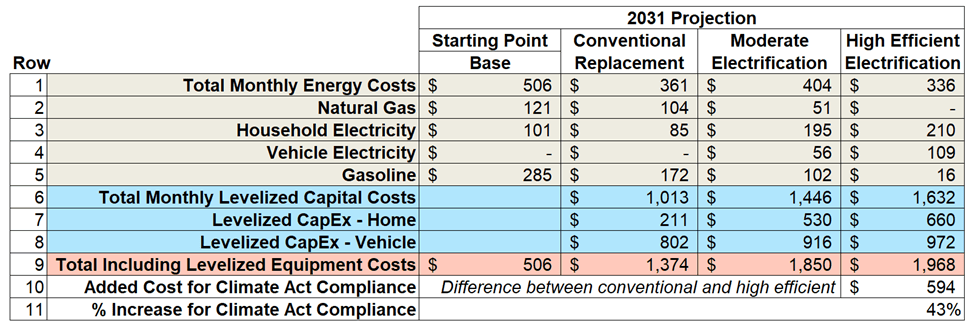
In addition to the articles arguing that the Climate Act needs to reconsidered, I also published an article describing my thoughts about the State Energy Planning Board (SEP) meeting on December 1, 2025 that described the NYSERDA energy affordability analysis.   The key point made in my articles is that the projected monthly energy cost increase necessary to convert an Upstate household that uses fossil fuel for the home and transportation to the equipment necessary to comply with the emission reductions necessary to achieve the Climate Act is extraordinary.  The monthly energy expense cost difference to replace existing fossil fuel equipment with new equipment relative to “zero emissions” electrification equipment is $593 a month in 2031, which is 43% more than the cost for conventional equipment replacement.  This article also updates the supporting information used consistent with the Energy Affordability Data Annex spreadsheet published on 4 December 2025.  To forestall any complaints that I am making up numbers this documents the numbers and provide context for NYSERDA claims.

Energy Affordability Fact Sheet

The contents of the Affordability Analysis Overview Fact Sheet are reproduced below.

The Fact Sheet includes the following text including highlighting:

Policy and market solutions that focus on lowering upfront costs and other barriers to adoption for a range of energy-saving choices — such as building envelope efficiency, efficient appliances and equipment, and electric vehicles — can enable households to lower their energy bills. This can help to alleviate energy insecurity and energy burdens.

While New Yorkers on average spend less on utility, heating fuel, and transportation fuel bills combined than the average American, New York households and residents across the country face overarching affordability challenges.

Drivers of household affordability include expenditures in areas such as housing, transportation, food, and healthcare. Energy, as a subset of transportation and housing costs, is an important driver of affordability challenges for many households. Low- and moderate-income households are more likely experience substantial cost burdens related to meeting their energy needs.

Due in part to proactive policies to boost energy efficiency and affordability, average utility, heating fuel, and transportation fuel spending for New York households is $700 less every year compared to the national average. These findings are reinforced by recent analysis from the U.S. Energy Information Administration, which finds that New York State has the second lowest per capita energy expenditure in the nation.

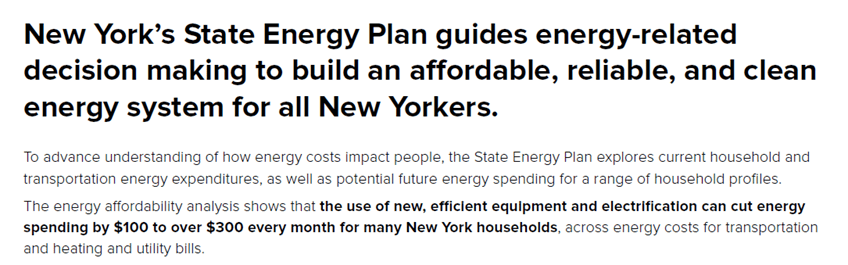
There is a stark contrast between the Fact Sheet energy affordability message and mine.  The supporting documentation does support the Fact Sheet takeaway message that  “The energy affordability analysis shows that the use of new, efficient equipment and electrification can cut energy spending by $100 to over $300 every month for many New York households, across energy costs for transportation and heating and utility bills.”  However, the supporting information and a sensitivity analysis  show that the monthly energy expense costs that consider the capital expense (CapEx) for new equipment present a vastly different conclusion.  It is no coincidence that the Fact Sheet emphasizes that “Policy and market solutions that focus on lowering upfront costs” can enable households to lower their energy bills.  Left unsaid is that if upfront capital costs are not lowered that the expected costs are unaffordable.

Energy Affordability Analysis

The December 2025 Energy Affordability Data Annex spreadsheet (Annex Spreadsheet)  and the Energy Affordability Impacts Analysis (Impact Analysis) document provide the supporting documentation for the Fact Sheet. To project potential future costs based on continued use of fossil fuels relative to two levels of electrification and emission reduction, the modelers considered eleven household energy use categories based on location, income levels, and energy equipment.

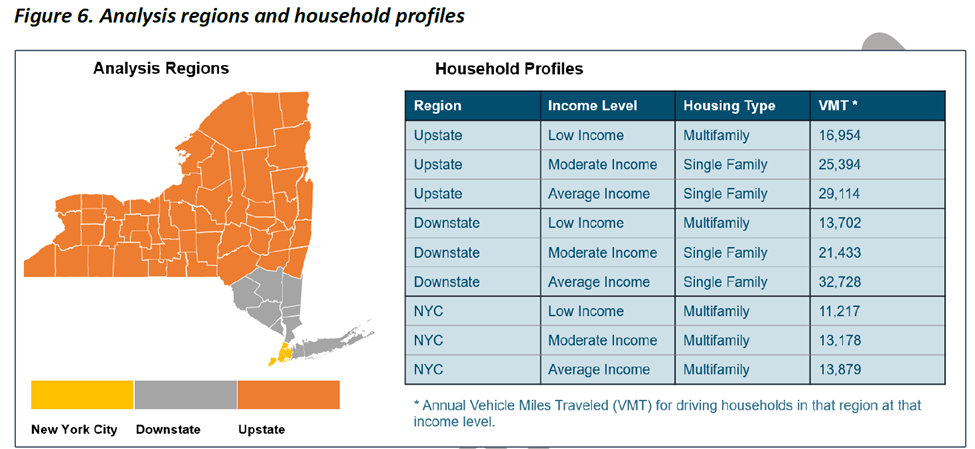
Figure 3 shows the analysis regions and summarizes household profiles used.  The three income level definitions are:

• Low-income includes households with incomes at or below 60 percent of State Median Income.

• Moderate-income includes households with incomes above 60 percent but below 80 percent of State Median Income or Area Median Income, whichever is higher

• Average income uses the average income of a household in an analysis region to represent households with incomes that fall above the low- or moderate-income range.

Figure 3: Figure 6 from the Impact Analysis

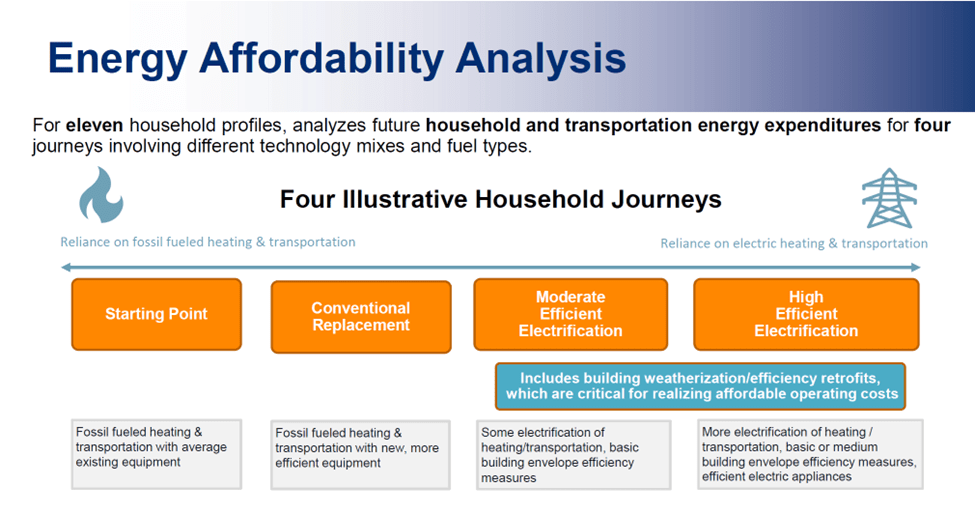
For each of the eleven household profiles four scenarios or journeys were considered:

  • Starting Point using fossil fueled heating and transportation with average existing equipment.
  • Conventional Replacement: Fossil fueled heating and transportation with new, more efficient equipment
  • Moderate Efficient Electrification: Some electrification of heating and transportation, with basic building envelope efficiency measures
  • High Efficient Electrification: More electrification of heating and transportation, with basic or medium building envelope efficiency measures, and efficient electric appliances

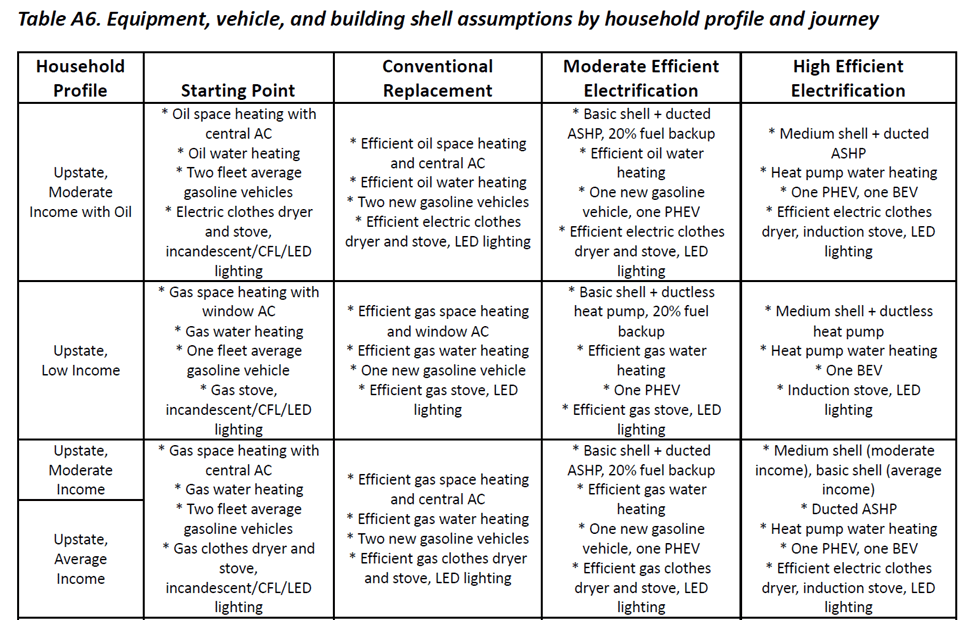
Table A-6 in the Impact Analysis document describes the equipment, vehicle, and building shell assumptions by household profile and scenario.  Figure 4 is an excerpt from that table that lists the four Upstate household profiles.  NYSERDA did a sensitivity analysis that included the equipment costs for one household profile: Upstate New York moderate income.  The starting point household for that scenario uses gas space heating with central AC, gas water heating, has two average gasoline vehicles, uses a gas clothes dryer and stove, and has a mixture of incandescent/CFL/LED lighting.  Conventional replacement for that household replaces all these systems with more efficient models.  In the “High Efficient Electrification” scenario existing systems are replaced with a medium building shell, ducted air source heat pump, heat pump water heating, one plugin hybrid electric vehicle and one battery electric vehicle, efficient electric clothes dryer, induction stove, and LED lighting.

Figure 4: Excerpt from Table A6 in the Impact Analysis Document

Energy Affordability Results

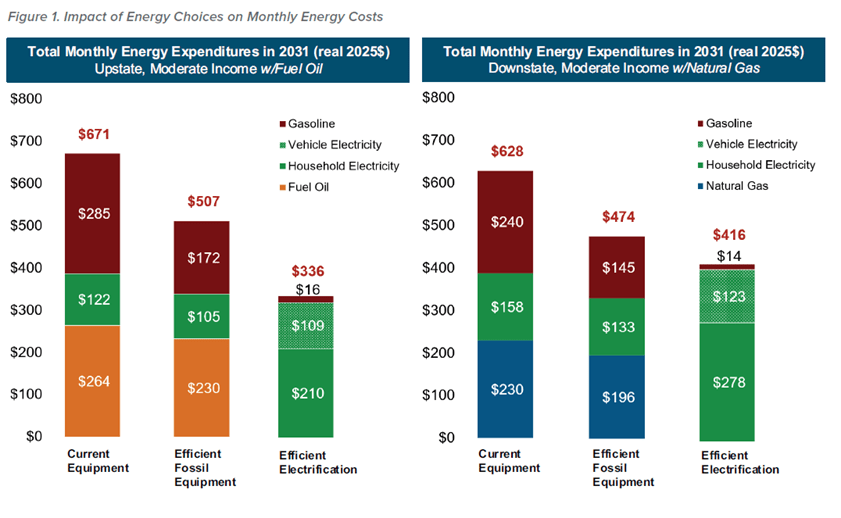
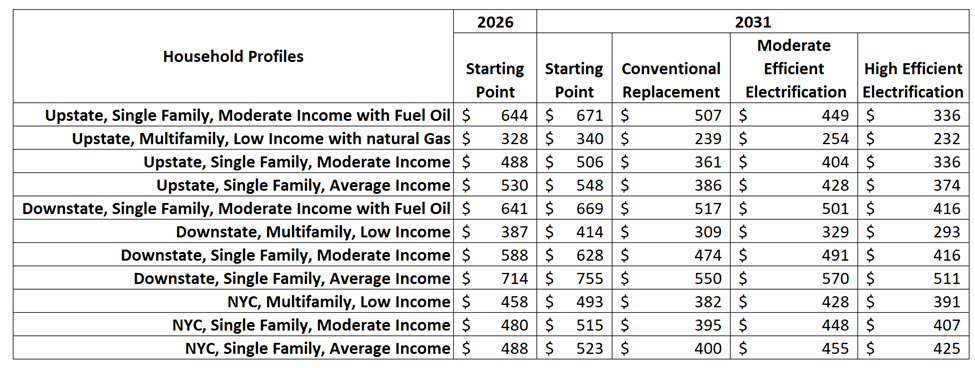
The monthly energy costs shown in Figure 1 in the Fact Sheet are derived from the Annex Spreadsheet in tables “Upstate Results” and Downstate Results”. For each of the eleven household profiles, data for the total monthly household energy and expenditures (real 2025 $) breaks down costs by four cost components: household electricity and fuel and vehicle electricity and fuel.  The Fact Sheet simply graphs two examples to illustrate the claim that monthly household expenditures will decrease in 2031 for the four future scenarios.  All the results show the same thing (Table 1).  When an existing household does nothing costs do rise between 2026 and 2031.  If the household upgrades their existing systems with more efficient conventional equipment the monthly energy bills go down.  If the household upgrades with the two electrification scenarios the monthly energy bills go down more.

Table 1: Household Profile Total Monthly Household Energy and Transportation Energy Expenditures (real 2025 $) excluding CapEx

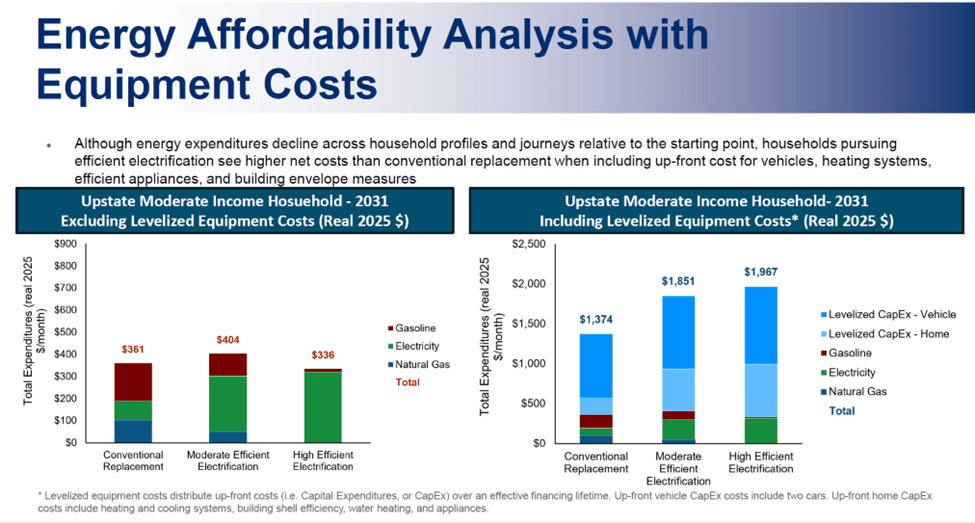
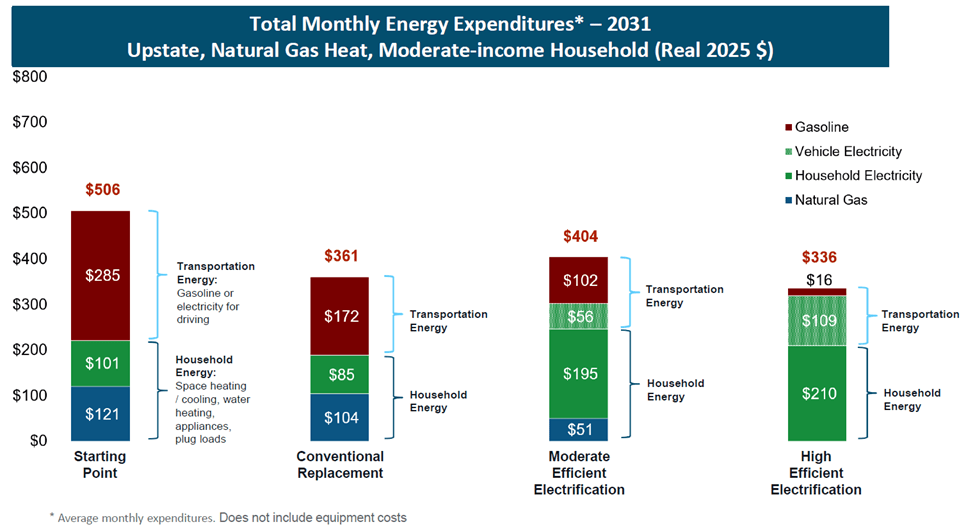
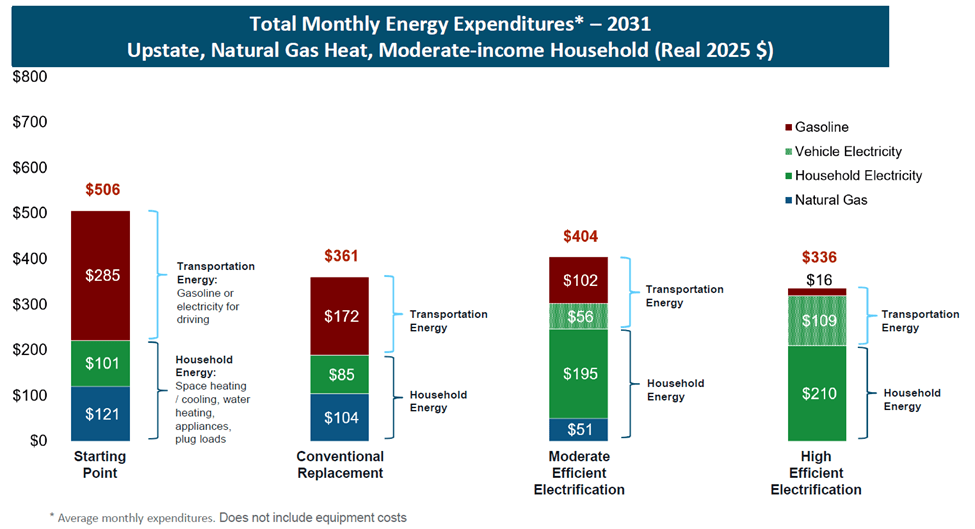
The meeting on December 1 emphasized a similar story.  Figure 5 from that presentation shows the data for the Upstate New York, natural gas, moderate income household using data from Annex Spreadsheet in table “Upstate Results.  The reason for the difference between my work and these NYSERDA results is buried at the bottom of the figure.  There is a notation that states: “Average monthly expenditures. Does not include equipment costs”. 

Figure 5: NYS Energy Planning Board Meeting Presentation Slide 40

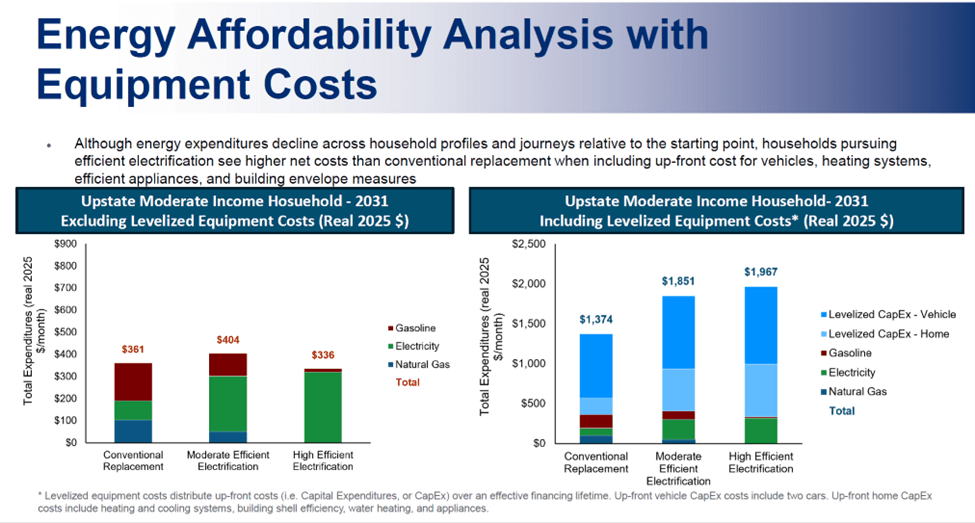
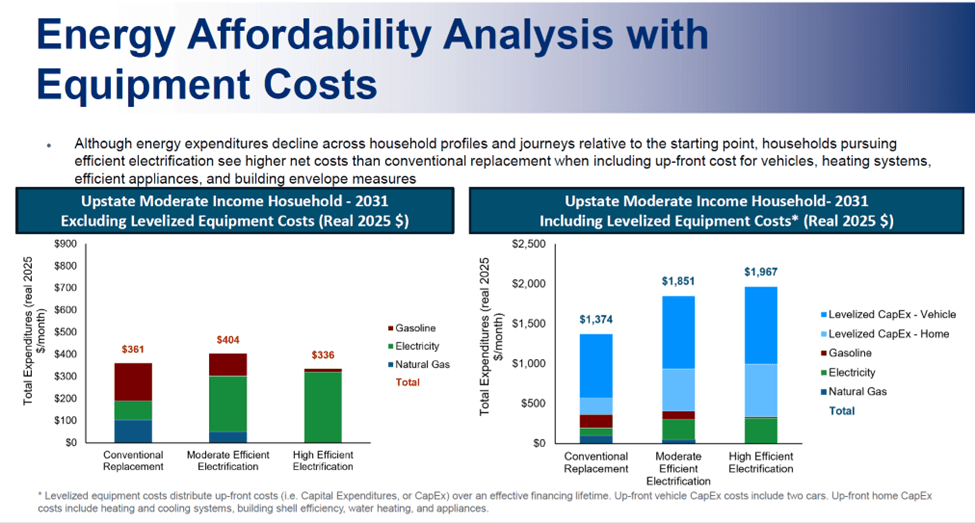
It turns out that including equipment costs makes a difference as shown in the Figure 6. This information is in Annex Spreadsheet in table “Equipment Cost Summary”.

Figure 6: NYS Energy Planning Board Meeting Presentation Slide 43

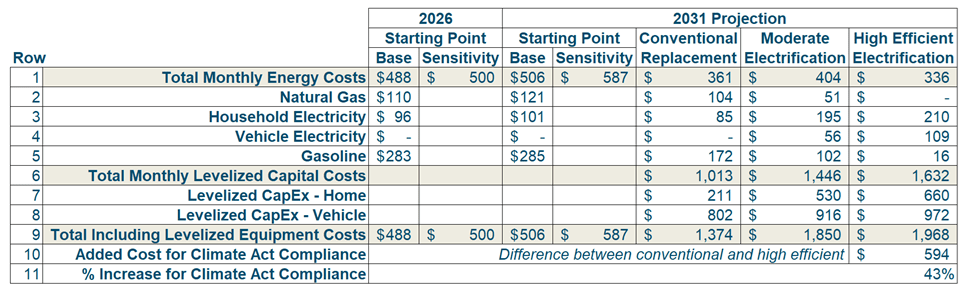
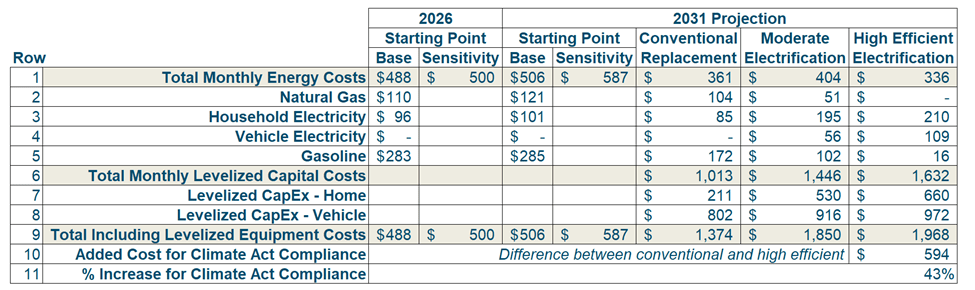
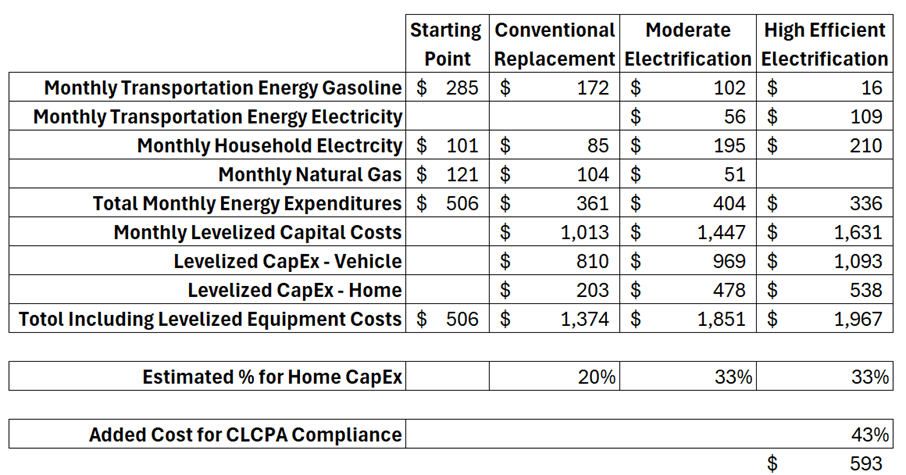
I extracted information from these Annex Spreadsheet “Upstate Results” and “Equipment Cost Summary” tables to prepare Table 2 that was used to prepare these bar chaarts.  Rows 1-4 list the monthly energy expenditures with the total in row 5 from the “Upstate Results” table.  The increase in efficiency decreases monthly energy costs for all three journeys but that changes when CapEx is considered.  The CapEx monthly total costs in rows in row 6-8 are from the “Equipment Cost Summary” table.  Row 9 lists the sum of the total monthly energy costs and rows 6 and 7 the total monthly levelized capital costs for home and vehicle.  The cost of Climate Act compliance is the difference between replacement of conventional equipment and the highly efficient electrification equipment.  Row 10 shows this difference.  It lists the $594 increase in costs necessary for Climate Act compliance and row 11 lists the percentage increase as 43%. 

Table 2: Upstate New York Moderate Income Household That Uses Natural Gas for Heat Projected Monthly Costs and Costs Necessary to Comply with the Climate Act

NYSERDA Affordability Messaging

The Energy Affordability Fact Sheet highlights the point that “The energy affordability analysis shows that the use of new, efficient equipment and electrification can cut energy spending by $100 to over $300 every month for many New York households, across energy costs for transportation and heating and utility bills.”  It acknowledges that New Yorkers face “overarching affordability challenges” and that

“Energy, as a subset of transportation and housing costs, is an important driver of affordability challenges for many households.”   However, it does not acknowledge that when the equipment’s capital expense costs necessary to achieve the Climate Act mandates are included in the projected total monthly energy costs that costs are certainly not affordable.

There is another aspect of the NYSERDA messaging.  I prepared an annotated transcript for the energy affordability presentation at the Energy Planning Board meeting on December 1 that includes a heading for questions made during the meeting with a link to each person who commented or asked a question. Chair Doreen Harris of the Energy Planning Board asked NYSERDA presenter James Wilcox about energy price uncertainty.  He admitted that the key driver of change over the next five years is “change in energy price”.  The modeling shows that this could increase household energy spending 3% to 8% in the starting point base case but could go up to as much as 14% to 19% even if they do nothing as shown in the ”Sensitivity” columns under the Starting Point 2026 and 2031 scenarios shown in Table 2.  Chair Harris extracted a response from him that summarizes the second public message: “That is what I was trying to elicit: What does doing nothing get you?”  These data show that even if you do nothing costs could rise as much as 19% if you exclude the CapEx costs of compliant equipment.  That is misleading because the equipment costs are the main cause of future costs and not changes in energy prices.  It is also emblematic of another NYSERDA message that costs are going to go up anyway and that the costs to comply with the Climate Act are less so we can still continue to pursue this initiative.

Discussion

On Oct. 24, 2025, there was an Albany County New York Supreme Court decision ordering the Department of Environmental Conservation (DEC) to issue final Climate Act implementing regulations establishing economy-wide greenhouse gas emission (GHG) limits on or before Feb. 6, 2026 or go to the Legislature and get the Climate Act 2030 GHG reduction mandate schedule changed.   During the legal proceeding the State Attorney General submitted a letter that argued that it was inappropriate to implement regulations that would ensure compliance with the 2030 40% reduction in GHG emissions Climate Act mandate because meeting the target is “currently infeasible”.  That argument was undoubtedly based on the total cost including CapEx for households results of the single equipment cost sensitivity analysis.

The State Energy Planning Board will meet on December 16, 2025 to “consider and act upon a resolution to adopt the State Energy Plan”.  The Energy Plan is a “comprehensive roadmap to build a clean, resilient, and affordable energy system for all New Yorkers”.  How can the Energy Planning Board members vote to approve something that will increase monthly energy bills nearly $600 a month and claim any credibility for an affordable energy system?  Clearly the answer is they cannot which means the whole process is only for show.

There is no question in my mind that the total cost, including CapEx results are being downplayed as much as possible.  Nowhere in the supporting quantitative information are results presented for all the households evaluated.  I believe that those results were calculated but not presented because of the affordability implications.  Iin addition, there is insufficient information provided that would enable independent analysis to calculate the CapEx costs for the other scenarios.

New York GHG emissions are less than one half of one percent of global emissions and global emissions have been increasing on average by more than one half of one percent per year since 1990.  The fact that New York cannot solve global warming by itself coupled with these extraordinary costs in the face of an acknowledged energy affordability challenge is a very strong case to reconsider the proposed Energy Plan and rethink the Climate Act.

Conclusion

When I tell people that I have spent a lot of time evaluating the Climate Act they usually ask how much is this going to cost.  When I tell them that that the Scoping Plan comprehensive roadmap to “build a clean, resilient, and affordable energy system for all New Yorkers” estimates that when the cost to buy the necessary infrastructure to meet the Climate Act are included households could see an increase of %594 per month they are shocked.  The Affordability Fact Sheet talks about affordability and gives numbers to the suggest affordability.  However, NYSERDA covered up the finding in the Energy Plan modeling that Climate Act compliance is anything but affordable.   This must be addressed.

Energy Affordability at Energy Planning Board Meeting on 12/1/2025

On December 6, 2025, I published an article describing my initial thoughts about the State Energy Planning Board (SEP) meeting on December 1 that discussed updated Pathways modeling for the State Energy Plan.  This post describes the presentations at the meeting that covered energy affordability.  I will cover the health benefits and employment analysis in another post.

I am convinced that implementation of the New York Climate Leadership & Community Protection Act (Climate Act or CLCPA) net-zero mandates will do more harm than good if the future electric system relies only on wind, solar, and energy storage because of reliability and affordability risks.  I have followed the Climate Act since it was first proposed, submitted comments on the Climate Act implementation plan, and have written over 600 articles about New York’s net-zero transition.  The opinions expressed in this article do not reflect the position of any of my previous employers or any other organization I have been associated with, these comments are mine alone.

Energy Plan Overview

According to the New York State Energy Plan website (Accessed 3/16/25):

The State Energy Plan is a comprehensive roadmap to build a clean, resilient, and affordable energy system for all New Yorkers. The Plan provides broad program and policy development direction to guide energy-related decision-making in the public and private sectors within New York State.

The New York State Energy Research & Development Authority (NYSERDA) prepared the Draft Energy Plan last summer.  Stakeholder comments were accepted until early October.  The Energy Planning Board has the responsibility to approve the document. At the November 13, 2025 Board meeting there was a perfunctory description of the comments received.  During the wrap up for this meeting Chair Doreen Harris said the Board will meet later this month to approve the plan before the end of the year. I have provided background information and a list of previous articles on my Energy Plan page

Meeting Overview

There were three items on the agenda: approval of last meeting minutes, discuss analyses conducted for the Energy Plan, and consider any new business.  The recording of the meeting available here included a transcript.  I created an edited transcript for the Pathways Analysis presentation and a separate transcript for the energy affordability, health benefits, and employment presentations. These annotated versions include tables and headings.

In this meeting NYSERDA described the updated Pathways Analysis—the modeling exercise that underpins New York’s triennial State Energy Plan. In my opinion, the entire Energy Planning Board process is political theater.  The members of the Board were chosen mostly for political reasons and not technical expertise.  Everyone involved is going through the motions. 

My last post explained that the updated Pathways Analysis described in the first part of this meeting found that the 2030 Climate Act goals will not be achieved on time.  The aspirational schedule of the Climate Act was never realistic, and these results are simply acknowledgement of that fact.  The topics featured in the remaining sessions support the positive spin narrative that the Hochul administration is trying to convey to the public to save some face regarding Climate Act implementation.  This post will highlight key points of the narrative.  I want to emphasize that this narrative is based mostly on political messaging, so it is appropriate to assume that every NYSERDA point has been approved by the Hochul Administration.

Energy Affordability

James Wilcox presented the Household Energy Affordability Analysis Update. He said that NYSERDA “reviewed key analysis structure and assumptions based on stakeholder feedback and new data availability”.  The claim regarding review of stakeholder feedback is the first narrative speaking point.  There will be a subsequent post detailing how New York State agency claim that all stakeholder feedback was considered is unsupported by evidence.  While there are indications that some feedback from outside NYSERDA was incorporated in the updated analyses, later I will detail instances where comments inconsistent with the intended story line were ignored.

Wilcox summarized the updates:

  • For Base Case, moved to an electric and gas price forecast based on the trend of total bills from bill history
  • Added a higher energy price growth sensitivity based on the trend of total bills from recent bill history combined with recent DPS/utility projections
  • Although numbers have shifted, key takeaways remain the same
  • Net result from changes is a higher growth rate for electricity and gas rates

The affordability messaging has been consistent.  NYSERDA acknowledges that there are energy affordability challenges.  The Climate Act embeds environmental justice principles throughout its implementation framework, so descriptions include low- and moderate- income household impacts that are consistent with this narrative talking point,  Unsurprisingly, those households are “more likely to experience energy affordability challenges”.

The following energy affordability analysis slide explains that for eleven household profiles, NYSERDA evaluated future household and transportation energy expenditures for four cases involving different technology mixes and fuel types.  These “Illustrative Household Journeys” include:

  • Starting Point: Fossil fueled heating and transportation with average existing equipment
  • Conventional Replacement: Fossil fueled heating and transportation with new, more efficient equipment
  • Moderate Efficient Electrification: Some electrification of heating and transportation, with basic building envelope efficiency measures
  • High Efficient Electrification: More electrification of heating and transportation, with basic or medium building envelope efficiency measures, and efficient electric appliances

Slides were presented that describe the four journeys for several profiles.   The following example describes monthly expenditures for a typical Upstate moderate-income household that uses natural gas for heat.  Relative to the current starting point all three projected “household journeys” reduce monthly energy expenditures.  However, buried at the bottom of the page is the notation that these values are “Average monthly expenditures. Does not include equipment costs”. 

It turns out that including equipment costs makes a difference as shown in the next slide.

The Hochul/NYSERDA story is that monthly energy expenditures will go down when investments in moderate electrification or high efficiency electrification necessary for Climate Act compliance are made.  The public release sound bite press releases will emphasize that point and barely acknowledge that the costs that include the capital expenses (CapEx) for the equipment costs tell a different story.  I summarized all this information in Table 1.  The first four rows list the monthly energy expenditures with the total in the fifth line.  The CapEx monthly total cost is listed but the breakdown between the costs of a new plugin hybrid electric vehicle (moderate electrification) and a battery electric vehicle (high efficiency electrification) relative to home energy electrification is not provided.  I estimated the percentage of home electrification from the bars in the previous figure.  When those CapEx costs are included all the projected alternative journeys are more expensive.  Note that the difference between replacement of conventional equipment and the highly efficient electrification equipment necessary for Climate Act compliance increases monthly average energy expenditures $593, a whopping 43% increase in energy costs.  That is the cost of Climate Act compliance.

Table 1: Upstate New York Moderate Income Household That Uses Natural Gas for Heat Projected Monthly Costs and Costs Necessary to Comply with the Climate Act

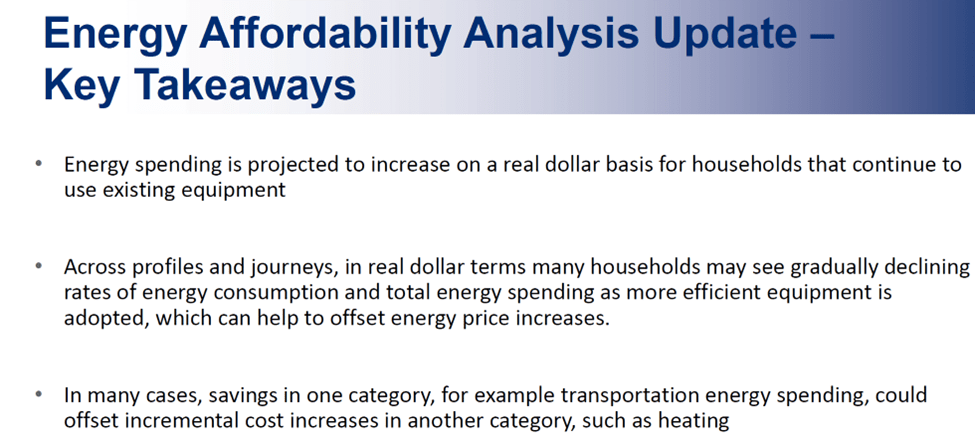
The following key takeaways slide summarizes the messages that NYSERDA and Hochul want the Energy Planning Board and public to accept.  The first statement suggests that if households continue to use existing equipment that energy spending will increase.  But households “see gradually declining rates of energy consumption and total energy spending as more efficient equipment is adopted” then that “can help to offset energy price increases”.  That advocates going forward despite a tacit acknowledgement that it may not save money, just reduce the increase.  The final takeaway points out that according to their numbers transportation energy spending could offset incremental cost increases for home heating.  I cannot overemphasize enough that results from this kind of modeling are completely dependent upon input assumptions.  That means that the modelers can get any answer they want.  It is therefore very telling that these takeaways cannot avoid the conclusion that the transition will incur significant costs. The modelers could not completely avoid reality.

Ultimately, the question is how much will all this cost. During his presentation Wilcox stated: “What we can take away is that the net costs for efficient electrification journeys could be 35% to 40% higher than conventional replacement when accounting for equipment, reinforcing the importance of action to address upfront equipment costs so that households are able to access the benefits of these systems.”   NYSERDA is left hoping that there will be a magical solution that will reduce upfront costs so that the projections might be palatable.

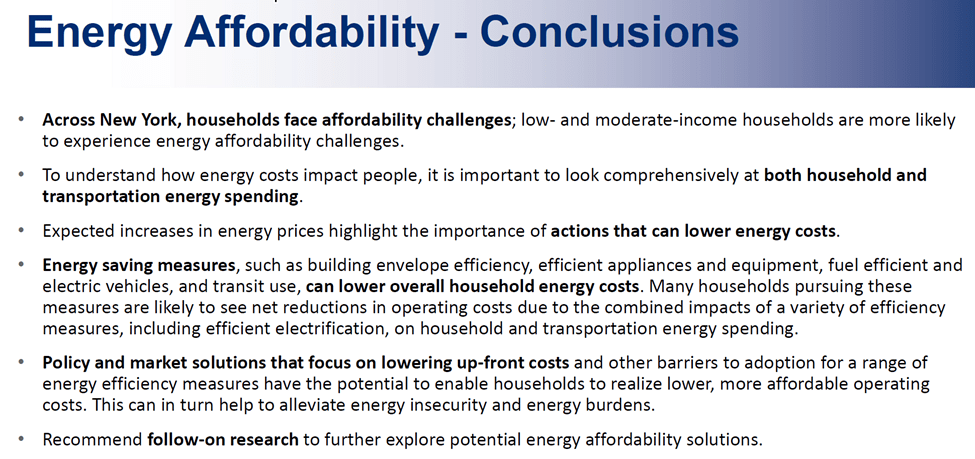
The conclusions sums up the energy affordability messaging.  There is an energy affordability problem that impacts low- and moderate-income households more with the implication that focus on those households will improve the situation.  Energy costs impact both household and transportation spending.  This needs to be emphasized because NYSERDA cannot claim monthly energy benefits for many household profiles if transportation costs are not included.  Wilcox concludes the obvious point that “expected increases in energy prices highlight the importance of actions that can lower energy costs”.  In my opinion the point that doing nothing is the least impactful action is not acknowledged.  The importance of energy savings measures is highlighted.  However, I don’t think this will provide as many benefits as they do because this has been emphasized for decades so the simple fixes and obvious solutions have already been implemented.  It is easy to say that “Policy and market solutions that focus on lowering up-front costs” may make this more affordable, but no suggestions how that can be done or why anyone would expect that this may happen are offered.  Finally, there is the recommendation of all analysts that have no clue how to get the preferred answer to “do further research”.

Presentation Discussion Topics

The annotated transcript for this presentation includes a heading for questions made during the meeting with a link to each person who commented or asked a question. 

Chair Doreen Harris asked about the differences between Upstate and Downstate.  Wilcox explained that there are climatic differences, transportation patterns are different, and the predominant type of housing is different.  Harris followed up stating:

I think that’s important because that’s one of the reasons why we had to produce so many variations, right? Like, it reflects the diversity of our state in a way that means that the answer isn’t the same for everyone, depending on their own experience and the way they live.

Because I believe that this presentation was scripted to further the messaging of the Administration, I think it is telling that she wanted to emphasize impacts are not the same for everyone.  I am not sure why, however. 

The rationale for her second question about what happens if households do not upgrade is obvious.  The projections show that all replacement scenarios doubles costs so doing nothing is an attractive option.  Not only is that a great argument against an implementation schedule, but it establishes a significant public acceptance hurdle.  Wilcox admitted that the key driver of change over the next five years is “change in energy price”.  The modeling shows that this will increase household energy spending 3% to 8% in the starting point base case but could go up to as much as 14% to 19% even if they do nothing. 

The questions and answers went on:

Harris: “And then, James, maybe to kind of take those percentages in context, was it in that higher price sensitivity, a household that did nothing could see as much as one hundred dollars a month increased costs. Is that about right?

Wilcox: “Yeah. That’s correct.”

Harris: “So there’s a substantial increase with these energy prices for folks who don’t take any action. Thank you. That is what I was trying to elicit: What does doing nothing get you?

To summarize, the Chair of the Energy Planning Board was trying to elicit a specific point from her staff that there will be a substantial increase in energy prices even if people don’t take any action.  Her staff person Wilcox could have destroyed his career if he had pointed out that the minimum increase in any of the scenarios that replaced household and transportation equipment is 1.7 times greater than current costs which is far greater than the greatest impact of doing nothing which was 0.19 times greater.

After that the rest of the questions were a comedown.  There were suggestions that the new technologies might offer new opportunities that might somehow, someway, mitigate the cold equations that show this is unaffordable.  There was also a suggestion made that all would work out if New Yorkers used public transit.

Discussion

Presumably the Attorney General Office supplemental letter  that argued that promulgating regulations for the Climate Act target would cause “undue harm” used in the New York Supreme Court litigation was developed with the assistance of NYSERDA.  That letter claimed that the Climate Act mandates are infeasible due to excessive costs that are “unaffordable for consumers”.  All these numbers confirm that there are affordability issues.

This finding sums up Climate Act affordability.  For a moderate-income household in Upstate New York that uses natural gas the difference between replacement of conventional equipment and the highly efficient electrification equipment necessary for Climate Act compliance increases monthly average energy expenditures $593, a whopping 43% increase in energy costs. 

There are ten other household profiles.  The presentation did not provide sufficient information for a similar assessment of any of those other profiles.  The State Energy Plan document web page does not list any updates to the draft materials from last summer so I am not able to develop an overview of all the household profile results.  Also note that the documentation does not provide backup to the graphs and tables presented in the Energy Plan reports so this is no small task.

Conclusion

Any argument that the Climate Act transition will not be extraordinarily expensive can be refuted by using the data included in this presentation.  Coupled with the Pathways Analysis presentation described previously that found that neither 2030 Climate Act target will be met before 2036, the only appropriate course of action is to reconsider the Climate Act.  Given that it will require accountability by the politicians who got New York into this mess I am not optimistic.

Climate Act Energy Affordability

Although proponents of the net-zero transition in New York and elsewhere continue to claim that building wind and solar energy resources is the cheapest resource, reality is catching up. If this is true, then why aren’t electricity bills going down?  I believe that affordability is the biggest challenge for the Climate Leadership & Community Protection Act (Climate Act) net-zero transition mandate.   This post addresses affordability and risks that proponents who claim it is cheaper ignore.

I am convinced that implementation of the Climate Act net-zero mandates will do more harm than good because of reliability and affordability risks.  I have followed the Climate Act since it was first proposed, submitted comments on the Climate Act implementation plan, and have written nearly 600 articles about New York’s net-zero transition.  The opinions expressed in this article do not reflect the position of any of my previous employers or any other organization I have been associated with, these comments are mine alone.

Lessons for an Energy Affordability Agenda

A recent article by Lauren Teixeira at the Ecomodernist Blog examines the affordability of renewable energy relying heavily on a new study from Lawrence Berkeley National Laboratory (LBNL) by Ryan Wiser, Eric O’Shaughnessy, Galen Barbose, Peter Cappers, and Will Gorman (LBNL Report).  The LBNL Report examined state-level trends in U.S. retail electricity prices.  There is a wide range of state-level trends.

The LBNL Report and Teixeira emphasize that there are many facts affecting electricity prices. Teixeira explains that the LBNL Report distinguishes between market-driven renewables, which show a statistically insignificant negative effect on prices, and policy-mandated renewables that are linked to significant price increases. ​The LBNL Report found that generation mix effects are not the biggest drivers of electricity prices.  Instead, the key factors driving price increases include utility infrastructure spending, load dynamics and factors like utility spending on wildfire mitigation are more influential on electricity prices.

There is an important finding relative to the Climate Act.  The abstract for the LBNL Report notes:

States with the greatest price increases typically exhibited shrinking customer loads—partially linked to growth in behind-the-meter solar and end-use energy efficiency—and had renewables portfolio standards (RPS) that required additional renewable energy supply. By contrast, the 75 percent of recent utility-scale wind and solar deployment that occurred outside Renewable Portfolio Standard (RPS) programs had no broadly discernible positive impact on retail prices and had suggestive (weak) evidence of reducing prices over the most recent time periods.

This is an unacknowledged implementation constraint for the Climate Act.  States with favorable renewable resources, like Texas, can lower prices without mandates but New York’s comparatively poor resources face higher costs because more capacity must be installed to produce the same amount of power, additional energy storage is required, and more transmission must be built for the greater capacity development.  As a result, it is unlikely that renewable energy could ever be cheaper.

If affordability is a priority, Teixeira advocates removing subsidies and policies favoring specific energy sources with a focus on market efficiency. ​ That is the fundamental problem with the Climate Act energy transition.  The Climate Act requires subsidies and includes mandates for specific energy technologies.  The article criticizes simplified narratives in the renewable energy debate, arguing for a nuanced understanding of the interactions between generation types, policies, and geographic factors. ​ Given the importance of energy affordability she calls for a shift from technology advocacy to a focus on consumer affordability, recognizing the trade-offs inherent in energy policy. ​

There is one other aspect of Teixeira’s article that is relevant to the New York discussion.  State agencies have claimed that renewable energy is cheaper because of lower price volatility.  Teixeira’s explains that the merit order effect impacts that claim.  The merit order effect explains how electricity prices are determined by the marginal costs of power plants, with cheaper sources like wind and solar being dispatched first. ​As a result, renewables, having near-zero marginal costs post-construction, push out more expensive fossil fuel generators, leading to lower wholesale electricity prices. ​However, without adequate energy storage in poor resource locations, it is impossible to push out fossil resources so it may be necessary to eventually subsidize them.  In the short term, as renewable energy increases supply during peak periods, it shifts the supply curve, reducing prices for all generators due to marginal pricing.  However, that means the costs necessary to support the resources that come on line during the worst peak periods must be secured during the peaks.  That means that price volatility during peaks will be higher as a feature not a bug of the system.

Teixeira claims that the costs of solar and wind energy have dramatically decreased, with solar prices dropping by 88% since 2009. ​She notes that while renewables can lower prices, they may also lead to “price cannibalization,” where excess renewable generation during high output periods can depress prices, sometimes resulting in negative pricing. Parker Gallant explains how this led to Ontario ratepayers coughing up $14 million in two days.  Finally, she argues that falling battery storage costs are expected to mitigate these challenges, enhancing the viability of renewables. ​ I disagree with her expectation that renewables can be viable if the underlying resources are weak like New York.

In my opinion, the LBNL Report and Teixeira both miss the effect of what I think is the intractable problem associated with dark doldrums. ​ Dark doldrums are extended periods of low wind and solar resource availability.  The LBNL report analyzed 24 years of U.S. data and found that states with higher renewable energy penetration see lower electricity price increases over time.  However, that reduction in prices does not account for the reliability risks of infrequent prolonged periods of low renewable resource availability.  Using Texas as an example, while they have great wind and solar resources on average, in February 2021, the Texas electric grid failed to provide sufficient energy when it was needed.  The storm and accompanying dark doldrum was the worst energy infrastructure failure in Texas history 4.5 million homes and residences were without power, at least 246 people died, and total damages were at least $195 billion.  Apologists for renewables claim the disaster was caused because other resources did not cover the lack of wind and solar.  In my opinion, electric market pricing must reflect the fact that wind and solar are intermittent and that the costs for backup during the worst periods should reflect that requirement.  Proponents claim that renewables act as fuel-saving resources that reduce the operational need for costly gas and coal plants and that results in system-wide savings for consumers.  However, if insufficient investments are made in backup resources, current policies are risking catastrophic blackouts that will wipe out all the savings and directly lead to injuries and death. 

State Supplemental Letter

Even the New York State Attorney General office agrees that the current Climate Act implementation schedule will lead to infeasible costs.  On Oct. 24, 2025,  the New York Albany Supreme Court ruled that the New York State Department of Environmental Conservation (DEC) failed to implement regulations necessary to comply with the Climate Act mandates.  During the legal process the State submitted a letter  that addressed “two categories of new developments: (1) the publication of the 2025 Draft New York State Energy Plan by the New York State Energy Planning Board on July 23, 2025 and (2) additional actions by the federal government that impede New York’s efforts to achieve the Climate Act.  The letter argued that it was inappropriate to implement regulations that would ensure compliance with the 2030 40% reduction in GHG emissions Climate Act mandate because meeting the target is “currently infeasible”. 

Ordering achievement of the 2030 target would equate to even higher costs than the net zero scenarios and would affect consumers even sooner. Undoubtedly, greenhouse-gas reducing policies can lead to longer-term benefits such as health improvements. This does not, however, offset the insurmountable upfront costs that New Yorkers would face if DEC were forced to try to achieve the Legislature’s aspirational emissions reductions by the 2030 deadline rather than proceeding at an ambitious but sustainable pace.

The letter concluded that the Climate Act is unaffordable:

Petitioners have not shown a plausible scenario where the 2030 greenhouse gas reduction goal can be achieved without inflicting unanticipated and undue harm on New York consumers, and the concrete analysis in the 2025 Draft Energy Plan dispels any uncertainty on the topic: New Yorkers will face alarming financial consequences if speed is given preference over sustainability.

Discussion

It is no longer possible to argue that New York can afford to implement the Climate Act mandates.  The State Attorney General’s office argued that meeting the 2030 emission reduction mandate was infeasible.  The LBNL Report found that States like New York that have RPS that require additional renewable energy supply but do not have adequate renewable energy resource potential for those resources to be developed without subsidies have seen and will continue to see higher retail energy prices.

Consistent with the Draft State Energy Plan, the LBNL Report found that renewable energy deployment was not the primary driver of increased electric prices.  The LBNL Report noted price increases were associated with load dynamics, extreme weather, natural disasters, and wildfires contributed to sizable price increases in some states.  The Draft State Energy Plan argued that electric energy prices increased because of infrastructure investment requirements, transmission system expansion, and distribution system upgrades as well as increasing loads.

However, there is no question that energy affordability is a problem.  Governor Hochul has expressed concerns about the affordability impacts of Climate Act implementation, stating worries about costs and “collateral damage” to New York families.  I have long argued that components of  New York Public Service Law  Section 66-p (4). “Establishment of a renewable energy program” should be considered because it includes safety valve conditions for affordability and reliability.  § 66-p (4) states: “The commission may temporarily suspend or modify the obligations under such program provided that the commission, after conducting a hearing as provided in section twenty of this chapter, makes a finding that the program impedes the provision of safe and adequate electric service; the program is likely to impair existing obligations and agreements; and/or that there is a significant increase in arrears or service disconnections that the commission determines is related to the program”.  The increase in arrears metric is an indirect indicator of affordability and I have shown that there has been a significant increase in arrears since Climate Act implementation began.

Even if Climate Act costs are not the primary driver of retail electric price increases can we afford to continue the net-zero transition?  New York GHG emissions are less than one half of one percent of global emissions and global emissions have been increasing on average by more than one half of one percent per year since 1990.  Anything we do is subsumed by increases elsewhere so that this is just political theater that negatively impacts those least able to afford energy increases.

Conclusion

The Attorney General office says compliance with 2030 emission reduction mandates is infeasible.  The LBNL Report suggests that states like New York that have policies that mandate renewable deployment but have renewable resources that require subsidies will increase costs.  Clearly, it is time for the New York Legislature to revisit the Climate Act and establish affordability metrics to protect New Yorkers.

Assembly Hearing Protecting Residential Ratepayers from Certain Increased Energy Costs

As electric energy prices increase substantially the blame game starts.  On October 23, 2025 the New York State Assembly Standing Committee on Energy had a public hearing “Protecting Residential Ratepayers from Certain Increased Energy Costs”.   This article explains why I think this heating misses the point of the affordability crisis affecting New Yorkers.

I am convinced that implementation of the New York Climate Leadership & Community Protection Act (Climate Act) net-zero mandates will do more harm than good if the future electric system relies only on wind, solar, and energy storage because of reliability and affordability risks.  I have followed the Climate Act since it was first proposed, submitted comments on the Climate Act implementation plan, and have written nearly 600 articles about New York’s net-zero transition.  The opinions expressed in this article do not reflect the position of any of my previous employers or any other organization I have been associated with, these comments are mine alone. 

Hearing Announcement

The hearing announcement states:

The United States Energy Information Administration’s April 2025 “Annual Energy Outlook” estimates that electricity consumption in the United States will increase to record highs in 2026, from 4,097 billion Kilowatt Hours (kWh) in 2024, to 4,283 billion kWh by 2026, driven primarily by large energy users such as computing services. The New York Independent System Operator’s (NYISO) “2025 Power Trends Report” confirms that this trend will likely also occur in New York, estimating that an additional 1,600 megawatts of power could be needed by 2030, driven primarily by these large energy users.

This increased energy demand, along with the accompanying need for infrastructure and generation, is expected to lead to higher utility bills for consumers in the coming years. This phenomenon has been seen in other states, such as in Illinois where data has shown that Commonwealth Edison’s existing customers paid over 91% of the costs associated with new large energy users. However, some states, such as Georgia and Oregon, have taken action to protect residential customers from such rate increases. The purpose of this hearing is to examine measures that may be effective in protecting residential ratepayers against increased energy costs associated with the integration of new large energy users.

I think this hearing is part of an effort by supporters of the fossil fuel transition to net-zero is deflect concerns about costs away from the Climate Act.  They argue that infrastructure costs associated with increased load driven primarily by large energy users such as computing services is driving the utility rate increases. 

The hearing announcement references the New York Independent System Operator’s (NYISO) “2025 Power Trends Report” estimates that an additional 1,600 megawatts of power could be needed by 2030, “driven primarily by these large energy users”.  Climate Act proponents are deflecting net-zero transition costs by blaming load growth due to energy centers and semiconductor manufacturing plants.  There is no question that this load growth impacts electric bills in New York, but context is important.  While those costs are substantial, they are dwarfed by the infrastructure support needed for electric grid transition to wind, solar, and energy storage displacement of fossil fuels.

Impact of New Large Loads on Electric Bills

I acknowledge the use of Perplexity AI to generate this summary of potential impacts on electric bills. The proposed Clay, NY Micron chip fabrication plant could use 16,000 gigawatt-hours annually which is more than the energy used by Vermont and New Hampshire and works out to be about 11% of New York’s total usage. ​ Loudoun County, Virginia—specifically the “Data Center Alley” area around Ashburn and Sterling—hosts the world’s highest concentration of data centers, with approximately 199 operational facilities as of 2025 and 40GW of contracted capacity. The higher demand from these sources leads to increased wholesale electricity prices.  In addition utilities must also invest in infrastructure upgrades for these large loads, resulting in higher delivery charges that are typically socialized across all ratepayers.

New York Assemblyman Jonathan Jackobson has proposed legislation that aims to prevent the transfer of infrastructure costs from large users to everyday consumers, targeting costs specifically to data centers and chip fabs. Meanwhile, discussions are ongoing about special contracts that would require major users to cover their infrastructure costs and reduce load during peak times, but these measures are not yet widespread. ​

On the other hand, increased electricity sales could help spread fixed costs, potentially lowering per-kWh delivery rates.  Sadly, this effect is usually less than the impact of new loads. ​There is the potential for demand response agreements with large users that could enhance system reliability and mitigate severe price spikes. ​

New York Future Loads

​I looked at load projections for New York.  The NYISO 2025 Load & Capacity Data Report (Gold Book) includes two spreadsheets: 2025 Gold Book Higher Demand Scenario Tables and the 2025 Lower Demand Scenario Tables that report future energy usage (GWh).  I used these tables to extract the expected sources of future load growth.  Unfortunately, the Gold Book does not break out the energy capacity (MW) for the same categories as the NYISO Power Trends report which makes comparison to the hearing announcement projection difficult.  Because ratepayers pay for energy and not capacity, I think the better metric is energy.

 In the following table I combined Gold Book projected annual energy load forecast (GWh) tables I-15a: and I-16a.  I extracted the NYISO projected future load for five different load categories: storage net energy consumption, electric vehicles, building electrification, large load projects and electrolysis.  Table 1 compares the large load projects energy relative to GHG reduction programs.  The GHG reduction programs are the sum of the other four categories that, were it not for efforts to reduce GHG emissions by the Climate Act, legacy New York programs and Federal policies, would not exist.  According to the NYISO Gold Book projections, in 2025 1.2% expected energy use is due to the GHG reduction programs and 2.4% is due to large load projects for the lower demand forecast and 1.4% due to the GHG reduction programs and 2.4% for large load projects for the higher demand forecast. 

Table 1: Gold Book Projected Annual Energy Load Lower and Higher Demand Forecasts – GWh

Assembly Bill A9064 presumes that prohibiting utilities from passing along the “costs of capital expenditures or maintenance of infrastructure resulting from the building or operation of a data center or semiconductor fabrication plant” will substantively reduce ratepayer costs.  While true it ignores the fact that GHG emission reduction load increase will be more than double the energy load increase expected for the large load projects.

Discussion

The ideologues who insist that the net-zero transition must proceed on the arbitrary schedule of the Climate Act do not generally support development of data centers and semiconductor fabrication plants.  I think continuing operations of crypto mining are also on their hit list.  In all three instances, they argue that they require a lot of energy and water and are responsible for electricity price increases. 

In my opinion, the analyses supporting their arguments were contrived to support the concept that they increase electricity prices.  Another characteristic of the analyses is that they ignore any potential positive impacts.  Vilifying chip fab plans ignores the tremendous economic benefits of hundreds of jobs, for example.  Ideologues tend to ignore any tradeoffs and that does not make for rational policy.

Conclusion

There is an energy affordability crisis.  The scramble to find excuses for higher electric prices to cover the costs of decarbonizing the energy system is on.  It is long past time for Climate Act supporters to define acceptable affordability, track where we stand relative to their metric, and commit to stop the insanity when costs inevitably exceed their limit.  Blaming data centers and chip fabrication plants is misdirection.

Draft NYS Energy Plan Pathways Scenario Costs

This is part of my continuing coverage of the New York State Energy Plan.  On July 23, 2025, the Draft Energy Plan was released for comment.  This post describes the scanty cost information in the draft.

I am convinced that implementation of the New York Climate Leadership & Community Protection Act (Climate Act or CLCPA) net-zero mandates will do more harm than good if the future electric system relies only on wind, solar, and energy storage because of reliability and affordability risks.  I have followed the Climate Act since it was first proposed, submitted comments on the Climate Act implementation plan, and have written over 550 articles about New York’s net-zero transition. 

I acknowledge the use of Perplexity AI to generate summaries and references included in this document.  The opinions expressed in this article do not reflect the position of any of my previous employers or any other organization I have been associated with, these comments are mine alone. 

Net-Zero Aspirations

The Climate Leadership & Community Protection Act (Climate Act) established a New York “Net Zero” target (85% reduction in GHG emissions and 15% offset of emissions) by 2050 and has two electric sector targets: 70% of the electricity must come from renewable energy by 2030 and all electricity must be generated by “zero-emissions” resources by 2040. The Scoping Plan that outlined how to “achieve the State’s bold clean energy and climate agenda” was based on an Integration Analysis prepared by the New York State Energy Research and Development Authority (NYSERDA). 

Energy Plan Overview

According to the New York State Energy Plan website (Accessed 3/16/25):

The State Energy Plan is a comprehensive roadmap to build a clean, resilient, and affordable energy system for all New Yorkers. The Plan provides broad program and policy development direction to guide energy-related decision-making in the public and private sectors within New York State.

The driving factor for change is the Energy Plan’s net-zero ambitions of New York’s ruling political party.  This is the first update of the Energy Plan since the Climate Act was passed in 2019.  I have provided more background information and a list of previous articles on my Energy Plan page

In this iteration of New York climate policy, the Pathways Analysis is equivalent to the Integration Analysis. Responsibility for implementing the Energy Plan as well as all the Climate Act programs lies with NYSERDA.  Over my multi-decade career, I have seen an ever-increasing level of political influence on NYSERDA’s research priorities and, more recently, the research results. This post describes the cost information in Pathways Analysis scenarios and explains why it is inadequate.

Costs

My last post described how the misleading definition of the “No Action” scenario was being used to hide the true costs of the Draft Energy Plan.  NYSERDA President and CEO Doreen Harris provided one of the few direct references to costs at the last Energy Planning Board meeting when she said.

You may recall during our last meeting in which we discussed the pathways modeling for this plan. And to remind you, the analysis showed that New York’s citizens and businesses will need to invest over one hundred billion dollars each year in the energy system, no matter which future path we take.

Even this reference was misleading because the expected cost is $120 billion.  I consider a 20% difference significant, making this an example of hiding the costs.

Cost References

I reviewed the meeting slides and transcripts for the two Energy Planning Board meetings where the Pathways Analysis was discussed to find explicit references to expected costs.  I searched for “$”, “dollar”, and “billion”.  Searching the June 25, 2025 Board Meeting Slides I found two $ references to Hochul’s $1 billion decarbonization commitment, there were no relevant dollar references, and references to billion were for the decarbonization commitment.  The meeting recording includes a transcript.  When I searched “$” I found a reference to Hochul’s $1 billion decarbonization commitment.  This came up when I searched “billion” along with a second reference to the decarbonization commitment.  Searching for “dollar” provided no additional relevant references.  Also note that there was no reference in the minutes to billions of dollars. My searches in the May 27 meeting materials also did not find references to the costs.  The only relevant reference to billions in the last two meeting materials was the quote by Harris.

 I find it telling that Harris said “you may recall” when she referenced the $100 billion investment figure but there are no actual references for that number in recent meeting materials.  Cynic that I am I believe this is another indication of the cover up.

Legacy Programs

In my previous post I explained that the “No Action” pathway scenario reflects “outcomes in the absence of the Climate Act and energy policies enacted from 2019 onwards”.  The Perplexity description goes on: “It includes federal energy incentives and legacy New York State policies (i.e., those in place as of early 2025), but it explicitly excludes any state and local climate, decarbonization, or efficiency policies put in place since 2019.”  As a result, NYSERDA can claim that costs will be high no matter which future energy path we take.  In no small part the costs in the “no action: case are the result of all the legacy programs that are only included to reduce greenhouse gas emissions.

Nine legacy programs are mentioned in the Draft Energy Plan:

  1. Core Infrastructure Investments
  2. Baseline System-Wide Spending
  3. Continued Investment in All Fuel Systems
  4. Natural Gas System Infrastructure
  5. Electricity System Expansion
  6. Transmission and Distribution Infrastructure
  7. Grid Reliability and Resilience Investments
  8. Load Growth Accommodation
  9. Energy Efficiency and Weatherization

It is impossible to determine how much of the costs in these legacy programs is due to pre-Climate Act GHG emission reduction programs and how much is necessary infrastructure maintenance and capital spending of the energy system in the absence of those initiatives.  The “continued investment in all fuel systems” legacy program clearly does not include programs to reduce GHG emissions.  The electricity system expansion refers to wind, solar, and storage programs that are necessary to achieve the Climate Act goals that clearly only exists to reduce GHG emissions.  The other legacy programs include initiatives that fit both categories so differentiating costs for New York’s climate ambitions is impossible.

Cost Analysis of Pathways Analysis Scenarios

I say that it is impossible to categorize costs to achieve the Climate Act mandates in the Draft Energy Plan not only because there is insufficient explanatory information but also because cost details are not provided to enable the public to determine the costs.  I submitted a Perplexity AI query asking for the costs in the Pathways Analysis “no action” scenario and other scenarios in the Draft New York State Energy Plan’s Pathways Analysis.

The response provided the following information:

The No Action scenario serves as the baselinefor cost comparisons and represents approximately $120 billion in annual system-wide spending (in 2024 dollars) through 2040. The Energy Plan states that the baseline spending covers:

  • Maintaining and modernizing existing energy infrastructure
  • Replacing aging equipment at the end of its useful life
  • Purchasing fuels to meet energy needs
  • Supporting replacement natural gas generators
  • Continuing with end-use equipment replacement following normal cycles
  • Scenario Cost Comparisons

The Pathways Analysis evaluates five different scenarios with specific cost implications relative to the No Action baseline:

The NYSERDA Pathways Analysis projects that energy system investments will total $120 billion per year out to 2040.  There are approximately 7.8 million households in New York State.  The following table shows that dividing the $120 billion total by the number of households projects results in a $1,282 monthly energy cost per household.   Keep in mind that these are total energy costs including not only utilities but also personal transportation.  There are three Pathways scenarios with projected cost increases.  The “Additional Action” scenario projects a 2% increase in 2030 equivalent to $26 a month extra.  In 2040, the “Additional Action” scenario projects a 9% increase equivalent to $115 a month extra.  To achieve the net-zero transition aspirations the modeling projects a 35% cost premium equivalent to $449 a month extra.

Discussion

As I noted in my previous post, I believe the reason to obscure the costs is because the energy costs necessary to achieve the Climate Act net-zero transition are so large that they are politically untenable.  The cost slogan for the Energy Plan will claim that costs will be high no matter which future energy path we take and the incremental increase for net-zero nirvana is a small addition.  I am sure that most New Yorkers will agree with me that the claimed $1,282 per month energy costs is higher than my personal costs.  Frankly, that claim alone should be addressed because it could be the reason so many people are having trouble paying their utility bills.

With respect to Climate Act implementation, there are buried GHG emission reduction program costs in the $1,282 per month estimate.  It is impossible to estimate how much it is because NYSERDA has not provided transparent and comprehensive cost documentation.  In my opinion, there is very little public appetite for the additional $449 per month increase in costs necessary to achieve the Climate Act net zero targets.  Governor Hochul’s recent admission that the Climate Act might not be affordable and the heretofore unacknowledged fact that there is an affordability safety valve give me some hope that changes are forthcoming.

Conclusion

The Climate Act has always been political theater.  Passage of the law placated the loud and emotional constituency that believes that climate change caused by GHG emissions is an existential threat and enabled the politicians supporting the law to brag that they were leading the nation.  Now that we have experience with the impacts of the rollout of wind and solar sprawl across the countryside and the cost impacts are becoming too large to ignore, the only way to stop the nonsense is for politicians to demand that the Public Service Commission address the safety valve provision in Public Service Law 66-P. That will not happen unless we hold politicians accountable.

Draft NYS Energy Plan Pathways Scenario Scam

This is part of my continuing coverage of the New York State Energy Plan.  On July 23, 2025, the Draft Energy Plan was released for comment.  This post explains how the analyses for the Draft Energy Plan are hiding the true costs to meet the Climate Act targets.

I am convinced that implementation of the New York Climate Leadership & Community Protection Act (Climate Act or CLCPA) net-zero mandates will do more harm than good if the future electric system relies only on wind, solar, and energy storage because of reliability and affordability risks.  I have followed the Climate Act since it was first proposed, submitted comments on the Climate Act implementation plan, and have written over 550 articles about New York’s net-zero transition. 

I acknowledge the use of Perplexity AI to generate summaries and references included in this document.  The opinions expressed in this article do not reflect the position of any of my previous employers or any other organization I have been associated with, these comments are mine alone. 

Net-Zero Aspirations

The Climate Leadership & Community Protection Act (Climate Act) established a New York “Net Zero” target (85% reduction in GHG emissions and 15% offset of emissions) by 2050 and has two electric sector targets: 70% of the electricity must come from renewable energy by 2030 and all electricity must be generated by “zero-emissions” resources by 2040. The Scoping Plan that outlined how to “achieve the State’s bold clean energy and climate agenda” was based on an Integration Analysis prepared by the New York State Energy Research and Development Authority (NYSERDA).  The Climate Act is not the only legislation or regulation that was promulgated to achieve reductions in greenhouse gas emissions to address climate change.  That fact has a major bearing on the NYSERDA Draft Energy Plan Pathways scenario.

Energy Plan Overview

According to the New York State Energy Plan website (Accessed 3/16/25):

The State Energy Plan is a comprehensive roadmap to build a clean, resilient, and affordable energy system for all New Yorkers. The Plan provides broad program and policy development direction to guide energy-related decision-making in the public and private sectors within New York State.

The driving factor for the Energy Plan is the net-zero ambitions of New York’s ruling political party.  This is the first update of the Energy Plan since the Climate Act was passed in 2019.  I have provided more background information and a list of previous articles on my Energy Plan page

In this iteration of New York climate policy the Pathways Analysis is equivalent to the Integration Analysis. Responsibility for implementing the Energy Plan as well as all the Climate Act programs lies with NYSERDA.  Over my multi-decade career, I have seen an ever-increasing level of political influence on NYSERDA’s research priorities and, more recently, the research results. This post explains how the Pathways Analysis scenarios are being used by NYSERDA to hide costs of the Energy Plan net-zero transition.

Costs

I recently gave my first impressions of the Draft Energy Plan released for comment at the most recent Energy Planning Board meeting.  NYSERDA President and CEO Doreen Harris is the Chairperson the Energy Planning Board.  This post focuses on this one aspect of the meeting.  After a presentation regarding the Transmission and Distribution Reliability Study she said.

You may recall during our last meeting in which we discussed the pathways modeling for this plan. And to remind you, the analysis showed that New York’s citizens and businesses will need to invest over one hundred billion dollars each year in the energy system, no matter which future path we take.

I have one immediate response.  There is a future path that would not cost over $100 billion.  NYSERDA, ever beholden to the Hochul Administration’s political plans, has prepared a comprehensive roadmap using a misleading limited assessment  As was the case with the Integration Analysis and Scoping Plan, NYSERDA is interpreting the “No action” scenario as one that includes all legacy programs in place prior to the passage of the Climate Act.  The appropriate baseline scenario is one that excludes all programs that were promulgated to reduce GHG emissions.

Legacy Programs

The Energy Plan Pathways Analysis defines the “No Action” pathway scenario as “reflecting outcomes in the absence of the Climate Act and energy policies enacted from 2019 onwards”.  The Perplexity description goes on: “It includes federal energy incentives and legacy New York State policies (i.e., those in place as of early 2025), but it explicitly excludes any state and local climate, decarbonization, or efficiency policies put in place since 2019.”

I have found that Perplexity is a very useful research tool enabling me to easily find references needed to document my articles.  However, its summaries are colored by the references it finds.  The query response concluded that “This scenario thus serves as a baseline representing a world without recent state-driven climate action”.  No, it does not.  It reflects New York State driven climate action since 2019 not a baseline without climate action. 

The Pathways analysis refers to previous actions as “legacy programs”.    When I requested a Perplexity description of the legacy program investments required no matter which future path New York takes I received the following summary (with my annotations):

Core Infrastructure Investments

According to the pathways modeling presented at the June 25, 2025 New York Energy Planning Board meeting, certain investments will be necessary across all energy scenarios through 2040. These “pathway-independent” investments represent critical infrastructure needs that New York must address regardless of the specific energy future the state ultimately pursues.

NYSERDA has not differentiated between investments necessary for greenhouse gas emission reduction aspirations and those unrelated to climate action.  The failure to differentiate means that the climate action costs are underestimated.

Baseline System-Wide Spending

The pathways analysis revealed that baseline system-wide spending of approximately $120 billion annually (in 2024 dollars) through 2040 will be required to maintain and modernize existing energy infrastructure, replace aging equipment, and purchase fuels to meet energy needs. This represents the foundational investment needed to keep New York’s energy system operational.

Note that when Harris said that investments over $100 billion were required the actual number is $120 billion.  The complication is that there are indeed energy costs that will occur whatever pathway occurs, but they are buried amongst the programs that are included to meet the targets for an 85% emission reduction by 2050, 70% of the electricity must come from renewable energy by 2030, and all electricity must be generated by “zero-emissions” resources by 2040..

Continued Investment in All Fuel Systems

A key finding from the pathways modeling is that all major fuels used in New York today will continue to meaningfully contribute to the state’s energy mix through 2040, including electricity, natural gas, and petroleum fuels. As stated in the Draft Pathways Analysis: “Continued investment in all fuel systems is necessary to assure safe and reliable energy services, in particular to meet peak day needs and to increase resilience”.

Natural Gas System Infrastructure

Despite projected declines in gas consumption across all scenarios, the natural gas system will require continued investment to ensure safe and reliable provision of service. The pathways modeling showed that while gas consumption is projected to decline, it remains a significant resource throughout the relevant period, necessitating ongoing system maintenance and upgrades.

In my opinion, investments in these legacy programs are appropriate for the “no GHG emission reduction mandates” programs.

Electricity System Expansion

The modeling demonstrated that electricity use is expected to grow substantially to power economic growth and expanded use of electric vehicles and heat pumps. This growth requires buildout of a diverse set of resources, including:

  • Wind and solar installations
  • Energy storage systems
  • Advanced nuclear facilities
  • Repowering of aging combustion power plants

Clearly every penny spent on these example buildouts is only included to meet the Climate Act mandates.  Saying anything otherwise is misinformation at best and a lie in my opinion.

Transmission and Distribution Infrastructure

Extensive transmission investments will be necessary to deliver renewable energy across the state and address new constraints appearing across the electric system. The New York Independent System Operator has identified that transmission expansion is “critical to facilitating efficient CLCPA energy target achievement” and noted that “the current New York transmission system, at both local and bulk levels, is inadequate to achieve currently required policy objectives”.

Specific transmission needs include:

  • Major public policy transmission projects already approved by NYISO
  • Local transmission upgrades (Phase 1 and Phase 2 projects approved by the PSC)
  • Infrastructure to accommodate up to 6,000 MW of offshore wind capacity into New York City

This is a mixed bag of programs specifically related to the Climate Act and other necessary infrastructure maintenance.  I have been told that there is a big push to replace aging transmission lines.  If the replacement infrastructure maintains current capacity, it is maintenance but if it is upgraded with additional circuits to collect wind and solar power, then that component is not necessary no matter which energy path we take.

Grid Reliability and Resilience Investments

The pathways analysis emphasized that investments in transmission and distribution systems must be designed to withstand climate change. This includes:

  • Upgrading aging infrastructure
  • Enhancing system reliability metrics
  • Incorporating scenario-based planning processes to address climate change impacts
  • Advanced transmission technologies deployment

These are also a mixed bag of necessary infrastructure programs and programs that would not exist were it not for GHG emission reduction aspirations.

Load Growth Accommodation

All scenarios showed significant new large loads interconnecting to the system, driving growing electricity demand across both annual loads and peaks. Early planning for abundant supply is essential to accommodate this load growth and ensure continued opportunities for economic development.

This is a complicated situation.  If the load growth is due to new manufacturing or cost-effective electrification, then this is true no action energy path cost.  If the upgrades are due to mandated home electrification and electric vehicles, then including the costs in a “no action” Pathway scenario is malfeasance.

Energy Efficiency and Weatherization

Across all pathways, households can lower their overall energy costs by making energy-saving choices such as home weatherization, efficient appliances, and fuel-efficient vehicles. Policy action to reduce up-front costs and other barriers will be necessary to make such choices more accessible.

This is even more complicated.  Energy efficiency and weatherization programs have been in place for decades.  Are they driven by net-zero fantasies or pragmatic cost effectiveness concerns?

Discussion

I believe that the NYSERDA rationale for not including a Pathways scenario that does not include any programs that are only included to address climate change is that there are laws mandating those programs.  Public Service Law Section 66-P Establishment of a Renewable Energy Program is the law that implements the Climate Act renewable energy mandates.  NYSERDA ignores the provisions for bounds on implementation in PSL 66-P. PSL 66-p(2),b states “The commission may, in designing the program, modify the obligations of jurisdictional load serving entities and/or the targets upon consideration of the factors described in this subdivision.”  Section 66-p (4) states: “The commission may temporarily suspend or modify the obligations under such program provided that the commission, after conducting a hearing as provided in section twenty of this chapter, makes a finding that the program impedes the provision of safe and adequate electric service; the program is likely to impair existing obligations and agreements; and/or that there is a significant increase in arrears or service disconnections that the commission determines is related to the program”.

The existence of those safety valve provisions and the current changes in Federal clean energy policies necessitate the inclusion of a Pathways Analysis scenario that does not include any New York or Federal emission reduction programs.  I believe that the majority of New Yorkers agree with me that we want to know the total cost, irrespective of which regulation requirement, that the Energy Plan projects will be necessary to meet the net-zero and electric system mandates of the Climate Act.  In my opinion, there is no question that those costs would be enormous and no question that that fact is being covered up by NYSERDA at the behest of the Hochul Administration.

The NYSERDA Pathways Analysis projects that energy system investments will total $120 billion per year out to 2040.  There are approximately 7.8 million households in New York State.  This equates to over $1200 per month per household.  How much of this is due to net-zero aspirations?

Conclusion

“Fooled me once, shame on you.  Fooled me twice, shame on me.”  NYSERDA is repeating the playbook of the Scoping Plan to hide the costs of Climate Act implementation.  I raised the issue in my Scoping Plan comments but there was no acknowledgement by NYSERDA.  I do not believe that the members of the Climate Action Council who voted to approve the Scoping Plan were told about the comment.  I did not reach enough people to get a scenario included that would represent no emission reduction program costs.  The result was a massive underestimate of the costs of the Climate Act.  The same approach is being used in the Energy Plan.  I believe that the only way to get this to change in the Energy Plan proceeding is for legislators to demand change.   Please contact your legislators and demand a full accounting of all the costs to achieve the Climate Act mandates.

Reality Bites Climate Act Affordability

There finally has been a long overdue admission that the Climate Leadership & Community Protection Act (Climate Act) might not be affordable.  Buffalo TV Station WRGZ 2 On You Side posed questions to the governor that forced Governor Hochul to suggest that a “slow down” on the Climate Act was needed because of affordability concerns.

I noticed this article as I was preparing this article on the New York Department of Public Service (DPS) “broad mandate to ensure access to safe, reliable utility service at just and reasonable rates.” The fact is that Climate Act implementation process pushes ahead because the law says so while at the same time DPS ignores another law that says that there are limits.  This is an update to earlier posts about Climate Act Safety Valves and the DPS response to my safety valve recommendations.  We shall see if the Governor’s revelation slows the process down.

I am convinced that implementation of the Climate Act net-zero mandates will do more harm than good because the energy density of wind and solar energy is too low and the resource intermittency too variable to ever support a reliable electric system relying on those resources. I have followed the Climate Act since it was first proposed, submitted comments on the Climate Act implementation plan, and have written over 550 articles about New York’s net-zero transition.  The opinions expressed in this article do not reflect the position of any of my previous employers or any other organization I have been associated with, these comments are mine alone.

Overview

The Climate Act established a New York “Net Zero” target (85% reduction in GHG emissions and 15% offset of emissions) by 2050.  The Climate Action Council (CAC) was responsible for preparing the Scoping Plan that outlined how to “achieve the State’s bold clean energy and climate agenda.”  After a year-long review, the Scoping Plan was finalized at the end of 2022.  Since then, the State has been trying to implement the Scoping Plan recommendations through regulations, proceedings, and legislation. 

Safety Valves

My previous article about safety valves described Public Service Law (PSL) Section 66-P Establishment of a renewable energy program that provides for bounds on implementation. Section 66-p (4) states: “The commission may temporarily suspend or modify the obligations under such program provided that the commission, after conducting a hearing as provided in section twenty of this chapter, makes a finding that the program impedes the provision of safe and adequate electric service; the program is likely to impair existing obligations and agreements; and/or that there is a significant increase in arrears or service disconnections that the commission determines is related to the program”.

I have started following some of the rate cases for electric and gas services which are universally requesting markedly higher rates.  Based on what I have found so far program costs to implement the Climate Act mandates are clearly part of the reason that the costs are increasing.  The rationale to include those programs is that the Climate Act is a law that requires it. Thus far, DPS has ignored the safety valve provisions of 66-p(4).

As documented in my DPS response to my safety valve recommendations article, DPS Staff said that this issue should be addressed elsewhere:

Finally, the issues raised by Caiazza and Kontogiannis regarding the CLCPA are beyond the scope of this rate case. The Commission has instituted a proceeding to address the CLCPA, and Caiazza and Kontogiannis’ statewide concerns are more appropriately addressed in that proceeding.

There are numerous generic proceedings that were initiated or expanded to comply with the directive for the Commission to establish a renewable energy program.

I researched these other proceedings.  The DPS Document and Matter Management (DMM) system is the online repository for all cases before the Public Service Commission.  There are thousands of cases in the system and individual cases can have thousands of filings.  I used Perplexity AI to generate summaries and references that are documented in a white paper. I entered the following prompts on [1 July 2025]:

  • Find all explicit recommendations for affordability related to implementation of the Climate Leadership & Community Protection Act in the New York DPS DMM system.
  • Find all explicit recommendations for reliability related to implementation of the Climate Leadership & Community Protection Act in the New York DPS DMM system.

Note that the Perplexity link also includes two other questions: “How does the DMM system document affordability criteria for CLCPA implementation” and “How does the DMM system evaluate household ability to pay energy costs” that I posed to clarify the affordability definition.

DMM Affordability Reference: Case 22-M-0149

Case 22-M-0149: Proceeding on Motion of the Commission Assessing Implementation of and Compliance with the Requirements and Targets of the Climate Leadership and Community Protection Act responds to a Public Service Commission order in May 2022. It required the major utilities to

  • Develop a proposal for an annual Greenhouse Gas Emissions Inventory Report, including “detailed requirements and the methodology used to calculate total gas system-wide emissions,” and then report annually;
  • Include, in all future rate filings, an “assessment of the impacts that the utility’s specific investments, capital expenditures, programs and initiatives included in the rate filing will have on its greenhouse gas emissions from its gas network, specifying the potential emissions impacts of each”;
  • “Develop a Greenhouse Gas Emissions Reduction Pathways Study Proposal that analyzes the scale, timing, costs, risks, uncertainties and customer bill impacts of achieving significant and quantifiable reductions in carbon emissions from the use of delivered gas”;
  • Describe in all future rate filings, “the investments, programs and initiatives necessary to achieve the objectives described in the Greenhouse Gas Emissions Reduction Pathways Study.”

In addition to the requirements for the major utilities the order included two other items:

  • Department of Public Service Staff is directed “to present an annual informational item detailing overall compliance with Climate Leadership and Community Protection Act as discussed in the body of this Order”
  • Seek public comment regarding “utility ownership of both distributed energy resources and large-scale renewables contemporaneously with the issuance of this Order.”

The annual informational report description stated:

Staff is directed to present to the Commission an annual informational item detailing the Commission’s actions and DPS’ activities associated with overall compliance with the CLCPA mandates. This presentation shall include, but not be limited to, the emissions associated with electric and gas usage in the State, as identified in the annual GHG Emissions Inventory Reports, progress on achieving the targets mandated within the renewable energy program (including the biannual review required by the CLCPA), the cost and benefits to ratepayers of CLCPA investments over the prior calendar year, including the purchase of RECs and ORECs by LSEs, the costs of local and bulk transmission facilities constructed for purposes of facilitating compliance with CLCPA targets, and the cost recovery associated with NE:NY and other energy efficiency programs implemented by the Utilities and NYSERDA.

The annual informational report should be a primary source for assessing the affordability impacts of Climate Act implementation.  Unfortunately, the Order included a condition that negates its value. “In the Secretary’s sole discretion, the deadlines set forth in this Order may be extended.”   The first annual Informational Report was released in July 2023, but nothing was released in 2024 and to date in 2025.  Note that the requirement is just for numbers.  There is no affordability mandate to relate the costs to the ability to pay.

The docket for Case 22-M-0149 only had 93 filed documents on July 2, 2025.  Most of the filings were related to the GHG Emissions Inventory Report or a request for information about Federal funding for the utility Climate Act work.  Earlier this year there were two requests for an update to the annual informational report and a reply from the Department of Public Service as chronicled here.

There is no apparent sense of urgency in this Proceeding.  The second annual informational report is a year late and the utility GHG emission inventory report “remains in a proposal stage”.  There hasn’t been a response to the last filing on April 14, 2025.

DMM Affordability References: Case 14-M-0565 and Case 23-M-0298

Case 14-M-0565: Proceeding on Motion of the Commission to Examine Programs to Address Energy Affordability for Low Income Utility Customers mandates that major utility companies provide quarterly updates for affordability-related metrics.  Notably that includes the number of customers in arrears that is parameter mentioned in PSL 66-P(4). 

Case 23-M-0298: In the Matter of Budget Appropriations to Enhance Energy Affordability Programs is closely linked to the other Proceeding.  Frankly I am not sure why this is separate.  Of note is the March 2025 Staff White Paper on Implementing an Enhanced Energy Affordability Policy.  It includes a procedural history that explains how energy affordability has been addressed and proposes a pilot program that builds on existing programs.  It does not mention the Climate Act.

These two proceedings address general affordability concerns.  They do not directly consider the effect of the Climate Act on affordability.

Discussion

In my opinion, the PSC and DPS have dropped the ball on Climate Act affordability.  No one has ever argued that affordability should not be a consideration.  The problem is that the Hochul Administration has not bothered to define what is acceptable.  A Business Council of New York memo on Climate Act implementation made the point that the “CLCPA only requires the consideration of equitable impacts and cost minimization, in effect making affordability and cost-effectiveness of CLCPA implementation measures a consideration, not a requirement.”

It was inevitable that the impact of the Climate Act on energy affordability would become a political liability.  On July 1, 2025 Governor Hochul suggested that a “slow down” on the Climate Act was needed.  Buffalo TV Station WRGZ 2 On You Side posed questions to the governor that forced her to admit “At the end of her long response on utility rates and energy strategy, there was this summation from Hochul: “You’re absolutely right. Utility costs are a huge burden for families, and I’ll do whatever I can to alleviate that.”  The entire article is well worth a read because it reveals that the Administration has realized that an “all of the above energy strategy” that includes nuclear power is needed.

There is no more direct and immediate impact of Climate Act implementation to New Yorkers than utility bills.   Hopefully, the Administration will realize that PSL 66-P(4) safety valve considerations can be interpreted to trigger the PSC to conduct a hearing that could result in a decision to “temporarily suspend or modify the obligations” of the Climate Act.  Such a hearing could address modifications to the Climate Act address affordability as well as changes necessary to incorporate nuclear power.

Such a hearing could also address reliability.  The PSC has acknowledged that a new category of resources is needed to support the proposed renewable-dependent electric energy system.  During periods of extended low wind and solar resource availability dispatchable, emission free resources (DEFR )are needed as backup to keep the lights on.   In my opinion, the most promising backup technology is nuclear generation because it is the only candidate resource that is technologically ready, can be expanded as needed and does not suffer from limitations of the Second Law of Thermodynamics. If the only viable DEFR solution is nuclear, then renewables cannot be implemented without it.  But nuclear can replace renewables, eliminating the need for a massive DEFR backup resource.  Therefore, it would be prudent to pause renewable development until DEFR feasibility is proven because nuclear generation may be the only viable path to zero emissions that can maintain current standards of reliability.

Conclusion

The PSC and DPS have not adequately addressed the necessity to consider the costs of the Climate Act on their “broad mandate to ensure access to safe, reliable utility service at just and reasonable rates.”  DPS has not even bothered to update its mandated report on Climate Act costs in over a year.  No proceeding has directly addressed the need for safety valve boundaries on costs or reliability. In rate case proceedings DPS says this issue is addressed elsewhere, but my search shows it is mentioned elsewhere but not directly addressed.  Even Governor Hochul has figured out that it is time to do this right.  Only time will tell whether the PSC acts.

In Search of the Climate Act Safety Valve

Proponents of the New York Climate Leadership & Community Protection Act (Climate Act) don’t acknowledge that there are affordability and reliability safety valves.  Worse, the rate case proceedings ignore them too.  This post documents references to Public Service Law 66-p safety valves in the New York State Department of Public Service (DPS) Document and Matter Management Proceedings.

I am convinced that implementation of the Climate Act net-zero mandates will do more harm than good because the energy density of wind and solar energy is too low and the resource intermittency too variable to ever support a reliable electric system relying on those resources. I have followed the Climate Act since it was first proposed, submitted comments on the Climate Act implementation plan, and have written over 540 articles about New York’s net-zero transition.  The opinions expressed in this article do not reflect the position of any of my previous employers or any other organization I have been associated with, these comments are mine alone.

Overview

The Climate Act established a New York “Net Zero” target (85% reduction in GHG emissions and 15% offset of emissions) by 2050.  The Climate Action Council (CAC) was responsible for preparing the Scoping Plan that outlined how to “achieve the State’s bold clean energy and climate agenda.”  After a year-long review, the Scoping Plan was finalized at the end of 2022.  Since then, the State has been trying to implement the Scoping Plan recommendations through regulations, proceedings, and legislation. 

Safety Valves

Public Service Law (PSL) Section 66-P Establishment of a renewable energy program includes subsection 2 that states that the commission shall establish a program to require that:

  1. a minimum of seventy percent of the state wide electric generation secured by jurisdictional load serving entities to meet the electrical energy requirements of all end-use customers in New York state in two thousand thirty shall be generated by renewable energy systems; and
  2. that by the year two thousand forty (collectively, the “targets”) the statewide electrical demand system will be zero emissions. In establishing such program, the commission shall consider and where applicable formulate the program to address impacts of the program on safe and adequate electric service in the state under reasonably foreseeable conditions. The commission may, in designing the program, modify the obligations of jurisdictional load serving entities and/or the targets upon consideration of the factors described in this subdivision.

These two requirements are mandates in the Climate Act so Public Service Law 66-P is simply executing those provisions.  It charges the Public Service Commission (PSC) with implementing renewable energy programs but includes feasibility safety valve conditions for affordability and reliability.  Section 66-p (4) states: “The commission may temporarily suspend or modify the obligations under such program provided that the commission, after conducting a hearing as provided in section twenty of this chapter, makes a finding that the program impedes the provision of safe and adequate electric service; the program is likely to impair existing obligations and agreements; and/or that there is a significant increase in arrears or service disconnections that the commission determines is related to the program”.

I have started following some of the rate cases for electric and gas services which are universally requesting markedly higher rates.  Based on what I have found so far. program costs to implement the Climate Act mandates are part of the reason that the costs are increasing.  The rationale to include those programs is that the Climate Act is a law that requires it. Thus far, they have ignored the safety valve provisions of 66-p(4).

The DPS Document and Matter Management (DMM) system is the online repository for all cases before the Public Service Commission.  There are thousands of cases in the system and individual cases can have thousands of filings.  Before the availability of artificial intelligence programs, it was impossible for me to determine how many of the filings in the system referred to the safety valve provisions in 66-p(4).  Now I can check out whether anyone besides me is questioning this requirement.

Response to DMM Safety Valve References Query

This post describes the findings to the following question I posed to Perplexity AI: “In the New York State Department of Public Service Matter Master Proceedings have any of the filings acknowledged Public Service Law Section 66-P, Establishment of a renewable energy program requirements section 66-p (4)?  This section quotes the Perplexity AI response with my annotated comments. Note that I have included links for the references. I want to make the point that AI is not without faults so I do not claim that the following documents are the only ones with references to PSL section 66-p(4).

The order (Case 15-E-0302) adopting the modifications to the Clean Energy Standard for consistency with the Climate Act describes all the provisions of PSL 66-P.  If this reference had not shown up, then the AI search would have failed.

Direct Acknowledgment of PSL Section 66-P(4) in DPS Proceedings

Clean Energy Standard Case (15-E-0302)

The most significant acknowledgment of PSL Section 66-P(4) appears in Case 15-E-0302, the proceeding on the Clean Energy Standard Reference Link 1.In this case, the Commission explicitly recognized that “PSL §66-p(4) provides the Commission with authority to ‘temporarily suspend or modify’ the obligations created by the Program if, after conducting a hearing, it finds that the Program ‘impedes the provision of safe and adequate electric service,’ ‘is likely to impair existing obligations and agreements,’ and/or is related to ‘a significant increase in arrears or service disconnections'”  Reference Link 1.

At least one entity acknowledged that there are bounds to the implementation of the Climate Act.  I do not know if there were others or just this example.

Independent Power Producers Filing

Independent Power Producers of New York, Inc. (IPPNY) filed comments in Case 15-E-0302 that directly reference PSL Section 66-P(4) Reference Link 2. Their filing states that “the CLCPA is also carefully bounded to ensure reliability and affordability, providing that ‘the Commission may temporarily suspend or modify’ the program if it finds ‘that the program impedes the provision of safe and adequate electric service; the program is likely to impair existing obligations and agreements; and/or that there is a significant increase in arrears or service disconnections that the commission determines is related to the program'” Reference Link 2.

The following response illustrates a shortcoming of AI searches.  I suppose I could have refined the search to ask for the number of unique individual stakeholders who referenced 66-p(4) but I did not.  The quotation is from one of my submittals and I know I have referenced this safety valve numerous times.  I suspect that the reference to multiple public comments means the search program found my comments in multiple filings.

Public Comments and Stakeholder Acknowledgment

Individual Stakeholder Comments

Multiple public comments filed in DPS proceedings have acknowledged PSL Section 66-P(4) Reference Link 3. One commenter specifically stated: “Section 66-p (4) states: ‘The commission may temporarily suspend or modify the obligations under such program provided that the commission, after conducting a hearing as provided in section twenty of this chapter, makes a finding that the program impedes the provision of safe and adequate electric service; the program is likely to impair existing obligations and agreements; and/or that there is a significant increase in arrears or service disconnections that the commission determines is related to the program'” Link 3.

The Perplexity AI report incorrectly refers to environmental advocacy comments twice.  In the first instance, the comment was from a renewable developer instead of an advocacy group.

Environmental Advocacy Comments

A September 2024 filing by Darren Suarez directly quotes PSL Section 66-P(4), noting that “the law grants the Commission the power to temporarily suspend or modify the program, but only after a hearing and a specific finding” Reference Link 4. This filing acknowledges the statutory framework while expressing concerns about the State’s ability to meet the legal standards for suspension Link 4.

It is interesting to note that the State Comptroller noted the requirement in its July 2024 audit of Climate Act progress.

State Comptroller’s Office Recognition

The New York State Comptroller’s Office has acknowledged PSL Section 66-P(4) in its audit reports of Climate Act implementation Reference link 5. The Comptroller’s report states: “According to the Climate Act, PSC may temporarily suspend or modify obligations after a hearing if it determines the implementation of the renewable energy program is impeding the provision of safe and reliable electric service, impairing existing obligations or agreements, or resulting in a significant increase in arrears or service disconnections” link 5.

The New York University School of Law Institute for Policy Integrity was referenced but the link provided does not work.

Academic and Legal Analysis

Policy Integration Analysis

Academic and policy analysis documents filed in DPS proceedings have recognized the significance of PSL Section 66-P(4) as a safeguard mechanism Reference Link 6.These analyses acknowledge that while PSL Section 66-p charges the Commission with implementing renewable energy programs, “it does not alter the extent of the Commission’s jurisdiction or authority to do so” and that the Commission should “carry out its responsibilities under PSL Section 66-p within the bounds of its jurisdictional constraints” Link 6.

The second reference to environmental advocacy also mislabeled the commenter.  I am not sure real environmental advocates would count this website as one of their own, but Perplexity AI did.

Stakeholder Process Documentation

Environmental advocacy groups have noted that PSL Section 66-P(4) establishes “safety valve criteria” for renewable energy program implementation Reference Link 7. These comments emphasize that “it is incumbent upon the Commission to define ‘safe and adequate electric service’ and ‘significant increase in arrears or service disconnections’ before the LT Plan is implemented” Link 7.

The reference for the following section is to a PSC order to “measure and track compliance with, and develop and consider proposals to implement, the provisions” of the Climate Act.

Regulatory Framework Context

Commission Authority Recognition

DPS staff documents and Commission orders acknowledge that PSL Section 66-P(4) provides necessary flexibility in renewable energy program implementation Reference Link 8. The Commission has recognized that this provision ensures renewable energy programs can be adjusted if they compromise electric system reliability or create significant customer impacts Link 8.

Procedural Requirements

Several filings acknowledge the specific procedural requirements of PSL Section 66-P(4), particularly the requirement for conducting a hearing “as provided in section twenty” before any suspension or modification can occur Link 1 and Link 3. This procedural safeguard ensures due process in any decision to suspend or modify renewable energy program obligations.

Discussion

The Comptroller report audited Climate Act progress and acknowledges the safety valve and then  makes the ultimate point:

PSC’s mission is to ensure affordable, safe, secure, and reliable access to utility services for the State’s consumers at just and reasonable rates while protecting the natural environment and to stimulate effective competitive markets for clean, renewable, and distributed energy resources along with product and service innovations to benefit consumers. PSC thus must determine the rates are reasonable for both the consumer and the producer so that New York can successfully transition to the level of renewable energy it desires to achieve.

One of the key findings of the Comptroller report addressed affordability:

The costs of transitioning to renewable energy are not known, nor have they been reasonably estimated. Moreover, funding sources to cover those costs have not been identified, leaving the ratepayers as the primary source of funding. The lack of alternative funding sources adds additional risk to whether the State can meet its goals timely. Data shows utility costs have already risen sharply over the last two decades and more New Yorkers are having difficulty paying their utility bills. 

The problem is that PSC has not determined whether the rates are reasonable and the transition can provide safe, secure and reliable energy.  Nor has it established the criteria to trigger a hearing if the program impedes the provision of safe and adequate electric service; the program is likely to impair existing obligations and agreements; and/or that there is a significant increase in arrears or service disconnections that the commission determines is related to the program.

With regards to the rate case expenditures, the utilities are in a difficult spot.  They are under tremendous pressure to invest in mandated programs to achieve Climate Act goals.  However, when they include the costs for those programs the costs go up so much that there is as much pressure to keep the rates down.  In my opinion, their rate case filings should at least acknowledge that there are limits to how much money can be squandered trying to decarbonize New York.

In my opinion, the Hochul Administration is doing everything in its power to hide the costs of Climate Act implementation.  On July 20, 2023 the first annual informational report (“Informational Report”) on the implementation of the Climate Act was released.  It included a description of financial data from 2022.  There hasn’t been an update since the initial report. 

Conclusion

This search for the safety valve provisions in DMM filings found multiple references to it, albeit a large percentage were my submittals that have been mostly ignored.  Importantly there is no sign that the provision has not been addressed by DPS.  This is more consistent with political pressure to focus on renewable energy program expansion than to protect the interests of New York ratepayers.

I recently evaluated National Grid Upstate New York customer in arrears data and found that there has been a significant increase in arrears. On the face of it that could be a safety valve trigger.  However, it is impossible to determine whether there has been a significant increase in arrears related to the Climate Act because there have been no updates to the DPS Informational Report and the other Agency information highlighted by the Comptroller Report. 

Given the magnitude of the rate case proposed increases observed, it long past due for the DPS and NYSERDA to provide sufficient financial status information to determine the impact of the Climate Act.  I believe that the Commission should hold a hearing as provided in PSL 66-P because it is likely that the safety valve triggers have been exceeded.

The Fallacy of Cheap Solar and Wind

The solar and wind mandates in the Climate Leadership & Community Protection Act (Climate Act) were no doubt heavily influenced by the idea that renewable energy is cheap.  This post describes three articles by Planning Engineer (Russ Schussler) that eviscerate that argument.

I am convinced that implementation of the Climate Act net-zero mandates will do more harm than good because the energy density of wind and solar energy is too low and the resource intermittency too variable to ever support a reliable electric system relying on those resources. I have followed the Climate Act since it was first proposed, submitted comments on the Climate Act implementation plan, and have written over 500 articles about New York’s net-zero transition.  The opinions expressed in this article do not reflect the position of any of my previous employers or any other organization I have been associated with, these comments are mine alone.

Overview

The Climate Act established a New York “Net Zero” target (85% reduction in GHG emissions and 15% offset of emissions) by 2050.  The Climate Action Council (CAC) was responsible for preparing the Scoping Plan that outlined how to “achieve the State’s bold clean energy and climate agenda.”  After a year-long review, the Scoping Plan was finalized at the end of 2022.  Since then, the State has been trying to implement the Scoping Plan recommendations through regulations, proceedings, and legislation. 

One rule is Public Service Law Section 66-P Establishment of a renewable energy program that requires the Public Service Commission to establish a program to meet the interim Climate Act targets for 70% of the energy delivered in 2030 “shall be generated by renewable energy systems” and that “by the year two thousand forty the statewide electrical demand system will be zero emissions”.  This mandate establishes a preference for solar and wind in the future New York grid.

Advocates think this will mean cheaper prices.  A quick search for cheap solar quickly an example of the cheap claim.  Pierina Fiestas recently updated an article at the WTS Energy website that claimed: “Solar energy has come a long way over the past few decades, and today it has become the cheapest source of electricity in history, according to the International Energy Agency (IEA).”

Russ Schussler is a retired electric system planner who wrote many articles at Climate Etc about the electric system under the pen name Planning Energy before he retired.  He recently posted a three-part series that addresses the myth of cheaper renewables: Why “cheaper” wind and solar raise costs. Part I: The fat tail problem;  Part II: The hidden costs of residential solar; and Part III: The problem with power markets

The Fat Tail Problem

I have argued elsewhere that green energy works well until you really need it and then it does not work.  Schussler notes that “just because a resource is cheaper most of the time that does not mean that it reduces overall system costs”. His post explains why renewable energy costs must be considered within the context of constant energy supply not just when the sun shines and the wind blows.

The fat tail problem refers to the shape of the total cost curve but don’t worry about that reference.  Schussler explains that the fat tail problem is simply the fact that rare but extreme events drive the costs of the electric system.  He notes:

Peak demand periods in power systems drive costs that overshadow renewables’ savings during easy times. Electricity demand fluctuates, and supplying power is far more challenging—and expensive—during certain periods.

His post includes both a generalized description and a more detailed discussion as backup.  He explains:

Typically, the most difficult times are peak demand periods in winter and summer, which account for less than 5% of the year.  During a single hour of peak demand, electricity costs can spike orders of magnitude higher than the typical average cost, forcing utilities to rely on expensive backup plants that sit idle most of the year.  For example, during the January 2014 Polar Vortex, a massive cold snap gripped the eastern U.S., driving electricity demand for heating across the PJM Interconnection to record levels. With no spare power to share among states, wholesale prices soared to $2,000 per megawatt-hour, over 60 times the typical $30/MWH average. Smaller localized events are more common with less drastic price fluctuations, but they contribute as well to the fat tail problem.

This is a particular issue with renewables that advocates ignore:

Wind and solar often shine during easy times, producing electricity at a lower marginal cost than traditional sources like natural gas or nuclear power. However, their output is intermittent and less reliable during peak periods, when weather conditions may not align with demand. Relying heavily on renewables requires backup systems—often expensive fossil fuel or nuclear plants—to ensure reliability during these critical fat tail events. The cost of maintaining these backup systems, combined with the infrastructure needed to integrate intermittent renewables, can greatly outweigh the savings from cheap renewable energy during easy times.

This problem is exacerbated because the peak load often occurs when wind resources are low and winter peaks occur when days are short.  The b0ttom line is that if you consider the total costs to provide power over every hour of the year, then the added costs for the extreme situations increase total costs so much that solar and wind are not the “cheapest”.

Hidden Costs of Residential Solar

In his second post, Schussler explains that residential solar has an issue like the fat tail.  He states that:

Residential solar follows a similar pattern: it seems affordable for homeowners, but raises system costs through rate structures that over-incentivize adoption. Generous subsidies, like retail-rate net metering, drive excessive solar growth, risking grid stability and shifting costs to non-solar customers that are often less affluent.

Schussler explains the problem of cost-shifting through rate structures well:

It’s hard to understand why many don’t see the unfairness in rate structures, as similar arrangements would seem absurd in other industries. Imagine hotels required to keep rooms ready for all customers (at standard rates) just in case they “might” want them. Worse, during low occupancy, hotels must send guests to customers’ Airbnb properties whenever there are excess rooms. Or consider pizza chains forced to buy excess pizzas from restaurants during slow hours while supplying low-cost pizzas during peak hours and covering all pickup and delivery costs. In all of these cases, the major problem is that large infrastructure investment is required that will sit idle most of the time and receive inadequate compensation from the beneficiaries.

He goes on to explain how the residential rate structure currently in use in New York is another incentive for the Climate Act transition.  He provides details on “net-metering” which in one way or another enables residential owners to serve their own needs and sell the excess that the don’t need back to the utility at a rate unfavorable to the utility and everyone who does not have solar panels.

Not surprisingly, the greater the incentive offered the more solar panels installed.  However, he also explains that there are significant costs to the system:

  • Lost Revenue: Utilities need steady charges to cover fixed costs (grid lines, backup power). Solar homeowners avoid these during low-demand periods, reducing revenue.
  • Overpaid Purchases: High credits for low-value power strain utility budgets.
  • Fat Tail Costs: Peak periods drive high costs (peaking plants and transmission and distribution expansion). Non-solar customers face 1-2% rate hikes in high-solar areas, per National Renewable Energy Laboratory studies.

Schussler also recommends a path forward that would “reduce incentives and align adoption with grid economics”.

Problem with Power Markets

In the third post Schussler describes why power markets that can optimize resource allocation in many sectors, “struggle to deliver affordability and reliability in electricity systems dominated by intermittent renewables.”

Schussler succinctly describes how power markets and the problem with renewables:

Power markets use a merit-order dispatch system, where generators bid their costs, and the market sets prices based on the most expensive unit needed. During “easy” times—when demand is low or renewable output is high—wind and solar often dominate. Their near-zero marginal costs (no fuel expenses) allow them to bid low, displacing higher-cost fossil fuel plants and driving down market prices. This creates the appearance of cheap electricity and fuels the narrative that renewables are inherently cost-effective.

However, during peak or extreme conditions, wind and solar often underperform due to weather or diurnal constraints. For example, wind speeds may drop during heatwaves, or solar output may be negligible at night or during cloudy winters. When demand spikes or renewables falter, markets rely on dispatchable resources—combined cycle plants, combustion turbines, or even older coal units—to meet the shortfall. These resources have higher marginal costs and are often called upon during the most expensive hours, driving market prices skyward. During Winter Storm Uri in February 2021, ERCOT prices surged to $9,000/MWh as renewables underperformed and demand soared. As discussed in the first posting, doing well most of the time is not enough. The challenge in providing costly backup during peak shortages exposes the limitations of power markets.

He goes on to note that he generally supports market-based systems over central planning.  However, he also explains why there are issues with power markets.  He notes:

Electricity differs from most commodities, with highly inelastic demand and a need for instantaneous balance between supply and demand to maintain grid stability. Unlike markets for goods like wheat or electronics, where substitutes abound, electricity has few viable alternatives. Storage technologies, such as batteries, remain costly and limited, unable to support seasonal needs, leaving utilities reliant on traditional generation (e.g., natural gas, coal, nuclear) to fill gaps left by intermittent wind and solar. This complexity makes electricity a poor fit for market-driven systems.

This complexity requires ten additional markets besides the real-time pricing market needed to address electric complexity.  Unfortunately, power markets “tend to prioritize short-term efficiency over long-term reliability.”  Consequently, we have seen blackouts occur because of market failures. 

He points to the best evidence that solar and wind do not reduce costs:

If you look globally there is an unmistakable pattern: “regions with high renewable penetration often face higher electricity prices.  Germany, with its aggressive Energiewende, has some of the highest retail electricity rates in Europe, despite abundant wind and solar.  In contrast, regions, like France, with balanced mixes, including nuclear and natural gas, often maintain lower and more stable prices. Power markets’ short-term focus exacerbates cost increases by neglecting reliability during high-cost events.

Conclusion

I cannot provide a better closing than just quoting Schussler’s conclusions.

Modern civilization needs electricity most all of the time. Otherwise wind and solar would be a better deal.  But having energy 80% or 90% of the time is not enough. Although there are many programs and approaches employed to limit electric use during peak times, large amounts of electricity are not shiftable away from peak periods. Consumers need cooling when it is hot and heating when the temperature is frigid. Those needs ensure the fat tail can’t be significantly slimmed down.

Poor rate designs hide solar’s true costs, making it seem affordable while raising electricity rates for all. Retail-rate net metering drives excessive adoption of solar, shifting costs to non-solar customers. Less supportive rates, like avoided costs or California’s NEM 3.0, slow solar growth, aligning it with grid needs. This ensures fairness and avoids cost spirals. A sustainable energy supply requires pricing that reflects true costs, ensuring affordability for all.

For now, the takeaway is this: power markets amplify the cost challenges of renewables by prioritizing short-term gains over long-term reliability.  A sustainable energy system must prioritize reliability and affordability through regulated planning, market reforms, or other tailored approaches addressing power market limitations. Policymakers must prioritize reliability over short-term market gains for a resilient, affordable energy future.

Champlain Hudson Power Express Payment in Lieu of Taxes Grift

One of the reasons that I decided to submit a statement in opposition to the Niagara Mohawk Power Corporation dba National Grid (NMPC) rate case proceeding was the lack of transparency on costs of the Climate Leadership & Community Protection Act (Climate Act) net zero transition.   This article describes a Climate Act cost to New Yorkers that uncaring Albany policy makers pass down to localities.

I am convinced that implementation of the Climate Act net-zero mandates will do more harm than good because of reliability and affordability risks.  I have followed the Climate Act since it was first proposed, submitted comments on the Climate Act implementation plan, and have written over 500 articles about New York’s net-zero transition.  The opinions expressed in this article do not reflect the position of any of my previous employers or any other organization I have been associated with, these comments are mine alone.

Overview

The Climate Act established a New York “Net Zero” target (85% reduction in GHG emissions and 15% offset of emissions) by 2050.  It includes an interim target of a 100% zero emission grid by 2040. The Climate Action Council (CAC) was responsible for preparing the Scoping Plan that outlined how to “achieve the State’s bold clean energy and climate agenda.”  After a year-long review, the Scoping Plan was finalized at the end of 2022.  Since then, the State has been trying to implement the Scoping Plan recommendations through regulations, proceedings, and legislation. 

Another Renewables Subsidy

One missing piece in the implementation of the Climate Act is an honest admission of costs.  Not only has the State failed to provide required cost information, but there is no accounting of all the costs like the property tax exemption for renewable projects.   Peter Carney explains the basis of the property tax subsidy:

New York State laws encourage projects that are aligned with specific public policies such as the development of renewable energy or infrastructure that supports the economy, in a variety of ways including Real Property Tax exemptions.

The laws provide the local county, town, and schools with the option of negotiating Payment In Lieu of Tax (PILOT) agreements to compensate the local jurisdictions for some of the lost tax revenue.

There are three outcomes for these potentially tax-exempt projects:

  1. The projects can be accepted as fully exempt (no tax revenues are collected) (TCSD has not done this).
  2. The local entities can negotiate Payment In Lieu of Taxes (PILOT) agreements that compensate the local jurisdictions for some of the lost tax revenue. (TCSD has done this with the recent energy projects.)
  3. The law also provides the affected governments with the several or joint ability to opt out of the tax exemptions provided by the state law, in which case the energy projects would be fully taxable. (The TCSD has not enacted such an opt-out provision and thus none of the energy projects will be taxed at their full value.)

New York State’s Real Property Tax Law (RPTL) Section 487 provides a 15-year tax exemption for properties with renewable energy systems, including solar, wind, and other clean energy technologies.  The costs of this tax forgiveness from PILOTs are not “hidden” rather the policy makers in Albany just don’t care about the costs imposed on local taxpayers.  It is setup as an “opt-out” rule that requires local jurisdictions to jump through hoops if they decide not to participate.  It automatically applies otherwise. 

PILOT agreements provide a structured payment system to developers that reduce their initial property tax burden to help support the new projects. Their benefits include “multifaceted effects on local economies, ranging from stimulating redevelopment to reshaping municipal revenue streams”. PILOT agreements in New York cover the following types of projects:

  • Manufacturing and industrial developments
  • Not-for-profit organizations
  • Renewable energy installations, particularly solar projects
  • Commercial and residential real estate developments
  • Economic revitalization initiatives

In my opinion, four of these five types of projects will provide value to the jurisdictions once the development is complete.  On the other hand, renewable energy installations do not.  New York GHG emissions are less than one half of one percent of global emissions and global emissions have been increasing on average by more than one half of one percent per year since 1990 so emission reduction projects in New York will be supplanted by increases elsewhere in a year..  Furthermore, New York’s statewide impact on global temperature is unmeasurable so no new project is going to impact global warming.

The response to my Perplexity AI query “How do New York Payment in lieu of tax agreements benefit jurisdictions for transmission or renewable energy projects?” claimed other benefits PILOT proponents thought these agreements would provide.  The query claimed seven benefits to the jurisdictions granting the PILOT:

  1. Predictable revenue streams – The basis of this is that traditional property tax arrangements can fluctuate with changes in assessment values, so the PILOT payments provide predictability.  I think that one thing that is predictable is that the tax revenues will be less than the traditional property tax proceeds.
  2. Growth-oriented payment structures – If the jurisdiction negotiates an escalation clause, then payments can increase.
  3. Revenue preservation mechanisms – “While PILOT agreements offer tax exemptions, they are designed to preserve a significant portion of the potential tax revenue that would have been generated without compromising project viability. Under New York law, PILOT amounts cannot exceed what the tax amount would have been without the exemption, creating a natural ceiling that balances developer needs with jurisdictional interests.”
  4. Economic development benefits – Proponents of PILOTs argue that the agreements support broad economic development but that only benefits New York if the installed infrastructure is manufactured in New York.
  5. Job creation and industry growth – The AI response claimed that there was remarkable growth in the renewable energy sector, but this is a weak argument in my opinion.  For an individual jurisdiction PILOT agreements for manufacturing or industrial projects will provide local jobs but the construction of a transmission line will only impact a local jurisdiction during construction and those jobs will not be local.  I do not think this is a benefit for a renewable project.
  6. Supporting the transition to clean energy – As noted previously, the Climate Act transition will have no tangible effect on global emissions or temperature, so it is only a virtue-signaling exercise.
  7. Jurisdictional control and flexibility – The Perplexity AI explanation states: “PILOT agreements provide local governments with significant control over how renewable energy projects are incentivized and taxed.”  It is not clear to me why local jurisdictions would care about incentives and taxation for renewable energy.

The Perplexity AI response claiming benefits for renewable energy projects from PILOT agreements gave an example of a successful agreement.  Note that the only reference cited for the following quotation was a Bethlehem Central School description of the PILOT:

The Champlain Hudson Power Express Project (CHPE) demonstrates how PILOT agreements work for large-scale transmission projects. This underground transmission line, delivering renewable energy from Canada to New York City, spans multiple jurisdictions including four towns, two villages, and four school districts

.

The Albany County Industrial Development Agency (IDA) structured a 30-year PILOT agreement for this project, significantly longer than typical 10-11 year terms. Payments are apportioned based on geographical coverage, with the Bethlehem Central School District receiving benefits proportional to the 2.14 miles of pipeline within its boundaries.

After reviewing the proposed PILOT terms, the school district found them reasonable, highlighting how these agreements can satisfy the needs of both developers and local jurisdictions.

After the acceptance of a PILOT agreement there is no way a school district is going to acknowledge any issues.  Before describing an example, here are more details on CHPE.

Champlain Hudson Power Express (CHPE)

This transmission project is intended to bring zero-carbon electricity from Quebec to New York City: “Two five-inch-diameter cables will be placed underwater or underground and run 339 miles from the U.S.-Canadian border, south through Lake Champlain, along and under the Hudson River, and eventually ending at a converter station that will be built in Astoria, Queens.”  This project has been underway for a long time.  The first regulatory filing was posted on March 30, 2010.  Construction finally started in September 2023 and the developers claim that as of April 2025 it is on schedule for an in-service date of May 2026. The New York Independent System Operator (NYISO) 2023-2032 Comprehensive Reliability Plan notes that the reliability of the grid is “heavily reliant on the timely completion of planned transmission projects, chiefly the Champlain Hudson Power Express (CHPE) project.”    

Note that it was designed with no substations or interconnections to the local or regional transmission system between Quebec and New York City along the CHPE route. The transmission line was designed as a point-to-point HVDC link, running continuously from the Hydro-Québec system at Hertel to the Astoria converter station.  This is not to say that an interconnection could be added later but for now it means that there are no local benefits once the line is in place.

CHPE Ticonderoga Central School PILOT

Peter Carney authored “A review of the Ticonderoga Central School District’s energy project PILOT agreements and impacts on taxpayers” (White Paper) that breaks down the effect of the PILOT agreements on local taxpayers that the Bethlehem Central School district description did not. Carney prepared the white paper to “document missed opportunities for the TCSD Board of Education (BoE) to increase non-tax school revenues, estimated at more than $1 million annually, from seven new energy projects. Consequently, rather than the energy projects paying their fair share of taxes, the taxpayers of Hague and Ticonderoga will need to make up the difference.” 

The White Paper analyzed six solar projects and CHPE.  It explains the impacts related to CHPE as follows:

This project is for the installation of a 1,250 MW DC transmission system from Hydro Quebec to New York City. Without the successful completion of this project, load shedding and blackouts are projected for NYC as soon as 2026vii. Clearly, this project will go forward to completion with or without a PILOT tax exemption.

Despite this, TCSD agreed to several disadvantageous terms:

  • The PILOT is a small fraction of the full tax: The PILOT Agreement forecasts that in the first year, TCSD will receive $122,770 or approximately one quarter of the fair share of taxes due from CHPE if taxed at full value.
  • The PILOT is calculated based on estimated construction costs, almost certain to be lower than the actual costs incurred several years later. Any costs above the preconstruction estimate will be fully tax exempt.
  • There are no PILOT payments until CHPE decides that the PILOT agreement should begin.
  • The payment schedule is back-end loaded with most of the payments due to be delivered in the last several years of the 30-year PILOT agreement.

The route for this system passes through TCSD jurisdiction for 9.26 miles. The first year PILOT payment for Essex County is fixed at $1,532,592 which will be divided among Essex County, seven host towns and six school districts based on a formulation that considers route distance, and full value tax rates for each jurisdiction for the first year the PILOT is effective.

TCSD copied the Town of Ticonderoga’s agreement, which copied the Essex County agreement, without considering that TCSD includes Hague and what impact that would have.

To the extent that Hague’s total Full Market Value assessment (FMV) increases compared to Ticonderoga’s, the Ticonderoga school tax rate decreases and therefore the TCSD will receive a reduced portion of the Essex County PILOT payments.

Discussion

The White Paper included the following table that reports the level of PILOT tax exemptions reported in NY.  Unfortunately, TCSD clearly passed up opportunities to be more protective of its taxpayers in its negotiations with CHPE. The only jurisdiction that gets value for providing tax breaks is New York City and they are taxing CHPE at the full value.  The opt-out provisions of New York’s Real Property Tax Law contributed to the sad state of affairs where a rural upstate school district unwittingly subsidizes a renewable energy project that provides no direct benefits to its taxpayers while the only entity that benefits charges the project as much as it can.

There are other costs associated with CHPE that are not obvious.  Carney wrote me that “Not only will CHPE receive New York State Energy Research & Development Authority subsidies that are many multiples of the New York City Locational Based Marginal Pricing (LBMP) they are also going to significantly increase the Locational Capacity Requirements for New York State thus increasing the capacity cost to New York City.  Through the magic of Perplexity AI, I have an explanation of his comment if you are interested.  Finally, if Niagara Mohawk/National Grid, Transco, and Con Ed built the CHPE it would be fully taxable, so the developers are unquestionably getting millions of dollars of tax breaks each year for 30 yrs on top of being paid many multiples of the LBMP in New York City.

Conclusion

CHPE offers a perfect example of the many subsidies and programs set up to facilitate renewable energy development. The Department of Public Service is required to report annually on the status of the implementation of the Climate Act and include cost impacts.  Not only is the 2024 report overdue, but it will not account for hidden costs like those described here.  Anyone who thinks that special interests are not taking advantage of these complexities at the expense of New Yorkers is naïve.