There are two fundamental drivers for New York’s Climate Leadership & Community Protection Act (Climate Act – the presumption that there is an existential threat from climate change and that the transition away from greenhouse gas (GHG) emitting energy sources requires no new technology and will be cheaper because the wind and sun energy is free. I disagree with both positions. This article addresses the cost fallacy based on a new analysis at the Cato Institute.
I have followed the Climate Act since it was first proposed, submitted comments on the Climate Act implementation plan, and have written over 380 articles about New York’s net-zero transition. The opinions expressed in this post do not reflect the position of any of my previous employers or any other organization I have been associated with, these comments are mine alone.
Overview
The Climate Act established a New York “Net Zero” target (85% reduction in GHG emissions and 15% offset of emissions) by 2050. It includes an interim 2030 reduction target of a 40% reduction by 2030 and a requirement that all electricity generated be “zero-emissions” by 2040. The Climate Action Council (CAC) is responsible for preparing the Scoping Plan that outlines how to “achieve the State’s bold clean energy and climate agenda.” In brief, that plan is to electrify everything possible using zero-emissions electricity. The Integration Analysis prepared by the New York State Energy Research and Development Authority (NYSERDA) and its consultants quantifies the impact of the electrification strategies. That material was used to develop the Draft Scoping Plan outline of strategies. After a year-long review, the Scoping Plan was finalized at the end of 2022. In 2023 the Scoping Plan recommendations were supposed to be implemented through regulation, PSC orders, and legislation. Not surprisingly, the aspirational schedule of the Climate Act has proven to be more difficult to implement than planned and many aspects of the transition are falling behind. When political fantasies meet reality, reality always wins.
Cato Report
Travis Fisher described the high cost of offshore wind policy. He argues that eventually political support for offshore wind will have to confront the costs: “Recent polling suggests that just 38 percent of Americans are willing to increase their energy costs by $1 per month to address climate change.” He goes on to show that offshore wind will cost much more.
He makes a compelling case that “offshore wind mandates are bad public policy because they simply cost too much and would not be economically viable without taxpayer support”. He also points out that there are significant environmental impacts. He explained that the political targets are coming to grips with these issues:
In contrast to the ease and simplicity of issuing aspirational offshore wind plans, policymakers are now confronting the reality that offshore wind faces many obstacles. The second half of 2023 brought story after story of canceled or renegotiated contracts for offshore wind. BP and Equinor canceled their contract with the state of New York; Ørsted canceled two large projects in New Jersey; and developers in Massachusetts canceled four projects totaling 2,400 MW of offshore wind.
Unfortunately, the politicians have not adjusted their policies:
With such high electricity prices, one might expect political leaders to attempt to reduce the burden of the energy costs their constituents pay. Instead, policymakers in these states have insisted on mandating offshore wind, which will invariably increase electricity rates and impose a higher federal spending and tax burden on the country. There are several ways of looking at the cost of electricity from specific resources, such as wind off the East Coast of the United States. Unfortunately, offshore wind is expensive by every measure.
The reason for this post is Fisher’s explanation of different ways of looking at the cost of electricity.
One way to subsidize offshore wind is through Power Purchase Agreements (PPAs) and Levelized Revenue of Energy (LROE). Fisher explains:
PPA prices are a generous way to examine the cost of offshore wind. They are the price paid by the offtakers of the energy from offshore wind projects—PPAs do not explicitly show the full cost paid by retail electricity consumers and taxpayers. These contract prices are usually expressed in wholesale units of dollars per megawatt‐hour ($/MWh).
As one example, the Vineyard Wind project off the coast of Massachusetts has a levelized PPA price of about $98/MWh (escalating from a lower base price to a higher final price at the end of a twenty‐year contract). As the National Renewable Energy Laboratory explained in 2019:
“This LROE estimate for the first commercial‐scale offshore wind project in the United States appears to be within the range of LROE estimated for offshore wind projects recently tendered in Northern Europe with a start of commercial operation by the early 2020s. This suggests that the expected cost and risk premium for the initial set of US offshore wind projects might be less pronounced than anticipated by many industry observers and analysts.”
Other operational projects, like the South Fork project in New York, don’t advertise the PPA price but have stated that “the power from South Fork Wind … will cost the average ratepayer between $1.39 and $1.54 per month when it starts operating.” (Recall that fewer than 40 percent of Americans are willing to spend $1 monthly to address climate change.)
In short, PPA prices tend to put the cost of offshore wind projects in the best light.
The State of New York has not admitted that even these best-case costs “do not compare well to clearing prices in wholesale markets”. Comparison to current prices shows that the PPA costs are much higher.
The second way to look at the cost of electricity is through the Levelized Cost of Energy (LCOE). Fisher describes the parameter:
LCOE is a common measure of the cost of electricity from a given class of resources. LCOE boils down construction and operating costs into a single cost estimate (in dollars), divided by the energy output of the plant over its lifetime (in watt‐hours). Hence the familiar unit of dollars per megawatt‐hour. LCOE is a straightforward way to get a sense of the levelized (or averaged‐out) cost of a standalone power plant.
According to recent LCOE estimates from EIA, the unsubsidized cost of offshore wind exceeds $120/MWh and is among the most expensive generation resources. The consulting firm Lazard also publishes LCOE estimates that have become common reference points. In the latest Lazard research, the LCOE for offshore wind ranged between $72/MWh and $140/MWh.
Fisher notes that if the LCOE parameter is used then “offshore wind compares favorably to the highest‐cost natural gas generators ($115–221/MWh) but not to the lowest‐cost renewables ($24–75/MWh for onshore wind and $24–96/MWh for utility‐scale solar photovoltaics [PV]).” However, this parameter only considers the cost of the generating capacity.
Fisher explains that the there is a third way to look at the cost of electricity: the Full Cost of Electricity (FCOE) and Levelized Full System Cost of Electricity (LFSCOE). He notes that:
Recently, scholars have expanded the LCOE model to include spillover costs that are borne by other generators on the system. To remedy the analytical shortcomings of LCOE, the FCOE approach zooms out and considers the all‐in cost of the entire electricity system. This is the appropriate measure to use when judging society‐wide costs because the full system costs are ultimately borne by retail ratepayers (and by taxpayers when subsidies are involved, as they are today).
The most important element of FCOE that is missing from LCOE is the cost to the rest of the system of intermittent output. Intermittent or “non‐dispatchable” generation always requires backup and balancing help from controllable or “dispatchable” resources to satisfy total electricity demand; however, the cost of making other resources fluctuate their output to accommodate intermittent generation—by backing down in times of high intermittent production and ramping up in times of low intermittent production—is not captured in LCOE estimates.
A group of authors who favor using the FCOE of solar PV and onshore wind said, “LCOE is inadequate to compare intermittent forms of energy generation with dispatchable ones and when making decisions at a country or society level.”
The LFSCOE are defined as the costs of providing electricity by a given generation technology, assuming that a particular market has to be supplied solely by this source of electricity plus storage. Methodologically, the LFSCOE for intermittent or baseload technologies are the opposite extreme of the LCOE. While the latter implicitly assume that a respective source has no obligation to balance the market and meet the demand (and thus demand patterns and intermittency can be ignored), LFSCOE assume that this source has maximal balancing and supply obligations.
For our purposes what does that mean for costs? Fisher explains
Under the LFSCOE assumptions, the cost of onshore wind in Texas is approximately seven times higher than its LCOE (an LFSCOE of $291/MWh compared to an LCOE of $40/MWh). The details of applying an LFSCOE to offshore wind would only be slightly different from applying it to onshore wind. Specifically, offshore wind has a slightly higher capacity factor than onshore wind (about 43 percent versus 34 percent in 2018, according to the International Renewable Energy Agency’s 2019 “Future of Wind” report). However, offshore wind is still an intermittent resource, meaning its LFSCOE is higher than its LCOE.
Conclusion
While the focus of this analysis was on offshore wind the differences between the three ways of looking at electricity costs is applicable to onshore wind and solar too. The FCOE and LFSCOE methods of calculating electricity costs are much better approaches for estimating the total costs. When using those parameters the costs of renewables are much more expensive than current electricity prices. In addition, those parameters do not incorporate the cost of the dispatchable emission-free resource that credible New York analyses project are necessary for an electric system that eliminates fossil-fired generation.
Proponents of the net-zero transition disparage fossil fuel subsidies but the explicit and implicit subsidies for wind and solar far exceed them. The Levelized Full System Costs of Electricity calculates the implicit subsidies necessary to integrate wind and solar into the electric system. Fisher concludes:
Policymakers need to understand the full costs of their actions and come back to the shore. The American people simply don’t want to pay more for energy—not in their electricity bills and not in their tax bills.
Today I found a perfect example of Hochul Administration misinformation. The New York State Energy Research & Development Authority (NYSEDA) Tier 4 renewable energy solicitation prepared Appendix C Cost Analysis document to support the petition by developers of four proposed offshore wind projects and 86 land-based renewable projects. The claims made for the societal benefits of greenhouse gas emission reductions that are used to claim that various components of the net-zero transition mandated by the New York Climate Leadership & Community Protection Act (Climate Act) have greater benefits than costs are based on inaccurate methods. This post explains the problem with the methodology used by New York State.
I have followed the Climate Act since it was first proposed, submitted comments on the Climate Act implementation plan, and have written over 350 articles about New York’s net-zero transition. I have devoted a lot of time to the Climate Act because I believe the ambitions for a zero-emissions economy embodied in the Climate Act outstrip available renewable technology such that the net-zero transition will do more harm than good by increasing costs unacceptably, threatening electric system reliability, and causing significant unintended environmental impacts. The opinions expressed in this post do not reflect the position of any of my previous employers or any other organization I have been associated with, these comments are mine alone.
Overview
The Climate Act established a New York “Net Zero” target (85% reduction and 15% offset of emissions) by 2050. It includes an interim 2030 reduction target of a 40% reduction by 2030 and a requirement that all electricity generated be “zero-emissions” by 2040. The Climate Action Council (CAC) is responsible for preparing the Scoping Plan that outlines how to “achieve the State’s bold clean energy and climate agenda.” In brief, that plan is to electrify everything possible using zero-emissions electricity. The Integration Analysis prepared by the New York State Energy Research and Development Authority (NYSERDA) and its consultants quantifies the impact of the electrification strategies. That material was used to develop the Draft Scoping Plan. After a year-long review, the Scoping Plan recommendations were finalized at the end of 2022. In 2023 the Scoping Plan recommendations are supposed to be implemented through regulation and legislation.
Obviously, it is important to consider whether the costs that will be incurred for the net-zero transition are lower than the benefits. The Hochul Administration narrative claims that the costs of inaction for the net zero Climate Act transition outweigh the costs of action. I have been arguing for years that the statement is nothing more than a slogan and it is misleading because it does not include all the costs of the transition. My analyses of costs found that there are several necessary program costs not included by the Administration. The benefits claimed are the focus of this post. The analysis of the benefits that I submitted as a comment to the Scoping Plan shows that they over-estimated the benefits in several ways and incorrectly calculated the benefits. The Climate Action Council never responded to my comments. This post will summarize my comments and show the effect of the flawed methodology on the cost-effectiveness analyses in the Appendix C Cost Analysis document.
Societal Benefits
The NYSEDA Tier 4 renewable energy solicitation (“Tier 4 Solicitation”) awarded contracts for two transmission projects. Clean Path New York (CPNY) and the Champlain Hudson Power Express (CHPE) The projects are:
Expected to deliver 18 million megawatt-hours of clean energy per year to New York City, or more than a third of the City’s annual consumption. During their construction and operation, the projects are expected to generate close to $6 billion in overall net societal benefits statewide, inclusive of greenhouse gas reductions and air quality improvements, and over $8 billion in economic development, including investments in disadvantaged communities.
I am only going to address the societal benefits of greenhouse gas reductions in this article. For a complete discussion of societal benefits used to justify the Scoping Plan and these projects, I refer you to my Scoping Plan Benefits Comments. I summarize some of the details I provided for the greenhouse gas reduction benefits discussion below.
The largest benefits claimed for the Scoping Plan and the Tier 4 Solicitation are related to avoided societal costs from GHG emissions. These benefits are calculated using the Social Cost of Carbon (SCC) or Value of Carbon. This is a measure of the avoided costs for estimated global warming impacts out to the year 2300 resulting from a reduction of one ton of today’s emissions. Models are used to project the benefits of reducing GHG emissions on future global warming impacts including those on agriculture, energy, and forestry, as well as sea-level rises, water resources, storms, biodiversity, cardiovascular and respiratory diseases, and vector-borne diseases (like malaria), and diarrhea.
Richard Tol describes the value of greenhouse gas emission reductions thusly: “In sum, the causal chain from carbon dioxide emission to social cost of carbon is long, complex, and contingent on human decisions that are at least partly unrelated to climate policy. The social cost of carbon is, at least in part, also the social cost of underinvestment in infectious disease, the social cost of institutional failure in coastal countries, and so on.” Clearly, the Social Cost of Carbon price is subject to value judgements. It is strongly affected by the choice of impacts included and by the assumptions made for the discount rate. New York’s choices all maximize the value used.
The net present value of the plan is equal to the cumulative benefit of the emission reductions that happened each year (adjusted for the discount rate). In other words, the value of carbon is applied to each year, based on the reduction from the no action case, 100,000 tons in this case. The Appendix provides the value of carbon for each year. For example, the social cost of carbon dioxide in 2021 at a 2% discount rate is $127 per metric ton. The value of the reductions in 2021 are equal to $127 times 5,000 metric tons, or $635,000; in 2022 $129 times 10,000 tons, etc. This calculation would be carried out for each year and for each discount rate of interest.
I believe that the guidance approach is wrong because it applies the social cost multiple times for each ton reduced. It is inappropriate to claim the cumulative benefits of an annual reduction of a ton of greenhouse gas over any lifetime or to compare it with avoided emissions. The value of carbon for an emission reduction is based on all the damage that occur from the year that ton of carbon is reduced out to 2300. Clearly, using cumulative values for this parameter is incorrect because it counts those values over and over. I contacted social cost of carbon expert Dr. Richard Tol about my interpretation of the use of lifetime savings and he confirmed that “The SCC should not be compared to life-time savings or life-time costs (unless the project life is one year)”.
For the record I have made this argument in several different proceedings and with one exception my comments have been ignored. I pushed for an explanation long enough for the comment that I submitted on the Value of Avoided Carbon Guidance that I did get a response. There wasn’t any explanation why Dr. Tol and I were wrong. The reason was “We ultimately decided to stay with the recommendation of applying the Value of Carbon as described in the guidance as that is consistent with how it is applied in benefit-cost analyses at the state and federal level.”
Impact on Claimed Benefits
Appendix C to the Tier 4 Petition describes how the societal benefits were calculated. It states: “net carbon value provided by the Project is quantified as the difference in carbon emissions between the scenarios with and without Tier 4 on an annual basis, multiplied by respective the social cost of carbon (SCC) per ton of carbon emissions”. In other words, they used models to project the GHG emissions with and without the Tier 4 projects and then multiplied the difference in emissions by the SCC value. To their credit they do make a conservative assumption: “Both scenarios are set up in the analysis to achieve New York’s goal of 100% carbon-free generation by 2040, so by 2040 the difference in carbon emissions between the two scenarios reduces to zero.”
NYSERDA and Staff estimate that the combination of the CPNY and HQUS projects would provide a societal benefit of between $2.3 and $5.8 billion, using a net present value based on 2021 dollars.
There is no documentation that lists the annual emission reduction projections used and which SCC values were used so I cannot reproduce their estimates. I made an estimate of the societal benefits of these two Tier 4 transmission projects. The NYSEDA Tier 4 renewable energy solicitation claims that the projects will “deliver 18 million megawatt-hours of clean energy” per year. Assuming this energy displaces electric generating units that in 2022 emitted CO2 at a rate of 0.51 tons per MWH, I calculate an emission reduction of 8.35 million metric tons. Using the 2030 value of carbon at a 3% discount rate the societal benefit is $0.53 billion which is an order of magnitude less than the higher societal benefit claimed.
Conclusion
This post re-iterates a point that I have been making for years. The Hochul Administration has contrived higher estimates for societal greenhouse gas emission benefits to the point where their valuation is much higher than other jurisdictions. This manipulation has not been sufficient to “prove” that societal benefits were greater than the costs for various Climate Act transition programs. To maximize benefits, the State inappropriately applies the Social Cost of Carbon to multiple years rather than once. This is akin to saying that because I lost five pounds ten years ago I can claim that I lost 50 pounds. The advocates of the Climate Act transition are the first to claim that they “follow the science” but the reality is that the biased analyses, selective choice of assumptions, and dodgy calculation methods represent misinformation of the highest order.
On October 24, 2023, Governor Kathy Hochul announced “the largest state investment in renewable energy in United States history” including three offshore wind and 22 land-based renewable energy projects “totaling 6.4 gigawatts of clean energy, enough to power 2.6 million New York homes and deliver approximately 12 percent of New York’s electricity needs once completed.” These projections are needed to implement the New York Climate Leadership & Community Protection Act (Climate Act). This post looks behind the hype and what it really means.
I have followed the Climate Act since it was first proposed, submitted comments on the Climate Act implementation plan, and have written over 350 articles about New York’s net-zero transition. I have devoted a lot of time to the Climate Act because I believe the ambitions for a zero-emissions economy embodied in the Climate Act outstrip available renewable technology such that the net-zero transition will do more harm than good by increasing costs unacceptably, threatening electric system reliability, and causing significant unintended environmental impacts. The opinions expressed in this post do not reflect the position of any of my previous employers or any other organization I have been associated with, these comments are mine alone.
Overview
The Climate Act established a New York “Net Zero” target (85% reduction and 15% offset of emissions) by 2050. It includes an interim 2030 reduction target of a 40% reduction by 2030 and a requirement that all electricity generated be “zero-emissions” by 2040. The Climate Action Council (CAC) is responsible for preparing the Scoping Plan that outlines how to “achieve the State’s bold clean energy and climate agenda.” In brief, that plan is to electrify everything possible using zero-emissions electricity. The Integration Analysis prepared by the New York State Energy Research and Development Authority (NYSERDA) and its consultants quantifies the impact of the electrification strategies. That material was used to develop the Draft Scoping Plan. After a year-long review, the Scoping Plan recommendations were finalized at the end of 2022. In 2023 the Scoping Plan recommendations are supposed to be implemented through regulation and legislation. In addition, New York must contract with developers to provide the enormous wind and solar resources necessary for a zero-emission grid.
If it’s failing, double down
One of the rules Irina Slav argues that the net-zero transition leadership climate crusaders follow is “If it’s failing, double down”. New York’s transition has not reached the point where we have performance data that shows that renewables cannot deliver the promises of Climate Act advocates. However, Hochul’s announcement for more new contracted projects when existing projects under development have begged for renegotiation is a perfect example of this rule.
In mid-October the Public Service Commission denied requests by European energy firms Orsted, Equinor, BP and other renewable developers to charge customers billions of dollars more under future power sale contracts for four offshore wind and 86 land-based renewable projects. “These projects must be financially sustainable to proceed,” Molly Morris, president of Equinor Renewables Americas, told Reuters, noting Equinor and BP will “assess the impact of the state’s decision on these projects.” Soon thereafter Governor Hochul announced a “10-Point Action Plan to Expand the Renewable Energy Industry and Support High-Quality Clean Jobs in New York State”. A couple of weeks later New York State Energy Research & Development Authority (NYSERDA) described what was included in the doubling down “largest-ever investment in renewable energy”. According to the announcement, “Three offshore wind and 22 land-based renewable energy projects totaling 6.4 gigawatts will power 2.6 million New York homes and deliver 12% of New York’s electricity needs in 2030”. This post unpacks these claims and looks at the projects themselves.
NYSERDA provisionally awarded three projects totaling 4,032 MW, enough to power 2 million homes: Attentive Energy One (developed by TotalEnergies, Rise Light & Power, and Corio Generation), Community Offshore Wind (developed by RWE Offshore Renewables and National Grid Ventures), and Excelsior Wind (developed by Vineyard Offshore).
There is no question that this project award is a key component of the net-zero transition. One of the legal mandates of the Climate Act is 9,000 MW of offshore wind by 2035. The Scoping Plan Integration Analysis projects offshore wind capacity of 6,200 MW by 2030 and 9,000 MW by 2035. The capacity in these projects is 45% of the mandate. NYSERDA claims these projects are supposed to provide about ten percent of New York’s electricity load, but I estimate that the energy produced is closer to 9% in 2030.
Generate enough renewable, locally-produced energy to power more than 2 million homes, or approximately 10 percent of New York’s electricity load.
Deliver $3.4 billion in commitments to Disadvantaged Communities, in alignment with New York’s Climate Act goals.
Contribute more than $85 million to support wildlife and fisheries research, mitigation, and enhancement.
Deliver over $100 million to training New York’s workforce to build and service offshore wind projects.
Commit nearly $300 million to Minority and Women Owned Business Enterprises (MWBEs) and Service-Disabled Veteran Owned Businesses (SDVOBs).
Reduce greenhouse gas emissions by 7 million metric tons annually, the equivalent of taking over 1.6 million cars off the road every year.
Provide billions of dollars in public health benefits resulting from reduced exposure to harmful pollutants—including fewer episodes of illness and premature death, fewer days of school or work missed, less disruption of business, and lower health care costs.
Commit to purchase more than $500 million in U.S. iron and steel and to include Project Labor Agreements, labor peace agreements, and prevailing wages.
The expectations for these projects cover a wide range of benefits to favored constituencies. The Climate Act mandates that at least 35% of the investments support Disadvantaged Communities but just how that is calculated is unresolved. I worry that funding the transition is going to be expensive enough without diluting the efficiency with this type of mandate. I wish I could say that the $85 million to support wildlife and fisheries research will cover the costs to monitor the effect of construction on whales but I am not optimistic that will be the case. There is no question that the trades workforce has to be expanded for all the construction projects, but I am not sure throwing money at it is going to create incentives for people to choose those careers. The money towards specific businesses is transparent pandering to a political constituency and increases the difficulties of the transition. NYSERDA claims 7 million metric tons of reductions per year, but I estimate 3.9 million metric tons. The claim for billions of public health benefits does not stand up to scrutiny. The final $500 million commitment is another transparent appeal to a political constituency, this time organized labor.
All three projects are anticipated to enter commercial operation by 2030. The average bill impact for customers over the life of the projects will be approximately 2.73 percent, or about $2.93 per month. The weighted average strike price of the awarded offshore wind projects over the life of the contracts is $96.72 per megawatt hour in 2023 (real) dollars, which equates to a nominal weighted average strike price of $145.07 per megawatt hour. The strike prices comprising the weighted average cited above are subject to certain adjustments in accordance with the terms of the awarded contracts, including, in some cases, adjustments based on certain price indices, interconnection costs and/or receipt of qualifying federal support.
The offshore wind industry is new and requires development of infrastructure and supply chain support. The announcement also includes this:
Delivering on Governor Hochul’s commitment to make New York State a hub for the U.S. offshore wind supply chain, this procurement includes continued support for offshore wind turbine manufacturing, which leverages over $2 in privately committed capital for every $1 of New York public funding.
NYSERDA is also awarding $300 million in state investment to enable the development of two supply chain facilities including nacelle manufacturing and assembly by GE Vernova, along with blade manufacturing developed by LM Wind Power Blades USA, both planned for New York’s Capital Region. This investment has the capacity to supply almost one-third of the total regional demand for offshore wind by 2035, which will unlock $968 million in public and private funding, create 1,700 direct and indirect jobs backed by prevailing wage and project labor agreements, and result in over $3 billion in direct spending in the State. Additionally, these projects also align with available federal tax credits, enabling future savings to New York’s ratepayers.
This is another buried cost of the Climate Act transition. They brag that they are leveraging over $2 in privately committed capital for every $1 of New York public funding. I see that as a 33% subsidy. The rest of the discussion is another example of political pandering.
New York’s Land-Based Renewable Energy Procurement
The NYSERDA announcement also described other projects included in the procurement:
In addition, New York also announced its latest round of conditional land-based large-scale renewable awards, which are comprised of 14 new solar projects, six wind repowering projects, one new wind project, and one return-to-service hydroelectric project, totaling a combined 2,410 megawatts – enough new renewable generation to power over 560,000 New York homes annually for at least 20 years. These projects are expected to spur over $4 billion in direct investments and create over 4,100 good-paying short- and long-term jobs across New York State.
As shown in the following table there are four sets of projects in the procurement. There are 14 solar projects totaling 1,495 MW, six wind project repowering projects totaling 612 MW, a new 298 MW wind project, and a 5 MW hydropower project.
NYSERDA awarded 22 large-scale renewable energy projects from the 2022 Renewable Energy Standard solicitation. The awarded projects are located throughout New York, including one paired with a utility-scale energy storage facility. Planned to be operational by 2028, these projects are expected to spur over $4 billion of direct investment and will create more than 4,100 short- and long-term jobs in development, construction, and operations and maintenance. Payments under these awards will not commence until projects have begun commercial operation after having obtained all required permits and local approvals.
The description of these projects leaves out some relevant points. These awards do not guarantee the projects will be built because not all the projects have completed applications and given the volatility of the supply chains and inflation the developers may decide not to proceed if they think they cannot make money. All these are intermittent sources and require energy storage to guarantee that the energy can be used when it is needed. Of the total of 2,410 MW proposed the only energy storage facility included is only for 20 MW capacity and I could not find out how much energy (MW-hours) were planned. Somebody else is going to have to subsidize these projects for the energy storage necessary to keep the lights on. The description talks about the direct investments and job creation but neglects to point out that the largest solar project is not in New York State so the job creation does not accrue to New York.
The Solicitation summary goes on to claim:
As these projects proceed, NYSERDA will continue to work with their developers, other State agencies, and stakeholders to preserve and protect New York’s valuable agricultural and environmental resources as part of the project development process. Once operational, these projects will add 2,410 megawatts of new renewable capacity and are expected to generate enough clean energy to power more than 560,000 homes each year and reduce carbon emissions by more than 2 million metric tons annually, the equivalent to taking over 440,000 cars off the road every year.
The claim that NYSERDA will work with the developers to “preserve and protect New York’s valuable agricultural and environmental resources as part of the project development process is a hollow gesture. As I have said many times there is no implementation plan that formally protects those resources and until a plan that explicitly protects farmland and cumulative environmental resources is implemented this is all just talk. My estimate of the carbon dioxide reduction is consistent with the 2 million metric ton projection. Finally, note that these projects will provide 3.1% of the expected load in 2030.
Finally, the cost impacts are described:
The average bill impact for customers over the life of the projects will be approximately 0.31 percent, or about $0.32 per month. The weighted average strike price of the awarded projects over the life of the contracts is $60.93 per megawatt hour in 2023 (real) dollars, which equates to a nominal weighted average strike price of $80.96 per megawatt hour. The strike prices comprising the weighted averages cited above are subject to certain adjustments in accordance with the terms of the awarded contracts based on certain price indices
There is a ramification of the six wind repowering projects that affect 612 MW of capacity. All six projects came online in 2008. I found a description that said:
Operational since 2009, Altona Wind is a project to which AES is excited to bring new life. The repowering of the wind park will incorporate significant component and control systems replacement with design improvements, resulting in greater energy production and improved energy reliability and availability. Repowering will ensure continued, significant economic benefits to the local community via HCA (Host Community Agreements) and PILOT (Payments in Lieu of Taxes) agreements.
This is notable because the Integration Analysis did not retire any of the existing wind resources in its projections. It appears that the total costs out to 2050 should include repowering costs every 15 to 20 years. The failure to incorporate that nuance means that the cost projections that NYSERDA claims show that benefits outweigh the costs are biased low.
Conclusion
The political theater associated with the “largest state investment in renewable energy in United States history” hides real problems. My experience with every aspect of the Climate Act is that detailed examination uncovers more uncertainty related to reliability. A key consideration renewable resources is energy storage but only one of the 22 projects included any energy storage (20 MW of storage to 2,410 MW of generating capacity with no estimate of energy ,MWh, storage capability). There is no feasibility analysis that demonstrates that the current approach will work. Instead, the only plan appears to be contract for as many resources as possible and hope it all works. Coupled with the aspects of the transition plan that are designed to appeal to particular political constituencies regardless of their effectiveness relative to the transition, this approach is doomed.
My other concern is costs. To their credit the announcements did include an expected cost to consumers totaling $3.25 per month for 12% of the energy needs in 2030. Assuming the costs for the remaining energy needs are the same, the increase in costs jumps to over $27 per month just for energy supply. The Hochul Administration has never provided all the costs to consumers for the Climate Act or provided details of the costs and expected emission reductions associated with the Scoping Plan control strategies. I have found that the Integration Analysis used to develop the Scoping Plan assumed that renewable development costs would decrease over time. Recent events have shown that is not happening. In addition, the fact that a renewable developer has a contract to repower wind turbines demonstrates that the Integration Analysis presumption that replacements out to 2050 were not needed is wrong. Therefore, the costs will be much higher than claimed.
Despite the lack of a feasibility analysis and the flawed cost estimates the Hochul Administration is racing ahead doubling down that someday the reliability issues will be resolved and the costs will fall. I think the New York electric system is headed to a reliability and affordability crisis.
On October 6, 2023 the New York State Public Service Commission (PSC) turned down the request by renewable energy developers to renegotiate their contracts and there was a fleeting hope that New York State was coming to grips that there was a realization that the costs associated with the Climate Leadership & Community Protection Act (Climate Act) net zero transition could be prohibitive. However, that hope was tempered on October 12, 2023 when Governor Hochul announced “the release of a new 10-Point Action Plan to expand and support the growing large-scale renewable energy industry in New York.” On November 16, 2023, Hochul announced that the contracts for offshore wind and land-based renewable energy projects would be re-opened for adjustments on an expedited basis and any hope that affordability would actually be a consideration evaporated. This post explains my concerns.
I have followed the Climate Act since it was first proposed, submitted comments on the Climate Act implementation plan, and have written over 350 articles about New York’s net-zero transition. I have devoted a lot of time to the Climate Act because I believe the ambitions for a zero-emissions economy embodied in the Climate Act outstrip available renewable technology such that the net-zero transition will do more harm than good by increasing costs unacceptably, threatening electric system reliability, and causing significant unintended environmental impacts. The opinions expressed in this post do not reflect the position of any of my previous employers or any other organization I have been associated with, these comments are mine alone.
Overview
The Climate Act established a New York “Net Zero” target (85% reduction and 15% offset of emissions) by 2050. It includes an interim 2030 reduction target of a 40% reduction by 2030 and a requirement that all electricity generated be “zero-emissions” by 2040. The Climate Action Council (CAC) is responsible for preparing the Scoping Plan that outlines how to “achieve the State’s bold clean energy and climate agenda.” In brief, that plan is to electrify everything possible using zero-emissions electricity. The Integration Analysis prepared by the New York State Energy Research and Development Authority (NYSERDA) and its consultants quantifies the impact of the electrification strategies. That material was used to develop the Draft Scoping Plan. After a year-long review, the Scoping Plan recommendations were finalized at the end of 2022. In 2023 the Scoping Plan recommendations are supposed to be implemented through regulation, PSC orders, and legislation. The comments described follow a recent decision by the PSC to deny petitions seeking to amend contracts with renewable energy projects.
My major concern with this issue is the impact on consumer prices. Consumer electric prices are too complicated to fully explain here but there are two things to keep in mind. In New York electric bills are separated into two components: ““supply” and “delivery”. When the renewable energy costs are increased it will affect the supply component of utility bills. The New York Independent System Operator (NYSISO) explains that “Household electricity bills include supply, transmission, distribution, and other charges approved by New York State. ‘Supply’ charges in a typical retail electric consumer bill reflect procurement costs that vary by utility and are influenced by the wholesale cost of producing electricity.” The wholesale price is made up of multiple components and electricity costs will be directly affected by the renegotiation of renewable energy contracts but note that this price varies by region. According to the Potomac Economics 2022 State of the Market Report for the New York ISO Markets, the average wholesale all-in price in 2022 averaged ~$70/MWh in Western and Central New York, ~$55/MWh in Northern New York, ~$110/MWh in the Capital region, ~$105/MWh in the Lower Hudson Valley and New York City, and ~$125/MWh on Long Island.
Request for Renewable Energy Contract Renegotiation
In June 2023 a group of offshore wind developers and a state renewable energy trade association sought to renegotiate their contracts requesting billions of dollars in additional funding from consumers for four proposed offshore wind projects and 86 land-based renewable projects. The developers claimed that “unexpected and unforeseeable rise in inflation and supply chain costs and constraints associated with, among other things, the COVID-19 pandemic and the Russian invasion of Ukraine.” They also stated that the increased costs have eroded internal rates of return and have therefore caused many in-development projects with NYSERDA awards to no longer be economically viable under existing contract pricing terms.
On October 12, 2023 the Public Service Commission (PSC) turned down the request to address the cost issues explaining that they “opted to preserve the robust competitive bidding process that provides critically needed renewable energy resources to New York in the fairest and most cost-effective manner that protects consumers.” Times Union writer Rick Karlin summarized:
At issue was a request in June by ACE NY, as well as Empire Offshore Wind LLC, Beacon Wind LLC, and Sunrise Wind LLC, which are putting up the offshore wind tower farms.
All told, the request, which was in the form of a filing before the PSC, represented four offshore wind projects totaling 4.2 gigawatts of power, five land-based wind farms worth 7.5 gigawatts and 81 large solar arrays.
All of these projects are underway but not completed. They have already been selected and are under contract with the New York State Energy Research and Development Authority, or NYSERDA, to help New York transition to a clean power grid, as called for in the Climate Leadership and Community Protection Act, approved by the state Legislature and signed into law in 2019.
Developer response to the PSC decision suggested that “a number of planned projects will now be canceled, and their developers will try to rebid for a higher price at a later date — which will lead to delays in ushering in an era of green energy in New York”. Karlin also quotes Fred Zalcman, director of the New York Offshore Wind Alliance: “Today’s PSC decision denying relief to the portfolio of contracted offshore wind projects puts these projects in serious jeopardy.”
In my opinion, New York ratepayers dodged a bullet when these requests were turned down. The Supplemental Comments of Multiple Intervenors and the Municipal Electric Utilities Association of New York State on the developer request for renegotiation found that “Using the changes in strike price presented in NYSERDA’s comments together with public information available in the OSW Petitioners’ respective OREC Agreements, it now appears that the OSW Petitioners collectively are requesting an additional $37.7 billion of customer funding above and beyond the value of their existing contracts (and excluding the relief requested in the petitions filed by ACENY, Clean Path NY, and CHPE)”. I excerpted estimates from Table 1. Estimated Cost Impact of Offshore Wind Petitions below.
Table 1. Estimated Cost Impact of Offshore Wind Petitions Excerpt
Original
Adjusted
Total
Strike Price
Strike Price
Incremental
($/MWh)
($/MWh)
Cost ($)
Empire Wind 1
$118.38
$159.64
$6,195,189,000
Empire Wind 2
$107.50
$177.84
$13,382,065,422
Beacon Wind
$118.00
$190.82
$14,461,855,386
Sunrise Wind
$110.37
$139.99
$3,600,148,090
Note that the PSC decision to reject the requests was based on concerns related to the competitive bidding process and not the expected $37.7 billion increase in costs described here.
October Announcement
On October 24, 2023, Governor Hochul announced the results of NYSERDA’s third competitive renewable energy solicitation:
The conditional awards include three offshore wind and 22 land-based renewable energy projects totaling 6.4 gigawatts of clean energy, enough to power 2.6 million New York homes and deliver approximately 12 percent of New York’s electricity needs once completed. When coupled with two marquee offshore wind blade and nacelle manufacturing facilities, this portfolio of newly announced projects is expected to create approximately 8,300 family-sustaining jobs and spur $20 billion in economic development investments statewide, including developer-committed investments to support disadvantaged communities.
For the offshore wind resources, NYSERDA provisionally awarded three projects totaling 4,032 MW, enough to power 2 million homes: Attentive Energy One (developed by Total Energies, Rise Light & Power, and Corio Generation), Community Offshore Wind (developed by RWE Offshore Renewables and National Grid Ventures), and Excelsior Wind (developed by Vineyard Offshore). I found the following description of the expected bill impacts:
All three projects are anticipated to enter commercial operation by 2030. The average bill impact for customers over the life of the projects will be approximately 2.73 percent, or about $2.93 per month. The weighted average strike price of the awarded offshore wind projects over the life of the contracts is $96.72 per megawatt hour in 2023 (real) dollars, which equates to a nominal weighted average strike price of $145.07 per megawatt hour. The strike prices comprising the weighted average cited above are subject to certain adjustments in accordance with the terms of the awarded contracts, including, in some cases, adjustments based on certain price indices, interconnection costs and/or receipt of qualifying federal support.
Ten Point Plan
Within a week of the PSC decision to reject contract renegotiation, the Hochul Administration responded with a 10-Point Renewable Energy Action Plan to “expand the renewable energy industry and support high-quality jobs clean jobs in New York State”. It included two actions directly related to the potential that these renewable projects could get cancelled. The first action said that the New York State Research & Development Authority (NYSERDA) will “address the directives issued in the October 2023 Public Service Commission (PSC) Order and will assess the impacts on its large-scale renewables contracted portfolio in an expedited manner.” The second action announced that:
NYSERDA will launch an accelerated renewable energy procurement process for both offshore and onshore renewable energy projects, aiming to backfill any contracted projects which are terminated. The process will be guided by core principles, including prioritizing competition, simplifying bid requirements, incorporating inflation indexing, applying critical labor protections, and collaborating with industry to optimize the accelerated procurement timing, all while coordinating with ongoing transmission planning initiatives.
Consistent with the ten point plan announcement, on November 16, 2023 Governor Kathy Hochul announced that “expedited offshore wind and land-based renewable energy solicitations as part of New York’s 10-Point Action Plan to bolster its growing large-scale renewable industry.” The new requests for proposals will be released on November 30, 2023, with bids due in January 2024. The new solicitation will be open to all bidders, including those with existing contracts. This would allow the companies to re-offer their planned projects at higher prices and exit their old contracts. In my opinion, I believe every developer will go back out seeking a contract that increases their payouts so we may not have dodged the bullet.
United Kingdom Offshore Wind
In the United Kingdom there is annual auction for companies hoping to build big offshore windfarms which awards contracts to generate renewable electricity for 15 years at a set price. The starting price for this year’s auction was set at £44 per MWh ($54.81 per MWh) but no one submitted bids. According to the Guardian:
The companies had warned ministers repeatedly that the auction price was set too low for offshore windfarms to take part after costs in the sector soared by about 40% because of inflation across their supply chains.
The UK Government recently increased the strike price for the next auction to £73 per MWh ($90.93), up 66%. Energy Security Secretary Claire Coutinho said:
The UK is home to the world’s five largest offshore wind farms projects. Today we have started the process of our latest Contracts for Difference auction for renewables, opening in March next year. We recognise that there have been global challenges in this sector and our new annual auction allows us to reflect this. This is a vital part of our plan to have enough homegrown clean energy, bringing bills down for families and strengthening our energy independence.
I think there are two points to consider from this The first is that there is no assurance that the 67% increase is enough to get developers to bid. The second is that New York developers are under the same pressures so the projected offshore wind cost decreases included in the Climate Action Plan are unlikely.
Discussion
I recognize that the Climate Act mandates the net-zero transition, but I do not believe that means that the transition is unconditional. I am very disappointed that the Hochul Administration has not made the expected net-zero transition costs transparent and established affordability thresholds. In the absence of that guidance, the PSC should define their expectations for rates that are just and reasonable. The PSC Order Denying Petitions Seeking to Amend Contracts with Renewable Energy Projects suggested that there are affordability conditions that must be considered. On page 39 of this order, it states:
We recognize that PSL §66-p(2) adds the pursuit of the 70 by 2030 and Zero Emissions by 2040 Targets to the Commission’s obligations but do not read the provisions of the more recent statute as superseding the Commission’s longstanding mandate to ensure that rates are just and reasonable. There is no indication in the statutory language or history that the legislature intended such a result, which could have the undesirable effect of driving ratepayer costs so high as to put the entire program at risk. To the contrary, the legislature provided the Commission with significant discretion under PSL §66-p(2) regarding how to establish the program to implement the 70 by 2030 and Zero Emissions by 2040 Targets by authorizing the Commission to “address impacts of the program on safe and adequate electric service in the state under reasonably foreseeable conditions,” as well as to “modify the obligations of jurisdictional load serving entities and/or the targets” based on consideration of such factors.
In addition, I believe that another provision of New York Public Service Law § 66-p. “Establishment of a renewable energy program” includes safety valve conditions. Section §66-p (4) states “The commission may temporarily suspend or modify the obligations under such program provided that the commission, after conducting a hearing as provided in section twenty of this chapter, makes a finding that the program impedes the provision of safe and adequate electric service; the program is likely to impair existing obligations and agreements; and/or that there is a significant increase in arrears or service disconnections that the commission determines is related to the program”. The reference to a significant increase in arrears or service disconnections clearly is an implied affordability requirement.
Conclusion
The most recent information on the cost of offshore wind raises legitimate cost concerns. Offshore wind is expected to provide 9% of the generating capacity and 14% of the electric energy produced by 2030 but at what cost? The average bill impact for the recently announced offshore wind projects is $2.93 per month. I project that when the original four offshore wind projects get new contracts it will add another $3.60 to consumer bills. The $6.53 for the offshore wind resources needed for the net-zero transition does not include the costs for the onshore wind resources, solar energy resources, the energy storage resources, and the dispatchable emissions-free resources that make up the supply component of future electric bills. It also does not include the delivery component costs of future electric bills that will be needed to pay for the transmission and distribution electric system upgrades. The Propel NY transmission line recently approved to get 3,000 MW of offshore wind into the New York grid is expected to cost $3.28 billion. That is just the start of those costs. In addition, consumers will be expected to pay to electrify their home heating, cooking, and hot water systems and purchase electric vehicles.
Governor Hochul recently said. “We remain committed in powering our state with affordable, zero-emission and reliable electricity.” Her Administration has yet to document the expected costs of the net-zero transition to consumers or detail the total expected costs. In order for New Yorkers to test her commitment for affordable electricity, I think it is well past time that the numbers are provided so that we can decide whether the costs are in fact affordable ourselves. I have no doubt that her idea of “affordable” and mine are not the same.
My fleeting hope that the Hochul Administration had realized that the costs of the net-zero transition are going to be unsustainable when the PSC refused to renegotiate renewable energy contracts has been dashed. Last week’s announcement that the contracts would be re-opened so that the contact costs can be revised guarantees that the costs will be increased substantially.
I worry that the implementation of New York’s Climate Leadership & Community Protection Act (Climate Act) is going to increase the cost of energy to those least able to afford it. New York State does not have a clearly defined affordability threshold for the Climate Act nor does it track energy burden metrics. The only metric referenced in the Climate Act Scoping Plan is a Public Service Commission target energy burden set at or below 6 percent of household income for all low-income households in New York State. This post addresses that metric.
I have followed the Climate Act since it was first proposed, submitted comments on the Climate Act implementation plan, and have written over 350 articles about New York’s net-zero transition. I have devoted a lot of time to the Climate Act because I believe the ambitions for a zero-emissions economy embodied in the Climate Act outstrip available renewable technology such that the net-zero transition will do more harm than good by increasing costs unacceptably, threatening electric system reliability, and causing significant unintended environmental impacts. The opinions expressed in this post do not reflect the position of any of my previous employers or any other organization I have been associated with, these comments are mine alone.
Climate Act Background
The Climate Act established a New York “Net Zero” target (85% reduction and 15% offset of emissions) by 2050. It includes an interim 2030 reduction target of a 40% reduction by 2030 and a requirement that all electricity generated be “zero-emissions” by 2040. The Climate Action Council is responsible for preparing the Scoping Plan that outlines how to “achieve the State’s bold clean energy and climate agenda.” In brief, that plan is to electrify everything possible using zero-emissions electricity. The Integration Analysis prepared by the New York State Energy Research and Development Authority (NYSERDA) and its consultants quantifies the impact of the electrification strategies. That material was used to develop the Draft Scoping Plan. After a year-long review, the Scoping Plan recommendations were finalized at the end of 2022. In 2023 the Scoping Plan recommendations are supposed to be implemented through regulation and legislation.
Renewable Energy Program Affordability Concerns
Proponents of the Climate Act don’t acknowledge that there is a affordability safety valve. New York Public Service Law § 66-p (4). “Establishment of a renewable energy program” includes constraints for affordability and reliability that could be used to limit the damage of Climate Act implementation. § 66-p (4) states: “The commission may temporarily suspend or modify the obligations under such program provided that the commission, after conducting a hearing as provided in section twenty of this chapter, makes a finding that the program impedes the provision of safe and adequate electric service; the program is likely to impair existing obligations and agreements; and/or that there is a significant increase in arrears or service disconnections that the commission determines is related to the program”.
There are affordability considerations regarding the constraint “significant increase in arrears or service disconnections”. I believe that the Hochul Administration’s Climate Action Council should define what that means. For example, Addressing Energy Poverty in the US offers possible criteria:
According to the U.S. Department of Energy, the average energy burden for low-income households is 8.6%. That is three times higher than for non-low income households, which is about 3%. And according to the Kleinman Center for Energy Policy at University of Pennsylvania, more than one-third of US households are experiencing “energy poverty,” having difficulty affording the energy they need to keep the lights on and heat and cool their home.
I think that New York should define its energy poverty targets and track them. Once the standard is defined, the status of the standard in New York should be monitored and made publicly available, and a threshold for acceptability established. For example, if the New York state low-income standard is 8.6% and the baseline energy burden level is 9%, then if the average energy burden increases to 10% provisions to temporarily suspend or modify the obligations should be triggered.
In order to implement my recommendation, the first task would be to establish the energy burden standard. As far as I can determine there is only one existing candidate. The Public Service Commission has a target energy burden set at or below 6 percent of household income for all low-income households in New York State. Reviewing it raises questions about its suitability for this purpose.
Order Adopting Low Income Program Modifications and Directing Utility Filings
The six percent target was included as part of Public Service Commission (PSC) Case Number: 14-M-0565, the Proceeding on Motion of the Commission to Examine Programs to Address Energy Affordability for Low Income Utility Customers. According to the PSC: “The primary purposes of the proceeding are to standardize utility low-income programs to reflect best practices where appropriate, streamline the regulatory process, and ensure consistency with the Commission’s statutory and policy objectives.” On May 20, 2016 the Order Adopting Low Income Program Modifications and Directing Utility Findings adopted “a policy that an energy burden at or below 6% of household income shall be the target level for all 2.3 million low income households in New York.”
The order notes that:
There is no universal measure of energy affordability; however, a widely accepted principle is that total shelter costs should not exceed 30% of income. For example, this percentage is often used by lenders to determine affordability of mortgage payments. It is further reasonable to expect that utility costs should not exceed 20% of shelter costs, leading to the conclusion that an affordable energy burden should be at or below 6% of household income (20% x 30% = 6%). A 6% energy burden is the target energy burden used for affordability programs in several states (e.g., New Jersey and Ohio), and thus appears to be reasonable. It also corresponds to what U.S. Energy Information Administration data reflects is the upper end of middle- and upper-income customer household energy burdens (generally in the range of 1 to 5%). The Commission therefore adopts a policy that an energy burden at or below 6% of household income shall be the target level for all low-income customers. The policy applies to customers who heat with electricity or natural gas.
The energy burden statistics cited in the Staff Report suggest a significant energy divide exists for low-income households. About 2.3 million households are at or below 200% of FPL, with an energy affordability “gap,” i.e., an average annual energy burden above the 6% level. Approximately 1.4 million of these households receive a HEAP benefit; however, for the 2013-2014 program year, only about 316,000 of those households received a benefit for utility service.
The Order notes that reducing this energy burden will be a challenge:
Closing such a wide gap for 2.3 million low-income households is a non-trivial pursuit, and will require a comprehensive effort that involves all of the tools at the state’s disposal, including, but not limited to, utility ratepayer-funded programs. A central role in achieving energy affordability for low income customers is played by the financial assistance programs administered by the Office of Temporary and Disability Assistance (OTDA), including the Home Energy Assistance Program (HEAP). Another important role is played by low income energy efficiency programs such as the Weatherization Assistance Program administered by New York State Homes and Community Renewal (HCR) and the ratepayer–funded EmPower-NY program administered by the New York State Energy Research and Development Authority (NYSERDA). Utility ratepayer funded programs also include the rate discount programs under discussion here, as well as investments designed to create opportunities for low income households to benefit from the cost savings offered by Distributed Energy Resources.
The Order goes on to offer suggestions to close the gap. It argues that a holistic approach among many state agencies is needed. For that to work there must be better coordination “among the various governmental and private agencies” that address this issue. The Order suggests that “achieving an optimal design will require building new partnerships and new mechanisms for identifying and enrolling eligible households”.
The most tangible aspect of the Order to address the energy burden problem was to establish low-income bill discount programs for each of the major electric and gas utilities. This included standardization of utility energy affordability programs statewide to “reflect best practices where appropriate, streamlining of rate cases, and greater consistency between the programs and the Commission’s statutory and policy objectives.”
On Augst 13, 2021 a press release describing the expansion of the low-income affordability program noted:
To reach the target of no more than a 6 percent energy burden for low-income New Yorkers, it would be necessary to coordinate and leverage all available resources at the State’s disposal, including multiple sources of financial assistance to lower customers’ bills, energy efficiency measures to reduce usage, and access to clean energy sources to lower the cost of the energy itself. As part of the Commission’s decision, Commission staff will work closely with other entities, including OTDA and the utilities, to ensure that low-income customers receive the assistance they need.
The utility companies submit quarterly reports documenting the number of low-income customers receiving discounts and the amount of money distributed. However, I have been unable to find any documentation describing how many customers meet the 6% energy burden criteria, much less any information on how those numbers are changing. The biggest problem with this energy burden program is that it only applies to electric and gas utility customers. Citizens who heat with fuel oil, propane, or wood are not covered.
Sc=oping Plan Energy Burden
The only reference in the Scoping Plan to the PSC low-income energy burden target of 6% was in Appendix A, the Enabling Initiative #7 slide in the Power Generation Advisory Panel Considerations. The relevant sentence states a potential barrier to success is “The State’s ability to project how much financial support will be adequate while assuring that low-income customers will not surpass the 6% energy burden during the transition to electrification”. As noted previously, this ignores citizens who do not heat with electricity or natural gas.
I am aware of only one other suggestion for an affordability metric. In the 2021-2022 legislative session there was a proposal that included a requirement for state agencies to identify policies to ensure affordable housing and affordable electricity using an “affordability of electricity” metric that was defined as “electricity does not cost more than six percent of a residential customer’s income.”
I don’t think either is the appropriate metric for the Climate Act transition. The legislative proposal only addresses electricity and the PSC energy burden target only addresses only utility bills. This fails to address the concerns of citizens who heat their homes with fuels not provided by a utility such as heating oil or propane. The Climate Action Council has proposed a cap-and-invest program that will put a price on gasoline and diesel fuels. Those should also be considered part of the energy burden.
Reality Disconnect
The Order Adopting Low Income Program Modifications narrative on the clean energy transition is inconsistent with the experience of every jurisdiction that has tried to replace existing sources of electrical generation with wind, solar, and storage. The total costs to integrate intermittent and diffuse wind and solar inevitably increase costs. The argument in the Order claims:
In addition, the best solution for all customers, including low income, lies in facilitating opportunities to invest in clean energy and the means to reduce energy costs. Greater access and support for low income and underserved communities to Distributed Energy Resources is the best way to narrow the affordability gap that needs to be filled with direct financial assistance for customers with low incomes. Greater access to advanced energy management products to increase efficiency for low-income customers will empower those for whom these savings may have the greatest value, as well as allowing the most disadvantaged customers more choice in how they manage and consume energy.
There are two aspects to the claim that clean energy will reduce energy costs that are problems. The first problem is the cost of new generating capacity in general. The New York State Energy Research & Development Authority recently announced that investments in three offshore wind and 22 land-based renewable energy projects totaling 6.4 gigawatts. For the offshore wind projects “the average bill impact for customers over the life of the projects will be approximately 2.73 percent, or about $2.93 per month.” For the other projects the average bill impact for customers over the life of the projects will be approximately 0.31 percent, or about $0.32 per month. If future projects somehow stay at the same price despite the costs of inflation, supply chain issues, and all the other reasons that developers for existing projects recently argued when calling for renegotiation of their project contracts, then the average monthly bill impacts will be $16.40 per month for the projected offshore wind, onshore wind, and solar capacity needed in 2030. That is just the cost of additional generating capacity and does not include the energy storage needed to address intermittency or transmission upgrades needed to address diffusivity. The Order’s claim that clean energy will reduce energy costs is unsupportable.
The second problem is that those additional costs necessitate changes to low-income customer support. In order to maintain the same relative level of energy burden more money will be required for these higher costs. Furthermore, the higher costs will mean more people will qualify for energy burden support. That additional money must be covered by the remaining ratepayers, driving their costs higher, and increasing the number of people that quality for energy burden support. At some point this spiral of costs will become unsustainable.
Conclusion
Increased energy costs are regressive taxes and impact those least able to afford them the most. I believe that the net-zero transition will inevitably increase energy costs. Surely there is a point when the costs are unaffordable overall or the impacts to low-income ratepayers are unacceptable.
I believe it is necessary to establish a energy burden standard. The first step to address this problem is to develop a transparent metric for energy burden. The Public Service Commission target energy burden of 6 percent of household income only applies to utility costs. A metric that considers all energy costs including transportation has to be developed. The second step would be to establish energy burden acceptability criteria that could be used to comply with the New York Public Service Law § 66-p (4) affordability considerations associate with the constraint “significant increase in arrears or service disconnections”. Finally, a transparent and readily available tracking system needs to be established.
Clearly there is a reluctance by any of the politicians supporting the clean energy transition to be accountable for costs. There is an existing energy burden metric but the status of ratepayers relative to the 6 percent metric is not documented. It is almost as if the State does not want us to know where we stand. As such, the possibility of properly tracking energy poverty is unlikely. I think that is to the great shame of the proponents of the clean energy transition.
Note: For quite a while now I have put my Citizens Guide to the Climate Act article as the top post on the website because it summarizes the Climate Leadership & Community Protection Act (Climate Act). This post updates my current thoughts about the Climate Act and will replaces that post at the top of the list of articles on October 2, 2023
There is a new climate reality and it is passing New York by. New York decision makers are going to have to address the new reality that proves that the Hochul Administration’s Scoping Plan to implement the Climate Act will adversely affect affordability, reliability, and the environment. This post highlights articles by others that address my concerns.
I have followed the Climate Act since it was first proposed, submitted comments on the Climate Act implementation plan, and have written over 350 articles about New York’s net-zero transition. I have devoted a lot of time to the Climate Act because I believe the ambitions for a zero-emissions economy embodied in the Climate Act outstrip available renewable technology such that the net-zero transition will do more harm than good by increasing costs unacceptably, threatening electric system reliability, and have major unintended environmental impacts. The opinions expressed in this post do not reflect the position of any of my previous employers or any other company I have been associated with, these comments are mine alone.
Climate Act Background
The Climate Act established a New York “Net Zero” target (85% reduction and 15% offset of emissions) by 2050. It includes an interim 2030 reduction target of a 40% reduction by 2030 and a requirement that all electricity generated be “zero-emissions” by 2040. The Climate Action Council is responsible for preparing the Scoping Plan that outlines how to “achieve the State’s bold clean energy and climate agenda.” In brief, that plan is to electrify everything possible using zero-emissions electricity. The Integration Analysis prepared by the New York State Energy Research and Development Authority (NYSERDA) and its consultants quantifies the impact of the electrification strategies. That material was used to develop the Draft Scoping Plan. After a year-long review, the Scoping Plan recommendations were finalized at the end of 2022. In 2023 the Scoping Plan recommendations are supposed to be implemented through regulation and legislation.
Climate Science
In the past several weeks there have been multiple articles highlighting issues that call into question the rationale for the Climate Act and Climate Act net-zero transition. The rationale for the Climate Act is that there is an existential threat due to climate change. However, the Epoch Times reports that is not a universally held position:
There’s no climate emergency. And the alarmist messaging pushed by global elites is purely political. That’s what 1,609 scientists and informed professionals stated when they signed the Global Climate Intelligence Group’s “World Climate Declaration.”
The article gives a good overview of the World Climate Declaration. The declaration’s signatories include Nobel laureates, theoretical physicists, meteorologists, professors, and environmental scientists worldwide. The article quotes a few signatories who when asked by The Epoch Times why they signed the declaration stating that the “climate emergency” is a farce, they all stated a variation of “because it’s true.”
In my case, I signed the Declaration because I do not think we understand natural climate variability well enough to be able to detect the effect of a relatively small change to the atmosphere’s radiative budget caused by mankind’s greenhouse gas (GHG) emissions. There are so many poorly understood factors at play and the mathematical challenges of simulating the chaotic, non-linear processes are so immense that I think that claiming that Global Climate Models can simulate the atmosphere well enough to make major changes to the energy system of the world is absurd.
There is another important aspect. One of the key points made in the Declaration is that climate science is overly politicized:
“Climate science should be less political, while climate policies should be more scientific,” the declaration begins. “Scientists should openly address uncertainties and exaggerations in their predictions of global warming, while politicians should dispassionately count the real costs as well as the imagined benefits of their policy measures.”
It seems to me that every day there is another mass media story attributing any extreme weather event to climate change and insinuating that the “science” has unequivocally shown that there is a link to mankind’s GHG emissions has made the weather more extreme. The fact is that the latest research and the Intergovernmental Panel on Climate Change are finding that as Roger Pielke, Jr. explains the “projected climate futures have become radically less dire”. He argues that the consensus has accepted a large change in expected warming due to a doubling of GHG emissions — from 4oC to 2.5oC or less. Pielke notes that he has documented this trend for years and has “been talking about the incredible shift in expectations for the future” recently. Unfortunately he also notes: “Despite the growing recognition that our collective views of the future have changed quickly and dramatically, this change in perspective — a positive and encouraging one at that — has yet to feature in policy, media or scientific discussions of climate.” He concludes “That silence can’t last, as reality is persistent.”
Affordability
I think this is the one issue that might force political change to the Climate Act net-zero transition. A coalition of business organizations have called for a “reassessment” of how the Climate Act is being implemented highlighting current policies to determine “what is feasible, what is affordable and what is best for the future of the state.” In response, Department of Environmental Conservation Commissioner Basil Seggos told Capital Tonight that “the costs of inaction are much higher.” He goes on: “Listen, we know from two years of very intensive research that the cost of inaction on climate in New York far exceeds the cost of action by the tune of over $100 billion”. I disagree.
The Scoping Plan that documents this claim by Seggos has been described as “a true masterpiece in how to hide what is important under an avalanche of words designed to make people never want to read it”. No where is this more evident than in the tortuous documentation for this cost claim. I documented the issues with costs and benefits in my comments (social cost of carbon benefits, Scoping Plan benefits, and electric system costs). In brief, the Hochul Administration has never provided concise documentation that includes the costs, expected emission reductions and assumptions used for the control strategies included in the Integration Analysis documentation making it impossible to verify their assumptions and cost estimates.
The claim that the costs of inaction are more than the costs of action compares real costs to New Yorkers relative to societal benefits that can be charitably described as “biased high” or more appropriately “cherry picked” to maximize alleged benefits and, more importantly, do not directly offset consumer costs. The benefits claimed are also poorly documented, misleading and the largest benefit is dependent upon an incorrect application of the value of carbon. The plan claims $235 billion societal benefits for avoided greenhouse gas emissions. I estimate those benefits should only be $60 billion. The Scoping Plan gets the higher benefit by counting benefits multiple times. If I lost 10 pounds five years ago, I cannot say I lost 50 pounds but that is what the plan says. The cost benefit methodology was duplicitous because the cost comparisons were relative only to Climate Act requirements that did not include “already implemented” programs. For example, this approach excludes the costs to transition to electric vehicles because that was a requirement mandated before the Climate Act. I maintain that the total costs to transition to net-zero should be provided because that ultimately represents total consumer costs.
It is also frustrating that the State ignores that other jurisdictions are finding costs are an issue. In a recent article I noted that the Prime Minister of Great Britain, Rishi Sunak, said he would spare the public the “unacceptable costs” of net zero as he scaled back a string of flagship environmental policies. The fact is that every jurisdiction that has tried to transition away from fossil-fueled energy has seen a significant increase in consumer costs. For example, Net Zero Watch recently published a report that describes six ways renewables increase electricity bills that makes that inevitable. The article explains:
In order to reduce bills, a new generator generally has to force an old one to leave the electricity market — otherwise there are two sets of costs to cover. But with wind power, you can’t let anything leave the market, because one day there might be no wind.
The article goes on to explain that as well as adding excess capacity to the grid, renewables also have a series of other effects, each of which will push bills up further:
Renewables need subsidies, they cause inefficiency, they require new grid balancing services that need to be paid for; the list of all the different effects is surprisingly long. There is only one way a windfarm will push your power bills, and that’s upwards.
Reliability
Another flawed aspect of the Climate Act narrative is that a transition to a zero-emissions electric system is straight-forward and there are no significant technological challenges. Terry Etam summed up the issues evident in the German transition that will also occur in New York. In an article about the ramifications of the energy requirements for implementing artificial intelligence applications, he argued that the fossil-fired energy growth in the developing nations has been discouraged by the G7 nations. However, those nations are pushing back on anything that is not in their best interests. He writes:
The second big tectonic shift was on full display at the recent G20 summit. The African Union was admitted as a member, which was kind of a big deal, particularly for Africa, but also for the world in general. The addition acknowledges that other voices need to be on the world stage, a sense of humility the G7 has long lacked. The final communique issued at the end of the G20 summit included doses of common sense lacking from typical utterances of the G7: “We affirm that no country should have to choose between fighting poverty and fighting for the planet…It is also critical to account for the short-, medium-, and long-term impact of both the physical impact of climate change and transition policies, including on growth, inflation, and unemployment.”
Contrast that with the west’s bizarre self-lobotomization when it comes to energy, as best personified by the entity furthest along the rapid-transition path, Germany: the dwindling economic powerhouse is chained to a green freight train it insists is under control, has shut down nuclear power plants with no low-emissions baseload to replace it, and in a final stunning swan dive to the pavement, is orchestrating the installation of 500,000 heat pumps per year to the grid, which will be in most demand in cold weather and will perform worst in cold weather, and will add a potential 10 gigawatts of cold-weather demand at the very instant the grid is least able to afford it, and for which there is no supply available anyway. A German energy economic university think tank says the additional cold-weather demand could only be met by new gas-fired power plants, which are not being built. In sum: Germany has shuttered its cleanest, most reliable energy; it has or is trying to banish hydrocarbons and replace them with intermittent power; and finally, is hastening adoption of devices that will function very well in 80 percent of conditions when it doesn’t matter much but will fail in a spectacularly deadly way at the point in time when they are needed the very most, because heat pumps will be turned up to 11 at the very time the grid will be the most taxed. German engineering isn’t what it used to be.
In the last several years I have concluded that intermittency of wind and solar is the fatal flaw for that technology. The most important consideration is the need for energy storage. Francis Menton writing at the Manhattan Contrarian summarizes energy storage problems in a recent post on a new British Royal Society report “Large-scale energy storage.” This report suffers from the same problems afflicting the Climate Act Scoping Plan. Menton explains:
Having now put some time into studying this Report, I would characterize it as semi-competent. That is an enormous improvement over every other effort on this subject that I have seen from green energy advocates. But despite their promising start, the authors come nowhere near a sufficient showing that wind plus solar plus storage can make a viable and cost-effective electricity system. In the end, their quasi-religious commitment to a fossil-fuel-free future leads them to minimize and divert attention away from critical cost and feasibility issues. As a result, the Report, despite containing much valuable information, is actually useless for any public policy purpose.
I believe that the insurmountable problem with energy storage backup for wind and solar is worst-case extremes. The Royal Society report notes that “it would be prudent to add contingency against prolonged periods of very low supply”. This contingency is the theoretical dispatchable emissions-free resource that the Integration Analysis, New York State Independent System Operator, New York State Reliability Council, and Public Service Commission in the Order Initiating Process Regarding Zero Emissions Target in Case 15-E-0302 all acknowledge is necessary. Incredibly, the loudest voices on the Climate Action Council clung to the dogmatic position that no new technology like this resource was necessary and excluded any consideration of a backup plan to address the contingency that a not yet commercialized technology might never become commercially viable and affordable.
If New York State were to embrace nuclear energy, then there might be a chance to significantly reduce GHG emissions without affecting reliability. Instead, the Scoping Plan placeholder option for this resource is green hydrogen. Menton describes the hydrogen option proposal in the Royal Society report:
Since hydrogen is the one and only possible solution to the storage problem, the authors proceed to a lengthy consideration of what the future wind/solar/hydrogen electricity system will look like. There will be massive electrolyzers to get hydrogen from the sea. Salt deposits will be chemically dissolved to create vast underground caverns to store the hydrogen. Hydrogen will be transported to these vast caverns and stored there for years and decades, then transported to power plants to burn when needed. A fleet of power plants will burn the hydrogen when called upon to do so, although admittedly they may be idle most of the time, maybe even 90% of the time; but for a pinch, there must be sufficient thermal hydrogen-burning plants to supply the whole of peak demand when needed.
The Scoping Plan proposal is slightly different. It envisions that the electrolyzers will be powered by wind and solar to create so-called “green” hydrogen. Menton and I agree that the biggest unknown is the cost. He raises the following cost issues:
How about the new network of pipelines to transport the hydrogen all over the place?
How about the entire new fleet of thermal power plants, capable of burning 100% hydrogen, and sufficient to meet 100% of peak demand when it’s night and the wind isn’t blowing.
They use a 5% interest rate for capital costs. That’s too low by at least half — should be 10% or more.
And can they really build all the wind turbines and solar panels and electrolyzers they are talking about at the prices they are projecting?
It gets worse in New York. Ideologues on the Climate Action Council have taken the position that “zero-emissions” means no emissions of any kind. They propose to use the hydrogen in fuel cells rather than combustion turbines because combustion turbines would emit nitrogen oxides emissions. This adds another unproven “at the scale necessary” technology making it even less likely to succeed as well as adding another unknown cost. In addition, it ignores that there are emissions associated with the so-called zero-emissions technologies that they espouse. All they are advocating is moving the emissions elsewhere.
Environmental Impacts
I addressed the implications that the Scoping Plan only considers environmental impacts of fossil fueled energy in my Draft Scoping Plan Comments. The life-cycle and upstream emissions and impacts are addressed but no impacts of the proposed “zero-emissions” resources or other energy storage technology are considered. The fact is that there are significant environmental, economic, and social justice impacts associated with the production of those technologies. Furthermore, the most recent cumulative environmental impact analysis only considered a fraction of the total number of wind turbines and area covered by solar PV installations proposed in the Scoping Plan. As a result, the ecological impacts on the immense area of impacted land and water have not been adequately addressed.
One of the more frustrating aspects of the Hochul Administration’s Climate Act implementation is the lack of a plan. For example, consider utility-scale solar development. There are no responsible solar siting requirements in place so solar developers routinely exceed the Department of Agriculture and Markets guidelines for protection of prime farmlands. My solar development scorecard found that prime farmland comprises 21% of the project area of 18 approved utility-scale solar project permit applications which is double the Ag and Markets guideline.
I am particularly concerned about environmental impacts associated with Off Shore Wind (OSW). This will be a major renewable resource in the proposed Climate Act net-zero electric energy system. The Climate Act mandates 9,000 MW of Off Shore Wind (OSW) generating capacity by 2035. The Integration Analysis modeling used to develop the Scoping Plan projects OSW capacity at 6,200 MW by 2030, 9,096 MW by 2035 and reaches 14,364 MW in 2040. I summarized several OSW issues in a recent article that highlighted an article by Craig Rucker titled Offshore Wind Power Isn’t ‘Clean and Green,’ and It Doesn’t Cut CO2 Emissions. He explains:
A single 12 MW (megawatts) offshore wind turbine is taller than the Washington Monument, weighs around 4,000 tons, and requires mining and processing millions of tons of iron, copper, aluminum, rare earths and other ores, with much of the work done in Africa and China using fossil fuels and near slave labor.
Relying on wind just to provide electricity to power New York state on a hot summer day would require 30,000 megawatts. That means 2,500 Haliade-X 12 MW offshore turbines and all the materials that go into them. Powering the entire U.S. would require a 100 times more than that.
These numbers are huge, but the situation is actually much worse.
This is because offshore turbines generate less than 40% of their “rated capacity.” Why? Because often there’s no wind at all for hours or days at a time. This requires a lot of extra capacity, which means a lot more windmills will have to be erected to charge millions of huge batteries, to ensure stable, reliable electricity supplies.
Once constructed, those turbines would hardly be earth or human friendly, either. They would severely impact aviation, shipping, fishing, submarines, and whales. They are hardly benign power sources.
The environmental impacts on whales of the OSW resources necessary to meet the net-zero transition are especially alarming. Earlier this year I described the Citizens Campaign for the Environment virtual forum entitled Whale Tales and Whale Facts. The sponsors wanted the public to hear the story that there was no evidence that site survey work was the cause of recent whale deaths. I concluded that the ultimate problem with the forum was that they ignored the fact that construction noises will be substantially different than the ongoing site surveys and will probably be much more extensive when the massive planned construction starts. The virtual forum noted a lack of funding for continued monitoring necessary to address the many concerns with massive offshore wind development to allay the concerns of the public. Since then, the Save Right Whales Coalition (SRWC) has found issues with the incidental harassment of whales associated with the noise levels associated sonar surveys done in conjunction with OSW development. I am very disappointed that the Hochul Administration is not investing in an adequate monitoring program that confirms that whales are not being harmed.
Conclusion
This article was intended to summarize my current concerns about the impacts of the Climate Act transition on affordability, reliability, and the environment. There is a growing realization that the alleged problem of global warming is not as big a threat as commonly assumed. Combined with the fact that New York GHG emissions are less than one half of one percent of global emissions and global emissions have been increasing on average by more than one half of one percent per year since 1990 the rationale for doing anything is weak. It may not mean that we should not do something, but clearly we have time to address the affordability, reliability and environmental impact issues.
The Scoping Plan has not provided comprehensive and transparent cost estimates so New Yorkers have no idea what this will cost. I explained why the Hochul Administration claim that the costs of inaction are more than the costs of action is misleading and inaccurate. I believe that all New Yorkers should let it be known that they need to know the expected costs so they can determine if they support the transition.
When the energy system becomes all-electric the reliability of the electric system will be even more critical than today. The State plan is to proceed as if there are no implementation issues. The rational thing to do would be to develop demonstration projects to prove feasibility and cost of the new technology needed before dismantling the current system. Francis Menton explains why this is necessary and how it could work. There is no sign that is being considered.
It is particularly galling that organizations who claim to be in favor of a better environment have failed to support comprehensive cumulative environmental impact assessment and on-going impact monitoring assessment to potential impacts from wind, solar, and energy storage development on the scale necessary for the net-zero transition. Maybe they don’t want to know that the concerns are real.
Mark Twain said: “It is easier to fool someone than it is to tell them they have been fooled.” The politicians who support the Climate Act net-zero transition have been fooled into thinking it is affordable, will not affect reliability, and benefits the environment. Unfortunately, it is very difficult to slow down, much less stop the unfolding train wreck of these policies. I encourage readers to keep asking for a full cost accounting of all the proposed programs as the most obvious concern.
A recent Siena College poll found that respondents thought that the cost of living in New York is the top issue for Governor Hochul and the Legislature to address and that threats to the state’s environments was a primary concern for only 4% of the respondents. This post argues that implementation of New York’s Climate Leadership & Community Protection Act (Climate Act) is inconsistent with the concerns expressed in the poll.
I have followed the Climate Act since it was first proposed, submitted comments on the Climate Act implementation plan, and have written over 350 articles about New York’s net-zero transition. I have devoted a lot of time to the Climate Act because I believe the ambitions for a zero-emissions economy embodied in the Climate Act outstrip available renewable technology such that the net-zero transition will do more harm than good by increasing costs unacceptably, threatening electric system reliability, and have major unintended environmental impacts. The opinions expressed in this post do not reflect the position of any of my previous employers or any other company I have been associated with, these comments are mine alone.
Climate Act Background
The Climate Act established a New York “Net Zero” target (85% reduction and 15% offset of emissions) by 2050. It includes an interim 2030 reduction target of a 40% reduction by 2030 and a requirement that all electricity generated be “zero-emissions” by 2040. The Climate Action Council is responsible for preparing the Scoping Plan that outlines how to “achieve the State’s bold clean energy and climate agenda.” In brief, that plan is to electrify everything possible using zero-emissions electricity. The Integration Analysis prepared by the New York State Energy Research and Development Authority (NYSERDA) and its consultants quantifies the impact of the electrification strategies. That material was used to develop the Draft Scoping Plan. After a year-long review, the Scoping Plan recommendations were finalized at the end of 2022. In 2023 the Scoping Plan recommendations are supposed to be implemented through regulation and legislation.
Siena College Poll
According to the press release for a recent Siena College Poll Conducted by the Siena College Research Institute:
More than eight in ten voters say that the cost of living in New York is a major problem – including at least 80% of Democrats, Republicans and independents – and 27%, a plurality, say it is the most important issue that the Governor and Legislature should be working on now. Crime, the recent influx of migrants and the availability of affordable housing are the next three most important issues for New Yorkers. Fifty-seven percent say the quality of life in the state is getting worse, while 27% say it’s staying the same and 14% say it’s getting better, according to a new Siena College poll of registered New York State voters released today.
The poll of 804 New York registered voters was conducted September 10 – 13, 2023. I spent some time looking at the poll results and think that there are ramifications of this poll on Climate Act implementation. Consistent with my personal beliefs, responses to questions about the direction of the state, the fiscal condition of the state, and quality of life were all negative as shown below.
The response to the question “Is New York State on the right track, or is it headed in the wrong direction?” yielded the following results:
Right track 35%
Wrong direction 52%
Don’t know/No opinion 13%
The question “How would you describe the fiscal condition of New York State right now? Would you describe it as excellent, good, fair, or poor?” generated he following:
Excellent 6%
Good 20%
Total Positive 26%
Fair 32%
Poor 27%
Total Negative 69%
Don’t know/No opinion 5%
The quality-of-life question, “As you consider all aspects of living in New York State, do you think the quality of life in the state is getting better, staying the same, or getting worse?” provided the following responses:
Getting better 14%
Staying the same 27%
Getting worse 57%
Vol: Combination (Better and worse) 1%
Don’t know/Refused 2%
In addition to the press release highlighted results, questions related to issues confronting New York were included. The poll asked respondents whether seven issues were “a major problem for New York State, a minor problem for New York State, or not really a problem for New York State.” The responses ranked by percentage that thought it was a major problem and including the question number follow
Q27: Cost of living in New York
Major problem 83%
Minor problem 12%
Not really a problem 4%
Don’t know/Refused 0%
Q25: The availability of affordable housing
Major problem 77%
Minor problem 15%
Not really a problem 6%
Don’t know/Refused 1%
Q23: Crime
Major problem 75%
Minor problem 20%
Not really a problem 6%
Don’t know/Refused 2%
Q24: The recent influx of migrants
Major problem 62%
Minor problem 22%
Not really a problem 14%
Don’t know/Refused 2%
Q28: Access to quality, affordable health care
Major problem 52%
Minor problem 28%
Not really a problem 16%
Don’t know/Refused 4%
Q26: Threats to the state’s environment
Major problem 44%
Minor problem 34%
Not really a problem 15%
Don’t know/Refused 6%
Q29: New Yorkers choosing to leave the state for other parts of the country
Major problem 38%
Minor problem 25%
Not really a problem 33%
Don’t know/Refused 4%
The final question in the poll asked which of these issues “is the single most important issue that the Governor and Legislature should be working on now?”. The ranked order results:
The cost of living in New York 27%
Crime 19%
The recent influx of migrants 18%
Affordable housing 17%
Having access to health care 8%
Threats to the environment 4%
New Yorkers leaving the state 4%
Something else 2%
Don’t know/Refused 1%
With respect to the Climate Act there are two notable results. The Climate Act narrative is that there is an existential threat to society due to climate change. The question concerning threats to the state’s environment found that only 44% agreed that environmental threats was a major problem. That 49% thought that threats to the state’s environment were either a minor problem or not really a problem is inconsistent with the “existential” threat narrative. Furthermore, only 4% of respondents thought this was the most important issue for the Governor and Legislature to consider.
The Hochul Administration has not provided clear and transparent costs to ratepayers for expected energy costs nor the costs of electrification of homes and transportation. All my analyses suggest that the costs to achieve the Climate Act mandates will be extraordinary and there is no question that they will add to the cost of living. The only issue nearly all respondents responded to was the cost of living in New York and 83% of respondents thought this was a major issue. This was also the highest ranked of the most important issues questions.
Discussion
There is no question that Climate Act implementation will add to the cost of living in New York. I recently described expected ratepayer costs due to the New York Climate Act. James Hanley explained: that multiple offshore wind projects that are not even built yet have asked the state’s Public Service Commission (PSC) to renegotiate their strike prices which will add to costs. Colin Kinniburgh wrote an article that notes that the renewable energy developers are not in agreement that bailing out struggling projects is appropriate.
In other jurisdictions that are further down the net-zero transition there are concerns. In the Climate Act, section 16 of § 75-0103, there is a mandate to consider efforts at other jurisdictions: “The council shall identify existing climate change mitigation and adaptation efforts at the federal, state, and local levels and may make recommendations regarding how such policies may improve the state’s efforts.” Although not expressly noted, I believe that this should extend to other jurisdictions wherever they are.
The Prime Minister of Great Britain, Rishi Sunak, recently said he would spare the public the “unacceptable costs” of net zero as he scaled back a string of flagship environmental policies. A summary of articles about this new position suggests that New York Climate Act implementation plans should pay attention to the lessons learned in Great Britain. A few highlights follow,
The Prime Minister warned that voters would revolt against making the UK a net zero carbon emitter by 2050 unless politicians were more honest and “realistic” about the costs involved.
Mr Sunak delayed the ban on new petrol car sales from 2030 to 2035, pushed back the ban on new oil boiler sales from 2026 to 2035, and increased heat pump grants to £7,500.
An editorial in the The Daily Telegraph, 21 September 2023 notes that “Market forces and scientific advancement should create a greener world. We won’t get there by impoverishing Britain and alienating voters”.
Those disappointed by Rishi Sunak’s sensible decision to delay the deadlines that set the pace of the British economy’s transition to net zero should not blame the prime minister. It was Boris Johnson, playing as statesman as the United Kingdom prepared to host the Cop26 climate summit, who rushed forward by a decade the ban on new petrol and diesel vehicles. It was Theresa May, in the final weeks of her premiership, who led the desultory 90 minutes of parliamentary debate that waved a legally binding 2050 net zero target onto the statute book. Both decisions were symptomatic of a political culture that has persistently failed to reckon with the true costs of a policy that will fundamentally reshape the Britain’s economic landscape.
Those articles provide a backdrop to an essay by Ben Pile that calls the entire Great Britain transition into question. The essay is a worthwhile read. He describes six failures of green policy:
“No politician has any clue how to realize Net Zero targets.” This extends to New York because there is no implementation plan just a scoping plan outline. The failure to include details ensures that the plans will fail.
“The green lobby has LONG promised lower prices and greater energy security but has failed to deliver.” As noted above the New York renewable lobbyists are asking for money before projects even break ground. Electric reliability issues have been ignored to date by the Climate Action Council.
“Behind the scenes, the failure of both global and national climate policy has been known for a long time — since the Paris Agreement (PA) at the latest.” New York GHG emissions are less than one half of one percent of global emissions and global emissions have been increasing on average by more than one half of one percent per year since 1990. Why is there any urgency in New York?
“Despite claims that other countries are steaming ahead with boiler bans, car bans, heat pumps, and championing Net Zero policies, especially in Europe, they are in fact creating deep schisms between and within EU member states”. We are starting to see this occur in the United States.
“Environmental, Social, and Governance is failing.” Pile explains that investing using these principles does not provide adequate returns.
“ Ukraine, Russia, and the realignment of geopolitics.” Pile explains that “Who really believes that Western diplomats now have any chance of bringing Russia, China, and India into the Net Zero suicide pact? “
Pile concludes:
Sunak could not have done less to correct this mess. But what he has done is a good thing. And it includes setting a trap for the eco-catastrophists. The more they howl and wail, the more they will expose their utter contempt for ordinary people. It is not in Sunak’s gift, even if he wanted it, to reverse the entire sorry policy agenda. Too much stands in his way. But every scream and tantrum from the blobbers will bring that possibility closer to him or a successor. Because no person with a functioning brain believes that banning the boiler earlier, rather than later, is a good thing. And so the blobbers are set to out themselves, for the duration of this controversy, as brainless ideological zombies. Long may it continue.
Conclusion
The Climate Act narrative is that climate change impacts are pervasive and catastrophic, the primary way to deal with them is not through practical adaptation measures but through policies that reduce greenhouse gas emissions, and the emission reduction strategies will be cheaper because wind and solar are “free”. I believe that all those beliefs are flawed but have been discouraged because it seems that the media pushes the narrative so much that there is little hope that the net zero transition will be slowed down or stopped. However, the experience in Great Britain clearly shows that the costs of the net-zero transition are enormous there and will be here too.
The Siena College Research Institute poll showed that despite the relentless climate threat propaganda, the public does not agree that there is an existential threat to society due to climate change. Most of the respondents to the poll thought that threats to the state’s environment were either a minor problem or not really a problem. Only 4% of respondents thought environmental threats was the most important issue for the Governor and Legislature to consider. Those results contradict the Climate Act existential threat narrative.
The only issue nearly all respondents responded to was the cost of living in New York and the highest percentage of respondents thought this was a major issue. This was also the highest ranked of the most important issues questions. It is obvious from the situation in Great Britain that renewable energy costs will increase the cost of living. This should make all New York politicians stop to think.
It is not unfair to ask the Hochul Administration to define what is unaffordable, what reliability risks are too great, and which environmental impacts are unacceptable. This poll offers some hope that if the potential costs are made clear that the politicians will consider pausing implementation until the costs are described completely, the reliability risks addressed, and a cumulative environmental impact assessment of the impacts of all the wind and solar developments that are estimated to be needed by the Scoping Plan is completed.
This is a correction to an earlier post that consolidates all the recent information on added costs associated with renewable energy development needed to meet Climate Leadership & Community Protection Act (Climate Act) targets that have been authorized or requested. Dr. Jonathan Lesser found an error that caused the explosive cost increases estimated in the original article. Although the correct increases are much lower, I still think that these costs are extraordinary albeit not explosive as I said in the original article.
I have been following the Climate Act since it was first proposed, submitted comments on the Climate Act implementation plan, and have written over 350 articles about New York’s net-zero transition. I have devoted a lot of time to the Climate Act because I believe the ambitions for a zero-emissions economy embodied in the Climate Act outstrip available renewable technology such that the net-zero transition will do more harm than good. The opinions expressed in this post do not reflect the position of any of my previous employers or any other company I have been associated with, these comments are mine alone.
Climate Act Background
The Climate Act established a New York “Net Zero” target (85% reduction and 15% offset of emissions) by 2050. It includes an interim 2030 reduction target of a 40% reduction by 2030 and a requirement that all electricity generated be “zero-emissions” by 2040. The Climate Action Council is responsible for preparing the Scoping Plan that outlines how to “achieve the State’s bold clean energy and climate agenda.” In brief, that plan is to electrify everything possible using zero-emissions electricity. The Integration Analysis prepared by the New York State Energy Research and Development Authority (NYSERDA) and its consultants quantifies the impact of the electrification strategies. That material was used to develop the Draft Scoping Plan. After a year-long review, the Scoping Plan recommendations were finalized at the end of 2022. In 2023 the Scoping Plan recommendations are supposed to be implemented through regulation and legislation.
Renewable Procurement Background
The NYSERDA is primarily responsible for facilitating projects to meet Governor Hochul’s target of generating 70 percent of New York State’s electricity from renewable sources by 2030. For background, I tried to figure out those projects will be funded. One component is solicitations for large-scale renewables. That includes a two-step process consisting of:
Step One Eligibility Application: A qualifying step through which the proposer must provide evidence that the Bid Facility is Tier 1 eligible and other general information about the Proposer and the Bid Facility. All Step One Eligibility Applications must be submitted via the RESRFP22-1 solicitation website
Step Two Bid Proposal: A competitive Bid Proposal step, through which NYSERDA will:
a. examine Bid Proposals to determine whether they demonstrate that the Bid Facility and Proposer meet the Minimum Threshold Requirements; and
b. for Bid Proposals that meet those Minimum Threshold Requirements, perform a competitive evaluation based on price and non-price factors.
The focus of this post is on ratepayer costs associated with the zero-emissions mandates. I did some research on the funding mechanisms and this is how I think renewable energy projects are funded. The Clean Energy Standard (CES) is the primary method used to “turn New York State’s ambitious clean energy goal into a reality.” The CES has two mechanisms: the renewable energy standard (RES) and the zero-emissions credit (ZEC) requirement designed to help create a low carbon energy system. According to NYSERDA:
The RES requires every load serving entity (LSE) in New York State to procure renewable energy certificates(RECs) associated with new renewable energy resources—known as Tier 1—for their retail customers. If LSEs cannot demonstrate they are meeting the Tier 1 obligation through the possession of RECs, they may make alternative compliance payments (ACPs).
The ZEC requirement mandates the LSEs procure ZECs from NYSERDA. The number of ZECs is based on each LSE’s proportionate amount of statewide load, or energy demanded, in a given compliance year.
In addition to these programs, NYSERDA is also advancing offshore wind energy projects through its Offshore Wind Program. NYSERDA also works with its State partners and local communities to rapidly advance new “Build-Ready” projects, prioritizing the development of existing or abandoned commercial sites, brownfields, landfills, former industrial sites, and other abandoned or underutilized sites.
The Renewable Energy Standard (RES) is a mechanism enacted by the Clean Energy Standard to help New York State reach its ambitious clean energy goals and transition toward a low carbon energy system. The RES requires utilities and other load serving entities in the State to procure Tier 1 renewable energy credits (RECs).
The LSEs must pay for the RECs. NYSERDA obtains the RECs from developers in auctions. For example, the 2022 solicitation tried to “procure approximately 4.5 million Tier 1 eligible Renewable Energy Certificates (RECs) from eligible facilities that enter commercial operation on or after January 1, 2015 and on or before May 31, 2025, unless extended to May 31, 2028.”
The costs for the RECs are passed on to consumers in several steps. First, NYSERDA awards contracts for the RECs to specific projects. There is no guarantee that a project that has been awarded a contract will actually get built and operate. The Utility Intervention Unit (UIU), Division of Consumer Protection NYS Department of State recently submitted a petition that noted that “only a tiny subset of awarded projects has completed the entire solicitation cycle and reached operational status (“Operational Projects”)”. When a project starts to operate, they are awarded RECs which are sold to the LSEs. The LSEs pass those costs on to their customers only after the PSC authorizes the cost in a utility rate case.
Note, however, that there are other programs described in this article that are also needed to meet the zero-emissions mandate that also add to consumer utility bills.
Informational Report on Ratepayer Costs
The Department of Public Service (DPS) first annual informational report (“Informational Report”) on the implementation of the Climate Act was released in July. The report is notable because it provided the first Climate Act ratepayer cost estimates provided by the Hochul Administration. However, those estimates only cover projects that are in the utility rate cases in 2022. There are many more costs that will eventually show up in electric bills.
The report was based on data submitted by utilities that were collected to pay for Climate Act projects. The Department of Public Service presentation on the Informational Report noted that “ the estimates of total funding authorized by the Commission to date for various clean energy programs in some instances reflect actions that pre-date the enactment of the Climate Act.” The conclusion states that the information presented “represents direct effects of Climate Act implementation only, and only the portion of direct effects of programs over which the Commission has oversight authority.”
In an earlier post I described Table 4: 2022 Electric CLCPA Recoveries from the report that summarizes costs recovered in 2022 by utilities for electric programs. The table states that $1,176 million in Climate Act costs were recovered in 2022 and it shows the amount these costs affected utility bills for seven utilities and eight program categories. I doubt that there are many people who understand what is in each of these different programs but for the purpose of trying to estimate ratepayer costs for renewable energy development we need to summarize the programs. The CES awards discussed above accounted for $348 million of that total. The Clean Energy Fund (CEF) “was established as a commitment to clean energy and efficiency measures”. The latest annual performance report lists four CEF components totaling $500 million: market development, innovation & research, NY-Sun (the distributed solar program), and the NY Green Bank. The value of distributed energy resources (VDER) also known as the Value Stack is a new mechanism to compensate energy created by distributed energy resources, like residential solar. The EV Make Ready Program goal is to support the development of electric infrastructure and equipment necessary to accommodate an increased deployment of EVs within New York State by reducing the upfront costs of building charging stations for EVs. The Integrated Energy Data Resource (IEDR) establishes a statewide centralized computer platform that “will allow effective access to useful energy data and information from New York’s electric, gas, and steam utilities – and other sources – to support new and innovative clean energy business models that deliver benefits to New York energy customers.” The “Electric EE/BE” program for home heating electrification using heat pumps and another for transmission upgrades needed to support the buildout of wind and solar developments. This is the other large ($279 million) cost component. The program categories descriptions that did not include costs total only $48 million.
The purpose of this post is to estimate the necessary cost recoveries for renewable energy development with the latest information. Informational Report Table 8: Authorized Funding to Date “gives a sense” of some of the expenditures that will ultimately be recovered in rates. The Informational Report explains:
This annual report is a review of actual costs incurred by ratepayers to date in support of various programs and projects to implement the CLCPA and does not fully capture potential future expenditures, including estimated costs already authorized by the Commission but not yet recovered in rates. To complement this overview of cost recoveries incurred to date, we also present below a table of the various programs and the total amount of estimated costs associated with each authorized by the Commission to date. Table 8 gives a sense of expenditures that ratepayers could ultimately see recovered in rates. These values are conservative and reflect both past and prospective estimated costs.
The takeaway message from Table 8 is that the authorized funding to date of program costs that will eventually make their way to ratepayer bills totals $43.756 billion. I assume that all the CES costs ($25.242 billion) are associated with renewable energy development. Although there are other components that could support the zero-emissions mandates, I am not aware of proposed adjustments to any other programs.
Offshore Wind (OSW) Transmission Support
The purpose of this post is to update the data in Table 8 with the latest information on renewable energy development costs. The first additional item is the necessary transmission upgrade for offshore wind. Buried in a footnote is an admission that these are not all the costs authorized. Footnote 7 in Table 8 states:
Not included in this table is the Propel NY transmission project, selected by the NYISO Board in June 2023 in response to the Commission’s declaration of a public policy transmission need (PPTN) to support injections of offshore wind energy to the Long Island system by 2030 at an estimated cost of $3.36 billion. Since the Commission did not directly approve this project, the estimated cost is not captured in the Table 8.
I posted an article about this component of the offshore wind implementation requirements earlier this year. The Department of Public Service has an Order for Public Policy Transmission Need (PPTN) (Case 20-E-0497) regarding Climate Act requirements related to offshore wind that drive the need to expand the number of transmission facilities between Long Island and the rest of the State. These transmission system upgrades are needed to get the generated offshore wind from where it comes on shore to where it is needed in the state.
In response to the New York Independent System Operator (NYISO) request for proposals for the PPTN 17 bids were received. The average total cost estimate was $7.1 billion, the maximum was $16.9 billion and the minimum was $2.1 billion. In June 2023, NYISO chose the Propel NY transmission project totaling $3.28 billion.
These are not the only additional costs needed to support offshore wind. The Propel NY costs are only for a portion of the new transmission lines needed and do not include additional costs associated with the impacts on the existing transmission and distribution systems on Long Island. This is the cost associated with 3,000 MW of offshore wind. The Climate Act goal is for 9,000 MW and the Scoping Plan Integration Analysis projects that 12,675 MW of offshore wind will be needed by 2040 in the Strategic Use of Low-Carbon Fuels mitigation scenario.
Offshore Wind Cost Renegotiation
The Informational Report Table 8 program costs include the costs for OSW wind projects that have contracts. One reason for this post is that inflation and supply chain issues have led developers to ask that the contracts be renegotiated. James Hanley writes:
Multiple offshore wind projects that are not even built yet have asked the state’s Public Service Commission (PSC) to renegotiate their strike prices—the amount they will be paid per megawatt hour (MWh) of electricity produced. (A megawatt hour is roughly enough electricity to power 750 homes for one hour.)
One of the glaring deficiencies of the Hochul Administration’s Climate Act implementation is the lack of information about ratepayer impacts. The Informational Report was the first report that provided any estimates of ratepayer impacts and that was a Climate Act mandate. In order to get a feel for the ratepayer impacts of the contract renegotiations it is up to outside parties to provide estimates. Multiple Intervenors and the Municipal Electric Utilities Association of New York State (“Customer Advocates”) recently submitted Supplemental Comments to the New York State Public Service Commission that includes estimates of the incremental costs to customers for these renegotiated contracts.
The Consumer Advocates comments addressed the NYSERDA submitted comments that estimated the change in contract strike prices that would result from contract modifications requested by offshore wind developers. NYSERDA did not provide any estimate of the effect on consumer costs so Consumer Advocates made their own. Their analysis found that the proposed changes could impose on customers incremental costs of between $20.8 billion and $37.6 billion. In my original article I did not pick up on the fact that the incremental costs accrue over 30 years. In other words I should have divided by 30 to get the annual ratepayer impact.
ACENY Tier 1 REC Adjustment
The crony capitalists representing other renewable developments lost no time in submitting their own petitions for additional money. The Alliance for Clean Energy New York (ACENY) submitted their own petition in June 2023 that claimed:
A number of factors not seen in decades, including the COVID-19 pandemic and the war of aggression in Europe with Russia’s invasion of Ukraine, have collectively led to intractable supply chain bottlenecks and labor constraints. Meanwhile, unprecedented increases in demand for new renewable energy development relative to other goods and services as more States and countries implement their own climate change initiatives has further exacerbated these inflationary effects for the renewable energy industry, leading to wholly unpredictable upsurges in the costs of renewable energy development.
The end result: skyrocketing, unpredictable inflationary spikes. As established herein, these effects collectively (“Post-COVID Impacts”) have eroded the viability of Awarded Projects that have not already been cancelled, are not operational and are not yet nearing operation (“Under Development Projects”). Proceeding with the Tier 1 REC program on a status quo basis is, thus, no longer viable.
Using the same methodology used for the offshore wind renegotiation costs, the Consumer Advocates estimated that the ACENY petition would add another $10.69 billion to ratepayer costs. This value needs to be divided by 30 to get the annual impact.
Transmission Project Adjustments
The ACENY petition did not over similar adjustments for the Clean Path New York (CPNY) and Champlain Hudson Express (CHPE) transmission line projects.
CPNY submitted their own petition asking for a similar adjustment:
Clean Path New York LLC (“CPNY”) requested that the New York Public Service Commission (“Commission”) authorize the New York State Energy Research and Development Authority (“NYSERDA”) to adjust CPNY’s strike price to adjust CPNY’s strike price attributable to the generation portion of the Tier 4 Renewable Energy Certificate Purchase and Sale Agreement entered into between CPNY and NYSERDA (the “CPNY Contract”), solely by the amount of the adjustment provided in response to the petition (the “Tier 1 Petition”) filed by the Alliance for Clean Energy New York (“ACE-NY”) requesting that the Commission authorize NYSERDA to incorporate an express adjustment mechanism provision in its Clean Energy Standard Tier 1 contracts (“Adjustment Mechanism”) for projects awarded through NYSERDA’s 2021 Renewable Energy Certificate (“REC”) Solicitation (“Under Development Projects”). As ACE-NY explained, this corrective action will produce RECs that are consistent with New York Public Service Law Section 65 and is required due to the unforeseen and severe market disruptions that have occurred since those solicitations were held. The changes have resulted in materially adverse impacts that have rendered the Under Development Projects economically infeasible.
CHPE also submitted a petition with Hydro Quebec Energy Services (HQES). The introduction to the petition states:
Unprecedented economic factors including rising interest rates, inflation, and supply shortages are jeopardizing all clean energy infrastructure projects needed to achieve New York’s climate goals. With respect to the CHPE Project, the construction costs for its new-build transmission components have increased significantly from the time of the CHPE Project bid submission (in May 2021) to the closing on the financing for the U.S. portion of the CHPE Project in October 2022, shortly after which construction began. Notwithstanding these challenges, Petitioners’ actions allowed the CHPE Project to start construction, and they remain committed to this necessary project and to the HQUS REC Contract.
The CHPE Project is indisputably critical to maintaining reliability while achieving New York State’s longstanding goal of decarbonizing Downstate New York energy consumption. By entering service in Spring 2026 as anticipated, the CHPE Project will create sufficient “reliability margins within New York City” to push off the need to add new generating or other resources for up to five or six years.
Like the other many developers that have filed petitions, Petitioners faced global supply chain shortages and market disruption, and the substantial negative impacts of inflation and interest rate increases on construction costs in both the United States and Canada. For this reason, the CHPE Project is similarly situated to the other major New York renewable energy project petitioners seeking cost adjustments and should be treated equally and consistently with respect to any cost adjustments granted by the Commission.
Accordingly, Petitioners propose that the Commission authorize NYSERDA to adopt a program-wide cost adjustment formula covering all Approved Projects, based on the inflationary adjustment already provided by NYSERDA for new Tier 1 REC contracts.9 The adoption of a program-wide, formula-based price adjustment for construction costs for all new-build project components is Petitioners’ preference, as it would treat all developers equally.
Consumer Advocates did not calculate an impact to consumers for these two project renegotiations. I did not try to estimate any additional ratepayer impacts for them.
Discussion
The Utility Intervention Unit, Division of Consumer Protection NYS Department of State submitted a petition responding to ACENY. They describe the ACENY petition as follows:
The ACE-NY petition seeks a one-time adjustment mechanism for solar and wind projects claiming it would restore “viability to support project completion, while also ensuring efficiency, transparency, and simplicity in their application.”
ACE-NY proposes an adjustment factor on each project so that Under Development Projects will become economically viable and claims this is necessary to meet a viable schedule to achieve the 2030 goal.
The Utility Intervention Unit had issues with the ACENY petition:
Yet, PA Consulting’s assessment did not consider “specific circumstances faced by individual renewable energy project or developer.” Nor did they analyze which portion of Under Development Projects would be successful, fail, or offer new projects in subsequent solicitations due to the number of judgement calls that would be required.10 While PA Consulting focused on the financial aspects, it did not consider or speak to whether the sought adjustment mechanism could overcome supply chain or labor shortages among the increase demand of renewable resources. Therefore, it appears ACE-NY and PA Consulting are proposing an adjustment factor with no guarantee that the 2030 goal will be met. Without such guarantees, UIU opposes the petition as requested and suggests the focus be on supporting only those projects worthy of ratepayers’ support.
For markets and competition to function efficiently, contracts and obligations should be honored. Altering contracts after terms are defined can diminish the competitive process that potentially disadvantages those bidders not selected in a respective solicitation and consumers who are paying for the project. The unsuccessful bidders may have included a risk premium that could be less than the REC price adjustment ACE-NY is seeking in its petition.
I agree with UIU. There are implications not only to costs but also to the schedule for all the factors cited by the developers.
Consolidated Ratepayer Cost Estimate
The following table lists all authorized and incremental relief ratepayer costs that could be on the backs of New York ratepayers except for the CPNY and CHPE project costs. The Informational Report listed $43.8 billion in costs that have been authorized but are not yet in ratepayer bills. That report did not include the $3.3 billion Propel NY transmission project needed for offshore wind. If total costs for the Integration Analysis offshore wind projection are proportional to the offshore wind capacity (12,765 MW to 3,000 MW) the transmission upgrades for offshore wind will be $13.9 billion. The Consumer Advocate petition estimated ratepayer costs for the NYSERDA and ACENY petitions ranging from $26.4 billion to $48.4 billion. When the Informational Report authorized funding to date, offshore wind transmission support, and the Consumer Advocate additional funding requirements are totaled the range is $73.47 billion to $105.7 billion.
Ratepayer Potential Impacts
The Informational Report included Table 7: 2022 Typical Monthly Electric Bills with Climate Act related costs disaggregated that was the first admission by the Hochul Administration of potential costs of the Climate Act to ratepayers. The basis for the typical electric delivery and supply bills for 2022 was provided for the following customer types:
A. Residential customers (600 kWh per month),
B. Non-residential customers (50 kW & 12,600 kWh per month),
C. Non-residential customers (2,000 kW & 720,000 kWh per month), and
D. Non-residential high load factor customers (2,000 kW & 1,296,000 kWh per month).
PSC Staff requested that utilities disaggregate the cost components reported in Table 2 (electric) to determine CLCPA related impacts on customers as shown in Table 7. Climate Act costs added between 9.8% and 3.7% to residential monthly electric bills in 2022.
This is the point where my mistake caused the results to go off the rails. It turns out that I made the same mistake in a previous post too. I pro-rated the Informational Report ratepayer Climate Act cost recoveries for $43.8 billion in costs for contracts that have been awarded but not yet authorized for cost recovery but did not account for a 30-year accrual. In the original post I showed calculations two ways but will only show the slightly more refined version here.
Recall that Table 4: 2022 Electric CLCPA Recoveries in the Informational Report summarizes costs recovered in 2022 by utilities for electric programs. The table states that $1,176 million in Climate Act costs were recovered in 2022 and it shows the amount these costs affected utility bills for seven utilities and eight program categories. I assume that future ratepayer costs will increase proportionally to the
Informational Report authorized funding to date, offshore wind transmission support, and the Consumer Advocate additional funding requirements in the range of $73.47 billion to $105.7 billion if these numbers are divided by 30 to account for the appropriate accrual rate.
Instead of using the ratio of the totals I prorated costs from the Table 8 program cost categories for all the additional costs expected and then scaled costs per utility for the lower and upper bounds. This adds another 4 to 20% increase in the Climate Act costs. Ultimately, the PSC should provide the refined numbers not the Consumer Advocates or folks like me. New Yorkers deserve the best estimates of ratepayer costs.
Note that if you want the spreadsheet with these data please contact me.
Conclusion
I believe that the Hochul Administration is trying hard to coverup the ratepayer cost impacts. The Informational Report is a useful first estimate of ratepayer impacts but it was a required Climate Act mandate. It provides as little information as possible. For example, it excludes the Propel NY transmission costs because “the Commission did not directly approve this project.” The intent of the Climate Act mandate was to describe all the effects of the Act on ratepayers not just what is politically palatable.
The costs shown here are notable and they are not the total costs. All the ratepayer costs that are described in this post are only for the supply portion of utility bills. The Hochul Administration is implementing a Cap-and-Invest program that will increase the costs of delivery. There has been absolutely no hint of the expected costs for the cap-and-invest program but it will certainly cause an additional increase in costs. In addition, this is just for the costs of the electricity. The Climate Act plan is to convert homes and transportation to zero emissions energy too so New Yorkers will have to pick up those costs too.
When I thought that the Climate Act would more than double electric utility bills I said I expected that a ratepayer revolt would occur when the public caught on. Even at these lower costs I believe that the Hochul Administration has a vested interest in covering up these costs up for as long as possible. I am disappointed that there have not been news stories about this issue. There always seems to be space for the latest unsubstantiated claim that an unusual weather event is proof of climate change but there does not appear to be room to show that New York’s plan to do something about climate change will make electricity unaffordable for many. The real impacts of energy poverty on health and welfare should be a higher priority than the speculative effects of climate change that New York cannot alter because New York GHG emissions are less than one half of one percent of global emissions and global emissions have been increasing on average by more than one half of one percent per year since 1990. Anything we do is supplanted by emission increases elsewhere in less than a year.
Update:There is an error in this post. Please refer to the corrected version . Dr. Jonathan Lesser pointed out that I need to adjust the consolidated costs described here for contracts that have been awarded but not yet authorized for cost recovery and other requested costs but did not account for a 30-year accrual. As a result the correct increases are much lower, but I still think that these costs are extraordinary albeit not explosive as I said here.
This post consolidates all the recent information on added costs associated with renewable energy development needed to meet Climate Leadership & Community Protection Act (Climate Act) targets that have been authorized or requested. These costs will eventually show up in electric bills and the projected cost increases are extraordinary.
I have been following the Climate Act since it was first proposed, submitted comments on the Climate Act implementation plan, and have written over 350 articles about New York’s net-zero transition. I have devoted a lot of time to the Climate Act because I believe the ambitions for a zero-emissions economy embodied in the Climate Act outstrip available renewable technology such that the net-zero transition will do more harm than good. The opinions expressed in this post do not reflect the position of any of my previous employers or any other company I have been associated with, these comments are mine alone.
Climate Act Background
The Climate Act established a New York “Net Zero” target (85% reduction and 15% offset of emissions) by 2050. It includes an interim 2030 reduction target of a 40% reduction by 2030 and a requirement that all electricity generated be “zero-emissions” by 2040. The Climate Action Council is responsible for preparing the Scoping Plan that outlines how to “achieve the State’s bold clean energy and climate agenda.” In brief, that plan is to electrify everything possible using zero-emissions electricity. The Integration Analysis prepared by the New York State Energy Research and Development Authority (NYSERDA) and its consultants quantifies the impact of the electrification strategies. That material was used to develop the Draft Scoping Plan. After a year-long review, the Scoping Plan recommendations were finalized at the end of 2022. In 2023 the Scoping Plan recommendations are supposed to be implemented through regulation and legislation.
Renewable Procurement Background
The NYSERDA is primarily responsible for facilitating projects to meet Governor Hochul’s target of generating 70 percent of New York State’s electricity from renewable sources by 2030. For background, I tried to figure out those projects will be funded. One component is solicitations for large-scale renewables. That includes a two-step process consisting of:
Step One Eligibility Application: A qualifying step through which the proposer must provide evidence that the Bid Facility is Tier 1 eligible and other general information about the Proposer and the Bid Facility. All Step One Eligibility Applications must be submitted via the RESRFP22-1 solicitation website
Step Two Bid Proposal: A competitive Bid Proposal step, through which NYSERDA will:
a. examine Bid Proposals to determine whether they demonstrate that the Bid Facility and Proposer meet the Minimum Threshold Requirements; and
b. for Bid Proposals that meet those Minimum Threshold Requirements, perform a competitive evaluation based on price and non-price factors.
The focus of this post is on ratepayer costs associated with the zero-emissions mandates. I did some research on the funding mechanisms and this is how I think renewable energy projects are funded. The Clean Energy Standard (CES) is the primary method used to “turn New York State’s ambitious clean energy goal into a reality.” The CES has two mechanisms: the renewable energy standard (RES) and the zero-emissions credit (ZEC) requirement designed to help create a low carbon energy system. According to NYSERDA:
The RES requires every load serving entity (LSE) in New York State to procure renewable energy certificates(RECs) associated with new renewable energy resources—known as Tier 1—for their retail customers. If LSEs cannot demonstrate they are meeting the Tier 1 obligation through the possession of RECs, they may make alternative compliance payments (ACPs).
The ZEC requirement mandates the LSEs procure ZECs from NYSERDA. The number of ZECs is based on each LSE’s proportionate amount of statewide load, or energy demanded, in a given compliance year.
In addition to these programs, NYSERDA is also advancing offshore wind energy projects through its Offshore Wind Program. NYSERDA also works with its State partners and local communities to rapidly advance new “Build-Ready” projects, prioritizing the development of existing or abandoned commercial sites, brownfields, landfills, former industrial sites, and other abandoned or underutilized sites.
The Renewable Energy Standard (RES) is a mechanism enacted by the Clean Energy Standard to help New York State reach its ambitious clean energy goals and transition toward a low carbon energy system. The RES requires utilities and other load serving entities in the State to procure Tier 1 renewable energy credits (RECs).
The LSEs must pay for the RECs. NYSERDA obtains the RECs from developers in auctions. For example, the 2022 solicitation tried to “procure approximately 4.5 million Tier 1 eligible Renewable Energy Certificates (RECs) from eligible facilities that enter commercial operation on or after January 1, 2015 and on or before May 31, 2025, unless extended to May 31, 2028.”
The costs for the RECs are passed on to consumers in several steps. First, NYSERDA awards contracts for the RECs to specific projects. There is no guarantee that a project that has been awarded a contract will actually get built and operate. The Utility Intervention Unit (UIU), Division of Consumer Protection NYS Department of State recently submitted a petition that noted that “only a tiny subset of awarded projects has completed the entire solicitation cycle and reached operational status (“Operational Projects”)”. When a project starts to operate, they are awarded RECs which are sold to the LSEs. The LSEs pass those costs on to their customers only after the PSC authorizes the cost in a utility rate case.
Note, however, that there are other programs described in this article that are also needed to meet the zero-emissions mandate that also add to consumer utility bills.
Informational Report on Ratepayer Costs
The Department of Public Service (DPS) first annual informational report (“Informational Report”) on the implementation of the Climate Act was released in July. The report is notable because it provided the first Climate Act ratepayer cost estimates provided by the Hochul Administration. However, those estimates only cover projects that are in the utility rate cases in 2022. There are many more costs that will eventually show up in electric bills.
The report was based on data submitted by utilities that were collected to pay for Climate Act projects. The Department of Public Service presentation on the Informational Report noted that “ the estimates of total funding authorized by the Commission to date for various clean energy programs in some instances reflect actions that pre-date the enactment of the Climate Act.” The conclusion states that the information presented “represents direct effects of Climate Act implementation only, and only the portion of direct effects of programs over which the Commission has oversight authority.”
In an earlier post I described Table 4: 2022 Electric CLCPA Recoveries from the report that summarizes costs recovered in 2022 by utilities for electric programs. The table states that $1,176 million in Climate Act costs were recovered in 2022 and it shows the amount these costs affected utility bills for seven utilities and eight program categories. I doubt that there are many people who understand what is in each of these different programs but for the purpose of trying to estimate ratepayer costs for renewable energy development we need to summarize the programs. The CES awards discussed above accounted for $348 million of that total. The Clean Energy Fund (CEF) “was established as a commitment to clean energy and efficiency measures”. The latest annual performance report lists four CEF components totaling $500 million: market development, innovation & research, NY-Sun (the distributed solar program), and the NY Green Bank. The value of distributed energy resources (VDER) also known as the Value Stack is a new mechanism to compensate energy created by distributed energy resources, like residential solar. The EV Make Ready Program goal is to support the development of electric infrastructure and equipment necessary to accommodate an increased deployment of EVs within New York State by reducing the upfront costs of building charging stations for EVs. The Integrated Energy Data Resource (IEDR) establishes a statewide centralized computer platform that “will allow effective access to useful energy data and information from New York’s electric, gas, and steam utilities – and other sources – to support new and innovative clean energy business models that deliver benefits to New York energy customers.” The “Electric EE/BE” program for home heating electrification using heat pumps and another for transmission upgrades needed to support the buildout of wind and solar developments. This is the other large ($279 million) cost component. The program categories descriptions that did not include costs total only $48 million.
The purpose of this post is to estimate the necessary cost recoveries for renewable energy development with the latest information. Informational Report Table 8: Authorized Funding to Date “gives a sense” of some of the expenditures that will ultimately be recovered in rates. The Informational Report explains:
This annual report is a review of actual costs incurred by ratepayers to date in support of various programs and projects to implement the CLCPA and does not fully capture potential future expenditures, including estimated costs already authorized by the Commission but not yet recovered in rates. To complement this overview of cost recoveries incurred to date, we also present below a table of the various programs and the total amount of estimated costs associated with each authorized by the Commission to date. Table 8 gives a sense of expenditures that ratepayers could ultimately see recovered in rates. These values are conservative and reflect both past and prospective estimated costs.
The takeaway message from Table 8 is that the authorized funding to date of program costs that will eventually make their way to ratepayer bills totals $43.756 billion. I assume that all the CES costs ($25.242 billion) are associated with renewable energy development. Although there are other components that could support the zero-emissions mandates, I am not aware of proposed adjustments to any other programs.
Offshore Wind (OSW) Transmission Support
The purpose of this post is to update the data in Table 8 with the latest information on renewable energy development costs. The first additional item is the necessary transmission upgrade for offshore wind. Buried in a footnote is an admission that these are not all the costs authorized. Footnote 7 in Table 8 states:
Not included in this table is the Propel NY transmission project, selected by the NYISO Board in June 2023 in response to the Commission’s declaration of a public policy transmission need (PPTN) to support injections of offshore wind energy to the Long Island system by 2030 at an estimated cost of $3.36 billion. Since the Commission did not directly approve this project, the estimated cost is not captured in the Table 8.
I posted an article about this component of the offshore wind implementation requirements earlier this year. The Department of Public Service has an Order for Public Policy Transmission Need (PPTN) (Case 20-E-0497) regarding Climate Act requirements related to offshore wind that drive the need to expand the number of transmission facilities between Long Island and the rest of the State. These transmission system upgrades are needed to get the generated offshore wind from where it comes on shore to where it is needed in the state.
In response to the New York Independent System Operator (NYISO) request for proposals for the PPTN 17 bids were received. The average total cost estimate was $7.1 billion, the maximum was $16.9 billion and the minimum was $2.1 billion. In June 2023, NYISO chose the Propel NY transmission project totaling $3.28 billion.
These are not the only additional costs needed to support offshore wind. The Propel NY costs are only for a portion of the new transmission lines needed and do not include additional costs associated with the impacts on the existing transmission and distribution systems on Long Island. This is the cost associated with 3,000 MW of offshore wind. The Climate Act goal is for 9,000 MW and the Scoping Plan Integration Analysis projects that 12,675 MW of offshore wind will be needed by 2040 in the Strategic Use of Low-Carbon Fuels mitigation scenario.
Offshore Wind Cost Renegotiation
The Informational Report Table 8 program costs include the costs for OSW wind projects that have contracts. One reason for this post is that inflation and supply chain issues have led developers to ask that the contracts be renegotiated. James Hanley writes:
Multiple offshore wind projects that are not even built yet have asked the state’s Public Service Commission (PSC) to renegotiate their strike prices—the amount they will be paid per megawatt hour (MWh) of electricity produced. (A megawatt hour is roughly enough electricity to power 750 homes for one hour.)
One of the glaring deficiencies of the Hochul Administration’s Climate Act implementation is the lack of information about ratepayer impacts. The Informational Report was the first report that provided any estimates of ratepayer impacts and that was a Climate Act mandate. In order to get a feel for the ratepayer impacts of the contract renegotiations it is up to outside parties to provide estimates. Multiple Intervenors and the Municipal Electric Utilities Association of New York State (“Customer Advocates”) recently submitted Supplemental Comments to the New York State Public Service Commission that includes estimates of the incremental costs to customers for these renegotiated contracts.
The Consumer Advocates comments addressed the NYSERDA submitted comments that estimated the change in contract strike prices that would result from contract modifications requested by offshore wind developers. NYSERDA did not provide any estimate of the effect on consumer costs so Consumer Advocates made their own. Their analysis found that the proposed changes could impose on customers incremental costs of between $20.8 billion and $37.6 billion.
ACENY Tier 1 REC Adjustment
The crony capitalists representing other renewable developments lost no time in submitting their own petitions for additional money. The Alliance for Clean Energy New York (ACENY) submitted their own petition in June 2023 that claimed:
A number of factors not seen in decades, including the COVID-19 pandemic and the war of aggression in Europe with Russia’s invasion of Ukraine, have collectively led to intractable supply chain bottlenecks and labor constraints. Meanwhile, unprecedented increases in demand for new renewable energy development relative to other goods and services as more States and countries implement their own climate change initiatives has further exacerbated these inflationary effects for the renewable energy industry, leading to wholly unpredictable upsurges in the costs of renewable energy development.
The end result: skyrocketing, unpredictable inflationary spikes. As established herein, these effects collectively (“Post-COVID Impacts”) have eroded the viability of Awarded Projects that have not already been cancelled, are not operational and are not yet nearing operation (“Under Development Projects”). Proceeding with the Tier 1 REC program on a status quo basis is, thus, no longer viable.
Using the same methodology used for the offshore wind renegotiation costs, the Consumer Advocates estimated that the ACENY petition would add another $10.69 billion to ratepayer costs.
Transmission Project Adjustments
The ACENY petition did not over similar adjustments for the Clean Path New York (CPNY) and Champlain Hudson Express (CHPE) transmission line projects.
CPNY submitted their own petition asking for a similar adjustment:
Clean Path New York LLC (“CPNY”) requested that the New York Public Service Commission (“Commission”) authorize the New York State Energy Research and Development Authority (“NYSERDA”) to adjust CPNY’s strike price to adjust CPNY’s strike price attributable to the generation portion of the Tier 4 Renewable Energy Certificate Purchase and Sale Agreement entered into between CPNY and NYSERDA (the “CPNY Contract”), solely by the amount of the adjustment provided in response to the petition (the “Tier 1 Petition”) filed by the Alliance for Clean Energy New York (“ACE-NY”) requesting that the Commission authorize NYSERDA to incorporate an express adjustment mechanism provision in its Clean Energy Standard Tier 1 contracts (“Adjustment Mechanism”) for projects awarded through NYSERDA’s 2021 Renewable Energy Certificate (“REC”) Solicitation (“Under Development Projects”). As ACE-NY explained, this corrective action will produce RECs that are consistent with New York Public Service Law Section 65 and is required due to the unforeseen and severe market disruptions that have occurred since those solicitations were held. The changes have resulted in materially adverse impacts that have rendered the Under Development Projects economically infeasible.
CHPE also submitted a petition with Hydro Quebec Energy Services (HQES). The introduction to the petition states:
Unprecedented economic factors including rising interest rates, inflation, and supply shortages are jeopardizing all clean energy infrastructure projects needed to achieve New York’s climate goals. With respect to the CHPE Project, the construction costs for its new-build transmission components have increased significantly from the time of the CHPE Project bid submission (in May 2021) to the closing on the financing for the U.S. portion of the CHPE Project in October 2022, shortly after which construction began. Notwithstanding these challenges, Petitioners’ actions allowed the CHPE Project to start construction, and they remain committed to this necessary project and to the HQUS REC Contract.
The CHPE Project is indisputably critical to maintaining reliability while achieving New York State’s longstanding goal of decarbonizing Downstate New York energy consumption. By entering service in Spring 2026 as anticipated, the CHPE Project will create sufficient “reliability margins within New York City” to push off the need to add new generating or other resources for up to five or six years.
Like the other many developers that have filed petitions, Petitioners faced global supply chain shortages and market disruption, and the substantial negative impacts of inflation and interest rate increases on construction costs in both the United States and Canada. For this reason, the CHPE Project is similarly situated to the other major New York renewable energy project petitioners seeking cost adjustments and should be treated equally and consistently with respect to any cost adjustments granted by the Commission.
Accordingly, Petitioners propose that the Commission authorize NYSERDA to adopt a program-wide cost adjustment formula covering all Approved Projects, based on the inflationary adjustment already provided by NYSERDA for new Tier 1 REC contracts.9 The adoption of a program-wide, formula-based price adjustment for construction costs for all new-build project components is Petitioners’ preference, as it would treat all developers equally.
Consumer Advocates did not calculate an impact to consumers for these two project renegotiations. I did not try to estimate any additional ratepayer impacts for them.
Discussion
The Utility Intervention Unit, Division of Consumer Protection NYS Department of State submitted a petition responding to ACENY. They describe the ACENY petition as follows:
The ACE-NY petition seeks a one-time adjustment mechanism for solar and wind projects claiming it would restore “viability to support project completion, while also ensuring efficiency, transparency, and simplicity in their application.”
ACE-NY proposes an adjustment factor on each project so that Under Development Projects will become economically viable and claims this is necessary to meet a viable schedule to achieve the 2030 goal.
The Utility Intervention Unit had issues with the ACENY petition:
Yet, PA Consulting’s assessment did not consider “specific circumstances faced by individual renewable energy project or developer.” Nor did they analyze which portion of Under Development Projects would be successful, fail, or offer new projects in subsequent solicitations due to the number of judgement calls that would be required.10 While PA Consulting focused on the financial aspects, it did not consider or speak to whether the sought adjustment mechanism could overcome supply chain or labor shortages among the increase demand of renewable resources. Therefore, it appears ACE-NY and PA Consulting are proposing an adjustment factor with no guarantee that the 2030 goal will be met. Without such guarantees, UIU opposes the petition as requested and suggests the focus be on supporting only those projects worthy of ratepayers’ support.
For markets and competition to function efficiently, contracts and obligations should be honored. Altering contracts after terms are defined can diminish the competitive process that potentially disadvantages those bidders not selected in a respective solicitation and consumers who are paying for the project. The unsuccessful bidders may have included a risk premium that could be less than the REC price adjustment ACE-NY is seeking in its petition.
I agree with UIU. There are implications not only to costs but also to the schedule for all the factors cited by the developers.
Consolidated Ratepayer Cost Estimate
The following table lists all authorized and incremental relief ratepayer costs that could be on the backs of New York ratepayers except for the CPNY and CHPE project costs. The Informational Report listed $43.8 billion in costs that have been authorized but are not yet in ratepayer bills. That report did not include the $3.3 billion Propel NY transmission project needed for offshore wind. If total costs for the Integration Analysis offshore wind projection are proportional to the offshore wind capacity (12,765 MW to 3,000 MW) the transmission upgrades for offshore wind will be $13.9 billion. The Consumer Advocate petition estimated ratepayer costs for the NYSERDA and ACENY petitions ranging from $26.4 billion to $48.4 billion. When the Informational Report authorized funding to date, offshore wind transmission support, and the Consumer Advocate additional funding requirements are totaled the range is $73.47 billion to $105.7 billion.
Ratepayer Potential Impacts
The Informational Report included Table 7: 2022 Typical Monthly Electric Bills with Climate Act related costs disaggregated that was the first admission by the Hochul Administration of potential costs of the Climate Act to ratepayers. The basis for the typical electric delivery and supply bills for 2022 was provided for the following customer types:
A. Residential customers (600 kWh per month),
B. Non-residential customers (50 kW & 12,600 kWh per month),
C. Non-residential customers (2,000 kW & 720,000 kWh per month), and
D. Non-residential high load factor customers (2,000 kW & 1,296,000 kWh per month).
PSC Staff requested that utilities disaggregate the cost components reported in Table 2 (electric) to determine CLCPA related impacts on customers as shown in Table 7. Climate Act costs added between 9.8% and 3.7% to residential monthly electric bills in 2022.
In a previous post I pro-rated the Informational Report ratepayer Climate Act cost recoveries for the $43.8 billion in costs for contracts that have been awarded but not yet authorized for cost recovery. I simply calculated the ratio of the authorized Climate Act funding to date ($43.8 billion) to the Climate Act costs that have been authorized and were in the 2022 residential bills ($1.2 billion). For a rough approximation of impacts by utility I simply multiplied the ratio by each of the monthly Climate Act disaggregated cost components reported by the utilities to determine CLCPA future related impacts on customers. This will not give an exact utility-specific estimate because the money authorizations per utility for 2022 and the future will not necessarily be the same. The following table uses the same methodology for all the expected ratepayer costs.
These numbers are so large that I suspect that I am missing something. I tried an alternative way to estimate ratepayer impacts. In the alternative approach I prorated costs from the Table 8 program cost categories for all the additional costs expected and then scaled costs per utility for the lower and upper bounds. This probably is a better estimate of utility costs but the numbers are still extraordinarily high.
I believe that when all the costs not included in the Informational Report are authorized for rate cases that residential bills will more than double, at least. Ultimately, the PSC should provide the refined numbers not the Consumer Advocates or folks like me. New Yorkers deserve the best estimates.
Conclusion
I believe that the Hochul Administration is trying hard to coverup the ratepayer cost impacts. The Informational Report is a useful first estimate of ratepayer impacts but it was a required Climate Act mandate. It provides as little information as possible. For example, it excludes the Propel NY transmission costs because “the Commission did not directly approve this project.” The intent of the Climate Act mandate was to describe all the effects of the Act on ratepayers not just what is politically palatable.
Furthermore, even the additional costs that I provided in this post are not the total costs. All the ratepayer costs that are described in this post are only for the supply portion of utility bills. The Hochul Administration is implementing a Cap-and-Invest program that will increase the costs of delivery. There has been absolutely no hint of the expected costs for this program but it will certainly cause an additional increase in costs. In addition, this is just for the costs of the electricity. The Climate Act plan is to convert homes and transportation to zero emissions energy too so New Yorkers will have to pick up those costs too.
I concluded that electric utility bills would double but I believe that is a lowball estimate. I think that most ratepayers would be grabbing pitchforks and torches to march on Albany in protest of these projected utility bill increases if they knew what was coming their way. Clearly the Hochul Administration has a vested interest in covering up these costs up for as long as possible. I am disappointed that there have not been news stories about this issue. There always seems to be space for the latest unsubstantiated claim that an unusual weather event is proof of climate change but there does not appear to be room to show that New York’s plan to do something about it will make electricity unaffordable for many. The real impacts of energy poverty on health and welfare should be a higher priority than the speculative effects of climate change that New York cannot affect because New York GHG emissions are less than one half of one percent of global emissions and global emissions have been increasing on average by more than one half of one percent per year since 1990. Anything we do is supplanted by emission increases elsewhere.
Update (9/17/23): I corrected an error in this post. Dr. Jonathan Lesser pointed out that I need to adjust the offshore wind costs described here to account for a 30-year accrual.
One of the important renewable energy components of the net-zero transition in New York’s Climate Leadership & Community Protection Act (Climate Act) is offshore wind. I recently did an update on several offshore wind issues that included a description of an offshore wind cost analysis. This is a follow up to that discussion with an emphasis on New York offshore wind costs. The Hochul Administration is doing everything possible to hide the costs of the Climate Act but the immense costs of offshore wind are getting too large to hide.
I have been following the Climate Act since it was first proposed, submitted comments on the Climate Act implementation plan, and have written over 350 articles about New York’s net-zero transition. I have devoted a lot of time to the Climate Act because I believe the ambitions for a zero-emissions economy embodied in the Climate Act outstrip available renewable technology such that the net-zero transition will do more harm than good. The opinions expressed in this post do not reflect the position of any of my previous employers or any other company I have been associated with, these comments are mine alone.
Climate Act Background
The Climate Act established a New York “Net Zero” target (85% reduction and 15% offset of emissions) by 2050. It includes an interim 2030 reduction target of a 40% reduction by 2030 and a requirement that all electricity generated be “zero-emissions” by 2040. The Climate Action Council is responsible for preparing the Scoping Plan that outlines how to “achieve the State’s bold clean energy and climate agenda.” In brief, that plan is to electrify everything possible using zero-emissions electricity. The Integration Analysis prepared by the New York State Energy Research and Development Authority (NYSERDA) and its consultants quantifies the impact of the electrification strategies. That material was used to develop the Draft Scoping Plan. After a year-long review, the Scoping Plan recommendations were finalized at the end of 2022. In 2023 the Scoping Plan recommendations are supposed to be implemented through regulation and legislation.
Off Shore Wind (OSW) is supposed to be a major renewable resource in the net-zero electric energy system. The Climate Act mandates 9,000 MW of Off Shore Wind (OSW) generating capacity by 2035. The Integration Analysis modeling used to develop the Scoping Plan projects OSW capacity at 6,200 MW by 2030, 9,096 MW by 2035 and reaches 14,364 MW in 2040. On the other hand, the New York Independent System Operator 2021-2040 System & Resource Outlook expects 5,036 MW in 2030 and 9,000 MW in 2035 with no additional development after that. By 2030 the Integration Analysis predicts that 14% of the electric energy (GWh) produced will come from OSW and the Resource Outlook predicts nearly as much (12%). This is an extraordinary build-out for a resource that is currently non-existent. There are significant differences in the buildout projections that deserve to be reconciled.
OSW Transmission Support
In order to determine the total cost to New Yorkers for OSW it is necessary to consider the transmission upgrade costs. I posted an article about this component of the OSW implementation requirements earlier this year. The Department of Public Service has an Order for Public Policy Transmission Need (PPTN) (Case 20-E-0497) regarding Climate Act requirements related to offshore wind that drive the need to expand the number of transmission facilities between Long Island and the rest of the State. These transmission system upgrades are needed to get the generated offshore wind from where it comes on shore to where it is needed in the state.
The Long Island PPTN project simulations all show improvements in the export capability of Long Island by adding tie lines between Long Island and the lower Hudson Valley. This added transfer capacity and upgrades to the internal Long Island system reduce the amount of curtailment from offshore wind resources. The energy produced through reduced curtailment of offshore wind resources can then be used to offset more expensive generation to meet New York’s energy demand and, therefore, produce a production cost savings. Production cost savings are also created by offsetting high-cost energy imports from neighboring regions with lower cost New York-based generation that was previously inaccessible due to transmission congestion.
In general, all of the proposed projects produce savings by unbottling offshore wind resources in Long Island and reducing the amount of imports from neighboring regions. The figure below shows the estimated production cost savings for each project over a 20-year period in 2022 real million dollars.
The New York Independent System Operator (NYISO) Electric System Planning Working Group (March 24, 2023 and April 3, 2023) evaluated independent cost estimates developed by NYISO’s consultant for proposed projects to address this issue. In response to the NYISO’s request for proposals for the PPTN 17 bids were received. The average total cost estimate was $7.1 billion, the maximum was $16.9 billion and the minimum was $2.1 billion. In June 2023, NYISO chose the Propel NY transmission project totaling $3.28 billion.
The transmission upgrades are one of the hidden costs of OSW. Without this connection upgrade as much as 92% of 3000 MW of off-shore wind which costs $15 billion would not be deliverable. However, it comes at an annual average subsidy of $339 million. Unfortunately, the indirect subsidy costs described are not the only costs. These costs are only for the new transmission and do not include additional costs associated with the impacts on the existing transmission and distribution systems on Long Island. In addition, this is the cost associated with 3,000 MW of offshore wind. The Climate Act goal is for 9,000 MW and the Scoping Plan Integration Analysis projects that 12,675 MW of offshore wind will be needed by 2040 in the Strategic Use of Low-Carbon Fuels mitigation scenario. If the transmission costs are proportional that would mean that this indirect subsidy alone would be at least $1,356 million a year for the Integration Analysis.
Offshore Wind Cost Renegotiation
The primary reason for this post is that inflation and supply chain issues have led developers to ask that the contracts be renegotiated. James Hanley writes:
Multiple offshore wind projects that are not even built yet have asked the state’s Public Service Commission (PSC) to renegotiate their strike prices—the amount they will be paid per megawatt hour (MWh) of electricity produced. (A megawatt hour is roughly enough electricity to power 750 homes for one hour.)
One of the glaring deficiencies of the Hochul Administration’s Climate Act implementation is the lack of information about ratepayer impacts. The Informational Report was the first report that provided any estimates of ratepayer impacts and that was a Climate Act mandate. The report provides as little information as possible. In order to get a feel for the ratepayer impacts of the contract renegotiations it is up to outside parties to provide estimates. Multiple Intervenors and the Municipal Electric Utilities Association of New York State2 (“Customer Advocates”) recently submitted Supplemental Comments to the New York State Public Service Commission that includes estimates of the incremental costs to customers for these renegotiated contracts.
The Consumer Advocates comments addressed the NYSERDA submitted comments that estimated the change in contract strike prices that would result from contract modifications requested by offshore wind developers. NYSERDA did not provide any estimate of the effect on consumer costs so Consumer Advocates made their own. Their analysis found that the proposed changes could impose on customers incremental costs of at least $20.8 billion, and as much as $37.6 billion.
Discussion
In an earlier post I described the first annual informational report (“Informational Report”) on the implementation of the Climate Act. It summarizes costs recovered in 2022 by utilities for electric programs and estimates that $1,175,788,000 in Climate Act costs were recovered in 2022 and it shows the amount these costs affected utility bills for seven utilities. Table 7: “2022 Typical Monthly Electric Bills with Climate Act related costs” from that report shows that residential ratepayer utility bills already are higher by between 9.8% and 3.7% for the 2022 recovered costs.
The following table lists the additional offshore wind authorized and incremental relief ratepayer costs that could be on the backs of New York ratepayers. The Informational Report did not include the $3.3 billion Propel NY transmission project needed for offshore wind. The Consumer Advocate petition estimated ratepayer costs for the NYSERDA petitions totaling $37.7 billion. When all these costs are totaled ratepayers could be on the hook for an additional $41.0 billion for offshore wind.
In a previous post I extrapolated the Informational Report ratepayer Climate Act cost recoveries for $43.8 billion in costs for contracts that have been awarded but not yet authorized for cost recovery. I simply calculated the ratio of the authorized Climate Act funding to date ($43.8 billion) to the Climate Act costs that have been authorized and were in the 2022 residential bills ($1.2 billion). I did not account the fact that those costs are not applied to consumer bills in one year but in this analysis, I have assumed a 30-year accrual. For a rough approximation of impacts by utility I simply multiplied the ratio by each of the monthly Climate Act disaggregated cost components reported by the utilities to determine CLCPA future related impacts on customers. This will not give an exact utility-specific estimate because the money authorizations per utility for 2022 and the future will not necessarily be the same. The following table uses the same methodology for all the expected ratepayer costs due to these offshore wind projects. I expect that the supply portion of every electric utility bill will more than double.
In response to similar extraordinary costs the British Government the recent Contracts for Difference (CfD) auction subsidies for renewable electricity generation were specified. Paul Homewood writes:
Participants in the auction bid for guaranteed prices, below a cap set by ministers in advance of the auction. The cap for offshore wind was set at £44/MWh (in 2012 prices, equivalent to around £70/MWh today). This is higher than successful bids in the past, yet no wind farm developers felt able to bid at this price. Wind industry claims that this is due to rising prices are implausible – CfD contracts are index-linked.
While offshore wind’s failure to bid may be surprising to some, perhaps even to the Government, it will come as no shock to those familiar with the long-term capital and operating cost trends for wind power, as revealed in audited financial statements. Costs have not been falling dramatically as the industry claimed. All around the world the wind industry is in trouble for the same reasons; costs remain high, and high levels of subsidy are needed to reward investors.
If New York were to revise its contracts to hold down costs I expect that the results would be the same. That is to say, no one would bid because the industry is in deep financial trouble.
Conclusion
In conclusion it is important to note that all the ratepayer costs that are described in this post are only for the supply portion of utility bills. The Hochul Administration is implementing a Cap-and-Invest program that will increase the costs of delivery. There has been absolutely no hint of the expected costs for this program but it will certainly cause an increase. Furthermore, this is just for the costs of the electricity. The plan is to convert homes and transportation too.
Offshore wind is a key part of the planned Climate Act net-zero transition. The New York Post notes that “In a fresh sign that New York’s state climate agenda is pure fantasy, contractors key to making good on a major piece of the so-called plan just filed to charge 54% more to build their offshore wind farms. “ This post estimates that these costs combined with all the other authorized but as yet unaccounted for ratepayer costs will be extraordinarily high.
The percentage of residential electric bill costs to meet the Climate Act mandates will increase such that between 8% and 21% of bills cover offshore wind costs and other mandates. The only reason that the public is not grabbing pitchforks and torches to march on Albany in protest of these regressive cost increases is that the public is unaware of what is coming. I am extremely disappointed that politicians and the media have not stepped up and demanded transparent accounting of expected Climate Act costs.


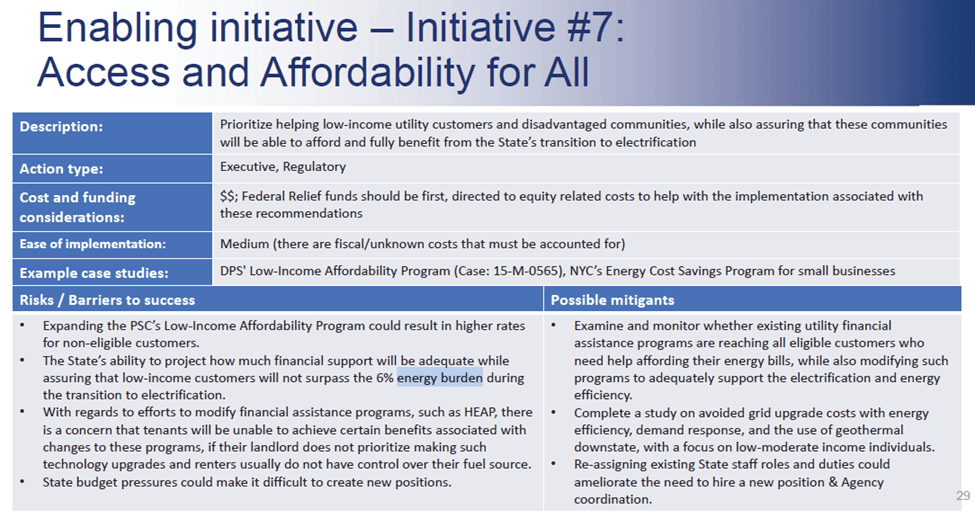

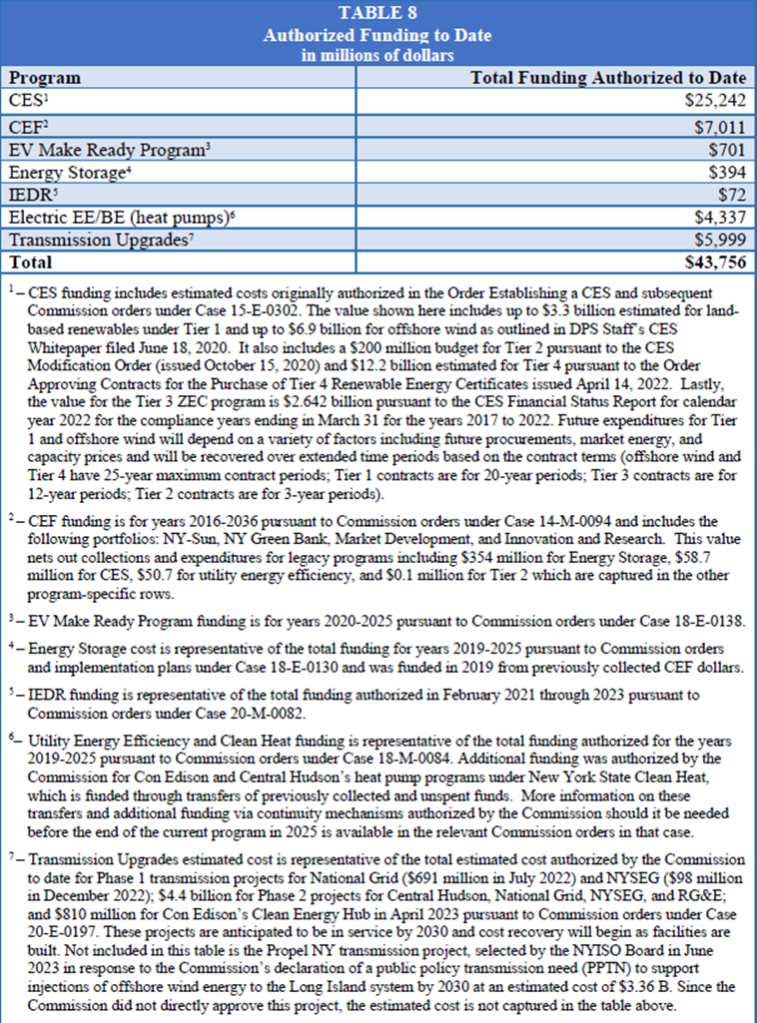
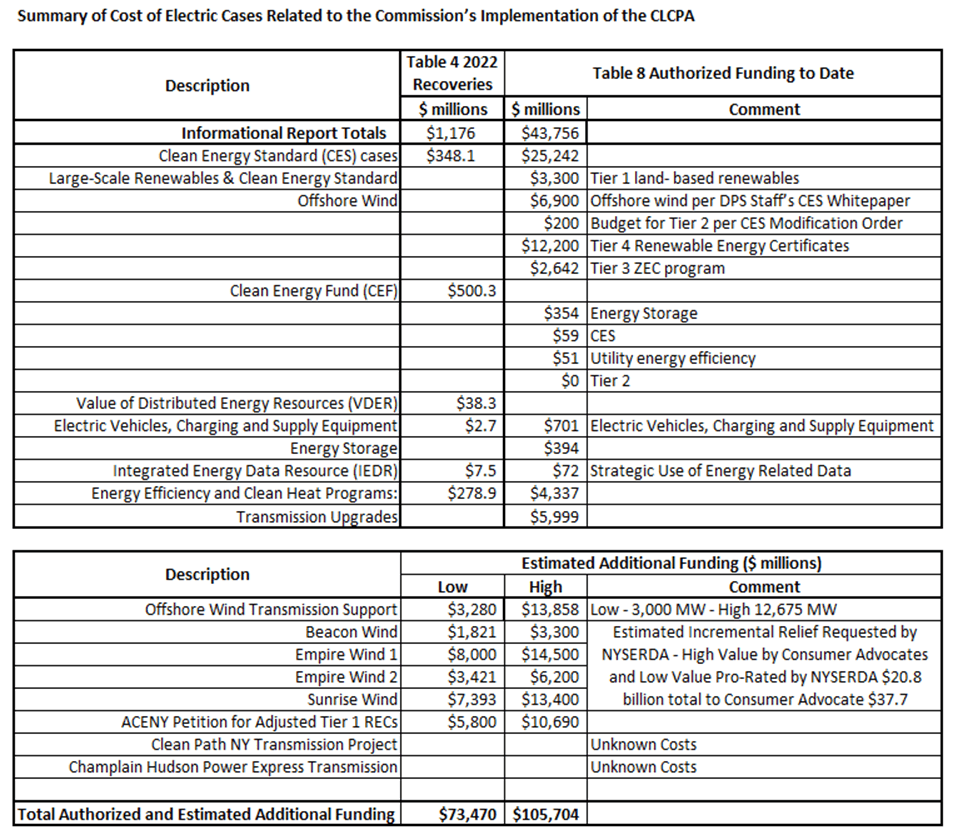

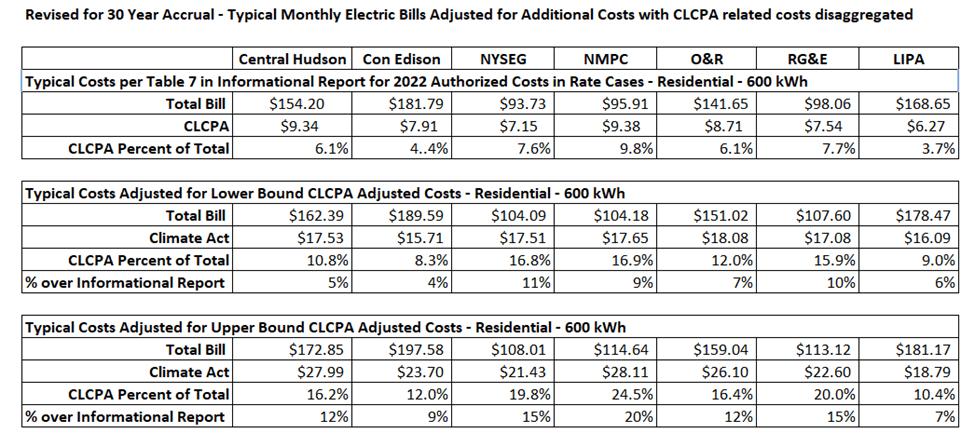

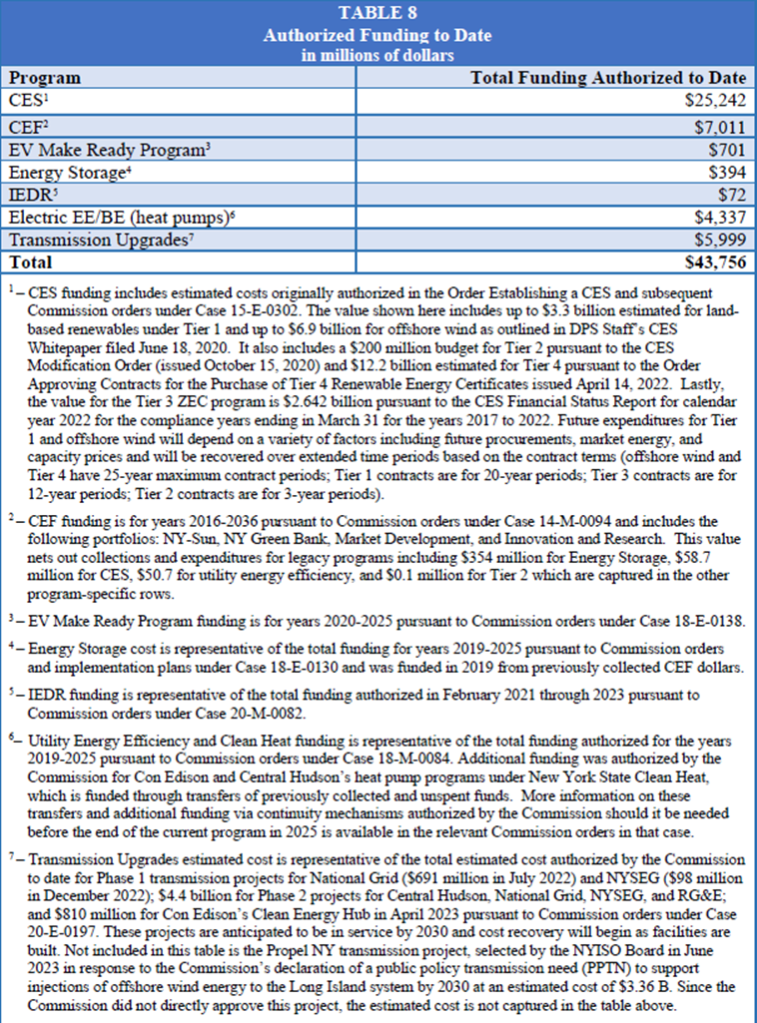
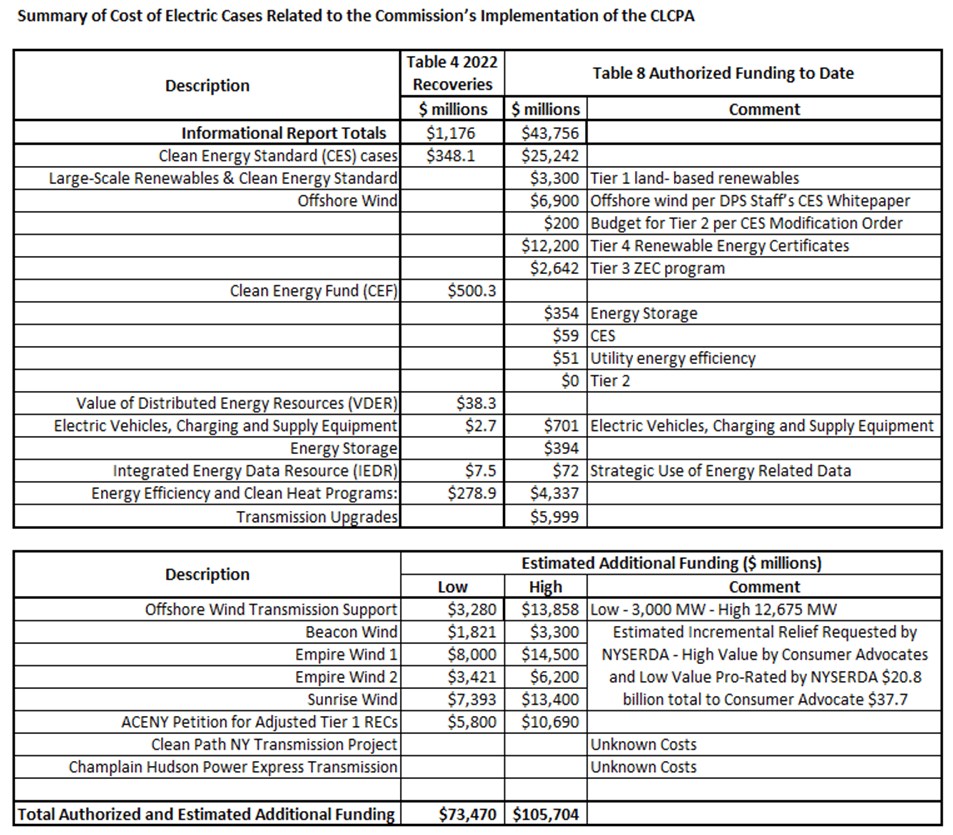

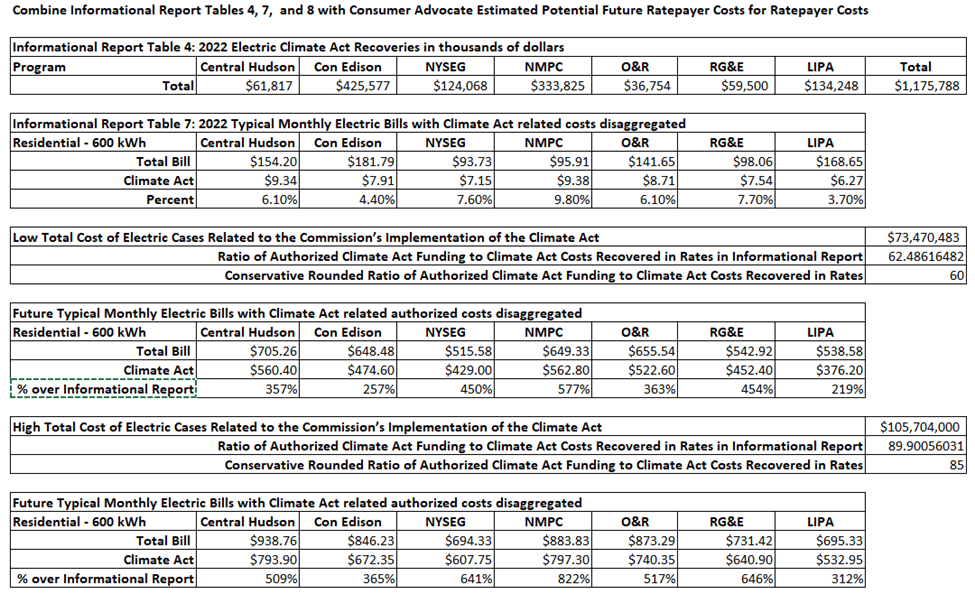
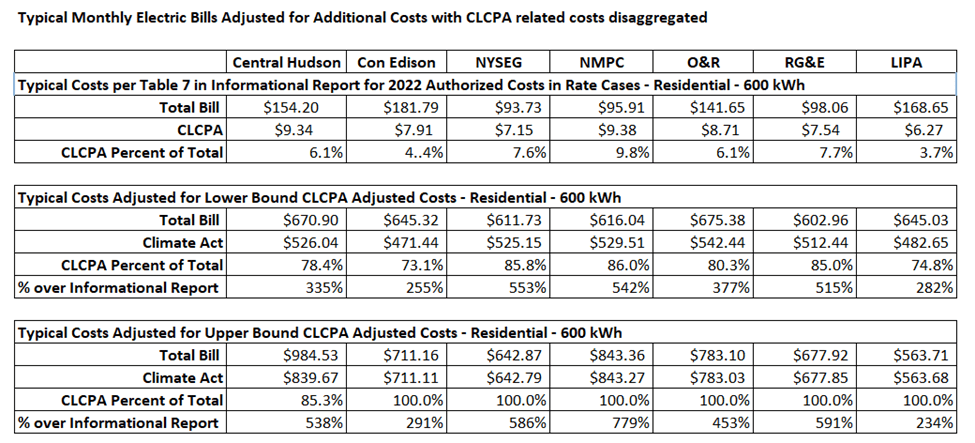
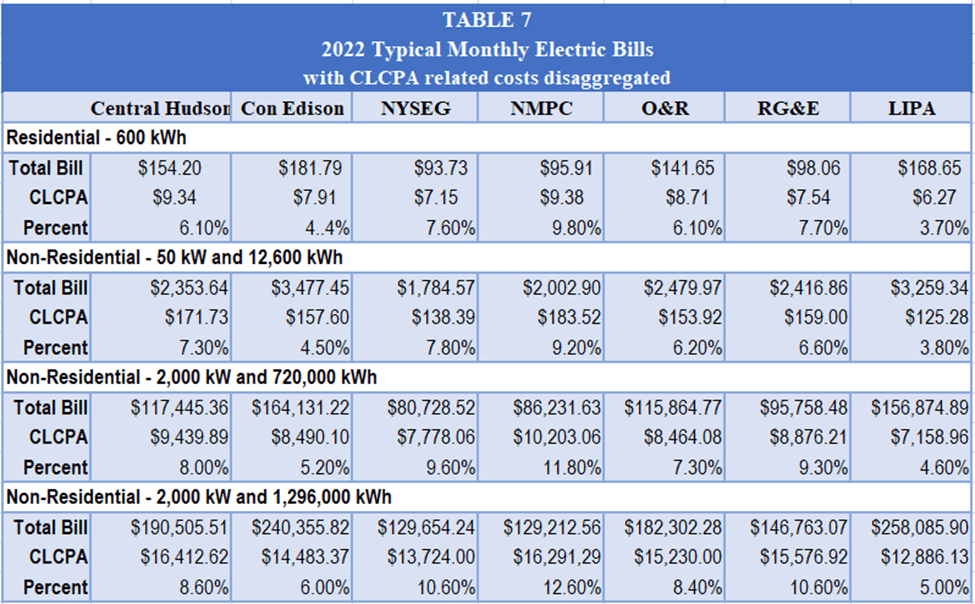
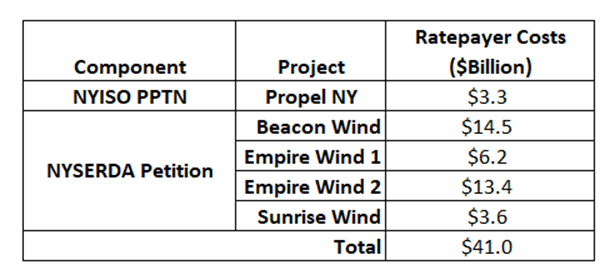
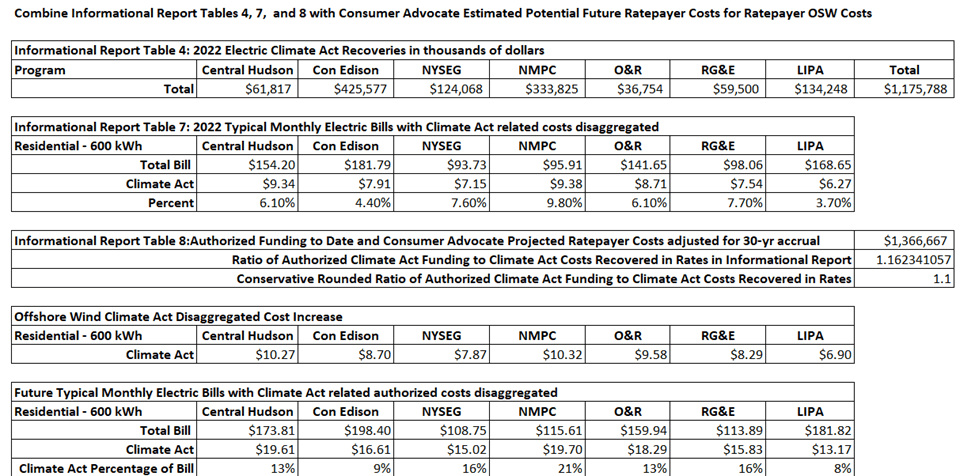
 Pragmatic Environmentalist of New York