
New York Solar Siting Travesty

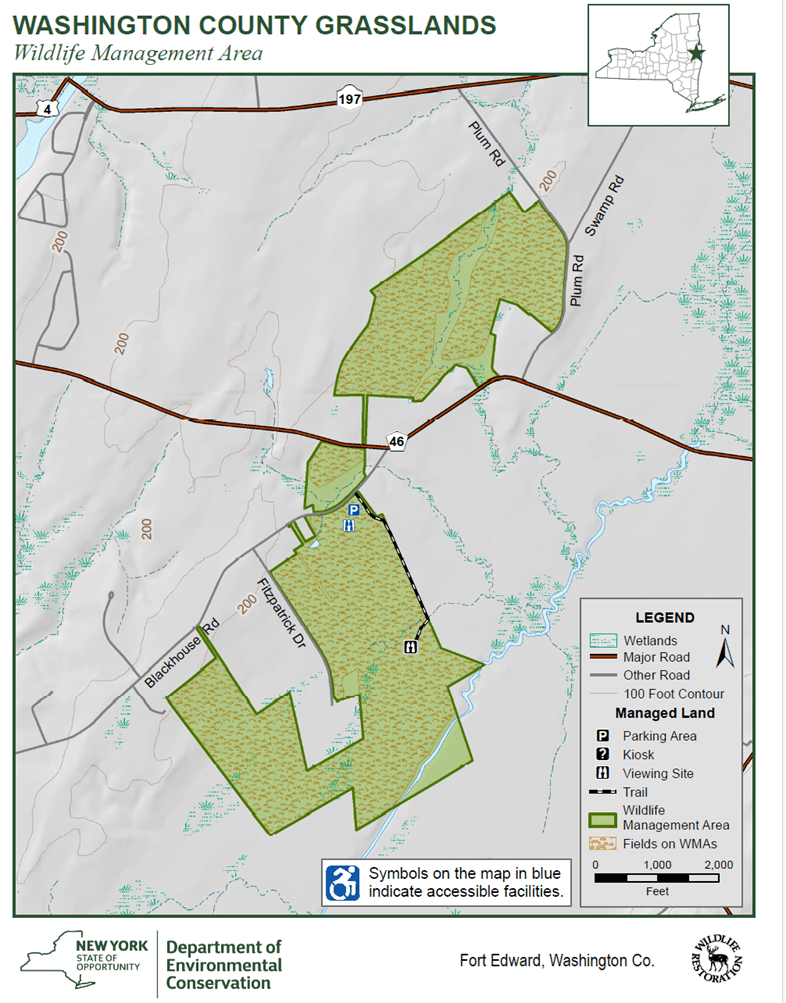
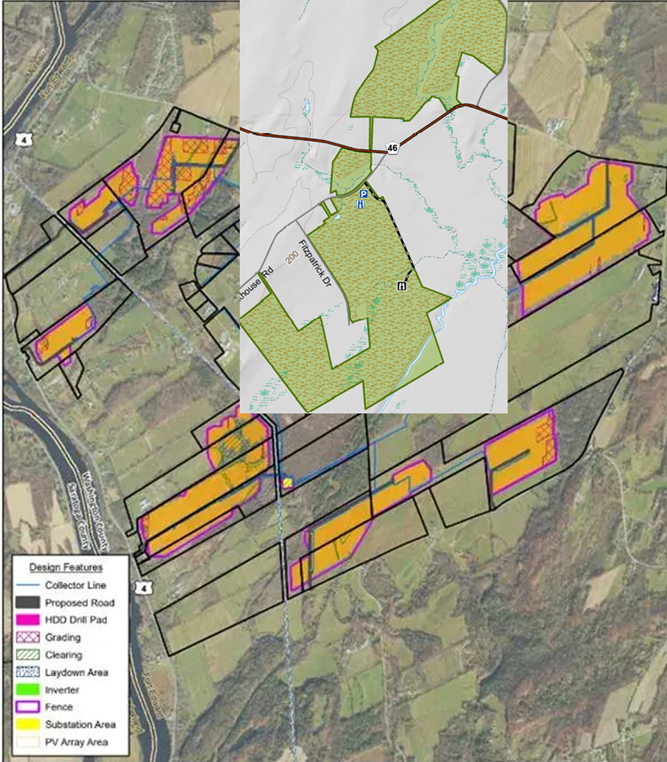
UPDATE 10/18/2025 – In response to a comment the Fort Edward Solar Site Map compared to Washington County Grasslands Wildlife Management Area has been added

In my opinion, the deployment of solar resources exemplifies the poor planning inherent in the Climate Leadership & Community Protection Act (Climate Act) net-zero transition plan.  One of my concerns is that the state process is not emphasizing responsible solar siting because facilities have been built on prime farmland.  I recently found out about a project that is going to be built adjacent to Department of Environmental Conservation (DEC) protected grasslands.  This is another “you have to be kidding me” solar siting travesty and indicates a bigger underlying issue.

I acknowledge the use of Perplexity AI to generate summaries and references included in this document.  Ethics-wise I also acknowledge that I am pushing the bounds of plagiarism simply because I don’t have time to re-write everything to dispel all claims of plagiarism.  I will, however, provide links to the Perplexity source material.  Note that my Perplexity queries are made through my account.  The AI program apparently keeps track of my queries and background so they include disconcerting, to me anyway, references to myself.

I am convinced that implementation of the Climate Act net-zero mandates will do more harm than good because of reliability and affordability risks.  I have followed the Climate Act since it was first proposed, submitted comments on the Climate Act implementation plan, and have written nearly 600 articles about New York’s net-zero transition.  The opinions expressed in this article do not reflect the position of any of my previous employers or any other organization I have been associated with, these comments are mine alone.

Overview

The Climate Act established a New York “Net Zero” target (85% reduction in GHG emissions and 15% offset of emissions) by 2050.  The Climate Action Council (CAC) was responsible for preparing the Scoping Plan that outlined how to “achieve the State’s bold clean energy and climate agenda.”  After a year-long review, the Scoping Plan was finalized at the end of 2022.  Since then, the State has been trying to implement the Scoping Plan recommendations through regulations, proceedings, and legislation.  However, this does not mean that there is a plan that includes milestones, acceptability criteria for targets or boundary conditions that must be met to continue.  As far as I am concerned, Climate Act implementation consists of building as many renewable energy resources as possible, as fast as possible without regard to the wishes of those people affected by those resources and hoping that it will all work out.

Renewable Permitting

Early in the process Climate Act proponents found that the New York State permitting process was slow.  I am familiar with those processes because I was involved with many projects over my career and I admit that they are slow and can be burdensome because there are extensive public participation requirements.  To make progress against those who just don’t want anything in their backyards, responsible State agencies developed extensive siting requirements.  If the proposed facility met all those requirements, then the public participation process incorporated them and worked with the public, so everyone understood what was necessary and made sure the proposal was consistent.

However, that takes time, and the Climate Act has an ambitious schedule.  Climate Act proponents successfully convinced the Legislature that a new siting process was necessary, and the Office of Renewable Energy Siting (ORES) was established.  My Perplexity research explains:

ORES, established under Executive Law Section 94-c through the 2020 Accelerated Renewable Energy Growth and Community Benefit Act, has authority to override local zoning and land use laws for major renewable energy facilities—those 25 megawatts or larger (with projects 20-25 MW able to opt in). This creates a two-tiered system where large solar farms fall under state jurisdiction while smaller projects remain subject to local control.​

The enabling statute explicitly grants ORES power to “elect not to apply, in whole or in part, any local law or ordinance” if it finds such laws “unreasonably burdensome in view of the CLCPA targets and the environmental benefits of the proposed facility”. This waiver authority operates on a case-by-case basis rather than creating blanket preemption.

I have been tracking solar permitting and its impact on prime farmland.  It is extremely disappointing that ORES has ignored guidance from other state agencies.  My latest article provides background on solar mandates   I also have a solar siting issues page that documents my concerns. 

Farmland Protection

The New York Department of Agriculture and Markets has guidelines for solar siting.  New York Department of Agriculture and Markets testimony notes that “The Department’s goal is for projects to limit the conversion of agricultural areas within the Project Areas, to no more than 10% of soils classified by the Department’s NYS Agricultural Land Classification mineral soil groups 1-4, generally Prime Farmland soils, which represent the State’s most productive farmland.”  That seems reasonable to me because they are the Agency responsible for supporting New York agriculture.

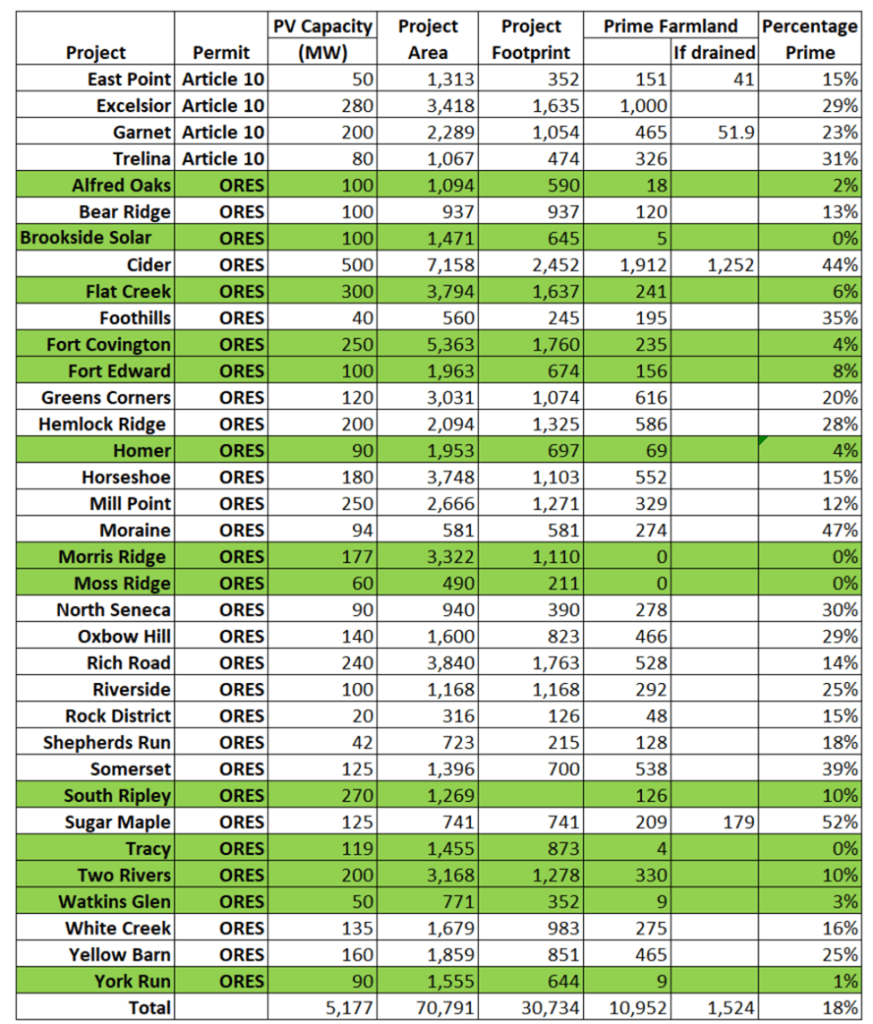
I keep track of the status of projects with this guideline with a Prime Farmland Scorecard.  In May 2025 only 12 of the 25 facilities with data available at the Office of Renewable Energy Permit Applications site meet those guidelines.  Two facilities had no impacts on prime farmland.  If they can do it, why can’t others.

In my last article on the status of prime farmland, I noted that it is extremely frustrating to me that the Department of Ag and Markets recommendation was not adopted as a matter of course for solar development permitting.  Instead, the New York State Energy Research & Development Authority (NYSERDA) is studying the issue.

Last May I noted that I did not see any sign of urgency to finalize and implement farmland protections using the NYSERDA  scorecard.  The Smart Siting Scorecard Specialist Committee had three meetings early in this year but according to the website there hasn’t been any meetings since then.  Worse it does not appear that a solar development can get a failing grade for not doing smart siting.  In my opinion, this is lip service to the issue.

DEC Protected Land

I recently came across another example of ORES ignoring other state agency land use priorities.  In this case the Washington County Grasslands Wildlife Management Area (WMA) is threatened by the development of the Boralex Fort Edward Solar project.  My first Perplexity query produced this description of the WMA:

The Washington County Grasslands Wildlife Management Area (WMA) encompasses 478 acres of protected former agricultural lands in the town of Fort Edward, Washington County. The primary purposes are for wildlife management, wildlife habitat management, and wildlife-dependent recreation. The New York State Department of Environmental Conservation acquired these lands through multiple purchases:​

When I asked Perplexity AI how close the WMA was to the Boralex Fort Edward Solar Farm I got this response: “The Boralex Fort Edward Solar project is not merely “close to” the DEC-protected grasslands—the project is located directly on top of and within these protected areas, creating an unprecedented conflict between renewable energy development and established conservation designations.” 
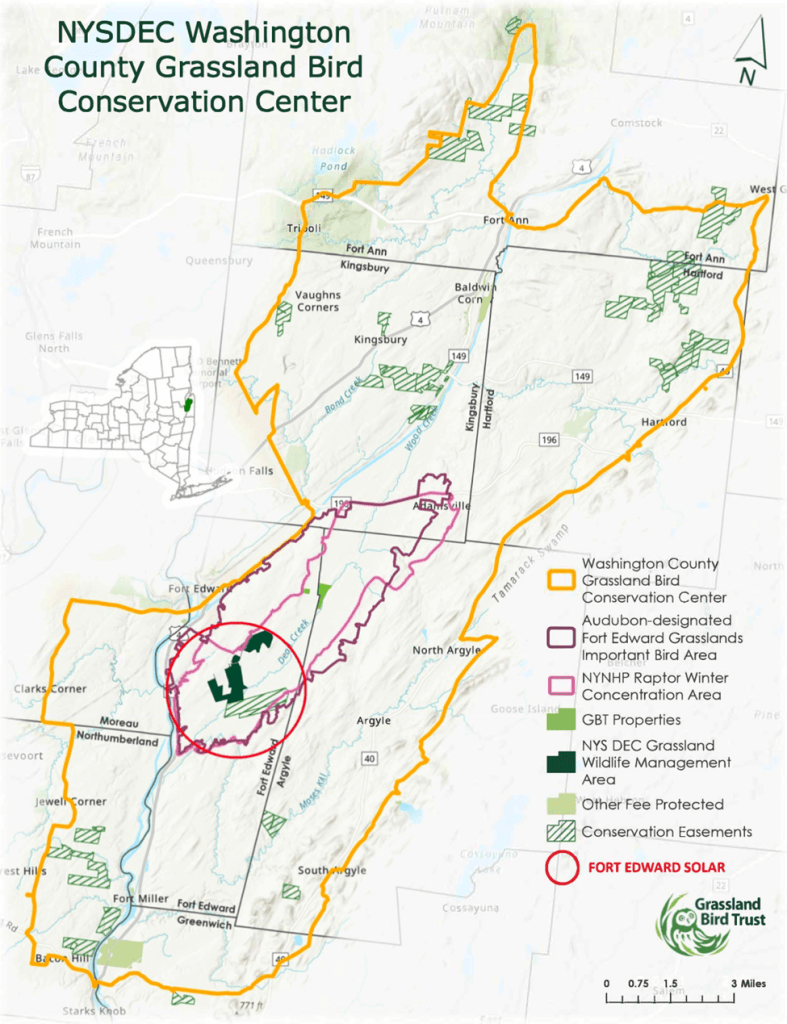
Source: https://houseofgreen.substack.com/p/no-your-eyes-arent-deceiving-you

Alexandra Fasulo writing at the House of Green Substack has described this situation   She posed the obvious question:   

So how could it be that a New York State DEC Grassland Wildlife Management Area could play host to a solar corporation that plans to clear the vegetation and anchor solar panels deep into the earth’s soil?

I called the DEC to ask them this very question. Their answer was discouraging. The DEC told me that since ORES (Office of Renewable Energy Siting) was created in 2020 to “streamline the environmental review process” and circumvent local town laws/pushback that are deemed “burdensome,” the DEC has been largely shut out of all environmental conversations related to solar and wind “farms.”

The individual at the DEC shared in my exasperation and then told me he had not heard of this Fort Edward Solar project. I said to him, “This is a massive solar project that’s going in on top of DEC-protected and fragile habitat! How could this be?”

Again, he shared in my frustration and told me that the future of this land rests with ORES.

Discussion

I have allied myself with the Stop Energy Sprawl coalition because of our shared concerns.  In fact, this post was prompted by Fasulo’s presentation at a recent meeting.  We all share the same vision of a clean environmental legacy but are convinced that New York State’s implementation of the Climate Act is causing significant and irreparable harm to rural communities.  Everyone in the coalition shares the same frustration with ORES. My Perplexity research condenses our local community concern:

In practice, ORES’s authority creates what amounts to state preemption of home rule for large-scale solar development, though with important procedural protection. The statutory framework acknowledges this by requiring ORES to apply local laws unless they’re found unreasonably burdensome—establishing a presumption in favor of local requirements that must be overcome through specific findings.​

However, the “unreasonably burdensome” standard is evaluated explicitly in relation to statewide CLCPA mandates. This inherently weights the analysis toward state energy policy goals over local land use preferences.

It is not only the home rule implications.  I am positive that staff in the state agencies responsible for prime farmland protection and wildlife management areas share the frustration that their guidance is being ignored as illustrated by the responses to Fasulo.  I believe that all this is the consequence of the failure to plan the transition to Net-zero.  The blame for that can be placed squarely on the Climate Action Council who approved the Scoping Plan without including provisions for the development of a feasible transition consistent with existing environmental guidance and recommendations. 

The failure to plan has had negative consequences.  The decision to not require developers to meet the Department of Ag & Markets prime farmland protection guideline has led to the destruction of 6,650 acres of prime farmland.  Renewable developers have blown off Agency comments by saying that their guidance is only a recommendation.  If Boralex is allowed to destroy rare grassland habitat, then this will be a sad day for the environment of New York.

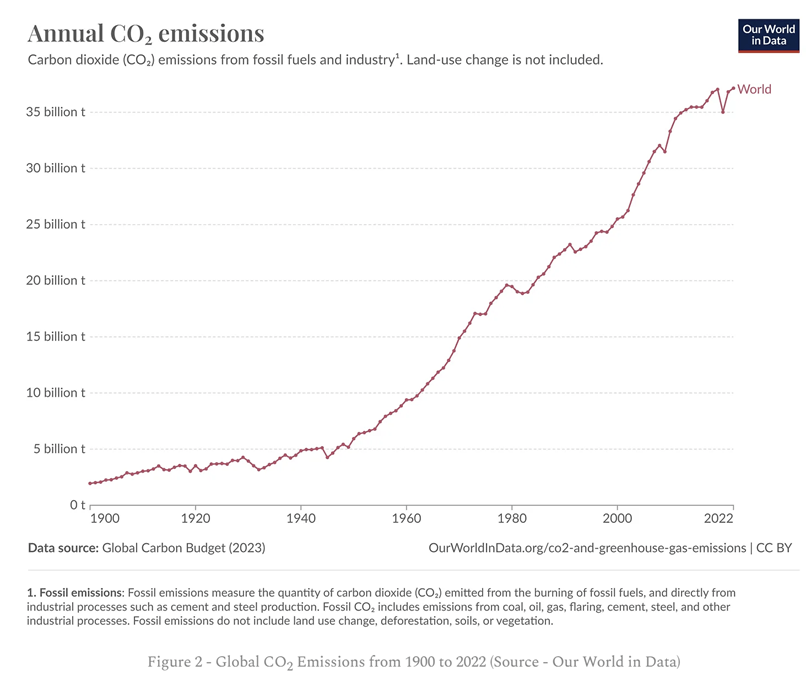
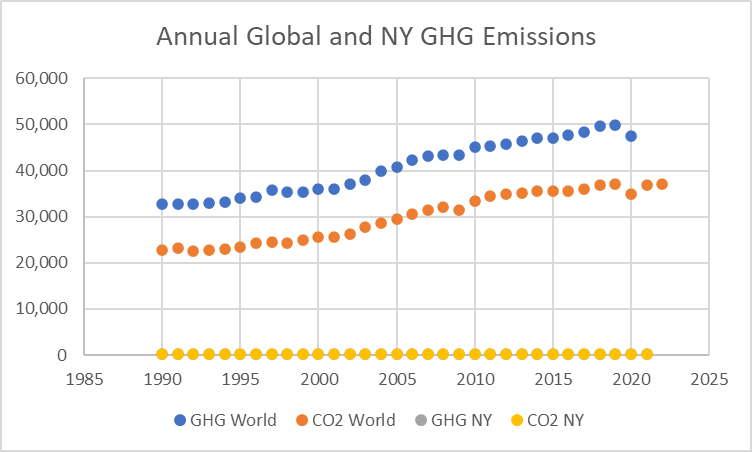
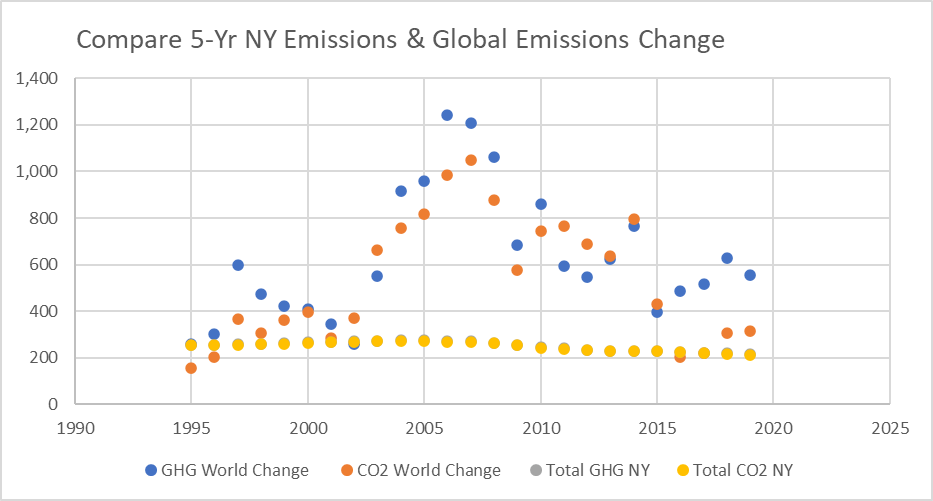
This was all preventable.  The claim that these programs had to be implemented as fast as possible because of the existential threat of climate change is no excuse.  If New York were able to eliminate all its GHG emissions, the effect of global emission increases elsewhere would supplant our efforts in one year.  New York GHG emissions are less than one half of one percent of global emissions and global emissions have been increasing on average by more than one half of one percent per year since 1990.  It is long past time to pause this process until safeguards consistent with State Agency guidance are incorporated into the ORES permitting decisions.  I also think that the public should be aware of the destruction of home rule actions by ORES.

Conclusion

This finding is a great example why I believe the Climate Act implementation can only do more harm than good.  It is time to hold the politicians who were responsible for this debacle accountable for their actions.  Revisions to the laws are necessary to prevent further harm.

Update 10/18/2025 in response to comment
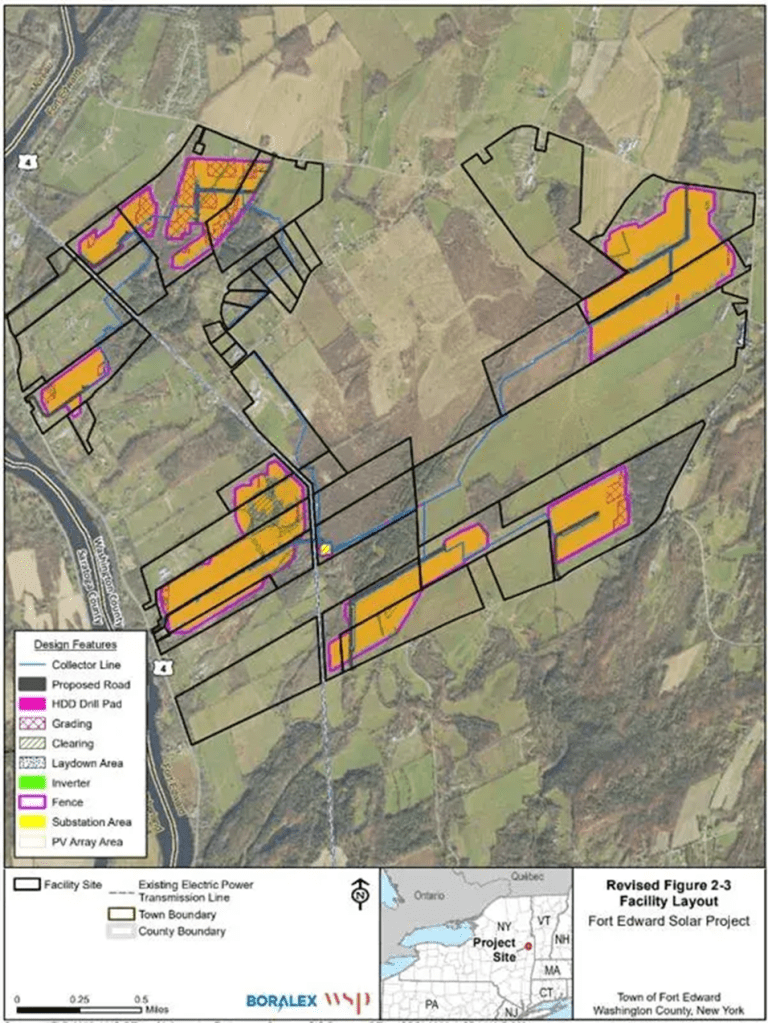
Fort Edward Solar Site Map

Washington County Grasslands Wildlife Management Area
Overlay Two Maps – Approximate Fit- However, the point is that the Boralex Fort Edward Solar panels will be close to the WMA and will impact similar land use types that the DEC is trying to protect. Given all the possible locations for solar projects, why does ORES allow development on this kind of land?
New York Solar Siting Status

I recently had the opportunity to give a briefing on solar siting issues and think it is time to publish an update here.  In my opinion, the deployment of solar resources exemplifies poor planning inherent in the Climate Leadership & Community Protection Act (Climate Act) net-zero transition plan.

I am convinced that implementation of the Climate Act net-zero mandates will do more harm than good because of reliability and affordability risks.  I have followed the Climate Act since it was first proposed, submitted comments on the Climate Act implementation plan, and have written over 500 articles about New York’s net-zero transition.  The opinions expressed in this article do not reflect the position of any of my previous employers or any other organization I have been associated with, these comments are mine alone.

Overview

The Climate Act established a New York “Net Zero” target (85% reduction in GHG emissions and 15% offset of emissions) by 2050.  The Climate Action Council (CAC) was responsible for preparing the Scoping Plan that outlined how to “achieve the State’s bold clean energy and climate agenda.”  After a year-long review, the Scoping Plan was finalized at the end of 2022.  Since then, the State has been trying to implement the Scoping Plan recommendations through regulations, proceedings, and legislation. 

Solar Mandates

Public Service Law Section 66-p requires the Public Service Commission (PSC) to establish a renewable energy program.   Subsection 66-p(2) requires the PSC to establish a program to require that 70% of the

statewide electric generation shall be generated by renewable energy systems; and that by 2040 the statewide electrical demand system will be zero emissions. This basically codifies the Scoping Plan outline for a decarbonized electric system.

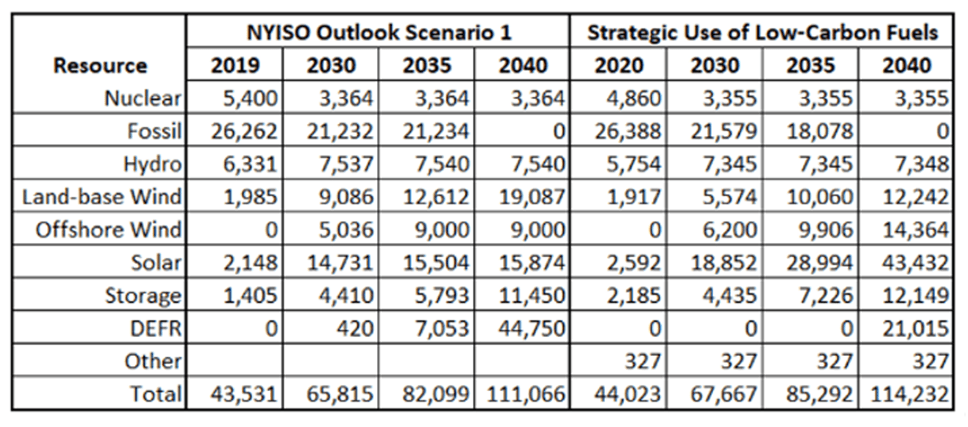
Both the Scoping Plan Key Drivers Output spreadsheet and the New York Independent System Operator (NYISO)  2021-2040 System & Resource Outlook  project a massive increase in New York solar capacity (Table 1).  Note that the solar generating capacity increases to over 20% of total capacity by 2030 for both scenarios.

Table 1: Installed Capacity (MW) NYISO Outlook Scenario 1 and Integration Analysis Mitigation Scenario 2 – Strategic Use of Low-Carbon Fuels

I have a solar siting issues page that documents my concerns.  In my briefing I highlighted three issues with the solar siting policy in New York since the inception of the Climate Act: protection of prime farmland, agrivoltaics policy, and inconsistency with the Scoping Plan,.  The farmland and agrivoltaics issues are addressed by Specialist Committees in the New York State’s Agricultural Technical Working Group.  At their last meeting in November 2024 there were updates for the Regional Agronomic Impacts of Solar Energy (RAISE) Specialist Committee, the Agrivoltaics Specialist Committee, and the Scorecard Specialist Committee that will be discussed below.

Farmland Protection

The New York Department of Agriculture and Markets has guidelines for solar siting.  New York Department of Agriculture and Markets testimony notes that “The Department’s goal is for projects to limit the conversion of agricultural areas within the Project Areas, to no more than 10% of soils classified by the Department’s NYS Agricultural Land Classification mineral soil groups 1-4, generally Prime Farmland soils, which represent the State’s most productive farmland.”  That seems reasonable to me because they are the Agency responsible for supporting New York agriculture.

I keep track of the status of projects with this guideline with a Prime Farmland Scorecard.  At this time only 12 of the 25 facilities with available data at the Office of Renewable Energy Permit Applications site meet those guidelines.  Two facilities had no impacts on prime farmland.  If they can do it, why can’t others.

Table 2: Prime Farmland Scorecard Updated May 25, 2025

It is extremely frustrating to me that the Department of Ag and Markets recommendation was not adopted as a matter of course for solar development permitting.  Instead, the New York State Energy Research & Development Authority (NYSERDA) is studying the issue.  The Smart Siting Scorecard considers this siting concern:

NYSERDA has developed the Smart Solar Siting Scorecard to 1) provide a tool to address multiple solar siting considerations and site management practices from the perspective of environmental, agricultural, and climate interests and 2) to provide criteria for renewable energy developers to consider in siting future projects, and include within project design, operations and maintenance, and decommissioning plans to encourage a balanced approach between renewable energy siting and other New York State policies, goals, and objectives. The Scorecard Specialist Committee provides input to NYSERDA on what avoidance and minimization approach to reduce impacts on these lands and how to value these approaches in a Scorecard format.  

I do not see any sign of urgency to finalize and implement farmland protections using the scorecard.  The Smart Siting Scorecard Specialist Committee has had three meetings this year:

Worse it does not appear that a solar development can get a failing grade for not doing smart siting.  In my opinion, this is lip service to the issue.

Agrivoltaics Policy

In my opinion, responsible solar siting policy would include agrivoltaics requirements that would mitigate impacts to agriculture.  NYSERDA is in charge of agrivoltaics policy: 

Agrivoltaics is a new and emerging combination of technologies that enhance climate resilience and allow sustainable food and energy production. From crop production to livestock grazing and pollinator habitat, agrivoltaics can support a wide range of agriculture practices.

This rapidly growing sector of the solar energy industry is undergoing considerable research, development, and demonstration in the United States and across the globe.

For the latest information and guidance, read the Growing Agrivoltaics in New York State report [PDF].

The New York State’s Agricultural Technical Working Group’s (A-TWG) Agrivoltaics Specialist Committee manages the agrivoltaics policy.  Based on the update at the A-TWG meeting last November, they have meetings and train farmers.  NYSERDA is supporting their efforts with the Agrivoltaics Research and Demonstration Request for Proposal (PON 5752).  The deadline to submit proposals was Sept 12th and contracts were supposed to be awarded in the first quarter of 2025. Nothing has been funded yet.

There is another agrivoltaics study: Regional Agronomic Impacts of Solar Energy (RAISE):

In 2022, the State Farmland Protection Working Group recommended the State initiate a study, to determine the potential benefits and/or burdens of renewable energy development related to New York’s agricultural industry. NYSERDA has convened a Specialist Committee under the A-TWG to assist NYSERDA to undertake a study or studies to assess the impact of solar development on the agricultural economy in the state. The study will inform State and regional policy, and will include an assessment of land use conversions, economic pressures, and other factors. The RAISE Specialist Committee shall:

  • Advise on developing scope(s) of work and associated study methodologies.
  • Identify information, data, and resources helpful to undertaking associated agricultural, economic, land use and other analyses.
  • Make recommendations on undertaking additional studies or actions.

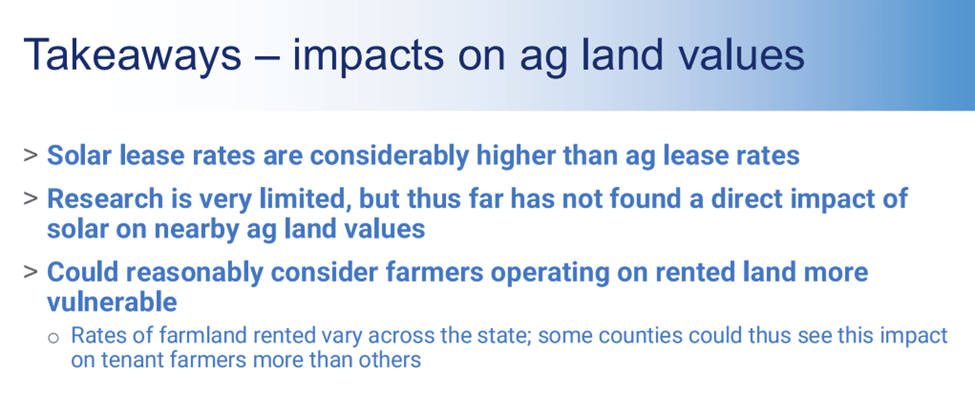
I have found that NYSERDA sponsored research related to the Climate Act is designed to further the narrative that the transition is simple, cheap, and has inconsequential negative impacts.  The RAISE presentation at the last A-TWG meeting described takeaways for the impacts of solar development on agricultural  land values illustrates this on the following slide.  If solar lease rates are higher than agriculture lease rates, then it is obvious that landowners will preferentially lease to the solar developers making it more difficult for farmers who need to lease land to operate.  Note the weasel words – “limited research”, no “direct impact”, and could be “more vulnerable” in the description that try to avoid concluding the obvious.  The longer this report takes to be released the longer these negative impacts will persist and the more the developers can continue to negatively impact agriculture.

Scoping Plan Inconsistency

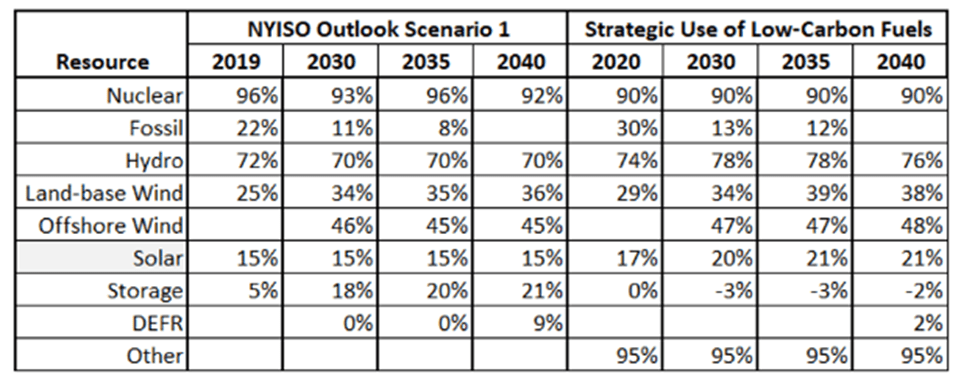
The capacity factor is a measure of how much energy can be provided by a generating facility in a year.  It is simply the amount of energy produced (MWh) divided by the capacity (MW) times the number of hours in the year.  Table 3 lists the capacity factors for the resources listed in Table 1. In my opinion, the Scoping Plan solar capacity factors are biased high.  I believe the only way these factors can be achieved is if the installed solar facilities use tilting axis solar panels.

Table 3: Capacity Factors (%) NYISO Outlook Study S-1 and Scoping Plan Scenario 2

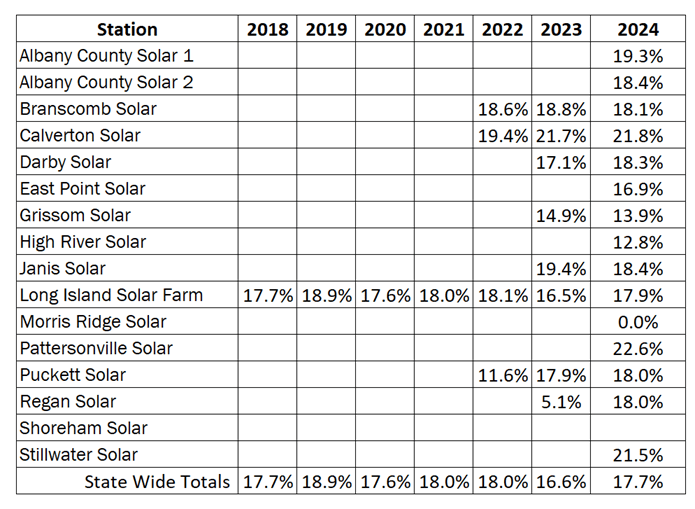
I recently reported on the observed capacity factors of solar facilities.  Table 4 lists individual station factors.

Table 4: New York State Utility-Scale Solar Facility Capacity Factors Based on NYISO “Gold Book” Load & Capacity Data Reports Table III-1

Assuming a linear interpolation between the Scoping Plan Strategic Use of Low Carbon Fuels 2020 capacity factor of 17% and the 2023 factor of 20%, the expected capacity factor was 18.2%.  The observed capacity factors are lower than the Scoping Plan projection and I believe that is likely because NYSERDA does not require solar developers to install tilting axis solar panels to obtain subsidies from the State.

Discussion

The Scoping Plan is just an outline of emission reduction strategies that NYSERDA claims will achieve the goals of the Climate Act.  There never has been a feasibility analysis that proves that the Public Service Law Section 66-p requirement to establish a renewable energy program can work and there are no jurisdictions anywhere that have successfully developed an electric system that relies primarily on wind, solar, and energy storage. As far as I can tell, the Hochul Administration plan is to build as much wind and solar as possible, as fast as possible. That approach meant that there was no provision to develop responsible solar siting guidelines. 

The failure to plan has had negative consequences.  The decision to not require developers to meet the Department of Ag & Markets prime farmland protection guideline has led to the destruction of 6,650 acres of prime farmland.  The lack of an agrivoltaic policy means that very few developers are trying to mitigate the impact of solar panels.  The failure to require utility-scale solar facilities to use tilting-axis solar panels means that even more land will be covered in solar panels.

This was all preventable.  The claim that these programs had to be implemented as fast as possible because of the existential threat of climate change is no excuse.  If New York were able to eliminate all its GHG emissions, the effect of global emission increases elsewhere would supplant our efforts in one year.  New York GHG emissions are less than one half of one percent of global emissions and global emissions have been increasing on average by more than one half of one percent per year since 1990.  

Conclusion

NYSERDA has lost its way as a source of unbiased scientific information to guide energy policy in New York.  Their Climate Act responsibilities are opaque, their work products are biased to support the political narrative, there is no sense of urgency to address obvious deficiencies in current policy, and they do not respond to stakeholder concerns.  This has significant negative consequences for New York.

I cannot help but think that there is another reason for the development policy to build as much as possible as fast as possible.  The developers of these facilities push that narrative because they know that limits on using prime farmland and mandates to use tilting-axis solar panels will hurt their profitability.  It is all about the money.

Grifters Follow the Money

A recent letter to the editor of the Syracuse Post Standard Focus on economic benefits of NY’s renewable energy projects is the subject of this post.  I am very frustrated with the New York Climate Leadership & Community Protection Act (Climate Act) net zero transition because claims made by the supporters are so misleading that it beggars my mind that editors publish the letters.  The reality is that there are so many issues coming up with the schedule and ambition of the Climate Act that it is obvious that we need to pause implementation and figure out how best to proceed.

I am convinced that implementation of the Climate Act net-zero mandates will do more harm than good if the future electric system relies only on wind, solar, and energy storage because of reliability and affordability risks.  I have followed the Climate Act since it was first proposed, submitted comments on the Climate Act implementation plan, and have written over 500 articles about New York’s net-zero transition.  The opinions expressed in this article do not reflect the position of any of my previous employers or any other organization I have been associated with, these comments are mine alone.

Overview

The Climate Act established a New York “Net Zero” target (85% reduction in GHG emissions and 15% offset of emissions) by 2050.  It includes an interim reduction target of a 40% GHG reduction by 2030. The Climate Action Council (CAC) was responsible for preparing the Scoping Plan that outlined how to “achieve the State’s bold clean energy and climate agenda.”  After a year-long review, the Scoping Plan was finalized at the end of 2022.  Since then, the State has been trying to implement the Scoping Plan recommendations through regulations, proceedings, and legislation. 

Letter to the Editor

The following letter was written by Marguerite Wells from Ithaca, NY. 

Keeping an open mind is one of the hardest things to do. With a constant stream of social media, information and communication, we can develop opinions and stances that are very hard to change.

When I first entered New York’s renewable energy conversation as a farmer in Central New York, my focus was on protecting air and water quality and not relying on foreign sources for our energy. While these goals are admirable, it was harder to answer the more personal questions, “How does this help me, my farm, and my family?” I wasn’t the only one asking that question.

When you hear of a solar or wind farm being proposed near you, it’s fair to ask, “How will this help me?”

While these projects will contribute to our statewide energy transition, those who most stand to benefit are the towns and landowners who host these projects.

It isn’t just about climate goals. It is about the deli down the street getting more customers during and after construction. It is about towns receiving funds to fix the roads, or build a new park. It is about our children’s public school receiving millions from tax agreements from these private companies. Projects such as Morris Ridge Solar, New York’s largest solar farm, will pay $1.6 million in direct community payments each year, according to public data. This is an example of how these types of investments bring real, tangible benefits to local communities.

As a farmer, I was also drawn to the fact that these projects help preserve agricultural land. Rather than being permanently lost to real estate development, developing wind and solar can offer a lifeline to our family farms, providing them with new revenue, and helping keep farmland in the family for future generations.

Skepticism is good. Questions are good. Preconceived notions that don’t allow you to hear the facts are not.

Whether you’re a farmer, a town official, an everyday citizen or a skeptic, I invite you to continue this conversation. Join us at the 21st Annual Symposium on Energy on April 4 at the SUNY College of Environmental Science and Forestry in Syracuse. Learn more at energy21symposium.org.

Marguerite Wells

Ithaca

Comments

Faced with incessant media messaging that the green energy transition is necessary and will save the planet keeping an open mind is indeed difficult.  Here is one aspect of the issue not pursued by the mass media. Robert Bryce describes the IRA lobbying frenzy currently underway in Washington:

The late economist Milton Friedman famously declared that “nothing is so permanent as a temporary government program.”

Friedman’s line comes to mind because a lobbying frenzy is underway in Washington, DC. Some of the city’s most powerful special interests are working to prevent a repeal or reduction of the lavish energy-related tax credits in the Inflation Reduction Act. No lobby group is working harder than the American Clean Power Association.

Why is the ACPA pushing so hard? The answer is simple: Its members have collected tens of billions of dollars in federal subsidies, loans, and loan guarantees over the past few years to install solar energy, wind energy, batteries, and other forms of alt-energy, and they don’t want that geyser of federal money to stop.

In the face of mounting evidence that the Climate Act net-zero transition is not going according to plan and should be paused for a re-assessment, New York’s green energy special interests are also pushing hard.  This letter is an example.

When I read the letter, my impression was that the author was a farmer who was only interested in the renewable energy conversation.  Her name was somewhat familiar, but it was not until I read an announcement for the New Yorkers for Clean Power April Renewables Supporters Speaker Series agenda for “Insights on Onshore Wind” that I made the connection.  The announcement said that Marguerite Wellswas an expert in onshore wind energy development and policy and she is the Executive Director at the Alliance for Clean Energy New York (ACE NY).  ACE NY mission is “to promote the use of clean, renewable electricity technologies and energy efficiency in New York state, in order to increase energy diversity and security, boost economic development, improve public health, and reduce air pollution.” My first observation is that readers deserve to know that Wells is not just a farmer but has more than a passing personal interest in the renewable energy transition.

Her association with ACE NY biases the letter contents.  Advocates like Wells invariably repeat the talking point that green energy will protect air and water quality while decreasing reliance on foreign sources for our energy. Russ Schussler compiled a document that addresses many green energy talking points.  He explains that claiming that green energy is environmentally neutral ignores the adverse impacts of renewable energy development. New York has not updated the environmental assessment of the cumulative impacts for the projected onshore wind, offshore wind, solar, and energy storage resources projected by the State in the Scoping Plan completed at the end of 2022.  The Final Supplemental Generic Environmental Impact Statement (SGEIS) on the proposed Climate Leadership and Community Protection Act was accepted in September 2020.  Since then, the projections for renewable resources have increased.  The Scoping Plan projects 830 additional 3 MW onshore wind turbines, 439 additional 18 MW offshore wind turbines, and over 100 million 350-watt solar panels compared to the SGEIS. There also were no projections for energy storage or Dispatchable Emissions-Free Resources that the Scoping Plan has determined are necessary for a zero-emissions electric generating system.  The Scoping Plan considered life-cycle impacts of fossil fuels but ignored the adverse impacts related to their operation and disposal of wind and solar components.  Recycling is challenging to impossible for the large structural components and also the scarce resources needed for energy conversion.

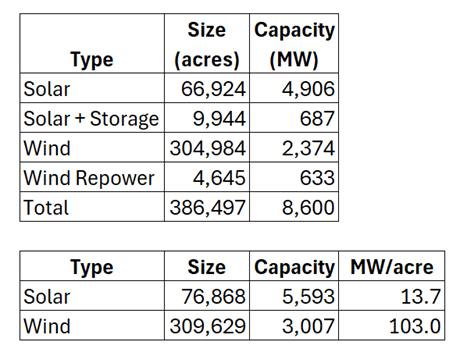
Another point that this letter ignores is the magnitude of the resources necessary and the resulting sprawl across New York.  The New York State Office of Renewable Energy Siting and Electric Transmission (ORES) and the Department of Public Service (DPS) have a new interactive map of solar and wind project siting status.  Here are the total capacity and the land covered by existing renewable energy sprawl.

The Scoping Plan’s Integration Analysis (IA) included three scenarios that projected future resources necessary (Strategic Use of Low-Carbon Fuels, Accelerated Transition from Combustion, and Beyond 85% Reduction) and the New York Independent System Operator made two projections too.  The number of acres required for those resources shown below is staggering.

According to Wells the development of wind and solar resources “bring real, tangible benefits to local communities” and help preserve agricultural land.  Wells mentions that the Morris Ridge Solar will pay $1.6 million in direct community payments each year and notes that rental payments “can offer a lifeline to our family farms, providing them with new revenue”.  One of the unintended consequences of extensive solar development is that it affects the viability of farmers that must rent land for their operations.  An agronomist and environmental planner in western New York explained that the problem is that farmers are now competing with solar developers who are paid direct and indirect subsidies that enable them to offer land owners up to ten times the current agricultural annual lease rates.   This raises the concern that farmers will not have enough available farmland to support the investment they have made in facilities, livestock, or equipment.  Furthermore, claims that these projects will support the agricultural economy overall is simply wrong.  It will reduce farm jobs when farmers rent their land rather than farm so economic activity may be improved during construction but once the facility is operational there are very few economic benefits to essential local businesses.

Wells claims that wind and solar development will “help preserve agricultural land”.  She does not mention that the New York state utility-scale solar siting program does not ensure responsible solar siting that protects agricultural land.  I have documented some of the issues with solar siting.  For example, the Department of Agriculture and Markets (“Department”) has a solar project siting goal “to limit the conversion of agricultural areas within the Project Areas, to no more than 10% of soils classified by the Department’s NYS Agricultural Land Classification soil groups 1-4, generally Prime Farmland soils, which represent the State’s most productive farmland.”  Undoubtedly due to lobbying pressure, the Department has submitted comments raising the issue when solar projects apply for permits but no application has been modified when the limit is exceeded.  The Morris Ridge Solar project is the biggest project in the state, and they did not convert any prime farmland so it can be done.  The Prime Farmland Scorecard at my solar issues page lists 35 solar projects and only 12 meet the Department goal and the average over all projects is 18%.  The total prime farmland converted to solar factories is 10,952 acres.

In her closing arguments she says that skepticism and questions are good, but “preconceived notions that don’t allow you to hear the facts are not.”  This leads up to an invitation to “continue this conversation at the 21st Annual Symposium on Energy in the 21st Century on April 4 at the SUNY College of Environmental Science and Forestry in Syracuse. This annual gathering of the grifters of the green energy scam is an example of the many ways that green energy can pay out.  I am familiar with examples of symposiums on issues of the day that provided the organizer with enough money to forgo full-time work.  I have little doubts that this symposium is any different.

Worse these purveyors of doom and gloom who claim it can be solved with their green energy solutions are a real danger to society.  Bryce provides two relevant reasons related to the Federal programs that are also applicable to New York:

First and foremost, the ITC and PTC are, to use the title of Meredith Angwin’s excellent 2020 book, shorting the grid. The massive subsidies for weather-dependent forms of generation are distorting electricity markets and contributing to the premature closure of the thermal plants needed to assure the affordability, reliability, and resilience of our electric grid.

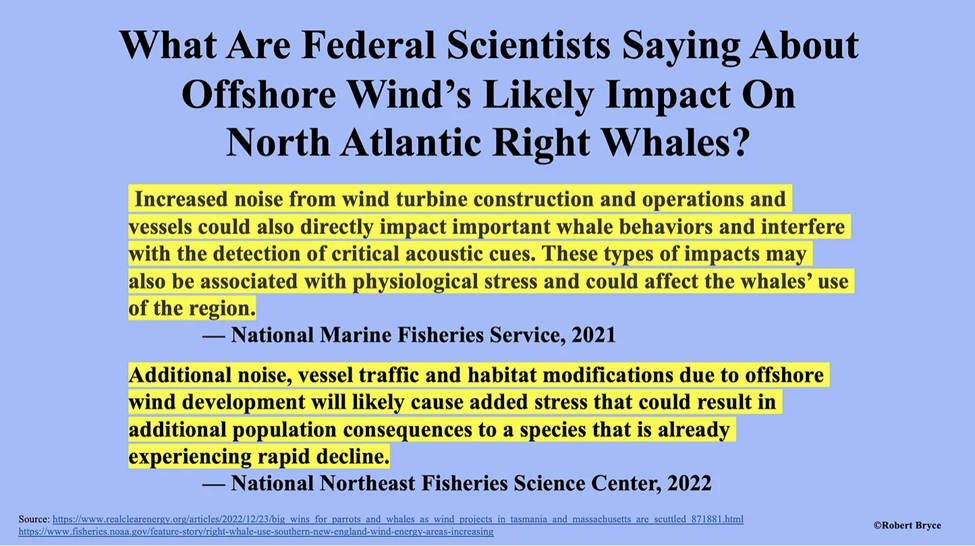
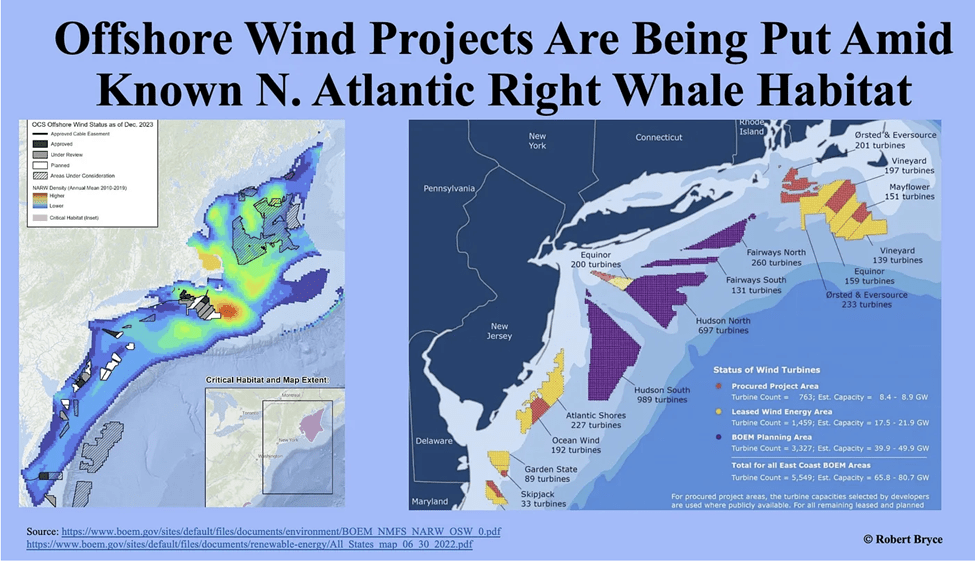
Second, these subsidies are fueling the landscape-wrecking, bird-and-bat killing, property-value-destroying energy sprawl that comes with the expansion of Big Solar and Big Wind. They are also fueling the insane expansion of offshore wind energy into the known habitat of the critically endangered North Atlantic Right Whale and other marine mammals.

Conclusion

The Scoping Plan and all the proposed green energy programs are crimes against physics.  The energy density of wind and solar energy is too low and the resource intermittency too variable so that no electric system relying on those resources for most of its energy can ever hope to provide reliable electricity.  If this reality is not acknowledged soon and these policies paused, then the enormous costs of this futile gesture to control the climate will bankrupt the state. 

Despite all the evidence that this can never work, the Hochul Administration continues to push the Climate Act, supporters like Wells continue to get misleading opinions published, and people flock to meetings to congratulate each other on their virtuous plans.  I believe that ultimately the reason for the continuing support is the money.  For every advocate motivated to save the planet for selfless reasons, there is someone whose primary motivation is cashing in on the scam.

Offshore Wind Cumulative Environmental Impacts

On October 26, 2024, Charles Rotter mentioned the availability of the Bureau of Ocean Energy Management (BOEM) final Programmatic Environmental Impact Statement (PEIS) for the offshore wind development in the New York Bight.  I have long complained that New York State has failed to consider the cumulative environmental impacts of New York’s offshore wind plans, so I reviewed the PEIS to see whehter BOEM addressed the problem.

I have followed the Climate Leadership & Community Protection Act (Climate Act)since it was first proposed, submitted comments on the Climate Act implementation plan, and have written over 450 articles about New York’s net-zero transition. The opinions expressed in this article do not reflect the position of any of my previous employers or any other organization I have been associated with, these comments are mine alone.

Overview and Background

The Climate Act established a New York “Net Zero” target (85% reduction in GHG emissions and 15% offset of emissions) by 2050.  It includes an interim 2030 reduction target of a 40% reduction by 2030. Two targets address the electric sector: 70% of the electricity must come from renewable energy by 2030 and all electricity must be generated by “zero-emissions” resources by 2040. The Climate Action Council (CAC) was responsible for preparing the Scoping Plan that outlined how to “achieve the State’s bold clean energy and climate agenda.” The Integration Analysis prepared by the New York State Energy Research and Development Authority (NYSERDA) and its consultants quantifies the impact of the electrification strategies.  That material was used to develop the Draft Scoping Plan outline of strategies.  After a year-long review, the Scoping Plan was finalized at the end of 2022.  Since then, the State has been trying to implement the Scoping Plan recommendations through regulations, proceedings, and legislation. 

The Integration Analysis Technical Supplement Appendix G Annex 2: Key Drivers and Outputs spreadsheet describes the projected resources necessary to implement the Climate Act targets.  The projections dated September 21, 2022, estimate that in 2030 New York State offshore wind will comprise 8.0% of the capacity (6,200 MW) and 15.3% of the energy production (GWh) and the percentages will increase to 12.0% of the capacity (13,484 MW) and 22.2% of the energy production in 2040.  Clearly the Scoping Plan is counting on offshore wind to be a major contributor to the future electric system.

In my Draft Scoping Plan comments I noted that on September 17, 2020 the Final Supplemental Generic Environmental Impact Statement (SGEIS) for the Climate Leadership and Community Protection Act was released.  It covered the “environmental impacts of the offshore wind and distributed solar procurement goals, and the estimate of utility-scale solar capacity required to meet the meet the 70 by 30 goal” based on the resources estimated necessary at that time.  The expected total offshore wind capacity considered was 9,000 MW.  This is much less than the Integration Analysis 2050 expected capacity of 16,905 MW.

New York Bight Offshore Wind Projections

Unfortunately, the scope of this document is limited and does not address cumulative impacts from all the projects expected.  The Executive Summary states:

This Final Programmatic Environmental Impact Statement (PEIS) assesses the potential biological, socioeconomic, physical, and cultural impacts that could result from development activities for six commercial wind energy leases in an area offshore New Jersey and New York known as the New York Bight (NY Bight), as well as the change in those impacts with avoidance, minimization, mitigation, and monitoring (AMMM) measures.

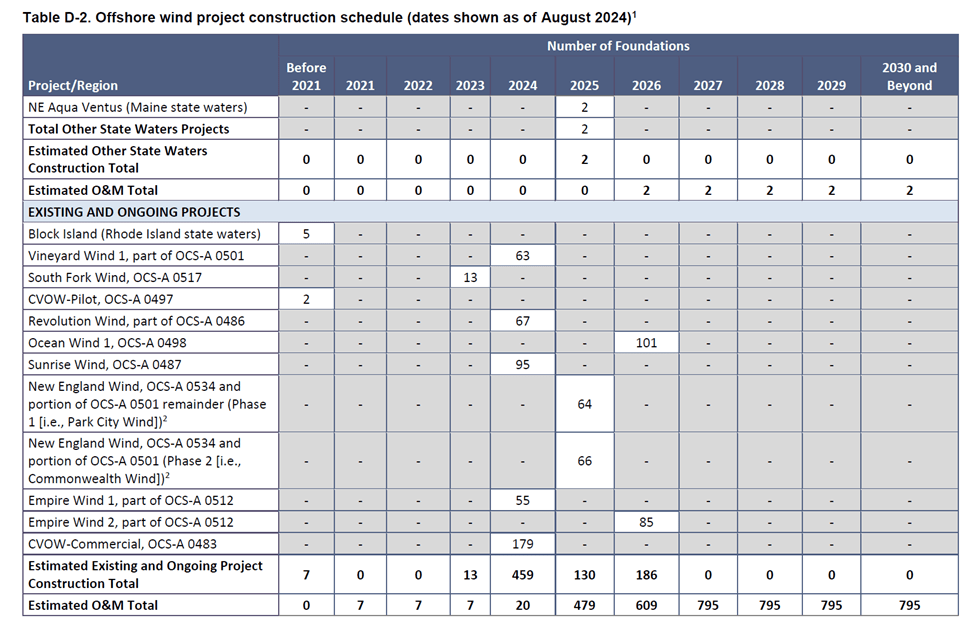
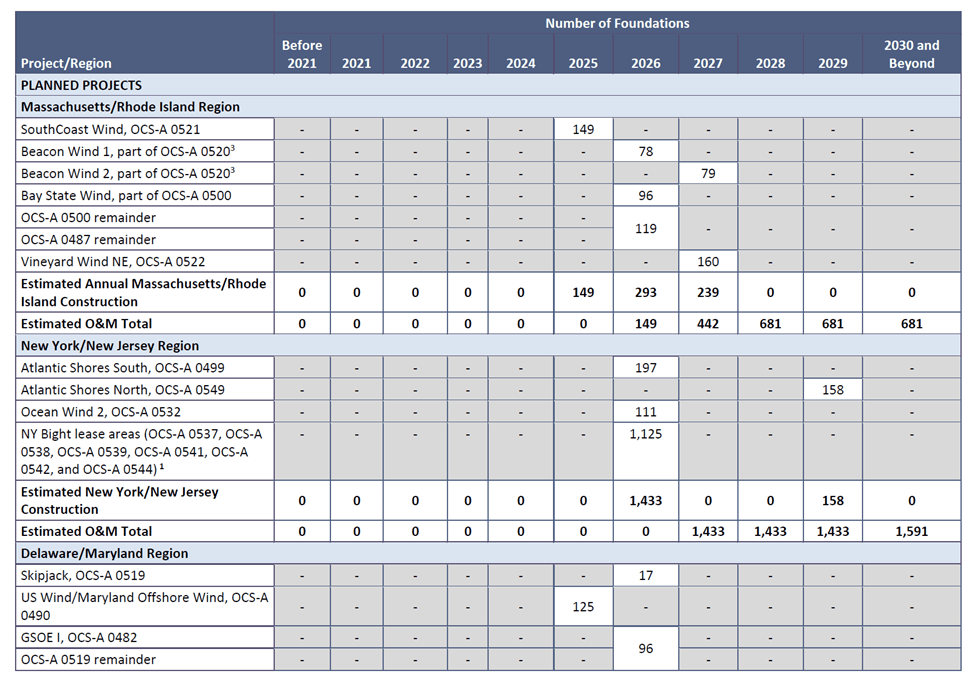
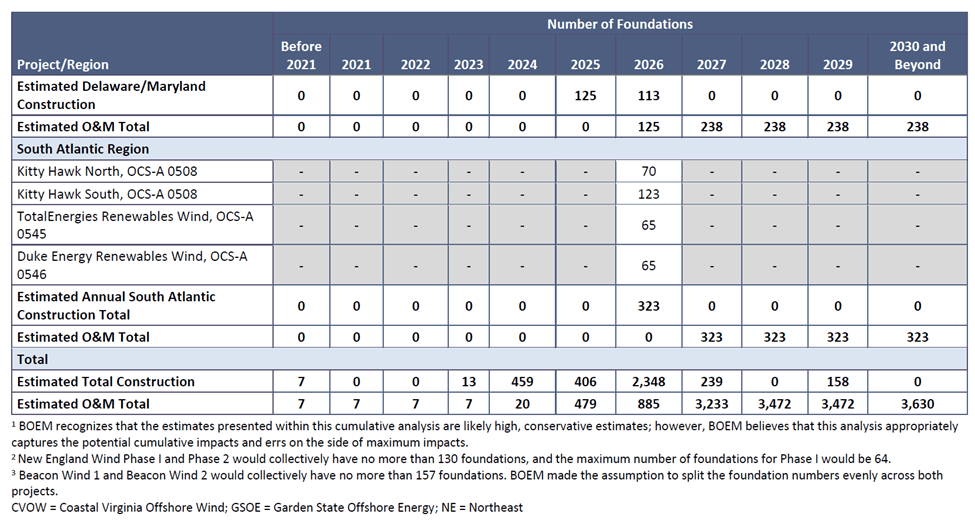
In PEIS Appendix D: Planned Activities Scenario there is a table that describes offshore wind project construction schedules.  It lists the number of foundations expected from Massachusetts to Delaware which is the same thing as estimating the number of turbines.  document describes the ongoing and planned activities that could occur in the New York Bight.  Table D-2 shows that 795 wind turbine foundations are expected by the end of 2026 for existing and ongoing projects.  Planned projects along the mid-Atlantic coast bring the total to 3,630 wind turbines by the end of 2029.  However, the PEIS only considers the 1,125 foundations/wind turbines in the New York Bight.

The Executive Summary explains that:

The PEIS assesses the potential biological, socioeconomic, physical, and cultural impacts that could result from development activities for six commercial wind energy leases in an area offshore New Jersey and New York known as the New York Bight (NY Bight), as well as the change in those impacts with avoidance, minimization, mitigation, and monitoring (AMMM) measures. The six commercial leases analyzed in this Final PEIS are OCS-A 0537, 0538, 0539, 0541, 0542, and 0544 (hereafter referred to as the NY Bight leases or NY Bight lease areas), totaling over 488,000 acres (197,486 hectares) (Figure ES-1), which were issued by the Bureau of Ocean Energy Management (BOEM) on May 1, 2022.

I conclude that the PEIS does not address the cumulative impacts of all future potential offshore wind development.

Goal of PEIS

It turns out that the PEIS was not intended to address cumulative impacts.  The Executive Summary describes the goals of the analysis:

BOEM has prepared this Final PEIS to (1) identify and analyze AMMM measures that could avoid, minimize, mitigate, and monitor impacts on resources in the six NY Bight lease areas and (2) focus future project-specific environmental analyses. This Final PEIS evaluates the potential impacts from anticipated wind energy development within the NY Bight lease areas to inform BOEM in identifying AMMM measures that BOEM may require as conditions of approval for activities proposed by lessees in Construction and Operation Plans (COPs). This Final PEIS will also facilitate the timely review of COPs submitted for the NY Bight lease areas by focusing the project-specific environmental analysis on project impacts not considered in the PEIS or those impacts that warrant further consideration. The project-specific analyses will occur after this PEIS is issued and may tier from or incorporate by reference this PEIS and could also incorporate revised, additional, or different AMMM measures as needed. This PEIS does not, by itself, impose any mitigation measures on future COPs, and instead depends on subsequent COP-specific environmental analysis. This PEIS is therefore not the consummation of the agency’s decision-making for these measures as applied to specific COPs.

The Executive Summary explains that the document describes expected issues and potential impacts to identify the AMMM measures that can mitigate impacts when the COPs are proposed.  BPEM chose this subset of projects because they are close to each other and their expected development times are similar.  They indicate that this will enable them to focus on site-specific issues for future project applications.  It describes four objectives:

  • Analyzing potential impacts if development is authorized in the six NY Bight lease areas.
  • Analyzing AMMM measures for the six NY Bight lease areas.
  • Analyzing focused, regional cumulative effects.
  • Tiering of project-specific environmental analyses.

Impacts Summary

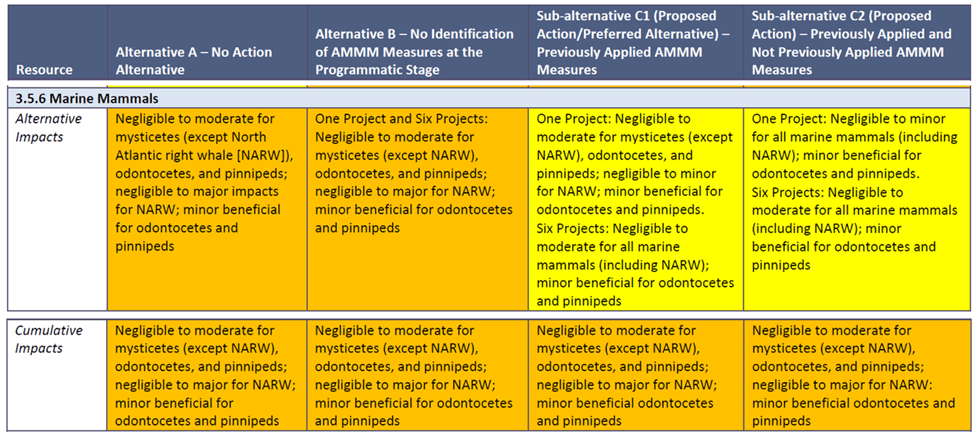
Table ES-2 summarizes and compares impacts among alternatives that includes an assessment of cumulative impacts for different alternatives.  The following excerpt from the table lists the impacts to marine mammals.  Note that the impacts to North Atlantic Right Whales (NARW) all suggest that major impacts are possible for all the alternatives in the New York Bight.  The PEIS only considers about a third of the wind turbines expected by 2030.

North Atlantic Right Whale

Last spring Bud’s Offshore Energy (BOE) “Energy Production, Safety, Pollution Prevention, and More” website reviewed the Bureau of Ocean Energy Management and National Oceanic and Atmospheric Administration Fisheries North Atlantic Right Whale and Offshore Wind Strategy.  His key takeaways:

The document effectively summarizes the dire state of the North Atlantic Right Whale.

  • The BOEM/NOAA strategy is to monitor and further assess the impacts.
  • The need for mitigation will be determined through collaborative processes.
  • This industry-friendly strategy contrasts sharply with the restrictive operating requirements proposed for the more speculative Rice’s whale expanded area in the Gulf of Mexico.

He describes the status of the Right Whales:

NARW status (pages 7-14):

  • Roughly 237 NARWs have died since the population peaked at 481 in 2011, exceeding the potential biological removal (PBR) level on average by more than 40 times for the past 5 years (Pace III et al. 2021).
  • Human-caused mortality is so high that no adult NARW has been confirmed to have died from natural causes in several decades (Hayes et al. 2023).
  • Most NARWs have a low probability of surviving past 40 years even though the NARW can live up to a century.
  • There were no first-time mothers in 2022.
  • About 42% of the population is known to be in reduced health (Hamilton et al. 2021)
  • A NASEM study confirmed that offshore wind has the potential to alter local and regional hydrodynamics
  • “Effects to NARWs could result from stressors generated from a single project; there is potential for these effects to be compounded by exposure to multiple projects.” (p. 14)

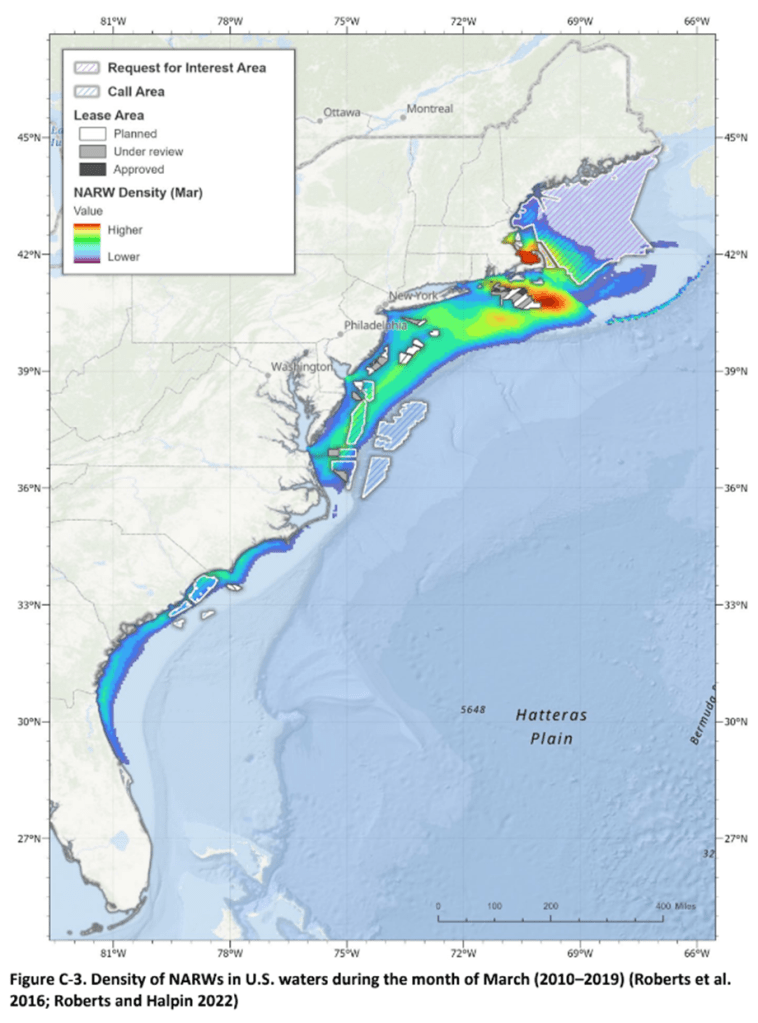
The following map shows where the whales are expected in March.  Note that the migration route will run the gauntlet of all the wind turbine facilities expected.

Conclusion

The PEIS scope was only intended to address Construction and Operation Plans for the New York Bight.  Given that BOEM expects a total of 3,630 wind turbine foundations by 20230 and only 1,125 are expected in the New York Bight, it is notable that the PEIS acknowledged that major impacts from offshore wind development to the NARW are possible for all alternatives.

It is unfortunate that the cumulative impacts of all the wind turbines to the critically endangered NARW are being ignored.  I cannot imagine any scenario where a species this stressed will survive when thousands of massive wind turbines are built across the migration routes. 

Climate Act Nuclear Reality and Clueless Anti-Nuclear Activists

Two recent Syracuse Post Standard letters, “Nuclear power emits no carbon dioxide but is anything but clean” and “Coverage of Hochul energy summit did not convey dangers of nuclear waste” oppose the idea of using nuclear power as part of the zero-emissions generating resources needed to achieve the Climate Leadership & Community Protection  Act (Climate Act) goals.  In this post I explain why their knee jerk rejection of nuclear is not in the best interests of New York.

I have followed the Climate Act since it was first proposed, submitted comments on the Climate Act implementation plan, and have written over 450 articles about New York’s net-zero transition.  The opinions expressed in this article do not reflect the position of any of my previous employers or any other organization I have been associated with, these comments are mine alone.

Overview and Background

The Climate Act established a New York “Net Zero” target (85% reduction in GHG emissions and 15% offset of emissions) by 2050.  It includes an interim 2030 reduction target of a 40% reduction by 2030. Two targets address the electric sector: 70% of the electricity must come from renewable energy by 2030 and all electricity must be generated by “zero-emissions” resources by 2040. The Climate Action Council (CAC) was responsible for preparing the Scoping Plan that outlined how to “achieve the State’s bold clean energy and climate agenda.” The Integration Analysis prepared by the New York State Energy Research and Development Authority (NYSERDA) and its consultants quantifies the impact of the electrification strategies.  That material was used to develop the Draft Scoping Plan outline of strategies.  After a year-long review, the Scoping Plan was finalized at the end of 2022.  Since then, the State has been trying to implement the Scoping Plan recommendations through regulations, proceedings, and legislation.

Evidence is mounting that the implementation is not going to as planned.  The Public Service Commission (PSC) Clean Energy Standard Biennial Review Report found that the 70% renewable energy goal will likely not be achieved until at least 2033.  The New York State Comptroller Office Climate Act Goals – Planning, Procurements, and Progress Tracking audit found that the PSC and NYSERDA implementation plans did not comprise all essential components, including “assessing risks to meeting goals and projecting costs.”  The New York Independent System Operator (NYISO) 2023-2042 System & Resource Outlook described issues that threaten reliability and resilience of the current and future electric system. The Department of Public Service Proceeding 15-E-0302 has initiated a process to “identify technologies that can close the gap between the capabilities of existing renewable energy technologies and future system reliability needs, and more broadly to identify the actions needed to pursue attainment of the Zero Emission by 2040 Target”. The Business Council of New York cited those reports and gave other reasons in a letter asking for a reassessment of the Climate Act goals. 

A technical conference held under the PSC’s auspices on December 11 and 12, 2023 entitled “Zero Emissions by 2040” included a session titled “Gap Characterization.”  Panelists at the session recognized the need for some new resource that would need to be developed to provide electricity to meet demand when wind and solar production are low.  They referred to this new, not-yet-existing, hypothetical technology as the Dispatchable Emissions-Free Resource, or “DEFR.”  The panel also described a few potential DEFR technologies.  Nuclear is the only proven technology that can be expanded sufficiently to fulfill the DEFR energy requirements projected for the future electric grid.

Future Energy Summit

In an apparent response to these issues, on September 4-5, 2024, the Hochul Administration hosted a Future Energy Summit that announced the draft Advanced Nuclear Technologies Blueprint.  The blueprint notes that a “growing and innovative group of advanced nuclear energy technologies has recently emerged as a potential source of dispatchable carbon-free power”. The blueprint introduces the goals:

The term advanced nuclear represents a suite of technologies, a description of which is provided in subsequent sections of this document. Advanced nuclear technologies could offer attractive possibilities for New York, with its scalability, economic development, low land use, and potential applications of process heat. It may represent an opportunity for additional grid capacity to support an electrifying economy, that can complement New York’s buildout of renewables. Yet advanced nuclear technologies raise a host of questions that would have to be addressed before planning on it, regarding technological readiness, costs and cost risks, environmental justice, among other factors.

Accordingly, this discussion paper examines a number of advanced nuclear technology options from the standpoint of technological readiness and systemic challenges and issues. The objective is to surface the most important opportunities, issues, and questions associated with these options to create a platform for additional analysis and stakeholder input on these options that moves New York forward towards its energy, economic, climate, and equity goals.

Tim Knauss described the Summit and the initial public response.  He noted that the Summit attracted two street demonstrations – one for nuclear energy and the other against.  He described the two protests:

Several speakers at the energy summit noted that both Democrats and Republicans in Washington support expanding nuclear power. And polling shows that a majority of Americans — some 56% — support building new nuclear plants, according to Pew Research Center.

But at the local level, the subject can still be divisive.

That was evident Thursday outside the energy summit at the Marriott Downtown Syracuse, where about 60 protestors gathered to denounce the discussions of nuclear power.

“Governor Hochul’s climate leadership is in freefall,’’ said Laura Shindell, New York director of Food & Water Watch, an environmental group. “Now, at the very moment that we need Gov. Hochul to be our climate’s strongest defender, she is instead wining and dining the slow, expensive, dirty and dangerous nuclear industry.”

Shindell and other activists called nuclear power a “fairytale distraction’’ that will weaken the state’s efforts to meet climate goals mandated by the 2019 Climate Leadership and Community Protection Act.

They were joined by Cornell University professor Robert Howarth, who served with Harris on the Climate Action Council that drew up the state’s plan to comply with the law’s mandates.

Aside from its environmental hazards – including uranium mining, much of which mars lands occupied by Indigenous peoples – nuclear power is too expensive and too slow to construct to help meet New York’s emission reduction goals, Howarth said.

Spending on nuclear will detract from the development of more beneficial power sources, he said.  “It’s nonsense in terms of our energy future in New York, even if it had an acceptable environmental and health footprint, which it does not,’’ Howarth said. “We can meet all of the energy needs of New York with solar, with hydro and wind and appropriate (energy) storage.’’

But the energy summit also drew a pro-nuclear protest. U.S. Rep. Brandon Williams, R-Sennett, and members of Nuclear New York held their own sidewalk event to protest the anti-nuclear protest. 

Williams, a former nuclear submarine officer, said he strongly supports new nuclear power for New York. But he does not support New York’s mandate of zero-emission electricity, which he said is costly and ineffective.  “This goal of net-zero emissions is based on ideology, not on economics and not on engineering and not on science,’’ Williams said.

Anti-Nuclear Letters

The Syracuse Post Standard published two anti-nuclear letters after the Summit.  Nuclear power emits no carbon dioxide but is anything but clean” was written by Donald Hughes, Ph.D., a longtime resident of Syracuse and environmental activist with Sierra Club and Sustain CNY.  “Coverage of Hochul energy summit did not convey dangers of nuclear waste” was written by Carole Resnick from Syracuse.  I have submitted rebuttals to those letters but there are space constraints and there is no assurance that my letter will be published.  This section describes my concerns with these letters.

Hughes argues that nuclear is anything but “clean.”  He claimed that the construction of reactors has a huge carbon footprint but ignored the mineral intensity of wind, solar, and energy storage technologies.   He said the nuclear fuel cycle is highly toxic and cited problems with uranium mining in the American Southwest.   I have compiled references for similar issues with the resources he claims are “clean”.  As part of the Nuclear New York demonstration mentioned previously ,Chris Denton assembled a booklet with numbers and pictures that show that ignoring the impacts of wind and solar when complaining about nuclear is poor form.

Hughes dismisses the advanced nuclear technology under consideration in the Advanced Nuclear Technologies Blueprint because of concerns with safety, nuclear waste, and costs. However, nuclear advocates see an opportunity to develop different types of reactors that could address these issues.  Ronald Stein explains:

The nuclear power production industry has the best industrial safety record among all industries for electricity production. So, the fear that most needs attention is the one surrounding spent nuclear fuel, which is commonly referred to as “nuclear waste.” The solution, then, lies in educating heads of state, mainstream media, and policymakers by extending the concept of recycling to include the unspent energy in used nuclear fuels, a method that can convince people that the “nuclear waste” issue is being dealt with, the cost of power is competitive, and that the production of nuclear power is safe.

Recycling Slightly Used Nuclear Fuel (SUNF) in a Fast Breeder Reactor (FBR) provides all these remedies in a way that is competitive and publicly acceptable.  The advantages to recycling used nuclear fuel in Fast Breeder Reactors are many:

  1. It provides a solution to the disposition of the stockpile of Slightly Used Nuclear Fuel (SUNF).
  2. Current inventories of SUNF provide an essentially unlimited supply of domestic fuel.
  3. The fuel material is already mined, so the energy produced is much closer to 100% clean, and further environmental degradation from mining operations is not required.
  4. The public would be more receptive to nuclear power because “waste” is being used as “fuel,” reducing the retention of unspent fuels and diminishing perceived risks.
  5. The design is “intrinsically safe”. This means that the reactor is designed to cool sufficiently in the case of an accident without human intervention.
  6. The current stockpile of SUNF has a value of $10 Trillion when the electric power that it produces is sold at 1 cent per kWh.
  7. Process heat can be used for industrial purposes such as hydrogen, freshwater production, and synthetic fuel production.

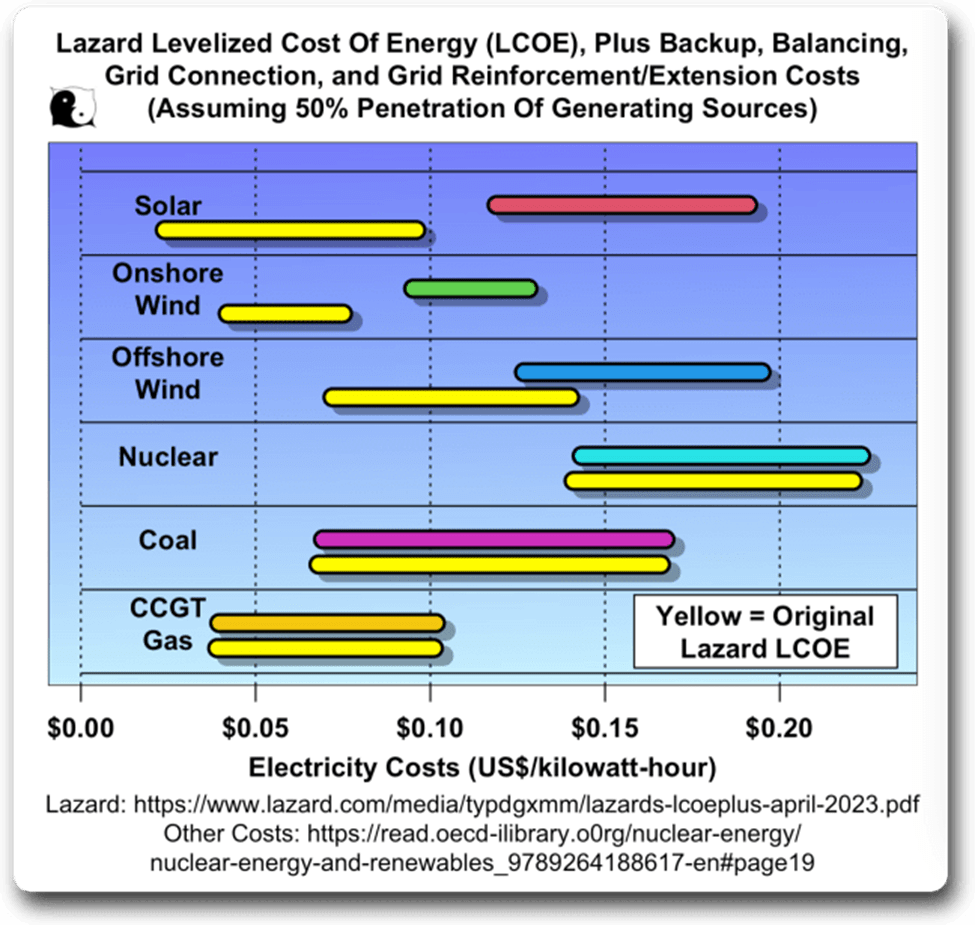
Hughes complains that the costs make nuclear a poor choice.  His main argument is that the relative costs of nuclear compared to wind, solar, and energy storage are high.  For example he cites a study by Lazard, that estimated that the unsubsidized levelized cost of electricity from new nuclear plants in the U.S. will be between $141 and $221 per megawatt hour. In comparison, a newly constructed utility-scale solar facility, with battery storage to provide power after the sun sets, will produce power at an unsubsidized levelized cost of between $46 and $102 per megawatt hour.

Willis Eschenbach evaluated that Lazard April 2023 annual report and summarized the problem with the Lazard Levelized Cost of Energy (LCOE) methodology:

The LCOE estimates the total capital, operations, and maintenance costs for new electric power plants coming into service. People use the Lazard LCOE all the time to claim that renewable electricity sources are now cheaper than fossil fuel electricity. However, the Lazard data has a problem—it doesn’t include the cost of backup and other costs for renewable energy. These costs fall into four groups:

  1. Backup costs – All power sources require backup power for the times when they are not generating any or enough power. However, the amount of backup required is much larger for intermittent sources.
  2. Balancing costs – Extra equipment is required when you have intermittent sources, to keep their highly variable input to the grid from destabilizing it.
  3. Grid connection costs – Renewable wind and solar power is variable voltage direct current. Before it can be fed into the grid, it must be run through costly synchronous inverters to convert it to stable voltage, stable frequency alternating current.
  4. Grid reinforcement/extension costs – Unlike fossil or nuclear plants, which can generally be sited as required, renewable sources of energy are often located far from where the power is needed. As a result, the grid will generally need to be extended, strengthened, or both for such source

Eschenbach’s analysis includes the following figure that compares the original Lazard costs relative to the addition of potential costs for the cost groups described above.

Note that nuclear costs are still higher than solar and wind.  However, these projections are based on a 50% penetration of generating sources.  New York’s Climate Act requires 100% penetration of wind and solar.  As a result, it does not include the necessity for a DEFR resource to backup solar and wind.  When DEFR cost support is included I believe that nuclear will be the cheaper option.

The only proven DEFR technology is nuclear so it is possible that there won’t be any choice but to develop it.  However, note that DEFR is not needed very often so it does not make much sense to use it solely for DEFR.  Instead, the obvious solution is to go all in for nuclear and stop trying to develop wind and solar.  Ron Stein sums it up: “Rather than pursue renewables of wind and solar that require huge land footprints, huge taxpayer subsidies, and even then, only generate electricity occasionally, it’s time to focus our technology resources on the nuclear power production industry that has the best industrial safety record among all companies and a track record of producing the cheapest non-subsidized electricity.”

The letter from Carole Resnick was long on emotion and short on numbers.  She believes professor of ecology and evolutionary biology professor Robert W. Howarth’s claim that “We can meet all of the energy needs of New York with solar, with hydro and wind and appropriate (energy) storage.”  Her belief is misplaced because Howarth is wrong.  I have analyzed his arguments that no new technology is needed and found them wanting.  More importantly, the Scoping Plan Integration Analysis, all analyses done by the New York Independent System Operator, and the Public Service Commission ‘Zero Emissions by 2040’ proceeding described previously all agree on the need for a new dispatchable emissions-free resource to support the electric system.  Her arguments against nuclear power itself echo the same points argued by Hughes

Conclusion

Hughes anti-nuclear claim is that “The reality is that it’s an unaffordable, slow to build and highly toxic process that has no place in a clean energy future.” Resnick claims that nuclear is a false solution and insinuates that is being considerable because it is profitable.  Neither of their arguments stands up to inspection.

I believe when the total costs of a wind, solar, and energy storage system are compared to the cost of a system that relies on nuclear for electricity generation that the nuclear system will be cheaper.  In addition, it will be more reliable because there is no reliance on weather-dependent generating resources.

The letter authors suggest that wind, solar, and energy storage have no downsides.  However, when the emissions from the full life cycle of those technologies, the impacts of renewable energy sprawl across the countryside, and the cumulative environmental impact of thousands of wind turbines and thousands of acres of solar panels necessary to provide the electricity projected are compared to the nuclear option, those technologies are anything but green. 

It is time for a nuclear renaissance.

Offshore Wind Risks in the News

In the past couple of weeks there has been a flurry of offshore wind related news.  This post consolidates several of the important items.  Climate Change Dispatch describes an analysis that implicates offshore wind surveys with whale deaths.  Bud’s Offshore Energy has posted numerous articles describing the recent Nantucket offshore wind turbine failure and David Wojick explains the risk implications to further development.

I have followed the Climate Act since it was first proposed, submitted comments on the Climate Act implementation plan, and have written over 400 articles about New York’s net-zero transition.  The opinions expressed in this article do not reflect the position of any of my previous employers or any other company I have been associated with, these comments are mine alone.

Overview

The Climate Act established a New York “Net Zero” target (85% reduction in GHG emissions and 15% offset of emissions) by 2050.  It includes an interim 2030 reduction target of a 40% reduction by 2030 and a requirement that all electricity generated be “zero-emissions” resources by 2040. The Climate Action Council (CAC) was responsible for preparing the Scoping Plan that outlined how to “achieve the State’s bold clean energy and climate agenda.” The Integration Analysis prepared by the New York State Energy Research and Development Authority (NYSERDA) and its consultants quantifies the impact of the electrification strategies used to reduce greenhouse gas emissions.  That material was used to develop the Draft Scoping Plan outline of strategies.  After a year-long review, the Scoping Plan was finalized at the end of 2022.  Since then, the State has been trying to implement the Scoping Plan recommendations through regulations, Public Service Commission orders, and legislation.

Offshore wind developments are a key decarbonization strategy.  There is a target of 9,000 MW of offshore wind by 2035.  However, there are overlooked risks to this strategy has described here.

Offshore Wind Impact on Whales

Climate Change Dispatch reports that a recent study finds that offshore wind survey vessels are causing whale deaths.  The article explains:

Apostolos Gerasoulis, a Rutgers professor emeritus of computer science who co-created the search engine that powers Ask.com developed a software system dubbed Luna to identify any relationship between the dead whales and offshore wind survey vessels.  He loaded NOAA data on whale deaths, the zigzag courses of survey ships, and even wave action into his computer system.  Luna revealed patterns that Gerasoulis believes point to offshore wind survey vessels as the cause of the whale deaths.

Luna generates maps of the U.S. East Coast and plots the locations of offshore wind farms; the deaths of whales, dolphins, and porpoises; and the routes taken by various survey ships.  The central region, including New York, New Jersey, and Rhode Island, had minimal survey traffic before 2016.  After [2016], survey vessel traffic was an average of 50,300 miles per year, double the amount of the southern region. The number of humpback whale deaths also doubled, to 10.625 per year.

‘When comparing the south and central regions after offshore wind surveying started, the averages show an almost linear increase in humpback whale deaths – doubling the traffic results in doubling the whale deaths.”

Nantucket Wind Turbine Blade Failure

Bud’s Offshore Energy (BOE) blog covers “Energy Production, Safety, Pollution Prevention, and More” topics with an emphasis on offshore projects.  In the last couple of weeks he has posted 12 articles about the wind turbine blade failure off Nantucket.  I have briefly summarized them below.

On July 17 he described the Vineyard Wind turbine blade incident.  He noted:

On Saturday night (7/13) the Coast Guard warned Mariners as follows: “Coast Guard received a report of 03 floating debris 10 meters by 2 meters in the vicinity of approximately 26 NM SE of Marthas Vineyard and 22 NM SW of Nantucket in position 40 59.559N 070 25.404W. All marines are requested to use extreme caution while transiting the area.

On Monday (7/15), Vineyard Wind confirmed that a turbine blade incident occurred on 7/13: “On Saturday evening, Vineyard Wind experienced blade damage on a wind turbine in its offshore development area. No personnel or third parties were in the vicinity of the turbine at the time, and all employees of Vineyard Wind and its contractors are safe and secure.”

On 7/16, Vineyard Wind issued another statement advising that they were deploying teams to Nantucket to clean up debris from the incident.

BOE followed up with another post on July 17 Vineyard Wind operations shut down.  He noted that “Late Tuesday afternoon, the Bureau of Safety and Environmental Enforcement (BSEE) said all operations are shut down until further notice.”  “A team of BSEE experts is onsite to work closely with Vineyard Wind on an analysis of the cause of the incident and next steps,” the agency said in a statement.  

He also described the risks to marine mammals in Debris poses a significant risk to marine mammals.  He said that the debris is a particular concern for baleen whales, like the endangered right whale, which filter large amounts of waterPer NOAA:

Marine Mammals: Many species of marine mammals have also been confirmed to eat marine debris. A review by Kühn and van Franeker found that 69 species of marine mammals have been found to ingest debris – that’s 56% of all marine mammals! This includes 44 species of odontocetes (toothed whales), manatees, and multiple seal species. Marine mammals are highly protected, which can make it difficult to research them. Most research on marine mammals takes place after an animal dies, making it difficult to understand what marine debris live animals eat. However, we do know that because baleen whales filter extremely large amounts of water while feeding, they may get plastic debris entangled in their baleen plates. 

On July 19 BOE described Vineyard Wind: regulatory observations.  He made the following observations:

Vineyard Wind statement (7/18):

  • “This morning, a significant part of the remaining GE Vernova blade detached from the turbine. Maritime crews were onsite overnight preparing to respond to this development, though current weather conditions create a difficult working environment.”
  • We are staying apprised of GE Vernova’s efforts to manage the situation, including the removal and recovery of the remaining blade attached to the turbine.”
  • Staying apprised? As operator, Vineyard Wind is fully responsible. This is their situation to manage.

BSEE statement:

  • BSEE has ordered Vineyard Wind to suspend power production and wind turbine generator construction.
  • Kudos to BSEE for their decisive and timely action. They need to better understand what happened before allowing operations and construction to continue.
  • Imagine the pressure on the regulator if the project was providing a significant portion of the region’s electricity.
  • BSEE’s comment that there has been “no harm to any marine resources or mammals from the incident” is premature given the extensive marine debris and the associated risks to mammals.

What about the CVA?

  • The regulations at 30 CFR § 285.707-712 assign important responsibilities to Certified Verification Agents (CVAs), independent third parties with established technical expertise. These responsibilities include detailed reviews of the design, fabrication, and installation plans.
  • Oddly, the CVA’s “Statement of Qualifications” and “Scope of Work and Verification Plan” have been redacted in their entirety from Vineyard Wind’s Construction and Operations Plan (COP) (see Appendix I-C and I-D).
  • Who was the CVA and why was that important information redacted?
  • Were any of the CVA requirements waived per 258.705?

BOEM:

  • Will BOEM, the lessor and Federal wind program manager, be making a statement? Will they be reassessing their COP review procedures?
  • BOEM should temper their over-the-top promotion of offshore wind. The complete shutdown of the first utility scale offshore wind farm heightens public concerns about the intermittency of this power source, and the need for reliable backup sources.

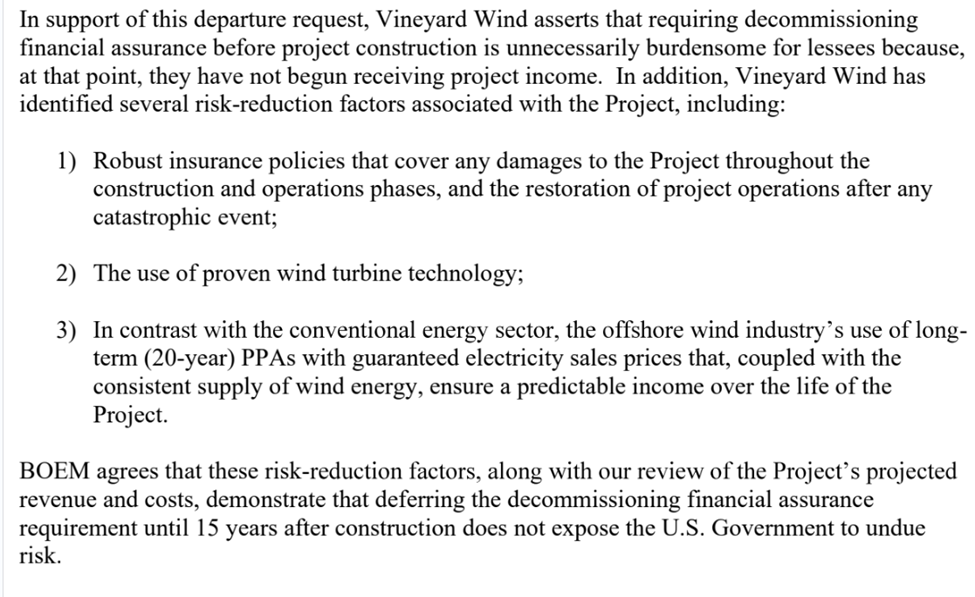
On July 22 BOE discussed financial implications in: Vineyard Wind’s financial assurance waiver cites robust insurance policies, proven technology, and guaranteed electricity sales.  He posted an excerpt from the BOEM letter waiving the“pay as you build” financial assurance requirement for the Vineyard Wind project.

The post included BOE’s comments on the three factors listed in the excerpt:

  • Factor 1: Those “robust insurance policies” may soon be tested given the costs associated with the turbine blade incident and potential law suits. (The notice pasted below informs that Nantucket officials will meet on Tuesday to consider litigation. A question for attorneys is the extent to which Nantucket is compromised by their good “Good Neighbor Agreement” with Vineyard Wind. That agreement essentially calls on Nantucket to promote the Vineyard Wind projects in return for payments that seem modest relative to the economic benefits from tourism and fishing.)
  • Factor 2: To the extent that GE Vernova Haliade-X 13 megawatt turbines are proven technology (and that is very much in doubt), the use of proven technology doesn’t prevent premature abandonment associated with unexpected incidents.
  • Factor 3: Reliable power generation and predictable long-term income remain to be demonstrated.

On July 23, 2024 BOE posed the question: Should wind leasing and development be paused until the Vineyard Wind investigation is completed?:

The Vineyard Wind turbine incident, which littered Nantucket beaches, has also tarnished the US offshore wind program. BSEE has prudently halted Vineyard Wind operations and construction pending an investigation into the blade failure.

Offshore wind development is structure rich, so public confidence in the design of turbines and support platforms is critical. BOEM lists 37 active wind leases on the US OCS. Most of these leases have not yet reached the construction phase. A hold on the approval of any Construction and Operations Plans would seem to be appropriate pending completion of the Vineyard Wind investigations.

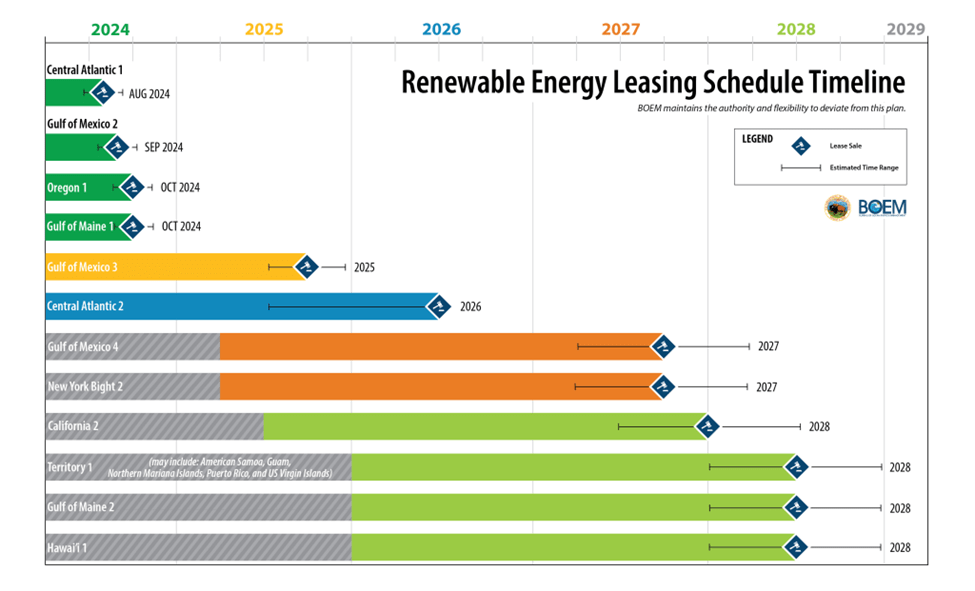
Per the leasing schedule below, BOEM intends to hold 4 wind sales during the remainder of 2024, all within a 3 month period. Only 1 sale is scheduled for each of the following 2 years. Deferring the 2024 sales until the investigations are complete would assist potential lessees by ensuring that the issues of concern were fully understood.

Unfortunately, BOEM’s failure to conduct a 2024 oil and gas lease sale has boxed in the wind program. The Inflation Reduction Act prohibits BOEM from issuing wind leases unless an oil and gas sale has been held within the previous year. Lease Sale 261 was held on 12/20/23 meaning that no wind leases may be issued after 12/20/24. BOEM has compressed the wind leasing schedule, presumably to beat the legislative deadline. It would have been better for both the oil and gas and the wind programs if at least one oil and gas sale had been held in 2024 as has been customary since the 1950s.

In another post, Aquinnah (Gay Head, Martha’s Vineyard) tribe calls for moratorium on offshore wind development, on July 23, 2024 BOE noted that “In the aftermath of a broken turbine blade off their coast, the Wampanoag Tribe of Gay Head (Aquinnah) is calling for a moratorium on all offshore wind development in the United States until further research can be done on the impact of wind farm construction.”  He explained that a letter to BSEE Director Kevin Slighm from Aquinnah  brought up the following points Wampanoag chairwoman Cheryl Andrews-Maltais brought up the following points:

  • expressed “strong concerns and outrage” over the fractured Vineyard Wind turbine blade and the debris that washed ashore on Nantucket.
  • said the foam and fiberglass debris have “potential negative and adverse impact[s]” on the environment, marine life, and human health.
  • said fragments in the water pose a threat to shellfish, which are a crucial part of both the marine food web and also ingested by humans.
  • commented that the potential contamination of shellfish with fiberglass and other materials could have severe consequences for human consumption and public health.
  • criticized the lack of communication from federal officials to the tribe.
  • called for an “immediate stoppage” of offshore wind construction in U.S. waters until they can be evaluated for microfractures and other damages.

On July 24, BOE provided a link to the initial assessment of the damage in Initial environmental assessment of Vineyard Wind blade debris.  He noted that “GE Vernova retained Arcadis US, Inc., to perform an initial assessment of environmental considerations associated with the presence of the blade debris in the water and along the shoreline and linked to a Nantucket Current article on the assessment.

In the July 25 post,  BOE described the developer’s excuse for the failure and the decision by the Nantucket Select Board to renegotiate their “Good Neighbor Agreement” with Vineyard Wind.

Quotes from Nantucket Current article (emphasis added):

“While we continue to work to finalize our root cause analysis, our investigation to date indicates that the affected blade experienced a manufacturing deviation,” said GE Vernova CEO Scott Strazik. “We have not identified information indicating an engineering design flaw in the blade or information of a connection with the blade event we experienced at an offshore wind project in the UK, which was caused by an installation error out at sea. We are working with urgency to scrutinize our operations across offshore wind. Pace matters here. But we are going to be thorough, instead of rushed.”

“It’s been 11 days since the event, and just to reinforce from the start, we have no indications of an engineering design flaw,” Strazik said. “We have identified a material deviation or a manufacturing deviation in one of our factories that, through the inspection or quality assurance process, we should have identified. Because of that, we’re going to use our existing data and reinspect all of the blades we’ve made for offshore wind. For context, this factory in Gaspé, Canada where the material deviation existed we’ve made about 150 blades. 

On July 26 BOE observed that the wind turbine company GE Vernova stock has taken a hit.  The Vineyard Wind turbine blade incident, the main reason for the sharp decline in their stock value in mid-July, is described as follows:

VINEYARD WIND OFFSHORE WIND FARM. We are the manufacturer and supplier of turbines and blades and the installation contractor for Vineyard Wind 1 offshore wind farm in the Atlantic Ocean (Vineyard Wind), at which we have installed 24 of 62 Haliade-X 220m wind turbines to date. Subsequent to the period covered by this report, a wind turbine blade event occurred at Vineyard Wind. Debris from the blade was released into the Atlantic Ocean and some has washed ashore on nearby beaches. On July 15, 2024, the U.S. Bureau of Safety and Environmental Enforcement (BSEE) issued a suspension order to cease power production and the installation of new wind turbines at the project site, pending an investigation of the event. As of the date of the filing of this report, we are currently engaged in a root cause analysis of the incident. We do not have an indication as to when BSEE will modify or lift its suspension order. Under our contractual arrangement with the developer of Vineyard Wind, we may receive claims for damages, including liquidated damages for delayed completion, and other incremental or remedial costs. These amounts could be significant and adversely affect our cash collection timelines and contract profitability. We are currently unable to reasonably estimate what impact the event, any potential claims, or the related BSEE order would have on our financial position, results of operations and cash flows.

He also noted that GE is also being sued by American Electric Power (AEP) for breach of contract and breach of warranty on turbine purchases for wind projects in Oklahoma:

“Within only two to three years of commercial operation, the GE wind turbine generators have exhibited numerous material defects on major components and experienced several complete failures, at least one turbine blade liberation event, and other deficiencies,”

On July 29 BOE described a new Order from BSEE to Vineyard Wind:

“The order comes as the bureau continues its oversight and investigation into the July 13, 2024, turbine generator blade failure. The order continues to prohibit Vineyard Wind 1 from generating electricity from any of the facilities or building any additional wind turbine generator towers, nacelles, or blades. This order also requires Vineyard Wind 1 to submit to BSEE an analysis of the risk to personnel and mitigation measures developed prior to personnel boarding any facility. Vineyard Wind 1 is not restricted from performing other activities besides those specifically directed for suspension or additional analysis. For example, Vineyard Wind 1 is still permitted to install inter-array cables and conduct surveys outside of the damaged turbine’s safety exclusion zone.” 

On July 30, 2024 BOE complimented the Nantucket Current for their coverage of the incident.  He quoted a a recent Current article (emphasis added):

The technology may not be new, but the size and scale of the Haliade-X turbine is novel for the offshore wind industry. And these jumbo-sized turbines have only recently been installed in just two locations in the world within the last year – at Vineyard Wind off Nantucket, and the Dogger Bank Wind Farm off the northeast coast of England. The Haliade-X turbine blades – which are supposed to have at least a 25-year lifespan – have suffered failures in both locations.

At the Dogger Bank Wind Farm – which is being completed in three sections which combined will make up the largest offshore wind farm in the world – the first GE Vernova Haliade-X turbine was installed in the fall of 2023 and began producing power on Oct. 10. But little is known about the blade failure that occurred just months later during the first week of May 2024. The damaged blade was disclosed by Dogger Bank’s owners – SSE Renewables, Equinor, and Vårgrønn – a week after the incident. In a statement, the companies said only that “damage was sustained to a single blade on an installed turbine at Dogger Bank A offshore wind farm.”

One reason the turbine blade incident at the Dogger Bank may not have generated more attention at the time is that the wind farm is located 100 miles off the coast of England, rather than just the 15 miles in the case of Vineyard Wind and Nantucket. If any debris was generated, it would have a far wider area to disperse in before nearing land – if it made it that far at all.

Risk of Offshore Wind Turbine Failure is Serious

David Wojick described the implications of the Nantucket failure on the development of Virginia’s offshore wind project.  In his article Wojick provides background information:

In this article, I present some technical background on that risk. The facility will be one of the world’s biggest, with 176 enormous turbines. It is just getting started with pile driving, so no turbine blades have been installed to date. This is an opportune time to undertake caution.

The Nantucket turbines are made by GE, and they are the world’s largest in operation today at 13 MW, each driven by three huge 107-meter-long blades. That is 351 feet for those of us who do not speak metric. The Virginia turbines will be even bigger at 14 MW with 108 meters (354+ feet) long. They are made by Siemens Gamesa, or SG for short.

The GE turbines and blades have been in production for going on two years, so have some operational experience. The SG turbines and blades just came into production so there is no experience with them. One could say they are being beta tested off Virginia.

This newness in itself is a great concern. At three blades each, there are an incredible 528 blades with a combined length of over 57,000 meters (187,000 feet or 35 miles) of blades. To take first production blades to these huge lengths is surely very risky.

For context consider that the Nantucket Current article referenced by BOEM noted that:

  • The Haliade-X turbine is the same one Orsted – a partner in Vineyard Wind – is planning to use for offshore wind farms slated for the waters off New Jersey and Maryland.
  • GE Vernova has allegedly refused to acknowledge responsibility for repairing the damaged turbines and generators in Oklahoma.
  • Land-based turbines have come apart in Sweden, Germany, Lithuania, Cypress, Brazil, and the US (and presumably elsewhere).

With respect to New York, there are two New York projects that plan to use large turbines.  Equinor’s Empire Wind 810 MW project provides comprehensive wind turbine information:

Vestas is the preferred supplier for wind turbine generators for Empire Wind.  Vestas will deliver 138 V236-15MW wind turbine generators with a total generating capacity of around 2GW.

  • 15 MW capacity
  • 774 feet rotor diameter
  • 886 feet high tip height
  • 463,000 sqf swept area

On the other hand the 924 MW Sunrise Wind project developed by  Ørsted and Eversource does not provide readily accessible turbine information.  I could not find what kind of turbines are planned or any details on their characteristics.

Wojick goes on to explain some of the problems with these immense turbine blades. 

Now let’s look at the blade stress physics just a bit, as it is amazing. SG has a quick look on their website, saying this:

“The rotational forces found in offshore wind turbines in operation put IMMENSE STRAIN ON THE BLADES and the rest of the wind turbine structure. (Emphasis added) At a tip speed of approximately 90 meters per second – equivalent to 324 kilometers per hour! (201 mph!) – and a projected lifetime of more than 25 years, high-quality and innovative design is imperative. For a 108-meter-long blade, the rotational forces are around a staggering 80 million newton meters, and the strain on the blades and the structure is intense! To put this into perspective, the force pulling on a human shoulder while spinning a 1 kg object around in an outstretched arm is only about 10 newton meters!”

Wojick sums up:

In summary, we have a newly huge blade, subject to immense stresses, made for the first time in an unusual way with a new composition and never tested in a hurricane. The high novelty risk to Virginia is obvious.

Conclusion

As noted by Robert Bryce the offshore wind scandal is even worse than you think.    These recent articles all reinforce his argument that it is time to pause the hurried rush to deploy offshore wind turbines.

I have no doubts that the proposed offshore wind development will have enormous impacts on whales and other mammals. The big green environmental organizations are abandoning whales in general and the remaining North American Right Whales in particular.  Bryce quotes an opponent of offshore wind: “What is Big Wind going to say when they kill the last whale? ‘Sorry’?” 

Red flag warnings abound for New York’s offshore wind development using these unproven huge wind turbines.  Wojick states the obvious “A sound engineering approach would be to build a few and see how they did over time.”  He also points out that the existing turbines of this size are in Europe where the dangers of hurricanes are not present. 

BOE provides a great concluding statement:

Greater transparency regarding turbine incidents, both in the US and internationally, is clearly needed. As we have learned from decades of experience with the oil and gas industry, most companies prefer reporting systems (if any) that protect details and information about the responsible parties from public disclosure. It’s the responsibility of the regulators to make sure that incident data and investigation reports are timely, complete, and publicly available. This is made more difficult by the promotional role that government agencies have assumed for offshore wind.

Risks of Climate Act Net Zero

I believe the Climate Leadership & Community Protection Act (Climate Act) transition will negatively affect affordability, reliability, and the environment.  I have been meaning to summarize my concerns for quite a while and two recent articles prompted me to write this.  David Turver explains how the transition to Net Zero has negatively affected affordability in the United Kingdom.   Robert Bryce provides an example of how the Climate Act mandates for offshore wind development will negatively affect the endangered North American Right Whale.  Finally, I describe why I worry that the reliance on wind and solar generating resources markedly increases reliability risks.

I have followed the Climate Act since it was first proposed, submitted comments on the Climate Act implementation plan, and have written over 400 articles about New York’s net-zero transition.  The opinions expressed in this article do not reflect the position of any of my previous employers or any other company I have been associated with, these comments are mine alone.

Introduction

David Turver’s Risks of Net Zero article prompted me to write this post.  He is the author of the Eigen Values Substack.  He is a retired consultant, CIO and project management professional. His description says that he is a first principles thinker who is tired of superficial media simply republishing press releases without critical analysis. His Substack incudes articles about contentious issues such as climate, energy, and net zero.

The Introduction to Risks of Net Zero provides an overview of the general concern about the risk.  He states:

We hear a lot about how we are supposedly in a climate crisis and how The Science™ tells us we are about to succumb to global boiling. Most climate activists claim that we must cut emissions by spending more money on windmills and solar panels or we will all burn to a crisp.

I would describe myself as a lukewarmer, by which I mean that I acknowledge the earth is warming and that human emissions of CO2 have made some contribution to that warming. However, it is also true that the climate has changed dramatically without human intervention; clearly, there are other causes of climate change too.

The strategy of reducing emissions of greenhouse gases to Net Zero is classified as a “mitigation strategy” in the parlance of the IPCC. The alternative strategy is adaptation which means taking measures to adjust to climate change such as building flood defences, irrigation systems or developing new strains of crops to cope better with changing weather patterns. Most spending effort in the West is geared towards mitigation. But, what if the Net Zero cure is worse than the disease? What if mitigation is less effective than adaptation?

Before he addresses affordability Turver compares mitigation against adapatation. He and I agree that adaptation is likely to be more effective than mitigation. He explains why in the following.

Mitigation Drawbacks

Turver points out issues related to mitigating climate change by reducing emissions.  Mitigation only works if CO2 is the only climate control knob but that cannot be the case because we have observed temperature changes over the last thousand years.   Mitigation can only work if everyone else slashes emissions too and we can see from Figure 2 (from Our World in Data) that this is not happening.

Adaptation Successes

Turver explains that adaptation since 1900 has dramatically decreased death rates.  He includes a figure sourced from  Our World in Data.

Not mentioned but certainly a factor is that the death rate went down in no small part because fossil fuels increased the ability of society to address the causes listed.  Based on past success the obvious alternative is to emphasize adaptation.  Turver explains:

Adaptation measures have many benefits. First, they require no international treaty, and they can be applied locally where they produce results quickly. They also work to protect against changes in the climate that are not driven by CO2. Adaptation measures might also have additional benefits such as more efficient water use or more robust crop varieties. There is no reason why we cannot continue to adapt.

New York Effect on Climate Change

There is another aspect of mitigation that is routinely ignored by proponents of the Climate Act.  New York emissions are tiny relative to global emissions.  In 2021, NYS GHG emissions (GWP-100) were 247 million metric tonnes (MMT).  GHG emissions from China were 13,774 MMT and from India were 3,879 MMT.  The increase in emission from 2020 to 2021 were 498 MMT in China and 265 MMT in India.  New York emissions will be supplanted by emissions from China or India in less than one year.  New York’s net-zero transition plan emission reductions will have no effect on emissions and thus no effect on the purported effects of climate change. Adaptation investments in New York infrastructure to reduce the costs of extreme weather impacts will focus on New York so the benefits will be to New Yorkers.

Climate Act advocates frequently argue that New York must take action because our economy is large.  I analyzed that claim and summarized the data here.  New York’s 2020 Gross State Product (GSP) ranks ninth if compared to the Gross Domestic Product (GDP) of countries in the world.  However, when New York’s GHG 2016 emissions are compared to emissions from other countries, New York ranks 35th.  More importantly, a country’s emissions divided by its GDP is a measure of GHG emission efficiency.  New York ranks third in this category trailing only Switzerland and Sweden. We are already doing our share.

Net Zero Affordability Risks

I think the biggest issue with the Climate Act is affordability.  Everyone wants a clean and safe environment but just how clean, how safe and at what price are all value judgements.  Turver points out that implementation of net-zero policies like the Climate Act have poorly acknowledged risks:

First and most obvious, they cannot work against climatic changes that are driven by forces other than CO2. Second is the outright cost. 

He goes on to describe observed cost increases in the United Kingdom.  He makes the point that additional costs also make manufacturing and other production less competitive, which leads to job losses.  Ultimately the inability to produce basic needs reduces security.  He also points out that renewable energy development requires more materials than alternatives.  That has environmental and cost implications. 

Turver explains that the increased penetration of renewables in the United Kingdom has led to a massive increase in electricity bills. This increase comes from “renewables subsidies as well as grid balancing costs and the massive costs of expanding the grid out to remote offshore wind farms”.  The article compares recent United Kingdom industrial gas prices and industrial electricity prices:

As can be seen in Figure 5, from 2008 to 2020, industrial electricity prices rose 53.8% while industrial gas prices actually fell slightly over the same time period. Both gas prices and electricity rose in 2021 as gas prices started to spike as demand increased after Covid lockdowns ended and supply could not keep up with demand. However, even though there was a spike in gas prices in 2021, the increase from 2008 is still only 33%, whereas electricity prices have surged 71.4% over the same period. The figures for 2022 are not yet available, but we might expect to see a big surge in both gas and electricity prices due to supply shortages resulting from the war in Ukraine.

There is no doubt that all these impacts will inevitably occur in New York as the Climate Act mandates are implemented. A recurring theme of many of my posts is that the Hochul Administration has never provided clear and comprehensive cost estimates for all the control strategies in the Scoping Plan

American Offshore Wind Energy Scandal

I believe that the environmental impacts of wind and solar development are greater than the impacts of fossil-fueled or nuclear resource development.  In my Draft Scoping Plan comments I noted that on September 17, 2020 the Final Supplemental Generic Environmental Impact Statement (SGEIS) for the Climate Leadership and Community Protection Act was released.  It covered the “environmental impacts of the offshore wind and distributed solar procurement goals, and the estimate of utility-scale solar capacity required to meet the meet the 70 by 30 goal” based on the resources estimated necessary at that time.  Since then, considerably more resources have been projected but the cumulative assessment has not been updated.

Robert Bryce published an article entitled The Offshore Wind Scandal is Even Worse Than You Think  that addresses one of the cumulative environmental impacts that the Scoping Plan ignored.  Bryce is an author, filmmaker, and public speaker who has been reporting on the energy sector for more than 30 years.  His background enables him to provide graphical evidence to support his arguments that I think are well done.  In this article he includes 11 charts that “show how America’s biggest NGOs are colluding with foreign corporations that want to industrialize our oceans with thousands of turbines that will hurt whales and ratepayers”.

He writes:

The hard reality is that America’s offshore wind sector is a subsidy-dependent industry that is dominated by foreign companies who are in bed with some of America’s biggest climate NGOs, including the NRDC (gross receipts: $555 million) and Sierra Club (Gross receipts: $184 million).  Those NGOs and others, including the National Wildlife Federation (gross receipts: $142 million) and Conservation Law Foundation (gross receipts: $17.5 million), are leading the most shameful environmental betrayal in modern American history. Rather than seek to protect marine mammals and stop the industrialization of our oceans, they are eagerly promoting the installation of hundreds of offshore wind platforms smack in the middle of the known habitat of the critically endangered North Atlantic Right Whale.

I recommend the article for its details.  In this summation I am not going to address all the charts in detail.  The first four charts support the quotation above.  The fifth chart addresses environmental impacts.  The offshore wind shills claim that there aren’t impacts on whales, but Federal scientists disagree.

Bryce describes Chart 6:

I’m old enough to remember when environmental groups cared about whales. Alas, that was a long time ago. On Sunday, the Daily Mail published an article about Apostolos Gerasoulis, a Rutgers professor emeritus of computer science who built a software system to analyze the dozens of whale deaths that have occurred on the Eastern Seaboard over the past few years. Gerasoulis set out to determine if the whale deaths were related to the loud blasts of sonar used by offshore wind survey vessels. His conclusion: “Offshore wind kills whales…The numbers never lie. There is a cause. We have shown that the cause for death of the whales is offshore wind. Period.” (H/t fellow Substack writer David Blackmon.) 

In Chart 7 Bryce notes that the Massachusetts Sierra Club notes that “Because the North Atlantic Right Whale has such a small population and a low annual reproductive rate, a single whale death can have a significant negative impact on the species’ ability to recover.”  In Chart 8 he provides a plain English translation of a statement in the Bureau of Ocean Energy Management environmental impact statement of Vineyard Wind: “These projects won’t make any difference on climate change. But they are good because they allow state-level bureaucrats to say they met their policy goals.” 

The remaining charts compare offshore wind capacity and costs relative to other resources.  He concludes that these developments will markedly increase costs for states that already have some of the highest electricity rates in the country.

I maintain that the New York State has shirked its commitment to the environment because it has not addressed cumulative environmental impacts of the Scoping Plan buildout of wind and solar.  No where is this more impactful than the effects on whales in general and the remaining North American Right Whales in particular.  Bryce quotes an opponent of offshore wind: “What is Big Wind going to say when they kill the last whale? ‘Sorry’?” 

Reliability Risks

I described my concern about the enormous risk of an electric grid relying on wind and solar resources in this post.  Since then, I have refined my description of the problem.  It boils down to “correlated intermittency”.  Let me explain.

Wind and solar are inherently intermittent – the sun does not shine at night and the wind does not always blow.  That intermittency is correlated.  All the solar in New York is unavailable at night.  It turns out that wind resources across New York also are usually high or low at the same time. There are exceptions but there is a high incidence of similar behavior.

That matters for electric resource planning.  Today electric resource planning relies on decades of performance experience with hydro, nuclear, and fossil plants that do not correlate, that is to say there is no reason to expect that all the nuclear plants will be offline at the same time.  As shown in the following New York Independent System Operator (NYISO) slide, this characteristic enables the resource planners to determine how much generating capacity is necessary to meet the loss of load expectation (LOLE) criterion.  The probability of losing load not more than once in ten years is based on observations of the existing uncorrelated generating resources.  Importantly, I believe that the lack of correlation also means that the capacity needed above firm system load would not change substantially if the LOLE planning horizon was shifted to 1 day in 20 years.

Source: NYISO Amount of Capacity Required, Intermediate ICAP Course, June 2023

The variation in weather that affects wind and solar resource availability will require changes to electric resource planning.  Everyone has heard of a hundred-year flood which is the parameter used for waterway planning.  This is the one in a hundred probability that the water level in a river or lake will exceed a certain level.  Similar estimates of low wind and solar resource availability must be developed and incorporated into electric resource planning.

The unresolved problem is what return period probability is acceptable.  If the resource planning process does not provide sufficient backup resources to provide capacity for a peak load period, then blackouts are inevitable.  Two factors exacerbate the challenge of this problem:

  1. Periods of highest load are associated with the hottest and coldest times of the year and frequently correspond to the periods of lowest wind resource availability. 
  2. The decarbonization strategy is to electrify everything possible so the impacts of a peak load blackout during the coldest and hottest periods will be greater.

In an earlier post I described an analysis by the Independent System Operator of New England (ISO-NE) Operational Impact of Extreme Weather Events.  The study evaluated 1, 5, and 21-day extreme cold and hot events using a database covering 1950 to 2021. Not surprisingly the system risk or “the aggregated unavailable supply plus the exceptional demand” during an event increased as the lookback period increased.  If the resource adequacy planning for New England only looked at the last ten years, then the system risk would be 8,714 MW, but over the whole period the worst system risk was 9,160 and that represents a resource increase of 5.1%.  There is no question that a similar analysis for New York would find a similar result.

The correlated intermittency of wind and solar resources means that we will depend on energy-limited resources that are a function of the weather causing low resource availability at the same time.  The unresolved issue is how to design an affordable and practical system to meet the worst-case weather induced lull. Consider the ISO-NE analysis where it was found that the most recent 10-year planning lookback period consistent with current LOLE evaluations would plan for a system risk of 8,714 MW.  If the planning horizon covered the period back to 1961, the worst-case to 1950, an additional 446 MW would be required to meet system risk.  I cannot imagine a business case for the deployment of electric system resources that will only be needed once in 63 years.  For one thing, the life expectancy of these technologies is much less than 63 years.  Even over a shorter horizon such as the last ten years, how will a required facility be able to stay solvent when it runs so rarely? The only solution is subsidies to build and very high payments when they do run.

Reliability risks have also been identified by the North American Electric Reliability Corporation.  They have expressed concerns that extreme weather events, rapid demand growth, and systemic vulnerabilities pose risks for supply shortfalls and grid reliability.  These are serious risks to the Climate Act net-zero transition plan that must be resolved sooner rather than later.

Conclusion

I believe that the Climate Act will do more harm than good.  Affordability is the first problem. The Hochul Administration has not provided transparent and comprehensive cost estimates for the control strategies proposed for the net-zero transition.  The New York State Comptroller Office audit of costs in Climate Act Goals – Planning, Procurements, and Progress Tracking  agrees with my concern and recommends a detailed analysis of cost estimates to transition to renewable energy sources and meet Climate Act goals. I believe such an analysis will agree with observed results elsewhere that show the costs will be extraordinary and will certainly affect affordability.

The Hochul Administration has not provided a cumulative environmental impact assessment for the generating resources projected in the Scoping Plan.  Nowhere is the potential impact more critical than with respect to whales and the massive deployment of offshore wind proposed.  It is incumbent upon the State to prove that there will not be adverse impacts to the critically endangered North American Right Whales.

Finally, there ae reliability risks inherent in a weather-dependent electric grid when all the wind and solar output is reduced at the same time.  This raises overarching questions that have not been addressed.  Furthermore, even if these weather risks can be addressed in theory, the solution will involve technologies that are not commercially available today.  I have no doubts that the only safe way to decarbonize the electric grid is to rely on nuclear power.  The Hochul Administration needs to confront these issues before it is too late. 

The risks of the Climate Act are all associated with mitigation efforts to reduce GHG emissions.  I agree with Turver that mitigation should be emphasized.  He concludes:

The risks of climate change can be averted by continuing to adapt, just as we have for millennia. It is certain that unilateral action by the UK, or indeed multilateral action by much of the West, will do nothing to change the weather while the developing world continues to increase their consumption of hydrocarbons to make themselves richer. Indeed, even if mitigation measures were adopted globally, it is naïve to believe that bad weather will cease and we will suddenly get the “stable climate” demanded by more than 170 lawyers.

Basis of New York Cap and Invest Health Benefits Claims

For the first two months of 2024 the New York State Department of Environmental Conservation (DEC) and the New York Energy Research & Development Authority (NYSERDA) have been working on the  New York Cap-and-Invest (NYCI) Program stakeholder engagement process.  As part of the stakeholder engagement process there was a webinar describing the Preliminary Scenario Analyses.  One thing that caught my attention was the claim that health benefits could be as much as $15.7 billion in 2035 because of NYCI implementation.

Two recent blog posts described a literature article about the development of the Linear No Threshold (LNT) model for cancer risk that is the basis of the NYCI health benefits claim. This post describes the Journal of Occupational and Environmental Hygiene paper by Edward Calabrese “Cancer risk assessment, its wretched history and what it means for public health”   and the NYCI health benefits claims.

I have followed the Climate Leadership & Community Protection Act (Climate Act)  since it was first proposed, submitted comments on the Climate Act implementation plan, and have written over 400 articles about New York’s net-zero transition. The opinions expressed in this post do not reflect the position of any of my previous employers or any other organization I have been associated with, these comments are mine alone.

Overview

The Climate Act established a New York “Net Zero” target (85% reduction in GHG emissions and 15% offset of emissions) by 2050.  It includes an interim 2030 reduction target of a 40% reduction by 2030 and a requirement that all electricity generated be “zero-emissions” by 2040. The Climate Action Council (CAC) is responsible for preparing the Scoping Plan that outlines how to “achieve the State’s bold clean energy and climate agenda.”  In brief, that plan is to electrify everything possible using zero-emissions electricity. The Integration Analysis prepared by the New York State Energy Research and Development Authority (NYSERDA) and its consultants quantifies the impact of the electrification strategies.  That material was used to develop the Draft Scoping Plan outline of strategies.  After a year-long review, the Scoping Plan was finalized at the end of 2022.  In 2023 the Scoping Plan recommendations were supposed to be implemented through regulation, PSC orders, and legislation.  Not surprisingly, the aspirational schedule of the Climate Act has proven to be more difficult to implement than planned.  NYSERDA and DEC are attempting to promulgate rules for NYCI so that the program starts in 2025 and the regulatory package will claim significant health impacts that I think are unjustified.

Linear No Threshold Model

The weekly newsletter “The Week That Was: 2024-03-23” produced by the Science and Environmental Policy Project includes a section titled “Lack of Science Integrity” that describes the Edward Calabrese “Cancer risk assessment, its wretched history and what it means for public health”   paper.  That post walks the reader through the paper with extensive quotes including the introduction:

The story about to unfold in this commentary will be disturbing but perhaps not too surprising now in contemporary society. You will be taken on a path of discovery that explores the history of cancer risk assessment for radiation and chemical carcinogens. This commentary is about a history of errors made by scientific leaders that have long remained hidden and uncorrected. The evidence shows that major biases led to deliberate misrepresentations (i.e., blatant dishonesties) of the scientific record by the very people society was supposed to trust, including multiple Nobel Prize winners. Equally troubling have been the dishonest actions of organizations, such as major advisory bodies, including the US NAS and the journal Science that have repeatedly succumbed to violations of the public trust. As disappointing and upsetting as such statements are, it is hard to believe that this historical record could get even more corrupt, but it does. It has become known that major US scientists conducting important mutation and cancer studies hid data and deliberately withheld results from the public and scientific community. Why? Because the findings didn’t fit their preconceived beliefs and would not enhance opportunities to obtain more funding for themselves and their programs. Yes, the destructive self-interest of the research community, especially governmental and university scientists, in this case, presents a prominent but long hidden dimension that unfolds in a complex journey of discovery.

Society is faced with questions over who can be trusted in today’s world: government, scientists, prestigious advisory groups, like the United States National Academy of Sciences (US NAS), and major journals like Science, Nature, The Lancet, and others. These have historically all been the entities that society has trusted for decades. The historical record presented here, therefore, involves powerful and high-profile individuals and groups that manipulated the public for personal gain and is presented in the following eight-part expose.

If you are interested, then I encourage you to read the rest of the SEPP newsletter and the article itself but the implications are not immediately obvious without background.  Originally, I thought I would use this post as the basis for describing the background of problems identified in the Calabrese paper.  However, Francis Menton wrote a post doing just what I was planning to do. 

Menton notes that:

Calabrese’s article is long (18 two-column single-space pages) and goes into detail of the names involved, the particular pieces of evidence suppressed along the way, the manipulation of members of committees to get to desired outcomes, and so forth. It has a lengthy bibliography, including references to multiple prior articles of his own where he has been piecing together and building the story of the LNT fraud for years. If you are interested in this subject, I highly recommend this article.

Menton argues that this approach is a candidate for the greatest scientific fraud of all time.  He writes:

This fraud goes by the common acronym of “LNT,” which stands for the “linear no threshold” hypothesis of causation of diseases, particularly cancer, from environmental factors. The LNT hypothesis is the basis for huge swaths of enormously costly regulation, probably the large majority of environmental regulatory cost outside the sphere of “climate.” In a March 7 article in the Journal of Occupational and Environmental Hygiene, a guy named Edward Calabrese makes the case that the LNT hypothesis has been advanced by means of intentional fraud since its inception nearly 100 years ago. The title of the article is “Cancer risk assessment, its wretched history and what it means for public health.”

He describes the basis of the approach:

The LNT hypothesis theorizes that if a chemical or phenomenon (e.g., radiation) is established as dangerous at some dosage, no matter how high, then it must also be dangerous at small dosages, no matter how tiny. That conclusion follows if the relation of dose to danger is linear, with no threshold below which the danger goes away. A tiny dose may have a tiny danger, but as long as the dose/danger relationship is linear without threshold, then there is no safe dose.

This approach was originally developed to address cancer risk from nuclear radiation exposure, but the principle is now applied in other ways.

Calabrese’s article provides a thorough history of the origins of the LNT hypothesis, and how it was advanced and promoted by the suppression of definitive contrary evidence. By the 1970s the LNT hypothesis had the backing of the National Academy of Sciences and had been adopted by the EPA as the basis for regulating hazardous chemicals and radiation. The EPA continues to use the LNT approach in its regulatory efforts today, even as evidence accumulates that it is wrong and has been based on fraud from the outset. And thus, the LNT hypothesis is the fundamental reason why nuclear power plants are so expensive and difficult to build; why no long-term solution for storage of spent nuclear fuel can be found; why EPA constantly proposes new regulations lowering allowable levels of emissions of chemical substances like mercury or PCBs; why pesticides and herbicides like glyphosate become the subject of multi-billion dollar liability disasters; and so forth.

Menton goes on to explain:

The LNT hypothesis may at first seem intuitively likely to be true. For example, it is established that large doses of radiation can induce mutations that can lead to cancer. So why then couldn’t a single item of radiation, like one alpha particle or a single gamma ray, induce the mutation that initiates the disease? But Calabrese points out that the LNT hypothesis presumes that mutations are rare, and that the body has no capacity to repair ongoing mutations. What research has revealed is that, far from being rare, mutations are extremely common; and the body has a large capacity to repair them. Thus, a small external source of mutations, like background or low-dose radiation, is easily dealt with, and if anything helps to stimulate and exercise the body’s natural repair system. Only when an external force causes very extensive mutations exceeding the body’s capacity to repair — i.e., when some threshold is crossed — does the external force increase the risk of cancer or other disease. From Calabrese, page 16:

[T]he most dominating cause of evolution is our metabolism which induces millions of mutations per day in each cell, with 99.99999% being repaired each day. If our repair systems were not so exceptionally good, life would not exist. Our metabolism produces about 200 million times more genetic damage events per cell per day than that induced by background radiation. There is no contest between the two. What this means is that our body is our biggest enemy; it also means that it is also our best friend. The body’s great repair mechanisms evolved not to prevent and repair damage from background radiation but to fix the damage that our metabolism induces each day. Thus, the body’s repair systems are designed by nature to protect our bodies against ourselves, with background radiation being a very tiny and insignificant factor.

Sadly, this approach is widely used and now provides “justification” for many environmental regulations.  Proponents calculate a relationship between health effects at two high levels then extrapolate the dose response curve to ridiculously low levels.  Even though there is a tiny effect multiplying the impact over a large population provides scary projections for things like asthma exacerbation.  Menton explains why it has become so pervasive.

So how did the LNT hypothesis gain such enormous sway, and become the basis for extensive and destructive government decision-making for decades? Calabrese points out that, by contrast to the threshold hypothesis, the LNT hypothesis has the potential to induce great fear in the public, and thus to stimulate large opportunities for funding and career advancement:

[T]he experts got the radiation and chemical mutation idea wrong from the start but they convinced many that they were correct and created debilitating fear in the population at the same time. We also learned that one of the reasons that these great scientists created such fears was to advance their careers and to get a constant flow of government grant monies.

In the next section I will show how NYSERDA and DEC have used this approach for NYCI.  Menton provides a good segue to that section:

Meanwhile, our government and its “experts” merrily go forth regulating on the basis of the LNT hypothesis, and imposing enormous costs on society for no benefit. From Calabrese’s Conclusion:

[The scientists who promoted the LNT hypothesis] were driven by ideological and self-serving professional biases that would lead to both falsifications of the research record and suppression of key scientific findings, all to establish the LNT model for hereditary and cancer risk assessment, replacing the threshold dose-response model. This troubling history has now been revealed in a long series of peer-reviewed publications by the author and summarized in a broad conversational manner in this Commentary. This troubling history remained hidden from regulatory agencies around the globe since its inception. These groups simply and uncritically accepted a flawed and corrupt history, assuming that it was accurate and reliable. Yet this path of historical ignorance led the US EPA, and other national regulatory agencies, to accept a dishonest foundation upon which to base and frame cancer risk assessment, terribly failing in their public service mission.

New York Cap and Invest Health Impacts

The purpose of this article is to show the basis for the projected health effects of NYCI. At the January 26, 2024 webinar the methodology for the health effects was described.   In brief, fuel consumption changes by sector projected by their modeling were used to estimate changes in emissions.  The changes in emissions reduce ambient air quality levels and this leads to the alleged health benefit improvements.  Because the emissions estimates cannot be broken down into detail the air quality impacts also are broad estimates.  EPA’s CO-Benefits Risk Assessment Health Impacts Screening and Mapping Tool uses the LNT approach to estimate health impacts, primarily for improvements in inhalable particulate matter that is 2.5 microns or smaller.

The projected health impacts description claims that there are substantial benefits.

The NYCI Preliminary Analysis Data Annex spreadsheet includes supplementary health effects data for the webinar presentation and  a table that estimates impacts on air quality and health.  The following table excerpts some of the health benefits projections.  Frankly, I think that all these improvements are well within normal variation so the whole exercise has little value.  Note that I expected that each of the benefits would be linearly proportional to the change in concentrations but applying the ratio of 2025 to 2030 improved concentrations to the health benefits did not match exactly.  In all cases the assumed proportional benefit was less than the benefits shown.

Despite the lack of an exact linear match, I believe the results are close enough to use them to project health benefits between the inhalable particulate concentrations in 2000 relative to 2022.  The Department of Environmental Conservation runs a network of inhalable particulate monitoring stations across the state and summarizes the results in its Ambient Air Quality Reports.  I extracted the annual average concentrations for seven widely ranged sites with the longest records.  All the stations show significant improvements in the inhalable concentrations over the period of record.  I calculated the average of these sites in 2000 11.4 micro grams per cubic meter and 2022 6.0 micro grams per cubic meter for a statewide improvement of 5.4.

New York State Annual Average Inhalable Particulate Air Quality (micro grams per cubic meter) Trend

The following table compares the observed improvement in air quality and projects health benefit improvements proportional to the change in inhalable particulates.  If there has been an observed reduction of over one million emergency room visits for asthma between 2000 and 2022 then I will believe the NYCI health benefit projections.  I have never seen anyone verify this health benefit model which should be easy to do.  I expect that the results would be inconvenient, and proponents of this methodology know this so it has never been done.

Conclusion

In every instance I have checked the Hochul Administration has overstated the benefits and understated the costs of the net-zero transition.  New York’s cap-and-invest projected health benefits are a vivid example of how NYSERDA manipulates the narrative to claim benefits that far exceed any reasonable interpretation.  I think Menton’s conclusion is an appropriate: “As of today, there is no evident retreat by EPA or other U.S. regulatory agencies from the LNT model. Fear sells, and they have no ability or incentive to self-correct.” 

Update: Climate Act Emission Reductions in Context

A couple of years ago I posted an article about New York GHG emissions  and found that they are less than one half of one percent of global emissions and that global emissions have been increasing on average by more than one half of one percent per year since 1990. I was recently asked to document that claim and updated that analysis.  This post describes the results.

I have followed the Climate Act since it was first proposed, submitted comments on the Climate Act implementation plan, and have written over 400 articles about New York’s net-zero transition. The opinions expressed in this post do not reflect the position of any of my previous employers or any other organization I have been associated with, these comments are mine alone.

Overview

The Climate Act established a New York “Net Zero” target (85% reduction in GHG emissions and 15% offset of emissions) by 2050.  It includes an interim 2030 reduction target of a 40% reduction by 2030 and a requirement that all electricity generated be “zero-emissions” by 2040. The Climate Action Council (CAC) is responsible for preparing the Scoping Plan that outlines how to “achieve the State’s bold clean energy and climate agenda.”  In brief, that plan is to electrify everything possible using zero-emissions electricity. The Integration Analysis prepared by the New York State Energy Research and Development Authority (NYSERDA) and its consultants quantifies the impact of the electrification strategies.  That material was used to develop the Draft Scoping Plan outline of strategies.  After a year-long review, the Scoping Plan was finalized at the end of 2022.  In 2023 the Scoping Plan recommendations were supposed to be implemented through regulation, PSC orders, and legislation.  Not surprisingly, the aspirational schedule of the Climate Act has proven to be more difficult to implement than planned and many aspects of the transition are falling behind.  In addition, there has not been any additional documentation provided that proves that the transition will be affordable, keep the same standards of energy reliability, or not have unacceptable cumulative environmental impacts.

GHG Emissions

I frequently note that New York greenhouse gas emissions are less than one half of one percent of global emissions, and global emissions have been increasing by more than one half of one percent per year since 1990.  This post shows that the claim is still true.

I originally used information from my post Climate Act Emission Reductions in Context to support that claim.  I recently updated the analysis.  I found CO2 and GHG emissions data for the world’s countries and consolidated the data in a spreadsheet.  There is interannual variation, but the five-year annual average has always been greater than 0.79% until the COVID year of 2020.  For the New York data I used GWP-100 data from Open Data NY through 2021 as documented in this post.  New York’s share of global GHG emissions is 0.42% in 2019 so this means that global annual increases in GHG emissions are greater than New York’s total contribution to global emissions.

The data used are shown in the following table.

Global and New York State GHG and CO2 Emissions (million metric tonnes)

The following graph lists the five-year annual average GHG and CO2 NY emissions and the annual change in the five-year global GHG and CO2 emissions.  Note that for most years the global change in emissions is greater than New York emissions.  Anything New York does to reduce emissions will be supplanted by emission increases elsewhere in less than a year.

Conclusion

By any measure New York’s complete elimination of GHG emissions is so small that there will not be any effect on the state’s climate and global climate change impacts to New York.  I previously showed that although New York’s economy would be ranked ninth relative to other countries, New York’s emissions are only 0.45% of global emissions which ranks 35th.  This post graphically shows New York emissions are negligible compared to global emissions.  The change to global warming from eliminating New York GHG emissions is only 0.01°C by the year 2100 which is too small to be measured much less influence any of the purported damages of greenhouse gas emissions.  Finally, this post shows global emissions have increased more than New York’s total share of global emissions consistently since 1990.  In other words, whatever New York does to reduce emissions will be supplanted by global emissions increases in a year.

The only possible conclusion is that the Climate Act emissions reduction program is nothing more than virtue-signaling.  Given the likely significant costs, risks to reliability, and other impacts to New York society, I think that the schedule and ambition of the Climate Act targets needs to be re-assessed for such an empty gesture.

New Climate Reality is Passing New York By

Note: For quite a while now I have put my Citizens Guide to the Climate Act article as the top post on the website because it summarizes the Climate Leadership & Community Protection Act (Climate Act). This post updates my current thoughts about the Climate Act and will replaces that post at the top of the list of articles on October 2, 2023

There is a new climate reality and it is passing New York by.  New York decision makers are going to have to address the new reality that proves that the Hochul Administration’s Scoping Plan to implement the Climate Act will adversely affect affordability, reliability, and the environment.  This post highlights articles by others that address my concerns.

I have followed the Climate Act since it was first proposed, submitted comments on the Climate Act implementation plan, and have written over 350 articles about New York’s net-zero transition.  I have devoted a lot of time to the Climate Act because I believe the ambitions for a zero-emissions economy embodied in the Climate Act outstrip available renewable technology such that the net-zero transition will do more harm than good by increasing costs unacceptably, threatening electric system reliability, and have major unintended environmental impacts.  The opinions expressed in this post do not reflect the position of any of my previous employers or any other company I have been associated with, these comments are mine alone.

Climate Act Background

The Climate Act established a New York “Net Zero” target (85% reduction and 15% offset of emissions) by 2050.  It includes an interim 2030 reduction target of a 40% reduction by 2030 and a requirement that all electricity generated be “zero-emissions” by 2040. The Climate Action Council is responsible for preparing the Scoping Plan that outlines how to “achieve the State’s bold clean energy and climate agenda.”  In brief, that plan is to electrify everything possible using zero-emissions electricity. The Integration Analysis prepared by the New York State Energy Research and Development Authority (NYSERDA) and its consultants quantifies the impact of the electrification strategies.  That material was used to develop the Draft Scoping Plan.  After a year-long review, the Scoping Plan recommendations were finalized at the end of 2022.  In 2023 the Scoping Plan recommendations are supposed to be implemented through regulation and legislation. 

Climate Science

In the past several weeks there have been multiple articles highlighting issues that call into question the rationale for the Climate Act and Climate Act net-zero transition.   The rationale for the Climate Act is that there is an existential threat due to climate change.  However, the Epoch Times reports that is not a universally held position:

There’s no climate emergency. And the alarmist messaging pushed by global elites is purely political. That’s what 1,609 scientists and informed professionals stated when they signed the Global Climate Intelligence Group’s “World Climate Declaration.”

The article gives a good overview of the World Climate Declaration.  The declaration’s signatories include Nobel laureates, theoretical physicists, meteorologists, professors, and environmental scientists worldwide. The article quotes a few signatories who when asked by The Epoch Times why they signed the declaration stating that the “climate emergency” is a farce, they all stated a variation of “because it’s true.” 

In my case, I signed the Declaration because I do not think we understand natural climate variability well enough to be able to detect the effect of a relatively small change to the atmosphere’s radiative budget caused by mankind’s greenhouse gas (GHG) emissions.  There are so many poorly understood factors at play and the mathematical challenges of simulating the chaotic, non-linear processes are so immense that I think that claiming that Global Climate Models can simulate the atmosphere well enough to make major changes to the energy system of the world is absurd.

There is another important aspect.  One of the key points made in the Declaration is that climate science is overly politicized:

“Climate science should be less political, while climate policies should be more scientific,” the declaration begins. “Scientists should openly address uncertainties and exaggerations in their predictions of global warming, while politicians should dispassionately count the real costs as well as the imagined benefits of their policy measures.”

It seems to me that every day there is another mass media story attributing any extreme weather event to climate change and insinuating that the “science” has unequivocally shown that there is a link to mankind’s GHG emissions has made the weather more extreme.  The fact is that the latest research and the Intergovernmental Panel on Climate Change are finding that as Roger Pielke, Jr. explains the “projected climate futures have become radically less dire”.  He argues that the consensus has accepted a large change in expected warming due to a doubling of GHG emissions — from 4oC to 2.5oC or less.   Pielke notes that he has documented this trend  for years and has “been talking about the incredible shift in expectations for the future” recently.  Unfortunately he also notes: “Despite the growing recognition that our collective views of the future have changed quickly and dramatically, this change in perspective — a positive and encouraging one at that — has yet to feature in policy, media or scientific discussions of climate.”   He concludes “That silence can’t last, as reality is persistent.”

Affordability

I think this is the one issue that might force political change to the Climate Act net-zero transition.  A coalition of business organizations have called for a “reassessment” of how the Climate Act is being implemented highlighting current policies to determine “what is feasible, what is affordable and what is best for the future of the state.”  In response, Department of Environmental Conservation Commissioner Basil Seggos told Capital Tonight that “the costs of inaction are much higher.”  He goes on: “Listen, we know from two years of very intensive research that the cost of inaction on climate in New York far exceeds the cost of action by the tune of over $100 billion”I disagree.

The Scoping Plan that documents this claim by Seggos has been described as “a true masterpiece in how to hide what is important under an avalanche of words designed to make people never want to read it”.  No where is this more evident than in the tortuous documentation for this cost claim.  I documented the issues with costs and benefits in my  comments (social cost of carbon benefits, Scoping Plan benefits, and electric system costs).  In brief, the Hochul Administration has never provided concise documentation that includes the costs, expected emission reductions and assumptions used for the control strategies included in the Integration Analysis documentation making it impossible to verify their assumptions and cost estimates. 

The claim that the costs of inaction are more than the costs of action compares real costs to New Yorkers relative to societal benefits that can be charitably described as “biased high” or more appropriately “cherry picked” to maximize alleged benefits and, more importantly, do not directly offset consumer costs.  The benefits claimed are also poorly documented, misleading and the largest benefit is dependent upon an incorrect application of the value of carbon.  The plan claims $235 billion societal benefits for avoided greenhouse gas emissions.  I estimate those benefits should only be $60 billion.  The Scoping Plan gets the higher benefit by counting benefits multiple times.  If I lost 10 pounds five years ago, I cannot say I lost 50 pounds but that is what the plan says.  The cost benefit methodology was duplicitous because the cost comparisons were relative only to Climate Act requirements that did not include “already implemented” programs.  For example, this approach excludes the costs to transition to electric vehicles because that was a requirement mandated before the Climate Act.  I maintain that the total costs to transition to net-zero should be provided because that ultimately represents total consumer costs.  

It is also frustrating that the State ignores that other jurisdictions are finding costs are an issue.  In a recent article I noted that the Prime Minister of Great Britain, Rishi Sunak, said he would spare the public the “unacceptable costs” of net zero as he scaled back a string of flagship environmental policies. The fact is that every jurisdiction that has tried to transition away from fossil-fueled energy has seen a significant increase in consumer costs.  For example, Net Zero Watch recently published a report that describes six ways renewables increase electricity bills that makes that inevitable.   The article explains:

In order to reduce bills, a new generator generally has to force an old one to leave the electricity market — otherwise there are two sets of costs to cover. But with wind power, you can’t let anything leave the market, because one day there might be no wind.

The article goes on to explain that as well as adding excess capacity to the grid, renewables also have a series of other effects, each of which will push bills up further:

Renewables need subsidies, they cause inefficiency, they require new grid balancing services that need to be paid for; the list of all the different effects is surprisingly long. There is only one way a windfarm will push your power bills, and that’s upwards.

Reliability

Another flawed aspect of the Climate Act narrative is that a transition to a zero-emissions electric system is straight-forward and there are no significant technological challenges.  Terry Etam summed up the issues evident in the German transition that will also occur in New York.  In an article about the ramifications of the energy requirements for implementing artificial intelligence applications, he argued that the fossil-fired energy growth in the developing nations has been discouraged by the G7 nations.  However, those nations are pushing back on anything that is not in their best interests.  He writes:

The second big tectonic shift was on full display at the recent G20 summit. The African Union was admitted as a member, which was kind of a big deal, particularly for Africa, but also for the world in general. The addition acknowledges that other voices need to be on the world stage, a sense of humility the G7 has long lacked. The final communique issued at the end of the G20 summit included doses of common sense lacking from typical utterances of the G7: “We affirm that no country should have to choose between fighting poverty and fighting for the planet…It is also critical to account for the short-, medium-, and long-term impact of both the physical impact of climate change and transition policies, including on growth, inflation, and unemployment.” 

Contrast that with the west’s bizarre self-lobotomization when it comes to energy, as best personified by the entity furthest along the rapid-transition path, Germany: the dwindling economic powerhouse is chained to a green freight train it insists is under control, has shut down nuclear power plants with no low-emissions baseload to replace it, and in a final stunning swan dive to the pavement, is orchestrating the installation of 500,000 heat pumps per year to the grid, which will be in most demand in cold weather and will perform worst in cold weather, and will add a potential 10 gigawatts of cold-weather demand at the very instant the grid is least able to afford it, and for which there is no supply available anyway. A German energy economic university think tank says the additional cold-weather demand could only be met by new gas-fired power plants, which are not being built. In sum: Germany has shuttered its cleanest, most reliable energy; it has or is trying to banish hydrocarbons and replace them with intermittent power; and finally, is hastening adoption of devices that will function very well in 80 percent of conditions when it doesn’t matter much but will fail in a spectacularly deadly way at the point in time when they are needed the very most, because heat pumps will be turned up to 11 at the very time the grid will be the most taxed. German engineering isn’t what it used to be.

In the last several years I have concluded that intermittency of wind and solar is the fatal flaw for that technology.  The most important consideration is the need for energy storage.  Francis Menton writing at the Manhattan Contrarian summarizes energy storage problems in a recent post on a new British Royal Society report “Large-scale energy storage.”  This report suffers from the same problems afflicting the Climate Act Scoping Plan.  Menton explains:

Having now put some time into studying this Report, I would characterize it as semi-competent. That is an enormous improvement over every other effort on this subject that I have seen from green energy advocates. But despite their promising start, the authors come nowhere near a sufficient showing that wind plus solar plus storage can make a viable and cost-effective electricity system. In the end, their quasi-religious commitment to a fossil-fuel-free future leads them to minimize and divert attention away from critical cost and feasibility issues. As a result, the Report, despite containing much valuable information, is actually useless for any public policy purpose.

I believe that the insurmountable problem with energy storage backup for wind and solar is worst-case extremes.  The Royal Society report notes that “it would be prudent to add contingency against prolonged periods of very low supply”.  This contingency is the theoretical dispatchable emissions-free resource that the Integration Analysis, New York State Independent System Operator, New York State Reliability Council, and Public Service Commission in the Order Initiating Process Regarding Zero Emissions Target in Case 15-E-0302 all acknowledge is necessary.  Incredibly, the loudest voices on the Climate Action Council clung to the dogmatic position that no new technology like this resource was necessary and excluded any consideration of a backup plan to address the contingency that a not yet commercialized technology might never become commercially viable and affordable.

If New York State were to embrace nuclear energy, then there might be a chance to significantly reduce GHG emissions without affecting reliability.  Instead, the Scoping Plan placeholder option for this resource is green hydrogen.  Menton describes the hydrogen option proposal in the Royal Society report:

Since hydrogen is the one and only possible solution to the storage problem, the authors proceed to a lengthy consideration of what the future wind/solar/hydrogen electricity system will look like. There will be massive electrolyzers to get hydrogen from the sea. Salt deposits will be chemically dissolved to create vast underground caverns to store the hydrogen. Hydrogen will be transported to these vast caverns and stored there for years and decades, then transported to power plants to burn when needed. A fleet of power plants will burn the hydrogen when called upon to do so, although admittedly they may be idle most of the time, maybe even 90% of the time; but for a pinch, there must be sufficient thermal hydrogen-burning plants to supply the whole of peak demand when needed.

The Scoping Plan proposal is slightly different.  It envisions that the electrolyzers will be powered by wind and solar to create so-called “green” hydrogen.  Menton and I agree that the biggest unknown is the cost.  He raises the following cost issues:

  • How about the new network of pipelines to transport the hydrogen all over the place?
  • How about the entire new fleet of thermal power plants, capable of burning 100% hydrogen, and sufficient to meet 100% of peak demand when it’s night and the wind isn’t blowing.
  • They use a 5% interest rate for capital costs. That’s too low by at least half — should be 10% or more.
  • And can they really build all the wind turbines and solar panels and electrolyzers they are talking about at the prices they are projecting?

It gets worse in New York.  Ideologues on the Climate Action Council have taken the position that “zero-emissions” means no emissions of any kind.  They propose to use the hydrogen in fuel cells rather than combustion turbines because combustion turbines would emit nitrogen oxides emissions.  This adds another unproven “at the scale necessary” technology making it even less likely to succeed as well as adding another unknown cost.  In addition, it ignores that there are emissions associated with the so-called zero-emissions technologies that they espouse.  All they are advocating is moving the emissions elsewhere.

Environmental Impacts

I addressed the implications that the Scoping Plan only considers environmental impacts of fossil fueled energy in my Draft Scoping Plan Comments.  The life-cycle and upstream emissions and impacts are addressed but no impacts of the proposed “zero-emissions” resources or other energy storage technology are considered.  The fact is that there are significant environmental, economic, and social justice impacts associated with the production of those technologies. Furthermore, the most recent cumulative environmental impact analysis only considered a fraction of the total number of wind turbines and area covered by solar PV installations proposed in the Scoping Plan.  As a result, the ecological impacts on the immense area of impacted land and water have not been adequately addressed.

One of the more frustrating aspects of the Hochul Administration’s Climate Act implementation is the lack of a plan.  For example, consider utility-scale solar development.  There are no responsible solar siting requirements in place so solar developers routinely exceed the Department of Agriculture and Markets guidelines for protection of prime farmlands.  My solar development scorecard found that prime farmland comprises 21% of the project area of 18 approved utility-scale solar project permit applications which is double the Ag and Markets guideline. 

I am particularly concerned about environmental impacts associated with Off Shore Wind (OSW).  This will be a major renewable resource in the proposed Climate Act net-zero electric energy system.  The Climate Act mandates 9,000 MW of Off Shore Wind (OSW) generating capacity by 2035.  The Integration Analysis modeling used to develop the Scoping Plan projects OSW capacity at 6,200 MW by 2030, 9,096 MW by 2035 and reaches 14,364 MW in 2040.  I summarized several OSW issues in a recent article that highlighted an article by Craig Rucker titled Offshore Wind Power Isn’t ‘Clean and Green,’ and It Doesn’t Cut CO2 Emissions.  He explains:

A single 12 MW (megawatts) offshore wind turbine is taller than the Washington Monument, weighs around 4,000 tons, and requires mining and processing millions of tons of iron, copper, aluminum, rare earths and other ores, with much of the work done in Africa and China using fossil fuels and near slave labor.

Relying on wind just to provide electricity to power New York state on a hot summer day would require 30,000 megawatts. That means 2,500 Haliade-X 12 MW offshore turbines and all the materials that go into them. Powering the entire U.S. would require a 100 times more than that. 

These numbers are huge, but the situation is actually much worse.

This is because offshore turbines generate less than 40% of their “rated capacity.” Why? Because often there’s no wind at all for hours or days at a time. This requires a lot of extra capacity, which means a lot more windmills will have to be erected to charge millions of huge batteries, to ensure stable, reliable electricity supplies.

Once constructed, those turbines would hardly be earth or human friendly, either. They would severely impact aviation, shipping, fishing, submarines, and whales. They are hardly benign power sources.

The environmental impacts on whales of the OSW resources necessary to meet the net-zero transition are especially alarming.  Earlier this year I described the Citizens Campaign for the Environment virtual forum entitled Whale Tales and Whale Facts.  The sponsors wanted the public to hear the story that there was no evidence that site survey work was the cause of recent whale deaths.  I concluded that the ultimate problem with the forum was that they ignored the fact that construction noises will be substantially different than the ongoing site surveys and will probably be much more extensive when the massive planned construction starts.  The virtual forum noted a lack of funding for continued monitoring necessary to address the many concerns with massive offshore wind development to allay the concerns of the public.   Since then, the Save Right Whales Coalition (SRWC) has found issues with the incidental harassment of whales associated with the noise levels associated sonar surveys done in conjunction with OSW development.  I am very disappointed that the Hochul Administration is not investing in an adequate monitoring program that confirms that whales are not being harmed. 

Conclusion

This article was intended to summarize my current concerns about the impacts of the Climate Act transition on affordability, reliability, and the environment.  There is a growing realization that the alleged problem of global warming is not as big a threat as commonly assumed. Combined with the fact that New York GHG emissions are less than one half of one percent of global emissions and global emissions have been increasing on average by more than one half of one percent per year since 1990 the rationale for doing anything is weak.  It may not mean that we should not do something, but clearly we have time to address the affordability, reliability and environmental impact issues.

The Scoping Plan has not provided comprehensive and transparent cost estimates so New Yorkers have no idea what this will cost.  I explained why the Hochul Administration claim that the costs of inaction are more than the costs of action is misleading and inaccurate.  I believe that all New Yorkers should let it be known that they need to know the expected costs so they can determine if they support the transition.

When the energy system becomes all-electric the reliability of the electric system will be even more critical than today.  The State plan is to proceed as if there are no implementation issues.  The rational thing to do would be to develop demonstration projects to prove feasibility and cost of the new technology needed before dismantling the current system.  Francis Menton explains why this is necessary and how it could work.  There is no sign that is being considered.

It is particularly galling that organizations who claim to be in favor of a better environment have failed to support comprehensive cumulative environmental impact assessment and on-going impact monitoring assessment to potential impacts from wind, solar, and energy storage development on the scale necessary for the net-zero transition.  Maybe they don’t want to know that the concerns are real.

Mark Twain said: “It is easier to fool someone than it is to tell them they have been fooled.”    The politicians who support the Climate Act net-zero transition have been fooled into thinking it is affordable, will not affect reliability, and benefits the environment.  Unfortunately, it is very difficult to slow down, much less stop the unfolding train wreck of these policies.  I encourage readers to keep asking for a full cost accounting of all the proposed programs as the most obvious concern.