Governor Hochul Confronts Climate Act Reality

Several recent reports show that New York’s Climate Leadership & Community Protection Act (Climate Act) is not going as planned.  It appears that Governor Hochul is becoming aware that reality always wins but the climate activists will explode if she acknowledges reality. Interesting times.

I have followed the Climate Leadership & Community Protection Act (Climate Act) since it was first proposed, submitted comments on the Climate Act implementation plan, and have written over 400 articles about New York’s net-zero transition.  The opinions expressed in this article do not reflect the position of any of my previous employers or any other company I have been associated with, these comments are mine alone.

Overview

The Climate Act established a New York “Net Zero” target (85% reduction in GHG emissions and 15% offset of emissions) by 2050.  It includes an interim 2030 reduction target of a 40% reduction by 2030 and a requirement that all electricity generated be “zero-emissions” by 2040. The Climate Action Council (CAC) was responsible for preparing the Scoping Plan that outlined how to “achieve the State’s bold clean energy and climate agenda.” The Integration Analysis prepared by the New York State Energy Research and Development Authority (NYSERDA) and its consultants quantifies the impact of the electrification strategies.  That material was used to develop the Draft Scoping Plan outline of strategies.  After a year-long review, the Scoping Plan was finalized at the end of 2022.  Since then, State agencies and the legislature have been attempting to implement the plans.

Three recent relevant reports have come out in the last month.

Climate Act Reality Flashes

The Public Service Commission (PSC) recently released the Clean Energy Standard Biennial Review Report (“Biennial Report”) that compares the renewable energy deployment progress relative to the Climate Act goal to obtain 70% of New York’s electricity from renewable sources by 2030 (the 70% goal).  It found that “there is a renewable energy supply deficit of 42,145 GWhthat would have to be addressed through future procurements in order to reach the 70% goal amount of 115,437 GWh.  This gap is greater than the sum of the operational renewable generation in 2022, imports of renewable energy in that year, and generation from projects operational since then.  The report admits that “the maximum annual new project development rate would likely be in the range of 6,000-7,000 GWh per year at least in the near term” and projects that the 70% renewable energy goal will not be achieved until 2033 when the historic renewable resource deployments are considered. 

The New York State Comptroller Office released an audit of the NYSERDA and PSC  implementation efforts for the Climate Act titled Climate Act Goals – Planning, Procurements, and Progress Tracking (“Comptroller Report”).  The audit found that: “While PSC and NYSERDA have taken considerable steps to plan for the transition to renewable energy in accordance with the Climate Act and CES, their plans did not comprise all essential components, including assessing risks to meeting goals and projecting costs.”  It noted that the “PSC is using outdated data, and, at times, incorrect calculations, for planning purposes and has not started to address all current and emerging issues that could significantly increase electricity demand and lower projected generation”.  Regarding costs the audit notes that “The costs of transitioning to renewable energy are not known, nor have they been reasonably estimated” and goes on to point out that the sources of funding have not been identified.

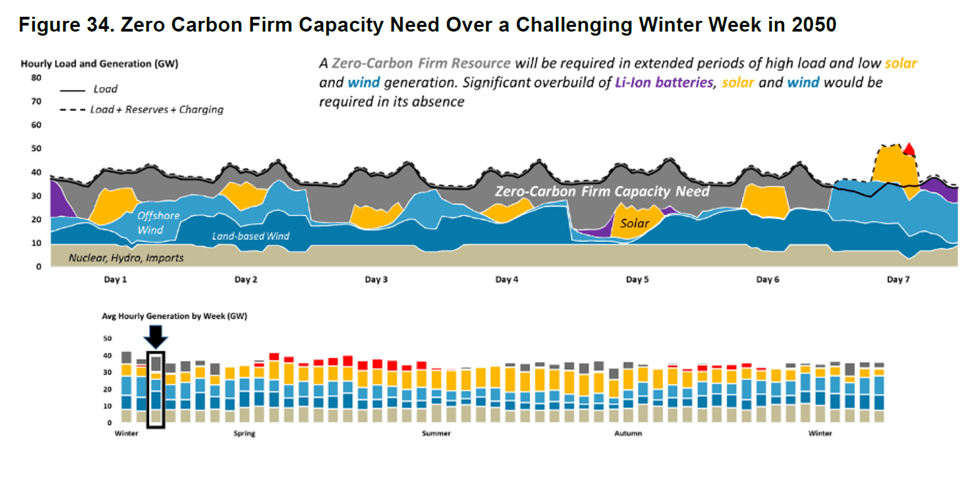
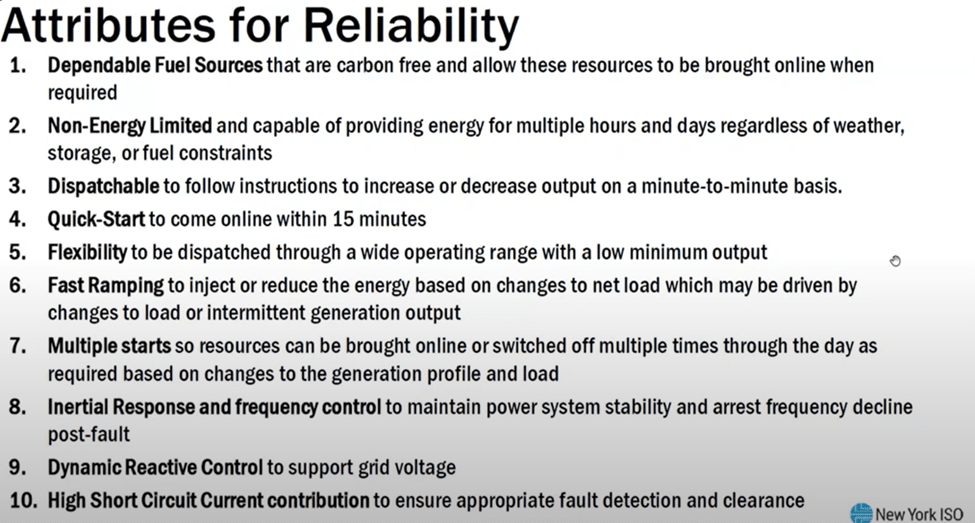
In June the New York Independent System Operator (NYISO) released the latest edition of its Power Trends report that describes factors influencing New York State’s power grid and wholesale electricity markets.  The report described current and future challenges for the electric system.  The description of the system status concludes that “electricity supplies are adequate to meet expected summer demand under normal conditions, but extreme weather and other factors pose reliability risks” but also noted that declining reliability margins are concerning.  The report notes that increases in load are expected due to Climate Act electrification strategies and new energy-intensive projects. Power Trends addressed the Climate Act schedule and noted that there have been delays in projects and planning processes take time.  Of particular concern is that new technologies, collectively referred to as Dispatchable Emission Free Resources (DEFRs), must be deployed as wind and solar resources are developed but these technologies do not exist yet on a commercial scale. Taken as a whole, these findings suggest that there will be significant reliability risks for the Climate Act transition on the mandated schedule.

Comptroller Report Reality

Marie French from Politico wrote that Gov. Kathy Hochul was asked by the Times Union’s Dan Clark about Comptroller Tom DiNapoli’s audit finding issues with the planning for the 70% goal the governor herself has touted. She said those goals were set based on information at the time and “predates” the then-lieutenant governor. “That was pre-pandemic, pre-supply chain disruptions,” she said.  We continue to power forward, but there’s some things that are out of our control,” Hochul said, noting the public isn’t rapidly adopting electric vehicles despite the state’s efforts. The governor said the state’s climate goals are something she “would love to meet, but also the cost has gone up so much. I now have to step back and say, ‘What is the cost on the typical New York family?’ Just like I did with congestion pricing.”

Politico also noted that her comments would raise even more concerns from environmental groups about Hochul’s commitment to meeting the statutory targets. It also raises more questions about whether the state will move forward with a cap-and-trade program. “if you’re a family with three kids living in upstate New York … and your energy source is oil or even natural gas, what is the cost of that transition to you?” Hochul asked.  “We’re going to get to our goals. If we miss it by a couple of years, which is probably what will happen, the goals are still worthy, but we have to think about the collateral damage of these decisions,” Hochul said. “Either mitigate them or rethink them.”

The Politico article included responses from climate activists:

NYLCV president and CEO Julie Tighe said it was “mind-boggling” to hear Hochul’s comments a day after she toured storm damage in Rome. “I had not heard her say that before. I think some of the goals are obviously near term, but we have a long-term goal, and that is still well within reach,” Tighe said. “Coming on the heels of her pausing congestion pricing, you start to wonder if this is a trend.”

The Nature Conservancy’s New York executive director, Bill Ufelder, urged the governor to commit to the goals in the law and zeroed in on her opening the door to “rethink” the goals. “The science on climate change has not changed; we are at a critical moment in the fight to ensure the health, well-being, and economic strength of our state,” he said in a statement.

Democratic Sen. Liz Krueger posted on X in response to Hochul’s comments: “The passage of time does not change the law and it doesn’t make the climate crisis magically disappear. We are dangerously behind on the science-based mandates in CLCPA. It’s time to redouble our efforts, and build a more affordable, healthier, livable future for New Yorkers.”

Clean Energy Standard Biennial Report Reality

POLITICO’s Marie J. French also wrote about the effect of the Biennial Report on the schedule noting that “New York is on track to miss most of the looming targets the legislation set. Gov. Kathy Hochul’s administration acknowledged in a July 1 report that the state was not going to meet the 70 percent renewable electricity by 2030 target — as offshore wind projects and upstate wind and solar development have faltered.”

French noted that other targets are in danger:

New York is expected to miss targets for energy efficiency, energy storage and electrification of vehicles and homes. Overall, the state as of 2021 had only reduced emissions 10 percent from the 1990 baseline. Much more progress will be needed to meet the 2030 target of a 40 percent reduction in the climate law.

She also noted that:

Environmental advocates worry Hochul won’t commit the resources needed to get New York on track to slash emissions and avoid the worsening impacts of climate change. “How many heat waves are we going to experience, and how many people are going to die in those heat waves?” said Jessica Azulay, program director of Alliance for a Green Economy. “We’re in a race against time, and we can’t really negotiate with greenhouse gas emissions.”

A North Country Public Radio interview with Colin Kinniburgh, a climate journalist with New York Focus, acknowledged that the “total overhaul of basically how we run our economy” has forced the Hochul Administration to “wobble on some aspects of the law” particularly relative to costs.  He believes that the building out rooftop and smaller-scale solar is going well.  On the other hand, he noted that the rollout of the proposed cap-and-dividend program will be the biggest signal of the Administration’s commitment to the Climate Act:

It’s going to affect the entire state’s economy. It’s called a price ceiling. They set a limit on how expensive it would be to pollute. That’s pretty crucial because if it’s low then you could argue that it gives polluters a pass. So that’s by far the biggest thing.

Agency Response

Marie French interviewed NYSERDA President and CEO Doreen Harris who claimed that the state is making headway. Harris said: “We have moved these markets in a very significant way”.  “The whole reason for setting goals … is to provide market sizing for the private sector to respond to.”

Susan Arbetter Capital Tonight also interviewed Harris and Rory Christian, chair and CEO of the PSC.  There is so much material in this interview that I am going to devote an article to it.  The highlight came when Arbetter asked if the Hochul Administration had plans to pause the implementation of its already delayed climate goals.   Harris responded:

“Absolutely not. And instead, what we are seeing is this market response. Clearly, change takes time but at the same time, when we set these goals, we see the market responding in ways that are truly transforming our economy and, and, benefiting New Yorkers. So, our commitment remains firm,” she said.

Both Harris and Christian maintained that everything is fine and gave a very optimistic interpretation of the Comptroller and Biennial Reports.  I wonder if they hope that the politicians bail them out when reality strikes and it is no longer possible to ignore the three reports described.  In the meantime, they are following the narrative.

Conclusion

In the last month three reports have raised concerns about meeting the schedule, documenting the costs, and potential risks to reliability.  Climate activists and their considerable lobbying power deny the importance of these reports.  The Administration will be forced to choose between the expert conclusions and the pervasive and emotional demands of the activists.  I think that Hochul has caught on to the fact that the biggest force, the unsuspecting populace of New York, is starting to realize how much this will affect their lives and bank accounts.  These irresistible forces are converging so stay tuned because when they collide the shocks will reverberate around New York.

Risks of Climate Act Net Zero

I believe the Climate Leadership & Community Protection Act (Climate Act) transition will negatively affect affordability, reliability, and the environment.  I have been meaning to summarize my concerns for quite a while and two recent articles prompted me to write this.  David Turver explains how the transition to Net Zero has negatively affected affordability in the United Kingdom.   Robert Bryce provides an example of how the Climate Act mandates for offshore wind development will negatively affect the endangered North American Right Whale.  Finally, I describe why I worry that the reliance on wind and solar generating resources markedly increases reliability risks.

I have followed the Climate Act since it was first proposed, submitted comments on the Climate Act implementation plan, and have written over 400 articles about New York’s net-zero transition.  The opinions expressed in this article do not reflect the position of any of my previous employers or any other company I have been associated with, these comments are mine alone.

Introduction

David Turver’s Risks of Net Zero article prompted me to write this post.  He is the author of the Eigen Values Substack.  He is a retired consultant, CIO and project management professional. His description says that he is a first principles thinker who is tired of superficial media simply republishing press releases without critical analysis. His Substack incudes articles about contentious issues such as climate, energy, and net zero.

The Introduction to Risks of Net Zero provides an overview of the general concern about the risk.  He states:

We hear a lot about how we are supposedly in a climate crisis and how The Science™ tells us we are about to succumb to global boiling. Most climate activists claim that we must cut emissions by spending more money on windmills and solar panels or we will all burn to a crisp.

I would describe myself as a lukewarmer, by which I mean that I acknowledge the earth is warming and that human emissions of CO2 have made some contribution to that warming. However, it is also true that the climate has changed dramatically without human intervention; clearly, there are other causes of climate change too.

The strategy of reducing emissions of greenhouse gases to Net Zero is classified as a “mitigation strategy” in the parlance of the IPCC. The alternative strategy is adaptation which means taking measures to adjust to climate change such as building flood defences, irrigation systems or developing new strains of crops to cope better with changing weather patterns. Most spending effort in the West is geared towards mitigation. But, what if the Net Zero cure is worse than the disease? What if mitigation is less effective than adaptation?

Before he addresses affordability Turver compares mitigation against adapatation. He and I agree that adaptation is likely to be more effective than mitigation. He explains why in the following.

Mitigation Drawbacks

Turver points out issues related to mitigating climate change by reducing emissions.  Mitigation only works if CO2 is the only climate control knob but that cannot be the case because we have observed temperature changes over the last thousand years.   Mitigation can only work if everyone else slashes emissions too and we can see from Figure 2 (from Our World in Data) that this is not happening.

Adaptation Successes

Turver explains that adaptation since 1900 has dramatically decreased death rates.  He includes a figure sourced from  Our World in Data.

Not mentioned but certainly a factor is that the death rate went down in no small part because fossil fuels increased the ability of society to address the causes listed.  Based on past success the obvious alternative is to emphasize adaptation.  Turver explains:

Adaptation measures have many benefits. First, they require no international treaty, and they can be applied locally where they produce results quickly. They also work to protect against changes in the climate that are not driven by CO2. Adaptation measures might also have additional benefits such as more efficient water use or more robust crop varieties. There is no reason why we cannot continue to adapt.

New York Effect on Climate Change

There is another aspect of mitigation that is routinely ignored by proponents of the Climate Act.  New York emissions are tiny relative to global emissions.  In 2021, NYS GHG emissions (GWP-100) were 247 million metric tonnes (MMT).  GHG emissions from China were 13,774 MMT and from India were 3,879 MMT.  The increase in emission from 2020 to 2021 were 498 MMT in China and 265 MMT in India.  New York emissions will be supplanted by emissions from China or India in less than one year.  New York’s net-zero transition plan emission reductions will have no effect on emissions and thus no effect on the purported effects of climate change. Adaptation investments in New York infrastructure to reduce the costs of extreme weather impacts will focus on New York so the benefits will be to New Yorkers.

Climate Act advocates frequently argue that New York must take action because our economy is large.  I analyzed that claim and summarized the data here.  New York’s 2020 Gross State Product (GSP) ranks ninth if compared to the Gross Domestic Product (GDP) of countries in the world.  However, when New York’s GHG 2016 emissions are compared to emissions from other countries, New York ranks 35th.  More importantly, a country’s emissions divided by its GDP is a measure of GHG emission efficiency.  New York ranks third in this category trailing only Switzerland and Sweden. We are already doing our share.

Net Zero Affordability Risks

I think the biggest issue with the Climate Act is affordability.  Everyone wants a clean and safe environment but just how clean, how safe and at what price are all value judgements.  Turver points out that implementation of net-zero policies like the Climate Act have poorly acknowledged risks:

First and most obvious, they cannot work against climatic changes that are driven by forces other than CO2. Second is the outright cost. 

He goes on to describe observed cost increases in the United Kingdom.  He makes the point that additional costs also make manufacturing and other production less competitive, which leads to job losses.  Ultimately the inability to produce basic needs reduces security.  He also points out that renewable energy development requires more materials than alternatives.  That has environmental and cost implications. 

Turver explains that the increased penetration of renewables in the United Kingdom has led to a massive increase in electricity bills. This increase comes from “renewables subsidies as well as grid balancing costs and the massive costs of expanding the grid out to remote offshore wind farms”.  The article compares recent United Kingdom industrial gas prices and industrial electricity prices:

As can be seen in Figure 5, from 2008 to 2020, industrial electricity prices rose 53.8% while industrial gas prices actually fell slightly over the same time period. Both gas prices and electricity rose in 2021 as gas prices started to spike as demand increased after Covid lockdowns ended and supply could not keep up with demand. However, even though there was a spike in gas prices in 2021, the increase from 2008 is still only 33%, whereas electricity prices have surged 71.4% over the same period. The figures for 2022 are not yet available, but we might expect to see a big surge in both gas and electricity prices due to supply shortages resulting from the war in Ukraine.

There is no doubt that all these impacts will inevitably occur in New York as the Climate Act mandates are implemented. A recurring theme of many of my posts is that the Hochul Administration has never provided clear and comprehensive cost estimates for all the control strategies in the Scoping Plan

American Offshore Wind Energy Scandal

I believe that the environmental impacts of wind and solar development are greater than the impacts of fossil-fueled or nuclear resource development.  In my Draft Scoping Plan comments I noted that on September 17, 2020 the Final Supplemental Generic Environmental Impact Statement (SGEIS) for the Climate Leadership and Community Protection Act was released.  It covered the “environmental impacts of the offshore wind and distributed solar procurement goals, and the estimate of utility-scale solar capacity required to meet the meet the 70 by 30 goal” based on the resources estimated necessary at that time.  Since then, considerably more resources have been projected but the cumulative assessment has not been updated.

Robert Bryce published an article entitled The Offshore Wind Scandal is Even Worse Than You Think  that addresses one of the cumulative environmental impacts that the Scoping Plan ignored.  Bryce is an author, filmmaker, and public speaker who has been reporting on the energy sector for more than 30 years.  His background enables him to provide graphical evidence to support his arguments that I think are well done.  In this article he includes 11 charts that “show how America’s biggest NGOs are colluding with foreign corporations that want to industrialize our oceans with thousands of turbines that will hurt whales and ratepayers”.

He writes:

The hard reality is that America’s offshore wind sector is a subsidy-dependent industry that is dominated by foreign companies who are in bed with some of America’s biggest climate NGOs, including the NRDC (gross receipts: $555 million) and Sierra Club (Gross receipts: $184 million).  Those NGOs and others, including the National Wildlife Federation (gross receipts: $142 million) and Conservation Law Foundation (gross receipts: $17.5 million), are leading the most shameful environmental betrayal in modern American history. Rather than seek to protect marine mammals and stop the industrialization of our oceans, they are eagerly promoting the installation of hundreds of offshore wind platforms smack in the middle of the known habitat of the critically endangered North Atlantic Right Whale.

I recommend the article for its details.  In this summation I am not going to address all the charts in detail.  The first four charts support the quotation above.  The fifth chart addresses environmental impacts.  The offshore wind shills claim that there aren’t impacts on whales, but Federal scientists disagree.

Bryce describes Chart 6:

I’m old enough to remember when environmental groups cared about whales. Alas, that was a long time ago. On Sunday, the Daily Mail published an article about Apostolos Gerasoulis, a Rutgers professor emeritus of computer science who built a software system to analyze the dozens of whale deaths that have occurred on the Eastern Seaboard over the past few years. Gerasoulis set out to determine if the whale deaths were related to the loud blasts of sonar used by offshore wind survey vessels. His conclusion: “Offshore wind kills whales…The numbers never lie. There is a cause. We have shown that the cause for death of the whales is offshore wind. Period.” (H/t fellow Substack writer David Blackmon.) 

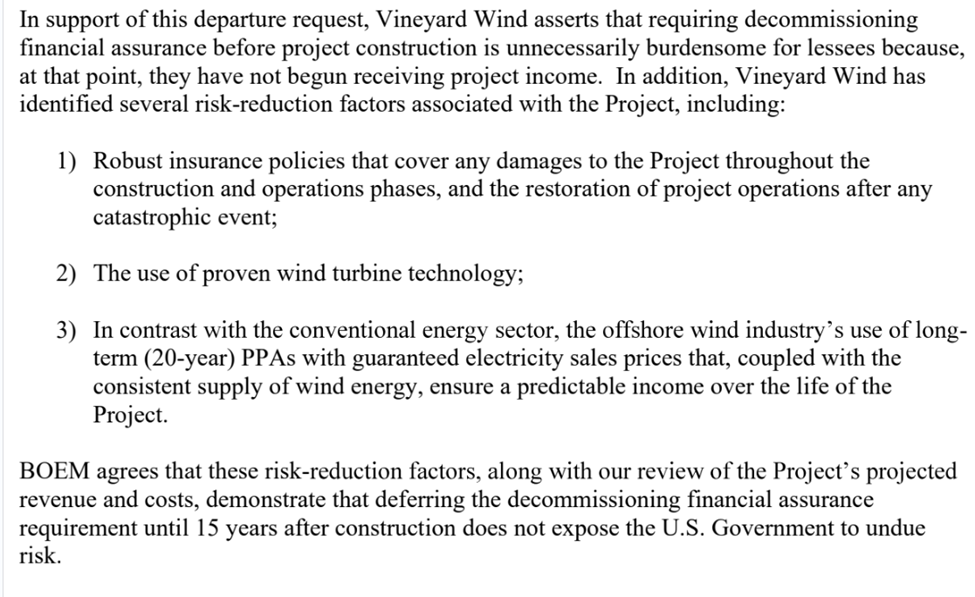
In Chart 7 Bryce notes that the Massachusetts Sierra Club notes that “Because the North Atlantic Right Whale has such a small population and a low annual reproductive rate, a single whale death can have a significant negative impact on the species’ ability to recover.”  In Chart 8 he provides a plain English translation of a statement in the Bureau of Ocean Energy Management environmental impact statement of Vineyard Wind: “These projects won’t make any difference on climate change. But they are good because they allow state-level bureaucrats to say they met their policy goals.” 

The remaining charts compare offshore wind capacity and costs relative to other resources.  He concludes that these developments will markedly increase costs for states that already have some of the highest electricity rates in the country.

I maintain that the New York State has shirked its commitment to the environment because it has not addressed cumulative environmental impacts of the Scoping Plan buildout of wind and solar.  No where is this more impactful than the effects on whales in general and the remaining North American Right Whales in particular.  Bryce quotes an opponent of offshore wind: “What is Big Wind going to say when they kill the last whale? ‘Sorry’?” 

Reliability Risks

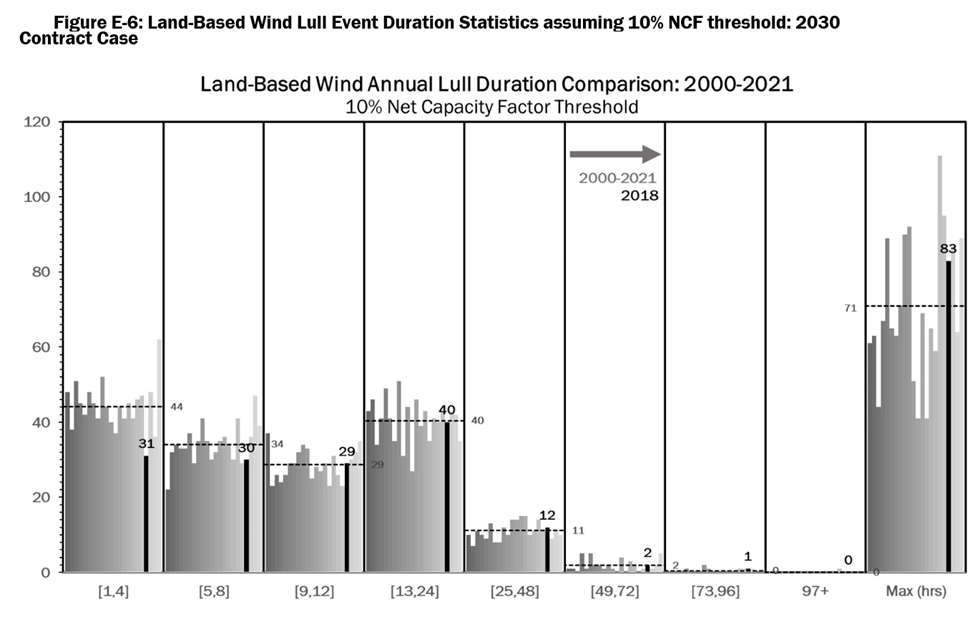
I described my concern about the enormous risk of an electric grid relying on wind and solar resources in this post.  Since then, I have refined my description of the problem.  It boils down to “correlated intermittency”.  Let me explain.

Wind and solar are inherently intermittent – the sun does not shine at night and the wind does not always blow.  That intermittency is correlated.  All the solar in New York is unavailable at night.  It turns out that wind resources across New York also are usually high or low at the same time. There are exceptions but there is a high incidence of similar behavior.

That matters for electric resource planning.  Today electric resource planning relies on decades of performance experience with hydro, nuclear, and fossil plants that do not correlate, that is to say there is no reason to expect that all the nuclear plants will be offline at the same time.  As shown in the following New York Independent System Operator (NYISO) slide, this characteristic enables the resource planners to determine how much generating capacity is necessary to meet the loss of load expectation (LOLE) criterion.  The probability of losing load not more than once in ten years is based on observations of the existing uncorrelated generating resources.  Importantly, I believe that the lack of correlation also means that the capacity needed above firm system load would not change substantially if the LOLE planning horizon was shifted to 1 day in 20 years.

Source: NYISO Amount of Capacity Required, Intermediate ICAP Course, June 2023

The variation in weather that affects wind and solar resource availability will require changes to electric resource planning.  Everyone has heard of a hundred-year flood which is the parameter used for waterway planning.  This is the one in a hundred probability that the water level in a river or lake will exceed a certain level.  Similar estimates of low wind and solar resource availability must be developed and incorporated into electric resource planning.

The unresolved problem is what return period probability is acceptable.  If the resource planning process does not provide sufficient backup resources to provide capacity for a peak load period, then blackouts are inevitable.  Two factors exacerbate the challenge of this problem:

  1. Periods of highest load are associated with the hottest and coldest times of the year and frequently correspond to the periods of lowest wind resource availability. 
  2. The decarbonization strategy is to electrify everything possible so the impacts of a peak load blackout during the coldest and hottest periods will be greater.

In an earlier post I described an analysis by the Independent System Operator of New England (ISO-NE) Operational Impact of Extreme Weather Events.  The study evaluated 1, 5, and 21-day extreme cold and hot events using a database covering 1950 to 2021. Not surprisingly the system risk or “the aggregated unavailable supply plus the exceptional demand” during an event increased as the lookback period increased.  If the resource adequacy planning for New England only looked at the last ten years, then the system risk would be 8,714 MW, but over the whole period the worst system risk was 9,160 and that represents a resource increase of 5.1%.  There is no question that a similar analysis for New York would find a similar result.

The correlated intermittency of wind and solar resources means that we will depend on energy-limited resources that are a function of the weather causing low resource availability at the same time.  The unresolved issue is how to design an affordable and practical system to meet the worst-case weather induced lull. Consider the ISO-NE analysis where it was found that the most recent 10-year planning lookback period consistent with current LOLE evaluations would plan for a system risk of 8,714 MW.  If the planning horizon covered the period back to 1961, the worst-case to 1950, an additional 446 MW would be required to meet system risk.  I cannot imagine a business case for the deployment of electric system resources that will only be needed once in 63 years.  For one thing, the life expectancy of these technologies is much less than 63 years.  Even over a shorter horizon such as the last ten years, how will a required facility be able to stay solvent when it runs so rarely? The only solution is subsidies to build and very high payments when they do run.

Reliability risks have also been identified by the North American Electric Reliability Corporation.  They have expressed concerns that extreme weather events, rapid demand growth, and systemic vulnerabilities pose risks for supply shortfalls and grid reliability.  These are serious risks to the Climate Act net-zero transition plan that must be resolved sooner rather than later.

Conclusion

I believe that the Climate Act will do more harm than good.  Affordability is the first problem. The Hochul Administration has not provided transparent and comprehensive cost estimates for the control strategies proposed for the net-zero transition.  The New York State Comptroller Office audit of costs in Climate Act Goals – Planning, Procurements, and Progress Tracking  agrees with my concern and recommends a detailed analysis of cost estimates to transition to renewable energy sources and meet Climate Act goals. I believe such an analysis will agree with observed results elsewhere that show the costs will be extraordinary and will certainly affect affordability.

The Hochul Administration has not provided a cumulative environmental impact assessment for the generating resources projected in the Scoping Plan.  Nowhere is the potential impact more critical than with respect to whales and the massive deployment of offshore wind proposed.  It is incumbent upon the State to prove that there will not be adverse impacts to the critically endangered North American Right Whales.

Finally, there ae reliability risks inherent in a weather-dependent electric grid when all the wind and solar output is reduced at the same time.  This raises overarching questions that have not been addressed.  Furthermore, even if these weather risks can be addressed in theory, the solution will involve technologies that are not commercially available today.  I have no doubts that the only safe way to decarbonize the electric grid is to rely on nuclear power.  The Hochul Administration needs to confront these issues before it is too late. 

The risks of the Climate Act are all associated with mitigation efforts to reduce GHG emissions.  I agree with Turver that mitigation should be emphasized.  He concludes:

The risks of climate change can be averted by continuing to adapt, just as we have for millennia. It is certain that unilateral action by the UK, or indeed multilateral action by much of the West, will do nothing to change the weather while the developing world continues to increase their consumption of hydrocarbons to make themselves richer. Indeed, even if mitigation measures were adopted globally, it is naïve to believe that bad weather will cease and we will suddenly get the “stable climate” demanded by more than 170 lawyers.

Ellenbogen on the Comptroller Audit of the Climate Act

On July 16, 2024 the New York State Comptroller Office released an audit of the New York State Energy Research and Development Authority (NYSERDA) and Public Service Commission (PSC) of their implementation efforts for the Climate Leadership and Community Protection Act (Climate Act) titled Climate Act Goals – Planning, Procurements, and Progress Tracking.  The key finding summary states: “While PSC and NYSERDA have taken considerable steps to plan for the transition to renewable energy in accordance with the Climate Act and CES, their plans did not comprise all essential components, including assessing risks to meeting goals and projecting costs.”  As much as I would like to do a post on this, I am stretched too thin.  Fortunately, Richard Ellenbogen sent along his thoughts that I have incorporated into my overview of the background and context of this report.

Ellenbogen is the President [BIO] Allied Converters and frequently copies me on emails that address various issues associated with the Climate Act I have published other articles by Ellenbogen and collaborated on a position paper on New York City’s Local Law 97 with him. There are only a few people in New York that are trying to educate people about the risks of the Climate Act with as much passion as I am, but Richard certainly fits that description.  He comes at the problem as an engineer who truly cares about the environment and how best to improve the environment without unintended consequences.  He has spent an enormous amount of time honing his presentation summarizing the problems he sees but most of all the environmental performance record of his business shows that he is walking the walk.  

Overview

The Climate Act established a New York “Net Zero” target (85% reduction in GHG emissions and 15% offset of emissions) by 2050.  It includes an interim 2030 reduction target of a 40% reduction by 2030 and a requirement that all electricity generated be “zero-emissions” by 2040. The Climate Action Council (CAC) was responsible for preparing the Scoping Plan that outlined how to “achieve the State’s bold clean energy and climate agenda.” The Integration Analysis prepared by the New York State Energy Research and Development Authority (NYSERDA) and its consultants quantifies the impact of the electrification strategies.  That material was used to develop the Draft Scoping Plan outline of strategies.  After a year-long review, the Scoping Plan was finalized at the end of 2022.  Since then, State agencies and the legislature have been attempting to implement the plans through regulations, PSC orders, and legislation. 

The New York State Comptroller Office audit of NYSERDA and PSC is available in  Climate Act Goals – Planning, Procurements, and Progress Tracking as a pdf format file.  The Audit Highlights section of the report lists the key findings and key recommendations:

Key Findings

While PSC and NYSERDA have taken considerable steps to plan for the transition to renewable energy in accordance with the Climate Act and CES, their plans did not comprise all essential components, including assessing risks to meeting goals and projecting costs. Specifically:

  • PSC is using outdated data, and, at times, incorrect calculations, for planning purposes and has not started to address all current and emerging issues that could significantly increase electricity demand and lower projected generation, such as increased push to transition to electric vehicles by 2035 and the cancellation or delay in renewable energy projects. Between 2005 and April 2023, 12% of contracted large-scale renewable projects were canceled. 
  • The costs of transitioning to renewable energy are not known, nor have they been reasonably estimated. Moreover, funding sources to cover those costs have not been identified, leaving the ratepayers as the primary source of funding. The lack of alternative funding sources adds additional risk to whether the State can meet its goals timely. Data shows utility costs have already risen sharply over the last two decades and more New Yorkers are having difficulty paying their utility bills. 
  • PSC has taken steps to address some risks and issues; however, it has not yet begun to formally review progress toward Climate Act goals with updated generation and electricity demand forecasts. While PSC noted it has until July 2024 to begin this assessment, waiting until that point to fully review all efforts and costs of the transition to renewable energy increases the risk that Climate Act goals will not be met within the established time frame.

Finally, a formal backup plan has not been established in the event Climate Act goals are found to be unachievable within the prescribed time frames, other than PSC suspending or modifying the obligations under the Climate Act and relying on the continued use of fossil fuels to generate electricity until sufficient renewable electric generation is developed. However, continuing to use fossil fuels as a backup plan would delay emission reductions and increase the burden on ratepayers by forcing them to continue to support fossil-fuel generation that otherwise could be retired—including the additional cost of the infrastructure to safely transport the fossil fuels to where they will be used to generate energy.

Key Recommendations

•            Begin the required comprehensive review of the Climate Act, including assessment of progress toward the goals, distribution of systems by load and size, and annual funding commitments and expenditures.

•            Continuously analyze the existing and emerging risks and known issues to ensure they are evaluated and addressed to minimize impact on the State’s ability to meet Climate Act goals.

•            Conduct a detailed analysis of cost estimates to transition to renewable energy sources and meet Climate Act goals. Periodically update and report the results of the analysis to the public.

•            Assess the extent to which ratepayers can reasonably assume the responsibility for covering Climate Act implementation costs. Identify potential alternative funding sources.

Note that the key finding that states that the PSC “has not yet begun to formally review progress toward Climate Act goals with updated generation and electricity demand forecasts.”  It goes on to say that “While PSC noted it has until July 2024 to begin this assessment, waiting until that point to fully review all efforts and costs of the transition to renewable energy increases the risk that Climate Act goals will not be met within the established time frame.”  A couple of weeks ago the PSC released the Clean Energy Standard Biennial Review Report.  I do not think that report uses “updated generation and electricity demand forecasts” but it does conclude that the 2030 goal requiring 70% of the electricity supplied to the grid come from renewable sources will not be met without extraordinary efforts.

In addition, the biennial report does not address costs.  It states that:

Appendix A also provides CES funding and expenditures for recent years through 2023. Forward-looking cost estimates for the CES and other costs associated with pursuit of the CLCPA goals are provided separately in the Department of Public Service (DPS) Annual CLCPA Report.  The most recent such report was filed on July 20, 2024. Case 22-M-0149, Proceeding on Motion of the Commission Assessing Implementation of and Compliance with the Requirements and Targets of the Climate Leadership and Community Protection Act, New York State Department of Public Service First Annual Informational Report on Overall Implementation of the Climate Leadership and Community Protection Act (filed July 20, 2024). The next report is expected to be filed later in 2024.

In other words the biennial reports are not going to provide the cost data that the Comptroller audit recommends.

Ellenbogen Commentary

The following was included in an email from Ellenbogen on 17 July 2024.  I have made a few edits for consistency with this article and have added a couple of annotations.

Regarding DiNapoli’s request for more transparent information mentioned in the audit report, he is correct but he is directing his arrows at the wrong targets.  While I have major issues with some of the things that NYSERDA has done over the past couple of years, primarily their silence on the CLCPA, the PSC and NYSERDA are not the ultimate culprits here.  At the BCNYS Renewable Energy Conference, I asked the NYISO speaker why they were screaming between the lines and not just coming out and saying that the entire process is devoid of reality because the people that need to hear it can’t, or are unwilling to, read between the lines.  The NYISO says that, “Because we shut down gas generation too quickly, the system is compromised and has inadequate excess generation during times of extremely high load” which translates to, “If we have too many hot days in a row, there is going to be a blackout and people are going to die.”

In their 2022 6 GW storage report, NYSERDA stated that to get the system to work would require 1000+ hours of storage and the cost at the time was $560 per KWh.  Doing the math, that was $3.36 Trillion dollars for storage that would last only ten years.  That doesn’t include the renewables and transmission that would be required or the hundreds of billions of dollars to electrify the buildings.  The actual cost will be at least ten times NY State’s annual budget, if not more.   It will impose a tax burden on every New Yorker that none of them will be able to afford.  NYSERDA put the number out there, but everyone ignored it and just plowed along as though they could somehow overcome that little detail.  The cost also ignores logistical issues that I have mentioned on numerous occasions.

The problem with agency cost estimates is that they are buried in different reports. The Scoping Plan that outlined how to “achieve the State’s bold clean energy and climate agenda” is the logical place to provide comprehensive cost estimates for all the strategies proposed to achieve the Climate Act mandates.  However, the cost documentation is incomplete, sparsely referenced, and misleading, in short it does not provide the necessary information for estimating ratepayer costs to New Yorkers. 

This is a problem because New York Public Service Law  § 66-p (4), “Establishment of a renewable energy program”, states: “The commission may temporarily suspend or modify the obligations under such program provided that the commission, after conducting a hearing as provided in section twenty of this chapter, makes a finding that the program impedes the provision of safe and adequate electric service; the program is likely to impair existing obligations and agreements; and/or that there is a significant increase in arrears or service disconnections that the commission determines is related to the program”.  It is only possible to determine the impact on ratepayers in arrears or service disconnections if full cost estimates are available.  The Comptroller audit appropriately addresses this shortcoming with the recommendation to “Conduct a detailed analysis of cost estimates to transition to renewable energy sources and meet Climate Act goals” and “Periodically update and report the results of the analysis to the public.”

I agree with Ellenbogen’s following explanation why this information is not available:

No one wants to put the actual number into the public domain because it is so astronomical that the minute it was announced, the project would implode, and the political fallout will be staggering.  Further, I’m sure that the lesson of what happened to Justin Driscoll of NYPA when he told the truth about the process is fresh in everyone’s mind.  The acolytes of this process wanted to hang him upside down from a light pole, as was done to Mussolini.  He was just telling them the truth but that evidently doesn’t mean anything in NY State.  No sane person wants to put that number down on paper and get pilloried for it and called a liar.  Everyone at the state level that knows better is required by law to implement this ridiculous plan that can’t be implemented.  So, they can tell the truth and get fired or they can duck and cover and hope that the law gets changed when it becomes brutally obvious how flawed it really is.  In the interim, everyone is finger pointing, including the state comptroller.

The real targets for DiNapoli should be the Climate Action Council and the legislature that proposed this insanity based upon fantasies with no grounding in reality.  No realistic cost analysis was ever done prior to voting to pass the Climate Act.  The cost analysis for the Draft Scoping Plan was inadequate but the Climate Act Scoping Plan was still approved and that is the fault of the Climate Action Council (CAC).  The few numbers that I have seen in the Climate Act Scoping Plan are so devoid from reality that they would be funny if the situation wasn’t so serious.   You can make stuff up as the Climate Action Council did, but with math and physics, reality will eventually rear its ugly head and that is what is happening now.

In a second email Ellenbogen continued:

The issue isn’t that the PSC and NYSERDA aren’t planning properly.  If you look at the three key findings quoted from the Audit highlights above, they are unachievable under any circumstances.  It wouldn’t matter what NYSERDA and the PSC did.  They can’t pull rabbits out of hats last I checked.

There is a Climate Action Council mandate (section 16 of § 75-0103) to consider efforts at other jurisdictions: “The council shall identify existing climate change mitigation and adaptation efforts at the federal, state, and local levels and may make recommendations regarding how such policies may improve the state’s efforts”. Ellenbogen points out the there are lessons to be learned at other jurisdictions that have attempted to decarbonize using wind and solar that have been ignored.  Why?

The math behind the solar and wind utility system doesn’t work.  It hasn’t worked anywhere it has been tried and the time frames have been measured in decades to get to a fraction of a renewable system, not 10 years or 20 years like the CLCPA requires.  Germany is 34 years in, controls the banking system in their jurisdiction which NY State does not, and they’ve only gotten to 34% renewables after about 34 years with energy costs twice those of France next door.  Their politicians are paying for that.  The costs are rising because they are being required to install transmission that only operates 15% of the time for solar or 30% for wind where it would operate 93% of the time for fossil or nuclear.  That increases the transmission cost per megawatt-hour.   Offshore wind bids are coming in at three times the price of current generation.  Projects are being canceled because of high transmission costs and material costs.  Building electrification is prohibitively expensive.  How can you plan for that?  

Why didn’t the legislature request a cost analysis prior to passing the bill?  Why didn’t the Climate Action Council do a cost analysis of what they were proposing?  It’s because it was driven by a couple of college professors that have absolutely no understanding of procurement, energy, economics, or basically anything else in the real world.  In their minds, no cost was too high to eliminate fossil fuels from the state.  The question for politicians today is whether spiraling energy costs brought on by this bill are going to make re-election more difficult.

The net-zero transition plan requires “Distributed Emission Free Resources” or DEFR’s that don’t exist in the present day aside from nuclear and that is a dirty word in NY State.  Even if the State made the rational decision to decarbonize the electric sector with nuclear instead of wind and solar, it would also take about 30 – 40 years to build enough nuclear capacity to meet the state’s needs if they started today.  Waiting for an alternative new technology to fulfill the DEFR requirement will take even longer.  None of these time frames fits within the CLCPA mandate.

The only mistake that the PSC and NYSERDA made was not speaking up in 2019 before this mess was passed but Cuomo was ruling with an iron hand at the time.  What makes this all so senseless is that nothing NY State does is going to impact Climate Change.  I’m not saying that we should do nothing, but we should be intelligent in our planning.  Saying that NY State is an energy leader is a joke.  We’re only a leader in chasing our businesses to other states where they are assured of an adequate energy supply.  In 20 years NY State is going to be an example of what not to do.

The backup plan for the near term to ensure sufficient generation would require the construction of fossil fuel plants which will draw the ire of the lunatic fringe that has no understanding of energy or math.  I gave them a backup plan in comments I submitted to the record for Department of Public Service Proceeding 15-E-0302 but numerous groups will fight against that.  When the level of desperation gets high enough, they will be implemented.  Unfortunately, there may have to be a major blackout to bring people to their senses.

Conclusion

The Comptroller Climate Act Goals – Planning, Procurements, and Progress Tracking and the PSC Clean Energy Standard Biennial Review Report both acknowledge that Climate Act implementation is not going as planned.  I believe Ellenbogen agrees with me that all the recommendations in the audit report should be implemented as soon as possible:

•            Begin the required comprehensive review of the Climate Act, including assessment of progress toward the goals, distribution of systems by load and size, and annual funding commitments and expenditures.

•            Continuously analyze the existing and emerging risks and known issues to ensure they are evaluated and addressed to minimize impact on the State’s ability to meet Climate Act goals.

•            Conduct a detailed analysis of cost estimates to transition to renewable energy sources and meet Climate Act goals. Periodically update and report the results of the analysis to the public.

•            Assess the extent to which ratepayers can reasonably assume the responsibility for covering Climate Act implementation costs. Identify potential alternative funding sources.

Richard Ellenbogen and I have long argued that a clear and transparent accounting of all the costs to meet the Climate Act goals is not available.  It is heartening to see that the Comptroller audit agrees with our position that this information is necessary.  The biennial review report concludes that the 2030 electric grid goal for 70% renewable energy is not likely.  It is time for New York State to acknowledge these problems should be resolved before continuing.  I recommend a pause in implementation until all the recommendations in the audit report are implemented and a feasibility study reconciles the electric system projections in the Scoping Plan and the New York Independent System Operator resource adequacy analyses.

Ellenbogen sums up the situation:

There is nothing happening now that I didn’t tell them would happen five years ago.  I’m not Nostradamus.  I just know how to count.

Climate Act Presumption That DEFR is Unnecessary

The New York Department of Public Service (DPS) Proceeding 15-E-0302 addresses among other things  a new category of generating resources called Dispatchable Emissions-Free Resources (DEFR).  All credible analyses of the future New York electric system agree that new technologies are necessary to keep the lights on during periods of extended low wind and solar resource availability.  This article describes the presumption of the authors of the Climate Leadership & Community Protection Act (Climate Act) that no new technologies would be required.

I have followed the Climate Act since it was first proposed, submitted comments on the Climate Act implementation plan, and have written over 400 articles about New York’s net-zero transition.  The opinions expressed in this article do not reflect the position of any of my previous employers or any other company I have been associated with, these comments are mine alone.

Overview

The Climate Act established a New York “Net Zero” target (85% reduction in GHG emissions and 15% offset of emissions) by 2050.  It includes an interim 2030 reduction target of a 40% reduction by 2030 and a requirement that all electricity generated be “zero-emissions” resources by 2040. The Climate Action Council (CAC) was responsible for preparing the Scoping Plan that outlined how to “achieve the State’s bold clean energy and climate agenda.” The Integration Analysis prepared by the New York State Energy Research and Development Authority (NYSERDA) and its consultants quantifies the impact of the electrification strategies.  That material was used to develop the Draft Scoping Plan outline of strategies.  After a year-long review, the Scoping Plan was finalized at the end of 2022.  Since then, the State has been trying to implement the Scoping Plan recommendations through regulations and legislation.

I have written about the out-sized and misleading impact that Robert W. Howarth, Ph.D., the David R. Atkinson Professor of Ecology & Environmental Biology at Cornell University had on many of the members of the Climate Action Council.  His statement supporting the approval of the Draft Scoping plan claimed that he played a key role in the drafting of the Climate Act and explained why he believes that no new technologies are needed to meet the Climate Act goals:

I further wish to acknowledge the incredible role that Prof. Mark Jacobson of Stanford has played in moving the entire world towards a carbon-free future, including New York State. A decade ago, Jacobson, I and others laid out a specific plan for New York (Jacobson et al. 2013). In that peer-reviewed analysis, we demonstrated that our State could rapidly move away from fossil fuels and instead be fueled completely by the power of the wind, the sun, and hydro. We further demonstrated that it could be done completely with technologies available at that time (a decade ago), that it could be cost effective, that it would be hugely beneficial for public health and energy security, and that it would stimulate a large increase in well-paying jobs. I have seen nothing in the past decade that would dissuade me from pushing for the same path forward. The economic arguments have only grown stronger, the climate crisis more severe. The fundamental arguments remain the same.

The presumption that “it could be done completely with technologies available at that time (a decade ago)” was a primary driver of the Climate Act schedule and confidence of success by the legislature and the Climate Action Council.  The feeling was that all it takes is a matter of political will because the professor said it will work.  Howarth appealed to the authority of peer-reviewed science to provide credibility for the Jacobson analysis that is the basis of his claims. However, science is a continuous process where hypotheses are constantly challenged and confirmed.  In this instance Howarth neglected to mention the analyses that discredit the Jacobson work. 

Jacobson Wind, Water, and Solar

The Jacobson analysis cited was a continuation of previous work broadly labeled as Wind, Water, and Solar.  For example, in a widely publicized November 2009 Scientific American article, Mark Jacobson and Mark Delucchi suggested all electrical generation and ground transportation internationally could be supplied by wind, water and solar resources as early as 2030. However, other contemporary projections were less optimistic, for example two examples: the 2015 MIT Energy and Climate Outlook has low carbon sources worldwide as only 25% of primary energy by 2050, and renewables only 16% and the International Energy Agency’s two-degree scenario has renewables, including biomass, as less than 50%.

Howarth’s statement cites a specific plan for New York (Jacobson et al. 2013) that he and Jacobson laid out a decade ago.  He says that “In that peer- reviewed analysis, we demonstrated that our State could rapidly move away from fossil fuels and instead be fueled completely by the power of the wind, the sun, and hydro.”   Table 2 from that report follows.  This analysis includes power from exotic resources such as waves, geothermal, tidal turbines, and concentrated solar power but no energy storage.  It is significantly different than the projections in the Integration Analysis and the New York Independent System Operator (NYISO) 2021-2040 System & Resource Outlook that exclude all the exotic renewable generating capacity, contain significant amounts of energy storage, and include a new dispatchable, emissions-free resource for a set of resources that they think can provide sufficient electrical power for the future.  Furthermore, Jacobson and Howarth claim that end-use power demand can be decreased by 37%.   In my opinion, there are many flaws in his claims.  For example, any analysis that suggests that concentrated solar power is a viable source of energy in New York is simply not credible because that resource would never work in New York.  It is too cloudy to operate enough to cover costs and the environmental impacts would be too great.

There was a formal rebuttal paper to this analysis by Nathaniel Gilbraith, Paulina Jaramillo, Fan Tong, and Felipe Faria. The rebuttal paper argued that: 

The feasibility analysis performed by Jacobson et al. (2013) is incomplete and scientifically questionable from both the technical and economic perspectives, and it implicitly assumes, without sufficient justification, that social criterion would not produce even larger feasibility barriers.

Jacobson et al. responded to that rebuttal claiming  that “The main limitations are social and political, not technical or economic.”  Given the significant differences between that analysis and the most recent projections by the organization responsible for keeping the lights on, I agree with the Gilbraith et al. conclusion cited above.  I do not believe that the 2013 WWS analysis includes a defensible feasibility analysis.

Using Jacobson as the basis for the idea that the Climate Act transition needs no new technology gets worse.  Unmentioned by Dr. Howarth is that in a 2015 article for a different iteration of the wind, water, and solar roadmap Clack et al, 2017 discredited the Jacobson approach:

In this paper, we evaluate that study and find significant shortcomings in the analysis. In particular, we point out that this work used invalid modeling tools, contained modeling errors, and made implausible and inadequately supported assumptions. Policy makers should treat with caution any visions of a rapid, reliable, and low-cost transition to entire energy systems that relies almost exclusively on wind, solar, and hydroelectric power.

In the scientific process, when issues with your work are noted, the proper response is to provide more evidence supporting your modeling tools, explain why the claimed errors are not errors, and defend your assumptions.  Instead, Jacobson filed a lawsuit, demanding $10 million in damages, against the peer-reviewed scientific journal Proceedings of the National Academy of Sciences and the authors for their study showing that Jacobson made improper assumptions in order to make his claims that he had demonstrated U.S. energy could be provided exclusively by renewable energy, primarily wind, water, and solar. In my opinion this is an appalling attack on free speech and scientific inquiry but want to emphasize that the bad actions by Jacobson in no way should be attributed to Howarth.

In February 2018, following a hearing at which PNAS argued for the case to be dismissed, Jacobson dropped the suit.  The defendants then filed, based on the anti-SLAPP — for “Strategic Lawsuit Against Public Participation” — statute in Washington, DC, for Jacobson to pay their legal fees. In September 2022, he was ordered to pay the defendants’ legal fees based on a statute “designed to provide for early dismissal of meritless lawsuits filed against people for the exercise of First Amendment rights.”  Jacobson appealed that award but lost that appeal in February 2024 thus closing this sad tale of academic controversy.

In Meredith Angwin’s 2020 book Shorting the Grid: The Hidden Fragility of Our Electric Grid (Carnot Communications, Wilder, VT, 422 pp.) she also addressed the Jacobson analysis.  Her description in a section entitled Hard-Core Renewables at page 195 is consistent with my portrayal above:

Wind and solar are the technologies that most people think about when they think of “renewables.” Indeed, many hard-core renewables advocates accept only solar, wind, and (sometimes) hydro as renewables. Biomass rarely makes the cut as a true renewable. Professor Mark Z. Jacobson of Stanford plans WWS (Wind Water Solar) as the energy sources for the world. In 2015, Jacobson and others published an article in the Proceedings of the National Academy of Sciences on using WWS for all purposes.125

In 2017, a group of professors headed by Christopher Clack responded with an evaluation article also in the Proceedings.126 The first paragraph of the Clack article stated that “We find that their (Jacobson analysis) involves errors, inappropriate methods, and implausible assumptions.” For example, their rebuttal paper pointed out that the Jacobson paper describes hydro power as providing 700 to 1300 GW. However, existing installed hydro capacity is 87 or 145 GW, depending on whether pumped hydro is included, and the most useful sites have already been exploited.127

When the Clack paper appeared, Jacobson published a letter in the same issue of the Proceedings, claiming “The premise and all error claims (of the Clack paper)… are demonstrably false.”128 Jacobson said that his assertion on the availability of hydro power was an “assumption,” not an error. As Jacobson wrote in the published letter: “The value of 1,300 GW is correct, because turbines were assumed added to existing reservoirs to increase their peak instantaneous discharge rate without increasing their average annual energy consumption.” Shortly after the Clack paper and the Jacobson rebuttal were published in the Proceedings, Jacobson sued Clack and the Proceedings for defamation.

Jacobson later dropped his lawsuit. On the Greentech Media website, Julian Spector wrote an article about the controversy and the lawsuit.129 In his article, Spector notes that “this ‘assumption’ (about hydro) was unwritten” in the original Jacobson article. In other words, in his original paper, Jacobson did not describe his assumption that multiple turbines would be added to existing dams. Frankly, adding about ten times as many turbines to existing powerhouses seems very unlikely to me. Dam construction is a massive undertaking. Putting many more turbines in an existing powerhouse … well, I can’t see how that could even work.130

Jacobson did drop his lawsuit, which should be a happy ending, I suppose. However, many people, including myself, feel that the fact that Jacobson even brought a lawsuit has had a chilling effect on the whole renewable-energy debate. If scientists can’t debate each other in peer-reviewed journals without fear of lawsuits, science will not be able to move forward very well.

There are two books directly refuting the Jacobson plan. Roadmap to Nowhere: The Myth of Powering the Nation With Renewable Energy by Mike Conley and Tim Maloney is available as a free PDF download on the web.131 Mathijs Beckers, of the Netherlands, wrote The Non-Solutions Project, available as an ebook or paperback.132 The work of these authors is clear and easy to follow.

Footnotes

  1. Mark Z. Jacobson, Mark A. Delucchi, Mary A. Cameron, and Bethany A. Frew, “Low-cost solution to the grid reliability problem with 100% penetration of intermittent wind, water, and solar for all purposes,” Proceedings of the National Academy of Sciences, 112, no. 49 (December 8, 2015): 15060-15065, https://wwu .pnas.org/’content/112149115060.
  2. Christopher T. M. Clack et al., “Evaluation of a proposal for reliable low- cost grid power with 100% wind, water, and solar,” Proceedings of the National Academy of Sciences 114, no. 26 (June 27, 2017): 6722-2627, https://www.pnas . o rg/con tent/114/2 6/6722.
  3. Supporting information for the above article by Clack et al., https://www.pnas .org/content/pnas/suppl/2017/06/16/16103 81114. DCSupplemental/pnas. 1610381114 .sapp.pdf
  4. Mark Z. Jacobson, Mark A. Delucchi, Mary A. Cameron, and Bethany A. Frew, “The United States can keep the grid stable at low cost with 100% clean, renewable energy in all sectors despite inaccurate claims” (letter), Proceedings of the National Academy of Sciences 114, no. 26 (June 27, 2017), https://www.pnas .org/content 1114126/P5021.
  5. Julian Spector, “Mark Jacobson Drops Lawsuit Against Critics of His 100% Renewables Plan,” gtm: (website of Greentech Media), February 26, 2018. https://www.greentechmedia.com/articles/read/mark-jacobson-drops-lawsnit- against-critics-of-his-100-renewables.
  6. Besides my general knowledge of the grid and several visits to working dams, I also headed a project on predicting and preventing corrosion in the penstocks of several medium-size dams in mountainous country. This project was not published: it was only a report to the client, so I cannot provide a link. While I would not claim hydro power as an area of deep expertise for me, I have enough knowledge to be seriously skeptical about the idea of adding ten times as many turbines to existing hydro plants.
  7. Mike Conley and Tim Maloney, “Road Map to Nowhere: The Myth of Powering the Nation with Renewable Energy,” Road Map to Nowhere (website), December 2017, https://www.roadmaptonowhere.com.
  8. Mathijs Beckers, “The non-solutions project,” CreateSpace Independent Publishing Platform January 18, 2017), https://www.amazon.com/gp/product/ B01N6SN5El/re/=dbs_a_def_rwt_hsch_vapi_tkin_pl_il.

Conclusion

Much of this material was published 18 months ago.  I wrote this article for two reasons.  I wanted to update some information and add the reference by Angwin.  The other reason is that I am compiling articles about DEFR to be used in a reference page.

Howarth’s argument that no new technology is needed has been refuted in the peer reviewed literature but also in other work.  When I publish the reference page it will include multiple examples of other analyses that conclude that the new DEFR technology is required for New York’s electric grid zero-emissions transition.  Successful implementation is not just a matter of political will.

It is unsettling that Howarth continues to claim that no new technology is needed in that light and relative to the lawsuits associated with Jacobson’s work.  Angwin and I agree that Jacobson’s attempted lawsuit was because his work could not stand on its own.  It is time for the Climate Action Council to disavow itself from any suggestions that DEFR will not be needed.

Initial Impression of Clean Energy Standard Biennial Status Report

The Climate Leadership & Community Protection Act (Climate Act) requires that the Public Service Commission (PSC) issue a review for notice and comment that considers “(a) progress in meeting the overall targets for deployment of renewable energy systems and zero emission sources, including factors that will or are likely to frustrate progress toward the targets; (b) distribution of systems by size and load zone; and (c) annual funding commitments and expenditures.”  The recently released Clean Energy Standard Biennial Review Report contains a lot of information that will be addressed in future posts.  This post provides my first impression of the document.  Spoiler – there is no chance that the 2030 mandate for the 70% renewable electric energy will be met.

I have followed the Climate act since it was first proposed, submitted comments on the Climate Act implementation plan, and have written over 400 articles about New York’s net-zero transition.  The opinions expressed in this article do not reflect the position of any of my previous employers or any other company I have been associated with, these comments are mine alone.

Overview

The Climate Act established a New York “Net Zero” target (85% reduction in GHG emissions and 15% offset of emissions) by 2050.  It includes an interim 2030 reduction target of a 40% reduction by 2030, a requirement for 70% renewable energy for electric production by 2030, and a requirement that all electricity generated be “zero-emissions” by 2040. The Climate Action Council (CAC) was responsible for preparing the Scoping Plan that outlined how to “achieve the State’s bold clean energy and climate agenda.” The Integration Analysis prepared by the New York State Energy Research and Development Authority (NYSERDA) and its consultants quantifies the impact of the electrification strategies.  That material was used to develop the Draft Scoping Plan outline of strategies.  After a year-long review, the Scoping Plan was finalized at the end of 2022. 

Biennial Report

The Introduction to the report states:

The Climate Leadership and Community Protection Act (CLCPA) of 2019 requires that the Public Service Commission (PSC) issue a review for notice and comment that considers “(a) progress in meeting the overall targets for deployment of renewable energy systems and zero emission sources, including factors that will or are likely to frustrate progress toward the targets; (b) distribution of systems by size and load zone; and (c) annual funding commitments and expenditures.” This Report serves to inform the Commission’s review. It summarizes the progress made toward the renewable energy and zero emission goals set by the CLCPA since the establishment of New York State’s Clean Energy Standard (CES), assesses what remains to be done to achieve those goals, presents policy options and proposals, and invites comments from stakeholders and the public on these or any other matters raised in this Report. The Report focuses in particular on New York’s goal to obtain 70% of New York’s electricity from renewable sources by 2030 (the 70% goal) and the related goal of 9 gigawatts (GW) of offshore wind by 2035.

The footnote for the first sentence states: PSL §66-p(3). PSL §66-p(4) provides the Commission with authority to “temporarily suspend or modify” the obligations created by the Program if, after conducting a hearing, it finds that the Program “impedes the provision of safe and adequate electric service,” “is likely to impair existing obligations and agreements,” and/or is related to “a significant increase in arrears or service disconnections.”  The Introduction goes on:

Section 1 identifies the key regulatory actions taken to date to support renewable energy deployment in New York, including the establishment of the CES. Section 2 summarizes progress to date in achieving the CLCPA and CES goals in terms of current contributions of operational renewable energy systems and zero-emission sources to the State’s energy portfolio. Section 3 offers a detailed assessment of major factors that have affected and will likely continue to affect progress towards the goals. Section 4 reports on the pipeline of contracted renewables from previous Tier 1 and offshore wind solicitations. Section 5 accesses the amount of renewables that would need to be procured, under the CES or a modified version of the program, to achieve the 70% goal and recommends adjustments to NYSERDA’s procurement authorization that may be necessary to do so. Section 6 considers other programmatic options for accelerating development and construction of renewable energy resources. Policy options and proposals under consideration in this Report are limited to the CES itself.

I could do a post on each section and may end up doing that.  It is encouraging that the PSC acknowledges the safety valve mechanism in Public Service Law §66 that I have mentioned on many occasions. Optimistically could this signal recognition that if the aspirational scheduled mandates of the Climate Act are not feasible that the schedule must be modified?

Progress to Date

Section 5 summarizes the “Path to the 70% goal”.  The description of the Table 8 “Summary of progress” states:

Under the base case load forecast assumption of 164,910 GWh by 2030 as described above, the 70% goal equates to 115,437 GWh. Table 8 below summarizes the contributions towards the goal from currently operational and contracted renewables, as set out above in Section 2 and Section 4 of this Report. In addition, it projects 10 GW of distributed generation by 2030 secured outside the CES framework.

I will follow up with a post addressing the assumptions used to calculate the numbers in Table 8.  Sections 2 and 4 described how operational and contracted/awarded renewable estimates were projected and that discussion is also worthy of its own post.  At this time it is notable that one of the key points in the report is the admission that contracted projects don’t always get built.   

The report describes Table 8:

With these conservative assumptions, the expected amount of renewable generation from operational and awarded/contracted sources in 2030 totals 73,292 GWh. Under the base case forecast for the 2030 statewide electric load, there is a renewable energy supply deficit of 42,145 GWh that would have to be addressed through future procurements in order to reach the 70% goal amount of 115,437 GWh.

Consider these numbers in context.  There is an admitted gap of 42,145 GWh which is greater than the total operational renewable generation in 2022, 2022 imports and operational after 2022 (37.692 GWh).  Trying to cover that gap is an ambitious challenge.

2030 Projected Renewables

The Biennial report proposes to double down on building renewables to cover the gap and meet the target. 

To fill the expected gap, three Tier 1 annual solicitations – those for 2024, 2025, and 2026 – are currently scheduled and will seek projects capable of deploying by 2030. However, the amounts procured in these solicitations would need to be adjusted to secure the needed quantity of 42,145 GWh. The analysis suggests NYSERDA would have to procure approximately 14,048 GWh per solicitation, assuming no project attrition, or, assuming a 30% attrition rate, an amount of 20,068 GWh per solicitation. This volume is significantly higher than the annual procurement quantity of 4,500 GWh per Tier 1 solicitation (before attrition) estimated in the 2020 CES White Paper and 2020 CES Order.

The best efforts of the State to date for renewable solicitations are far lower than what is needed.  The report admits that “the maximum annual new project development rate would likely be in the range of 6,000-7,000 GWh per year at least in the near term” and that is contingent on meeting a number of conditions.  Table 9 below describes what the report argues is feasible.

Even under the revised assumptions the PSC projects that the 70% renewable energy goal will not be achieved until 2033 when the historic renewable resource deployments are considered.

Conclusion

The State has never done a feasibility analysis to prove that their plan to rely on wind and solar will work.  The Climate Act deadlines were set arbitrarily by politicians so achieving that is another level of wishful thinking.

Get out the popcorn.  Reality is catching up to the Climate Act net-zero transition.  This report is the first indication that things are not going as planned.  How will the Hochul Administration handle the obvious need to relax the deadlines? 

Stay tuned for future articles on this important report.

New York Power Trends Report

Recently the New York Independent System Operator (NYISO) released the latest edition of Power Trends 2024.  This is the NYISO’s annual analysis of factors influencing New York State’s power grid and wholesale electricity markets.  This post highlights some of the key points made.

I have followed the Climate Leadership & Community Protection Act (Climate Act)since it was first proposed, submitted comments on the Climate Act implementation plan, and have written over 400 articles about New York’s net-zero transition.  The opinions expressed in this article do not reflect the position of any of my previous employers or any other company I have been associated with, these comments are mine alone.

Overview

The Climate Act established a New York “Net Zero” target (85% reduction in GHG emissions and 15% offset of emissions) by 2050.  It includes an interim 2030 reduction target of a 40% reduction by 2030 and a requirement that all electricity generated be “zero-emissions” by 2040. The Climate Action Council (CAC) was responsible for preparing the Scoping Plan that outlined how to “achieve the State’s bold clean energy and climate agenda.” The Integration Analysis prepared by the New York State Energy Research and Development Authority (NYSERDA) and its consultants quantifies the impact of the electrification strategies.  That material was used to develop the Draft Scoping Plan outline of strategies.  After a year-long review, the Scoping Plan was finalized at the end of 2022.  Since then, State agencies and the legislature have been attempting to implement the plans.

Power Trends includes a letter from the NYISO CEO Rich Dewey.  He highlights concerns about the Climate Act and grid:

New York’s public policies are increasingly prioritizing clean energy production and a rapid transition away from fossil fuels. It is imperative that during this time of rapid change we maintain adequate supply necessary to meet growing consumer demand for electricity. Power Trends shows that achieving this balance will be the central industry challenge over the next decade.

The NYISO power assessment information includes: Power Trends Resources is the landing page for documentation, Power Trends 2024 is the report itself, and there is a Power Trends Fact Sheet.  The report notes:

The shift from fossil fuel-based generation to clean energy resources is advancing with a quickening pace. At the same time, consumer demand for electricity is increasing as state policies decarbonize the building and transportation sectors and attract large economic development projects to New York. The successful transition of the electric grid depends on the careful balance of reliable energy supply with the forecasted increase in demand.

NYISO planning must address public policies intended to drive rapid change in the electric system in the state, impacting how electricity is produced, transmitted, and consumed.  There are two Climate Act direct drivers for the electric system.  In addition to the requirement that all electricity generated be “zero-emissions” by 2040 there is a mandate that the electric grid be 70% renewable energy by 2030. 

This article highlights the following challenges raised in the report: status of the system, electrification challenges, Climate Act schedule, the interconnection process, the technology required, and the electric market.

Status

Power Trends included a discussion of the present status of the electric systems.  It concludes that “electricity supplies are adequate to meet expected summer demand under normal conditions, but extreme weather and other factors pose reliability risks.”  In a recent post about the June heatwave I quoted the following from the Summer 2024 reliability outlook:

For summer 2024, the NYISO expects 34,913 MW of resources available to meet 31,541 MW of forecasted demand under normal conditions. Under extreme summer weather conditions, however, forecasted reliability margins could potentially be deficient without reliance on emergency operating procedures. For example, if the state experiences a heatwave with an average daily temperature of 95 degrees lasting three or more days, demand is forecasted to rise to 33,301 MW, while predicted supply levels are reduced to 34,502 MW. When accounting for the required 2,620 MW of operating reserves that must be maintained, this scenario results in a forecasted reliability margin of -1,419 MW. That reliability margin declines further to -3,093 MW under an extreme heatwave with an average daily temperature of 98 degrees. Under these more extreme summer weather conditions, the NYISO forecasts an available supply of 34,317 MW to meet the required 2,620 MW of operating reserve requirements, plus a forecasted demand of 34,790 MW.

The Climate Act strategy to reduce building emissions through electrification will eventually shift the peak loads to winter.  In the meantime, there are potential issues.  The report notes that “On the coldest days, the availability of natural gas for power generation may be limited and significant interruptions to natural gas supply can disrupt reliable operations.”  In addition, electric planners across the country as well as New York are dealing with “evolving challenges and considerations for ensuring power system reliability under extreme winter conditions.” The increased reliance on natural gas is a problem when there is intense cold weather because it stresses gas networks and electricity grids across the nation.  An unintended consequence of the shift from coal to natural gas is the loss of electricity generated by facilities with on-site storage.  Now there is reliance on the gas network and something else that can go wrong.  New York addresses this with dual-fueled units that can burn oil stored on-site.

The last Power Trends status issue is declining reliability margins as illustrated in the following figure.  As noted, this is mostly because fossil units are retiring faster than the zero emissions replacements are coming on-line.  In addition, the New York Department of Environmental Conservation (DEC) is pressuring existing power plants to reduce emissions or shut down and they have rejected several applications to replace existing old generators with modern new facilities because of the Climate Act.  Unfortunately, there is no direct link between the proposed facilities and a particular reliability issue.  As a result, the permit decisions were considered in isolation and the permits were rejected exacerbating the declining reliability margin.

Electrification Control Strategy

The Power Trends report addresses the trend for higher electric loads.  The primary Climate Act emissions reduction strategy is to electrify everything possible using zero-emissions electricity.   In addition, economic development initiatives are driving projected demand higher. The following graphic describes the proposed energy-intensive projects.  Not included is the potential for new data centers needed to power the artificial intelligence applications coming out.

As shown below, the New York statewide grid is projected to become a winter-peaking system in the 2030s, primarily driven by electrification of space heating and transportation.  This means that the focus on future generating sources will have to change.  In particular, the value of solar resources is lower during the shorter days of winter and reduced solar intensity due to lower sun angles.  Moreover, there is the potential for even more reductions if solar panels are covered in snow.

Schedule

The Climate Act was promulgated without consideration of feasibility.  Nowhere is this more impactful than with respect to the schedule.  A rational New York energy plan would implement the zero-emission resources before retiring existing generating resources.  New York is not rational.  Despite the obvious delays in construction of new supply and transmission due to a whole host is issues the Hochul Administration has not broached the possibility of postponing any Climate Act targets.

The Power Trends report includes a description of their reliability planning process.  Four reports are included:

  • Short-Term Assessment of Reliability (STAR): Conducted every quarter to assess reliability needs within a five-year horizon to determine whether the grid will be able to supply enough power to meet demand.
  • Reliability Needs Assessment (RNA): Evaluates the reliability of the New York bulk electric system considering forecasts of peak power demand, planned upgrades to the transmission system, and changes to the generation mix over the next ten years.
  • Comprehensive Reliability Plan (CRP): integrates STAR reports and the most recent RNA, resolves any identified reliability needs and develops a ten-year reliability plan.
  • System and Resource Outlook (Outlook): The Outlook will provide a comprehensive overview of system resources and transmission constraints throughout New York, highlighting opportunities for transmission investment driven by economics and public policy over a 20 year period.

Implementing the resources necessary to meet the Climate Act is not just a matter of building as many zero-emissions resources as possible as soon as possible. These reliability planning reports indirectly affect the implementation schedule.  The process identifies specific issues which triggers a procedure to address them.  All that takes time.  The bigger issue is NYISO’s interconnection process.  Before any generator can be added to the electric grid NYISO has to evaluate its impact.  This process is so important that it was highlighted.

Improving the interconnection process

The Power Trends report notes that “NYISO’s interconnection processes continue to evolve to balance developer flexibility with the need to manage the process to more stringent timeframes.”  NYISO is trying to speed up the turnaround time and make the process more efficient while protecting grid reliability.  The report notes:

Driven by state and federal policies, an unprecedented number of renewable and clean energy projects are entering our interconnection queue. In 2019, there were 275 projects in the queue. Today, more than 500 projects are under consideration. Recent enhancements to our processes, interconnection team, and technology have led to measurable improvements.

There is another complication.  Wind and solar project electric out has different characteristics than fossil-fired units.  The Federal Energy Regulatory Commission’s Order 2023 addresses those differences and NYISO is incorporating that order into their processes.  They hope that “Those reforms will further shorten the total study period while maintaining a focus on system reliability.”

Despite these improvements it takes years from the time a company starts to develop a wind or solar project until it gets online.

DEFR

The Power Trends report describes a major technological issue:

Renewable energy generation, subject to sudden changes in weather, also provides new challenges to grid operators that must balance supply and demand in real time. These variables highlight the need for new generation technologies that can fill in when weather-dependent resources are unavailable. Such new technologies, collectively referred to as Dispatchable Emission Free Resources (DEFRs), must be dispatchable, emissions free, and able to respond quickly to changing grid conditions. Such technologies do not exist yet on a commercial scale.

The NYISO described this resource in the last System and Resource Outlook:

DEFRs are a classification of emission- free resources that provide the reliability attributes of synchronous generation and can be dispatched to provide both energy and capacity over long durations. DEFRs must be developed and added to the system at scale to reliably serve demand when intermittent generation is unavailable. The lead time necessary for research, development, permitting, and construction of DEFR supply will require action well in advance of 2040 if state policy mandates under the CLCPA are to be achieved.

Both descriptions closed with the caveat that these resources do not exist.  I described other DEFR issues raised at a Department of Public Service technical conference last December.  The report statement that research and development are required before permitting and construction can begin underscores the scheduling challenge that this resource entails.

Markets

When the New York electric system was de-regulated the NYISO was formed to operate the electric system.  To transition the electric markets to meet the Climate Act mandates the NYISO must attract necessary investments.  The report explains:

Managing wholesale electric markets is a core responsibility for the NYISO. We are committed to administering and overseeing the competitive electricity markets as the most cost-effective way to attract and retain new resources to meet our reliability needs as we transition to a decarbonized grid.

For 25 years, competitive electricity markets have provided New Yorkers with reliable, least- cost power. Since 2000, the carbon dioxide emissions rate in the power sector decreased by 45%.  Competitive markets produce real-time price signals that allow power suppliers to respond to the grid’s changing needs. With ever-increasing intermittency, extreme weather, and demand from electrification and economic development, the balancing force of markets is essential.

Our market design team is hard at work developing new tools and programs to encourage investment in resources that are fast-ramping, flexible, dispatchable, and emissions-free ― resource characteristics that are becoming increasingly important for grid reliability.

It is not surprising that NYISO places great faith in markets given that they are the reason for its existence.  However, even market advocates must admit that developing the market for DEFR and all the other components of the grid needed for the transition adds another layer of complexity.  It is not only that a new resource has to be developed but now the NYISO has to develop some sort of market mechanism to ensure that it is available when it is needed.  Given the likely high costs for this new technology and the expected low utilization rate that is a serious challenge.

Discussion

The Power Trends report explains that Climate Act mandates on the electric system will drive electric system planning and development efforts through 2040.  It notes that “The successful transition of the electric grid depends on the careful balance of reliable energy supply with the forecasted increase in demand.”  The NYISO reliability planning analyses are based on decades of experience with dispatchable resources.  Balancing demand with weather-dependent resources is an extraordinary test for the Climate Act schedule.

In its review of the status of the system NYISO notes important reliability caveats.  An extended heatwave or limits on natural gas in winter could cause problems today and New York energy policies are reducing options to address those concerns.  New York energy policy eliminated coal-fired generation and environmental requirements have reduced the number of facilities that provide peaking power.  State policy has also restricted the development of more natural gas pipelines that directly contributes to increasing risk for the problems noted.

The report also describes potential scheduling issues but does not explicitly compare the real scheduling issues with the aspirational schedule.  Other NYISO reports have projected that the number of new resources needed to meet the Climate Act mandates is unprecedented.  Despite obvious delays in deployments today for reasons (e.g., supply chain issues, lack of trade personnel, and inflation) that show no sign of abating, the NYISO has not broached the idea that delays should be considered.  This report describes interconnection issues and the requirement for a new resource that must be developed from scratch that exacerbate the problem.

Finally, market mechanisms must be developed to encourage the investments necessary to deploy all these resources.  Despite the optimism of NYISO I suspect that investors are going to be reluctant to jump into the New York market without guarantees.  All that uncertainty adds to potential costs and time to deploy resources.

There is an overarching issue unrecognized by the State and not addressed in this report.  The NYISO resource adequacy planning process is based on decades of experience with independently operating generators.  Probabilistic estimates of their performance are used to evaluate reliability standards.  There is no expectation that many of the facilities will not be available at the same time.  The proposed Climate Act transition to wind and solar resources changes that paradigm.  Weather-dependent resources are highly correlated in space and time, and this is the reason DEFR is needed.  The unresolved issue is that the worst-case wind and solar resource lull is very rare.  Deploying sufficient DEFR to provide adequate resources based on the historical worst-case is likely impractical.  However, if society does not develop those resources, then when those weather conditions inevitably reoccur in the future, there will be a catastrophic blackout.

Conclusion

The Power Trends 2024 report provides an excellent overview of New York State’s power grid and wholesale electricity markets.  Unfortunately, NYISO does not consolidate all the warning signs about Climate Act implementation, nor does it call out state policies that are exacerbating problems.

Ultimately the problem is that New York has no comprehensive energy plan.  The Scoping Plan is just a list of technologies that describe an electric system that is zero-emissions.  However, there is no feasibility study that shows how it will work nor has the Hochul Administration reconciled the differences between the Integration Analysis and NYISO resource outlooks.  As it stands now the apparent Administration plan is to build as many wind and solar facilities as possible and hope someone works out how they are supposed to be integrated into the electric system.  When that does not work, I predict the NYISO will be fall guy.

The only way to ensure the safety of New Yorkers is to do a demonstration project that proves that an electric system that relies on wind and solar will work.  A poor second choice would be a comprehensive feasibility analysis that reconciles the Integration Analysis and NYISO analyses.  Failing to do either is planning to fail.

New York State June 2024 Heat Wave Implications for the Grid

Before last week’s heat wave started my article, Get Out the Popcorn – NYS Heat Wave Might Affect the Grid,  about the potential impact on the New York State grid was published at Watts Up With That.  This post summarizes the implications of the heat wave on the grid.

I have followed the Climate Leadership & Community Protection Act (Climate Act)since it was first proposed, submitted comments on the Climate Act implementation plan, and have written over 400 articles about New York’s net-zero transition.  The opinions expressed in this article do not reflect the position of any of my previous employers or any other company I have been associated with, these comments are mine alone.

Power Trends

The New York Independent System Operator (NYISO) recently issued its Power Trends 2024

report which is billed as their “annual analysis of factors influencing New York State’s power grid and wholesale electricity Markets”. In the WUWT post I focused on the NYISO Summer 2024 Reliability Outlook chapter. I highlighted the particular concern for heat waves in the following:

For summer 2024, the NYISO expects 34,913 MW of resources available to meet 31,541 MW of forecasted demand under normal conditions. Under extreme summer weather conditions, however, forecasted reliability margins could potentially be deficient without reliance on emergency operating procedures. For example, if the state experiences a heatwave with an average daily temperature of 95 degrees lasting three or more days, demand is forecasted to rise to 33,301 MW, while predicted supply levels are reduced to 34,502 MW. When accounting for the required 2,620 MW of operating reserves that must be maintained, this scenario results in a forecasted reliability margin of -1,419 MW. That reliability margin declines further to -3,093 MW under an extreme heatwave with an average daily temperature of 98 degrees. Under these more extreme summer weather conditions, the NYISO forecasts an available supply of 34,317 MW to meet the required 2,620 MW of operating reserve requirements, plus a forecasted demand of 34,790 MW.

The intent of the article was to alert readers that the extreme summer weather conditions highlighted by NYISO could occur with the heat wave.

Observations

In brief, the June 2024 heatwave came nowhere near the potential deficit criteria.  Table 1 shows that the average daily temperature did not exceed 84o F over the last four days.  This was not a real stress test for the New York State electric grid.

NYISO Fuel Mix

Even though the heat wave did not push the New York grid the fuel-mix load data from the NYISO Real-Time Dashboard provides some interesting information. I have compiled the data for 17-21 June here.  The following graph shows the hourly fuel type generation throughout the period.  The generator types include “Hydro” that includes pumped storage hydro; “Wind”, land-based wind; “Other Renewables” that covers solar energy, energy storage resources, methane, refuse, or wood; “Other Fossil Fuels” is oil; “Nuclear”; “Natural Gas”; and “Dual Fuel” which are units that burn both natural gas and oil.

The NYISO Summer 2024 Reliability Outlook expects 34,913 MW of resources available to meet 31,541 MW of forecasted demand under normal conditions.  During this period, the maximum hourly generation was 30,525 MW at hour 18 on June 18.  There are important considerations relative to the fuel mix at that time.

The following table lists the fuel mix for generating facilities in New York for June 18.  NYISO does not track behind-the-meter solar that reduces the load that NYISO must provide.  Note that nuclear is constant throughout the day and hydro, dual-fuel, and natural gas increases to match the load peak.

The remaining three categories are of particular interest.  The following graph only includes these three categories because they are small relative to the other fuel types.

In the “Other Renewables” categories the Gold Book lists the following capabilities at the end of 2023:  utility-scale solar energy 254 MW, energy storage resources 20 MW, methane 104 MW, refuse 239 MW, and wood 56 MW for a total of 653 MW.  The graph suggests that solar was providing its peak load during each day.  The methane, refuse, and wood generators are dispatched so that they reduce load at night to a little under 300 MW. 

One of the notable features during this period was that the wind resource consistently was lowest during the daily peak load.  Despite this result New York is continuing to double down on renewable development.  On June 20 the New York State Energy Research & Development Authority announced:

Governor Hochul today announced a new NYSERDA large-scale renewable energy solicitation to deliver clean electricity to New Yorkers. Building on New York’s 10-Point Action Plan , this solicitation seeks proposals for the development of new large-scale land-based renewable energy projects which are expected to spur billions in clean energy investments and create thousands of family-sustaining jobs in the State’s green economy. 

Given that when needed most during the peak load observed here that all the New York land-based wind went to very low levels this solicitation will not solve this problem.  Higher wind capacity with zero wind resource yields zero electricity.

There is another notable feature of the observed wind resources.  The peak winds occurred in the early morning hours which are the lowest load periods.  I believe this is a feature of the nocturnal wind pattern.  Low-level winds affecting wind turbines increase with height as the effect of surface roughness and atmospheric mixing are reduced.  At night the solar surface heating stops and the level of reduced wind speed contracts.  This causes the wind speeds to increase and wind energy resources to improve.  It also is another load balancing issue that must be addressed for an electric grid that depends on wind power generation.

The last of these three categories illustrates another related issue.  The category “Other Fossil Fuels” provides generation for units that are exclusively oil-firing.  In New York there are two types of these units – residual oil-fired steam boilers and simple-cycle peaking turbines.  All the oil-fired boilers must remain at minimum loads higher than the lowest hourly values listed above to be able to ramp up for the diurnal peak.  Therefore, the generation came from simple-cycle peaking turbines.  As I have previously explained, New York City peaking turbines are vilified as “the most egregious energy-related example of what environmental injustice means today.”  However, the presumption of egregious harm is based on selective choice of metrics, poor understanding of air quality health impacts,  and ignorance of air quality trends. I wish I could say that there is no chance that these units will not be shutdown sooner than necessary to mollify Environmental Justice activists who demand it, but I am unconvinced.

Discussion

I am not optimistic that New York State energy policy will be up to the task addressing the future system resources challenge for a zero-emissions electric grid.  One of the issues highlighted by the NYISO Power Trends report is illustrated in the following figure from the Power Trends Fact Sheet.

Overall, the capacity reduction from generator retirements relative to additions is 57%.  However, if you compare the energy capability of the deactivated generators, especially the 2,000 MW of nuclear power retired, with the addition of primarily solar and wind capacity the energy available to the system is even less.

One other recent development is relevant.  The owners of the Danskammer power plant north of New York City have had an application to repower and replace the existing Danskammer generating station with the Danskammer Energy Center, a new state-of-the art, efficient natural gas-fired combined cycle generating unit.  Unfortunately, like a couple of other proposals to replace old fossil generating units with much cleaner and modern units, the New York State Department of Environmental Conservation has denied the permits to construct basically because there are Climate Leadership & Community Protection Act mandates coming.  The fact that there is no feasibility analysis that proves that those mandates can be achieved was ignored.  After years of court battles the developers gave up and withdrew their application this week.  As a result, the electric system will continue to rely on aging and dirtier fossil generation for however long it takes for the State to figure out that existing technology is incapable of replacing fossil fired peaking power plants needed to keep the lights on.

Conclusion

The latest heat wave in New York State did not exceed the criteria determined by the NYISO for potential problems.  Nonetheless, the facts that wind resources were a fraction of potential capacity during the peak hours and the grid relied on peaking power plants that environmental activists demand be shut down as soon as possible suggest that the potential problem is not going to go away anytime soon.  Stay tuned.

Wind and Solar Resource Availability Fatal Flaw

A slightly different version of this article was posted at Watts Up With That.

I have been following issues associated with wind and solar resource availability for many years.  My thinking has evolved to the point where I now believe that in a rational world it would be recognized that any electric grid relying on wind and solar is doomed to failure.  This post explains why.

I am a retired electric utility meteorologist and have taken every opportunity I have had to raise my concerns about wind and solar resource availability in New York regulatory proceedings. I have followed the Climate Act since it was first proposed, submitted comments on the Climate Act implementation plan, and have written over 400 articles about New York’s net-zero transition. The opinions expressed in this post do not reflect the position of any of my previous employers or any other organization I have been associated with, these comments are mine alone.

Overview

The Climate Act established a New York “Net Zero” target (85% reduction in GHG emissions and 15% offset of emissions) by 2050.  It includes an interim 2030 reduction target of a 40% reduction by 2030 and a requirement that all electricity generated be “zero-emissions” by 2040. The Climate Action Council (CAC) was responsible for preparing the Scoping Plan that outlined how to “achieve the State’s bold clean energy and climate agenda.”  In brief, that plan is to electrify everything possible using zero-emissions electricity. The Integration Analysis prepared by the New York State Energy Research and Development Authority (NYSERDA) and its consultants quantifies the impact of the electrification strategies.  That material was used to develop the Draft Scoping Plan outline of strategies.  After a year-long review, the Scoping Plan was finalized at the end of 2022.  In 2023 the Scoping Plan recommendations were supposed to be implemented through regulation, PSC orders, and legislation.  That process is falling behind as the enormity of the challenge becomes clearer.

Background

The North American Electric Reliability Corporation (NERC) recently convened a webinar for the Cold Weather Preparedness Small Group Advisory Sessions (SGAS) to “provide an educational opportunity for registered entities to meet with NERC and Regional Entity representatives to discuss the cold weather preparedness Standards and possible compliance approaches in an open and non-audit environment.”  The impetus for this initiative was the February 2021 Texas event described in the following slide. The regulatory fallout for this event is not finished but the need to discuss how best to address these events is so acute that SGAS was established in “an open and non-audit environment”.

Source: May 6, 2024 NERC Cold Weather Preparedness Small Group Advisory Session

The takeaway point is that there are already electric grid resource adequacy issues in the existing system during extreme weather events. I am most concerned about the future grid that relies on weather impacted resources. Even though Texas has substantial wind and solar resources their presence did not contribute meaningfully to this Texas blackout. Instead, it was the failure of many components of the traditional generating and transmission systems to be sufficiently hardened to extreme cold. In the future the weather dependent grid will cause similar problems more frequently and, as I will show, may not be able to prevent a catastrophic blackout.

My primary concern is the feasibility for the New York Climate Act implementation plan. or more appropriately the lack of a proper feasibility analysis, that addresses the worst-case wind and solar energy resource drought.  In September 2021, I described the reliability challenges for the Climate Act described by the organizations responsible for electric system reliability.  All the credible analyses done for future grid reliability point out the expected worst-case scenario – When New York electrifies heating and transportation the peak load will be in the winter when temperatures are coldest.  The Integration Analysis identified a multi-day period winter wind lull.  The New York Independent System Operator has done similar analyses and showed that winter wind lulls that coincide with low solar availability and high loads will be the ultimate problem.  The New York Department of Public Service also has identified the Renewable Energy Gap as a major issue.  In my opinion, however, no analysis done to date has identified the worst-case scenario because they have all used relatively short periods of historical data.

All credible renewable resource projection analyses use historical meteorological data, projections of future load during those periods, and estimates of electric resource availability based on assumed deployment of wind, solar, energy storage, and other technologies needed to supply the expected load.  Hourly profiles of weather variables produced via the weather forecast modeling techniques are used to develop hourly demand forecasts and energy output profiles for wind and solar resources for the periods being studied.  The credible analyses only differ in their assumptions for the characteristics of the buildouts and the sophistication of potential availability based on climatological and geographical constraints.  Once the analysis is complete the resulting data can be used to identify the worst case.

The New York Independent System Operator (NYISO) is working with its consultant DNV to develop New York onshore wind, offshore wind, and solar resource availability.  Their analysis uses a 23-year historical meteorological database for the New York State renewable resource areas. Similar analyses are underway in other regional transmission operator regions.  It has also been recognized that larger areas need to be treated similarly.  The Electric Power Research Institute has a Low-Carbon Resources Initiative that has been looking at the North American continent.  Researchers outside of the industry have also done analyses of wind and solar power droughts using the ERA5 reanalysis data from 1950 to the present.  The reanalysis data analysis uses current weather forecast models and historical observations to provide hourly meteorological fields.  These data can be further refined to finer scales to project the wind and solar resource availability.

Results

All these analyses find there are periods of low renewable resource availability.  For example, the New York State Reliability Council Extreme Weather Working Group (EWWG) analyzed the high resolution NY offshore wind data provided by NYISO and its consultant DNV for offshore wind resources.  The summary of the report stated:

The magnitude, duration, and widespread geographic impacts identified by this preliminary analysis are quite significant and will be compounded by load growth from electrification. This highlights the importance of reliability considerations associated with offshore wind and wind lulls be accounted for in upcoming reliability assessments, retirement studies, and system adequacy reviews to ensure sufficiency of system design to handle the large offshore wind volume expected to become operational in the next five to ten years.

The NYISO/DNV analysis used a 21-year database.  In a similar type of analysis, the Independent System Operator of New England (ISO-NE) Operational Impact of Extreme Weather Events, the ERA5 data were used to prepare a database covering 1950 to 2021.  The analysis evaluated 1, 5, and 21-day extreme cold and hot events. 

One of the important results presented in the ISO-NE analysis was a table of projected system risk for weather events over the 72-year data record.  In the analysis, system risk was defined as the aggregated unavailable supply plus the exceptional demand during the 21-day event.  Note that the analysis considered sliding windows for the 21-day events by shifting the 21-day window every seven days.  The unsurprising point I want to highlight is that the system risk increases as the lookback period increases.  If the resource adequacy planning for New England only looked at the last ten years, then the system risk would be 8,714 MW, but over the whole period the worst system risk was 9,160 and that represents an resource increase of 5.1%.

Source: ISO-NE Operational Impact of Extreme Weather Events, available here

Note that there was an EWWG analysis of Historical Weather and Climate Extremes for New York performed by Judith Curry and myself that identified the January 1961 event as the probable worst-case scenario.  We found that there was a 15-day period from January 20 until February 3, 1961 that will likely turn out to be the worst-case cold wave. This was a period when high-pressure systems dominated the weather in the Northeast and those conditions mean light wind speeds.

Discussion

I do not think we can ever have an electric grid that will provide reliable power when it is needed the most. Today electric system resource adequacy planners don’t have to worry that many generating resources might not be available at the same time. In a future electric grid that relies on wind and solar the fact that those resources correlate in time and space is what I think is the insurmountable planning problem. All solar goes away at night and wind lulls affect entire regional transmission organization (RTO) areas at the same time. This issue is exacerbated by the fact that the wind lull will cover multiple RTO areas at the same time the highest load is expected.

The reason we can never trust a wind, solar, and energy storage grid is because if we depend on energy-limited resources that are a function of the weather, then a system designed to meet the worst-case is likely impractical. Consider the ISO-NE events where it was found that the most recent 10-year planning lookback period would plan for a system risk of 8,714 MW.  However, if the planning horizon covered the period back to 1961, the worst-case to 1950, an additional 446 MW would be required to meet the system risk.  I cannot imagine a business case for the deployment of energy storage or the magical dispatchable emissions free resource that will only be needed once in 63 years.  For one thing, the life expectancy of these technologies is much less than 63 years.  Even over a shorter horizon such as the last ten years, how will a required facility be able to stay solvent when it runs so rarely without subsidies and very high payments when they do run.

As I described in an earlier article, the New York Department of Public Service (DPS) Proceeding 15-E-0302 technical conference Zero Emissions by 2040  highlighted concerns about this Gap resource gap and how it could be addressed.  Besides the fact that the preferred candidate technologies have not been commercially proven, they all will be extraordinarily expensive.  I believe that makes worst-case solutions impractical.

On the other hand, the alternative to ignore the worst case is unacceptable.  In the net-zero fantasy world that is supposed to rely on wind and solar when heating and transportation is supposed to be electrified the need for reliable electricity is magnified. If we don’t provide resources for the observed worst case, when those conditions inevitably reoccur then there will be a blackout when electricity is needed the most to keep people from freezing to death in the dark because they are unable to flee.

The tradeoff between practicality and necessity is not going to be resolved by the resource adequacy planning groups doing the analyses described.  I don’t think organizations like the New York State Reliability Council or NERC will make the decisions either.  This is something that will have to be decided by politicians at the highest levels.  Hopefully the problem will be considered in an open and transparent manner, but political lobbying pressures will be immense because the viability of the politically correct current plan to depend on wind and solar in New York and elsewhere is threatened.

Conclusion

I have long argued that New York should perform a feasibility study to determine if the net-zero outline to comply with the Climate Act in the Scoping Plan could possibly work.  Francis Menton has convinced me that it would be better to do a demonstration project in some smaller jurisdiction to prove that it can work.   The described tradeoff between the practicality of deploying resources for the observed worst-case resource deficit and the necessity to do so to prevent a catastrophic blackout should be a key consideration in either workability evaluation.

In my opinion any electric system that depends on wind and solar is impractical.  Obviously, if the goal is a zero-emissions electric system then nuclear must be the cornerstone.  If affordability is a concern, then the pragmatic acceptance of a large reduction in emissions rather than a zero target would allow the use of some natural gas as proposed by Russell Schussler and myself last year.  Given the entrenched crony capitalists and special interests supporting wind and solar any shift in direction, even if necessary to protect health and safety, will be a tremendous lift.

Status Update on New York Wind and Solar Capacity Factors

Last year I published an article describing the New York Independent System Operator (NYISO) Load & Capacity Data Report (also known as the “Gold Book”) and how I used it.  This post uses the latest edition to determine the wind and solar capacity factors last year.

I have followed the Climate Act since it was first proposed, submitted comments on the Climate Act implementation plan, and have written over 400 articles about New York’s net-zero transition. The opinions expressed in this post do not reflect the position of any of my previous employers or any other organization I have been associated with, these comments are mine alone.

Overview

The Climate Act established a New York “Net Zero” target (85% reduction in GHG emissions and 15% offset of emissions) by 2050.  It includes an interim 2030 reduction target of a 40% reduction by 2030 and a requirement that all electricity generated be “zero-emissions” by 2040. The Climate Action Council (CAC) was responsible for preparing the Scoping Plan that outlined how to “achieve the State’s bold clean energy and climate agenda.”  In brief, that plan is to electrify everything possible using zero-emissions electricity. The Integration Analysis prepared by the New York State Energy Research and Development Authority (NYSERDA) and its consultants quantifies the impact of the electrification strategies.  That material was used to develop the Draft Scoping Plan outline of strategies.  After a year-long review, the Scoping Plan was finalized at the end of 2022.  In 2023 the Scoping Plan recommendations were supposed to be implemented through regulation, PSC orders, and legislation.  That process is falling behind as the enormity of the challenge becomes clearer.

Capacity Factor

The capacity factor is a useful metric to understand electric generation resources.  The annual capacity factor for a generator equals the actual observed generation (MWh) divided by maximum possible generation (capacity in MW times the hours in a year).  Projections for the amount of future wind and solar generation capacity needed for the Climate Act depend on capacity factor assumptions.

Not surprisingly, the aspirational schedule of the Climate Act has proven to be more difficult to implement than planned and many aspects of the transition are falling behind.  Worse, there has not been any indication that the Scoping Plan is being refined to incorporate the lessons learned in the years since it was drafted or address any of the issues u raised in the comments.  The capacity factor assumptions are a prime example of an issue that needs to be addressed.

Wind and Solar Capacity Factor Projections

I have previously summarized future resource projections. The New York Independent System Operator (NYISO) 2021-2040 System & Resource Outlook is part of the NYISO Comprehensive System Planning Process.  That analysis included several scenarios for the future grid that includes capacity factor projections.  The Integration Analysis also included several scenarios and capacity factor projections.  In both instances the capacity factor projections determine how much wind and solar capacity will be needed in the future.

I am not the only one who submitted comments about the Scoping Plan capacity factors.  I pointed out that the Integration Analysis land-based wind capacity factors were unrealistically high.  The model projected the 2020 generation with a capacity factor of 29% but the 2021 observed capacity factor was only 22%.  The Integration Analysis model could not even get the starting year correct.  As a result, the Integration Analysis projections for the land-based wind capacity needed to meet the load are too low.  It is particularly disturbing that the State has never attempted to reconcile the NYISO projections and assumptions with the Integration Analysis.  For all renewable resources the Integration Analysis capacity factors are higher than the NYISO projections as shown below.

2023 Wind and Solar Observed Capacity Factors

The New York Independent System Operator (NYISO) 2024 Load & Capacity Data Report (also known as the “Gold Book”) is now available and has been posted on the NYISO website: 2024 Load & Capacity Data Report (Gold Book).  Many of the most useful tables are also provided as spreadsheets.  The following supplemental materials have also been posted:

The Existing Generating Facilities spreadsheet was used to calculate New York capacity factors.  The first table sums the capacities and net energy for all the combinations of primary fuel type and secondary fuel type for all the generators tracked by the NYISO.  This includes units that are in the market system as well as others that are not.  The nameplate capacity of generating units that use natural gas and can also burn number 2 fuel oil is the largest category in the state.

2024 NYISO Gold Book Tables III – 2a NYISO Market Generators and Table III – 2b Non-Market Generators 2023 Capacity, Energy, and Capacity Factors

The next table lists the capacity data and net energy produced for the wind generating units in New York.  Using that data, it is possible to calculate the capacity factors for each facility.  The NYISO Resource Outlook and the Integration Analysis both assume a 34% capacity factor in 2030.  Only two wind farms exceeded 34% and there were only three more that were over 30% capacity of the 31 wind farms in New York.  The overall capacity factor was 21.8%.  In order to achieve the assumed capacity factor for 2030 most of the existing wind farms will have to be replaced.  The Integration Analysis does not retire any of the existing wind farms which I suspect is so that the cost estimate does not have to include those costs.

I have been tracking the wind farm capacity factors since 2006 as shown in the next table.  There is nothing to suggest that 2023 was an abnormal year.  In order to meet the 2030 projections these wind farms are going to have to be replaced or a large number of wind farms with much higher capacity factors that will bring the average up will have to be built.  The data shown are also interesting as they show large interannual variation by site and the state overall.  Finally note that the NYISO wind capacity factor for 2019 was modeled as 25% but the observed capacity factor was  22.3%.  The Integration Analysis did not get their first year correct either.  It modeled the 2020 capacity factor as 29% but the observed capacity factor was only 23.9%.

New York State Wind Facility Capacity Factors Based on NYISO “Gold Book” Load & Capacity Data Reports Table III-1

There is much less historical information available for solar facilities so only the 2023 data are presented.  In 2023 the capacity factor of the solar facilities in New York was 16.8%, the highest capacity factor was 21.7% and the lowest credible capacity factor was 14.9%. The NYISO assumed a capacity factor of 15% from 2019  to 2040.  On the other hand, the Integration Analysis assumed a capacity factor of 17% in 2020 increasing to 20% by 2030. 

Discussion

The NYISO has interesting generation resource information available in its Gold Book.  As shown here, that information can be used to calculate the capacity factors for wind and solar resources in New York.  The annual capacity factors observed are consistently lower than the values used in the Integration Analysis which is being used to implement the state plan to meet the Climate Act mandates.  As a result, The Scoping Plan is underpredicting the wind and solar resources necessary to generate the energy they project will be needed. That also means that their cost projections are too low.

It is troubling that the differences shown here between the NYISO capacity factors and the Integration Analysis capacity factors have not been reconciled.  Worse, none of the differences between the two sets of projected resource projections have been addressed.  This matters not only because the differences affect the projected outcomes and the costs, but also because Integration Analysis projections are being used for the New York Cap-and-Invest (NYCI) Program proposal.  A key component of the NYCI plan is the trajectory for allowance allocations.  NYCI’s reduction trajectory is based on the Integration Analysis and the overly optimistic capacity factors used means that they are projecting lower emissions than is likely to occur.  That imbalance could have significant consequences to the allowance market.

One other point is that these are annual metrics.  In order to assure that the electric grid will be able to provide energy when it is needed the most the NYISO must deal with resource availability over shorter periods.  Think of it as the capacity factor over the coldest week of the year.  That is a much more difficult issue and one that the Scoping Plan has not addressed.

Conclusion

This post documents the most recent wind and solar capacity factors observed in New York.  It is notable that the wind data show a lot of interannual variation that should be considered when projecting future resource availability.  These data have not been incorporated into an updated analysis of the generating resources needed to achieve the Climate Act goals. 

I have long argued that the State’s plans for implementing the Climate Act mandates must include a feasibility study that could address the observed variability and lower capacity factors.  Given the tremendous uncertainties like these shown here, I have recently decided that a feasibility study is not enough.  No jurisdiction anywhere has successfully demonstrated an electric grid that depends on wind and solar to the extent that the Scoping Plan does.  Before New York goes any further it should prove it can be done with a demonstration project.  Anything less risks catastrophic blackouts and enormous costs.